Matthew, Chapter 19 (Codex Bezae)
Introduction
Matthew 19 from Codex Bezae (Codex Cantabrigiensis, 5th c.), the most important Western text manuscript. A bilingual Greek/Latin codex containing the Gospels and Acts, held at Cambridge University Library.
Codex Bezae is bilingual: at each opening the Greek is on the left-hand (verso) page and the Latin on the facing right-hand (recto) page. Only the Greek pages are shown here; the Latin column is not included.
Greek text: a diplomatic transcription of Codex Bezae made by the Institut für Neutestamentliche Textforschung (INTF), Münster, for the New Testament Virtual Manuscript Room (NTVMR), published under a Creative Commons Attribution 4.0 licence. It gives the letters as the first scribe wrote them: no accents or breathings, the scribe's own spelling, and the sacred names in their contracted form (θς for θεος, ις for ιησους, κς for κυριος; the overline is not reproduced). Corrections by later hands are not shown. Letters in square brackets are not legible on the page and were restored by the transcribers, a dot under a letter marks an uncertain reading, and [...] marks text lost to damage. Beneath each section, for comparison, is Tischendorf's 8th critical edition (1869). Where the two differ, the transcription is what the manuscript says. Each section is shown with the page on which the transcription places its verses.
What survives and what is shown: Codex Bezae has lost leaves. In the Greek pages Matthew 1:1-20 (to μη φοβηθης), 6:20-9:2, 27:2-12 and John 1:16-3:26 are missing in whole or in part: Matthew 1:20, 6:20, 9:2, 27:12, John 1:16 and 3:26 survive only in part, and Matthew 27:2 only as a torn fragment. The surviving part of each edge verse is marked in both columns, and the verses in between are not shown. A few leaves were replaced by a later scribe; pages from these supplementary leaves are marked "supplement". This library so far shows only Matthew and John from the codex; its Mark, Luke and Acts are not included.
How was this verified? (Provenance)
Where on the image
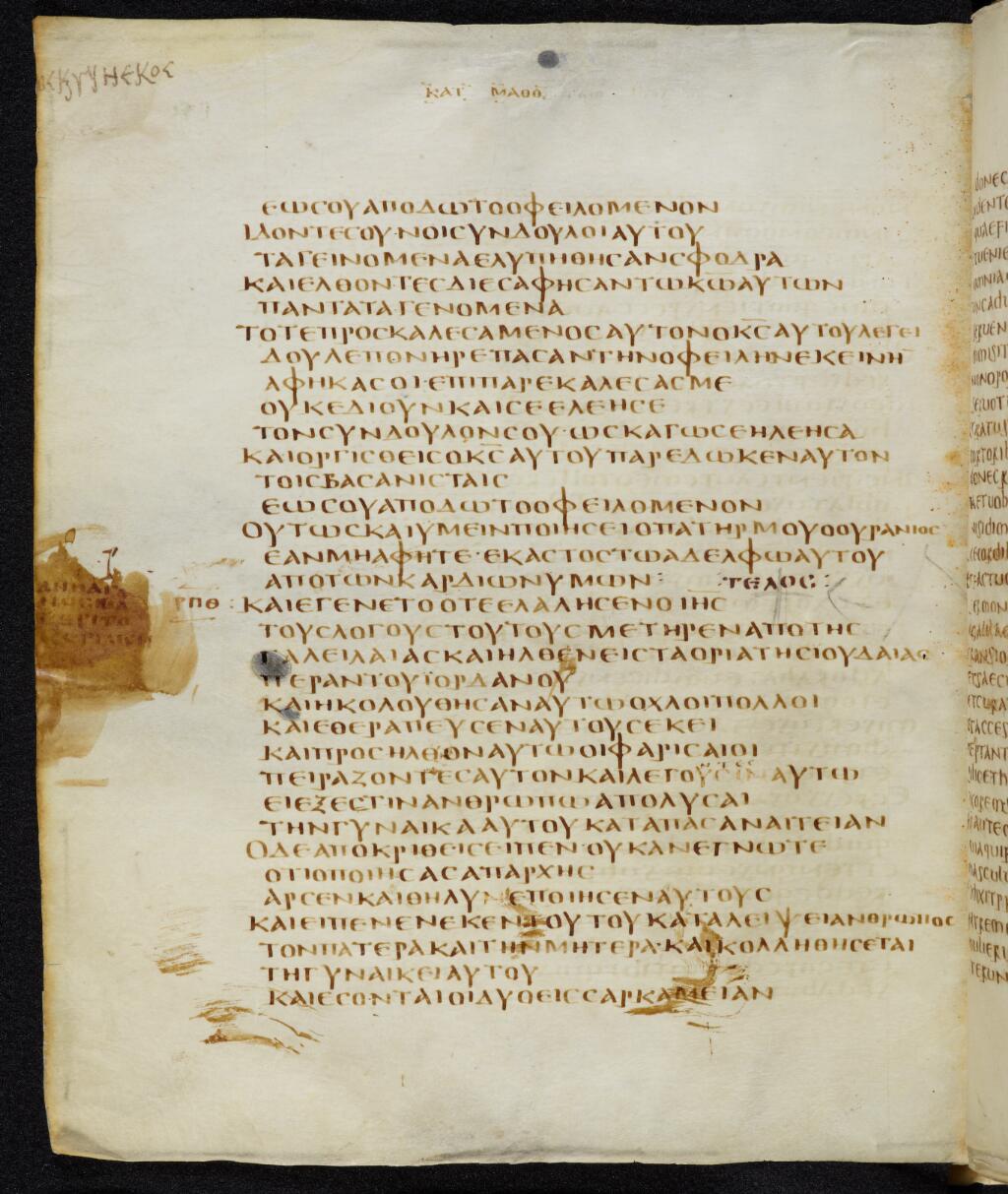
Page from the NTVMR transcription (docID 20005): verses 1-5 on fol. 61v.
1και εγενετο οτε ελαλησεν ο ιης τους λογους τουτους μετηρεν απο της γαλειλαιας και ηλθεν εις τα ορια της ιουδαιας περαν του ιορδανου 2και ηκολουθησαν αυτω οχλοι πολλοι και εθεραπευσεν αυτους εκει 3και προσηλθον αυτω οι φαρισαιοι πειραζοντες αυτον και λεγουσιν αυτω ει εξεστιν ανθρωπω απολυσαι την γυναικα αυτου κατα πασαν αιτειαν 4ο δε αποκριθεις ειπεν · ουκ ανεγνωτε οτι ο ποιησας απ αρχης αρσεν και θηλυν εποιησεν αυτους 5και ειπεν ενεκεν τουτου καταλειψει ανθρωπος τον πατερα και την μητερα · και κολληθησεται τη γυναικει αυτου και εσονται οι δυο εις σαρκα μειαν
Compare: Tischendorf 8th edition (1869)
1Καὶ ἐγένετο ὅτε ἐτέλεσεν ὁ Ἰησοῦς τοὺς λόγους τούτους, μετῆρεν ἀπὸ τῆς Γαλιλαίας καὶ ἦλθεν εἰς τὰ ὅρια τῆς Ἰουδαίας πέραν τοῦ Ἰορδάνου. 2καὶ ἠκολούθησαν αὐτῷ ὄχλοι πολλοί, καὶ ἐθεράπευσεν αὐτοὺς ἐκεῖ. 3Καὶ προσῆλθον αὐτῷ οἱ Φαρισαῖοι πειράζοντες αὐτὸν καὶ λέγοντες· εἰ ἔξεστιν ἀπολῦσαι τὴν γυναῖκα αὐτοῦ κατὰ πᾶσαν αἰτίαν; 4ὁ δὲ ἀποκριθεὶς εἶπεν· οὐκ ἀνέγνωτε ὅτι ὁ ποιήσας ἀπ’ ἀρχῆς ἄρσεν καὶ θῆλυ ἐποίησεν αὐτούς; 5καὶ εἶπεν· ἕνεκα τούτου καταλείψει ἄνθρωπος τὸν πατέρα καὶ τὴν μητέρα καὶ κολληθήσεται τῇ γυναικὶ αὐτοῦ, καὶ ἔσονται οἱ δύο εἰς σάρκα μίαν.
1And it came to pass, that when Jesus had finished these sayings, he departed from Galilee, and came into the coasts of Judaea beyond Jordan; 2And great multitudes followed him; and he healed them there. 3The Pharisees also came unto him, tempting him, and saying unto him, Is it lawful for a man to put away his wife for every cause? 4And he answered and said unto them, Have ye not read, that he which made them at the beginning made them male and female, 5And said, For this cause shall a man leave father and mother, and shall cleave to his wife: and they twain shall be one flesh?
Where on the image
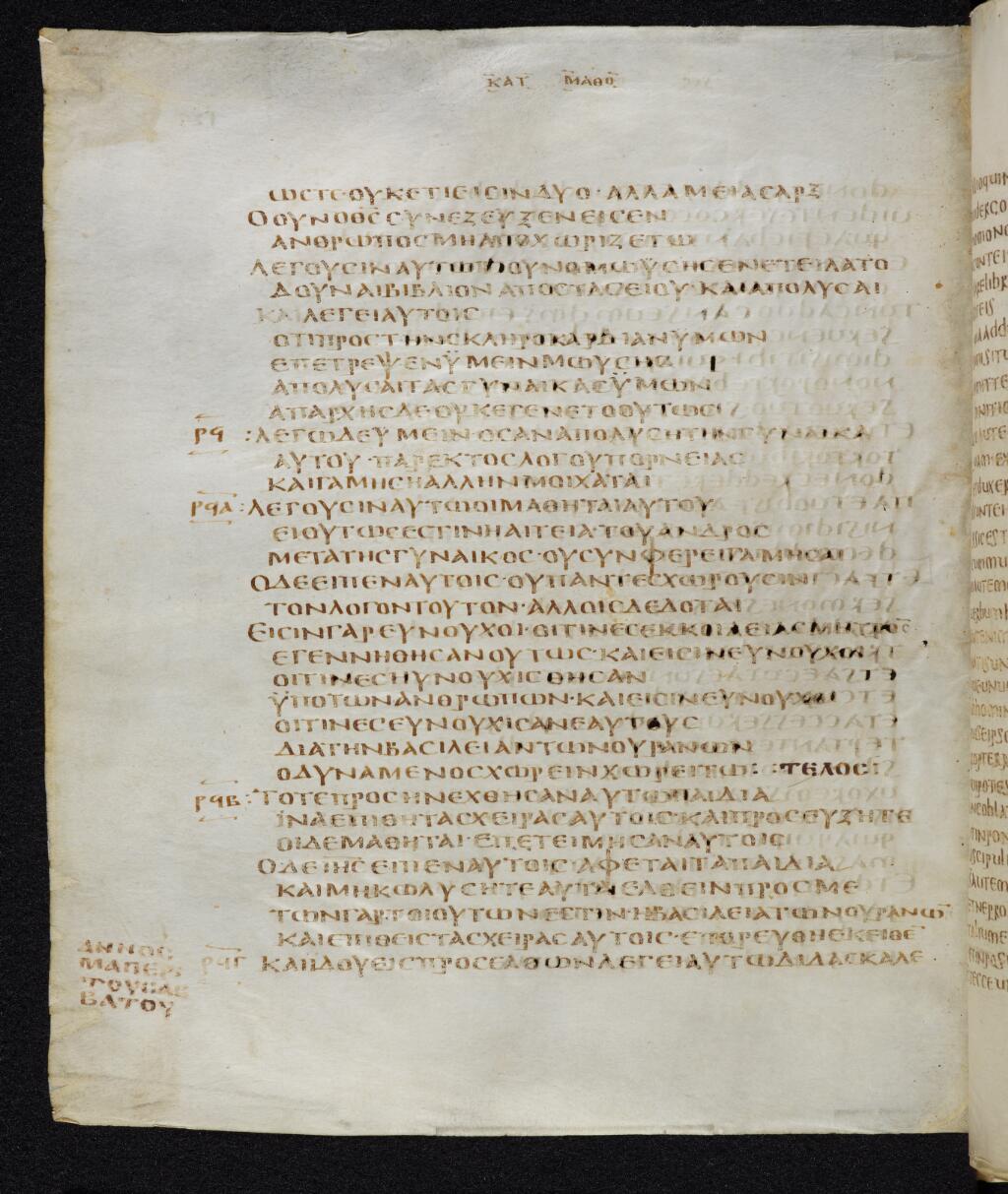
Page from the NTVMR transcription (docID 20005): verses 6-16 on fol. 62v; verse 16 continues on fol. 63v (which begins 'τι αγαθον ποιησω').
6ωστε ουκετι εισιν δυο · αλλα μεια σαρξ ο ουν ο θς συνεζευξεν εις εν ανθρωπος μη αποχωριζετω 7λεγουσιν αυτω τι ουν ο μωυσης ενετειλατο δουναι βιβλιον αποστασειου · και απολυσαι 8και λεγει αυτοις οτι προς την σκληροκαρδιαν υμων επετρεψεν υμειν μωυσης απολυσαι τας γυναικας υμων απ αρχης δε ουκ εγενετο ουτως 9λεγω δε υμειν · ος αν απολυση την γυναικα αυτου · παρεκτος λογου πορνειας και γαμηση αλλην μοιχαται 10λεγουσιν αυτω οι μαθηται αυτου ει ουτως εστιν η αιτεια · του ανδρος μετα της γυναικος · ου συνφερει γαμησαι 11ο δε ειπεν αυτοις · ου παντες χωρουσιν τον λογον τουτον · αλλ οις δεδοται 12εισιν γαρ ευνουχοι · οιτινες εκ κοιλειας μητρος εγεννηθησαν ουτως · και εισιν ευνουχοι οιτινες ηυνουχισθησαν υπο των ανθρωπων · και εισιν ευνουχοι οιτινες ευνουχισαν εαυτους δια την βασιλειαν των ουρανων ο δυναμενος χωρειν χωρειτω · 13τοτε προσηνεχθησαν αυτω παιδια ινα επιθη τας χειρας αυτοις · και προσευξητε οι δε μαθηται · επετειμησαν αυτοις 14ο δε ιης ειπεν αυτοις · αφεται τα παιδια και μη κωλυσητε αυτα ελθειν προς με των γαρ τοιουτων εστιν · η βασιλεια των ουρανων 15και επιθεις τας χειρας αυτοις · επορευθη εκειθεν 16και ιδου εις προσελθων λεγει αυτω διδασκαλε τι αγαθον ποιησω ινα σχω ζωην αιωνιον
Compare: Tischendorf 8th edition (1869)
6ὥστε οὐκέτι εἰσὶν δύο ἀλλὰ σὰρξ μία. ὃ οὖν ὁ θεὸς συνέζευξεν ἄνθρωπος μὴ χωριζέτω. 7λέγουσιν αὐτῷ· τί οὖν Μωϋσῆς ἐνετείλατο δοῦναι βιβλίον ἀποστασίου καὶ ἀπολῦσαι; 8λέγει αὐτοῖς· ὅτι Μωϋσῆς πρὸς τὴν σκληροκαρδίαν ὑμῶν ἐπέτρεψεν ὑμῖν ἀπολῦσαι τὰς γυναῖκας ὑμῶν· ἀπ’ ἀρχῆς δὲ οὐ γέγονεν οὕτως. 9λέγω δὲ ὑμῖν ὅτι ὃς ἂν ἀπολύσῃ τὴν γυναῖκα αὐτοῦ μὴ ἐπὶ πορνείᾳ καὶ γαμήσῃ ἄλλην, μοιχᾶται. 10λέγουσιν αὐτῷ οἱ μαθηταὶ· εἰ οὕτως ἐστὶν ἡ αἰτία τοῦ ἀνθρώπου μετὰ τῆς γυναικός, οὐ συμφέρει γαμῆσαι. 11ὁ δὲ εἶπεν αὐτοῖς· οὐ πάντες χωροῦσιν τὸν λόγον τοῦτον, ἀλλ’ οἷς δέδοται. 12εἰσὶν γὰρ εὐνοῦχοι οἵτινες ἐκ κοιλίας μητρὸς ἐγεννήθησαν οὕτως, καὶ εἰσὶν εὐνοῦχοι οἵτινες εὐνουχίσθησαν ὑπὸ τῶν ἀνθρώπων, καὶ εἰσὶν εὐνοῦχοι οἵτινες εὐνούχισαν ἑαυτοὺς διὰ τὴν βασιλείαν τῶν οὐρανῶν. ὁ δυνάμενος χωρεῖν χωρείτω. 13Τότε προσηνέχθησαν αὐτῷ παιδία, ἵνα τὰς χεῖρας ἐπιθῇ αὐτοῖς καὶ προσεύξηται· οἱ δὲ μαθηταὶ ἐπετίμησαν αὐτοῖς. 14ὁ δὲ Ἰησοῦς εἶπεν αὐτοῖς· ἄφετε τὰ παιδία καὶ μὴ κωλύετε αὐτὰ ἐλθεῖν πρός ἐμέ· τῶν γὰρ τοιούτων ἐστὶν ἡ βασιλεία τῶν οὐρανῶν. 15καὶ ἐπιθεὶς τὰς χεῖρας αὐτοῖς ἐπορεύθη ἐκεῖθεν. 16Καὶ ἰδοὺ εἷς προσελθὼν αὐτῷ εἶπεν· διδάσκαλε, τί ἀγαθὸν ποιήσω ἵνα σχῶ ζωὴν αἰώνιον;
6Wherefore they are no more twain, but one flesh. What therefore God hath joined together, let not man put asunder. 7They say unto him, Why did Moses then command to give a writing of divorcement, and to put her away? 8He saith unto them, Moses because of the hardness of your hearts suffered you to put away your wives: but from the beginning it was not so. 9And I say unto you, Whosoever shall put away his wife, except it be for fornication, and shall marry another, committeth adultery: and whoso marrieth her which is put away doth commit adultery. 10His disciples say unto him, If the case of the man be so with his wife, it is not good to marry. 11But he said unto them, All men cannot receive this saying, save they to whom it is given. 12For there are some eunuchs, which were so born from their mother’s womb: and there are some eunuchs, which were made eunuchs of men: and there be eunuchs, which have made themselves eunuchs for the kingdom of heaven’s sake. He that is able to receive it, let him receive it. 13Then were there brought unto him little children, that he should put his hands on them, and pray: and the disciples rebuked them. 14But Jesus said, Suffer little children, and forbid them not, to come unto me: for of such is the kingdom of heaven. 15And he laid his hands on them, and departed thence. 16And, behold, one came and said unto him, Good Master, what good thing shall I do, that I may have eternal life?
Where on the image
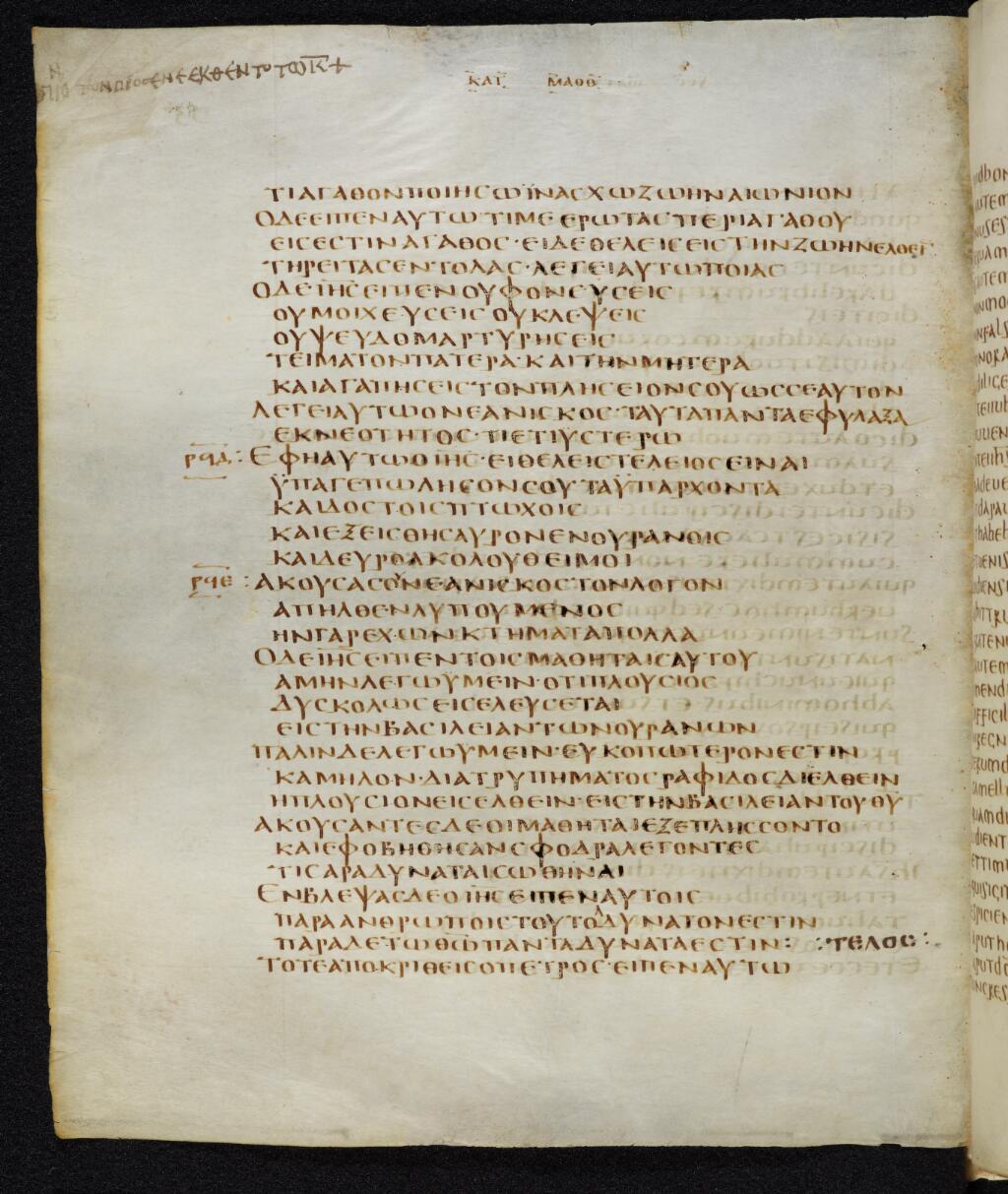
Page from the NTVMR transcription (docID 20005): verses 17-27 on fol. 63v; verse 27 continues on fol. 64v (which begins 'ιδου ημεις αφηκαμεν').
17ο δε ειπεν αυτω τι με ερωτας περι αγαθου εις εστιν αγαθος · ει δε θελεις εις την ζωην ελθειν τηρει τας εντολας · 18λεγει αυτω ποιας ο δε ιης ειπεν ου φονευσεις ου μοιχευσεις ου κλεψεις ου ψευδομαρτυρησεις 19τειμα τον πατερα · και την μητερα και αγαπησεις τον πλησειον σου ως σεαυτον 20λεγει αυτω ο νεανισκος · ταυτα παντα εφυλαξα εκ νεοτητος · τι ετι υστερω 21εφη αυτω ο ιης · ει θελεις τελειος ειναι υπαγε πωλησον σου τα υπαρχοντα και δος τοις πτωχοις και εξεις θησαυρον εν ουρανοις και δευρο ακολουθει μοι 22ακουσας ο νεανισκος τον λογον απηλθεν λυπουμενος ην γαρ εχων κτηματα πολλα 23ο δε ιης ειπεν τοις μαθηταις αυτου αμην λεγω υμειν · οτι πλουσιος δυσκολως εισελευσεται εις την βασιλειαν των ουρανων 24παλιν δε λεγω υμειν · ευκοπωτερον εστιν καμηλον · δια τρυπηματος ραφιδος διελθειν η πλουσιον εισελθειν · εις την βασιλειαν του θυ · 25ακουσαντες δε οι μαθηται εξεπλησσοντο και εφοβηθησαν σφοδρα λεγοντες τις αρα δυναται σωθηναι 26ενβλεψας δε ο ιης ειπεν αυτοις παρα ανθρωποις τουτο δυνατον εστιν παρα δε τω θω παντα δυνατα εστιν 27τοτε αποκριθεις ο πετρος · ειπεν αυτω ιδου ημεις αφηκαμεν παντα και ηκολουθηκαμεν σοι · τι αρα εστε ημειν
Compare: Tischendorf 8th edition (1869)
17ὁ δὲ εἶπεν αὐτῷ, τί με ἐρωτᾷς περὶ τοῦ ἀγαθοῦ; εἷς ἐστιν ὁ ἀγαθός. εἰ δὲ θέλεις εἰς τὴν ζωὴν εἰσελθεῖν, τήρησον τὰς ἐντολάς. 18ποίας; φησίν ὁ δὲ Ἰησοῦς εἶπεν· τὸ οὐ φονεύσεις, οὐ μοιχεύσεις, οὐ κλέψεις, οὐ ψευδομαρτυρήσεις, 19τίμα τὸν πατέρα καὶ τὴν μητέρα, καί, ἀγαπήσεις τὸν πλησίον σου ὡς σεαυτόν. 20λέγει αὐτῷ ὁ νεανίσκος· πάντα ταῦτα ἐφύλαξα· τί ἔτι ὑστερῶ; 21ἔφη αὐτῷ ὁ Ἰησοῦς, εἰ θέλεις τέλειος εἶναι, ὕπαγε πώλησόν σου τὰ ὑπάρχοντα καὶ δὸς πτωχοῖς, καὶ ἕξεις θησαυρὸν ἐν οὐρανοῖς, καὶ δεῦρο ἀκολούθει μοι. 22ἀκούσας δὲ ὁ νεανίσκος ἀπῆλθεν λυπούμενος· ἦν γὰρ ἔχων κτήματα πολλά. 23Ὁ δὲ Ἰησοῦς εἶπεν τοῖς μαθηταῖς αὐτοῦ· ἀμὴν λέγω ὑμῖν ὅτι πλούσιος δυσκόλως εἰσελεύσεται εἰς τὴν βασιλείαν τῶν οὐρανῶν. 24πάλιν δὲ λέγω ὑμῖν ὅτι εὐκοπώτερόν ἐστιν κάμηλον διὰ τρυπήματος ῥαφίδος εἰσελθεῖν ἢ πλούσιον εἰς τὴν βασιλείαν τῶν οὐρανῶν. 25ἀκούσαντες δὲ οἱ μαθηταὶ ἐξεπλήσσοντο σφόδρα λέγοντες· τίς ἄρα δύναται σωθῆναι; 26ἐμβλέψας δὲ ὁ Ἰησοῦς εἶπεν αὐτοῖς· παρὰ ἀνθρώποις τοῦτο ἀδύνατόν ἐστιν, παρὰ δὲ θεῷ δυνατά πάντα. 27Τότε ἀποκριθεὶς ὁ Πέτρος εἶπεν αὐτῷ· ἰδοὺ ἡμεῖς ἀφήκαμεν πάντα καὶ ἠκολουθήσαμέν σοι· τί ἄρα ἔσται ἡμῖν;
17And he said unto him, Why callest thou me good? there is none good but one, that is, God: but if thou wilt enter into life, keep the commandments. 18He saith unto him, Which? Jesus said, Thou shalt do no murder, Thou shalt not commit adultery, Thou shalt not steal, Thou shalt not bear false witness, 19Honour thy father and thy mother: and, Thou shalt love thy neighbour as thyself. 20The young man saith unto him, All these things have I kept from my youth up: what lack I yet? 21Jesus said unto him, If thou wilt be perfect, go and sell that thou hast, and give to the poor, and thou shalt have treasure in heaven: and come and follow me. 22But when the young man heard that saying, he went away sorrowful: for he had great possessions. 23Then said Jesus unto his disciples, Verily I say unto you, That a rich man shall hardly enter into the kingdom of heaven. 24And again I say unto you, It is easier for a camel to go through the eye of a needle, than for a rich man to enter into the kingdom of God. 25When his disciples heard it, they were exceedingly amazed, saying, Who then can be saved? 26But Jesus beheld them, and said unto them, With men this is impossible; but with God all things are possible. 27Then answered Peter and said unto him, Behold, we have forsaken all, and followed thee; what shall we have therefore?
Where on the image
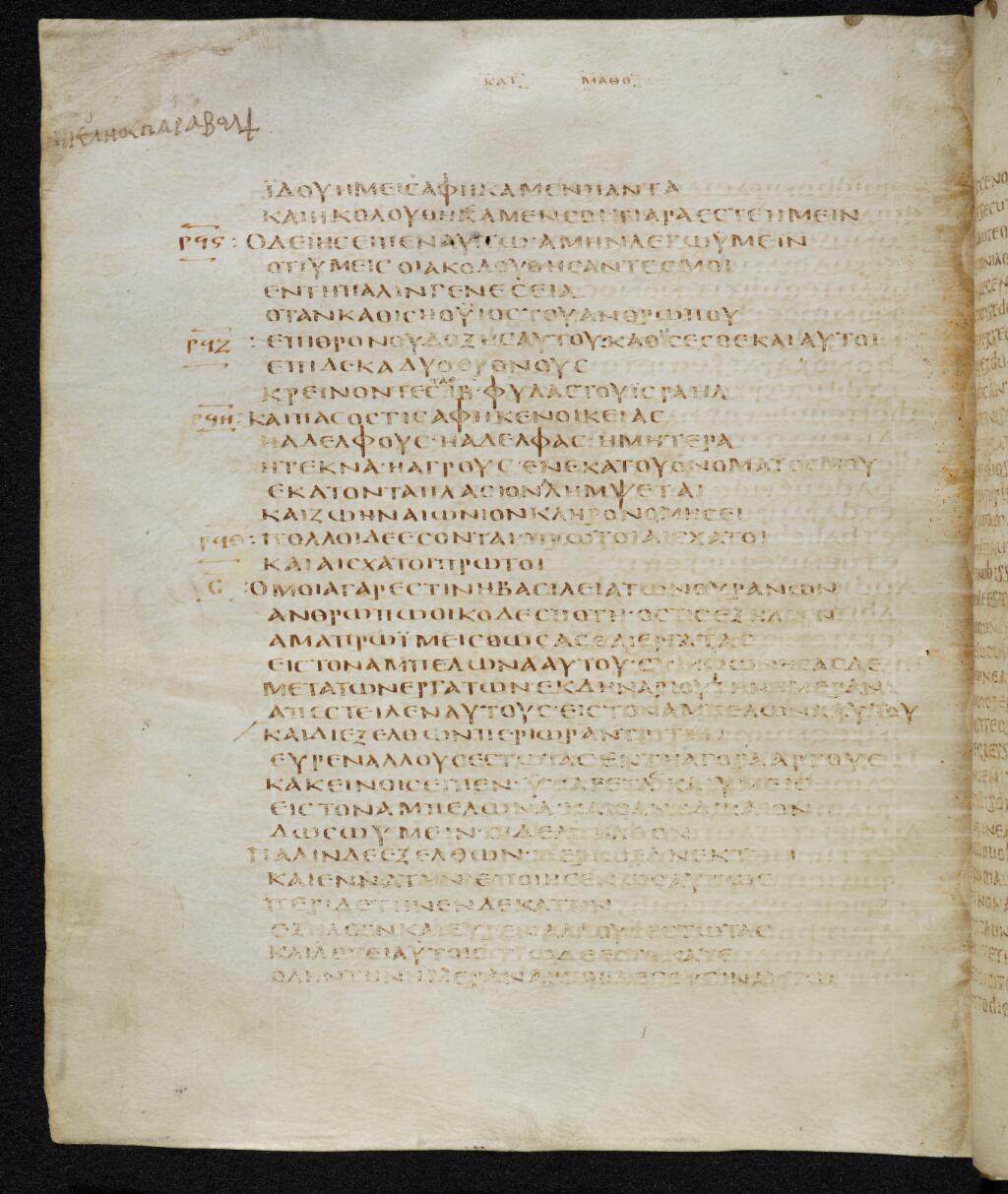
Page from the NTVMR transcription (docID 20005): verses 28-30 on fol. 64v.
28ο δε ιης ειπεν αυτω · αμην λεγω υμειν οτι υμεις οι ακολουθησαντες μοι εν τη παλινγενεσεια οταν καθιση ο υιος του ανθρωπου επι θρονου δοξης αυτου · καθισεσθε και αυτοι επι δεκαδυο θρονους κρεινοντες ιβ φυλας του ισραηλ · 29και πας οστις αφηκεν οικειας η αδελφους · η αδελφας · η μητερα η τεκνα · η αγρους · ενεκα του ονοματος μου εκατονταπλασιον λημψεται και ζωην αιωνιον κληρονομησει 30πολλοι δε εσονται · πρωτοι αισχατοι και αισχατοι πρωτοι
Compare: Tischendorf 8th edition (1869)
28ὁ δὲ Ἰησοῦς εἶπεν αὐτοῖς· ἀμὴν λέγω ὑμῖν ὅτι ὑμεῖς οἱ ἀκολουθήσαντές μοι, ἐν τῇ παλινγενεσίᾳ, ὅταν καθίσῃ ὁ υἱὸς τοῦ ἀνθρώπου ἐπὶ θρόνου δόξης αὐτοῦ, καθίσεσθε καὶ αὐτοὶ ἐπὶ δώδεκα θρόνους κρίνοντες τὰς δώδεκα φυλὰς τοῦ Ἰσραήλ. 29καὶ πᾶς ὅστις ἀφῆκεν ἀδελφοὺς ἢ ἀδελφὰς ἢ πατέρα ἢ μητέρα ἢ τέκνα ἢ ἀγροὺς ἢ οἰκίας ἕνεκα τοῦ ἐμοῦ ὀνόματός, πολλαπλασίονα λήμψεται καὶ ζωὴν αἰώνιον κληρονομήσει. 30πολλοὶ δὲ ἔσονται πρῶτοι ἔσχατοι καὶ ἔσχατοι πρῶτοι.
28And Jesus said unto them, Verily I say unto you, That ye which have followed me, in the regeneration when the Son of man shall sit in the throne of his glory, ye also shall sit upon twelve thrones, judging the twelve tribes of Israel. 29And every one that hath forsaken houses, or brethren, or sisters, or father, or mother, or wife, or children, or lands, for my name’s sake, shall receive an hundredfold, and shall inherit everlasting life. 30But many that are first shall be last; and the last shall be first.
Notes
- Codex Bezae is bilingual: at each opening the Greek is on the left-hand (verso) page and the Latin on the facing right-hand (recto) page. Only the Greek pages are shown here; the Latin column is not included.
Cite
Sources
- Source: Codex Bezae page images + NTVMR transcription (CC BY 4.0) + Tischendorf 8th edition + KJV (holding institution)
- Critical edition: Codex Bezae transcription, NTVMR (INTF Münster, CC BY 4.0); Tischendorf 8th edition for comparison
← previous · → next · v cycle view · l back to library