Bhagavad Gita, Chapter 6: The Yoga of Self-subdual
Introduction
The Bhagavad Gita ("Song of the Lord") is a dialogue of 700 verses between the prince Arjuna and Krishna, set on the battlefield of Kurukshetra in book 6 (Bhishmaparvan) of the Mahabharata. Its date of composition is debated; many scholars place it in the last centuries BCE. This is chapter 6, The Yoga of Self-subdual (47 verses as numbered in the manuscript and in Besant's edition).
The pages shown are from a complete Sanskrit manuscript of the Gita at the University of Pennsylvania (Penn Ms. Coll. 390 Item 559), 90 paper leaves of 7 lines in Devanagari, with speaker headings, colophons and verse-end marks in red. Its final colophon (fol. 90r) dates the copy to Saṃvat 1851, the third day of the bright half of Caitra (1794 CE). Chapter 6 runs from fol. 31v to the chapter colophon on fol. 37r.
Each section below is one manuscript page: the verses whose text ends on that page, located by reading the scribe's verse numbers and the first and last words on the image. When a verse begins at the foot of one page and ends on the next, both pages are shown. The Sanskrit and English are from Annie Besant's edition and translation (4th edition, 1922), which prints each verse in Devanagari with its English; the manuscript's spelling differs from the printed text in small details.
How was this verified? (Provenance)
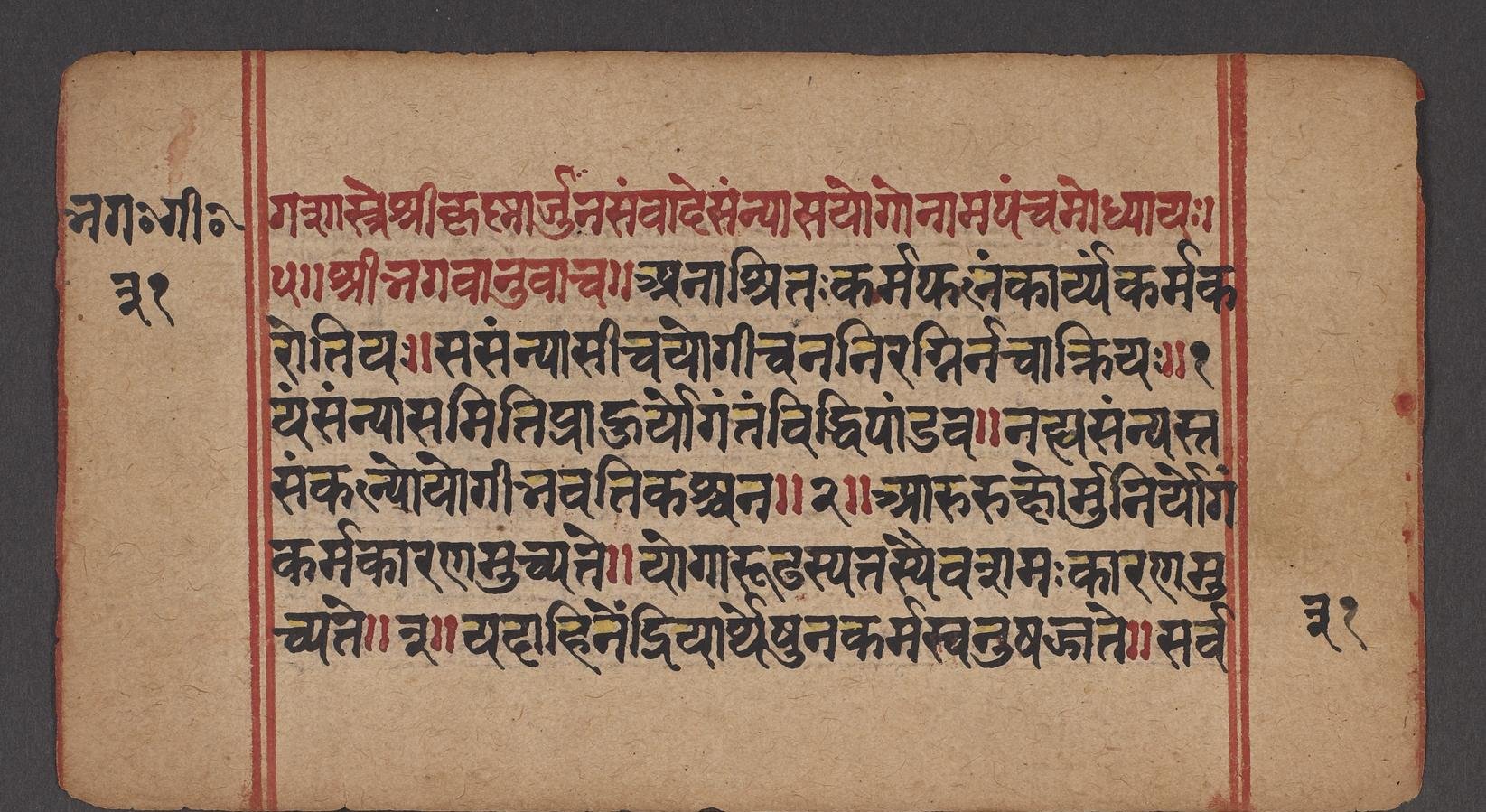
Where on the image
fol. 31v, OPenn image 6555_0031 (upper leaf). Checked on the image: colophon of ch. 5 ends line 1-2 '-gaśāstre śrīkṛṣṇārjunasaṃvāde saṃnyāsayogo nāma paṃcamo 'dhyāyaḥ ||5||'; śrībhagavān uvāca line 2; ||1|| line 3, ||2|| line 5, ||3|| line 7; 6.4 begins line 7.
1श्रीभगवानुवाच ।
अनाश्रितः कर्मफलं कार्यं कर्म करोति यः ।
स संन्यासी च योगी च न निरग्निर्न चाक्रियः ॥ १ ॥
2यं संन्यासमिति प्राहुर्योगं तं विद्धि पाण्डव ।
न ह्यसंन्यस्तसङ्कल्पो योगी भवति कश्चन ॥ २ ॥
3आरुरुक्षोर्मुनेर्योगं कर्म कारणमुच्यते ।
योगारूढस्य तस्यैव शमः कारणमुच्यते ॥ ३ ॥
1The Blessed Lord said:
He that performeth such action as his duty, independently of the fruit of action, he is an ascetic, he is a Yogî, not he that is without fire, and without rites.
2That which is called renunciation, know thou that as yoga, O Pândava; nor doth any one become a Yogî with the formative will unrenounced.
3For a Sage who is seeking Yoga, action is called the means; for the same Sage, when he is enthroned in yoga, serenity is called the means.
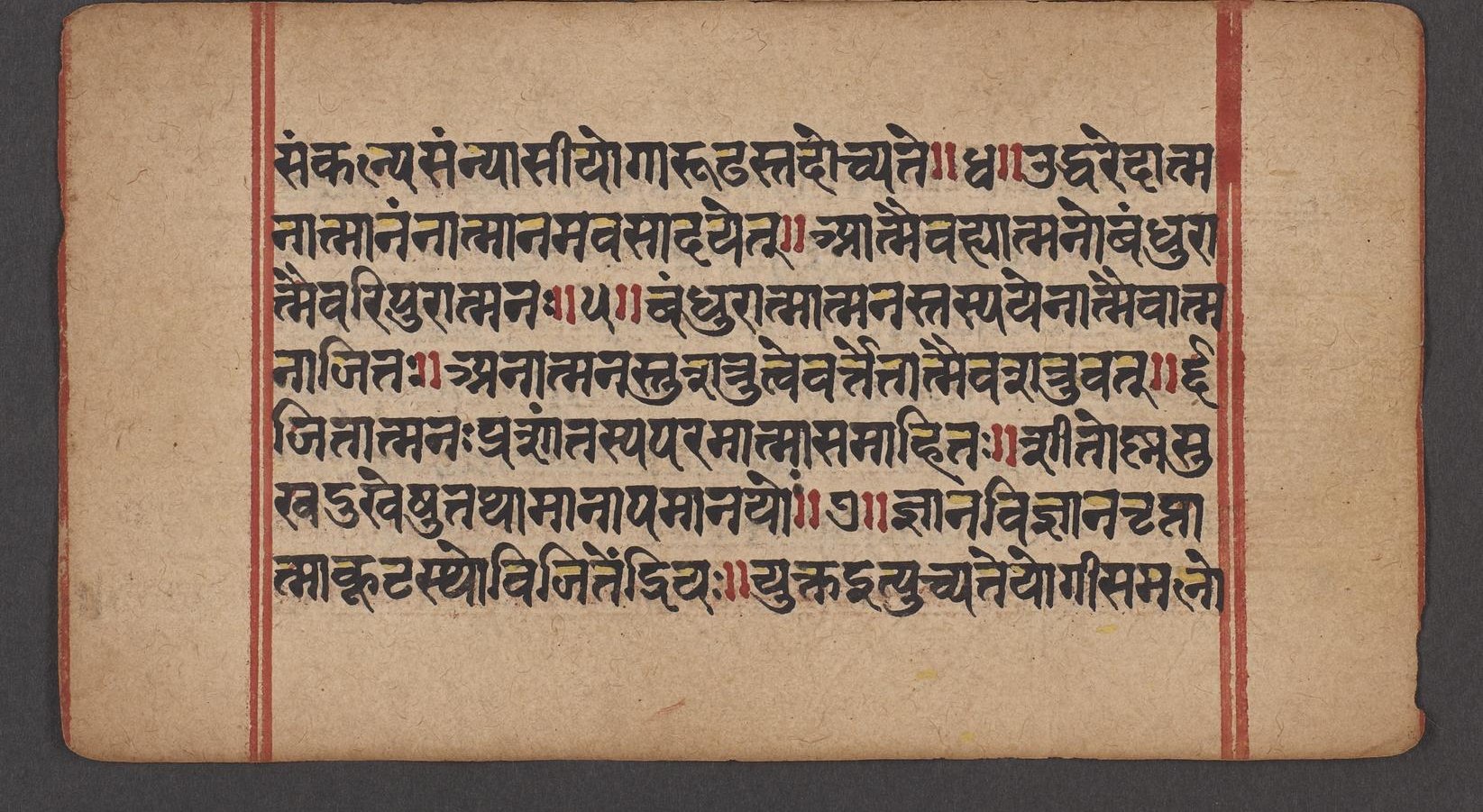
Where on the image
fol. 32r, OPenn image 6555_0031 (lower leaf). Checked on the image: ||4|| line 1 ... ||7|| line 6. Verse 6.4 begins on the previous page, fol. 31v, so both pages are shown.
4यदा हि नेन्द्रियार्थेषु न कर्मस्वनुषज्जते ।
सर्वसङ्कल्पसंन्यासी योगारूढस्तदोच्यते ॥ ४ ॥
5उद्धरेदात्मनाऽऽत्मानं नात्मानमवसादयेत् ।
आत्मैव ह्यात्मनो बन्धुरात्मैव रिपुरात्मनः ॥ ५ ॥
6बन्धुरात्माऽऽत्मनस्तस्य येनात्मैवात्मना जितः ।
अनात्मनस्तु शत्रुत्वे वर्तेतात्मैव शत्रुवत् ॥ ६ ॥
7जितात्मनः प्रशान्तस्य परमात्मा समाहितः ।
शीतोष्णसुखदुःखेषु तथा मानापमानयोः ॥ ७ ॥
4When a man feeleth no attachment either for the objects of sense or for actions, renouncing the formative will, then, he is said to be enthroned in yoga.
5Let him raise the self by the Self and not let the self become depressed; for verily is the Self the friend of the self, and also the Self the self's enemy;
6The Self is the friend of the self of him in whom the self by the Self is vanquished; but to the unsubdued self the Self verily becometh hostile as an enemy.
7The higher Self of him who is Self-controlled and peaceful is uniform in cold and heat, pleasure and pain, as well as in honour and dishonour.
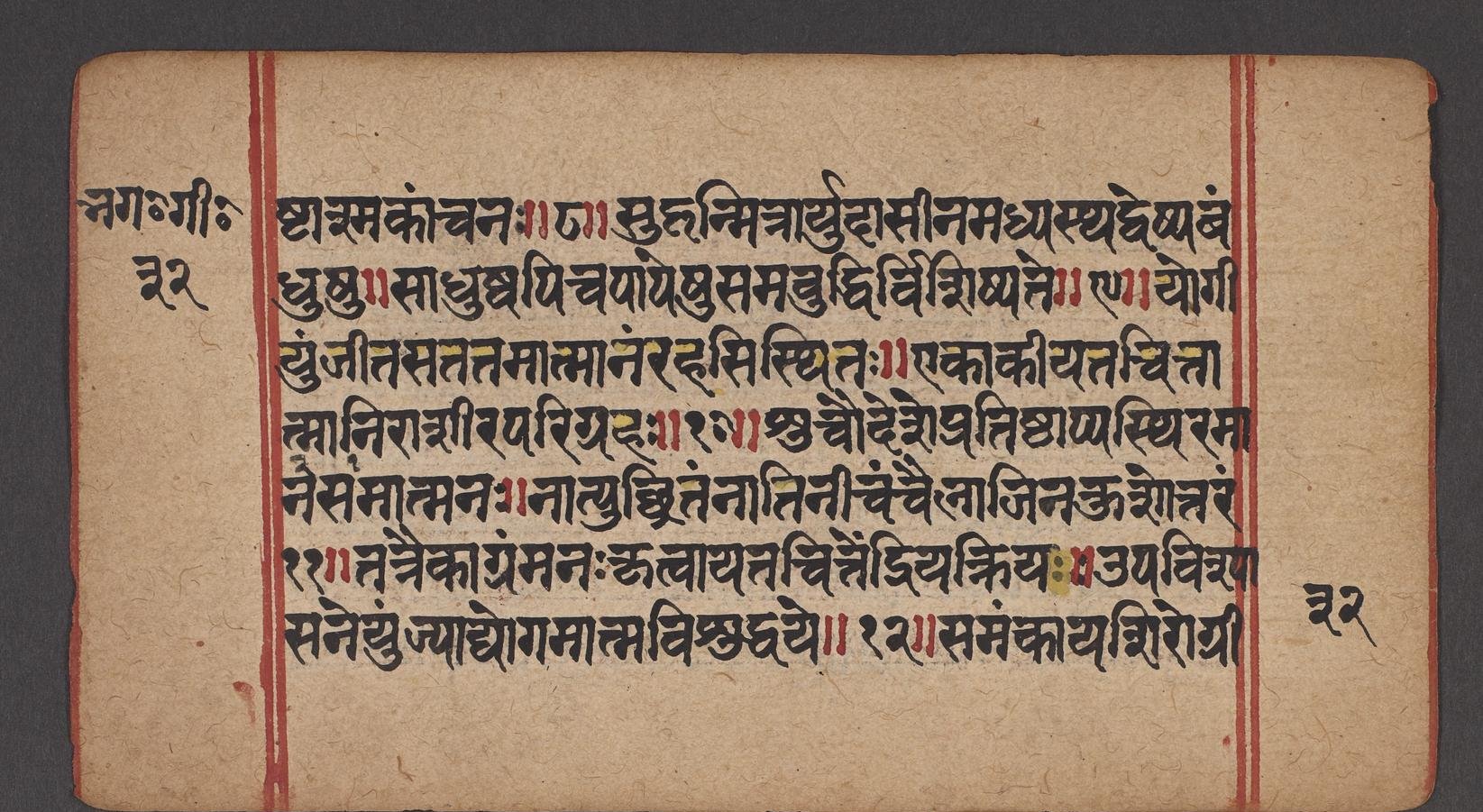
Where on the image
fol. 32v, OPenn image 6555_0032 (upper leaf). Checked on the image: ||8|| line 1 ... ||12|| line 7. Verse 6.8 begins on the previous page, fol. 32r, so both pages are shown.
8ज्ञानविज्ञानतृप्तात्मा कूटस्थो विजितेन्द्रियः ।
युक्त इत्युच्यते योगी समलोष्टाश्मकाञ्चनः ॥ ८ ॥
9सुहृन्मित्रार्युदासीनमध्यस्थद्वेष्यबन्धुषु ।
साधुष्वपि च पापेषु समबुद्धिर्विशिष्यते ॥ ९ ॥
10योगी युञ्जीत सततमात्मानं रहसि स्थितः ।
एकाकी यतचित्तात्मा निराशीरपरिग्रहः ॥ १० ॥
11शुचौ देशे प्रतिष्ठाप्य स्थिरमासनमात्मनः ।
नात्युच्छ्रितं नातिनीचं चेलाजिनकुशोत्तरम् ॥ ११ ॥
12तत्रैकाग्रं मनः कृत्वा यतचित्तेन्द्रियक्रियः ।
उपविश्यासने युञ्ज्याद्योगमात्मविशुद्धये ॥ १२ ॥
8The Yogî who is satisfied with wisdom and knowledge, unwavering, whose senses are subdued, to whom a lump of earth, a stone and gold are the same, is said to be harmonised.
9He who regards impartially lovers, friends, and foes, strangers, neutrals, foreigners and relatives, also the righteous and unrighteous, he excelleth.
10Let the Yogî constantly engage himself in yoga, remaining in a secret place by himself, with thought and self subdued, free from hope and greed.
11In a pure place, established on a fixed seat of his own, neither very much raised nor very low, made of a cloth, a black antelope skin, and kusha grass, one over the other;
12There, having made the mind one-pointed, with thought and the functions of the senses subdued, steady on his seat, he should practise yoga for the purification of the self.
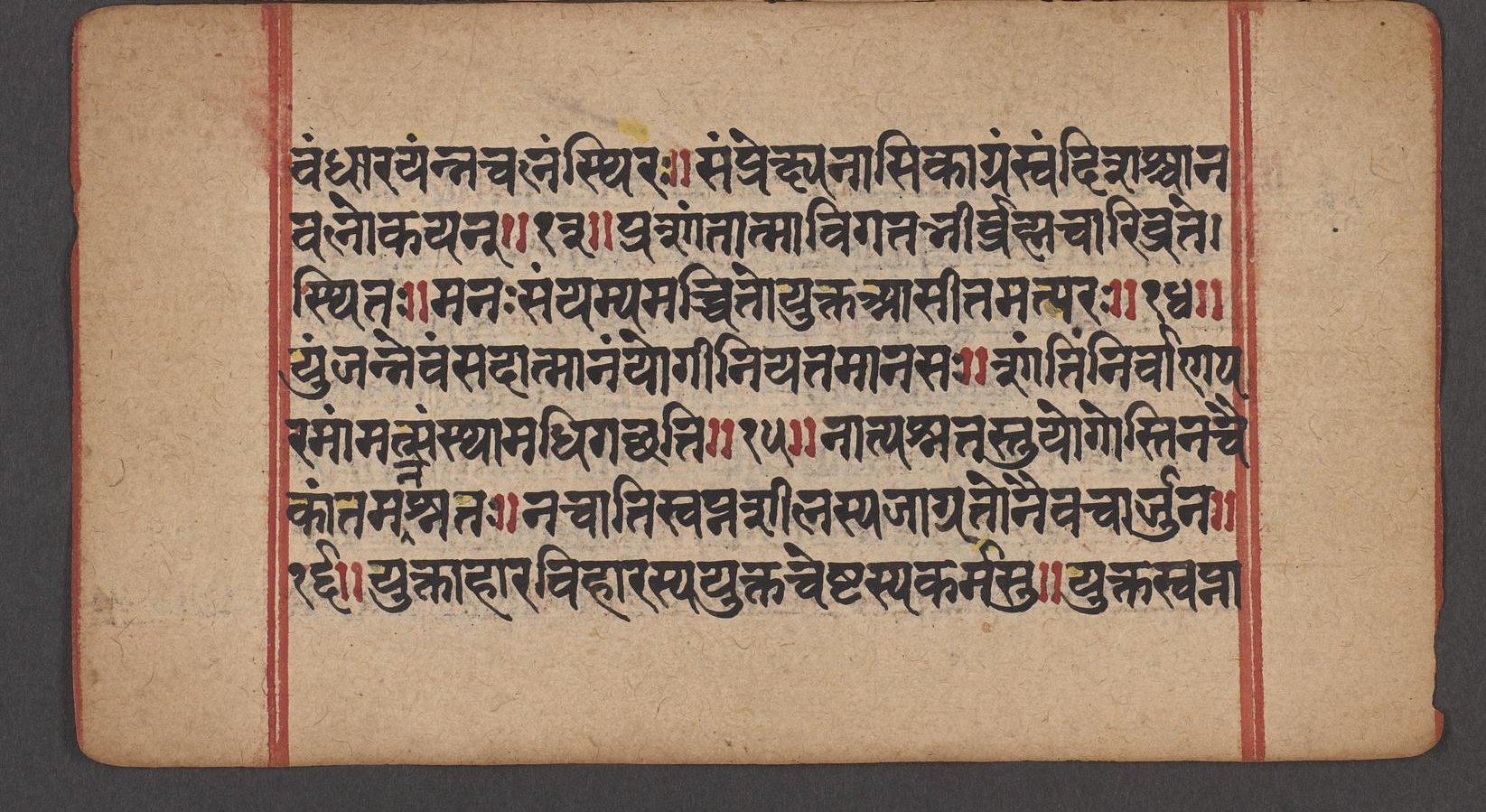
Where on the image
fol. 33r, OPenn image 6555_0032 (lower leaf). Checked on the image: ||13|| line 2 ... ||16|| line 7. Verse 6.13 begins on the previous page, fol. 32v, so both pages are shown.
13समं कायशिरोग्रीवं धारयन्नचलं स्थिरः ।
संप्रेक्ष्य नासिकाग्रं स्वं दिशश्चानवलोकयन् ॥ १३ ॥
14प्रशान्तात्मा विगतभीर्ब्रह्मचारिव्रते स्थितः ।
मनः संयम्य मच्चित्तो युक्त आसीत मत्परः ॥ १४ ॥
15युञ्जन्नेवं सदाऽऽत्मानं योगी नियतमानसः ।
शान्तिं निर्वाणपरमां मत्संस्थामधिगच्छति ॥ १५ ॥
16नात्यश्नतस्तु योगोऽस्ति न चैकान्तमनश्नतः ।
न चातिस्वप्नशीलस्य जाग्रतो नैव चार्जुन ॥ १६ ॥
13Holding the body, head and neck erect, immovably steady, looking fixedly at the point of the nose, with unseeing gaze,
14The self serene, fearless, firm in the vow of the Brahmachâri, the mind controlled, thinking on Me, harmonised, let him sit aspiring after Me.
15The Yogî ever united thus with the Self, with the mind controlled, goeth to Peace, to the supreme Bliss that abideth in Me.
16Verily yoga is not for him who eateth too much, nor who abstaineth to excess, nor who is too much addicted to sleep, nor even to wakefulness, O Arjuna.
Where on the image
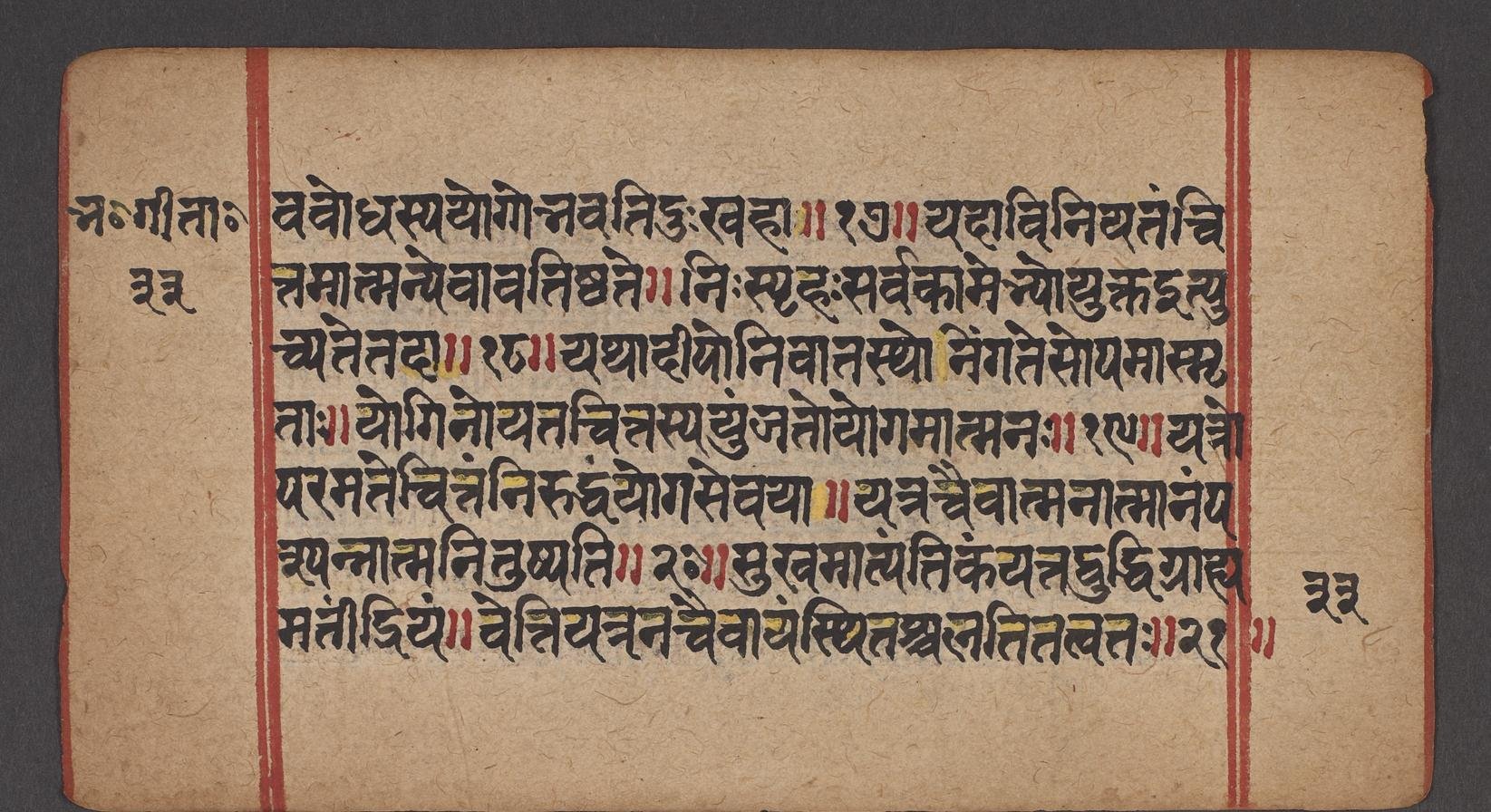
fol. 33v, OPenn image 6555_0033 (upper leaf). Checked on the image: ||17|| line 1 ... ||21|| end of line 7. Verse 6.17 begins on the previous page, fol. 33r, so both pages are shown.
17युक्ताहारविहारस्य युक्तचेष्टस्य कर्मसु ।
युक्तस्वप्नावबोधस्य योगो भवति दुःखहा ॥ १७ ॥
18यदा विनियतं चित्तमात्मन्येवावतिष्ठते ।
निःस्पृहः सर्वकामेभ्यो युक्त इत्युच्यते तदा ॥ १८ ॥
19यथा दीपो निवातस्थो नेङ्गते सोपमा स्मृता ।
योगिनो यतचित्तस्य युञ्जतो योगमात्मनः ॥ १९ ॥
20यत्रोपरमते चित्तं निरुद्धं योगसेवया ।
यत्र चैवात्मनाऽऽत्मानं पश्यन्नात्मनि तुष्यति ॥ २० ॥
21सुखमात्यन्तिकं यत्तद् बुद्धिग्राह्यमतीन्द्रियम् ।
वेत्ति यत्र न चैवाऽयं स्थितश्चलति तत्त्वतः ॥ २१ ॥
17Yoga killeth out all pain for him who is regulated in eating and amusement, regulated in performing actions, regulated in sleeping and waking.
18When his subdued thought is fixed on the Self, free from longing after all desirable things, then it is said, "he is harmonised."
19As a lamp in a windless place flickereth not, to such is likened the Yogî of subdued thought, absorbed in the yoga of the Self.
20That in which the mind finds rest, quieted by the practice of yoga: that in which he, seeing the Self by the Self, in the Self is satisfied;
21That in which he findeth the supreme delight which the Reason can grasp beyond the senses, wherein established he moveth not from the Reality;
Where on the image
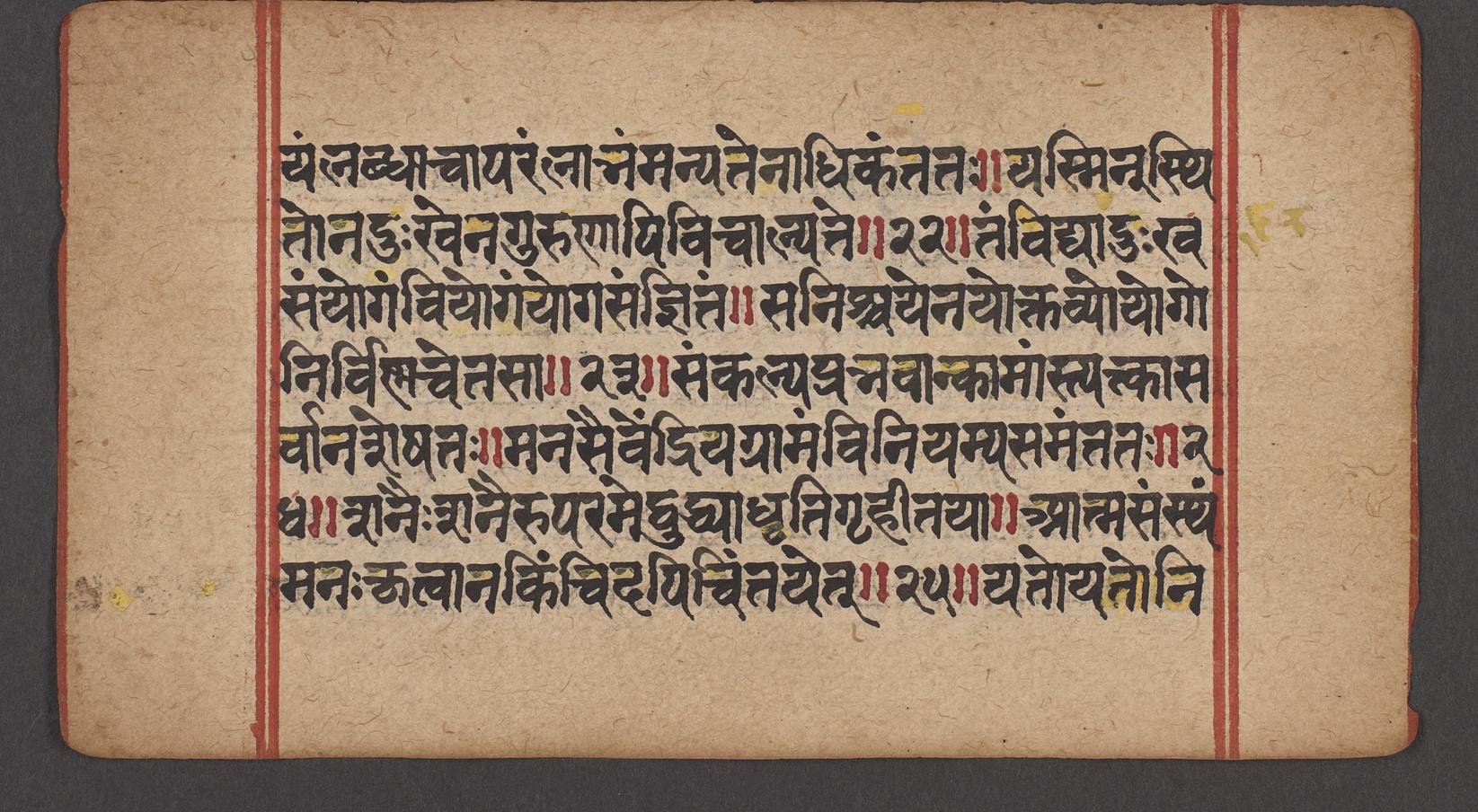
fol. 34r, OPenn image 6555_0033 (lower leaf). Checked on the image: ||22|| line 2 ... ||25|| line 7.
22यं लब्ध्वा चापरं लाभं मन्यते नाधिकं ततः ।
यस्मिन्स्थितो न दुःखेन गुरुणाऽपि विचाल्यते ॥ २२ ॥
23तं विद्याद् दुःखसंयोगवियोगं योगसंज्ञितम् ।
स निश्चयेन योक्तव्यो योगोऽनिर्विण्णचेतसा ॥ २३ ॥
24सङ्कल्पप्रभावान्कामांस्त्यक्त्वा सर्वानशेषतः ।
मनसैवेन्द्रियग्रामं विनियम्य समन्ततः ॥ २४ ॥
25शनैःशनैरुपरमेद् बुद्ध्या धृतिगृहीतया ।
आत्मसंस्थं मनः कृत्वा न किञ्चिदपि चिन्तयेत् ॥ २५ ॥
22Which, having obtained, he thinketh there is no greater gain beyond it; wherein, established, he is not shaken even by heavy sorrow;
23That should be known by the name of yoga, this disconnection from the union with pain. This yoga must be clung to with a firm conviction and with undesponding mind.
24Abandoning without reserve all desires born of the imagination, by the mind curbing in the aggregate of the senses on every side,
25Little by little let him gain tranquillity, by means of Reason controlled by steadiness; having made the mind abide in the Self, let him not think of anything.
Where on the image
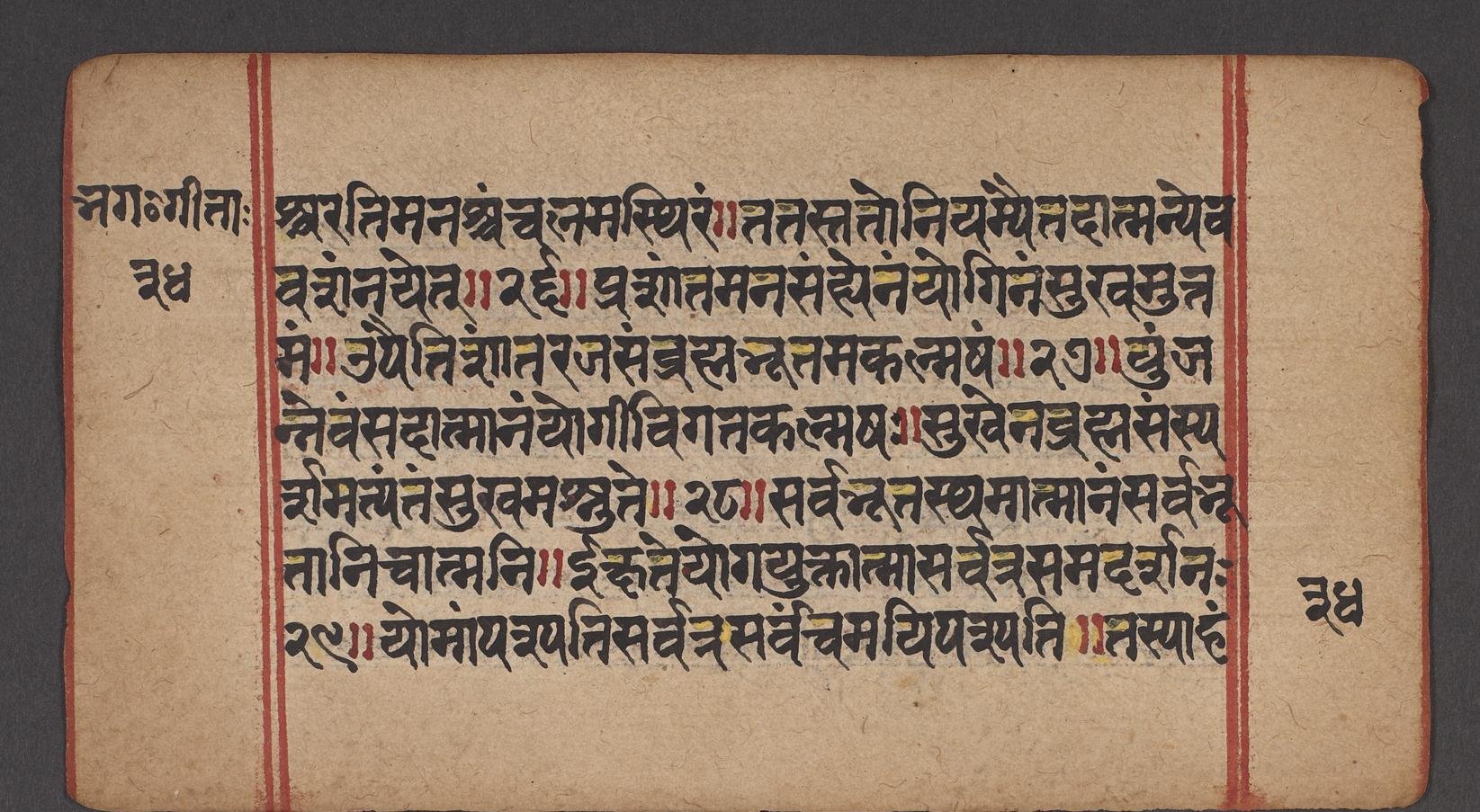
fol. 34v, OPenn image 6555_0034 (upper leaf). Checked on the image: ||26|| line 2 ... ||29|| line 7. Verse 6.26 begins on the previous page, fol. 34r, so both pages are shown.
26यतो यतो निश्चरति मनश्चञ्चलमस्थिरम् ।
ततस्ततो नियम्यैतदात्मन्येव वशं नयेत् ॥ २६ ॥
27प्रशान्तमनसं ह्येनं योगिनं सुखमुत्तमम् ।
उपैति शान्तरजसं ब्रह्मभूतमकल्मषम् ॥ २७ ॥
28युञ्जन्नेवं सदाऽऽत्मानं योगी विगतकल्मषः ।
सुखेन ब्रह्मसंस्पर्शमत्यन्तं सुखमश्नुते ॥ २८ ॥
29सर्वभूतस्थमात्मानं सर्वभूतानि चात्मनि ।
ईक्षते योगयुक्तात्मा सर्वत्र समदर्शनः ॥ २९ ॥
26As often as the wavering and unsteady mind goeth forth, so often reining it in, let him bring it under the control of the Self.
27Supreme joy is for this Yogi whose mind is peaceful, whose passion-nature is calmed, who is sinless and of the nature of the Eternal.
28The Yogî who thus, ever harmonising the self, hath put away sin, he easily enjoyeth the infinite bliss of contact with the Eternal.
29The self, harmonised by yoga, seeth the Self abiding in all beings, all beings in the Self; everywhere he seeth the same.
Where on the image
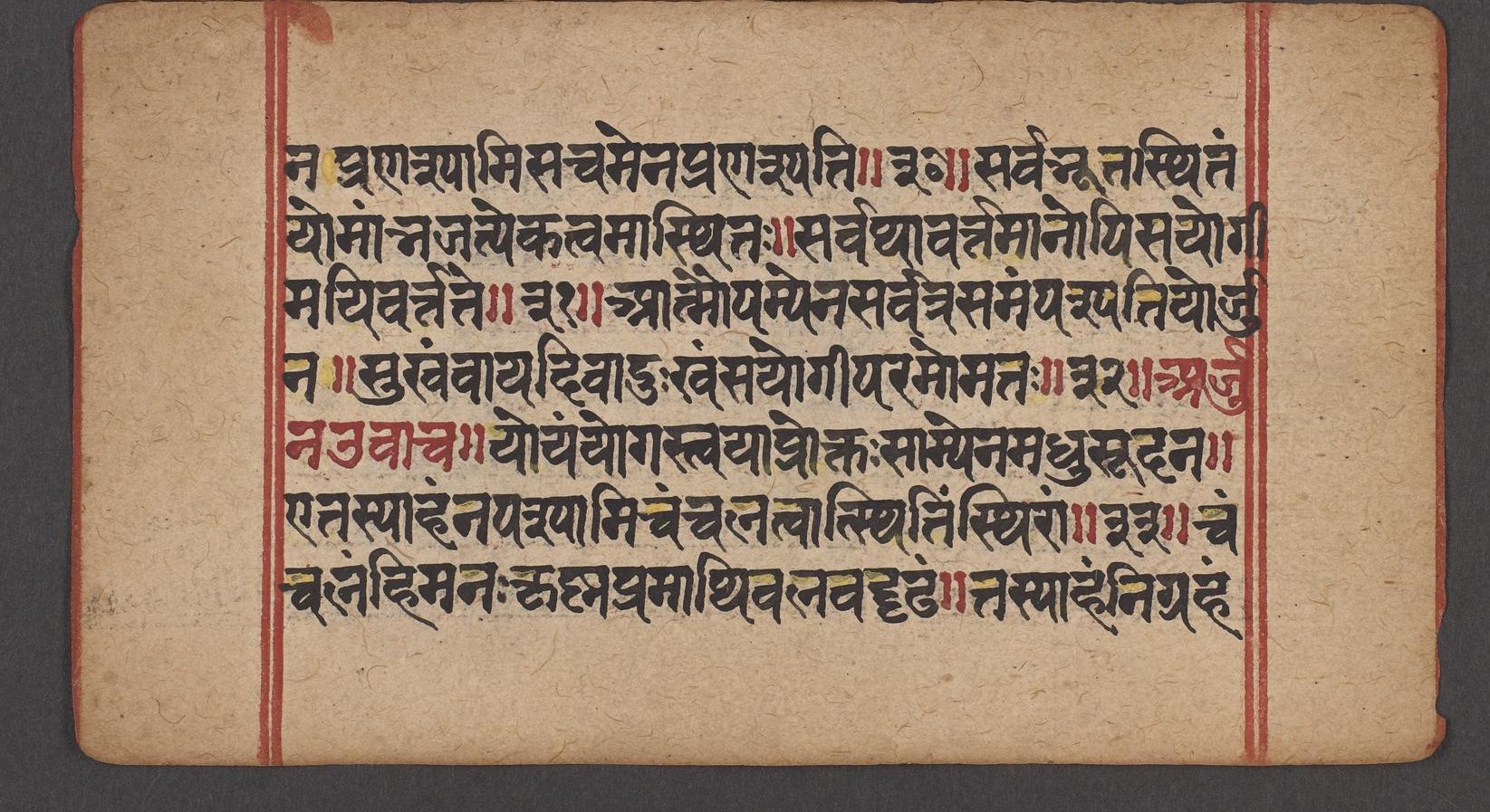
fol. 35r, OPenn image 6555_0034 (lower leaf). Checked on the image: ||30|| line 1 ... ||33|| line 6. Verse 6.30 begins on the previous page, fol. 34v, so both pages are shown.
30यो मां पश्यति सर्वत्र सर्वं च मयि पश्यति ।
तस्याहं न प्रणश्यामि स च मे न प्रणश्यति ॥ ३० ॥
31सर्वभूतस्थितं यो मां भजत्येकत्वमास्थितः ।
सर्वथा वर्त्तमानोऽपि स योगी मयि वर्तते ॥ ३१ ॥
32आत्मौपम्येन सर्वत्र समं पश्यति योऽर्जुन ।
सुखं वा यदि वा दुःखं स योगी परमो मतः ॥ ३२ ॥
33अर्जुन उवाच ।
योऽयं योगस्त्वया प्रोक्तः साम्येन मधुसूदन ।
एतस्याहं न पश्यामि चञ्चलत्वात्स्थितिं स्थिराम् ॥ ३३ ॥
30He who seeth Me everywhere, and seeth everything in Me, of him will I never lose hold, and he shall never lose hold of Me.
31He who, established in unity, worshippeth Me abiding in all beings, that Yogi liveth in Me, whatever his mode of living.
32He who, through the likeness of the Self, O Arjuna, seeth equality in everything, whether pleasant or painful, he is considered a perfect Yogî.
33This yoga which Thou hast declared to be by equanimity, O Madhusûdana, I see not a stable foundation for it, owing to restlessness;
Where on the image
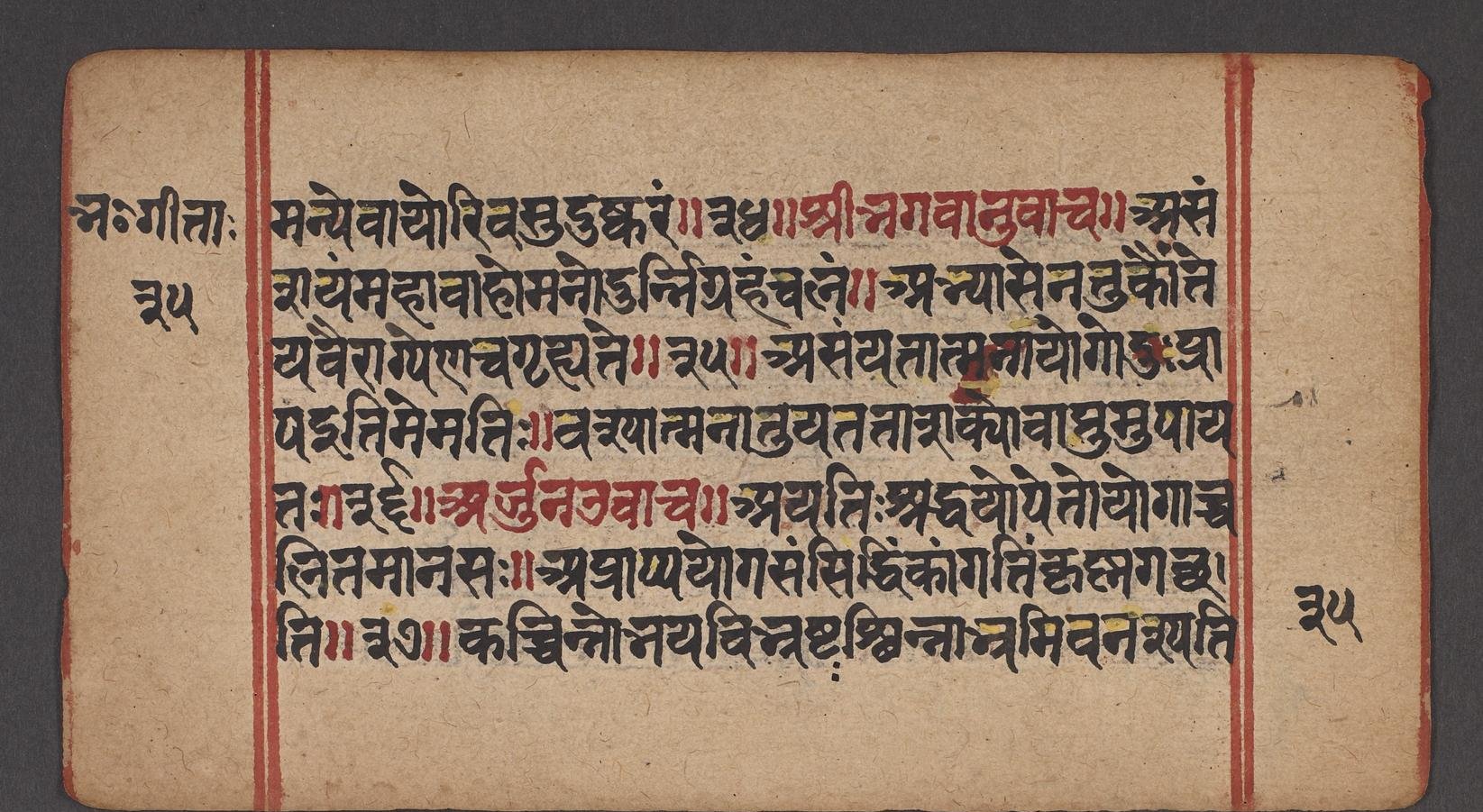
fol. 35v, OPenn image 6555_0035 (upper leaf). Checked on the image: ||34|| line 1 ... ||37|| line 7. Verse 6.34 begins on the previous page, fol. 35r, so both pages are shown.
34चञ्चलं हि मनः कृष्ण प्रमाथि बलवद् दृढम् ।
तस्याऽहं निग्रहं मन्ये वायोरिव सुदुष्करम् ॥ ३४ ॥
35श्रीभगवानुवाच ।
असंशयं महाबाहो मनो दुर्निग्रहं चलम् ।
अभ्यासेन तु कौन्तेय वैराग्येण च गृह्यते ॥ ३५ ॥
36असंयतात्मना योगो दुष्प्राप इति मे मतिः ।
वश्यात्मना तु यतता शक्योऽवाप्तुमुपायतः ॥ ३६ ॥
37अर्जुन उवाच ।
अयतिः श्रद्धयोपेतो योगाच्चलितमानसः ।
अप्राप्य योगसंसिद्धिं कां गतिं कृष्ण गच्छति ॥ ३७ ॥
34For the mind is verily restless, O Krishna; it is impetuous, strong and difficult to bend. I deem it as hard to curb as the wind.
35The Blessed Lord said:
Without doubt, O mighty-armed, the mind is hard to curb and restless; but it may be curbed by constant practice and by dispassion.
36Yoga is hard to attain, methinks, by a self that is uncontrolled; but by the Self-controlled it is attainable by properly directed energy.
37Arjuna said:
He who is unsubdued but who possesseth faith, with the mind wandering away from yoga, failing to attain perfection in yoga, what path doth he tread, O Krishna?
Where on the image
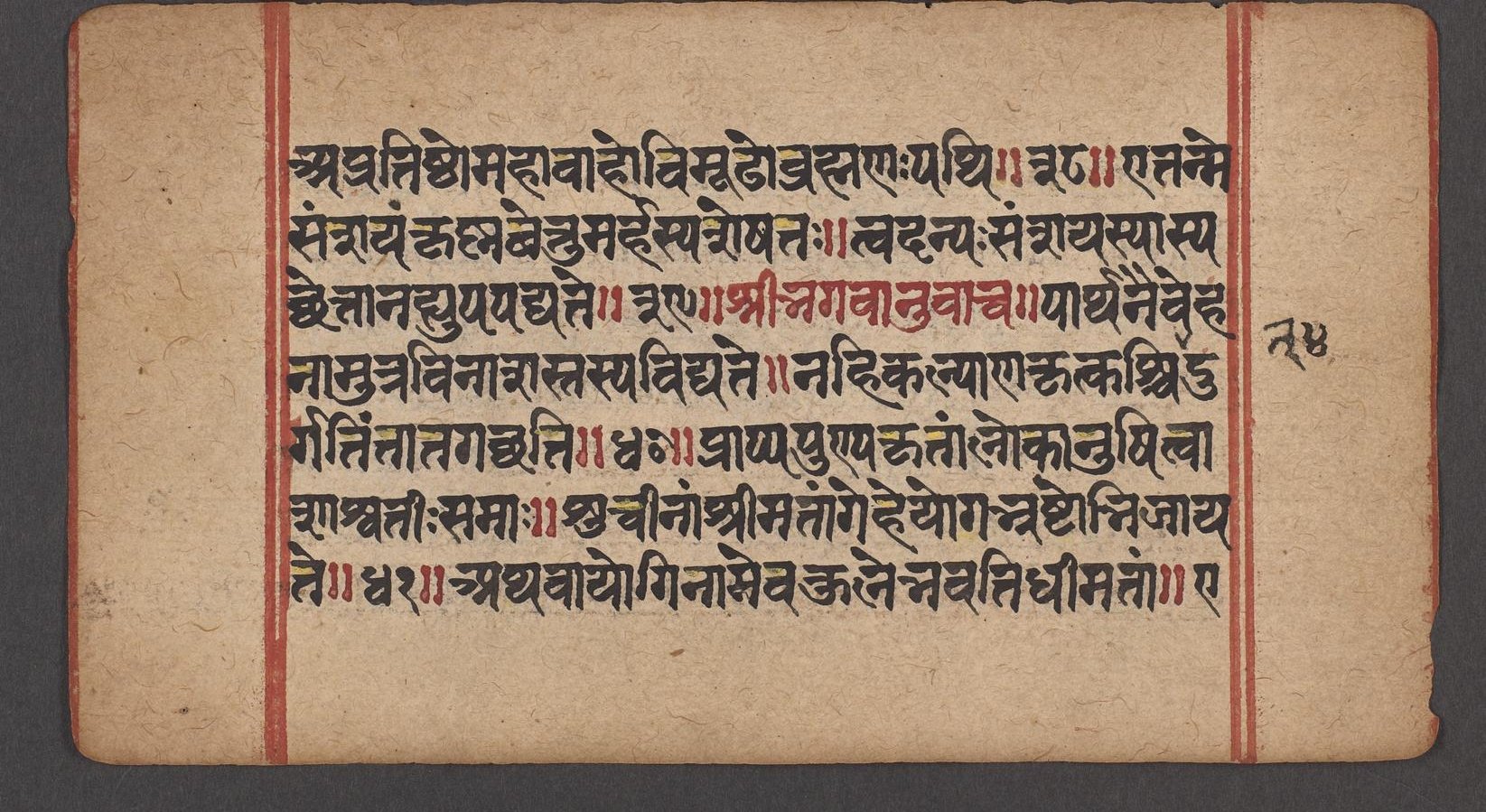
fol. 36r, OPenn image 6555_0035 (lower leaf). Checked on the image: ||38|| line 1 ... ||41|| line 7. Verse 6.38 begins on the previous page, fol. 35v, so both pages are shown.
38कच्चिन्नोभयविभ्रष्टश्छिन्नाभ्रमिव नश्यति ।
अप्रतिष्ठो महाबाहो विमूढो ब्रह्मणः पथि ॥ ३८ ॥
39एतं मे संशयं कृष्ण छेत्तुमर्हस्यशेषतः ।
त्वदन्यः संशयस्यास्य छेत्ता नह्युपपद्यते ॥ ३९ ॥
40श्रीभगवानुवाच ।
पार्थ नैवेह नामुत्र विनाशस्तस्य विद्यते ।
न हि कल्याणकृत्कश्चिद्दुर्गतिं तात गच्छति ॥ ४० ॥
41प्राप्य पुण्यकृतां लोकानुषित्वा शाश्वतीः समाः ।
शुचीनां श्रीमतां गेहे योगभ्रष्टोऽभिजायते ॥ ४१ ॥
38Fallen from both, is he destroyed like a rent cloud, unsteadfast, O mighty-armed, deluded in the path of the Eternal?
39Deign, O Krishna, to completely dispel this doubt of mine; for there is none to be found save Thyself able to destroy this doubt.
40The Blessed Lord said:
O son of Prithâ, neither in this world nor in the life to come is there destruction for him; never doth any who worketh righteousness, O beloved, tread the path of woe.
41Having attained to the worlds of the pure-doing, and having dwelt there for immemorial years, he who fell from yoga is reborn in a pure and blessed house;
Where on the image
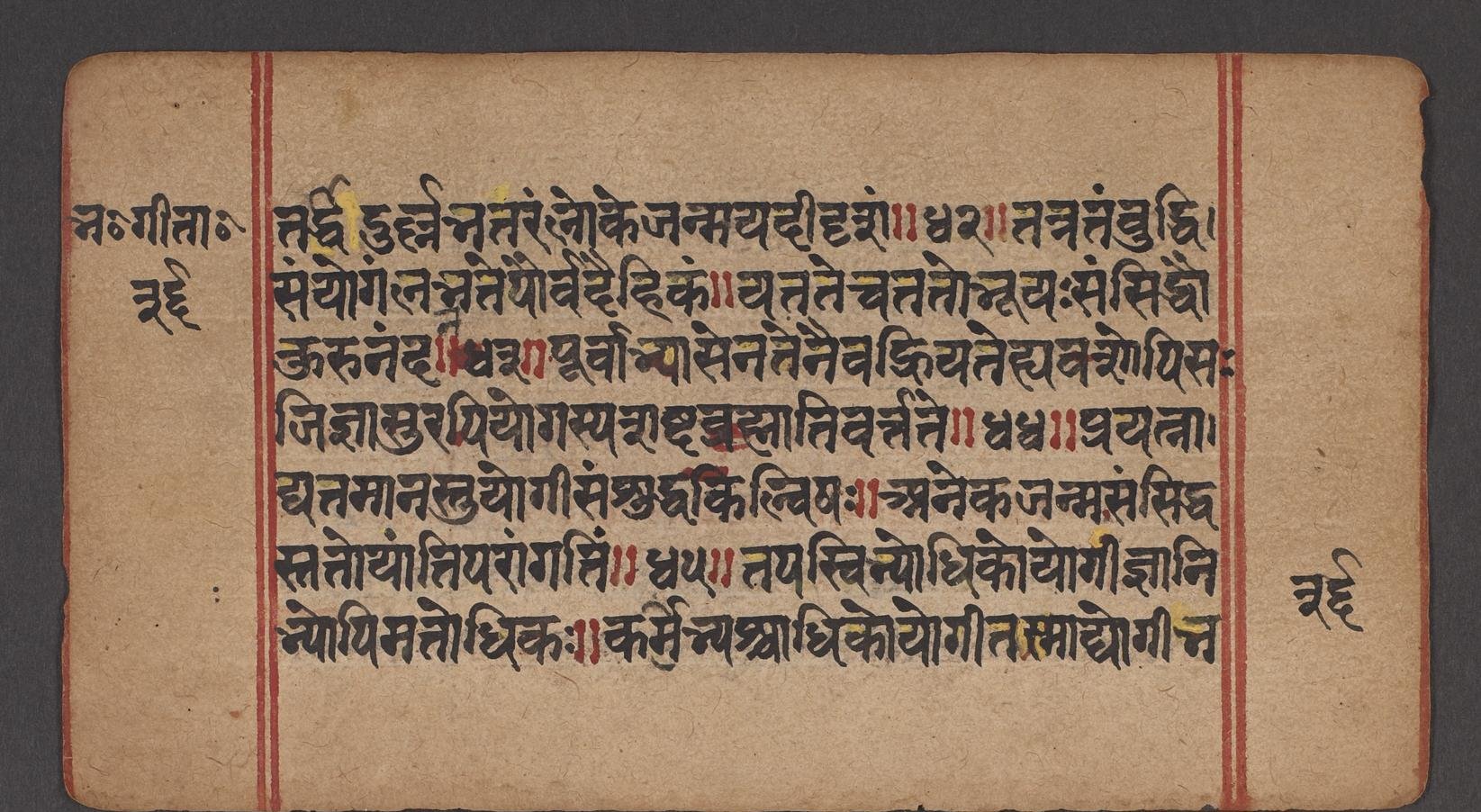
fol. 36v, OPenn image 6555_0036 (upper leaf). Checked on the image: ||42|| line 1 ... ||45|| line 6. Verse 6.42 begins on the previous page, fol. 36r, so both pages are shown.
42अथवा योगिनामेव कुले भवति धीमताम् ।
एतद्धि दुर्लभतरं लोके जन्म यदीदृशम् ॥ ४२ ॥
43तत्र तं बुद्धिसंयोगं लभते पौर्वदेहिकम् ।
यतते च ततो भूयः संसिद्धौ कुरुनन्दन ॥ ४३ ॥
44पूर्वाभ्यासेन तेनैव ह्रियते ह्यवशोऽपि सः ।
जिज्ञासुरपि योगस्य शब्दब्रह्मातिवर्तते ॥ ४४ ॥
45प्रयत्नाद्यतमानस्तु योगी संशुद्धकिल्बिषः ।
अनेकजन्मसंसिद्धस्ततो याति परां गतिम् ॥ ४५ ॥
42Or he may even be born into a family of wise Yogîs; but such a birth as that is most difficult to obtain in this world.
43There he recovereth the characteristics belonging to this former body, and with these he again laboureth for perfection, O joy of the Kurus.
44By that former practice he is irresistibly swept away. Only wishing to know yoga, even the seeker after yoga goeth beyond the Brâhmic world;
45But the Yogî, labouring with assiduity, purified from sin, fully perfected through manifold births, he reacheth the supreme goal.
Where on the image
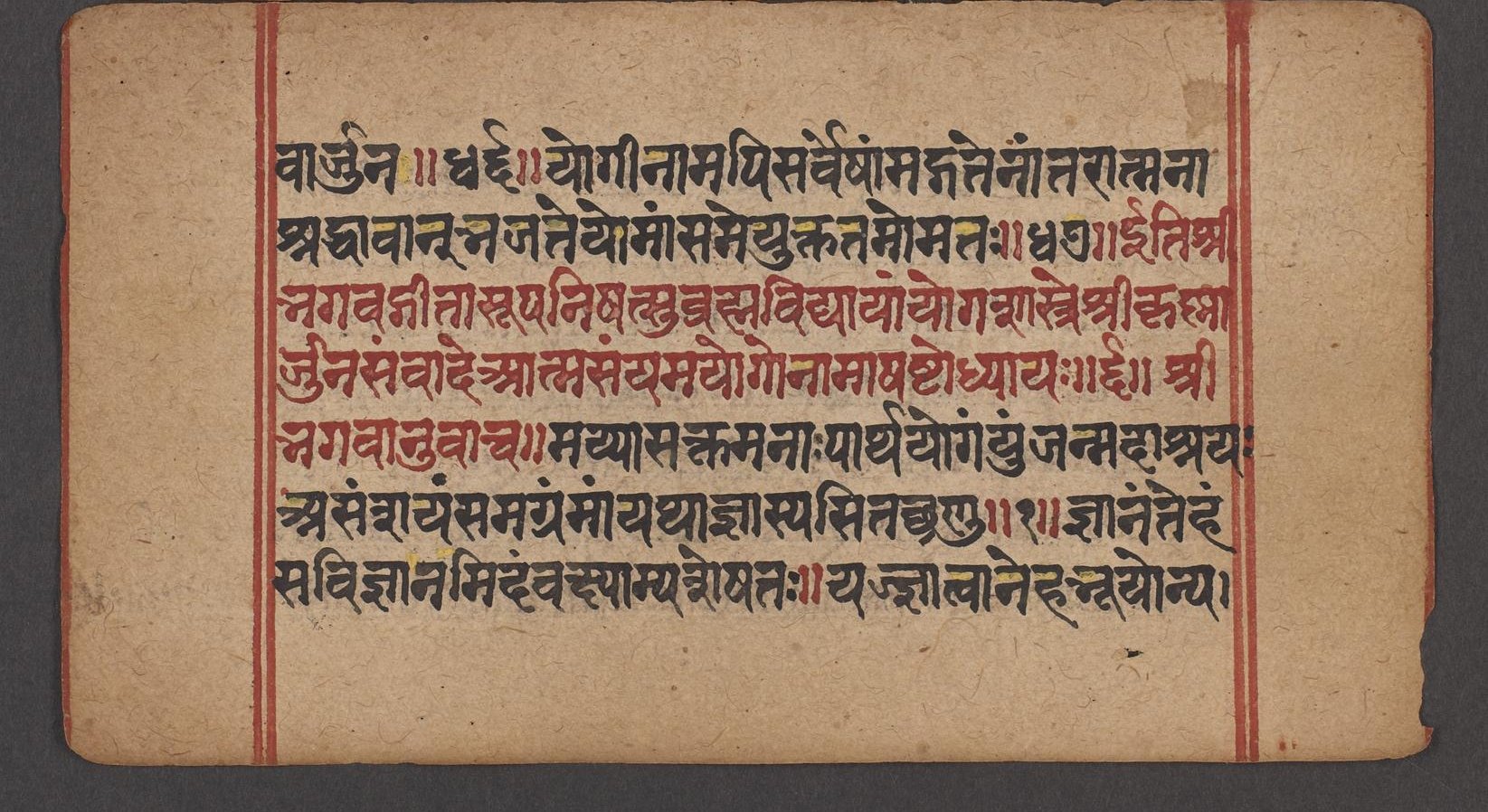
fol. 37r, OPenn image 6555_0036 (lower leaf). Checked on the image: ||46|| line 1, ||47|| line 2; colophon lines 2-4 '... ātmasaṃyamayogo nāma ṣaṣṭho 'dhyāyaḥ ||6||'; śrībhagavān uvāca; 7.1 ends line 6 (||1||), 7.2 begins line 6. Verse 6.46 begins on the previous page, fol. 36v, so both pages are shown.
46तपस्विभ्योऽधिको योगी ज्ञानिभ्योऽपि मतोऽधिकः ।
कर्मिभ्यश्चाधिको योगी तस्माद्योगी भवार्जुन ॥ ४६ ॥
47योगिनामपि सर्वेषां मद्गतेनान्तरात्मना ।
श्रद्धावान्भजते यो मां स मे युक्ततमो मतः ॥ ४७ ॥
46The Yogî is greater than the ascetics; he is thought to be greater than even the wise; the Yogî is greater than the men of action; therefore become thou a Yogî, O Arjuna!
47And among all Yogîs, he who, full of faith, with the inner Self abiding in Me, adoreth Me, he is considered by Me to be the most completely harmonised.
Where on the image
fol. 37r: ||46|| line 1, ||47|| line 2; colophon lines 2-4 '... ātmasaṃyamayogo nāma ṣaṣṭho 'dhyāyaḥ ||6||'; śrībhagavān uvāca; 7.1 ends line 6 (||1||), 7.2 begins line 6. The manuscript names the chapter ātmasaṃyamayoga; the Sanskrit and English shown are the colophon printed in Besant's edition, whose wording differs in places from the manuscript's.
इति श्रीमद्भगवद्गीता॰ अध्यात्मयोगो नाम षष्ठोऽध्यायः ।
Thus in the glorious Upanishads of the Bhagavad-Gita, the science of the Eternal, the scripture of Yoga, in the dialogue between Shrî Krishna and Arjuna, the sixth discourse, entitled: THE YOGA OF SELF-SUBDUAL.
Notes
- Sanskrit and English: Annie Besant, The Bhagavad-Gita, 4th edition (Madras: G. A. Natesan, 1922), transcription validated on English Wikisource. Besant's footnotes are not reproduced.
- Verse numbers follow Besant and the manuscript, which agree throughout: chapter 13 counts Arjuna's opening question ('prakṛtiṃ puruṣaṃ caiva...') as verse 1, so it has 35 verses and the whole text 701.
- K. T. Telang's translation (Sacred Books of the East 8, 1882) was the first choice for the English, but it is continuous prose without verse divisions, so it cannot be matched to manuscript pages verse by verse; Besant's verse-numbered translation is used instead.
- The last section of each chapter is the chapter colophon. Besant prints most Sanskrit colophons in shortened form (marked with ॰) while her English gives the full formula; the manuscript writes the colophon out in full, and its chapter names differ in places from Besant's (see the scan note).
Cite
Sources
- Source: Penn Ms. Coll. 390 Item 559 (dated 1794) via OPenn + Sanskrit and English of Annie Besant, The Bhagavad-Gita (4th ed. 1922), Wikisource (holding institution)
- Critical edition: Annie Besant, The Bhagavad-Gita, 4th ed. (1922), Sanskrit text, via Wikisource
← previous · → next · v cycle view · l back to library