Bhagavad Gita, Chapter 7: The Yoga of Discriminative Knowledge
Introduction
The Bhagavad Gita ("Song of the Lord") is a dialogue of 700 verses between the prince Arjuna and Krishna, set on the battlefield of Kurukshetra in book 6 (Bhishmaparvan) of the Mahabharata. Its date of composition is debated; many scholars place it in the last centuries BCE. This is chapter 7, The Yoga of Discriminative Knowledge (30 verses as numbered in the manuscript and in Besant's edition).
The pages shown are from a complete Sanskrit manuscript of the Gita at the University of Pennsylvania (Penn Ms. Coll. 390 Item 559), 90 paper leaves of 7 lines in Devanagari, with speaker headings, colophons and verse-end marks in red. Its final colophon (fol. 90r) dates the copy to Saṃvat 1851, the third day of the bright half of Caitra (1794 CE). Chapter 7 runs from fol. 37r to the chapter colophon on fol. 40v.
Each section below is one manuscript page: the verses whose text ends on that page, located by reading the scribe's verse numbers and the first and last words on the image. When a verse begins at the foot of one page and ends on the next, both pages are shown. The Sanskrit and English are from Annie Besant's edition and translation (4th edition, 1922), which prints each verse in Devanagari with its English; the manuscript's spelling differs from the printed text in small details.
How was this verified? (Provenance)
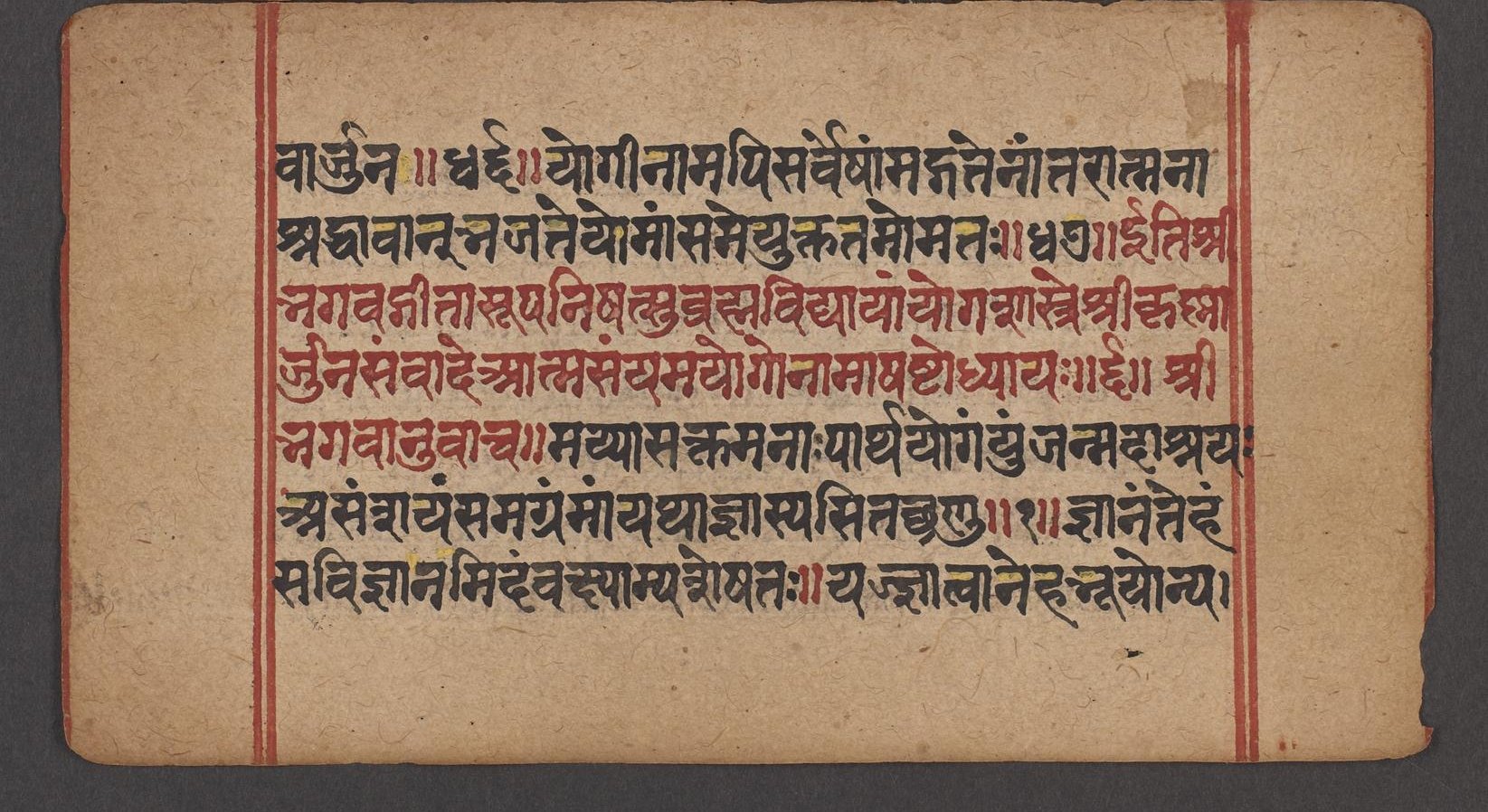
Where on the image
fol. 37r, OPenn image 6555_0036 (lower leaf). Checked on the image: ||46|| line 1, ||47|| line 2; colophon lines 2-4 '... ātmasaṃyamayogo nāma ṣaṣṭho 'dhyāyaḥ ||6||'; śrībhagavān uvāca; 7.1 ends line 6 (||1||), 7.2 begins line 6.
1श्रीभगवानुवाच ।
मय्यासक्तमनाः पार्थ योगं युञ्जन्मदाश्रयः ।
असंशयं समग्रं मां यथा ज्ञास्यसि तच्छृणु ॥ १ ॥
1The Blessed Lord said:
With the mind clinging to me, O Pârtha, performing yoga, refuged in Me, how thou shalt without doubt know Me to the uttermost, that hear thou.
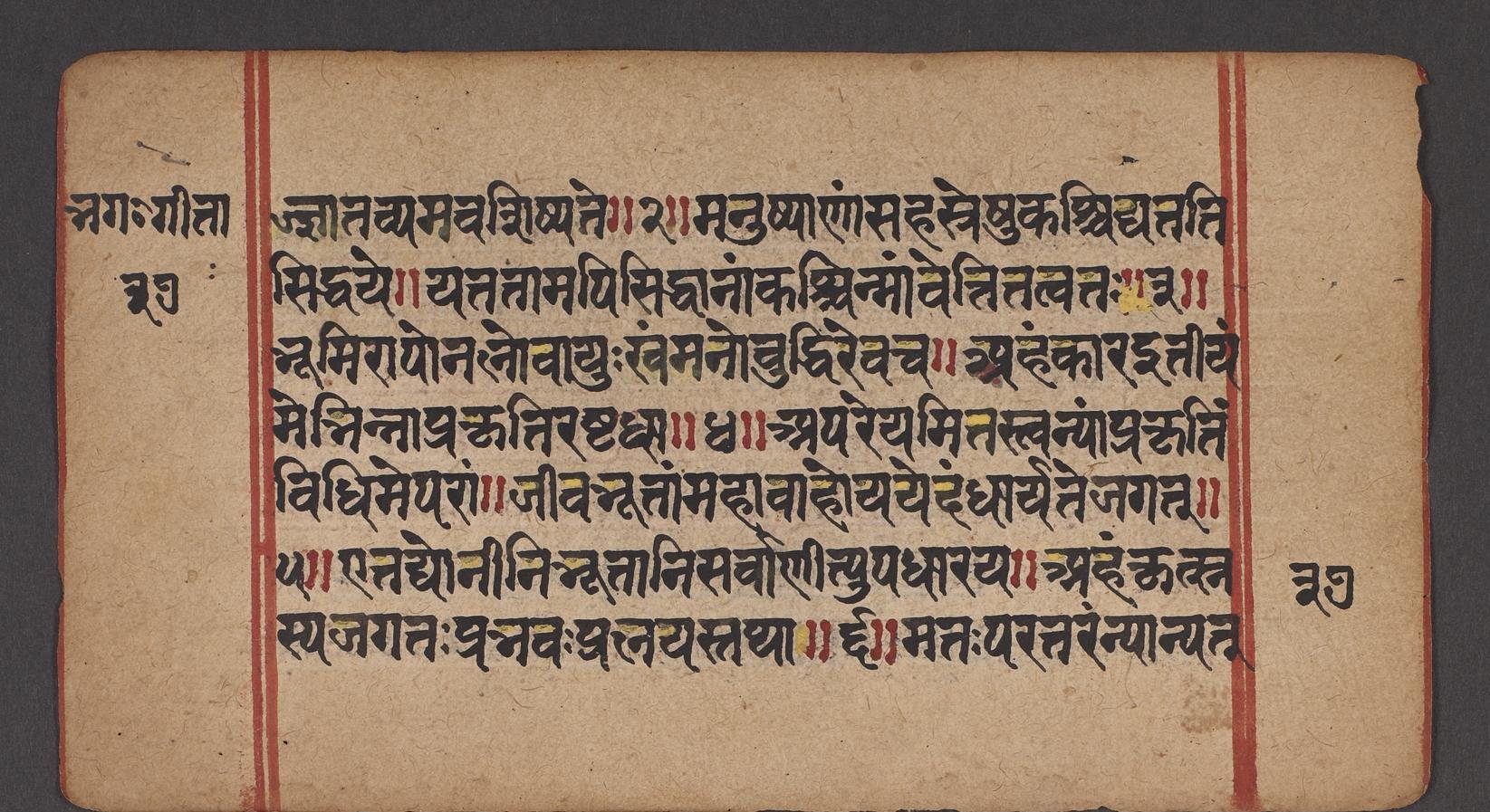
Where on the image
fol. 37v, OPenn image 6555_0037 (upper leaf). Checked on the image: ||2|| line 1 ... ||6|| line 7. Verse 7.2 begins on the previous page, fol. 37r, so both pages are shown.
2ज्ञानं तेऽहं सविज्ञानमिदं वक्ष्याम्यशेषतः ।
यज्ज्ञात्वा नेह भूयोऽन्यज्ज्ञातव्यमवशिष्यते ॥ २ ॥
3मनुष्याणां सहस्रेषु कश्चिद्यतति सिद्धये ।
यततामपि सिद्धानां कश्चिन्मां वेत्ति तत्त्वतः ॥ ३ ॥
4भूमिरापोऽनलो वायुः खं मनो बुद्धिरेव च ।
अहङ्कार इतीयं मे भिन्ना प्रकृतिरष्टधा ॥ ४ ॥
5अपरेयमितस्त्वन्यां प्रकृतिं विद्धि मे पराम् ।
जीवभूतां महाबाहो ययेदं धार्यते जगत् ॥ ५ ॥
6एतद्योनीनि भूतानि सर्वाणीत्युपधारय ।
अहं कृत्स्नस्य जगतः प्रभवः प्रलयस्तथा ॥ ६ ॥
2I will declare to thee this knowledge and wisdom in its completeness, which, having known, there is nothing more here needeth to be known.
3Among thousands of men scarce one striveth for perfection; of the successful strivers scarce one knoweth Me in essence.
4Earth, water, fire, air, ether, Mind, and Reason also and Egoism—these are the eightfold division of My nature.
5This the inferior. Know My other nature, the higher, the life-element, O mighty-armed, by which the universe is upheld.
6Know this to be the womb of all beings. I am the source of the forthgoing of the whole universe and likewise the place of its dissolving.
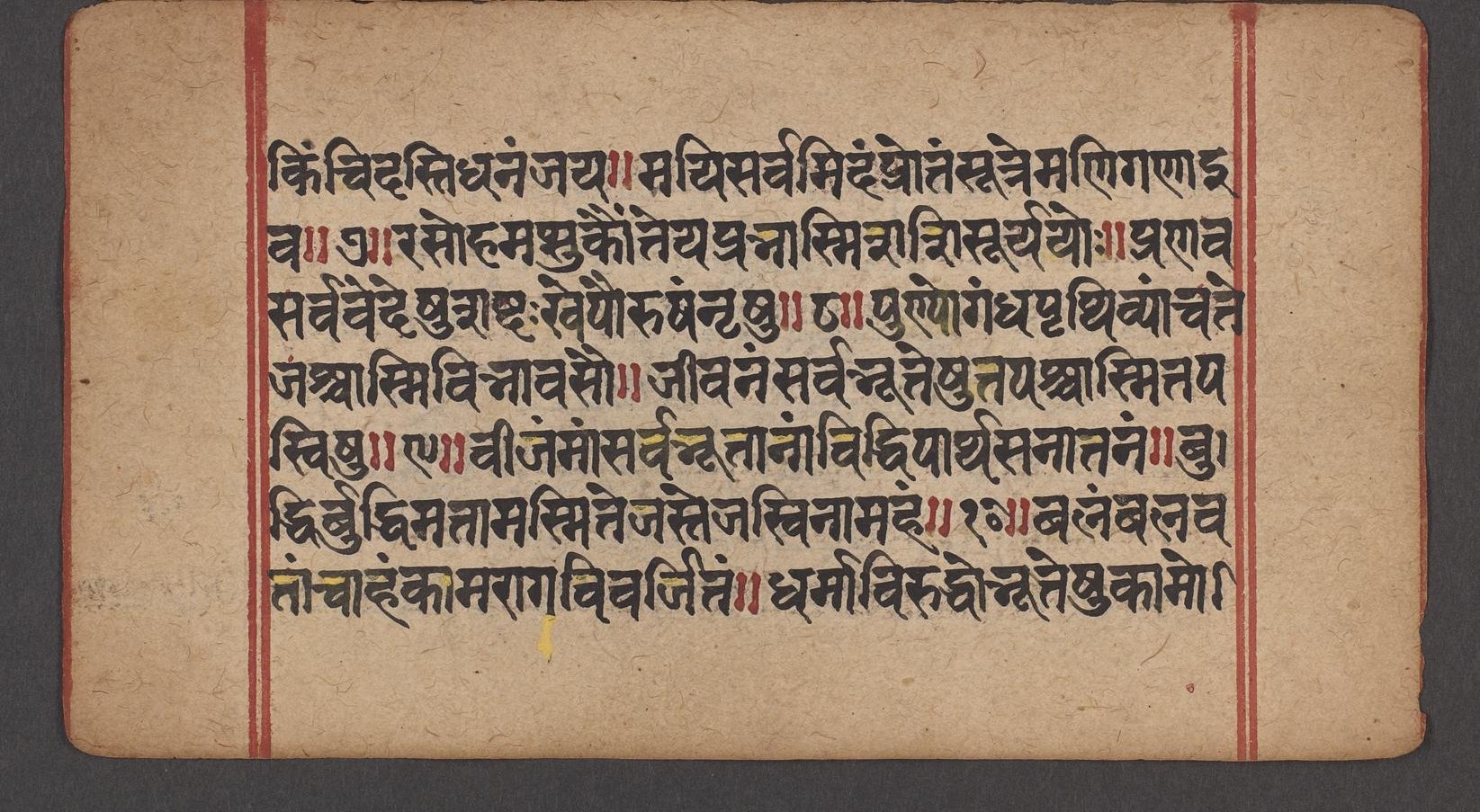
Where on the image
fol. 38r, OPenn image 6555_0037 (lower leaf). Checked on the image: ||7|| line 2 ... ||10|| line 6. Verse 7.7 begins on the previous page, fol. 37v, so both pages are shown.
7मत्तः परतरं नान्यत्किञ्चिदस्ति धनञ्जय ।
मयि सर्वमिदं प्रोतं सूत्रे मणिगणा इव ॥ ७ ॥
8रसोऽहमप्सु कौन्तेय प्रभाऽस्मि शशिसूर्ययोः ।
प्रणवः सर्ववेदेषु शब्दः खे पौरुषं नृषु ॥ ८ ॥
9पुण्यो गन्धः पृथिव्यां च तेजश्चास्मि विभावसौ ।
जीवनं सर्वभूतेषु तपश्चास्मि तपस्विषु ॥ ९ ॥
10बीजं मां सर्वभूतानां विद्धि पार्थ सनातनम् ।
बुद्धिर्बुद्धिमतामस्मि तेजस्तेजस्विनामहम् ॥ १० ॥
7There is naught whatsoever higher than I, O Dhananjaya. All this is threaded on Me, as rows of pearls on a string.
8I the sapidity in waters, O son of Kuntî, I the radiance in moon and sun; the Word of Power in all the Vedas, sound in ether, and virility in men;
9The pure fragrance of earths and the brilliance in fire am I; the life in all beings am I, and the austerity in ascetics.
10Know Me, O Pârtha! as the eternal seed of all beings. I am the Reason of the Reason-endowed, the splendour of splendid things am I.
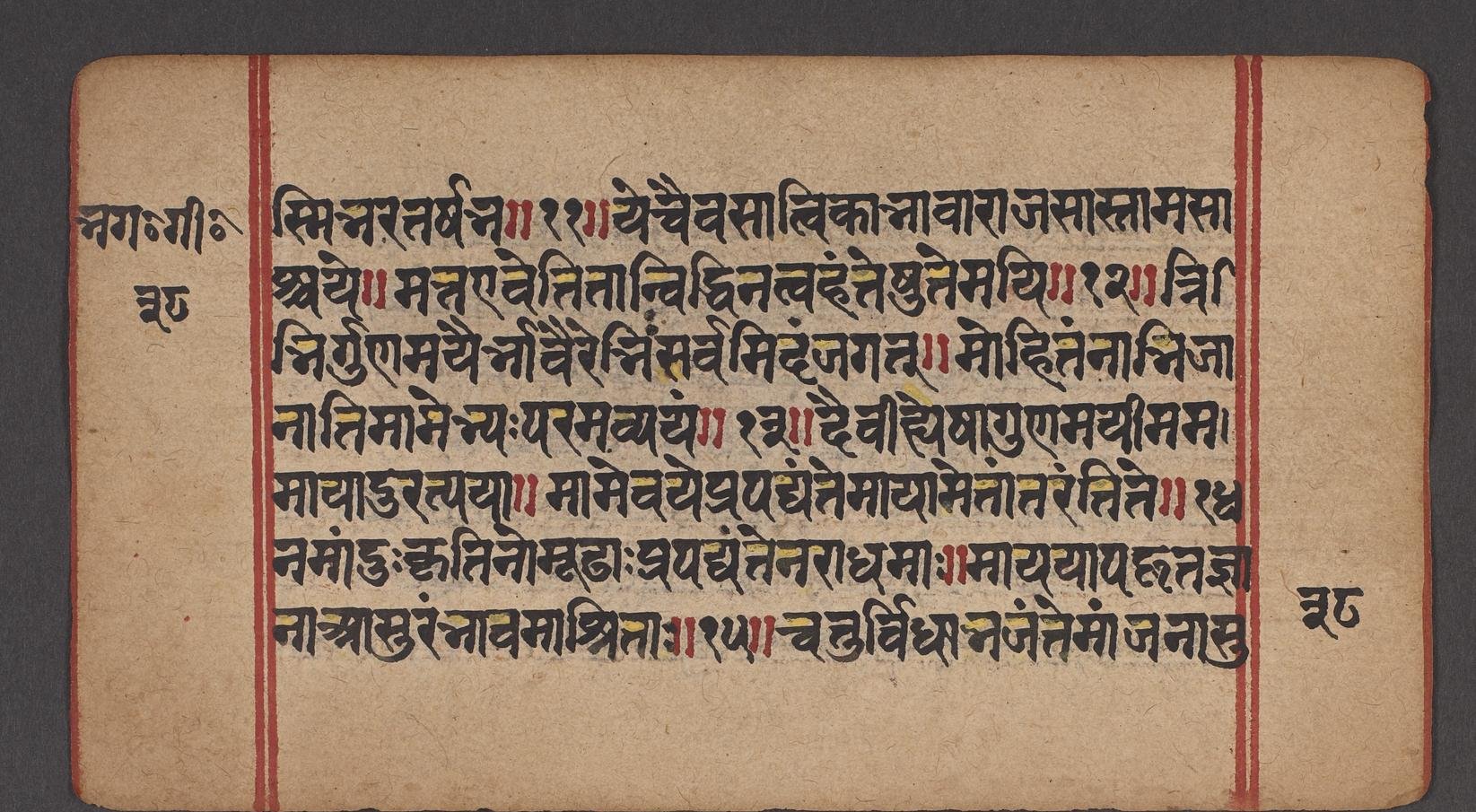
Where on the image
fol. 38v, OPenn image 6555_0038 (upper leaf). Checked on the image: ||11|| line 1 ... ||15|| line 7. Verse 7.11 begins on the previous page, fol. 38r, so both pages are shown.
11बलं बलवतामस्मि कामरागविवर्जितम् ।
धर्माविरुद्धो भूतेषु कामोऽस्मि भरतर्षभ ॥ ११ ॥
12ये चैव सात्त्विका भावा राजसास्तामसाश्च ये ।
मत्त एवेति तान्विद्धि न त्वहं तेषु ते मयि ॥ १२ ॥
13त्रिभिर्गुणमयैर्भावैरेभिः सर्वमिदं जगत् ।
मोहितं नाभिजानाति मामेभ्यः परमव्ययम् ॥ १३ ॥
14दैवी ह्येषा गुणमयी मम माया दुरत्यया ।
मामेव ये प्रपद्यन्ते मायामेतां तरन्ति ते ॥ १४ ॥
15न मां दुष्कृतिनो मूढाः प्रपद्यन्ते नराधमाः ।
माययाऽपहृतज्ञाना आसुरं भावमाश्रिताः ॥ १५॥
11And I the strength of the strong, devoid of desire and passion. In beings I am desire not contrary to duty, O Lord of the Bharatas.
12The natures that are harmonious, active, slothful, these know as from Me; not I in them, but they in me.
13All this world, deluded by these natures made by the three qualities, knoweth not Me, above these, imperishable.
14This divine illusion of Mine, caused by the qualities, is hard to pierce; they who come to Me, they cross over this illusion.
15The evil-doing, the deluded, the vilest men, they come not to Me, they whose wisdom is destroyed by illusion, who have embraced the nature of demons.
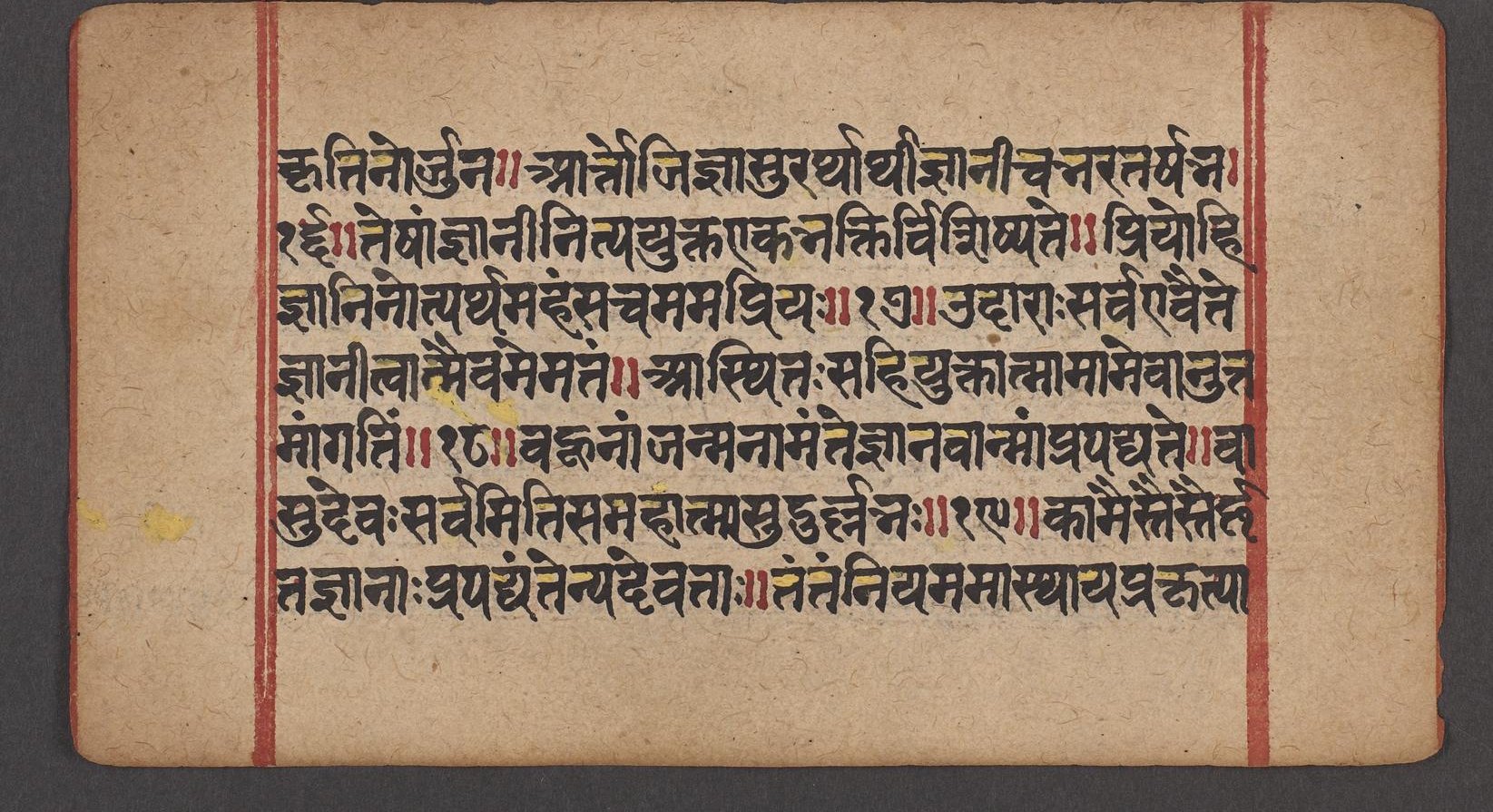
Where on the image
fol. 39r, OPenn image 6555_0038 (lower leaf). Checked on the image: ||16|| line 2 ... ||19|| line 6. Verse 7.16 begins on the previous page, fol. 38v, so both pages are shown.
16चतुर्विधा भजन्ते मां जनाः सुकृतिनोऽर्जुन ।
आर्तो जिज्ञासुरर्थार्थी ज्ञानी च भरतर्षभ ॥ १६ ॥
17तेषां ज्ञानी नित्ययुक्त एकभक्तिर्विशिष्यते ।
प्रियो हि ज्ञानिनोऽत्यर्थमहं स च मम प्रियः ॥ १७ ॥
18उदाराः सर्व एवैते ज्ञानी त्वात्मैव मे मतम् ।
आस्थितः स हि युक्तात्मा मामेवानुत्तमां गतिम् ॥ १८ ॥
19बहूनां जन्मनामन्ते ज्ञानवान्मां प्रपद्यते ।
वासुदेवः सर्वमिति स महात्मा सुदुर्लभः ॥ १९ ॥
16Fourfold in division are the righteous ones who worship me, O Arjuna; the suffering, the seeker for knowledge, the self-interested and the wise, O Lord of the Bhâratas.
17Of these the wise, constantly harmonised, worshipping the One, is the best; I am supremely dear to the wise, and he is dear to Me.
18Noble are all these, but I hold the wise as verily Myself; he, Self united, is fixed on Me, the highest Path.
19At the close of many births the man full of wisdom cometh unto Me; "Vâsudeva is all." saith he, the Mahâtmâ, very difficult to find.
Where on the image
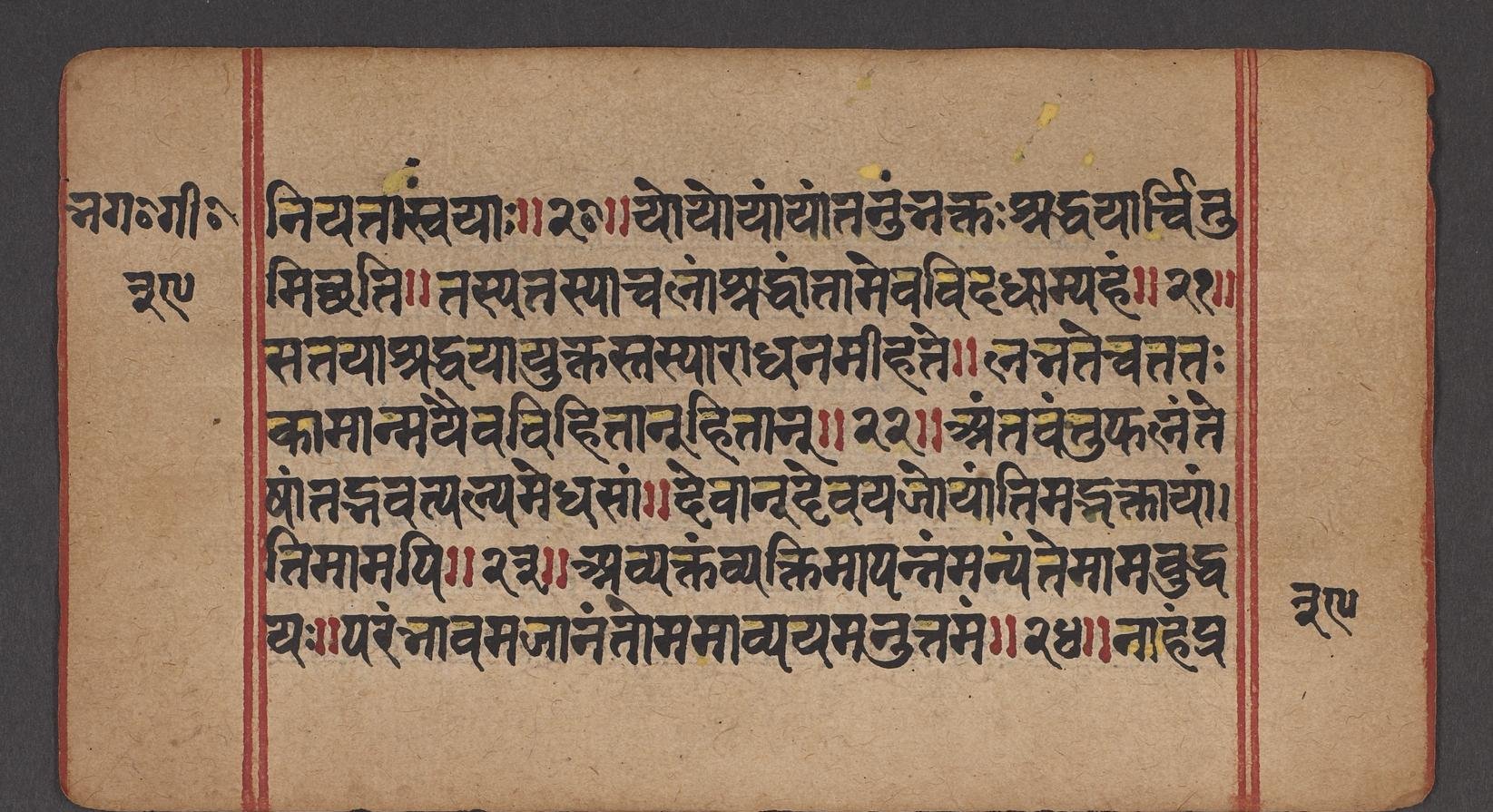
fol. 39v, OPenn image 6555_0039 (upper leaf). Checked on the image: ||20|| line 1 ... ||24|| line 7. Verse 7.20 begins on the previous page, fol. 39r, so both pages are shown.
20कामैस्तैस्तैर्हृतज्ञानाः प्रपद्यन्तेऽन्यदेवताः ।
तं तं नियममास्थाय प्रकृत्या नियताः स्वया ॥ २० ॥
21यो यो यां यां तनुं भक्तः श्रद्धयाऽर्चितुमिच्छति ।
तस्य तस्याचलां श्रद्धां तामेव विदधाम्यहम् ॥ २१ ॥
22स तया श्रद्धया युक्तस्तस्याराधनमीहते ।
लभते च ततः कामान्मयैव विहितान्हि तान् ॥ २२ ॥
23अन्तवत्तु फलं तेषां तद्भवत्यल्पमेधसाम् ।
देवान्देवयजो यान्ति मद्भक्ता यान्ति मामपि ॥ २३ ॥
24अव्यक्तं व्यक्तिमापन्नं मन्यन्ते मामबुद्धयः ।
परं भावमजानन्तो ममाव्ययमनुत्तमम् ॥ २४ ॥
20They whose wisdom hath been rent away by desires go forth to other Shining Ones, resorting to various external observances, according to their own natures.
21Any devotee who seeketh to worship with faith any such aspect, I verily bestow the unswerving faith of that man.
22He endowed with that faith, seeketh the worship of such a one, and from him he obtaineth his desires, I verily decreeing the benefits;
23Finite indeed the fruit that belongeth to those who are of small intelligence. To the Shining Ones go the worshippers of the Shining Ones, but my devotees come unto Me.
24Those devoid of Reason think of Me, the unmanifest, as having manifestation, knowing not My supreme nature, imperishable, most excellent.
Where on the image
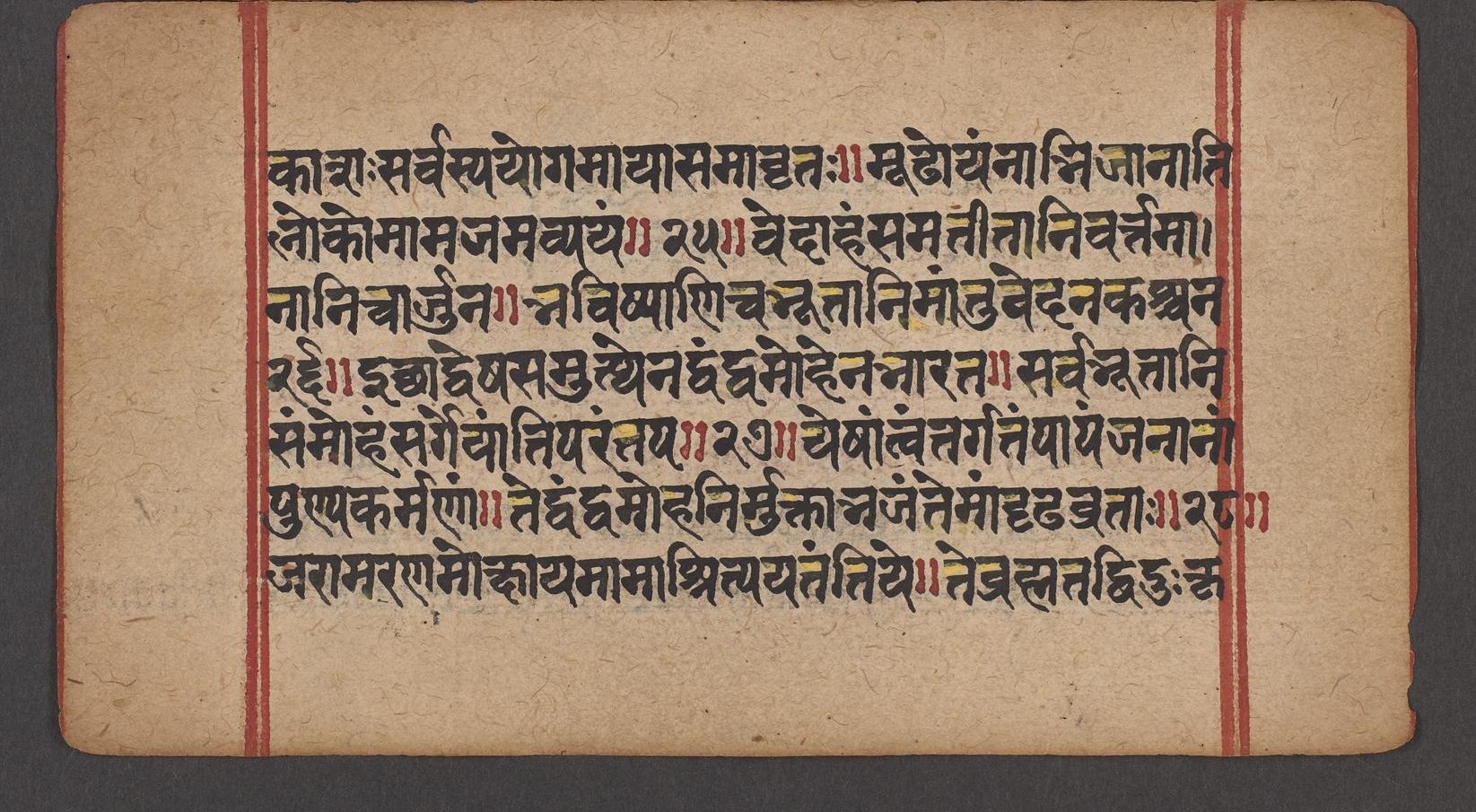
fol. 40r, OPenn image 6555_0039 (lower leaf). Checked on the image: ||25|| line 2 ... ||28|| line 6. Verse 7.25 begins on the previous page, fol. 39v, so both pages are shown.
25नाहं प्रकाशः सर्वस्य योगमायासमावृतः ।
मूढोऽयं नाभिजानाति लोको मामजमव्ययम् ॥ २५ ॥
26वेदाहं समतीतानि वर्तमानानि चार्जुन ।
भविष्याणि च भूतानि मां तु वेद न कश्चन ॥ २६ ॥
27इच्छाद्वेषसमुत्थेन द्वन्द्वमोहेन भारत ।
सर्वभूतानि सम्मोहं सर्गे यान्ति परन्तप ॥ २७ ॥
28येषां त्वन्तगतं पापं जनानां पुण्यकर्मणाम् ।
ते द्वन्द्वमोहनिर्मुक्ता भजन्ते मां दृढव्रताः ॥ २८ ॥
25Nor am I of all discovered, enveloped in My creation-illusion. This deluded world knoweth Me not, the unborn, the imperishable.
26I know the beings that are past, that are present, that are to come, O Arjuna, but no one knoweth Me.
27By the delusion of the pairs of opposites, sprung from attraction and repulsion, O Bhârata, all beings walk this universe wholly deluded, O Parantapa.
28But those men of pure deeds, in whom sin is come to an end, they, freed from the delusive pairs of opposites, worship Me, steadfast in vows.
Where on the image
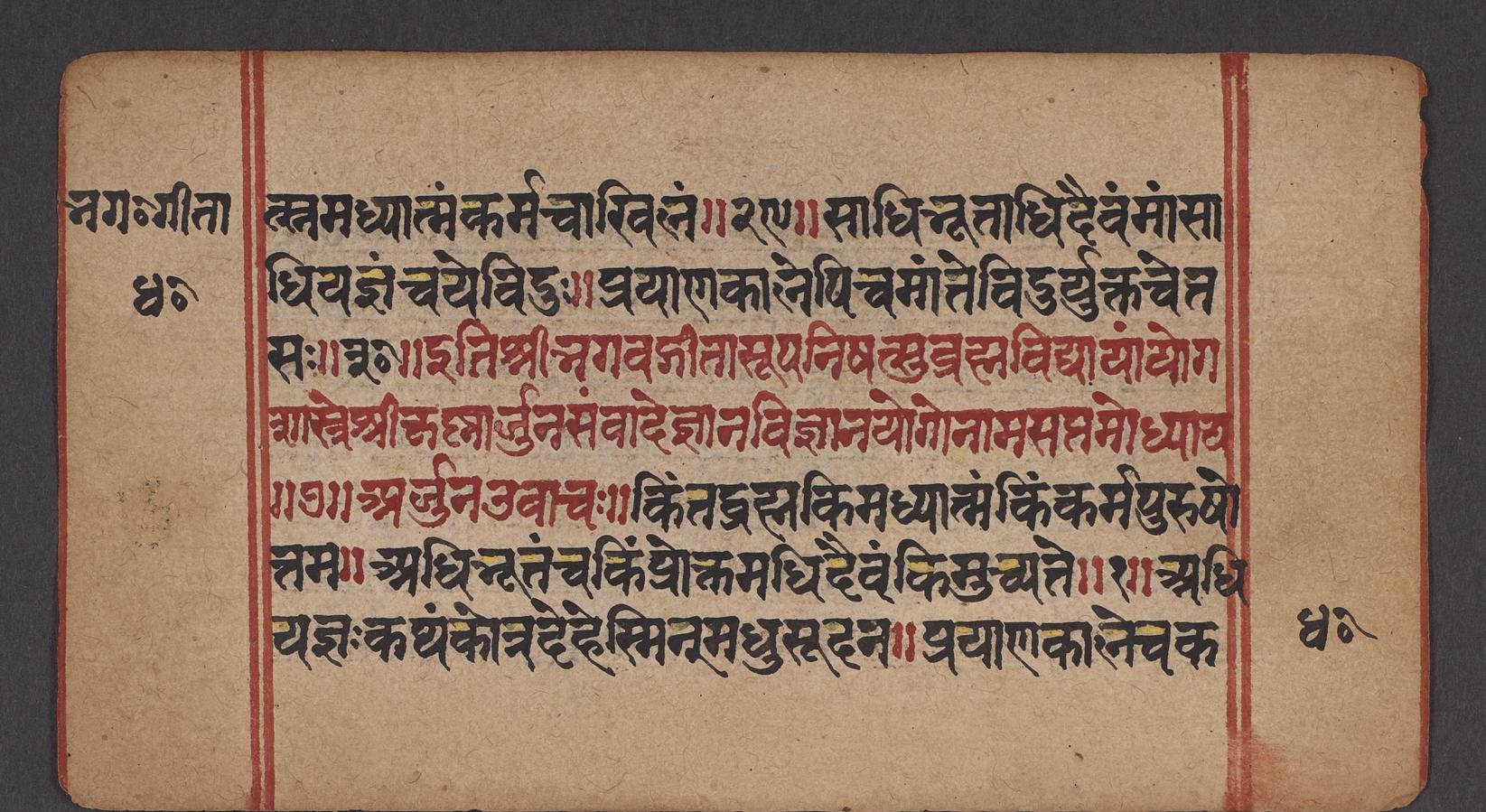
fol. 40v, OPenn image 6555_0040 (upper leaf). Checked on the image: ||29|| line 1, ||30|| line 3; colophon lines 3-5 '... jñānavijñānayogo nāma saptamo 'dhyāyaḥ ||7||'; arjuna uvāca line 5; 8.1 ends line 6 (||1||), 8.2 begins line 6. Verse 7.29 begins on the previous page, fol. 40r, so both pages are shown.
29जरामरणमोक्षाय मामाश्रित्य यतन्ति ये ।
ते ब्रह्म तद्विदुः कृत्स्नमध्यात्मं कर्म चाखिलम् ॥ २९ ॥
30साधिभूताधिदैवं मां साधियज्ञं च ये विदुः ।
प्रयाणकालेऽपि च मां ते विदुर्युक्तचेतसः ॥ ३० ॥
29They who, refuged in Me, strive for liberation from birth and death, they know the Eternal, the whole Self-knowledge, and all action.
30They who know Me as the knowledge of the elements, as that of the Shining Ones, and as that of the Sacrifice, they harmonised in mind, know Me verily even in the time of forthgoing.
Where on the image
fol. 40v: ||29|| line 1, ||30|| line 3; colophon lines 3-5 '... jñānavijñānayogo nāma saptamo 'dhyāyaḥ ||7||'; arjuna uvāca line 5; 8.1 ends line 6 (||1||), 8.2 begins line 6. The manuscript names the chapter jñānavijñānayoga; the Sanskrit and English shown are the colophon printed in Besant's edition, whose wording differs in places from the manuscript's.
इति श्रीमद्भगवद्गीता॰ ज्ञानयोगो नाम सप्तमोऽध्यायः ।
Thus in the glorious Upanishads of the Bhagavad-Gita, the science of the Eternal, the scripture of Yoga, the dialogue between Shrî Krishna and Arjuna, the seventh discourse, entitled: THE YOGA OF DISCRIMINATIVE KNOWLEDGE.
Notes
- Sanskrit and English: Annie Besant, The Bhagavad-Gita, 4th edition (Madras: G. A. Natesan, 1922), transcription validated on English Wikisource. Besant's footnotes are not reproduced.
- Verse numbers follow Besant and the manuscript, which agree throughout: chapter 13 counts Arjuna's opening question ('prakṛtiṃ puruṣaṃ caiva...') as verse 1, so it has 35 verses and the whole text 701.
- K. T. Telang's translation (Sacred Books of the East 8, 1882) was the first choice for the English, but it is continuous prose without verse divisions, so it cannot be matched to manuscript pages verse by verse; Besant's verse-numbered translation is used instead.
- The last section of each chapter is the chapter colophon. Besant prints most Sanskrit colophons in shortened form (marked with ॰) while her English gives the full formula; the manuscript writes the colophon out in full, and its chapter names differ in places from Besant's (see the scan note).
Cite
Sources
- Source: Penn Ms. Coll. 390 Item 559 (dated 1794) via OPenn + Sanskrit and English of Annie Besant, The Bhagavad-Gita (4th ed. 1922), Wikisource (holding institution)
- Critical edition: Annie Besant, The Bhagavad-Gita, 4th ed. (1922), Sanskrit text, via Wikisource
← previous · → next · v cycle view · l back to library