Bhagavad Gita, Chapter 10: The Yoga of Sovereignty
Introduction
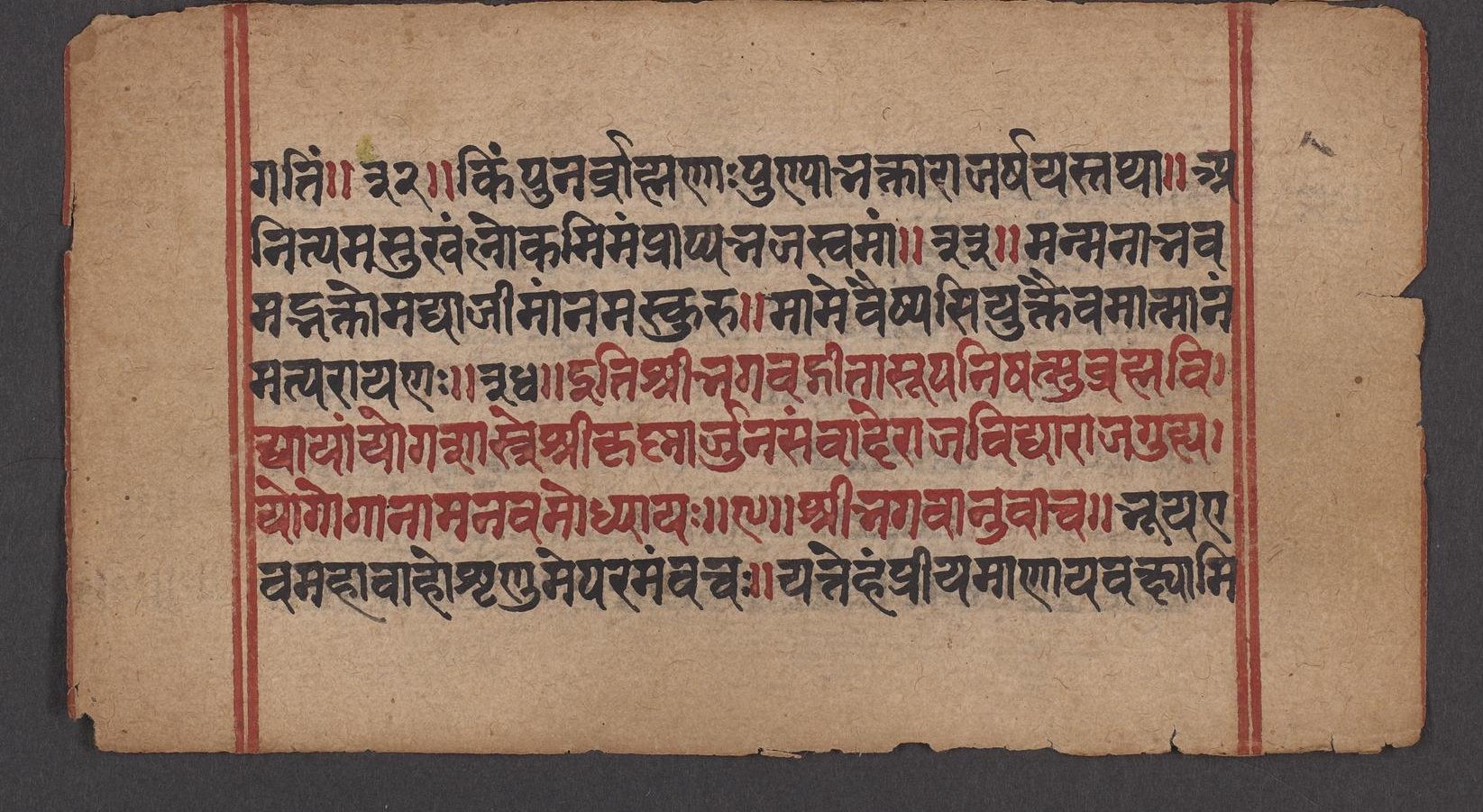
The Bhagavad Gita ("Song of the Lord") is a dialogue of 700 verses between the prince Arjuna and Krishna, set on the battlefield of Kurukshetra in book 6 (Bhishmaparvan) of the Mahabharata. Its date of composition is debated; many scholars place it in the last centuries BCE. This is chapter 10, The Yoga of Sovereignty (42 verses as numbered in the manuscript and in Besant's edition).
The pages shown are from a complete Sanskrit manuscript of the Gita at the University of Pennsylvania (Penn Ms. Coll. 390 Item 559), 90 paper leaves of 7 lines in Devanagari, with speaker headings, colophons and verse-end marks in red. Its final colophon (fol. 90r) dates the copy to Saṃvat 1851, the third day of the bright half of Caitra (1794 CE). Chapter 10 runs from fol. 48r to the chapter colophon on fol. 53r.
Each section below is one manuscript page: the verses whose text ends on that page, located by reading the scribe's verse numbers and the first and last words on the image. When a verse begins at the foot of one page and ends on the next, both pages are shown. The Sanskrit and English are from Annie Besant's edition and translation (4th edition, 1922), which prints each verse in Devanagari with its English; the manuscript's spelling differs from the printed text in small details.
How was this verified? (Provenance)
Where on the image
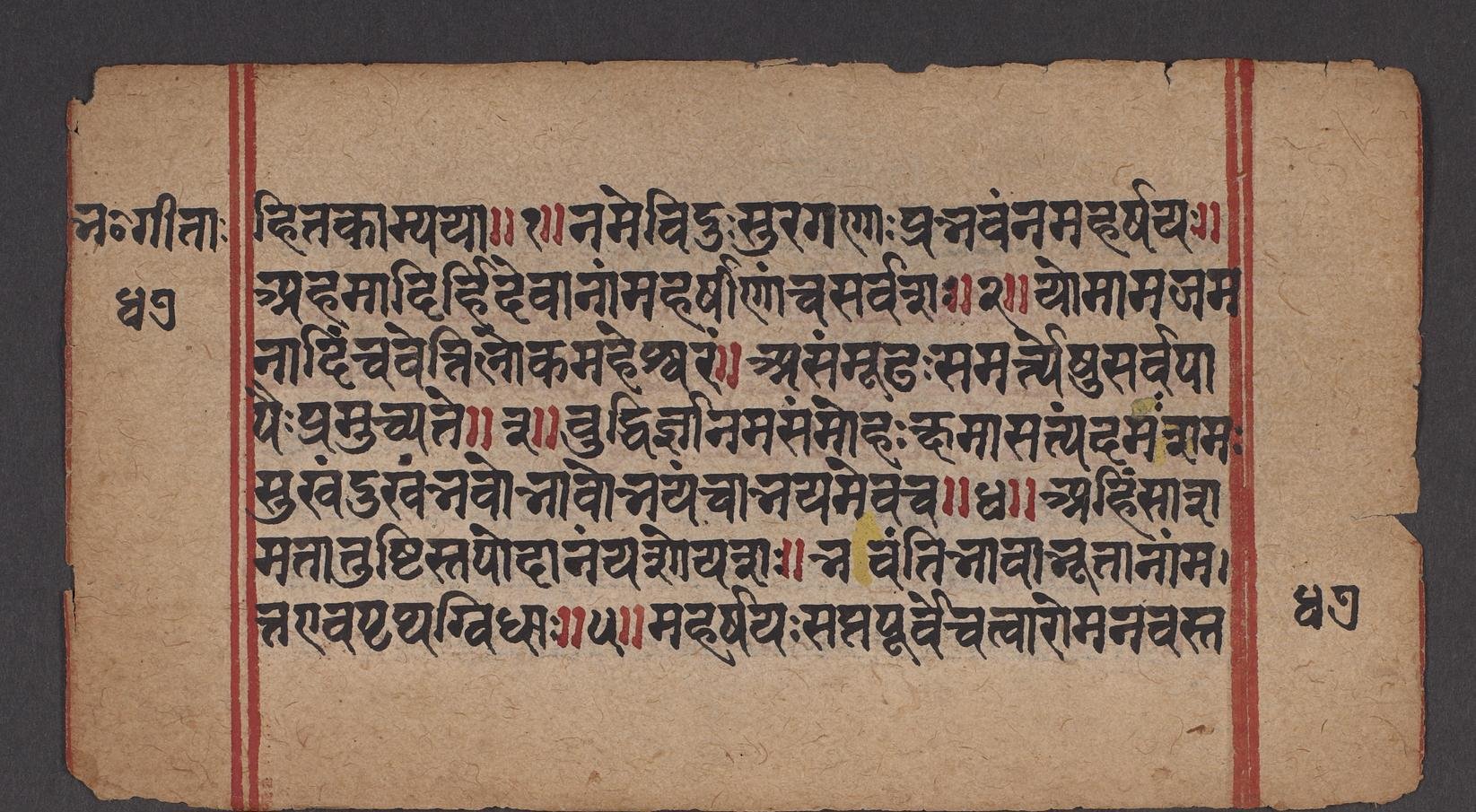
fol. 48v (catalogue label 47v =48v; the scribe repeated folio number 41), OPenn image 6555_0048 (upper leaf). Checked on the image: TEI '47v (=48v)'; ||1|| line 1 ... ||5|| line 7. Verse 10.1 begins on the previous page, fol. 48r, so both pages are shown.
1श्रीभगवानुवाच ।
भूय एव महाबाहो शृणु मे परमं वचः ।
यत्तेऽहं प्रीयमाणाय वक्ष्यामि हितकाम्यया ॥ १ ॥
2न मे विदुः सुरगणाः प्रभवं न महर्षयः ।
अहमादिर्हि देवानां महर्षीणां च सर्वशः ॥ २ ॥
3यो मामजमनादिं च वेत्ति लोकमहेश्वरम् ।
असम्मूढः स मर्त्येषु सर्वपापैः प्रमुच्यते ॥ ३ ॥
4बुद्धिर्ज्ञानमसम्मोहः क्षमा सत्यं दमः शमः ।
सुखं दुःखं भवोऽभावो भयं चाभयमेव च ॥ ४ ॥
5अहिंसा समता तुष्टिस्तपो दानं यशोऽयशः ।
भवन्ति भावा भूतानां मत्त एव पृथग्विधाः ॥ ५ ॥
1The Blessed Lord said:
Again, O mighty-armed, hear thou My supreme word, that, desiring thy welfare, I will declare to thee who art beloved.
2The multitude of the Shining Ones, or the great Rishis, know not my forthcoming, for I am the beginning of all the Shining Ones and the great Rishis.
3He who knoweth Me, unborn, beginningless, the great Lord of the world, he among mortals without delusion, is liberated from all sin.
4Reason, wisdom, non-illusion, forgiveness, truth, self-restraint, calmness, pleasure, pain, existence, non-existence, fear, and also courage
5Harmlessness, equanimity, content, austerity, almsgiving, fame and obloquy are the various characteristics of beings issuing from Me.
Where on the image
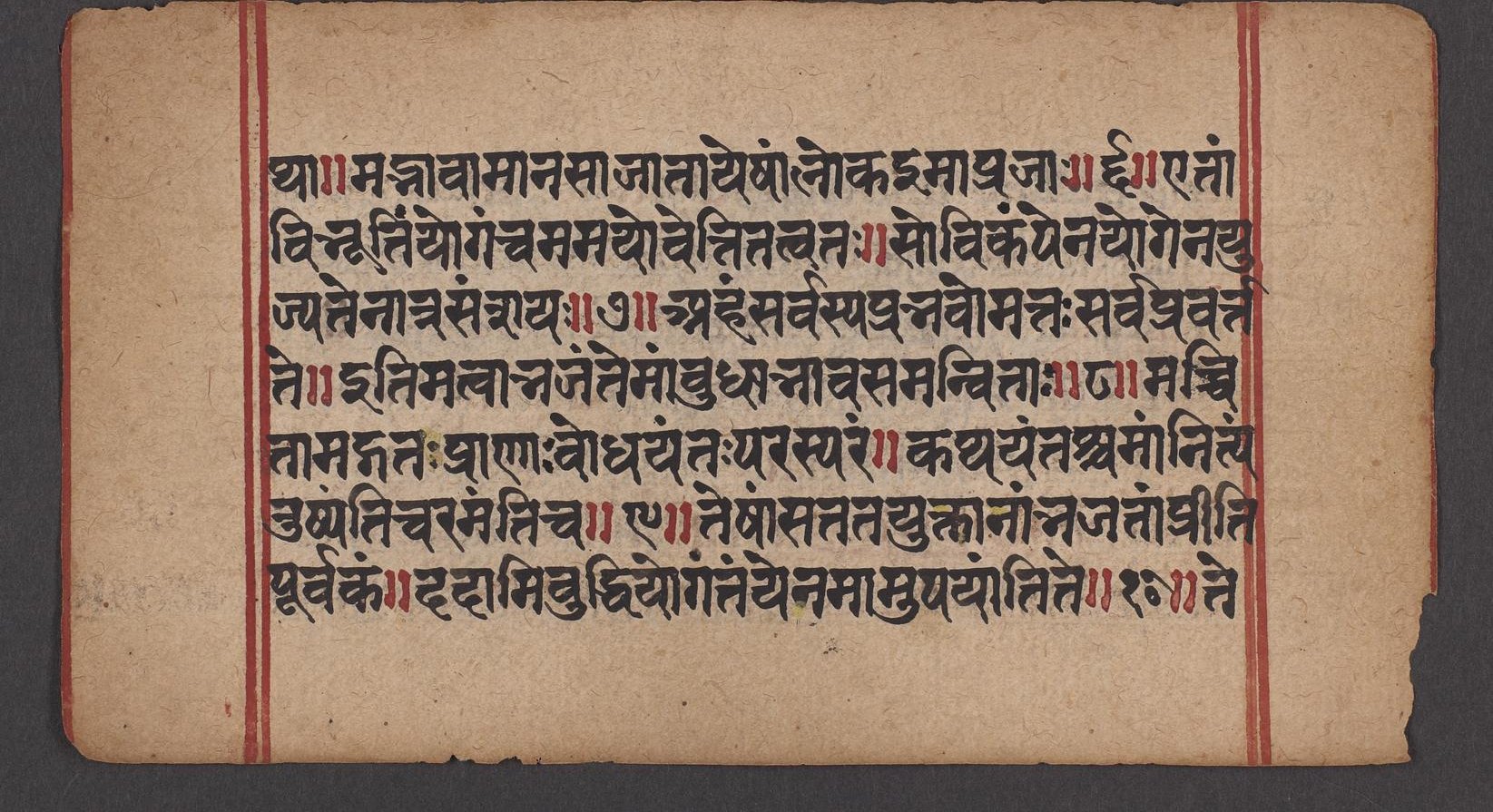
fol. 49r (catalogue label 48r =49r; the scribe repeated folio number 41), OPenn image 6555_0048 (lower leaf). Checked on the image: TEI '48r (=49r)'; ||6|| line 1 ... ||10|| line 7. Verse 10.6 begins on the previous page, fol. 48v, so both pages are shown.
6महर्षयः सप्त पूर्वे चत्वारो मनवस्तथा ।
मद्भावा मानसा जाता येषां लोक इमाः प्रजाः ॥ ६ ॥
7एतां विभूतिं योगं च मम यो वेत्ति तत्त्वतः ।
सोऽविकम्पेन योगेन युज्यते नात्र संशयः ॥ ७ ॥
8अहं सर्वस्य प्रभवो मत्तः सर्वं प्रवर्तते ।
इति मत्वा भजन्ते मां बुधा भावसमन्विताः ॥ ८ ॥
9मच्चित्ता मद्गतप्राणा बोधयन्तः परस्परम् ।
कथयन्तश्च मां नित्यं तुष्यन्ति च रमन्ति च ॥ ९ ॥
10तेषां सततयुक्तानां भजतां प्रीतिपूर्वकम् ।
ददामि बुद्धियोगं तं येन मामुपयान्ति ते ॥ १० ॥
6The seven great Rishis, the ancient Four, and also the Manus, were born of My nature, and mind; of them this race was generated.
7He who knows in essence that sovereignty and yoga of Mine, he is harmonised by unfaltering yoga; there is no doubt thereof.
8I am the Generator of all; all evolves from Me; understanding thus, the wise adore Me in rapt emotion.
9Mindful of Me, their life hidden in Me, illumining each other, ever conversing about Me, they are content and joyful.
10To these, ever harmonious, worshipping in love, I give the yoga of discrimination by which they come unto Me.
Where on the image
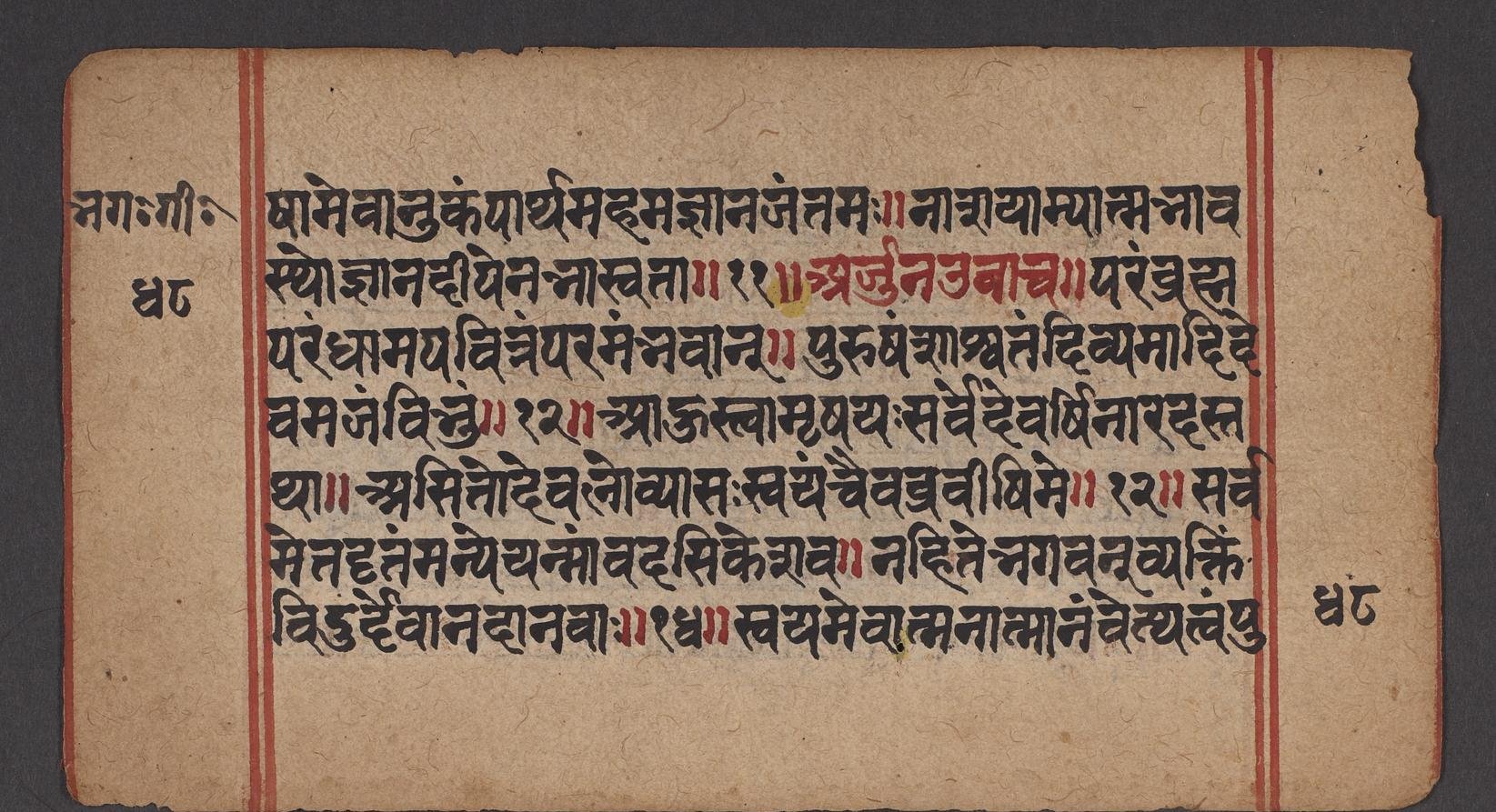
fol. 49v (catalogue label 48v =49v; the scribe repeated folio number 41), OPenn image 6555_0049 (upper leaf). Checked on the image: TEI '48v (=49v)'; ||11|| line 2 ... ||14|| line 7. Verse 10.11 begins on the previous page, fol. 49r, so both pages are shown.
11तेषामेवानुकम्पार्थमहमज्ञानजं तमः ।
नाशयाम्यात्मभावस्थो ज्ञानदीपेन भास्वता ॥ ११ ॥
12अर्जुन उवाच ।
परं ब्रह्म परं धाम पवित्रं परमं भवान् ।
पुरुषं शाश्वतं दिव्यमादिदेवमजं विभुम् ॥ १२ ॥
13आहुस्त्वामृषयः सर्वे देवर्षिर्नारदस्तथा ।
असितो देवलो व्यासः स्वयं चैव ब्रवीषि मे ॥ १३ ॥
14सर्वमेतदृतं मन्ये यन्मां वदसि केशव ।
न हि ते भगवन्व्यक्तिं विदुर्देवा न दानवाः ॥ १४ ॥
11Out of pure compassion for them, dwelling within their Self, I destroy the ignorance-born darkness by the shining lamp of wisdom.
12Arjuna said:
Thou art the supreme Eternal, the supreme Abode, the supreme Purity, eternal divine man, primeval Deity, unborn, the Lord!
13All the Rishis have thus acclaimed Thee, as also the divine Rishi, Nârada; so Asita, Devala, and Vyâsa; and now Thou Thyself tellest it me.
14All this I believe true that Thou sayest to me, O Keshava. Thy manifestation, O Blessed Lord, neither Shining Ones nor Dânavas comprehend.
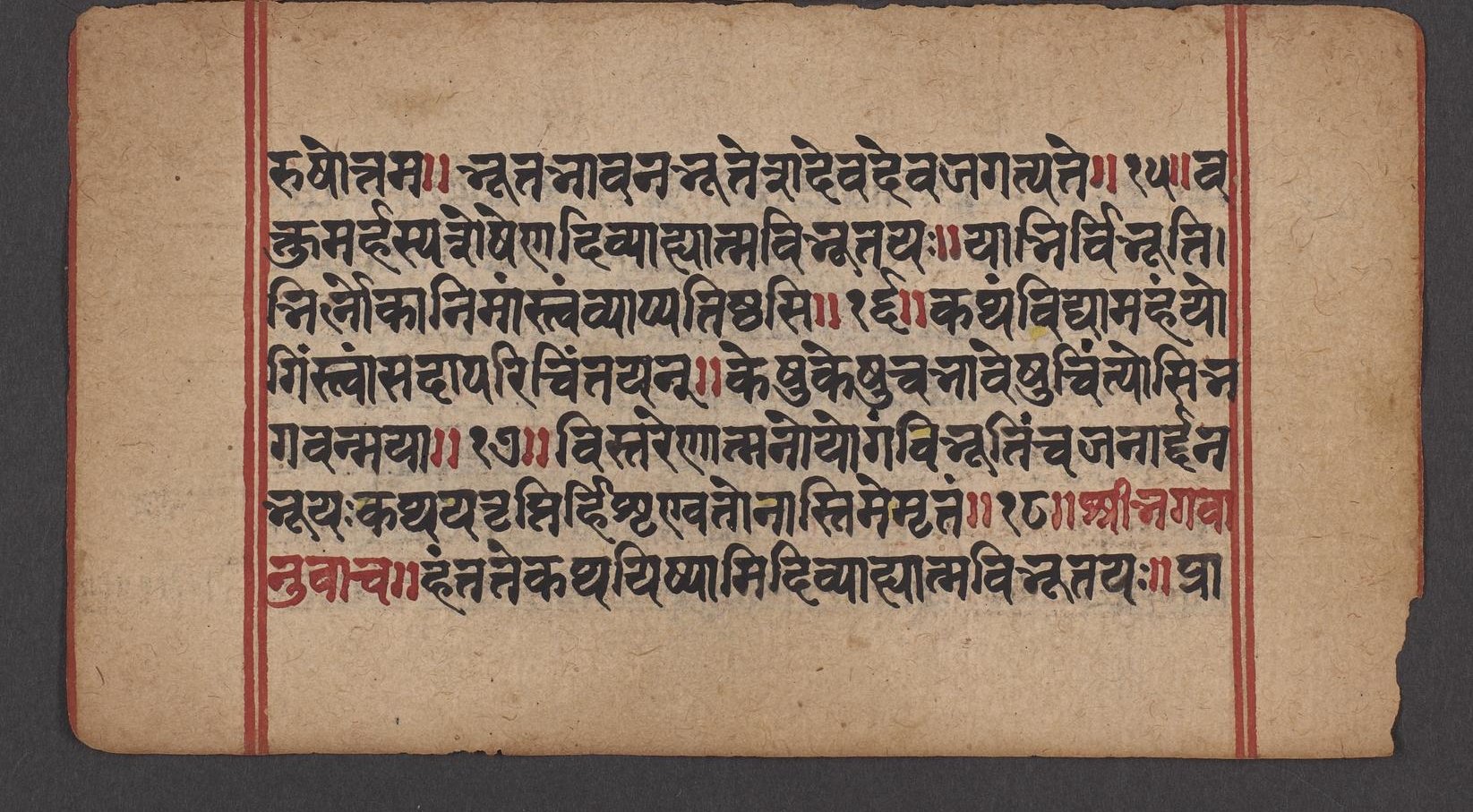
Where on the image
fol. 50r (catalogue label 49r =50r; the scribe repeated folio number 41), OPenn image 6555_0049 (lower leaf). Checked on the image: TEI '49r (=50r)'; ||15|| line 1 ... ||18|| line 6. Verse 10.15 begins on the previous page, fol. 49v, so both pages are shown.
15स्वयमेवात्मनाऽऽत्मानं वेत्थ त्वं पुरुषोत्तम ।
भूतभावन भूतेश देवदेव जगत्पते ॥ १५ ॥
16वक्तुमर्हस्यशेषेण दिव्या ह्यात्मविभूतयः ।
याभिर्विभूतिभिर्लोकानिमांस्त्वं व्याप्य तिष्ठसि ॥ १६ ॥
17कथं विद्यामहं योगिंस्त्वां सदा परिचिन्तयन् ।
केषु केषु च भावेषु चिन्त्योऽसि भगवन्मया ॥ १७ ॥
18विस्तरेणात्मनो योगं विभूतिं च जनार्दन ।
भूयः कथय तृप्तिर्हि शृण्वतो नास्ति मेऽमृतम् ॥ १८ ॥
15Thyself indeed knowest Thyself by Thyself, O Purushottama; Source of beings, Lord of beings, Shining One of Shining Ones, Ruler of the world!
16Deign to tell without reserve of Thine own divine glories, by which glories Thou remainest, pervading these worlds.
17How may I know thee, O Yogi, by constant meditation? In what, in what aspects art Thou to be thought of by me, O blessed Lord?
18In detail tell me again of Thy yoga and glory, O Janardana; for me there is never satiety in hearing thy life-giving words.
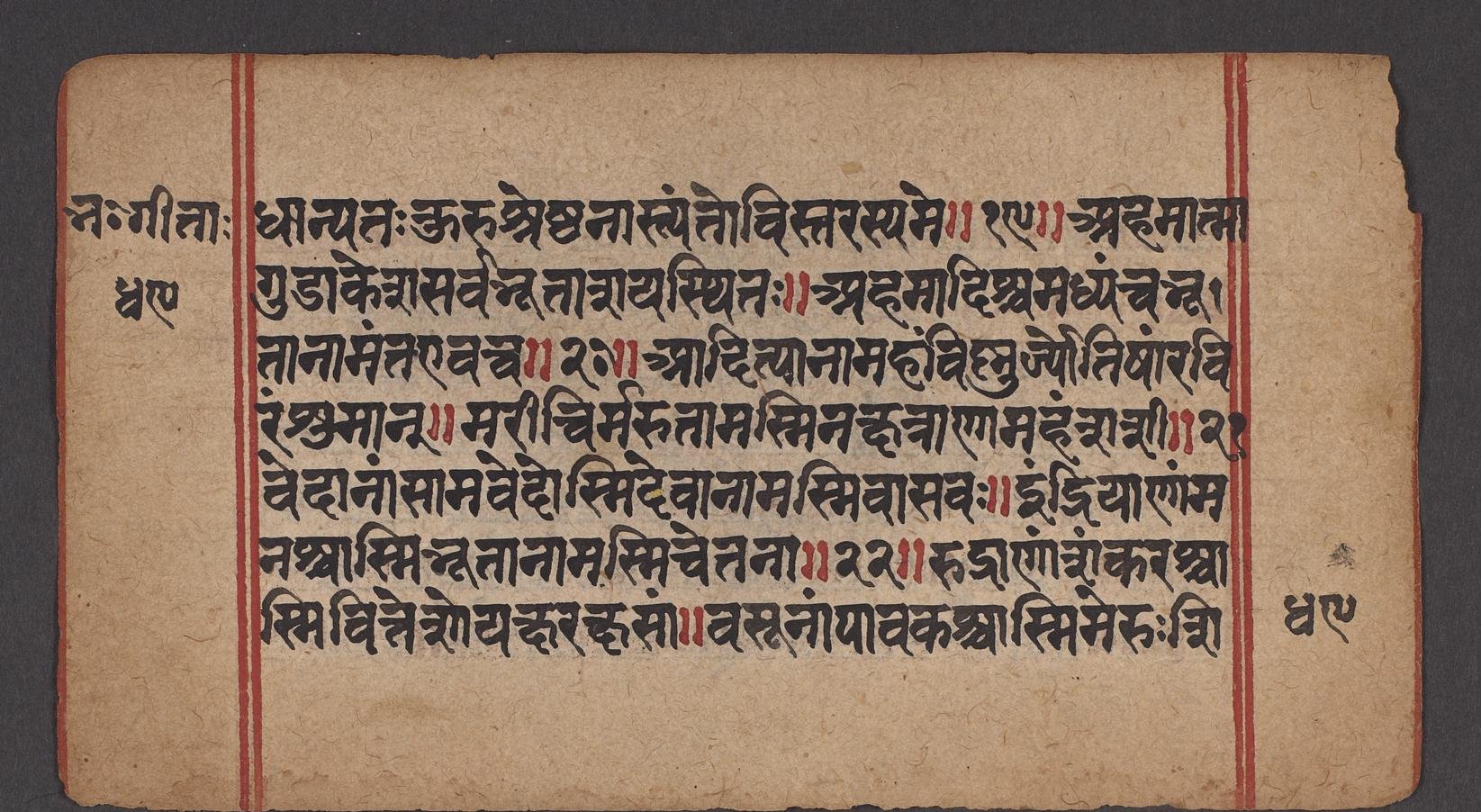
Where on the image
fol. 50v (catalogue label 49v =50v; the scribe repeated folio number 41), OPenn image 6555_0050 (upper leaf). Checked on the image: TEI '49v (=50v)'; ||19|| line 1 ... ||22|| line 6. Verse 10.19 begins on the previous page, fol. 50r, so both pages are shown.
19श्रीभगवानुवाच ।
हन्त ते कथयिष्यामि दिव्या ह्यात्मविभूतयः ।
प्राधान्यतः कुरुश्रेष्ठ नास्त्यन्तो विस्तरस्य मे ॥ १९ ॥
20अहमात्मा गुडाकेश सर्वभूताशयस्थितः ।
अहमादिश्च मध्यं च भूतानामन्त एव च ॥ २० ॥
21आदित्यानामहं विष्णुर्ज्योतिषां रविरंशुमान् ।
मरीचिर्मरुतामस्मि नक्षत्राणामहं शशी ॥ २१ ॥
22वेदानां सामवेदोऽस्मि देवानामस्मि वासवः ।
इन्द्रियाणां मनश्चास्मि भूतानामस्मि चेतना ॥ २२ ॥
19The Blessed Lord said:
Blessed be thou! I will declare to thee My divine glory by its chief characteristics, O best of the Kurus; there is no end to details of Me.
20I, O Gudakesha, am the Self, seated in the heart of all beings; I am the beginning, the middle, and also the end of all beings.
21Of the Adityas I am Vishnu; of radiances the glorious sun; I am Marîchi of the Maruts; of the asterisms the Moon am I.
22Of the Vedas I am the Sâma-Veda; I am Vâsava of the Shining Ones; and of the senses I am the mind; I am of living beings the intelligence.
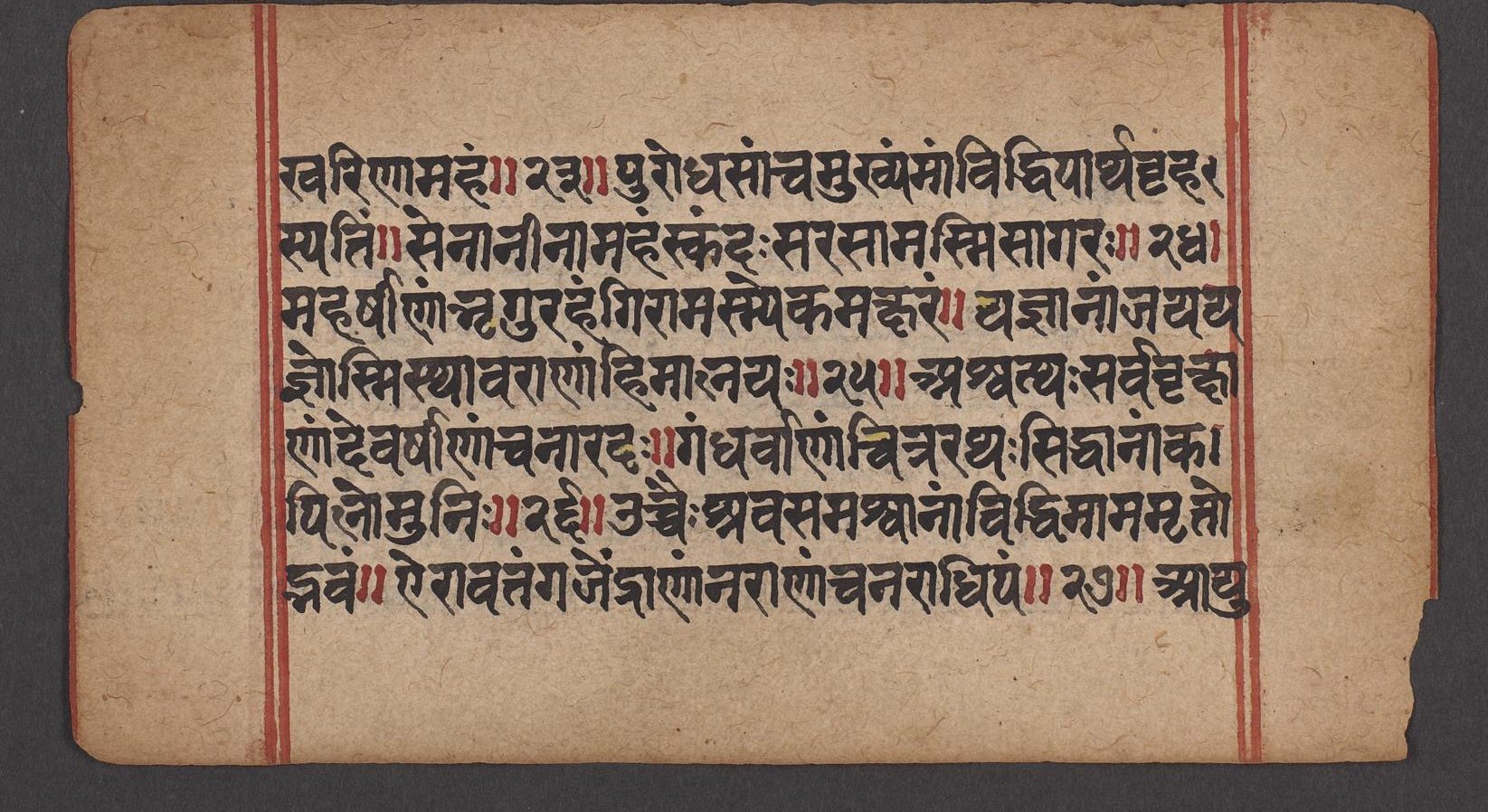
Where on the image
fol. 51r (catalogue label 50r =51r; the scribe repeated folio number 41), OPenn image 6555_0050 (lower leaf). Checked on the image: TEI '50r (=51r)'; ||23|| line 1 ... ||27|| line 7. Verse 10.23 begins on the previous page, fol. 50v, so both pages are shown.
23रुद्राणां शङ्करश्चास्मि वित्तेशो यक्षरक्षसाम् ।
वसूनां पावकश्चास्मि मेरुः शिखरिणामहम् ॥ २३ ॥
24पुरोधसां च मुख्यं मां विद्धि पार्थ बृहस्पतिम् ।
सेनानीनामहं स्कन्दः सरसामस्मि सागरः ॥ २४ ॥
25महर्षीणां भृगुरहं गिरामस्म्येकमक्षरम् ।
यज्ञानां जपयज्ञोऽस्मि स्थावराणां हिमालयः ॥ २५ ॥
26अश्वत्थः सर्ववृक्षाणां देवर्षीणां च नारदः ।
गन्धर्वाणां चित्ररथः सिद्धानां कपिलो मुनिः ॥ २६ ॥
27उच्चैःश्रवसमश्वानां विद्धि माममृतोद्भवम् ।
ऐरावतं गजेन्द्राणां नराणां च नराधिपम् ॥ २७ ॥
23And of the Rudras Shañkara am I; Vittesha of the Yakshas and Râkshasas; and of the Vasus I am Pâvaka; Meru of high mountains am I.
24And know Me, O Pârtha, of household priests the chief, Brihaspati: of generals I am Skanda; of lakes I am the ocean.
25Of the great Rishis Bhṛigu; of speech I am the one syllable; of sacrifices I am the sacrifice of silent repetitions; of immovable things the Himâlaya.
26Asvattha of all tree; and of divine Rishis Nârada; of Gandharvas Chitraratha; of the perfected the Muni Kapila.
27Uchchaishravas of horses know me, nectar-born; Airâvata of lordly elephants, and of men the Monarch.
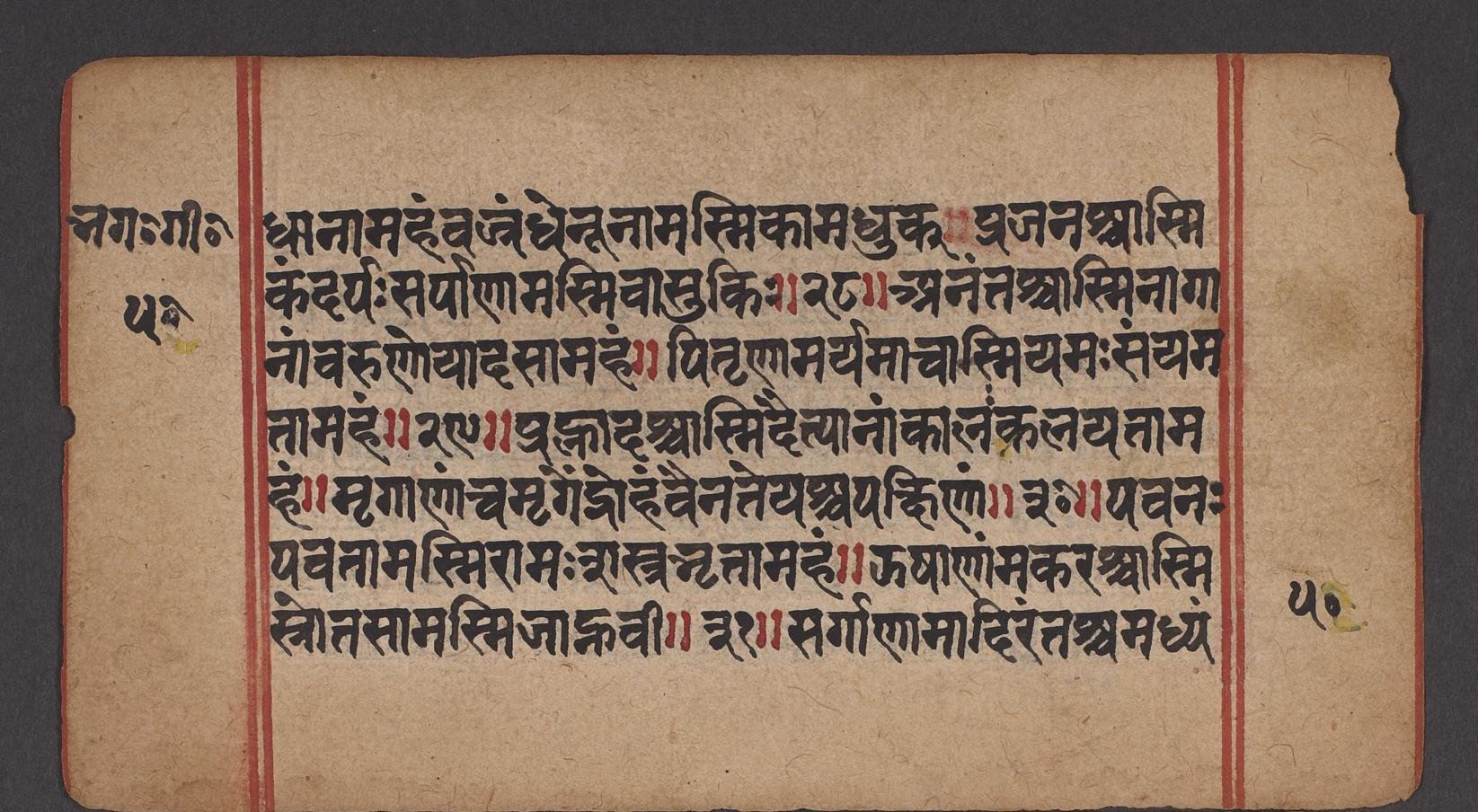
Where on the image
fol. 51v (catalogue label 50v =51v; the scribe repeated folio number 41), OPenn image 6555_0051 (upper leaf). Checked on the image: TEI '50v (=51v)'; ||28|| line 2 ... ||31|| line 7. Verse 10.28 begins on the previous page, fol. 51r, so both pages are shown.
28आयुधानामहं वज्रं धेनूनामस्मि कामधुक् ।
प्रजनश्चास्मि कन्दर्पः सर्पाणामस्मि वासुकिः ॥ २८ ॥
29अनन्तश्चास्मि नागानां वरुणो यादसामहम् ।
पितॄणामर्यमा चास्मि यमः संयमतामहम् ॥ २९ ॥
30प्रह्लादश्चास्मि दैत्यानां कालः कलयतामहम् ।
मृगाणां च मृगेन्द्रोऽहं वैनतेयश्च पक्षिणाम् ॥ ३० ॥
31पवनः पवतामस्मि रामः शस्त्रभृतामहम् ।
झषाणां मकरश्चास्मि स्रोतसामस्मि जाह्नवी ॥ ३१ ॥
28Of weapons I am the thunderbolt; of cows I am Kâmadhuk; I am Kandarpa of the progenitors; of serpents Vâsuki am I.
29And I am Ananta of Nâgas, Varuna of sea-dwellers I; and of ancestors Aryaman; Yama of governors am I.
30And I am Prahlâda of Daityas; of calculators Time am I; and of wild beasts I the imperial beast; and Vainateya of birds.
31Of purifiers I am the wind; Rama of warriors I; and I am Makara of fishes; of streams the Gangâ am I.
Where on the image
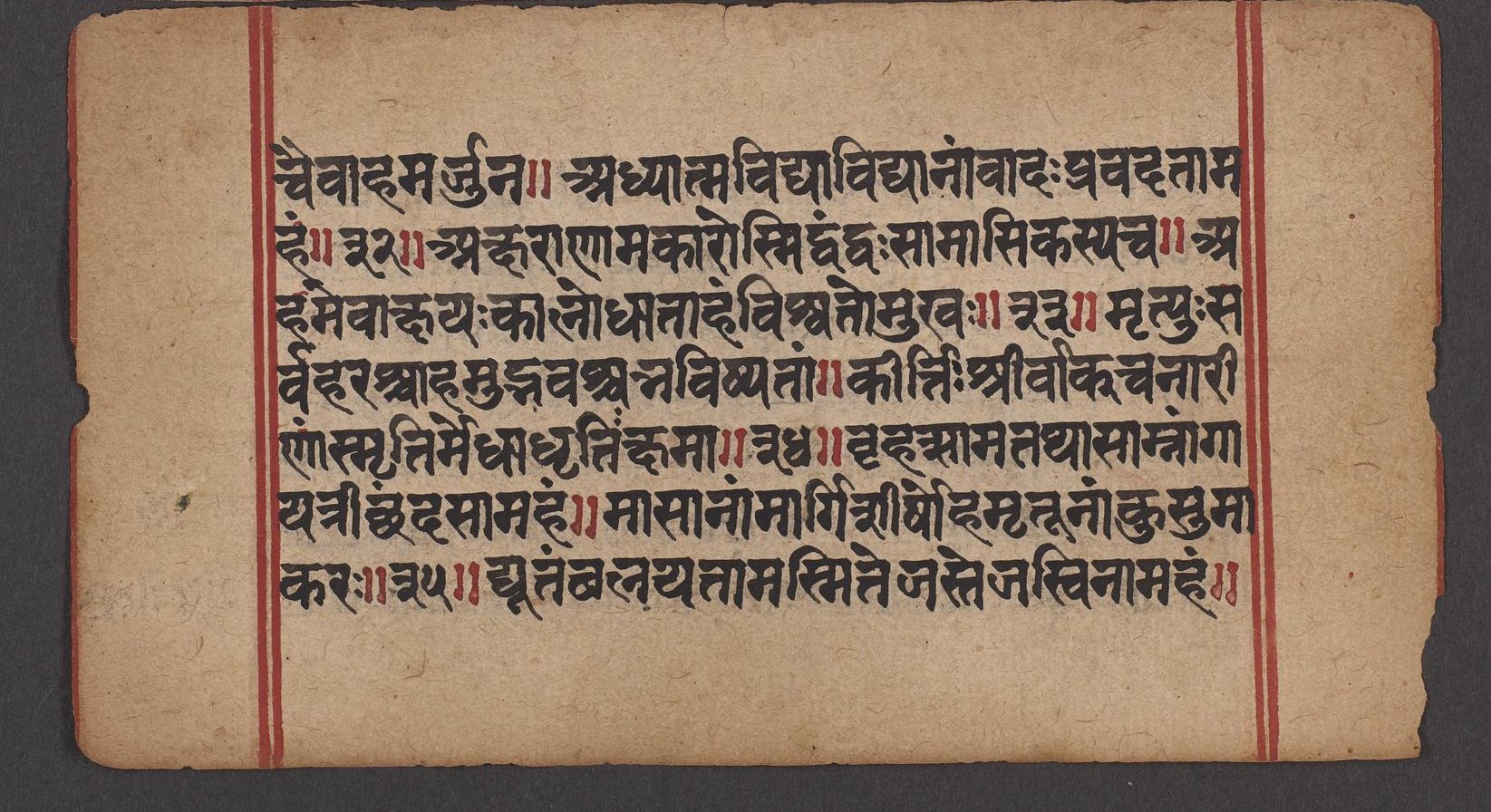
fol. 52r (catalogue label 51r =52r; the scribe repeated folio number 41), OPenn image 6555_0051 (lower leaf). Checked on the image: TEI '51r (=52r)'; ||32|| line 2 ... ||35|| line 7. Verse 10.32 begins on the previous page, fol. 51v, so both pages are shown.
32सर्गाणामादिरन्तश्च मध्यं चैवाहमर्जुन ।
अध्यात्मविद्या विद्यानां वादः प्रवदतामहम् ॥ ३२ ॥
33अक्षराणामकारोऽस्मि द्वन्द्वः सामासिकस्य च ।
अहमेवाक्षयः कालो धाताऽहं विश्वतोमुखः ॥ ३३ ॥
34मृत्युः सर्वहरश्चाहमुद्भवश्च भविष्यताम् ।
कीर्तिः श्रीर्वाक्च नारीणां स्मृतिर्मेधा धृतिः क्षमा ॥ ३४ ॥
35बृहत्साम तथा साम्नां गायत्री छन्दसामहम् ।
मासानां मार्गशीर्षोऽहमृतूनां कुसुमाकरः ॥ ३५ ॥
32Of creations the beginning and the ending, and also the middle am I, O Arjuna. Of sciences the science concerning the Self; the speech of orators I.
33Of letters the letter A I am, and the duality of a compound; I also everlasting Time; I the Supporter, whose face turns everywhere.
34And all-devouring Death am I, and the origin of all to come; and of feminine qualities, fame, prosperity, speech, memory, intelligence, constancy, forgiveness.
35Of hymns also Brihatsâman; Gâyatrî of metres am I; of months I am Mârgasîrsha; of seasons the flowery.
Where on the image
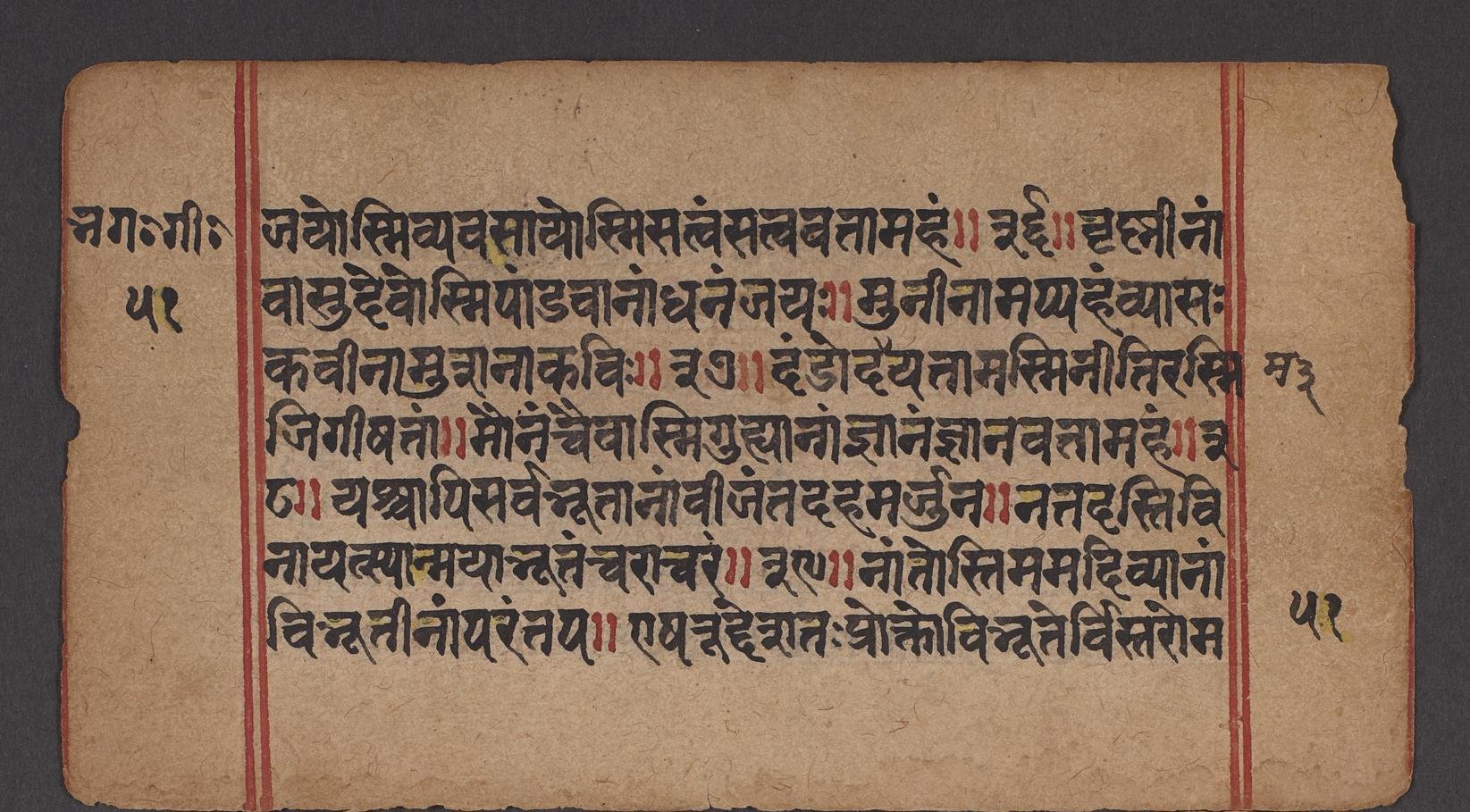
fol. 52v (catalogue label 51v =52v; the scribe repeated folio number 41), OPenn image 6555_0052 (upper leaf). Checked on the image: TEI '51v (=52v)'; ||36|| line 1 ... ||39|| line 6. Verse 10.36 begins on the previous page, fol. 52r, so both pages are shown.
36द्यूतं छलयतामस्मि तेजस्तेजस्विनामहम् ।
जयोऽस्मि व्यवसायोऽस्मि सत्त्वं सत्त्ववतामहम् ॥ ३६ ॥
37वृष्णीनां वासुदेवोऽस्मि पाण्डवानां धनञ्जयः ।
मुनीनामप्यहं व्यासः कवीनामुशना कविः ॥ ३७ ॥
38दण्डो दमयतामस्मि नीतिरस्मि जिगीषताम् ।
मौनं चैवास्मि गुह्यानां ज्ञानं ज्ञानवतामहम् ॥ ३८ ॥
39यच्चापि सर्वभूतानां बीजं तदहमर्जुन ।
न तदस्ति विना यत्स्यान्मया भूतं चराचरम् ॥ ३९ ॥
36I am the gambling of the cheat, and the splendour of splendid things I; I am victory, I am determination, and the truth of the truthful I.
37Of the Vṛishnis Vâsudeva am I; of the Pândavas Dhananjaya; of the Sages also I am Vyâsa; of poets Ushanâ the Bard.
38Of rulers I am the sceptre; of those that seek victory I am statesmanship; and of secrets I am also silence; the knowledge of knowers am I.
39And whatsoever is the seed of all beings, that am I, O Arjuna; nor is there aught, moving or unmoving, that may exist bereft of Me.
Where on the image
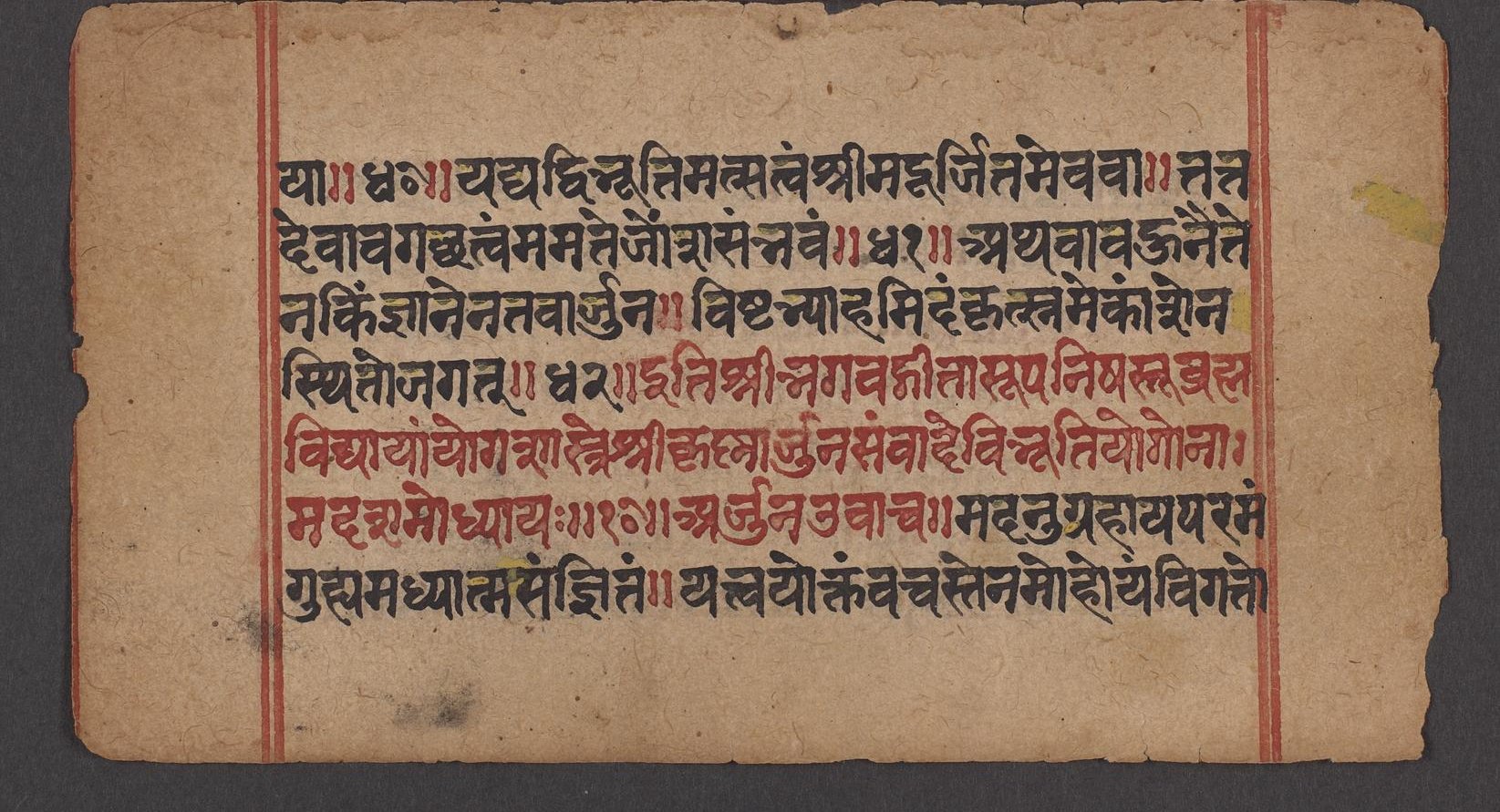
fol. 53r, OPenn image 6555_0052 (lower leaf). Checked on the image: TEI '53r'; ||40|| line 1, ||41|| line 2, ||42|| line 3; colophon lines 3-5 '... vibhūtiyogo nāma daśamo 'dhyāyaḥ ||10||'; arjuna uvāca line 5; 11.1 begins line 5. Verse 10.40 begins on the previous page, fol. 52v, so both pages are shown.
40नान्तोऽस्ति मम दिव्यानां विभूतीनां परन्तप ।
एष तूद्देशतः प्रोक्तो विभूतेर्विस्तरो मया ॥ ४० ॥
41यद्यद्विभूतिमत्सत्त्वं श्रीमदूर्जितमेव वा ।
तत्तदेवावगच्छ त्वं मम तेजोंऽशसम्भवम् ॥ ४१ ॥
42अथवा बहुनैतेन किं ज्ञातेन तवार्जुन ।
विष्टभ्याहमिदं कृत्स्नमेकांशेन स्थितो जगत् ॥ ४२ ॥
40There is no end of My divine powers, O Parantapa. What has been declared is illustrative of My infinite glory.
41Whatsoever is glorious, good, beautiful, and mighty, understand thou that to go forth from a fragment of My splendour.
42But what is the knowledge of all these details to thee, O Arjuna? Having pervaded this whole universe with one fragment of Myself, I remain.
Where on the image
fol. 53r: TEI '53r'; ||40|| line 1, ||41|| line 2, ||42|| line 3; colophon lines 3-5 '... vibhūtiyogo nāma daśamo 'dhyāyaḥ ||10||'; arjuna uvāca line 5; 11.1 begins line 5. The manuscript names the chapter vibhūtiyoga; the Sanskrit and English shown are the colophon printed in Besant's edition, whose wording differs in places from the manuscript's.
इति श्रीमद्भगवद्गीता॰ विभूतियोगो नाम दशमोऽध्यायः ।
Thus in the glorious Upanishads of the Bhagavad-Gita, the science of the Eternal, the scripture of Yoga, the dialogue between Shri Krishna and Arjuna, the tenth discourse, entitled: THE YOGA OF SOVEREIGNTY.
Notes
- Sanskrit and English: Annie Besant, The Bhagavad-Gita, 4th edition (Madras: G. A. Natesan, 1922), transcription validated on English Wikisource. Besant's footnotes are not reproduced.
- Verse numbers follow Besant and the manuscript, which agree throughout: chapter 13 counts Arjuna's opening question ('prakṛtiṃ puruṣaṃ caiva...') as verse 1, so it has 35 verses and the whole text 701.
- K. T. Telang's translation (Sacred Books of the East 8, 1882) was the first choice for the English, but it is continuous prose without verse divisions, so it cannot be matched to manuscript pages verse by verse; Besant's verse-numbered translation is used instead.
- The last section of each chapter is the chapter colophon. Besant prints most Sanskrit colophons in shortened form (marked with ॰) while her English gives the full formula; the manuscript writes the colophon out in full, and its chapter names differ in places from Besant's (see the scan note).
- In the Wikisource transcription of Besant's edition, the verse-number label is irregular at 10.31 (number missing in the transcription). The verses are counted in sequence and checked against the Sanskrit numbers, which are regular.
Cite
Sources
- Source: Penn Ms. Coll. 390 Item 559 (dated 1794) via OPenn + Sanskrit and English of Annie Besant, The Bhagavad-Gita (4th ed. 1922), Wikisource (holding institution)
- Critical edition: Annie Besant, The Bhagavad-Gita, 4th ed. (1922), Sanskrit text, via Wikisource
← previous · → next · v cycle view · l back to library