Bhagavad Gita, Chapter 14: The Yoga of Separation from the Three Qualities
Introduction
The Bhagavad Gita ("Song of the Lord") is a dialogue of 700 verses between the prince Arjuna and Krishna, set on the battlefield of Kurukshetra in book 6 (Bhishmaparvan) of the Mahabharata. Its date of composition is debated; many scholars place it in the last centuries BCE. This is chapter 14, The Yoga of Separation from the Three Qualities (27 verses as numbered in the manuscript and in Besant's edition).
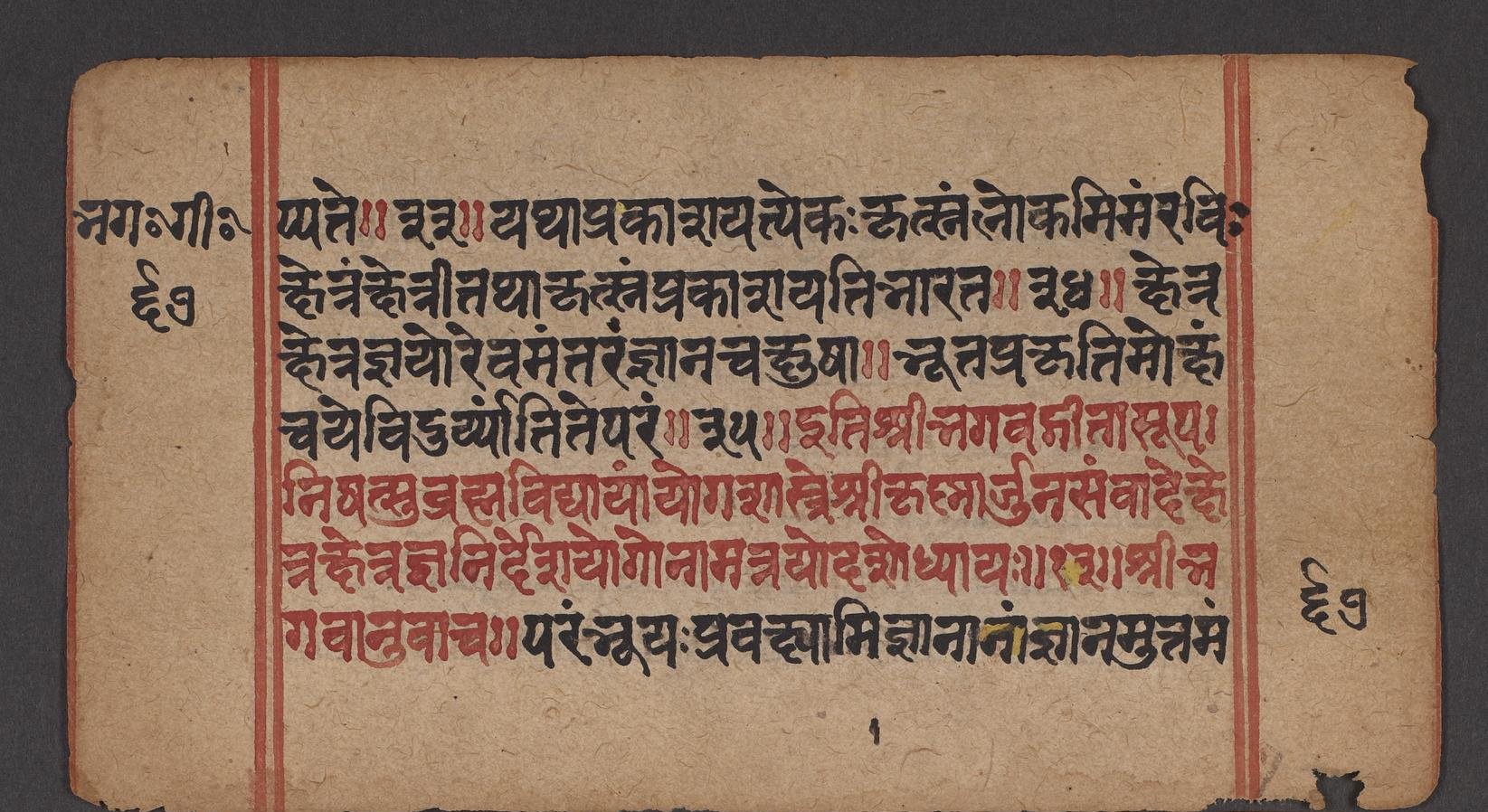
The pages shown are from a complete Sanskrit manuscript of the Gita at the University of Pennsylvania (Penn Ms. Coll. 390 Item 559), 90 paper leaves of 7 lines in Devanagari, with speaker headings, colophons and verse-end marks in red. Its final colophon (fol. 90r) dates the copy to Saṃvat 1851, the third day of the bright half of Caitra (1794 CE). Chapter 14 runs from fol. 67v to the chapter colophon on fol. 71r.
Each section below is one manuscript page: the verses whose text ends on that page, located by reading the scribe's verse numbers and the first and last words on the image. When a verse begins at the foot of one page and ends on the next, both pages are shown. The Sanskrit and English are from Annie Besant's edition and translation (4th edition, 1922), which prints each verse in Devanagari with its English; the manuscript's spelling differs from the printed text in small details.
How was this verified? (Provenance)
Where on the image
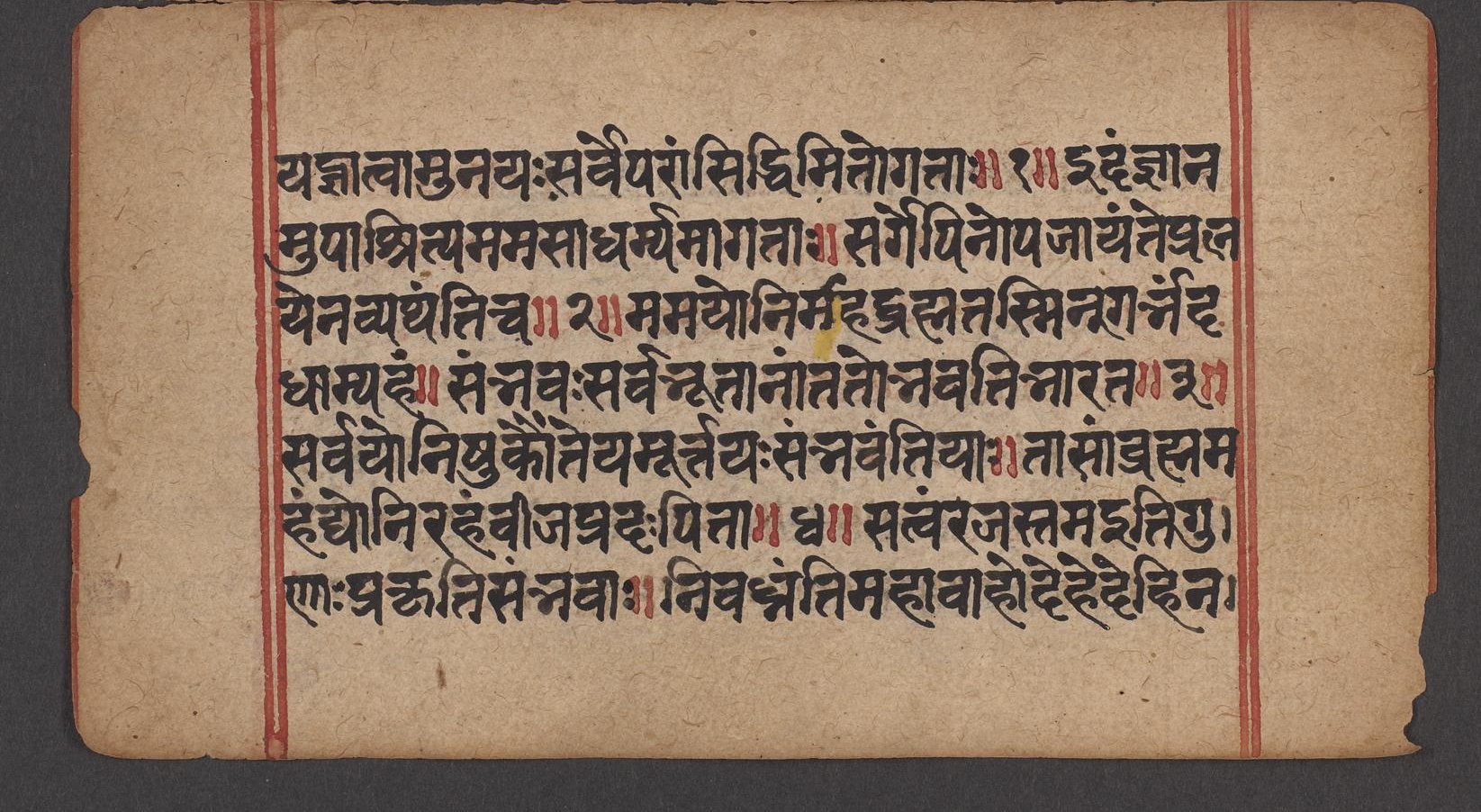
fol. 68r, OPenn image 6555_0067 (lower leaf). Checked on the image: ||1|| line 1 ... ||4|| line 6. Verse 14.1 begins on the previous page, fol. 67v, so both pages are shown.
1श्रीभगवानुवाच ।
परं भूयः प्रवक्ष्यामि ज्ञानानां ज्ञानमुत्तमम् ।
यज्ज्ञात्वा मुनयः सर्वे परां सिद्धिमितो गताः ॥ १ ॥
2इदं ज्ञानमुपाश्रित्य मम साधर्म्यमागताः ।
सर्गेऽपि नोपजायन्ते प्रलये न व्यथन्ति च ॥ २ ॥
3मम योनिर्महद्ब्रह्म तस्मिन् गर्भं दधाम्यहम् ।
सम्भवः सर्वभूतानां ततो भवति भारत ॥ ३ ॥
4सर्वयोनिषु कौन्तेय मूर्तयः संभवन्ति याः ।
तासां ब्रह्म महद्योनिरहं बीजप्रदः पिता ॥ ४ ॥
1The Blessed Lord said:
I will again proclaim that supreme Wisdom, of all wisdom the best, which having known, all the Sages have gone hence to the supreme Perfection.
2Having taken refuge in this Wisdom and being assimilated to My own nature, they are not re-born even in the emanation of a universe, nor are disquieted in the dissolution.
3My womb is the great Eternal; in that I place the germ; thence cometh the birth of all beings, O Bhârata.
4In whatsoever wombs mortals are produced, O Kaunteya, the great Eternal is their womb, I their generating father.
Where on the image
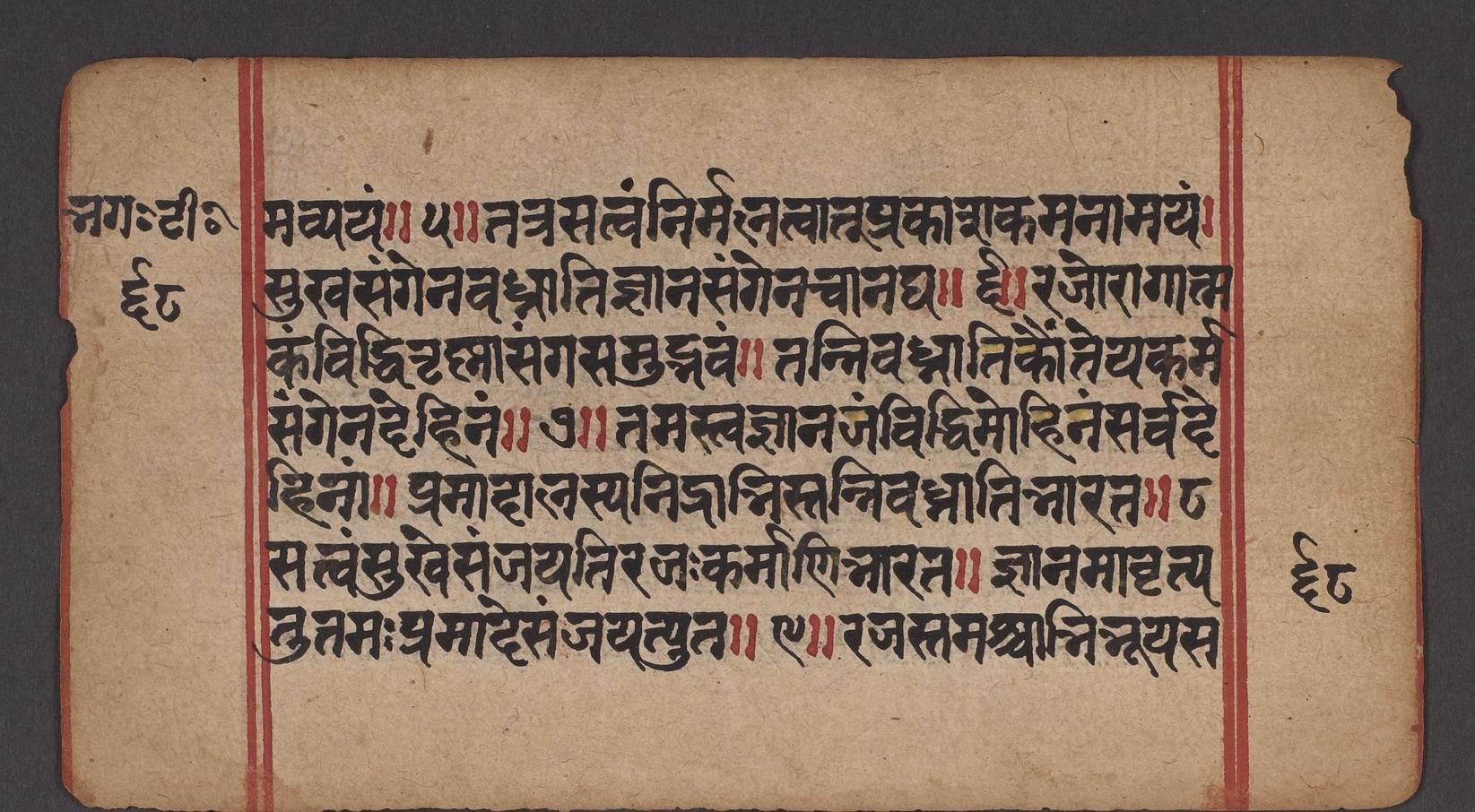
fol. 68v, OPenn image 6555_0068 (upper leaf). Checked on the image: ||5|| line 1 ... ||9|| line 7. Verse 14.5 begins on the previous page, fol. 68r, so both pages are shown.
5सत्त्वं रजस्तम इति गुणाः प्रकृतिसंभवाः ।
निबध्नन्ति महाबाहो देहे देहिनमव्ययम् ॥ ५ ॥
6तत्र सत्त्वं निर्मलत्वात्प्रकाशकमनामयम् ।
सुखसङ्गेन बध्नाति ज्ञानसङ्गेन चानघ ॥ ६ ॥
7रजो रागात्मकं विद्धि तृष्णासङ्गसमुद्भवम् ।
तन्निबध्नाति कौन्तेय कर्मसङ्गेन देहिनम् ॥ ७ ॥
8तमस्त्वज्ञानजं विद्धि मोहनं सर्वदेहिनाम् ।
प्रमादालस्यनिद्राभिस्तन्निबध्नाति भारत ॥ ८ ॥
9सत्त्वं सुखे सञ्जयति रजः कर्मणि भारत ।
ज्ञानमावृत्य तु तमः प्रमादे सञ्जयत्युत ॥ ९ ॥
5Harmony, Motion, Inertia, such are the qualities, Matter-born; they bind fast in the body, O great-armed one, the indestructible dweller in the body.
6Of these Harmony from its stainlessness, luminous and healthy, bindeth by the attachment to bliss and the attachment to wisdom, O sinless one.
7Motion, the passion nature, know thou, is the source of attachment and thirst for life, O Kaunteya, that bindeth the dweller in the body by the attachment to action.
8But Inertia, know thou, born of unwisdom, is the deluder of all dwellers in the body; that bindeth by heedlessness, indolence and sloth, O Bharata.
9Harmony attacheth to bliss, Motion to action O Bharata. Inertia, verily, having shrouded wisdom, attacheth on the contrary to heedlessness.
Where on the image
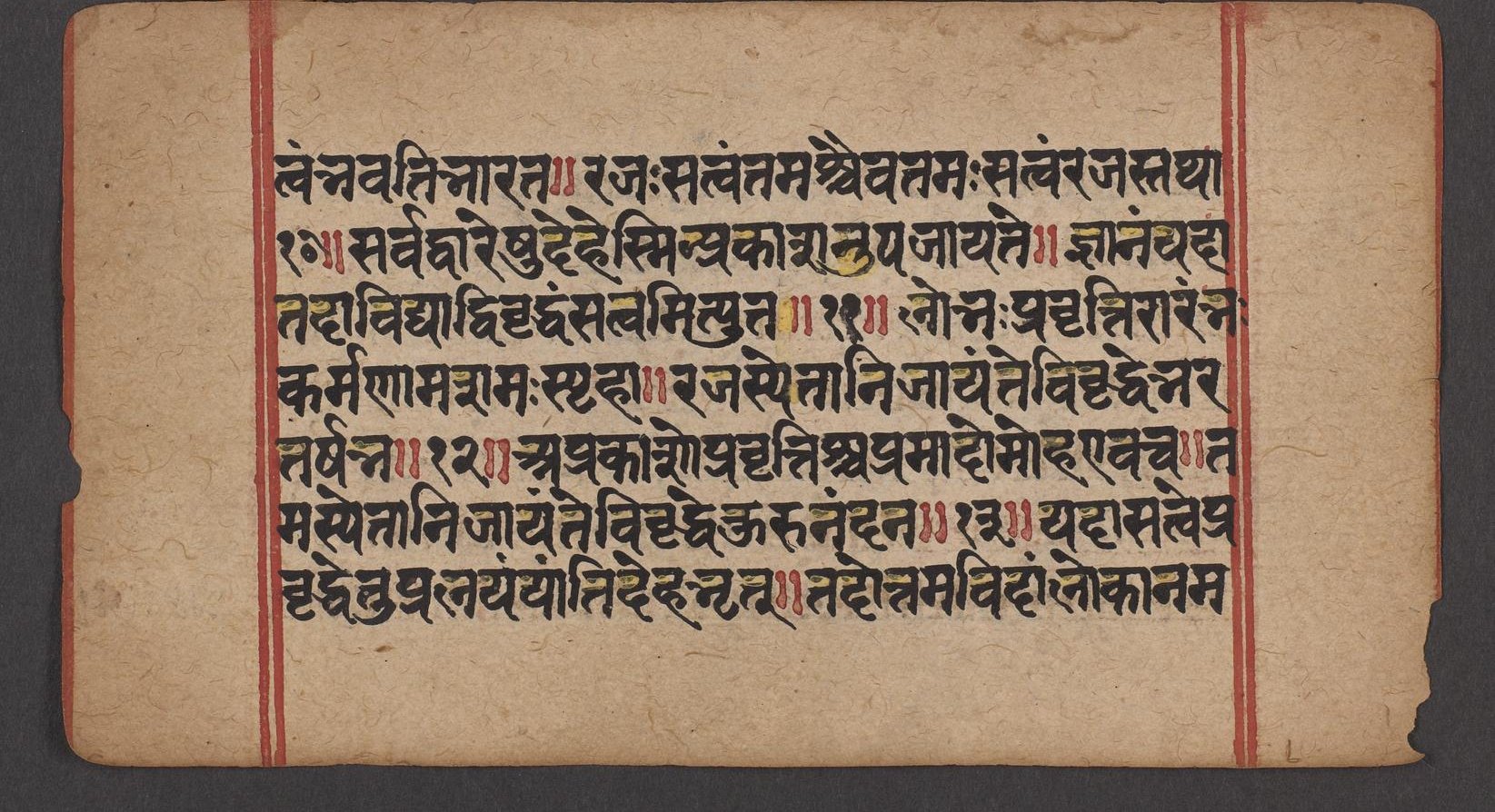
fol. 69r, OPenn image 6555_0068 (lower leaf). Checked on the image: ||10|| line 2 ... ||13|| line 6. Verse 14.10 begins on the previous page, fol. 68v, so both pages are shown.
10रजस्तमश्चाभिभूय सत्त्वं भवति भारत ।
रजः सत्त्वं तमश्चैव तमः सत्त्वं रजस्तथा ॥ १० ॥
11सर्वद्वारेषु देहेऽस्मिन्प्रकाश उपजायते ।
ज्ञानं यदा तदा विद्याद्विवृद्धं सत्त्वमित्युत ॥ ११ ॥
12लोभः प्रवृत्तिरारंभः कर्मणामशमः स्पृहा ।
रजस्येतानि जायन्ते विवृद्धे भरतर्षभ ॥ १२ ॥
13अप्रकाशोऽप्रवृत्तिश्च प्रमादो मोह एव च ।
तमस्येतानि जायन्ते विवृद्धे कुरुनन्दन ॥ १३ ॥
10Now Harmony prevaileth, having overpowered Motion and Inertia, O Bhârata; now Motion, having overpowered Harmony and Inertia; and now Inertia, having overpowered Harmony and Motion.
11When the wisdom-light streameth forth from all the gates of the body, then it may be known that Harmony is increasing.
12Greed, outgoing energy, undertaking of actions, restlessness, desire—these are born of the increase of Motion, O best of the Bhâratas.
13Darkness, stagnation and heedlessness and also delusion—these are born of the increase of Inertia, O joy of the Kurus.
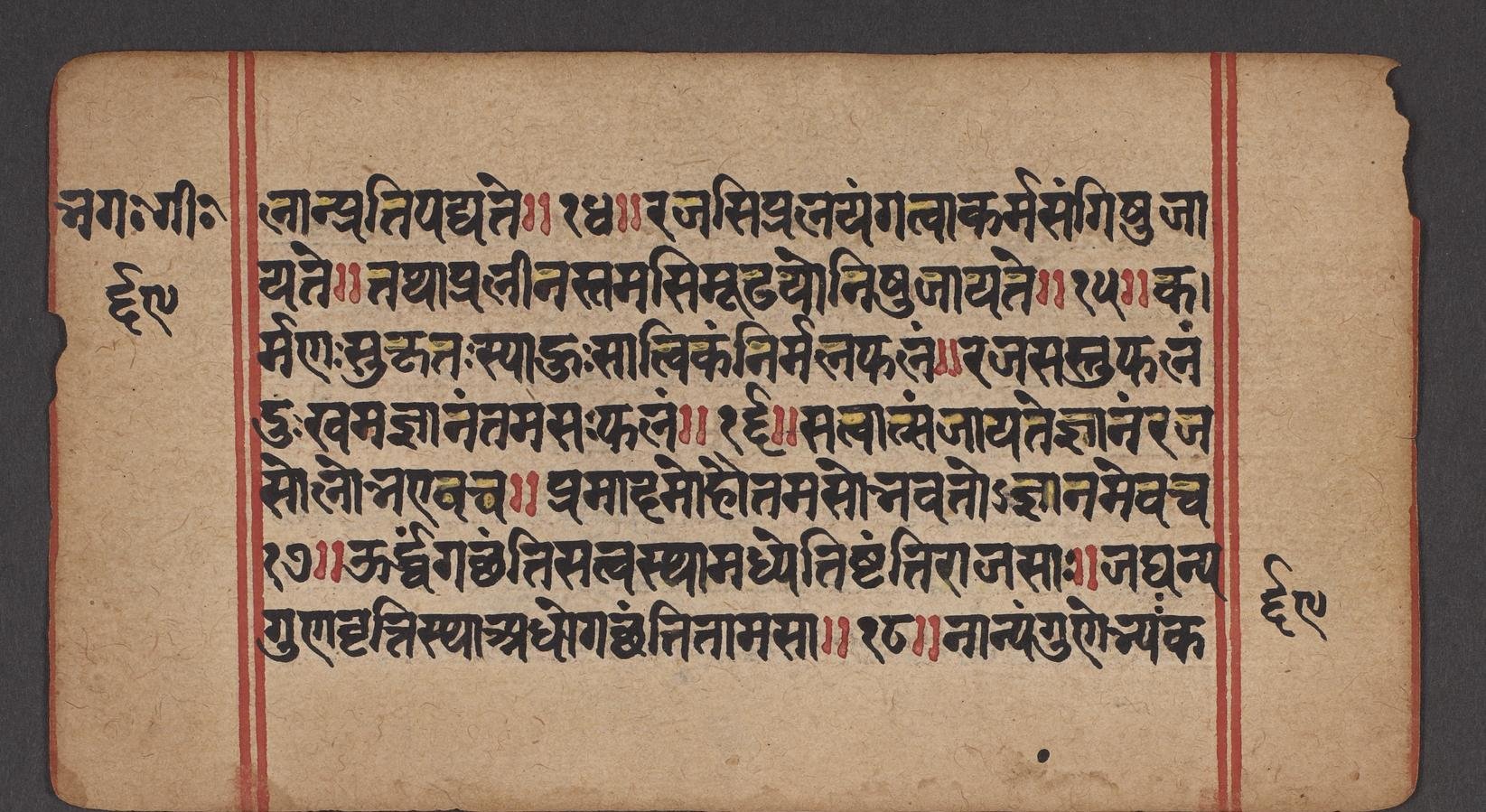
Where on the image
fol. 69v, OPenn image 6555_0069 (upper leaf). Checked on the image: ||14|| line 1 ... ||18|| line 7. Verse 14.14 begins on the previous page, fol. 69r, so both pages are shown.
14यदा सत्त्वे प्रवृद्धे तु प्रलयं याति देहभृत् ।
तदोत्तमविदां लोकानमलान्प्रतिपद्यते ॥ १४ ॥
15रजसि प्रलयं गत्वा कर्मसङ्गिषु जायते ।
तथा प्रलीनस्तमसि मूढयोनिषु जायते ॥ १५ ॥
16कर्मणः सुकृतस्याहुः सात्त्विकं निर्मलं फलम् ।
रजसस्तु फलं दुःखमज्ञानं तमसः फलम् ॥ १६ ॥
17सत्त्वात्सञ्जायते ज्ञानं रजसो लोभ एव च ।
प्रमादमोहौ तमसो भवतोऽज्ञानमेव च ॥ १७ ॥
18ऊर्ध्वं गच्छन्ति सत्त्वस्था मध्ये तिष्ठन्ति राजसाः ।
जघन्यगुणवृत्तिस्था अधो गच्छन्ति तामसाः ॥ १८ ॥
14If Harmony verily prevaileth when the embodied goeth to dissolution, then he goeth forth to the spotless worlds of the great Sages.
15Having gone to dissolution in Motion, he is born among those attached to action; if dissolved in Inertia, he is born in the wombs of the senseless.
16It is said the fruit of a good action is harmonious and spotless; verily the fruit of Motion is pain, and the fruit of Inertia unwisdom
17From Harmony wisdom is born, and also greed from Motion; heedlessness and delusion are of Inertia and also unwisdom.
18They rise upwards who are settled in Harmony; the Active dwell in the mid-most place: the Inert go downwards, enveloped in the vilest
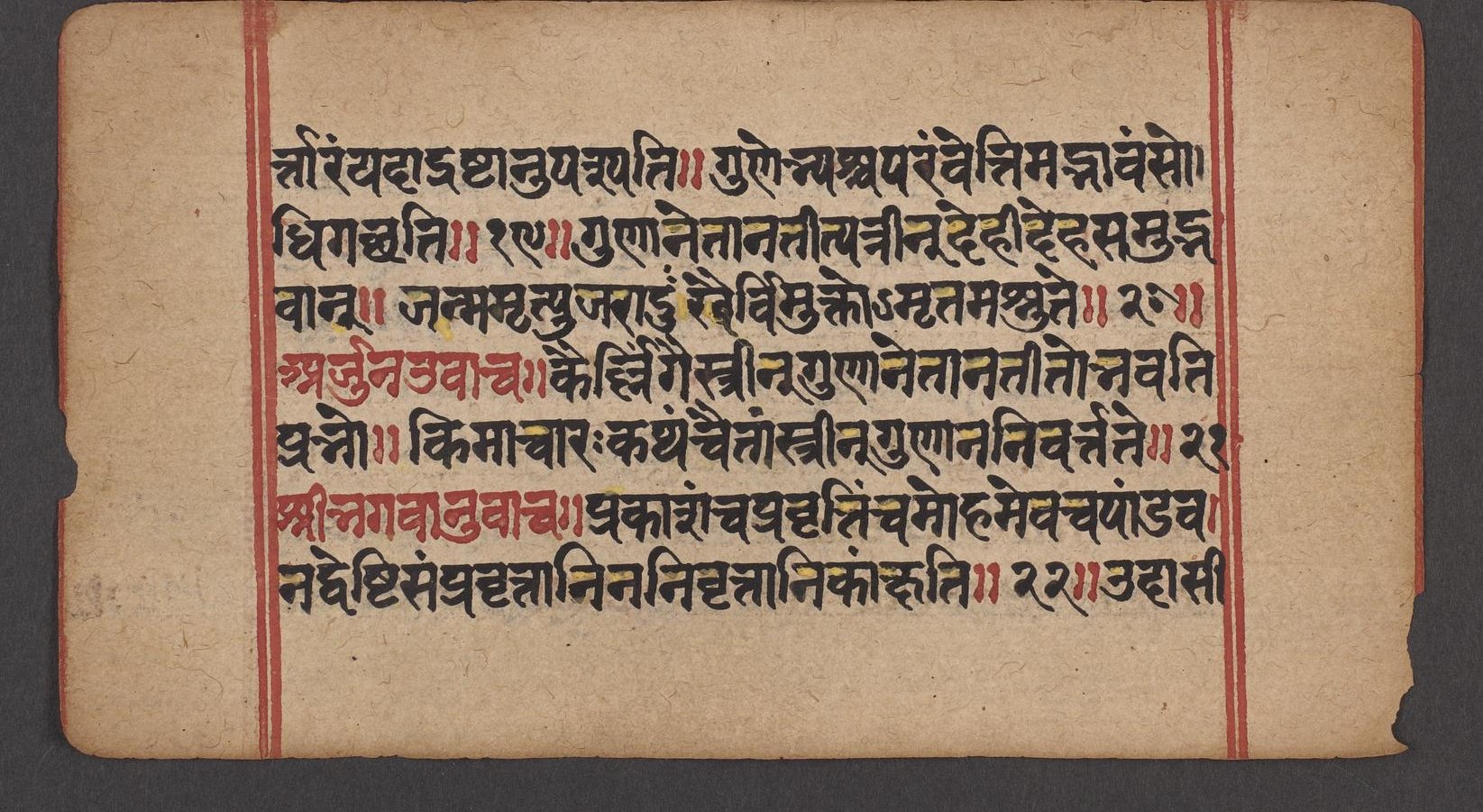
Where on the image
fol. 70r, OPenn image 6555_0069 (lower leaf). Checked on the image: ||19|| line 2 ... ||22|| line 7. Verse 14.19 begins on the previous page, fol. 69v, so both pages are shown.
19नान्यं गुणेभ्यः कर्तारं यदा द्रष्टाऽनुपश्यति ।
गुणेभ्यश्च परं वेत्ति मद्भावं सोऽधिगच्छति ॥ १९ ॥
20गुणानेतानतीत्य त्रीन्देही देहसमुद्भवान् ।
जन्ममृत्युजरादुःखैर्विमुक्तोऽमृतमश्नुते ॥ २० ॥
21अर्जुन उवाच ।
कैर्लिङ्गैस्त्रीन्गुणानेतानतीतो भवति प्रभो ।
किमाचारः कथं चैतांस्त्रीन्गुणानतिवर्तते ॥ २१ ॥
22श्रीभगवानुवाच ।
प्रकाशं च प्रवृत्तिं च मोहमेव च पाण्डव ।
न द्वेष्टि संप्रवृत्तानि न निवृत्तानि काङ्क्षति ॥ २२ ॥
19When the Seer perceiveth no agent other than the qualities, and knoweth That which is higher than the qualities, he entereth into My Nature.
20When the dweller in the body hath crossed over these three qualities, whence all bodies have been produced, liberated from birth, death, old age and sorrow, he drinketh the nectar of immortality.
21Arjuna said:
What are the marks of him who hath crossed over the three qualities, O Lord? How acteth he, and how doth he go beyond these three qualities?
22The Blessed Lord said:
He, O Pândava, who hateth not radiance, nor outgoing energy, nor even delusion, when present, nor longeth after them, absent;
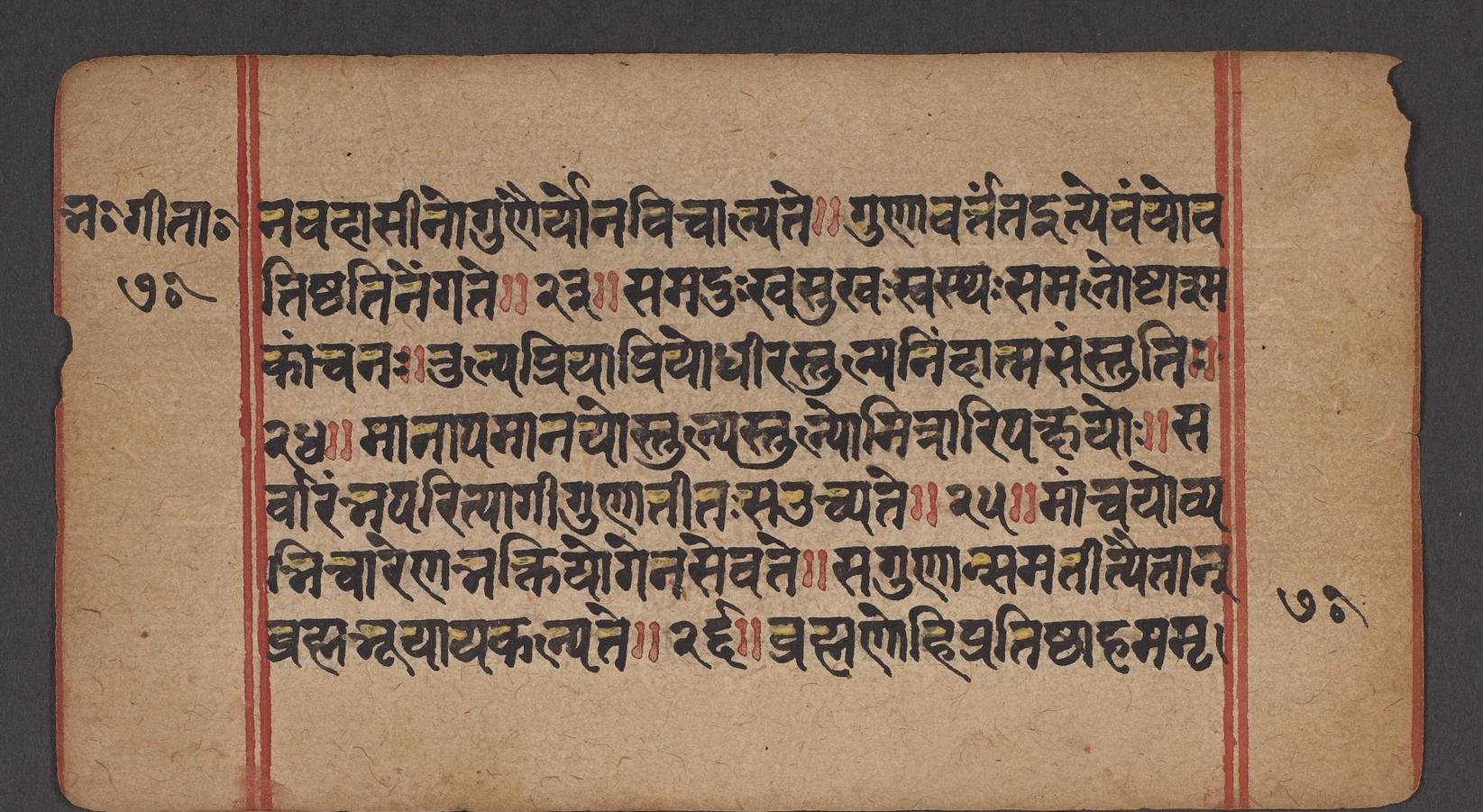
Where on the image
fol. 70v, OPenn image 6555_0070 (upper leaf). Checked on the image: ||23|| line 2 ... ||26|| line 7. Verse 14.23 begins on the previous page, fol. 70r, so both pages are shown.
23उदासीनवदासीनो गुणैर्यो न विचाल्यते ।
गुणा वर्तन्त इत्येव योऽवतिष्ठति नेङ्गते ॥ २३ ॥
24समदुःखसुखः स्वस्थः समलोष्टाश्मकाञ्चनः ।
तुल्यप्रियाप्रियो धीरस्तुल्यनिन्दात्मसंस्तुतिः ॥ २४ ॥
25मानापमानयोस्तुल्यस्तुल्यो मित्रारिपक्षयोः ।
सर्वारंभपरित्यागी गुणातीतः स उच्यते ॥ २५ ॥
26मां च योऽव्यभिचारेण भक्तियोगेन सेवते ।
स गुणान्समतीत्यैतान् ब्रह्मभूयाय कल्पते ॥ २६ ॥
23He who, seated as a neutral, is unshaken by the qualities; who, saying, "The qualities revolve," standeth apart immovable.
24Balanced in pleasure and pain, self-reliant, to whom a lump of earth, a rock and gold are alike, the same to loved and unloved, firm, the same in censure and in praise,
25The same in honour and ignominy, the same to friend and foe, abandoning all undertakings—he is said to have crossed over the qualities.
26And he who serveth Me exclusively by the Yoga of devotion, he, crossing beyond the qualities, he is fit to become the Eternal.
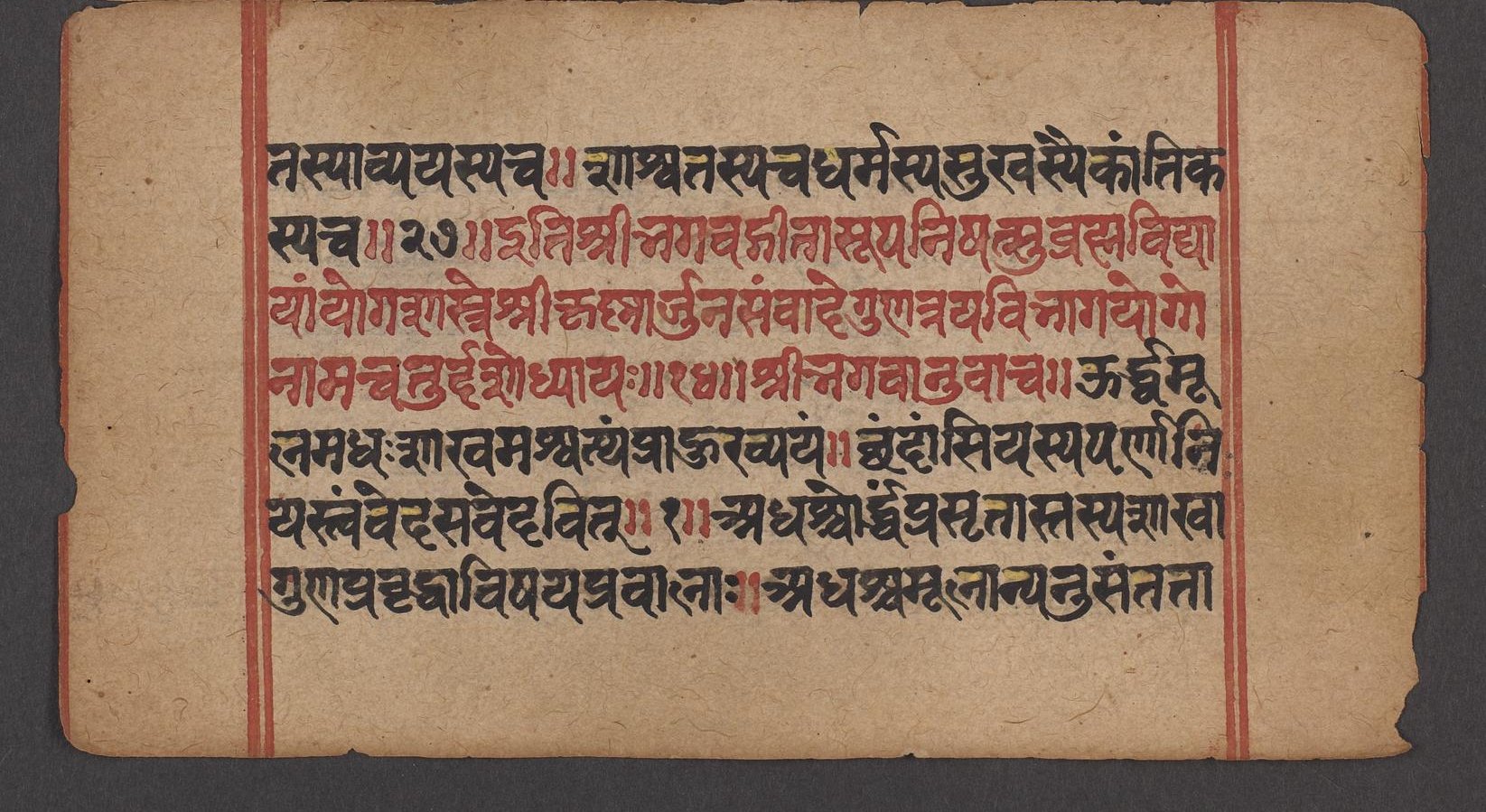
Where on the image
fol. 71r, OPenn image 6555_0070 (lower leaf). Checked on the image: ||27|| line 2; colophon lines 2-4 '... guṇatrayavibhāgayogo nāma caturdaśo 'dhyāyaḥ ||14||'; śrībhagavān uvāca line 4; 15.1 ends line 6 (||1||), 15.2 begins line 6. Verse 14.27 begins on the previous page, fol. 70v, so both pages are shown.
27ब्रह्मणो हि प्रतिष्ठाऽहममृतस्याव्ययस्य च ।
शाश्वतस्य च धर्मस्य सुखस्यैकान्तिकस्य च ॥ २७ ॥
27For I am the abode of the Eternal, and of the indestructible nectar of immortality, of immemorial righteousness, and of unending bliss.
Where on the image
fol. 71r: ||27|| line 2; colophon lines 2-4 '... guṇatrayavibhāgayogo nāma caturdaśo 'dhyāyaḥ ||14||'; śrībhagavān uvāca line 4; 15.1 ends line 6 (||1||), 15.2 begins line 6. The manuscript names the chapter guṇatrayavibhāgayoga; the Sanskrit and English shown are the colophon printed in Besant's edition, whose wording differs in places from the manuscript's.
इति श्रीमद्भगवद्गीता॰ गुणत्रयविभागयोगो नाम चतुर्दशोऽध्यायः ।
Thus in the glorious Upanishads of the Bhagavad-Gita, the science of the Eternal, the scripture of Yoga, the dialogue between Shri Krishna and Arjuna, the fourteenth discourse entitled: THE YOGA OF SEPARATION FROM THE THREE QUALITIES.
Notes
- Sanskrit and English: Annie Besant, The Bhagavad-Gita, 4th edition (Madras: G. A. Natesan, 1922), transcription validated on English Wikisource. Besant's footnotes are not reproduced.
- Verse numbers follow Besant and the manuscript, which agree throughout: chapter 13 counts Arjuna's opening question ('prakṛtiṃ puruṣaṃ caiva...') as verse 1, so it has 35 verses and the whole text 701.
- K. T. Telang's translation (Sacred Books of the East 8, 1882) was the first choice for the English, but it is continuous prose without verse divisions, so it cannot be matched to manuscript pages verse by verse; Besant's verse-numbered translation is used instead.
- The last section of each chapter is the chapter colophon. Besant prints most Sanskrit colophons in shortened form (marked with ॰) while her English gives the full formula; the manuscript writes the colophon out in full, and its chapter names differ in places from Besant's (see the scan note).
Cite
Sources
- Source: Penn Ms. Coll. 390 Item 559 (dated 1794) via OPenn + Sanskrit and English of Annie Besant, The Bhagavad-Gita (4th ed. 1922), Wikisource (holding institution)
- Critical edition: Annie Besant, The Bhagavad-Gita, 4th ed. (1922), Sanskrit text, via Wikisource
← previous · → next · v cycle view · l back to library