Book of the Dead, Spell 1: The beginning of the spells of going forth by day (the funeral) (papyrus of Iuefankh)
Introduction
The Book of the Dead, in Egyptian the spells for going forth by day, is a collection of funerary spells written on papyrus rolls and placed in burials from the New Kingdom to the Roman period. Each roll was made for one person, with spells taken from a large repertoire and illustrated with drawings (vignettes). This library gives one complete roll: the papyrus of Iuefankh in the Museo Egizio, Turin (Cat. 1791), written in the Ptolemaic period (332-30 BCE) and coming from Thebes. Richard Lepsius published it in 1842 and divided it into 165 chapters; his numbering is still the standard numbering of the spells, and it is used here.
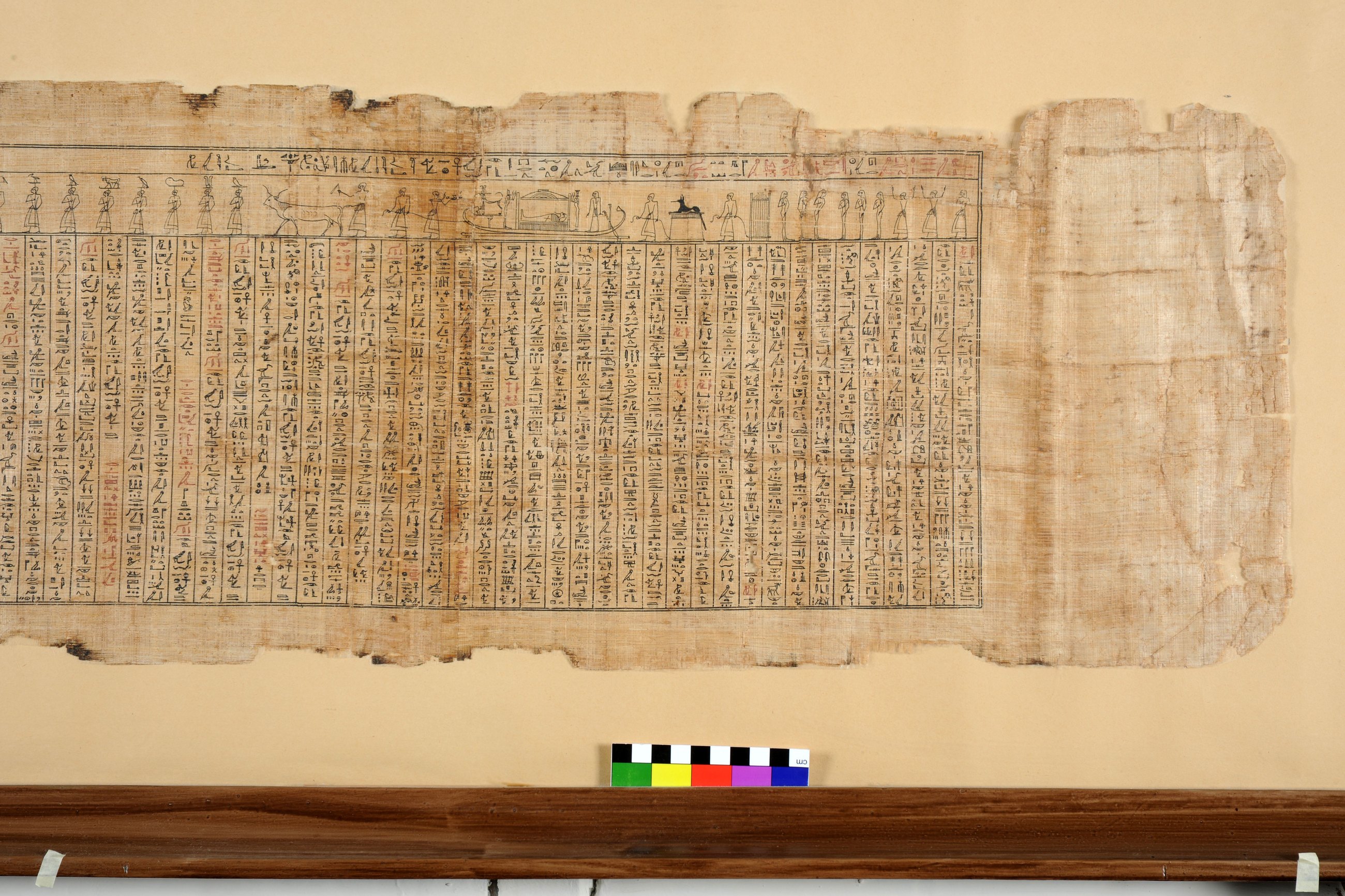
Spell 1 (Birch: 'The Beginning of the Chapters of the coming forth from [or as] the Day of bearing the Dead [Spirits] in [Karneter] Hades, said the Day of the Funeral going in after coming forth, by the Osiris deceased.') is on Lepsius's plates I-II and on photograph 1 of the 31 Museo Egizio photographs of the roll.
The Egyptian is the transliteration of the Thesaurus Linguae Aegyptiae (edition by Burkhard Backes), with the column number of the spell before each column; the numbers are those of Lepsius's plates. On the papyrus the text runs in vertical columns of cursive hieroglyphs from right to left along the roll; titles and some words are written in red. Signs restored by the editor are in square brackets, signs the scribe left out in angle brackets, superfluous signs in braces and damaged signs in half brackets. The English is the translation by Samuel Birch, published in 1867 and made from Lepsius's copy of this papyrus, so the English and the Egyptian come from the same manuscript. It was the first complete English translation of the Book of the Dead; many passages are now understood differently. Birch's own square brackets give his alternatives and explanations. The photographs are by the Museo Egizio; each shows a stretch of the roll, and the note of each section says where the spell stands on it.
How was this verified? (Provenance)
Where on the image
Turin 1791, Spell 1 (TLA Tb 001: title line, columns 1-24; Lepsius 1842, pl. I-II). Photograph 1 of 31 (Commons Book_of_the_Dead_of_Iuefankh,_papyrus_-_Museo_Egizio_Turin_C_1791_p034.jpg): the inscribed area begins at 72% (the right part of the photograph is the blank start of the roll); Spell 1 stands under the long title line and the vignette of the funeral procession (the boat with the mummy drawn by oxen, Anubis, the mourning women), as on Lepsius pl. I-II. Checked by eye: the photographs were matched to Lepsius's plates by their vignettes, red titles and framed compartments, and the overlapping edges of neighbouring photographs were compared.
titleḥꜣ,t-ꜥ〈,w〉-m rʾ.pl n.w pri̯〈.t〉 m hrw sṯz[,pl] sꜣḫ.w m ẖr,t-nṯr ḏd =tw hrw q{r}js ꜥq m-ḫt pri̯.t jn Wsjr […] mꜣꜥ-ḫrw
1j Wsjr kꜣ-jmn,tt j.n Ḏḥw,tj nswt n nḥḥ jnk nṯr-ꜥꜣ r-gs dp,t-nṯr ꜥḥꜣ.n =j ḥr =k jnk wꜥ,w m nn n nṯr.pl ḏꜣḏꜣ,t smꜣꜥ-ḫrw
2Wsjr r ḫfti̯.pl =f hrw pwy n wḏꜥ-md,t n-wj wnḏw.w〈,t〉 =k Wsjr jnk wꜥ,w m nn n nṯr.pl ms.w Nw,t smꜣ ḫfti̯.pl
3n.w wrḏ,w-jb ḫnj sbj.pl ḥr =s!! n-wj wnḏw.w〈,t〉 =k Ḥr,w ꜥḥꜣ.n =j ḥr =k zbj.n =j ḥr rn =k jnk Ḏḥwtj smꜣꜥ-ḫrw
4Ḥr,w r ḫfti̯.pl =f hrw pwy n wḏꜥ-md,t m ḥw,t-sr wr m Jwn,w jnk ḏd〈,wj〉 zꜣ ḏd〈,wj〉 jwr.w =j m Ḏd,w msi̯.w =j
5m Ḏd,w{t} wnn =j r-ḥnꜥ ḥꜣ,y〈t〉du Wsjr j〈ꜣ〉kb.w〈t〉 ḥr Wsjr m jdb,pl-rḫt smꜣꜥ-ḫrw Wsjr r ḫfti̯.pl =f {ḫsf}〈ḫrw-fj〉 sw Rꜥ,w n Ḏḥw,tj smꜣꜥ-ḫrw Wsjr r ḫfti̯.pl =f
6{ḫsf}〈ḫrw-fj〉 jri̯.t =j n Ḏḥw,tj wnn =j r-ḥnꜥ Ḥr,w hrw pfj n ḥbs tštš r wn ṯpḥ,t r yꜥi̯ jb n wrḏ,w-jb
7sštꜣ štꜣ,pl m Rʾ-sṯꜣ,w wnn =j r-ḥnꜥ Ḥr,w m nḏ qꜥḥ pwy jꜣb〈,j〉 n Wsjr jm,j {Z}Ḫm pri̯ =〈j〉 ꜥq =〈j〉 m jꜣ,t-nsrsr dr sbj.pl
8ky-ḏd nšnj.pl m {Z}Ḫm wnn =j r-ḥnꜥ Ḥr,w hrw ḥ〈ꜣ〉b n Wsjr-Wnn-nfr,w mꜣꜥ-ḫrw jri̯.y ꜥꜣb,t n{.t} Rꜥ,w hrw sn,wt dnj〈,t〉 m Jwn,w jnk
9wꜥb m Ḏd,w sbq m Ꜣbḏ,w sqꜣi̯ jm,j qꜣ,yt jnk ḥm-nṯr m Ꜣbḏ,w hrw n qꜣ,w tꜣ jnk mꜣꜣ sštꜣ m Rʾ-sṯꜣ,w jnk šdi̯ ḥ〈ꜣ〉b〈,t〉 n Bꜣ-nb-Ḏd,t
10jnk sm m jr,jpl =f jnk wr-〈ḫrp-〉ḥmw〈,t〉 rḏi̯{.t} ḥny ḥr mfḫ jnk šzp ḫbs-tꜣ m ḥw,t-nn-nsw,t j stkn〈.pl〉
11bꜣ.pl mnḫ.pl m pr,w Wsjr stkn =ṯn bꜣ n Wsjr […] mꜣꜥ-ḫrw ḥnꜥ =ṯn r pr,w Wsjr mꜣꜣ =f mj mꜣꜣ =ṯn sḏm =f mj sḏm =ṯn
12ꜥḥꜥ =f mj ꜥḥꜥ =ṯn ḥmsi̯ =f mj ḥmsi̯ =ṯn j ḏi̯ tʾ ḥ〈n〉q,t n bꜣ.pl mnḫ.pl m pr,w Wsjr ḏi̯ =ṯn tʾ ḥ〈n〉q,t r-tr n Wsjr
13[…] mꜣꜥ-ḫrw ḥnꜥ =ṯn j wn〈.pl〉 wꜣ,t.pl j wpi̯〈.pl〉 mṯn.w n bꜣ.pl mnḫ.pl m pr,w Wsjr wn =ṯn wꜣ,t.pl wpi̯ =ṯn
14mṯn.w n Wsjr […] mꜣꜥ-ḫrw ḥnꜥ =ṯn ꜥq =f m rʾ pwy m pr,w Wsjr ꜥq =f m dndn pri̯ =f m-ḥtp Wsjr […] mꜣꜥ-ḫrw
15nn ḫsf.tw =f nn šnꜥ.tw =f ꜥq =f ḥzi̯.tw pri̯ =f mri̯.tw smꜣꜥ-ḫrw =f jri̯ =t〈w〉 wḏ.t =f m pr,w Wsjr šmi̯ =f md,t =f ḥnꜥ =ṯn šmi̯ Wsjr
16[…] mꜣꜥ-ḫrw r jmn,tt m-ḥtp nn gmi̯.tw wn =f m mḫꜣ,yt nn rḏi̯{.t} ky-ḏd rḫ sjp.kwj m rʾ.pl ꜥšꜣ{,t}.pl sꜥḥꜥ bꜣ =k r-ḫft-ḥr
17gmi̯.tw =f wḏꜣ〈.w〉 rʾ tp tꜣ m =k wj m-bꜣḥ =k nb nṯr.pl pḥ.n =j spꜣ,t mꜣꜥ,tdu ḫꜥi̯.kw m nṯr ꜥnḫ psḏ.kw m psḏ,t jm,j.w p,t wnn =j
18mj wꜥ,w jm =ṯn sṯz nmt,t =〈j〉 m H̱r,j-ꜥḥꜣ mꜣꜣ =j sqd,wt Sꜣḥ šps ḏꜣi̯ nw,w nn šnꜥ wj r mꜣn! =j nb.w-dꜣ,t
19ky-ḏd psḏ,t ḫnm =〈j〉 ḏf〈ꜣ〉 n psḏ,t ḥmsi̯ =〈j〉 r-ḥnꜥ =sn njs n =j ẖr,j-ḥ〈ꜣ〉b,t hn sḏm.n =j dbḥ,w〈t〉-ḥtp dg{ꜣ}s.n =j nšm〈,t〉
20nn šnꜥ.tw bꜣ =j ḥnꜥ nb =f j:nḏ-ḥr =k ḫnt,j-jmn,tt Wsjr ḥr〈,j〉-jb Tꜣ-wr ḏi̯! =k hꜣi̯ =j m-ḥtp r jmn,tt šzp wj
21nb.w tꜣ-ḏsr ḏd =sn n =j jꜣ,w zp-2 m-ḥtp jri̯ =sn n =j s,t r-gs wr m ḏꜣḏꜣ,t šzp wj ḫnm,t.j r-tr.pl pri̯ =j
22m-bꜣḥ Wnn-nfr,w mꜣꜥ-ḫrw šms =j Ḥr,w m Rʾ-sṯꜣ,w Wsjr m Ḏd,w jri̯ r ḏḏ! jb =j m b〈w〉 nb mrr! kꜣ =j jm jr rḫ mḏꜣ,t tn ḥr-tp tꜣ
23jw =f 〈ḥr〉 jri̯ =s m zẖꜣ,w ḥr qrs〈,w〉 rʾ-pw jw =f pri̯ =f m rꜥ,w-nb mrr! =f ḥnꜥ ꜥq r ḥw,t =f nn šnꜥ.tw =f jw ḏi̯! =tw n =f tʾ ḥ〈n〉q,t wr n jwf
24ḥr ḫꜣw,t n.t Rꜥ,w sꜣḥ =f m ꜣḥ,t.pl m sḫ,t-jꜣr,w ḏi̯! =tw n =f jt btj jm ḫr wnn =f wꜣḏ〈.w〉 mj wnn =f ḥr-tp tꜣ
I. The Beginning of the Chapters of the coming forth from [or as] the Day of bearing the Dead [Spirits] in [Karneter] Hades, said the Day of the Funeral going in after coming forth, by the Osiris deceased.
[Vignette representing the Procession of the Dead to the Sepulchre and accompanying ceremonies.)
Oh Bull of the West! says Thoth, King eternal, I am the Great God at the divine keel [bark]. I have contended for you. I am one of the chief Gods justifying Osiris against his enemies, the day of weighing the words of thy evildoers, oh Osiris! one of the Gods born of Nu [Rhea, or the Primordial water], smiting the accusers of the meek one, taking the profane there. I look to thy evildoers, oh Har [Horus]! I have fought for thee. I have succeeded [passed] in thy name. I am Thoth, justifier of the words of Horus against his enemies, the day of weighing words in the great abode in An [Heliopolis]. I am Tat, the son of Tat, conceived in Tat, born in Tat. I am with the wives of Osiris lamenting over Osiris in the Region of the Dead, justifying Osiris against his accusers. The Sun says to Thoth: Stop them, justify Osiris against his enemies. The stoppage is made; says Thoth.
I am with Horus the day of clothing Tesh-tesh [the Nile], to open the door to wash the heart of the meek one, keeping secret the secret places in Rusta. I am with Horus supporting the right shoulder of Osiris in Skhem. I come and go from the Realms of Fire [the Phlegethon]. I expel the wicked [or the opposers] from Skhem. I am with Horus the day of the Festival of Osiris Onnophris, justified, making the sacrifice of the Sun the day of the Festival of the 6th and 10th in Annu [Heliopolis]. I am the priest in Tattu, the spondist of Abydos, growing tall among the tall. I am the priest in Abydos, the day of calling the world. I see the hidden places of the Rusta. I am the maker of the Festivals of the Spirit Lord of Tattu. I am the blessed [?] of his keeping. I am the great workman who made the Ark of Socharis on the stocks. I am the receiver of the Festival of ploughing the Earth [khebsta] in the land of Suten-Khen [Bubastis].
Oh Companions of Souls made in the House of Osiris, accompany ye the Soul of the Osiris with yourselves to the House of Osiris! Let him see as ye see, let him hear as ye hear, let him stand as ye stand, let him sit as ye sit.
Oh Givers of food and drink to the Spirits, Souls made in the House of Osiris! give ye food and drink in due season to the Osiris with yourselves.
Oh Openers of Roads! Oh Guides of Paths to the Soul made in the abode of Osiris! open ye the roads, level ye the paths to the Osiris with yourselves.
He enters the Gate of Osiris. He goes in with exultation, he comes out in peace. The Osiris is neither stopped nor turned away. He goes in as he wishes, he comes out as he likes. He is justified, he does what he is ordered in the House of Osiris, he proffers his words with you. The Osiris goes to the West peace. He is not found wanting in the Balance. I do not make or reckon my judgment in many parts, thy Soul is set up [stands up] to the face. It has been found sound-mouthed [truthful] upon earth. I place myself before thee, oh Lord of the Gods! I have penetrated the Region of the two Truths. I rise as a living God, I set like the Daimons in heaven. I am like one of you, placing the foot in Kal. I see the great constellation which traverses the ether. The Lords of the Gate or the Daimons do not turn me back from seeing it. I smell the kuphi of the Gods seated with them. I have hailed the Priest of the Chest, I have listened to the peaceful prayers. I have kept on the deck. My Soul has not been turned away from its master.
Hail, Dweller in the West! Osiris, Lord of the Region of the great Winds! let me stand in peace at the West! The Lords of the Hill receive me. They say to me, Glory, glory in peace [or rather Come, come in peace]. They give me a place where is the chief of the Great Gods. The two Nurse-Goddesses receive me at the time. I come before Onnophris justified. I follow Har [Horus] in Rusta, Osiris in Tattu. I make all the transformations to place my heart in every place in which I desire it to be.
Let this book be known on earth. It is made in [pictures or] writing on the coffin. It is the chapter by which he comes out every day as he wishes, and he goes to his house. He is not turned back. There are given to him food and drink, slices of flesh off the altar of the Sun. When he passes from the fields of the Aahlu [Elysium], corn and barley are given to him out of them. For he is supplied as he was on earth. M Or Tu-ur.
Notes
- Birch's English was taken from three scans of Bunsen's Egypt's Place in Universal History, vol. V (1867), on the Internet Archive. The three OCR texts were aligned word by word and each word was settled by their agreement; running heads, page numbers, footnote markers and footnotes were removed. Some OCR errors may remain, chiefly in proper names.
- Birch uses the terms and name forms of his time: Hades, Aahlu (Elysium), Tum for Atum, Seb for Geb, Anup for Anubis, Phoenix or Bennu for the heron.
- Labels such as 'title line' or 'gate 1' before a line of the Egyptian translate the position labels of the TLA.
- The TLA has no hieroglyphic encoding for these texts, so only the transliteration is shown.
Cite
Sources
- Source: Papyrus of Iuefankh, Turin, Museo Egizio Cat. 1791 (Museo Egizio photographs, CC0) + TLA transliteration (ed. B. Backes, CC BY-SA 4.0) + English of Samuel Birch (1867, public domain) (holding institution)
- Critical edition: Thesaurus Linguae Aegyptiae, ed. Burkhard Backes (2018 data, AED-TEI)
← previous · → next · v cycle view · l back to library