Book of the Dead, Spell 32: Stopping the Crocodiles coming to take the Mind of a Spirit from him in ... (papyrus of Iuefankh)
Introduction
The Book of the Dead, in Egyptian the spells for going forth by day, is a collection of funerary spells written on papyrus rolls and placed in burials from the New Kingdom to the Roman period. Each roll was made for one person, with spells taken from a large repertoire and illustrated with drawings (vignettes). This library gives one complete roll: the papyrus of Iuefankh in the Museo Egizio, Turin (Cat. 1791), written in the Ptolemaic period (332-30 BCE) and coming from Thebes. Richard Lepsius published it in 1842 and divided it into 165 chapters; his numbering is still the standard numbering of the spells, and it is used here.
Spell 32 (Birch: 'The chapter of Stopping the Crocodiles coming to take the Mind of a Spirit from him in Hades.') is on Lepsius's plates XVI-XVII and on photograph 7 of the 31 Museo Egizio photographs of the roll.
The Egyptian is the transliteration of the Thesaurus Linguae Aegyptiae (edition by Burkhard Backes), with the column number of the spell before each column; the numbers are those of Lepsius's plates. On the papyrus the text runs in vertical columns of cursive hieroglyphs from right to left along the roll; titles and some words are written in red. Signs restored by the editor are in square brackets, signs the scribe left out in angle brackets, superfluous signs in braces and damaged signs in half brackets. The English is the translation by Samuel Birch, published in 1867 and made from Lepsius's copy of this papyrus, so the English and the Egyptian come from the same manuscript. It was the first complete English translation of the Book of the Dead; many passages are now understood differently. Birch's own square brackets give his alternatives and explanations. The photographs are by the Museo Egizio; each shows a stretch of the roll, and the note of each section says where the spell stands on it.
How was this verified? (Provenance)
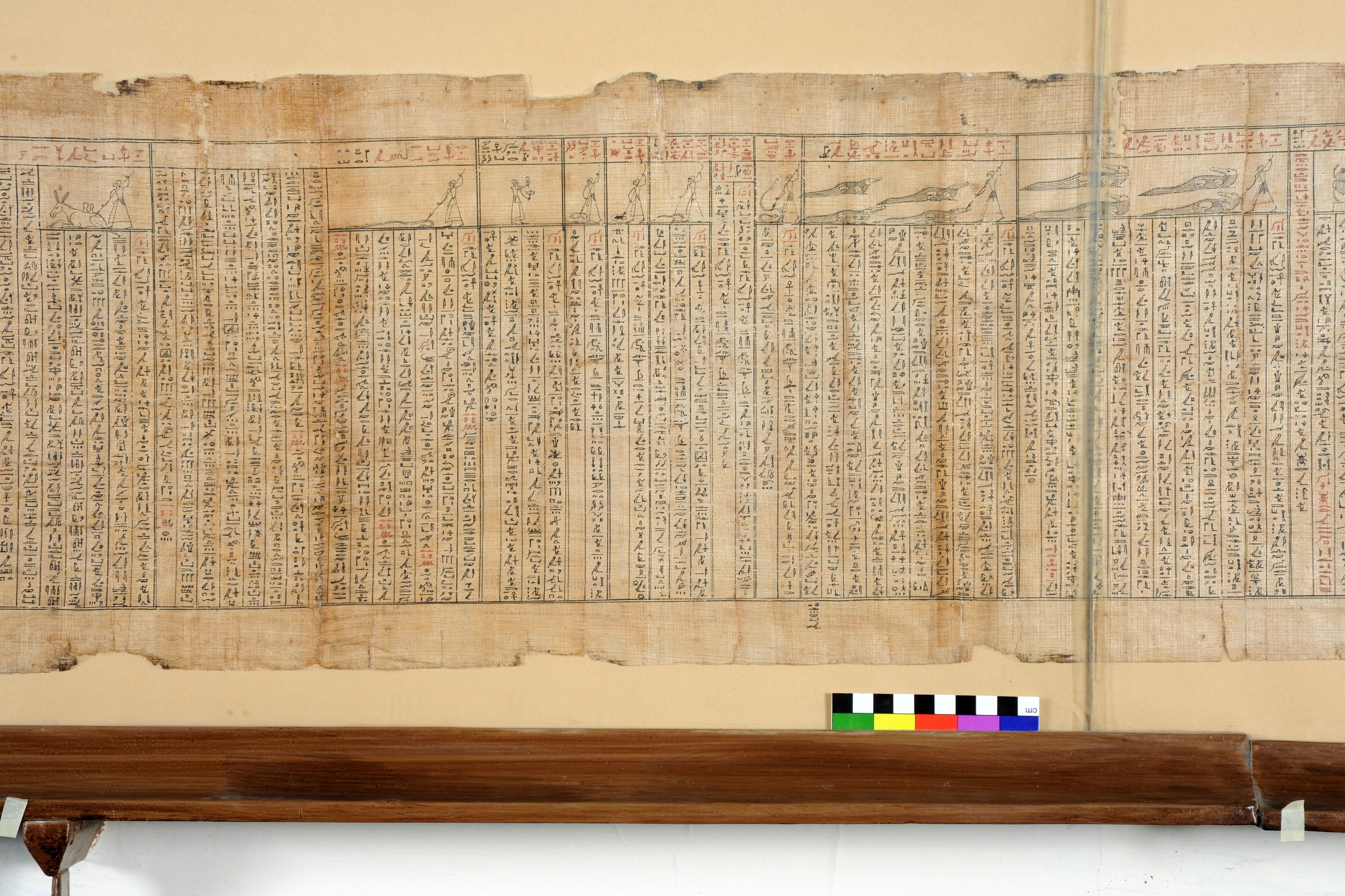
Where on the image
Turin 1791, Spell 32 (TLA Tb 032: title line, columns 1-10; Lepsius 1842, pl. XVI-XVII). Photograph 7 of 31 (Commons Book_of_the_Dead_of_Iuefankh,_papyrus_-_Museo_Egizio_Turin_C_1791_p028.jpg): the crocodiles at 59-75%. Checked by eye: the photographs were matched to Lepsius's plates by their vignettes, red titles and framed compartments, and the overlapping edges of neighbouring photographs were compared.
titlerʾ n ḫsf mzḥ.pl jy r jṯi̯〈.t〉 ḥkꜣ{,t} n ꜣḫ m-ꜥ =f m ẖr-nṯr
1ḏd-mdw jn Wsjr […] mꜣꜥ-ḫrw ḫr wr ḥr gs =f ky-ḏd ẖ,t =f s〈ꜣ〉q.n sw psḏ,t jy bꜣ md{,t}〈wi̯〉 =f ḥnꜥ jti̯ =f nḥm =f wr
2pn m-ꜥ mzḥ 8 jpw jw =j rḫ.kw st m rn.pl ḥnꜥ ꜥnḫ =sn jnk nḥm jti̯ =f m-ꜥ =sn ḥꜣ =k mzḥw jmn,tt ꜥnḫ m jḫm.pl-wrḏ jw
3bw,t =k m ẖ,t =j ꜥm.n =j wsr,t Wsjr jnk Stš ḥꜣ =k mzḥw jmn,tt jw nꜥjw m ẖ,t =j 〈nn〉 rḏi̯.n =j wj n =k nn nsr,t =k r =j ḥꜣ =k mzḥw
4jꜣb,tt ꜥnḫ m jm,j.w ⸢ꜥfꜣ⸣ =sn jw bw,t =k m ẖ,t =j šꜣjs.n =j jnk Wsjr ḥꜣ =k mzḥw jm,j jꜣb,tt jw nꜥjw
5m ẖ,t =j nn rḏi̯.n =j n =k nn nsr,t =k r =j ḥꜣ =k mzḥw rsj ꜥnḫ m ḥs ḥtj gꜣu̯ jw bw,t =k m ẖ,t =j nn dšr,t jm,j〈.t〉 ꜥ =k jnk Spd,w
6ḥꜣ =k mzḥw jm,j rsj jw zjn =j ṯw jw ḫp〈ꜣ〉 =j m bb,t.pl n rḏi̯.n 〈=j〉 wj n =k ḥꜣ =k mzḥw mḥ,t〈t〉 ꜥnḫ m ⸢ḏꜣ⸣ pn ḥr〈,j〉-jb wnw,t.pl
7jw bw,t =k m ẖ,t =j jw mtw〈,t〉 =k m tp =j jnk Jtm,w ḥꜣ =k mzḥw jm,j mḥ,t〈t〉 jw Srq,t m ẖ,t =j nn msi̯ =j s{w}〈j〉
8jnk wꜣḏ jr,t.du jw n,t{j}〈t〉 m ḫfꜥ =j jw jw,t{j}〈t〉 m ẖ,t =j jw =j sd.kw ꜥpr.kw m ḥkꜣ{,t} =k Rꜥ,w nw ḥr,j =j ẖr,j =j ⸢skm⸣ n =j
9qꜣi̯ n =j ꜣw n ḥtj,t =j m ẖnw jti̯ =j wr jw rḏi̯.n =f n =j jmn,tt twy nfr.t ḥtm ꜥnḫ,w wsr nb sbkꜣ.w
10ky-ḏd bꜣgi̯ zp-2 jm =s rꜥ,w-nb jw ḥr =j wn〈.w〉 jw jb =j ḥr s,t =f tp,t =j ḫr =j rꜥ,w-nb jnk Rꜥ,w mki̯{,t} sw ḏs =f n ḫmi̯ wj 〈j〉ḫ,t-nb〈,t〉 ḏw
XXXII. The chapter of Stopping the Crocodiles coming to take the Mind of a Spirit from him in Hades.
[Vignette. — Deceased turning back four Crocodile.]
The Great One falls in his place or on his belly subdued behind the Gods. I have made my Soul come, it speaks with his father. He saves this elder [or great one] from these eight crocodiles. I know them by their names, and how they live. I am he who saves his father from them.
Back, Crocodile of the West, living off those never at rest! What thou hatest is in my belly. I have eaten the limbs of Osiris. I am Set Back, Crocodile of the West! There is an asp in my belly. I am not given to thee. Do not burn me Back, Eastern Crocodile, living off of those who are attached to their flesh! What thou hatest is in my belly. I have crossed. I am Osiris. — Back, Crocodile in the East! There is a snake in my belly. I have not been given to thee. Do not burn me Back, Crocodile of the South, living off the unclean! What thou hatest is in my body. Do not gore me with thy claw. I am Sothis.— Back, Crocodile of the South! I have been healed, my palm is like a stick. I have not been given to thee. Back, Crocodile of the North, living off. .. dwelling in the hours! What thou hatest is in my belly, thou hast spat [or thy venom is] away from my head. I am Turn. Back, Crocodile in the North! There is a scorpion in my belly. I do not bring it forth. I am the light of the Eyes, Existences are in my hand, Non-existences are in my belly.
I dress myself, I equip myself with thy spells, oh Sun! both above and below me. I have listened, I have stretched the length of my throat within my great father. He has given me the happy West, suffocating the living, holding its quiet or humble Lord, in it daily. My face is open, my heart is in its place, my head is on me daily. I am the Sun protecting [or making] himself. No evil thing injures me.
Notes
- Birch's English was taken from three scans of Bunsen's Egypt's Place in Universal History, vol. V (1867), on the Internet Archive. The three OCR texts were aligned word by word and each word was settled by their agreement; running heads, page numbers, footnote markers and footnotes were removed. Some OCR errors may remain, chiefly in proper names.
- Birch uses the terms and name forms of his time: Hades, Aahlu (Elysium), Tum for Atum, Seb for Geb, Anup for Anubis, Phoenix or Bennu for the heron.
- Labels such as 'title line' or 'gate 1' before a line of the Egyptian translate the position labels of the TLA.
- The TLA has no hieroglyphic encoding for these texts, so only the transliteration is shown.
Cite
Sources
- Source: Papyrus of Iuefankh, Turin, Museo Egizio Cat. 1791 (Museo Egizio photographs, CC0) + TLA transliteration (ed. B. Backes, CC BY-SA 4.0) + English of Samuel Birch (1867, public domain) (holding institution)
- Critical edition: Thesaurus Linguae Aegyptiae, ed. Burkhard Backes (2018 data, AED-TEI)
← previous · → next · v cycle view · l back to library