Book of the Dead, Spell 39: Stopping all Reptiles (papyrus of Iuefankh)
Introduction
The Book of the Dead, in Egyptian the spells for going forth by day, is a collection of funerary spells written on papyrus rolls and placed in burials from the New Kingdom to the Roman period. Each roll was made for one person, with spells taken from a large repertoire and illustrated with drawings (vignettes). This library gives one complete roll: the papyrus of Iuefankh in the Museo Egizio, Turin (Cat. 1791), written in the Ptolemaic period (332-30 BCE) and coming from Thebes. Richard Lepsius published it in 1842 and divided it into 165 chapters; his numbering is still the standard numbering of the spells, and it is used here.
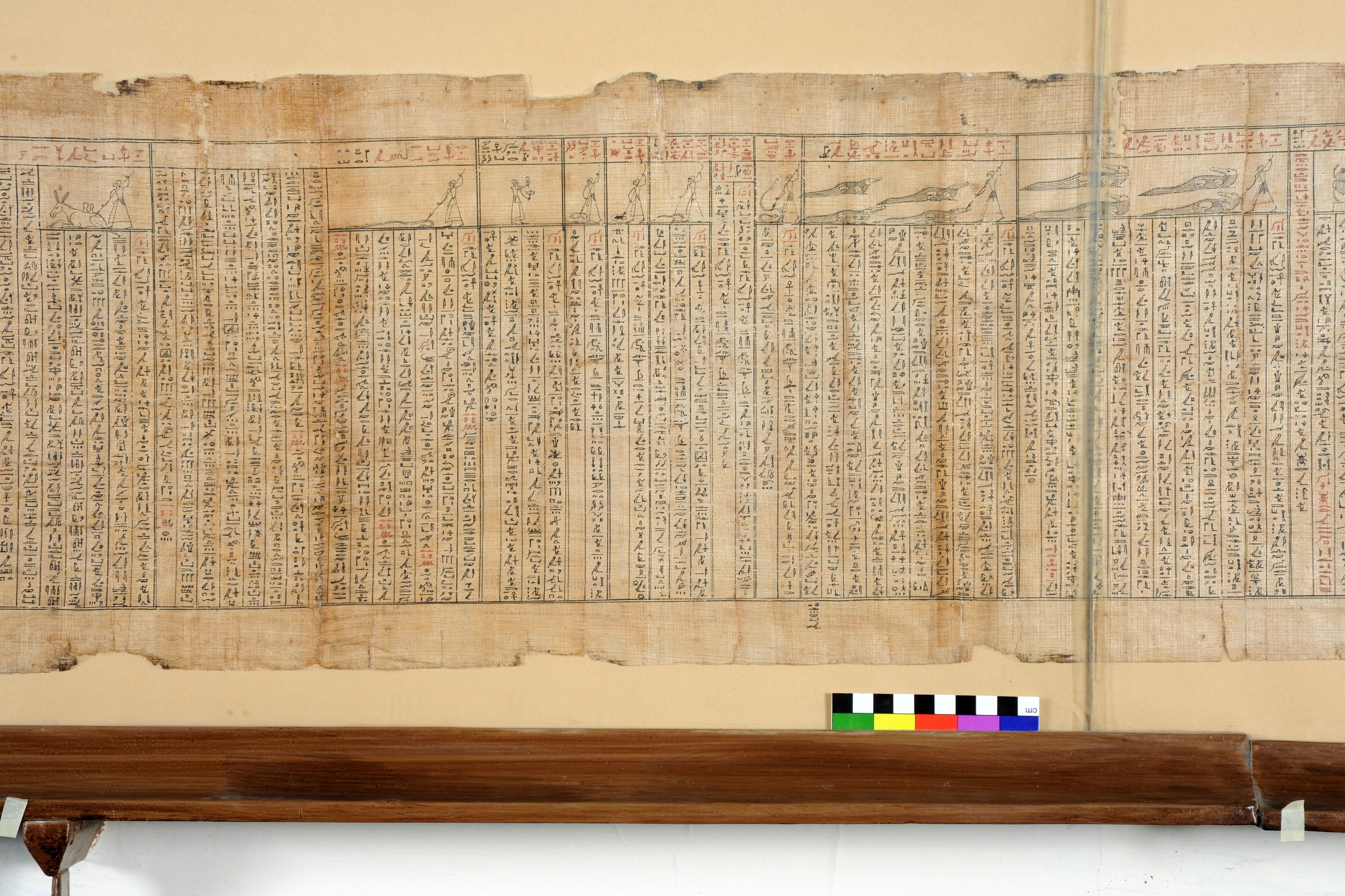
Spell 39 (Birch: 'The chapter of Stopping all Reptiles.') is on Lepsius's plate XVIII and on photograph 7 of the 31 Museo Egizio photographs of the roll.
The Egyptian is the transliteration of the Thesaurus Linguae Aegyptiae (edition by Burkhard Backes), with the column number of the spell before each column; the numbers are those of Lepsius's plates. On the papyrus the text runs in vertical columns of cursive hieroglyphs from right to left along the roll; titles and some words are written in red. Signs restored by the editor are in square brackets, signs the scribe left out in angle brackets, superfluous signs in braces and damaged signs in half brackets. The English is the translation by Samuel Birch, published in 1867 and made from Lepsius's copy of this papyrus, so the English and the Egyptian come from the same manuscript. It was the first complete English translation of the Book of the Dead; many passages are now understood differently. Birch's own square brackets give his alternatives and explanations. The photographs are by the Museo Egizio; each shows a stretch of the roll, and the note of each section says where the spell stands on it.
How was this verified? (Provenance)
Where on the image
Turin 1791, Spell 39 (TLA Tb 039: title line, columns 1-15; Lepsius 1842, pl. XVIII). Photograph 7 of 31 (Commons Book_of_the_Dead_of_Iuefankh,_papyrus_-_Museo_Egizio_Turin_C_1791_p028.jpg): the man spearing a serpent under a long red title at 24-35%, its columns to 11% (Lepsius pl. XVIII). Checked by eye: the photographs were matched to Lepsius's plates by their vignettes, red titles and framed compartments, and the overlapping edges of neighbouring photographs were compared.
titlerʾ n ḫsf rfrf m ẖr,t-nṯr
1ḏd-mdw jn Wsjr […] mꜣꜥ-ḫrw ḥꜣ =k zbn jntj pfj m-ꜥ ꜥꜣpp mḥi̯ =k r š nw,w r b〈w〉 wḏ.n jti̯ =k r jri̯〈.t〉 šꜥd =k jm ḥri̯.w
2ṯw r msḫn〈,t〉 twy n〈.t〉 Rꜥ,w jm,j〈.t〉 sdꜣdꜣ jnk Rꜥ,w sdꜣdꜣ ḥꜣ =k mds ḫp =k sḫr.n Rꜥ,w pnꜥ ḥr =k jn nṯr.pl šdi̯ ḥꜣ,tj =k
3jn mꜣfd,t qꜣjs =k jn Ḥdd,t wḏ nkn =k jn Mꜣꜥ,t sḫr ṯw jm,j.w wꜣ,t ḫr zbn ꜥꜣpp ḫfti̯ n Rꜥ,w
4j rwj ꜥḏ m jꜣb,tt n.t p,t ḥr ḫrw qrj,w m nhmhm wn sbꜣ.pl ꜣḫ,t tp-ꜥ Rꜥ,w pri̯ =f bꜣgi̯〈.w〉 rf m nzp,w
5jri̯.y =j jb =k zp-2 jri̯.y =j nfr zp-2 jri̯.y =j m-ḥtp zp-2 Rꜥ,w jri̯.y =j hy nwḥ =k Rꜥ,w jw ꜥꜣpp ḫr〈.w〉 snḥ.w qꜣjs.n
6s〈w〉 rsj,pl mḥ,t〈j〉pl jmn,t〈j〉pl jꜣb,t〈j〉pl qꜣs =sn jm =f sḫr sw Ꜣkr qꜣjs.n sw ḥr,j-ry{bḥ}〈,t〉 ḥtp zp-2 Rꜥ,w swḏꜣ m-ḥtp
7ꜥꜣpp ḫfti̯{.pl} n Rꜥ,w ḫr〈.w〉 sḫr〈.w〉 hꜣi̯ ꜥꜣpp wr dp〈,t〉 =k r dp〈,t〉 twy bjnr〈.t〉 ḥr〈,j.t〉 jb n Ḥdd,t jri̯.n =s r =k mr ṯw n =s
8ẖr,t n-ḏ,t zb〈n〉.n =k bnn =k n-ḏ,t ꜣ nk =k n-ḏ,t ḫfti̯{.pl} n Rꜥ,w ḫsf =f ḥr =k msḏi̯ Rꜥ,w mꜣꜣ =k ḥꜣ =k zni̯ tp =k ds ḥr zni̯ ḥr-gs,wj wꜣ〈,t〉
9r dndn tp =k 〈j〉n jm,j.w-tp =k sḏ qs.pl bḥn ꜥ,t.pl =k jn Wsjr sjp〈.n〉 ṯw Ꜣkr ꜥꜣpp ḫfti̯{.pl} n Rꜥ,w ky-ḏd wḏ Sḫm,t nṯr,j.t jp.t ḥtp jm jni̯〈.t〉
10ḥnk =k jm j{w} ḫpi̯ zp⸢[-2]⸣ jri̯ n =k r pr,w =k ḫpi̯ zp-2 jri̯ n =k r pr,w ḫpi̯ zp-2 nfr nn hꜣi̯ bjn nb ḏw m rʾ =k r =j jri̯.n =k n =j jnk Swtj šdi̯ {ḫ}〈ẖ〉nn,w ḫrw pri̯ =f m-ẖnw ꜣḫ,t n.t p,t
11mj nbḏ jb =f pw j j.n Jtm,w ṯzi̯ =ṯn ḥr =ṯn nfr,pl ḫsf nbḏ m ḏꜣḏꜣ,t j j.n Gbb smn ns,t =ṯn m-ḥr-jb wjꜣ Ḫprj šzp =ṯn ꜥḥꜣ =ṯn
12msq bb,t.pl =ṯn ḏḏ!.y{m}w =ṯn ḥr ꜥ.wj =ṯn j.n Ḥw,t-Ḥr,w Rꜥ,w pri̯ =f šzp nzp.pl =ṯn j:j.n Nw,t mi̯≡n ḫsf nbḏ pfj jy r jm,j-kꜣ{r}jw≡f
13ḏꜣi̯ wꜥi̯〈.w〉 ky-ḏd wꜥi̯〈.w〉 ꜥ.wj!! nb-〈r-〉ḏr jw,tj ḫsf =f m nṯr.pl j j.n nṯr.pl šzp pꜣ,t.pl =ṯn pẖr š m mfk〈ꜣ〉,t mi̯≡n n jm,j-kꜣ{r}jw≡f
14pri̯ psḏ,t jm =f jri̯.ypl n =f sꜣḫ,pl ḏḏ! =ṯn n =f jꜣ,w smj sw jrf =ṯn j j.n Nw,t mw,t nṯr.pl pri̯ 〈=f〉 gmi̯.n =f wꜣ,t jri̯.n =f ḥꜣq〈,t〉 m nṯr.pl šzp.n =f
15ḫnt Nw,t ꜥḥꜥ Gbb nrj.w psḏ,t-ꜥꜣ,t m sṯꜣ zp-2 Ḥw,t-Ḥr,w jm psḏ,t sdꜣdꜣ〈.w〉 mꜣꜥ-ḫrw Rꜥ,w r ꜥꜣpp zp-4
XXXIX. The chapter of Stopping all Reptiles.
[Vignette Deceased turning back a Serpent.]
Back, Precursor, the one proceeding [?] from the Apep! thou art drowned at the Pool of the Nu [firmament], at the place where thy father has ordered thee to be cut up in, having gone to the House of Regeneration of the Sun at his failing. I am the Sun. Back, Block of stone! thy person the Sun has struck. [?] Thy face is turned down [is said] by the Gods, thy heart is pierced [is said] by the Lynx; thou art embalmed [is said] by the Scorpion. That which is thy destruction has been ordered to thee [is said] by Truth. Those who are on the road have been cast down. The Precursors of the Apophis, the Accusers of the Sun, are overthrown.
Oh swift Passer from the East of the heaven, at the word, overcoming by roaring! The doors of the chief horizon of the Sun open. He comes forth. Let him squat in ambush. I make thy heart. I do well. I act peaceably, [oh] Sun! I make the haul of thy rope, oh Sun! The Apophis is overthrown; their cords bind the South, North, East, and West. Their cords are on him. Akar [Victory, or the Sphinx] has overthrown him. Har-ru-bah [he who is over the Gate of the Inundation] has knotted him. The Sun is at peace, he goeth forth in peace. The Apophis and Accusers of the Sun fall. Overthrown is the advance of the Apophis. Thy tongue is greater than the envious tongue of a scorpion, which has been made to thee; it has failed in its power for ever.
Thou hast thy pollution for ever, oh Horus! thou pollutest the Accusers of the Sun. The Hater of the Sun whom thou seest is stopped by thee. Back, thy hard head is cut [?] in opening the places, elevating thy head to those who belong to thy head, dragging thy limbs, cutting thy arms. [Said] by Osiris.
The Great Apophis, the Accusers of the Sun, have been judged by Akar. Pasht goes forth, by whom the divine judgment is set at rest. In which thou leadcst thy offering. The pacing thou hast made to thy house, which thou hast made to thy house [is] good. No evil comes out of thy mouth against me [in what] thou hast done to me. I am Sut, the aider of the believers of his word, who came out from the midst of the horizon of the heaven. His image is that of the Hateful heart.
Oh! [is said] by Tum, Ye lift your good faces. The wicked has been stopped by the assembled Gods. — Oh [is said] by Seb, Prepare your seat in the midst of the bark of Khepera, receive ye your battle [armour], your legs are chopped off, ye give water [or blood] out of your hand. [Is said] by Athor, the Sun he comes forth, receive your weapons Oh [is said] by Nupe, Come ye [we come]. The wicked who comes against “ Him, who is in his Chest,” has been stopped; he the one, or he alone, takes the hands of the Universal Lord. He is not stopped by the Gods.
Oh! [is said] by the Gods, Receive your food, go PRESERVATION OF THE BODY IN nADES. round the Pool of Copper. We come to “Him who in his Box.” The Gods proceed from him. He has made Intelligences. Give ye to him glory. Ascribe ye it to him. Oh! [said] by Nu[pe], the mother of the Gods, proceeding, he has found the way. He has been taken captive by the Gods. He has been received [by] Nu, Seb stands, and the Great Gods are victors towing [him]; Athor and the Gods tow him exhausted, justifying the Sun against the Apophis four times.
Notes
- Birch's English was taken from three scans of Bunsen's Egypt's Place in Universal History, vol. V (1867), on the Internet Archive. The three OCR texts were aligned word by word and each word was settled by their agreement; running heads, page numbers, footnote markers and footnotes were removed. Some OCR errors may remain, chiefly in proper names.
- Birch uses the terms and name forms of his time: Hades, Aahlu (Elysium), Tum for Atum, Seb for Geb, Anup for Anubis, Phoenix or Bennu for the heron.
- Labels such as 'title line' or 'gate 1' before a line of the Egyptian translate the position labels of the TLA.
- The TLA has no hieroglyphic encoding for these texts, so only the transliteration is shown.
Cite
Sources
- Source: Papyrus of Iuefankh, Turin, Museo Egizio Cat. 1791 (Museo Egizio photographs, CC0) + TLA transliteration (ed. B. Backes, CC BY-SA 4.0) + English of Samuel Birch (1867, public domain) (holding institution)
- Critical edition: Thesaurus Linguae Aegyptiae, ed. Burkhard Backes (2018 data, AED-TEI)
← previous · → next · v cycle view · l back to library