Book of the Dead, Spell 42: Turning away all Evil [Injury], and turning back the Blows made in Hades (papyrus of Iuefankh)
Introduction
The Book of the Dead, in Egyptian the spells for going forth by day, is a collection of funerary spells written on papyrus rolls and placed in burials from the New Kingdom to the Roman period. Each roll was made for one person, with spells taken from a large repertoire and illustrated with drawings (vignettes). This library gives one complete roll: the papyrus of Iuefankh in the Museo Egizio, Turin (Cat. 1791), written in the Ptolemaic period (332-30 BCE) and coming from Thebes. Richard Lepsius published it in 1842 and divided it into 165 chapters; his numbering is still the standard numbering of the spells, and it is used here.
Spell 42 (Birch: 'The chapter of Turning away all Evil [Injury], and turning back the Blows made in Hades.') is on Lepsius's plates XIX-XX and on photograph 8 of the 31 Museo Egizio photographs of the roll.
The Egyptian is the transliteration of the Thesaurus Linguae Aegyptiae (edition by Burkhard Backes), with the column number of the spell before each column; the numbers are those of Lepsius's plates. On the papyrus the text runs in vertical columns of cursive hieroglyphs from right to left along the roll; titles and some words are written in red. Signs restored by the editor are in square brackets, signs the scribe left out in angle brackets, superfluous signs in braces and damaged signs in half brackets. The English is the translation by Samuel Birch, published in 1867 and made from Lepsius's copy of this papyrus, so the English and the Egyptian come from the same manuscript. It was the first complete English translation of the Book of the Dead; many passages are now understood differently. Birch's own square brackets give his alternatives and explanations. The photographs are by the Museo Egizio; each shows a stretch of the roll, and the note of each section says where the spell stands on it.
How was this verified? (Provenance)
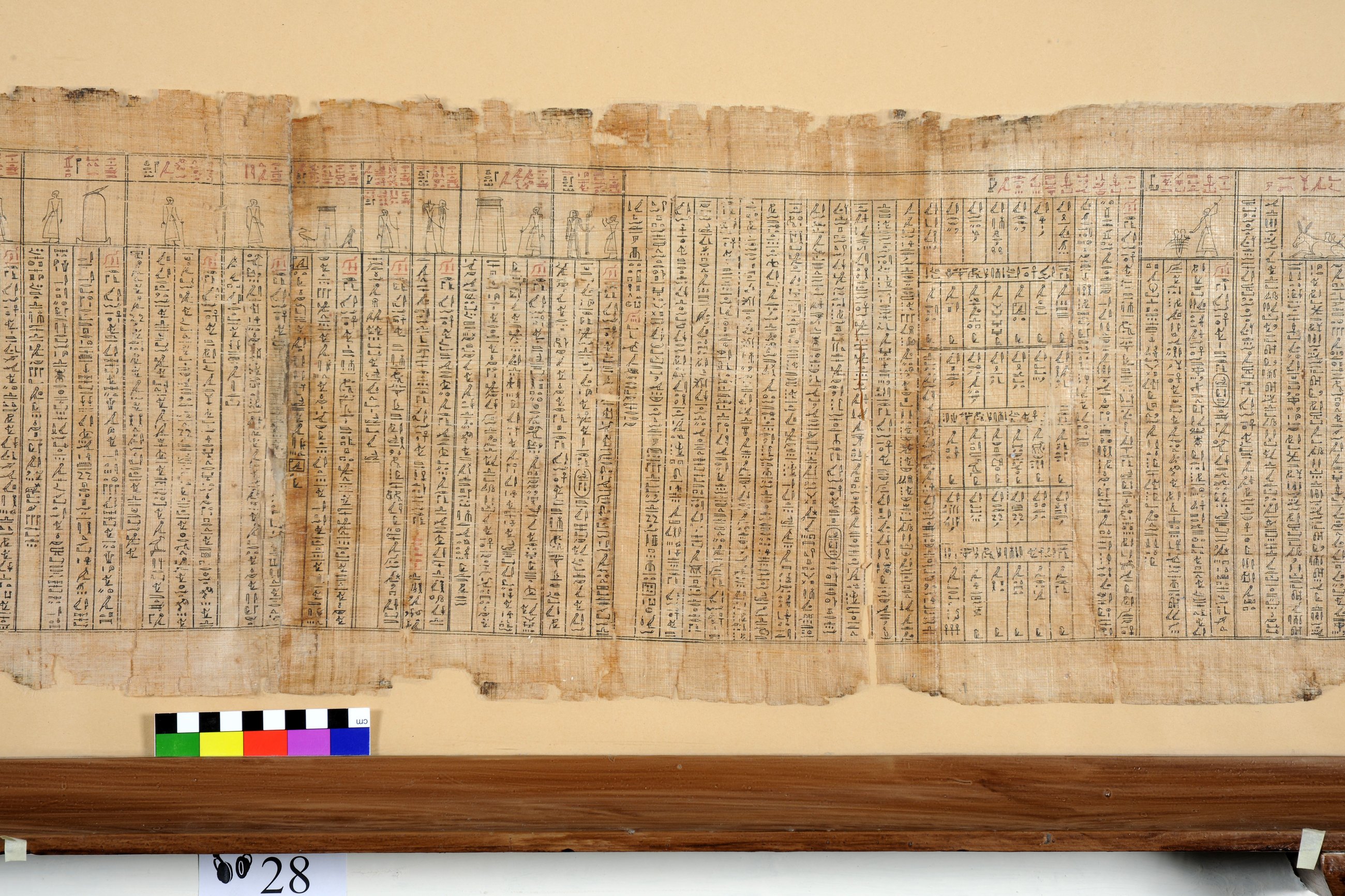
Where on the image
Turin 1791, Spell 42 (TLA Tb 042: title line, columns 1-23; Lepsius 1842, pl. XIX-XX). Photograph 8 of 31 (Commons Book_of_the_Dead_of_Iuefankh,_papyrus_-_Museo_Egizio_Turin_C_1791_p027.jpg): long red title at 70-84% over the table of the members of the body; its columns run to 46%. Checked by eye: the photographs were matched to Lepsius's plates by their vignettes, red titles and framed compartments, and the overlapping edges of neighbouring photographs were compared.
titlerʾ n ḫsf sḏb nb ḏw ḫsf šꜥd jrr!.t m ẖr-nṯr
1ḏd-mdw jn Wsjr […] mꜣꜥ-ḫrw tꜣ n ⸢ḫt⸣ ḥḏ,t n twt jꜣ〈,t〉 Wsjr-Wnn-nfr,w mꜣꜥ-ḫrw jnk ḫ〈y〉 zp-4 j jb wr {j}〈jw〉 ḏd.n =k mjn
2zp-2 ꜥpr nm,t =f m rḫ rn =k jn-jw jy.n =k r =s m jz{f} wr jnk Rꜥ,w smnḫ ḥz,pl jnk nṯr-ꜥꜣ m-ẖnw jzr.pl nfr ,{t}w〈j〉 jns Rꜥ,w ky-ḏd jnw
3r sfḫ zp-4 jnk smn ḥz,pl ṯz nṯr m-ẖnw jzr.pl wḏꜣ =j wḏꜣ Rꜥ,w ṯz-pẖr
4,1jw šnj.w n Wsjr […] mꜣꜥ-ḫrw m Nw,w
5,1jw ḥr n Wsjr […] mꜣꜥ-ḫrw m Rꜥ,w
6,1jw jr,t.j n Wsjr […] mꜣꜥ-ḫrw m Ḥw,t-Ḥr,w
7,1jw msḏr.du n Wsjr […] mꜣꜥ-ḫrw m Wpi̯,w-wꜣ,tpl
8,1jw fnḏ n Wsjr […] mꜣꜥ-ḫrw m ḫnt,j-Ḫm
9,1jw sp,t.j n Wsjr […] mꜣꜥ-ḫrw m Jnp〈,w〉
10,1jw jbḥ.w n Wsjr […] mꜣꜥ-ḫrw m Srq,t
4,2jw nḥb,t n Wsjr […] mꜣꜥ-ḫrw m Ꜣs,t nṯr,t
5,2jw ꜥ.du n Wsjr […] mꜣꜥ-ḫrw m Bꜣ-nb-Ḏd,t
6,2jw šnꜥ{,t} n Wsjr […] mꜣꜥ-ḫrw m Ni̯,t nb〈,t〉 Zꜣw
7,2jw šnb,t n Wsjr […] mꜣꜥ-ḫrw m nb H̱r,j-ꜥḥꜣ
8,2jw ẖ,t jꜣ,t n Wsjr […] mꜣꜥ-ḫrw m Stš ky-ḏd Ḏḥwtj
9,2jw psḏ n Wsjr […] mꜣꜥ-ḫrw m Sḫm,t
4,3jw ḥnn n Wsjr […] mꜣꜥ-ḫrw m Wsjr
5,3jw ḫpd n Wsjr […] mꜣꜥ-ḫrw m jr,t-Ḥr,w
6,3jw mn〈,t〉.du n Wsjr […] mꜣꜥ-ḫrw m Nw,t
7,3jw rd.du n Wsjr […] mꜣꜥ-ḫrw m Ptḥ
8,3jw ꜥ,t.pl n Wsjr […] mꜣꜥ-ḫrw m Ḥr,j-š≡f
9,3jw ḏbꜥ.pl qs.pl n Wsjr […] mꜣꜥ-ḫrw m ꜥrꜥ,t.pl ꜥnḫ.pl
10,2nn ꜥ,t jm =f šwi̯ m nṯr jw Ḏḥwtj m-ḥr,pl jwf =f tm rꜥ,w-nb nn ḫfꜥ.tw =f ḥr ꜥ.wj =f nn
11ꜣm! =f ḥr ḏr,t.du =f nn jri̯ r〈m〉ṯ.pl nṯr.pl ꜣḫ.pl mt.pl nb nb nb rḫ,yt nb ḥnmm〈,t〉 nb ḥm〈w,t〉-rʾ ꜥwꜣ,y nb jm =f ntf pri̯ wḏꜣ〈.w〉 ḫmi̯
12r〈m〉ṯ.pl rn =f ntf sf mꜣꜣ ḥḥ.pl n〈.w〉 rnp,t rn =f zbi̯ m wꜣ,t.pl ḥr,j.w sjp n Wsjr […] mꜣꜥ-ḫrw nb-ḏ,t jw jp =tw sw mj Ḫprj ntf nb wrr〈,t〉
13ntf jm,j wḏꜣ,t swḥ,t rḏi̯ n =f ꜥnḫ =f m-ꜥ =sn ky-ḏd m-ꜥ =ṯn ntf jm,j wḏꜣ,t s,t =f m ns,t =f ḥmsi̯〈.w〉 m 〈j〉dn〈,w〉 ḫr =s ntf Ḥr,w ḫnt,j ḥḥ.pl ky-ḏd ḫnd
14wḏ 〈n〉 =f ns,t =f ḥqꜣ =f sw m =k rʾ md,t =f gr〈.w〉 ꜥqꜣ s〈w〉 m =k jrw =f sḫd〈.w〉 Wsjr […] mꜣꜥ-ḫrw pn Wnn-nfr,w mꜣꜥ-ḫrw tr m tr ẖr〈,t〉 =f
15jm =f wꜥ,w-m-wꜥ,w pẖr.n =f ntf jm,j wḏꜣ,t nn ḫpr 〈j〉ḫ,t-nb〈,t〉 bjn〈.t〉 ḏw〈.t〉 r =f 〈j〉n ẖnn,w nn gmi̯ ntf wpi̯ sbꜣ.w p,t ḥqꜣ ns,t wpi̯ ms,wt m hrw pn
16ntf ḫ〈y〉 ḥwi̯ mṯn,w n sf ntf hr〈w〉 pn r〈m〉ṯ.pl m r〈m〉ṯ.pl ntf pw mki̯ n ḥḥ.pl jn-jw =ṯn wnn.tjwn m p,t rsi̯〈.t〉 mḥ,t〈j.t〉 jmn,t〈j〉.t jꜣb,t〈j.t〉 snḏ =f
17m ẖ,t =ṯn ntf nbj.w m ḏr,t =f nn mt =f m-wḥm ꜣ,t =f m ẖ,t =ṯn jrw =f m-ḫntj =f nn rḫ =f dšr,tj.pl ḥr =sn r =f ntf wnf nn gmi̯
18tr ⸢pn⸣ jri̯ =f r =f p,t ṯnw tꜣ ṯnw ms,w〈t〉 [z]nn.jw nn zmꜣ =sn m zni̯ sw r =f m 〈j〉ḫ,t-nb〈,t〉 ḏw〈.t〉 wrḏ.pl jm md,t.pl
19Wsjr […] mꜣꜥ-ḫrw n =ṯn ntf wbn psḏ jnb{,t}〈.pl〉 wꜥ,w-m-wꜥ,w nn hrw{nṯr} šwi̯ m jr,w =f zni̯ m zni̯ zp-2 m =k ḏd Wsjr […] mꜣꜥ-ḫrw
20n =k ntf wnb,w pri̯ m nw,w mw,t =f pw Nw,t j:⸢qmꜣ⸣ sw ntf jw,tj ḫnd ṯz ꜥꜣ m-ẖnw sf jw ꜥ ṯz m-ẖnw ḏr,t =f n〈n〉 rḫ Wsjr
21[…] mꜣꜥ-ḫrw rḫ =f sw n〈n〉 ḫfꜥ sw r =f j […] swḥ,t ntf Ḥr,w ḫnt,j ḥḥ.pl hh n ḥr =sn ⸢ꜣšjḥ.w⸣ jb =sn n Wsjr […] mꜣꜥ-ḫrw
22ḥqꜣ =f ns,t =f zni̯ =f tr pn wꜣ,t wpi̯〈.tj〉 n =f jw wḥꜥ m ḏw nb ntf qfdn 〈m〉 nbu̯ n nṯr.pl nn ꜥ.wj =f nn rd.du =f ḫnt,j Ḥw,t-kꜣ-Ptḥ wḏꜣ =f
23wḏꜣ qfdn ḫnt,j Ḥw,t-kꜣ-Ptḥ ḏd-md,t ꜥbꜣ =k r-ꜥ =k ky-ḏd r-rʾ =k
XLII. The chapter of Turning away all Evil [Injury], and turning back the Blows made in Hades.
The Region of the. .. the white crown of the figure, place of Osiris the revealer of good.
I am the Babe [said four times]. Oh Abaur [Great Thirst], thou hast spoken like the Sun! who preparest the block by the knowledge of thy name, for thou hast come from it for the great sinner. I am the Sun preparing the obedient. I am the Great God betwixt the tamarisks; finished (is) Ans-Ra, or the Pied, at dawn. I am the Creator of the obedient, the God embowered betwixt the tamarisks I go out, the Sun goes out in his turn.
The hair of the Osiris is in shape of that of Nu.
The face „ „ Ra.
The eyes are in shape of those of Athor.
The ears „ Apheru.
The nose is in shape of that of Khentskhem.
The lips are in shape of those of Anup.
The teeth Selk.
The neck is shape of that of the Goddess Isis. The arms of the Osiris are in shape of those of the Soul Lord of Tattu.
The elbows Neith Lady of Sais.
The legs „ the Lord of Khar [Mentu].
The belly and back Set or of Thoth.
The spine of the Osiris is in shape of that of Pasht.
The phallus „ Osiris.
The thigh the Eye of Horus.
The legs are in shape of those of Nu.
The feet Ptah.
The arms Her-shaft [Ram-headed.]
The fingers and nails of the Osiris are in shape of living Unci.
There is not a limb of him without a God. Thoth is vivifying [or watching] his limbs. Not a day he has not been squeezed in his arms or clasped in his hands. Men, Gods, Spirits, the dead, mortals, beatified spirits, Illuminated, do not make any attack upon him. He it is who comes out sound, Immortal is his name. He is Yesterday [or morn], Beholder of millions of years, that is his name. He has passed along the upper roads. The Osiris has been deemed the Lord Eternal. He has been judged like Khepera. He is the Lord of the Crown. He is in the Eye and the Egg. Life has been given to him by them, or by ye. He is in the Eye, he is seated in his place. He sits in its seat.. .. He [it] is [who is] Horus who dwells in or who treads amongst millions. He has ordered his place, he rules it. He made his mouth speak at its centre. Making his shapes. The Osiris turns over from time to time what is in him. One after another he has revolved. He is belonging to the Eye; no evil thing is done to him by the Convoyers. He has not been found by the Emissary of the Gates of Heaven, ruling the throne, guiding the hateful on that day. He is the child dragging the path of Yesterday [or morn]. He is the Day for race after race of men. He is regulator of millions of years, ye [say] who are beings of the South, North, East, and West of heaven: the terror of him is in your belly. He it is who grasps with his hand, he does not die again, he is a moment in your belly, he does it when he stops [or his shapes return to him]. The redness of their faces is unknown to him. He is his being. The time when he made the heaven, creating the earth, creating all the cursed generation, cannot be found out; they do not combine, letting all evil things pass to him, who is at rest through his words. The words of Osiris are addressed to ye. He is the light illuminating the precincts, one after another. The Sun does not want his protection [or company], passing and repassing. May the Osiris speak to thee! He is the Germ [or flowers] emanating from Nu [or the firmament]. His mother is Nu. He has made it. He is the one not trampling on the great Tie within Yesterday [or morn]. The hand is tied within his hand. The Osiris does not know. He knows him. Let him not grasp him. Oh Layer of the Egg! He is Horus who dwells amongst millions. Their countenances burn, their hearts are agonized at the Osiris. He rules his seat, he passes at the time, he is guided on his road. He has escaped from all evil things. He is the Golden Ape of the Gods without hands or feet, the wall in Ptah Ka. He goes forth, the Ape which dwells in Ptah Ka goes forth.
This said [you] a person passes in every direction or in every part.
Notes
- Birch's English was taken from three scans of Bunsen's Egypt's Place in Universal History, vol. V (1867), on the Internet Archive. The three OCR texts were aligned word by word and each word was settled by their agreement; running heads, page numbers, footnote markers and footnotes were removed. Some OCR errors may remain, chiefly in proper names.
- Birch uses the terms and name forms of his time: Hades, Aahlu (Elysium), Tum for Atum, Seb for Geb, Anup for Anubis, Phoenix or Bennu for the heron.
- Labels such as 'title line' or 'gate 1' before a line of the Egyptian translate the position labels of the TLA.
- The TLA has no hieroglyphic encoding for these texts, so only the transliteration is shown.
Cite
Sources
- Source: Papyrus of Iuefankh, Turin, Museo Egizio Cat. 1791 (Museo Egizio photographs, CC0) + TLA transliteration (ed. B. Backes, CC BY-SA 4.0) + English of Samuel Birch (1867, public domain) (holding institution)
- Critical edition: Thesaurus Linguae Aegyptiae, ed. Burkhard Backes (2018 data, AED-TEI)
← previous · → next · v cycle view · l back to library