Book of the Dead, Spell 64: Going forth by day in a single spell (papyrus of Iuefankh)
Introduction
The Book of the Dead, in Egyptian the spells for going forth by day, is a collection of funerary spells written on papyrus rolls and placed in burials from the New Kingdom to the Roman period. Each roll was made for one person, with spells taken from a large repertoire and illustrated with drawings (vignettes). This library gives one complete roll: the papyrus of Iuefankh in the Museo Egizio, Turin (Cat. 1791), written in the Ptolemaic period (332-30 BCE) and coming from Thebes. Richard Lepsius published it in 1842 and divided it into 165 chapters; his numbering is still the standard numbering of the spells, and it is used here.
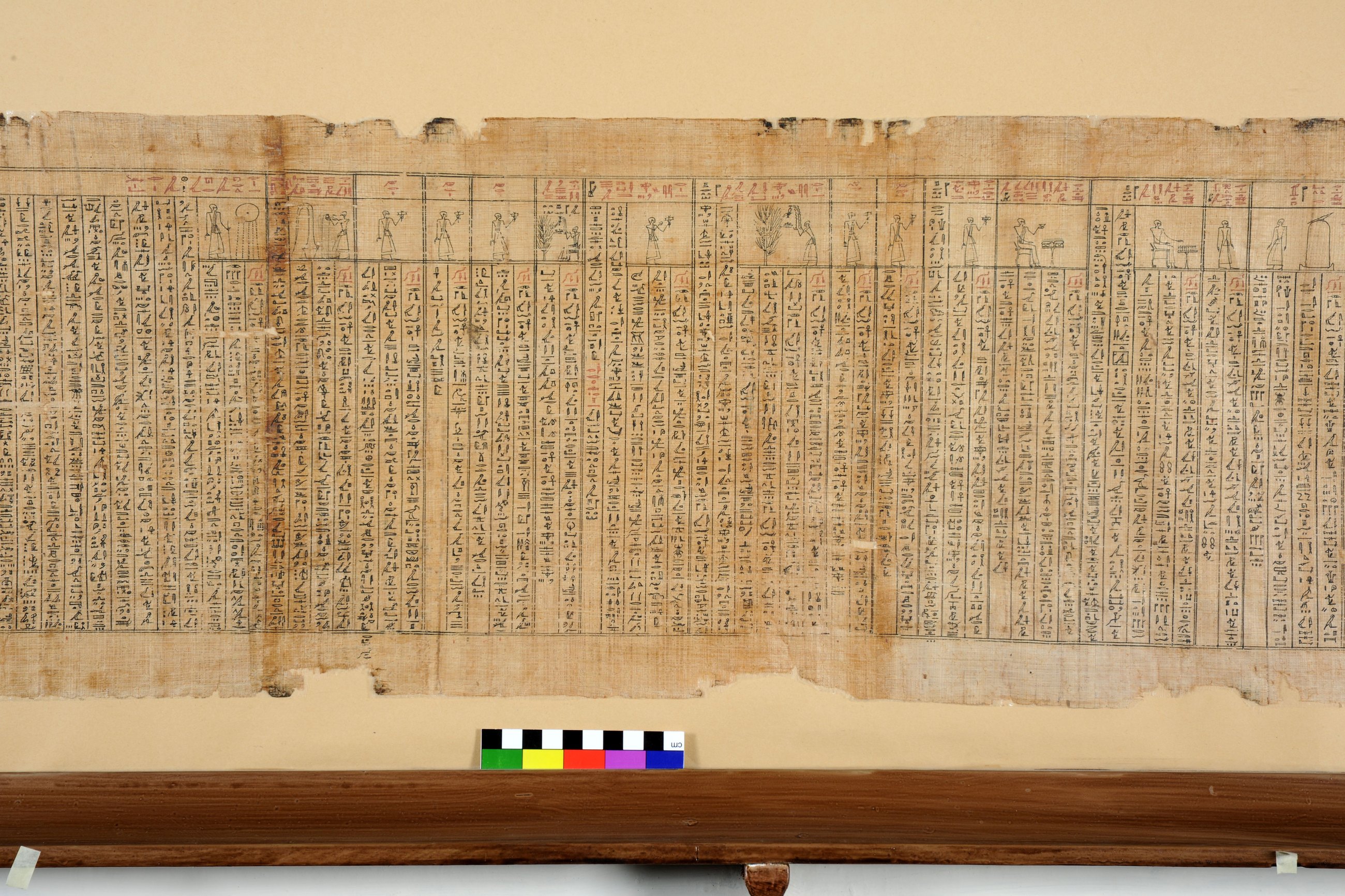
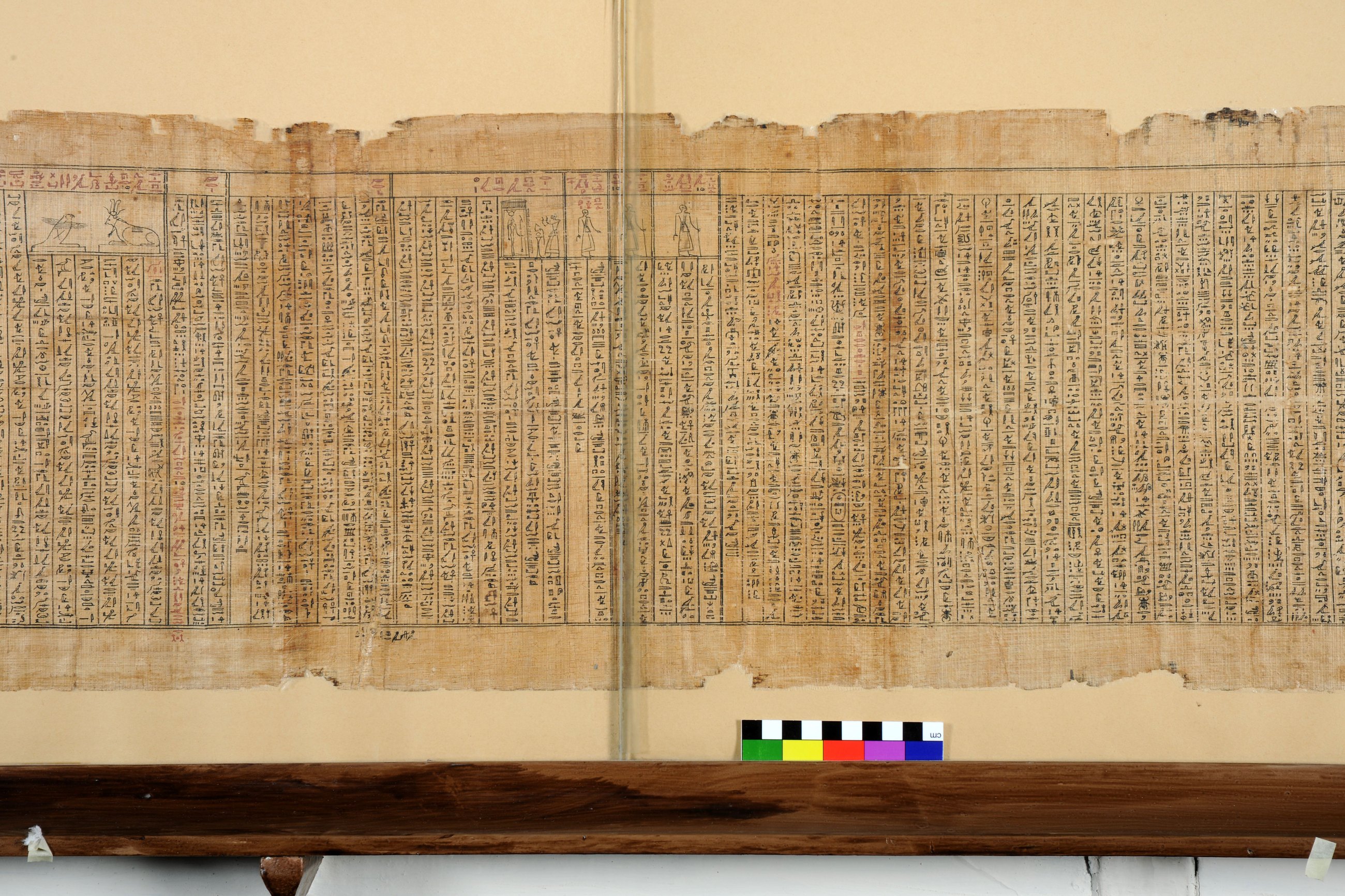
Spell 64 (Birch: 'The chapter of Coming forth [as] the Day in one Chapter.') is on Lepsius's plates XXIII-XXV and on photographs 9, 10 of the 31 Museo Egizio photographs of the roll.
The Egyptian is the transliteration of the Thesaurus Linguae Aegyptiae (edition by Burkhard Backes), with the column number of the spell before each column; the numbers are those of Lepsius's plates. On the papyrus the text runs in vertical columns of cursive hieroglyphs from right to left along the roll; titles and some words are written in red. Signs restored by the editor are in square brackets, signs the scribe left out in angle brackets, superfluous signs in braces and damaged signs in half brackets. The English is the translation by Samuel Birch, published in 1867 and made from Lepsius's copy of this papyrus, so the English and the Egyptian come from the same manuscript. It was the first complete English translation of the Book of the Dead; many passages are now understood differently. Birch's own square brackets give his alternatives and explanations. The photographs are by the Museo Egizio; each shows a stretch of the roll, and the note of each section says where the spell stands on it.
How was this verified? (Provenance)
Where on the image
Turin 1791, Spell 64 (TLA Tb 064: title line, columns 1-36; Lepsius 1842, pl. XXIII-XXV). Photograph 9 of 31 (Commons Book_of_the_Dead_of_Iuefankh,_papyrus_-_Museo_Egizio_Turin_C_1791_p026.jpg): red title at 9-20% with the man before the sun disc (15-20%; Lepsius pl. XXIII); its columns run to the left-hand edge and on to photograph 10. Photograph 10 of 31 (Commons Book_of_the_Dead_of_Iuefankh,_papyrus_-_Museo_Egizio_Turin_C_1791_p025.jpg): its columns fill the right part (53-100%; Lepsius pl. XXIV-XXV). Checked by eye: the photographs were matched to Lepsius's plates by their vignettes, red titles and framed compartments, and the overlapping edges of neighbouring photographs were compared.
titlerʾ n pri̯〈.t〉 m hrw m rʾ wꜥ,w
1ḏd-mdw jn Wsjr […] mꜣꜥ-ḫrw jnk sf jw =j rḫ.kw ⸢dwꜣ,w⸣ ⸢bkꜣ⸣ ḥr,t msi̯.tw =f m ky zp štꜣ bꜣ
2jri̯ nṯr.pl jri̯ ḥtp n 〈j〉mn,tj.w jmn,tt p,t ḥm〈,w〉 jꜣb,tt ⸢nb⸣ ⸢ḥr,wj≡fj⸣ mꜣꜣ m stw,t =f nb sṯz pri̯ m jḫḫ〈,w〉 j bjk.du ḥr,j.w
3qnb,t =sn sḏm 〈j〉ḫ,t nsb jw ḫpš ṯz〈.w〉 ḥr nḥb,t ḫpd tp ḏꜣḏꜣ jmn,tt sšmi̯ jmn,tj.ypl r ⸢štꜣ⸣ ⸢zni̯⸣ ⸢mntj.w⸣
4sṯꜣ.n =s Rꜥ,w m šms m s,t jwꜣ,y ḥr,j-tp ḥr,t ḥr〈,j〉-jb krjw ꜥḥꜥ m wmt,t tꜣ ntf pw jnk ṯz-pẖr jw jri̯.n =j ṯḥn〈,t〉 nbj.w
5Ptḥ ḥr bjꜣ =f Rꜥ,w ḥr sbḥ,w ḥr =k nḏm〈.w〉 ḥr mꜣꜥ =k nfr n{.t} hrw pn ꜥq m nw,t pri̯ m jꜣb,tt njs{.pl} sms〈,w〉〈.pl〉 sns,pl ḥr
6jm,j.w-bꜣḥ snḏm n =j wꜣ,t.pl =k swsḫ n =j mṯn.w =k r ḏꜣi̯〈.t〉 tꜣ m wsḫ p,t šw =k ḥr =j bꜣ ḫmt ḫrw =j m
7tkn nṯr.pl ḏd.t sḏm msḏr.du =j m dꜣ,t nn jw ky-ḏd r ḏw nb mw,t =j r =ṯn nḥm wj mki̯{,t} wj m〈-ꜥ〉 ꜥḫnj jr,t.du m-mšr,w n zni̯ tm
8m wšꜣ 〈n〉nk bꜥḥ =j sḏm wr rn =k mḥ =j bꜣ ḥbs〈.w〉 m-ẖnw =f m =k ḫpš ṯz〈.w〉 ḥr nḥb,t ḫpd tp ḏꜣḏꜣ jmn,tt jꜣwj pfj jw,tj ⸢štm⸣ =f
9ḏi̯! n =j jm,j.w wr wr zꜣ〈,t〉du nn gmi̯ =j w⸢di̯⸣ jm […] ⸢r⸣ rmi̯ =〈j〉 n mꜣꜣ〈.t〉 =j m sqd,wt n dnj〈,t〉 Ꜣbḏ,w qr〈,t〉.pl sḫni̯.w r-ꜥ.wj qnb,tj.w{ḥ}
10ḥr,j.w jrw =ṯn m ẖr,t ꜥ.wj =k m-⸢ẖnw⸣ =⸢k⸣ ḥr =k m ṯzm{.pl} ḥr ḫnmm =f m krj ⸢s⸣qdi̯ wj rd.du =j m Jnp〈,w〉 m nwd nn ḏr pri̯ sḫnm Tꜣ-twynn
11r Rw,tj swḏꜣ.kw jnk pri̯ m gꜣu̯〈,t〉 ꜥꜣ sšp […] jw […] r mḏwj rn =j jri̯.y =j r ẖr,t ꜣḫ.w ḥḥ.pl 4 pw ḥfn.pl 4 pw ḫꜣ〈w〉 =f
12m 〈j〉ḫ,t jw =j ḥr m 〈j〉ḫ,t =sn bꜣbꜣ.pl wnw,t.pl m hrw smtr rmn-Sꜣḥ 24 pw zš〈.w〉 zmꜣ〈.w〉 m ḏḏ!〈.t〉 wꜥ,w-n-wꜥ,w rʾ-6 pw ḫnt〈,j〉.t dꜣ,t wnw,t
13n.t sḫr sbj.pl jm m mꜣꜥ-ḫrw nn pw gr n,tj m wbꜣ dꜣ,t nw pw [n],t〈j〉 ḏs =f ⸢ḥtr.y⸣ Šw wbn =⸢j⸣ m nb-ꜥnḫ mꜣꜥ nfr jrr!.j 7 m pri̯〈.t〉 =f mk,t
14pw m zꜣ ꜣḫ,pl =f znf qbḥ〈.w〉 nzp,w wꜣḏ〈.w〉 zmꜣ-⸢tꜣ⸣ wpi̯.n =j ꜥb,du n dmḏ ḥn =j m štꜣ,w qmꜣ m ḫsf wj ḥ{ꜣ,t}r,j.w-ẖ,t =sn
15jy.n =j m jpw〈,t〉 n〈.t〉 nb{,t},pl-〈j〉ḫ,t m nḏ 〈j〉ḫ,t […] Wsjr jmi̯ ꜥm jr,t rmi̯〈,t〉.pl =s jnk pw nṯr n pr,w n jm,j ꜥḥꜥ{ꜣ},w =f jy.n =f m Ḫm ḫr Jwn,w
16r ḏi̯!.t rḫ bn,w 〈j〉ḫ,t dꜣ,t j mn ⸢šṯ.pl⸣ {wnm}〈jm,j〉 =s qmꜣ ḫpr,w mj Ḫprj pri̯ m jtn tp ꜥnḏ,w jwr.n =j m jmn,tt n.t p,t ꜣḫ m ḫtm
17wbn{Rꜥ,w} 〈=j〉 m ḫꜣ ky-ḏd zꜣꜣ! m qrr,t zš.n =j m ḥr,t ⸢ḫ⸣n⸢d⸣.n =j ḥr bjꜣ swꜣwꜣ.pl ḥr =s pꜣi̯.y =〈j〉 r mꜣw〈,t〉 ꜣḫ,w ḫpr,w =〈j〉
18m Rꜥ,w r rḫ,yt ḫnd =f ḥr sd.pl jm,j.w-tꜣ jhm =j ḥr nwd šw,t.pl ꜣḫ.w ḏsr n =j wꜣ,t nfr〈.t〉 ḥr sbꜣ.pl n〈.w〉 dꜣ,t jri̯.y =j ḥr n,tj-jm gꜣḥ.w =f
19s〈ꜣ〉q 〈=j〉 sw ḥr-n,tj r 〈j〉my nḥm s〈w〉 pw m jmn〈,t〉 n,tj-jm j gr{,t} j gr〈.t〉 wn 〈n〉 =j ḫtm ḏi̯! nb nfr zš =j
20nm tr m ns{p}〈b〉.w m jmn,t jnk ḫnt,j Rʾ-sṯꜣ,w ꜥq m rn =f pri̯ m rn =f pri̯ m ḥz,pl nb ḥḥ.pl tꜣ jri̯ rn =f jwr〈,t〉
21wꜣḥ ꜣ{d}〈ṯ〉p,pl =s msḥ.w tp-ꜥ sḫd ḫtm ⸢sꜣ〈w〉⸣ jnb pnꜥ =f nḏm ḏꜣr pw ḫr.tw ḥr psḏ bn,w ḥr zmꜣ,y.pl
22jw Ḥr,w rḏi̯ n =f jr,t =f ḥḏ-tꜣ rn =j pw rn =f nn qꜣi̯ r =j m Rw ḥn.w Šw {jw}〈r〉 =j jnk {s}〈n〉-mḥ≡f nfr mꜣꜣ mnj.w wrḏ〈,w〉-jb jri̯.t sḫni̯.w
23gꜣš m =k pri̯ =j jnk nb-ꜥnḫ dwꜣ.n =j Nw,w jy.n =j m nni̯ pri̯ =j m rʾ ⸢nj⸣ ⸢wr⸣ ⸢nʾ,t⸣ Wsjr mk,t =k r sꜣr ḥpt =j
24nh,t n{pr}〈h〉i̯.n wj nh,t.pl jw wpi̯.n =j ⸢sꜣ〈w〉⸣ dꜣ,t jy.n =j ḥpt.n =j wḏꜣ,t jw =k tr ṯnw hrw n ḥ〈ꜣ〉b ẖꜣ〈,t〉 gr.tw jy.n =j
25r mꜣꜣ jm,j-mḥn≡f ḥr-m-ḥr jr,t-m-jr,t ṯḥn ṯꜣw m pri̯〈.t〉 =f ⸢g⸣〈ꜣ〉gꜣu̯ nn m ḥr =〈j〉 ꜥf{k}〈n,t〉y jmm! n =j ꜥ.wj =ṯn ms.pl pri̯ m rʾ ḫꜥi̯ =sn {nw}〈m〉
26jr〈,t〉-Rꜥ,w ꜥḥꜥ.n =j sꜣq.n =j pꜣi̯.y =j r p,t sḫni̯.w =j r tꜣ rꜥ,w-nb ḥpt =j jr,t =j r nmt,t =j jnk msi̯ m sf{ḫ} nb sḫpr.n =j
27Ꜣkr,pl tꜣ wḥꜥ wj r nw jw sdgꜣ ꜥḥꜣ-ꜥ =f n ḥbs wnḫ mj m-sꜣ =j ḥkꜣ =j rwḏ jwf =j ꜣḫ,w =j
28m zꜣ n ꜥ〈,t〉.pl =j r nw pw sḫni̯.w ḥr nḏ-rʾ ꜥḥꜥ psḏ,t ḥr ḏd.t =j rw ⸢n⸣ Rꜥ,w fꜣi̯ jm,j tꜣ-ḏsr jw =k jm =j jw =j jm =k
29jrw =k jnk bꜥḥ {⸢ḫ⸣}〈k〉m-wr rn =j ḫpr,w =〈j〉 Jtm,w ky-ḏd Ḫprj šnj-tꜣ n Jtm,w r =j ꜥq.n =j m Ḫm pri̯ =j m 〈j〉ꜣḫ〈,w〉 jnk Wsjr
30[…] mꜣꜥ-ḫrw mꜣꜣ jrw.pl n r〈m〉ṯ.pl ḏ,t jr rḫ rʾ pn smꜣꜥ-ḫrw =f pw ḥr-tp tꜣ m ẖr,t-nṯr jw =f jri̯ =f jrr!.w〈t〉 nb n ꜥnḫ,pl mk,t pw n.t nṯr-ꜥꜣ gmi̯.tw
31rʾ pn n Ḫmn,w ḥr ḏb〈,t〉 n.t bjꜣ-qs zẖꜣ m ḫsbḏ ẖr rd.du n nṯr pn gmi̯〈.w〉 m hꜣw n nswt-bjt Mn-kꜣ〈,w〉-Rꜥ,w mꜣꜥ-ḫrw rḏi̯〈.w〉 n zꜣ-〈n〉sw Ḥr-ḏḏ≡f {j}〈g〉mi̯ =f s〈j〉 m-ḫt
32mnmn =f r jri̯.t sjp m rʾ.pl-pr.pl jw 〈n〉ḫt ḥnꜥ =f ḥr dbḥ{w} n =f sw m swꜣš jni̯.n =f sw m bjꜣ,t n nswt ḫft mꜣꜣ =f n,tj ḥr =s sštꜣ pw ꜥꜣ
33n mꜣꜣ n sḏm {⸢wbꜣ⸣}〈šdi̯〉 rʾ pn wꜥb〈.w〉 dwr〈.w〉 nn tkn m ḥm,t.pl nn wnm ywj.pl mḥy jsk ḫprr n 〈n-〉mḥ〈≡f〉 qd swꜥb m nb〈w〉 rḏi̯〈.w〉 m jb n z jri̯ n =f
34wp〈,t〉-rʾ gs m tp〈,t〉 ḏd.t ḥr =f m ḥkꜣ jb =j n mw,t =j zp-2 ḥꜣ,tj =j m ḫpr,w =j m ꜥḥꜥ r =j m mtr〈,w〉 m ḫsf r =j m ḏꜣḏꜣ,t m r⸢q⸣ꜣ
35r =j m-bꜣḥ jr,j-mḫꜣ〈,t〉 ntk kꜣ m ẖ,t =j H̱nm,w swḏꜣ ḥꜥ =j pri̯ =k r b〈w〉 nfr ḥn.w =k n jm m s{t}〈ḫ〉nš!! rn šny.pl […]
36r〈m〉{r}〈ṯ〉.pl m ꜥḥꜥ.w ky-ḏd m ꜥḥꜥ,w =f m b〈w〉 nfr sḏm ꜣw,t-jb n.t wḏꜥ-md,t m ḏd grg r =j r-gs nṯr-ꜥꜣ m =k tnw =k wnn.tj
LXIV. The chapter of Coming forth [as] the Day in one Chapter.
[Vignette.— Deceased walking to the Disk shedding Rays ]
I the Yesterday, the Morning, the Light at its birth the second time; the Mystery of the Soul made by the Gods, making the food of the hidden ones of the West of the heaven; the Paddle of the East, Lord of mankind seen in all his rays, the Conductor coming forth from the darkness. Oh Hawk of hawks, over their orbits, listening to things whispered! The thigh is twisted on the neck, the thigh is on the head of the West; the hidden ones pass rejoicing to the secret place. The Sun has hastened to it following from the space above in the midst of the box, standing at the wall of the earth. He is I, I am he. I have made the dress which Ptah has woven out of his clay. The Sun [is] worshipping thy face, delighting in thy good truth on that day, going from the Nu, coming from the East, hailing the ministers, adoring those attached to the race. have created thy roads, I have enlarged thy paths, to traverse the earth, to dwell (in) heaven; thou givest light to my face and my Soul is produced. I am about to accompany the divine words, my ears listen in the Gate. Do not ye do any evil to my mother, save ye me, guard me with your unclosed eyelids in the night, making it as if it were not dark.
I the Inundater; Kamur [Egypt or Great Listener] is thy [or my] name. I fill the Soul wrapped within it. When the thigh is tied on the neck and the thigh placed on the left side of the head, that Chief [or old one] is without his mystery. I have placed myself amongst those belonging to the two great ones. I find no escape from weeping, when I see the conductors on the week of Abydos. Oh keys, or bolts, the Gods of the Hall draw ye! Hold thy hands, thy face is as a dog when he smells in the chest. My legs bear me like Anepu when escaping, when this Smeller of the Earth has not come forth to Lion-Gods. I am sound, I am coming forth from the post of the door, as the one who receives his heart. I who know to the Depths is my name. I give to spiritual things. Millions and billions are the measure of the things. I am behind their spiritual things, the hours of adjusting the arm of the constellation Orion. The twenty-four are passing together one after another till the sixth. He remains in the Gate. The hour of the night of smiting the profane. I come justified. I come with justification. So it is while passing the Gate. It is as it were self-existence. Shu causes me to shine as a living Lord, true and good, and be made the seventh when he comes forth. I make for the animation of his Spirits the blood poured forth by the Deluder to supply the embalmments. I have made Abu [Horns] unite. I return from the mysteries of creation. I am not turned back by those who go on their bellies. I have come, led by the Lords of things, to save the things of the Osiris. The Eye does not swallow its grief.
I the [Sut] God of the House, belonging to his houses. He has come from S’Khem to Annu [Heliopolis]. He informs the Bennu of the things of the Gate. Oh strong mysteries in it, creater of forms like the Creator, emanating from the disk, the bright head! I have returned from the West of the heaven, the Spirit shines in the shrine as Light I have left or kept in the orbits, I have opened or passed on high, I have trod in its clouds, I have been adored as Chief shining [?] in its [Eye] flying to the blessed, doing as the Sun to the Wise, who treads on the ends of the earth. I hasten to escape the Shades and Spirits of Tasr. I have made good my path through the doors of the Gateway. I do it because of fatiguing him, wearying him through weeping. It saves, that is, from the concealed, for I am a God in Hades. Oh Hades! I open what is shut! Give me a good road: how have I passed by those lying in wait in the Amenti ?
I he who dwells in Rusta. I go in under his name, I come out in his name, coming forth as ordered, Lord of the millions on earth. The Conceiver augments [or throws] her burthen, giving birth to those thrown aside. The lock of that inverted precinct falls down. The Scorpions repose fallen on their backs, the Phoenix is in halves. Horns has made his eye illumine the world. His name is my name. Let me not be surpassed by the Lion-God, or Shu turn against me. I am [not] drowned in the good water. I see the repose of the mild one [Osiris], when he makes his stay under the pools; for I have come forth.
I am the Lord of Life. I have adored Nu. I have come from the place, I have come forth from the Great Gate. Oh Osiris! aid thou my planting. I have added sycomore to sycomore. I have detected the guardian [from] the Gate. I have come, I have rejoined the Eye. Who art thou then ? Lord of the Silent Body! I have come to see him who is in the serpent, face to face, eye to eye. The winds fall when he comes forth, blowing also in my face. Oh Af [Caps] where ye are. Give me your arms, oh ye children emanating from the mouth! who are arisen from the Eye of the Sun [Horus]. I have stood, I have prepared to fly to heaven, to alight on earth daily. I have joined the Eye of Horus to my footsteps.
I am the one born of Sefkh [Capturer], the Lord. I have transformed the powerful vipers of earth, catching me just at the time I was leading captive the quarrelsome Great-arm, bound with fetters, coming behind me. Wonderful is my growth and my substance, my spirits, and the power of my hand; whenever I delayed to open my mouth the Gods stood at my words. Oh, the Lion of the Sun who lifts his arm in the Taser [Hill]! Thou art as I, I am as thou art, and in thy shape.
I am the Inundation. Rising from the Great Water is my name. My transformations are made of Tum or Kheper. Tum has deferred to me. I have departed from the shrine. I have come out as a Spirit. I am the Osiris. I behold the forms of men for ever.
If this chapter is known, he has been justified upon earth in Hades, he does all the living do [or all the Lord of the Living]. It is the composition of a Great God. This chapter was found at Sesennu [Hermopolis], on a brick of burnt [?] clay, painted with real lapis lazuli, under the feet of that God; it was found in the days of King Ramenkar [Menkhercs], the justified. The royal son Ilartetaf gave it him when he went round to make n visitation of Egypt. He was coming with it at the request of the king when prayed. He brought it in the king’s sledge, when he saw what was upon it. The mystery is great. Neither drink nor eat .... wash often do not go near women, nor eat flesh or fish. Then make a scarabaeus of carved stone, washed with gold, placed in the heart of a person. Having made a phylactery dipped in oil, say over it magically My heart to my mother, my heart in all my shapes, whether the Gods stop me in perverseness, or oppose me before the keeper of the balance. Thou art the being in my belly, Chnum, keeping my limbs well. Thou comest forth to the proper place. We return it to thee, carping at the name of millions [making] men to stand, or its time, in a good place. Listening joyfully at the judgment of words against any one, Saying what is greatly untrue is my name where is the Great God [the Lord of the West]? Thy judgment is made, thou art [justified, or as I am].”
Notes
- Birch's English was taken from three scans of Bunsen's Egypt's Place in Universal History, vol. V (1867), on the Internet Archive. The three OCR texts were aligned word by word and each word was settled by their agreement; running heads, page numbers, footnote markers and footnotes were removed. Some OCR errors may remain, chiefly in proper names.
- Birch uses the terms and name forms of his time: Hades, Aahlu (Elysium), Tum for Atum, Seb for Geb, Anup for Anubis, Phoenix or Bennu for the heron.
- Labels such as 'title line' or 'gate 1' before a line of the Egyptian translate the position labels of the TLA.
- The TLA has no hieroglyphic encoding for these texts, so only the transliteration is shown.
Cite
Sources
- Source: Papyrus of Iuefankh, Turin, Museo Egizio Cat. 1791 (Museo Egizio photographs, CC0) + TLA transliteration (ed. B. Backes, CC BY-SA 4.0) + English of Samuel Birch (1867, public domain) (holding institution)
- Critical edition: Thesaurus Linguae Aegyptiae, ed. Burkhard Backes (2018 data, AED-TEI)
← previous · → next · v cycle view · l back to library