Book of the Dead, Spell 71: Coming forth as the Day, of stopping the Robber, of how a Person is ... (papyrus of Iuefankh)
Introduction
The Book of the Dead, in Egyptian the spells for going forth by day, is a collection of funerary spells written on papyrus rolls and placed in burials from the New Kingdom to the Roman period. Each roll was made for one person, with spells taken from a large repertoire and illustrated with drawings (vignettes). This library gives one complete roll: the papyrus of Iuefankh in the Museo Egizio, Turin (Cat. 1791), written in the Ptolemaic period (332-30 BCE) and coming from Thebes. Richard Lepsius published it in 1842 and divided it into 165 chapters; his numbering is still the standard numbering of the spells, and it is used here.
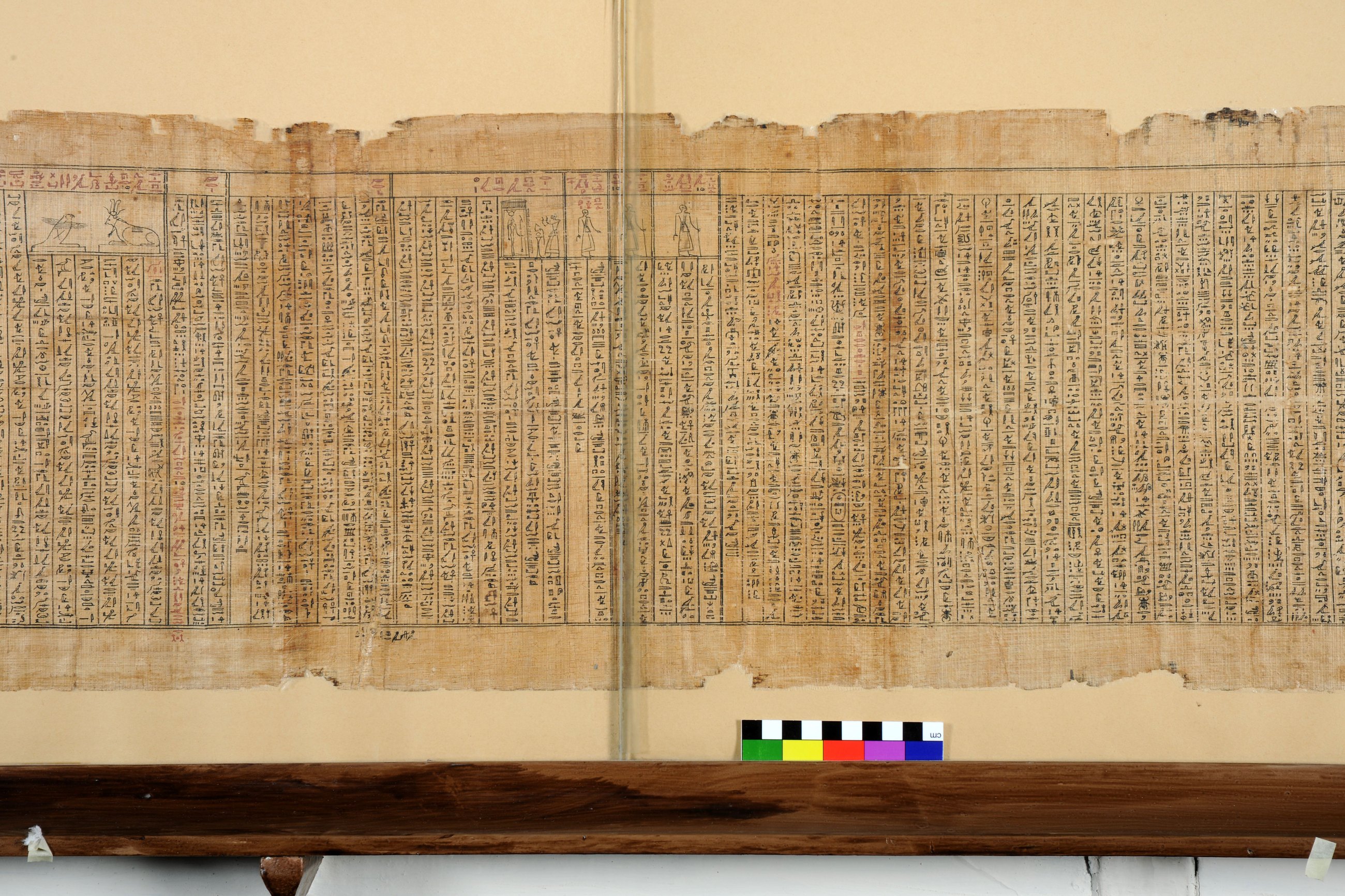
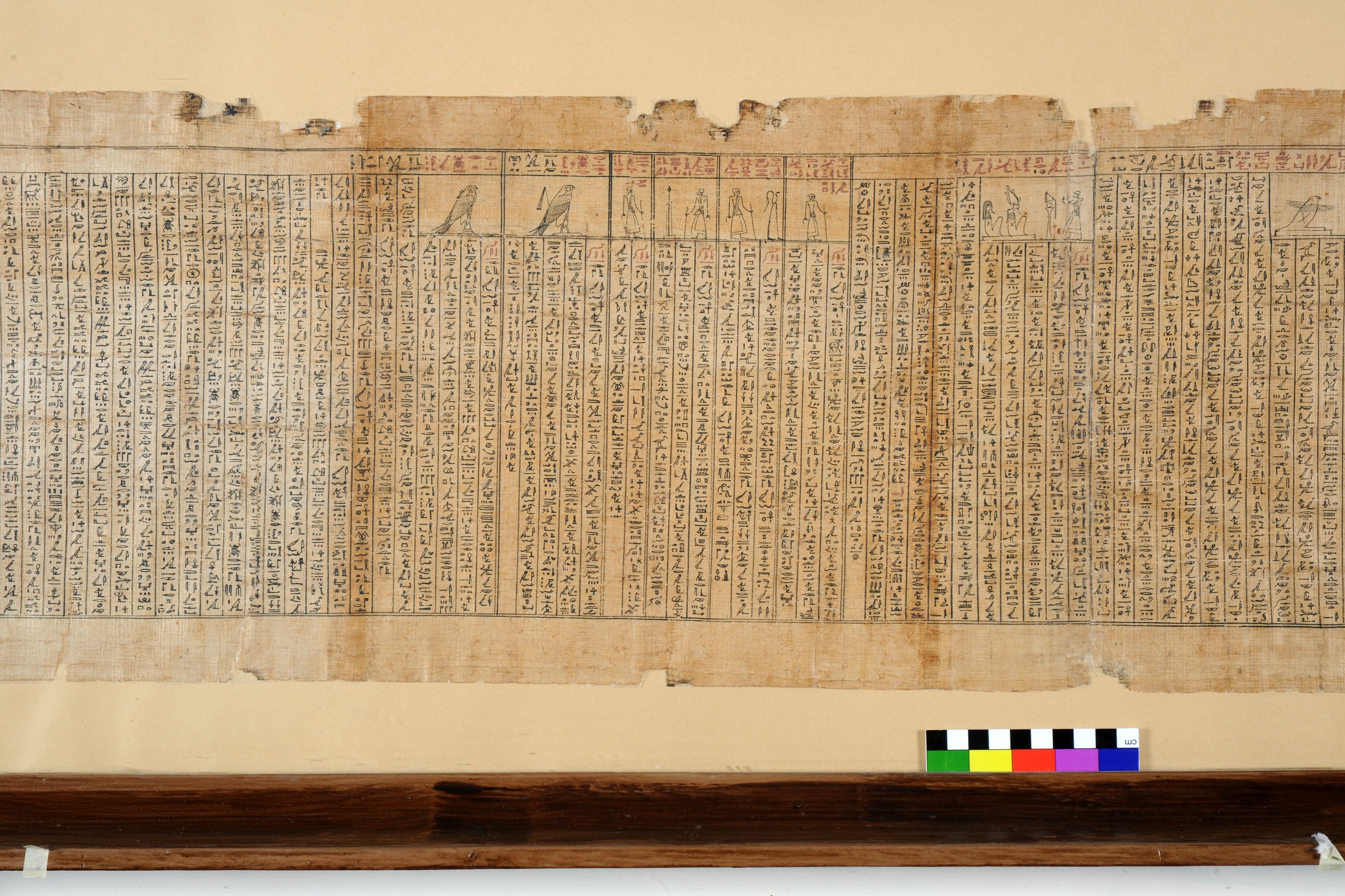
Spell 71 (Birch: 'The chapter of Coming forth as the Day, of stopping the Robber, of how a Person is not taken in Hades, and his Soul is sound in [escapes from] Taser.') is on Lepsius's plates XXVI-XXVII and on photographs 10, 11 of the 31 Museo Egizio photographs of the roll.
The Egyptian is the transliteration of the Thesaurus Linguae Aegyptiae (edition by Burkhard Backes), with the column number of the spell before each column; the numbers are those of Lepsius's plates. On the papyrus the text runs in vertical columns of cursive hieroglyphs from right to left along the roll; titles and some words are written in red. Signs restored by the editor are in square brackets, signs the scribe left out in angle brackets, superfluous signs in braces and damaged signs in half brackets. The English is the translation by Samuel Birch, published in 1867 and made from Lepsius's copy of this papyrus, so the English and the Egyptian come from the same manuscript. It was the first complete English translation of the Book of the Dead; many passages are now understood differently. Birch's own square brackets give his alternatives and explanations. The photographs are by the Museo Egizio; each shows a stretch of the roll, and the note of each section says where the spell stands on it.
How was this verified? (Provenance)
Where on the image
Turin 1791, Spell 71 (TLA Tb 071: title line, columns 1-14; Lepsius 1842, pl. XXVI-XXVII). Photograph 10 of 31 (Commons Book_of_the_Dead_of_Iuefankh,_papyrus_-_Museo_Egizio_Turin_C_1791_p025.jpg): long red title at 0-12% with the falcon and the cow; it continues on photograph 11 (Lepsius pl. XXVI). Photograph 11 of 31 (Commons Book_of_the_Dead_of_Iuefankh,_papyrus_-_Museo_Egizio_Turin_C_1791_p024.jpg): the falcon vignette and the red title at 82-100%. Checked by eye: the photographs were matched to Lepsius's plates by their vignettes, red titles and framed compartments, and the overlapping edges of neighbouring photographs were compared.
titlerʾ n pri̯〈.t〉 m hrw ḫsf ꜥwꜣ,y tm rḏi̯.t jṯi̯.tw z m ẖr,t-nṯr swḏꜣ bꜣ =f m tꜣ-ḏsr
1ḏd-mdw jn Wsjr […] mꜣꜥ-ḫrw j bjk pri̯ m nw,w nb Mḥ〈,t〉-wr,t swḏꜣ =k wj mj swḏꜣ =k ṯw ḏs =k wḥꜥ =k
2wj sfḫ =k wj j{w}〈m〉m! wj r tꜣ jmm! mr,wt =j j.n nb ḥr wꜥ,w r =j jnk bjk m-ẖnw sšd wbꜣ Tꜣ,du ḥr snb
3ky-ḏd snb.pl ky-ḏd z〈n〉b,t j.n Ḥr,w zꜣ ꜣs,t swḏꜣ =k wj mj swḏꜣ =k ṯw ḏs =k wḥꜥ =k wj sfḫ =k wj j{w}〈m〉m! wj r tꜣ jmm!
4mr,wt =j j.n nb ḥr wꜥ,w r =j jnk bjk n p,t rsj〈.t〉 Ḏḥw,tj n p,t mḥ,t〈j.t〉 sḥtp nsr,t nšnj〈.t〉 tw s〈j〉ꜥr mꜣꜥ,t n nb-mꜣꜥ,t j.n
5Ḏḥw,tj swḏꜣ =k wj mj swḏꜣ =k ṯw ḏs =k wḥꜥ =k wj sfḫ =k wj j{w}〈m〉m! wj r tꜣ jmm! mr,wt 〈=j〉 j.n nb ḥr wꜥ,w
6r =j jnk wnb,w n-〈ꜣ〉r≡f nbḥ,w n jꜣ,t jmn.t j.n Wsjr swḏꜣ =k wj mj swḏꜣ =k ṯw ḏs =k wḥꜥ =k
7wj sfḫ =k wj j{w}〈m〉m! wj r tꜣ jmm! mr,wt 〈=j〉 j.n nb ḥr wꜥ,w r =j j nbj,t m rd.du =f ṯnw ꜣ,t =f mḥn〈j〉,t〈.j〉
8nb-bꜣ,pl ḥr〈,j〉-jb ṯꜣ.wj =f swḏꜣ =k wj mj swḏꜣ =k ṯw ḏs =k wḥꜥ =k wj sfḫ =k wj j{w}〈m〉m! wj r tꜣ jmm! mr,wt 〈=j〉 j.n nb
9ḥr wꜥ,w r =j j Rꜥ,w swḏꜣ =k wj mj swḏꜣ =k ṯw ḏs =k wḥꜥ =k wj sfḫ =k wj jmm! wj r tꜣ jmm! mr,wt =j j.n nb
10ḥr wꜥ,w r =j ꜥḥꜥ Sbk ḥr〈,j〉-jb qꜣ〈,w〉 =f ꜥḥꜥ Ni̯,t ḥr〈,j.t〉-jb wḏb swḏꜣ =k wj mj swḏꜣ =k ṯw ḏs =k wḥꜥ =k wj sfḫ =k wj j{w}〈m〉m! wj
11r tꜣ jmm! mr,wt 〈=j〉 j.n nb ḥr wꜥ,w r =j j 7-ḏꜣjs.pl jpw rmni̯.w mḫꜣ〈,t〉 hrw pfj n jp.t wḏꜣ,t smꜣ tp.pl jw nḥb,t
12jṯi̯ jb.pl ḫnp ḥꜣ,tj.pl jri̯{.t} šꜥd m š-nsr,t.du rḫ.n =j ṯn rḫ.n =j rn =ṯn mj rḫ.n =j ṯnw =ṯn spr.w =j r =ṯn spr.w =ṯn r =j
13ꜥnḫ =j n-jm =ṯn ꜥnḫ =ṯn jm =j swḏ =ṯn 〈w〉j 〈n〉 ꜥnḫ jm,j ꜥ =ṯn wꜣs m ḫfꜥ =ṯn swḏ =ṯn 〈wj〉 〈n〉 ꜥnḫ tp〈,j〉 rʾ =ṯn ḏi̯! =ṯn n =j rnp,t.pl ꜥšꜣ.tpl ḥr rnp,t.pl =j n ꜥnḫ
14ḏi̯! =f n =j hrw.pl ꜥšꜣ.{t}pl ḥr hrw.pl =j n ꜥnḫ grḥ.pl ꜥšꜣ.{t}pl ḥr grḥ.pl =j n ꜥnḫ r wḏꜣ =j wbn =j r znn.pl =j ṯꜣw r fnḏ =k jr,t.du mꜣꜣ =sn mj nn jm,j.w-ꜣḫ,t hrw pfj n ḥsb ꜥwꜣ,y
LXXI. The chapter of Coming forth as the Day, of stopping the Robber, of how a Person is not taken in Hades, and his Soul is sound in [escapes from] Taser.
[Vignette. — A mummied Cow with Plumes and Hawk.]
On Hawk coming forth from Nu! Lord of the Great Cow [the Flood, Meh-hul']. I am sound as thou thyself art well, I net, I enwrap, I have placed myself on the earth as I wished, [said] by the Lord doing this to me only. I am the Hawk within the bandages, passing through the earth out of the case or the doors, or the gates, [said] by Horus son of Isis [repeated]. I am the Hawk of the Southern heaven, the Ibis of the Northern heaven, pacifying destructive fire, passing truth to the Lord of Truth [said] by Thoth. — Then, “I am sound,” &c., to “doing this to me only.”
I am the Unbu [flower] of the region where nought grows [Anrutf], the flower fiabhu of the hidden place, [said] by Osiris. — Then follows, “ I am sound,” &c.
Oh “Burning [Fuming] with his foot!” reckoning the moment, the Viper, Lord of Souls, dwelling in his halves! sound, &c., to “ doing this to me only.”
Oh Sun! I am well, &c. Sebak stands on his floor, Nit stands in the fountain. I am well, &c.
Oh seven Chief Powers at the arm of the Balance! the day of judgment, cutting off heads, breaking necks taking hearts, destroying hearts, making blows in the Pool of Fire! I knew ye, I knew your name I have known ye, each of ye: I approach to ye, approach ye to me. I live like you, ye live as I do — impart ye me the life in your hands, the health in your fists — impart ye the life of your lips, give ye to me many years for my years of life. He gave me many days for the days of my life, many nights for the nights of my life, to be well and shine or to breathe as the types; breath to thy nostril, thy eyes see as if they were those of the horizon, the day of reckoning the transgressions.
Notes
- Birch's English was taken from three scans of Bunsen's Egypt's Place in Universal History, vol. V (1867), on the Internet Archive. The three OCR texts were aligned word by word and each word was settled by their agreement; running heads, page numbers, footnote markers and footnotes were removed. Some OCR errors may remain, chiefly in proper names.
- Birch uses the terms and name forms of his time: Hades, Aahlu (Elysium), Tum for Atum, Seb for Geb, Anup for Anubis, Phoenix or Bennu for the heron.
- Labels such as 'title line' or 'gate 1' before a line of the Egyptian translate the position labels of the TLA.
- The TLA has no hieroglyphic encoding for these texts, so only the transliteration is shown.
Cite
Sources
- Source: Papyrus of Iuefankh, Turin, Museo Egizio Cat. 1791 (Museo Egizio photographs, CC0) + TLA transliteration (ed. B. Backes, CC BY-SA 4.0) + English of Samuel Birch (1867, public domain) (holding institution)
- Critical edition: Thesaurus Linguae Aegyptiae, ed. Burkhard Backes (2018 data, AED-TEI)
← previous · → next · v cycle view · l back to library