Book of the Dead, Spell 130: Vivifying the Soul for ever, of letting it go to the Boat of the ... (papyrus of Iuefankh)
Introduction
The Book of the Dead, in Egyptian the spells for going forth by day, is a collection of funerary spells written on papyrus rolls and placed in burials from the New Kingdom to the Roman period. Each roll was made for one person, with spells taken from a large repertoire and illustrated with drawings (vignettes). This library gives one complete roll: the papyrus of Iuefankh in the Museo Egizio, Turin (Cat. 1791), written in the Ptolemaic period (332-30 BCE) and coming from Thebes. Richard Lepsius published it in 1842 and divided it into 165 chapters; his numbering is still the standard numbering of the spells, and it is used here.
Spell 130 (Birch: 'The book of Vivifying the Soul for ever, of letting it go to the Boat of the Sun to pass the Crowds at the Gate. Done on the Day of the Birth of Osiris.') is on Lepsius's plates LII-LIV and on photograph 21 of the 31 Museo Egizio photographs of the roll.
The Egyptian is the transliteration of the Thesaurus Linguae Aegyptiae (edition by Burkhard Backes), with the column number of the spell before each column; the numbers are those of Lepsius's plates. On the papyrus the text runs in vertical columns of cursive hieroglyphs from right to left along the roll; titles and some words are written in red. Signs restored by the editor are in square brackets, signs the scribe left out in angle brackets, superfluous signs in braces and damaged signs in half brackets. The English is the translation by Samuel Birch, published in 1867 and made from Lepsius's copy of this papyrus, so the English and the Egyptian come from the same manuscript. It was the first complete English translation of the Book of the Dead; many passages are now understood differently. Birch's own square brackets give his alternatives and explanations. The photographs are by the Museo Egizio; each shows a stretch of the roll, and the note of each section says where the spell stands on it.
How was this verified? (Provenance)
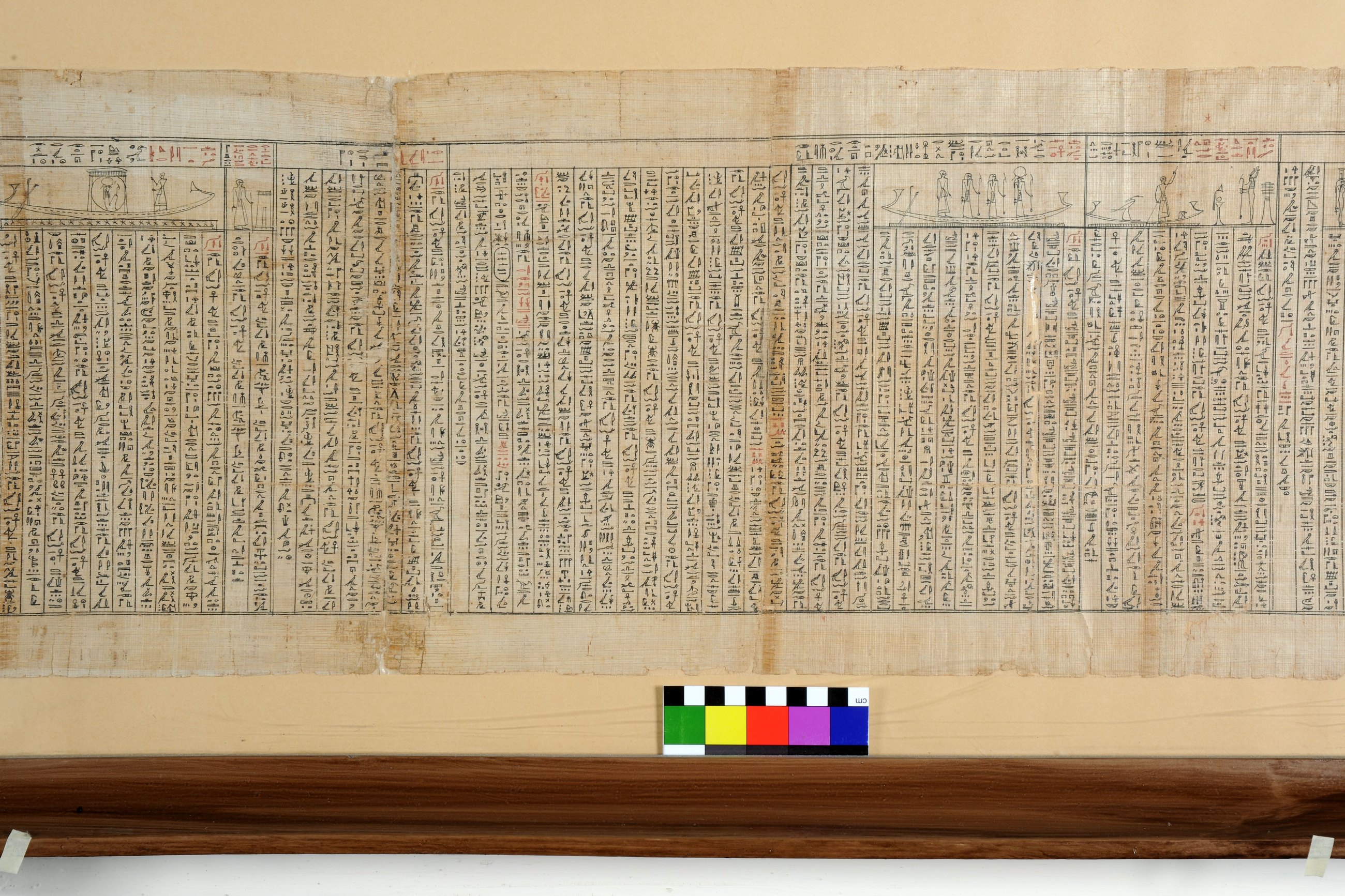
Where on the image
Turin 1791, Spell 130 (TLA Tb 130: title line, columns 1-30; Lepsius 1842, pl. LII-LIV). Photograph 21 of 31 (Commons Book_of_the_Dead_of_Iuefankh,_papyrus_-_Museo_Egizio_Turin_C_1791_p014.jpg): the boat of four gods with the sun-headed god at 65-79%; its columns run to 30% (Lepsius pl. LIII). Checked by eye: the photographs were matched to Lepsius's plates by their vignettes, red titles and framed compartments, and the overlapping edges of neighbouring photographs were compared.
titlemḏꜣ,t n.t sꜥnḫ bꜣ r-nḥḥ rḏi̯.t hꜣi̯ =f r wjꜣ-n-Rꜥ,w r swꜣ šn,wt dꜣ,t jri̯.t n hrw msw,t-Wsjr
1ḏd-mdw jn Wsjr […] mꜣꜥ-ḫrw wn p,t wn tꜣ wn rsj wn mḥ,tt wn jmn,tt wn jꜣb,tt wn jtr,t{.j}-šmꜥ〈,t〉
2wn jtr,t{.du}-mḥ〈,t〉 wn ꜥꜣ.du zš sbꜣ.pl n Rꜥ,w pri̯ =f m ꜣḫ,t wn n =f ꜥꜣ.du sk,tt zš n =f sbꜣ.pl n〈.w〉 mꜥ〈n〉ḏ,t ssn =f
3Šw qmꜣ.n =f Tfnw,t šms sw jm,j.w-šms,w =f Wsjr […] mꜣꜥ-ḫrw šms,w{.pl} Rꜥ,w šzp bjꜣ =f ḏbꜣ ḫm mj Ḥr,w 〈j〉ꜥr =f
4⸢šꜣw⸣ sštꜣ s,t =f m ꜥbw krjw =f wpw,t〈j〉 nṯr n mri̯.yn =f jw šdi̯.n Wsjr […] mꜣꜥ-ḫrw mꜣꜥ,t s〈j〉ꜥr.n =f sšm,pl =s
5jw šdi̯.n Wsjr […] mꜣꜥ-ḫrw pn q〈ꜣ〉s.n =f krjw bw,t =f nšnj jbs ⸢ḫꜣb〈ꜣ〉≡s⸣ ky-ḏd […] nn ḫꜣb〈ꜣ〉≡s r-gs =f nn ḫsf.tw =f
6ḥr Rꜥ,w ḥr Wsjr nn šnꜥ.tw =f j{r}〈n〉 jri̯{.t} m ꜥ,wj =f nn šmi̯ Wsjr […] mꜣꜥ-ḫrw m jn,t kk,w nn ꜥq =f m š ḫbn,tj.w nn
7wnn =f m wšꜣ ꜣ,t nn ḫr =f m ḥꜣq b〈w〉 jm m-ꜥ jṯi̯-n-ḥr≡f ḥꜣ〈,j〉 nm,t Spd jꜥn,w n =ṯn mꜣs,tj.w
8jw ds nṯr m štꜣ,w ꜥ.wj ḫsr{ꜣ} ḥꜣtjw ṯz,t Gbb ḥr nhp,w jr nḏm jrf sšmi̯ =f wr.pl r =f ḥnꜥ šrj.w
9r nw js gr Ḏḥwtj m-ẖnw štꜣ jri̯ =f ꜥbw ḥḥ.pl wbꜣ bjꜣ ḫsr ḥꜣywj!! m-ḏrj Wsjr […]
10mꜣꜥ-ḫrw m s,t =f nḏrjw.n =f mdw =f šzp.n =f jms =f r-gs Rꜥ,w ꜥꜣ šm =f wbn wr m s,t jri̯.wt =f psḏ,t ḫsf ḥꜣ s,t =f dr =sn
11ꜣhꜣ =f mn〈,t〉 =f jw dr.n Wsjr […] mꜣꜥ-ḫrw jhꜣ =f snḏm =f Rꜥ,w Wsjr wbꜣ =f ꜣḫ,t n.t Rꜥ,w jw jri̯ n =f wjꜣ swḏꜣ =f sḥḏ n =f
12ḥr Ḏḥwtj jw dwꜣ =f Rꜥ,w nb-ꜣḫ,t jwi̯ =f ḥwi̯.n =f sḏb r ḫfti̯.w =f nn jwi̯ Wsjr […] mꜣꜥ-ḫrw sꜥḥ m rʾ =f ḏd.n =f n =f jw Wsjr […]
13mꜣꜥ-ḫrw nn šnꜥ.tw =f m ꜣḫ,t ky-ḏd Rꜥ,w ntf Wsjr nn jwi̯.tw =f ḥr ḏꜣi̯〈.t〉 ꜥꜣ〈.t〉 j{z}〈n〉 ⸢tp⸣ =f m mꜣs,t.j =f ḏr-n,tj rn =f m rʾ n Rꜥ,w m ẖ,t n.t Wsjr […]
14mꜣꜥ-ḫrw sḏm md,t =f jꜣ,w n Rꜥ,w nb-ꜣḫ,t Wsjr-ḫnti̯-jmn,tt j:nḏ-ḥr =k wꜥb n =f ḥnmm〈,t〉 ḫrp =f p,t r {j}ꜣ,t twy wr〈.t〉 swꜣ ḥp〈,t〉.pl sn,wj m =k Wsjr
15[…] mꜣꜥ-ḫrw jy〈.w〉 sr{t}.n =f mꜣꜥ,t ḏr-n,tj bjꜣ m jmn,tt sḏ.n =f nšnj ꜥꜣpp ntf Rw,tj Wsjr […] mꜣꜥ-ḫrw sr.n =f mk〈,t〉
16jm,j.pl =f m-tp-ꜥ ḥw,t-wr〈,t〉 sḏm =k n =f h〈ꜣ〉b Wsjr […] mꜣꜥ-ḫrw m ḏꜣḏꜣ,t jw sḫr =f ꜥꜣpp ḥr Rꜥ,w rꜥ,w-nb nn ⸢pḥ⸣.n =f sṯz =f jw nḏrjw =j
17Wsjr […] mꜣꜥ-ḫrw jw šzp =f ḥtp ꜥpr =f Ḏḥwtj m jrr!.t =f jw rḏi̯.n =f pẖr mꜣꜥ,t m-tp wjꜣ ꜥꜣ ẖr〈,j〉 mꜣꜥ-ḫrw m ḏꜣḏꜣ,t jw smn.n =f
18ḥḥ.pl jw sšmi̯.n =f šn,wy =f ḏi̯! n =sn Wsjr […] mꜣꜥ-ḫrw ẖni̯〈.t〉 n =f m ḥꜥꜥ〈,wt〉 tp〈,j〉 pẖr jz,t.y Rꜥ,w m-sꜣ nfr,pl =f qꜣi̯ mꜣꜥ〈,t〉 pẖr =s nb =s
19ḏi̯ =tw jꜣ,w 〈n〉 nb-r-ḏr jw šzp.n Wsjr […] mꜣꜥ-ḫrw mdw sk.n =f p,t jm =f ḏi̯ n =f ḥnmm,t j〈ꜣ〉,w mj ꜥḥꜥ nn wrḏ.n =f sqꜣi̯ =f
20Rꜥ,w 〈m〉 jri̯.tn =f jw ḫsr.n =f ḥꜣyw mꜣꜣ.n =f nfr,pl =f smn.n =f ḥp〈,t〉.pl =f pẖr =f wḏꜣ =f r wjꜣ m p,t ḫꜥi̯.n =f m ꜥnḏ,w Wsjr […]
21mꜣꜥ-ḫrw ꜥꜣ ḥr〈,j〉-jb jr,t =f ḥmsi̯ mꜣs{,t.j}〈.w〉 m wjꜣ ꜥꜣ n Ḫprj ḫpr Wsjr […] mꜣꜥ-ḫrw ḫpr ḏd.t =f ntf nw pẖr p,t r jmn,tt ꜥḥꜥ jrf ḫꜣb〈ꜣ〉≡s
22Šw m ḥꜥꜥ〈,wt〉 šzp =sn ḥꜣ,t〈t〉 n.t Rꜥ,w m-ꜥ jz,t.y =f pẖr Rꜥ,w mꜣꜣ.n =f Wsjr wḏ.n =f Wsjr […] mꜣꜥ-ḫrw m-ḥtp zp-2 nn ḫsf.tw =f nn šnꜥ.tw =f
23nn jṯi̯.tw =f jn hh n ꜣ,t =k nn pri̯ šnꜥ{.tw} =f m rʾ =k r =f nn šmi̯ Wsjr […] mꜣꜥ-ḫrw ḥr ꜣd〈,w〉.pl bw,t =f jḥy.pl n pḥ{.twpl} =swpl
24sw h〈ꜣ〉i̯.y Wsjr […] mꜣꜥ-ḫrw r wjꜣ =k ḏbꜣ =f ns,t =k šzp.n =f sꜥḥ =k sšmi̯ =f wꜣ,t.pl Rꜥ,w dwꜣ =f r ḫsf nbḏ pwy jy ḥr nsr,t r wjꜣ =k
25〈ḥr〉 wꜥr,t twy wr.t jw Wsjr […] mꜣꜥ-ḫrw rḫ〈.w〉 sw nn pḥ sw wjꜣ =k js Wsjr […] mꜣꜥ-ḫrw jm =f ntf jri̯{.t} ḥtp.pl-nṯr n nṯr.pl pr-ḫrw n ꜣḫ.w
26ḏd-mdw ḥr twt n ꜣḫ pn jqr rḏi̯〈.w〉 m wjꜣ pn jsk jri̯.n =k sk,tj ḥr{=f}-gs =f wnmi̯ mꜥnḏ,t{j} ḥr-gs =f jꜣbi̯ wdn.w 〈n〉 =sn tʾ ḥ〈n〉q,t jḥ.pl ꜣpd.pl snṯr ḥr sḏ,t
27〈j〉ḫ,t-nb〈,t〉 nfr〈.t〉 hrw msw,t-Wsjr jr jri̯ =tw n =f nn wnn bꜣ =f ꜥnḫ〈.w〉 r-nḥḥ nn mt =f m-wḥm sštꜣ dꜣ,t bz štꜣ m ẖr,t-nṯr gmi̯ m
28ꜥḥ,t n〈.t〉 ḥw,t-ꜥꜣ,t ḫr ḥm n nsw,t-bj,t ⸢Zm,tj⸣ mꜣꜥ-ḫrw m gmi̯〈.t〉 m qr,t n.t ḏw jri̯.tn Ḥr,w n jti̯ =f Wsjr-wnn-nfr,w mꜣꜥ-ḫrw ḏr-n,tt mꜣꜣ Rꜥ,w ꜣḫ,w pn m ḥꜥ =f ḏs =f mꜣꜣ =f sw mj psḏ,t tw
29wr snḏ =f ꜥꜣ šfy,t =f m jb n r〈m〉ṯ.pl nṯr.pl ꜣḫ.w mt{j}.pl wnn.ḫr bꜣ =f ꜥnḫ〈.w〉 r-nḥḥ nn mt =f m-wḥm m ẖr,t-nṯr nn zpi̯.ntw =f hrw wḏꜥ-md,t
30wnn ḫrw =f mꜣꜥ.{t}〈w〉 r ḫfti̯.pl =f wnn ḥtp =f ḥr ḫꜣw,t n.t Rꜥ,w m-ẖr〈,t〉-hrw n.t rꜥ,w-nb
CXXX. The book of Vivifying the Soul for ever, of letting it go to the Boat of the Sun to pass the Crowds at the Gate. Done on the Day of the Birth of Osiris.
[Vignette — Boat of Ra, two Gods and a Pilot.)
THE heaven is open, the earth opens, the South opens, the North opens, the West opens, the East opens, the Southern zenith opens, the Northern nadir opens, the valves of the door open, the gateway of the Sun opens. He proceeds from the horizon. He has unclosed the doors of the ark. He has opened the doors of the cabin. Shu has given him breath, Tefnu.t created him; they serve in his service.
The Osiris serves the Sun. He has received his due reward at the shrine; like Horus, he goes to the recesses of his place, to the sanctuary of his chest. The God leads him where he has wished. The Osiris has acted truly, he has gone through its course. The Osiris has made this justification. He has prepared the chest. He hates the opposition of Abs or Khabs or the Beast. There are no shades where he is. He has not been turned back by the Sun, or by Osiris; he has not been turned away for what he has done with his hands. The Osiris does not walk in the V alley of Darkness, he does not go in the Pool of the Damned. He is not in the fissure [trap] a moment. He knows no terror in the place in which he is, for he can take his head behind the block of Setp.
Hail to ye, Feet! The God has grown hard with the mysteries of his hand, the God dissipates the ex-tremities [?] of Seb by light. Let him be delighted, for the old and young pass to him when they see Thoth is in the mysteries. He gives delight to millions, he passes through matter, he chases injury from the form of the Osiris in his place. He has carved his stick, he has taken his wig where the Sun is. He is the great Passer, the chief shining out of the place which the Gods have made him. When he turns back from his place they correct his faults and omissions. The Osiris corrects his faults, he delights the Sun and Osiris, he has passed the horizon of the Sun. He has made his boat, he has gone forth, he has shone through means of Thoth. He has adored the Sun, Lord of the Hill, he goes and has smitten his wicked enemies. The Osiris does not deceive [reject] the dead [mummies] with his mouth. He has said to him: The Osiris has not been turned away from the horizon, or from the Sun. He is Osiris. He has not been rejected from his great boat. He rests on his legs while his name is in the mouth of the Sun, in the belly of the Osiris, listening to his words.
Glory to the Sun, Lord of the Horizon! Osiris, Lord of the West! Hail, thou who purifiest mankind, who soundest the heaven at the great place, making the boatmen to go along! Make thou the Osiris come, — he has arranged truth while there is. .. from the West. He has been at enmity with the Apophis. He, the Osiris, is the Lion-Gods. He has prepared defence for his followers at the great Place. Listen thou to him.
The Osiris goes in company. He has overthrown the Apep for the Sun daily. He has not escaped his vigilance. The Osiris has worked, he has received peace offerings. Thoth provides him with what he has made. He lias made truth approach him at the head of the great boat, having justification like the assembled Gods. He has prepared millions, he has passed his billions. They have allowed the Osiris to go. The circle of the ministers of the Sun is before him, his blessings are after him. Come. Truth exclaims, she approaches her Lord; glory is given to the Universal Lord. The Osiris has taken a stick, he has struck Nuher [Firmament] with it. It has given glorious light, as if he had never been at rest. He has announced to the Sun what he has done he has dissipated the injury; he has seen his blessings, he has set in order his boatmen, he has gone round, he has gone forth to the boat in the heaven. He has risen from An tu. The Osiris his eye reposes, his legs sit in the great boat of Kheperu, he is made; his words are made. He then goes round the heaven to the West. The Shades [stars] stand without joy for him. They receive the tow-line of the Sun from his ministers. The Sun goes round, he has seen Osiris, he has ordered Osiris in peace, he is neither stopped nor turned away, he has not been taken; [is said] by the fire of thy orb. Nothing comes out of thy mouth to him by which he has been turned away. The Osiris does not walk among the crocodiles, what he hates is the fishers. They have not pursued him. The Osiris comes to thy boat, he takes thy seat. He has taken thy body. He goes along the path of the Sun. He prays to stop that noose coming out of the fire to thy boat. That great leg, the Osiris knows it; it does not follow thy boat when the Osiris is in it. He has made the divine food of the Gods, the meals of the Spirits.
Said over the figure of the wise dead placed in that boat. When thou hast made an ark in it on its left hand and a cabin on its right, present to them food and drink, cattle and geese, burning incense, and all good things on the birthday of the Osiris. When all this is done his soul lives for ever, it does not die again, owing to the shut gate, entering the recesses in Hades, finding the palace of the great house of the king Hept-makheru, found in the region of the Hill, which Horus made for his father Osiris, the revealer of good, the justified. While the Sun looks at that Spirit in his own limbs he has seen him made divine. Great is his terror, great is the fear of him in the heart of Gods, Spirits, and the dead. For his soul lives for ever, he does not die again in Hades, he is not annihilated the day of weighing words. His word is true against his enemies. His food is off the altar of the Sun to the end of every day.
Notes
- Birch's English was taken from three scans of Bunsen's Egypt's Place in Universal History, vol. V (1867), on the Internet Archive. The three OCR texts were aligned word by word and each word was settled by their agreement; running heads, page numbers, footnote markers and footnotes were removed. Some OCR errors may remain, chiefly in proper names.
- Birch uses the terms and name forms of his time: Hades, Aahlu (Elysium), Tum for Atum, Seb for Geb, Anup for Anubis, Phoenix or Bennu for the heron.
- Labels such as 'title line' or 'gate 1' before a line of the Egyptian translate the position labels of the TLA.
- The TLA has no hieroglyphic encoding for these texts, so only the transliteration is shown.
Cite
Sources
- Source: Papyrus of Iuefankh, Turin, Museo Egizio Cat. 1791 (Museo Egizio photographs, CC0) + TLA transliteration (ed. B. Backes, CC BY-SA 4.0) + English of Samuel Birch (1867, public domain) (holding institution)
- Critical edition: Thesaurus Linguae Aegyptiae, ed. Burkhard Backes (2018 data, AED-TEI)
← previous · → next · v cycle view · l back to library