1 Clement (Letter of the Church of Rome to the Corinthians), on Codex Alexandrinus
Introduction
1 Clement is a letter from the church at Rome to the church at Corinth, written because the Corinthians had removed their presbyters. It does not name its author, but from the second century it was attributed to Clement, a leader of the Roman church, and it is usually dated to the 90s AD. It is one of the oldest Christian writings outside the New Testament; it mentions the deaths of Peter and Paul (chapter 5).
The oldest manuscript is Codex Alexandrinus (London, British Library, Royal MS 1 D. VIII, 5th century), where 1 and 2 Clement follow the Book of Revelation on fol. 159r-169v. The pages are shown from the photographic facsimile published by the British Museum in 1909. Each section is linked to the facsimile plate or plates that carry the chapter, using the caption the facsimile prints beneath each plate.
One leaf of Alexandrinus is lost between fol. 167v and fol. 168r, taking 57.7 to the end of chapter 63, and the foot of the second column of fol. 167v is damaged. Those chapters are shown on the only other complete Greek manuscript, Codex Hierosolymitanus 54 (Jerusalem, dated 1056), from the Library of Congress microfilm. The Greek is Kirsopp Lake's edition (1912); the English is J. B. Lightfoot's translation (1891).
Numbering: Greek verse numbers are Lake's; the English carries the verse numbers of the Lightfoot transcription. They differ in six chapters, and each of those sections says how in its heading: ch. 5: Lake's verses 5-6 are Lightfoot's 5, Lake's 7 is Lightfoot's 6; ch. 8: Lake's verse 2 is Lightfoot's 2-3 and the start of his 4 ("and He added also a merciful judgment"), Lake's 3 is the rest of Lightfoot's 4, Lake's 4-5 are Lightfoot's 5-6; ch. 15: Lake's verses 6-7 are Lightfoot's 6; ch. 18: Lake's 3-4 are Lightfoot's 3, Lake's 5-6 his 4, Lake's 7-9 his 5-7, Lake's 10-11 his 8, Lake's 12-13 his 9-10, Lake's 14 and the first sentence of 15 his 11, the rest of Lake's 15 his 12, Lake's 16-17 his 13-14; ch. 44: Lake's verses 2-3 are Lightfoot's 2, Lake's 4-6 are Lightfoot's 3-5; ch. 50: Lake's verses 2-3 are Lightfoot's 2, Lake's 4-7 are Lightfoot's 3-6.
How was this verified? (Provenance)
Where on the image
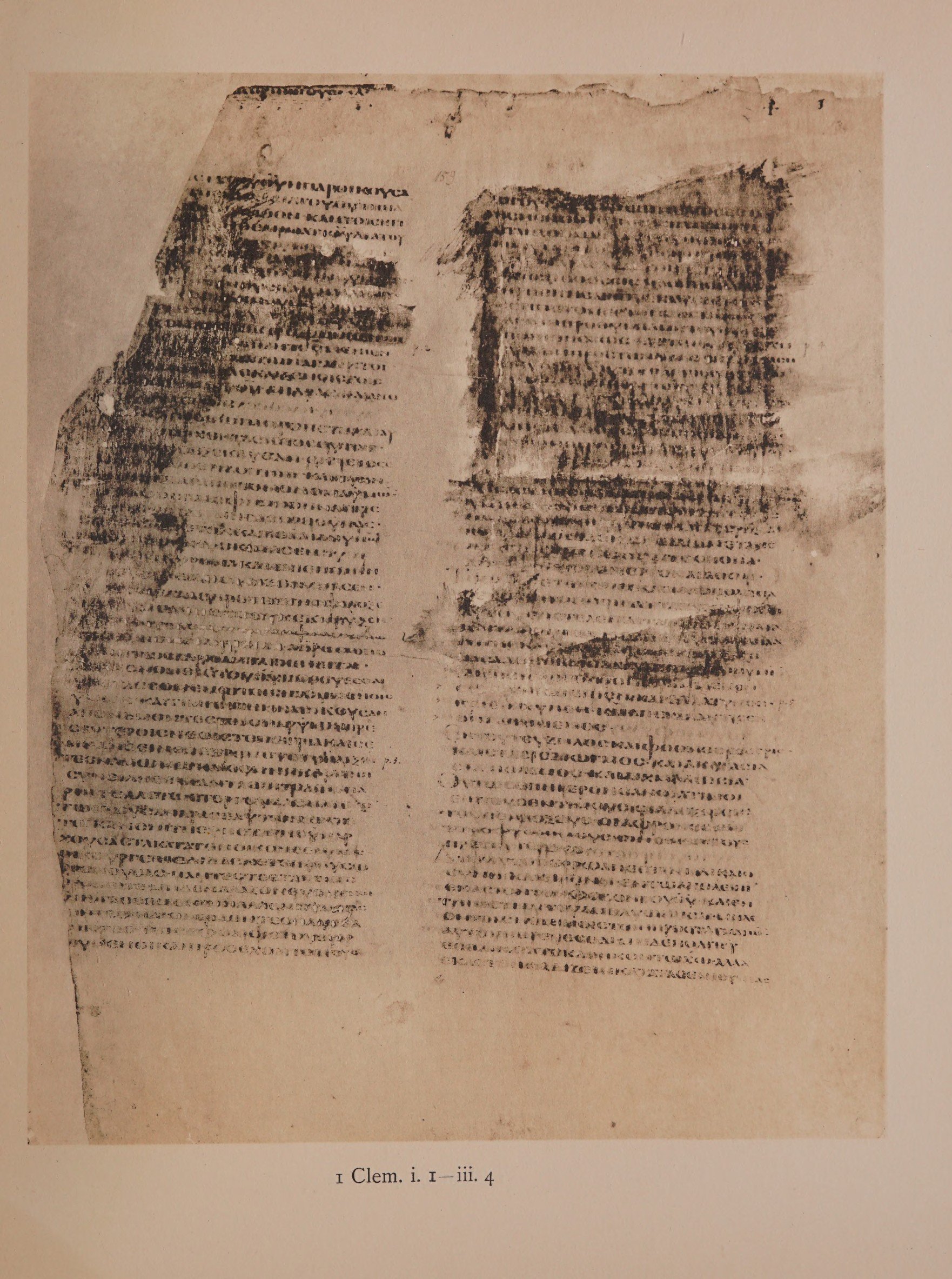
Codex Alexandrinus fol. 159r (1909 facsimile, scan leaf 281; caption printed under the plate: '1 Clem. i. 1-iii. 4'). The Greek shown is Lake's edited text (1912), not a transcription of the manuscript page.
Ἡ ἐκκλησία τοῦ θεοῦ ἡ παροικοῦσα Ῥώμην τῇ ἐκκλησίᾳ τοῦ θεοῦ τῇ παροικούσῃ Κόρινθον, κλητοῖς ἡγιασμένοις ἐν θελήματι θεοῦ διὰ τοῦ κυρίου ἡμῶν Ἰησοῦ Χριστοῦ. χάρις ὑμῖν καὶ εἰρήνη ἀπὸ παντοκράτορος θεοῦ διὰ Ἰησοῦ Χριστοῦ πληθυνθείη.
The Church of God which sojourneth in Rome to the Church of God which sojourneth in Corinth, to them which are called and sanctified by the will of God through our Lord Jesus Christ. Grace to you and peace from Almighty God through Jesus Christ be multiplied.
Where on the image
Codex Alexandrinus fol. 159r (1909 facsimile, scan leaf 281; caption printed under the plate: '1 Clem. i. 1-iii. 4'). The Greek shown is Lake's edited text (1912), not a transcription of the manuscript page.
1Διὰ τὰς αἰφνιδίους καὶ ἐπαλλήλους γενομένας ἡμῖν συμφορὰς καὶ περιπτώσεις, βράδιον νομίζομεν ἐπιστροφὴν πεποιῆσθαι περὶ τῶν ἐπιζητουμένων παρ’ ὑμῖν πραγμάτων, ἀγαπητοί, τῆς τε ἀλλοτρίας καὶ ξένης τοῖς ἐκλεκτοῖς τοῦ θεοῦ, μιαρᾶς καὶ ἀνοσίου στάσεως ἣν ὀλίγα πρόσωπα προπετῆ καὶ αὐθάδη ὑπάρχοντα εἰς τοσοῦτον ἀπονοίας ἐξέκαυσαν, ὥστε τὸ σεμνὸν καὶ περιβόητον καὶ πᾶσιν ἀνθρώποις ἀξιαγάπητον ὄνομα ὑμῶν μεγάλως βλασφημηθῆναι. 2τίς γὰρ παρεπιδημήσας πρὸς ὑμᾶς τὴν πανάρετον καὶ βεβαίαν ὑμῶν πίστιν οὐκ ἐδοκίμασεν; τήν τε σώφρονα καὶ ἐπιεικῆ ἐν Χριστῷ εὐσέβειαν οὐκ ἐθαύμασεν; καὶ τὸ μεγαλοπρεπὲς τῆς φιλοξενίας ὑμῶν ἦθος οὐκ ἐκήρυξεν; καὶ τὴν τελείαν καὶ ἀσφαλῆ γνῶσιν οὐκ ἐμακάρισεν; 3ἀπροσωπολήμπτως γὰρ πάντα ἐποιεῖτε καὶ ἐν τοῖς νομίμοις τοῦ θεοῦ ἐπορεύεσθε, ὑποτασσόμενοι τοῖς ἡγουμένοις ὑμῶν, καὶ τιμὴν τὴν καθήκουσαν ἀπονέμοντες τοῖς παρ’ ὑμῖν πρεσβυτέροις· νέοις τε μέτρια καὶ σεμνὰ νοεῖν ἐπετρέπετε· γυναιξίν τε ἐν ἀμώμῳ καὶ σεμνῇ καὶ ἁγνῇ συνειδήσει πάντα ἐπιτελεῖν παρηγγέλλετε, στεργούσας καθηκόντως τοὺς ἄνδρας ἑαυτῶν· ἔν τε τῷ κανόνι τῆς ὑποταγῆς ὑπαρχούσας τὰ κατὰ τὸν οἶκον σεμνῶς οἰκουργεῖν ἐδιδάσκετε, πάνυ σωφρονούσας.
1By reason of the sudden and repeated calamities and reverses which are befalling us, brethren, we consider that we have been somewhat tardy in giving heed to the matters of dispute that have arisen among you, dearly beloved, and to the detestable and unholy sedition, so alien and strange to the elect of God, which a few headstrong and self-willed persons have kindled to such a pitch of madness that your name, once revered and renowned and lovely in the sight of all men, hath been greatly reviled. 2For who that had sojourned among you did not approve your most virtuous and stedfast faith? Who did not admire your sober and forbearing piety in Christ? Who did not publish abroad your magnificent disposition of hospitality? Who did not congratulate you on your perfect and sound knowledge? 3For ye did all things without respect of persons, and ye walked after the ordinances of God, submitting yourselves to your rulers and rendering to the older men among you the honour which is their due. On the young too ye enjoined modest and seemly thoughts: and the women ye charged to perform all their duties in a blameless and seemly and pure conscience, cherishing their own husbands, as is meet; and ye taught them to keep in the rule of obedience, and to manage the affairs of their household in seemliness, with all discretion.
Where on the image
Codex Alexandrinus fol. 159r (1909 facsimile, scan leaf 281; caption printed under the plate: '1 Clem. i. 1-iii. 4'). The Greek shown is Lake's edited text (1912), not a transcription of the manuscript page.
1Πάντες τε ἐταπεινοφρονεῖτε μηδὲν ἀλαζονευόμενοι, ὑποτασσόμενοι μᾶλλον ἢ ὑποτάσσοντες, ἥδιον διδόντες ἢ λαμβάνοντες. τοῖς ἐφοδίοις τοῦ Χριστοῦ ἀρκούμενοι, καὶ προσέχοντες τοὺς λόγους αὐτοῦ ἐπιμελῶς ἐνεστερνισμένοι ἦτε τοῖς σπλάγχνοις, καὶ τὰ παθήματα αὐτοῦ ἦν πρὸ ὀφθαλμῶν ὑμῶν. 2οὕτως εἰρήνη βαθεῖα καὶ λιπαρὰ ἐδέδοτο πᾶσιν καὶ ἀκόρεστος πόθος εἰς ἀγαθοποιΐαν, καὶ πλήρης πνεύματος ἁγίου ἔκχυσις ἐπὶ πάντας ἐγίνετο· 3μεστοί τε ὁσίας βουλῆς, ἐν ἀγαθῇ προθυμίᾳ μετ’ εὐσεβοῦς πεποιθήσεως ἐξετείνετε τὰς χεῖρας ὑμῶν πρὸς τὸν παντοκράτορα θεόν, ἱκετεύοντες αὐτὸν ἱλέως γενέσθαι, εἴ τι ἄκοντες ἡμάρτετε. 4ἀγὼν ἦν ὑμῖν ἡμέρας τε καὶ νυκτὸς ὑπὲρ πάσης τῆς ἀδελφότητος, εἰς τὸ σώζεσθαι μετ’ ἐλέους καὶ συνειδήσεως τὸν ἀριθμὸν τῶν ἐκλεκτῶν αὐτοῦ. 5εἰλικρινεῖς καὶ ἀκέραιοι ἦτε καὶ ἀμνησίκακοι εἰς ἀλλήλους. 6πᾶσα στάσις καὶ πᾶν σχίσμα βδελυκτὸν ἦν ὑμῖν. ἐπὶ τοῖς παραπτώμασιν τῶν πλησίον ἐπενθεῖτε· τὰ ὑστερήματα αὐτῶν ἴδια ἐκρίνετε. 7ἀμεταμέλητοι ἦτε ἐπὶ πάσῃ ἀγαθοποιΐᾳ, ἕτοιμοι εἰς πᾶν ἔργον ἀγαθόν. 8τῇ παναρέτῳ καὶ σεβασμίῳ πολιτείᾳ κεκοσμημένοι πάντα ἐν τῷ φόβῳ αὐτοῦ ἐπετελεῖτε· τὰ προστάγματα καὶ τὰ δικαιώματα τοῦ κυρίου ἐπὶ τὰ πλάτη τῆς καρδίας ὑμῶν ἐγέγραπτο.
1And ye were all lowly in mind and free from arrogance, yielding rather than claiming submission, more glad to give than to receive, and content with the provisions which God supplieth. And giving heed unto His words, ye laid them up diligently in your hearts, and His sufferings were before your eyes. 2Thus a profound and rich peace was given to all, and an insatiable desire of doing good. An abundant outpouring also of the Holy Spirit fell upon all; 3and, being full of holy counsel, in excellent zeal and with a pious confidence ye stretched out your hands to Almighty God, supplicating Him to be propitious, if unwillingly ye had committed any sin. 4Ye had conflict day and night for all the brotherhood, that the number of His elect might be saved with fearfulness and intentness of mind. 5Ye were sincere and simple and free from malice one towards another. 6Every sedition and every schism was abominable to you. Ye mourned over the transgressions of your neighbours: ye judged their shortcomings to be your own. 7Ye repented not of any well-doing, but were ready unto every good work. 8Being adorned with a most virtuous and honourable life, ye performed all your duties in the fear of Him. The commandments and the ordinances of the Lord were written on the tables of your hearts.
Where on the image
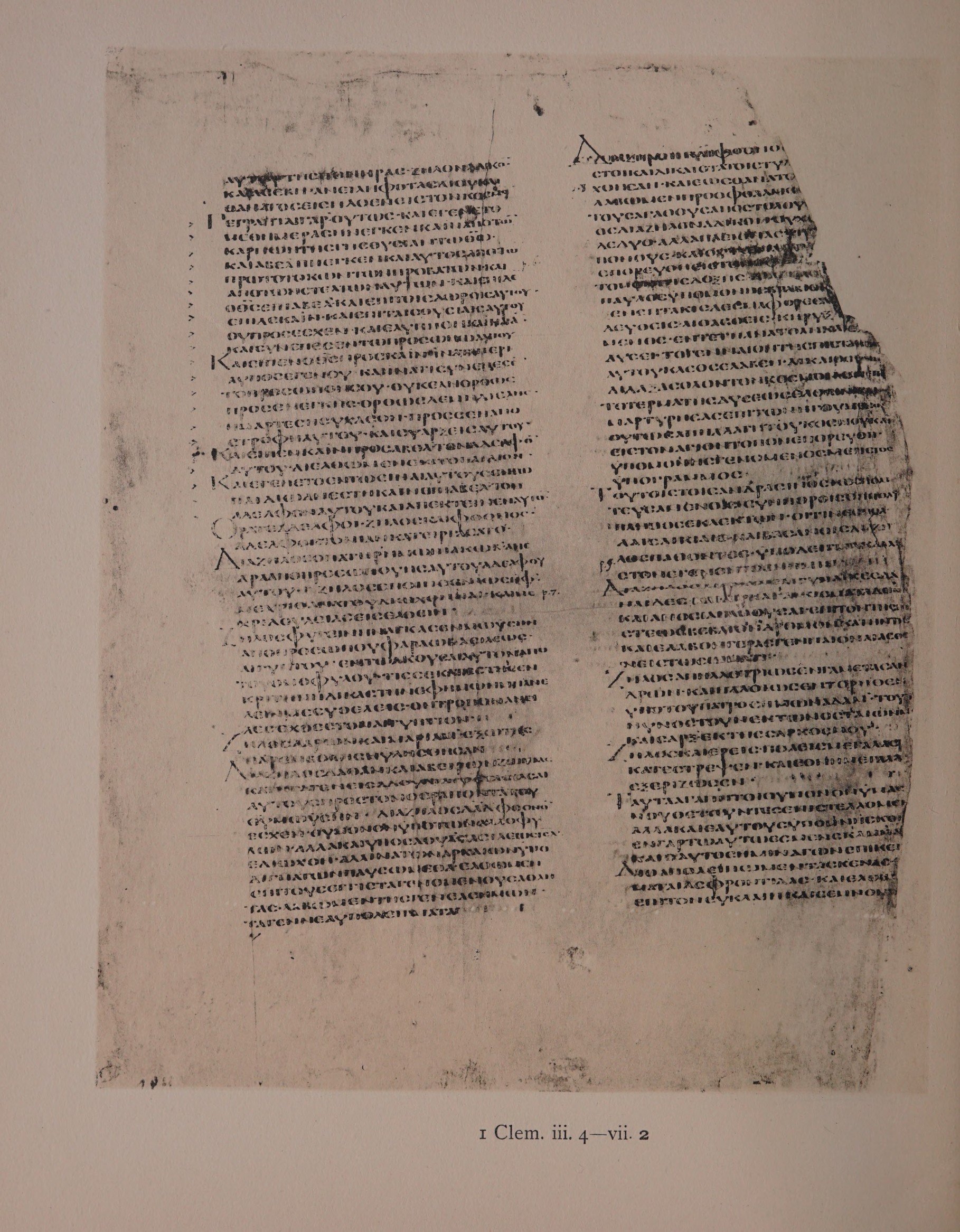
Codex Alexandrinus fol. 159r (1909 facsimile, scan leaf 281; caption printed under the plate: '1 Clem. i. 1-iii. 4'); Codex Alexandrinus fol. 159v (1909 facsimile, scan leaf 282; caption printed under the plate: '1 Clem. iii. 4-vii. 2'). The Greek shown is Lake's edited text (1912), not a transcription of the manuscript page.
1Πᾶσα δόξα καὶ πλατυσμὸς ἐδόθη ὑμῖν, καὶ ἐπετελέσθη τὸ γεγραμμένον· Ἔφαγεν καὶ ἔπιεν, καὶ ἐπλατύνθη, καὶ ἐπαχύνθη, καὶ ἀπελάκτισεν ὁ ἠγαπημένος. 2ἐκ τούτου ζῆλος καὶ φθόνος, καὶ ἔρις, καὶ στάσις, διωγμὸς καὶ ἀκαταστασία, πόλεμος καὶ αἰχμαλωσία. 3οὕτως ἐπηγέρθησαν οἱ ἄτιμοι ἐπὶ τοὺς ἐντίμους, οἱ ἄδοξοι ἐπὶ τοὺς ἐνδόξους, οἱ ἄφρονες ἐπὶ τοὺς φρονίμους, οἱ νέοι ἐπὶ τοὺς πρεσβυτέρους. 4διὰ τοῦτο πόρρω ἄπεστιν ἡ δικαιοσύνη καὶ εἰρήνη, ἐν τῷ ἀπολιπεῖν ἕκαστον τὸν φόβον τοῦ θεοῦ καὶ ἐν τῇ πίστει αὐτοῦ ἀμβλυωπῆσαι, μηδὲ ἐν τοῖς νομίμοις τῶν προσταγμάτων αὐτοῦ πορεύεσθαι, μηδὲ πολιτεύεσθαι κατὰ τὸ καθῆκον τῷ Χριστῷ, ἀλλὰ ἕκαστον βαδίζειν κατὰ τὰς ἐπιθυμίας τῆς καρδίας αὐτοῦ τῆς πονηρᾶς, ζῆλον ἄδικον καὶ ἀσεβῆ ἀνειληφότας, δι’ οὗ καὶ θάνατος εἰσῆλθεν εἰς τὸν κόσμον.
1All glory and enlargement was given unto you, and that was fulfilled which is written My beloved ate and drank and was enlarged and waxed fat and kicked. 2Hence come jealousy and envy, strife and sedition, persecution and tumult, war and captivity. 3So men were stirred up, the mean against the honourable, the ill reputed against the highly reputed, the foolish against the wise, the young against the elder. 4For this cause righteousness and peace stand aloof, while each man hath forsaken the fear of the Lord and become purblind in the faith of Him, neither walketh in the ordinances of His commandments nor liveth according to that which becometh Christ, but each goeth after the lusts of his evil heart, seeing that they have conceived an unrighteous and ungodly jealousy, through which also death entered into the world.
Where on the image
Codex Alexandrinus fol. 159v (1909 facsimile, scan leaf 282; caption printed under the plate: '1 Clem. iii. 4-vii. 2'). The Greek shown is Lake's edited text (1912), not a transcription of the manuscript page.
1Γέγραπται γὰρ οὕτως· Καὶ ἐγένετο μεθ’ ἡμέρας, ἤνεγκεν Κάϊν ἀπὸ τῶν καρπῶν τῆς γῆς θυσίαν τῷ θεῷ, καὶ Ἄβελ ἤνεγκεν καὶ αὐτὸς ἀπὸ τῶν πρωτοτόκων τῶν προβάτων καὶ ἀπὸ τῶν στεάτων αὐτῶν. 2καὶ ἐπεῖδεν ὁ θεὸς ἐπὶ Ἄβελ καὶ ἐπὶ τοῖς δώροις αὐτοῦ, ἐπὶ δὲ Κάϊν καὶ ἐπὶ ταῖς θυσίαις αὐτοῦ οὐ προσέσχεν. 3καὶ ἐλυπήθη Κάϊν λίαν καὶ συνέπεσεν τῷ προσώπῳ αὐτοῦ. 4καὶ εἶπεν ὁ θεὸς πρὸς Κάϊν· Ἱνατί περίλυπος ἐγένου, καὶ ἱνατί συνέπεσεν τὸ πρόσωπόν σου; οὐκ ἐὰν ὀρθῶς προσενέγκῃς, ὀρθῶς δὲ μὴ διέλῃς, ἥμαρτες; 5ἡσύχασον· πρὸς σὲ ἡ ἀποστροφὴ αὐτοῦ, καὶ σὺ ἄρξεις αὐτοῦ. 6καὶ εἶπεν Κάϊν πρὸς Ἄβελ τὸν ἀδελφὸν αὐτοῦ· Διέλθωμεν εἰς τὸ πεδίον. καὶ ἐγένετο ἐν τῷ εἶναι αὐτοὺς ἐν τῷ πεδίῳ, ἀνέστη Κάϊν ἐπὶ Ἄβελ τὸν ἀδελφὸν αὐτοῦ καὶ ἀπέκτεινεν αὐτόν. 7ὁρᾶτε, ἀδελφοί, ζῆλος καὶ φθόνος ἀδελφοκτονίαν κατειργάσατο. 8διὰ ζῆλος ὁ πατὴρ ἡμῶν Ἰακὼβ ἀπέδρα ἀπὸ προσώπου Ἠσαῦ τοῦ ἀδελφοῦ αὐτοῦ. 9ζῆλος ἐποίησεν Ἰωσὴφ μέχρι θανάτου διωχθῆναι καὶ μέχρι δουλείας εἰσελθεῖν. 10ζῆλος φυγεῖν ἠνάγκασεν Μωϋσῆν ἀπὸ προσώπου Φαραὼ βασιλέως Αἰγύπτου ἐν τῷ ἀκοῦσαι αὐτὸν ἀπὸ τοῦ ὁμοφύλου· Τίς σε κατέστησεν κριτὴν ἢ δικαστὴν ἐφ’ ἡμῶν; μὴ ἀνελεῖν με σὺ θέλεις, ὃν τρόπον ἀνεῖλες ἐχθὲς τὸν Αἰγύπτιον; 11διὰ ζῆλος Ἀαρὼν καὶ Μαριὰμ ἔξω τῆς παρεμβολῆς ηὐλίσθησαν. 12ζῆλος Δαθὰν καὶ Ἀβειρὼν ζῶντας κατήγαγεν εἰς ᾅδου διὰ τὸ στασιάσαι αὐτοὺς πρὸς τὸν θεράποντα τοῦ θεοῦ Μωϋσῆν. 13διὰ ζῆλος Δαυεὶδ φθόνον ἔσχεν οὐ μόνον ὑπὸ τῶν ἀλλοφύλων, ἀλλὰ καὶ ὑπὸ Σαοὺλ βασιλέως Ἰσραὴλ ἐδιώχθη.
1For so it is written, And it came to pass after certain days that Cain brought of the fruits of the earth a sacrifice unto God, and Abel he also brought of the firstlings of the sheep and of theirfatness. 2And God looked upon Abel and upon his gifts, but unto Cain and unto his sacrifices He gave no heed. 3And Cain sorrowed exceedingly, and his countenance fell. 4And God said unto Cain, Wherefore art thou very sorrowful and wherefore did thy countenance fall? If thou hast offered aright and hast not divided aright, didst thou not sin? Hold thy peace. 5Unto thee shall he turn, and thou shalt rule over him. 6And Cain said unto Abel his brother, Let us go over unto the plain. And it came to pass, while they Were in the plain, that Cain rose up against Abel his brother and slew him. 7Ye see, brethren, jealousy and envy wrought a brother's murder. 8By reason of jealousy our father Jacob ran away from the face of Esau his brother. 9Jealousy caused Joseph to be persecuted even unto death, and to come even unto bondage. 10Jealousy compelled Moses to flee from the face of Pharaoh king of Egypt while it was said to him by his own countryman, Who made thee a judge or a decider over us, Wouldest thou slay me, even as yesterday thou slewest the Egyptian? 11By reason of jealousy Aaron and Miriam were lodged outside the camp. 12Jealousy brought Dathan and Abiram down alive to hades, because they made sedition against Moses the servant of God. 13By reason of jealousy David was envied not only by the Philistines, but was persecuted also by Saul [king of Israel].
Where on the image
Codex Alexandrinus fol. 159v (1909 facsimile, scan leaf 282; caption printed under the plate: '1 Clem. iii. 4-vii. 2'). The Greek shown is Lake's edited text (1912), not a transcription of the manuscript page.
1Ἀλλ’ ἵνα τῶν ἀρχαίων ὑποδειγμάτων παυσώμεθα, ἔλθωμεν ἐπὶ τοὺς ἔγγιστα γενομένους ἀθλητάς· λάβωμεν τῆς γενεᾶς ἡμῶν τὰ γενναῖα ὑποδείγματα. 2διὰ ζῆλον καὶ φθόνον οἱ μέγιστοι καὶ δικαιότατοι στύλοι ἐδιώχθησαν καὶ ἕως θανάτου ἤθλησαν. 3λάβωμεν πρὸ ὀφθαλμῶν ἡμῶν τοὺς ἀγαθοὺς ἀποστόλους· 4Πέτρον, ὃς διὰ ζῆλον ἄδικον οὐχ ἕνα οὐδὲ δύο, ἀλλὰ πλείονας ὑπήνεγκεν πόνους καὶ οὕτω μαρτυρήσας ἐπορεύθη εἰς τὸν ὀφειλόμενον τόπον τῆς δόξης. 5διὰ ζῆλον καὶ ἔριν Παῦλος ὑπομονῆς βραβεῖον ὑπέδειξεν, 6ἑπτάκις δεσμὰ φορέσας, φυγαδευθείς, λιθασθείς, κήρυξ γενόμενος ἔν τε τῇ ἀνατολῇ καὶ ἐν τῇ δύσει, τὸ γενναῖον τῆς πίστεως αὐτοῦ κλέος ἔλαβεν, 7δικαιοσύνην διδάξας ὅλον τὸν κόσμον, καὶ ἐπὶ τὸ τέρμα τῆς δύσεως ἐλθὼν καὶ μαρτυρήσας ἐπὶ τῶν ἡγουμένων, οὕτως ἀπηλλάγη τοῦ κόσμου καὶ εἰς τὸν ἅγιον τόπον ἀνελήμφθη, ὑπομονῆς γενόμενος μέγιστος ὑπογραμμός.
1But, to pass from the examples of ancient days, let us come to those champions who lived nearest to our time. Let us set before us the noble examples which belong to our generation. 2By reason of jealousy and envy the greatest and most righteous pillars of the Church were persecuted, and contended even unto death. 3Let us set before our eyes the good Apostles. 4There was Peter who by reason of unrighteous jealousy endured not one nor two but many labours, and thus having borne his testimony went to his appointed place of glory. 5By reason of jealousy and strife Paul by his example pointed out the prize of patient endurance. After that he had been seven times in bonds, had been driven into exile, had been stoned, had preached in the East and in the West, he won the noble renown which was the reward of his faith, 6having taught righteousness unto the whole world and having reached the farthest bounds of the West; and when he had borne his testimony before the rulers, so he departed from the world and went unto the holy place, having been found a notable pattern of patient endurance.
Where on the image
Codex Alexandrinus fol. 159v (1909 facsimile, scan leaf 282; caption printed under the plate: '1 Clem. iii. 4-vii. 2'). The Greek shown is Lake's edited text (1912), not a transcription of the manuscript page.
1Τούτοις τοῖς ἀνδράσιν ὁσίως πολιτευσαμένοις συνηθροίσθη πολὺ πλῆθος ἐκλεκτῶν, οἵτινες πολλαῖς αἰκίαις καὶ βασάνοις διὰ ζῆλος παθόντες ὑπόδειγμα κάλλιστον ἐγένοντο ἐν ἡμῖν. 2διὰ ζῆλος διωχθεῖσαι γυναῖκες Δαναΐδες καὶ Δίρκαι, αἰκίσματα δεινὰ καὶ ἀνόσια παθοῦσαι, ἐπὶ τὸν τῆς πίστεως βέβαιον δρόμον κατήντησαν καὶ ἔλαβον γέρας γενναῖον αἱ ἀσθενεῖς τῷ σώματι. 3ζῆλος ἀπηλλοτρίωσεν γαμετὰς ἀνδρῶν καὶ ἠλλοίωσεν τὸ ῥηθὲν ὑπὸ τοῦ πατρὸς ἡμῶν Ἀδάμ· Τοῦτο νῦν ὀστοῦν ἐκ τῶν ὀστέων μου καὶ σὰρξ ἐκ τῆς σαρκός μου. 4ζῆλος καὶ ἔρις πόλεις μεγάλας κατέστρεψεν καὶ ἔθνη μεγάλα ἐξερίζωσεν.
1Unto these men of holy lives was gathered a vast multitude of the elect, who through many indignities and tortures, being the victims of jealousy, set a brave example among ourselves. 2By reason of jealousy women being persecuted, after that they had suffered cruel and unholy insults †as Danaids and Dircæ†, safely reached the goal in the race of faith, and received a noble reward, feeble though they were in body. 3Jealousy hath estranged wives from their husbands and changed the saying of our father Adam, This now is bone of my bones and flesh of my flesh. 4Jealousy and strife have overthrown great cities and uprooted great nations.
Where on the image
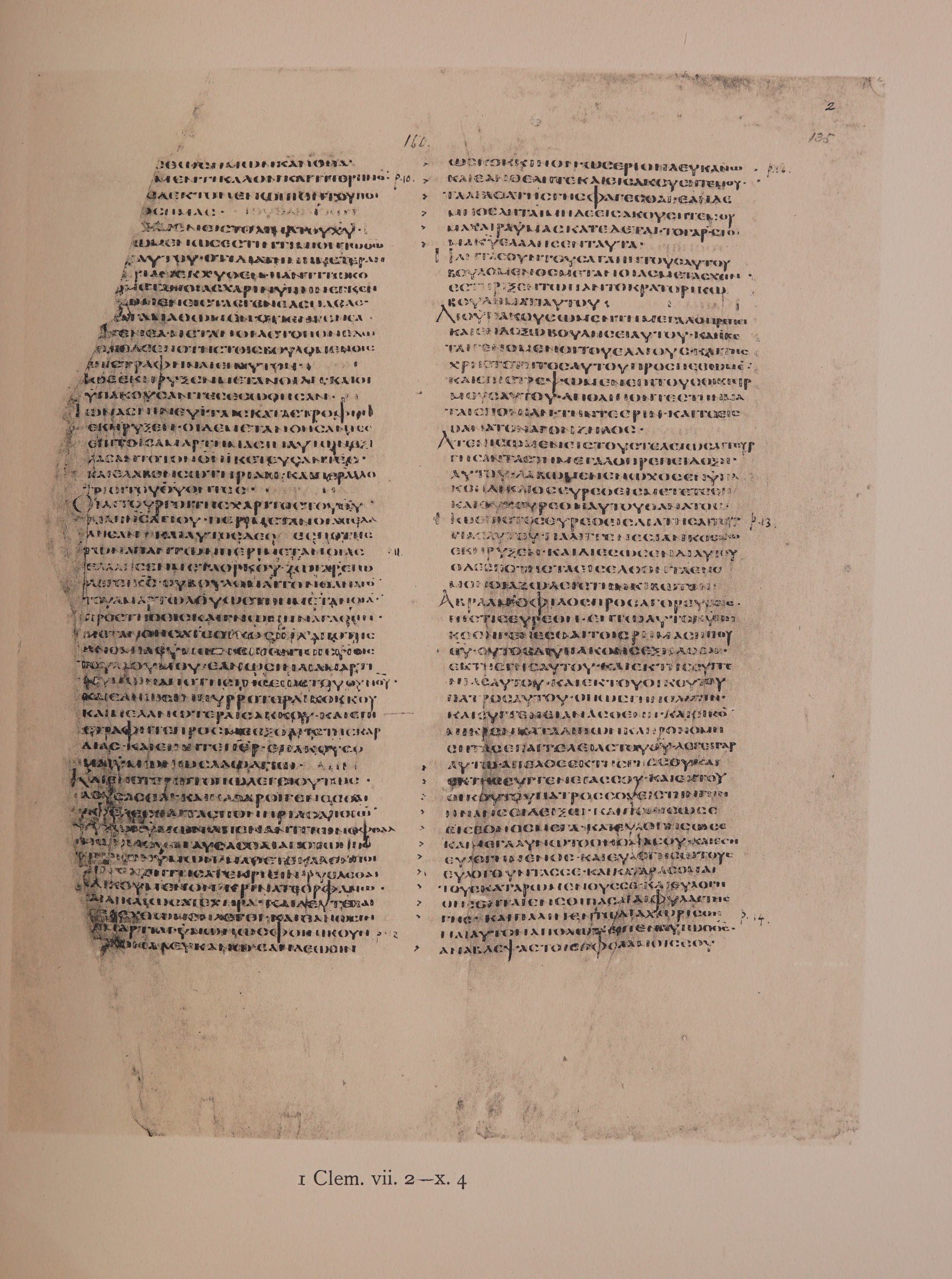
Codex Alexandrinus fol. 159v (1909 facsimile, scan leaf 282; caption printed under the plate: '1 Clem. iii. 4-vii. 2'); Codex Alexandrinus fol. 160r (1909 facsimile, scan leaf 283; caption printed under the plate: '1 Clem. vii. 2-x. 4'). The Greek shown is Lake's edited text (1912), not a transcription of the manuscript page.
1Ταῦτα, ἀγαπητοί, οὐ μόνον ὑμᾶς νουθετοῦντες ἐπιστέλλομεν, ἀλλὰ καὶ ἑαυτοὺς ὑπομιμνήσκοντες· ἐν γὰρ τῷ αὐτῷ ἐσμὲν σκάμματι, καὶ ὁ αὐτὸς ἡμῖν ἀγὼν ἐπίκειται. 2διὸ ἀπολίπωμεν τὰς κενὰς καὶ ματαίας φροντίδας, καὶ ἔλθωμεν ἐπὶ τὸν εὐκλεῆ καὶ σεμνὸν τῆς παραδόσεως ἡμῶν κανόνα, 3καὶ ἴδωμεν, τί καλὸν καὶ τί τερπνὸν καὶ τί προσδεκτὸν ἐνώπιον τοῦ ποιήσαντος ἡμᾶς. 4ἀτενίσωμεν εἰς τὸ αἷμα τοῦ Χριστοῦ καὶ γνῶμεν, ὡς ἔστιν τίμιον τῷ πατρὶ αὐτοῦ, ὅτι διὰ τὴν ἡμετέραν σωτηρίαν ἐκχυθὲν παντὶ τῷ κόσμῳ μετανοίας χάριν ὑπήνεγκεν. 5διέλθωμεν εἰς τὰς γενεὰς πάσας, καὶ καταμάθωμεν ὅτι ἐν γενεᾷ καὶ γενεᾷ μετανοίας τόπον ἔδωκεν ὁ δεσπότης τοῖς βουλομένοις ἐπιστραφῆναι ἐπ’ αὐτόν. 6Νῶε ἐκήρυξεν μετάνοιαν, καὶ οἱ ὑπακούσαντες ἐσώθησαν. 7Ἰωνᾶς Νινευΐταις καταστροφὴν ἐκήρυξεν· οἱ δὲ μετανοήσαντες ἐπὶ τοῖς ἁμαρτήμασιν αὐτῶν ἐξιλάσαντο τὸν θεὸν ἱκετεύσαντες καὶ ἔλαβον σωτηρίαν, καίπερ ἀλλότριοι τοῦ θεοῦ ὄντες.
1These things, dearly beloved, we write, not only as admonishing you, but also as putting ourselves in remembrance. For we are in the same lists, and the same contest awaiteth us. 2Wherefore let us forsake idle and vain thoughts; and let us conform to the glorious and venerable rule which hath been handed down to us; 3and let us see what is good and what is pleasant and what is acceptable in the sight of Him that made us. 4Let us fix our eyes on the blood of Christ and understand how precious it is unto His Father, because being shed for our salvation it won for the whole world the grace of repentance. 5Let us review all the generations in turn, and learn how from generation to generation the Master hath given a place for repentance unto them that desire to turn to Him. 6Noah preached repentance, and they that obeyed were saved. 7Jonah preached destruction unto the men of Nineveh; but they, repenting of their sins, obtained pardon of God by their supplications and received salvation, albeit they were aliens from God.
Where on the image
Codex Alexandrinus fol. 160r (1909 facsimile, scan leaf 283; caption printed under the plate: '1 Clem. vii. 2-x. 4'). The Greek shown is Lake's edited text (1912), not a transcription of the manuscript page.
1Οἱ λειτουργοὶ τῆς χάριτος τοῦ θεοῦ διὰ πνεύματος ἁγίου περὶ μετανοίας ἐλάλησαν, 2καὶ αὐτὸς δὲ ὁ δεσπότης τῶν ἁπάντων περὶ μετανοίας ἐλάλησεν μετὰ ὅρκου· Ζῶ γὰρ ἐγώ, λέγει κύριος, οὐ βούλομαι τὸν θάνατον τοῦ ἁμαρτωλοῦ ὡς τὴν μετάνοιαν, προστιθεὶς καὶ γνώμην ἀγαθήν· 3Μετανοήσατε, οἶκος Ἰσραήλ, ἀπὸ τῆς ἀνομίας ὑμῶν· εἶπον τοῖς υἱοῖς τοῦ λαοῦ μου. Ἐὰν ὦσιν αἱ ἁμαρτίαι ὑμῶν ἀπὸ τῆς γῆς ἕως τοῦ οὐρανοῦ καὶ ἐὰν ὦσιν πυρρότεραι κόκκου καὶ μελανώτεραι σάκκου, καὶ ἐπιστραφῆτε πρός με ἐξ ὅλης τῆς καρδίας καὶ εἴπητε· Πάτερ· ἐπακούσομαι ὑμῶν ὡς λαοῦ ἁγίου. 4καὶ ἐν ἑτέρῳ τόπῳ λέγει οὕτως· Λούσασθε καὶ καθαροὶ γένεσθε, ἀφέλεσθε τὰς πονηρίας ἀπὸ τῶν ψυχῶν ὑμῶν ἀπέναντι τῶν ὀφθαλμῶν μου· παύσασθε ἀπὸ τῶν πονηριῶν ὑμῶν, μάθετε καλὸν ποιεῖν, ἐκζητήσατε κρίσιν, ῥύσασθε ἀδικούμενον, κρίνατε ὀρφανῷ καὶ δικαιώσατε χήρᾳ· καὶ δεῦτε καὶ διελεγχθῶμεν, λέγει κύριος· καὶ ἐὰν ὦσιν αἱ ἁμαρτίαι ὑμῶν ὡς φοινικοῦν, ὡς χιόνα λευκανῶ· ἐὰν δὲ ὦσιν ὡς κόκκινον, ὡς ἔριον λευκανῶ· καὶ ἐὰν θέλητε καὶ εἰσακούσητέ μου, τὰ ἀγαθὰ τῆς γῆς φάγεσθε· ἐὰν δὲ μὴ θέλητε μηδὲ εἰσακούσητέ μου, μάχαιρα ὑμᾶς κατέδεται· τὸ γὰρ στόμα κυρίου ἐλάλησεν ταῦτα. 5πάντας οὖν τοὺς ἀγαπητοὺς αὐτοῦ βουλόμενος μετανοίας μετασχεῖν ἐστήριξεν τῷ παντοκρατορικῷ βουλήματι αὐτοῦ.
1The ministers of the grace of God through the Holy Spirit spake concerning repentance. 2Yea and the Master of the universe Himself spake concerning repentance with an oath: 3for, as I live saith the Lord, I desire not the death of the sinner, so much as his repentance, 4and He added also a merciful judgment: Repent ye, O house of Israel, of your iniquity; say unto the sons of My people, Though your sins reach from the earth even unto the heaven, and though they be redder than scarlet and blacker than sackcloth, and ye turn unto Me with your whole heart and say Father, I will give ear unto you as unto a holy people. 5And in another place He saith on this wise, Wash, be ye clean. Put away your iniquities from your souls out of My sight. Cease from your iniquities; learn to do good; seek out judgment; defend him that is wronged: give judgment for the orphan, and execute righteousness for the widow; and come and let us reason together, saith He; and though your sins be as crimson, I will make them white as snow; and though they be as scarlet, I will make them white as wool. And if ye be willing and will hearken unto Me, ye shall eat the good things of the earth; but if ye be not willing, neither hearken unto Me, a sword shall devour you; for the mouth of the Lord hath spoken these things. 6Seeing then that He desireth all His beloved to be partakers of repentance, He confirmed it by an act of His almighty will.
Where on the image
Codex Alexandrinus fol. 160r (1909 facsimile, scan leaf 283; caption printed under the plate: '1 Clem. vii. 2-x. 4'). The Greek shown is Lake's edited text (1912), not a transcription of the manuscript page.
1Διὸ ὑπακούσωμεν τῇ μεγαλοπρεπεῖ καὶ ἐνδόξῳ βουλήσει αὐτοῦ, καὶ ἱκέται γενόμενοι τοῦ ἐλέους καὶ τῆς χρηστότητος αὐτοῦ προσπέσωμεν καὶ ἐπιστρέψωμεν ἐπὶ τοὺς οἰκτιρμοὺς αὐτοῦ, ἀπολιπόντες τὴν ματαιοπονίαν τήν τε ἔριν καὶ τὸ εἰς θάνατον ἄγον ζῆλος. 2ἀτενίσωμεν εἰς τοὺς τελείως λειτουργήσαντας τῇ μεγαλοπρεπεῖ δόξῃ αὐτοῦ. 3λάβωμεν Ἐνώχ, ὃς ἐν ὑπακοῇ δίκαιος εὑρεθεὶς μετετέθη, καὶ οὐχ εὑρέθη αὐτοῦ θάνατος. 4Νῶε πιστὸς εὑρεθεὶς διὰ τῆς λειτουργίας αὐτοῦ παλιγγενεσίαν κόσμῳ ἐκήρυξεν, καὶ διέσωσεν δι’ αὐτοῦ ὁ δεσπότης τὰ εἰσελθόντα ἐν ὁμονοίᾳ ζῶα εἰς τὴν κιβωτόν.
1Wherefore let us be obedient unto His excellent and glorious will; and presenting ourselves as suppliants of His mercy and goodness, let us fall down before Him and betake ourselves unto His compassions, forsaking the vain toil and the strife and the jealousy which leadeth unto death. 2Let us fix our eyes on them that ministered perfectly unto His excellent glory. 3Let us set before us Enoch, who being found righteous in obedience was translated, and his death was not found. 4Noah, being found faithful, by his ministration preached regeneration unto the world, and through him the Master saved the living creatures that entered into the ark in concord.
Where on the image
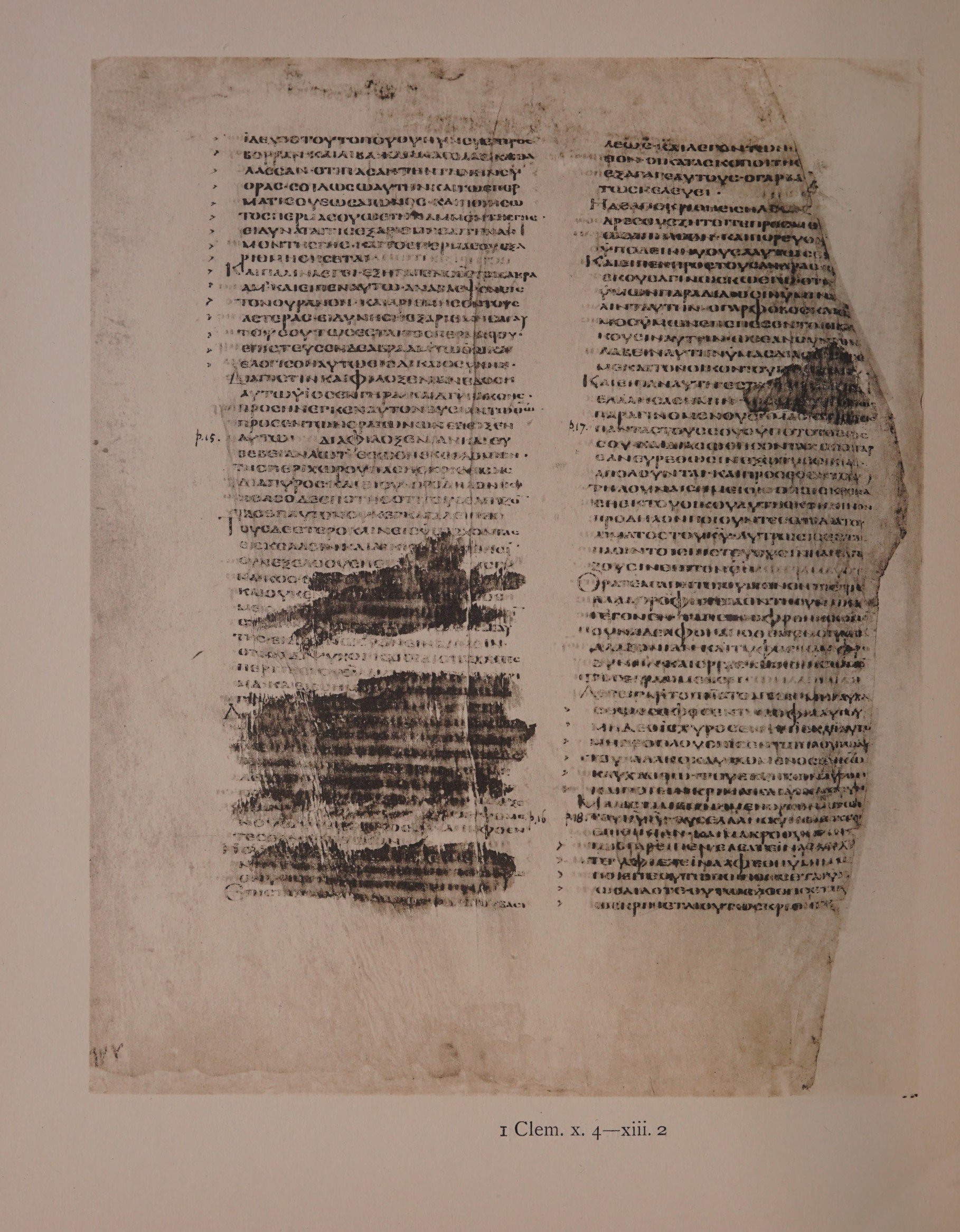
Codex Alexandrinus fol. 160r (1909 facsimile, scan leaf 283; caption printed under the plate: '1 Clem. vii. 2-x. 4'); Codex Alexandrinus fol. 160v (1909 facsimile, scan leaf 284; caption printed under the plate: '1 Clem. x. 4-xiii. 2'). The Greek shown is Lake's edited text (1912), not a transcription of the manuscript page.
1Ἀβραάμ, ὁ φίλος προσαγορευθείς, πιστὸς εὑρέθη ἐν τῷ αὐτὸν ὑπήκοον γενέσθαι τοῖς ῥήμασιν τοῦ θεοῦ. 2οὗτος δι’ ὑπακοῆς ἐξῆλθεν ἐκ τῆς γῆς αὐτοῦ καὶ ἐκ τῆς συγγενείας αὐτοῦ καὶ ἐκ τοῦ οἴκου τοῦ πατρὸς αὐτοῦ, ὅπως γῆν ὀλίγην καὶ συγγένειαν ἀσθενῆ καὶ οἶκον μικρὸν καταλιπὼν κληρονομήσῃ τὰς ἐπαγγελίας τοῦ θεοῦ. λέγει γὰρ αὐτῷ· 3Ἄπελθε ἐκ τῆς γῆς σου καὶ ἐκ τῆς συγγενείας σου καὶ ἐκ τοῦ οἴκου τοῦ πατρός σου εἰς τὴν γῆν ἣν ἄν σοι δείξω· καὶ ποιήσω σε εἰς ἔθνος μέγα καὶ εὐλογήσω σε καὶ μεγαλυνῶ τὸ ὄνομά σου, καὶ ἔσῃ εὐλογημένος· καὶ εὐλογήσω τοὺς εὐλογοῦντάς σε καὶ καταράσομαι τοὺς καταρωμένους σε, καὶ εὐλογηθήσονται ἐν σοὶ πᾶσαι αἱ φυλαὶ τῆς γῆς. 4καὶ πάλιν ἐν τῷ διαχωρισθῆναι αὐτὸν ἀπὸ Λὼτ εἶπεν αὐτῷ ὁ θεός. Ἀναβλέψας τοῖς ὀφθαλμοῖς σου ἴδε ἀπὸ τοῦ τόπου, οὗ νῦν σὺ εἶ, πρὸς βορρᾶν καὶ λίβα καὶ ἀνατολὰς καὶ θάλασσαν, ὅτι πᾶσαν τὴν γῆν, ἣν σὺ ὁρᾷς, σοὶ δώσω αὐτὴν καὶ τῷ σπέρματί σου ἕως αἰῶνος. 5καὶ ποιήσω τὸ σπέρμα σου ὡς τὴν ἄμμον τῆς γῆς· εἰ δύναταί τις ἐξαριθμῆσαι τὴν ἄμμον τῆς γῆς, καὶ τὸ σπέρμα σου ἐξαριθμηθήσεται. 6καὶ πάλιν λέγει· Ἐξήγαγεν ὁ θεὸς τὸν Ἀβραὰμ καὶ εἶπεν αὐτῷ· Ἀνάβλεψον εἰς τὸν οὐρανὸν καὶ ἀρίθμησον τοὺς ἀστέρας, εἰ δυνήσῃ ἐξαριθμῆσαι αὐτούς· οὕτως ἔσται τὸ σπέρμα σου. ἐπίστευσεν δὲ Ἀβραὰμ τῷ θεῷ, καὶ ἐλογίσθη αὐτῷ εἰς δικαιοσύνην. 7διὰ πίστιν καὶ φιλοξενίαν ἐδόθη αὐτῷ υἱὸς ἐν γήρᾳ, καὶ δι’ ὑπακοῆς προσήνεγκεν αὐτὸν θυσίαν τῷ θεῷ πρὸς τὸ ὄρος ὃ ἔδειξεν αὐτῷ.
1Abraham, who was called the 'friend,' was found faithful in that he rendered obedience unto the words of God. 2He through obedience went forth from his land and from his kindred and from his father's house, that leaving a scanty land and a feeble kindred and a mean house he might inherit the promises of God. 3For He saith unto him Go forth from thy land and from thy kindred and from thy father's house unto the land which I shall show thee, and I will make thee into a great nation, and I will bless thee and will magnify thy name, and thou shalt be blessed. And I will bless them that bless thee, and I will curse them that curse thee; and in thee shall all the tribes of the earth be blessed. 4And again, when he was parted from Lot, God said unto him Look up with thine eyes, and behold from the place where thou now art, unto the north and the south and the sunrise and the sea; for all the land which thou seest, I will give it unto thee and to thy seed for ever; 5and I will make thy seed as the dust of the earth. If any man can count the dust of the earth, then shall thy seed also be counted. 6And again He saith; God led Abraham forth and said unto him, Look up unto the heaven and count the stars, and see whether thou canst number them. So shall thy seed be. And Abraham believed God, and it was reckoned unto him for righteousness. 7For his faith and hospitality a son was given unto him in old age, and by obedience he offered him a sacrifice unto God on one of the mountains which He showed him.
Where on the image
Codex Alexandrinus fol. 160v (1909 facsimile, scan leaf 284; caption printed under the plate: '1 Clem. x. 4-xiii. 2'). The Greek shown is Lake's edited text (1912), not a transcription of the manuscript page.
1Διὰ φιλοξενίαν καὶ εὐσέβειαν Λὼτ ἐσώθη ἐκ Σοδόμων, τῆς περιχώρου πάσης κριθείσης διὰ πυρὸς καὶ θείου, πρόδηλον ποιήσας ὁ δεσπότης, ὅτι τοὺς ἐλπίζοντας ἐπ’ αὐτὸν οὐκ ἐγκαταλείπει, τοὺς δὲ ἑτεροκλινεῖς ὑπάρχοντας εἰς κόλασιν καὶ αἰκισμὸν τίθησιν. 2συνεξελθούσης γὰρ αὐτῷ τῆς γυναικὸς ἑτερογνώμονος ὑπαρχούσης καὶ οὐκ ἐν ὁμονοίᾳ, εἰς τοῦτο σημεῖον ἐτέθη, ὥστε γενέσθαι αὐτὴν στήλην ἁλὸς ἕως τῆς ἡμέρας ταύτης, εἰς τὸ γνωστὸν εἶναι πᾶσιν, ὅτι οἱ δίψυχοι καὶ οἱ διστάζοντες περὶ τῆς τοῦ θεοῦ δυνάμεως εἰς κρίμα καὶ εἰς σημείωσιν πάσαις ταῖς γενεαῖς γίνονται.
1For his hospitality and godliness Lot was saved from Sodom, when all the country round about was judged by fire and brimstone; the Master having thus foreshown that He forsaketh not them which set their hope on Him, but appointeth unto punishment and torment them which swerve aside. 2For when his wife had gone forth with him, being otherwise minded and not in accord, she was appointed for a sign hereunto, so that she became a pillar of salt unto this day, that it might be known unto all men that they which are double-minded and they which doubt concerning the power of God are set for a judgment and for a token unto all the generations.
Where on the image
Codex Alexandrinus fol. 160v (1909 facsimile, scan leaf 284; caption printed under the plate: '1 Clem. x. 4-xiii. 2'). The Greek shown is Lake's edited text (1912), not a transcription of the manuscript page.
1Διὰ πίστιν καὶ φιλοξενίαν ἐσώθη Ῥαὰβ ἡ πόρνη. 2ἐκπεμφθέντων γὰρ ὑπὸ Ἰησοῦ τοῦ τοῦ Ναυὴ κατασκόπων εἰς τὴν Ἱεριχώ, ἔγνω ὁ βασιλεὺς τῆς γῆς, ὅτι ἥκασιν κατασκοπεῦσαι τὴν χώραν αὐτῶν, καὶ ἐξέπεμψεν ἄνδρας τοὺς συλλημψομένους αὐτούς, ὅπως συλλημφθέντες θανατωθῶσιν. 3ἡ οὖν φιλόξενος Ῥαὰβ εἰσδεξαμένη αὐτοὺς ἔκρυψεν εἰς τὸ ὑπερῷον ὑπὸ τὴν λινοκαλάμην. 4ἐπισταθέντων δὲ τῶν παρὰ τοῦ βασιλέως καὶ λεγόντων· Πρὸς σὲ εἰσῆλθον οἱ κατάσκοποι τῆς γῆς ἡμῶν· ἐξάγαγε αὐτούς, ὁ γὰρ βασιλεὺς οὕτως κελεύει, ἥδε ἀπεκρίθη· Εἰσῆλθον μὲν οἱ ἄνδρες, οὓς ζητεῖτε, πρός με, ἀλλ’ εὐθέως ἀπῆλθον καὶ πορεύονται τῇ ὁδῷ· ὑποδεικνύουσα αὐτοῖς ἐναλλάξ. 5καὶ εἶπεν πρὸς τοὺς ἄνδρας· Γινώσκουσα γινώσκω ἐγώ, ὅτι κύριος ὁ θεὸς παραδίδωσιν ὑμῖν τὴν γῆν ταύτην· ὁ γὰρ φόβος καὶ ὁ τρόμος ὑμῶν ἐπέπεσεν τοῖς κατοικοῦσιν αὐτήν. ὡς ἐὰν οὖν γένηται λαβεῖν αὐτὴν ὑμᾶς, διασώσατέ με καὶ τὸν οἶκον τοῦ πατρός μου. 6καὶ εἶπαν αὐτῇ· Ἔσται οὕτως, ὡς ἐλάλησας ἡμῖν. ὡς ἐὰν οὖν γνῷς παραγινομένους ἡμᾶς, συνάξεις πάντας τοὺς σοὺς ὑπὸ τὸ στέγος σου, καὶ διασωθήσονται· ὅσοι γὰρ ἐὰν εὑρεθῶσιν ἔξω τῆς οἰκίας, ἀπολοῦνται. 7καὶ προσέθεντο αὐτῇ δοῦναι σημεῖον, ὅπως ἐκκρεμάσῃ ἐκ τοῦ οἴκου αὐτῆς κόκκινον, πρόδηλον ποιοῦντες, ὅτι διὰ τοῦ αἵματος τοῦ κυρίου λύτρωσις ἔσται πᾶσιν τοῖς πιστεύουσιν καὶ ἐλπίζουσιν ἐπὶ τὸν θεόν. 8ὁρᾶτε, ἀγαπητοί, ὅτι οὐ μόνον πίστις, ἀλλὰ καὶ προφητεία ἐν τῇ γυναικὶ γέγονεν.
1For her faith and hospitality Rahab the harlot was saved. 2For when the spies were sent forth unto Jericho by Joshua the son of Nun, the king of the land perceived that they were come to spy out his country, and sent forth men to seize them, that being seized they might be put to death. 3So the hospitable Rahab received them and hid them in the upper chamber under the flax stalks. 4And when the messengers of the king came near and said, The spies of our land entered in unto thee: bring them forth, for the king so ordereth: then she answered, The men truly, whom ye seek, entered in unto me, but they departed forthwith and are journeying on the way; and she pointed out to them the opposite road. 5And she said unto the men, Of a surety I perceive that the Lord your God delivereth this city unto you; for the fear and the dread of you is fallen upon the inhabitants thereof. When therefore it shall come to pass that ye take it, save me and the house of my father. 6And they said unto her, It shall be even so as thou hast spoken unto us. Whensoever therefore thou perceivest that we are coming, thou shalt gather all thy folk beneath thy roof and they shall be saved; for as many as shall be found without the house shall perish. 7And moreover they gave her a sign, that she should hang out from her house a scarlet thread, thereby showing beforehand that through the blood of the Lord there shall be redemption unto all them that believe and hope on God. 8Ye see, dearly beloved, not only faith, but prophecy, is found in the woman.
Where on the image
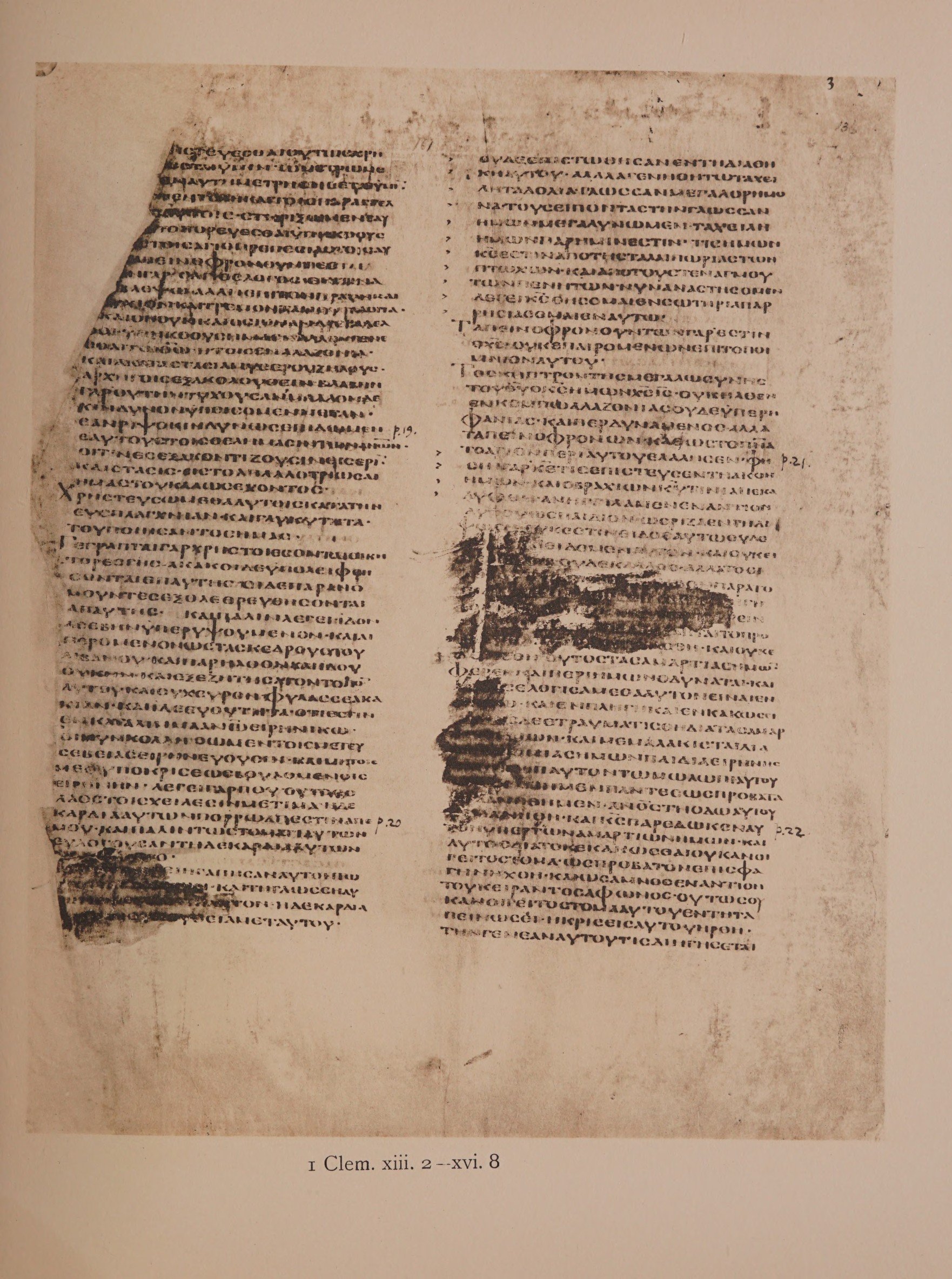
Codex Alexandrinus fol. 160v (1909 facsimile, scan leaf 284; caption printed under the plate: '1 Clem. x. 4-xiii. 2'); Codex Alexandrinus fol. 161r (1909 facsimile, scan leaf 285; caption printed under the plate: '1 Clem. xiii. 2-xvi. 8'). The Greek shown is Lake's edited text (1912), not a transcription of the manuscript page.
1Ταπεινοφρονήσωμεν οὖν, ἀδελφοί, ἀποθέμενοι πᾶσαν ἀλαζονείαν καὶ τῦφος καὶ ἀφροσύνην καὶ ὀργάς, καὶ ποιήσωμεν τὸ γεγραμμένον, λέγει γὰρ τὸ πνεῦμα τὸ ἅγιον· Μὴ καυχάσθω ὁ σοφὸς ἐν τῇ σοφίᾳ αὐτοῦ μηδὲ ὁ ἰσχυρὸς ἐν τῇ ἰσχύϊ αὐτοῦ μηδὲ ὁ πλούσιος ἐν τῷ πλούτῳ αὐτοῦ, ἀλλ’ ἢ ὁ καυχώμενος ἐν κυρίῳ καυχάσθω, τοῦ ἐκζητεῖν αὐτὸν καὶ ποιεῖν κρίμα καὶ δικαιοσύνην· μάλιστα μεμνημένοι τῶν λόγων τοῦ κυρίου Ἰησοῦ, οὓς ἐλάλησεν διδάσκων ἐπιείκειαν καὶ μακροθυμίαν. 2οὕτως γὰρ εἶπεν· Ἐλεᾶτε, ἵνα ἐλεηθῆτε· ἀφίετε, ἵνα ἀφεθῇ ὑμῖν· ὡς ποιεῖτε, οὕτω ποιηθήσεται ὑμῖν· ὡς δίδοτε, οὕτως δοθήσεται ὑμῖν· ὡς κρίνετε, οὕτως κριθήσεσθε· ὡς χρηστεύεσθε, οὕτως χρηστευθήσεται ὑμῖν· ᾧ μέτρῳ μετρεῖτε, ἐν αὐτῷ μετρηθήσεται ὑμῖν. 3ταύτῃ τῇ ἐντολῇ καὶ τοῖς παραγγέλμασιν τούτοις στηρίξωμεν ἑαυτοὺς εἰς τὸ πορεύεσθαι ὑπηκόους ὄντας τοῖς ἁγιοπρεπέσι λόγοις αὐτοῦ, ταπεινοφρονοῦντες· φησὶν γὰρ ὁ ἅγιος λόγος· 4Ἐπὶ τίνα ἐπιβλέψω, ἀλλ’ ἢ ἐπὶ τὸν πραῢν καὶ ἡσύχιον καὶ τρέμοντά μου τὰ λόγια.
1Let us therefore be lowly minded, brethren, laying aside all arrogance and conceit and folly and anger, and let us do that which is written. For the Holy Ghost saith, Let not the wise man boast in his wisdom, nor the strong in his strength, neither the rich in his riches; but he that boasteth let him boast in the Lord, that he may seek Him out, and do judgment and righteousness most of all remembering the words of the Lord Jesus which He spake, teaching forbearance and long-suffering: 2for thus He spake Have mercy, that ye may receive mercy: forgive, that it may be forgiven to you. As ye do, so shall it be done to you. As ye give, so shall it be given unto you. As ye judge, so shall ye be judged. As ye show kindness, so shall kindness be showed unto you. With what measure ye mete, it shall be measured withal to you. 3With this commandment and these precepts let us confirm ourselves, that we may walk in obedience to His hallowed words, with lowliness of mind. 4For the holy word saith, Upon whom shall I look, save upon him that is gentle and quiet and feareth Mine oracles?
Where on the image
Codex Alexandrinus fol. 161r (1909 facsimile, scan leaf 285; caption printed under the plate: '1 Clem. xiii. 2-xvi. 8'). The Greek shown is Lake's edited text (1912), not a transcription of the manuscript page.
1Δίκαιον οὖν καὶ ὅσιον, ἄνδρες ἀδελφοί, ὑπηκόους ἡμᾶς μᾶλλον γενέσθαι τῷ θεῷ ἢ τοῖς ἐν ἀλαζονείᾳ καὶ ἀκαταστασίᾳ μυσεροῦ ζήλους ἀρχηγοῖς ἐξακολουθεῖν. 2βλάβην γὰρ οὐ τὴν τυχοῦσαν, μᾶλλον δὲ κίνδυνον ὑποίσομεν μέγαν, ἐὰν ῥιψοκινδύνως ἐπιδῶμεν ἑαυτοὺς τοῖς θελήμασιν τῶν ἀνθρώπων, οἵτινες ἐξακοντίζουσιν εἰς ἔριν καὶ στάσεις, εἰς τὸ ἀπαλλοτριῶσαι ἡμᾶς τοῦ καλῶς ἔχοντος. 3χρηστευσώμεθα ἑαυτοῖς κατὰ τὴν εὐσπλαγχνίαν καὶ γλυκύτητα τοῦ ποιήσαντος ἡμᾶς. 4γέγραπται γάρ· Χρηστοὶ ἔσονται οἰκήτορες γῆς, ἄκακοι δὲ ὑπολειφθήσονται ἐπ’ αὐτῆς· οἱ δὲ παρανομοῦντες ἐξολεθρευθήσονται ἀπ’ αὐτῆς. 5καὶ πάλιν λέγει· Εἶδον ἀσεβῆ ὑπερυψούμενον καὶ ἐπαιρόμενον ὡς τὰς κέδρους τοῦ Λιβάνου· καὶ παρῆλθον, καὶ ἰδοὺ οὐκ ἦν, καὶ ἐξεζήτησα τὸν τόπον αὐτοῦ, καὶ οὐχ εὗρον. φύλασσε ἀκακίαν καὶ ἴδε εὐθύτητα, ὅτι ἐστὶν ἐγκατάλειμμα ἀνθρώπῳ εἰρηνικῷ.
1Therefore it is right and proper, brethren, that we should be obedient unto God, rather than follow those who in arrogance and unruliness have set themselves up as leaders in abominable jealousy. 2For we shall bring upon us no common harm, but rather great peril, if we surrender ourselves recklessly to the purposes of men who launch out into strife and seditions, so as to estrange us from that which is right. 3Let us be good one towards another according to the compassion and sweetness of Him that made us. For it is written: 4The good shall be dwellers in the land, and the innocent shall be left on it but they that transgress shall be destroyed utterly from it. 5And again He saith I saw the ungodly lifted up on high and exalted as the cedars of Lebanon. And I passed by, and behold he was not; and I sought out his place, and I found it not. Keep innocence and behold uprightness; for there is a remnant for the peaceful man.
Where on the image
Codex Alexandrinus fol. 161r (1909 facsimile, scan leaf 285; caption printed under the plate: '1 Clem. xiii. 2-xvi. 8'). The Greek shown is Lake's edited text (1912), not a transcription of the manuscript page.
1Τοίνυν κολληθῶμεν τοῖς μετ’ εὐσεβείας εἰρηνεύουσιν, καὶ μὴ τοῖς μεθ’ ὑποκρίσεως βουλομένοις εἰρήνην. 2λέγει γάρ που· Οὗτος ὁ λαὸς τοῖς χείλεσίν με τιμᾷ, ἡ δὲ καρδία αὐτῶν πόρρω ἄπεστιν ἀπ’ ἐμοῦ. 3καὶ πάλιν· Τῷ στόματι αὐτῶν εὐλογοῦσιν, τῇ δὲ καρδίᾳ αὐτῶν κατηρῶντο. 4καὶ πάλιν λέγει· Ἠγάπησαν αὐτὸν τῷ στόματι αὐτῶν καὶ τῇ γλώσσῃ αὐτῶν ἐψεύσαντο αὐτόν, ἡ δὲ καρδία αὐτῶν οὐκ εὐθεῖα μετ’ αὐτοῦ, οὐδὲ ἐπιστώθησαν ἐν τῇ διαθήκῃ αὐτοῦ. 5διὰ τοῦτο ἄλαλα γενηθήτω τὰ χείλη τὰ δόλια τὰ λαλοῦντα κατὰ τοῦ δικαίου ἀνομίαν. καὶ πάλιν· Ἐξολεθρεύσαι κύριος πάντα τὰ χείλη τὰ δόλια, γλῶσσαν μεγαλορήμονα, τοὺς εἰπόντας· Τὴν γλῶσσαν ἡμῶν μεγαλυνοῦμεν, τὰ χείλη ἡμῶν παρ’ ἡμῖν ἐστιν· τίς ἡμῶν κύριός ἐστιν; 6ἀπὸ τῆς ταλαιπωρίας τῶν πτωχῶν καὶ τοῦ στεναγμοῦ τῶν πενήτων νῦν ἀναστήσομαι, λέγει κύριος· θήσομαι ἐν σωτηρίῳ, 7παρρησιάσομαι ἐν αὐτῷ.
1Therefore let us cleave unto them that practise peace with godliness, and not unto them that desire peace with dissimulation. 2For He saith in a certain place This people honoureth Me with their lips, but their heart is far from Me, 3and again, They blessed with their mouth, but they cursed with their heart. 4And again He saith, They loved Him with their mouth, and with their tongue they lied unto Him; and their heart was not upright with Him, neither were they stedfast in His covenant. 5For this cause let the deceitful lips be made dumb which speak iniquity against the righteous. And again May the Lord utterly destroy all the deceitful lips, the tongue that speaketh proud things, even them that say, Let us magnify our tongue; our lips are our own; who is lord over us? 6For the misery of the needy and for the groaning of the poor I will now arise, saith the Lord. I will set him in safety; I will deal boldly by him.
Where on the image
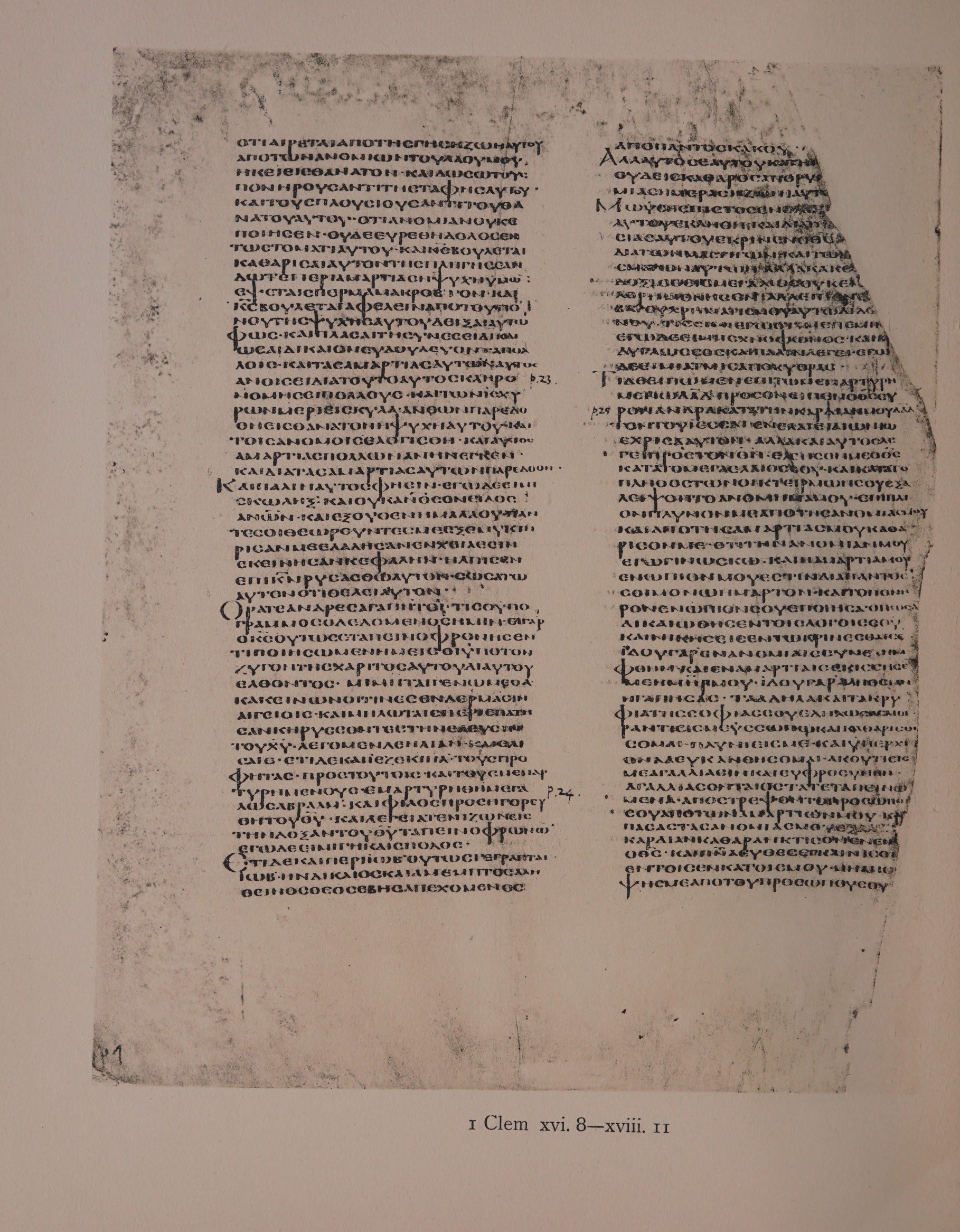
Codex Alexandrinus fol. 161r (1909 facsimile, scan leaf 285; caption printed under the plate: '1 Clem. xiii. 2-xvi. 8'); Codex Alexandrinus fol. 161v (1909 facsimile, scan leaf 286; caption printed under the plate: '1 Clem. xvi. 8-xviii. 11'). The Greek shown is Lake's edited text (1912), not a transcription of the manuscript page.
1Ταπεινοφρονούντων γάρ ἐστιν ὁ Χριστός, οὐκ ἐπαιρομένων ἐπὶ τὸ ποίμνιον αὐτοῦ. 2τὸ σκῆπτρον τῆς μεγαλωσύνης τοῦ θεοῦ, ὁ κύριος Ἰησοῦς Χριστός, οὐκ ἦλθεν ἐν κόμπῳ ἀλαζονείας οὐδὲ ὑπερηφανίας, καίπερ δυνάμενος, ἀλλὰ ταπεινοφρονῶν, καθὼς τὸ πνεῦμα τὸ ἅγιον περὶ αὐτοῦ ἐλάλησεν· φησὶν γάρ· 3Κύριε, τίς ἐπίστευσεν τῇ ἀκοῇ ἡμῶν; καὶ ὁ βραχίων κυρίου τίνι ἀπεκαλύφθη; ἀνηγγείλαμεν ἐναντίον αὐτοῦ, ὡς παιδίον, ὡς ῥίζα ἐν γῇ διψώσῃ· οὐκ ἔστιν αὐτῷ εἶδος οὐδὲ δόξα, καὶ εἴδομεν αὐτόν, καὶ οὐκ εἶχεν εἶδος οὐδὲ κάλλος, ἀλλὰ τὸ εἶδος αὐτοῦ ἄτιμον, ἐκλεῖπον παρὰ τὸ εἶδος τῶν ἀνθρώπων· ἄνθρωπος ἐν πληγῇ ὢν καὶ πόνῳ καὶ εἰδὼς φέρειν μαλακίαν, ὅτι ἀπέστραπται τὸ πρόσωπον αὐτοῦ, ἠτιμάσθη καὶ οὐκ ἐλογίσθη· 4οὗτος τὰς ἁμαρτίας ἡμῶν φέρει καὶ περὶ ἡμῶν ὀδυνᾶται, καὶ ἡμεῖς ἐλογισάμεθα αὐτὸν εἶναι ἐν πόνῳ καὶ ἐν πληγῇ καὶ ἐν κακώσει· 5αὐτὸς δὲ ἐτραυματίσθη διὰ τὰς ἁμαρτίας ἡμῶν καὶ μεμαλάκισται διὰ τὰς ἀνομίας ἡμῶν. παιδεία εἰρήνης ἡμῶν ἐπ’ αὐτόν· τῷ μώλωπι αὐτοῦ ἡμεῖς ἰάθημεν. 6πάντες ὡς πρόβατα ἐπλανήθημεν, ἄνθρωπος τῇ ὁδῷ αὐτοῦ ἐπλανήθη· 7καὶ κύριος παρέδωκεν αὐτὸν ὑπὲρ τῶν ἁμαρτιῶν ἡμῶν, καὶ αὐτὸς διὰ τὸ κεκακῶσθαι οὐκ ἀνοίγει τὸ στόμα. ὡς πρόβατον ἐπὶ σφαγὴν ἤχθη, καὶ ὡς ἀμνὸς ἐναντίον τοῦ κείραντος ἄφωνος, οὕτως οὐκ ἀνοίγει τὸ στόμα αὐτοῦ. ἐν τῇ ταπεινώσει ἡ κρίσις αὐτοῦ ἤρθη. 8τὴν γενεὰν αὐτοῦ τίς διηγήσεται; ὅτι αἴρεται ἀπὸ τῆς γῆς ἡ ζωὴ αὐτοῦ. 9ἀπὸ τῶν ἀνομιῶν τοῦ λαοῦ μου ἥκει εἰς θάνατον. 10καὶ δώσω τοὺς πονηροὺς ἀντὶ τῆς ταφῆς αὐτοῦ καὶ τοὺς πλουσίους ἀντὶ τοῦ θανάτου αὐτοῦ· ὅτι ἀνομίαν οὐκ ἐποίησεν, οὐδὲ εὑρέθη δόλος ἐν τῷ στόματι αὐτοῦ. καὶ κύριος βούλεται καθαρίσαι αὐτὸν τῆς πληγῆς. 11ἐὰν δῶτε περὶ ἁμαρτίας, ἡ ψυχὴ ὑμῶν ὄψεται σπέρμα μακρόβιον. 12καὶ κύριος βούλεται ἀφελεῖν ἀπὸ τοῦ πόνου τῆς ψυχῆς αὐτοῦ, δεῖξαι αὐτῷ φῶς καὶ πλάσαι τῇ συνέσει, δικαιῶσαι δίκαιον εὖ δουλεύοντα πολλοῖς. καὶ τὰς ἁμαρτίας αὐτῶν αὐτὸς ἀνοίσει. 13διὰ τοῦτο αὐτὸς κληρονομήσει πολλοὺς καὶ τῶν ἰσχυρῶν μεριεῖ σκῦλα· ἀνθ’ ὧν παρεδόθη εἰς θάνατον ἡ ψυχὴ αὐτοῦ, καὶ ἐν τοῖς ἀνόμοις ἐλογίσθη. 14καὶ αὐτὸς ἁμαρτίας πολλῶν ἀνήνεγκεν καὶ διὰ τὰς ἁμαρτίας αὐτῶν παρεδόθη. 15καὶ πάλιν αὐτός φησιν· Ἐγὼ δέ εἰμι σκώληξ καὶ οὐκ ἄνθρωπος, ὄνειδος ἀνθρώπων καὶ ἐξουθένημα λαοῦ. 16πάντες οἱ θεωροῦντές με ἐξεμυκτήρισάν με, ἐλάλησαν ἐν χείλεσιν, ἐκίνησαν κεφαλήν· Ἤλπισεν ἐπὶ κύριον, ῥυσάσθω αὐτόν, σωσάτω αὐτόν, ὅτι θέλει αὐτόν. 17ὁρᾶτε, ἄνδρες ἀγαπητοί, τίς ὁ ὑπογραμμὸς ὁ δεδομένος ἡμῖν· εἰ γὰρ ὁ κύριος οὕτως ἐταπεινοφρόνησεν, τί ποιήσωμεν ἡμεῖς οἱ ὑπὸ τὸν ζυγὸν τῆς χάριτος αὐτοῦ δι’ αὐτοῦ ἐλθόντες;
1For Christ is with them that are lowly of mind, not with them that exalt themselves over the flock. 2The sceptre of the majesty of God, even our Lord Jesus Christ, came not in the pomp of arrogance or of pride, though He might have done so, but in lowliness of mind, according as the Holy Spirit spake concerning Him. 3For He saith Lord, who believed our report? and to whom was the arm of the Lord revealed? We announced Him in His presence. As a child was He, as a root in a thirsty ground. There is no form in Him, neither glory. And we beheld Him, and He had no form nor comeliness, but His form was mean, lacking more than the form of men. He was a man of stripes and of toil, and knowing how to bear infirmity: for His face is turned away. He was dishonoured and held of no account. 4He beareth our sins and suffereth pain for our sakes: and we accounted Him to be in toil and in stripes and in affliction. 5And He was wounded for our sins and hath been afflicted for our iniquities. The chastisement of our peace is upon Him. With His bruises we were healed. 6We all went astray like sheep, each man went astray in his own path: 7and the Lord delivered Him over for our sins. And He openeth not His mouth, because He is afflicted. As a sheep He was led to slaughter; and as a lamb before his shearer is dumb, so openeth He not His mouth. In His humiliation His judgment was taken away. 8His generation who shall declare? For His life is taken away from the earth. 9For the iniquities of my people He is come to death. 10And I will give the wicked for His burial, and the rich for His death; for He wrought no iniquity, neither was guile found in His mouth. And the Lord desireth to cleanse Him from His stripes. 11If ye offer for sin, your soul shall see a long-lived seed. 12And the Lord desireth to take away from the toil of His soul, to show Him light and to mould Him with understanding, to justify a Just One that is a good servant unto many. And He shall bear their sins. 13Therefore He shall inherit many, and shall divide the spoils of the strong; because His soul was delivered unto death, and He was reckoned unto the transgressors; 14and He bare the sins of many, and for their sins was He delivered up. 15And again He Himself saith; But I am a worm and no man, a reproach of men and an outcast of the people. 16All they that beheld me mocked at me; they spake with their lips; they wagged their heads, saying, He hoped on the Lord; let Him deliver him, or let Him save him, for He desireth him. 17Ye see, dearly beloved, what is the pattern that hath been given unto us; for, if the Lord was thus lowly of mind, what should we do, who through Him have been brought under the yoke of His grace?
Where on the image
Codex Alexandrinus fol. 161v (1909 facsimile, scan leaf 286; caption printed under the plate: '1 Clem. xvi. 8-xviii. 11'). The Greek shown is Lake's edited text (1912), not a transcription of the manuscript page.
1Μιμηταὶ γενώμεθα κἀκείνων, οἵτινες ἐν δέρμασιν αἰγείοις καὶ μηλωταῖς περιεπάτησαν κηρύσσοντες τὴν ἔλευσιν τοῦ Χριστοῦ· λέγομεν δὲ Ἠλίαν καὶ Ἑλισαιέ, ἔτι δὲ καὶ Ἰεζεκιήλ, τοὺς προφήτας· πρὸς τούτοις καὶ τοὺς μεμαρτυρημένους. 2ἐμαρτυρήθη μεγάλως Ἀβραὰμ καὶ φίλος προσηγορεύθη τοῦ θεοῦ, καὶ λέγει ἀτενίζων εἰς τὴν δόξαν τοῦ θεοῦ ταπεινοφρονῶν· Ἐγὼ δέ εἰμι γῆ καὶ σποδός. 3ἔτι δὲ καὶ περὶ Ἰὼβ οὕτως γέγραπται· Ἰὼβ δὲ ἦν δίκαιος καὶ ἄμεμπτος, ἀληθινός, θεοσεβής, ἀπεχόμενος ἀπὸ παντὸς κακοῦ. 4ἀλλ’ αὐτὸς ἑαυτοῦ κατηγορεῖ λέγων· Οὐδεὶς καθαρὸς ἀπὸ ῥύπου, οὐδ’ ἂν μιᾶς ἡμέρας ἡ ζωὴ αὐτοῦ. 5Μωϋσῆς πιστὸς ἐν ὅλῳ τῷ οἴκῳ αὐτοῦ ἐκλήθη, καὶ διὰ τῆς ὑπηρεσίας αὐτοῦ ἔκρινεν ὁ θεὸς Αἴγυπτον διὰ τῶν μαστίγων καὶ τῶν αἰκισμάτων αὐτῶν· ἀλλὰ κἀκεῖνος δοξασθεὶς μεγάλως οὐκ ἐμεγαλορημόνησεν, ἀλλ’ εἶπεν ἐκ τῆς βάτου χρηματισμοῦ αὐτῷ διδομένου· Τίς εἰμι ἐγώ, ὅτι με πέμπεις ; Ἐγὼ δέ εἰμι ἰσχνόφωνος καὶ βραδύγλωσσος. 6καὶ πάλιν λέγει· Ἐγὼ δέ εἰμι ἀτμὶς ἀπὸ κύθρας.
1Let us be imitators also of them which went about in goatskins and sheepskins, preaching the coming of Christ. We mean Elijah and Elisha and likewise Ezekiel, the prophets, and besides them those men also that obtained a good report. 2Abraham obtained an exceeding good report and was called the friend of God; and looking stedfastly on the glory of God, he saith in lowliness of mind, But I am dust and ashes. 3Moreover concerning Job also it is thus written; And Job was righteous and unblameable, one that was true and honoured God and abstained from all evil. 4Yet he himself accuseth himself saying, No man is clean from filth; no, not though his life be but for a day. 5Moses was called faithful in all His house, and through his ministration God judged Egypt with the plagues and the torments which befel them. Howbeit he also, though greatly glorified, yet spake no proud words, but said, when an oracle was given to him at the bush, Who am I, that Thou sendest me? 6Nay, I am feeble of speech and slow of tongue. And again he saith, But I am smoke from the pot.
Where on the image
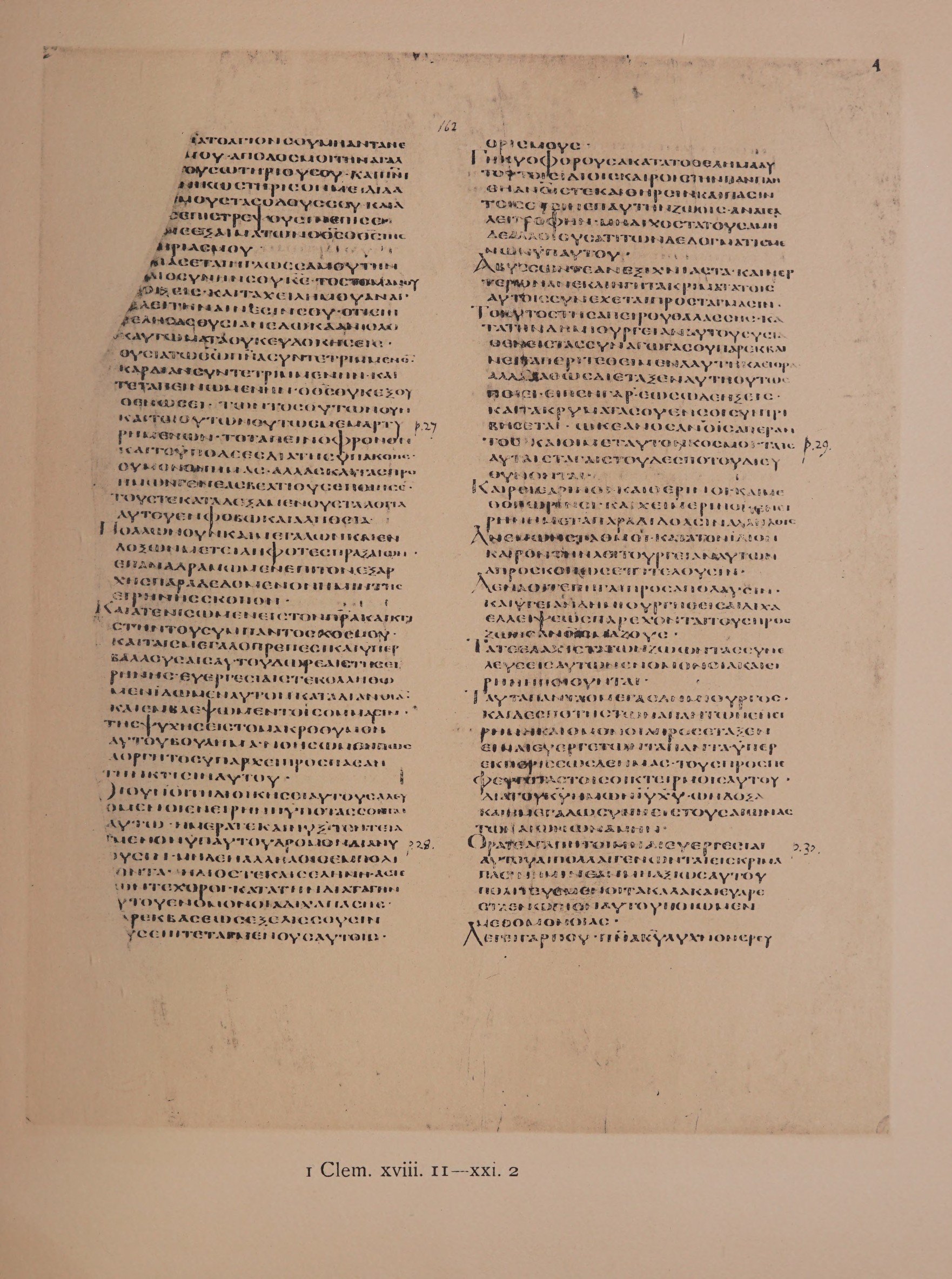
Codex Alexandrinus fol. 161v (1909 facsimile, scan leaf 286; caption printed under the plate: '1 Clem. xvi. 8-xviii. 11'); Codex Alexandrinus fol. 162r (1909 facsimile, scan leaf 287; caption printed under the plate: '1 Clem. xviii. 11-xxi. 2'). The Greek shown is Lake's edited text (1912), not a transcription of the manuscript page.
1Τί δὲ εἴπωμεν ἐπὶ τῷ μεμαρτυρημένῳ Δαυείδ; ἐφ’ οὗ εἶπεν ὁ θεός· Εὗρον ἄνδρα κατὰ τὴν καρδίαν μου, Δαυεὶδ τὸν τοῦ Ἰεσσαί, ἐν ἐλέει αἰωνίῳ ἔχρισα αὐτόν. 2ἀλλὰ καὶ αὐτὸς λέγει πρὸς τὸν θεόν· Ἐλέησόν με, ὁ θεός, κατὰ τὸ μέγα ἔλεός σου, καὶ κατὰ τὸ πλῆθος τῶν οἰκτιρμῶν σου ἐξάλειψον τὸ ἀνόμημά μου. 3ἐπὶ πλεῖον πλῦνόν με ἀπὸ τῆς ἀνομίας μου, καὶ ἀπὸ τῆς ἁμαρτίας μου καθάρισόν με· ὅτι τὴν ἀνομίαν μου ἐγὼ γινώσκω, καὶ ἡ ἁμαρτία μου ἐνώπιόν μου ἐστὶν διαπαντός. 4σοὶ μόνῳ ἥμαρτον, καὶ τὸ πονηρὸν ἐνώπιόν σου ἐποίησα, ὅπως ἂν δικαιωθῇς ἐν τοῖς λόγοις σου, καὶ νικήσῃς ἐν τῷ κρίνεσθαί σε. 5ἰδοὺ γὰρ ἐν ἀνομίαις συνελήμφθην, καὶ ἐν ἁμαρτίαις ἐκίσσησέν με ἡ μήτηρ μου. 6ἰδοὺ γὰρ ἀλήθειαν ἠγάπησας· τὰ ἄδηλα καὶ τὰ κρύφια τῆς σοφίας σου ἐδήλωσάς μοι. 7ῥαντιεῖς με ὑσσώπῳ, καὶ καθαρισθήσομαι· πλυνεῖς με, καὶ ὑπὲρ χιόνα λευκανθήσομαι. 8ἀκουτιεῖς με ἀγαλλίασιν καὶ εὐφροσύνην. ἀγαλλιάσονται ὀστᾶ τεταπεινωμένα. 9ἀπόστρεψον τὸ πρόσωπόν σου ἀπὸ τῶν ἁμαρτιῶν μου, καὶ πάσας τὰς ἀνομίας μου ἐξάλειψον. 10καρδίαν καθαρὰν κτίσον ἐν ἐμοί, ὁ θεός, καὶ πνεῦμα εὐθὲς ἐγκαίνισον ἐν τοῖς ἐγκάτοις μου. 11μὴ ἀπορίψῃς με ἀπὸ τοῦ προσώπου σου, καὶ τὸ πνεῦμα τὸ ἅγιόν σου μὴ ἀντανέλῃς ἀπ’ ἐμοῦ. 12ἀπόδος μοι τὴν ἀγαλλίασιν τοῦ σωτηρίου σου, καὶ πνεύματι ἡγεμονικῷ στήρισόν με. 13διδάξω ἀνόμους τὰς ὁδούς σου, καὶ ἀσεβεῖς ἐπιστρέψουσιν ἐπὶ σέ. 14ῥῦσαί με ἐξ αἱμάτων, ὁ θεός, ὁ θεὸς τῆς σωτηρίας μου. 15ἀγαλλιάσεται ἡ γλῶσσά μου τὴν δικαιοσύνην σου. κύριε, τὸ στόμα μου ἀνοίξεις, καὶ τὰ χείλη μου ἀναγγελεῖ τὴν αἴνεσίν σου. 16ὅτι εἰ ἠθέλησας θυσίαν, ἔδωκα ἄν· ὁλοκαυτώματα οὐκ εὐδοκήσεις. 17θυσία τῷ θεῷ πνεῦμα συντετριμμένον· καρδίαν συντετριμμένην καὶ τεταπεινωμένην ὁ θεὸς οὐκ ἐξουθενώσει.
1But what must we say of David that obtained a good report? of whom God said, I have found a man after My heart, David the son of Jesse: with eternal mercy have I anointed him. 2Yet he too saith unto God Have mercy upon me, O God, according to Thy great mercy; and according to the multitude of Thy compassions, blot out mine iniquity. 3Wash me yet more from mine iniquity, and cleanse me from my sin. For I acknowledge mine iniquity, and my sin is ever before me. Against Thee only did I sin, and I wrought evil in Thy sight; that Thou mayest be justified in Thy words, and mayest conquer in Thy pleading. 4For behold, in iniquities was I conceived, and in sins did my mother bear me. For behold Thou hast loved truth: the dark and hidden things of Thy wisdom hast Thou showed unto me. 5Thou shalt sprinkle me with hyssop, and I shall be made clean. Thou shalt wash me, and I shall become whiter than snow. 6Thou shalt make me to hear of joy and gladness. The bones which have been humbled shall rejoice. 7Turn away Thy face from my sins, and blot out all mine iniquities. 8Make a clean heart within me, O God, and renew a right spirit in mine inmost parts. Cast me not away from Thy presence, and take not Thy Holy Spirit from me. 9Restore unto me the joy of Thy salvation, and strengthen me with a princely spirit. 10I will teach sinners Thy ways, and godless men shall be converted unto Thee. 11Deliver me from bloodguiltiness, O God, the God of my salvation. My tongue shall rejoice in Thy righteousness. 12Lord, Thou shalt open my mouth, and my lips shall declare Thy praise. 13For, if Thou hadst desired sacrifice, I would have given it: in whole burnt offerings Thou wilt have no pleasure. 14A sacrifice unto God is a contrite spirit; a contrite and humbled heart God will not despise.
Where on the image
Codex Alexandrinus fol. 162r (1909 facsimile, scan leaf 287; caption printed under the plate: '1 Clem. xviii. 11-xxi. 2'). The Greek shown is Lake's edited text (1912), not a transcription of the manuscript page.
1Τῶν τοσούτων οὖν καὶ τοιούτων οὕτως μεμαρτυρημένων τὸ ταπεινόφρον καὶ τὸ ὑποδεὲς διὰ τῆς ὑπακοῆς οὐ μόνον ἡμᾶς, ἀλλὰ καὶ τὰς πρὸ ἡμῶν γενεὰς βελτίους ἐποίησεν, τούς τε καταδεξαμένους τὰ λόγια αὐτοῦ ἐν φόβῳ καὶ ἀληθείᾳ. 2πολλῶν οὖν καὶ μεγάλων καὶ ἐνδόξων μετειληφότες πράξεων ἐπαναδράμωμεν ἐπὶ τὸν ἐξ ἀρχῆς παραδεδομένον ἡμῖν τῆς εἰρήνης σκοπόν, καὶ ἀτενίσωμεν εἰς τὸν πατέρα καὶ κτίστην τοῦ σύμπαντος κόσμου καὶ ταῖς μεγαλοπρεπέσι καὶ ὑπερβαλλούσαις αὐτοῦ δωρεαῖς τῆς εἰρήνης εὐεργεσίαις τε κολληθῶμεν. 3ἴδωμεν αὐτὸν κατὰ διάνοιαν καὶ ἐμβλέψωμεν τοῖς ὄμμασιν τῆς ψυχῆς εἰς τὸ μακρόθυμον αὐτοῦ βούλημα· νοήσωμεν, πῶς ἀόργητος ὑπάρχει πρὸς πᾶσαν τὴν κτίσιν αὐτοῦ.
1The humility therefore and the submissiveness of so many and so great men, who have thus obtained a good report, hath through obedience made better not only us but also the generations which were before us, even them that received His oracles in fear and truth. 2Seeing then that we have been partakers of many great and glorious doings, let us hasten to return unto the goal of peace which hath been handed down to us from the beginning, and let us look stedfastly unto the Father and Maker of the whole world, and cleave unto His splendid and excellent gifts of peace and benefits. 3Let us behold Him in our mind, and let us look with the eyes of our soul unto His long-suffering will. Let us note how free from anger He is towards all His creatures.
Where on the image
Codex Alexandrinus fol. 162r (1909 facsimile, scan leaf 287; caption printed under the plate: '1 Clem. xviii. 11-xxi. 2'). The Greek shown is Lake's edited text (1912), not a transcription of the manuscript page.
1Οἱ οὐρανοὶ τῇ διοικήσει αὐτοῦ σαλευόμενοι ἐν εἰρήνῃ ὑποτάσσονται αὐτῷ. 2ἡμέρα τε καὶ νὺξ τὸν τεταγμένον ὑπ’ αὐτοῦ δρόμον διανύουσιν, μηδὲν ἀλλήλοις ἐμποδίζοντα. 3ἥλιός τε καὶ σελήνη, ἀστέρων τε χοροὶ κατὰ τὴν διαταγὴν αὐτοῦ ἐν ὁμονοίᾳ δίχα πάσης παρεκβάσεως ἐξελίσσουσιν τοὺς ἐπιτεταγμένους αὐτοῖς ὁρισμούς. 4γῆ κυοφοροῦσα κατὰ τὸ θέλημα αὐτοῦ τοῖς ἰδίοις καιροῖς τὴν πανπληθῆ ἀνθρώποις τε καὶ θηρσὶν καὶ πᾶσιν τοῖς οὖσιν ἐπ’ αὐτῆς ζώοις ἀνατέλλει τροφήν, μὴ διχοστατοῦσα μηδὲ ἀλλοιοῦσά τι τῶν δεδογματισμένων ὑπ’ αὐτοῦ. 5ἀβύσσων τε ἀνεξιχνίαστα καὶ νερτέρων ἀνεκδιήγητα κλίματα τοῖς αὐτοῖς συνέχεται προστάγμασιν. 6τὸ κύτος τῆς ἀπείρου θαλάσσης κατὰ τὴν δημιουργίαν αὐτοῦ συσταθὲν εἰς τὰς συναγωγὰς οὐ παρεκβαίνει τὰ περιτεθειμένα αὐτῇ κλεῖθρα, ἀλλὰ καθὼς διέταξεν αὐτῇ, οὕτως ποιεῖ. 7εἶπεν γάρ· Ἕως ὧδε ἥξεις, καὶ τὰ κύματά σου ἐν σοὶ συντριβήσεται. 8ὠκεανὸς ἀπέραντος ἀνθρώποις καὶ οἱ μετ’ αὐτὸν κόσμοι ταῖς αὐταῖς ταγαῖς τοῦ δεσπότου διευθύνονται. 9καιροὶ ἐαρινοὶ καὶ θερινοὶ καὶ μετοπωρινοὶ καὶ χειμερινοὶ ἐν εἰρήνῃ μεταπαραδιδόασιν ἀλλήλοις. 10ἀνέμων σταθμοὶ κατὰ τὸν ἴδιον καιρὸν τὴν λειτουργίαν αὐτῶν ἀπροσκόπως ἐπιτελοῦσιν· ἀέναοί τε πηγαί, πρὸς ἀπόλαυσιν καὶ ὑγείαν δημιουργηθεῖσαι, δίχα ἐλλείψεως παρέχονται τοὺς πρὸς ζωῆς ἀνθρώποις μαζούς· τά τε ἐλάχιστα τῶν ζώων τὰς συνελεύσεις αὐτῶν ἐν ὁμονοίᾳ καὶ εἰρήνῃ ποιοῦνται. 11ταῦτα πάντα ὁ μέγας δημιουργὸς καὶ δεσπότης τῶν ἁπάντων ἐν εἰρήνῃ καὶ ὁμονοίᾳ προσέταξεν εἶναι, εὐεργετῶν τὰ πάντα, ὑπερεκπερισσῶς δὲ ἡμᾶς τοὺς προσπεφευγότας τοῖς οἰκτιρμοῖς αὐτοῦ διὰ τοῦ κυρίου ἡμῶν Ἰησοῦ Χριστοῦ, 12ᾧ ἡ δόξα καὶ ἡ μεγαλωσύνη εἰς τοὺς αἰῶνας τῶν αἰώνων. ἀμήν.
1The heavens are moved by His direction and obey Him in peace. 2Day and night accomplish the course assigned to them by Him, without hindrance one to another. 3The sun and the moon and the dancing stars according to His appointment circle in harmony within the bounds assigned to them, without any swerving aside. 4The earth, bearing fruit in fulfilment of His will at her proper seasons, putteth forth the food that supplieth abundantly both men and beasts and all living things which are thereupon, making no dissension, neither altering anything which He hath decreed. 5Moreover, the inscrutable depths of the abysses and the unutterable statutes of the nether regions are constrained by the same ordinances. 6The basin of the boundless sea, gathered together by His workmanship into its reservoirs, passeth not the barriers wherewith it is surrounded; but even as He ordered it, so it doeth. 7For He said, So far shalt thou come, and thy waves shall be broken within thee. 8The ocean which is impassable for men, and the worlds beyond it, are directed by the same ordinances of the Master. 9The seasons of spring and summer and autumn and winter give way in succession one to another in peace. 10The winds in their several quarters at their proper season fulfil their ministry without disturbance; and the everflowing fountains, created for enjoyment and health, without fail give their breasts which sustain the life for men. Yea, the smallest of living things come together in concord and peace. 11All these things the great Creator and Master of the universe ordered to be in peace and concord, doing good unto all things, but far beyond the rest unto us who have taken refuge in His compassionate mercies through our Lord Jesus Christ, 12to whom be the glory and the majesty for ever and ever. Amen.
Where on the image
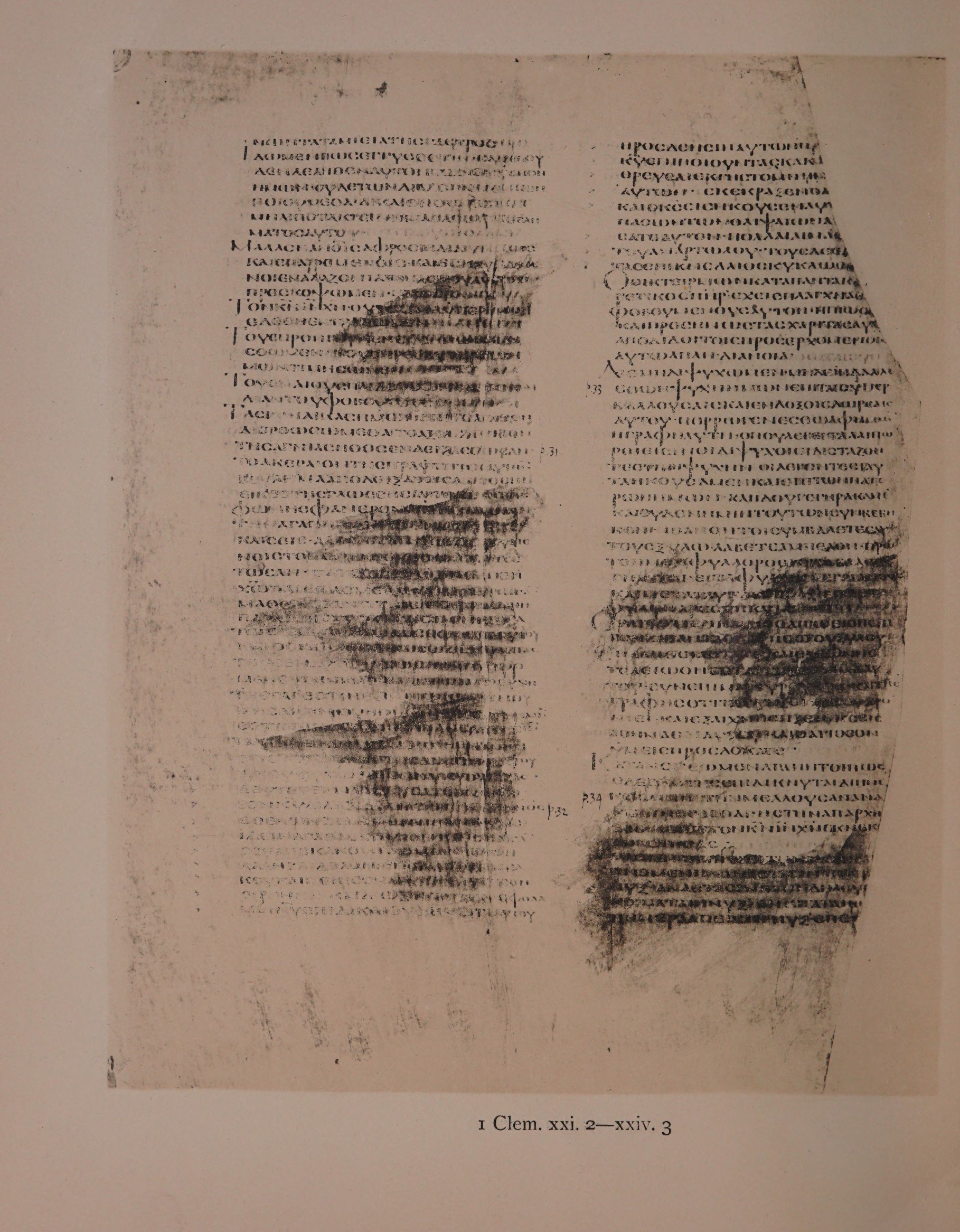
Codex Alexandrinus fol. 162r (1909 facsimile, scan leaf 287; caption printed under the plate: '1 Clem. xviii. 11-xxi. 2'); Codex Alexandrinus fol. 162v (1909 facsimile, scan leaf 288; caption printed under the plate: '1 Clem. xxi. 2-xxiv. 3'). The Greek shown is Lake's edited text (1912), not a transcription of the manuscript page.
1Ὁρᾶτε, ἀγαπητοί, μὴ αἱ εὐεργεσίαι αὐτοῦ αἱ πολλαὶ γένωνται εἰς κρίμα ἡμῖν, ἐὰν μὴ ἀξίως αὐτοῦ πολιτευόμενοι τὰ καλὰ καὶ εὐάρεστα ἐνώπιον αὐτοῦ ποιῶμεν μεθ’ ὁμονοίας. 2λέγει γάρ που· Πνεῦμα κυρίου λύχνος ἐρευνῶν τὰ ταμιεῖα τῆς γαστρός· 3ἴδωμεν, πῶς ἐγγύς ἐστιν, καὶ ὅτι οὐδὲν λέληθεν αὐτὸν τῶν ἐννοιῶν ἡμῶν οὐδὲ τῶν διαλογισμῶν ὧν ποιούμεθα· 4δίκαιον οὖν ἐστὶν μὴ λειποτακτεῖν ἡμᾶς ἀπὸ τοῦ θελήματος αὐτοῦ. 5μᾶλλον ἀνθρώποις ἄφροσι καὶ ἀνοήτοις καὶ ἐπαιρομένοις καὶ ἐγκαυχωμένοις ἐν ἀλαζονείᾳ τοῦ λόγου αὐτῶν προσκόψωμεν ἢ τῷ θεῷ. 6τὸν κύριον Ἰησοῦν Χριστόν, οὗ τὸ αἷμα ὑπὲρ ἡμῶν ἐδόθη, ἐντραπῶμεν, τοὺς προηγουμένους ἡμῶν αἰδεσθῶμεν, τοὺς πρεσβυτέρους τιμήσωμεν, τοὺς νέους παιδεύσωμεν τὴν παιδείαν τοῦ φόβου τοῦ θεοῦ, τὰς γυναῖκας ἡμῶν ἐπὶ τὸ ἀγαθὸν διορθωσώμεθα. 7τὸ ἀξιαγάπητον τῆς ἁγνείας ἦθος ἐνδειξάσθωσαν, τὸ ἀκέραιον τῆς πραΰτητος αὐτῶν βούλημα ἀποδειξάτωσαν, τὸ ἐπιεικὲς τῆς γλώσσης αὐτῶν διὰ τῆς σιγῆς φανερὸν ποιησάτωσαν, τὴν ἀγάπην αὐτῶν μὴ κατὰ προσκλίσεις, ἀλλὰ πᾶσιν τοῖς φοβουμένοις τὸν θεὸν ὁσίως ἴσην παρεχέτωσαν. 8τὰ τέκνα ἡμῶν τῆς ἐν Χριστῷ παιδείας μεταλαμβανέτωσαν· μαθέτωσαν, τί ταπεινοφροσύνη παρὰ θεῷ ἰσχύει, τί ἀγάπη ἁγνὴ παρὰ θεῷ δύναται, πῶς ὁ φόβος αὐτοῦ καλὸς καὶ μέγας καὶ σώζων πάντας τοὺς ἐν αὐτῷ ὁσίως ἀναστρεφομένους ἐν καθαρᾷ διανοίᾳ. 9ἐρευνητὴς γάρ ἐστιν ἐννοιῶν καὶ ἐνθυμήσεων· οὗ ἡ πνοὴ αὐτοῦ ἐν ἡμῖν ἐστίν, καὶ ὅταν θέλῃ, ἀνελεῖ αὐτήν.
1Look ye, brethren, lest His benefits, which are many, turn unto judgment to all of us, if we walk not worthily of Him, and do those things which are good and well-pleasing in His sight with concord. 2For He saith in a certain place, The Spirit of the Lord is a lamp searching the closets of the belly. 3Let us see how near He is, and how that nothing escapeth Him of our thoughts or our devices which we make. 4It is right therefore that we should not be deserters from His will. 5Let us rather give offence to foolish and senseless men who exalt themselves and boast in the arrogance of their words, than to God. 6Let us fear the Lord Jesus [Christ], whose blood was given for us. Let us reverence our rulers; let us honour our elders; let us instruct our young men in the lesson of the fear of God. Let us guide our women toward that which is good: 7let them show forth their lovely disposition of purity; let them prove their sincere affection of gentleness; let them make manifest the moderation of their tongue through their silence; let them show their love, not in factious preferences but without partiality towards all them that fear God, in holiness. Let our children be partakers of the instruction which is in Christ: 8let them learn how lowliness of mind prevaileth with God, what power chaste love hath with God, how the fear of Him is good and great and saveth all them that walk therein in a pure mind with holiness. 9For He is the searcher out of the intents and desires; whose breath is in us, and when He listeth, He shall take it away.
Where on the image
Codex Alexandrinus fol. 162v (1909 facsimile, scan leaf 288; caption printed under the plate: '1 Clem. xxi. 2-xxiv. 3'). The Greek shown is Lake's edited text (1912), not a transcription of the manuscript page.
1Ταῦτα δὲ πάντα βεβαιοῖ ἡ ἐν Χριστῷ πίστις· καὶ γὰρ αὐτὸς διὰ τοῦ πνεύματος τοῦ ἁγίου οὕτως προσκαλεῖται ἡμᾶς· Δεῦτε, τέκνα, ἀκούσατέ μου, φόβον κυρίου διδάξω ὑμᾶς. 2τίς ἐστιν ἄνθρωπος ὁ θέλων ζωήν, ἀγαπῶν ἡμέρας ἰδεῖν ἀγαθάς ; 3παῦσον τὴν γλῶσσάν σου ἀπὸ κακοῦ, καὶ χείλη σου τοῦ μὴ λαλῆσαι δόλον. 4ἔκκλινον ἀπὸ κακοῦ, καὶ ποίησον ἀγαθόν. 5ζήτησον εἰρήνην, καὶ δίωξον αὐτήν· 6ὀφθαλμοὶ κυρίου ἐπὶ δικαίους, καὶ ὦτα αὐτοῦ πρὸς δέησιν αὐτῶν· πρόσωπον δὲ κυρίου ἐπὶ ποιοῦντας κακά, τοῦ ἐξολεθρεῦσαι ἐκ γῆς τὸ μνημόσυνον αὐτῶν. 7ἐκέκραξεν ὁ δίκαιος, καὶ ὁ κύριος εἰσήκουσεν αὐτοῦ, καὶ ἐκ πασῶν τῶν θλίψεων αὐτοῦ ἐρύσατο αὐτόν. 8Πολλαὶ αἱ μάστιγες τοῦ ἁμαρτωλοῦ, τοὺς δὲ ἐλπίζοντας ἐπὶ κύριον ἔλεος κυκλώσει.
1Now all these things the faith which is in Christ confirmeth: for He Himself through the Holy Spirit thus inviteth us: Come, my children, hearken unto Me, I will teach you the fear of the Lord. 2What man is he that desireth life and loveth to see good days? 3Make thy tongue to cease from evil, and thy lips that they speak no guile. 4Turn aside from evil and do good. 5Seek peace and ensue it. 6The eyes of the Lord are over the righteous, and His ears are turned to their prayers. But the face of the Lord is upon them that do evil, to destroy their memorial from the earth. 7The righteous cried out, and the Lord heard him, and delivered him from all his troubles. Many are the troubles of the righteous, and the Lord shall deliver him from them all. 8And again Many are the stripes of the sinner, but them that set their hope on the Lord mercy shall compass about.
Where on the image
Codex Alexandrinus fol. 162v (1909 facsimile, scan leaf 288; caption printed under the plate: '1 Clem. xxi. 2-xxiv. 3'). The Greek shown is Lake's edited text (1912), not a transcription of the manuscript page.
1Ὁ οἰκτίρμων κατὰ πάντα καὶ εὐεργετικὸς πατὴρ ἔχει σπλάγχνα ἐπὶ τοὺς φοβουμένους αὐτόν, ἠπίως τε καὶ προσηνῶς τὰς χάριτας αὐτοῦ ἀποδιδοῖ τοῖς προσερχομένοις αὐτῷ ἁπλῇ διανοιᾳ. 2διὸ μὴ διψυχῶμεν, μηδὲ ἰνδαλλέσθω ἡ ψυχὴ ἡμῶν ἐπὶ ταῖς ὑπερβαλλούσαις καὶ ἐνδόξοις δωρεαῖς αὐτοῦ. 3πόρρω γενέσθω ἀφ’ ἡμῶν ἡ γραφὴ αὕτη, ὅπου λέγει· Ταλαίπωροί εἰσιν οἱ δίψυχοι, οἱ διστάζοντες τῇ ψυχῇ, οἱ λέγοντες· Ταῦτα ἠκούσαμεν καὶ ἐπὶ τῶν πατέρων ἡμῶν, καὶ ἰδού, γεγηράκαμεν, καὶ οὐδὲν ἡμῖν τούτων συνβέβηκεν. 4ὦ ἀνόητοι, συμβάλετε ἑαυτοὺς ξύλῳ· λάβετε ἄμπελον· πρῶτον μὲν φυλλοροεῖ, εἶτα βλαστὸς γίνεται, εἶτα φύλλον, εἶτα ἄνθος, καὶ μετὰ ταῦτα ὄμφαξ, εἶτα σταφυλὴ παρεστηκυῖα. ὁρᾶτε, ὅτι ἐν καιρῷ ὀλίγῳ εἰς πέπειρον καταντᾷ ὁ καρπὸς τοῦ ξύλου. 5ἐπ’ ἀληθείας ταχὺ καὶ ἐξαίφνης τελειωθήσεται τὸ βούλημα αὐτοῦ, συνεπιμαρτυρούσης καὶ τῆς γραφῆς, ὅτι ταχὺ ἥξει καὶ οὐ χρονιεῖ, καὶ ἐξαίφνης ἥξει ὁ κύριος εἰς τὸν ναὸν αὐτοῦ, καὶ ὁ ἅγιος, ὃν ὑμεῖς προσδοκᾶτε.
1The Father, who is pitiful in all things, and ready to do good, hath compassion on them that fear Him, and kindly and lovingly bestoweth His favours on them that draw nigh unto Him with a single mind. 2Wherefore let us not be double-minded, neither let our soul indulge in idle humours respecting His exceeding and glorious gifts. 3Let this scripture be far from us where He saith Wretched are the double-minded, which doubt in their soul and say, These things we did hear in the days of our fathers also, and behold we have grown old, and none of these things hath befallen us. 4Ye fools, compare yourselves unto a tree; take a vine. First it sheddeth its leaves, then a shoot cometh, then a leaf, then a flower, and after these a sour berry, then a full ripe grape. Ye see that in a little time the fruit of the tree attaineth unto mellowness. 5Of a truth quickly and suddenly shall His will be accomplished, the scripture also bearing witness to it, saying He shall come quickly and shall not tarry; and the Lord shall come suddenly into His temple, even the Holy One, whom ye expect.
Where on the image
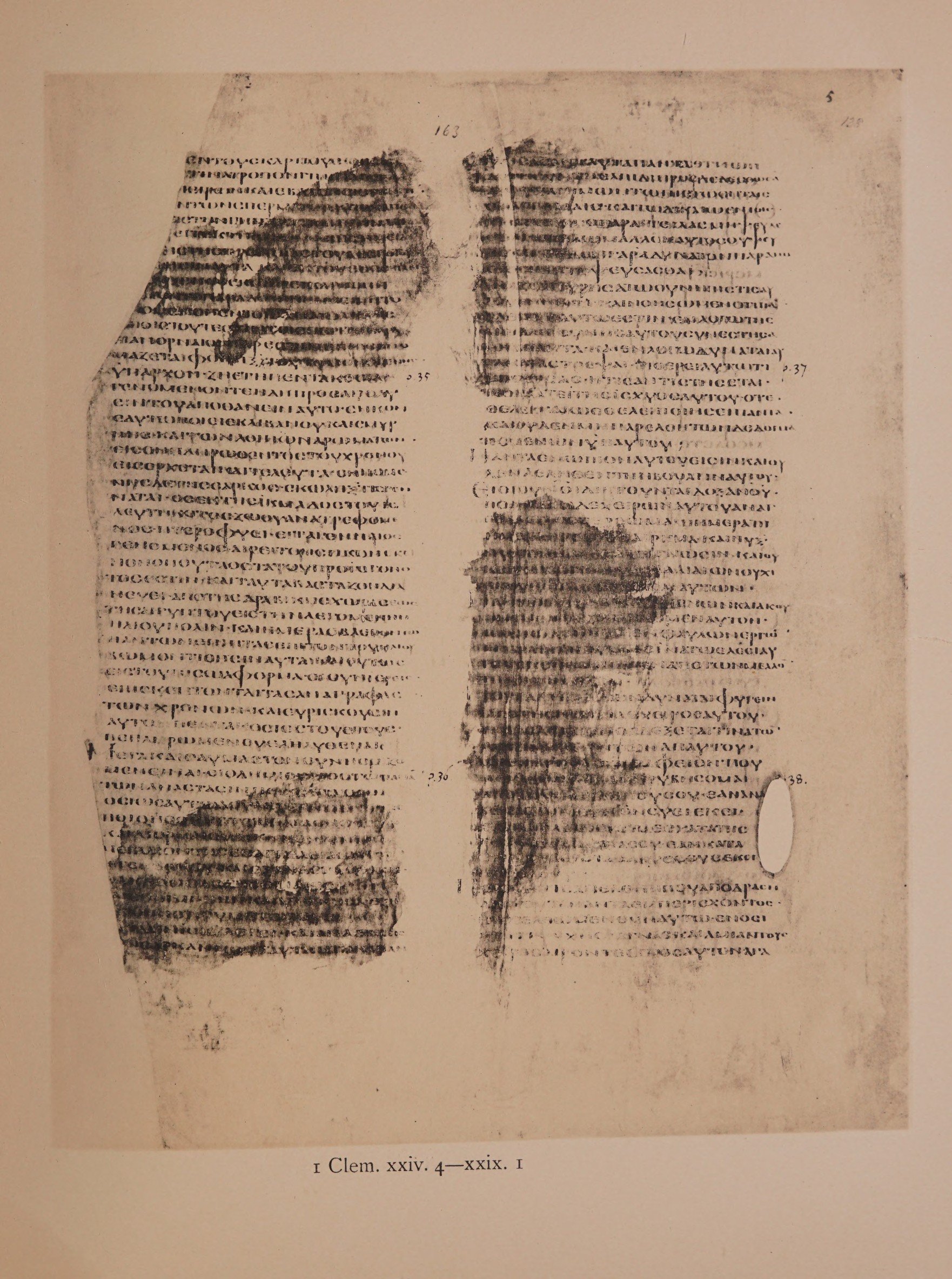
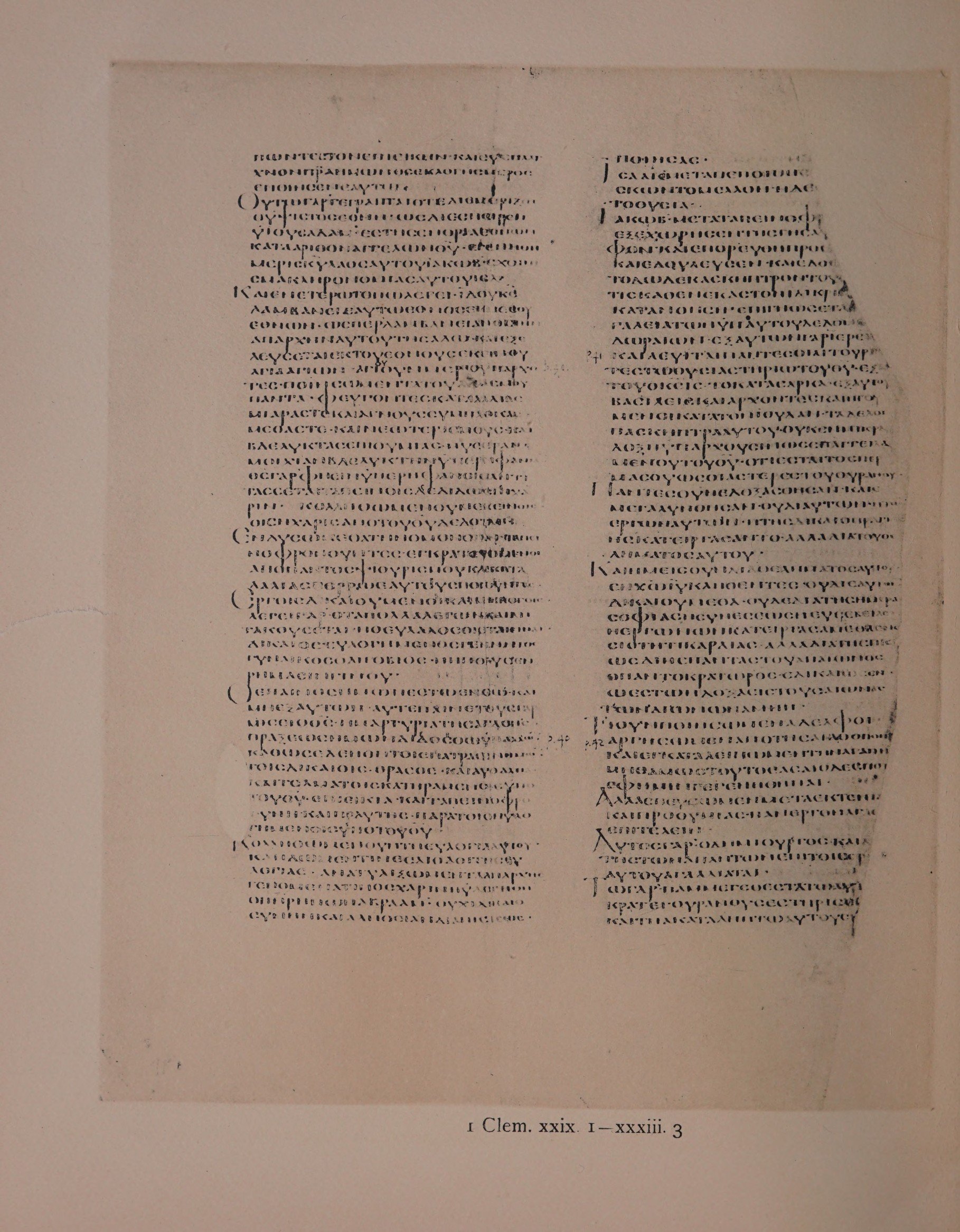
Codex Alexandrinus fol. 162v (1909 facsimile, scan leaf 288; caption printed under the plate: '1 Clem. xxi. 2-xxiv. 3'); Codex Alexandrinus fol. 163r (1909 facsimile, scan leaf 289; caption printed under the plate: '1 Clem. xxiv. 4-xxix. 1'). The Greek shown is Lake's edited text (1912), not a transcription of the manuscript page.
1Κατανοήσωμεν, ἀγαπητοί, πῶς ὁ δεσπότης ἐπιδείκνυται διηνεκῶς ἡμῖν τὴν μέλλουσαν ἀνάστασιν ἔσεσθαι, ἧς τὴν ἀπαρχὴν ἐποιήσατο τὸν κύριον Ἰησοῦν Χριστὸν ἐκ νεκρῶν ἀναστήσας. 2ἴδωμεν, ἀγαπητοί, τὴν κατὰ καιρὸν γινομένην ἀνάστασιν. 3ἡμέρα καὶ νὺξ ἀνάστασιν ἡμῖν δηλοῦσιν· κοιμᾶται ἡ νύξ, ἀνίσταται ἡ ἡμέρα· ἡ ἡμέρα ἄπεισιν, νὺξ ἐπέρχεται. 4λάβωμεν τοὺς καρπούς· ὁ σπόρος πῶς καὶ τίνα τρόπον γίνεται; 5ἐξῆλθεν ὁ σπείρων καὶ ἔβαλεν εἰς τὴν γῆν ἕκαστον τῶν σπερμάτων, ἅτινα πεσόντα εἰς τὴν γῆν ξηρὰ καὶ γυμνὰ διαλύεται· εἶτ’ ἐκ τῆς διαλύσεως ἡ μεγαλειότης τῆς προνοίας τοῦ δεσπότου ἀνίστησιν αὐτά, καὶ ἐκ τοῦ ἑνὸς πλείονα αὔξει καὶ ἐκφέρει καρπόν.
1Let us understand, dearly beloved, how the Master continually showeth unto us the resurrection that shall be hereafter; whereof He made the Lord Jesus Christ the firstfruit, when He raised Him from the dead. 2Let us behold, dearly beloved, the resurrection which happeneth at its proper season. 3Day and night show unto us the resurrection. The night falleth asleep, and day ariseth; the day departeth, and night cometh on. 4Let us mark the fruits, how and in what manner the sowing taketh place. 5The sower goeth forth and casteth into the earth each of the seeds; and these falling into the earth dry and bare decay: then out of their decay the mightiness of the Master's providence raiseth them up, and from being one they increase manifold and bear fruit.
Where on the image
Codex Alexandrinus fol. 163r (1909 facsimile, scan leaf 289; caption printed under the plate: '1 Clem. xxiv. 4-xxix. 1'). The Greek shown is Lake's edited text (1912), not a transcription of the manuscript page.
1Ἴδωμεν τὸ παράδοξον σημεῖον τὸ γινόμενον ἐν τοῖς ἀνατολικοῖς τόποις, τουτέστιν τοῖς περὶ τὴν Ἀραβίαν. 2ὄρνεον γάρ ἐστιν, ὃ προσονομάζεται φοῖνιξ· τοῦτο μονογενὲς ὑπάρχον ζῇ ἔτη πεντακόσια, γενόμενόν τε ἤδη πρὸς ἀπόλυσιν τοῦ ἀποθανεῖν αὐτό, σηκὸν ἑαυτῷ ποιεῖ ἐκ λιβάνου καὶ σμύρνης καὶ τῶν λοιπῶν ἀρωμάτων, εἰς ὃν πληρωθέντος τοῦ χρόνου εἰσέρχεται καὶ τελευτᾷ. 3σηπομένης δὲ τῆς σαρκὸς σκώληξ τις γεννᾶται, ὃς ἐκ τῆς ἰκμάδος τοῦ τετελευτηκότος ζώου ἀνατρεφόμενος πτεροφυεῖ· εἶτα γενναῖος γενόμενος αἴρει τὸν σηκὸν ἐκεῖνον, ὅπου τὰ ὀστᾶ τοῦ προγεγονότος ἐστίν, καὶ ταῦτα βαστάζων διανύει ἀπὸ τῆς Ἀραβικῆς χώρας ἕως τῆς Αἰγύπτου εἰς τὴν λεγομένην Ἡλιούπολιν, 4καὶ ἡμέρας, βλεπόντων πάντων, ἐπιπτὰς ἐπὶ τὸν τοῦ ἡλίου βωμὸν τίθησιν αὐτὰ καὶ οὕτως εἰς τοὐπίσω ἀφορμᾷ. 5οἱ οὖν ἱερεῖς ἐπισκέπτονται τὰς ἀναγραφὰς τῶν χρόνων καὶ εὑρίσκουσιν αὐτὸν πεντακοσιοστοῦ ἔτους πεπληρωμένου ἐληλυθέναι.
1Let us consider the marvellous sign which is seen in the regions of the east, that is, in the parts about Arabia. 2There is a bird, which is named the phœnix. This, being the only one of its kind, liveth for five hundred years; and when it hath now reached the time of its dissolution that it should die, it maketh for itself a coffin of frankincense and myrrh and the other spices, into the which in the fulness of time it entereth, and so it dieth. 3But, as the flesh rotteth, a certain worm is engendered, which is nurtured from the moisture of the dead creature and putteth forth wings. Then, when it is grown lusty, it taketh up that coffin where are the bones of its parent, and carrying them journeyeth from the country of Arabia even unto Egypt, to the place called the City of the Sun; 4and in the day time in the sight of all, flying to the altar of the Sun, it layeth them thereupon; and this done, it setteth forth to return. 5So the priests examine the registers of the times, and they find that it hath come when the five hundredth year is completed.
Where on the image
Codex Alexandrinus fol. 163r (1909 facsimile, scan leaf 289; caption printed under the plate: '1 Clem. xxiv. 4-xxix. 1'). The Greek shown is Lake's edited text (1912), not a transcription of the manuscript page.
1Μέγα καὶ θαυμαστὸν οὖν νομίζομεν εἶναι, εἰ ὁ δημιουργὸς τῶν ἁπάντων ἀνάστασιν ποιήσεται τῶν ὁσίως αὐτῷ δουλευσάντων ἐν πεποιθήσει πίστεως ἀγαθῆς, ὅπου καὶ δι’ ὀρνέου δείκνυσιν ἡμῖν τὸ μεγαλεῖον τῆς ἐπαγγελίας αὐτοῦ; 2λέγει γάρ που· Καὶ ἐξαναστήσεις με, καὶ ἐξομολογήσομαί σοι, καί· Ἐκοιμήθην καὶ ὕπνωσα, ἐξηγέρθην, ὅτι σὺ μετ’ ἐμοῦ εἶ. 3καὶ πάλιν Ἰὼβ λέγει· Καὶ ἀναστήσεις τὴν σάρκα μου ταύτην τὴν ἀναντλήσασαν ταῦτα πάντα.
1Do we then think it to be a great and marvellous thing, if the Creator of the universe shall bring about the resurrection of them that have served Him with holiness in the assurance of a good faith, seeing that He showeth to us even by a bird the magnificence of His promise? 2For He saith in a certain place And Thou shalt raise me up, and I will praise Thee; and; I went to rest and slept, I was awaked, for Thou art with me. 3And again Job saith And Thou shalt raise this my flesh which hath endured all these things.
Where on the image
Codex Alexandrinus fol. 163r (1909 facsimile, scan leaf 289; caption printed under the plate: '1 Clem. xxiv. 4-xxix. 1'). The Greek shown is Lake's edited text (1912), not a transcription of the manuscript page.
1Ταύτῃ οὖν τῇ ἐλπίδι προσδεδέσθωσαν αἱ ψυχαὶ ἡμῶν τῷ πιστῷ ἐν ταῖς ἐπαγγελίαις καὶ τῷ δικαίῳ ἐν τοῖς κρίμασιν. 2ὁ παραγγείλας μὴ ψεύδεσθαι, πολλῷ μᾶλλον αὐτὸς οὐ ψεύσεται· οὐδὲν γὰρ ἀδύνατον παρὰ τῷ θεῷ εἰ μὴ τὸ ψεύσασθαι. 3ἀναζωπυρησάτω οὖν ἡ πίστις αὐτοῦ ἐν ἡμῖν, καὶ νοήσωμεν ὅτι πάντα ἐγγὺς αὐτῷ ἐστιν. 4ἐν λόγῳ τῆς μεγαλωσύνης αὐτοῦ συνεστήσατο τὰ πάντα, καὶ ἐν λόγῳ δύναται αὐτὰ καταστρέψαι. 5Τίς ἐρεῖ αὐτῷ· Τί ἐποίησας; ἢ τίς ἀντιστήσεται τῷ κράτει τῆς ἰσχύος αὐτοῦ; ὅτε θέλει καὶ ὡς θέλει ποιήσει πάντα, καὶ οὐδὲν μὴ παρέλθῃ τῶν δεδογματισμένων ὑπ’ αὐτοῦ. 6πάντα ἐνώπιον αὐτοῦ εἰσίν, καὶ οὐδὲν λέληθεν τὴν βουλὴν αὐτοῦ, 7εἰ οἱ οὐρανοὶ διηγοῦνται δόξαν θεοῦ, ποίησιν δὲ χειρῶν αὐτοῦ ἀναγγέλλει τὸ στερέωμα· ἡ ἡμέρα τῇ ἡμέρᾳ ἐρεύγεται ῥῆμα, καὶ νὺξ νυκτὶ ἀναγγέλλει γνῶσιν· καὶ οὐκ εἰσὶν λόγοι οὐδὲ λαλιαί, ὧν οὐχὶ ἀκούονται αἱ φωναὶ αὐτῶν.
1With this hope therefore let our souls be bound unto Him that is faithful in His promises and that is righteous in His judgments. 2He that commanded not to lie, much more shall He Himself not lie: for nothing is impossible with God save to lie. 3Therefore let our faith in Him be kindled within us, and let us understand that all things are nigh unto Him. 4By a word of His majesty He compacted the universe; and by a word He can destroy it. 5Who shall say unto Him, What hast thou done? or who shall resist the might of His strength? When He listeth, and as He listeth, He will do all things; and nothing shall pass away of those things that He hath decreed. 6All things are in His sight, and nothing escapeth His counsel, 7seeing that The heavens declare the glory of God, and the firmament proclaimeth His handiwork. Day uttereth word unto day, and night proclaimeth knowledge unto night; and there are neither words nor speeches, whose voices are not heard.
Where on the image
Codex Alexandrinus fol. 163r (1909 facsimile, scan leaf 289; caption printed under the plate: '1 Clem. xxiv. 4-xxix. 1'). The Greek shown is Lake's edited text (1912), not a transcription of the manuscript page.
1Πάντων οὖν βλεπομένων καὶ ἀκουομένων, φοβηθῶμεν αὐτόν, καὶ ἀπολίπωμεν φαύλων ἔργων μιαρὰς ἐπιθυμίας, ἵνα τῷ ἐλέει αὐτοῦ σκεπασθῶμεν ἀπὸ τῶν μελλόντων κριμάτων. 2ποῦ γάρ τις ἡμῶν δύναται φυγεῖν ἀπὸ τῆς κραταιᾶς χειρὸς αὐτοῦ; ποῖος δὲ κόσμος δέξεταί τινα τῶν αὐτομολούντων ἀπ’ αὐτοῦ; 3λέγει γάρ που τὸ γραφεῖον· Ποῦ ἀφήξω καὶ ποῦ κρυβήσομαι ἀπὸ τοῦ προσώπου σου; ἐὰν ἀναβῶ εἰς τὸν οὐρανόν, σὺ ἐκεῖ εἶ· ἐὰν ἀπέλθω εἰς τὰ ἔσχατα τῆς γῆς, ἐκεῖ ἡ δεξιά σου· ἐὰν καταστρώσω εἰς τὰς ἀβύσσους, ἐκεῖ τὸ πνεῦμά σου. 4ποῖ οὖν τις ἀπέλθῃ ἢ ποῦ ἀποδράσῃ ἀπὸ τοῦ τὰ πάντα ἐμπεριέχοντος;
1Since therefore all things are seen and heard, let us fear Him and forsake the abominable lusts of evil works, that we may be shielded by His mercy from the coming judgments. 2For where can any of us escape from His strong hand? And what world will receive any of them that desert from His service? 3For the holy writing saith in a certain place Where shall I go, and where shall I be hidden from Thy face? If I ascend into the heaven, Thou art there; if I depart into the farthest parts of the earth, there is Thy right hand; if I make my bed in the depths, there is Thy Spirit. 4Whither then shall one depart, or where shall one flee, from Him that embraceth the universe?
Where on the image
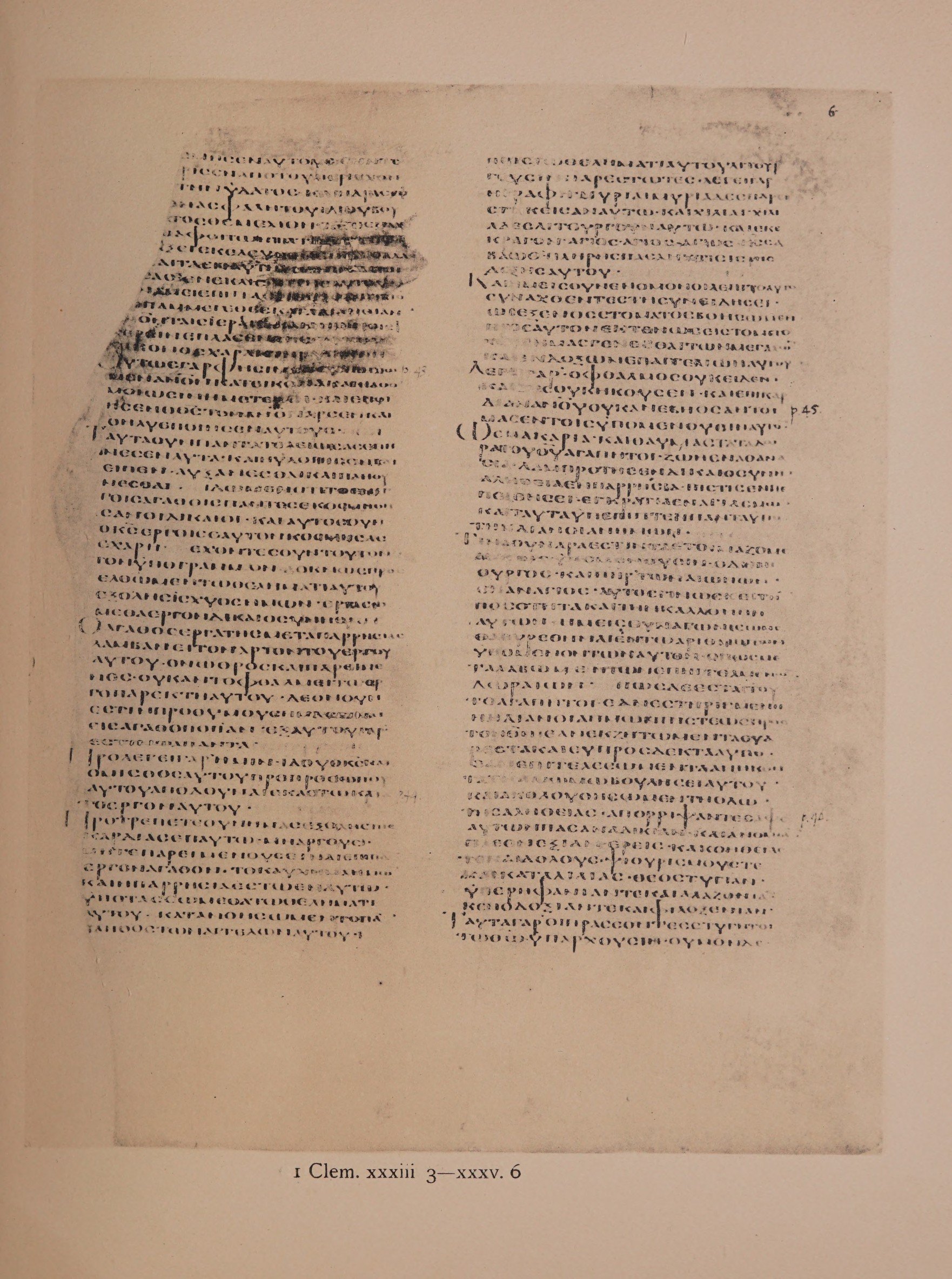
Codex Alexandrinus fol. 163r (1909 facsimile, scan leaf 289; caption printed under the plate: '1 Clem. xxiv. 4-xxix. 1'); Codex Alexandrinus fol. 163v (1909 facsimile, scan leaf 290; caption printed under the plate: '1 Clem. xxix. 1-xxxiii. 3'). The Greek shown is Lake's edited text (1912), not a transcription of the manuscript page.
1Προσέλθωμεν οὖν αὐτῷ ἐν ὁσιότητι ψυχῆς, ἁγνὰς καὶ ἀμιάντους χεῖρας αἴροντες πρὸς αὐτόν, ἀγαπῶντες τὸν ἐπιεικῆ καὶ εὔσπλαγχνον πατέρα ἡμῶν, ὃς ἐκλογῆς μέρος ἡμᾶς ἐποίησεν ἑαυτῷ. 2οὕτω γὰρ γέγραπται· Ὅτε διεμέριζεν ὁ ὕψιστος ἔθνη, ὡς διέσπειρεν υἱοὺς Ἀδάμ, ἔστησεν ὅρια ἐθνῶν κατὰ ἀριθμὸν ἀγγέλων θεοῦ. ἐγενήθη μερὶς κυρίου λαὸς αὐτοῦ Ἰακώβ, σχοίνισμα κληρονομίας αὐτοῦ Ἰσραήλ. 3καὶ ἐν ἑτέρῳ τόπῳ λέγει· Ἰδού, κύριος λαμβάνει ἑαυτῷ ἔθνος ἐκ μέσου ἐθνῶν, ὥσπερ λαμβάνει ἄνθρωπος τὴν ἀπαρχὴν αὐτοῦ τῆς ἅλω· καὶ ἐξελεύσεται ἐκ τοῦ ἔθνους ἐκείνου ἅγια ἁγίων.
1Let us therefore approach Him in holiness of soul, lifting up pure and undefiled hands unto Him, with love towards our gentle and compassionate Father who made us an elect portion unto Himself. 2For thus it is written: When the Most High divided the nations, when He dispersed the sons of Adam, He fixed the boundaries of the nations according to the number of the angels of God. His people Jacob became the portion of the Lord, and Israel the measurement of His inheritance. 3And in another place He saith, Behold, the Lord taketh for Himself a nation out of the midst of the nations, as a man taketh the firstfruits of his threshing floor; and the holy of holies shall come forth from that nation.
Where on the image
Codex Alexandrinus fol. 163v (1909 facsimile, scan leaf 290; caption printed under the plate: '1 Clem. xxix. 1-xxxiii. 3'). The Greek shown is Lake's edited text (1912), not a transcription of the manuscript page.
1Ἁγίου οὖν μερὶς ὑπάρχοντες ποιήσωμεν τὰ τοῦ ἁγιασμοῦ πάντα, φεύγοντες καταλαλιάς, μιαράς τε καὶ ἀνάγνους συμπλοκάς, μέθας τε καὶ νεωτερισμοὺς καὶ βδελυκτὰς ἐπιθυμίας, μυσερὰν μοιχείαν, βδελυκτὴν ὑπερηφανίαν. 2Θεὸς γάρ, φησίν, ὑπερηφάνοις ἀντιτάσσεται, ταπεινοῖς δὲ δίδωσιν χάριν. 3κολληθῶμεν οὖν ἐκείνοις, οἷς ἡ χάρις ἀπὸ τοῦ θεοῦ δέδοται· ἐνδυσώμεθα τὴν ὁμόνοιαν ταπεινοφρονοῦντες, ἐγκρατευόμενοι, ἀπὸ παντὸς ψιθυρισμοῦ καὶ καταλαλιᾶς πόρρω ἑαυτοὺς ποιοῦντες, ἔργοις δικαιούμενοι, μὴ λόγοις. 4λέγει γάρ· Ὁ τὰ πολλὰ λέγων καὶ ἀντακούσεται· ἢ ὁ εὔλαλος οἴεται εἶναι δίκαιος; 5εὐλογημένος γεννητὸς γυναικὸς ὀλιγόβιος. μὴ πολὺς ἐν ῥήμασιν γίνου. 6ὁ ἔπαινος ἡμῶν ἔστω ἐν θεῷ καὶ μὴ ἐξ αὐτῶν· αὐτεπαινέτους γὰρ μισεῖ ὁ θεός. 7ἡ μαρτυρία τῆς ἀγαθῆς πράξεως ἡμῶν διδόσθω ὑπ’ ἄλλων, καθὼς ἐδόθη τοῖς πατράσιν ἡμῶν τοῖς δικαίοις. 8θράσος καὶ αὐθάδεια καὶ τόλμα τοῖς κατηραμένοις ὑπὸ τοῦ θεοῦ· ἐπιείκεια καὶ ταπεινοφροσύνη καὶ πραΰτης παρὰ τοῖς ηὐλογημένοις ὑπὸ τοῦ θεοῦ.
1Seeing then that we are the special portion of a Holy God, let us do all things that pertain unto holiness, forsaking evil speakings, abominable and impure embraces, drunkennesses and tumults and hateful lusts, abominable adultery, hateful pride. 2For God, He saith, resisteth the proud, but giveth grace to the lowly. 3Let us therefore cleave unto those to whom grace is given from God. Let us clothe ourselves in concord, being lowly-minded and temperate, holding ourselves aloof from all backbiting and evil speaking, being justified by works and not by words. 4For He saith, He that saith much shall hear also again. Doth the ready talker think to be righteous? 5Blessed is the offspring of a woman that liveth but a short time. Be not thou abundant in words. 6Let our praise be with God, and not of ourselves: for God hateth them that praise themselves. 7Let the testimony to our well doing be given by others, as it was given unto our fathers who were righteous. 8Boldness and arrogance and daring are for them that are accursed of God; but forbearance and humility and gentleness are with them that are blessed of God.
Where on the image
Codex Alexandrinus fol. 163v (1909 facsimile, scan leaf 290; caption printed under the plate: '1 Clem. xxix. 1-xxxiii. 3'). The Greek shown is Lake's edited text (1912), not a transcription of the manuscript page.
1Κολληθῶμεν οὖν τῇ εὐλογίᾳ αὐτοῦ καὶ ἴδωμεν, τίνες αἱ ὁδοὶ τῆς εὐλογίας. ἀνατυλίξωμεν τὰ ἀπ’ ἀρχῆς γενόμενα. 2τίνος χάριν ηὐλογήθη ὁ πατὴρ ἡμῶν Ἀβραάμ, οὐχὶ δικαιοσύνην καὶ ἀλήθειαν διὰ πίστεως ποιήσας; 3Ἰσαὰκ μετὰ πεποιθήσεως γινώσκων τὸ μέλλον ἡδέως προσήγετο θυσία. 4Ἰακὼβ μετὰ ταπεινοφροσύνης ἐξεχώρησεν τῆς γῆς αὐτοῦ δι’ ἀδελφὸν καὶ ἐπορεύθη πρὸς Λαβὰν καὶ ἐδούλευσεν, καὶ ἐδόθη αὐτῷ τὸ δωδεκάσκηπτρον τοῦ Ἰσραήλ.
1Let us therefore cleave unto His blessing, and let us see what are the ways of blessing. Let us study the records of the things that have happened from the beginning. 2Wherefore was our father Abraham blessed? Was it not because he wrought righteousness and truth through faith? 3Isaac with confidence, as knowing the future, was led a willing sacrifice. 4Jacob with humility departed from his land because of his brother, and went unto Laban and served; and the twelve tribes of Israel were given unto him.
Where on the image
Codex Alexandrinus fol. 163v (1909 facsimile, scan leaf 290; caption printed under the plate: '1 Clem. xxix. 1-xxxiii. 3'). The Greek shown is Lake's edited text (1912), not a transcription of the manuscript page.
1Ὃ ἐάν τις καθ’ ἓν ἕκαστον εἰλικρινῶς κατανοήσῃ, ἐπιγνώσεται μεγαλεῖα τῶν ὑπ’ αὐτοῦ δεδομένων δωρεῶν. 2ἐξ αὐτοῦ γὰρ ἱερεῖς καὶ Λευῖται πάντες οἱ λειτουργοῦντες τῷ θυσιαστηρίῳ τοῦ θεοῦ· ἐξ αὐτοῦ ὁ κύριος Ἰησοῦς τὸ κατὰ σάρκα. ἐξ αὐτοῦ βασιλεῖς καὶ ἄρχοντες καὶ ἡγούμενοι κατὰ τὸν Ἰούδαν· τὰ δὲ λοιπὰ σκῆπτρα αὐτοῦ οὐκ ἐν μικρᾷ δόξῃ ὑπάρχουσιν, ὡς ἐπαγγειλαμένου τοῦ θεοῦ, ὅτι ἔσται τὸ σπέρμα σου ὡς οἱ ἀστέρες τοῦ οὐρανοῦ. 3πάντες οὖν ἐδοξάσθησαν καὶ ἐμεγαλύνθησαν οὐ δι’ αὐτῶν ἢ τῶν ἔργων αὐτῶν ἢ τῆς δικαιοπραγίας ἧς κατειργάσαντο, ἀλλὰ διὰ τοῦ θελήματος αὐτοῦ. 4καὶ ἡμεῖς οὖν, διὰ θελήματος αὐτοῦ ἐν Χριστῷ Ἰησοῦ κληθέντες, οὐ δι’ ἑαυτῶν δικαιούμεθα, οὐδὲ διὰ τῆς ἡμετέρας σοφίας ἢ συνέσεως ἢ εὐσεβείας ἢ ἔργων ὧν κατειργασάμεθα ἐν ὁσιότητι καρδίας, ἀλλὰ διὰ τῆς πίστεως, δι’ ἧς πάντας τοὺς ἀπ’ αἰῶνος ὁ παντοκράτωρ θεὸς ἐδικαίωσεν· ᾧ ἔστω ἡ δόξα εἰς τοὺς αἰῶνας τῶν αἰώνων. ἀμήν.
1If any man will consider them one by one in sincerity, he shall understand the magnificence of the gifts that are given by Him. 2For of Jacob are all the priests and levites who minister unto the altar of God; of him is the Lord Jesus as concerning the flesh; of him are kings and rulers and governors in the line of Judah; yea and the rest of his tribes are held in no small honour, seeing that God promised saying, Thy seed shall be as the stars of heaven. 3They all therefore were glorified and magnified, not through themselves or their own works or the righteous doing which they wrought, but through His will. 4And so we, having been called through His will in Christ Jesus, are not justified through ourselves or through our own wisdom or understanding or piety or works which we wrought in holiness of heart, but through faith, whereby the Almighty God justified all men that have been from the beginning; to whom be the glory for ever and ever. Amen.
Where on the image
Codex Alexandrinus fol. 163v (1909 facsimile, scan leaf 290; caption printed under the plate: '1 Clem. xxix. 1-xxxiii. 3'); Codex Alexandrinus fol. 164r (1909 facsimile, scan leaf 291; caption printed under the plate: '1 Clem. xxxiii. 3-xxxv. 6'). The Greek shown is Lake's edited text (1912), not a transcription of the manuscript page.
1Τί οὖν ποιήσωμεν, ἀδελφοί; ἀργήσωμεν ἀπὸ τῆς ἀγαθοποιΐας καὶ ἐγκαταλίπωμεν τὴν ἀγάπην; μηθαμῶς τοῦτο ἐάσαι ὁ δεσπότης ἐφ’ ἡμῖν γε γενηθῆναι, ἀλλὰ σπεύσωμεν μετὰ ἐκτενείας καὶ προθυμίας πᾶν ἔργον ἀγαθὸν ἐπιτελεῖν. 2αὐτὸς γὰρ ὁ δημιουργὸς καὶ δεσπότης τῶν ἁπάντων ἐπὶ τοῖς ἔργοις αὐτοῦ ἀγαλλιᾶται. 3τῷ γὰρ παμμεγεθεστάτῳ αὐτοῦ κράτει οὐρανοὺς ἐστήρισεν καὶ τῇ ἀκαταλήπτῳ αὐτοῦ συνέσει διεκόσμησεν αὐτούς· γῆν τε διεχώρισεν ἀπὸ τοῦ περιέχοντος αὐτὴν ὕδατος καὶ ἥδρασεν ἐπὶ τὸν ἀσφαλῆ τοῦ ἰδίου βουλήματος θεμέλιον· τά τε ἐν αὐτῇ ζῶα φοιτῶντα τῇ ἑαυτοῦ διατάξει ἐκέλευσεν εἶναι· θάλασσαν καὶ τὰ ἐν αὐτῇ ζῶα προετοιμάσας ἐνέκλεισεν τῇ ἑαυτοῦ δυνάμει. 4ἐπὶ πᾶσι τὸ ἐξοχώτατον καὶ παμμέγεθες κατὰ διάνοιαν, ἄνθρωπον, ταῖς ἱεραῖς καὶ ἀμώμοις χερσὶν ἔπλασεν τῆς ἑαυτοῦ εἰκόνος χαρακτῆρα. 5οὕτως γάρ φησιν ὁ θεός· Ποιήσωμεν ἄνθρωπον κατ’ εἰκόνα καὶ καθ’ ὁμοίωσιν ἡμετέραν· καὶ ἐποίησεν ὁ θεὸς τὸν ἄνθρωπον, ἄρσεν καὶ θῆλυ ἐποίησεν αὐτούς. 6ταῦτα οὖν πάντα τελειώσας ἐπῄνεσεν αὐτὰ καὶ ηὐλόγησεν καὶ εἶπεν· Αὐξάνεσθε καὶ πληθύνεσθε. 7ἴδωμεν, ὅτι ἐν ἔργοις ἀγαθοῖς πάντες ἐκοσμήθησαν οἱ δίκαιοι, καὶ αὐτὸς δὲ ὁ κύριος ἔργοις ἀγαθοῖς ἑαυτὸν κοσμήσας ἐχάρη. 8ἔχοντες οὖν τοῦτον τὸν ὑπογραμμὸν ἀόκνως προσέλθωμεν τῷ θελήματι αὐτοῦ· ἐξ ὅλης τῆς ἰσχύος ἡμῶν ἐργασώμεθα ἔργον δικαιοσύνης.
1What then must we do, brethren? Must we idly abstain from doing good, and forsake love? May the Master never allow this to befal us at least; but let us hasten with instancy and zeal to accomplish every good work. 2For the Creator and Master of the universe Himself rejoiceth in His works. 3For by His exceeding great might He established the heavens, and in His incomprehensible wisdom He set them in order. And the earth He separated from the water that surroundeth it, and He set it firm on the sure foundation of His own will; and the living creatures which walk upon it He commanded to exist by His ordinance. Having before created the sea and the living creatures therein, He enclosed it by His own power. 4Above all, as the most excellent and exceeding great work of His intelligence, with His sacred and faultless hands He formed man in the impress of His own image. 5For thus saith God Let us make man after our image and after our likeness. And God made man; male and female made He them. 6So having finished all these things, He praised them and blessed them and said, Increase and multiply. 7We have seen that all the righteous were adorned in good works. Yea, and the Lord Himself having adorned Himself with works rejoiced. 8Seeing then that we have this pattern, let us conform ourselves with all diligence to His will; let us with all our strength work the work of righteousness.
Where on the image
Codex Alexandrinus fol. 164r (1909 facsimile, scan leaf 291; caption printed under the plate: '1 Clem. xxxiii. 3-xxxv. 6'). The Greek shown is Lake's edited text (1912), not a transcription of the manuscript page.
1Ὁ ἀγαθὸς ἐργάτης μετὰ παρρησίας λαμβάνει τὸν ἄρτον τοῦ ἔργου αὐτοῦ. ὁ νωθρὸς καὶ παρειμένος οὐκ ἀντοφθαλμεῖ τῷ ἐργοπαρέκτῃ αὐτοῦ, 2δέον οὖν ἐστὶν προθύμους ἡμᾶς εἶναι εἰς ἀγαθοποιΐαν· ἐξ αὐτοῦ γάρ ἐστιν τὰ πάντα. 3προλέγει γὰρ ἡμῖν· Ἰδοὺ ὁ κύριος, καὶ ὁ μισθὸς αὐτοῦ πρὸ προσώπου αὐτοῦ, ἀποδοῦναι ἑκάστῳ κατὰ τὸ ἔργον αὐτοῦ. 4προτρέπεται οὖν ἡμᾶς πιστεύοντας ἐξ ὅλης τῆς καρδίας ἐπ’ αὐτῷ, μὴ ἀργοὺς μηδὲ παρειμένους εἶναι ἐπὶ πᾶν ἔργον ἀγαθόν. 5τὸ καύχημα ἡμῶν καὶ ἡ παρρησία ἔστω ἐν αὐτῷ· ὑποτασσώμεθα τῷ θελήματι αὐτοῦ· κατανοήσωμεν τὸ πᾶν πλῆθος τῶν ἀγγέλων αὐτοῦ, πῶς τῷ θελήματι αὐτοῦ λειτουργοῦσιν παρεστῶτες. 6λέγει γὰρ ἡ γραφή· Μύριαι μυριάδες παρειστήκεισαν αὐτῷ, καὶ χίλιαι χιλιάδες ἐλειτούργουν αὐτῷ, καὶ ἐκέκραγον, Ἅγιος, ἅγιος, ἅγιος κύριος σαβαώθ, πλήρης πᾶσα ἡ κτίσις τῆς δόξης αὐτοῦ. 7καὶ ἡμεῖς, οὖν, ἐν ὁμονοίᾳ ἐπὶ τὸ αὐτὸ συναχθέντες τῇ συνειδήσει, ὡς ἐξ ἑνὸς στόματος βοήσωμεν πρὸς αὐτὸν ἐκτενῶς εἰς τὸ μετόχους ἡμᾶς γενέσθαι τῶν μεγάλων καὶ ἐνδόξων ἐπαγγελιῶν αὐτοῦ. 8λέγει γάρ· Ὀφθαλμὸς οὐκ εἶδεν, καὶ οὖς οὐκ ἤκουσεν, καὶ ἐπὶ καρδίαν ἀνθρώπου οὐκ ἀνέβη, ὅσα ἡτοίμασεν κύριος τοῖς ὑπομένουσιν αὐτόν.
1The good workman receiveth the bread of his work with boldness, but the slothful and careless dareth not look his employer in the face. 2It is therefore needful that we should be zealous unto well-doing, for of Him are all things: 3since He forewarneth us saying, Behold, the Lord, and His reward is before His face, to recompense each man according to his work. 4He exhorteth us therefore to believe on Him with our whole heart, and to be not idle nor careless unto every good work. 5Let our boast and our confidence be in Him: let us submit ourselves to His will; let us mark the whole host of His angels, how they stand by and minister unto His will. 6For the scripture saith, Ten thousands of ten thousands stood by Him, and thousands of thousands ministered unto Him: and they cried aloud, Holy, holy, holy is the Lord of Sabaoth; all creation is full of His glory. 7Yea, and let us ourselves then, being gathered together in concord with intentness of heart, cry unto Him as from one mouth earnestly that we may be made partakers of His great and glorious promises. 8For He saith, Eye hath not seen and ear hath not heard, and it hath not entered into the heart of man what great things He hath prepared for them that patiently await Him.
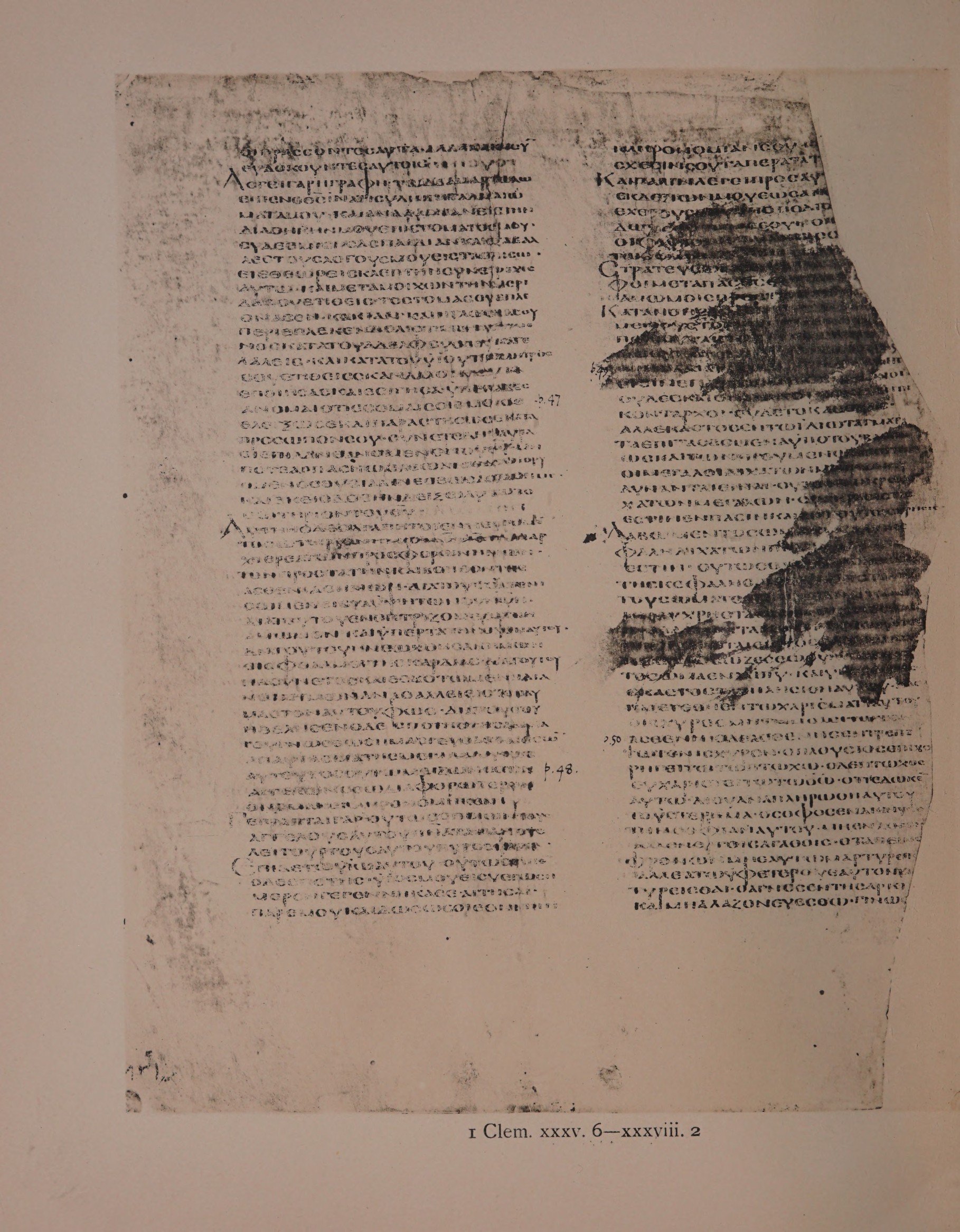
Where on the image
Codex Alexandrinus fol. 164r (1909 facsimile, scan leaf 291; caption printed under the plate: '1 Clem. xxxiii. 3-xxxv. 6'); Codex Alexandrinus fol. 164v (1909 facsimile, scan leaf 292; caption printed under the plate: '1 Clem. xxxv. 6-xxxviii. 2'). The Greek shown is Lake's edited text (1912), not a transcription of the manuscript page.
1Ὡς μακάρια καὶ θαυμαστὰ τὰ δῶρα τοῦ θεοῦ, ἀγαπητοί. 2ζωὴ ἐν ἀθανασίᾳ, λαμπρότης ἐν δικαιοσύνῃ, ἀλήθεια ἐν παρρησίᾳ, πίστις ἐν πεποιθήσει, ἐγκράτεια ἐν ἁγιασμῷ· καὶ ταῦτα ὑπέπιπτεν πάντα ὑπὸ τὴν διάνοιαν ἡμῶν. 3τίνα οὖν ἄρα ἐστὶν τὰ ἑτοιμαζόμενα τοῖς ὑπομένουσιν; ὁ δημιουργὸς καὶ πατὴρ τῶν αἰώνων ὁ πανάγιος αὐτὸς γινώσκει τὴν ποσότητα καὶ τὴν καλλονὴν αὐτῶν. 4ἡμεῖς οὖν ἀγωνισώμεθα εὑρεθῆναι ἐν τῷ ἀριθμῷ τῶν ὑπομενόντων, ὅπως μεταλάβωμεν τῶν ἐπηγγελμένων δωρεῶν. 5πῶς δὲ ἔσται τοῦτο, ἀγαπητοί; ἐὰν ἐστηριγμενη ᾖ ἡ διάνοια ἡμῶν πιστῶς πρὸς τὸν θεόν, ἐὰν ἐκζητῶμεν τὰ εὐάρεστα καὶ εὐπρόσδεκτα αὐτῷ, ἐὰν ἐπιτελέσωμεν τὰ ἀνήκοντα τῇ ἀμώμῳ βουλήσει αὐτοῦ, καὶ ἀκολουθήσωμεν τῇ ὁδῷ τῆς ἀληθείας, ἀπορρίψαντες ἀφ’ ἑαυτῶν πᾶσαν ἀδικίαν καὶ πονηρίαν, πλεονεξίαν, ἔρεις, κακοηθείας τε καὶ δόλους, ψιθυρισμούς τε καὶ καταλαλιάς, θεοστυγίαν, ὑπερηφανίαν τε καὶ ἀλαζονείαν, κενοδοξίαν τε καὶ ἀφιλοξενίαν. 6ταῦτα γὰρ οἱ πράσσοντες στυγητοὶ τῷ θεῷ ὑπάρχουσιν· οὐ μόνον δὲ οἱ πράσσοντες αὐτά, ἀλλὰ καὶ οἱ συνευδοκοῦντες αὐτοῖς. 7λέγει γὰρ ἡ γραφή· Τῷ δὲ ἁμαρτωλῷ εἶπεν ὁ θεός· Ἱνατί σὺ διηγῇ τὰ δικαιώματά μου, καὶ ἀναλαμβάνεις τὴν διαθήκην μου ἐπὶ στόματός σου; 8σὺ δὲ ἐμίσησας παιδείαν καὶ ἐξέβαλες τοὺς λόγους μου εἰς τὰ ὀπίσω. εἰ ἐθεώρεις κλέπτην, συνέτρεχες αὐτῷ, καὶ μετὰ μοιχῶν τὴν μερίδα σου ἐτίθεις. τὸ στόμα σου ἐπλεόνασεν κακίαν, καὶ ἡ γλῶσσα σου περιέπλεκεν δολιότητα. καθήμενος κατὰ τοῦ ἀδελφοῦ σου κατελάλεις, καὶ κατὰ τοῦ υἱοῦ τῆς μητρός σου ἐτίθεις σκάνδαλον. 9ταῦτα ἐποίησας, καὶ ἐσίγησα· ὑπέλαβες, ἄνομε, ὅτι ἔσομαί σοι ὅμοιος. 10ἐλέγξω σε καὶ παραστήσω σε κατὰ προσωπόν σου. 11σύνετε δὴ ταῦτα, οἱ ἐπιλανθανόμενοι τοῦ θεοῦ, μήποτε ἁρπάσῃ ὡς λέων, καὶ μὴ ᾖ ὁ ῥυόμενος. 12θυσία αἰνέσεως δοξάσει με, καὶ ἐκεῖ ὁδός, ᾗ δείξω αὐτῷ τὸ σωτήριον τοῦ θεοῦ.
1How blessed and marvellous are the gifts of God, dearly beloved!! 2Life in immortality, splendour in righteousness, truth in boldness, faith in confidence, temperance in sanctification! And all these things fall under our apprehension. 3What then, think ye, are the things preparing for them that patiently await Him? The Creator and Father of the ages, the All holy One Himself knoweth their number and their beauty. 4Let us therefore contend, that we may be found in the number of those that patiently await Him, to the end that we may be partakers of His promised gifts. 5But how shall this be, dearly beloved? If our mind be fixed through faith towards God; if we seek out those things which are well pleasing and acceptable unto Him; if we accomplish such things as beseem His faultless will, and follow the way of truth, casting off from ourselves all unrighteousness and iniquity, covetousness, strifes, malignities and deceits, whisperings and backbitings, hatred of God, pride and arrogance, vainglory and inhospitality. 6For they that do these things are hateful to God; and not only they that do them, but they also that consent unto them. 7For the scripture saith, But unto the sinner said God, Wherefore dost thou declare Mine ordinances, and takest My covenant upon thy lips? 8Yet thou didst hate instruction and didst cast away My words behind thee. If thou sawest a thief thou didst keep company with him, and with the adulterers thou didst set thy portion. Thy mouth multiplied wickedness and thy tongue wove deceit. Thou sattest and spakest against thy brother, and against the son of thy mother thou didst lay a stumbling block. 9These things thou hast done, and I kept silence. Thou thoughtest, unrighteous man, that I should be like unto thee. 10I will convict thee and will set thee face to face with thyself. 11Now understand ye these things, ye that forget God, lest at any time He seize you as a lion, and there be none to deliver. 12The sacrifice of praise shall glorify Me, and there is the way wherein I will show him the salvation of God.
Where on the image
Codex Alexandrinus fol. 164v (1909 facsimile, scan leaf 292; caption printed under the plate: '1 Clem. xxxv. 6-xxxviii. 2'). The Greek shown is Lake's edited text (1912), not a transcription of the manuscript page.
1Αὕτη ἡ ὁδός, ἀγαπητοί, ἐν ᾗ εὕρομεν τὸ σωτήριον ἡμῶν, Ἰησοῦν Χριστόν, τὸν ἀρχιερέα τῶν προσφορῶν ἡμῶν, τὸν προστάτην καὶ βοηθὸν τῆς ἀσθενείας ἡμῶν. 2διὰ τούτου ἀτενίζομεν εἰς τὰ ὕψη τῶν οὐρανῶν, διὰ τούτου ἐνοπτριζόμεθα τὴν ἄμωμον καὶ ὑπερτάτην ὄψιν αὐτοῦ, διὰ τούτου ἠνεῴχθησαν ἡμῶν οἱ ὀφθαλμοὶ τῆς καρδίας, διὰ τούτου ἡ ἀσύνετος καὶ ἐσκοτωμένη διάνοια ἡμῶν ἀναθάλλει εἰς τὸ φῶς, διὰ τούτου ἠθέλησεν ὁ δεσπότης τῆς ἀθανάτου γνώσεως ἡμᾶς γεύσασθαι, ὃς ὢν ἀπαύγασμα τῆς μεγαλωσύνης αὐτοῦ, τοσούτῳ μείζων ἐστὶν ἀγγέλων, ὅσῳ διαφορώτερον ὄνομα κεκληρονόμηκεν. 3γέγραπται γὰρ οὕτως· Ὁ ποιῶν τοὺς ἀγγέλους αὐτοῦ πνεύματα καὶ τοὺς λειτουργοὺς αὐτοῦ πυρὸς φλόγα. 4ἐπὶ δὲ τῷ υἱῷ αὐτοῦ οὕτως εἶπεν ὁ δεσπότης. Υἱός μου εἶ σύ, ἐγὼ σήμερον γεγέννηκά σε· αἴτησαι παρ’ ἐμοῦ, καὶ δώσω σοι ἔθνη τὴν κληρονομίαν σου καὶ τὴν κατάσχεσίν σου τὰ πέρατα τῆς γῆς. 5καὶ πάλιν λέγει πρὸς αὐτόν· Κάθου ἐκ δεξιῶν μου, ἕως ἂν θῶ τοὺς ἐχθρούς σου ὑποπόδιον τῶν ποδῶν σου. 6τίνες οὖν οἱ ἐχθροί; οἱ φαῦλοι καὶ ἀντιτασσομενοι τῷ θελήματι αὐτοῦ.
1This is the way, dearly beloved, wherein we found our salvation, even Jesus Christ the High priest of our offerings, the Guardian and Helper of our weakness. 2Through Him let us look stedfastly unto the heights of the heavens; through Him we behold as in a mirror His faultless and most excellent visage; through Him the eyes of our hearts were opened; through Him our foolish and darkened mind springeth up unto the light; through Him the Master willed that we should taste of the immortal knowledge Who being the brightness of His majesty is so much greater than angels, as He hath inherited a more excellent name. 3For so it is written Who maketh His angels spirits and His ministers a flame of fire 4but of His Son the Master said thus, Thou art My Son, I this day have begotten Thee. Ask of Me, and I will give Thee the Gentiles for Thine inheritance, and the ends of the earth for Thy possession. 5And again He saith unto Him Sit Thou on My right hand, until I make Thine enemies a footstool for Thy feet. 6Who then are these enemies? They that are wicked and resist His will.
Where on the image
Codex Alexandrinus fol. 164v (1909 facsimile, scan leaf 292; caption printed under the plate: '1 Clem. xxxv. 6-xxxviii. 2'). The Greek shown is Lake's edited text (1912), not a transcription of the manuscript page.
1Στρατευσώμεθα οὖν, ἄνδρες ἀδελφοί, μετὰ πάσης ἐκτενείας ἐν τοῖς ἀμώμοις προστάγμασιν αὐτοῦ. 2κατανοήσωμεν τοὺς στρατευομένους τοῖς ἡγουμένοις ἡμῶν, πῶς εὐτάκτως, πῶς ἑκτικῶς, πῶς ὑποτεταγμένως ἐπιτελοῦσιν τὰ διατασσόμενα. 3οὐ πάντες εἰσὶν ἔπαρχοι οὐδὲ χιλίαρχοι οὐδὲ ἑκατόνταρχαι οὐδὲ πεντηκόνταρχοι οὐδὲ τὸ καθεξῆς, ἀλλ’ ἕκαστος ἐν τῷ ἰδίῳ τάγματι τὰ ἐπιτασσόμενα ὑπὸ τοῦ βασιλέως καὶ τῶν ἡγουμένων ἐπιτελεῖ. 4οἱ μεγάλοι δίχα τῶν μικρῶν οὐ δύνανται εἶναι, οὔτε οἱ μικροὶ δίχα τῶν μεγάλων· σύγκρασίς τίς ἐστιν ἐν πᾶσιν, καὶ ἐν τούτοις χρῆσις. 5λάβωμεν τὸ σῶμα ἡμῶν· ἡ κεφαλὴ δίχα τῶν ποδῶν οὐδέν ἐστιν, οὕτως οὐδὲ οἱ πόδες δίχα τῆς κεφαλῆς· τὰ δὲ ἐλάχιστα μέλη τοῦ σώματος ἡμῶν ἀναγκαῖα καὶ εὔχρηστά εἰσιν ὅλῳ τῷ σώμᾳτι· ἀλλὰ πάντα συνπνεῖ καὶ ὑποταγῇ μιᾷ χρῆται εἰς τὸ σώζεσθαι ὅλον τὸ σῶμα.
1Let us therefore enlist ourselves, brethren, with all earnestness in His faultless ordinances. 2Let us mark the soldiers that are enlisted under our rulers, how exactly, how readily, how submissively, they execute the orders given them. 3All are not prefects, nor rulers of thousands, nor rulers of hundreds, nor rulers of fifties, and so forth; but each man in his own rank executeth the orders given by the king and the governors. 4The great without the small cannot exist, neither the small without the great. There is a certain mixture in all things, and therein is utility. 5Let us take our body as an example. The head without the feet is nothing; so likewise the feet without the head are nothing: even the smallest limbs of our body are necessary and useful for the whole body: but all the members conspire and unite in subjection, that the whole body may be saved.
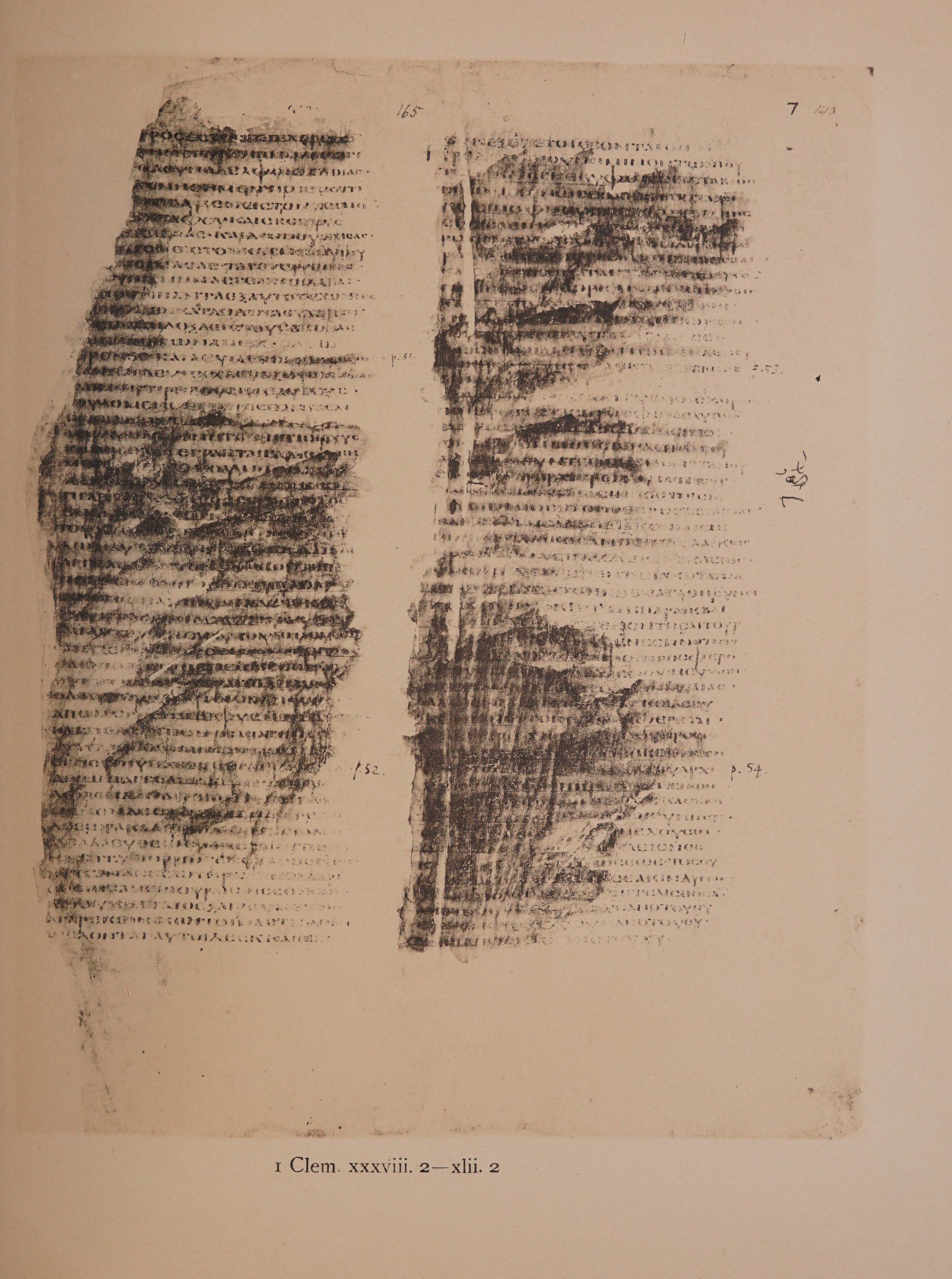
Where on the image
Codex Alexandrinus fol. 164v (1909 facsimile, scan leaf 292; caption printed under the plate: '1 Clem. xxxv. 6-xxxviii. 2'); Codex Alexandrinus fol. 165r (1909 facsimile, scan leaf 293; caption printed under the plate: '1 Clem. xxxviii. 2-xlii. 2'). The Greek shown is Lake's edited text (1912), not a transcription of the manuscript page.
1Σωζέσθω οὖν ἡμῶν ὅλον τὸ σῶμα ἐν Χριστῷ Ἰησοῦ, καὶ ὑποτασσέσθω ἕκαστος τῷ πλησίον αὐτοῦ, καθὼς ἐτέθη ἐν τῷ χαρίσματι αὐτοῦ. 2ὁ ἰσχυρὸς τημελείτω τὸν ἀσθενῆ, ὁ δὲ ἀσθενὴς ἐντρεπέσθω τὸν ἰσχυρόν· ὁ πλούσιος ἐπιχορηγείτω τῷ πτωχῷ, ὁ δὲ πτωχὸς εὐχαριστείτω τῷ θεῷ, ὅτι ἔδωκεν αὐτῷ, δι’ οὗ ἀναπληρωθῇ αὐτοῦ τὸ ὑστέρημα· ὁ σοφὸς ἐνδεικνύσθω τὴν σοφίαν αὐτοῦ μὴ ἐν λόγοις, ἀλλ’ ἐν ἔργοις ἀγαθοῖς· ὁ ταπεινοφρονῶν μὴ ἑαυτῷ μαρτυρείτω, ἀλλ’ ἐάτω ὑφ’ ἑτέρου ἑαυτὸν μαρτυρεῖσθαι· ὁ ἁγνὸς ἐν τῇ σαρκὶ μὴ ἀλαζονευέσθω, γινώσκων ὅτι ἕτερός ἐστιν ὁ ἐπιχορηγῶν αὐτῷ τὴν ἐγκράτειαν. 3ἀναλογισώμεθα οὖν, ἀδελφοί, ἐκ ποίας ὕλης ἐγενήθημεν, ποῖοι καὶ τίνες εἰσήλθαμεν εἰς τὸν κόσμον, ἐκ ποίου τάφου καὶ σκότους ὁ πλάσας ἡμᾶς καὶ δημιουργήσας εἰσήγαγεν εἰς τὸν κόσμον αὐτοῦ, προετοιμάσας τὰς εὐεργεσίας αὐτοῦ, πρὶν ἡμᾶς γεννηθῆναι. 4ταῦτα οὖν πάντα ἐξ αὐτοῦ ἔχοντες ὀφείλομεν κατὰ πάντα εὐχαριστεῖν αὐτῷ· ᾧ ἡ δόξα εἰς τοὺς αἰῶνας τῶν αἰώνων. ἀμήν.
1So in our case let the whole body be saved in Christ Jesus, and let each man be subject unto his neighbour, according as also he was appointed with his special grace. 2Let not the strong neglect the weak; and let the weak respect the strong. Let the rich minister aid to the poor; and let the poor give thanks to God, because He hath given him one through whom his wants may be supplied. Let the wise display his wisdom, not in words, but in good works. He that is lowly in mind, let him not bear testimony to himself, but leave testimony to be borne to him by his neighbour. He that is pure in the flesh, let him be so, and not boast, knowing that it is Another who bestoweth his continence upon him. 3Let us consider, brethren, of what matter we were made; who and what manner of beings we were, when we came into the world; from what a sepulchre and what darkness He that moulded and created us brought us into His world, having prepared His benefits aforehand ere ever we were born. 4Seeing therefore that we have all these things from Him, we ought in all things to give thanks to Him, to whom be the glory for ever and ever. Amen.
Where on the image
Codex Alexandrinus fol. 165r (1909 facsimile, scan leaf 293; caption printed under the plate: '1 Clem. xxxviii. 2-xlii. 2'). The Greek shown is Lake's edited text (1912), not a transcription of the manuscript page.
1Ἄφρονες καὶ ἀσύνετοι καὶ μωροὶ καὶ ἀπαίδευτοι χλευάζουσιν ἡμᾶς καὶ μυκτηρίζουσιν, ἑαυτοὺς βουλόμενοι ἐπαίρεσθαι ταῖς διανοίαις αὐτῶν. 2τί γὰρ δύναται θνητός; ἢ τίς ἰσχὺς γηγενοῦς; 3γέγραπται γάρ· Οὐκ ἦν μορφὴ πρὸ ὀφθαλμῶν μου, ἀλλ’ ἢ αὔραν καὶ φωνὴν ἤκουον· 4Τί γάρ; μὴ καθαρὸς ἔσται βροτὸς ἔναντι κυρίου; ἢ ἀπὸ τῶν ἔργων αὐτοῦ ἄμεμπτος ἀνήρ, εἰ κατὰ παίδων αὐτοῦ οὐ πιστεύει, κατὰ δὲ ἀγγέλων αὐτοῦ σκολιόν τι ἐπενόησεν; 5οὐρανὸς δὲ οὐ καθαρὸς ἐνώπιον αὐτοῦ· ἔα δέ, οἱ κατοικοῦντες οἰκίας πηλίνας, ἐξ ὧν καὶ αὐτοὶ ἐκ τοῦ αὐτοῦ πηλοῦ ἐσμεν· ἔπαισεν αὐτοὺς σητὸς τρόπον, καὶ ἀπὸ πρωΐθεν ἕως ἑσπέρας οὐκ ἔτι εἰσίν· παρὰ τὸ μὴ δύνασθαι αὐτοὺς ἑαυτοῖς βοηθῆσαι ἀπώλοντο. 6ἐνεφύσησεν αὐτοῖς, καὶ ἐτελεύτησαν παρὰ τὸ μὴ ἔχειν αὐτοὺς σοφίαν. 7ἐπικάλεσαι δέ, εἴ τίς σοι ὑπακούσεται, ἢ εἴ τινα ἁγίων ἀγγέλων ὄψῃ· καὶ γὰρ ἄφρονα ἀναιρεῖ ὀργή, πεπλανημένον δὲ θανατοῖ ζῆλος. 8ἐγὼ δὲ ἑώρακα ἄφρονας ῥίζας βάλλοντας, ἀλλ’ εὐθέως ἐβρώθη αὐτῶν ἡ δίαιτα. 9πόρρω γένοιντο οἱ υἱοὶ αὐτῶν ἀπὸ σωτηρίας· κολαβρισθείησαν ἐπὶ θύραις ἡσσόνων, καὶ οὐκ ἔσται ὁ ἐξαιρούμενος· ἃ γὰρ ἐκείνοις ἡτοίμασται, δίκαιοι ἔδονται, αὐτοὶ δὲ ἐκ κακῶν οὐκ ἐξαίρετοι ἔσονται.
1Senseless and stupid and foolish and ignorant men jeer and mock at us, desiring that they themselves should be exalted in their imaginations. 2For what power hath a mortal? or what strength hath a child of earth? 3For it is written; There was no form before mine eyes; only I heard a breath and a voice. 4What then? Shall a mortal be clean in the sight of the Lord; or shall a man be unblameable for his works? seeing that He is distrustful against His servants and noteth some perversity against His angels. 5Nay, the heaven is not clean in His sight. Away then, ye that dwell in houses of clay, whereof, even of the same clay, we ourselves are made. He smote them like a moth, and from morn to even they are no more. Because they could not succour themselves, they perished. 6He breathed upon them and they died, because they had no wisdom. 7But call thou, if perchance one shall obey thee, or if thou shalt see one of the holy angels. For wrath killeth the foolish man, and envy slayeth him that is gone astray. 8And I have seen fools throwing out roots, but forthwith their habitation was eaten up. 9Far be their sons from safety. May they be mocked at the gates of inferiors, and there shall be none to deliver them. For the things which are prepared for them, the righteous shall eat; but they themselves shall not be delivered from evils.
Where on the image
Codex Alexandrinus fol. 165r (1909 facsimile, scan leaf 293; caption printed under the plate: '1 Clem. xxxviii. 2-xlii. 2'). The Greek shown is Lake's edited text (1912), not a transcription of the manuscript page.
1Προδήλων οὖν ἡμῖν ὄντων τούτων, καὶ ἐγκεκυφότες εἰς τὰ βάθη τῆς θείας γνώσεως, πάντα τάξει ποιεῖν ὀφείλομεν, ὅσα ὁ δεσπότης ἐπιτελεῖν ἐκέλευσεν κατὰ καιροὺς τεταγμένους. 2τάς τε προσφορὰς καὶ λειτουργίας ἐπιτελεῖσθαι, καὶ οὐκ εἰκῆ ἢ ἀτάκτως ἐκέλευσεν γίνεσθαι, ἀλλ’ ὡρισμένοις καιροῖς καὶ ὥραις. 3ποῦ τε καὶ διὰ τίνων ἐπιτελεῖσθαι θέλει, αὐτὸς ὥρισεν τῇ ὑπερτάτῳ αὐτοῦ βουλήσει, ἵν’ ὁσίως πάντα γινόμενα ἐν εὐδοκήσει εὐπρόσδεκτα εἴη τῷ θελήματι αὐτοῦ. 4οἱ οὖν τοῖς προστεταγμένοις καιροῖς ποιοῦντες τὰς προσφορὰς αὐτῶν εὐπρόσδεκτοί τε καὶ μακάριοι· τοῖς γὰρ νομίμοις τοῦ δεσπότου ἀκολουθοῦντες οὐ διαμαρτάνουσιν. 5τῷ γὰρ ἀρχιερεῖ ἴδιαι λειτουργίαι δεδομέναι εἰσίν, καὶ τοῖς ἱερεῦσιν ἴδιος ὁ τόπος προστέτακται, καὶ Λευΐταις ἴδιαι διακονίαι ἐπίκεινται· ὁ λαϊκὸς ἄνθρωπος τοῖς λαϊκοῖς προστάγμασιν δέδεται.
1Forasmuch then as these things are manifest beforehand, and we have searched into the depths of the Divine knowledge, we ought to do all things in order, as many as the Master hath commanded us to perform at their appointed seasons. 2Now the offerings and ministrations He commanded to be performed with care, and not to be done rashly or in disorder, but at fixed times and seasons. 3And where and by whom He would have them performed, He Himself fixed by His supreme will: that all things being done with piety according to His good pleasure might be acceptable to His will. 4They therefore that make their offerings at the appointed seasons are acceptable and blessed: for while they follow the institutions of the Master they cannot go wrong. 5For unto the high priest his proper services have been assigned, and to the priests their proper office is appointed, and upon the levites their proper ministrations are laid. The layman is bound by the layman's ordinances.
Where on the image
Codex Alexandrinus fol. 165r (1909 facsimile, scan leaf 293; caption printed under the plate: '1 Clem. xxxviii. 2-xlii. 2'). The Greek shown is Lake's edited text (1912), not a transcription of the manuscript page.
1Ἕκαστος ἡμῶν, ἀδελφοί, ἐν τῷ ἰδίῳ τάγματι εὐαριστείτω τῷ θεῷ ἐν ἀγαθῇ συνειδήσει ὑπάρχων, μὴ παρεκβαίνων τὸν ὡρισμένον τῆς λειτουργίας αὐτοῦ κανόνα, ἐν σεμνότητι. 2οὐ πανταχοῦ, ἀδελφοί, προσφέρονται θυσίαι ἐνδελεχισμοῦ ἢ εὐχῶν ἢ περὶ ἁμαρτίας καὶ πλημμελείας, ἀλλ’ ἢ ἐν Ἱερουσαλὴμ μόνῃ· κἀκεῖ δὲ οὐκ ἐν παντὶ τόπῳ προσφέρεται, ἀλλ’ ἔμπροσθεν τοῦ ναοῦ πρὸς τὸ θυσιαστήριον, μωμοσκοπηθὲν τὸ προσφερόμενον διὰ τοῦ ἀρχιερέως καὶ τῶν προειρημένων λειτουργῶν. 3οἱ οὖν παρὰ τὸ καθῆκον τῆς βουλήσεως αὐτοῦ ποιοῦντές τι θάνατον τὸ πρόστιμον ἔχουσιν. 4ὁρᾶτε, ἀδελφοί· ὅσῳ πλείονος κατηξιώθημεν γνώσεως, τοσούτῳ μᾶλλον ὑποκείμεθα κινδύνῳ.
1Let each of you, brethren, in his own order give thanks unto God, maintaining a good conscience and not transgressing the appointed rule of his service, but acting with all seemliness. 2Not in every place, brethren, are the continual daily sacrifices offered, or the freewill offerings, or the sin offerings and the trespass offerings, but in Jerusalem alone. And even there the offering is not made in every place, but before the sanctuary in the court of the altar; and this too through the high-priest and the aforesaid ministers, after that the victim to be offered hath been inspected for blemishes. 3They therefore who do any thing contrary to the seemly ordinance of His will receive death as the penalty. 4Ye see, brethren, in proportion as greater knowledge hath been vouchsafed unto us, so much the more are we exposed to danger.
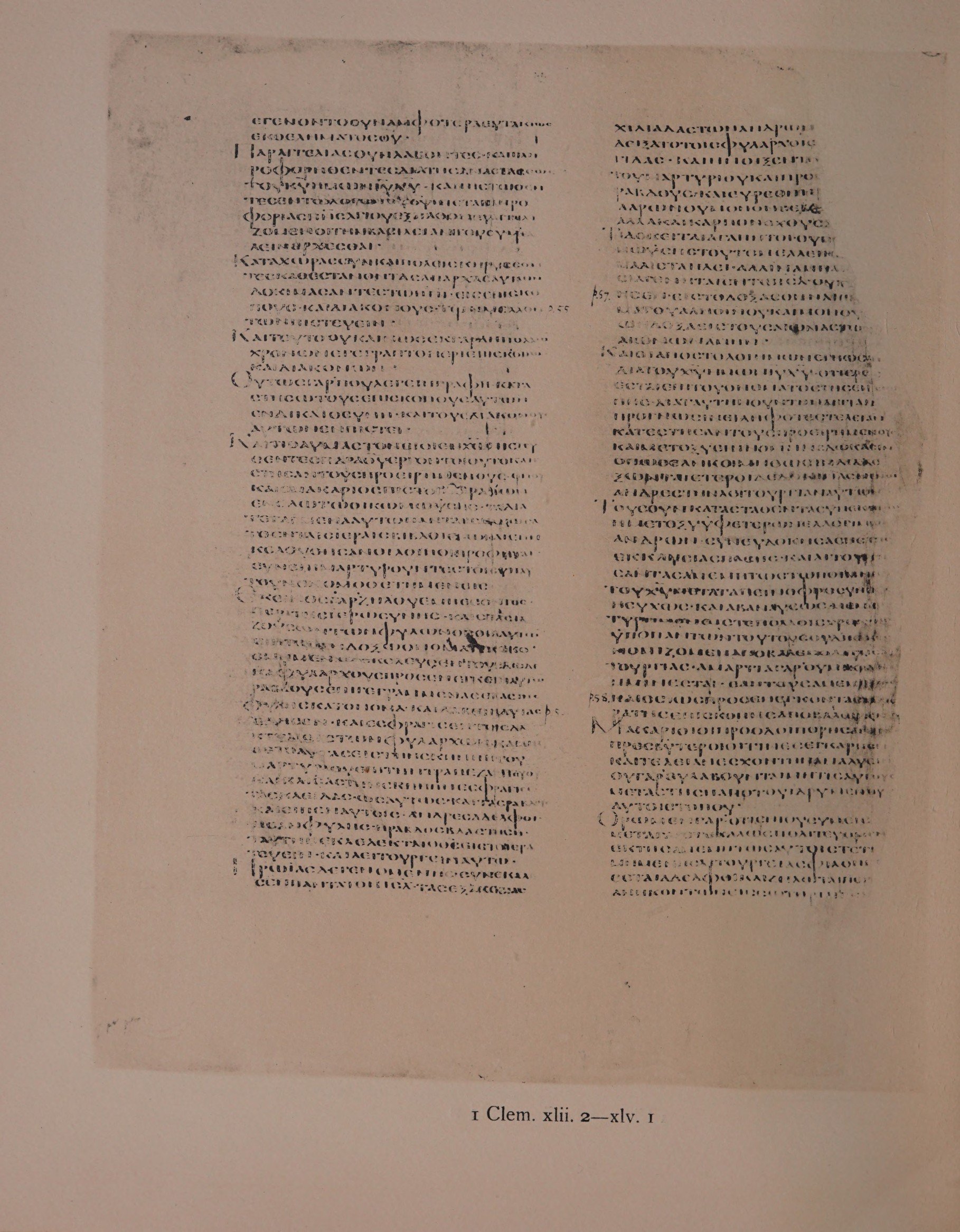
Where on the image
Codex Alexandrinus fol. 165r (1909 facsimile, scan leaf 293; caption printed under the plate: '1 Clem. xxxviii. 2-xlii. 2'); Codex Alexandrinus fol. 165v (1909 facsimile, scan leaf 294; caption printed under the plate: '1 Clem. xlii. 2-xlv. 1'). The Greek shown is Lake's edited text (1912), not a transcription of the manuscript page.
1Οἱ ἀπόστολοι ἡμῖν εὐηγγελίσθησαν ἀπὸ τοῦ κυρίου Ἰησοῦ Χριστοῦ, Ἰησοῦς ὁ Χριστὸς ἀπὸ τοῦ θεοῦ ἐξεπέμφθη. 2ὁ Χριστος οὖν ἀπὸ τοῦ θεοῦ καὶ οἱ ἀπόστολοι ἀπὸ τοῦ Χριστοῦ· ἐγένοντο οὖν ἀμφότερα εὐτάκτως ἐκ θελήματος θεοῦ. 3παραγγελίας οὖν λαβόντες καὶ πληροφορηθέντες διὰ τῆς ἀναστάσεως τοῦ κυρίου ἡμῶν Ἰησοῦ Χριστοῦ καὶ πιστωθέντες ἐν τῷ λόγῳ τοῦ θεοῦ, μετὰ πληροφορίας πνεύματος ἁγίου ἐξῆλθον εὐαγγελιζόμενοι, τὴν βασιλείαν τοῦ θεοῦ μέλλειν ἔρχεσθαι. 4κατὰ χώρας οὖν καὶ πόλεις κηρύσσοντες καθίστανον τὰς ἀπαρχὰς αὐτῶν, δοκιμάσαντες τῷ πνεύματι, εἰς ἐπισκόπους καὶ διακόνους τῶν μελλόντων πιστεύειν. 5καὶ τοῦτο οὐ καινῶς· ἐκ γὰρ δὴ πολλῶν χρόνων ἐγέγραπτο περὶ ἐπισκόπων καὶ διακόνων. οὕτως γάρ που λέγει ἡ γραφή· Καταστήσω τοὺς ἐπισκόπους αὐτῶν ἐν δικαιοσύνῃ καὶ τοὺς διακόνους αὐτῶν ἐν πίστει.
1The Apostles received the Gospel for us from the Lord Jesus Christ; Jesus Christ was sent forth from God. 2So then Christ is from God, and the Apostles are from Christ. Both therefore came of the will of God in the appointed order. 3Having therefore received a charge, and having been fully assured through the resurrection of our Lord Jesus Christ and confirmed in the word of God with full assurance of the Holy Ghost, they went forth with the glad tidings that the kingdom of God should come. 4So preaching everywhere in country and town, they appointed their first-fruits, when they had proved them by the Spirit, to be bishops and deacons unto them that should believe. 5And this they did in no new fashion; for indeed it had been written concerning bishops and deacons from very ancient times; for thus saith the scripture in a certain place, I will appoint their bishops in righteousness and their deacons in faith.
Where on the image
Codex Alexandrinus fol. 165v (1909 facsimile, scan leaf 294; caption printed under the plate: '1 Clem. xlii. 2-xlv. 1'). The Greek shown is Lake's edited text (1912), not a transcription of the manuscript page.
1Καὶ τί θαυμαστόν, εἰ οἱ ἐν Χριστῷ πιστευθέντες παρὰ θεοῦ ἔργον τοιοῦτο κατέστησαν τοὺς προειρημένους; ὅπου καὶ ὁ μακάριος πιστὸς θεράπων ἐν ὅλῳ τῷ οἴκῳ Μωϋσῆς τὰ διατεταγμένα αὐτῷ πάντα ἐσημειώσατο ἐν ταῖς ἱεραῖς βίβλοις, ᾧ καὶ ἐπηκολούθησαν οἱ λοιποὶ προφῆται, συνεπιμαρτυροῦντες τοῖς ὑπ’ αὐτοῦ νενομοθετημένοις. 2ἐκεῖνος γάρ, ζήλου ἐμπεσόντος περὶ τῆς ἱερωσύνης καὶ στασιαζουσῶν τῶν φυλῶν, ὁποία αὐτῶν εἴη τῷ ἐνδόξῳ ὀνόματι κεκοσμημένη, ἐκέλευσεν τοὺς δώδεκα φυλάρχους προσενεγκεῖν αὐτῷ ῥάβδους ἐπιγεγραμμένας ἑκάστης φυλῆς κατ’ ὄνομα· καὶ λαβὼν αὐτὰς ἔδησεν καὶ ἐσφράγισεν τοῖς δακτυλίοις τῶν φυλάρχων, καὶ ἀπέθετο αὐτὰς εἰς τὴν σκηνὴν τοῦ μαρτυρίου ἐπὶ τὴν τράπεζαν τοῦ θεοῦ. 3καὶ κλείσας τὴν σκηνὴν ἐσφράγισεν τὰς κλεῖδας ὡσαύτως καὶ τὰς ῥάβδους, 4καὶ εἶπεν αὐτοῖς· Ἄνδρες ἀδελφοί, ἧς ἂν φυλῆς ἡ ῥάβδος βλαστήσῃ, ταύτην ἐκλέλεκται ὁ θεὸς εἰς τὸ ἱερατεύειν καὶ λειτουργεῖν αὐτῷ. 5πρωΐας δὲ γενομένης συνεκάλεσεν πάντα τὸν Ἰσραήλ, τὰς ἑξακοσίας χιλιάδας τῶν ἀνδρῶν, καὶ ἐπεδείξατο τοῖς φυλάρχοις τὰς σφραγῖδας, καὶ ἤνοιξεν τὴν σκηνὴν τοῦ μαρτυρίου καὶ προεῖλεν τὰς ῥάβδους· καὶ εὑρέθη ἡ ῥάβδος Ἀαρὼν οὐ μόνον βεβλαστηκυῖα, ἀλλὰ καὶ καρπὸν ἔχουσα. 6τί δοκεῖτε, ἀγαπητοί; οὐ προῄδει Μωϋσῆς τοῦτο μέλλειν ἔσεσθαι; μάλιστα ᾔδει· ἀλλ’ ἵνα μὴ ἀκαταστασία γένηται ἐν τῷ Ἰσραήλ, οὕτως ἐποίησεν, εἰς τὸ δοξασθῆναι τὸ ὄνομα τοῦ ἀληθινοῦ καὶ μόνου θεοῦ· ᾧ ἡ δόξα εἰς τοὺς αἰῶνας τῶν αἰώνων. ἀμήν.
1And what marvel, if they which were entrusted in Christ with such a work by God appointed the aforesaid persons? seeing that even the blessed Moses who was a faithful servant in all His house recorded for a sign in the sacred books all things that were enjoined upon him. And him also the rest of the prophets followed, bearing witness with him unto the laws that were ordained by him. 2For he, when jealousy arose concerning the priesthood, and there was dissension among the tribes which of them was adorned with the glorious name, commanded the twelve chiefs of the tribes to bring to him rods inscribed with the name of each tribe. And he took them and tied them and sealed them with the signet rings of the chiefs of the tribes, and put them away in the tabernacle of the testimony on the table of God. 3And having shut the tabernacle he sealed the keys and likewise also the doors. 4And he said unto them, Brethren, the tribe whose rod shall bud, this hath God chosen to be priests and ministers unto Him. 5Now when morning came, he called together all Israel, even the six hundred thousand men, and showed the seals to the chiefs of the tribes and opened the tabernacle of the testimony and drew forth the rods. And the rod of Aaron was found not only with buds, but also bearing fruit. 6What think ye, dearly beloved? Did not Moses know beforehand that this would come to pass? Assuredly he knew it. But that disorder might not arise in Israel, he did thus, to the end that the Name of the true and only God might be glorified: to whom be the glory for ever and ever. Amen...
Where on the image
Codex Alexandrinus fol. 165v (1909 facsimile, scan leaf 294; caption printed under the plate: '1 Clem. xlii. 2-xlv. 1'). The Greek shown is Lake's edited text (1912), not a transcription of the manuscript page.
1Καὶ οἱ ἀπόστολοι ἡμῶν ἔγνωσαν διὰ τοῦ κυρίου ἡμῶν Ἰησοῦ Χριστοῦ, ὅτι ἔρις ἔσται ἐπὶ τοῦ ὀνόματος τῆς ἐπισκοπῆς. 2διὰ ταύτην οὖν τὴν αἰτίαν πρόγνωσιν εἰληφότες τελείαν κατέστησαν τοὺς προειρημένους, καὶ μεταξὺ ἐπινομὴν δεδωκασιν, ὅπως, ἐὰν κοιμηθῶσιν, διαδέξωνται ἕτεροι δεδοκιμασμένοι ἄνδρες τὴν λειτουργίαν αὐτῶν. 3τοὺς οὖν κατασταθέντας ὑπ’ ἐκείνων ἢ μεταξὺ ὑφ’ ἑτέρων ἐλλογίμων ἀνδρῶν συνευδοκησάσης τῆς ἐκκλησίας πάσης, καὶ λειτουργήσαντας ἀμέμπτως τῷ ποιμνίῳ τοῦ Χριστοῦ μετὰ ταπεινοφροσύνης, ἡσύχως καὶ ἀβαναύσως, μεμαρτυρημένους τε πολλοῖς χρόνοις ὑπὸ πάντων, τούτους οὐ δικαίως νομίζομεν ἀποβάλλεσθαι τῆς λειτουργίας. 4ἁμαρτία γὰρ οὐ μικρὰ ἡμῖν ἔσται, ἐὰν τοὺς ἀμέμπτως καὶ ὁσίως προσενεγκόντας τὰ δῶρα τῆς ἐπισκοπῆς ἀποβάλωμεν. 5μακάριοι οἱ προοδοιπορήσαντες πρεσβύτεροι, οἵτινες ἔγκαρπον καὶ τελείαν ἔσχον τὴν ἀνάλυσιν· οὐ γὰρ εὐλαβοῦνται μή τις αὐτοὺς μεταστήσῃ ἀπὸ τοῦ ἱδρυμένου αὐτοῖς τόπου. 6ὁρῶμεν γάρ, ὅτι ἐνίους ὑμεῖς μετηγάγετε καλῶς πολιτευομένους ἐκ τῆς ἀμέμπτως αὐτοῖς τετιμημένης λειτουργίας.
1And our Apostles knew through our Lord Jesus Christ that there would be strife over the name of the bishop's office. 2For this cause therefore, having received complete foreknowledge, they appointed the aforesaid persons, and afterwards they provided a continuance, that if these should fall asleep, other approved men should succeed to their ministration. Those therefore who were appointed by them, or afterward by other men of repute with the consent of the whole Church, and have ministered unblameably to the flock of Christ in lowliness of mind, peacefully and with all modesty, and for long time have borne a good report with all these men we consider to be unjustly thrust out from their ministration. 3For it will be no light sin for us, if we thrust out those who have offered the gifts of the bishop's office unblameably and holily. 4Blessed are those presbyters who have gone before, seeing that their departure was fruitful and ripe: for they have no fear lest any one should remove them from their appointed place. 5For we see that ye have displaced certain persons, though they were living honourably, from the ministration which had been respected by them blamelessly.
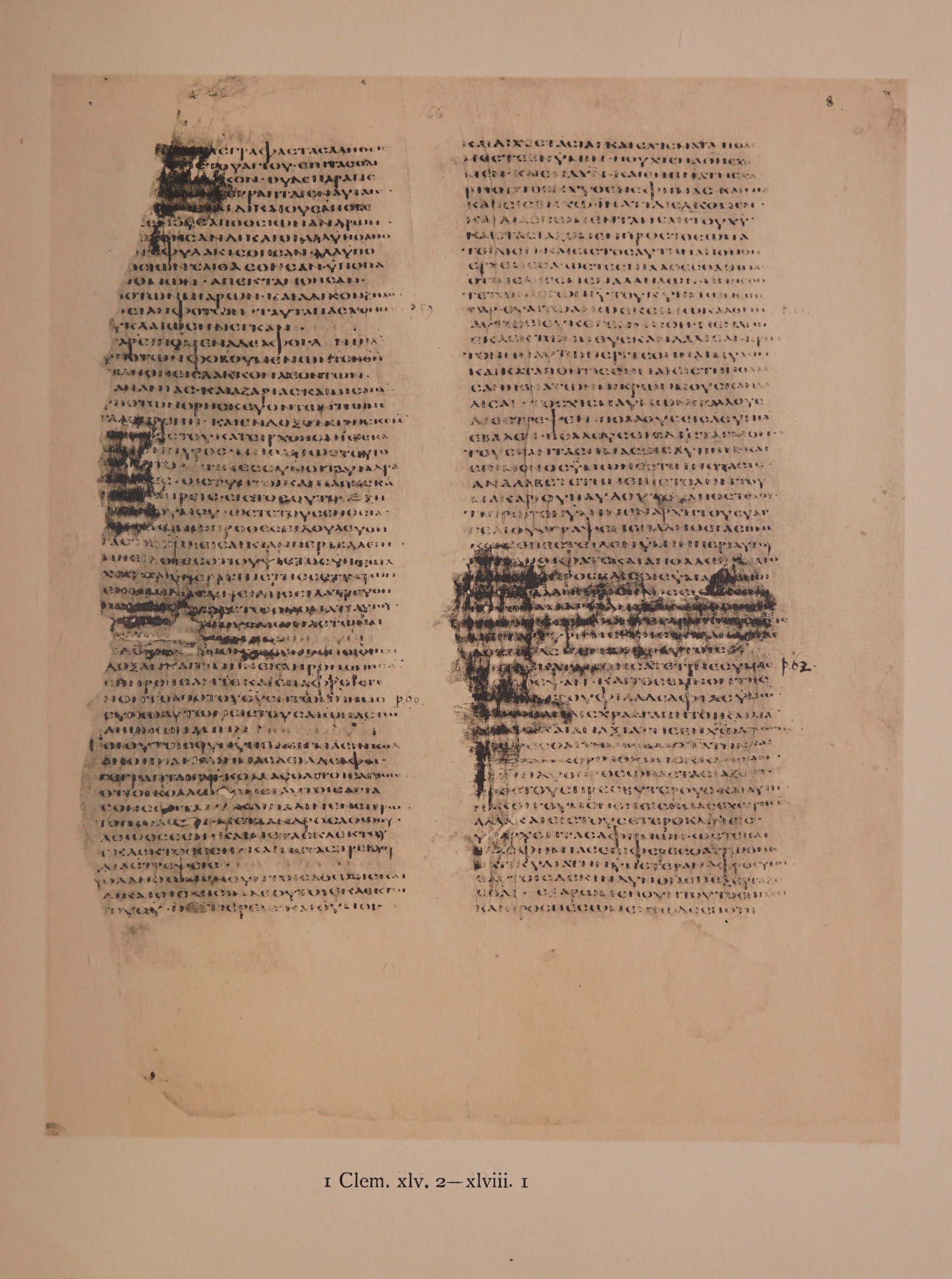
Where on the image
Codex Alexandrinus fol. 165v (1909 facsimile, scan leaf 294; caption printed under the plate: '1 Clem. xlii. 2-xlv. 1'); Codex Alexandrinus fol. 166r (1909 facsimile, scan leaf 295; caption printed under the plate: '1 Clem. xlv. 2-xlviii. 1'). The Greek shown is Lake's edited text (1912), not a transcription of the manuscript page.
1Φιλόνεικοι ἔστε, ἀδελφοί, καὶ ζηλωταὶ περὶ τῶν ἀνηκόντων εἰς σωτηρίαν. 2ἐγκεκύφατε εἰς τὰς ἱερὰς γραφάς, τὰς ἀληθεῖς, τὰς διὰ τοῦ πνεύματος τοῦ ἁγίου. 3ἐπίστασθε, ὅτι οὐδὲν ἄδικον οὐδὲ παραπεποιημένον γέγραπται ἐν αὐταῖς. οὐχ εὑρήσετε δικαίους ἀποβεβλημένους ἀπὸ ὁσίων ἀνδρῶν. 4ἐδιώχθησαν δίκαιοι, ἀλλ’ ὑπὸ ἀνόμων· ἐφυλακίσθησαν, ἀλλ’ ὑπὸ ἀνοσίων· ἐλιθάσθησαν ὑπὸ παρανόμων· ἀπεκτάνθησαν ὑπὸ τῶν μιαρὸν καὶ ἄδικον ζῆλον ἀνειληφότων. 5ταῦτα πάσχοντες εὐκλεῶς ἤνεγκαν. 6τί γὰρ εἴπωμεν, ἀδελφοί; Δανιὴλ ὑπὸ τῶν φοβουμένων τὸν θεὸν ἐβλήθη εἰς λάκκον λεόντων; 7ἢ Ἀνανίας καὶ Ἀζαρίας καὶ Μισαὴλ ὑπὸ τῶν θρησκευόντων τὴν μεγαλοπρεπῆ καὶ ἔνδοξον θρησκείαν τοῦ ὑψίστου κατείρχθησαν εἰς κάμινον πυρός; μηθαμῶς τοῦτο γένοιτο. τίνες οὖν οἱ ταῦτα δράσαντες; οἱ στυγητοὶ καὶ πάσης κακίας πλήρεις εἰς τοσοῦτο ἐξήρισαν θυμοῦ, ὥστε τοὺς ἐν ὁσίᾳ καὶ ἀμώμῳ προθέσει δουλεύοντας τῷ θεῷ εἰς αἰκίαν περιβαλεῖν, μὴ εἰδότες ὅτι ὁ ὕψιστος ὑπέρμαχος καὶ ὑπερασπιστής ἐστιν τῶν ἐν καθαρᾷ συνειδήσει λατρευόντων τῷ παναρέτῳ ὀνόματι αὐτοῦ· ᾧ ἡ δόξα εἰς τοὺς αἰῶνας τῶν αἰώνων. ἀμήν. 8οἱ δὲ ὑπομένοντες ἐν πεποιθήσει δόξαν καὶ τιμὴν ἐκληρονόμησαν, ἐπήρθησάν τε καὶ ἔγγραφοι ἐγένοντο ἀπὸ τοῦ θεοῦ ἐν τῷ μνημοσύνῳ αὐτοῦ εἰς τοὺς αἰῶνας τῶν αἰώνων. ἀμήν.
1Be ye contentious, brethren, and jealous about the things that pertain unto salvation. 2Ye have searched the scriptures, which are true, which were given through the Holy Ghost; 3and ye know that nothing unrighteous or counterfeit is written in them. Ye will not find that righteous persons have been thrust out by holy men. 4Righteous men were persecuted, but it was by the lawless; they were imprisoned, but it was by the unholy. They were stoned by transgressors: they were slain by those who had conceived a detestable and unrighteous jealousy. 5Suffering these things, they endured nobly. 6For what must we say, brethren? Was Daniel cast into the lions' den by them that feared God? 7Or were Ananias and Azarias and Misael shut up in the furnace of fire by them that professed the excellent and glorious worship of the Most High? Far be this from our thoughts. Who then were they that did these things? Abominable men and full of all wickedness were stirred up to such a pitch of wrath, as to bring cruel suffering upon them that served God in a holy and blameless purpose, not knowing that the Most High is the champion and protector of them that in a pure conscience serve His excellent Name: unto whom be the glory for ever and ever. Amen. 8But they that endured patiently in confidence inherited glory and honour; they were exalted, and had their names recorded by God in their memorial for ever and ever. Amen.
Where on the image
Codex Alexandrinus fol. 166r (1909 facsimile, scan leaf 295; caption printed under the plate: '1 Clem. xlv. 2-xlviii. 1'). The Greek shown is Lake's edited text (1912), not a transcription of the manuscript page.
1Τοιούτοις οὖν ὑποδείγμασιν κολληθῆναι καὶ ἡμᾶς δεῖ, ἀδελφοί. 2γέγραπται γάρ· Κολλᾶσθε τοῖς ἁγίοις, ὅτι οἱ κολλώμενοι αὐτοῖς ἁγιασθήσονται. 3καὶ πάλιν ἐν ἑτέρῳ τόπῳ λέγει· Μετὰ ἀνδρὸς ἀθῴου ἀθῷος ἔσῃ καὶ μετὰ ἐκλεκτοῦ ἐκλεκτὸς ἔσῃ, καὶ μετὰ στρεβλοῦ διαστρέψεις. 4κολληθῶμεν οὖν τοῖς ἀθῴοις καὶ δικαίοις· εἰσὶν δὲ οὗτοι ἐκλεκτοὶ τοῦ θεοῦ. 5ἱνατί ἔρεις καὶ θυμοὶ καὶ διχοστασίαι καὶ σχίσματα πόλεμός τε ἐν ὑμῖν; 6ἢ οὐχὶ ἕνα θεὸν ἔχομεν καὶ ἕνα Χριστὸν καὶ ἓν πνεῦμα τῆς χάριτος τὸ ἐκχυθὲν ἐφ’ ἡμᾶς; καὶ μία κλῆσις ἐν Χριστῷ; 7ἱνατί διέλκομεν καὶ διασπῶμεν τὰ μέλη τοῦ Χριστοῦ καὶ στασιάζομεν πρὸς τὸ σῶμα τὸ ἴδιον, καὶ εἰς τοσαύτην ἀπόνοιαν ἐρχόμεθα, ὥστε ἐπιλαθέσθαι ἡμᾶς, ὅτι μέλη ἐσμὲν ἀλλήλων; μνήσθητε τῶν λόγων τοῦ κυρίου Ἰησοῦ. 8εἶπεν γάρ· Οὐαὶ τῷ ἀνθρώπῳ ἐκείνῳ· καλὸν ἦν αὐτῷ, εἰ οὐκ ἐγεννήθη, ἢ ἕνα τῶν ἐκλεκτῶν μου σκανδαλίσαι· κρεῖττον ἦν αὐτῷ περιτεθῆναι μύλον καὶ καταποντισθῆναι εἰς τὴν θάλασσαν, ἢ ἕνα τῶν ἐκλεκτῶν μου διαστρέψαι. 9τὸ σχίσμα ὑμῶν πολλοὺς διέστρεψεν, πολλοὺς εἰς ἀθυμίαν ἔβαλεν, πολλοὺς· εἰς δισταγμόν, τοὺς πάντας ἡμᾶς εἰς λύπην· καὶ ἐπίμονος ὑμῶν ἐστιν ἡ στάσις.
1To such examples as these therefore, brethren, we also ought to cleave. 2For it is written; Cleave unto the saints, for they that cleave unto them shall be sanctified. 3And again He saith in another place; With the guiltless man thou shalt be guiltless, and with the elect thou shalt be elect, and with the crooked thou shalt deal crookedly. 4Let us therefore cleave to the guiltless and righteous: and these are the elect of God. 5Wherefore are there strifes and wraths and factions and divisions and war among you? 6Have we not one God and one Christ and one Spirit of grace that was shed upon us? And is there not one calling in Christ? 7Wherefore do we tear and rend asunder the members of Christ, and stir up factions against our own body, and reach such a pitch of folly, as to forget that we are members one of another? 8Remember the words of Jesus our Lord: for He said, Woe unto that man; it were good for him if he had not been born, rather than that he should offend one of Mine elect. It were better for him that a mill-stone were hanged about him, and he cast into the sea, than that he should pervert one of Mine elect. 9Your division hath perverted many; it hath brought many to despair, many to doubting, and all of us to sorrow. And your sedition still continueth.
Where on the image
Codex Alexandrinus fol. 166r (1909 facsimile, scan leaf 295; caption printed under the plate: '1 Clem. xlv. 2-xlviii. 1'). The Greek shown is Lake's edited text (1912), not a transcription of the manuscript page.
1Ἀναλάβετε τὴν ἐπιστολὴν τοῦ μακαρίου Παύλου τοῦ ἀποστόλου. 2τί πρῶτον ὑμῖν ἐν ἀρχῇ τοῦ εὐαγγελίου ἔγραψεν ; 3ἐπ’ ἀληθείας πνευματικῶς ἐπέστειλεν ὑμῖν περὶ ἑαυτοῦ τε καὶ Κηφᾶ τε καὶ Ἀπολλώ, διὰ τὸ καὶ τότε προσκλίσεις ὑμᾶς πεποιῆσθαι. 4ἀλλ’ ἡ πρόσκλισις ἐκείνη ἥττονα ἁμαρτίαν ὑμῖν προσήνεγκεν· προσεκλίθητε γὰρ ἀποστόλοις μεμαρτυρημένοις καὶ ἀνδρὶ δεδοκιμασμένῳ παρ’ αὐτοῖς. 5νυνὶ δὲ κατανοήσατε, τίνες ὑμᾶς διέστρεψαν καὶ τὸ σεμνὸν τῆς περιβοήτου φιλαδελφίας ὑμῶν ἐμείωσαν. 6αἰσχρά, ἀγαπητοί, καὶ λίαν αἰσχρά, καὶ ἀνάξια τῆς ἐν Χριστῷ ἀγωγῆς ἀκούεσθαι, τὴν βεβαιοτάτην καὶ ἀρχαίαν Κορινθίων ἐκκλησίαν δι’ ἓν ἢ δύο πρόσωπα στασιάζειν πρὸς τοὺς πρεσβυτέρους· 7καὶ αὕτη ἡ ἀκοὴ οὐ μόνον εἰς ἡμᾶς ἐχώρησεν, ἀλλὰ καὶ εἰς τοὺς ἑτεροκλινεῖς ὑπάρχοντας ἀφ’ ἡμῶν, ὥστε καὶ βλασφημίας ἐπιφέρεσθαι τῷ ὀνόματι κυρίου διὰ τὴν ὑμετέραν ἀφροσύνην, ἑαυτοῖς δὲ κίνδυνον ἐπεξεργάζεσθαι.
1Take up the epistle of the blessed Paul the Apostle. 2What wrote he first unto you in the beginning of the Gospel? 3Of a truth he charged you in the Spirit concerning himself and Cephas and Apollos, because that even then ye had made parties. 4Yet that making of parties brought less sin upon you; for ye were partisans of Apostles that were highly reputed, and of a man approved in their sight. 5But now mark ye, who they are that have perverted you and diminished the glory of your renowned love for the brotherhood. 6It is shameful, dearly beloved, yes, utterly shameful and unworthy of your conduct in Christ, that it should be reported that the very stedfast and ancient Church of the Corinthians, for the sake of one or two persons, maketh sedition against its presbyters. 7And this report hath reached not only us, but them also which differ from us, so that ye even heap blasphemies on the Name of the Lord by reason of your folly, and moreover create peril for yourselves.
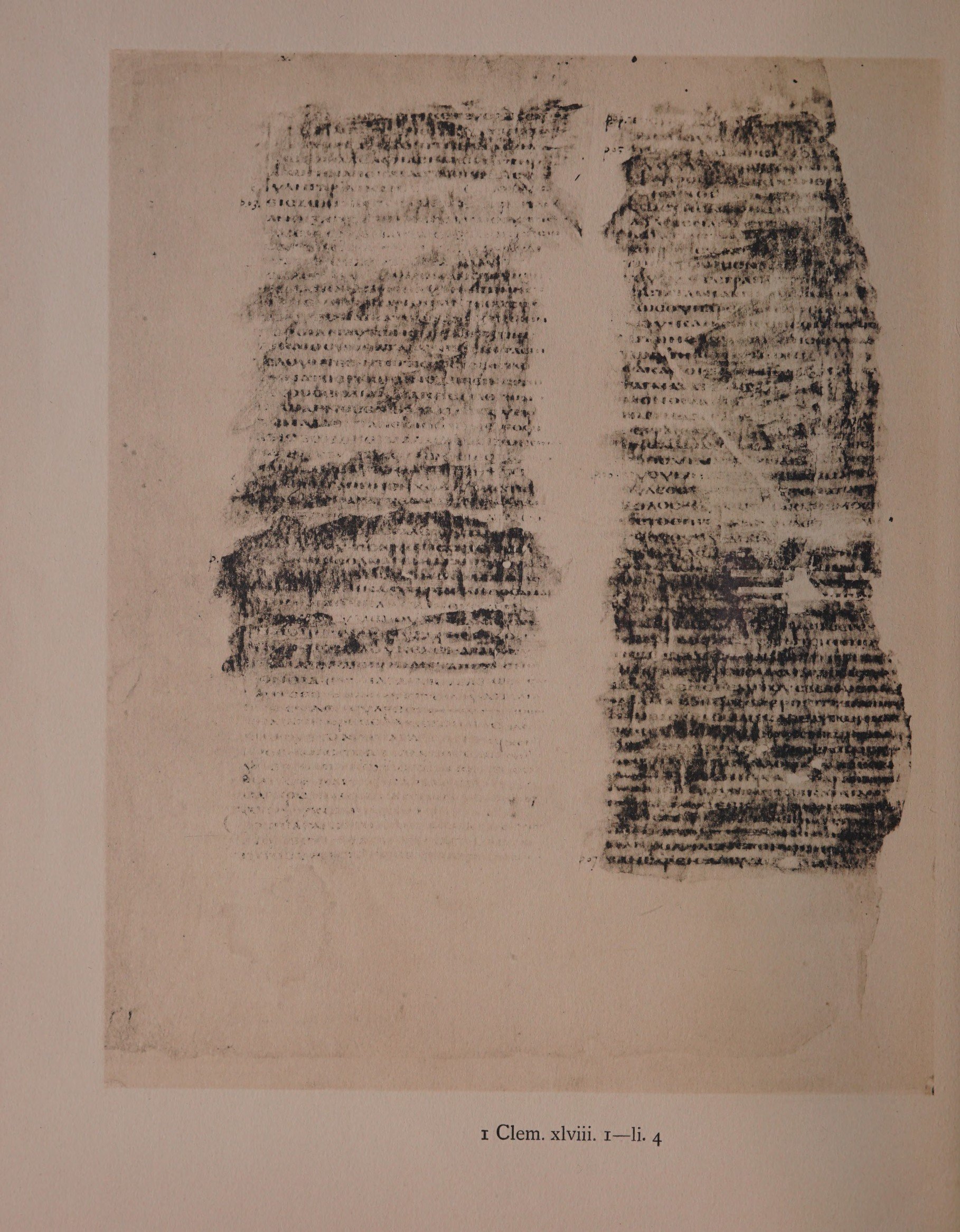
Where on the image
Codex Alexandrinus fol. 166r (1909 facsimile, scan leaf 295; caption printed under the plate: '1 Clem. xlv. 2-xlviii. 1'); Codex Alexandrinus fol. 166v (1909 facsimile, scan leaf 296; caption printed under the plate: '1 Clem. xlviii. 1-li. 4'). The Greek shown is Lake's edited text (1912), not a transcription of the manuscript page.
1Ἐξαρωμεν οὖν τοῦτο ἐν τάχει καὶ προσπέσωμεν τῷ δεσπότῃ καὶ κλαύσωμεν ἱκετεύοντες αὐτόν, ὅπως ἵλεως γενόμενος ἐπικαταλλαγῇ ἡμῖν καὶ ἐπὶ τὴν σεμνὴν τῆς φιλαδελφίας ἡμῶν ἁγνὴν ἀγωγὴν ἀποκαταστήσῃ ἡμᾶς. 2πύλη γὰρ δικαιοσύνης ἀνεῳγυῖα εἰς ζωὴν αὕτη, καθὼς γέγραπται· Ἀνοίξατέ μοι πύλας δικαιοσύνης, ἵνα εἰσελθὼν ἐν αὐταῖς ἐξομολογήσωμαι τῷ κυρίῳ. 3αὕτη ἡ πύλη τοῦ κυρίου· δίκαιοι εἰσελεύσονται ἐν αὐτῇ. 4πολλῶν οὖν πυλῶν ἀνεῳγυιῶν ἡ ἐν δικαιοσύνῃ αὕτη ἐστὶν ἡ ἐν Χριστῷ, ἐν ᾗ μακάριοι πάντες οἱ εἰσελθόντες καὶ κατευθύνοντες τὴν πορείαν αὐτῶν ἐν ὁσιότητι καὶ δικαιοσύνῃ, ἀταράχως πάντα ἐπιτελοῦντες. 5ἤτω τις πιστός, ἤτω δυνατὸς γνῶσιν ἐξειπεῖν, ἤτω σοφὸς ἐν διακρίσει λόγων, ἤτω ἁγνὸς ἐν ἔργοις. 6τοσούτῳ γὰρ μᾶλλον ταπεινοφρονεῖν ὀφείλει, ὅσῳ δοκεῖ μᾶλλον μείζων εἶναι, καὶ ζητεῖν τὸ κοινωφελὲς πᾶσιν, καὶ μὴ τὸ ἑαυτοῦ.
1Let us therefore root this out quickly, and let us fall down before the Master and entreat Him with tears, that He may show Himself propitious and be reconciled unto us, and may restore us to the seemly and pure conduct which belongeth to our love of the brethren. 2For this is a gate of righteousness opened unto life, as it is written; Open me the gates of righteousness, that I may enter in thereby and praise the Lord. 3This is the gate of the Lord; the righteous shall enter in thereby. 4Seeing then that many gates are opened, this is that gate which is in righteousness, even that which is in Christ, whereby all are blessed that have entered in and direct their path in holiness and righteousness, performing all things without confusion. 5Let a man be faithful, let him be able to expound a deep saying, let him be wise in the discernment of words, let him be strenuous in deeds, let him be pure; 6for so much the more ought he to be lowly in mind, in proportion as he seemeth to be the greater; and he ought to seek the common advantage of all, and not his own.
Where on the image
Codex Alexandrinus fol. 166v (1909 facsimile, scan leaf 296; caption printed under the plate: '1 Clem. xlviii. 1-li. 4'). The Greek shown is Lake's edited text (1912), not a transcription of the manuscript page.
1Ὁ ἔχων ἀγάπην ἐν Χριστῷ ποιησάτω τὰ τοῦ Χριστοῦ παραγγέλματα. 2τὸν δεσμὸν τῆς ἀγάπης τοῦ θεοῦ τίς δύναται ἐξηγήσασθαι; 3τὸ μεγαλεῖον τῆς καλλονῆς αὐτοῦ τίς ἀρκετὸς ἐξειπεῖν; 4τὸ ὕψος, εἰς ὃ ἀνάγει ἡ ἀγάπη, ἀνεκδιήγητόν ἐστιν. 5ἀγάπη κολλᾷ ἡμᾶς τῷ θεῷ, ἀγάπη καλύπτει πλῆθος ἁμαρτιῶν, ἀγάπη πάντα ἀνέχεται, πάντα μακροθυμεῖ· οὐδὲν βάναυσον ἐν ἀγάπῃ, οὐδὲν ὑπερήφανον· ἀγάπη σχίσμα οὐκ ἔχει, ἀγάπη οὐ στασιάζει, ἀγάπη πάντα ποιεῖ ἐν ὁμονοίᾳ· ἐν τῇ ἀγάπῃ ἐτελειώθησαν πάντες οἱ ἐκλεκτοὶ τοῦ θεοῦ, δίχα ἀγάπης οὐδὲν εὐάρεστόν ἐστιν τῷ θεῷ. 6ἐν ἀγάπῃ προσελάβετο ἡμᾶς ὁ δεσπότης· διὰ τὴν ἀγάπην, ἣν ἔσχεν πρὸς ἡμᾶς, τὸ αἷμα αὐτοῦ ἔδωκεν ὑπὲρ ἡμῶν Ἰησοῦς Χριστὸς ὁ κύριος ἡμῶν ἐν θελήματι θεοῦ, καὶ τὴν σάρκα ὑπὲρ τῆς σαρκὸς ἡμῶν καὶ τὴν ψυχὴν ὑπὲρ τῶν ψυχῶν ἡμῶν.
1Let him that hath love in Christ fulfil the commandments of Christ. 2Who can declare the bond of the love of God? 3Who is sufficient to tell the majesty of its beauty? 4The height, whereunto love exalteth, is unspeakable. 5Love joineth us unto God; love covereth a multitude of sins; love endureth all things, is long-suffering in all things. There is nothing coarse, nothing arrogant in love. Love hath no divisions, love maketh no seditions, love doeth all things in concord. In love were all the elect of God made perfect; without love nothing is well pleasing to God: 6in love the Master took us unto Himself; for the love which He had toward us, Jesus Christ our Lord hath given His blood for us by the will of God, and His flesh for our flesh and His life for our lives.
Where on the image
Codex Alexandrinus fol. 166v (1909 facsimile, scan leaf 296; caption printed under the plate: '1 Clem. xlviii. 1-li. 4'). The Greek shown is Lake's edited text (1912), not a transcription of the manuscript page.
1Ὁρᾶτε, ἀγαπητοι, πῶς μεγα καὶ θαυμαστόν ἐστιν ἡ ἀγάπη, καὶ τῆς τελειότητος αὐτῆς οὐκ ἔστιν ἐξήγησις. 2τίς ἱκανὸς ἐν αὐτῇ εὑρεθῆναι, εἰ μὴ οὓς ἂν καταξιώσῃ ὁ θεός; δεώμεθα οὖν καὶ αἰτώμεθα ἀπὸ τοῦ ἐλέους αὐτοῦ, ἵνα ἐν ἀγάπῃ εὑρεθῶμεν δίχα προσκλίσεως ἀνθρωπίνης, ἄμωμοι. 3αἱ γενεαὶ πᾶσαι ἀπὸ Ἀδὰμ ἕως τῆσδε τῆς ἡμέρας παρῆλθον, ἀλλ’ οἱ ἐν ἀγάπῃ τελειωθέντες κατὰ τὴν τοῦ θεοῦ χάριν ἔχουσιν χῶρον εὐσεβῶν, οἳ φανερωθήσονται ἐν τῇ ἐπισκοπῇ τῆς βασιλείας τοῦ Χριστοῦ. 4γέγραπται γάρ· Εἰσέλθετε εἰς τὰ ταμεῖα μικρὸν ὅσον ὅσον, ἕως οὗ παρέλθῃ ἡ ὀργὴ καὶ ὁ θυμός μου, καὶ μνησθήσομαι ἡμέρας ἀγαθῆς, καὶ ἀναστήσω ὑμᾶς ἐκ τῶν θηκῶν ὑμῶν. 5μακάριοί ἐσμεν, ἀγαπητοί, εἰ τὰ προστάγματα τοῦ θεοῦ ἐποιοῦμεν ἐν ὁμονοίᾳ ἀγάπης, εἰς τὸ ἀφεθῆναι ἡμῖν δι’ ἀγάπης τὰς ἁμαρτίας. 6γέγραπται γάρ· Μακάριοι, ὧν ἀφέθησαν αἱ ἀνομίαι καὶ ὧν ἐπεκαλύφθησαν αἱ ἁμαρτίαι· μακάριος ἀνήρ, οὗ οὐ μὴ λογίσηται κύριος ἁμαρτίαν, οὐδέ ἐστιν ἐν τῷ στόματι αὐτοῦ δόλος· 7οὗτος ὁ μακαρισμὸς ἐγένετο ἐπὶ τοὺς ἐκλελεγμένους ὑπὸ τοῦ θεοῦ διὰ Ἰησοῦ Χριστοῦ τοῦ κυρίου ἡμῶν, ᾧ ἡ δόξα εἰς τοὺς αἰῶνας τῶν αἰώνων. ἀμήν.
1Ye see, dearly beloved, how great and marvellous a thing is love, and there is no declaring its perfection. 2Who is sufficient to be found therein, save those to whom God shall vouchsafe it? Let us therefore entreat and ask of His mercy, that we may be found blameless in love, standing apart from the factiousness of men. All the generations from Adam unto this day have passed away: but they that by God's grace were perfected in love dwell in the abode of the pious; and they shall be made manifest in the visitation of the Kingdom of God. 3For it is written; Enter into the closet for a very little while until Mine anger and My wrath shall pass away, and I will remember a good day and will raise you from your tombs. 4Blessed were we, dearly beloved, if we should be doing the commandments of God in concord of love, to the end that our sins may through love be forgiven us. 5For it is written; Blessed are they whose iniquities are forgiven, and whose sins are covered. Blessed is the man to whom the Lord shall impute no sin, neither is guile in his mouth. 6This declaration of blessedness was pronounced upon them that have been elected by God through Jesus Christ our Lord, to whom be the glory for ever and ever. Amen.
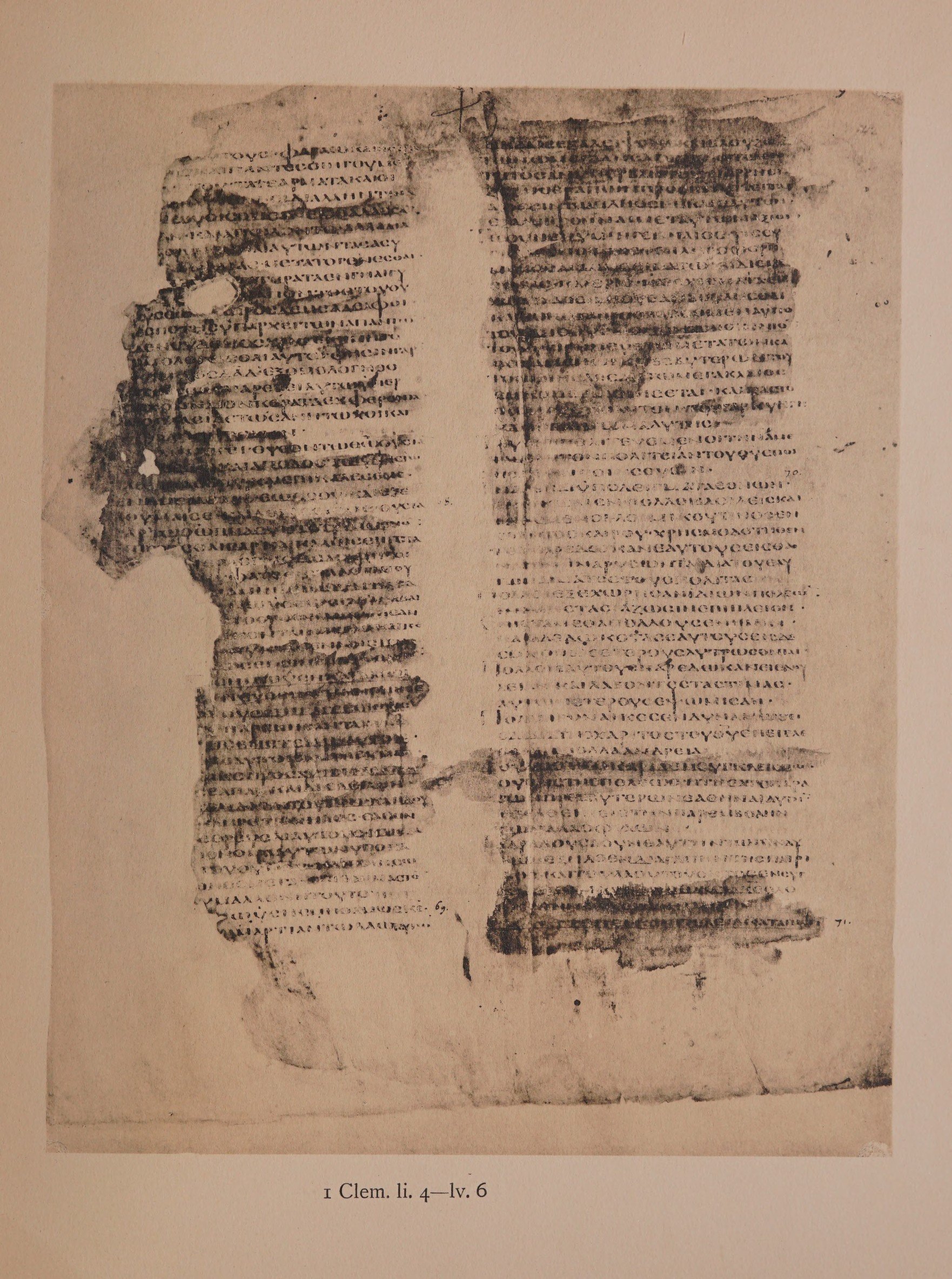
Where on the image
Codex Alexandrinus fol. 166v (1909 facsimile, scan leaf 296; caption printed under the plate: '1 Clem. xlviii. 1-li. 4'); Codex Alexandrinus fol. 167r (1909 facsimile, scan leaf 297; caption printed under the plate: '1 Clem. li. 4-lv. 6'). The Greek shown is Lake's edited text (1912), not a transcription of the manuscript page.
1Ὅσα οὖν παρεπέσαμεν καὶ ἐποιήσαμεν δια τινας παρεμπτώσεις τοῦ ἀντικειμένου, ἀξιώσωμεν ἀφεθῆναι ἡμῖν. καὶ ἐκεῖνοι δέ, οἵτινες ἀρχηγοὶ στάσεως καὶ διχοστασίας ἐγενήθησαν, ὀφείλουσιν τὸ κοινὸν τῆς ἐλπίδος σκοπεῖν. 2οἱ γὰρ μετὰ φόβου καὶ ἀγάπης πολιτευόμενοι ἑαυτοὺς θέλουσιν μᾶλλον αἰκίαις περιπίπτειν ἢ τοὺς πλησίον· μᾶλλον δὲ ἑαυτῶν κατάγνωσιν φέρουσιν ἢ τῆς παραδεδομένης ἡμῖν καλῶς καὶ δικαίως ὁμοφωνίας, 3καλὸν γὰρ ἀνθρώπῳ ἐξομολογεῖσθαι περὶ τῶν παραπτωμάτων ἢ σκληρῦναι τὴν καρδίαν αὐτοῦ, καθὼς ἐσκληρύνθη ἡ καρδία τῶν στασιαζόντων πρὸς τὸν θεράποντα τοῦ θεοῦ Μωϋσῆν, ὧν τὸ κρίμα πρόδηλον ἐγενήθη, 4κατέβησαν γὰρ εἰς ᾅδου ζῶντες, καὶ θάνατος ποιμανεῖ αὐτούς. 5Φαραὼ καὶ ἡ στρατιὰ αὐτοῦ καὶ πάντες οἱ ἡγούμενοι Αἰγύπτου, τά τε ἅρματα καὶ οἱ ἀνάβαται αὐτῶν οὐ δι’ ἄλλην τινὰ αἰτίαν ἐβυθίσθησαν εἰς θάλασσαν ἐρυθρὰν καὶ ἀπώλοντο, ἀλλὰ διὰ τὸ σκληρυνθῆναι αὐτῶν τὰς ἀσυνέτους καρδίας μετὰ τὸ γενέσθαι τὰ σημεῖα καὶ τὰ τέρατα ἐν γῇ Αἰγύπτου διὰ τοῦ θεράποντος τοῦ θεοῦ Μωϋσέως.
1For all our transgressions which we have committed through any of the wiles of the adversary, let us entreat that we may obtain forgiveness. Yea and they also, who set themselves up as leaders of faction and division, ought to look to the common ground of hope. 2For such as walk in fear and love desire that they themselves should fall into suffering rather than their neighbours; and they pronounce condemnation against themselves rather than against the harmony which hath been handed down to us nobly and righteously. 3For it is good for a man to make confession of his trespasses rather than to harden his heart, as the heart of those was hardened who made sedition against Moses the servant of God; whose condemnation was clearly manifest, 4for they went down to hades alive, and Death shall be their shepherd. 5Pharaoh and his host and all the rulers of Egypt, their chariots and their horsemen, were overwhelmed in the depths of the Red Sea, and perished for none other reason but because their foolish hearts were hardened after that the signs and the wonders had been wrought in the land of Egypt by the hand of Moses the servant of God.
Where on the image
Codex Alexandrinus fol. 167r (1909 facsimile, scan leaf 297; caption printed under the plate: '1 Clem. li. 4-lv. 6'). The Greek shown is Lake's edited text (1912), not a transcription of the manuscript page.
1Ἀπροσδεής, ἀδελφοί, ὁ δεσπότης ὑπάρχει τῶν ἁπάντων· οὐδὲν οὐδενὸς χρῄζει εἰ μὴ τὸ ἐξομολογεῖσθαι αὐτῷ. 2φησὶν γὰρ ὁ ἐκλεκτὸς Δαυείδ· Ἐξομολογήσομαι τῷ κυρίῳ, καὶ ἀρέσει αὐτῷ ὑπὲρ μόσχον νέον κέρατα ἐκφέροντα καὶ ὁπλάς· ἰδέτωσαν πτωχοὶ καὶ εὐφρανθήτωσαν. 3καὶ πάλιν λέγει· Θῦσον τῷ θεῷ θυσίαν αἰνέσεως καὶ ἀπόδος τῷ ὑψίστῳ τὰς εὐχάς σου· καὶ ἐπικάλεσαί με ἐν ἡμέρᾳ θλίψεώς σου, καὶ ἐξελοῦμαί σε, καὶ δοξάσεις με. 4θυσία γὰρ τῷ θεῷ πνεῦμα συντετριμμένον.
1The Master, brethren, hath need of nothing at all. He desireth not anything of any man, save to confess unto Him. 2For the elect David saith; I will confess unto the Lord, and it shall please Him more than a young calf that groweth horns and hoofs. Let the poor see it, and rejoice. 3And again He saith; Sacrifice to God a sacrifice of praise, and pay thy vows to the Most High: and call upon Me in the day of thine affliction, and I will deliver thee, and thou shalt glorify Me. 4For a sacrifice unto God is a broken spirit.
Where on the image
Codex Alexandrinus fol. 167r (1909 facsimile, scan leaf 297; caption printed under the plate: '1 Clem. li. 4-lv. 6'). The Greek shown is Lake's edited text (1912), not a transcription of the manuscript page.
1Ἐπίστασθε γὰρ καὶ καλῶς ἐπίστασθε τὰς ἱερὰς γραφάς, ἀγαπητοί, καὶ ἐγκεκύφατε εἰς τὰ λόγια τοῦ θεοῦ. πρὸς ἀνάμνησιν οὖν ταῦτα γράφομεν. 2Μωϋσέως γὰρ ἀναβάντος εἰς τὸ ὄρος καὶ ποιήσαντος τεσσαράκοντα ἡμέρας καὶ τεσσαράκοντα νύκτας ἐν νηστείᾳ καὶ ταπεινώσει, εἶπεν πρὸς αὐτὸν ὁ θεός· Κατάβηθι τὸ τάχος ἐντεῦθεν, ὅτι ἠνόμησεν ὁ λαός σου, οὓς ἐξήγαγες ἐκ γῆς Αἰγύπτου· παρέβησαν ταχὺ ἐκ τῆς ὁδοῦ ἧς ἐνετείλω αὐτοῖς, ἐποίησαν ἑαυτοῖς χωνεύματα. 3καὶ εἶπεν κύριος πρὸς αὐτόν· Λελάληκα πρός σε ἅπαξ καὶ δὶς λέγων· Ἑώρακα τὸν λαὸν τοῦτον, καὶ ἰδού ἐστιν σκληροτράχηλος· ἔασόν με ἐξολεθρεῦσαι αὐτούς, καὶ ἐξαλείψω τὸ ὄνομα αὐτῶν ὑποκάτωθεν τοῦ οὐρανοῦ, καὶ ποιήσω σε εἰς ἔθνος μέγα καὶ θαυμαστὸν καὶ πολὺ μᾶλλον ἢ τοῦτο. 4καὶ εἶπεν Μωϋσῆς· Μηδαμῶς, κύριε· ἄφες τὴν ἁμαρτίαν τῷ λαῷ τούτῳ, ἢ κἀμὲ ἐξάλειψον ἐκ βίβλου ζώντων. 5ὢ μεγάλης ἀγάπης, ὢ τελειότητος ἀνυπερβλήτου. παρρησιάζεται θεράπων πρὸς κύριον, αἰτεῖται ἄφεσιν τῷ πλήθει, ἢ καὶ ἑαυτὸν ἐξαλειφθῆναι μετ’ αὐτῶν ἀξιοῖ.
1For ye know, and know well, the sacred scriptures, dearly beloved, and ye have searched into the oracles of God. We write these things therefore to put you in remembrance. 2When Moses went up into the mountain and had spent forty days and forty nights in fasting and humiliation, God said unto him; Moses, Moses, come down, quickly hence, for My people whom thou leddest forth from the land of Egypt have wrought iniquity: they have transgressed quickly out of the way which thou didst command unto them: they have made for themselves molten images. 3And the Lord said unto him; I have spoken unto thee once and twice, saying, I have seen this people, and behold it is stiff-necked. Let Me destroy them utterly, and I will blot out their name from under heaven, and I will make of thee a nation great and wonderful and numerous more than this. 4And Moses said; Nay, not so, Lord Forgive this people their sin, or blot me also out of the book of the living. 5O mighty love! O unsurpassable perfection! The servant is bold with his Master; he asketh forgiveness for the multitude, or he demandeth that himself also be blotted out with them.
Where on the image
Codex Alexandrinus fol. 167r (1909 facsimile, scan leaf 297; caption printed under the plate: '1 Clem. li. 4-lv. 6'). The Greek shown is Lake's edited text (1912), not a transcription of the manuscript page.
1Τίς οὖν ἐν ὑμῖν γενναῖος, τίς εὔσπλαγχνος, τίς πεπληροφορημένος ἀγάπης; 2εἰπάτω· Εἰ δι’ ἐμὲ στάσις καὶ ἔρις καὶ σχίσματα, ἐκχωρῶ, ἄπειμι, οὗ ἐὰν βούλησθε, καὶ ποιῶ τὰ προστασσόμενα ὑπὸ τοῦ πλήθους· μόνον τὸ ποίμνιον τοῦ Χριστοῦ εἰρηνευέτω μετὰ τῶν καθεσταμένων πρεσβυτέρων. 3τοῦτο ὁ ποιήσας ἑαυτῷ μέγα κλέος ἐν Χριστῷ περιποιήσεται, καὶ πᾶς τόπος δέξεται αὐτόν, τοῦ γὰρ κυρίου ἡ γῆ καὶ τὸ πλήρωμα αὐτῆς. 4ταῦτα οἱ πολιτευόμενοι τὴν ἀμεταμέλητον πολιτείαν τοῦ θεοῦ ἐποίησαν καὶ ποιήσουσιν.
1Who therefore is noble among you? Who is compassionate? Who is fulfilled with love? 2Let him say; If by reason of me there be faction and strife and divisions, I retire, I depart, whither ye will, and I do that which is ordered by the people: only let the flock of Christ be at peace with its duly appointed presbyters. 3He that shall have done this, shall win for himself great renown in Christ, and every place will receive him: for the earth is the Lord's and the fulness thereof. 4Thus have they done and will do, that live as citizens of that kingdom of God which bringeth no regrets.
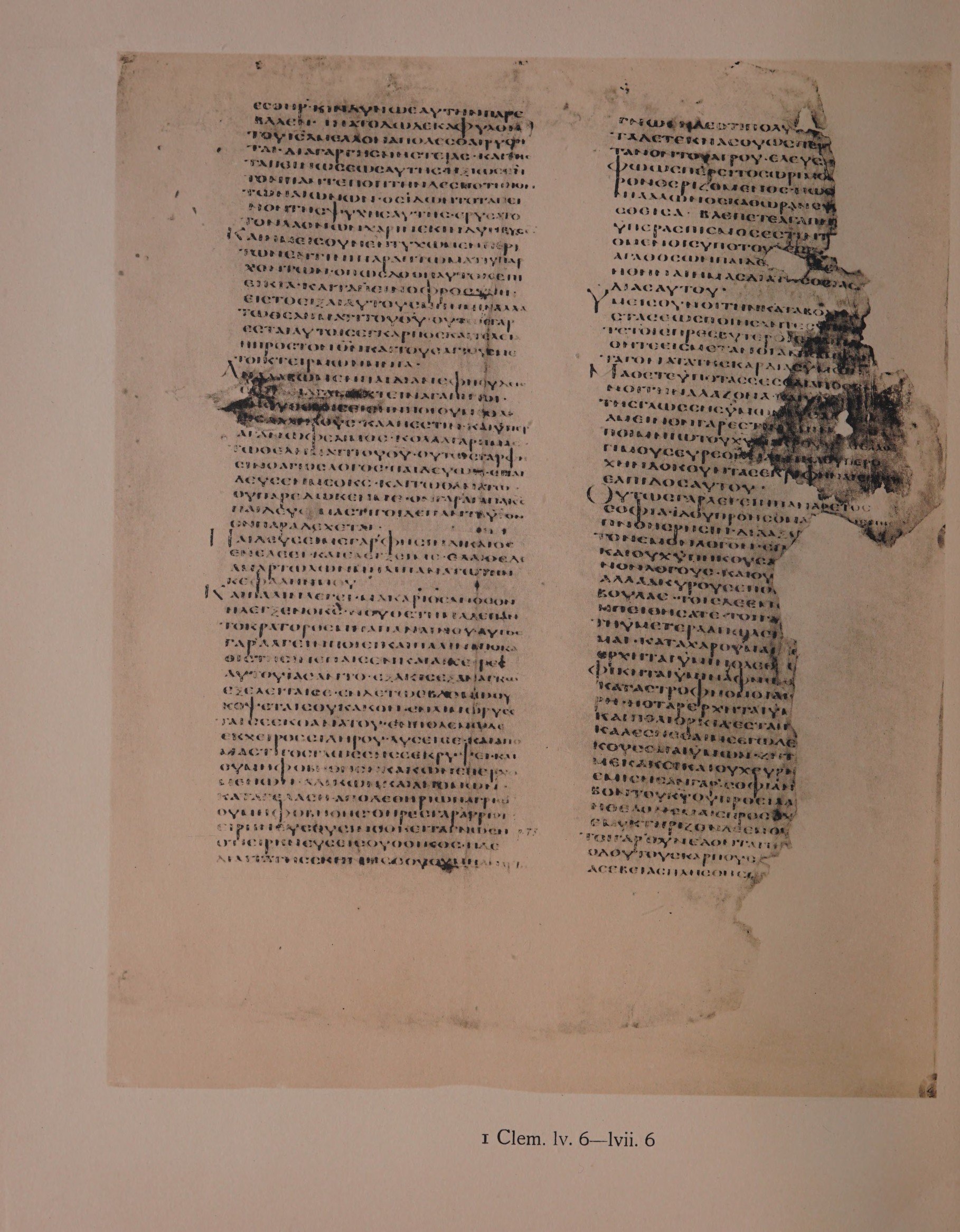
Where on the image
Codex Alexandrinus fol. 167r (1909 facsimile, scan leaf 297; caption printed under the plate: '1 Clem. li. 4-lv. 6'); Codex Alexandrinus fol. 167v (1909 facsimile, scan leaf 298; caption printed under the plate: '1 Clem. lv. 6-lvii. 6'). The Greek shown is Lake's edited text (1912), not a transcription of the manuscript page.
1Ἵνα δὲ καὶ ὑποδείγματα ἐθνῶν ἐνέγκωμεν. πολλοὶ βασιλεῖς καὶ ἡγούμενοι, λοιμικοῦ τινος ἐνστάντος καιροῦ, χρησμοδοτηθέντες παρέδωκαν ἑαυτοὺς εἰς θάνατον, ἵνα ῥύσωνται διὰ τοῦ ἑαυτῶν αἵματος τοὺς πολίτας· πολλοὶ ἐξεχώρησαν ἰδίων πόλεων, ἵνα μὴ στασιάζωσιν ἐπὶ πλεῖον. 2ἐπιστάμεθα πολλοὺς ἐν ἡμῖν παραδεδωκότας ἑαυτοὺς εἰς δεσμά, ὅπως ἑτέρους λυτρώσονται· πολλοὶ ἑαυτοὺς παρέδωκαν εἰς δουλείαν, καὶ λαβόντες τὰς τιμὰς αὐτῶν ἑτέρους ἐψώμισαν. 3πολλαὶ γυναῖκες ἐνδυναμωθεῖσαι διὰ τῆς χάριτος τοῦ θεοῦ ἐπετελέσαντο πολλὰ ἀνδρεῖα. 4Ἰουδὶθ ἡ μακαρία, ἐν συγκλεισμῷ οὔσης τῆς πόλεως, ᾐτήσατο παρὰ τῶν πρεσβυτέρων ἐαθῆναι αὐτὴν ἐξελθεῖν εἰς τὴν παρεμβολὴν τῶν ἀλλοφύλων. 5παραδοῦσα οὖν ἑαυτὴν τῷ κινδύνῳ ἐξῆλθεν δι’ ἀγάπην τῆς πατρίδος καὶ τοῦ λαοῦ τοῦ ὄντος ἐν συγκλεισμῷ, καὶ παρέδωκεν κύριος Ὀλοφέρνην ἐν χειρὶ θηλείας. 6οὐχ ἧττον καὶ ἡ τελεία κατὰ πίστιν Ἐσθὴρ κινδύνῳ ἑαυτὴν παρέβαλεν, ἵνα τὸ ἔθνος τοῦ Ἰσραὴλ μέλλον ἀπολέσθαι ῥύσηται· διὰ γὰρ τῆς νηστείας καὶ τῆς ταπεινώσεως αὐτῆς ἠξίωσεν τὸν παντεπόπτην δεσπότην τῶν αἰώνων· ὃς ἰδὼν τὸ ταπεινὸν τῆς ψυχῆς αὐτῆς ἐρύσατο τὸν λαόν, ὧν χάριν ἐκινδύνευσεν.
1But, to bring forward examples of Gentiles also; many kings and rulers, when some season of pestilence pressed upon them, being taught by oracles have delivered themselves over to death, that they might rescue their fellow citizens through their own blood. Many have retired from their own cities, that they might have no more seditions. 2We know that many among ourselves have delivered themselves to bondage, that they might ransom others. Many have sold themselves to slavery, and receiving the price paid for themselves have fed others. 3Many women being strengthened through the grace of God have performed many manly deeds. 4The blessed Judith, when the city was beleaguered, asked of the elders that she might be suffered to go forth into the camp of the aliens. 5So she exposed herself to peril and went forth for love of her country and of her people which were beleaguered; and the Lord delivered Holophernes into the hand of a woman. 6To no less peril did Esther also, who was perfect in faith, expose herself, that she might deliver the twelve tribes of Israel, when they were on the point to perish. For through her fasting and her humiliation she entreated the all seeing Master, the God of the ages; and He, seeing the humility of her soul, delivered the people for whose sake she encountered the peril.
Where on the image
Codex Alexandrinus fol. 167v (1909 facsimile, scan leaf 298; caption printed under the plate: '1 Clem. lv. 6-lvii. 6'). The Greek shown is Lake's edited text (1912), not a transcription of the manuscript page.
1Καὶ ἡμεῖς οὖν ἐντύχωμεν περὶ τῶν ἔν τινι παραπτώματι ὑπαρχόντων, ὅπως δοθῇ αὐτοῖς ἐπιείκεια καὶ ταπεινοφροσύνη εἰς τὸ εἶξαι αὐτοὺς μὴ ἡμῖν ἀλλὰ τῷ θελήματι τοῦ θεοῦ· οὕτως γὰρ ἔσται αὐτοῖς ἔγκαρπος καὶ τελεία ἡ πρὸς τὸν θεὸν καὶ τοὺς ἁγίους μετ’ οἰκτιρμῶν μνεία. 2ἀναλάβωμεν παιδείαν, ἐφ’ ᾗ οὐδεὶς ὀφείλει ἀγανακτεῖν, ἀγαπητοί. ἡ νουθέτησις, ἣν ποιούμεθα εἰς ἀλλήλους, καλή ἐστιν καὶ ὑπεράγαν ὠφέλιμος· κολλᾷ γὰρ ἡμᾶς τῷ θελήματι τοῦ θεοῦ. 3οὕτως γάρ φησιν ὁ ἅγιος λόγος· Παιδεύων ἐπαίδευσέν με ὁ κύριος, καὶ τῷ θανάτῳ οὐ παρέδωκέν με· 4ὃν γὰρ ἀγαπᾷ κύριος παιδεύει, μαστιγοῖ δὲ πάντα υἱὸν ὃν παραδέχεται. 5Παιδεύσει με γάρ, φησίν, δίκαιος ἐν ἐλέει καὶ ἐλέγξει με, ἔλαιον δὲ ἁμαρτωλῶν μὴ λιπανάτω τὴν κεφαλήν μου. 6καὶ πάλιν λέγει· Μακάριος ἄνθρωπος, ὃν ἤλεγξεν ὁ κύριος· νουθέτημα δὲ παντοκράτορος μὴ ἀπαναίνου· αὐτὸς γὰρ ἀλγεῖν ποιεῖ, καὶ πάλιν ἀποκαθίστησιν· 7ἔπαισεν, καὶ αἱ χεῖρες αὐτοῦ ἰάσαντο. 8ἑξάκις ἐξ ἀναγκῶν ἐξελεῖταί σε, ἐν δὲ τῷ ἑβδόμῳ οὐχ ἅψεταί σου κακόν. 9ἐν λιμῷ ῥύσεταί σε ἐκ θανάτου, ἐν πολέμῳ δὲ ἐκ χειρὸς σιδήρου λύσει σε· 10καὶ ἀπὸ μάστιγος γλώσσης σε κρύψει, καὶ οὐ μὴ φοβηθήσῃ κακῶν ἐπερχομένων. 11ἀδίκων καὶ ἀνόμων καταγελάσῃ, ἀπὸ δὲ θηρίων ἀγρίων οὐ μὴ φοβηθῇς· 12θῆρες γὰρ ἄγριοι εἰρηνεύσουσίν σοι. 13εἶτα γνώσῃ, ὅτι εἰρηνεύσει σου ὁ οἶκος, ἡ δὲ δίαιτα τῆς σκηνῆς σου οὐ μὴ ἁμάρτῃ. 14γνώσῃ δέ, ὅτι πολὺ τὸ σπέρμα σου, τὰ δὲ τέκνα σου ὥσπερ τὸ παμβότανον τοῦ ἀγροῦ. 15ἐλεύσῃ δὲ ἐν τάφῳ ὥσπερ σῖτος ὥριμος κατὰ καιρὸν θεριζόμενος, ἢ ὥσπερ θημωνιὰ ἅλωνος καθ’ ὥραν συγκομισθεῖσα. 16βλέπετε, ἀγαπητοί, πόσος ὑπερασπισμός ἐστιν τοῖς παιδευομένοις ὑπὸ τοῦ δεσπότου· πατὴρ γὰρ ἀγαθὸς ὢν παιδεύει εἰς τὸ ἐλεηθῆναι ἡμᾶς διὰ τῆς ὁσίας παιδείας αὐτοῦ.
1Therefore let us also make intercession for them that are in any transgression, that forbearance and humility may be given them, to the end that they may yield not unto us, but unto the will of God. For so shall the compassionate remembrance of them with God and the saints be fruitful unto them, and perfect. 2Let us accept chastisement, whereat no man ought to be vexed, dearly beloved. The admonition which we give one to another is good and exceeding useful; for it joineth us unto the will of God. 3For thus saith the holy word; The Lord hath indeed chastened me, and hath not delivered me over unto death. 4For whom the Lord loveth He chasteneth, and scourgeth every son whom He receiveth. 5For the righteous, it is said, shall chasten me in mercy and shall reprove me, but let not the mercy of sinners anoint my head. 6And again He saith; Blessed is the man whom the Lord hath reproved, and refuse not thou the admonition of the Almighty. For He causeth pain, and He restoreth again: 7He hath smitten, and His hands have healed. 8Six times shall He rescue thee from afflictions and at the seventh no evil shall touch thee. 9In famine He shall deliver thee from death, and in war He shall release thee from the arm of the sword. 10And from the scourge of the tongue shall He hide thee, and thou shalt not be afraid when evils approach. 11Thou shalt laugh at the unrighteous and wicked, and of the wild beasts thou shalt not be afraid. 12For wild beasts shall be at peace with thee. 13Then shalt thou know that thy house shall be at peace: and the abode of thy tabernacle shall not go wrong, 14and thou shalt know that thy seed is many, and thy children as the plenteous herbage of the field. 15And thou shalt come to the grave as ripe corn reaped in due season, or as the heap of the threshing floor gathered together at the right time. 16Ye see, dearly beloved, how great protection there is for them that are chastened by the Master: for being a kind father He chasteneth us to the end that we may obtain mercy through His holy chastisement.
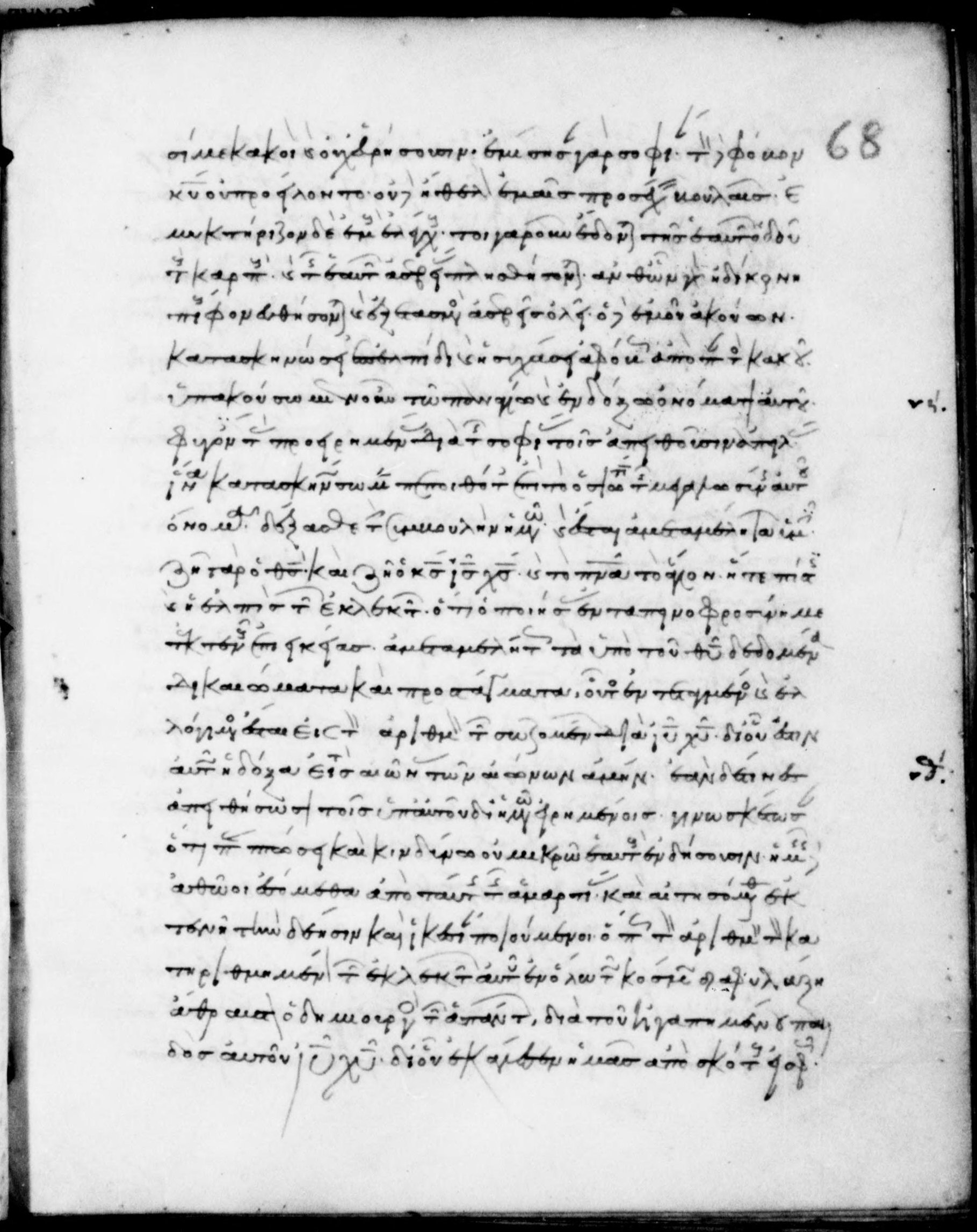
Where on the image
Codex Alexandrinus fol. 167v (1909 facsimile, scan leaf 298; caption printed under the plate: '1 Clem. lv. 6-lvii. 6'); Codex Hierosolymitanus 54 fol. 68r (LoC microfilm frame 70, right page), checked on the image: the page opens '[ζητήσου]σί με κακοὶ καὶ οὐχ εὑρήσουσιν· ἐμίσησαν γὰρ σοφίαν' (1 Clem 57.5). Alexandrinus carries 57.1-6 (fol. 167v, where the foot of the second column is damaged); 57.7 is lost there and is on Hierosolymitanus 54 fol. 68r. The Greek shown is Lake's edited text (1912), not a transcription of the manuscript page.
1Ὑμεῖς οὖν οἱ τὴν καταβολὴν τῆς στάσεως ποιήσαντες ὑποτάγητε τοῖς πρεσβυτέροις καὶ παιδεύθητε εἰς μετάνοιαν, κάμψαντες τὰ γόνατα τῆς καρδίας ὑμῶν. 2μάθετε ὑποτάσσεσθαι, ἀποθέμενοι τὴν ἀλαζόνα καὶ ὑπερήφανον τῆς γλώσσης ὑμῶν αὐθάδειαν· ἄμεινον γάρ ἐστιν ὑμῖν, ἐν τῷ ποιμνίῳ τοῦ Χριστοῦ μικροὺς καὶ ἐλλογίμους εὑρεθῆναι, ἢ καθ’ ὑπεροχὴν δοκοῦντας ἐκριφῆναι ἐκ τῆς ἐλπίδος αὐτοῦ. 3οὕτως γὰρ λέγει ἡ πανάρετος σοφία· Ἰδού, προήσομαι ὑμῖν ἐμῆς πνοῆς ῥῆσιν, διδάξω δὲ ὑμᾶς τὸν ἐμὸν λόγον. 4ἐπειδὴ ἐκάλουν καὶ οὐχ ὑπηκούσατε, καὶ ἐξέτεινον λόγους καὶ οὐ προσείχετε, ἀλλὰ ἀκύρους ἐποιεῖτε τὰς ἐμὰς βουλάς, τοῖς δὲ ἐμοῖς ἐλέγχοις ἠπειθήσατε· τοιγαροῦν κἀγὼ τῇ ὑμετέρᾳ ἀπωλείᾳ ἐπιγελάσομαι, καταχαροῦμαι δὲ ἡνίκα ἂν ἔρχηται ὑμῖν ὄλεθρος καὶ ὡς ἂν ἀφίκηται ὑμῖν ἄφνω θόρυβος, ἡ δὲ καταστροφὴ ὁμοία καταιγίδι παρῇ, ἢ ὅταν ἔρχηται ὑμῖν θλίψις καὶ πολιορκία. 5ἔσται γὰρ ὅταν ἐπικαλέσησθέ με, ἐγὼ δὲ οὐκ εἰσακούσομαι ὑμῶν· ζητήσουσίν με κακοί, καὶ οὐχ εὑρήσουσιν. ἐμίσησαν γὰρ σοφίαν, τὸν δὲ φόβον τοῦ κυρίου οὐ προείλαντο, οὐδὲ ἤθελον ἐμαῖς προσέχειν βουλαῖς, ἐμυκτήριζον δὲ ἐμοὺς ἐλέγχους. 6τοιγαροῦν ἔδονται τῆς ἑαυτῶν ὁδοῦ τοὺς καρπούς, καὶ τῆς ἑαυτῶν ἀσεβείας πλησθήσονται· 7ἀνθ’ ὧν γὰρ ἠδίκουν νηπίους φονευθήσονται, καὶ ἐξετασμὸς ἀσεβεῖς ὀλεῖ· ὁ δὲ ἐμοῦ ἀκούων κατασκηνώσει ἐπ’ ἐλπίδι πεποιθὼς καὶ ἡσυχάσει ἀφόβως ἀπὸ παντὸς κακοῦ.
1Ye therefore that laid the foundation of the sedition, submit yourselves unto the presbyters and receive chastisement unto repentance, bending the knees of your heart. 2Learn to submit yourselves, laying aside the arrogant and proud stubbornness of your tongue. For it is better for you to be found little in the flock of Christ and to have your name on God's roll, than to be had in exceeding honour and yet be cast out from the hope of Him. 3For thus saith the All virtuous Wisdom; Behold I will pour out for you a saying of My breath, and I will teach you My word. 4Because I called and ye obeyed not, and I held out words and ye heeded not, but made My counsels of none effect, and were disobedient unto My reproofs; therefore I also will laugh at your destruction, and will rejoice over you when ruin cometh upon you, and when confusion overtaketh you suddenly, and your overthrow is at hand like a whirlwind, or when anguish and beleaguerment come upon you. 5For it shall be, when ye call upon Me, yet will I not hear you. Evil men shall seek Me and shall not find Me: for they hated wisdom, and chose not the fear of the Lord, neither would they give heed unto My counsels, but mocked at My reproofs. 6Therefore they shall eat the fruits of their own way, and shall be filled with their own ungodliness. 7For because they wronged babes, they shall be slain, and inquisition shall destroy the ungodly. But he that heareth Me shall dwell safely trusting in hope, and shall be quiet from fear of all evil.
Where on the image
Codex Hierosolymitanus 54 fol. 68r (LoC microfilm frame 70, right page), checked on the image: the page opens '[ζητήσου]σί με κακοὶ καὶ οὐχ εὑρήσουσιν· ἐμίσησαν γὰρ σοφίαν' (1 Clem 57.5). This chapter is lost from Codex Alexandrinus (a missing leaf between fol. 167v and 168r) and is shown on Hierosolymitanus 54. The Greek shown is Lake's edited text (1912), not a transcription of the manuscript page.
1Ὑπακούσωμεν οὖν τῷ παναγίῳ καὶ ἐνδόξῳ ὀνόματι αὐτοῦ φυγόντες τὰς προειρημένας διὰ τῆς σοφίας τοῖς ἀπειθοῦσιν ἀπειλάς, ἵνα κατασκηνώσωμεν πεποιθότες ἐπὶ τὸ ὁσιώτατον τῆς μεγαλωσύνης αὐτοῦ ὄνομα. 2δέξασθε τὴν συμβουλὴν ἡμῶν, καὶ ἔσται ἀμεταμέλητα ὑμῖν. ζῇ γὰρ ὁ θεὸς καὶ ζῇ ὁ κύριος Ἰησοῦς Χριστὸς καὶ τὸ πνεῦμα τὸ ἅγιον, ἥ τε πίστις καὶ ἡ ἐλπὶς τῶν ἐκλεκτῶν, ὅτι ὁ ποιήσας ἐν ταπεινοφροσύνῃ μετ’ ἐκτενοῦς ἐπιεικείας ἀμεταμελήτως τὰ ὑπὸ τοῦ θεοῦ δεδομένα δικαιώματα καὶ προστάγματα, οὗτος ἐντεταγμένος καὶ ἐλλόγιμος ἔσται εἰς τὸν ἀριθμὸν τῶν σωζομένων διὰ Ἰησοῦ Χριστοῦ, δι’ οὗ ἐστὶν αὐτῷ ἡ δόξα εἰς τοὺς αἰῶνας τῶν αἰώνων. ἀμήν.
1Let us therefore be obedient unto His most holy and glorious Name, thereby escaping the threatenings which were spoken of old by the mouth of Wisdom against them which disobey, that we may dwell safely, trusting in the most holy Name of His majesty. 2Receive our counsel, and ye shall have no occasion of regret. For as God liveth, and the Lord Jesus Christ liveth, and the Holy Spirit, who are the faith and the hope of the elect, so surely shall he, who with lowliness of mind and instant in gentleness hath without regretfulness performed the ordinances and commandments that are given by God, be enrolled and have a name among the number of them that are saved through Jesus Christ, through whom is the glory unto Him for ever and ever. Amen.
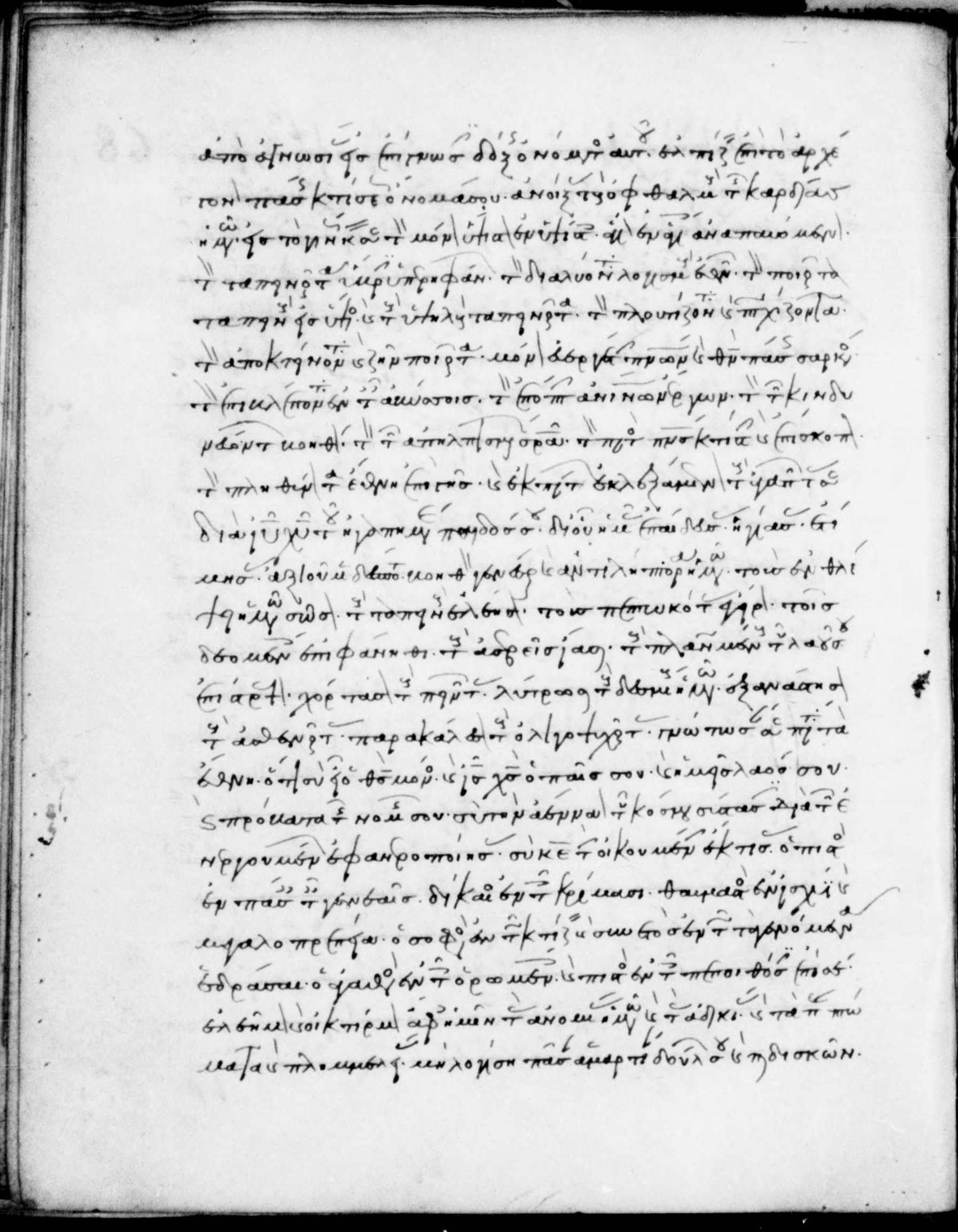
Where on the image
Codex Hierosolymitanus 54 fol. 68r (LoC microfilm frame 70, right page), checked on the image: the page opens '[ζητήσου]σί με κακοὶ καὶ οὐχ εὑρήσουσιν· ἐμίσησαν γὰρ σοφίαν' (1 Clem 57.5); Codex Hierosolymitanus 54 fol. 68v (LoC microfilm frame 71, left page), checked on the image: the page opens 'ἀπὸ ἀγνωσίας εἰς ἐπίγνωσιν δόξης ὀνόματος αὐτοῦ' (1 Clem 59.2). This chapter is lost from Codex Alexandrinus (a missing leaf between fol. 167v and 168r) and is shown on Hierosolymitanus 54. The Greek shown is Lake's edited text (1912), not a transcription of the manuscript page.
1Ἐὰν δέ τινες ἀπειθήσωσιν τοῖς ὑπ’ αὐτοῦ δι’ ἡμῶν εἰρημένοις, γινωσκέτωσαν ὅτι παραπτώσει καὶ κινδύνῳ οὐ μικρῷ ἑαυτοὺς ἐνδήσουσιν. 2ἡμεῖς δὲ ἀθῷοι ἐσόμεθα ἀπὸ ταύτης τῆς ἁμαρτίας καὶ αἰτησόμεθα ἐκτενῆ τὴν δέησιν καὶ ἱκεσίαν ποιούμενοι, ὅπως τὸν ἀριθμὸν τὸν κατηριθμημένον τῶν ἐκλεκτῶν αὐτοῦ ἐν ὅλῳ τῷ κόσμῳ διαφυλάξῃ ἄθραυστον ὁ δημιουργὸς τῶν ἁπάντων διὰ τοῦ ἠγαπημένου παιδὸς αὐτοῦ Ἰησοῦ Χριστοῦ, δι’ οὗ ἐκάλεσεν ἡμᾶς ἀπὸ σκότους εἰς φῶς, ἀπὸ ἀγνωσίας εἰς ἐπίγνωσιν δόξης ὀνόματος αὐτοῦ, 3... ἐλπίζειν ἐπὶ τὸ ἀρχεγόνον πάσης κτίσεως ὄνομά σου, ἀνοίξας τοὺς ὀφθαλμοὺς τῆς καρδίας ἡμῶν εἰς τὸ γινώσκειν σε τὸν μόνον ὕψιστον ἐν ὑψίστοις, ἅγιον ἐν ἁγίοις ἀναπαυόμενον. τὸν ταπεινοῦντα ὕβριν ὑπερηφάνων, τὸν διαλύοντα λογισμοὺς ἐθνῶν, τὸν ποιοῦντα ταπεινοὺς εἰς ὕψος καὶ τοὺς ὑψηλοὺς ταπεινοῦντα, τὸν πλουτίζοντα καὶ πτωχίζοντα, τὸν ἀποκτείνοντα καὶ ζῆν ποιοῦντα, μόνον εὑρέτην πνευμάτων καὶ θεὸν πάσης σαρκός· τὸν ἐπιβλέποντα ἐν τοῖς ἀβύσσοις, τὸν ἐπόπτην ἀνθρωπίνων ἔργων, τὸν τῶν κινδυνευόντων βοηθόν, τὸν τῶν ἀπηλπισμένων σωτῆρα, τὸν παντὸς πνεύματος κτίστην καὶ ἐπίσκοπον· τὸν πληθύνοντα ἔθνη ἐπὶ γῆς καὶ ἐκ πάντων ἐκλεξάμενον τοὺς ἀγαπῶντάς σε διὰ Ἰησοῦ Χριστοῦ τοῦ ἠγαπημένου παιδός σου, δι’ οὗ ἡμᾶς ἐπαίδευσας, ἡγίασας, ἐτίμησας· 4ἀξιοῦμέν σε, δέσποτα, βοηθὸν γενέσθαι καὶ ἀντιλήπτορα ἡμῶν. τοὺς ἐν θλίψει ἡμῶν σῶσον, τοὺς ταπεινοὺς ἐλέησον, τοὺς πεπτωκότας ἔγειρον, τοῖς δεομένοις ἐπιφάνηθι, τοὺς ἀσθενεῖς ἴασαι, τοὺς πλανωμένους τοῦ λαοῦ σου ἐπίστρεψον· χόρτασον τοὺς πεινῶντας, λύτρωσαι τοὺς δεσμίους ἡμῶν, ἐξανάστησον τοὺς ἀσθενοῦντας, παρακάλεσον τοὺς ὀλιγοψυχοῦντας· γνώτωσάν σε ἅπαντα τὰ ἔθνη, ὅτι σὺ εἶ ὁ θεὸς μόνος καὶ Ἰησοῦς Χριστὸς ὁ παῖς σου καὶ ἡμεῖς λαός σου καὶ πρόβατα τῆς νομῆς σου.
1But if certain persons should be disobedient unto the words spoken by Him through us, let them understand that they will entangle themselves in no slight transgression and danger; 2but we shall be guiltless of this sin. And we will ask, with instancy of prayer and supplication, that the Creator of the universe may guard intact unto the end the number that hath been numbered of His elect throughout the whole world, through His beloved Son Jesus Christ, through whom He called us from darkness to light, from ignorance to the full knowledge of the glory of His Name. 3[Grant unto us, Lord,] that we may set our hope on Thy Name which is the primal source of all creation, and open the eyes of our hearts, that we may know Thee, who alone abidest Highest in the lofty, Holy in the holy; who layest low the insolence of the proud, who scatterest the imaginings of nations; who settest the lowly on high, and bringest the lofty low; who makest rich and makest poor; who killest and makest alive; who alone art the Benefactor of spirits and the God of all flesh; who lookest into the abysses, who scannest the works of man; the Succour of them that are in peril, the Saviour of them that are in despair; the Creator and Overseer of every spirit; who multipliest the nations upon earth, and hast chosen out from all men those that love Thee through Jesus Christ, Thy beloved Son, through whom Thou didst instruct us, didst sanctify us, didst honour us. 4We beseech Thee, Lord and Master, to be our help and succour. Save those among us who are in tribulation; have mercy on the lowly; lift up the fallen; show Thyself unto the needy; heal the ungodly; convert the wanderers of Thy people; feed the hungry; release our prisoners; raise up the weak; comfort the faint-hearted. Let all the Gentiles know that Thou art God alone, and Jesus Christ is Thy Son, and we are Thy people and the sheep of Thy pasture.
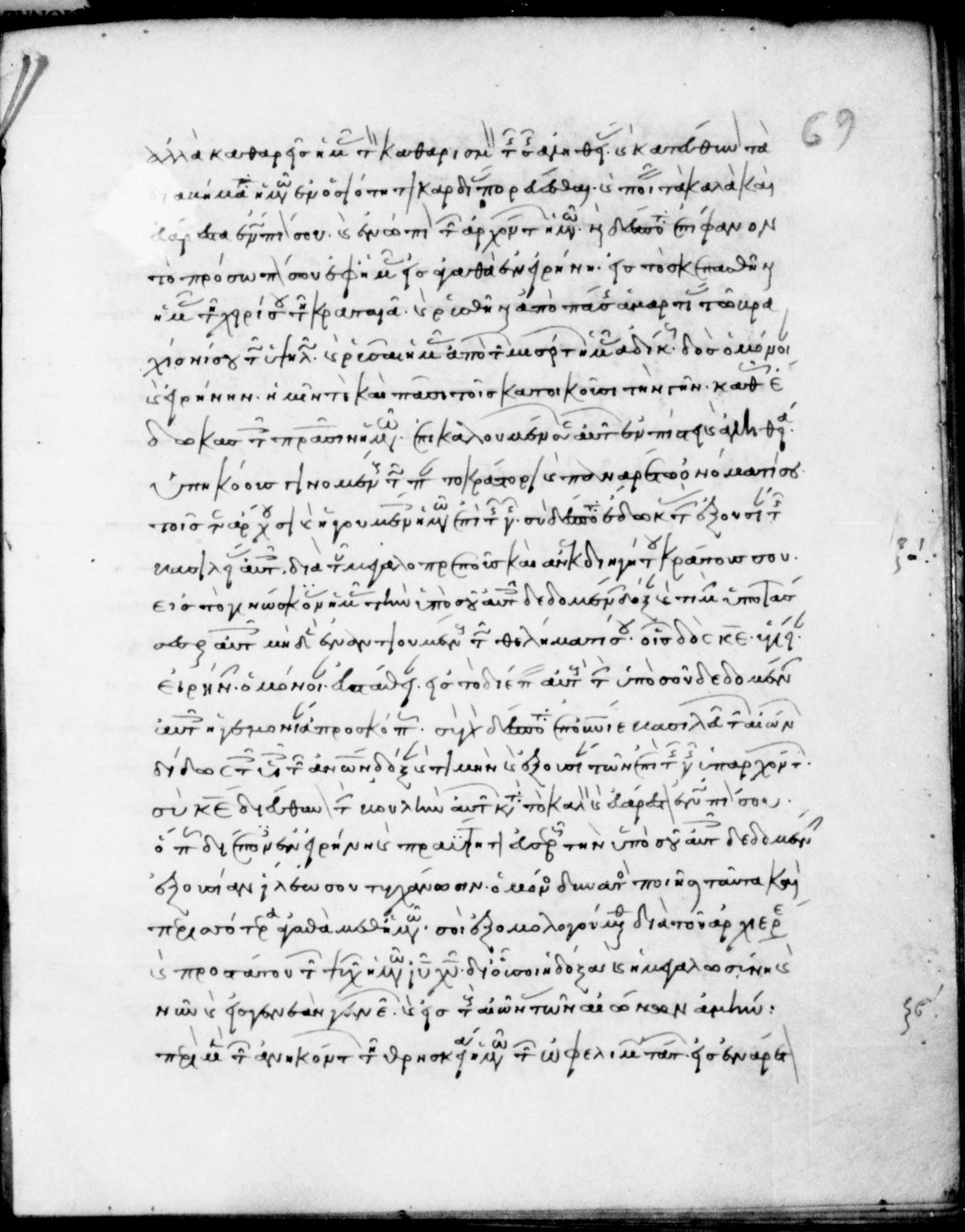
Where on the image
Codex Hierosolymitanus 54 fol. 68v (LoC microfilm frame 71, left page), checked on the image: the page opens 'ἀπὸ ἀγνωσίας εἰς ἐπίγνωσιν δόξης ὀνόματος αὐτοῦ' (1 Clem 59.2); Codex Hierosolymitanus 54 fol. 69r (LoC microfilm frame 71, right page), checked on the image: the page opens 'ἀλλὰ καθάρισον ἡμᾶς τὸν καθαρισμὸν τῆς σῆς ἀληθείας' (1 Clem 60.2). This chapter is lost from Codex Alexandrinus (a missing leaf between fol. 167v and 168r) and is shown on Hierosolymitanus 54. The Greek shown is Lake's edited text (1912), not a transcription of the manuscript page.
1Σὺ γὰρ τὴν ἀέναον τοῦ κόσμου σύστασιν διὰ τῶν ἐνεργουμένων ἐφανεροποίησας· σύ, κύριε, τὴν οἰκουμένην ἔκτισας, ὁ πιστὸς ἐν πάσαις ταῖς γενεαῖς, δίκαιος ἐν τοῖς κρίμασιν, θαυμαστὸς ἐν ἰσχύϊ καὶ μεγαλοπρεπείᾳ, ὁ σοφὸς ἐν τῷ κτίζειν καὶ συνετὸς ἐν τῷ τὰ γενόμενα ἑδράσαι, ὁ ἀγαθὸς ἐν τοῖς ὁρωμένοις καὶ χρηστὸς ἐν τοῖς πεποιθόσιν ἐπὶ σέ, ἐλεῆμον καὶ οἰκτίρμον, ἄφες ἡμῖν τὰς ἀνομίας ἡμῶν καὶ τὰς ἀδικίας καὶ τὰ παραπτώματα καὶ πλημμελείας. 2μὴ λογίσῃ πᾶσαν ἁμαρτίαν δούλων σου καὶ παιδισκῶν, ἀλλὰ καθάρισον ἡμᾶς τὸν καθαρισμὸν τῆς σῆς ἀληθείας, καὶ κατεύθυνον τὰ διαβήματα ἡμῶν ἐν ὁσιότητι καρδίας πορεύεσθαι καὶ ποιεῖν τὰ καλὰ καὶ εὐάρεστα ἐνώπιόν σου καὶ ἐνώπιον τῶν ἀρχόντων ἡμῶν. 3ναί, δέσποτα, ἐπίφανον τὸ πρόσωπόν σου ἐφ’ ἡμᾶς εἰς ἀγαθὰ ἐν εἰρήνῃ, εἰς τὸ σκεπασθῆναι ἡμᾶς τῇ χειρί σου τῇ κραταιᾷ καὶ ῥυσθῆναι ἀπὸ πάσης ἁμαρτίας τῷ βραχίονί σου τῷ ὑψηλῷ, καὶ ῥῦσαι ἡμᾶς ἀπὸ τῶν μισούντων ἡμᾶς ἀδίκως. 4δὸς ὁμόνοιαν καὶ εἰρήνην ἡμῖν τε καὶ πᾶσιν τοῖς κατοικοῦσιν τὴν γῆν, καθὼς ἔδωκας τοῖς πατράσιν ἡμῶν, ἐπικαλουμένων σε αὐτῶν ὁσίως ἐν πίστει καὶ ἀληθείᾳ, ὑπηκόους γινομένους τῷ παντοκράτορι καὶ ἐνδόξῳ ὀνόματί σου, τοῖς τε ἄρχουσιν καὶ ἡγουμένοις ἡμῶν ἐπὶ τῆς γῆς.
1Thou through Thine operations didst make manifest the everlasting fabric of the world. Thou, Lord, didst create the earth. Thou that art faithful throughout all generations, righteous in Thy judgments, marvellous in strength and excellence, Thou that art wise in creating and prudent in establishing that which Thou hast made, that art good in the things which are seen and faithful with them that trust on Thee, pitiful and compassionate, forgive us our iniquities and our unrighteousnesses and our transgressions and shortcomings. 2Lay not to our account every sin of Thy servants and Thine handmaids, but cleanse us with the cleansing of Thy truth, and guide our steps to walk in holiness and righteousness and singleness of heart and to do such things as are good and well pleasing in Thy sight and in the sight of our rulers. 3Yea, Lord, make Thy face to shine upon us in peace for our good, that we may be sheltered by Thy mighty hand and delivered from every sin by Thine uplifted arm. And deliver us from them that hate us wrongfully. 4Give concord and peace to us and to all that dwell on the earth, as Thou gavest to our fathers, when they called on Thee in faith and truth with holiness, [that we may be saved,] while we render obedience to Thine almighty and most excellent Name, and to our rulers and governors upon the earth.
Where on the image
Codex Hierosolymitanus 54 fol. 69r (LoC microfilm frame 71, right page), checked on the image: the page opens 'ἀλλὰ καθάρισον ἡμᾶς τὸν καθαρισμὸν τῆς σῆς ἀληθείας' (1 Clem 60.2). This chapter is lost from Codex Alexandrinus (a missing leaf between fol. 167v and 168r) and is shown on Hierosolymitanus 54. The Greek shown is Lake's edited text (1912), not a transcription of the manuscript page.
1Σύ, δεσποτα, ἔδωκας τὴν ἐξουσίαν τῆς βασιλείας αὐτοῖς διὰ τοῦ μεγαλοπρεποῦς καὶ ἀνεκδιηγήτου κράτους σου, εἰς τὸ γινώσκοντας ἡμᾶς τὴν ὑπὸ σοῦ αὐτοῖς δεδομένην δόξαν καὶ τιμὴν ὑποτάσσεσθαι αὐτοῖς, μηδὲν ἐναντιουμένους τῷ θελήματί σου· οἷς δός, κύριε, ὑγίειαν, εἰρήνην, ὁμόνοιαν, εὐστάθειαν, εἰς τὸ διέπειν αὐτοὺς τὴν ὑπὸ σοῦ δεδομένην αὐτοῖς ἡγεμονίαν ἀπροσκόπως. 2σὺ γάρ, δέσποτα ἐπουράνιε, βασιλεῦ τῶν αἰώνων, δίδως τοῖς υἱοῖς τῶν ἀνθρώπων δόξαν καὶ τιμὴν καὶ ἐξουσίαν τῶν ἐπὶ τῆς γῆς ὑπαρχόντων· σύ, κύριε, διεύθυνον τὴν βουλὴν αὐτῶν κατὰ τὸ καλὸν καὶ εὐάρεστον ἐνώπιόν σου, ὅπως διέποντες ἐν εἰρήνῃ καὶ πραΰτητι εὐσεβῶς τὴν ὑπὸ σοῦ αὐτοῖς δεδομένην ἐξουσίαν ἵλεώ σου τυγχάνωσιν. 3ὁ μόνος δυνατὸς ποιῆσαι ταῦτα καὶ περισσότερα ἀγαθὰ μεθ’ ἡμῶν, σοὶ ἐξομολογούμεθα διὰ τοῦ ἀρχιερέως καὶ προστάτου τῶν ψυχῶν ἡμῶν Ἰησοῦ Χριστοῦ, δι’ οὗ σοι ἡ δόξα καὶ ἡ μεγαλωσύνη καὶ νῦν καὶ εἰς γενεὰν γενεῶν καὶ εἰς τοὺς αἰῶνας τῶν αἰώνων. ἀμήν.
1Thou, Lord and Master, hast given them the power of sovereignty through Thine excellent and unspeakable might, that we knowing the glory and honour which Thou hast given them may submit ourselves unto them, in nothing resisting Thy will. Grant unto them therefore, O Lord, health peace, concord, stability, that they may administer the government which Thou hast given them without failure. 2For Thou, O heavenly Master, King of the ages, givest to the sons of men glory and honour and power over all things that are upon the earth. Do Thou, Lord, direct their counsel according to that which is good and well pleasing in Thy sight, that, administering in peace and gentleness with godliness the power which Thou hast given them, they may obtain Thy favour. 3O Thou, who alone art able to do these things and things far more exceeding good than these for us, we praise Thee through the High priest and Guardian of our souls, Jesus Christ, through whom be the glory and the majesty unto Thee both now and for all generations and for ever and ever. Amen.
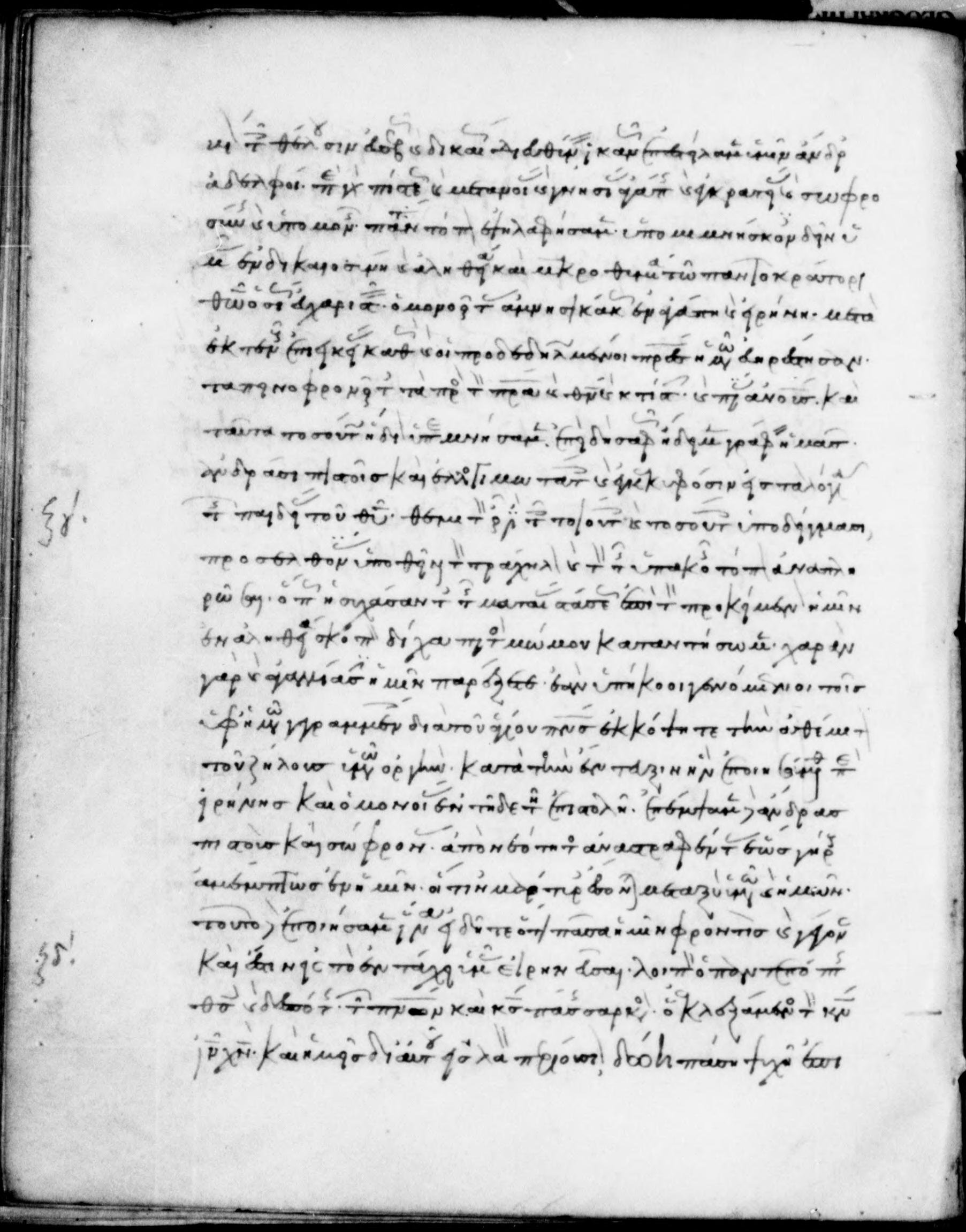
Where on the image
Codex Hierosolymitanus 54 fol. 69r (LoC microfilm frame 71, right page), checked on the image: the page opens 'ἀλλὰ καθάρισον ἡμᾶς τὸν καθαρισμὸν τῆς σῆς ἀληθείας' (1 Clem 60.2); Codex Hierosolymitanus 54 fol. 69v (LoC microfilm frame 72, left page), checked on the image: the page opens '[θέλουσιν] εὐσεβῶς καὶ δικαίως διευθύνειν, ἱκανῶς ἐπεστείλαμεν ὑμῖν, ἄνδρες ἀδελφοί' (1 Clem 62.1); the next page, fol. 70r, opens 'ἐπικεκλημένῃ τὸ μεγαλοπρεπὲς καὶ ἅγιον ὄνομα αὐτοῦ' (1 Clem 64.1). This chapter is lost from Codex Alexandrinus (a missing leaf between fol. 167v and 168r) and is shown on Hierosolymitanus 54. The Greek shown is Lake's edited text (1912), not a transcription of the manuscript page.
1Περὶ μὲν τῶν ἀνηκόντων τῇ θρησκείᾳ ἡμῶν καὶ τῶν ὠφελιμωτάτων εἰς ἐνάρετον βίον τοῖς θέλουσιν εὐσεβῶς καὶ δικαίως διευθύνειν, ἱκανῶς ἐπεστείλαμεν ὑμῖν, ἄνδρες ἀδελφοί. 2περὶ γὰρ πίστεως καὶ μετανοίας καὶ γνησίας ἀγάπης καὶ ἐγκρατείας καὶ σωφροσύνης καὶ ὑπομονῆς πάντα τόπον ἐψηλαφήσαμεν, ὑπομιμνήσκοντες δεῖν ὑμᾶς ἐν δικαιοσύνῃ καὶ ἀληθείᾳ καὶ μακροθυμίᾳ τῷ παντοκράτορι θεῷ ὁσίως εὐαρεστεῖν, ὁμονοοῦντας ἀμνησικάκως ἐν ἀγάπῃ καὶ εἰρήνῃ μετὰ ἐκτενοῦς ἐπιεικείας, καθὼς καὶ οἱ προδεδηλωμένοι πατέρες ἡμῶν εὐηρέστησαν ταπεινοφρονοῦντες τὰ πρὸς τὸν πατέρα καὶ κτίστην θεὸν καὶ πάντας ἀνθρώπους. 3καὶ ταῦτα τοσούτῳ ἥδιον ὑπεμνήσαμεν, ἐπειδὴ σαφῶς ᾔδειμεν γράφειν ἡμᾶς ἀνδράσιν πιστοῖς καὶ ἐλλογιμωτάτοις καὶ ἐγκεκυφόσιν εἰς τὰ λόγια τῆς παιδείας τοῦ θεοῦ.
1As touching those things which befit our religion and are most useful for a virtuous life to such as would guide [their steps] in holiness and righteousness, we have written fully unto you, brethren. 2For concerning faith and repentance and genuine love and temperance and sobriety and patience we have handled every argument, putting you in remembrance, that ye ought to please Almighty God in righteousness and truth and long suffering with holiness, laying aside malice and pursuing concord in love and peace, being instant in gentleness; even as our fathers, of whom we spake before, pleased Him, being lowly-minded towards their Father and God and Creator and towards all men. 3And we have put you in mind of these things the more gladly, since we knew well that we were writing to men who are faithful and highly accounted and have diligently searched into the oracles of the teaching of God.
Where on the image
Codex Hierosolymitanus 54 fol. 69v (LoC microfilm frame 72, left page), checked on the image: the page opens '[θέλουσιν] εὐσεβῶς καὶ δικαίως διευθύνειν, ἱκανῶς ἐπεστείλαμεν ὑμῖν, ἄνδρες ἀδελφοί' (1 Clem 62.1); the next page, fol. 70r, opens 'ἐπικεκλημένῃ τὸ μεγαλοπρεπὲς καὶ ἅγιον ὄνομα αὐτοῦ' (1 Clem 64.1). This chapter is lost from Codex Alexandrinus (a missing leaf between fol. 167v and 168r) and is shown on Hierosolymitanus 54. The Greek shown is Lake's edited text (1912), not a transcription of the manuscript page.
1Θεμιτὸν οὖν ἐστὶν τοῖς τοιούτοις καὶ τοσούτοις ὑποδείγμασιν προσελθόντας ὑποθεῖναι τὸν τράχηλον καὶ τὸν τῆς ὑπακοῆς τόπον ἀναπληρῶσαι, ὅπως ἡσυχάσαντες τῆς ματαίας στάσεως ἐπὶ τὸν προκείμενον ἡμῖν ἐν ἀληθείᾳ σκοπὸν δίχα παντὸς μώμου καταντήσωμεν. 2χαρὰν γὰρ καὶ ἀγαλλίασιν ἡμῖν παρέξετε, ἐὰν ὑπήκοοι γενόμενοι τοῖς ὑφ’ ἡμῶν γεγραμμένοις διὰ τοῦ ἁγίου πνεύματος ἐκκόψητε τὴν ἀθέμιτον τοῦ ζήλους ὑμῶν ὀργὴν κατὰ τὴν ἔντευξιν, ἣν ἐποιησάμεθα περὶ εἰρήνης καὶ ὁμονοίας ἐν τῇδε τῇ ἐπιστολῇ. 3ἐπέμψαμεν δὲ ἄνδρας πιστοὺς καὶ σώφρονας ἀπὸ νεότητος ἀναστραφέντας ἕως γήρους ἀμέμπτως ἐν ἡμῖν, οἵτινες καὶ μάρτυρες ἔσονται μεταξὺ ὑμῶν καὶ ἡμῶν. 4τοῦτο δὲ ἐποιήσαμεν, ἵνα εἰδῆτε, ὅτι πᾶσα ἡμῖν φροντὶς καὶ γέγονεν καὶ ἔστιν εἰς τὸ ἐν τάχει ὑμᾶς εἰρηνεῦσαι.
1Therefore it is right for us to give heed to so great and so many examples and to submit the neck and occupying the place of obedience to take our side with them that are the leaders of our souls, that ceasing from this foolish dissension we may attain unto the goal which lieth before us in truthfulness, keeping aloof from every fault. 2For ye will give us great joy and gladness, if ye render obedience unto the things written by us through the Holy Spirit, and root out the unrighteous anger of your jealousy, according to the entreaty which we have made for peace and concord in this letter. 3And we have also sent faithful and prudent men that have walked among us from youth unto old age unblameably, who shall also be witnesses between you and us. 4And this we have done that ye might know that we have had, and still have, every solicitude that ye should be speedily at peace.
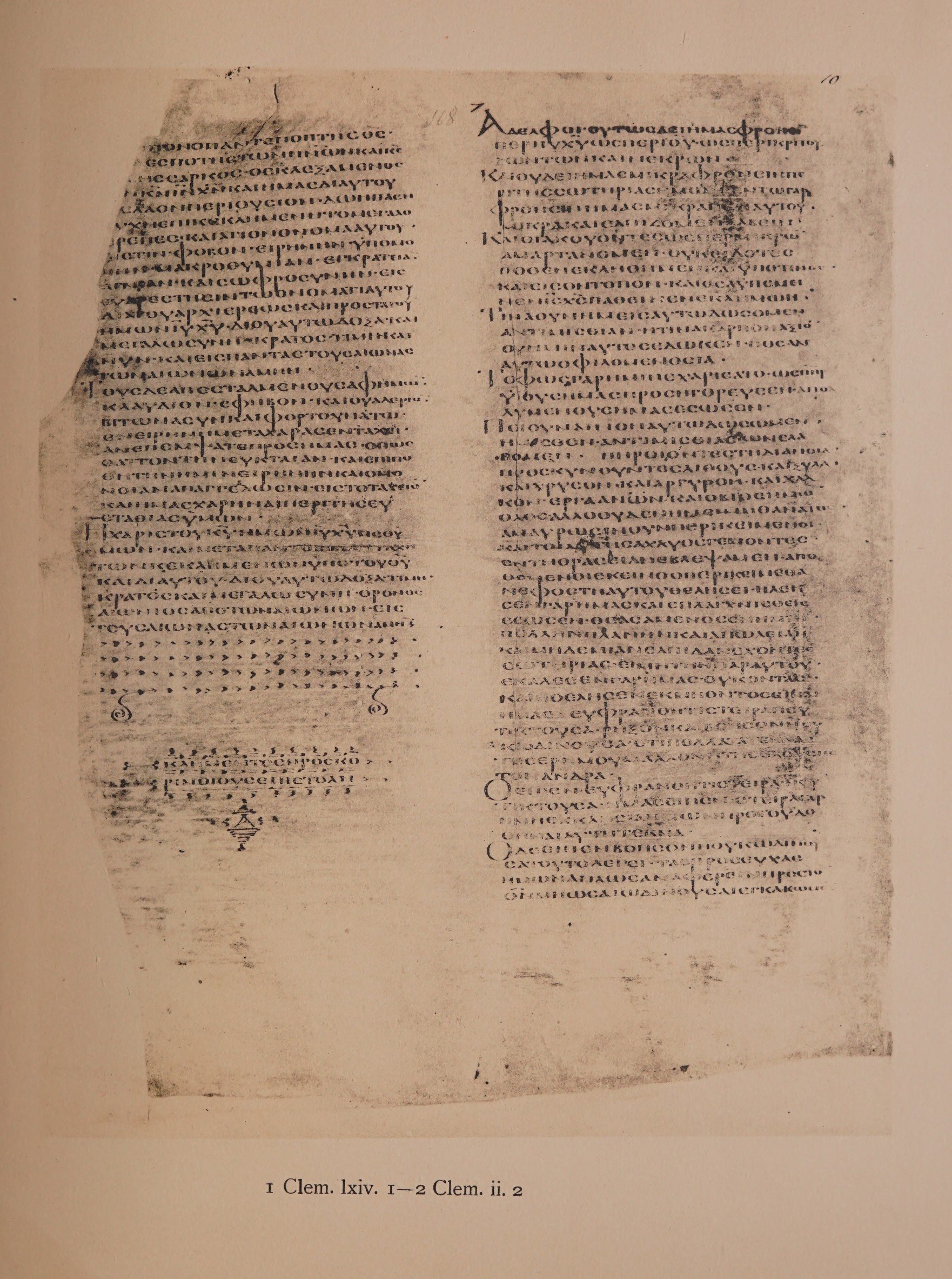
Where on the image
Codex Alexandrinus fol. 168r (1909 facsimile, scan leaf 299; caption printed under the plate: '1 Clem. lxiv. 1-2 Clem. ii. 2'). The Greek shown is Lake's edited text (1912), not a transcription of the manuscript page.
1Λοιπὸν ὁ παντεπόπτης θεὸς καὶ δεσπότης τῶν πνευμάτων καὶ κύριος πάσης σαρκός, ὁ ἐκλεξάμενος τὸν κύριον Ἰησοῦν Χριστὸν καὶ ἡμᾶς δι’ αὐτοῦ εἰς λαὸν περιούσιον, δῴη πάσῃ ψυχῇ ἐπικεκλημένῃ τὸ μεγαλοπρεπὲς καὶ ἅγιον ὄνομα αὐτοῦ πίστιν, φόβον, εἰρήνην, ὑπομονὴν καὶ μακροθυμίαν, ἐγκράτειαν, ἁγνείαν, σωφροσύνην, εἰς εὐαρέστησιν τῷ ὀνόματι αὐτοῦ διὰ τοῦ ἀρχιερέως καὶ προστάτου ἡμῶν Ἰησοῦ Χριστοῦ, δι’ οὗ αὐτῷ δόξα καὶ μεγαλωσύνη, κράτος καὶ τιμή, καὶ νῦν καὶ εἰς πάντας τοῦς αἰῶνας τῶν αἰώνων. ἀμήν.
1Finally may the All seeing God and Master of spirits and Lord of all flesh, who chose the Lord Jesus Christ, and us through Him for a peculiar people, grant unto every soul that is called after His excellent and holy Name faith, fear, peace, patience, long-suffering, temperance, chastity and soberness, that they may be well pleasing unto His Name through our High priest and Guardian Jesus Christ, through whom unto Him be glory and majesty, might and honour, both now and for ever and ever. Amen.
Where on the image
Codex Alexandrinus fol. 168r (1909 facsimile, scan leaf 299; caption printed under the plate: '1 Clem. lxiv. 1-2 Clem. ii. 2'). The Greek shown is Lake's edited text (1912), not a transcription of the manuscript page.
1Τοὺς δὲ ἀπεσταλμένους ἀφ’ ἡμῶν Κλαύδιον Ἔφηβον καὶ Οὐαλέριον Βίτωνα σὺν καὶ Φορτουνάτῳ ἐν εἰρήνῃ μετὰ χαρᾶς ἐν τάχει ἀναπέμψατε πρὸς ἡμᾶς, ὅπως θᾶττον τὴν εὐκταίαν καὶ ἐπιποθήτην ἡμῖν εἰρήνην καὶ ὁμόνοιαν ἀπαγγέλλωσιν, εἰς τὸ τάχιον καὶ ἡμᾶς χαρῆναι περὶ τῆς εὐσταθείας ὑμῶν. 2Ἡ χάρις τοῦ κυρίου ἡμῶν Ἰησοῦ Χριστοῦ μεθ’ ὑμῶν καὶ μετὰ πάντων πανταχῆ τῶν κεκλημένων ὑπὸ τοῦ θεοῦ δι’ αὐτοῦ, δι’ οὗ αὐτῷ δόξα, τιμή, κράτος καὶ μεγαλωσύνη, θρόνος αἰώνιος, ἀπὸ τῶν αἰώνων εἰς τοὺς αἰῶνας τῶν αἰώνων. ἀμήν. Ἐπιστολὴ τῶν Ῥωμαίων πρὸς τοὺς Κορινθίους.
1Now send ye back speedily unto us our messengers Claudius Ephebus and Valerius Bito, together with Fortunatus also, in peace and with joy, to the end that they may the more quickly report the peace and concord which is prayed for and earnestly desired by us, that we also may the more speedily rejoice over your good order. 2The grace of our Lord Jesus Christ be with you and with all men in all places who have been called by God and through Him, through whom be glory and honour, power and greatness and eternal dominion, unto Him, from the ages past and for ever and ever. Amen.
Notes
- Greek: Kirsopp Lake, The Apostolic Fathers I (Loeb Classical Library, 1912), digital text by First1KGreek (tlg1271.tlg001, CC BY-SA 4.0). Lake's footnotes and scripture references are not shown. Elided words, which the digital text encodes with stray accent characters (e.g. 'δἰ', 'παῤ', 'καθ̓'), are written with an apostrophe as Lake prints them, and the digital text's colon is shown as the Greek raised dot.
- English: J. B. Lightfoot, The Apostolic Fathers (1891), as transcribed at earlychristianwritings.com; Lightfoot's italics (scripture quotations) are kept. Lightfoot translated his own Greek text, which differs from Lake's in places, and his verse numbers differ from Lake's in a few chapters.
- The whole digital Greek text was proofread against the printed pages of Lake 1912 (archive.org theapostolicfath00unknuoft): every page was read by OCR and compared word by word with the digital text, and every difference in letters, accents, breathings and punctuation was checked on the page image. These 85 errors of the digital text were corrected to the printed reading: 4.11 'ʼΛαρὼν' to 'Ἀαρὼν'; 32.4 'ʽ??ʼ' to 'ὁ'; 0.1 'Ῥώμην τῆ ἐκκλησίᾳ' to 'Ῥώμην τῇ ἐκκλησίᾳ'; 2.1 'μᾶλλον ἦ ὑποτάσσοντες' to 'μᾶλλον ἢ ὑποτάσσοντες'; 2.1 'ἥτε' to 'ἦτε'; 2.3 'ἵλέως' to 'ἱλέως'; 3.4 'δι’ οὖ καὶ' to 'δι’ οὗ καὶ'; 4.5 'σὲ ή ἀποστροφὴ' to 'σὲ ἡ ἀποστροφὴ'; 4.10 'Λἰγύπτιον' to 'Αἰγύπτιον'; 5.4 'Πέτρον, ὅς' to 'Πέτρον, ὃς'; 7.5 'ἔδωκεν ὀ δεσπότης' to 'ἔδωκεν ὁ δεσπότης'; 8.1 'μετανοίας ἐλάλησαν.' to 'μετανοίας ἐλάλησαν,'; 10.4 'τόπου, οὖ νῦν' to 'τόπου, οὗ νῦν'; 13.1 'ἀλλ’ ἡ ὁ καυχώμενος' to 'ἀλλ’ ἢ ὁ καυχώμενος'; 14.1 'τῷ θεῷ ἡ τοῖς' to 'τῷ θεῷ ἢ τοῖς'; 14.4 'ἐπ αὐτῆς' to 'ἐπ’ αὐτῆς'; 15.5 'χείηλ' to 'χείλη'; 16.3 'Κύριε. τίς' to 'Κύριε, τίς'; 16.17 'ὁρᾶτε, ἅνδρες' to 'ὁρᾶτε, ἄνδρες'; 17.5 'Μωυσῆς' to 'Μωϋσῆς'; 17.5 'Λἴγυπτον' to 'Αἴγυπτον'; 18.4 'λόγοις σου. καὶ' to 'λόγοις σου, καὶ'; 18.12 'σωτηρίου σου. καὶ' to 'σωτηρίου σου, καὶ'; 18.16 'ἠθέλησας θυσίαν. ἔδωκα' to 'ἠθέλησας θυσίαν, ἔδωκα'; 21.3 'ἴδωμεν. πῶς' to 'ἴδωμεν, πῶς'; 23.4 'ὧ ἀνόητοι' to 'ὦ ἀνόητοι'; 24.2 'ἴδωμεν, ἀγαπητοί. τὴν' to 'ἴδωμεν, ἀγαπητοί, τὴν'; 28.1 'αὐτοῦσκεπασθῶμεν' to 'αὐτοῦ σκεπασθῶμεν'; 28.3 'τῆς γῆς. ἐκεῖ' to 'τῆς γῆς, ἐκεῖ'; 30.1 'Αγίου' to 'Ἁγίου'; 32.4 'ἔργων ὦν κατειργασάμεθα' to 'ἔργων ὧν κατειργασάμεθα'; 32.4 'δι’ ἦς πάντας' to 'δι’ ἧς πάντας'; 33.1 'προθυμίας πᾶς ἔργον' to 'προθυμίας πᾶν ἔργον'; 34.1 'ἔργου αὐτοῦ, ὁ' to 'ἔργου αὐτοῦ. ὁ'; 34.8 'καὶ οὕς οὐκ' to 'καὶ οὖς οὐκ'; 35.6 'ἀλλά καὶ' to 'ἀλλὰ καὶ'; 35.8 'καὶ ή γλῶσσα' to 'καὶ ἡ γλῶσσα'; 35.8 'ἐθεώρεις κλέπτην. συνέτρεχες' to 'ἐθεώρεις κλέπτην, συνέτρεχες'; 35.11 'τοῦ θεοῦ. μήποτε' to 'τοῦ θεοῦ, μήποτε'; 36.1 'ἐν ᾖ εὕρομεν' to 'ἐν ᾗ εὕρομεν'; 36.2 'ὃς ὦν ἀπαύγασμα' to 'ὃς ὢν ἀπαύγασμα'; 36.5 'Κάθον' to 'Κάθου'; 37.1 'προστώγμασιν' to 'προστάγμασιν'; 39.1 'Ἅφρονες' to 'Ἄφρονες'; 39.7 'ἤ εἴ τινα' to 'ἢ εἴ τινα'; 39.7 'ἀναιρεῖ ὀργή. πεπλανημένον' to 'ἀναιρεῖ ὀργή, πεπλανημένον'; 40.1 'θείας γνώσεως. πάντα' to 'θείας γνώσεως, πάντα'; 40.3 'αὐτοῦ βουλήσει. ἵν’' to 'αὐτοῦ βουλήσει, ἵν’'; 40.5 'λαῖκοῖς' to 'λαϊκοῖς'; 42.3 'μέλλειν ἔρχεσθαι,' to 'μέλλειν ἔρχεσθαι.'; 43.4 'ἦς ἂν φυλῆς' to 'ἧς ἂν φυλῆς'; 43.4 'Ἅνδρες' to 'Ἄνδρες'; 43.6 'ᾦ ἡ δόξα' to 'ᾧ ἡ δόξα'; 44.2 'ἅνδρες' to 'ἄνδρες'; 44.2 'δεδοκιμασμὲνοι' to 'δεδοκιμασμένοι'; 44.2 'μπταξὺ' to 'μεταξὺ'; 44.3 'συνενδοκησάσης' to 'συνευδοκησάσης'; 46.3 'ἀνδρὸς ἀθῷον' to 'ἀνδρὸς ἀθῴου'; 46.3 'ἐκλεκτὸς ἔσῃ. καὶ' to 'ἐκλεκτὸς ἔσῃ, καὶ'; 46.6 'ἔνα Χριστὸν' to 'ἕνα Χριστὸν'; 46.8 'ἦ ἕνα' to 'ἢ ἕνα'; 46.8 'κρεῖττον ἢν' to 'κρεῖττον ἦν'; 46.8 'καταπον τισθῆναι' to 'καταποντισθῆναι'; 46.8 'μου σκανδαλίσαι κρεῖττον' to 'μου σκανδαλίσαι· κρεῖττον'; 46.9 'ἐπίμονος ἀμῶν' to 'ἐπίμονος ὑμῶν'; 48.1 'προσπεσωμεν' to 'προσπέσωμεν'; 50.4 'ἕως οὖ' to 'ἕως οὗ'; 50.6 'ὦν ἀφέθησαν' to 'ὧν ἀφέθησαν'; 50.6 'ἀνήρ, οὖ οὐ' to 'ἀνήρ, οὗ οὐ'; 51.5 'Μωῦσέως' to 'Μωϋσέως'; 53.2 'Μωῦσέως' to 'Μωϋσέως'; 55.2 'εἰς δουλείαν. καὶ' to 'εἰς δουλείαν, καὶ'; 56.15 'καθ’ ὤραν' to 'καθ’ ὥραν'; 57.7 'ἀνθ’ ὦν' to 'ἀνθ’ ὧν'; 58.2 'δι’ οὖ ἐστὶν' to 'δι’ οὗ ἐστὶν'; 59.3 'ἐν ἀγίοις' to 'ἐν ἁγίοις'; 59.4 'τὰ ἔθνη. ὅτι' to 'τὰ ἔθνη, ὅτι'; 61.1 'οἶς δός' to 'οἷς δός'; 61.1 'ὁμόνοιαν, εὐστάθειαν. εἰς' to 'ὁμόνοιαν, εὐστάθειαν, εἰς'; 63.2 'τὴν ἔντευξιν. ἣν' to 'τὴν ἔντευξιν, ἣν'; 63.4 'τὸ ὲν τάχει' to 'τὸ ἐν τάχει'; 63.4 'ἵνα εἰδῆτε. ὅτι' to 'ἵνα εἰδῆτε, ὅτι'; 64.1 'ό ἐκλεξάμενος' to 'ὁ ἐκλεξάμενος'; 64.1 'τῶν αἰώνων ἀμήν.' to 'τῶν αἰώνων. ἀμήν.'; 65.2 'δι’ αὐτοῦ. δι’' to 'δι’ αὐτοῦ, δι’'.
- 1 Clem 42.2 'Χριστος', 44.2 'δεδωκασιν', 61.1 'δεσποτα', 51.1 'δια', 23.1 'διανοιᾳ', 50.1 'μεγα' and 'ἀγαπητοι', 48.1 'Ἐξαρωμεν', 36.6 'ἀντιτασσομενοι', 35.5 'ἐστηριγμενη' are printed without an accent in Lake (worn type) and are kept as printed.
- English proofreading: the earlychristianwritings.com transcription was compared word by word with Lightfoot's printed text (1891 first printing, archive.org apostolicfathers00lighuoft; 1907 reprint, archive.org cu31924024254744, whose page images were used to check each difference; where the reprint differs from 1891, the 1891 wording is kept). Lightfoot's British spellings, which the transcription modernises, are restored (honour, neighbour, Saviour, stedfast, marvellous, labour, favour, fulfil, unblameable and the like), and these 59 readings of the transcription were corrected to the print: 2:8 'written on the tablets of your hearts' to 'written on the tables of your hearts'; 5:4 'endured not one not one but many' to 'endured not one nor two but many'; 6:2 'insults as Danaids and Dircae,' to 'insults †as Danaids and Dircæ†,'; 11:1 'having thus fore shown that' to 'having thus foreshown that'; 12:4 'and are sojourning on the way' to 'and are journeying on the way'; 14:5 'he was not; and sought out his place' to 'he was not; and I sought out his place'; 15:1 'them that practice peace' to 'them that practise peace'; 16:11 'shall see along lived seed' to 'shall see a long-lived seed'; 17:4 'No man from filth;' to 'No man is clean from filth;'; 17:5 'the torments which befell them' to 'the torments which befel them'; 18:11 'Deliver me from blood guiltiness' to 'Deliver me from bloodguiltiness'; 20:6 'into it's reservoirs' to 'into its reservoirs'; 20:10 'and the ever flowing fountains' to 'and the everflowing fountains'; 22:1 'Holy Spirit thus invite thus:' to 'Holy Spirit thus inviteth us:'; 23:2 'Therefore let us not be double-minded' to 'Wherefore let us not be double-minded'; 25:2 'named the phoenix.' to 'named the phœnix.'; 25:4 'and in the daytime in the sight' to 'and in the day time in the sight'; 26:3 'And Thou shall raise' to 'And Thou shalt raise'; 28:1 'that we maybe shielded' to 'that we may be shielded'; 29:3 'taketh the first fruits of his' to 'taketh the firstfruits of his'; 30:3 'being lowlyminded and temperate' to 'being lowly-minded and temperate'; 30:3 'from all back biting and' to 'from all backbiting and'; 33:1 'allow this to befall us' to 'allow this to befal us'; 33:7 'adorned Himself with worlds rejoiced' to 'adorned Himself with works rejoiced'; 34:2 'zealous unto well doing' to 'zealous unto well-doing'; 36:3 'His ministers aflame of fire' to 'His ministers a flame of fire'; 37:5 'the whole body maybe saved' to 'the whole body may be saved'; 39:6 'He breathed on them' to 'He breathed upon them'; 39:7 'slayeth him that has gone astray' to 'slayeth him that is gone astray'; 41:2 'through the high priest and the afore said ministers' to 'through the high-priest and the aforesaid ministers'; 42:4 'appointed their firstfruits,' to 'appointed their first-fruits,'; 43:6 'to whom he the glory' to 'to whom be the glory'; 46:8 'rather than that at he should offend' to 'rather than that he should offend'; 46:8 'that a millstone were hanged about him, and be cast' to 'that a mill-stone were hanged about him, and he cast'; 48:2 'enter in thereby and preach the Lord' to 'enter in thereby and praise the Lord'; 49:4 'The height, where unto love' to 'The height, whereunto love'; 50:3 'Mine anger and Mine wrath' to 'Mine anger and My wrath'; 53:2 'whom thou leadest forth' to 'whom thou leddest forth'; 56:10 'the tongue He shall hide thee and thou' to 'the tongue shall He hide thee, and thou'; 57:4 'made My councils of none effect' to 'made My counsels of none effect'; 57:4 'like a whirlwind,' to 'like a whirlwind, or when anguish and beleaguerment come upon you.'; 57:5 'or when ye call upon Me, yet will I not here you. Evil men shall seek me and not find me:' to 'For it shall be, when ye call upon Me, yet will I not hear you. Evil men shall seek Me and shall not find Me:'; 57:5 'give head unto My councils' to 'give heed unto My counsels'; 57:7 'quiet from all fear of all evil' to 'quiet from fear of all evil'; 59:3 'layest low in the insolence of the proud, who settest' to 'layest low the insolence of the proud, who scatterest the imaginings of nations; who settest'; 59:3 'who scanest the works' to 'who scannest the works'; 59:4 'comfort the fainthearted.' to 'comfort the faint-hearted.'; 59:4 'that Thou art the God alone' to 'that Thou art God alone'; 62:2 'being lowly minded toward their' to 'being lowly-minded towards their'; 21:1 'good and well pleasing in His sight' to 'good and well-pleasing in His sight'; 15:3 'they blessed with' to 'They blessed with'; 23:3 'the double-minded, Which doubt' to 'the double-minded, which doubt'; 35:8 'Yet Thou didst hate' to 'Yet thou didst hate'; 35:9 'These things Thou hast done' to 'These things thou hast done'; 36:4 'have begotten thee.' to 'have begotten Thee.'; 56:6 'and he restoreth again' to 'and He restoreth again'; 56:9 'In famine he shall deliver' to 'In famine He shall deliver'; 59:3 '; The Creator and Overseer' to '; the Creator and Overseer'; 61:2 'gentleness with Godliness the power' to 'gentleness with godliness the power'. Punctuation and the hyphens of some compound words (e.g. 'dearly beloved', printed 'dearly-beloved' in places) follow the transcription, which drops some of them.
- Alternative renderings that the English transcription gives in braces are left out of the text: 1 Clem 4:5: This last phrase has also been translated: Be at peace: thine offering returns to thyself, and thou shalt again possess it.
- Codex Alexandrinus lacks 57.7-63.4 (a lost leaf); those chapters are shown on Codex Hierosolymitanus 54.
Cite
Sources
- Source: Codex Alexandrinus (1909 BM facsimile, archive.org) + Codex Hierosolymitanus 54 (LoC microfilm) + Lake 1912 Greek (First1KGreek, CC BY-SA 4.0) + Lightfoot 1891 English (public domain) (holding institution)
- Critical edition: Kirsopp Lake, The Apostolic Fathers I (1912), via First1KGreek
← previous · → next · v cycle view · l back to library