2 Clement (an early Christian sermon), on Codex Alexandrinus
Introduction
2 Clement is a sermon calling its hearers to repentance and self-control, read aloud in an assembly ("I read you an exhortation", 19.1). Manuscripts transmit it after 1 Clement as Clement's second letter to the Corinthians, but it is not a letter and is usually thought to be by another, unknown author of the second century. It is often called the oldest complete Christian sermon after the New Testament.
In Codex Alexandrinus (British Library, Royal MS 1 D. VIII, 5th century) it begins on fol. 168r after the end of 1 Clement and breaks off in 12.5 at the foot of fol. 169v, the last surviving page of the codex. Those pages are shown from the British Museum's 1909 photographic facsimile, each linked by the caption printed beneath the plate. The rest of the sermon (12.5-20.5) is shown on Codex Hierosolymitanus 54 (Jerusalem, 1056), from the Library of Congress microfilm, where the page boundaries were read on the images. The Greek is Kirsopp Lake's edition (1912); the English is J. B. Lightfoot's translation (1891).
How was this verified? (Provenance)
Where on the image
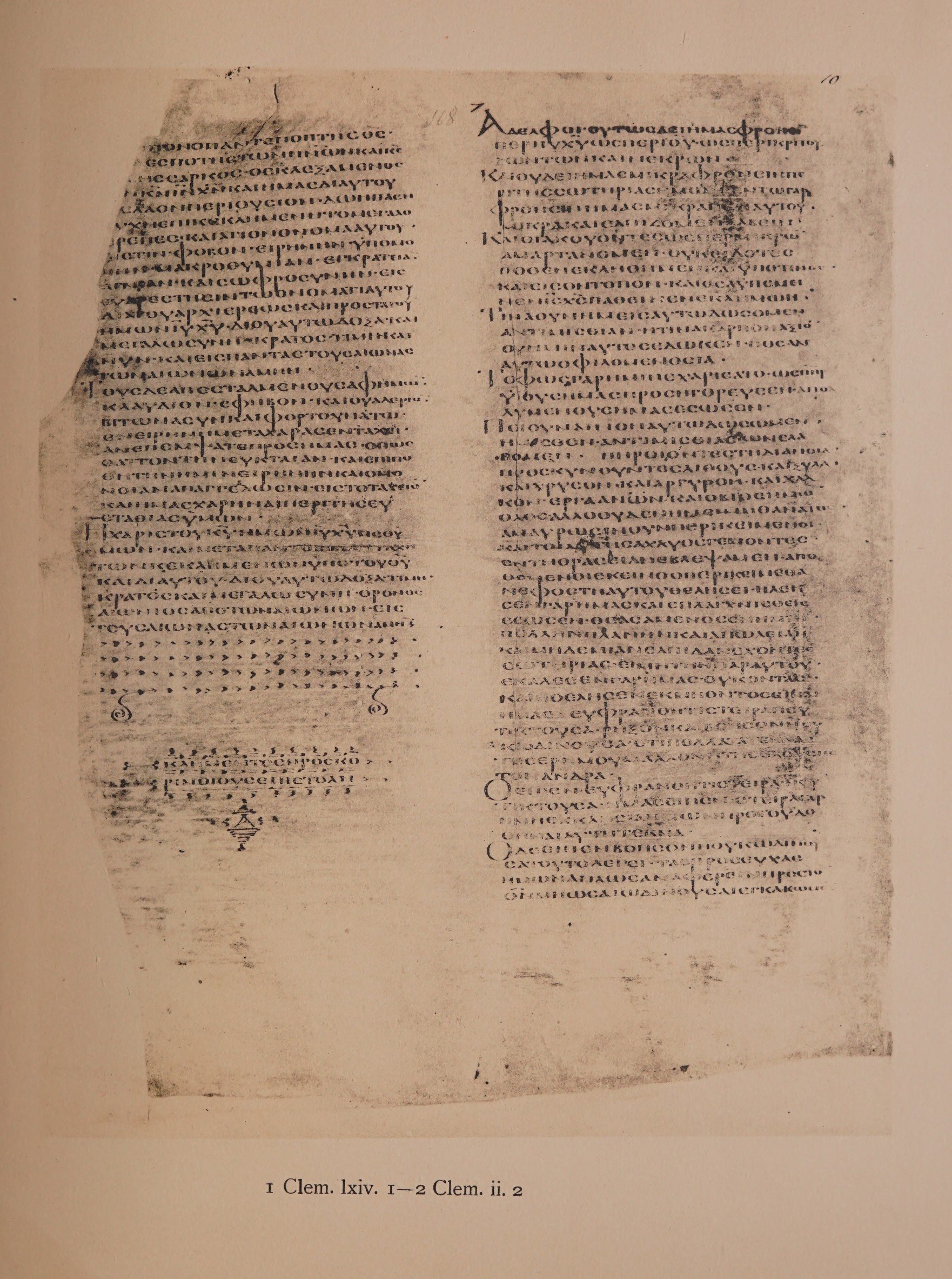
Codex Alexandrinus fol. 168r (1909 facsimile, scan leaf 299; caption printed under the plate: '1 Clem. lxiv. 1-2 Clem. ii. 2'). The Greek shown is Lake's edited text (1912), not a transcription of the manuscript page.
1Ἀδελφοί, οὕτως δεῖ ἡμᾶς φρονεῖν περὶ Ἰησοῦ Χριστοῦ, ὡς περὶ θεοῦ, ὡς περὶ κριτοῦ ζώντων καὶ νεκρῶν· καὶ οὐ δεῖ ἡμᾶς μικρὰ φρονεῖν περὶ τῆς σωτηρίας ἡμῶν. 2ἐν τῷ γὰρ φρονεῖν ἡμᾶς μικρὰ περὶ αὐτοῦ, μικρὰ καὶ ἐλπίζομεν λαβεῖν· καὶ οἱ ἀκούοντες ὡς περὶ μικρῶν ἁμαρτάνουσιν, καὶ ἡμεῖς ἁμαρτάνομεν οὐκ εἰδότες, πόθεν ἐκλήθημεν καὶ ὑπὸ τίνος καὶ εἰς ὃν τόπον, καὶ ὅσα ὑπέμεινεν Ἰησοῦς Χριστὸς παθεῖν ἕνεκα ἡμῶν. 3τίνα οὖν ἡμεῖς αὐτῷ δώσομεν ἀντιμισθίαν, ἢ τίνα καρπὸν ἄξιον οὗ ἡμῖν αὐτὸς ἔδωκεν; πόσα δὲ αὐτῷ ὀφείλομεν ὅσια; 4τὸ φῶς γὰρ ἡμῖν ἐχαρίσατο, ὡς πατὴρ υἱοὺς ἡμᾶς προσηγόρευσεν, ἀπολλυμένους ἡμᾶς ἔσωσεν. 5ποῖον οὖν αἶνον αὐτῷ δώσομεν ἢ μισθὸν ἀντιμισθίας ὧν ἐλάβομεν; 6πηροὶ ὄντες τῇ διανοίᾳ, προσκυνοῦντες λίθους καὶ ξύλα καὶ χρυσὸν καὶ ἄργυρον καὶ χαλκόν, ἔργα ἀνθρώπων· καὶ ὁ βίος ἡμῶν ὅλος ἄλλο οὐδὲν ἦν εἰ μὴ θάνατος. ἀμαύρωσιν οὖν περικείμενοι καὶ τοιαύτης ἀχλύος γέμοντες ἐν τῇ ὁράσει, ἀνεβλέψαμεν ἀποθέμενοι ἐκεῖνο ὃ περικείμεθα νέφος τῇ αὐτοῦ θελήσει. 7ἠλέησεν γὰρ ἡμᾶς καὶ σπλαγχνισθεὶς ἔσωσεν, θεασάμενος ἐν ἡμῖν πολλὴν πλάνην καὶ ἀπώλειαν, καὶ μηδεμίαν ἐλπίδα ἔχοντας σωτηρίας, εἰ μὴ τὴν παρ’ αὐτοῦ. 8ἐκάλεσεν γὰρ ἡμᾶς οὐκ ὄντας καὶ ἠθέλησεν ἐκ μὴ ὄντος εἶναι ἡμᾶς.
1Brethren, we ought so to think of Jesus Christ, as of God, as of the Judge of quick and dead. 2And we ought not to think mean things of our Salvation: for when we think mean things of Him, we expect also to receive mean things. And they that listen as concerning mean things do wrong; and we ourselves do wrong, not knowing whence and by whom and unto what place we were called, and how many things Jesus Christ endured to suffer for our sakes. 3What recompense then shall we give unto Him? or what fruit worthy of His own gift to us? And how many mercies do we owe to Him! 4For He bestowed the light upon us; He spake to us, as a father to his sons; He saved us, when we were perishing. 5What praise then shall we give to Him? or what payment of recompense for those things which we received? 6we who were maimed in our understanding, and worshipped stocks and stones and gold and silver and bronze, the works of men; and our whole life was nothing else but death. While then we were thus wrapped in darkness and oppressed with this thick mist in our vision, we recovered our sight, putting off by His will the cloud wherein we were wrapped. 7For He had mercy on us, and in His compassion saved us, having beheld in us much error and perdition, even when we had no hope of salvation, save that which came from Him. 8For He called us, when we were not, and from not being He willed us to be.
Where on the image
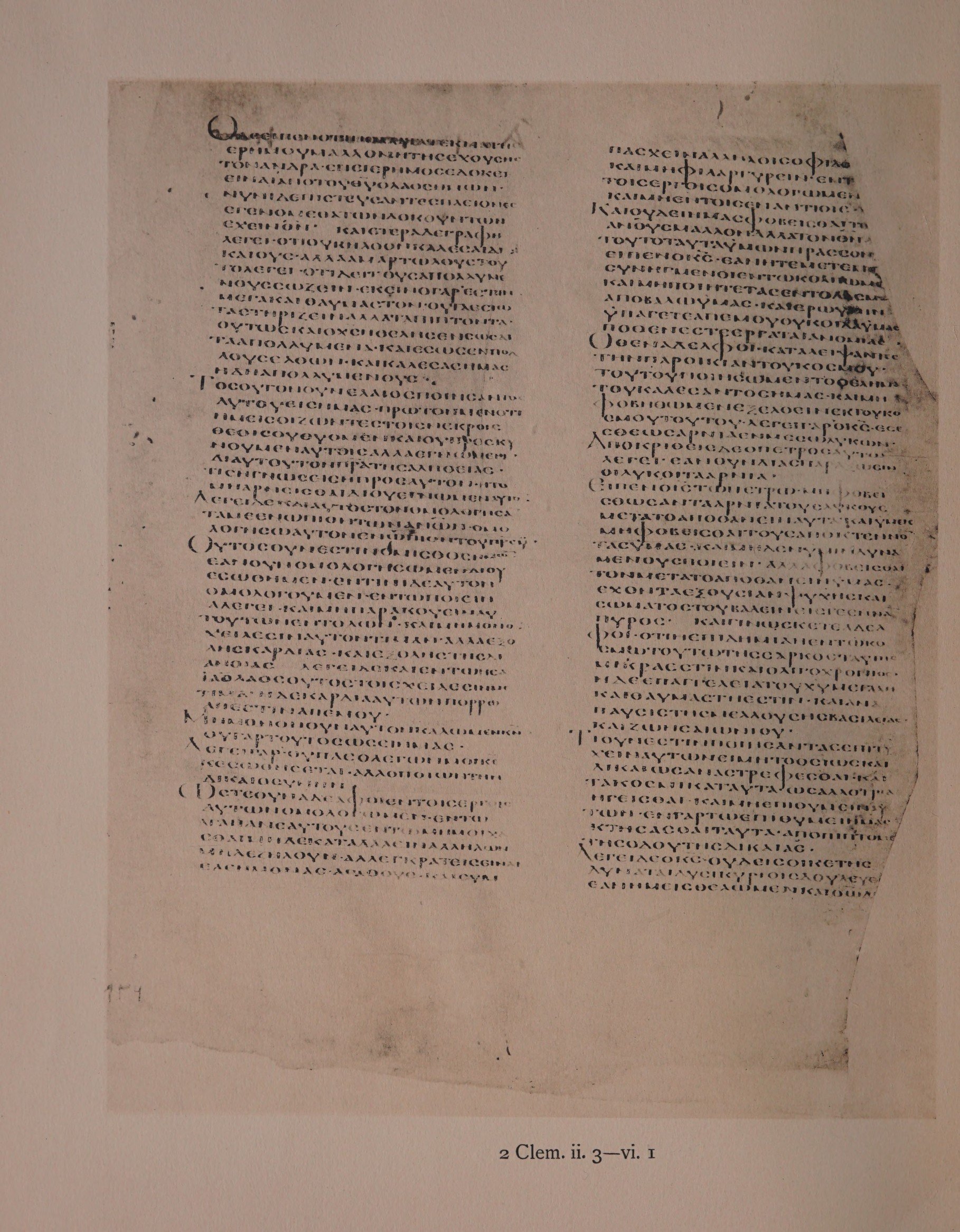
Codex Alexandrinus fol. 168r (1909 facsimile, scan leaf 299; caption printed under the plate: '1 Clem. lxiv. 1-2 Clem. ii. 2'); Codex Alexandrinus fol. 168v (1909 facsimile, scan leaf 300; caption printed under the plate: '2 Clem. ii. 3-vi. 1'). The Greek shown is Lake's edited text (1912), not a transcription of the manuscript page.
1Εὐφράνθητι, στεῖρα ἡ οὐ τίκτουσα, ῥῆξον καὶ βόησον, ἡ οὐκ ὠδίνουσα, ὅτι πολλὰ τὰ τέκνα τῆς ἐρήμου μᾶλλον ἢ τῆς ἐχούσης τὸν ἄνδρα. ὃ εἶπεν· Εὐφράνθητι, στεῖρα ἡ οὐ τίκτουσα, ἡμᾶς εἶπεν· στεῖρα γὰρ ἦν ἡ ἐκκλησία ἡμῶν πρὸ τοῦ δοθῆναι αὐτῇ τέκνα. 2ὃ δὲ εἶπεν· Βόησον, ἡ οὐκ ὠδίνουσα, τοῦτο λέγει· τὰς προσευχὰς ἡμῶν ἁπλῶς ἀναφέρειν πρὸς τὸν θεόν, μὴ ὡς αἱ ὠδίνουσαι ἐγκακῶμεν, 3ὃ δὲ εἶπεν· Ὅτι πολλὰ τὰ τέκνα τῆς ἐρήμου μᾶλλον ἢ τῆς ἐχούσης τὸν ἄνδρα· ἐπεὶ ἔρημος ἐδόκει εἶναι ἀπὸ τοῦ θεοῦ ὁ λαὸς ἡμῶν, νυνὶ δὲ πιστεύσαντες πλείονες ἐγενόμεθα τῶν δοκούντων ἔχειν θεόν. 4καὶ ἑτέρα δὲ γραφὴ λέγει, ὅτι οὐκ ἦλθον καλέσαι δικαίους, ἀλλὰ ἁμαρτωλούς· 5τοῦτο λέγει, ὅτι δεῖ τοὺς ἀπολλυμένους σώζειν. 6ἐκεῖνο γάρ ἐστιν μέγα καὶ θαυμαστὸν οὐ τὰ ἑστῶτα στηρίζειν, ἀλλὰ τὰ πίπτοντα. 7οὕτως καὶ ὁ Χριστὸς ἠθέλησεν σῶσαι τὰ ἀπολλύμενα, καὶ ἔσωσεν πολλούς, ἐλθὼν καὶ καλέσας ἡμᾶς ἤδη ἀπολλυμένους.
1Rejoice, thou barren that bearest not. Break out and cry, thou that travailest not; for more are the children of the desolate than of her that hath the husband. In that He said Rejoice, thou barren that bearest not, He spake of us: for our Church was barren, before that children were given unto her. 2And in that He said, Cry aloud, thou that travailest not, He meaneth this; Let us not, like women in travail, grow weary of offering up our prayers with simplicity to God. 3Again, in that He said, For the children of the desolate are more than of her that hath the husband, He so spake, because our people seemed desolate and forsaken of God, whereas now, having believed, we have become more than those who seemed to have God. 4Again another scripture saith, I came not to call the righteous, but sinners. 5He meaneth this; that it is right to save them that are perishing. 6For this indeed is a great and marvellous work, to establish, not those things which stand, but those which are falling. 7So also Christ willed to save the things which were perishing And He saved many, coming and calling us when we were even now perishing.
Where on the image
Codex Alexandrinus fol. 168v (1909 facsimile, scan leaf 300; caption printed under the plate: '2 Clem. ii. 3-vi. 1'). The Greek shown is Lake's edited text (1912), not a transcription of the manuscript page.
1Τοσοῦτον οὖν ἔλεος ποιήσαντος αὐτοῦ εἰς ἡμᾶς, πρῶτον μέν, ὅτι ἡμεῖς οἱ ζῶντες τοῖς νεκροῖς θεοῖς οὐ θύομεν καὶ οὐ προσκυνοῦμεν αὐτοῖς, ἀλλὰ ἔγνωμεν δι’ αὐτοῦ τὸν πατέρα τῆς ἀληθείας· τίς ἡ γνῶσις ἡ πρὸς αὐτόν, ἢ τὸ μὴ ἀρνεῖσθαι δι’ οὗ ἔγνωμεν αὐτόν; 2λέγει δὲ καὶ αὐτός· Τὸν ὁμολογήσαντά με ἐνώπιον τῶν ἀνθρώπων, ὁμολογήσω αὐτὸν ἐνώπιον τοῦ πατρός μου. 3οὗτος οὖν ἐστὶν ὁ μισθὸς ἡμῶν, ἐὰν οὖν ὁμολογήσωμεν δι’ οὗ ἐσώθημεν. 4ἐν τίνι δὲ αὐτὸν ὁμολογοῦμεν; ἐν τῷ ποιεῖν ἃ λέγει καὶ μὴ παρακούειν αὐτοῦ τῶν ἐντολῶν, καὶ μὴ μόνον χείλεσιν αὐτὸν τιμᾶν, ἀλλὰ ἐξ ὅλης καρδίας καὶ ἐξ ὅλης τῆς διανοίας. 5λέγει δὲ καὶ ἐν τῷ Ἡσαΐᾳ· Ὁ λαὸς οὗτος τοῖς χείλεσίν με τιμᾷ, ἡ δὲ καρδία αὐτῶν πόρρω ἄπεστιν ἀπ’ ἐμοῦ.
1Seeing then that He bestowed so great mercy on us; first of all, that we, who are living, do not sacrifice to these dead gods, neither worship them, but through Him have known the Father of truth. What else is this knowledge to Himward, but not to deny Him through whom we have known Him? 2Yea, He Himself saith, Whoso confesseth Me, Him will I confess before the Father. 3This then is our reward, if verily we shall confess Him through whom we were saved. 4But wherein do we confess Him? When we do that which He saith and are not disobedient unto His commandments, and not only honour Him with our lips, but with our whole heart and with our whole mind. 5Now He saith also in Isaiah, This people honoureth Me with their lips, but their heart is far from Me.
Where on the image
Codex Alexandrinus fol. 168v (1909 facsimile, scan leaf 300; caption printed under the plate: '2 Clem. ii. 3-vi. 1'). The Greek shown is Lake's edited text (1912), not a transcription of the manuscript page.
1Μὴ μόνον οὖν αὐτὸν καλῶμεν κύριον· οὐ γὰρ τοῦτο σώσει ἡμᾶς. 2λέγει γάρ· Οὐ πᾶς ὁ λέγων μοι· Κύριε, κύριε, σωθήσεται, ἀλλ’ ὁ ποιῶν τὴν δικαιοσύνην. 3ὥστε οὖν, ἀδελφοί, ἐν τοῖς ἔργοις αὐτὸν ὁμολογῶμεν, ἐν τῷ ἀγαπᾶν ἑαυτούς, ἐν τῷ μὴ μοιχᾶσθαι μηδὲ καταλαλεῖν ἀλλήλων μηδὲ ζηλοῦν, ἀλλ’ ἐγκρατεῖς εἶναι, ἐλεήμονας, ἀγαθούς· καὶ συμπάσχειν ἀλλήλοις ὀφείλομεν, καὶ μὴ φιλαργυρεῖν. ἐν τούτοις τοῖς ἔργοις ὁμολογῶμεν αὐτὸν καὶ μὴ ἐν τοῖς ἐναντίοις· 4καὶ οὐ δεῖ ἡμᾶς φοβεῖσθαι τοὺς ἀνθρώπους μᾶλλον, ἀλλὰ τὸν θεόν. 5διὰ τοῦτο, ταῦτα ὑμῶν πρασσόντων, εἶπεν ὁ κύριος· Ἐὰν ἦτε μετ’ ἐμοῦ συνηγμένοι ἐν τῷ κόλπῳ μου καὶ μὴ ποιῆτε τὰς ἐντολάς μου, ἀποβαλῶ ὑμᾶς καὶ ἐρῶ ὑμῖν· Ὑπάγετε ἀπ’ ἐμοῦ, οὐκ οἶδα ὑμᾶς, πόθεν ἐστέ, ἐργάται ἀνομίας.
1Let us therefore not only call Him Lord, for this will not save us: 2for He saith, Not every one that saith unto Me, Lord, Lord, shall be saved, but he that doeth righteousness. 3So then, brethren, let us confess Him in our works, by loving one another, by not committing adultery nor speaking evil one against another nor envying, but being temperate, merciful, kindly. And we ought to have fellow-feeling one with another and not to be covetous. By these works let us confess Him, and not by the contrary. 4And we ought not rather to fear men but God. 5For this cause, if ye do these things, the Lord said, Though ye be gathered together with Me in My bosom, and do not My commandments, I will cast you away and will say unto you, Depart from Me, I know you not whence ye are, ye workers of iniquity.
Where on the image
Codex Alexandrinus fol. 168v (1909 facsimile, scan leaf 300; caption printed under the plate: '2 Clem. ii. 3-vi. 1'). The Greek shown is Lake's edited text (1912), not a transcription of the manuscript page.
1Ὅθεν, ἀδελφοί, καταλείψαντες τὴν παροικίαν τοῦ κόσμου τούτου ποιήσωμεν τὸ θέλημα τοῦ καλέσαντος ἡμᾶς, καὶ μὴ φοβηθῶμεν ἐξελθεῖν ἐκ τοῦ κόσμου τούτου. 2λέγει γὰρ ὁ κύριος Ἔσεσθε ὡς ἀρνία ἐν μέσῳ λύκων. 3ἀποκριθεὶς δὲ ὁ Πέτρος αὐτῷ λέγει· Ἐὰν οὖν διασπαράξωσιν οἱ λύκοι τὰ ἀρνία; 4εἶπεν ὁ Ἰησοῦς τῷ Πέτρῳ· Μὴ φοβείσθωσαν τὰ ἀρνία τοὺς λύκους μετὰ τὸ ἀποθανεῖν αὐτά· καὶ ὑμεῖς μὴ φοβεῖσθε τοὺς ἀποκτέννοντας ὑμᾶς καὶ μηδὲν ὑμῖν δυναμένους ποιεῖν, ἀλλὰ φοβεῖσθε τὸν μετὰ τὸ ἀποθανεῖν ὑμᾶς ἔχοντα ἐξουσίαν ψυχῆς καὶ σώματος τοῦ βαλεῖν εἰς γέενναν πυρός. 5καὶ γινώσκετε, ἀδελφοί, ὅτι ἡ ἐπιδημία ἡ ἐν τῷ κόσμῳ τούτῳ τῆς σαρκὸς ταύτης μικρά ἐστιν καὶ ὀλιγοχρόνιος, ἡ δὲ ἐπαγγελία τοῦ Χριστοῦ μεγάλη καὶ θαυμαστή ἐστιν, καὶ ἀνάπαυσις τῆς μελλούσης βασιλείας καὶ ζωῆς αἰωνίου. 6τί οὖν ἐστὶν ποιήσαντας ἐπιτυχεῖν αὐτῶν, εἰ μὴ τὸ ὁσίως καὶ δικαίως ἀναστρέφεσθαι καὶ τὰ κοσμικὰ ταῦτα ὡς ἀλλότρια ἡγεῖσθαι καὶ μὴ ἐπιθυμεῖν αὐτῶν; 7ἐν γὰρ τῷ ἐπιθυμεῖν ἡμᾶς κτήσασθαι ταῦτα ἀποπίπτομεν τῆς ὁδοῦ τῆς δικαίας.
1Wherefore, brethren, let us forsake our sojourn in this world and do the will of Him that called us, and let us not be afraid to depart out of this world. 2For the Lord saith, Ye shall be as lambs in the midst of wolves. 3But Peter answered and said unto Him, What then, if the wolves should tear the lambs? 4Jesus said unto Peter, Let not the lambs fear the wolves after they are dead; and ye also, fear ye not them that kill you and are not able to do anything to you; but fear Him that after ye are dead hath power over soul and body, to cast them into the gehenna of fire. 5And ye know, brethren, that the sojourn of this flesh in this world is mean and for a short time, but the promise of Christ is great and marvellous, even the rest of the kingdom that shall be and of life eternal. 6What then can we do to obtain them, but walk in holiness and righteousness, and consider these worldly things as alien to us, and not desire them? 7For when we desire to obtain these things we fall away from the righteous path.
Where on the image
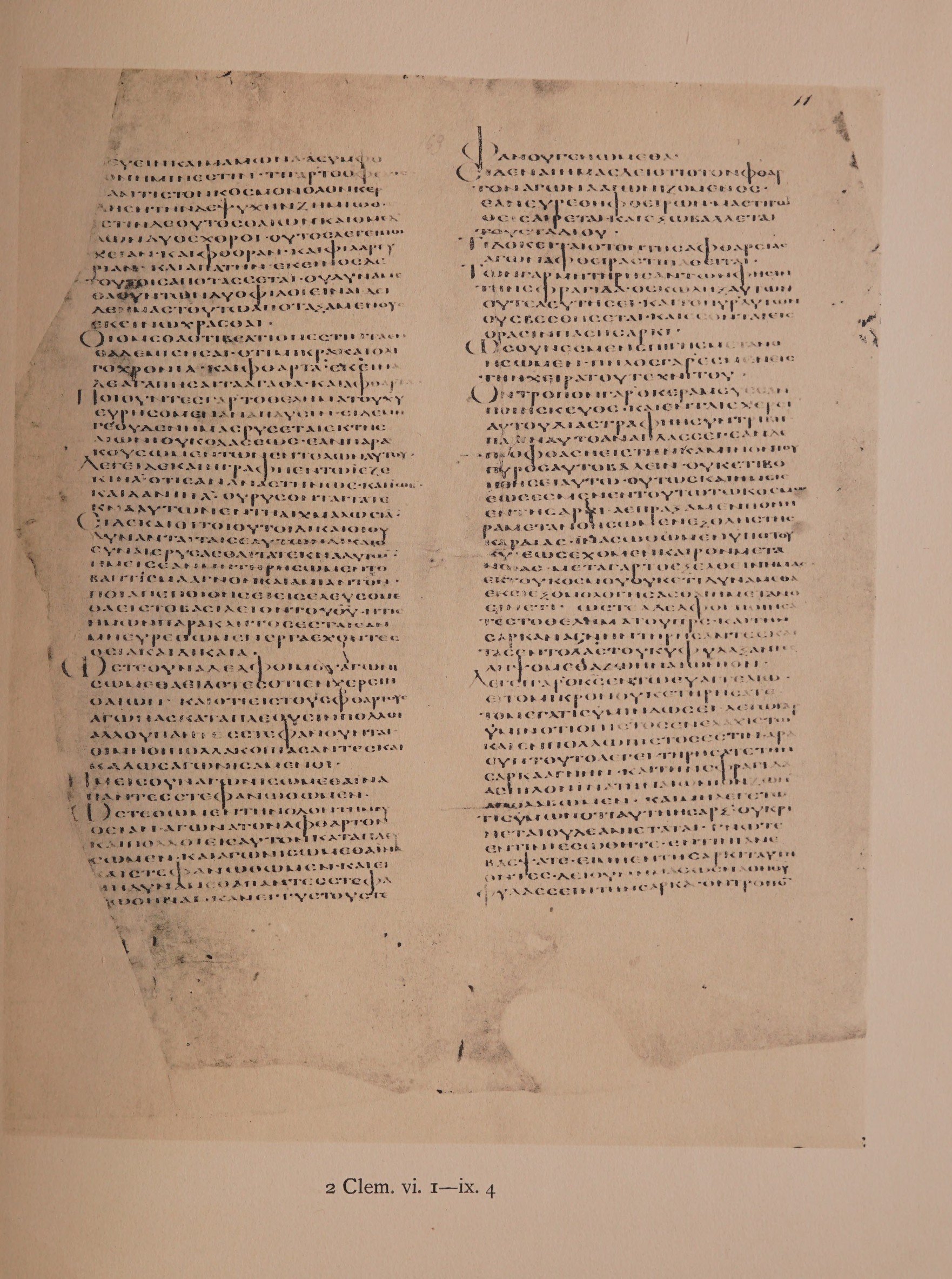
Codex Alexandrinus fol. 168v (1909 facsimile, scan leaf 300; caption printed under the plate: '2 Clem. ii. 3-vi. 1'); Codex Alexandrinus fol. 169r (1909 facsimile, scan leaf 301; caption printed under the plate: '2 Clem. vi. 1-ix. 4'). The Greek shown is Lake's edited text (1912), not a transcription of the manuscript page.
1Λέγει δὲ ὁ κύριος· Οὐδεὶς οἰκέτης δύναται δυσὶ κυρίοις δουλεύειν. ἐὰν ἡμεῖς θέλωμεν καὶ θεῷ δουλεύειν καὶ μαμωνᾷ, ἀσύμφορον ἡμῖν ἐστίν. 2τί γὰρ τὸ ὄφελος, ἐάν τις τὸν κόσμον ὅλον κερδήσῃ, τὴν δὲ ψυχὴν ζημιωθῇ; 3ἔστιν δὲ οὗτος ὁ αἰὼν καὶ ὁ μέλλων δύο ἐχθροί. 4οὗτος λέγει μοιχείαν καὶ φθορὰν καὶ φιλαργυρίαν καὶ ἀπάτην, ἐκεῖνος δὲ τούτοις ἀποτάσσεται. 5οὐ δυνάμεθα οὖν τῶν δύο φίλοι εἶναι· δεῖ δὲ ἡμᾶς τούτῳ ἀποταξαμένους ἐκείνῳ χρᾶσθαι 6οἰόμεθα. ὅτι βέλτιόν ἐστιν τὰ ἐνθάδε μισῆσαι, ὅτι μικρὰ καὶ ὀλιγοχρόνια καὶ φθαρτά, ἐκεῖνα δὲ ἀγαπῆσαι, τὰ ἀγαθὰ τὰ ἄφθαρτα. 7ποιοῦντες γὰρ τὸ θέλημα τοῦ Χριστοῦ εὑρήσομεν ἀνάπαυσιν· εἰ δὲ μήγε, οὐδὲν ἡμᾶς ῥύσεται ἐκ τῆς αἰωνίου κολάσεως, ἐὰν παρακούσωμεν τῶν ἐντολῶν αὐτοῦ. 8λέγει δὲ καὶ ἡ γραφὴ ἐν τῷ Ἰεζεκιήλ. ὅτι ἐὰν ἀναστῇ Νῶε καὶ Ἰὼβ καὶ Δανιήλ, οὐ ῥύσονται τὰ τέκνα αὐτῶν ἐν τῇ αἰχμαλωσίᾳ. 9εἰ δὲ καὶ οἱ τοιοῦτοι δίκαιοι οὐ δύνανται ταῖς ἑαυτῶν δικαιοσύναις ῥύσασθαι τὰ τέκνα αὐτῶν, ἡμεῖς, ἐὰν μὴ τηρήσωμεν τὸ βάπτισμα ἁγνὸν καὶ ἀμίαντον, ποίᾳ πεποιθήσει εἰσελευσόμεθα εἰς τὸ βασίλειον τοῦ θεοῦ; ἢ τίς ἡμῶν παράκλητος ἔσται, ἐὰν μὴ εὑρεθῶμεν ἔργα ἔχοντες ὅσια καὶ δίκαια;
1But the Lord saith, No servant can serve two masters. If we desire to serve both God and mammon, it is unprofitable for us: 2For what advantage is it, if a man gain the whole world and forfeit his soul? 3Now this age and the future are two enemies. 4The one speaketh of adultery and defilement and avarice and deceit, but the other biddeth farewell to these. 5We cannot therefore be friends of the two, but must bid farewell to the one and hold companionship with the other. 6Let us consider that it is better to hate the things which are here, because they are mean and for a short time and perishable, and to love the things which are there, for they are good and imperishable. 7For, if we do the will of Christ, we shall find rest; but if otherwise, then nothing shall deliver us from eternal punishment, if we should disobey His commandments. 8And the scripture also saith in Ezekiel, Though Noah and Job and Daniel should rise up, they shall not deliver their children in the captivity. 9But if even such righteous men as these cannot by their righteous deeds deliver their children, with what confidence shall we, if we keep not our baptism pure and undefiled, enter into the kingdom of God? Or who shall be our advocate, unless we be found having holy and righteous works?
Where on the image
Codex Alexandrinus fol. 169r (1909 facsimile, scan leaf 301; caption printed under the plate: '2 Clem. vi. 1-ix. 4'). The Greek shown is Lake's edited text (1912), not a transcription of the manuscript page.
1Ὥστε οὖν, ἀδελφοι μου, ἀγωνισώμεθα εἰδότες, ὅτι ἐν χερσὶν ὁ ἀγὼν καὶ ὅτι εἰς τοὺς φθαρτοὺς ἀγῶνας καταπλέουσιν πολλοί, ἀλλ’ οὐ πάντες στεφανοῦνται, εἰ μὴ οἱ πολλὰ κοπιάσαντες καὶ καλῶς ἀγωνισάμενοι. 2ἡμεῖς οὖν ἀγωνισώμεθα, ἵνα πάντες στεφανωθῶμεν. 3ὥστε θέωμεν τὴν ὁδὸν τὴν εὐθείαν, ἀγῶνα τὸν ἄφθαρτον, καὶ πολλοὶ εἰς αὐτὸν καταπλεύσωμεν καὶ ἀγωνισώμεθα, ἵνα καὶ στεφανωθῶμεν· καὶ εἰ μὴ δυνάμεθα πάντες στεφανωθῆναι, κἂν ἐγγὺς τοῦ στεφάνου γενώμεθα. 4εἰδέναι ἡμᾶς δεῖ, ὅτι ὁ τὸν φθαρτὸν ἀγῶνα ἀγωνιζόμενος, ἐὰν εὑρεθῇ φθείρων, μαστιγωθεὶς αἴρεται καὶ ἔξω βάλλεται τοῦ σταδίου. 5τί δοκεῖτε; ὁ τὸν τῆς ἀφθαρσίας ἀγῶνα φθείρας τί παθεῖται; 6τῶν γὰρ μὴ τηρησάντων, φησίν, τὴν σφραγῖδα ὁ σκώληξ αὐτῶν οὐ τελευτήσει καὶ τὸ πῦρ αὐτῶν οὐ σβεσθήσεται, καὶ ἔσονται εἰς ὅρασιν πάσῃ σαρκί.
1So then, my brethren, let us contend, knowing that the contest is nigh at hand, and that, while many resort to the corruptible contests, yet not all are crowned, but only they that have toiled hard and contended bravely. 2Let us then contend that we all may be crowned. 3Wherefore let us run in the straight course, the incorruptible contest. And let us resort to it in throngs and contend, that we may also be crowned. And if we cannot all be crowned, let us at least come near to the crown. 4We ought to know that he which contendeth in the corruptible contest, if he be found dealing corruptly with it, is first flogged. and then removed and driven out of the race course. 5What think ye? What shall be done to him that hath dealt corruptly with the contest of incorruption? 6For as concerning them that have not kept the seal, He saith, Their worm shall not die, and their fire shall not be quenched, and they shall be for a spectacle unto all flesh.
Where on the image
Codex Alexandrinus fol. 169r (1909 facsimile, scan leaf 301; caption printed under the plate: '2 Clem. vi. 1-ix. 4'). The Greek shown is Lake's edited text (1912), not a transcription of the manuscript page.
1Ὡς οὖν ἐσμὲν ἐπὶ γῆς, μετανοήσωμεν. 2πηλὸς γάρ ἐσμεν εἰς τὴν χεῖρα τοῦ τεχνίτου· ὃν τρόπον γὰρ ὁ κεραμεύς, ἐὰν ποιῇ σκεῦος καὶ ἐν ταῖς χερσὶν αὐτοῦ διαστραφῇ ἢ συντριβῇ, πάλιν αὐτὸ ἀναπλάσσει, ἐὰν δὲ προφθάσῃ εἰς τὴν κάμινον τοῦ πυρὸς αὐτὸ βαλεῖν, οὐκέτι βοηθήσει αὐτῷ· οὕτως καὶ ἡμεῖς, ἕως ἐσμὲν ἐν τούτῳ τῷ κόσμῳ, ἐν τῇ σαρκὶ ἃ ἐπράξαμεν πονηρὰ μετανοήσωμεν ἐξ ὅλης τῆς καρδίας, ἵνα σωθῶμεν ὑπὸ τοῦ κυρίου, ἕως ἔχομεν καιρὸν μετανοίας. 3μετὰ γὰρ τὸ ἐξελθεῖν ἡμᾶς ἐκ τοῦ κόσμου οὐκέτι δυνάμεθα ἐκεῖ ἐξομολογήσασθαι ἢ μετανοεῖν ἔτι. 4ὥστε, ἀδελφοί, ποιήσαντες τὸ θέλημα τοῦ πατρὸς καὶ τὴν σάρκα ἁγνὴν τηρήσαντες καὶ τὰς ἐντολὰς τοῦ κυρίου φυλάξαντες ληψόμεθα ζωὴν αἰώνιον. 5λέγει γὰρ ὁ κύριος ἐν τῷ εὐαγγελίῳ· Εἰ τὸ μικρὸν οὐκ ἐτηρήσατε, τὸ μέγα τίς ὑμῖν δώσει; λέγω γὰρ ὑμῖν, ὅτι ὁ πιστὸς ἐν ἐλαχίστῳ καὶ ἐν πολλῷ πιστός ἐστιν. 6ἆρα οὖν τοῦτο λέγει· τηρήσατε τὴν σάρκα ἁγνὴν καὶ τὴν σφραγῖδα ἄσπιλον, ἵνα τὴν αἰώνιον ζωὴν ἀπολάβωμεν.
1While we are on earth then, let us repent: for we are clay under the craftsman's hand. 2For in like manner as the potter, if he be making a vessel, and it get twisted or crushed in his hands, reshapeth it again; but if he have once put it into the fiery oven, he shall no longer mend it: so also let us, while we are in this world, repent with our whole heart of the evil things which we have done in the flesh, that we may be saved by the Lord, while we have yet time for repentance. 3For after that we have departed out of the world, we can no more make confession there, or repent any more. 4Wherefore, brethren, if we shall have done the will of the Father and kept the flesh pure and guarded the commandments of the Lord, we shall receive life eternal. 5For the Lord saith in the Gospel, If ye kept not that which is little, who shall give unto you that which is great? For I say unto you that he which is faithful in the least, is faithful also in much. 6So then He meaneth this, Keep the flesh pure and the seal unstained, to the end that we may receive life.
Where on the image
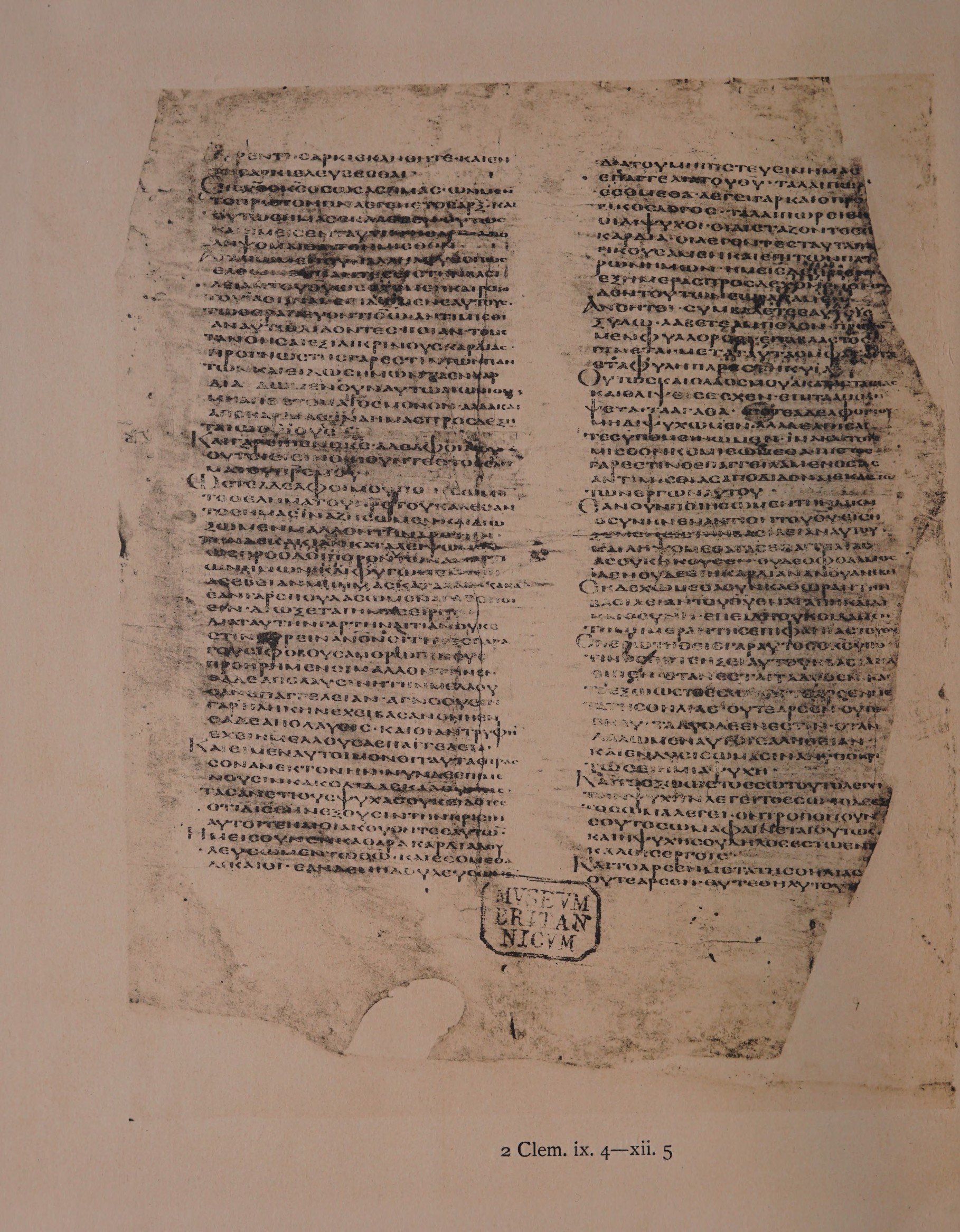
Codex Alexandrinus fol. 169r (1909 facsimile, scan leaf 301; caption printed under the plate: '2 Clem. vi. 1-ix. 4'); Codex Alexandrinus fol. 169v (1909 facsimile, scan leaf 302; caption printed under the plate: '2 Clem. ix. 4-xii. 5'). The Greek shown is Lake's edited text (1912), not a transcription of the manuscript page.
1Καὶ μὴ λεγέτω τις ὑμῶν, ὅτι αὕτη ἡ σὰρξ οὐ κρίνεται οὐδὲ ἀνίσταται. 2γνῶτε· ἐν τίνι ἐσώθητε, ἐν τίνι ἀνεβλέψατε, εἰ μὴ ἐν τῇ σαρκὶ ταύτῃ ὄντες; 3δεῖ οὖν ἡμᾶς ὡς ναὸν θεοῦ φυλάσσειν τὴν σάρκα· 4ὃν τρόπον γὰρ ἐν τῇ σαρκὶ ἐκλήθητε, καὶ ἐν τῇ σαρκὶ ἐλεύσεσθε. 5εἰ Χριστός, ὁ κύριος ὁ σώσας ἡμᾶς, ὢν μὲν τὸ πρῶτον πνεῦμα, ἐγένετο σὰρξ καὶ οὕτως ἡμᾶς ἐκάλεσεν· οὕτως καὶ ἡμεῖς ἐν ταύτῃ τῇ σαρκὶ ἀποληψόμεθα τὸν μισθόν. 6ἀγαπῶμεν οὖν ἀλλήλους, ὅπως ἔλθωμεν πάντες εἰς τὴν βασιλείαν τοῦ θεοῦ. 7ὡς ἔχομεν καιρὸν τοῦ ἰαθῆναι, ἐπιδῶμεν ἑαυτοὺς τῷ θεραπεύοντι θεῷ, ἀντιμισθίαν αὐτῷ διδόντες. 8ποίαν; τὸ μετανοῆσαι ἐξ εἰλικρινοῦς καρδίας. 9προγνώστης γάρ ἐστιν τῶν πάντων καὶ εἰδὼς ἡμῶν τὰ ἐν καρδίᾳ. 10δῶμεν οὖν αὐτῷ αἶνον, μὴ ἀπὸ στόματος μόνον, ἀλλὰ καὶ ἀπὸ καρδίας, ἵνα ἡμᾶς προσδέξηται ὡς υἱούς. 11καὶ γὰρ εἶπεν ὁ κύριος· Ἀδελφοί μου οὗτοί εἰσιν οἱ ποιοῦντες τὸ θέλημα τοῦ πατρός μου.
1And let not any one of you say that this flesh is not judged neither riseth again. 2Understand ye. In what were ye saved? In what did ye recover your sight? if ye were not in this flesh. 3We ought therefore to guard the flesh as a temple of God: 4for in like manner as ye were called in the flesh, ye shall come also in the flesh. 5If Christ the Lord who saved us, being first spirit, then became flesh, and so called us, in like manner also shall we in this flesh receive our reward. 6Let us therefore love one another, that we all may come unto the kingdom of God. 7While we have time to be healed, let us place ourselves in the hands of God the physician, giving Him a recompense. 8What recompense? Repentance from a sincere heart. 9For He discerneth all things beforehand and knoweth what is in our heart. 10Let us therefore give unto Him eternal praise, not from our lips only, but also from our heart, that He may receive us as sons. 11For the Lord also said, These are My brethren, which do the will of My Father.
Where on the image
Codex Alexandrinus fol. 169v (1909 facsimile, scan leaf 302; caption printed under the plate: '2 Clem. ix. 4-xii. 5'). The Greek shown is Lake's edited text (1912), not a transcription of the manuscript page.
1Ὥστε, ἀδελφοί μου, ποιήσωμεν τὸ θέλημα τοῦ πατρὸς τοῦ καλέσαντος ἡμᾶς, ἵνα ζήσωμεν, καὶ διώξωμεν μᾶλλον τὴν ἀρετήν, τὴν δὲ κακίαν καταλείψωμεν ὡς προοδοιπόρον τῶν ἁμαρτιῶν ἡμῶν, καὶ φύγωμεν τὴν ἀσέβειαν, μὴ ἡμᾶς καταλάβῃ κακά. 2ἐὰν γὰρ σπουδάσωμεν ἀγαθοποιεῖν, διώξεται ἡμᾶς εἰρήνη. 3διὰ ταύτην γὰρ τὴν αἰτίαν οὐκ ἔστιν εὑρεῖν ἄνθρωπον, οἵτινες παράγουσι φόβους ἀνθρωπίνους, προῃρημένοι μᾶλλον τὴν ἐνθάδε ἀπόλαυσιν ἢ τὴν μέλλουσαν ἐπαγγελίαν. 4ἀγνοοῦσιν γὰρ ἡλίκην ἔχει βάσανον ἡ ἐνθάδε ἀπόλαυσις, καὶ οἵαν τρυφὴν ἔχει ἡ μέλλουσα ἐπαγγελία. 5καὶ εἰ μὲν αὐτοὶ μόνοι ταῦτα ἔπρασσον, ἀνεκτὸν ἦν· νῦν δὲ ἐπιμένουσιν κακοδιδασκαλοῦντες τὰς ἀναιτίους ψυχάς, οὐκ εἰδότες, ὅτι δισσὴν ἕξουσιν τὴν κρίσιν, αὐτοί τε καὶ οἱ ἀκούοντες αὐτῶν.
1Wherefore, my brethren, let us do the will of the Father which called us, that we may live; and let us the rather pursue virtue, but forsake vice as the forerunner of our sins, and let us flee from ungodliness, lest evils overtake us. 2For if we be diligent in doing good, peace will pursue us. 3For for this cause is a man unable to †attain happiness†, seeing that they call in the fears of men, preferring rather the enjoyment which is here than the promise which is to come. 4For they know not how great torment the enjoyment which is here bringeth, and what delight the promise which is to come bringeth. 5And if verily they were doing these things by themselves alone, it had been tolerable: but now they continue teaching evil to innocent souls, not knowing that they shall have their condemnation doubled, both themselves and their hearers.
Where on the image
Codex Alexandrinus fol. 169v (1909 facsimile, scan leaf 302; caption printed under the plate: '2 Clem. ix. 4-xii. 5'). The Greek shown is Lake's edited text (1912), not a transcription of the manuscript page.
1Ἡμεῖς οὖν ἐν καθαρᾷ καρδίᾳ δουλεύσωμεν τῷ θεῷ, καὶ ἐσόμεθα δίκαιοι· ἐὰν δὲ μὴ δουλεύσωμεν διὰ τὸ μὴ πιστεύειν ἡμᾶς τῇ ἐπαγγελίᾳ τοῦ θεοῦ, ταλαίπωροι ἐσόμεθα. 2λέγει γὰρ καὶ ὁ προφητικὸς λόγος· Ταλαίπωροί εἰσιν οἱ δίψυχοι, οἱ διστάζοντες τῇ καρδίᾳ, οἱ λέγοντες· Ταῦτα πάλαι ἠκούσαμεν καὶ ἐπὶ τῶν πατέρων ἡμῶν, ἡμεῖς δὲ ἡμέραν ἐξ ἡμέρας προσδεχόμενοι οὐδὲν τούτων ἑωράκαμεν. 3ἀνόητοι, συμβάλετε ἑαυτοὺς ξύλῳ· λάβετε ἄμπελον· πρῶτον μὲν φυλλοροεῖ, εἶτα βλαστὸς γίνεται, μετὰ ταῦτα ὄμφαξ, εἶτα σταφυλὴ παρεστηκυῖα. 4οὕτως καὶ ὁ λαός μου ἀκαταστασίας καὶ θλίψεις ἔσχεν· ἔπειτα ἀπολήψεται τὰ ἀγαθά. 5ὥστε, ἀδελφοί μου, μὴ διψυχῶμεν, ἀλλὰ ἐλπίσαντες ὑπομείνωμεν, ἵνα καὶ τὸν μισθὸν κομισώμεθα. 6πιστὸς γάρ ἐστιν ὁ ἐπαγγειλάμενος τὰς ἀντιμισθίας ἀποδιδόναι ἑκάστῳ τῶν ἔργων αὐτοῦ. 7ἐὰν οὖν ποιήσωμεν τὴν δικαιοσύνην ἐναντίον τοῦ θεοῦ, εἰσήξομεν εἰς τὴν βασιλείαν αὐτοῦ καὶ ληψόμεθα τὰς ἐπαγγελίας, ἃς οὖς οὐκ ἤκουσεν οὐδὲ ὀφθαλμὸς εἶδεν, οὐδὲ ἐπὶ καρδίαν ἀνθρώπου ἀνέβη.
1Let us therefore serve God in a pure heart, and we shall be righteous; but if we serve Him not, because we believe not the promise of God, we shall be wretched. 2For the word of prophecy also saith: Wretched are the double-minded, that doubt in their heart and say, These things we heard of old in the days of our fathers also, yet we have waited day after day and have seen none of them. 3Ye fools! compare yourselves unto a tree; take a vine. First it sheddeth its leaves, then a shoot cometh, after this a sour berry, then a full ripe grape. 4So likewise My people had tumults and afflictions: but afterward they shall receive good things. 5Wherefore, my brethren, let us not be double-minded but endure patiently in hope, that we may also obtain our reward. 6For faithful is He that promised to pay to each man the recompense of his works. 7If therefore we shall have wrought righteousness in the sight of God, we shall enter into His kingdom and shall receive the promises which ear hath not heard nor eye seen, neither hath it entered into the heart of man.
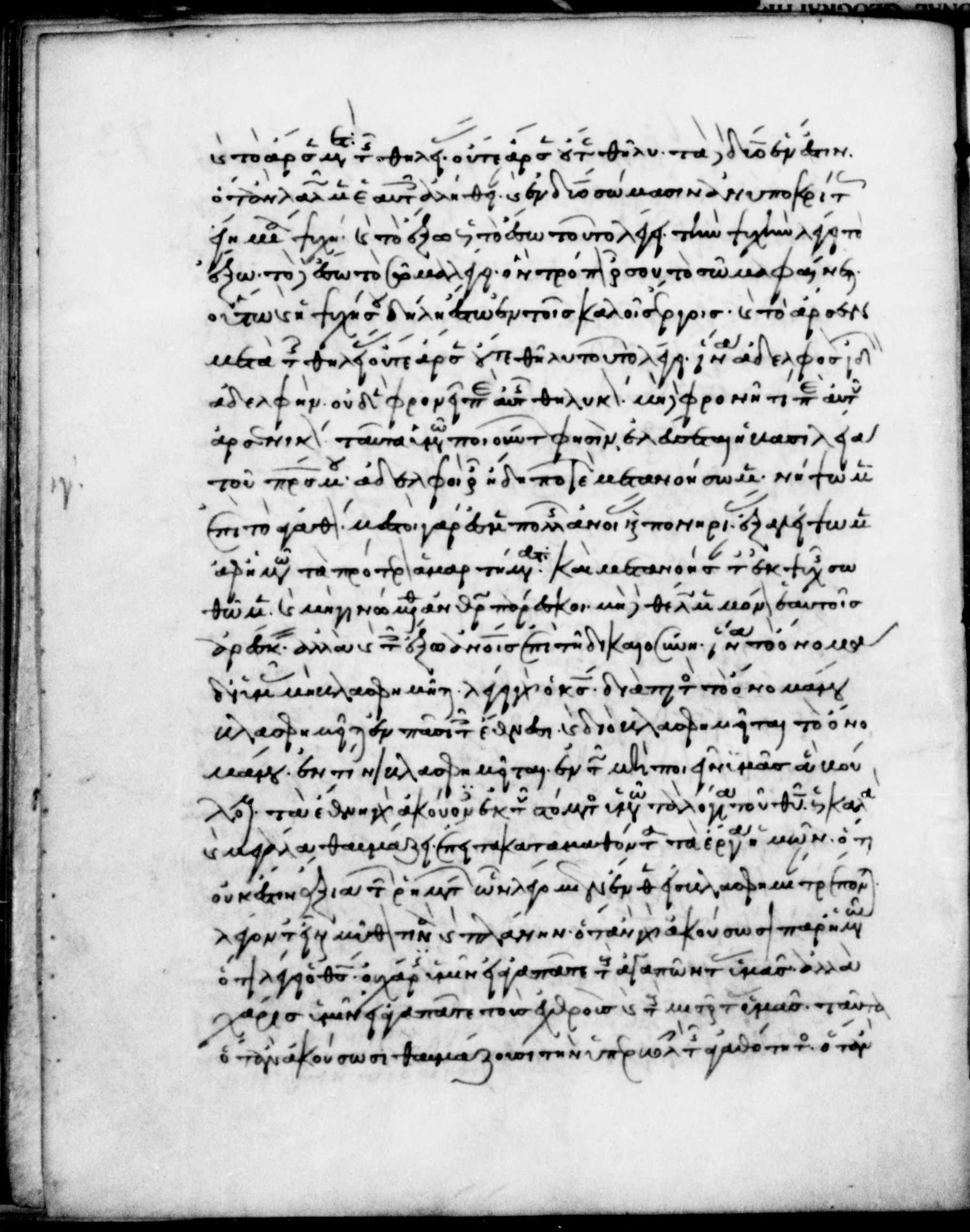
Where on the image
Codex Alexandrinus fol. 169v (1909 facsimile, scan leaf 302; caption printed under the plate: '2 Clem. ix. 4-xii. 5'); Codex Hierosolymitanus 54 fol. 73v (LoC microfilm frame 76, left page), checked on the image: the page opens 'καὶ τὸ ἄρσεν μετὰ τῆς θηλείας, οὔτε ἄρσεν οὔτε θῆλυ. τὰ δύο δὲ ἕν' (2 Clem 12.2-3). Alexandrinus breaks off in 12.5 at the foot of fol. 169v, its last surviving page; the rest of the chapter is on Hierosolymitanus 54 fol. 73v. The Greek shown is Lake's edited text (1912), not a transcription of the manuscript page.
1Ἐκδεχώμεθα οὖν καθ’ ὥραν τὴν βασιλείαν τοῦ θεοῦ ἐν ἀγάπῃ καὶ δικαιοσύνῃ, ἐπειδὴ οὐκ οἴδαμεν τὴν ἡμέραν τῆς ἐπιφανείας τοῦ θεοῦ. 2ἐπερωτηθεὶς γὰρ αὐτὸς ὁ κύριος ὑπό τινος, πότε ἥξει αὐτοῦ ἡ βασιλεία, εἶπεν· Ὅταν ἔσται τὰ δύο ἕν, καὶ τὸ ἔξω ὡς τὸ ἔσω, καὶ τὸ ἄρσεν μετὰ τῆς θηλείας οὔτε ἄρσεν οὔτε θῆλυ. 3τὰ δύο δὲ ἕν ἐστιν, ὅταν λαλῶμεν ἑαυτοῖς ἀλήθειαν καὶ ἐν δυσὶ σώμασιν ἀνυποκρίτως εἴη μία ψυχή. 4καὶ τὸ ἔξω ὡς τὸ ἔσω, τοῦτο λέγει· τὴν ψυχὴν λέγει τὸ ἔσω, τὸ δὲ ἔξω τὸ σῶμα λέγει. ὃν τρόπον οὖν σου τὸ σῶμα φαίνεται, οὕτως καὶ ἡ ψυχή σου δῆλος ἔστω ἐν τοῖς καλοῖς ἔργοις. 5καὶ τὸ ἄρσεν μετὰ τῆς θηλείας, οὔτε ἄρσεν οὔτε θῆλυ, τοῦτο λέγει· ἵνα ἀδελφὸς ἰδὼν ἀδελφὴν οὐδὲν φρονῇ περὶ αὐτῆς θηλυκόν, μηδὲ φρονῇ τι περὶ αὐτοῦ ἀρσενικόν. 6ταῦτα ὑμῶν ποιούντων, φησίν, ἐλεύσεται ἡ βασιλεία τοῦ πατρός μου.
1Let us therefore await the kingdom of God betimes in love and righteousness, since we know not the day of God's appearing. 2For the Lord Himself, being asked by a certain person when His kingdom would come, said, When the two shall be one, and the outside as the inside, and the male with the female, neither male nor female. 3Now the two are one, when we speak truth among ourselves, and in two bodies there shall be one soul without dissimulation. 4And by the outside as the inside He meaneth this: by the inside He meaneth the soul and by the outside the body. Therefore in like manner as thy body appeareth, so also let thy soul be manifest in its good works. 5And by the male with the female, neither male nor female, He meaneth this; that a brother seeing a sister should have no thought of her as of a female, and that a sister seeing a brother should not have any thought of him as of a male. 6These things if ye do, saith He, the kingdom of my Father shall come.
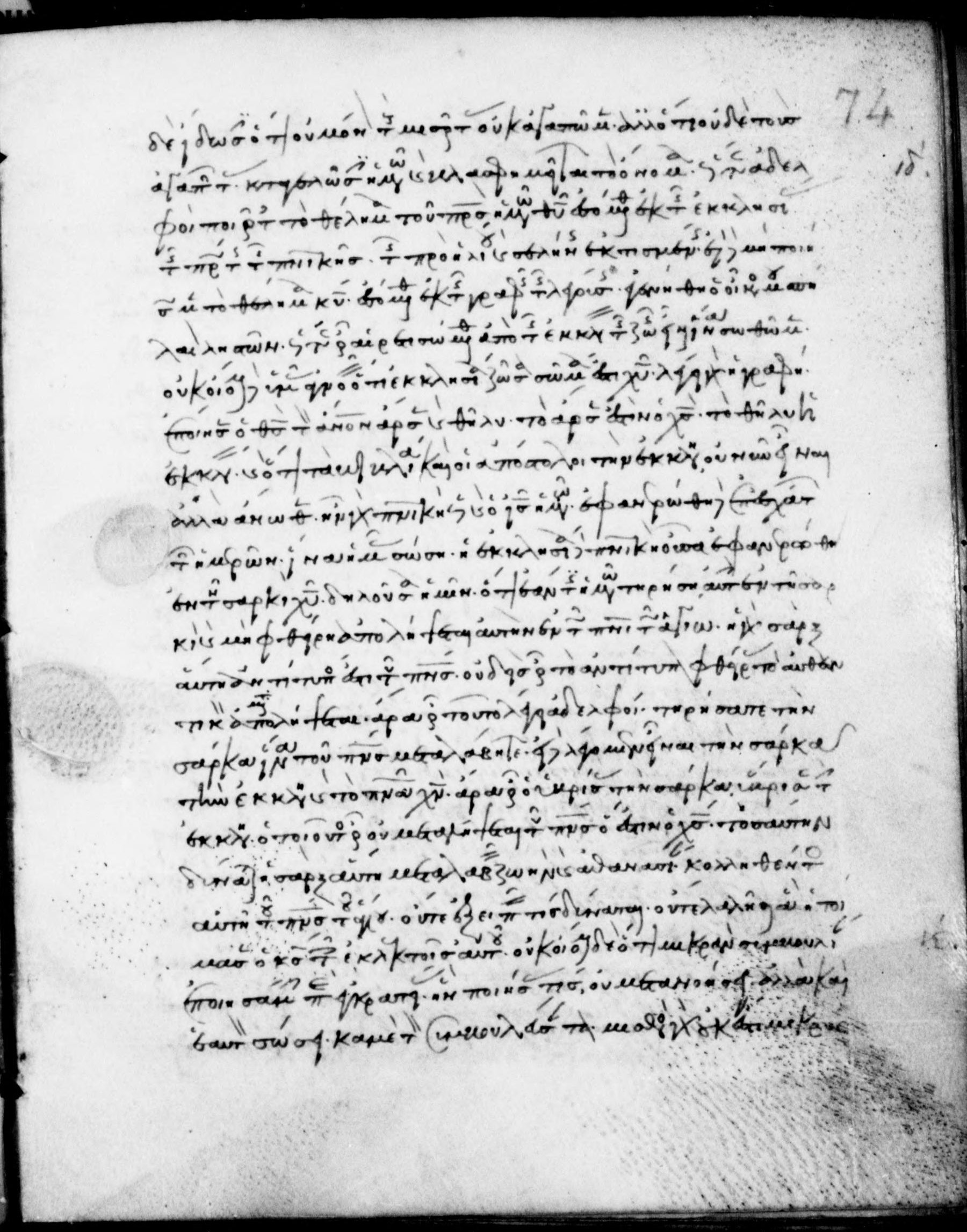
Where on the image
Codex Hierosolymitanus 54 fol. 73v (LoC microfilm frame 76, left page), checked on the image: the page opens 'καὶ τὸ ἄρσεν μετὰ τῆς θηλείας, οὔτε ἄρσεν οὔτε θῆλυ. τὰ δύο δὲ ἕν' (2 Clem 12.2-3); Codex Hierosolymitanus 54 fol. 74r (LoC microfilm frame 76, right page), checked on the image: the page opens '[ἴ]δωσιν ὅτι οὐ μόνον τοὺς μισοῦντας οὐκ ἀγαπῶμεν' (2 Clem 13.4; the scribe's marginal ιδ' marks 14.1). This chapter is lost from Codex Alexandrinus, whose last surviving page ends in 12.5, and is shown on Hierosolymitanus 54. The Greek shown is Lake's edited text (1912), not a transcription of the manuscript page.
1Ἀδελφοὶ οὖν, ἤδη ποτὲ μετανοήσωμεν, νήψωμεν ἐπὶ τὸ ἀγαθόν· μεστοὶ γάρ ἐσμεν πολλῆς ἀνοίας καὶ πονηρίας. ἐξαλείψωμεν ἀφ’ ἡμῶν τὰ πρότερα ἁμαρτήματα καὶ μετανοήσαντες ἐκ ψυχῆς σωθῶμεν, καὶ μὴ γινώμεθα ἀνθρωπάρεσκοι μηδὲ θέλωμεν μόνον ἑαυτοῖς ἀρέσκειν, ἀλλὰ καὶ τοῖς ἔξω ἀνθρώποις ἐπὶ τῇ δικαιοσύνῃ, ἵνα τὸ ὄνομα δι’ ἡμᾶς μὴ βλασφημῆται. 2λέγει γὰρ ὁ κύριος· Διὰ παντὸς τὸ ὄνομά μου βλασφημεῖται ἐν πᾶσιν τοῖς ἔθνεσιν, καὶ πάλιν· Οὐαὶ δι’ ὃν βλασφημεῖται τὸ ὄνομά μου. ἐν τίνι βλασφημεῖται; ἐν τῷ μὴ ποιεῖν ὑμᾶς ἃ βούλομαι. 3τὰ ἔθνη γὰρ ἀκούοντα ἐκ τοῦ στόματος ἡμῶν τὰ λόγια τοῦ θεοῦ ὡς καλὰ καὶ μεγάλα θαυμάζει· ἔπειτα καταμαθόντα τὰ ἔργα ἡμῶν ὅτι οὐκ ἔστιν ἄξια τῶν ῥημάτων ὧν λέγομεν, ἔνθεν εἰς βλασφημίαν τρέπονται, λέγοντες εἶναι μῦθόν τινα καὶ πλάνην. 4ὅταν γὰρ ἀκούσωσιν παρ’ ἡμῶν, ὅτι λέγει ὁ θεός· Οὐ χάρις ὑμῖν, εἰ ἀγαπᾶτε τοὺς ἀγαπῶντας ὑμᾶς, ἀλλὰ χάρις ὑμῖν, εἰ ἀγαπᾶτε τοὺς ἐχθροὺς καὶ τοὺς μισοῦντας ὑμᾶς· ταῦτα ὅταν ἀκούσωσιν, θαυμάζουσιν τὴν ὑπερβολὴν τῆς ἀγαθότητος· ὅταν δὲ ἴδωσιν, ὅτι οὐ μόνον τοὺς μισοῦντας οὐκ ἀγαπῶμεν, ἀλλ’ ὅτι οὐδὲ τοὺς ἀγαπῶντας, καταγελῶσιν ἡμῶν, καὶ βλασφημεῖται τὸ ὄνομα.
1Therefore, brethren, let us repent forthwith. Let us be sober unto that which is good: for we are full of much folly and wickedness. Let us wipe away from us our former sins, and let us repent with our whole soul and be saved. And let us not be found men-pleasers. Neither let us desire to please one another only, but also those men that are without, by our righteousness, that the Name be not blasphemed by reason of us. 2For the Lord saith, Every way My Name is blasphemed among all the Gentiles; and again, Woe unto him by reason of whom My Name is blasphemed. Wherein is it blasphemed? In that ye do not the things which I desire. 3For the Gentiles, when they hear from our mouth the oracles of God, marvel at them for their beauty and greatness; then, when they discover that our works are not worthy of the words which we speak, forthwith they betake themselves to blasphemy, saying that it is an idle story and a delusion. 4For when they hear from us that God saith, It is no thank unto you, if ye love them that love you, but this is thank unto you, if ye love your enemies and them that hate you; when they hear these things, I say, they marvel at their exceeding goodness; but when they see that we not only do not love them that hate us, but not even them that love us, they laugh us to scorn, and the Name is blasphemed.
Where on the image
Codex Hierosolymitanus 54 fol. 74r (LoC microfilm frame 76, right page), checked on the image: the page opens '[ἴ]δωσιν ὅτι οὐ μόνον τοὺς μισοῦντας οὐκ ἀγαπῶμεν' (2 Clem 13.4; the scribe's marginal ιδ' marks 14.1). This chapter is lost from Codex Alexandrinus, whose last surviving page ends in 12.5, and is shown on Hierosolymitanus 54. The Greek shown is Lake's edited text (1912), not a transcription of the manuscript page.
1Ὥστε, ἀδελφοί, ποιοῦντες τὸ θέλημα τοῦ πατρὸς ἡμῶν θεοῦ ἐσόμεθα ἐκ τῆς ἐκκλησίας τῆς πρώτης, τῆς πνευματικῆς, τῆς πρὸ ἡλίου καὶ σελήνης ἐκτισμένης. ἐὰν δὲ μὴ ποιήσωμεν τὸ θέλημα κυρίου, ἐσόμεθα ἐκ τῆς γραφῆς τῆς λεγούσης· Ἐγενήθη ὁ οἶκός μου σπήλαιον λῃστῶν. ὥστε οὖν αἱρετισώμεθα ἀπὸ τῆς ἐκκλησίας τῆς ζωῆς εἶναι, ἵνα σωθῶμεν. 2οὐκ οἴομαι δὲ ὑμᾶς ἀγνοεῖν, ὅτι ἐκκλησία ζῶσα σῶμά ἐστιν Χριστοῦ· λέγει γὰρ ἡ γραφή· Ἐποίησεν ὁ θεὸς τὸν ἄνθρωπον ἄρσεν καὶ θῆλυ· τὸ ἄρσεν ἐστὶν ὁ Χριστός, τὸ θῆλυ ἡ ἐκκλησία· καὶ ἔτι τὰ βιβλία καὶ οἱ ἀπόστολοι τὴν ἐκκλησίαν οὐ νῦν εἶναι λέγουσιν ἀλλὰ ἄνωθεν. ἦν γὰρ πνευματική, ὡς καὶ ὁ Ἰησοῦς ἡμῶν, ἐφανερώθη δὲ ἐπ’ ἐσχάτων τῶν ἡμερῶν, ἵνα ἡμᾶς σώσῃ. 3ἡ ἐκκλησία δὲ πνευματικὴ οὖσα ἐφανερώθη ἐν τῇ σαρκὶ Χριστοῦ, δηλοῦσα ἡμῖν, ὅτι ἐάν τις ἡμῶν τηρήσῃ αὐτὴν ἐν τῇ σαρκὶ καὶ μὴ φθείρῃ, ἀπολήψεται αὐτὴν ἐν τῷ πνεύματι τῷ ἁγίῳ· ἡ γὰρ σὰρξ αὕτη ἀντίτυπός ἐστιν τοῦ πνεύματος· οὐδεὶς οὖν τὸ ἀντίτυπον φθείρας τὸ αὐθεντικὸν μεταλήψεται. ἄρα οὖν τοῦτο λέγει, ἀδελφοί· τηρήσατε τὴν σάρκα, ἵνα τοῦ πνεύματος μεταλάβητε. 4εἰ δὲ λέγομεν εἶναι τὴν σάρκα τὴν ἐκκλησίαν καὶ τὸ πνεῦμα Χριστόν, ἄρα οὖν ὁ ὑβρίσας τὴν σάρκα ὕβρισεν τὴν ἐκκλησίαν. ὁ τοιοῦτος οὖν οὐ μεταλήψεται τοῦ πνεύματος, ὅ ἐστιν ὁ Χριστός. 5τοσαύτην δύναται ἡ σὰρξ αὕτη μεταλαβεῖν ζωὴν καὶ ἀφθαρσίαν κολληθέντος αὐτῇ τοῦ πνεύματος τοῦ ἁγίου, οὔτε ἐξειπεῖν τις δύναται οὔτε λαλῆσαι ἃ ἡτοίμασεν ὁ κύριος τοῖς ἐκλεκτοῖς αὐτοῦ.
1Wherefore, brethren, if we do the will of God our Father, we shall be of the first Church, which is spiritual, which was created before the sun and moon; but if we do not the will of the Lord, we shall be of the scripture that saith, My house was made a den of robbers. So therefore let us choose rather to be of the Church of life, that we may be saved. 2And I do not suppose ye are ignorant that the living Church is the body of Christ: for the scripture saith, God made man, male and female. The male is Christ and the female is the Church. And the Books and the Apostles plainly declare that the Church existeth not now for the first time, but hath been from the beginning: for she was spiritual, as our Jesus also was spiritual, but was manifested in the last days that He might save us. 3Now the Church, being spiritual was manifested in the flesh of Christ, thereby showing us that if any of us guard her in the flesh and defile her not, he shall receive her again in the Holy Spirit: for this flesh is the counterpart and copy of the spirit. No man therefore, when he hath defiled the copy, shall receive the original for his portion. This therefore is what He meaneth, brethren; Guard ye the flesh, that ye may partake of the spirit. 4But if we say that the flesh is the Church and the spirit is Christ, then he that hath dealt wantonly with the flesh hath dealt wantonly with the Church. Such an one therefore shall not partake of the spirit, which is Christ. 5So excellent is the life and immortality which this flesh can receive as its portion, if the Holy Spirit be joined to it. No man can declare or tell those things which the Lord hath prepared for His elect.
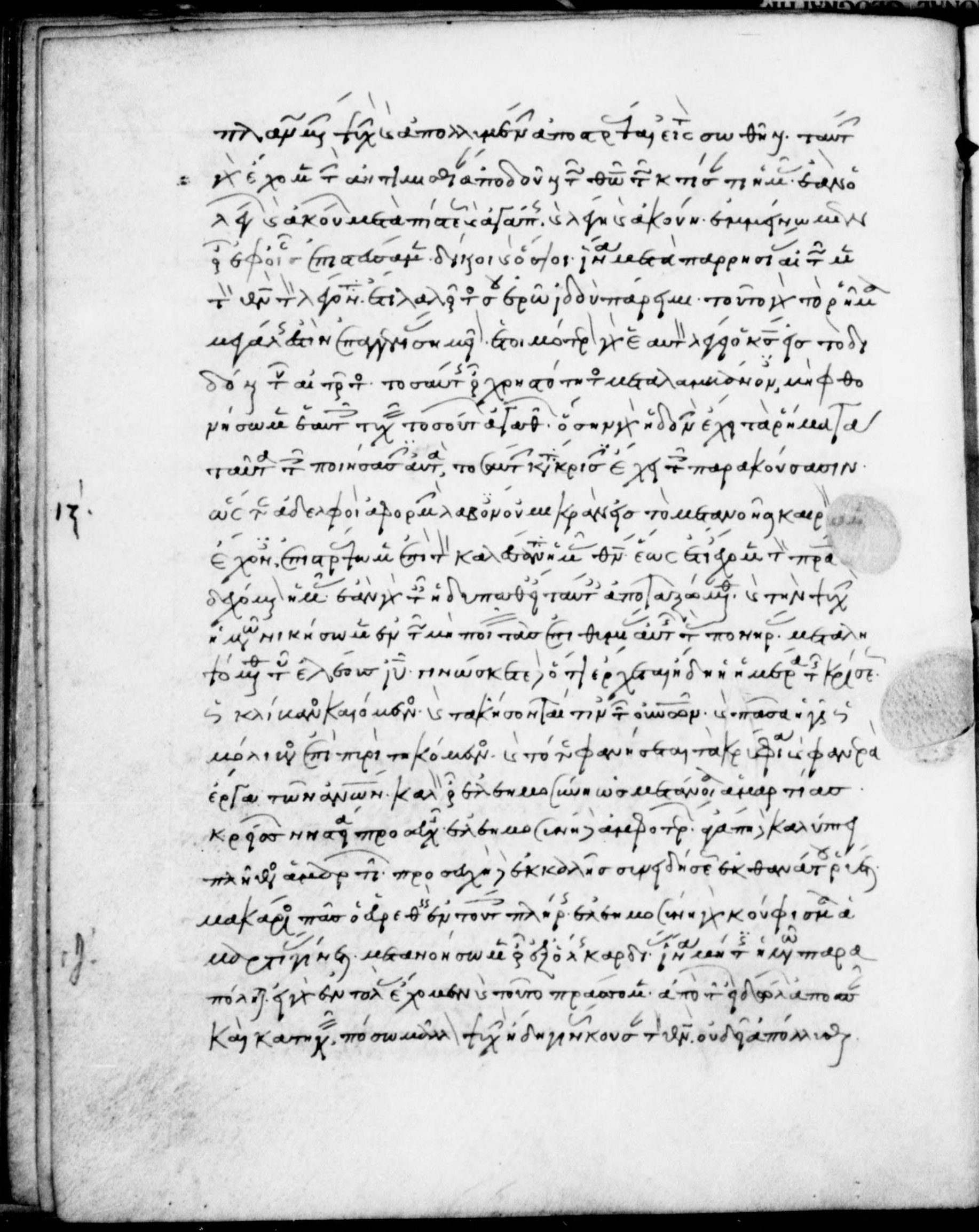
Where on the image
Codex Hierosolymitanus 54 fol. 74r (LoC microfilm frame 76, right page), checked on the image: the page opens '[ἴ]δωσιν ὅτι οὐ μόνον τοὺς μισοῦντας οὐκ ἀγαπῶμεν' (2 Clem 13.4; the scribe's marginal ιδ' marks 14.1); Codex Hierosolymitanus 54 fol. 74v (LoC microfilm frame 77, left page), checked on the image: the page opens 'πλανωμένην ψυχὴν καὶ ἀπολλυμένην ἀποστρέψαι εἰς τὸ σωθῆναι' (2 Clem 15.1). This chapter is lost from Codex Alexandrinus, whose last surviving page ends in 12.5, and is shown on Hierosolymitanus 54. The Greek shown is Lake's edited text (1912), not a transcription of the manuscript page.
1Οὐκ οἴομαι δέ, ὅτι μικρὰν συμβουλίαν ἐποιησάμην περὶ ἐγκρατείας, ἣν ποιήσας τις οὐ μετανοήσει, ἀλλὰ καὶ ἑαυτὸν σώσει κἀμὲ τὸν συμβουλεύσαντα. μισθὸς γὰρ οὔκ ἐστιν μικρὸς πλανωμένην ψυχὴν καὶ ἀπολλυμένην ἀποστρέψαι εἰς τὸ σωθῆναι. 2ταύτην γὰρ ἔχομεν τὴν ἀντιμισθίαν ἀποδοῦναι τῷ θεῷ τῷ κτίσαντι ἡμᾶς, ἐὰν ὁ λέγων καὶ ἀκούων μετὰ πίστεως καὶ ἀγάπης καὶ λέγῃ καὶ ἀκούῃ. 3ἐμμείνωμεν οὖν ἐφ’ οἷς ἐπιστεύσαμεν δίκαιοι καὶ ὅσιοι, ἵνα μετὰ παρρησίας αἰτῶμεν τὸν θεὸν τὸν λέγοντα· Ἔτι λαλοῦντός σου ἐρῶ· ἰδοὺ πάρειμι. 4τοῦτο γὰρ τὸ ῥῆμα μεγάλης ἐστιν ἐπαγγελίας σημεῖον· ἑτοιμότερον γὰρ ἑαυτὸν λέγει ὁ κύριος εἰς τὸ διδόναι τοῦ αἰτοῦντος. 5τοσαύτης οὖν χρηστότητος μεταλαμβάνοντες μὴ φθονήσωμεν ἑαυτοῖς τυχεῖν τοσούτων ἀγαθῶν. ὅσην γὰρ ἡδονὴν ἔχει τὰ ῥήματα ταῦτα τοῖς ποιήσασιν αὐτά, τοσαύτην κατάκρισιν ἔχει τοῖς παρακούσασιν.
1Now I do not think that I have given any mean counsel respecting continence, and whosoever performeth it shall not repent thereof, but shall save both himself and me his counsellor. For it is no mean reward to convert a wandering and perishing soul, that it may be saved. 2For this is the recompense which we are able to pay to God who created us, if he that speaketh and heareth both speak and hear with faith and love. 3Let us therefore abide in the things which we believed, in righteousness and holiness, that we may with boldness ask of God who saith, Whiles thou art still speaking I will say, Behold, I am here. 4For this word is the token of a great promise: for the Lord saith of Himself that He is more ready to give than he that asketh to ask. 5Seeing then that we are partakers of so great kindness, let us not grudge ourselves the obtaining of so many good things. For in proportion as the pleasure is great which these words bring to them that have performed them, so also is the condemnation great which they bring to them that have been disobedient.
Where on the image
Codex Hierosolymitanus 54 fol. 74v (LoC microfilm frame 77, left page), checked on the image: the page opens 'πλανωμένην ψυχὴν καὶ ἀπολλυμένην ἀποστρέψαι εἰς τὸ σωθῆναι' (2 Clem 15.1). This chapter is lost from Codex Alexandrinus, whose last surviving page ends in 12.5, and is shown on Hierosolymitanus 54. The Greek shown is Lake's edited text (1912), not a transcription of the manuscript page.
1Ὥστε, ἀδελφοί, ἀφορμὴν λαβόντες οὐ μικρὰν εἰς τὸ μετανοῆσαι, καιρὸν ἔχοντες ἐπιστρέψωμεν ἐπὶ τὸν καλέσαντα ἡμᾶς θεόν, ἕως ἔτι ἔχομεν τὸν παραδεχόμενον ἡμᾶς. 2ἐὰν γὰρ ταῖς ἡδυπαθείαις ταύταις ἀποταξώμεθα καὶ τὴν ψυχὴν ἡμῶν νικήσωμεν ἐν τῷ μὴ ποιεῖν τὰς ἐπιθυμίας αὐτῆς τὰς πονηράς, μεταληψόμεθα τοῦ ἐλέους Ἰησοῦ. 3γινώσκετε δέ, ὅτι ἔρχεται ἤδη ἡ ἡμέρα τῆς κρίσεως ὡς κλίβανος καιόμενος, καὶ τακήσονταί τινες τῶν οὐρανῶν καὶ πᾶσα ἡ γῆ ὡς μόλιβος ἐπὶ πυρὶ τηκόμενος· καὶ τότε φανήσεται τὰ κρύφια καὶ φανερὰ ἔργα τῶν ἀνθρώπων. 4καλὸν οὖν ἐλεημοσύνη ὡς μετάνοια ἁμαρτίας· κρείσσων νηστεία προσευχῆς, ἐλεημοσύνη δὲ ἀμφοτέρων· ἀγάπη δὲ καλύπτει πλῆθος ἁμαρτιῶν, προσευχὴ δὲ ἐκ καλῆς συνειδήσεως ἐκ θανάτου ῥύεται. μακάριος πᾶς ὁ εὑρεθεὶς ἐν τούτοις πλήρης· ἐλεημοσύνη γὰρ κούφισμα ἁμαρτίας γίνεται.
1Therefore, brethren, since we have found no small opportunity for repentance, seeing that we have time, let us turn again unto God that called us, while we have still One that receiveth us. 2For if we bid farewell to these enjoyments and conquer our soul in refusing to fulfil its evil lusts, we shall be partakers of the mercy of Jesus. 3But ye know that the day of judgment cometh even now as a burning oven, and the powers of the heavens shall melt, and all the earth as lead melting on the fire, and then shall appear the secret and open works of men. 4Almsgiving therefore is a good thing, even as repentance from sin. Fasting is better than prayer, but almsgiving than both. And love covereth a multitude of sins, but prayer out of a good conscience delivereth from death. Blessed is every man that is found full of these. For almsgiving lifteth off the burden of sin.
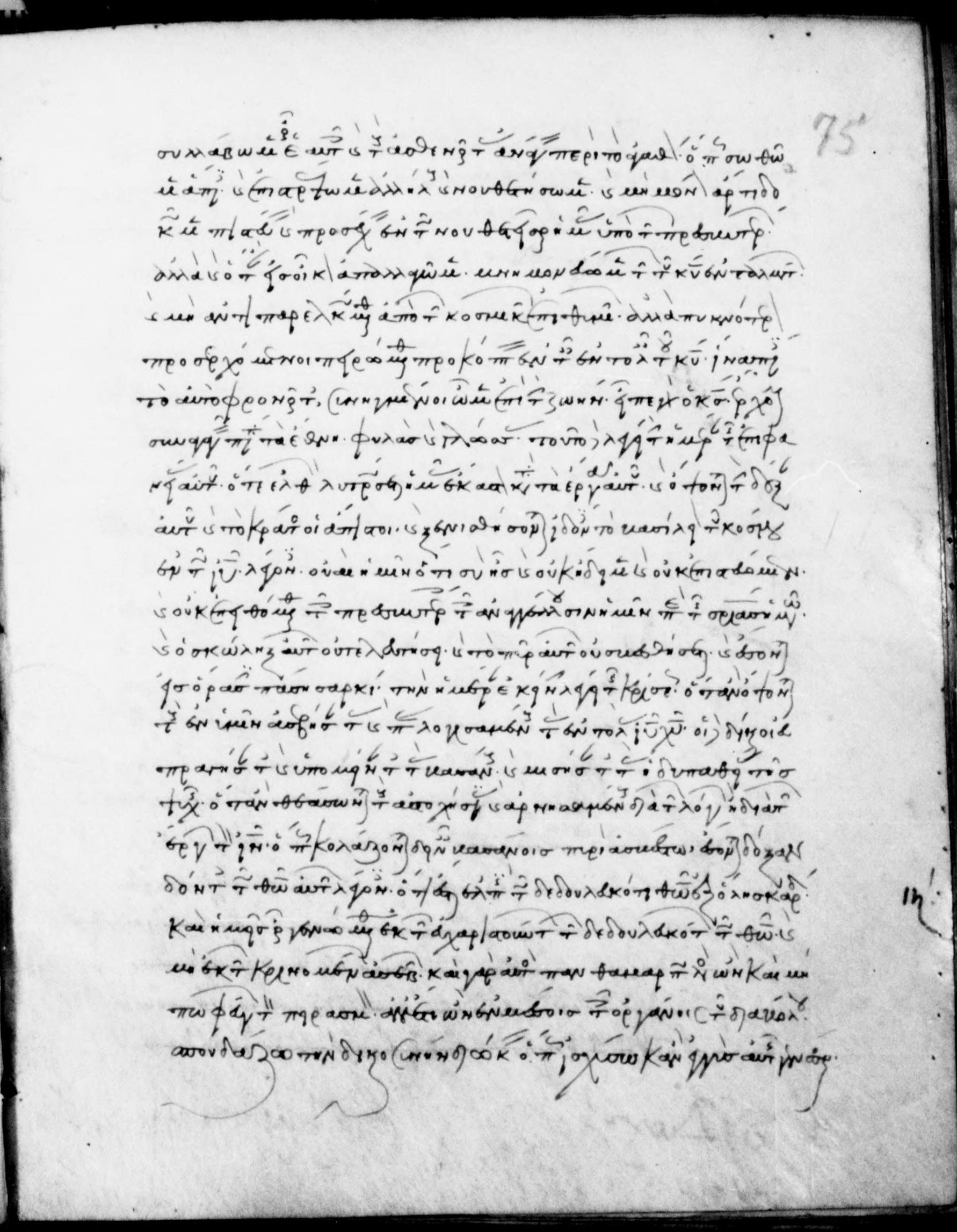
Where on the image
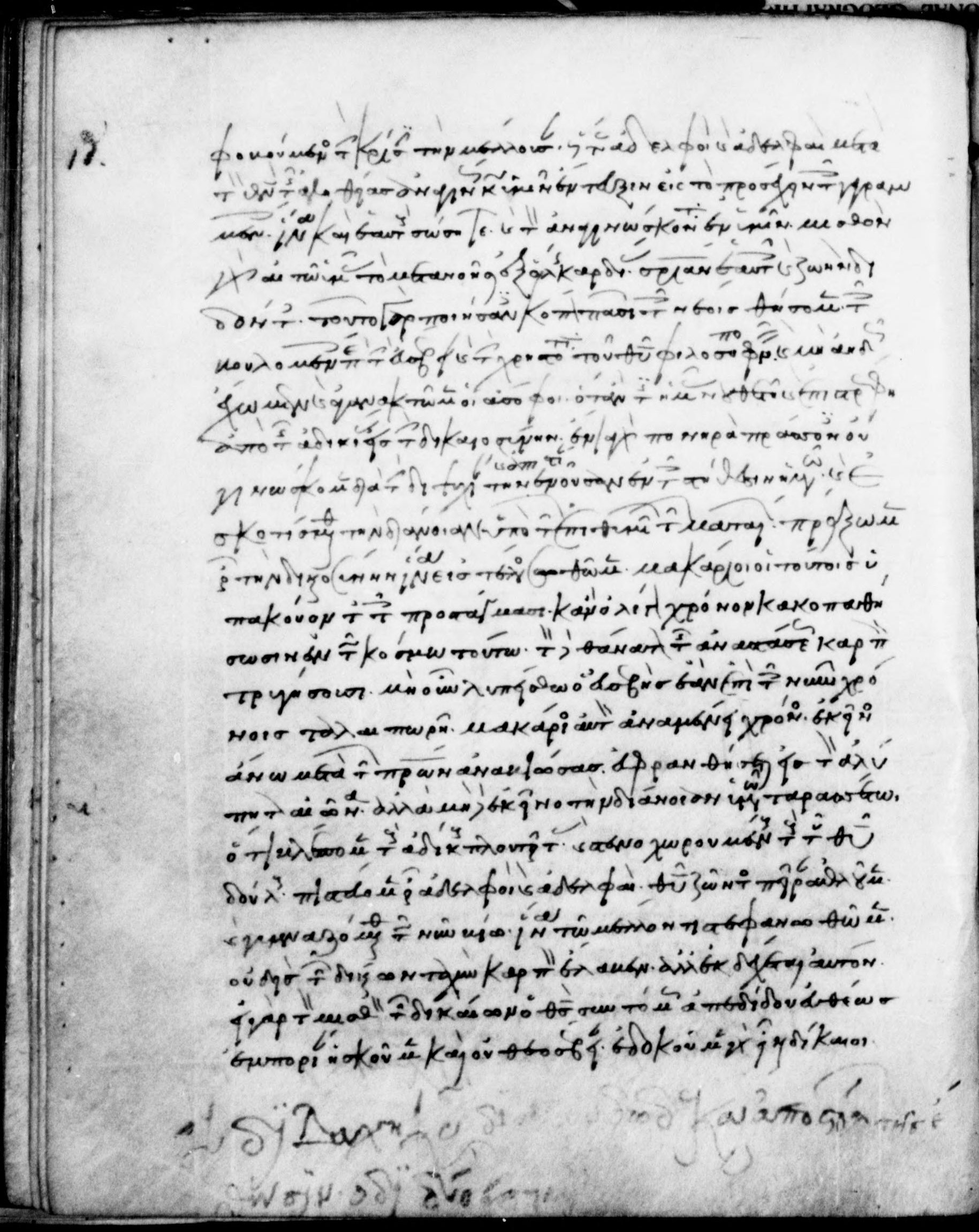
Codex Hierosolymitanus 54 fol. 74v (LoC microfilm frame 77, left page), checked on the image: the page opens 'πλανωμένην ψυχὴν καὶ ἀπολλυμένην ἀποστρέψαι εἰς τὸ σωθῆναι' (2 Clem 15.1); Codex Hierosolymitanus 54 fol. 75r (LoC microfilm frame 77, right page), checked on the image: the page opens 'συλλάβωμεν ἑαυτοῖς ... περὶ τὸ ἀγαθόν, ὅπως σωθῶμεν ἅπαντες' (2 Clem 17.2). This chapter is lost from Codex Alexandrinus, whose last surviving page ends in 12.5, and is shown on Hierosolymitanus 54. The Greek shown is Lake's edited text (1912), not a transcription of the manuscript page.
1Μετανοήσωμεν οὖν ἐξ ὅλης καρδίας, ἵνα μή τις ἡμῶν παραπόληται. εἰ γὰρ ἐντολὰς ἔχομεν ἵνα καὶ τοῦτο πράσσωμεν, ἀπὸ τῶν εἰδώλων ἀποσπᾶν καὶ κατηχεῖν, πόσῳ μᾶλλον ψυχὴν ἤδη γινώσκουσαν τὸν θεὸν οὐ δεῖ ἀπόλλυσθαι; 2συλλάβωμεν οὖν ἑαυτοῖς καὶ τοὺς ἀσθενοῦντας ἀνάγειν περὶ τὸ ἀγαθόν, ὅπως σωθῶμεν ἅπαντες καὶ ἐπιστρέψωμεν ἀλλήλους καὶ νουθετήσωμεν. 3καὶ μὴ μόνον ἄρτι δοκῶμεν πιστεύειν καὶ προσέχειν ἐν τῷ νουθετεῖσθαι ἡμᾶς ὑπὸ τῶν πρεσβυτέρων, ἀλλὰ καὶ ὅταν εἰς οἶκον ἀπαλλαγῶμεν, μνημονεύωμεν τῶν τοῦ κυρίου ἐνταλμάτων καὶ μὴ ἀντιπαρελκώμεθα ἀπὸ τῶν κοσμικῶν ἐπιθυμιῶν, ἀλλὰ πυκνότερον προσερχόμενοι πειρώμεθα προκόπτειν ἐν ταῖς ἐντολαῖς τοῦ κυρίου, ἵνα πάντες τὸ αὐτὸ φρονοῦντες συνηγμένοι ὦμεν ἐπὶ τὴν ζωήν· 4εἶπεν γὰρ ὁ κύριος· Ἔρχομαι συναγαγεῖν πάντα τὰ ἔθνη, φυλὰς καὶ γλώσσας· τοῦτο δὲ λέγει τὴν ἡμέραν τῆς ἐπιφανείας αὐτοῦ, ὅτε ἐλθὼν λυτρώσεται ἡμᾶς, ἕκαστον κατὰ τὰ ἔργα αὐτοῦ. 5καὶ ὄψονται τὴν δόξαν αὐτοῦ καὶ τὸ κράτος οἱ ἄπιστοι, καὶ ξενισθήσονται ἰδόντες τὸ βασίλειον τοῦ κόσμου ἐν τῷ Ἰησοῦ, λέγοντες· Οὐαὶ ἡμῖν, ὅτι σὺ ἦς, καὶ οὐκ ᾔδειμεν καὶ οὐκ ἐπιστεύομεν καὶ οὐκ ἐπειθόμεθα τοῖς πρεσβυτέροις τοῖς ἀναγγέλλουσιν ἡμῖν περὶ τῆς σωτηρίας ἡμῶν. καὶ ὁ σκώληξ αὐτῶν οὐ τελευτήσει καὶ τὸ πῦρ αὐτῶν οὐ σβεσθήσεται, καὶ ἔσονται εἰς ὅρασιν πάσῃ σαρκί. 6τὴν ἡμέραν ἐκείνην λέγει τῆς κρίσεως, ὅταν ὄψονται τοὺς ἐν ἡμῖν ἀσεβήσαντας καὶ παραλογισαμένους τὰς ἐντολὰς Ἰησοῦ Χριστοῦ. 7οἱ δὲ δίκαιοι εὐπραγήσαντες καὶ ὑπομείναντες τὰς βασάνους καὶ μισήσαντες τὰς ἡδυπαθείας τῆς ψυχῆς, ὅταν θεάσωνται τοὺς ἀστοχήσαντας καὶ ἀρνησαμένους διὰ τῶν λόγων ἢ διὰ τῶν ἔργων τὸν Ἰησοῦν, ὅπως κολάζονται δειναῖς βασάνοις πυρὶ ἀσβέστῳ, ἔσονται δόξαν διδόντες τῷ θεῷ αὐτῶν λέγοντες, ὅτι ἔσται ἐλπὶς τῷ δεδουλευκότι θεῷ ἐξ ὅλης καρδίας.
1Let us therefore repent with our whole heart, lest any of us perish by the way. For if we have received commands, that we should make this also our business, to tear men away from idols and to instruct them, how much more is it wrong that a soul which knoweth God already should perish! 2Therefore let us assist one another, that we may also lead the weak upward as touching that which is good, to the end that we all may be saved: and let us convert and admonish one another. 3And let us not think to give heed and believe now only, while we are admonished by the presbyters; but likewise when we have departed home, let us remember the commandments of the Lord, and not suffer ourselves to be dragged off the other way by our worldly lusts; but coming hither more frequently, let us strive to go forward in the commands of the Lord, that we all having the same mind may be gathered together unto life. 4For the Lord said, I come to gather together all the nations, tribes, and languages. Herein He speaketh of the day of His appearing, when He shall come and redeem us, each man according to his works. 5And the unbelievers shall see His glory and His might: and they shall be amazed when they see the kingdom of the world given to Jesus, saying, Woe unto us, for Thou wast, and we knew it not, and believed not; and we obeyed not the presbyters when they told us of our salvation. And Their worm shall not die, and their fire shall not be quenched, and they shall be for a spectacle unto all flesh. 6He speaketh of that day of judgment, when men shall see those among us that lived ungodly lives and dealt falsely with the commandments of Jesus Christ. 7But the righteous, having done good and endured torments and hated the pleasures of the soul, when they shall behold them that have done amiss and denied Jesus by their words or by their deeds, how that they are punished with grievous torments in unquenchable fire, shall give glory to God, saying, There will be hope for him that hath served God with his whole heart.
Where on the image
Codex Hierosolymitanus 54 fol. 75r (LoC microfilm frame 77, right page), checked on the image: the page opens 'συλλάβωμεν ἑαυτοῖς ... περὶ τὸ ἀγαθόν, ὅπως σωθῶμεν ἅπαντες' (2 Clem 17.2); Codex Hierosolymitanus 54 fol. 75v (LoC microfilm frame 78, left page), checked on the image: the page opens 'φοβούμενος τὴν κρίσιν τὴν μέλλουσαν. ὥστε, ἀδελφοὶ καὶ ἀδελφαί' (2 Clem 18.2-19.1). This chapter is lost from Codex Alexandrinus, whose last surviving page ends in 12.5, and is shown on Hierosolymitanus 54. The Greek shown is Lake's edited text (1912), not a transcription of the manuscript page.
1Καὶ ἡμεῖς οὖν γενώμεθα ἐκ τῶν εὐχαριστούντων, δεδουλευκότων τῷ θεῷ, καὶ μὴ ἐκ τῶν κρινομένων ἀσεβῶν. 2καὶ γὰρ αὐτὸς πανθαμαρτωλὸς ὢν καὶ μήπω φυγὼν τὸν πειρασμόν, ἀλλ’ ἔτι ὢν ἐν μέσοις τοῖς ὀργάνοις τοῦ διαβόλου σπουδάζω τὴν δικαιοσύνην διώκειν, ὅπως ἰσχύσω κἂν ἐγγὺς αὐτῆς γενέσθαι, φοβούμενος τὴν κρίσιν τὴν μέλλουσαν.
1Therefore let us also be found among those that give thanks, among those that have served God, and not among the ungodly that are judged. 2For I myself too, being an utter sinner and not yet escaped from temptation, but being still amidst the engines of the devil, do my diligence to follow after righteousness, that I may prevail so far at least as to come near unto it, while I fear the judgment to come.
Where on the image
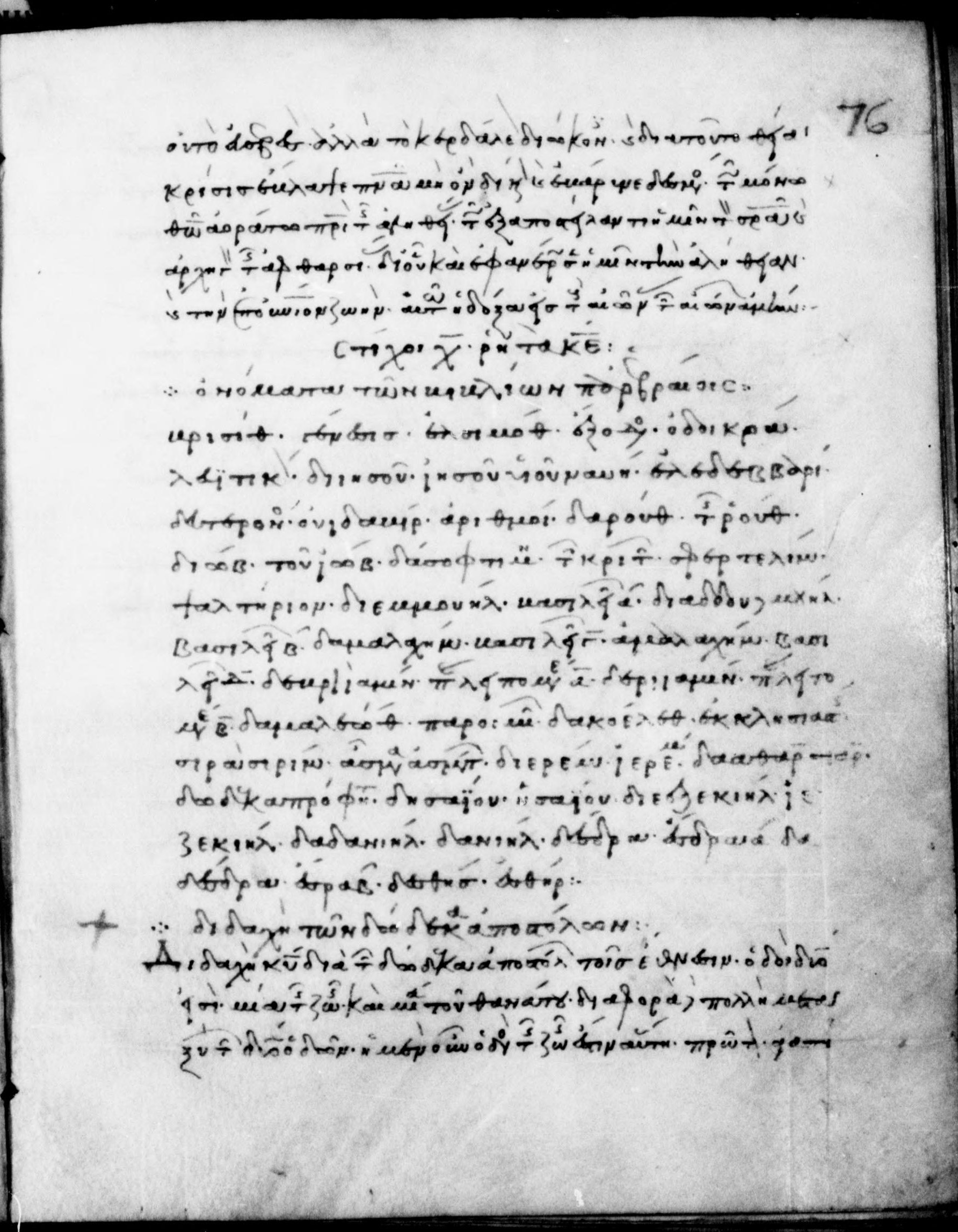
Codex Hierosolymitanus 54 fol. 75v (LoC microfilm frame 78, left page), checked on the image: the page opens 'φοβούμενος τὴν κρίσιν τὴν μέλλουσαν. ὥστε, ἀδελφοὶ καὶ ἀδελφαί' (2 Clem 18.2-19.1). This chapter is lost from Codex Alexandrinus, whose last surviving page ends in 12.5, and is shown on Hierosolymitanus 54. The Greek shown is Lake's edited text (1912), not a transcription of the manuscript page.
1Ὥστε, ἀδελφοὶ καὶ ἀδελφαί, μετὰ τὸν θεὸν τῆς ἀληθείας ἀναγινώσκω ὑμῖν ἔντευξιν εἰς τὸ προσέχειν τοῖς γεγραμμένοις, ἵνα καὶ ἑαυτοὺς σώσητε καὶ τὸν ἀναγινώσκοντα ἐν ὑμῖν. μισθὸν γὰρ αἰτῶ ὑμᾶς τὸ μετανοῆσαι ἐξ ὅλης καρδίας, σωτηρίαν ἑαυτοῖς καὶ ζωὴν διδόντας. τοῦτο γὰρ ποιήσαντες σκοπὸν πᾶσιν τοῖς νέοις θήσομεν, τοῖς βουλομένοις περὶ τὴν εὐσέβειαν καὶ τὴν χρηστότητα τοῦ θεοῦ φιλοπονεῖν. 2καὶ μὴ ἀηδῶς ἔχωμεν καὶ ἀγανακτῶμεν οἱ ἄσοφοι, ὅταν τις ἡμᾶς νουθετῇ καὶ ἐπιστρέφῃ ἀπὸ τῆς ἀδικίας εἰς τὴν δικαιοσύνην. ἐνίοτε γὰρ πονηρὰ πράσσοντες οὐ γινώσκομεν διὰ τὴν διψυχίαν καὶ ἀπιστίαν τὴν ἐνοῦσαν ἐν τοῖς στήθεσιν ἡμῶν, καὶ ἐσκοτίσμεθα τὴν διάνοιαν ὑπὸ τῶν ἐπιθυμιῶν τῶν ματαίων. 3πράξωμεν οὖν τὴν δικαιοσύνην, ἵνα εἰς τέλος σωθῶμεν. μακάριοι οἱ τούτοις ὑπακούοντες τοῖς προστάγμασιν· κἂν ὀλίγον χρόνον κακοπαθήσωσιν ἐν τῷ κόσμῳ τούτῳ, τὸν ἀθάνατον τῆς ἀναστάσεως καρπὸν τρυγήσουσιν. 4μὴ οὖν λυπείσθω ὁ εὐσεβής, ἐὰν ἐπὶ τοῖς νῦν χρόνοις ταλαιπωρῇ· μακάριος αὐτὸν ἀναμένει χρόνος· ἐκεῖνος ἄνω μετὰ τῶν πατέρων ἀναβιώσας εὐφρανθήσεται εἰς τὸν ἀλύπητον αἰῶνα.
1Therefore, brothers and sisters, after the God of truth hath been heard, I read to you an exhortation to the end that ye may give heed to the things which are written, so that ye may save both yourselves and him that readeth in the midst of you. For I ask of you as a reward that ye repent with your whole heart, and give salvation and life to yourselves. For doing this we shall set a goal for all the young who desire to toil in the study of piety and of the goodness of God. 2And let us not be displeased and vexed, fools that we are, whensoever any one admonisheth us and turneth us aside from unrighteousness unto righteousness. For sometimes while we do evil things, we perceive it not by reason of the double-mindedness and unbelief which is in our breasts, and we are darkened in our understanding by our vain lusts. 3Let us therefore practise righteousness that we may be saved unto the end. Blessed are they that obey these ordinances. Though they may endure affliction for a short time in the world, they will gather the immortal fruit of the resurrection. 4Therefore let not the godly be grieved, if he be miserable in the times that now are: a blessed time awaiteth him. He shall live again in heaven with the fathers, and shall have rejoicing throughout a sorrowless eternity.
Where on the image
Codex Hierosolymitanus 54 fol. 75v (LoC microfilm frame 78, left page), checked on the image: the page opens 'φοβούμενος τὴν κρίσιν τὴν μέλλουσαν. ὥστε, ἀδελφοὶ καὶ ἀδελφαί' (2 Clem 18.2-19.1); Codex Hierosolymitanus 54 fol. 76r (LoC microfilm frame 78, right page), checked on the image: the page opens 'οὐ τὸ εὐσεβὲς ἀλλὰ τὸ κερδαλέον διώκοντες' (2 Clem 20.4). This chapter is lost from Codex Alexandrinus, whose last surviving page ends in 12.5, and is shown on Hierosolymitanus 54. The Greek shown is Lake's edited text (1912), not a transcription of the manuscript page.
1Ἀλλὰ μηδὲ ἐκεῖνο τὴν διάνοιαν ὑμῶν ταρασσέτω, ὅτι βλέπομεν τοὺς ἀδίκους πλουτοῦντας καὶ στενοχωρουμένους τοὺς τοῦ θεοῦ δούλους. 2πιστεύωμεν οὖν, ἀδελφοὶ καὶ ἀδελφαί· θεοῦ ζῶντος πεῖραν ἀθλοῦμεν καὶ γυμναζόμεθα τῷ νῦν βίῳ, ἵνα τῷ μέλλοντι στεφανωθῶμεν. 3οὐδεὶς τῶν δικαίων ταχὺν καρπὸν ἔλαβεν, ἀλλ’ ἐκδέχεται αὐτόν. 4εἰ γὰρ τὸν μισθὸν τῶν δικαίων ὁ θεὸς συντόμως ἀπεδίδου, εὐθέως ἐμπορίαν ἠσκοῦμεν καὶ οὐ θεοσέβειαν· ἐδοκοῦμεν γὰρ εἶναι δίκαιοι, οὐ τὸ εὐσεβές, ἀλλὰ τὸ κερδαλέον διώκοντες. καὶ διὰ τοῦτο θεία κρίσις ἔβλαψεν πνεῦμα μὴ ὃν δίκαιον, καὶ ἐβάρυνεν δεσμοῖς. 5Τῷ μόνῳ θεῷ ἀοράτῳ, πατρὶ τῆς ἀληθείας, τῷ ἐξαποστείλαντι ἡμῖν τὸν σωτῆρα καὶ ἀρχηγὸν τῆς ἀφθαρσίας, δι’ οὗ καὶ ἐφανέρωσεν ἡμῖν τὴν ἀλήθειαν καὶ τὴν ἐπουράνιον ζωήν, αὐτῷ ἡ δόξα εἰς τοὺς αἰῶνας τῶν αἰώνων. ἀμήν. Κλήμεντος πρὸς Κορινθίους ἐπιστολὴ β.
1Neither suffer ye this again to trouble your mind, that we see the unrighteous possessing wealth, and the servants of God straitened. 2Let us then have faith, brothers and sisters. We are contending in the lists of a living God; and we are trained by the present life, that we may be crowned with the future. 3No righteous man hath reaped fruit quickly but waiteth for it. 4For if God had paid the recompense of the righteous speedily, then straightway we should have been training ourselves in merchandise, and not in godliness; for we should seem to be righteous, though we were pursuing not that which is godly, but that which is gainful. And for this cause Divine judgment overtaketh a spirit that is not just, and loadeth it with chains. 5To the only God invisible, the Father of truth, who sent forth unto us the Saviour and Prince of immortality, through whom also He made manifest unto us the truth and the heavenly life, to Him be the glory for ever and ever. Amen.
Notes
- Greek: Kirsopp Lake, The Apostolic Fathers I (Loeb Classical Library, 1912), digital text by First1KGreek (tlg1271.tlg002, CC BY-SA 4.0). Lake's footnotes and scripture references are not shown. Elided words, which the digital text encodes with stray accent characters (e.g. 'δἰ', 'παῤ', 'καθ̓'), are written with an apostrophe as Lake prints them, and the digital text's colon is shown as the Greek raised dot.
- English: J. B. Lightfoot, The Apostolic Fathers (1891), as transcribed at earlychristianwritings.com; Lightfoot's italics (scripture quotations) are kept. Lightfoot translated his own Greek text, which differs from Lake's in places, and his verse numbers differ from Lake's in a few chapters.
- The whole digital Greek text was proofread against the printed pages of Lake 1912 (archive.org theapostolicfath00unknuoft): every page was read by OCR and compared word by word with the digital text, and every difference in letters, accents, breathings and punctuation was checked on the page image. These 25 errors of the digital text were corrected to the printed reading: 1.3 'ἄξιον οὖ' to 'ἄξιον οὗ'; 1.5 'δώσομεν ἡ μισθὸν' to 'δώσομεν ἢ μισθὸν'; 1.5 'ἀντιμισθίας ὦν' to 'ἀντιμισθίας ὧν'; 2.1 'στείρα ἦ οὐ' to 'στεῖρα ἡ οὐ'; 2.2 'τὸν θεόν. μὴ' to 'τὸν θεόν, μὴ'; 2.3 'δ δὲ εἶπεν' to 'ὃ δὲ εἶπεν'; 2.3 'λαὸς ἡμῶν. νυνὶ' to 'λαὸς ἡμῶν, νυνὶ'; 3.1 'δι’ οὖ ἔγνωμεν' to 'δι’ οὗ ἔγνωμεν'; 3.2 'τῶν ἀνθρώπων. ὁμολογήσω' to 'τῶν ἀνθρώπων, ὁμολογήσω'; 3.3 'δι’ οὖ ἐσώθημεν' to 'δι’ οὗ ἐσώθημεν'; 6.9 'ἣ τίς' to 'ἢ τίς'; 7.1 'καταπλέουσα·' to 'καταπλέουσιν'; 8.2 'διαστραφῇ ἣ συντριβῇ' to 'διαστραφῇ ἢ συντριβῇ'; 8.3 'τοῦ κόσμον' to 'τοῦ κόσμου'; 10.3 'ἀπόλαυσιν ἡ τὴν' to 'ἀπόλαυσιν ἢ τὴν'; 11.6 'ἐκάστῳ' to 'ἑκάστῳ'; 11.7 'ἅς οὖς' to 'ἃς οὖς'; 12.1 'καθ’ ῶραν' to 'καθ’ ὥραν'; 12.2 'οὔτε ἅρσεν' to 'οὔτε ἄρσεν'; 12.4 'τὸ ἕσω' to 'τὸ ἔσω'; 14.2 'τὸν ἅνθρωπον ἅρσεν' to 'τὸν ἄνθρωπον ἄρσεν'; 14.4 'πνεῦμα Χριστόν. ἄρα' to 'πνεῦμα Χριστόν, ἄρα'; 17.3 'τοῦ κυρίον. ἵνα' to 'τοῦ κυρίου, ἵνα'; 17.5 'πάσῃ σαρκί,' to 'πάσῃ σαρκί.'; 19.4 'ὁ εὐσεβής. ἐὰν' to 'ὁ εὐσεβής, ἐὰν'.
- 2 Clem 7.1 'ἀδελφοι' is printed without an accent in Lake and is kept as printed; at 12.1 the print shows 'ὧραν' (rough breathing with circumflex), which is given as 'ὥραν'.
- English proofreading: the earlychristianwritings.com transcription was compared word by word with Lightfoot's printed text (1891 first printing, archive.org apostolicfathers00lighuoft; 1907 reprint, archive.org cu31924024254744, whose page images were used to check each difference; where the reprint differs from 1891, the 1891 wording is kept). Lightfoot's British spellings, which the transcription modernises, are restored (honour, neighbour, Saviour, stedfast, marvellous, labour, favour, fulfil, unblameable and the like), and these 52 readings of the transcription were corrected to the print: 1:3 'Him? Or what fruit' to 'Him? or what fruit'; 1:5 'Him? Or what payment' to 'Him? or what payment'; 1:6 'We who were maimed' to 'we who were maimed'; 3:5 'This people honoreth me with' to 'This people honoreth Me with'; 5:4 'into the Gehenna of fire' to 'into the gehenna of fire'; 9:11 'These are my brethren' to 'These are My brethren'; 12:2 'certain person when his kingdom' to 'certain person when His kingdom'; 12:4 'by the inside he meaneth' to 'by the inside He meaneth'; 12:5 ', he meaneth this;' to ', He meaneth this;'; 12:6 'the kingdom of my father shall come' to 'the kingdom of my Father shall come'; 2:1 'thou barren that barest not. Break' to 'thou barren that bearest not. Break'; 2:1 'thou barren that barest not' to 'thou barren that bearest not'; 4:2 'saith unto Me, Lord, shall be saved' to 'saith unto Me, Lord, Lord, shall be saved'; 8:5 'is also faithful in much' to 'is faithful also in much'; 10:3 'For this cause is a man unable to *attain happiness*,' to 'For for this cause is a man unable to †attain happiness†,'; 11:2 'day after day and seen none' to 'day after day and have seen none'; 11:3 'First it sheds its leaves' to 'First it sheddeth its leaves'; 11:7 'If therefore we shalt have' to 'If therefore we shall have'; 11:7 'God, we shalt enter' to 'God, we shall enter'; 11:7 'nor eye seen, nor eye seen, neither' to 'nor eye seen, neither'; 12:2 'neither male or female' to 'neither male nor female'; 12:4 'be manifest by its good works' to 'be manifest in its good works'; 12:5 'thought of her as a female' to 'thought of her as of a female'; 12:5 'thought of him as a male' to 'thought of him as of a male'; 13:1 'and let us not be found to be men pleasers.' to 'and let us repent with our whole soul and be saved. And let us not be found men-pleasers.'; 13:3 'hear from our mouths the oracles' to 'hear from our mouth the oracles'; 13:4 'For when they here from us' to 'For when they hear from us'; 13:4 'we not only do not love us,' to 'we not only do not love them that hate us, but not even them that love us,'; 14:1 'before the sun and the moon' to 'before the sun and moon'; 14:4 'Such and one therefore' to 'Such an one therefore'; 14:4 'which is Christ>.' to 'which is Christ.'; 15:1 'any mean council respecting' to 'any mean counsel respecting'; 15:1 'me his councilor.' to 'me his counsellor.'; 15:1 'to convert a wondering and' to 'to convert a wandering and'; 15:3 'Let is therefore abide' to 'Let us therefore abide'; 15:3 'with boldness as of God' to 'with boldness ask of God'; 16:4 'repentance from sin> Fasting' to 'repentance from sin. Fasting'; 16:4 'but almsgiving better than both' to 'but almsgiving than both'; 17:1 'should make this our business' to 'should make this also our business'; 17:3 'go forward in the commandments of the Lord' to 'go forward in the commands of the Lord'; 17:3 'believe now only, while we have departed home' to 'believe now only, while we are admonished by the presbyters; but likewise when we have departed home'; 17:6 'among us that live ungodly lives' to 'among us that lived ungodly lives'; 17:7 'But the righteous, done good' to 'But the righteous, having done good'; 17:7 'and hated pleasures' to 'and hated the pleasures'; 19:1 'I read unto you an exhortation' to 'I read to you an exhortation'; 19:1 'which are written, for that ye may' to 'which are written, so that ye may'; 19:2 'And let is not be' to 'And let us not be'; 19:2 'any one admonish us' to 'any one admonisheth us'; 19:3 'Let us therefore practice righteousness' to 'Let us therefore practise righteousness'; 19:4 'in heaven with our fathers' to 'in heaven with the fathers'; 20:2 'brothers and sisters. We are trained' to 'brothers and sisters. We are contending in the lists of a living God; and we are trained'; 20:4 'godly, but which is gainful' to 'godly, but that which is gainful'. Punctuation and the hyphens of some compound words (e.g. 'dearly beloved', printed 'dearly-beloved' in places) follow the transcription, which drops some of them.
- Codex Alexandrinus ends in 12.5; 12.5-20.5 are shown on Codex Hierosolymitanus 54.
Cite
Sources
- Source: Codex Alexandrinus (1909 BM facsimile, archive.org) + Codex Hierosolymitanus 54 (LoC microfilm) + Lake 1912 Greek (First1KGreek, CC BY-SA 4.0) + Lightfoot 1891 English (public domain) (holding institution)
- Critical edition: Kirsopp Lake, The Apostolic Fathers I (1912), via First1KGreek
← previous · → next · v cycle view · l back to library