Daodejing, chapter 31 (Mawangdui silk manuscripts)
Introduction
Chapter 31 of the Daodejing (Laozi), shown on the two oldest nearly complete copies of the work: the silk manuscripts Laozi A and Laozi B, found in 1973 in Tomb 3 at Mawangdui, Changsha (Hunan), a tomb sealed in 168 BCE. Laozi A is written in a script between seal and clerical forms and does not avoid the personal name of the Han founder Liu Bang (邦); it is commonly dated before 195 BCE. Laozi B is in clerical script, avoids 邦, and is commonly dated 194-180 BCE. Both put the De part (chapters 38-81) before the Dao part (chapters 1-37), and a few chapters stand in a different order from the received text.
Each section gives the silk transcription column by column, with the Jicheng column number before each column (for Laozi B, 上 and 下 are the upper and lower halves of a column, photographed on facing plates), and links to the plate that carries those columns. □ marks a lost character; ∠, ‧ and ﹦ are marks written on the silk (﹦ repeats the character before it). Below the transcription is the received text of the Wang Bi recension, which is the text James Legge translated in 1891; the silk wording differs from it, most visibly in 恆 for received 常 (the received text avoids the name of Emperor Wen, Liu Heng), in the frequent final particle 也, and in loan characters such as 胃 for 謂.
How was this verified? (Provenance)
Where on the image
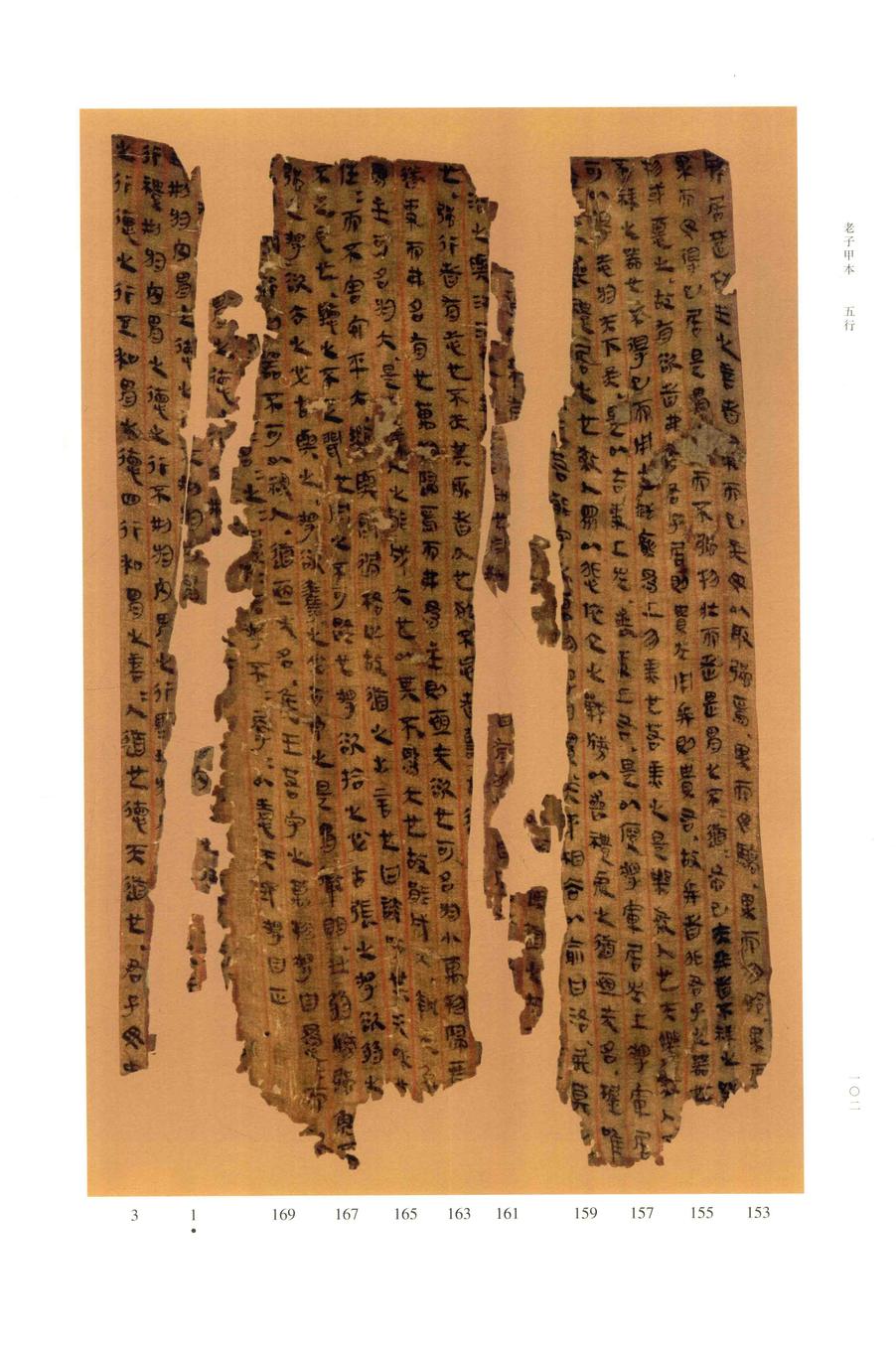
Laozi A (甲本), columns 154 to 158, on plate p. 102 of Changsha Mawangdui Han mu jianbo jicheng, vol. 1 (column numbers are printed under each plate; the columns run from right to left). Checked on the image: column 154 reads 道﹦蚤已 夫兵者不祥之器 (the opening of this chapter, with the end of the preceding text where shown). □ marks a character lost on the silk (3 in this section). Transcription and column numbers: Wikisource 老子 (帛書甲本), which follows the Jicheng column numbering. The English is Legge's translation of the received text, shown below the silk transcription; the silk wording differs from it in many places, so compare the two Chinese texts for the variants.
154夫兵者不祥之器□
155物或惡之∠故有欲者弗居君子居則貴左用兵則貴右∠故兵者非君子之器也□□
156不祥之器也不得已而用之銛襲為上勿美也若美之是樂殺人也夫樂殺人不
157可以得志於天下矣‧是以吉事上左‧喪事上右∠是以便將軍居左上將軍居
158右言以喪禮居之也殺人眾以悲依立之戰勝以喪禮處之
Compare: Received text (Wang Bi recension), the text Legge translated
夫佳兵者,不祥之器,物或惡之,故有道者不處。君子居則貴左,用兵則貴右。兵者不祥之器,非君子之器,不得已而用之,恬淡為上。勝而不美,而美之者,是樂殺人。夫樂殺人者,則不可以得志於天下矣。吉事尚左,凶事尚右。偏將軍居左,上將軍居右,言以喪禮處之。殺人之眾,以哀悲泣之,戰勝,以喪禮處之。
1Now arms, however beautiful, are instruments of evil omen, hateful, it may be said, to all creatures. Therefore they who have the Tao do not like to employ them.
2The superior man ordinarily considers the left hand the most honourable place, but in time of war the right hand. Those sharp weapons are instruments of evil omen, and not the instruments of the superior man;--he uses them only on the compulsion of necessity. Calm and repose are what he prizes; victory (by force of arms) is to him undesirable. To consider this desirable would be to delight in the slaughter of men; and he who delights in the slaughter of men cannot get his will in the kingdom.
3On occasions of festivity to be on the left hand is the prized position; on occasions of mourning, the right hand. The second in command of the army has his place on the left; the general commanding in chief has his on the right;--his place, that is, is assigned to him as in the rites of mourning. He who has killed multitudes of men should weep for them with the bitterest grief; and the victor in battle has his place (rightly) according to those rites.
Where on the image
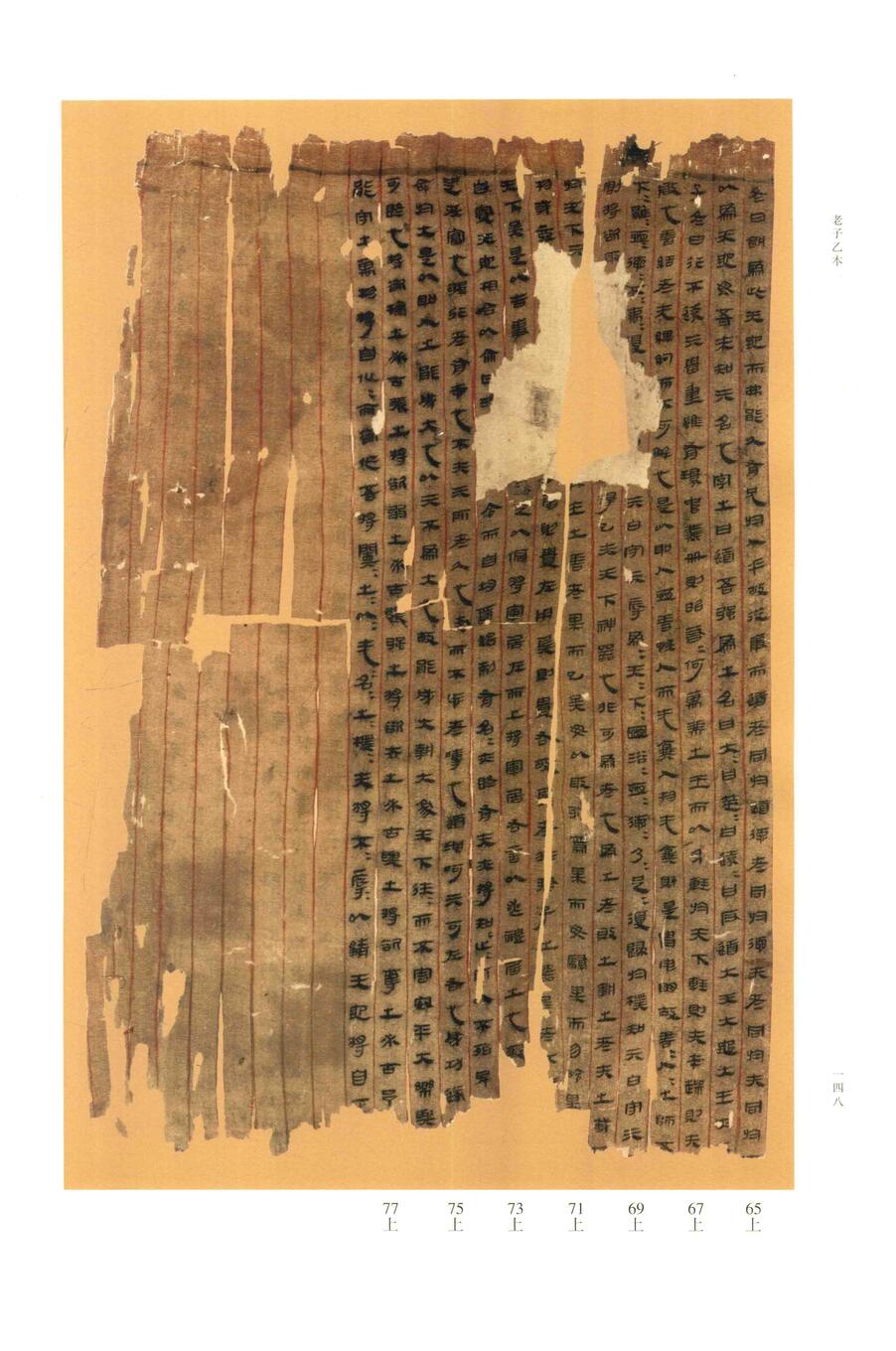
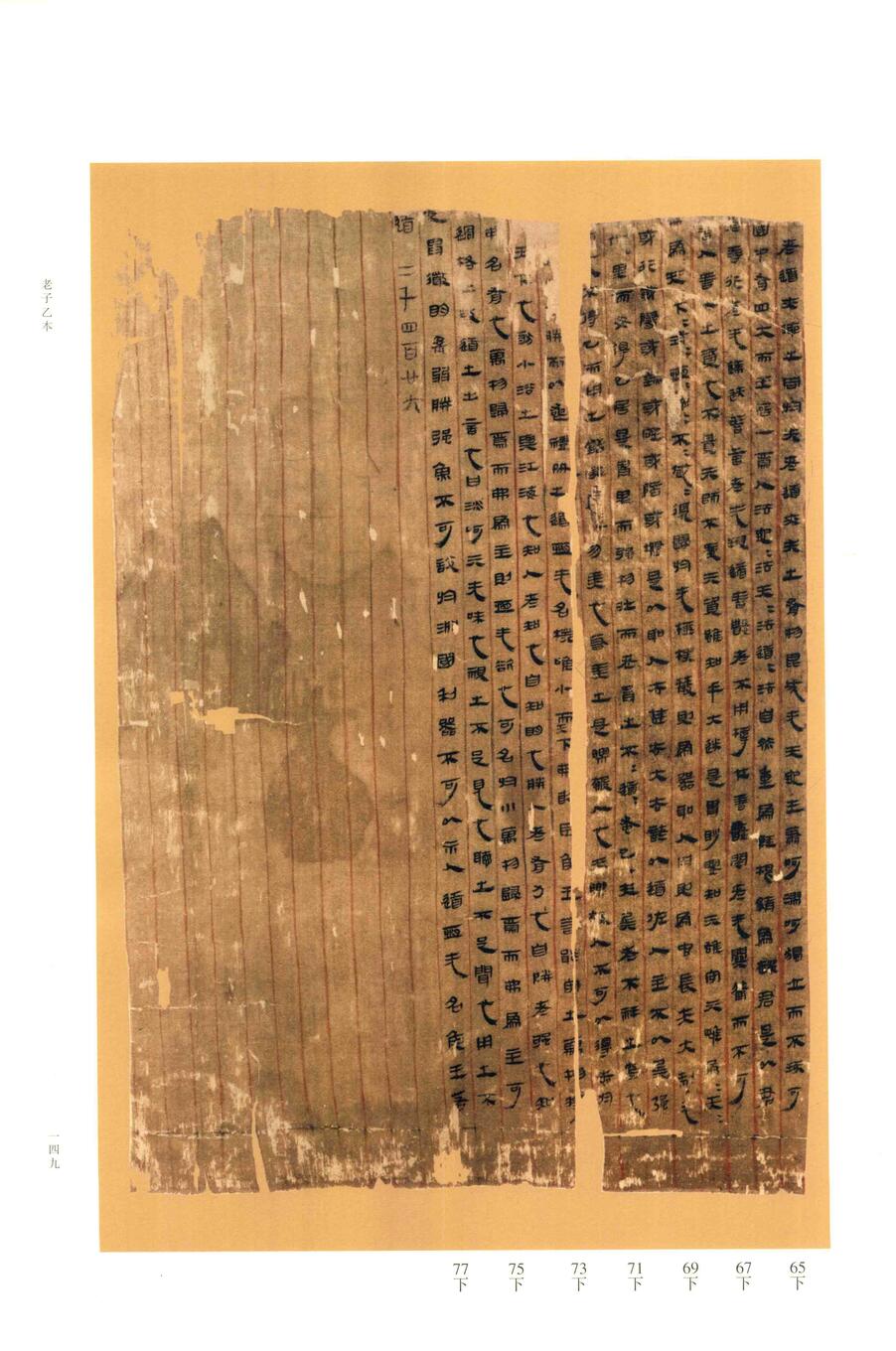
Laozi B (乙本), columns 71下 to 73下, on plates p. 148 and p. 149 of Changsha Mawangdui Han mu jianbo jicheng, vol. 1 (column numbers are printed under each plate; the columns run from right to left; each column of Laozi B is photographed as an upper half (上) and a lower half (下) on facing plates). Checked on the image: column 71下 reads 道﹦蚤已 夫兵者不祥之器 (the opening of this chapter, with the end of the preceding text where shown). □ marks a character lost on the silk (22 in this section). Transcription and column numbers: Wikisource 老子 (帛書乙本), which follows the Jicheng column numbering. The English is Legge's translation of the received text, shown below the silk transcription; the silk wording differs from it in many places, so compare the two Chinese texts for the variants.
71下夫兵者不祥之器也
72上物或亞□□□□□□□□子居則貴左用兵則貴右故兵者非君子之器兵者不祥□
72下器也不得已而用之銛龍為上勿美也若美之是樂殺人也夫樂殺人不可以得志於
73上天下矣是以吉事□□□□□□是以偏將軍居左而上將軍居右言以喪禮居之也殺□□□□
73下□立□□朕而以喪禮處之
Compare: Received text (Wang Bi recension), the text Legge translated
夫佳兵者,不祥之器,物或惡之,故有道者不處。君子居則貴左,用兵則貴右。兵者不祥之器,非君子之器,不得已而用之,恬淡為上。勝而不美,而美之者,是樂殺人。夫樂殺人者,則不可以得志於天下矣。吉事尚左,凶事尚右。偏將軍居左,上將軍居右,言以喪禮處之。殺人之眾,以哀悲泣之,戰勝,以喪禮處之。
1Now arms, however beautiful, are instruments of evil omen, hateful, it may be said, to all creatures. Therefore they who have the Tao do not like to employ them.
2The superior man ordinarily considers the left hand the most honourable place, but in time of war the right hand. Those sharp weapons are instruments of evil omen, and not the instruments of the superior man;--he uses them only on the compulsion of necessity. Calm and repose are what he prizes; victory (by force of arms) is to him undesirable. To consider this desirable would be to delight in the slaughter of men; and he who delights in the slaughter of men cannot get his will in the kingdom.
3On occasions of festivity to be on the left hand is the prized position; on occasions of mourning, the right hand. The second in command of the army has his place on the left; the general commanding in chief has his on the right;--his place, that is, is assigned to him as in the rites of mourning. He who has killed multitudes of men should weep for them with the bitterest grief; and the victor in battle has his place (rightly) according to those rites.
Notes
- English: James Legge, The Tao Teh King (Sacred Books of the East 39, 1891); Legge's paragraph numbers are kept as superscripts.
- Legge translated the received text, not the silk manuscripts. Where the silk wording differs, his English follows the received text shown under the transcription.
- Silk transcription: Wikisource Page transcriptions of the Jicheng plates (revisions of 18 October 2026, marked not yet proofread on Wikisource), checked against the plates for each chapter opening.
Cite
Sources
- Source: Mawangdui Laozi A and B silk manuscripts (plates of Changsha Mawangdui Han mu jianbo jicheng vol. 1, via Wikimedia Commons) + Wikisource column transcription + Wang Bi received text (Wikisource) + Legge 1891 English (Project Gutenberg) (holding institution)
- Critical edition: Changsha Mawangdui Han mu jianbo jicheng (2014) column numbers; Wikisource transcription; Wang Bi received text
← previous · → next · v cycle view · l back to library