Daodejing, chapter 38 (Mawangdui silk manuscripts)
Introduction
Chapter 38 of the Daodejing (Laozi), shown on the two oldest nearly complete copies of the work: the silk manuscripts Laozi A and Laozi B, found in 1973 in Tomb 3 at Mawangdui, Changsha (Hunan), a tomb sealed in 168 BCE. Laozi A is written in a script between seal and clerical forms and does not avoid the personal name of the Han founder Liu Bang (邦); it is commonly dated before 195 BCE. Laozi B is in clerical script, avoids 邦, and is commonly dated 194-180 BCE. Both put the De part (chapters 38-81) before the Dao part (chapters 1-37), and a few chapters stand in a different order from the received text.
Each section gives the silk transcription column by column, with the Jicheng column number before each column (for Laozi B, 上 and 下 are the upper and lower halves of a column, photographed on facing plates), and links to the plate that carries those columns. □ marks a lost character; ∠, ‧ and ﹦ are marks written on the silk (﹦ repeats the character before it). Below the transcription is the received text of the Wang Bi recension, which is the text James Legge translated in 1891; the silk wording differs from it, most visibly in 恆 for received 常 (the received text avoids the name of Emperor Wen, Liu Heng), in the frequent final particle 也, and in loan characters such as 胃 for 謂.
How was this verified? (Provenance)
Where on the image
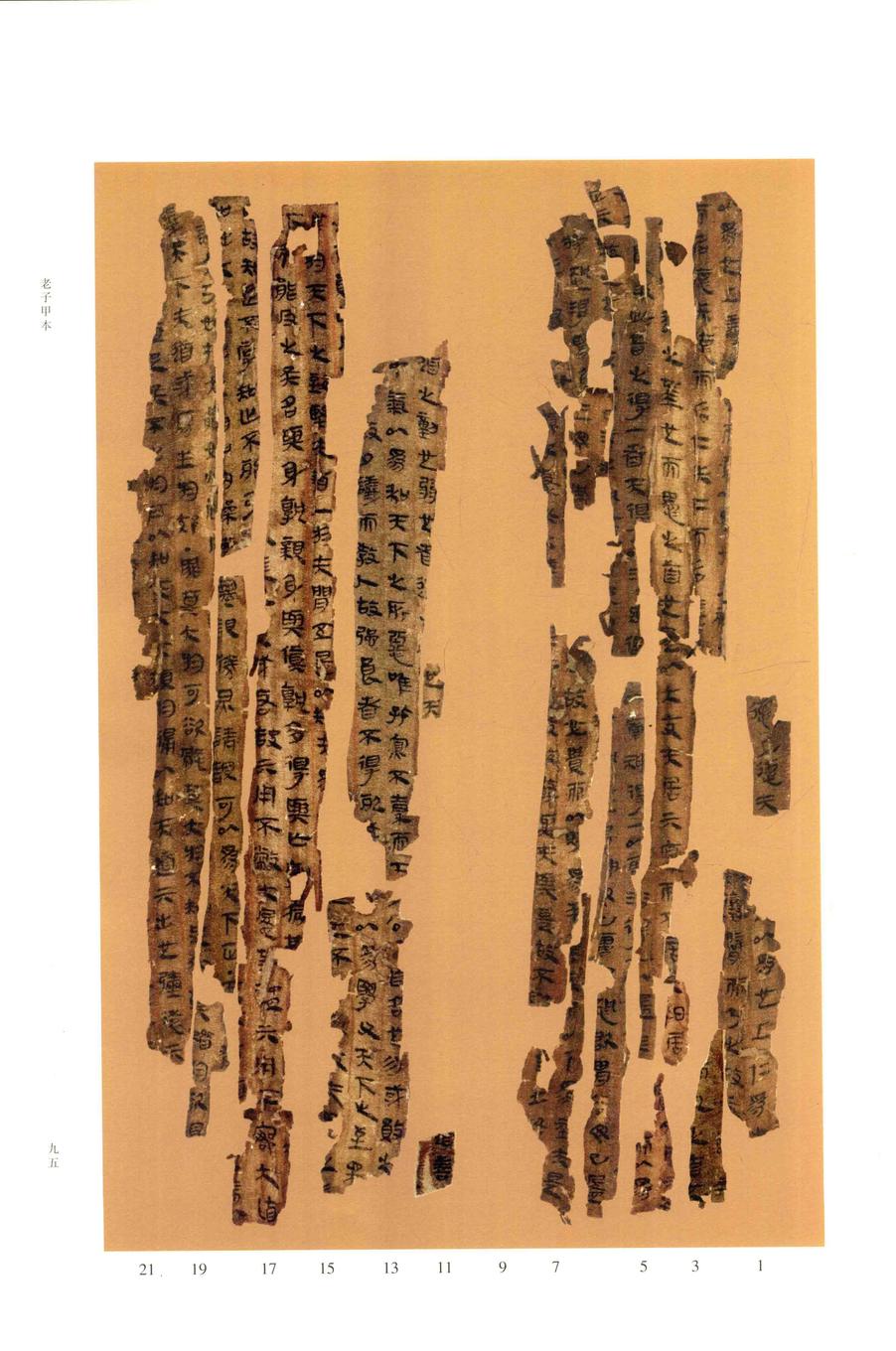
Laozi A (甲本), columns 1 to 5, on plate p. 95 of Changsha Mawangdui Han mu jianbo jicheng, vol. 1 (column numbers are printed under each plate; the columns run from right to left). Checked on the image: column 1 reads 德上德無…無以為也上仁為之. The opening characters of this chapter are lost or not readable on this plate image, so these are the first characters that were confirmed. This chapter opens the manuscript: the De part (chapters 38-81) comes before the Dao part (chapters 1-37). □ marks a character lost on the silk (42 in this section). Transcription and column numbers: Wikisource 老子 (帛書甲本), which follows the Jicheng column numbering. The English is Legge's translation of the received text, shown below the silk transcription; the silk wording differs from it in many places, so compare the two Chinese texts for the variants.
1□□□□□□□□□□□□□□□□德上德無□□無以為也上仁為之□□
2以為也上義為之而有以為也上禮□□□□□□□□攘臂而乃之故失道失道矣
3而后德失德而后仁失仁而后義□義而□□□□□□□□□□而亂之首也
4□□□道之華也而愚之首也是以大丈夫居亓厚而不居亓泊居亓實不居亓華
5故去皮取此
Compare: Received text (Wang Bi recension), the text Legge translated
上德不德,是以有德;下德不失德,是以無德。上德無為而無以為,下德為之而有以為。上仁為之而無以為,上義為之而有以為。上禮為之而莫之應,則攘臂而扔之。故失道而後德,失德而後仁,失仁而後義,失義而後禮。夫禮者,忠信之薄,而亂之首。前識者,道之華,而愚之始。是以大丈夫處其厚,不居其薄;處其實,不居其華。故去彼取此。
1(Those who) possessed in highest degree the attributes (of the Tao) did not (seek) to show them, and therefore they possessed them (in fullest measure). (Those who) possessed in a lower degree those attributes (sought how) not to lose them, and therefore they did not possess them (in fullest measure).
2(Those who) possessed in the highest degree those attributes did nothing (with a purpose), and had no need to do anything. (Those who) possessed them in a lower degree were (always) doing, and had need to be so doing.
3(Those who) possessed the highest benevolence were (always seeking) to carry it out, and had no need to be doing so. (Those who) possessed the highest righteousness were (always seeking) to carry it out, and had need to be so doing.
4(Those who) possessed the highest (sense of) propriety were (always seeking) to show it, and when men did not respond to it, they bared the arm and marched up to them.
5Thus it was that when the Tao was lost, its attributes appeared; when its attributes were lost, benevolence appeared; when benevolence was lost, righteousness appeared; and when righteousness was lost, the proprieties appeared.
6Now propriety is the attenuated form of leal-heartedness and good faith, and is also the commencement of disorder; swift apprehension is (only) a flower of the Tao, and is the beginning of stupidity.
7Thus it is that the Great man abides by what is solid, and eschews what is flimsy; dwells with the fruit and not with the flower. It is thus that he puts away the one and makes choice of the other.
Where on the image
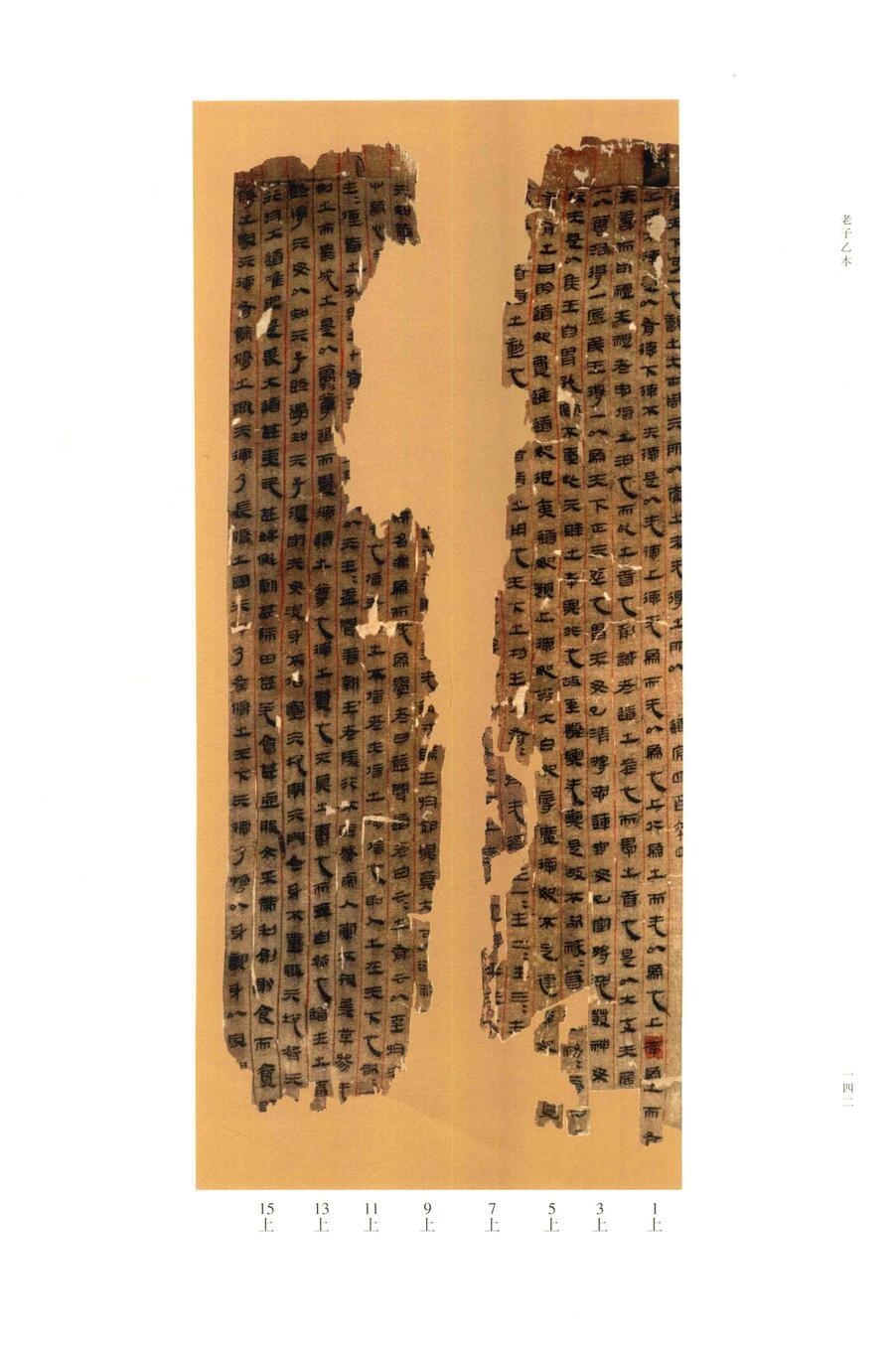
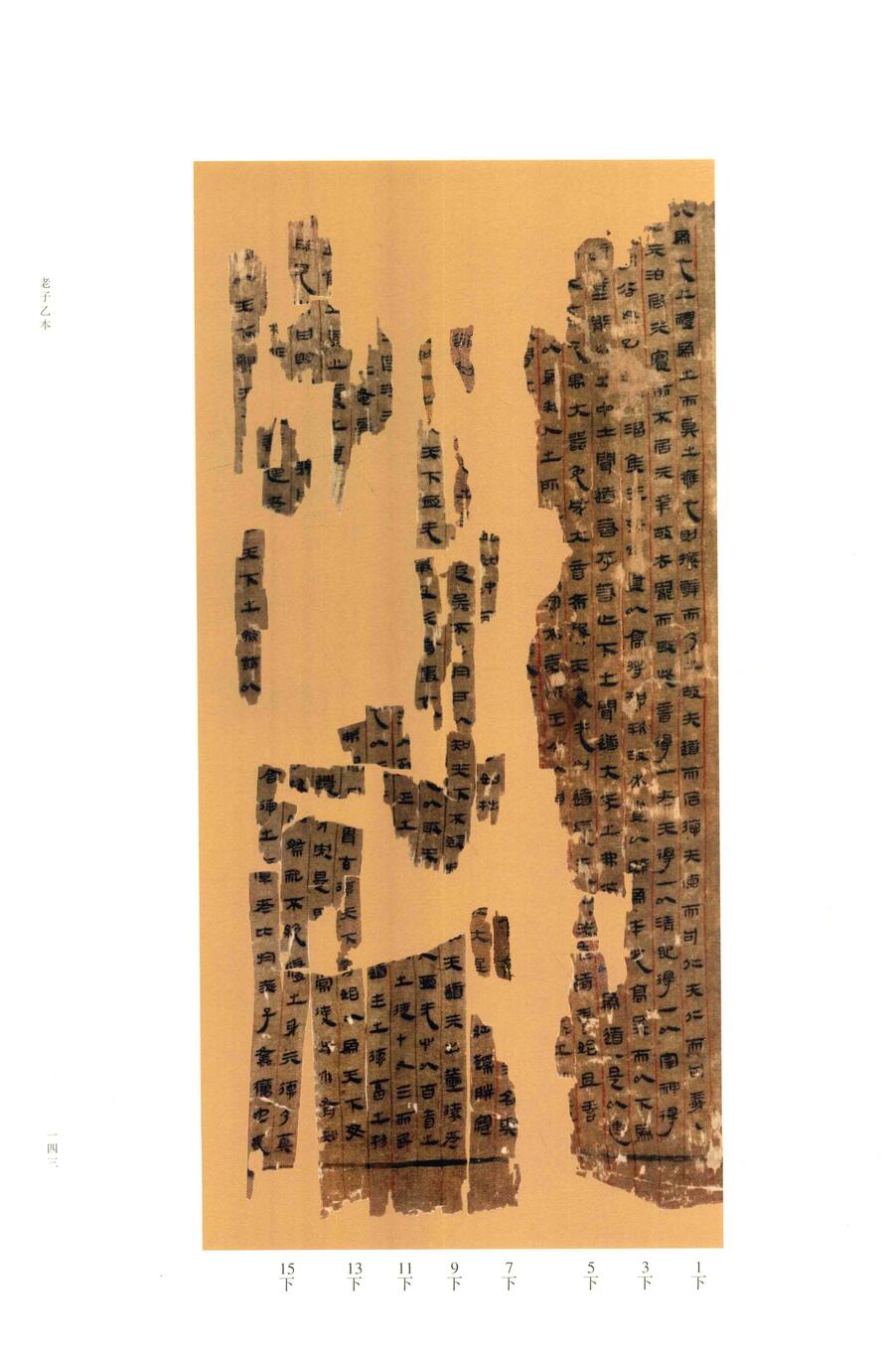
Laozi B (乙本), columns 1上 to 2下, on plates p. 142 and p. 143 of Changsha Mawangdui Han mu jianbo jicheng, vol. 1 (column numbers are printed under each plate; the columns run from right to left; each column of Laozi B is photographed as an upper half (上) and a lower half (下) on facing plates). Checked on the image: column 1上 reads 上德不德是以有德下德不失德 (the opening of this chapter, with the end of the preceding text where shown). This chapter opens the manuscript: the De part (chapters 38-81) comes before the Dao part (chapters 1-37). □ marks a character lost on the silk (3 in this section). Transcription and column numbers: Wikisource 老子 (帛書乙本), which follows the Jicheng column numbering. The English is Legge's translation of the received text, shown below the silk transcription; the silk wording differs from it in many places, so compare the two Chinese texts for the variants.
1上上德不德是以有德下德不失德是以無德上德無為而無以為也上仁為之而無以為也上○為之而有
1下以為也上禮為之而莫之應也則攘臂而乃之故失道而后德失德而句仁失仁而句義∠
2上失義而句禮夫禮者忠信之泊也而亂之首也前識者道之華也而愚之首也是以大丈夫居□□□
2下居亓泊居亓實而不居亓華故去罷而取此‧
Compare: Received text (Wang Bi recension), the text Legge translated
上德不德,是以有德;下德不失德,是以無德。上德無為而無以為,下德為之而有以為。上仁為之而無以為,上義為之而有以為。上禮為之而莫之應,則攘臂而扔之。故失道而後德,失德而後仁,失仁而後義,失義而後禮。夫禮者,忠信之薄,而亂之首。前識者,道之華,而愚之始。是以大丈夫處其厚,不居其薄;處其實,不居其華。故去彼取此。
1(Those who) possessed in highest degree the attributes (of the Tao) did not (seek) to show them, and therefore they possessed them (in fullest measure). (Those who) possessed in a lower degree those attributes (sought how) not to lose them, and therefore they did not possess them (in fullest measure).
2(Those who) possessed in the highest degree those attributes did nothing (with a purpose), and had no need to do anything. (Those who) possessed them in a lower degree were (always) doing, and had need to be so doing.
3(Those who) possessed the highest benevolence were (always seeking) to carry it out, and had no need to be doing so. (Those who) possessed the highest righteousness were (always seeking) to carry it out, and had need to be so doing.
4(Those who) possessed the highest (sense of) propriety were (always seeking) to show it, and when men did not respond to it, they bared the arm and marched up to them.
5Thus it was that when the Tao was lost, its attributes appeared; when its attributes were lost, benevolence appeared; when benevolence was lost, righteousness appeared; and when righteousness was lost, the proprieties appeared.
6Now propriety is the attenuated form of leal-heartedness and good faith, and is also the commencement of disorder; swift apprehension is (only) a flower of the Tao, and is the beginning of stupidity.
7Thus it is that the Great man abides by what is solid, and eschews what is flimsy; dwells with the fruit and not with the flower. It is thus that he puts away the one and makes choice of the other.
Notes
- English: James Legge, The Tao Teh King (Sacred Books of the East 39, 1891); Legge's paragraph numbers are kept as superscripts.
- Legge translated the received text, not the silk manuscripts. Where the silk wording differs, his English follows the received text shown under the transcription.
- Silk transcription: Wikisource Page transcriptions of the Jicheng plates (revisions of 18 October 2026, marked not yet proofread on Wikisource), checked against the plates for each chapter opening.
Cite
Sources
- Source: Mawangdui Laozi A and B silk manuscripts (plates of Changsha Mawangdui Han mu jianbo jicheng vol. 1, via Wikimedia Commons) + Wikisource column transcription + Wang Bi received text (Wikisource) + Legge 1891 English (Project Gutenberg) (holding institution)
- Critical edition: Changsha Mawangdui Han mu jianbo jicheng (2014) column numbers; Wikisource transcription; Wang Bi received text
← previous · → next · v cycle view · l back to library