Daodejing, chapter 39 (Mawangdui silk manuscripts)
Introduction
Chapter 39 of the Daodejing (Laozi), shown on the two oldest nearly complete copies of the work: the silk manuscripts Laozi A and Laozi B, found in 1973 in Tomb 3 at Mawangdui, Changsha (Hunan), a tomb sealed in 168 BCE. Laozi A is written in a script between seal and clerical forms and does not avoid the personal name of the Han founder Liu Bang (邦); it is commonly dated before 195 BCE. Laozi B is in clerical script, avoids 邦, and is commonly dated 194-180 BCE. Both put the De part (chapters 38-81) before the Dao part (chapters 1-37), and a few chapters stand in a different order from the received text.
Each section gives the silk transcription column by column, with the Jicheng column number before each column (for Laozi B, 上 and 下 are the upper and lower halves of a column, photographed on facing plates), and links to the plate that carries those columns. □ marks a lost character; ∠, ‧ and ﹦ are marks written on the silk (﹦ repeats the character before it). Below the transcription is the received text of the Wang Bi recension, which is the text James Legge translated in 1891; the silk wording differs from it, most visibly in 恆 for received 常 (the received text avoids the name of Emperor Wen, Liu Heng), in the frequent final particle 也, and in loan characters such as 胃 for 謂.
How was this verified? (Provenance)
Where on the image
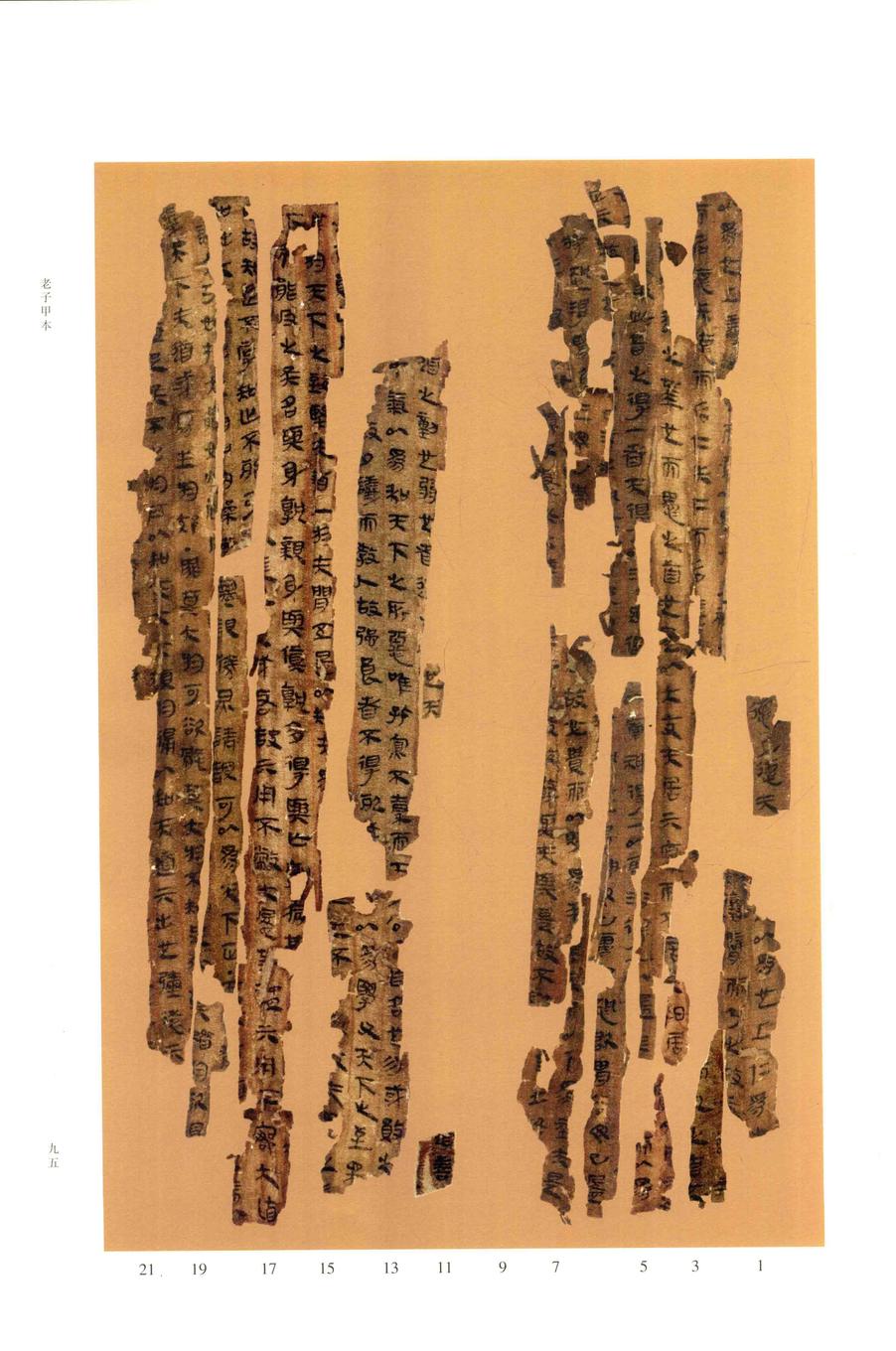
Laozi A (甲本), columns 5 to 8, on plate p. 95 of Changsha Mawangdui Han mu jianbo jicheng, vol. 1 (column numbers are printed under each plate; the columns run from right to left). Checked on the image: column 5 reads 昔之得一者天得一以清 (the opening of this chapter, with the end of the preceding text where shown). □ marks a character lost on the silk (21 in this section). Transcription and column numbers: Wikisource 老子 (帛書甲本), which follows the Jicheng column numbering. The English is Legge's translation of the received text, shown below the silk transcription; the silk wording differs from it in many places, so compare the two Chinese texts for the variants.
5昔之得一者天得一以清地得□以寧神得一以霝浴得一以盈侯□□□而以為
6正亓致之也胃天毌已清將恐□胃地毌□□將恐□胃神毌已霝將恐歇胃浴毌已盈
7將恐渴胃侯王毌已貴□□□□□故必貴而以賤為本必高矣而以下為基夫是
8以侯王自胃□孤寡不穀此亓賤□□與非□故致數與無與是故不欲□□若玉硌﹦□□
Compare: Received text (Wang Bi recension), the text Legge translated
昔之得一者,天得一以清,地得一以寧,神得一以靈,谷得一以盈,萬物得一以生,侯王得一以為天下貞。其致之,天無以清將恐裂,地無以寧將恐發,神無以靈將恐歇,谷無以盈將恐竭,萬物無以生將恐滅,侯王無以貴高將恐蹶。故貴以賤為本,高以下為基。是以侯王自稱孤﹑寡﹑不穀。此非以賤為本邪?非乎?故致數輿無輿,不欲琭琭如玉,珞珞如石。
1The things which from of old have got the One (the Tao) are--
Heaven which by it is bright and pure;
Earth rendered thereby firm and sure;
Spirits with powers by it supplied;
Valleys kept full throughout their void
All creatures which through it do live
Princes and kings who from it get
The model which to all they give.
All these are the results of the One (Tao).
2If heaven were not thus pure, it soon would rend;
If earth were not thus sure, 'twould break and bend;
Without these powers, the spirits soon would fail;
If not so filled, the drought would parch each vale;
Without that life, creatures would pass away;
Princes and kings, without that moral sway,
However grand and high, would all decay.
3Thus it is that dignity finds its (firm) root in its (previous) meanness, and what is lofty finds its stability in the lowness (from which it rises). Hence princes and kings call themselves 'Orphans,' 'Men of small virtue,' and as 'Carriages without a nave.' Is not this an acknowledgment that in their considering themselves mean they see the foundation of their dignity? So it is that in the enumeration of the different parts of a carriage we do not come on what makes it answer the ends of a carriage. They do not wish to show themselves elegant-looking as jade, but (prefer) to be coarse-looking as an (ordinary) stone.
Where on the image
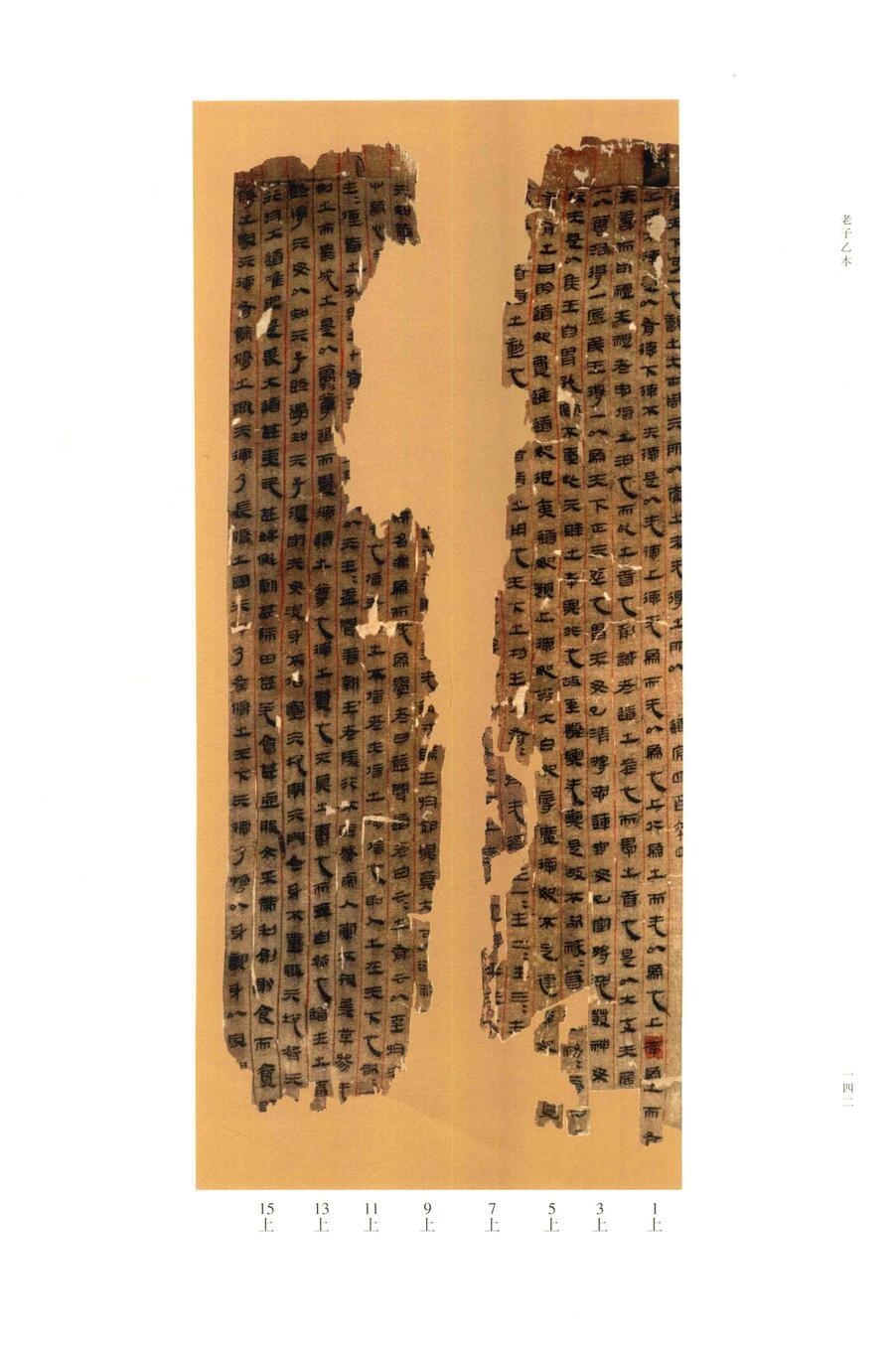
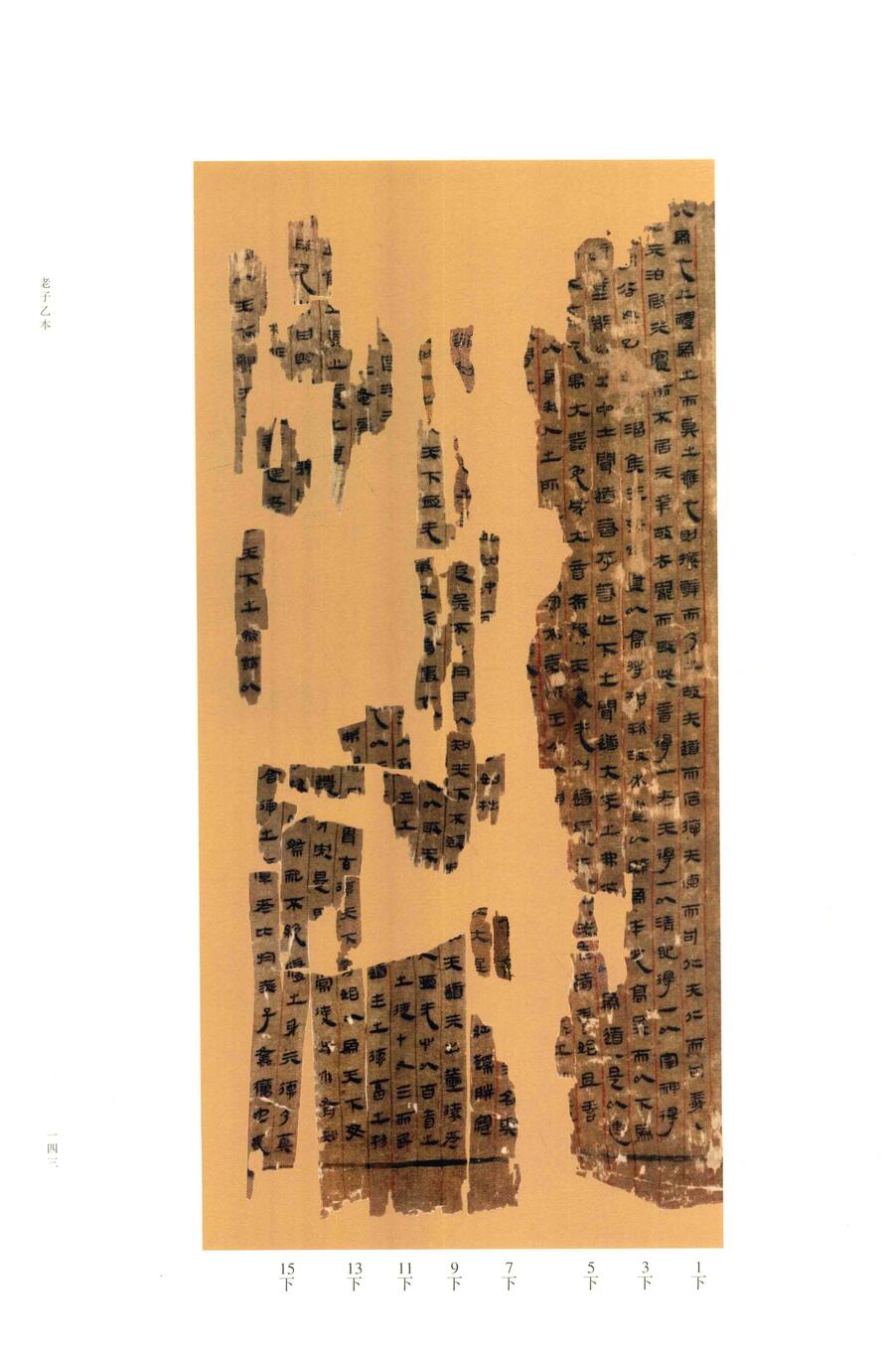
Laozi B (乙本), columns 2下 to 4上, on plates p. 142 and p. 143 of Changsha Mawangdui Han mu jianbo jicheng, vol. 1 (column numbers are printed under each plate; the columns run from right to left; each column of Laozi B is photographed as an upper half (上) and a lower half (下) on facing plates). Checked on the image: column 2下 reads 故去罷而取此‧ 昔得一者天得一以清地得一以寧神得 (the opening of this chapter, with the end of the preceding text where shown). □ marks a character lost on the silk (4 in this section). Transcription and column numbers: Wikisource 老子 (帛書乙本), which follows the Jicheng column numbering. The English is Legge's translation of the received text, shown below the silk transcription; the silk wording differs from it in many places, so compare the two Chinese texts for the variants.
2下昔得一者天得一以清地得一以寧神得
3上一以霝浴得一盈侯王得一以為天下正亓至也胃天毌已清將恐蓮地毌已寧將恐發神毌□□□
3下恐歇谷毌已□將渴侯王毌已貴以高將恐蹶故必貴以賤為本必高矣而以下為
4上基夫是以侯王自胃孤寡不穀此亓賤之本與非也故至數輿無輿是故不欲祿﹦若玉硌﹦若石
Compare: Received text (Wang Bi recension), the text Legge translated
昔之得一者,天得一以清,地得一以寧,神得一以靈,谷得一以盈,萬物得一以生,侯王得一以為天下貞。其致之,天無以清將恐裂,地無以寧將恐發,神無以靈將恐歇,谷無以盈將恐竭,萬物無以生將恐滅,侯王無以貴高將恐蹶。故貴以賤為本,高以下為基。是以侯王自稱孤﹑寡﹑不穀。此非以賤為本邪?非乎?故致數輿無輿,不欲琭琭如玉,珞珞如石。
1The things which from of old have got the One (the Tao) are--
Heaven which by it is bright and pure;
Earth rendered thereby firm and sure;
Spirits with powers by it supplied;
Valleys kept full throughout their void
All creatures which through it do live
Princes and kings who from it get
The model which to all they give.
All these are the results of the One (Tao).
2If heaven were not thus pure, it soon would rend;
If earth were not thus sure, 'twould break and bend;
Without these powers, the spirits soon would fail;
If not so filled, the drought would parch each vale;
Without that life, creatures would pass away;
Princes and kings, without that moral sway,
However grand and high, would all decay.
3Thus it is that dignity finds its (firm) root in its (previous) meanness, and what is lofty finds its stability in the lowness (from which it rises). Hence princes and kings call themselves 'Orphans,' 'Men of small virtue,' and as 'Carriages without a nave.' Is not this an acknowledgment that in their considering themselves mean they see the foundation of their dignity? So it is that in the enumeration of the different parts of a carriage we do not come on what makes it answer the ends of a carriage. They do not wish to show themselves elegant-looking as jade, but (prefer) to be coarse-looking as an (ordinary) stone.
Notes
- English: James Legge, The Tao Teh King (Sacred Books of the East 39, 1891); Legge's paragraph numbers are kept as superscripts.
- Legge translated the received text, not the silk manuscripts. Where the silk wording differs, his English follows the received text shown under the transcription.
- Silk transcription: Wikisource Page transcriptions of the Jicheng plates (revisions of 18 October 2026, marked not yet proofread on Wikisource), checked against the plates for each chapter opening.
Cite
Sources
- Source: Mawangdui Laozi A and B silk manuscripts (plates of Changsha Mawangdui Han mu jianbo jicheng vol. 1, via Wikimedia Commons) + Wikisource column transcription + Wang Bi received text (Wikisource) + Legge 1891 English (Project Gutenberg) (holding institution)
- Critical edition: Changsha Mawangdui Han mu jianbo jicheng (2014) column numbers; Wikisource transcription; Wang Bi received text
← previous · → next · v cycle view · l back to library