Daodejing, chapter 41 (Mawangdui silk manuscripts)
Introduction
Chapter 41 of the Daodejing (Laozi), shown on the two oldest nearly complete copies of the work: the silk manuscripts Laozi A and Laozi B, found in 1973 in Tomb 3 at Mawangdui, Changsha (Hunan), a tomb sealed in 168 BCE. Laozi A is written in a script between seal and clerical forms and does not avoid the personal name of the Han founder Liu Bang (邦); it is commonly dated before 195 BCE. Laozi B is in clerical script, avoids 邦, and is commonly dated 194-180 BCE. Both put the De part (chapters 38-81) before the Dao part (chapters 1-37), and a few chapters stand in a different order from the received text.
Each section gives the silk transcription column by column, with the Jicheng column number before each column (for Laozi B, 上 and 下 are the upper and lower halves of a column, photographed on facing plates), and links to the plate that carries those columns. □ marks a lost character; ∠, ‧ and ﹦ are marks written on the silk (﹦ repeats the character before it). Below the transcription is the received text of the Wang Bi recension, which is the text James Legge translated in 1891; the silk wording differs from it, most visibly in 恆 for received 常 (the received text avoids the name of Emperor Wen, Liu Heng), in the frequent final particle 也, and in loan characters such as 胃 for 謂.
How was this verified? (Provenance)
Where on the image
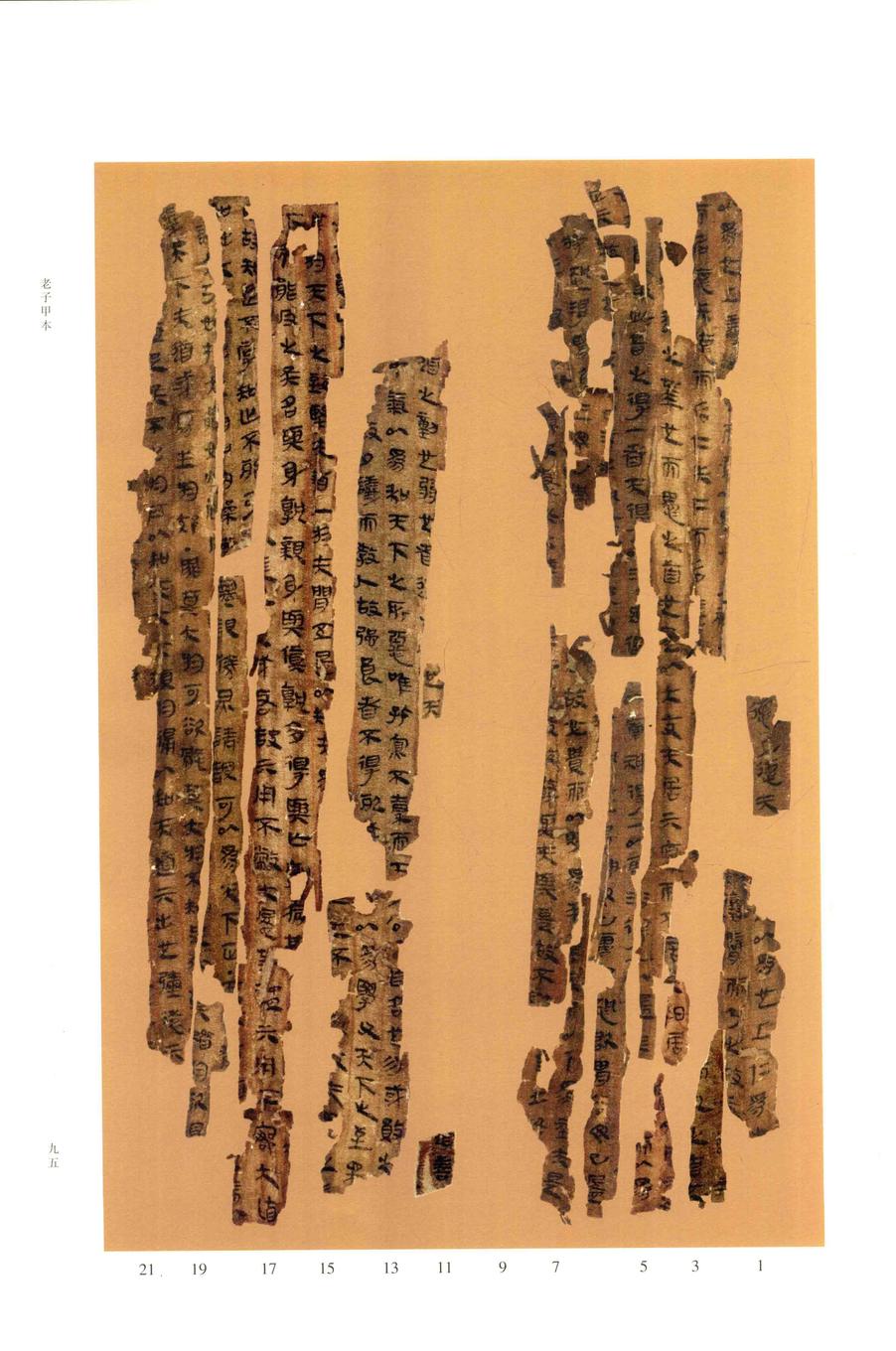
Laozi A (甲本), columns 9 to 12, on plate p. 95 of Changsha Mawangdui Han mu jianbo jicheng, vol. 1 (column numbers are printed under each plate; the columns run from right to left). Checked on the image: column 11 reads 道善. The opening characters of this chapter are lost or not readable on this plate image, so these are the first characters that were confirmed. In this manuscript the chapter follows chapter 39, not chapter 40. □ marks a character lost on the silk (96 in this section). Transcription and column numbers: Wikisource 老子 (帛書甲本), which follows the Jicheng column numbering. The English is Legge's translation of the received text, shown below the silk transcription; the silk wording differs from it in many places, so compare the two Chinese texts for the variants.
9□□□□□□□□□□□□□□□□□□□□□□□□□□□□□□□□
10□□□□□□□□□□□□□□□□□□□□□□□□□□□□□□□□
11□□□□□□□□□□□□□□□□□□□□□□□□□□□□道善□□
12□□
Compare: Received text (Wang Bi recension), the text Legge translated
上士聞道,勤而行之;中士聞道,若存若亡;下士聞道,大笑之。不笑不足以為道。故建言有之﹕明道若昧,進道若退,夷道若纇,上德若谷,大白若辱,廣德若不足,建德若偷,質真若渝,大方無隅,大器晚成,大音希聲,大象無形,道隱無名。夫唯道,善貸且成。
1Scholars of the highest class, when they hear about the Tao, earnestly carry it into practice. Scholars of the middle class, when they have heard about it, seem now to keep it and now to lose it. Scholars of the lowest class, when they have heard about it, laugh greatly at it. If it were not (thus) laughed at, it would not be fit to be the Tao.
2Therefore the sentence-makers have thus expressed themselves:--
'The Tao, when brightest seen, seems light to lack;
Who progress in it makes, seems drawing back;
Its even way is like a rugged track.
Its highest virtue from the vale doth rise;
Its greatest beauty seems to offend the eyes;
And he has most whose lot the least supplies.
Its firmest virtue seems but poor and low;
Its solid truth seems change to undergo;
Its largest square doth yet no corner show
A vessel great, it is the slowest made;
Loud is its sound, but never word it said;
A semblance great, the shadow of a shade.'
3The Tao is hidden, and has no name; but it is the Tao which is skilful at imparting (to all things what they need) and making them complete.
Where on the image
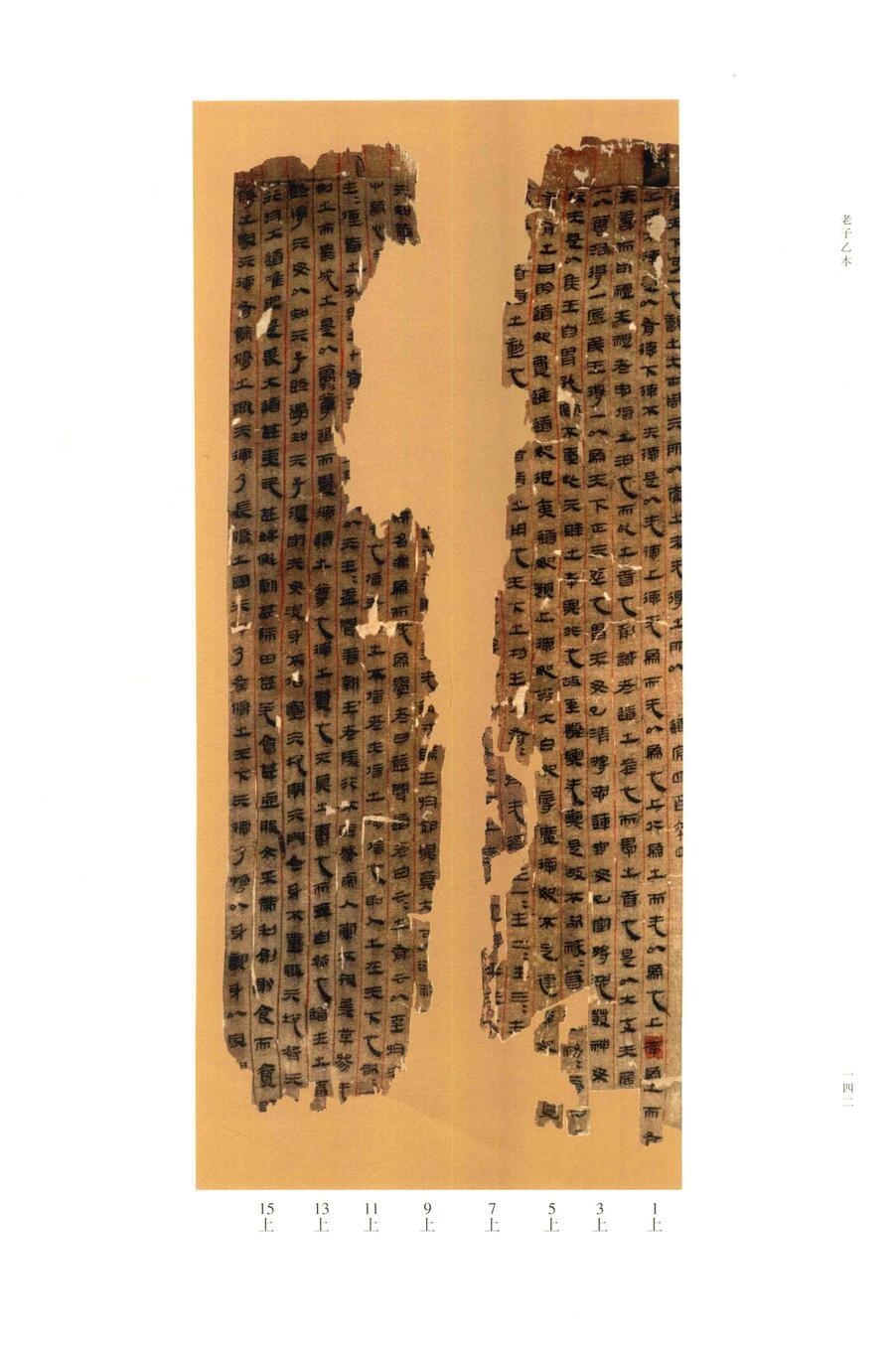
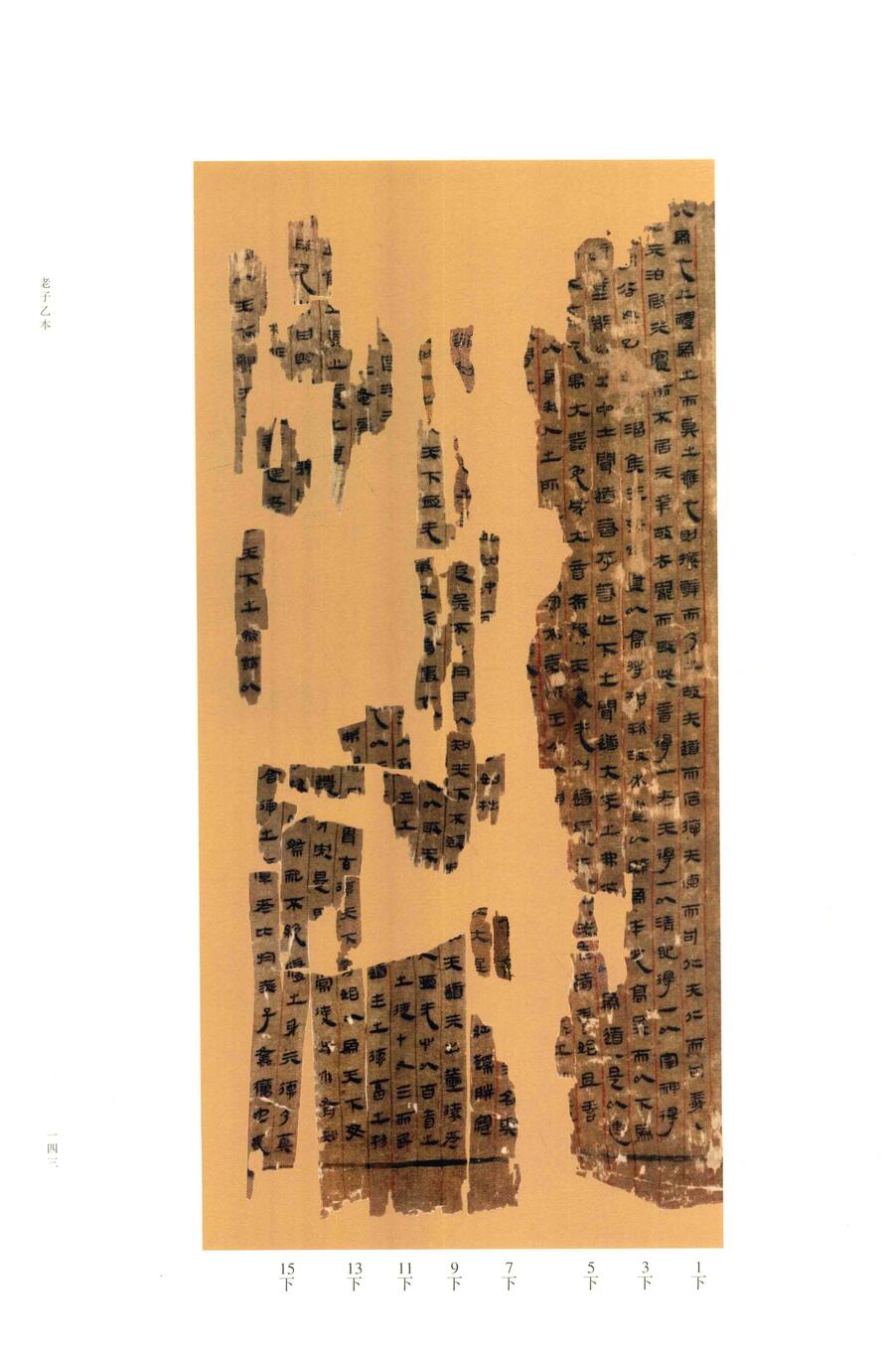
Laozi B (乙本), columns 4上 to 6上, on plates p. 142 and p. 143 of Changsha Mawangdui Han mu jianbo jicheng, vol. 1 (column numbers are printed under each plate; the columns run from right to left; each column of Laozi B is photographed as an upper half (上) and a lower half (下) on facing plates). Checked on the image: column 4上 reads 若石 上 (the opening of this chapter, with the end of the preceding text where shown). In this manuscript the chapter follows chapter 39, not chapter 40. □ marks a character lost on the silk (8 in this section). Transcription and column numbers: Wikisource 老子 (帛書乙本), which follows the Jicheng column numbering. The English is Legge's translation of the received text, shown below the silk transcription; the silk wording differs from it in many places, so compare the two Chinese texts for the variants.
4上上□
4下□道堇能行之中士聞道若存若亡下士聞道大笑之弗笑□□以為道‧是以建
5上言有之曰明道如費進道如退夷道如類上德如浴大白如辱廣德如不足建德如□質□
5下□□大方無禺大器免成大音希聲天象無刑道褒無名‧夫唯道善始且善
6上成
Compare: Received text (Wang Bi recension), the text Legge translated
上士聞道,勤而行之;中士聞道,若存若亡;下士聞道,大笑之。不笑不足以為道。故建言有之﹕明道若昧,進道若退,夷道若纇,上德若谷,大白若辱,廣德若不足,建德若偷,質真若渝,大方無隅,大器晚成,大音希聲,大象無形,道隱無名。夫唯道,善貸且成。
1Scholars of the highest class, when they hear about the Tao, earnestly carry it into practice. Scholars of the middle class, when they have heard about it, seem now to keep it and now to lose it. Scholars of the lowest class, when they have heard about it, laugh greatly at it. If it were not (thus) laughed at, it would not be fit to be the Tao.
2Therefore the sentence-makers have thus expressed themselves:--
'The Tao, when brightest seen, seems light to lack;
Who progress in it makes, seems drawing back;
Its even way is like a rugged track.
Its highest virtue from the vale doth rise;
Its greatest beauty seems to offend the eyes;
And he has most whose lot the least supplies.
Its firmest virtue seems but poor and low;
Its solid truth seems change to undergo;
Its largest square doth yet no corner show
A vessel great, it is the slowest made;
Loud is its sound, but never word it said;
A semblance great, the shadow of a shade.'
3The Tao is hidden, and has no name; but it is the Tao which is skilful at imparting (to all things what they need) and making them complete.
Notes
- English: James Legge, The Tao Teh King (Sacred Books of the East 39, 1891); Legge's paragraph numbers are kept as superscripts.
- Legge translated the received text, not the silk manuscripts. Where the silk wording differs, his English follows the received text shown under the transcription.
- Silk transcription: Wikisource Page transcriptions of the Jicheng plates (revisions of 18 October 2026, marked not yet proofread on Wikisource), checked against the plates for each chapter opening.
Cite
Sources
- Source: Mawangdui Laozi A and B silk manuscripts (plates of Changsha Mawangdui Han mu jianbo jicheng vol. 1, via Wikimedia Commons) + Wikisource column transcription + Wang Bi received text (Wikisource) + Legge 1891 English (Project Gutenberg) (holding institution)
- Critical edition: Changsha Mawangdui Han mu jianbo jicheng (2014) column numbers; Wikisource transcription; Wang Bi received text
← previous · → next · v cycle view · l back to library