Daodejing, chapter 43 (Mawangdui silk manuscripts)
Introduction
Chapter 43 of the Daodejing (Laozi), shown on the two oldest nearly complete copies of the work: the silk manuscripts Laozi A and Laozi B, found in 1973 in Tomb 3 at Mawangdui, Changsha (Hunan), a tomb sealed in 168 BCE. Laozi A is written in a script between seal and clerical forms and does not avoid the personal name of the Han founder Liu Bang (邦); it is commonly dated before 195 BCE. Laozi B is in clerical script, avoids 邦, and is commonly dated 194-180 BCE. Both put the De part (chapters 38-81) before the Dao part (chapters 1-37), and a few chapters stand in a different order from the received text.
Each section gives the silk transcription column by column, with the Jicheng column number before each column (for Laozi B, 上 and 下 are the upper and lower halves of a column, photographed on facing plates), and links to the plate that carries those columns. □ marks a lost character; ∠, ‧ and ﹦ are marks written on the silk (﹦ repeats the character before it). Below the transcription is the received text of the Wang Bi recension, which is the text James Legge translated in 1891; the silk wording differs from it, most visibly in 恆 for received 常 (the received text avoids the name of Emperor Wen, Liu Heng), in the frequent final particle 也, and in loan characters such as 胃 for 謂.
How was this verified? (Provenance)
Where on the image
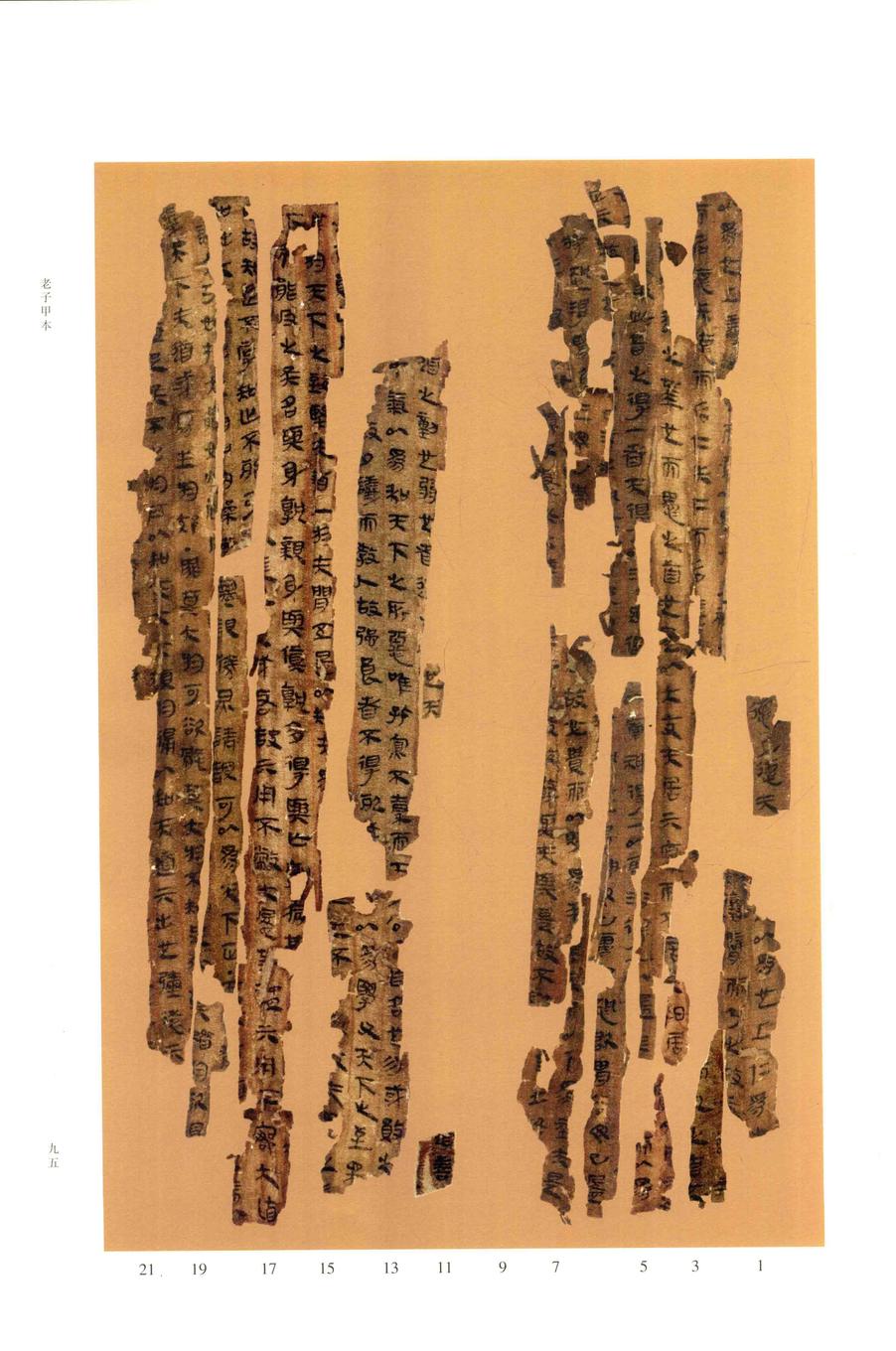
Laozi A (甲本), columns 14 to 16, on plate p. 95 of Changsha Mawangdui Han mu jianbo jicheng, vol. 1 (column numbers are printed under each plate; the columns run from right to left). Checked on the image: column 14 reads 以為學父 天下之至柔 (the opening of this chapter, with the end of the preceding text where shown). □ marks a character lost on the silk (6 in this section). Transcription and column numbers: Wikisource 老子 (帛書甲本), which follows the Jicheng column numbering. The English is Legge's translation of the received text, shown below the silk transcription; the silk wording differs from it in many places, so compare the two Chinese texts for the variants.
14天下之至柔□
15騁於天下之致堅無有入於無閒五是以知無為□□益也不□□教無為之益□
16下希能及之矣
Compare: Received text (Wang Bi recension), the text Legge translated
天下之至柔,馳騁天下之至堅。無有入無間,吾是以知無為之有益。不言之教,無為之益,天下希及之。
1The softest thing in the world dashes against and overcomes the hardest; that which has no (substantial) existence enters where there is no crevice. I know hereby what advantage belongs to doing nothing (with a purpose).
2There are few in the world who attain to the teaching without words, and the advantage arising from non-action.
Where on the image
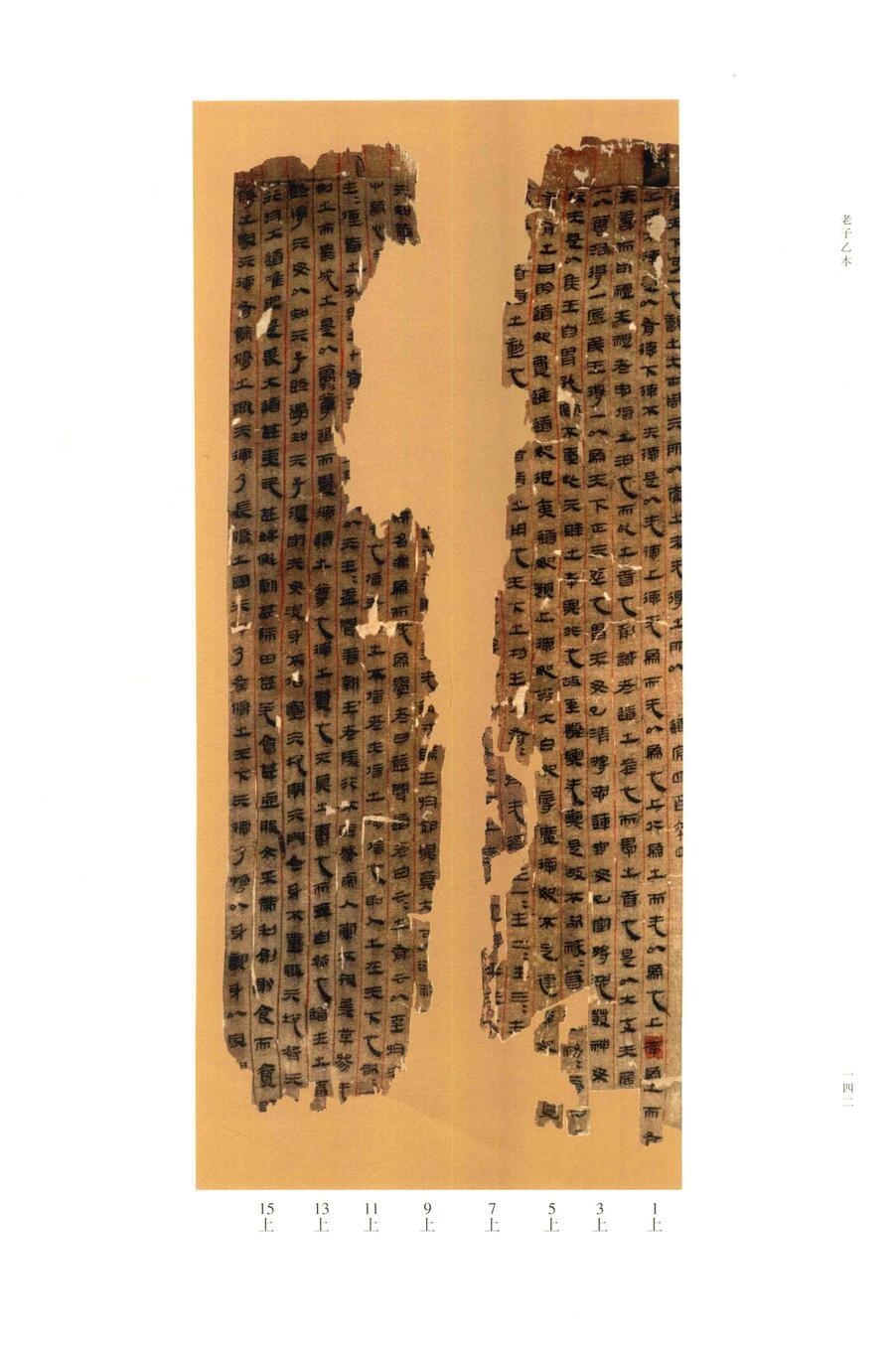
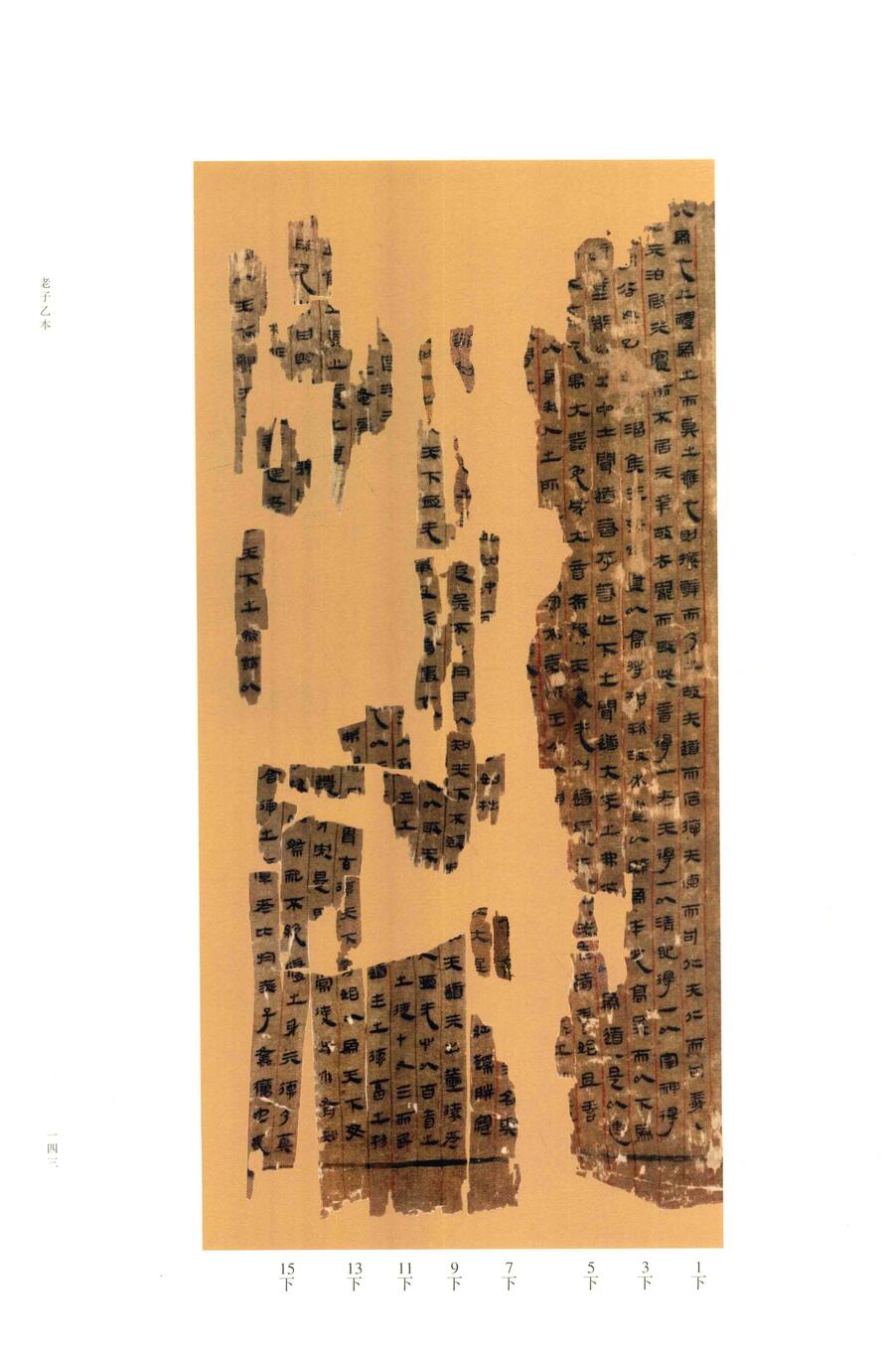
Laozi B (乙本), column 7 (上 and 下), on plates p. 142 and p. 143 of Changsha Mawangdui Han mu jianbo jicheng, vol. 1 (column numbers are printed under each plate; the columns run from right to left; each column of Laozi B is photographed as an upper half (上) and a lower half (下) on facing plates). Checked on the image: column 7下 ends 矣 followed by 名與 (opening of chapter 44); column 6上 carries the opening of chapter 42 (道生一﹦生二﹦生三); the chapter 43 characters in columns 7上 and 7下 could not be read at the resolution of this image. □ marks a character lost on the silk (29 in this section). Transcription and column numbers: Wikisource 老子 (帛書乙本), which follows the Jicheng column numbering. The English is Legge's translation of the received text, shown below the silk transcription; the silk wording differs from it in many places, so compare the two Chinese texts for the variants.
7上天下之至□馳騁乎天下□□□□□
7下□□□□無閒吾是以□□□□□□也不□□□□□□□□□□□□□矣
Compare: Received text (Wang Bi recension), the text Legge translated
天下之至柔,馳騁天下之至堅。無有入無間,吾是以知無為之有益。不言之教,無為之益,天下希及之。
1The softest thing in the world dashes against and overcomes the hardest; that which has no (substantial) existence enters where there is no crevice. I know hereby what advantage belongs to doing nothing (with a purpose).
2There are few in the world who attain to the teaching without words, and the advantage arising from non-action.
Notes
- English: James Legge, The Tao Teh King (Sacred Books of the East 39, 1891); Legge's paragraph numbers are kept as superscripts.
- Legge translated the received text, not the silk manuscripts. Where the silk wording differs, his English follows the received text shown under the transcription.
- Silk transcription: Wikisource Page transcriptions of the Jicheng plates (revisions of 18 October 2026, marked not yet proofread on Wikisource), checked against the plates for each chapter opening.
Cite
Sources
- Source: Mawangdui Laozi A and B silk manuscripts (plates of Changsha Mawangdui Han mu jianbo jicheng vol. 1, via Wikimedia Commons) + Wikisource column transcription + Wang Bi received text (Wikisource) + Legge 1891 English (Project Gutenberg) (holding institution)
- Critical edition: Changsha Mawangdui Han mu jianbo jicheng (2014) column numbers; Wikisource transcription; Wang Bi received text
← previous · → next · v cycle view · l back to library