Daodejing, chapter 54 (Mawangdui silk manuscripts)
Introduction
Chapter 54 of the Daodejing (Laozi), shown on the two oldest nearly complete copies of the work: the silk manuscripts Laozi A and Laozi B, found in 1973 in Tomb 3 at Mawangdui, Changsha (Hunan), a tomb sealed in 168 BCE. Laozi A is written in a script between seal and clerical forms and does not avoid the personal name of the Han founder Liu Bang (邦); it is commonly dated before 195 BCE. Laozi B is in clerical script, avoids 邦, and is commonly dated 194-180 BCE. Both put the De part (chapters 38-81) before the Dao part (chapters 1-37), and a few chapters stand in a different order from the received text.
Each section gives the silk transcription column by column, with the Jicheng column number before each column (for Laozi B, 上 and 下 are the upper and lower halves of a column, photographed on facing plates), and links to the plate that carries those columns. □ marks a lost character; ∠, ‧ and ﹦ are marks written on the silk (﹦ repeats the character before it). Below the transcription is the received text of the Wang Bi recension, which is the text James Legge translated in 1891; the silk wording differs from it, most visibly in 恆 for received 常 (the received text avoids the name of Emperor Wen, Liu Heng), in the frequent final particle 也, and in loan characters such as 胃 for 謂.
How was this verified? (Provenance)
Where on the image
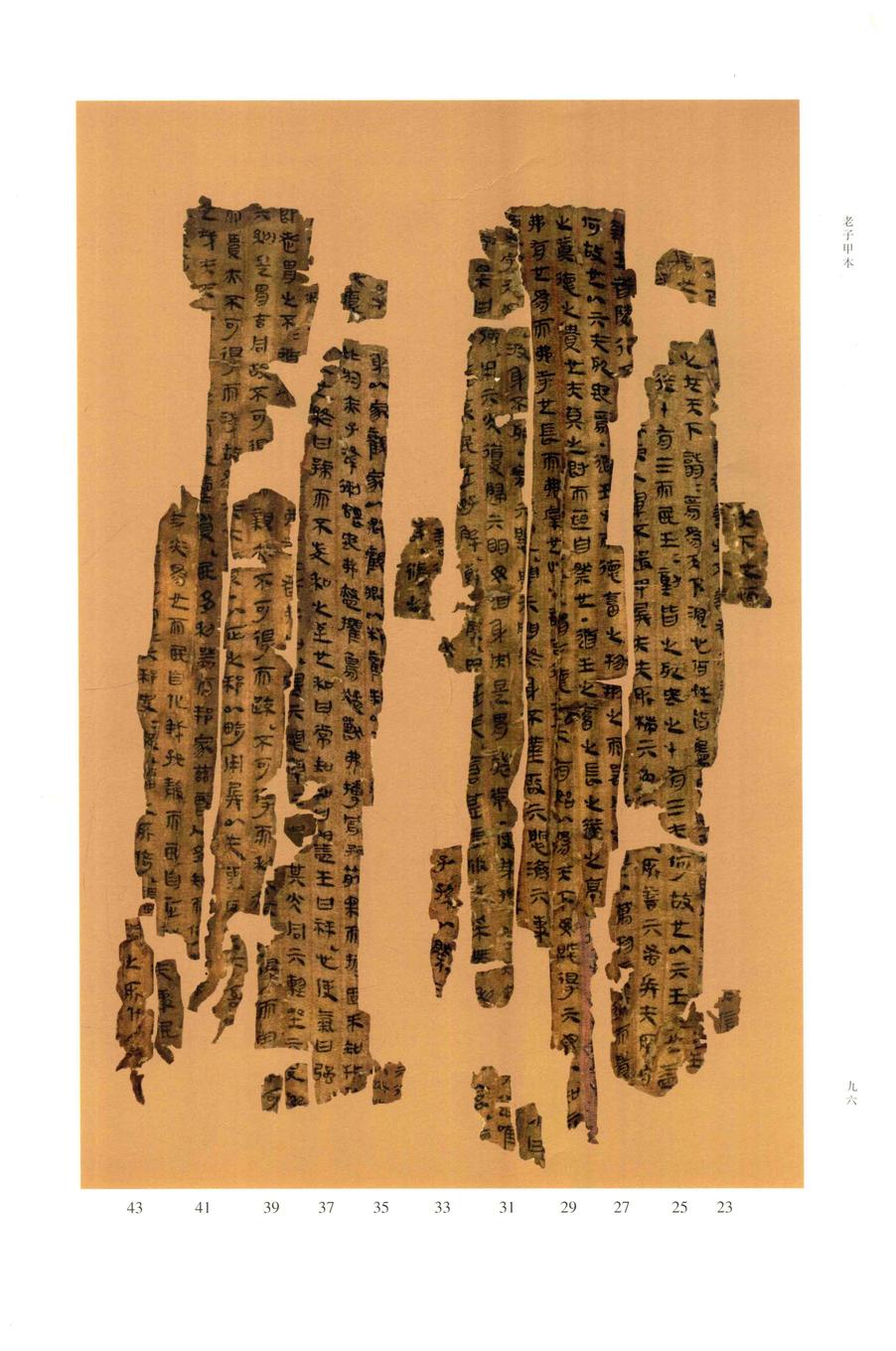
Laozi A (甲本), columns 33 to 35, on plate p. 96 of Changsha Mawangdui Han mu jianbo jicheng, vol. 1 (column numbers are printed under each plate; the columns run from right to left). Checked on the image: column 35 reads 以身□身以家觀家以鄉觀鄉以邦觀邦. The opening characters of this chapter are lost or not readable on this plate image, so these are the first characters that were confirmed. □ marks a character lost on the silk (56 in this section). Transcription and column numbers: Wikisource 老子 (帛書甲本), which follows the Jicheng column numbering. The English is Legge's translation of the received text, shown below the silk transcription; the silk wording differs from it in many places, so compare the two Chinese texts for the variants.
33善建□□撥□□□□□子孫以祭祀□□□□□
34□□□□□□□□□□餘‧脩之□□□□□□□□□□□□□□□□□
35□□以身□身以家觀家以鄉觀鄉以邦觀邦以天□觀□□□□□□□□□□□□□
Compare: Received text (Wang Bi recension), the text Legge translated
善建者不拔,善抱者不脫,子孫以祭祀不輟。修之於身,其德乃真;修之於家,其德乃餘;修之於鄉,其德乃長;修之於國,其德乃豐;修之於天下,其德乃普。故以身觀身,以家觀家,以鄉觀鄉,以國觀國,以天下觀天下。吾何以知天下然哉?以此。
1What (Tao's) skilful planter plants
Can never be uptorn;
What his skilful arms enfold,
From him can ne'er be borne.
Sons shall bring in lengthening line,
Sacrifices to his shrine.
2Tao when nursed within one's self,
His vigour will make true;
And where the family it rules
What riches will accrue!
The neighbourhood where it prevails
In thriving will abound;
And when 'tis seen throughout the state,
Good fortune will be found.
Employ it the kingdom o'er,
And men thrive all around.
3In this way the effect will be seen in the person, by the observation of different cases; in the family; in the neighbourhood; in the state; and in the kingdom.
4How do I know that this effect is sure to hold thus all under the sky? By this (method of observation).
Where on the image
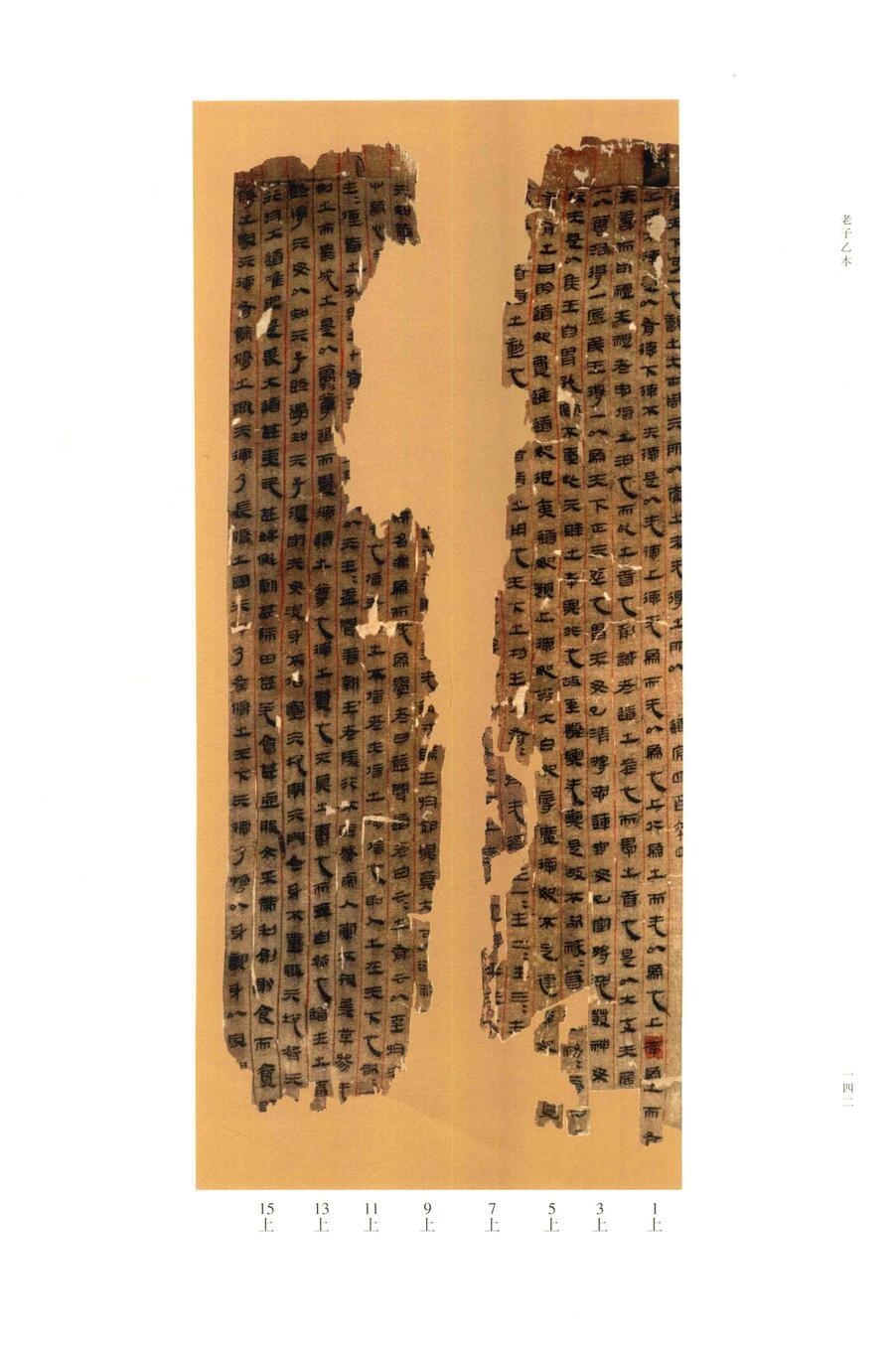
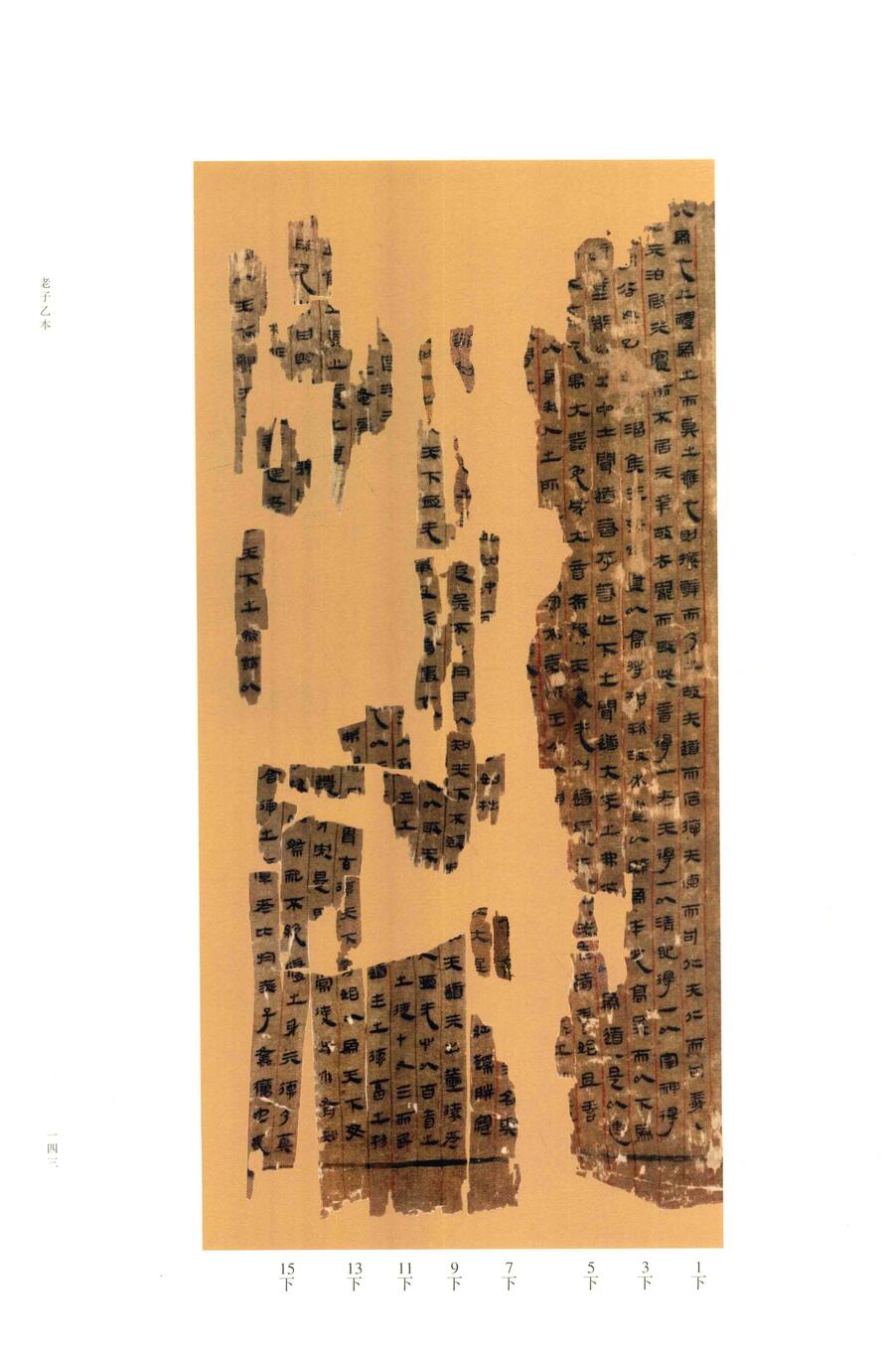
Laozi B (乙本), columns 15下 to 16下, on plates p. 142 and p. 143 of Changsha Mawangdui Han mu jianbo jicheng, vol. 1 (column numbers are printed under each plate; the columns run from right to left; each column of Laozi B is photographed as an upper half (上) and a lower half (下) on facing plates). Checked on the image: column 15下 reads 子孫以祭祀不絕脩之身亓德乃真. The opening characters of this chapter are lost or not readable on this plate image, so these are the first characters that were confirmed. □ marks a character lost on the silk (13 in this section). Transcription and column numbers: Wikisource 老子 (帛書乙本), which follows the Jicheng column numbering. The English is Legge's translation of the received text, shown below the silk transcription; the silk wording differs from it in many places, so compare the two Chinese texts for the variants.
15下善建者□□□□□□□子孫以祭祀不絕脩之身亓德乃真
16上脩之家亓德有餘脩之鄉亓德乃長脩之國亓德乃夆脩之天下亓德乃博以身觀身以家觀□
16下□□□國以天下觀天下吾何□知天下之然茲以□
Compare: Received text (Wang Bi recension), the text Legge translated
善建者不拔,善抱者不脫,子孫以祭祀不輟。修之於身,其德乃真;修之於家,其德乃餘;修之於鄉,其德乃長;修之於國,其德乃豐;修之於天下,其德乃普。故以身觀身,以家觀家,以鄉觀鄉,以國觀國,以天下觀天下。吾何以知天下然哉?以此。
1What (Tao's) skilful planter plants
Can never be uptorn;
What his skilful arms enfold,
From him can ne'er be borne.
Sons shall bring in lengthening line,
Sacrifices to his shrine.
2Tao when nursed within one's self,
His vigour will make true;
And where the family it rules
What riches will accrue!
The neighbourhood where it prevails
In thriving will abound;
And when 'tis seen throughout the state,
Good fortune will be found.
Employ it the kingdom o'er,
And men thrive all around.
3In this way the effect will be seen in the person, by the observation of different cases; in the family; in the neighbourhood; in the state; and in the kingdom.
4How do I know that this effect is sure to hold thus all under the sky? By this (method of observation).
Notes
- English: James Legge, The Tao Teh King (Sacred Books of the East 39, 1891); Legge's paragraph numbers are kept as superscripts.
- Legge translated the received text, not the silk manuscripts. Where the silk wording differs, his English follows the received text shown under the transcription.
- Silk transcription: Wikisource Page transcriptions of the Jicheng plates (revisions of 18 October 2026, marked not yet proofread on Wikisource), checked against the plates for each chapter opening.
Cite
Sources
- Source: Mawangdui Laozi A and B silk manuscripts (plates of Changsha Mawangdui Han mu jianbo jicheng vol. 1, via Wikimedia Commons) + Wikisource column transcription + Wang Bi received text (Wikisource) + Legge 1891 English (Project Gutenberg) (holding institution)
- Critical edition: Changsha Mawangdui Han mu jianbo jicheng (2014) column numbers; Wikisource transcription; Wang Bi received text
← previous · → next · v cycle view · l back to library