Dhammapada 1: Yamakavagga, The Twin-Verses (verses 1-20)
Introduction
Chapter 1 of the Dhammapada, the Yamakavagga ('The Twin-Verses' in Max Müller's translation), verses 1-20. The Dhammapada is a collection of 423 verses in Pali attributed to the Buddha, part of the Khuddakanikāya of the Pali canon; its compilation is usually dated to about the third century BCE.
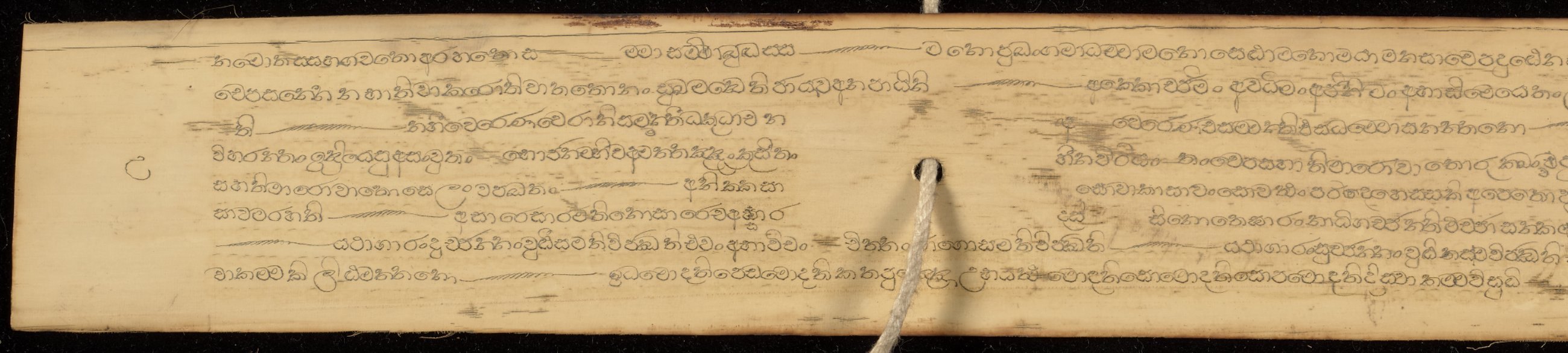
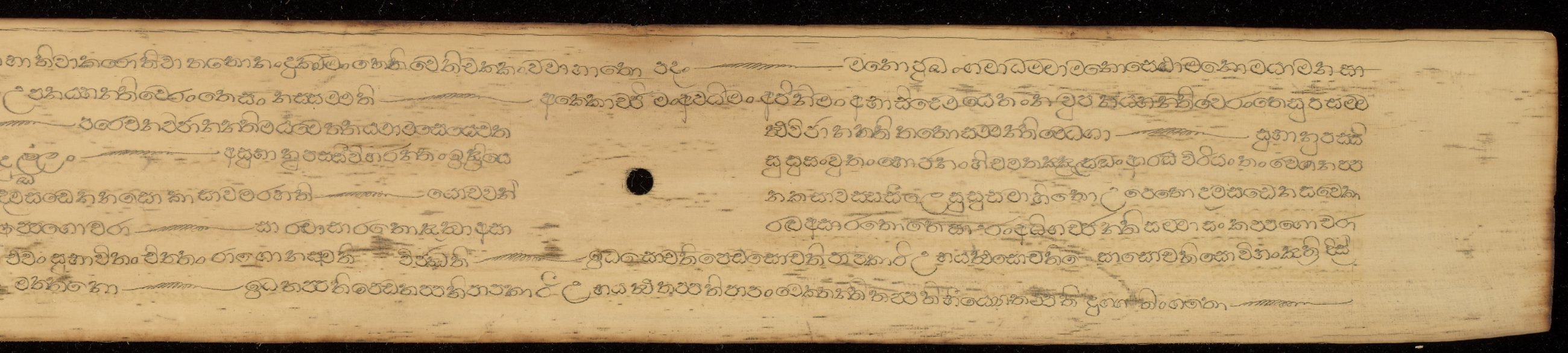
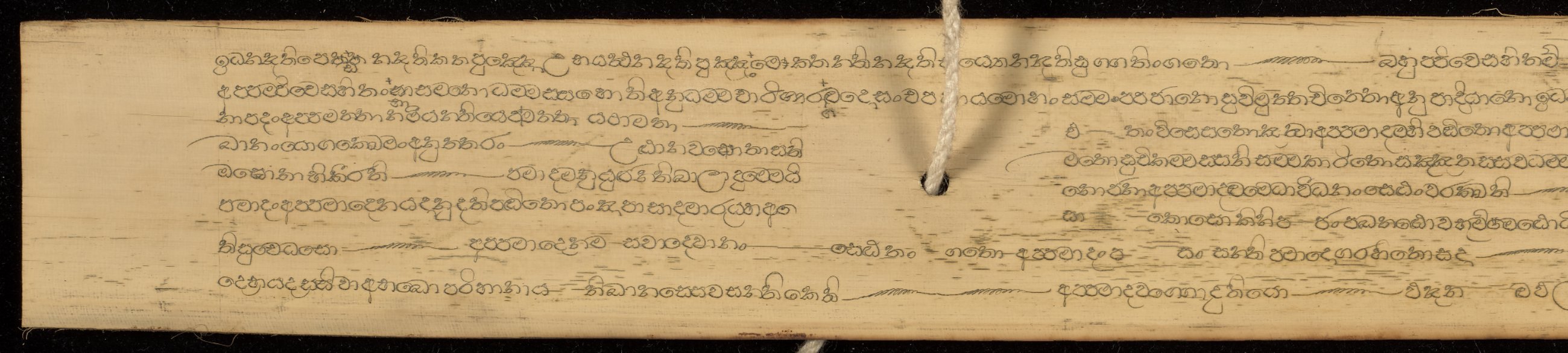
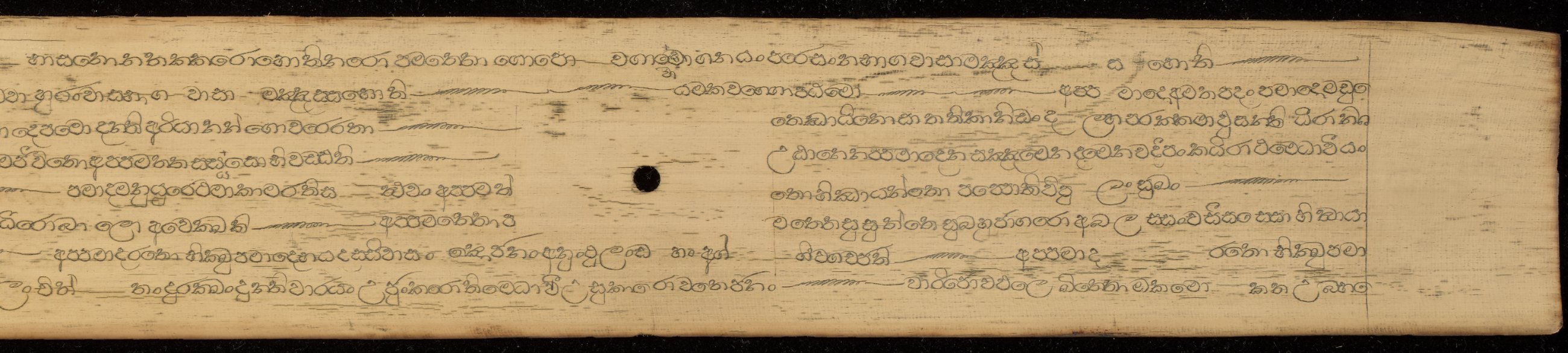
The images are of a Sinhalese palm-leaf manuscript in the John Rylands Library, Manchester (Pali MS 19), once owned by T. W. Rhys Davids. The text is written in Sinhalese script across the whole width of each leaf, nine lines a side, interrupted only by the string holes; each image is one half of a leaf side. This chapter is on fol. 5a, 5b. Each section holds the verses that end on that side.
The Pali is the Mahāsaṅgīti edition published by SuttaCentral, and the English is Max Müller's translation in the Sacred Books of the East (1881), which sometimes renders two verses together (for example 58-59).
How was this verified? (Provenance)
Where on the image
Pali MS 19, fol. 5a (both halves of the leaf side). Checked on the image: the side begins 'namo tassa bhagavato arahato sammāsambuddhassa, then manopubbaṅgamā dhammā (v.1)' and its last line ends '... bhiyyo tappati duggatiṃ gato (end of v.17)'. The Pali shown is the Mahāsaṅgīti edition (SuttaCentral), not a transcription of the manuscript; the scribe's spellings differ in places.
1Manopubbaṅgamā dhammā, manoseṭṭhā manomayā; Manasā ce paduṭṭhena, bhāsati vā karoti vā; Tato naṁ dukkhamanveti, cakkaṁva vahato padaṁ.
2Manopubbaṅgamā dhammā, manoseṭṭhā manomayā; Manasā ce pasannena, bhāsati vā karoti vā; Tato naṁ sukhamanveti, chāyāva anapāyinī.
3Akkocchi maṁ avadhi maṁ, ajini maṁ ahāsi me; Ye ca taṁ upanayhanti, veraṁ tesaṁ na sammati.
4Akkocchi maṁ avadhi maṁ, ajini maṁ ahāsi me; Ye ca taṁ nupanayhanti, veraṁ tesūpasammati.
5Na hi verena verāni, sammantīdha kudācanaṁ; Averena ca sammanti, esa dhammo sanantano.
6Pare ca na vijānanti, mayamettha yamāmase; Ye ca tattha vijānanti, tato sammanti medhagā.
7Subhānupassiṁ viharantaṁ, indriyesu asaṁvutaṁ; Bhojanamhi cāmattaññuṁ, kusītaṁ hīnavīriyaṁ; Taṁ ve pasahati māro, vāto rukkhaṁva dubbalaṁ.
8Asubhānupassiṁ viharantaṁ, Indriyesu susaṁvutaṁ; Bhojanamhi ca mattaññuṁ, Saddhaṁ āraddhavīriyaṁ; Taṁ ve nappasahati māro, Vāto selaṁva pabbataṁ.
9Anikkasāvo kāsāvaṁ, yo vatthaṁ paridahissati; Apeto damasaccena, na so kāsāvamarahati.
10Yo ca vantakasāvassa, sīlesu susamāhito; Upeto damasaccena, sa ve kāsāvamarahati.
11Asāre sāramatino, sāre cāsāradassino; Te sāraṁ nādhigacchanti, micchāsaṅkappagocarā.
12Sārañca sārato ñatvā, asārañca asārato; Te sāraṁ adhigacchanti, sammāsaṅkappagocarā.
13Yathā agāraṁ ducchannaṁ, vuṭṭhī samativijjhati; Evaṁ abhāvitaṁ cittaṁ, rāgo samativijjhati.
14Yathā agāraṁ suchannaṁ, vuṭṭhī na samativijjhati; Evaṁ subhāvitaṁ cittaṁ, rāgo na samativijjhati.
15Idha socati pecca socati, Pāpakārī ubhayattha socati; So socati so vihaññati, Disvā kammakiliṭṭhamattano.
16Idha modati pecca modati, Katapuñño ubhayattha modati; So modati so pamodati, Disvā kammavisuddhimattano.
17Idha tappati pecca tappati, Pāpakārī ubhayattha tappati; “Pāpaṁ me katan”ti tappati, Bhiyyo tappati duggatiṁ gato.
1All that we are is the result of what we have thought: it is founded on our thoughts, it is made up of our thoughts. If a man speaks or acts with an evil thought, pain follows him, as the wheel follows the foot of the ox that draws the carriage.
2All that we are is the result of what we have thought: it is founded on our thoughts, it is made up of our thoughts. If a man speaks or acts with a pure thought, happiness follows him, like a shadow that never leaves him.
3"He abused me, he beat me, he defeated me, he robbed me,"—in those who harbour such thoughts hatred will never cease.
4"He abused me, he beat me, he defeated me, he robbed me,"—in those who do not harbour such thoughts hatred will cease.
5For hatred does not cease by hatred at any time: hatred ceases by love, this is an old rule.
6The world does not know that we must all come to an end here;—but those who know it, their quarrels cease at once.
7He who lives looking for pleasures only, his senses uncontrolled, immoderate in his food, idle, and weak, Mara (the tempter) will certainly overthrow him, as the wind throws down a weak tree.
8He who lives without looking for pleasures, his senses well controlled, moderate in his food, faithful and strong, him Mara will certainly not overthrow, any more than the wind throws down a rocky mountain.
9He who wishes to put on the yellow dress without having cleansed himself from sin, who disregards temperance and truth, is unworthy of the yellow dress.
10But he who has cleansed himself from sin, is well grounded in all virtues, and regards also temperance and truth, he is indeed worthy of the yellow dress.
11They who imagine truth in untruth, and see untruth in truth, never arrive at truth, but follow vain desires.
12They who know truth in truth, and untruth in untruth, arrive at truth, and follow true desires.
13As rain breaks through an ill-thatched house, passion will break through an unreflecting mind.
14As rain does not break through a well-thatched house, passion will not break through a well-reflecting mind.
15The evil-doer mourns in this world, and he mourns in the next; he mourns in both. He mourns and suffers when he sees the evil of his own work.
16The virtuous man delights in this world, and he delights in the next; he delights in both. He delights and rejoices, when he sees the purity of his own work.
17The evil-doer suffers in this world, and he suffers in the next; he suffers in both. He suffers when he thinks of the evil he has done; he suffers more when going on the evil path.
Where on the image
Pali MS 19, fol. 5b (both halves of the leaf side). Checked on the image: the side begins 'idha nandati pecca nandati (v.18)' and its last line ends 'vārijova thale khitto okamokata ubbha- (v.34)'. The Pali shown is the Mahāsaṅgīti edition (SuttaCentral), not a transcription of the manuscript; the scribe's spellings differ in places.
18Idha nandati pecca nandati, Katapuñño ubhayattha nandati; “Puññaṁ me katan”ti nandati, Bhiyyo nandati suggatiṁ gato.
19Bahumpi ce saṁhita bhāsamāno, Na takkaro hoti naro pamatto; Gopova gāvo gaṇayaṁ paresaṁ, Na bhāgavā sāmaññassa hoti.
20Appampi ce saṁhita bhāsamāno, Dhammassa hoti anudhammacārī; Rāgañca dosañca pahāya mohaṁ, Sammappajāno suvimuttacitto; Anupādiyāno idha vā huraṁ vā, Sa bhāgavā sāmaññassa hoti.
18The virtuous man is happy in this world, and he is happy in the next; he is happy in both. He is happy when he thinks of the good he has done; he is still more happy when going on the good path.
19The thoughtless man, even if he can recite a large portion (of the law), but is not a doer of it, has no share in the priesthood, but is like a cowherd counting the cows of others.
20The follower of the law, even if he can recite only a small portion (of the law), but, having forsaken passion and hatred and foolishness, possesses true knowledge and serenity of mind, he, caring for nothing in this world or that to come, has indeed a share in the priesthood.
Notes
- Müller's English is from the Wikisource transcription, which leaves out the diacritics the printed book uses in names (for example Nirvana, Brahmana, Mara).
- Words in round brackets are Müller's additions for sense.
Cite
Sources
- Source: Manchester, John Rylands Library, Pali MS 19 (palm leaf, Sinhalese script) + SuttaCentral Pali (Mahāsaṅgīti) + Max Müller's English (SBE X, 1881) (holding institution)
- Critical edition: SuttaCentral, Mahāsaṅgīti Tipiṭaka edition
← previous · → next · v cycle view · l back to library