Alvíssmál
Introduction
Alvíssmál is preserved in the Codex Regius of the Poetic Edda (GKS 2365 4to, Árni Magnússon Institute, Reykjavík), an Icelandic parchment book written about 1270. The poem fills fol. 19v-20r (manuscript pages 38-39).
Pages: each section holds the stanzas that begin on one manuscript page and links that page's photograph (handrit.is); a stanza that runs onto the next page links both pages. The page of every stanza comes from Wimmer and Finnur Jónsson's 1891 diplomatic edition, which prints the text of each manuscript page, and the first line of every page was checked on the photograph. 'Where on the image' under each section gives the details.
Texts: the first Old Norse text is the manuscript's own text, letter by letter, from the diplomatic transcription of Wimmer and Finnur Jónsson (1891), which prints each page line for line: line breaks are the manuscript's, ‖ marks a new page, letters in italics are supplied where the scribe abbreviated, and special letters are kept (ſ long s, ꝛ round r, ꝼ insular f, ı dotless i, ꜹ the av ligature, ǫ and ę with hooks, ᛘ the rune for maðr, small capitals for the scribe's small capitals). The manuscript writes the poem as continuous lines without stanza breaks; the stanza numbers (Guðni Jónsson's) are inserted where each stanza begins and do not appear in the manuscript. Letters with a dot below are marked for deletion in the manuscript; letters between ⸌ and ⸍ are written above the line, and ⟨marg. ...⟩ gives what Wimmer and Jónsson print in the margin (corrections, and in Vafþrúðnismál the speaker marks o, v, q). The second text is Guðni Jónsson's normalized edition (via heimskringla.no), a reading text in modern spelling; in places it adds words or lines from other manuscripts and follows modern editions where they rearrange stanzas. The English is Benjamin Thorpe's 1866 translation (public domain).
English alignment: From stanza 9 on Thorpe's number is one higher than the Old Norse (Old Norse 9 = Thorpe 10, ... 35 = 36).
How was this verified? (Provenance)
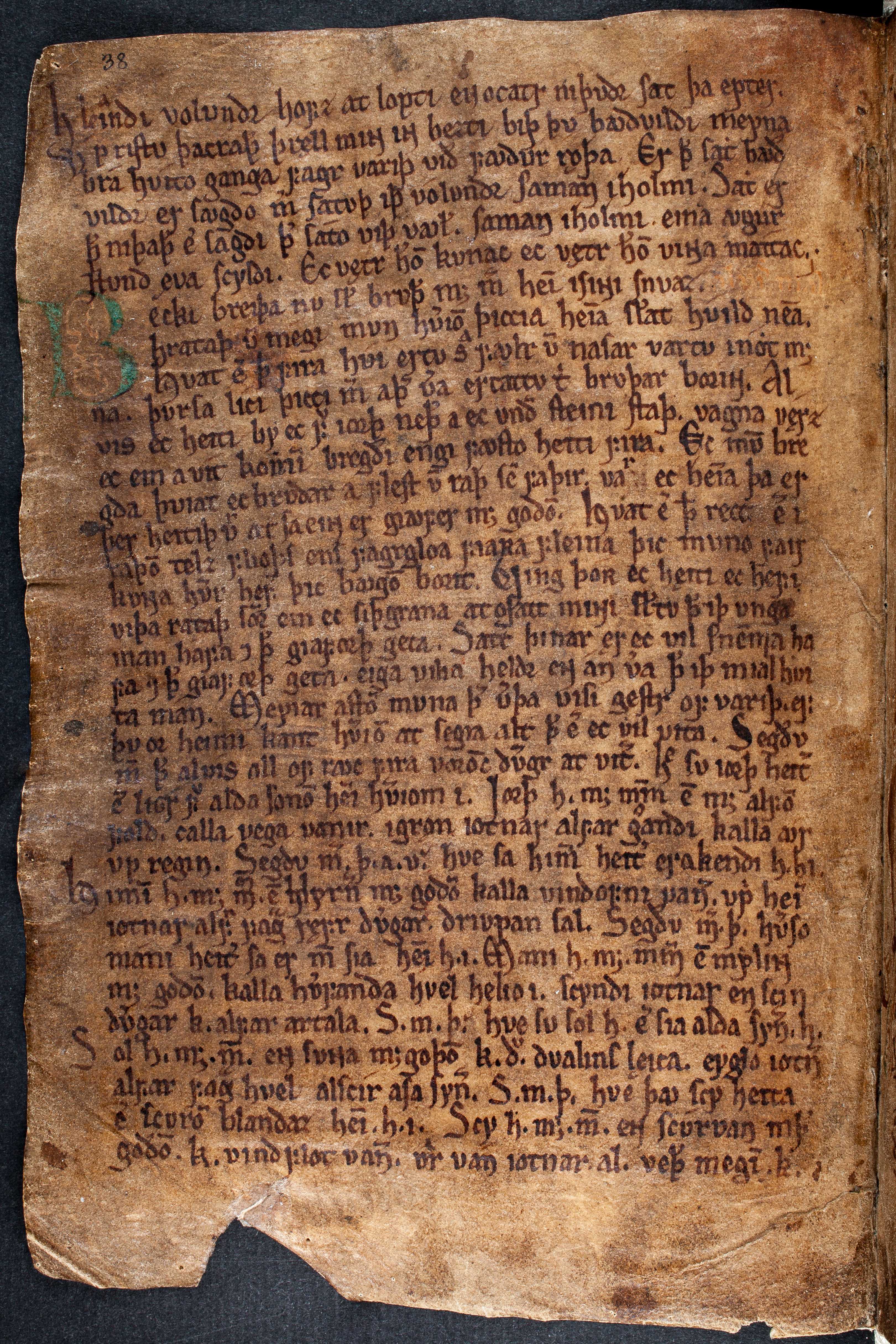
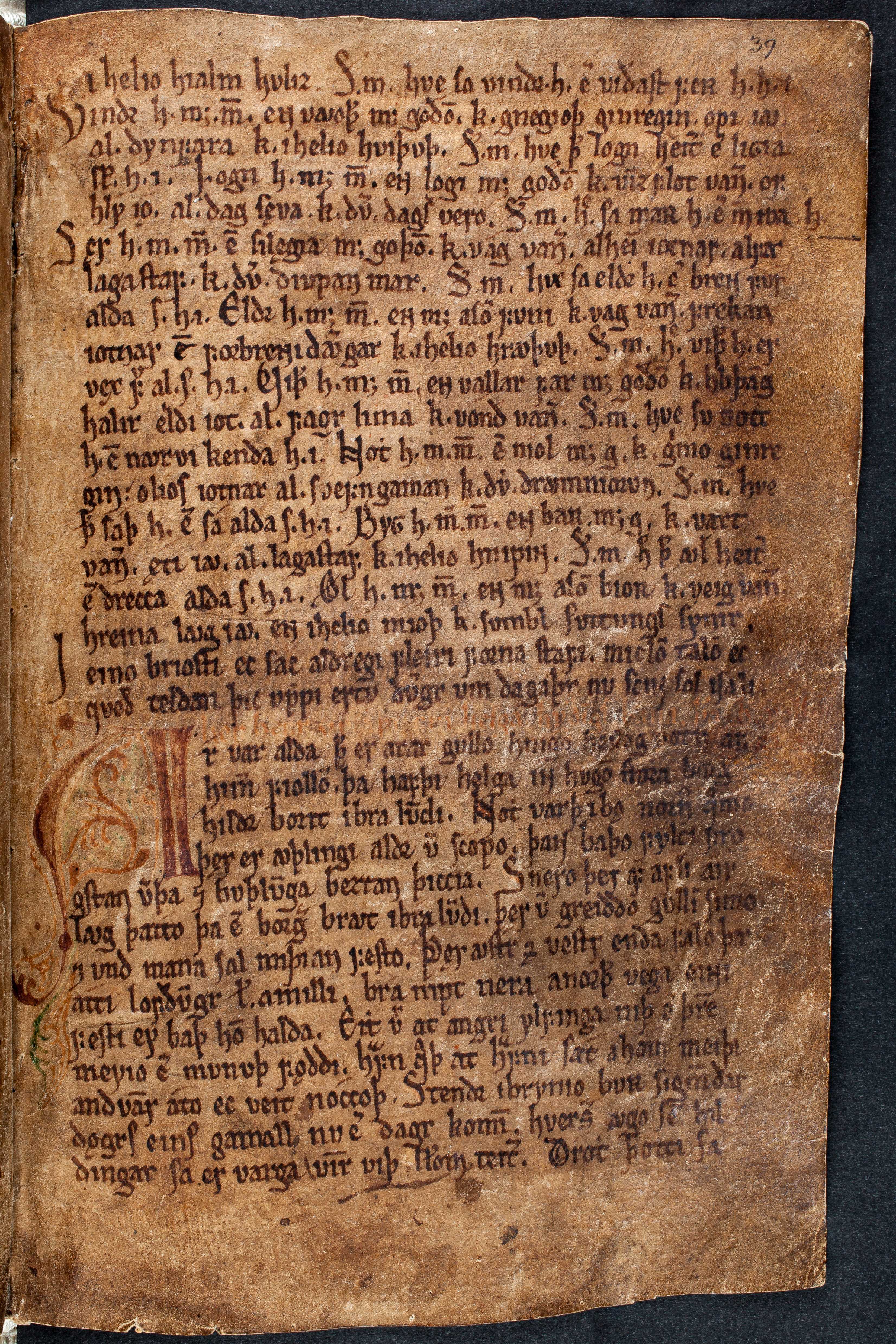
Where on the image
Fol. 19v (manuscript page 38; handrit.is image 47; Wimmer and Jónsson 1891 page 38, caption 'Vǫlundarkviða v. 38 - Alvíssmál v. 18'): stanza 1 is lower on the page (the first line belongs to Vǫlundarkviða 38); stanzas 1-18 begin here; stanza 18 runs on to fol. 20r. Fol. 20r (manuscript page 39; handrit.is image 48; Wimmer and Jónsson 1891 page 39, caption 'Alvíssmál v. 18 - Helgakviða Hundingsbana I v. 7'): the top of the page finishes stanza 18 ('hjalm huliðs ...'). Checked on the image: the first line of fol. 19v has 'Hlæjandi Völundr' (Vǫlundarkviða 38); the first line of fol. 20r has 'hjalm huliðs' (end of Alvíssmál 18). Diplomatic text: Wimmer and Jónsson 1891, page 38, lines 7-34; page 39, line 1, transcribed from their page images and proofread line by line; they print each manuscript page line for line beside its phototype, so the line breaks shown are the manuscript's.
1Beckı breıþa nv́ ſcal brvþr meþ mer heım ıſıɴı ſnvaz. alvı⸌s⸍ mal
hrataþ vm mégı mv́n hverıom þıccıa heıma ſcalat hvíld nema.
2Hvat er þat ꝼıra hví ertv sva ꝼꜹlr vm naſar vartv ınótt meþ
ná. þvrſa lící þıccı mer aþer vera ertattv tıl brvþar bóꝛɴ. 3Al-
vís ec heıtı bẏ́ ec ꝼyr ıoꝛþ neþan a ec vnðır ſteını ſtaþ. vagna vęrz
ec em a vít komınn bregðı engı ꝼꜹſto heıtı ꝼıra. 4Ec mvn bre-
gða þvıat ec brvðar a ꝼleſt vm raþ ſem ꝼaþır. va⸌r⸍,(ca) ec heıma þa er
þer heıtıþ var at ſaeıɴ er gıꜹꝼer meþ goðom. 5Hvat er þat recc(a) er ı
raþom telz ꝼlıoþſ enſ ꝼagrgloa ꝼıaʀa ꝼleína þıc mvno ꝼaır
kvɴa hverr heꝼır þıc bꜹgom boꝛıt. 6Uıng þóʀ ec hęıtı ec heꝼı
vıþa rataþ ſonꝛ em ec ſıþgrána at oſátt mıɴı ſcaltv þat ıþ vnga
man háꝼa oc þat gıaꝼoꝛþ geta. 7Sattır þınar ęr ec vıl ſnemma ha-
ꝼa oc þat gıaꝼ oꝛþ geta. eıga vılıa helðꝛ eɴ án vera þat ıþ mıall hvı
ta man. 8Meyıar áſtom mvna þer verþa vıſı geſtr ᴏꝼ varıþ. eꝼ
þv oꝛ heımı kant hverıom at ſegıa alt þat er ec vıl vıta. 9Segðv
mer þat alvís oll ᴏꝼ rꜹc ꝼıra voꝛomc ðvergr at vıtır. hve ſv ıoꝛþ heıtır
er lıɢʀ ꝼyr alða ſonom heımı hverıom ı. 10Ioꝛþ h. meþ monnom en meþ alꝼom
ꝼolð. calla vega vanır. ıgrǫn ıotnar alꝼar groanðı kalla ꜹ́r
vp regın. 11Segðv mer. þ. a. vˀ hve ſa hımınn heıtır erakenðı h. hı.
12Hımınn h. meþ monnom. en hlyrnır meþ goðom kalla vınðóꝼnı vanır. vpp heım
ıotnar alꝼar ꝼagra ręꝼr ðvergar. ðrıvpan ſal. 13Segðv mer. þ. hverſo
mánı heıtır ſa er menn ſıa heımı h. ı. 14Manı h. meþ. monnom en mẏ́lıɴ
meþ goðom. kalla hverꝼanða hvel helıo ı. ſcẏ́nðı ıotnar en ſcın
ðvergar k. alꝼar artala. 15S. m. þˀ hve ſv ſol h. er ſıa alða ſynır. h.
16Sol h. meþ. monnom. eɴ ſvɴa meþ goþom k. ðv. ðvalınſ lęıca. eẏ́glo ıotnar
alꝼar ꝼagra hvel alſcír aſa ſynır. 17S. m. þ. hve þꜹ ſcy heıta
er ſcvrom blanðaz heımı. h. ı. 18Scy h. meþ. monnom. eɴ ſcv́rvan meþ
goðom. k. vınðꝼlot vanır. v́r ván ıotnar. al. veþr megın. k.
‖ ı helıo hıalm hvlız.
Compare: Normalized text (Guðni Jónsson)
1"Bekki breiða, / nú skal brúðr með mér / heim í sinni snúask; / hratat um mægi / mun hverjum þykkja, / heima skal-at hvíld nema." 2"Hvat er þat fira? / Hví ertu svá fölr um nasar? / Vartu í nótt með ná? / Þursa líki / þykki mér á þér vera; / ert-at-tu til brúðar borinn." 3"Alvíss ek heiti, / bý ek fyr jörð neðan, / á ek undir steini stað; / vagna vers / ek em á vit kominn; / bregði engi föstu heiti fira." 4"Ek mun bregða / því at ek brúðar á / flest of ráð sem faðir; / vark-a ek heima, / þá er þér heitit var, / at sá einn, er gjöf er, með goðum." 5"Hvat er þat rekka, / er í ráðum telsk / fljóðs ins fagrglóa? / Fjarrafleina / þik munu fáir kunna; / hverr hefr þik baugum borit?" 6"Vingþórr ek heiti, / ek hef víða ratat, / sonr em ek Síðgrana; / at ósátt minni skal-at-tu / þat it unga man hafa / ok þat gjaforð geta." 7"Sáttir þínar / er ek vil snemma hafa / ok þat gjaforð geta; / eiga vilja / heldr en án vera / þat it mjallhvíta man." 8"Meyjar ástum / mun-a þér verða, / vísi gestr, of varit, / ef þú ór heimi kannt / hverjum at segja / allt þat, er ek vil vita." 9"Segðu mér þat, Alvíss, / - öll of rök fira / vörumk, dvergr, at vitir -: / hvé sú jörð heitir, / er liggr fyr alda sonum / heimi hverjum í?" 10"Jörð heitir með mönnum, / en með ásum fold, / kalla vega vanir, / ígræn jötnar, / alfar gróandi, / kalla aur uppregin." 11"Segðu mér þat, Alvíss, / - öll of rök fira / vörumk, dvergr, at vitir -: / hvé sá himinn heitir, / erakendi, / heimi hverjum í?" 12"Himinn heitir með mönnum, / en hlýrnir með goðum, / kalla vindófni vanir, / uppheim jötnar, / alfar fagraræfr, / dvergar drjúpansal." 13"Segðu mér þat, Avlíss, / - öll of rök fira / vörumk, dvergr, at vitir -: / hversu máni heitir, / sá er menn séa, / heimi hverjum í?" 14"Máni heitir með mönnum, / en mylinn með goðum, / kalla hverfanda hvél helju í, / skyndi jötnar, / en skin dvergar, / kalla alfar ártala." 15"Segðu mér þat, Alvíss, / - öll of rök fira / vörumk, dvergr, at vitir -: / hvé sú sól heitir, / er séa alda synir, / heimi hverjum í?" 16"Sól heitir með mönnum, / en sunna með goðum, / kalla dvergar Dvalins leika, / eygló jötnar, / alfar fagrahvél, / alskír ása synir." 17"Segðu mér þat, Alvíss, / - öll of rök fira / vörumk, dvergr, at vitir -: / hvé þau ský heita, / er skúrum blandask, / heimi hverjum í? 18"Ský heita með mönnum, / en skúrván með goðum, / kalla vindflot vanir, / úrván jötnar, / alfar veðrmegin, / kalla í helju hjalm huliðs."
1Alvis. The benches they are decking, now shall the bride with me bend her way home. That beyond my strength I have hurried will to every one appear: at home naught shall disturb my quiet. 2Vingthor. What man is this? Why about the nose art thou so pale? Hast thou last night with corpses lain? To me thou seemst to bear resemblance to the Thursar. Thou art not born to carry off a bride. 3Alvis. Alvis I am named, beneath the earth I dwell, under the rock I own a place. The lord of chariots I am come to visit. A promise once confirmed let no one break. 4Vingthor. I will break it; for o'er the maid I have, as father, greatest power. I was from home when the promise was given thee. Among the gods I the sole giver am. 5Alvis. What man is this, who lays claim to power over that fair, bright maiden? For far-reaching shafts few will know thee. Who has decked thee with bracelets? 6Vingthor. Vingthor I am named, wide I have wandered; I am Sidgrani's son: with my dissent thou shalt not that young maiden have, nor that union obtain. 7Alvis. Thy consent I fain would have, and that union obtain. Rather would I possess than be without that snow-white maiden. 8Vingthor. The maiden's love shall not, wise guest! be unto thee denied, if thou of every world canst tell all I desire to know. 9Vingthor. Tell me, Alvis!--for all men's concerns I presume thee, dwarf, to know--how the earth is called, which lies before the sons of men, in every world. 10Alvis. Jord among men 'tis called, but with the Æsir fold; the Vanir call it vega, the Jotuns igroen, the Alfar groandi, the powers supreme aur. 11Vingthor. Tell me, Alvis, etc. how the heaven is called, which is perceptible in every world. 12Alvis. Himinn 'tis called by men; but hlyrnir with the gods; vindofni the Vanir call it, uppheimr the Jotuns, the Alfar fagraræfr, the dwarfs driupansal. 13Vingthor. Tell me, Alvis! etc., how the moon is called, which men see in every world. 14Alvis. Mani 'tis called by men, but mylinn with the gods, hverfanda hvel in Hel they call it, skyndi the Jotuns, but the dwarfs skin; the Alfar name it artali. 15Vingthor. Tell me, Alvis! etc., how the sun is called, which men's sons see in every world. 16Alvis. Sol among men 'tis called, but with the gods sunna, the dwarfs call it Dvalinn's leika, the Jotuns eyglo, the Alfar fagrahvel, the Æsir's sons alskir. 17Vingthor. Tell me, Alvis, etc., how the clouds are called, which with showers are mingled in every world. 18Alvis. Sky they are called by men, but skurvan by the gods; the Vanir call them vindflot, the Jotuns urvan, the Alfar vedrmegin; in Hel they are called hialm hulids.
Where on the image
Fol. 20r (manuscript page 39; handrit.is image 48; Wimmer and Jónsson 1891 page 39, caption 'Alvíssmál v. 18 - Helgakviða Hundingsbana I v. 7'): stanzas 19-35 begin here. Checked on the image: the first line of fol. 20r has 'hjalm huliðs' (end of Alvíssmál 18). Diplomatic text: Wimmer and Jónsson 1891, page 39, lines 1-19, transcribed from their page images and proofread line by line; they print each manuscript page line for line beside its phototype, so the line breaks shown are the manuscript's.
19Segðv. m. hve ſa vınðꝛ. h. er vıðaſt ꝼᴇʀ h. h. ı
20Vınðꝛ h. meþ. monnom. eɴ vꜹoþr meþ goðom. k. gnegıoþ gınregın. ǫpı ıꜹ.
al. ðynꝼara k. ıhelıo hvıþvþ. 21Segðv. m. hve þat logn heıtır er lıɢıa
ſcal. h. ı. 22Logn h. meþ monnom. eɴ lǫgı meþ goðom k. vınzꝼlot vanır. ᴏꝼ
hlý ıǫ́. al. ðag ſęva. k. ðver. ðagſ vero. 23Segðv. m. hve. ſa maʀ h. er menn roa ⟨marg. .h.⟩
24Sęr h. m. monnom. en ſılęgıa meþ goþom. k. vág vanır. ·álheım ıotnár. alꝼar
lagaſtaꝼ. k. ðver. ðıvpan mar. 25Segðv. m. hve ſa elðꝛ h. er breɴ ꝼv́r
alða ſ. h. ı. 26Elðꝛ h. meþ monnom. eɴ meþ aſom ꝼvnı k. vag vanır. ꝼrekan
ıotnar en ꝼoꝛbreɴı ðꜹergar k. ıhelıo hrꜹþvþ. 27Segðv. m. hve. vıþr h. er
vex ꝼyr al. ſ. h. ı. 28Uıþr h. meþ monnom. eɴ vallar ꝼar meþ goðom k. hlıþang
halır ellðı ıot. al. ꝼagr lıma k. vónð vanır. 29Segðv. m. hve ſv nótt
h. en nꜹrvı kenða h. ı. 30Nott h. m. monnom. en níol meþ g. k. grımo gınre
gınˀ olíoſ ıotnar al. ſveꝼngaman k. ðver. ðrꜹmnıoꝛvn. 31Segðv. m. hve
þat ſáþ h. er ſá alða ſ. h. ı. 32Byɢ h. meþ. monnom. eɴ baʀ. meþ g. k. vaxt
vanır. ę́tı ıꜹ. al. lagaſtaꝼ k. ıhelıo hnıpıɴ. 33Segðv. m. hve þat ꜹl heıtır
er ðrecca alða ſ. h. ı. 34Ø̨l h. meþ monnom. eɴ meþ aſom bíoʀ k. veıg vanır.
hreına lꜹg ıꜹ. eɴ ıhelıo míoþ k. ſvmbl ſvttvngſ ſynır.
35I eıno brıoſtı ec ſác alðregı ꝼleırı ꝼoꝛna ſtaꝼı. mıclom talom ec
qveð telðan þıc vpppı ertv ðvergr vm ðagaþr. nv ſcıɴ ſól ıſalı.
Compare: Normalized text (Guðni Jónsson)
19"Segðu mér þat, Alvíss, / - öll of rök fira / vörumk, dvergr, at vitir -: / hvé sá vindr heitir, / er víðast ferr, / heimi hverjum í?" 20"Vindr heitir með mönnum, / en váfuðr með goðum, / kalla gneggjuð ginnregin, / æpi jötnar, / alfar dynfara, / kalla í helju hviðuð." 21"Segðu mér þat, Alvíss, / - öll of rök fira / vörumk, dvergr, at vitir -: / hvé þat logn heitir, / er liggja skal, / heimi hverjum í?" 22"Logn heitir með mönnum, / en lægi með goðum, / kalla vindlot vanir, / ofhlý jötnar, / alfar dagsefa, / kalla dvergar dags veru." 23"Segðu mér þat, Alvíss, / - öll of rök fira / vörumk, dvergr, at vitir -: / hvé sá marr heitir, / er menn róa, / heimi hverjum í?" 24"Sær heitir með mönnum, / en sílægja með goðum, / kalla vág vanir, / álheim jötnar, / alfar lagastaf, / kalla dvergar djúpan mar." 25"Segðu mér þat, Alvíss, / - öll of rök fira / vörumk, dvergr, at vitir -: / hvé sá eldr heitir, / er brennr fyr alda sonum, / heimi hverjum í?" 26"Eldr heitir með mönnum, / en með ásum funi, / kalla vág vanir, / frekan jötnar, / en forbrenni dvergar, / kalla í helju hröðuð." 27"Segðu mér þat, Alvíss, / - öll of rök fira / vörumk, dvergr, at vitir -: / hvé viðr heitir, / er vex fyr alda sonum, / heimi hverjum í?" 28"Viðr heitir með mönnum, / en vallarfax með goðum, / kalla hlíðþang halir, / eldi jötnar / alfar fagrlima, / kalla vönd vanir." 29"Segðu mér þat, Alvíss, / - öll of rök fira / vörumk, dvergr,at vitir, / hvé sú nótt heitir, / in Nörvi kennda, / heimi hverjum í?" 30"Nótt heitir með mönnum, / en njól með goðum, / kalla grímu ginnregin, / óljós jötnar, / alfar svefngaman, / kalla dvergar draumnjörun." 31"Segðu mér þat, Alvíss, / - öll of rök fira / vörumk, dvergr, at vitir -: / hvé þat sáð heitir, / er sá alda synir, / heimi hverjum í?" 32"Bygg heitir með mönnum, / en barr með goðum, / kalla vöxt vanir, / æti jötnar, / alfar lagastaf, / kalla í helju hnipin." 33"Segðu mér þat, Alvíss, / - öll of rök fira / vörumk, dvergr, at vitir -: / hvé þat öl heitir, / er drekka alda synir, / heimi hverjum í?" 34"Öl heitir með mönnum, / en með ásum bjórr, / kalla veig vanir, / hreinalög jötnar, / en í helju mjöð, / kalla sumbl Suttungs synir." 35"Í einu brjósti / ek sák aldrigi / fleiri forna stafi; / miklum tálum / kveð ek tældan þik: / Uppi ertu, dvergr, of dagaðr, / nú skínn sól í sali."
19Vingthor. Tell me, Alvis! etc., how the wind is called, which widely passes over every world. 20Alvis. Windr 'tis called by men, but vavudr by the gods, the wide-ruling powers call it gneggiud, the Jotuns oepir, the Alfar dynfari, in Hel they call it hvidudr. 21Vingthor. Tell me, Alvis! etc., how the calm is called, which has to rest in every world. 22Alvis. Logn 'tis called by men, but lægi by the gods, the Vanir call it vindslot, the Jotuns ofhly, the Alfar dagsevi, the Dwarfs call it dags vera. 23Vingthor. Tell me, Alvis! etc., what the sea is called, which men row over in every world. 24Alvis. Sær 'tis called by men, but silægia with the gods; the vanir call it vagr, the Jotuns alheimr, the Alfar lagastafr, the Dwarfs call it diupan mar. 25Vingthor. Tell me, Alvis! etc., how the fire is called, which burns before men's sons in every world. 26Alvis. Eldr 'tis called by men, but by the Æsir funi; the Vanir call it vagr, the Jotuns frekr, but the Dwarfs forbrennir; in Hel they call it hrodudr. 27Vingthor. Tell me, Alvis! etc., how the forest is called, which grows for the sons of men in every world. 28Alvis. Vidr 'tis called by men, but vallarfax by the gods, Hel's inmates call it hlidthangr, the Jotuns eldi, the Alfar fagrlimi; the Vanir call it vondr. 29Vingthor. Tell me, Alvis! etc., how the night is called, that Norvi's daughter hight, in every world. 30Alvis. Nott it is called by men, but by the gods niol; the wide-ruling powers call it grima, the Jotuns olios, the Alfar svefngaman; the Dwarfs call it draumniorunn. 31Vingthor. Tell me, Alvis! etc., how the seed is called, which the sons of men sow in every world. 32Alvis. Bygg it is called by men, but by the gods barr, the Vanir call it vaxtr, the Jotuns æti, the Alfar lagastafr; in Hel 'tis hnipinn called. 33Vingthor. Tell me, Alvis! etc., how the beer is called, which the sons of men drink in every world. 34Alvis. Ol it is called by men, but by the Æsir biorr, the Vanir call it veig, hreina logr the Jotuns, but in Hel 'tis called miodr: Suttung's sons call it sumbl. 35Vingthor. In one breast I have never found more ancient lore. By great wiles thou hast, I tell thee, been deluded. Thou art above ground, dwarf! at dawn; already in the hall the sun is shining!
Notes
- From stanza 9 on Thorpe's number is one higher than the Old Norse (Old Norse 9 = Thorpe 10, ... 35 = 36).
- Thorpe's stanza 9 (Alvis: 'Vingthor! thou canst try ... All the nine worlds I have travelled over') has no counterpart in Codex Regius, where stanza 8 (Meyjar ástum) is followed directly by Thor's first question (fol. 19v), so it is not shown.
Cite
Sources
- Source: Codex Regius (GKS 2365 4to) page images via handrit.is + Wimmer and Jónsson's 1891 diplomatic text + Guðni Jónsson's normalized Old Norse via heimskringla.no + Thorpe (1866) English (holding institution)
- Critical edition: Diplomatic text of Codex Regius, Wimmer and Finnur Jónsson 1891; normalized text (Guðni Jónsson) for comparison
← previous · → next · v cycle view · l back to library