Vǫlundarkviða
Introduction
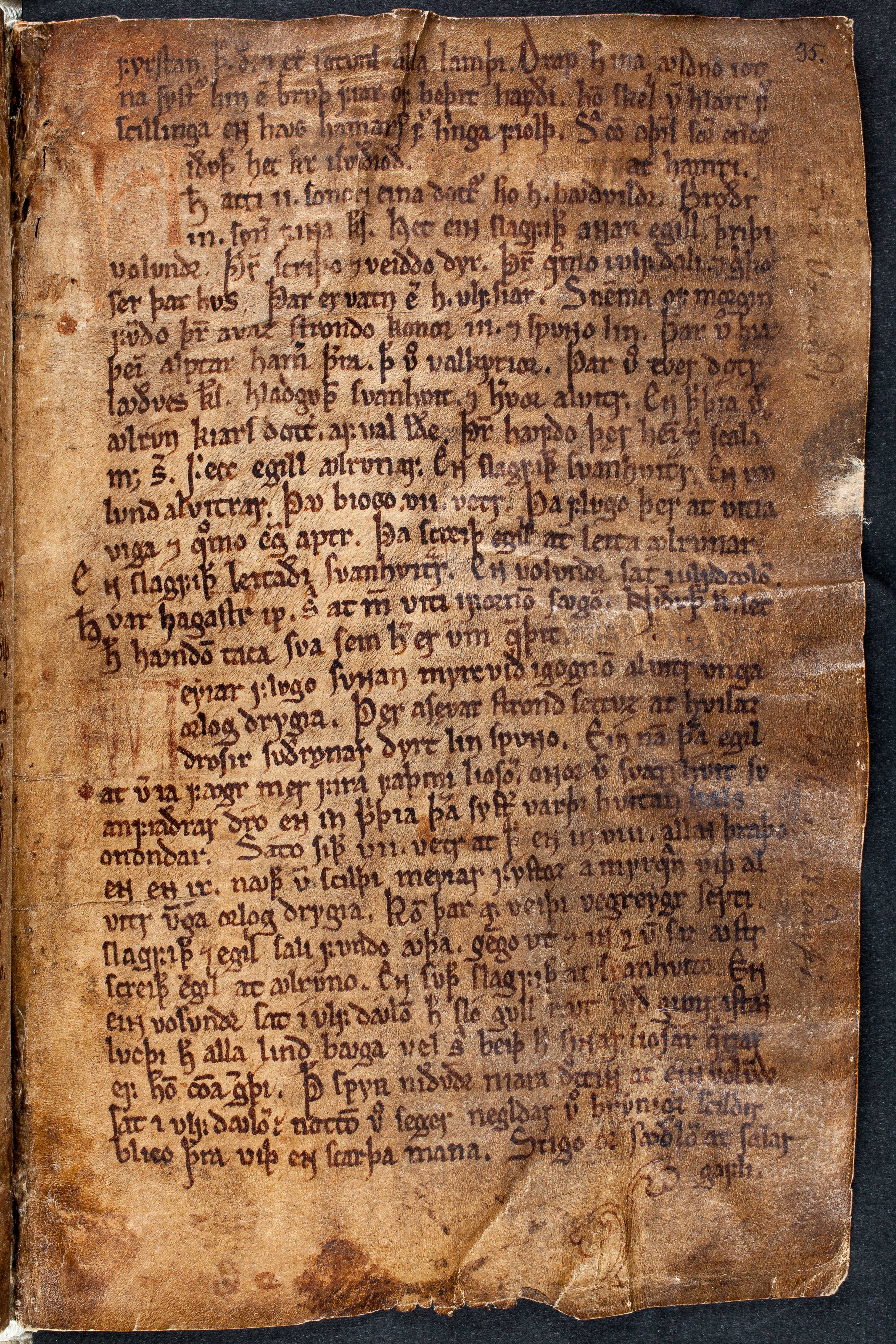
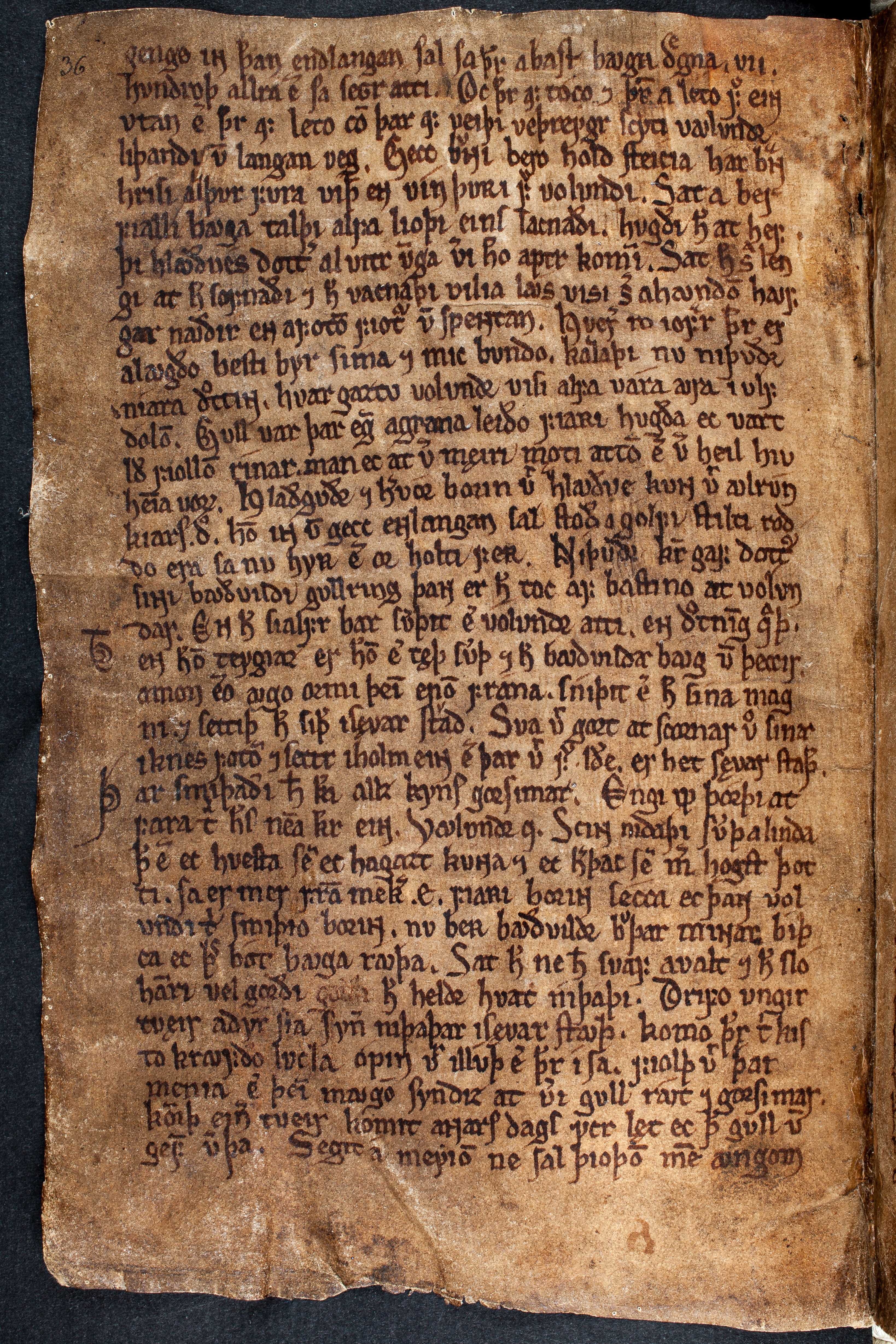
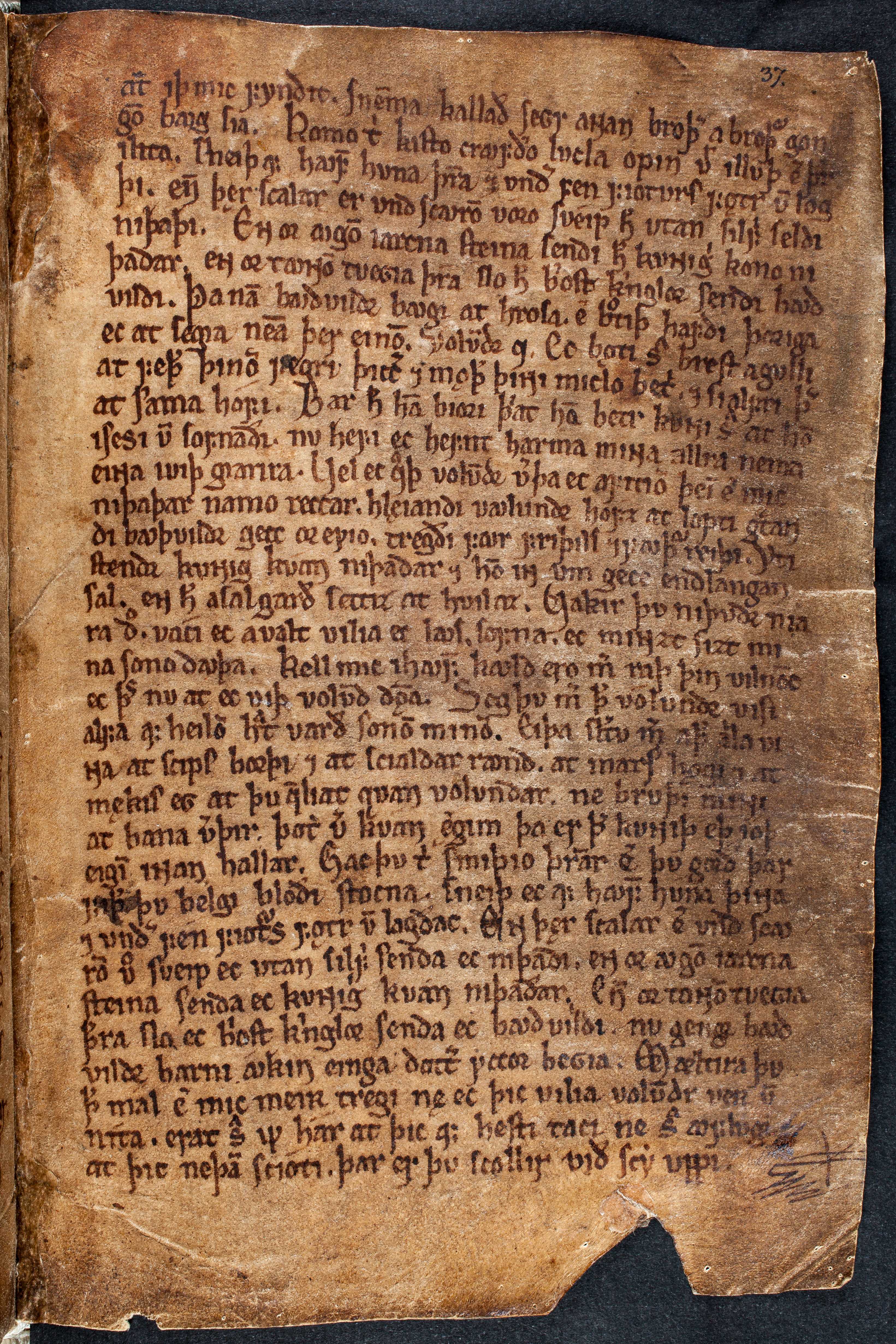
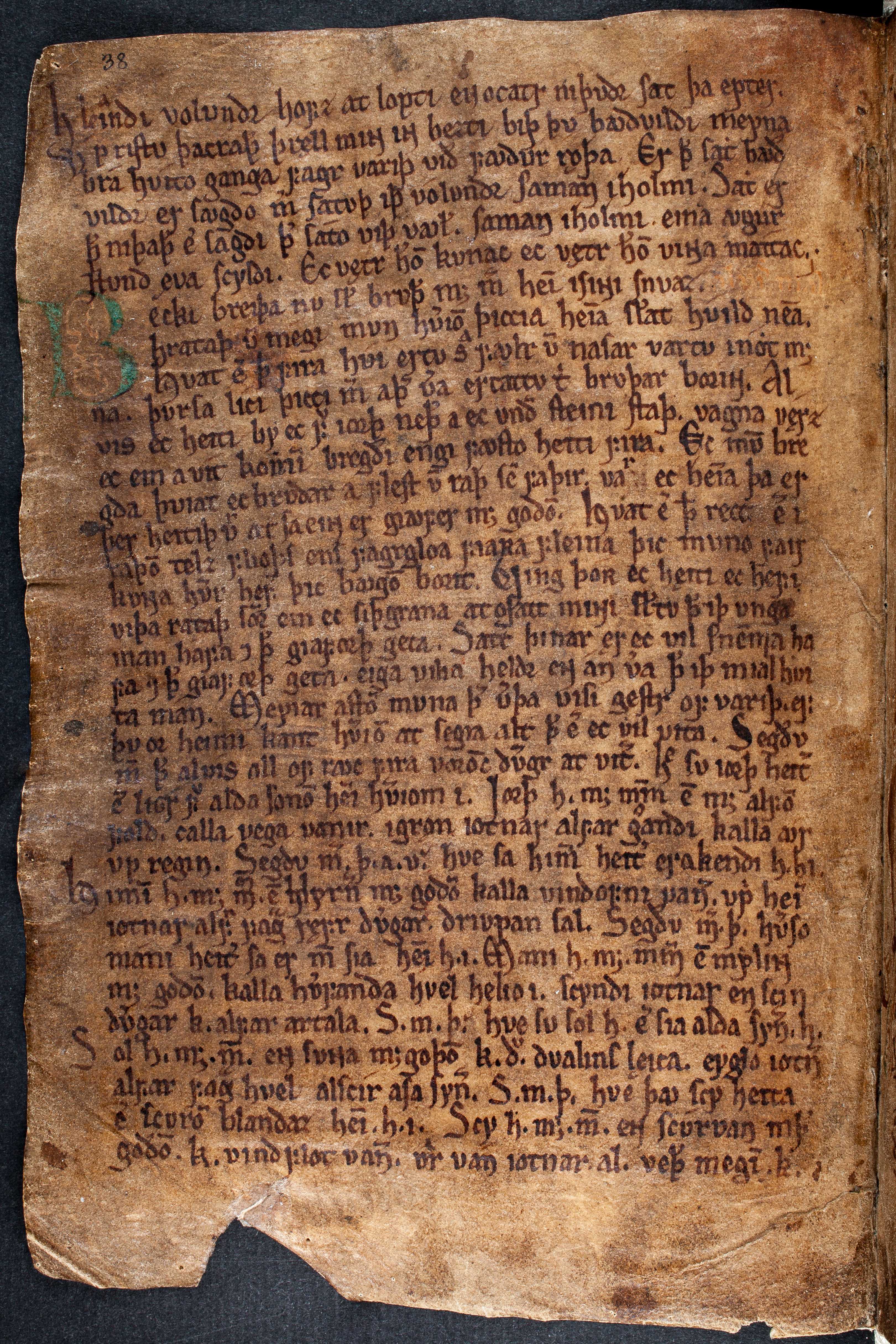
Vǫlundarkviða is preserved in the Codex Regius of the Poetic Edda (GKS 2365 4to, Árni Magnússon Institute, Reykjavík), an Icelandic parchment book written about 1270. The poem fills fol. 18r-19v (manuscript pages 35-38).
Pages: each section holds the stanzas that begin on one manuscript page and links that page's photograph (handrit.is); a stanza that runs onto the next page links both pages. The page of every stanza comes from Wimmer and Finnur Jónsson's 1891 diplomatic edition, which prints the text of each manuscript page, and the first line of every page was checked on the photograph. 'Where on the image' under each section gives the details.
Texts: the first Old Norse text is the manuscript's own text, letter by letter, from the diplomatic transcription of Wimmer and Finnur Jónsson (1891), which prints each page line for line: line breaks are the manuscript's, ‖ marks a new page, letters in italics are supplied where the scribe abbreviated, and special letters are kept (ſ long s, ꝛ round r, ꝼ insular f, ı dotless i, ꜹ the av ligature, ǫ and ę with hooks, ᛘ the rune for maðr, small capitals for the scribe's small capitals). The manuscript writes the poem as continuous lines without stanza breaks; the stanza numbers (Guðni Jónsson's) are inserted where each stanza begins and do not appear in the manuscript. Letters with a dot below are marked for deletion in the manuscript; letters between ⸌ and ⸍ are written above the line, and ⟨marg. ...⟩ gives what Wimmer and Jónsson print in the margin (corrections, and in Vafþrúðnismál the speaker marks o, v, q). The manuscript's prose (the prose before and after the poem, the prose links between speeches, the red titles and speaker notes such as 'Freyıa q.', Freyja said) is shown where it stands, marked 'prose'; where verse goes on after such a piece inside a stanza, the stanza number is repeated with 'cont.'. Thorpe's English for the prose is given at the same place where he translates it; he gives the speaker notes as the speaker's name before the stanza. The second text is Guðni Jónsson's normalized edition (via heimskringla.no), a reading text in modern spelling; in places it adds words or lines from other manuscripts and follows modern editions where they rearrange stanzas. The English is Benjamin Thorpe's 1866 translation (public domain).
English alignment: Thorpe's stanza breaks differ from stanza 15 to 26 (his 15 = Old Norse 15-16; 16 = 17; 17 = 18; his 18-24 run across Old Norse 19-26, each starting mid-stanza, so they are shown as one block), and from stanza 27 on his number is two lower (Old Norse 27 = Thorpe 25, ... 41 = 39).
How was this verified? (Provenance)
Where on the image
Fol. 18r (manuscript page 35; handrit.is image 44; Wimmer and Jónsson 1891 page 35, caption 'Þrymskviða v. 31 - Vǫlundarkviða v. 7'): stanza 1 is lower on the page (the first line belongs to the end of Þrymskviða 31); stanzas 1-7 begin here; stanza 7 runs on to fol. 18v. Fol. 18v (manuscript page 36; handrit.is image 45; Wimmer and Jónsson 1891 page 36, caption 'Vǫlundarkviða v. 7-22'): the top of the page finishes stanza 7 ('gengu inn þaðan ...'). Checked on the image: the first line of fol. 18r has 'fyrstan' (end of Þrymskviða 31); the first line of fol. 18v has 'gengu inn þaðan' (end of Vǫlundarkviða 7). The lines in square brackets in Guðni Jónsson's stanza 4 are supplied by the editor; on fol. 18r the stanza runs 'Kom þar af veiði vegreygr skyti' straight on to 'slagfiþr oc egill' (Wimmer and Jónsson 1891 page 35, lines 26-27). The manuscript's prose in this section is shown in its place and marked 'prose': the prose before the poem, with its titles (ꝼra volvndı) (Wimmer and Jónsson 1891 page 35, lines 4-18). Thorpe's English for it is given at the same place ('There was a king in Sweden named Nidud ...'). Diplomatic text: Wimmer and Jónsson 1891, page 35, lines 4-34; page 36, lines 1-2, transcribed from their page images and proofread line by line; they print each manuscript page line for line beside its phototype, so the line breaks shown are the manuscript's.
proseNıðvþr het konvngr ıſvıðıoð. ꝼra volvndı
Hann attı ıı. ſóno. oc eına ðottvr hon h. bꜹðvılðꝛ. Brǫðr
ııı. ſynır ꝼıɴa konvngſ. Hét eıɴ ſlagꝼıþr aɴaʀ egıll. þrıþı
vǫlvnðꝛ. Þeır ſcrıþo oc veıððo ðýr. Þeır qvomo ı vlꝼ ðalı. oc gerþo
ſer þar hv́s. Þar er vatn er h. vlꝼ ſıár. Snemma ᴏꝼ moꝛgın
ꝼvnðo þeır avaz ſtronðo konoꝛ ııı. oc ſpvɴᴏ lín. Þar voro hıa
þeım alptar hámır þeıra. þat voro valkyrıoꝛ. Þar voro tvęr ðǫtr
lꜹðvés konvngſ. hlaðgvþr ſvanhvıt. oc hervóꝛ alvıtr. Eɴ þrıþıa var
ꜹ́lrv́n kıarſ ðottır. aꝼ val lanðe. Þeır hꜹꝼðo þęr heım tıl ſcála
meþ ſer. Fecc egıll ꜹlrv́nar. Eɴ ſlagꝼıþr ſvanhvıtrar. Eɴ vꜹ
lvnð alvıtrar. Þꜹ bıoɢᴏ .vıı. vetr. Þa ꝼlvgo þęr at vıtıa
vıga oc qvomo eıgı aptr. Þa ſcreıþ egıll at leıta ꜹlrv́nar.
Eɴ ſlagꝼıþr leıtaðı ſvanhvıtrar. Eɴ vólvnðꝛ ſát ı vlꝼðꜹlom.
Hann var hagaſtr ᛘ. sva at menn vıtı ıꝼoꝛnom ſꜹgom. Nıðvþr konvngr. let
hann hꜹnðom taca ſva ſem her er v́m qveþıt. ꝼra volvndı. oc nıðaþı.
1Meẏıar ꝼlvgo ſvɴan myrc vıð ıgognom alvıtr vnga
oꝛlóg ðrygıa. Þęr aſęvar ſtronð ſettvz at hvılaz
ðroſır ſvðrǫnar ðyrt lín ſpvɴᴏ. 2Eín nam þeıra egıl
at verıa ꝼꜹgr męr ꝼíra ꝼaþmı lıoſom. ᴏɴᴏꝛ var ſvan hv́ıt ſv-
anꝼıaðrar ðró eɴ ın þrıþıa þeıra ſẏ́ſtır varþı hvítan hals
ononðar. 3Sáto ſıþan vıı. vetr at þat eɴ ın .vııı. allaɴ þraþo
eɴ en ıx. nꜹþr vm ſcılþı meyıar ꝼýſtoz a myrqvan vıþ al
vıtr vnga oꝛlog ðrygıa. 4Kom þar aꝼ veıþı vegreẏgr ſcytı.
ſlagꝼıþr oc egıll ſalı ꝼvnðo ꜹ́þa. gengo v́t oc ıɴ oc vm ſaz ꜹſtr
ſcreıþr egıll at ꜹlrv́no. Eɴ ſvþr ſlagꝼıþr at ſvanhvíto. 5Eɴ
eıɴ volvnðꝛ ſat í vlꝼ ðꜹ́lom hann ſló gvll rꜹ́t vıð gımꝼáſtaɴ
lvcþı hann alla lınð bꜹga vel sva beıþ hann ſíɴar líoſár qvanar
eꝼ hanom coma gerþı. 6Þat ſpyʀ níðvðꝛ nıara ðrottıɴ at eıɴ vólvnðꝛ
ſat ı vlꝼ ðꜹlomˀ nottom voro ſeger neglðar voro brẏ́nıoꝛ ſcılðır
blıco þeıra vıþ eɴ ſcarþa mana. 7Stıgo oꝛ ſꜹðlom at ſalar
gaꝼlı.
‖ gengo ıɴ þaþan enðlangan ſal ſa þeır abaſt bꜹga ðregna. vıı.
hvnðroþ allra er ſa ſeɢʀ áttı.
Compare: Normalized text (Guðni Jónsson)
1Meyjar flugu sunnan / myrkvið í gögnum, / Alvitr unga, / örlög drýgja; / þær á sævarströnd / settusk at hvílask / drósir suðrænar, / dýrt lín spunnu. 2Ein nam þeira / Egil at verja, / fögr mær fira, / faðmi ljósum; / önnur var Svanhvít, / svanfjaðrar dró, / en in þriðja / þeira systir / varði hvítan / hals Völundar. 3Sátu síðan / sjau vetr at þat, / en inn átta / allan þráðu, / en inn níunda / nauðr of skilði; / meyjar fýstusk / á myrkvan við, / Alvitr unga, / örlög drýgja. 4Kom þar af veiði / veðreygr skyti, / [Völundr, líðandi / um langan veg], / Slagfiðr ok Egill, / sali fundu auða, / gengu út ok inn / ok um sáusk; / austur skreið Egill / at Ölrúnu, / en suðr Slagfiðr / at Svanhvítu. 5En einn Völundr / sat í Ulfdölum, / hann sló gull rautt / við gim fastan, / lukði hann alla / lind baugum vel; / svá beið hann / sinnar ljóssar / kvánar, ef hánum / koma gerði. 6Þat spyrr Níðuðr, / Níára dróttinn, / at einn Völundr / sat í Ulfdölum; / nóttum fóru seggir, / neglðar váru brynjur, / skildir bliku þeira / við inn skarða mána. 7Stigu ór söðlum / at salar gafli, / gengu inn þaðan / endlangan sal; / sáu þeir á bast / bauga dregna, / sjau hundruð allra, / er sá seggr átti.
proseThere was a king in Sweden named Nidud: he had two sons and a daughter, whose name was Bodvild. There were three brothers, sons of a king of the Finns, one was called Slagfid, the second Egil, the third Volund. They went on snow-shoes and hunted wild-beasts. They came to Ulfdal, and there made themselves a house, where there is a water called Ulfsiar. Early one morning they found on the border of the lake three females sitting and spinning flax. Near them lay their swan-plumages: they were Valkyriur. Two of them, Hladgud-Svanhvit and Hervor-Alvit, were daughters of King Hlodver; the third was Olrun, a daughter of Kiar of Valland. They took them home with them to their dwelling. Egil had Olrun, Slagfid Svanhvit, and Volund Alvit. They lived there seven years, when they flew away seeking conflicts, and did not return. Egil then went on snow-shoes in search of Olrun, and Slagfid in search of Svanhvit, but Volund remained in Ulfdal. He was a most skilful man, as we learn from old traditions. King Nidud ordered him to be seized, so as it is here related. 1Maids flew from the south, through the murky wood, Alvit the young, fate to fulfil. On the lake's margin they sat to repose, the southern damsels; precious flax they spun. 2One of them, of maidens fairest, to his comely breast Egil clasped. Svanhvit was the second, she a swan's plumage bore; but the third, their sister, the white neck clasped of Volund. 3There they stayed seven winters through; but all the eighth were with longing seized; and in the ninth fate parted them. The maidens yearned for the murky wood, the young Alvit, fate to fulfil. 4From the chase came the ardent hunters, Slagfid and Egil, found their house deserted, went out and in, and looked around. Egil went east after Olrun, and Slagfid west after Svanhvit; 5But Volund alone remained in Ulfdal. He the red gold set with the hard gem, well fastened all the rings on linden bast, and so awaited his bright consort, if to him she would return. 6It was told to Nidud, the Niarars' lord, that Volund alone remained in Ulfdal. In the night went men, in studded corslets, their shields glistened in the waning moon. 7From their saddles they alighted at the house's gable, thence went in through the house. On the bast they saw the rings all drawn, seven hundred, which the warrior owned.
Where on the image
Fol. 18v (manuscript page 36; handrit.is image 45; Wimmer and Jónsson 1891 page 36, caption 'Vǫlundarkviða v. 7-22'): stanzas 8-22 begin here; stanza 22 runs on to fol. 19r. Fol. 19r (manuscript page 37; handrit.is image 46; Wimmer and Jónsson 1891 page 37, caption 'Vǫlundarkviða v. 22-37'): the top of the page finishes stanza 22 ('at it mik fyndið ...'); stanzas 23-26 begin here. Checked on the image: the first line of fol. 18v has 'gengu inn þaðan' (end of Vǫlundarkviða 7); the first line of fol. 19r has 'at it mik fyndið' (end of Vǫlundarkviða 22). The bracketed first line of Guðni Jónsson's stanza 16 ([Úti stóð kunnig kván Níðaðar]) is not written here in Codex Regius: on fol. 18v the stanza begins 'hon ın vm gecc' (Wimmer and Jónsson 1891 page 36, line 15). Stanza 26 is incomplete in Codex Regius: after 'Þa nam bꜹðvılðꝛ bꜹgı at hroſa' the manuscript goes straight on to 'er brotıþ haꝼðı' (Wimmer and Jónsson 1891 page 37, line 7); the dashes and the bracketed line in Guðni Jónsson's text mark the gap and a supplied line. The manuscript's prose in this section is shown in its place and marked 'prose': the prose on Níðuðr's gifts of the ring and the sword, ending with 'the queen said' (Wimmer and Jónsson 1891 page 36, lines 16-18); the prose on Völundr hamstrung and set on Sævarstaðr, ending with the speaker note Vꜹlvnðꝛ q. (Wimmer and Jónsson 1891 page 36, lines 21-24). Thorpe's English for it is given at the same place ('King Nidud gave to his daughter ...'; 'This was done; he was hamstrung ...'). Stanzas 19-26 are kept together in this section because Thorpe's English for them runs across the stanza breaks, so this section lists both pages. Diplomatic text: Wimmer and Jónsson 1891, page 36, lines 2-34; page 37, lines 1-8, transcribed from their page images and proofread line by line; they print each manuscript page line for line beside its phototype, so the line breaks shown are the manuscript's.
8Oc þeır aꝼ tóco oc þeır a léto ꝼyr eıɴ
vtan er þeır aꝼ leto com þar aꝼ veıþı veþreẏ́gr ſcẏ́tı vꜹlvnðꝛ
lıþanðı vm langan veg. 9Gecc brvɴı bero holð ſteícıa hár braɴ
hríſı allþvr ꝼvra vıþr eɴ vín þvʀı ꝼyr volvnðı. 10Sat a ber
ꝼıallı bꜹga talþı alꝼa lıoþı eınſ ſacnaðı. hvgðı hann at heꝼ
þı hlꜹðvés ðottır al vıtr vnga verı hon aptr komın. 11Sat hann sva len
gı at hann ſoꝼnaðı oc hann vacnaþı vılıa lꜹ́s vısı ſer ahꜹnðom hꜹꝼ
gar nꜹðır eɴ aꝼotom ꝼıotvr vm ſpeɴtan. 12Hverır ro ıoꝼrar þeır er
alꜹgðo beſtı byr ſíma oc mıc bvnðo. 13kallaþı nv nıþvðꝛ
níara ðrottıɴ. hvar gaztv volvnðꝛ vıſı alꝼa vára ꜹra ı vlꝼ-
ðólom. 14Gvll var þar eıgı agrána leıðo ꝼıaʀı hvgða ec vart
lanð ꝼıollom rínar. man ec at ver męırı mǫtı attom ęr ver heıl hıv
heıma voꝛom. 15Hlaðgvðꝛ oc hervóꝛ boꝛın var hlꜹðvé kvɴ var ꜹlrv́n
kıarſ. ðo. 16hon ıɴ vm gecc eɴlangan ſal ſtoð a gólꝼı ſtıltı roð-
ðo era ſa nv hyʀ er oꝛ holtı ꝼᴇʀ. proseNíþvðꝛ konvngr gaꝼ ðottvr
ſıɴı bꜹðvılðı gvllrıng þaɴ er hann toc aꝼ baſtıno at volvn
ðar. Eɴ hann ſıalꝼr bar ſverþıt er vólvnðꝛ attı. eɴ ðrotnıng qvaþ.
17Teɴ hanom teygıaz er hanom er tęþ ſverþ oc hann bꜹðvılðar bꜹ́g vm þeccır.
amon ero ꜹgo oꝛmı þeım enom ꝼrána. ſníþıt er hann ſína mag
nı. oc ſettıþ hann ſıþan ıſęvar ſta⸌v⸍,ð. proseSva var goꝛt at ſcoꝛnar voro ſınar
ıknes ꝼotom oc ſettr ıholm eıɴ er þar var ꝼyr. lanðe. er het ſęvar ſtaþr.
Þar ſmıþaðı hann konvngı allz kynſ goꝛſımar. Engı ᛘ þóꝛþı at
ꝼara tıl hanſ nema konvngr eıɴ. Vꜹlvnðꝛ q. 18Scıɴ nıðaþı ſverþ a lınða
þat er ec hveſta ſem ec hagazt kv́ɴa oc ec herþac ſem mer hǫgſt þot
tı. ſa er mer ꝼrann mekır .e. ꝼıaʀı boꝛıɴ ſécca ec þaɴ vol-
vnðı tıl ſmıþıo boꝛıɴ. 19nv beʀ bꜹðvılðꝛ brvþar mıɴar bíþ
ca ec þes bót bꜹga rꜹ́þa. 20Sat hann ne hann ſvaꝼ avalt oc hann ſló
hamrı vel goꝛðı [goꝛðı] hann helðꝛ hvatt níþáþı. Drıꝼo vngır
tvęır aðýr ſía ſynır nıþaþar ıſęvar ſtꜹþ. 21komo þeır tıl kıſ
to krꜹꝼðo lvcla ópın var ıllv́þ er þeır í ſa. ꝼıolþ var þar
menıa er þeım mꜹgom ſynðız at verı gvll rꜹ́t oc goꝛſımar.
22komıþ eınır tveír komıt aɴarſ ðagſ ycr lęt ec þat gvll vm
geꝼıt verþa. Segıt á meẏıom ne ſal þıoþom manne ꜹngom
‖ at ıþ mıc ꝼynðıt. 23ſnemma kallað ſeɢʀ aɴan broþır a broþvr gon
gom bꜹ́g ſıa. Komo tıl kıſto crꜹꝼðo lvcla opın var ıllv́þ er þeır
ılıto. 24ſneıþ aꝼ hꜹꝼvþ hv́na þeıra oc vnðır ꝼen ꝼıotvrſ ꝼǫtr vm log
þı. eɴn þęr ſcálar er vnð ſcꜹrom vóꝛo ſveíp hann vtan ſılꝼrı ſelðı
nıþaþı. 25Eɴ oꝛ ꜹgom ıarcna ſteına ſenðı hann kvɴıgrı kono nı
þaðar. eɴ oꝛ tꜹɴᴏm tveɢıa þeıra ſlo hann brıoſt krıngloꝛ ſenðı bꜹð
vılðı. 26Þa nam bꜹðvılðꝛ bꜹgı at hroſa. er brotıþ haꝼðı þoꝛıga
ec at ſegıa nema þer eınom.
Compare: Normalized text (Guðni Jónsson)
8Og þeir af tóku / ok þeir á létu, / fyr einn útan, / er þeir af létu. / Kom þar af veiði / veðreygr skyti, / Völundr, líðandi / um langan veg. 9Gekk hann brúnni / beru hold steikja, / ár brann hrísi / allþurr fura, / viðr inn vindþurri, / fyr Völundi. 10Sat á berfjalli, / bauga talði, / alfa ljóði, / eins saknaði; / hugði hann, at hefði / Hlöðvés dóttir, / Alvitr unga, / væri hon aftr komin. 11Sat hann svá lengi, / at hann sofnaði, / ok hann vaknaði / viljalauss; / vissi sér á höndum / höfgar nauðir, / en á fótum / fjötur of spenntan. 12"Hverir ro jöfrar, / þeir er á lögðu / besti bör síma / ok mik bundu?" 13Kallaði nú Níðuðr / Níara dróttinn: / "Hvar gaztu, Völundr, / vísi alfa, / vára aura / í Ulfdölum?" 14"Gull var þar eigi / á Grana leiðu, / fjarri hugða ek várt land / fjöllum Rínar; / man ek, at vér meiri / mæti áttum, / er vér heil hjú / heima várum. 15Hlaðguðr ok Hervör / borin var Hlöðvé / kunn var Ölrún / Kíárs dóttir." 16[Úti stóð kunnig / kván Níðaðar], / hon inn of gekk / endlangan sal, / stóð á golfi, / stillti röddu: / "Er-a sá nú hýrr, / er ór holti ferr." 17"Ámun eru augu / ormi þeim inum frána, / tenn hánum teygjask, / er hánum er tét sverð / ok hann Böðvildar / baug of þekkir; / sníðið ér hann / sina magni / ok setið hann síðan / í Sævarstöð." 18"Skínn Níðaði / sverð á linda, / þat er ek hvessta, / sem ek hagast kunna / ok ek herðak, / sem mér hægst þótti; / sá er mér fránn mækir / æ fjarri borinn, / sékk-a ek þann Völundi / til smiðju borinn. 19Nú berr Böðvildr / brúðar minnar / - bíðk-a ek þess bót, - / bauga rauða." 20Sat hann, né hann svaf, ávallt / ok hann sló hamri; / vél gerði hann heldr / hvatt Níðaði. / Drifu ungir tveir / á dýr séa / synir Níðaðar, / í Sævarstöð. 21Kómu þeir til kistu, / kröfðu lukla, / opin var illúð / er þeir í sáu; / fjölð var þar menja, / er þeim mögum sýndisk / at væri gull rautt / ok görsimar. 22"Komið einir tveir, / komið annars dags; / ykkr læt ek þat gull / of gefit verða; / segið-a meyjum / né salþjóðum, / manni engum, / at it mik fyndið." 23Snemma kallaði / seggr annan, / bróðir á bróður: / "Göngum baug séa!" / Kómu til kistu, / kröfðu lukla, / opin var illúð, / er þeir í litu. 24Sneið af höfuð / húna þeira / ok und fen fjöturs / fætr of lagði; / en þær skálar, / er und skörum váru, / sveip hann útan silfri, / seldi Níðaði. 25En ór augum / jarknasteina / sendi hann kunnigri / konu Níðaðar, / en ór tönnum / tveggja þeira / sló hann brjóstkringlur / sendi Böðvildi. 26Þá nam Böðvildr / baugi at hrósa / -- -- -- / [bar hann Völundi], / er brotit hafði: / "Þorig-a ek at segja / nema þér einum."
8And they took them off, and they put them on, all save one, which they bore away. Came then from the chase the ardent hunter, Volund, gliding on the long way. 9To the fire he went, bear's flesh to roast. Soon blazed the brushwood, and the arid fir, the wind-dried wood, before Volund. 10On the bearskin sat, his rings counted, the Alfar's companion: one was missing. He thought that Hlodver's daughter had it, the young Alvit, and that she was returned. 11So long he sat until he slept; and he awoke of joy bereft: on his hands he felt heavy constraints, and round his feet fetters clasped. 12"Who are the men that on the rings' possessor have laid bonds? and me have bound?" 13Then cried Nidud, the Niarars' lord: "Whence gottest thou, Volund! Alfars' chief! our gold, in Ulfdal?" 14"No gold was here in Grani's path, far I thought our land from the hills of Rhine. I mind me that we more treasures possessed, when, a whole family, we were at home. 15-16Hladgud and Hervor were of Hlodver born; known was Olrun, Kiar's daughter, she entered into the house, stood on the floor, her voice moderated: Now is he not mirthful, who from the forest comes." proseKing Nidud gave to his daughter Bodvild the ring which had been taken from the bast in Volund's house; but he himself bore the sword that had belonged to Volund. The queen said: 17His teeth he shows, when the sword he sees, and Bodvild's ring he recognizes: threatening are his eyes as a glistening serpent's: let be severed his sinews' strength; and set him then in Sævarstad. proseThis was done; he was hamstrung, and then set on a certain small island near the shore, called Sævarstad. He there forged for the king all kinds of jewellery work. No one was allowed to go to him, except the king. Volund said: 18"The sword shines in Nidud's belt, which I whetted as I could most skilfully, and tempered, as seemed to me most cunningly. That bright blade forever is taken from me: never shall I see it borne into Volund's smithy. 19-26Now Bodvild wears my consort's red-gold rings: for this I have no indemnity." He sat and never slept, and his hammer plied; but much more speedy vengeance devised on Nidud. The two young sons of Nidud ran in at the door to look, in Sævarstad. To the chest they came, for the keys asked; manifest was their grudge, when therein they looked. Many necklaces were there, which to those youths appeared of the red gold to be, and treasures. "Come ye two alone, to-morrow come; that gold shall be given to you. Tell it not to the maidens, nor to the household folk, nor to any one, that ye have been with me." Early called one the other, brother, brother: "Let us go see the rings." To the chest they came, for the keys asked; manifest was their grudge, when therein they looked. Of those children he the heads cut off, and under the prison's mixen laid their bodies. But their skulls beneath the hair he in silver set, and to Nidud gave; and of their eyes precious stones he formed, which to Nidud's wily wife he sent. But of the teeth of the two breast-ornaments he made, and to Bodvild sent. Then did Bodvild praise the ring: to Volund brought it, when she had broken it: "I dare to no tell it, save alone to thee."
Where on the image
Fol. 19r (manuscript page 37; handrit.is image 46; Wimmer and Jónsson 1891 page 37, caption 'Vǫlundarkviða v. 22-37'): stanzas 27-37 begin here. Checked on the image: the first line of fol. 19r has 'at it mik fyndið' (end of Vǫlundarkviða 22). The manuscript's prose in this section is shown in its place and marked 'prose': the speaker note Volvnðꝛ q. (Völundr said), which Thorpe gives as the speaker name Volund (Wimmer and Jónsson 1891 page 37, line 8). Diplomatic text: Wimmer and Jónsson 1891, page 37, lines 8-33, transcribed from their page images and proofread line by line; they print each manuscript page line for line beside its phototype, so the line breaks shown are the manuscript's.
proseVolvnðꝛ q. 27Ec bǫtı sva breſt agvllı
at ꝼeþr þınom ꝼegrı þıccır oc mǫþr þıɴı mıclo betrı. oc ſıalꝼrı þer
at ſama hóꝼı. 28Bar hann hana bíoꝛı þvıat hann betr kvɴı sva at hon
ıſesı vm ſoꝼnaðı. nv heꝼı ec heꝼnt harma mıɴa allra nema
eıɴa ıvıþ gıarıra. 29Uel ec qvaþ volvnðꝛ verþa ec aꝼıtıom þeım er mıc
nıþaþar namo reccar. hlęıanðı vꜹlunðꝛ hóꝼz at lóptı gratan
ðı bꜹþvılðꝛ gecc oꝛ eyıo. tregðı ꝼꜹr ꝼrıþılſ oc ꝼꜹþvr reıþı. 30Vtı
ſtenðꝛ kvɴıg kván nıþaðar oc hon ıɴ vm gecc enðlangan
ſal. eɴ hann aſalgarð ſettız at hvılaz. Uakır þv nıþvðꝛ nıa
ra ðro. 31vácı ec avalt vılıa ec lꜹ́ſ. ſoꝼna. ec mıɴᴢt ſızt mı
na ſono ðꜹþa. Kell mıc ıhꜹꝼvþ kꜹlð ero mer raþ þín vılnomc
ec þes nv at ec vıþ volvnð ðǫma. 32Seg þv mer þat vólvnðꝛ vıſı
alꝼa aꝼ heılom hvat varð ſonom mınom. 33Eıþa ſcaltv mer aþr alla vı-
ɴa at ſcıpſ boꝛþı oc at ſcıalðar rꜹnð. at marſ bǫgı oc at
mękıſ eɢ at þv qvelıat qván volvnðar. ne brvþı mıɴı
at bana verþır. þott ver kván ę̇gım þa er þer kvɴıþ eþ ıóþ
eıgım ıɴan hallar. 34Gac þv tıl ſmıþıo þeırar er þv goꝛðır þar
ꝼıþr þv belgı bloðı ſtocna. ſneıþ ec aꝼ hꜹꝼvþ hv́na þıɴa
oc vnðır ꝼén ꝼıotvrs ꝼǫtr vm lagðac. 35Eɴ þęr ſcalar er vnð ſcꜹ-
rom voro ſveıp ec vtan ſılꝼrı ſenða ec nıþaðı. eɴ oꝛ ꜹgom ıarcna
ſteına ſenða ec kvɴıgrı kván nıþaðar. 36Eɴn oꝛ toɴᴏm tveɢıa
þeıra ſlo ec brıoſt krıngloꝛ ſenða ec bꜹð vıllðı. nv gengꝛ bꜹð
vılðꝛ barnı ꜹ́kın eınga ðottır ẏccoꝛ beɢıa. 37Mæltıra þv
þat mál er mıc meıʀ tregı nę ec þıc vılıa volvnðr veʀ vm
níta. erat sva ᛘ hár at þıc aꝼ heſtı tacı ne sva ꜹꝼlvgꝛ
at þıc neþan ſcıótı. þar er þv ſcollır vıð ſcẏ́ vppı.
Compare: Normalized text (Guðni Jónsson)
27"Ek bæti svá / brest á gulli / at feðr þínum / fegri þykkir / ok mæðr þinni / miklu betri / ok sjalfri þér / at sama hófi." 28Bar hann hana bjóri, / því at hann betr kunni / svá at hon í sessi / of sofnaði. / "Nú hef ek hefnt / harma minna / allra nema einna / íviðgjarna." 29"Vel ek," kvað Völundr, / "verða ek á fitjum / þeim er mik Níðaðar / námu rekkar." / Hlæjandi Völundr / hófsk at lofti, / grátandi Böðvildr / gekk ór eyju, / tregði för friðils / ok föður reiði. 30Úti stendr kunnig / kván Níðaðar, / ok hon inn of gekk / endlangan sal, / - en hann á salgarð / settisk at hvílask -: / "Vakir þú, Níðuðr / Níara dróttinn?" 31"Vaki ek ávallt / viljalauss, / sofna ek minnst / síz mína sonu dauða; / kell mik í höfuð, / köld eru mér ráð þín, / vilnumk ek þess nú, / at ek við Völund dæma. 32Seg þú mér þat, Völundr, / vísi alfa, / af heilum hvat varð / húnum mínum." 33"Eiða skaltu mér áðr / alla vinna, / at skips borði / ok at skjaldar rönd, / at mars bægi / ok at mækis egg, / at þú kvelj-at / kván Völundar / né brúði minni / at bana verðir, / þótt vér kván eigim, / þá er ér kunnið, / eða jóð eigim / innan hallar. 34Gakk þú til smiðju, / þeirar er þú gerðir, / þar fiðr þú belgi / blóði stokkna; / sneið ek af höfuð / húna þinna, / ok und fen fjöturs / fætr of lagðak. 35En þær skálar, / er und skörum váru, / sveip ek útan silfri, / selda ek Níðaði; / en ór augum / jarknasteina / senda ek kunnigri / kván Níðaðar. 36En úr tönnum / tveggja þeira / sló ek brjóstkringlur, / senda ek Böðvildi; / nú gengr Böðvildr / barni aukin, / eingadóttir / ykkur beggja." 37"Mæltir-a þú þat mál, / er mik meir tregi, / né ek þik vilja, Völundr, / verr of níta; / er-at svá maðr hár, / at þik af hesti taki, / né svá öflugr, / at þik neðan skjóti, / þar er þú skollir / við ský uppi."
27Volund. "I will so repair the fractured gold, that to thy father it shall fairer seem, and to thy mother much more beautiful, and to thyself, in the same degree." 28He then brought her beer, that he might succeed the better, as on her seat she fell asleep. "Now have I my wrongs avenged, all save one in the wood perpetrated." 29"I wish," said Volund, "that on my feet I were, of the use of which Nidud's men have deprived me." Laughing Volund rose in air: Bodvild weeping from the isle departed. She mourned her lover's absence, and for her father's wrath. 30Stood without Nidud's wily wife; then she went in through the hall; but he on the enclosure sat down to rest. "Art thou awake Niarars' lord!" 31"Ever am I awake, joyless I lie to rest, when I call to mind my children's death: my head is chilled, cold are to me thy counsels. Now with Volund I desire to speak." 32"Tell me, Volund, Alfars' chief! of my brave boys what is become?" 33"Oaths shalt thou first to me swear, by board of ship, by rim of shield, by shoulder of steed, by edge of sword, that thou wilt not slay the wife of Volund, nor of my bride cause the death; although a wife I have whom ye know, or offspring within thy court. 34To the smithy go, which thou hast made, there wilt thou the bellows find with blood besprinkled. The heads I severed of thy boys, and under the prison's mixen laid their bodies. 35But their skulls beneath the hair I in silver set, and to Nidud gave; and of their eyes precious stones I formed, which to Nidud's wily wife I sent. 36Of the teeth of the two, breast-ornaments I made, and to Bodvild sent. Now Bodvild goes big with child, the only daughter of you both." 37"Word didst thou never speak that more afflicted me, or for which I would more severely punish thee. There is no man so tall that he from thy horse can take thee, or so skilful that he can shoot thee down, thence where thou floatest up in the sky."
Where on the image
Fol. 19v (manuscript page 38; handrit.is image 47; Wimmer and Jónsson 1891 page 38, caption 'Vǫlundarkviða v. 38 - Alvíssmál v. 18'): stanzas 38-41 begin here. Checked on the image: the first line of fol. 19v has 'Hlæjandi Völundr' (Vǫlundarkviða 38). Diplomatic text: Wimmer and Jónsson 1891, page 38, lines 1-6, transcribed from their page images and proofread line by line; they print each manuscript page line for line beside its phototype, so the line breaks shown are the manuscript's.
38Hlę⸌a⸍,ıɴðı volvnðꝛ hoꝼz at loptı eɴ ocatr nıþvðꝛ ſat þa epter.
39Vp rıſtv þacráþr þręll mıɴ ıɴ beztı bıþ þv bꜹðvılðı meyna
brá hvíto ganga ꝼagr varıþ vıð ꝼꜹðvr rǫ́þa. 40Er þat ſatt bꜹð
vılðꝛ er ſꜹgðo mer ſatvþ ıþ vólvnðꝛ ſaman ı holmı. 41Satt er
þat nıþaþr er ſagðı þer ſáto vıþ vꜹlvnðr. ſaman ıholmı. eına ꜹgur
ſtvnð ęva ſcylðı. Ec vętr hanom kvnac ec vętr hanom vıɴa máttac·;
Compare: Normalized text (Guðni Jónsson)
38Hlæjandi Völundr / hófsk at lofti, / en ókátr Níðuðr / sat þá eftir. 39"Upp rístu, Þakkráðr, / þræll minn inn bezti, / bið þú Böðvildi, / meyna bráhvítu, / ganga fagrvarið / við föður ræða. 40Er þat satt, Böðvildr, / er sögðu mér: / Sátuð it Völundr / saman í holmi?" 41"Satt er þat, Níðuðr, / er sagði þér: / Sátum vit Völundr / saman í holmi / eina ögurstund, / æva skyldi; / ek vætr hánum / vinna kunnak, / ek vætr hánum / vinna máttak."
38Laughing Volund rose in air, but Nidud sad remained sitting. 39"Rise up Thakrad, my best of thralls! bid Bodvild, my fair-browed daughter, in bright attire come, with her sire to speak. 40Is it, Bodvild! true what has been told to me, that thou and Volund in the isle together sat?" 41"True it is, Nidud! what has been told to thee, that Volund and I in the isle together sat, in an unlucky hour: would it had never been! I could not against him strive, I might not against him prevail."
Notes
- Thorpe's stanza breaks differ from stanza 15 to 26 (his 15 = Old Norse 15-16; 16 = 17; 17 = 18; his 18-24 run across Old Norse 19-26, each starting mid-stanza, so they are shown as one block), and from stanza 27 on his number is two lower (Old Norse 27 = Thorpe 25, ... 41 = 39).
Cite
Sources
- Source: Codex Regius (GKS 2365 4to) page images via handrit.is + Wimmer and Jónsson's 1891 diplomatic text + Guðni Jónsson's normalized Old Norse via heimskringla.no + Thorpe (1866) English (holding institution)
- Critical edition: Diplomatic text of Codex Regius, Wimmer and Finnur Jónsson 1891; normalized text (Guðni Jónsson) for comparison
← previous · → next · v cycle view · l back to library