Völuspá
Introduction
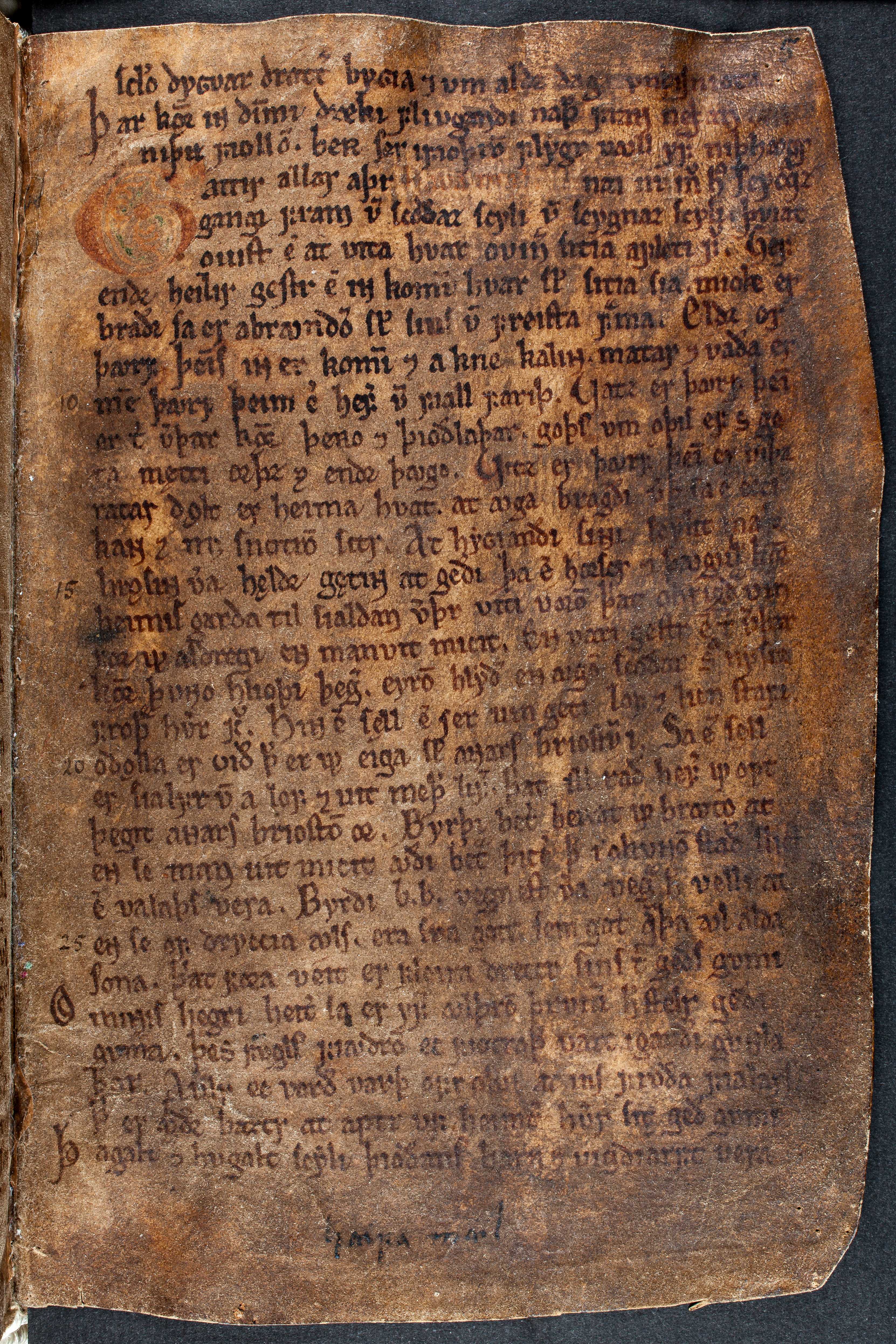
Völuspá from the Poetic Edda, preserved in Codex Regius (GKS 2365 4to, c. 1270). 5 sections across 5 distinct manuscript pages.
How was this verified? (Provenance)
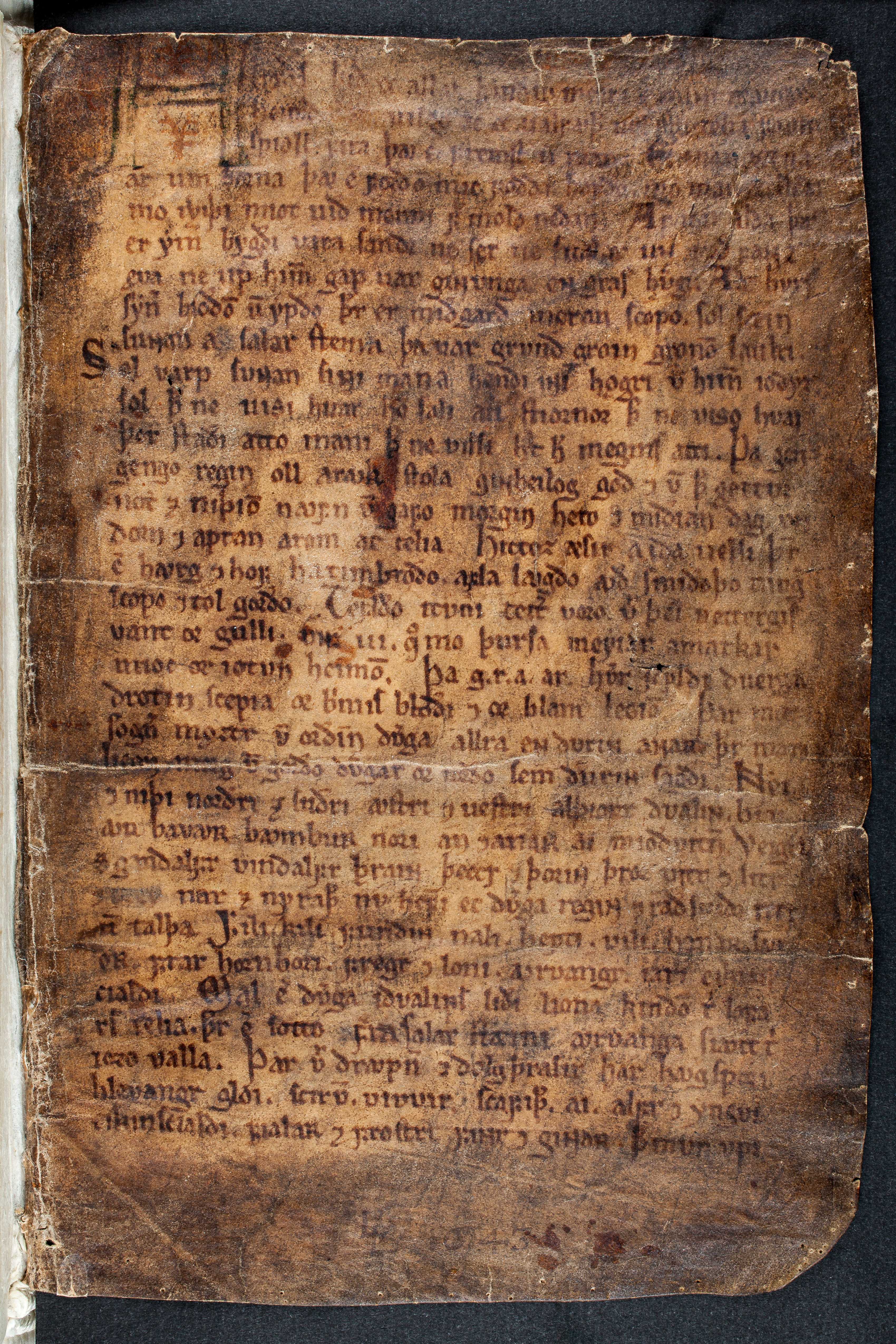
1Hljóðs bið ek allar / helgar kindir, / meiri ok minni / mögu Heimdallar; / viltu at ek, Valföðr, / vel fyr telja / forn spjöll fira, / þau er fremst of man. 2Ek man jötna / ár of borna, / þá er forðum mik / fædda höfðu; / níu man ek heima, / níu íviðjur, / mjötvið mæran / fyr mold neðan. 3Ár var alda, / þat er ekki var, / var-a sandr né sær / né svalar unnir; / jörð fannsk æva / né upphiminn, / gap var ginnunga / en gras hvergi. 4Áðr Burs synir / bjöðum of yppðu, / þeir er Miðgarð / mæran skópu; / sól skein sunnan / á salar steina, / þá var grund gróin / grænum lauki. 5Sól varp sunnan, / sinni mána, / hendi inni hægri / um himinjöður; / sól þat né vissi, / hvar hon sali átti, / máni þat né vissi, / hvat hann megins átti, / stjörnur þat né vissu / hvar þær staði áttu. 6Þá gengu regin öll / á rökstóla, / ginnheilög goð, / ok um þat gættusk; / nótt ok niðjum / nöfn of gáfu, / morgin hétu / ok miðjan dag, / undorn ok aftan, / árum at telja. 7Hittusk æsir / á Iðavelli, / þeir er hörg ok hof / hátimbruðu; / afla lögðu, / auð smíðuðu, / tangir skópu / ok tól gerðu. 8Tefldu í túni, / teitir váru, / var þeim vettergis / vant ór gulli, / uns þrjár kvámu / þursa meyjar / ámáttkar mjök / ór Jötunheimum. 9Þá gengu regin öll / á rökstóla, / ginnheilög goð, / ok um þat gættusk, / hverir skyldi dverga / dróttir skepja / ór Brimis blóði / ok ór Bláins leggjum. 10Þar var Móðsognir / mæztr of orðinn / dverga allra, / en Durinn annarr; / þeir mannlíkun / mörg of gerðu / dvergar í jörðu, / sem Durinn sagði. 11Nýi, Niði, / Norðri, Suðri, / Austri, Vestri, / Alþjófr, Dvalinn, / Nár ok Náinn / Nípingr, Dáinn / Bívurr, Bávurr, / Bömburr, Nóri, / Ánn ok Ánarr, / Óinn, Mjöðvitnir. 12Veggr ok Gandalfr, / Vindalfr, Þorinn, / Þrár ok Þráinn, / Þekkr, Litr ok Vitr, / Nýr ok Nýráðr, / nú hefi ek dverga, / Reginn ok Ráðsviðr, / rétt of talða. 13Fíli, Kíli, / Fundinn, Náli, / Hefti, Víli, / Hannar, Svíurr, / Billingr, Brúni, / Bíldr ok Buri, / Frár, Hornbori, / Frægr ok Lóni, / Aurvangr, Jari, / Eikinskjaldi.
1For silence I pray all sacred children, great and small, sons of Heimdall, they will that I Valfather's deeds recount, men's ancient saws, those that I best remember. 2The Jötuns I remember early born, those who me of old have reared. I nine worlds remember, nine trees, the great central tree, beneath the earth. 3There was in times of old, where Ymir dwelt, nor sand nor sea, nor gelid waves; earth existed not, nor heaven above, 'twas a chaotic chasm, and grass nowhere. 4Before Bur's sons raised up heaven's vault, they who the noble mid-earth shaped. The sun shone from the south over the structure's rocks: then was the earth begrown with herbage green. 5The sun from the south, the moon's companion, her right hand cast about the heavenly horses. The sun knew not where she a dwelling had, the moon knew not what power he possessed, the stars knew not where they had a station. 6Then went the powers all to their judgment-seats, the all-holy gods, and thereon held council: to night and to the waning moon gave names; morn they named, and mid-day, afternoon and eve, whereby to reckon years. 7The Æsir met on Ida's plain; they altar-steads and temples high constructed; their strength they proved, all things tried, furnaces established, precious things forged, formed tongs, and fabricated tools; 8At tables played at home; joyous they were; to them was naught the want of gold, until there came Thurs-maidens three, all powerful, from Jötunheim. 9Then went all the powers to their judgment-seats, the all-holy gods, and thereon held council, who should of the dwarfs the race create, from the sea-giant's blood and livid bones. 10Then was Môtsognir created greatest of all the dwarfs, and Durin second; there in man's likeness they created many dwarfs from earth, as Durin said. 11Nýi and Nidi, Nordri and Sudri, Austri and Vestri, Althiôf, Dvalin Nâr and Nâin, Niping, Dain, Bivör, Bavör, Bömbur, Nori, An and Anar, Ai, Miodvitnir, 12Veig and Gandâlf, Vindâlf, Thrain, Thekk and Thorin, Thrôr, Vitr, and Litr, Nûr and Nýrâd, Regin and Râdsvid. Now of the dwarfs I have rightly told. 13Fili, Kili, Fundin, Nali, Hepti, Vili, Hanar, Svior, Billing, Bruni, Bild, Bûri, Frâr, Hornbori, Fræg and Lôni, Aurvang, Iari, Eikinskialdi.
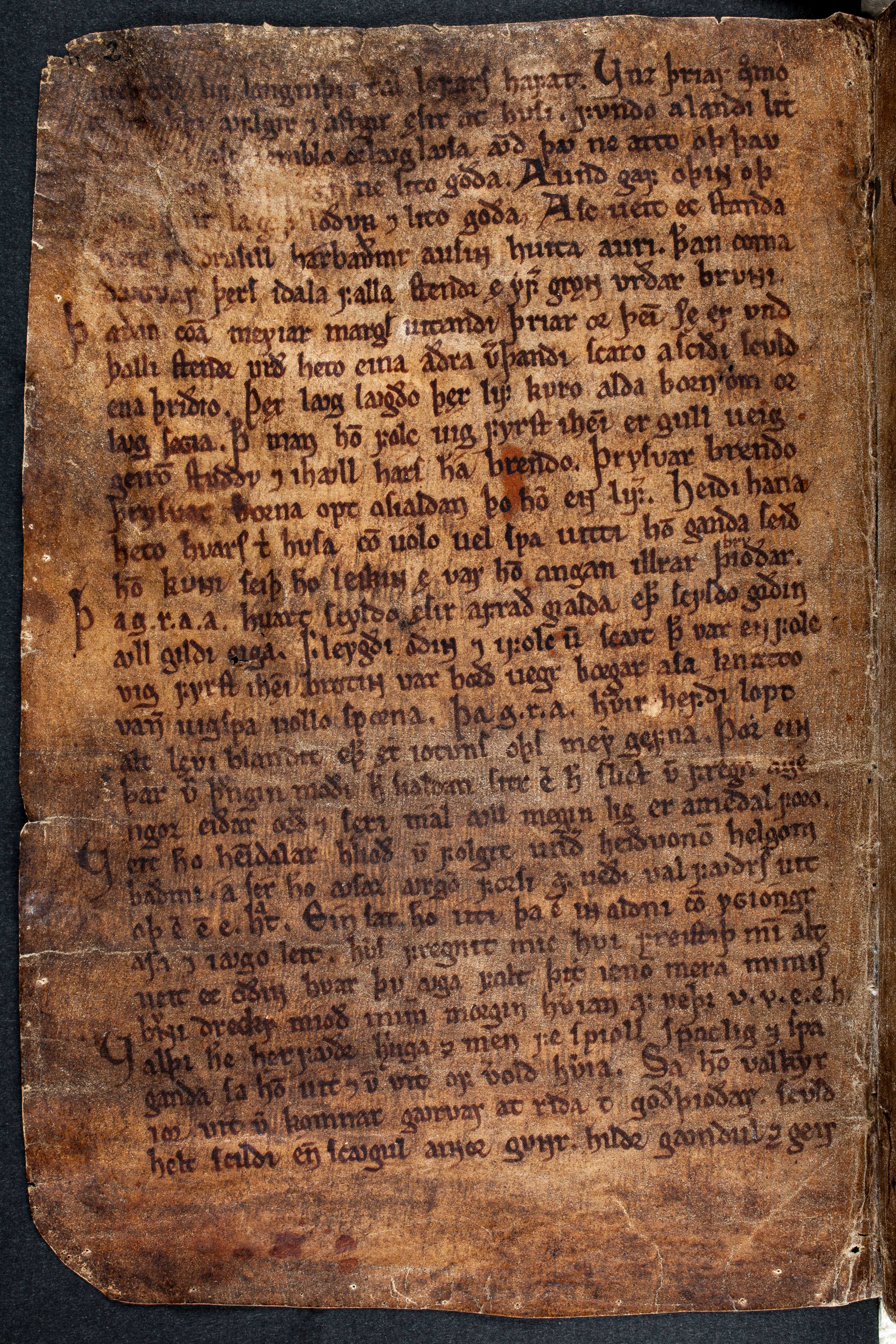
14Mál er dverga / í Dvalins liði / ljóna kindum / til Lofars telja, / þeir er sóttu / frá salar steini / Aurvanga sjöt / til Jöruvalla. 15Þar var Draupnir / ok Dolgþrasir, / Hár, Haugspori, / Hlévangr, Glóinn, / Dóri, Óri / Dúfr, Andvari / Skirfir, Virfir, / Skáfiðr, Ái. 16Alfr ok Yngvi, / Eikinskjaldi, / Fjalarr ok Frosti, / Finnr ok Ginnarr; / þat mun æ uppi / meðan öld lifir, / langniðja tal / Lofars hafat. 17Unz þrír kvámu / ór því liði / öflgir ok ástkir / æsir at húsi, / fundu á landi / lítt megandi / Ask ok Emblu / örlöglausa. 18Önd þau né áttu, / óð þau né höfðu, / lá né læti / né litu góða; / önd gaf Óðinn, / óð gaf Hænir, / lá gaf Lóðurr / ok litu góða. 19Ask veit ek standa, / heitir Yggdrasill, / hár baðmr, ausinn / hvíta auri; / þaðan koma döggvar, / þærs í dala falla, / stendr æ yfir grænn / Urðarbrunni. 20Þaðan koma meyjar / margs vitandi / þrjár ór þeim sæ, / er und þolli stendr; / Urð hétu eina, / aðra Verðandi, / - skáru á skíði, - / Skuld ina þriðju; / þær lög lögðu, / þær líf kuru / alda börnum, / örlög seggja. 21Þat man hon folkvíg / fyrst í heimi, / er Gullveigu / geirum studdu / ok í höll Hárs / hana brenndu, / þrisvar brenndu, / þrisvar borna, / oft, ósjaldan, / þó hon enn lifir. 22Heiði hana hétu / hvars til húsa kom, / völu velspáa, / vitti hon ganda; / seið hon, hvars hon kunni, / seið hon hug leikinn, / æ var hon angan / illrar brúðar. 23Þá gengu regin öll / á rökstóla, / ginnheilög goð, / ok um þat gættusk, / hvárt skyldu æsir / afráð gjalda / eða skyldu goðin öll / gildi eiga. 24Fleygði Óðinn / ok í folk of skaut, / þat var enn folkvíg / fyrst í heimi; / brotinn var borðveggr / borgar ása, / knáttu vanir vígspá / völlu sporna. 25Þá gengu regin öll / á rökstóla, / ginnheilög goð, / ok um þat gættusk, / hverjir hefði loft allt / lævi blandit / eða ætt jötuns / Óðs mey gefna. 26Þórr einn þar vá / þrunginn móði, / - hann sjaldan sitr - / er hann slíkt of fregn -: / á gengusk eiðar, / orð ok særi, / mál öll meginlig, / er á meðal fóru.
14Time 'tis of the dwarfs in Dvalin's band, to the sons of men, to Lofar up to reckon, those who came forth from the world's rock, earth's foundation, to Iora's plains. 15There were Draupnir, and Dôlgthrasir, Hâr, Haugspori, Hlævang, Glôi, Skirvir, Virvir, Skafid, Ai, Alf and Yngvi, Eikinskialdi, 16Fialar and Frosti, Finn and Ginnar, Heri, Höggstari, Hliôdôlf, Moin: that above shall, while mortals live, the progeny of Lofar, accounted be. 17Until there came three mighty and benevolent Æsir to the world from their assembly. They found on earth, nearly powerless, Ask and Embla, void of destiny. 18Spirit they possessed not, sense they had not, blood nor motive powers, nor goodly colour. Spirit gave Odin, sense gave Hoenir, blood gave Lodur, and goodly colour. 19I know an ash standing Yggdrasil hight, a lofty tree, laved with limpid water: thence come the dews into the dales that fall; ever stands it green over Urd's fountain. 20Thence come maidens, much knowing, three from the hall, which under that tree stands; Urd hight the one, the second Verdandi,--on a tablet they graved--Skuld the third. Laws they established, life allotted to the sons of men; destinies pronounced. 21Alone she sat without, when came that ancient dread Æsir's prince; and in his eye she gazed. 22"Of what wouldst thou ask me? Why temptest thou me? Odin! I know all, where thou thine eye didst sink in the pure well of Mim." Mim drinks mead each morn from Valfather's pledge. Understand ye yet, or what? 23The chief of hosts gave her rings and necklace, useful discourse, and a divining spirit: wide and far she saw o'er every world. 24She the Valkyriur saw from afar coming, ready to ride to the god's people: Skuld held a shield, Skögul was second, then Gunn, Hild Göndul, and Geirskögul. Now are enumerated Herian's maidens, the Valkyriur, ready over the earth to ride. 25She that war remembers, the first on earth, when Gullveig they with lances pierced, and in the high one's hall her burnt, thrice burnt, thrice brought her forth, oft not seldom; yet she still lives. 26Heidi they called her, whithersoe'r she came, the well-foreseeing Vala: wolves she tamed, magic arts she knew, magic arts practised; ever was she the joy of evil people.
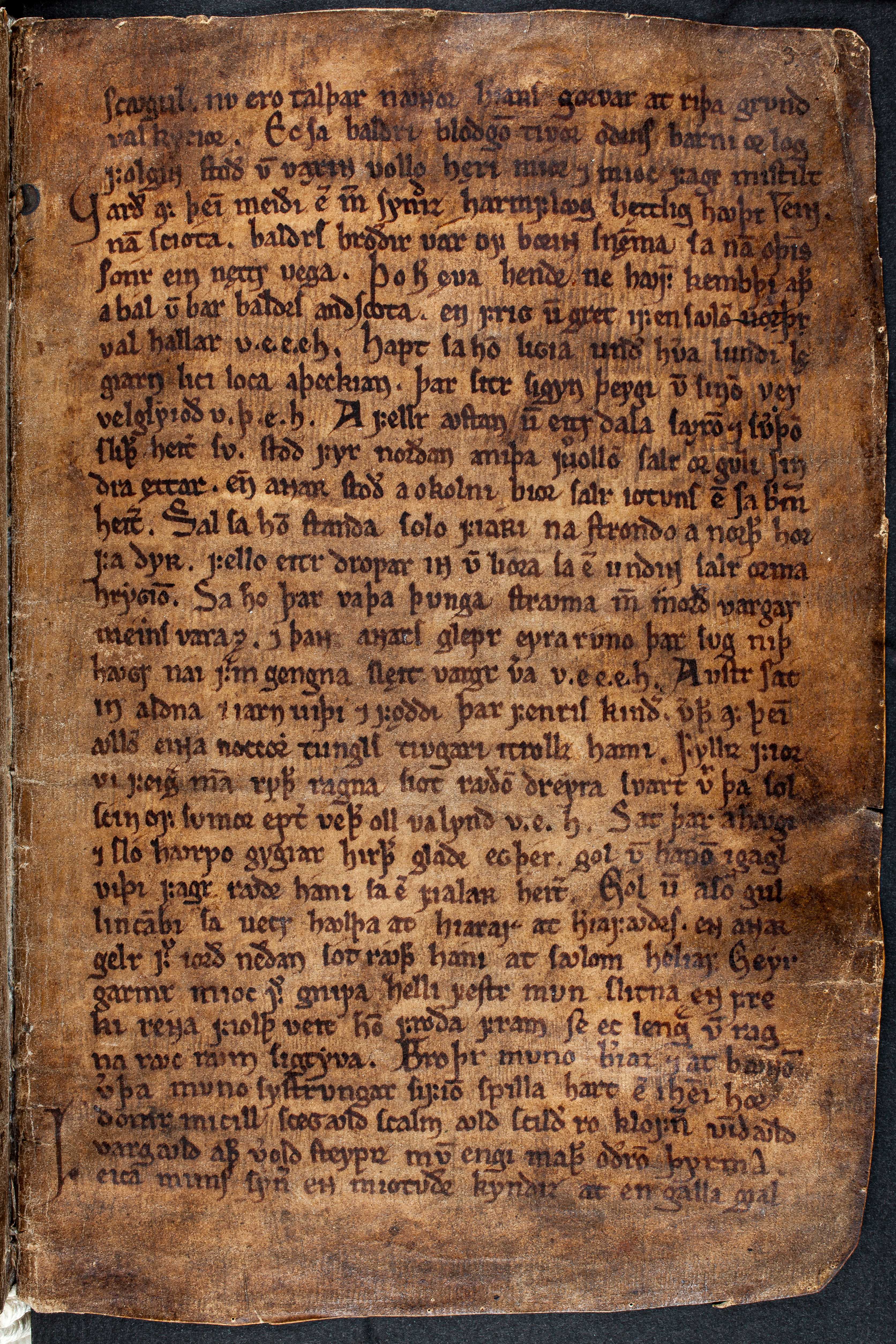
27Veit hon Heimdallar / hljóð of folgit / und heiðvönum / helgum baðmi, / á sér hon ausask / aurgum forsi / af veði Valföðrs. / Vituð ér enn - eða hvat? 28Ein sat hon úti, / þá er inn aldni kom / yggjungr ása / ok í augu leit. / Hvers fregnið mik? / Hví freistið mín? / Allt veit ek, Óðinn, / hvar þú auga falt, / í inum mæra / Mímisbrunni. / Drekkr mjöð Mímir / morgun hverjan / af veði Valföðrs. / Vituð ér enn - eða hvat? 29Valði henni Herföðr / hringa ok men, / fekk spjöll spaklig / ok spá ganda, / sá hon vítt ok of vítt / of veröld hverja. 30Sá hon valkyrjur / vítt of komnar, / görvar at ríða / til Goðþjóðar; / Skuld helt skildi, / en Skögul önnur, / Gunnr, Hildr, Göndul / ok Geirskögul. / Nú eru talðar / nönnur Herjans, / görvar at ríða / grund valkyrjur. 31Ek sá Baldri, / blóðgum tívur, / Óðins barni, / örlög folgin; / stóð of vaxinn / völlum hæri / mjór ok mjök fagr / mistilteinn. 32Varð af þeim meiði, / er mær sýndisk, / harmflaug hættlig, / Höðr nam skjóta; / Baldrs bróðir var / of borinn snemma, / sá nam Óðins sonr / einnættr vega. 33Þó hann æva hendr / né höfuð kembði, / áðr á bál of bar / Baldrs andskota; / en Frigg of grét / í Fensölum / vá Valhallar. / Vituð ér enn - eða hvat? 34Þá kná Váli / vígbönd snúa, / heldr váru harðgör / höft ór þörmum. 35Haft sá hon liggja / und Hveralundi, / lægjarns líki / Loka áþekkjan; / þar sitr Sigyn / þeygi of sínum / ver vel glýjuð. / Vituð ér enn - eða hvat? 36Á fellur austan / um eitrdala / söxum ok sverðum, / Slíðr heitir sú. 37Stóð fyr norðan / á Niðavöllum / salr ór gulli / Sindra ættar; / en annarr stóð / á Ókólni / bjórsalr jötuns, / en sá Brimir heitir. 38Sal sá hon standa / sólu fjarri / Náströndu á, / norðr horfa dyrr; / falla eitrdropar / inn um ljóra, / sá er undinn salr / orma hryggjum. 39Sá hon þar vaða / þunga strauma / menn meinsvara / ok morðvarga / ok þann er annars glepr / eyrarúnu; / þar saug Niðhöggr / nái framgengna, / sleit vargr vera. / Vituð ér enn - eða hvat?
27Then went the powers all to their judgment-seats, the all-holy gods, and thereon held council, whether the Æsir should avenge the crime, or all the gods receive atonement. 28Broken was the outer wall of the Æsir's burgh. The Vanir, foreseeing conflict, tramp o'er the plains. Odin cast [his spear], and mid the people hurled it: that was the first warfare in the world. 29Then went the powers all to their judgment-seats, the all-holy gods, and thereon held council: who had all the air with evil mingled? or to the Jötun race Od's maid had given? 30There alone was Thor with anger swollen. He seldom sits, when of the like he hears. Oaths are not held sacred; nor words, nor swearing, nor binding compacts reciprocally made. 31She knows that Heimdall's horn is hidden under the heaven-bright holy tree. A river she sees flow, with foamy fall, from Valfather's pledge. Understand ye yet, or what? 32East sat the crone, in Iârnvidir, and there reared up Fenrir's progeny: of all shall be one especially the moon's devourer, in a troll's semblance. 33He is sated with the last breath of dying men; the god's seat he with red gore defiles: swart is the sunshine then for summers after; all weather turns to storm. Understand ye yet, or what? 34There on a height sat, striking a harp, the giantess's watch, the joyous Egdir; by him crowed, in the bird-wood, the bright red cock, which Fialar hight. 35Crowed o'er the Æsir Gullinkambi, which wakens heroes with the sire of hosts; but another crows beneath the earth, a soot-red cock, in the halls of Hel. 36I saw of Baldr, the blood-stained god, Odin's son, the hidden fate. There stood grown up, high on the plain, slender and passing fair, the mistletoe. 37From that shrub was made, as to me it seemed, a deadly, noxious dart. Hödr shot it forth; but Frigg bewailed, in Fensalir, Valhall's calamity. Understand ye yet, or what? 38Bound she saw lying, under Hveralund, a monstrous form, to Loki like. There sits Sigyn, for her consort's sake, not right glad. Understand ye yet, or what? 39Then the Vala knew the fatal bonds were twisting, most rigid, bonds from entrails made.
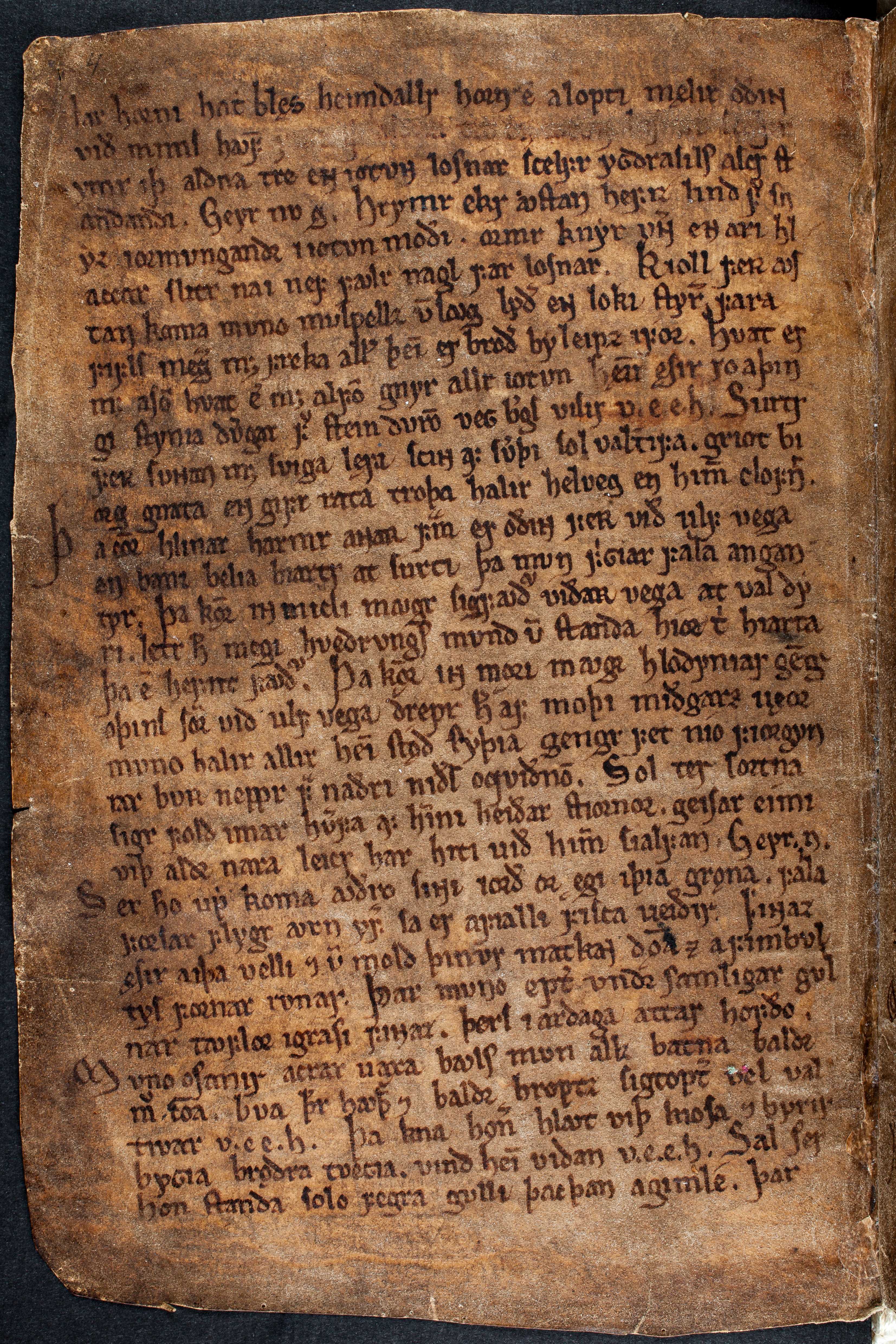
40Austr sat in aldna / í Járnviði / ok fæddi þar / Fenris kindir; / verðr af þeim öllum / einna nokkurr / tungls tjúgari / í trölls hami. 41Fyllisk fjörvi / feigra manna, / rýðr ragna sjöt / rauðum dreyra; / svört verða sólskin / um sumur eftir, / veðr öll válynd. / Vituð ér enn - eða hvat? 42Sat þar á haugi / ok sló hörpu / gýgjar hirðir, / glaðr Eggþér; / gól of hánum / í galgviði / fagrrauðr hani, / sá er Fjalarr heitir. 43Gól of ásum / Gullinkambi, / sá vekr hölða / at Herjaföðrs; / en annarr gelr / fyr jörð neðan / sótrauðr hani / at sölum Heljar. 44Geyr nú Garmr mjök / fyr Gnipahelli, / festr mun slitna, / en freki renna; / fjölð veit ek fræða, / fram sé ek lengra / um ragna rök / römm sigtíva. 45Bræðr munu berjask / ok at bönum verðask, / munu systrungar / sifjum spilla; / hart er í heimi, / hórdómr mikill, / skeggöld, skalmöld, / skildir ro klofnir, / vindöld, vargöld, / áðr veröld steypisk; / mun engi maðr / öðrum þyrma. 46Leika Míms synir, / en mjötuðr kyndisk / at inu galla / Gjallarhorni; / hátt blæss Heimdallr, / horn er á lofti, / mælir Óðinn / við Míms höfuð. 47Skelfr Yggdrasils / askr standandi, / ymr it aldna tré, / en jötunn losnar; / hræðask allir / á helvegum / áðr Surtar þann / sefi of gleypir. 48Hvat er með ásum? / Hvat er með alfum? / Gnýr allr Jötunheimr, / æsir ro á þingi, / stynja dvergar / fyr steindurum, / veggbergs vísir. / Vituð ér enn - eða hvat? 49Geyr nú Garmr mjök / fyr Gnipahelli, / festr mun slitna / en freki renna; / fjölð veit ek fræða, / fram sé ek lengra / um ragna rök / römm sigtíva. 50Hrymr ekr austan, / hefisk lind fyrir, / snýsk Jörmungandr / í jötunmóði; / ormr knýr unnir, / en ari hlakkar, / slítr nái niðfölr, / Naglfar losnar. 51Kjóll ferr austan, / koma munu Múspells / of lög lýðir, / en Loki stýrir; / fara fíflmegir / með freka allir, / þeim er bróðir / Býleists í för. 52Surtr ferr sunnan / með sviga lævi, / skínn af sverði / sól valtíva; / grjótbjörg gnata, / en gífr rata, / troða halir helveg, / en himinn klofnar.
40From the east a river falls, through venom dales, with mire and clods, Slîd is its name. 41On the north there stood, on Nida-fells, a hall of gold, for Sindri's race; and another stood in Okôlnir, the Jötuns beer-hall which Brîmir hight. 42She saw a hall standing, far from the sun, in Nâströnd; its doors are northward turned, venom-drops fall in through its apertures: entwined is that hall with serpents' backs. 43She there saw wading the sluggish streams bloodthirsty men and perjurers, and him who the ear beguiles of another's wife. There Nidhögg sucks the corpses of the dead; the wolf tears men. Understand ye yet, or what? 44Further forward I see, much can I say of Ragnarök and the gods' conflict. 45Brothers shall fight, and slay each other; cousins shall kinship violate. The earth resounds, the giantesses flee; no man will another spare. 46Hard is it in the world, great whoredom, an axe age, a sword age, shields shall be cloven, a wind age, a wolf age, ere the world sinks. 47Mim's sons dance, but the central tree takes fire at the resounding Giallar-horn. Loud blows Heimdall, his horn is raised; Odin speaks with Mim's head. 48Trembles Yggdrasil's ash yet standing; groans that aged tree, and the jötun is loosed. Loud bays Garm before the Gnupa-cave, his bonds he rends asunder; and the wolf runs. 49Hrym steers from the east, the waters rise, the mundane snake is coiled in jötun-rage. The worm beats the water, and the eagle screams: the pale of beak tears carcases; Naglfar is loosed. 50That ship fares from the east: come will Muspell's people o'er the sea, and Loki steers. The monster's kin goes all with the wolf; with them the brother is of Byleist on their course. 51Surt from the south comes with flickering flame; shines from his sword the Val-gods' sun. The stony hills are dashed together, the giantesses totter; men tread the path of Hel, and heaven is cloven. 52How is it with the Æsir? How with the Alfar? All Jötunheim resounds; the Æsir are in council. The dwarfs groan before their stony doors, the sages of the rocky walls. Understand ye yet, or what?
53Þá kemr Hlínar / harmr annarr fram, / er Óðinn ferr / við ulf vega, / en bani Belja / bjartr at Surti; / þá mun Friggjar / falla angan. 54Geyr nú Garmr mjök / fyr Gnipahelli, / festr mun slitna, / en freki renna; / fjölð veit ek fræða, / fram sé ek lengra / um ragna rök / römm sigtíva. 55Þá kemr inn mikli / mögr Sigföður, / Víðarr, vega / at valdýri. / Lætr hann megi Hveðrungs / mundum standa / hjör til hjarta, / þá er hefnt föður. 56Þá kemr inn mæri / mögr Hlóðynjar, / gengr Óðins sonr / við orm vega, / drepr af móði / Miðgarðs véurr, / munu halir allir / heimstöð ryðja; / gengr fet níu / Fjörgynjar burr / neppr frá naðri / níðs ókvíðnum. 57Sól tér sortna, / sígr fold í mar, / hverfa af himni / heiðar stjörnur; / geisar eimi / ok aldrnari, / leikr hár hiti / við himin sjalfan. 58Geyr nú Garmr mjök / fyr Gnipahelli, / festr mun slitna / en freki renna; / fjölð veit ek fræða / fram sé ek lengra / um ragna rök / römm sigtíva. 59Sér hon upp koma / öðru sinni / jörð ór ægi / iðjagræna; / falla forsar, / flýgr örn yfir, / sá er á fjalli / fiska veiðir. 60Finnask æsir / á Iðavelli / ok um moldþinur / máttkan dæma / ok minnask þar / á megindóma / ok á Fimbultýs / fornar rúnir. 61Þar munu eftir / undrsamligar / gullnar töflur / í grasi finnask, / þærs í árdaga / áttar höfðu. 62Munu ósánir / akrar vaxa, / böls mun alls batna, / Baldr mun koma; / búa þeir Höðr ok Baldr / Hrofts sigtoftir, / vé valtíva. / Vituð ér enn - eða hvat? 63Þá kná Hænir / hlautvið kjósa / ok burir byggja / bræðra tveggja / vindheim víðan. / Vituð ér enn - eða hvat? 64Sal sér hon standa / sólu fegra, / gulli þakðan / á Gimléi; / þar skulu dyggvar / dróttir byggja / ok um aldrdaga / ynðis njóta. 65Þá kemr inn ríki / at regindómi / öflugr ofan, / sá er öllu ræðr.
53Then arises Hlîn's second grief, when Odin goes with the wolf to fight, and the bright slayer of Beli with Surt. Then will Frigg's beloved fall. 54Then comes the great victor-sire's son, Vidar, to fight with the deadly beast. He with his hands will make his sword pierce to the heart of the giant's son: then avenges he his father. 55Then comes the mighty son of Hlôdyn: (Odin's son goes with the monster to fight); Midgârd's Veor in his rage will slay the worm. Nine feet will go Fiörgyn's son, bowed by the serpent, who feared no foe. All men will their homes forsake. 56The sun darkens, earth in ocean sinks, fall from heaven the bright stars, fire's breath assails the all-nourishing tree, towering fire plays against heaven itself. 57She sees arise, a second time, earth from ocean, beauteously green, waterfalls descending; the eagle flying over, which in the fell captures fish. 58The Æsir meet on Ida's plain, and of the mighty earth-encircler speak, and there to memory call their mighty deeds, and the supreme god's ancient lore. 59There shall again the wondrous golden tables in the grass be found, which in days of old had possessed the ruler of the gods, and Fiölnir's race. 60Unsown shall the fields bring forth, all evil be amended; Baldr shall come; Hödr and Baldr, the heavenly gods, Hropt's glorious dwellings shall inhabit. Understand ye yet, or what? 61Then can Hoenir choose his lot, and the two brothers' sons inhabit the spacious Vindheim. Understand ye yet, or what? 62She a hall standing than the sun brighter, with gold bedecked, in Gimill: there shall be righteous people dwell, and for evermore happiness enjoy. 64Then comes the mighty one to the great judgment, the powerful from above, who rules o'er all. He shall dooms pronounce, and strifes allay, holy peace establish, which shall ever be. 65There comes the dark dragon flying from beneath the glistening serpent, from Nida-fels. On his wings bears Nidhögg, flying o'er the plain, a corpse. Now she will descend.
Cite
Source & Cross-References
- Source text: Codex Regius (GKS 2365 4to) via handrit.is + heimskringla.no + Thorpe (PG #14726) — view original
- Critical edition: Codex Regius (GKS 2365 4to)
← previous · → next · v cycle view · l back to library