Enuma Elish, Tablet I: the birth of the gods and Tiamat's army
Introduction
Before heaven and earth were named, Apsu and Tiamat mingled their waters and the gods were born. Disturbed by their noise, Apsu plans to destroy them; Ea puts him to sleep and kills him, and in his dwelling Marduk is born. Tiamat, urged on by other gods, creates monsters for battle and gives Qingu the Tablet of Destinies.
Enuma Elish ('When on high'), the Babylonian Poem of Creation, tells how Marduk, god of Babylon, defeated Tiamat, created the ordered world and became king of the gods. It was written on seven tablets and recited in Babylon during the New Year festival. The date of composition is debated (proposals range from the 18th to the 12th century BCE); the surviving copies date from the 9th to the 2nd century BCE and come from Ashur, Nineveh, Kish, Babylon, Sippar, Uruk and other sites. This page follows the line numbering of the electronic Babylonian Library edition.
How this page is built. Each section is a run of consecutive lines as written on one photographed clay tablet. For every line the eBL edition (https://www.ebl.lmu.de/corpus/L/1/2/SB/I) lists the manuscripts that carry it, with each tablet's own column and line numbers; the tablet chosen for each run is the photographed copy of the work with the most signs preserved there. Commentaries and texts that only quote a line are never chosen. School and excerpt tablets are used only for lines that no photographed library copy preserves as well, and only where they carry the line as text; their sections say so (BM.36681, BM.36726, BM.37287, BM.37969). The original text is eBL's transliteration of that tablet's signs (not a modern composite text): square brackets mark broken signs, x an illegible sign, # a damaged sign, ? an uncertain reading, and words in {braces} are determinatives; the notes give a key to every sign used on this page, and eBL's layout codes are written out in words (for example '(line break)' or '(blank space)'). Superscript numbers are the line numbers of the eBL edition, used in both the Akkadian and the English. The English is B. R. Foster's translation in the eBL edition (CC BY-NC-SA 4.0), one line of English per line of the poem; italics mark uncertain renderings, as in the source. Where the tablet is broken, the English still translates the whole line of eBL's composite text; each section's note names the lines that are broken on its tablet.
Finding a line on the photograph. Each section names the tablet, the face and column, and the tablet's own line numbers (a prime, as in 5', counts from the first preserved line of a broken column). On a tablet with six columns the obverse carries columns i-iii from left to right; the reverse, turned over from bottom to top, carries columns iv-vi from right to left. The photographs often show the obverse above the reverse with the edges around them; a fragment preserves only part of this layout.
This page shows 162 of the 162 lines of the eBL edition (100%), from 12 tablets in the British Museum: K.5419.C (Nineveh), BM.45528, BM.36726, BM.36681, 1881,0727.80 (Nineveh), BM.46803, K.13299 (Nineveh), BM.37287, Rm.982 (Nineveh), BM.45571, BM.38024, BM.37969.
How was this verified? (Provenance)
Where on the image
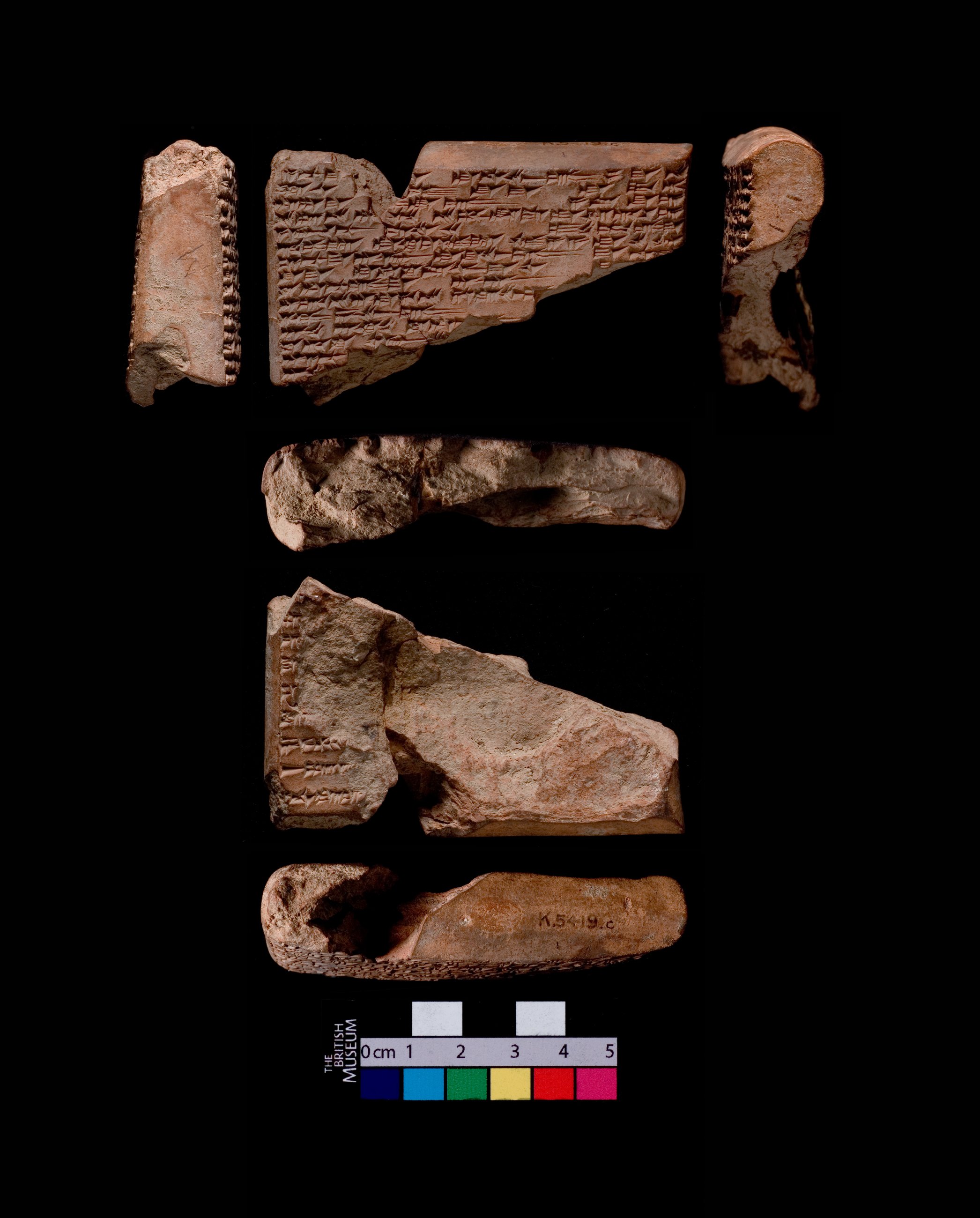
British Museum K.5419.C: obverse, the tablet's own lines 1 to 7. eBL's corpus edition (https://www.ebl.lmu.de/corpus/L/1/2/SB/I) attributes SB I 1-7 to this manuscript at these column and line numbers. Photograph checked: obverse, reverse and edges, ink K.5419.c on the bottom edge. About 14 to 16 lines on the obverse and a few lines along the left side of the reverse, consistent with eBL's 16 obverse lines of Tablet I and one reverse line of Tablet II. On this tablet lines 1-2 are partly broken (square brackets and x in the Akkadian). The English of these lines translates eBL's composite text, so it includes words that are not preserved on this tablet but are restored from other manuscripts or by the editors. Square brackets in the English mark eBL's restorations in its composite text; words that survive on other tablets carry no brackets even where this tablet is broken. Lines 3-7 are complete on this tablet.
1e#-nu-ma# [e]-liš# la na-bu-u₂ ša₂-ma-mu
2šap-liš am#-[ma]-tu₄ šu-ma la zak-rat
3ABZU-ma reš#-tu-u₂ za-ru-šu-un
4mu-um-mu ti#-amtu mu-al-li-da-at gim-ri-šu₂-un
5A-MEŠ-šu₂-nu iš-te-niš i-hi-qu-u₂-ma
6gi-pa-ra la ki-iṣ-ṣu-ra ṣu-ṣa-a la še-ʾi
7e-nu-ma DINGIR-MEŠ la šu-pu-u₂ ma-na-ma#
1When on high no word was used for heaven,
2Nor below was firm ground called by name,
3Primeval Apsu was their progenitor,
4Matrix-Tiamat was she who bore them all,
5They were mingling their waters together,
6No lea was packed together, no canebrake matted close.
7When no gods at all had been brought forth,
Where on the image
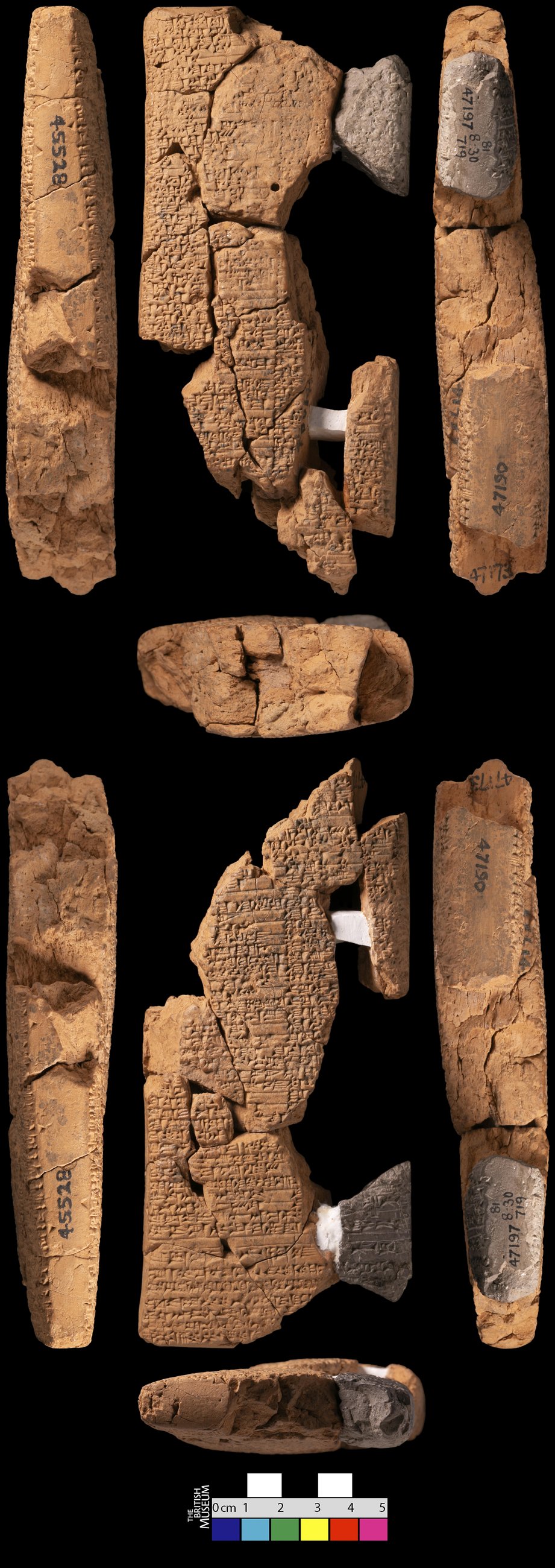
British Museum BM.45528: obverse, the tablet's own lines 8 to 27. eBL's corpus edition (https://www.ebl.lmu.de/corpus/L/1/2/SB/I) attributes SB I 8-27 to this manuscript at these column and line numbers. Photograph checked: obverse, reverse and edges of a tall tablet (about 17 cm) built from many joined pieces, some with plaster, ink 45528 on the left edge and 47197 (81-8-30,719) and 47150 on joined pieces on the right edge. Both faces densely inscribed in small script, consistent with eBL's 58 obverse and 39 reverse lines. On this tablet lines 8-10, 12-13, 15-27 are partly broken (square brackets and x in the Akkadian). The English of these lines translates eBL's composite text, so it includes words that are not preserved on this tablet but are restored from other manuscripts or by the editors. Square brackets in the English mark eBL's restorations in its composite text; words that survive on other tablets carry no brackets even where this tablet is broken. Lines 11, 14 are complete on this tablet.
8šu-ma la# zuk#-ku#-[r]u ši-ma-tu# [l]a ši#-i-mu
9ib-ba-nu-u₂ [DINGIR].DINGIR qe₂-reb#-šu#-un#
10(gloss: 10) {d}lah₃#-mu u {d}la#-ha-mu uš-ta#-pu#-[u₂ šu-ma] iz-zak#-ru!?#
11a-di ir#-bu-u₂# i#-ši#-hu#
12an-šar₂ u {d}ki-šar₂# ib-ba-nu-ma e-li#-šu-[nu] at#-ru#
13u₂-ur-ri-ku U₄-MEŠ u₂-uṣ#-ṣi#-[bu] MU.AN.NA#-MEŠ#
14{d}a-num# a-pil-šu-nu ša#-ni#-nu ab-be₂-e#-šu
15an-šar₂ {d}a-num bu#-uk#-ri?#-[šu u₂-ma]š-ši-il#-ma
16u₃ {d#}a-num tam#-ši#-la!#-š[u x x x] {d#}nu-dim₂#-mud
17{d}nu-dim₂-mu[d] ša₂ AD-MEŠ-šu a-lid-[su-nu šu-m]a
18pal-ka u[z-n]u ha-sis e#-[mu-qa₂-an x x x]
19gu-uš-šu[r ma-a]-di-iš a#-[na x x x x x x]
20(gloss: 10) la i-ši ša#-[ni]-na# i#-[na x x x x x]
21in-nen-du-m[a at-h]u-u₂# [x x x x x (x)]
22e-šu-u₂ ti#-amta!?#-ma# [x x x x x x x]
23da-al-hu-nim-ma [x x x x x x]
24i-na šu-ʾ-a-ru šu-du#-r[u x x x x x]
25la na-ši-ir ABZU# r[i-gim-šu-un]
26u₃ ti-amtu [šu]-qa-am-mu-ma#-at?# i#-[na x x x x]
27im-tar-ṣa-am-ma# ep#-še-ta-šu-un e#-[li-šu-un]
8Nor called by names, none destinies ordained,
9Then were gods formed within these two.
10Lahmu and Lahamu were brought forth, were called by name.
11While they matured, while they grew tall,
12Anshar and Kishar were formed, surpassing them,
13Lengthy were they of days, added years to years.
14Anu their firstborn was like unto his forebears,
15Anu, his son, became Anshar’s equal.
16Then Anu begot his own equal, Nudimmud,
17Nudimmud was one to dominate his forebears:
18Profound in wisdom, acute of sense, he was massively strong,
19Far more stalwart than his grandfather Anshar,
20No rival had he among the gods his brethren.
21The divine brethren swarmed about,
22Confounding Tiamat as their uproar grew ever more loud,
23Roiling the vitals of Tiamat,
24Their romping troubled the Heavenly Abode.
25Apsu could not lessen their clamor,
26But Tiamat was silent before them.
27Their actions were noisome to her,
Where on the image
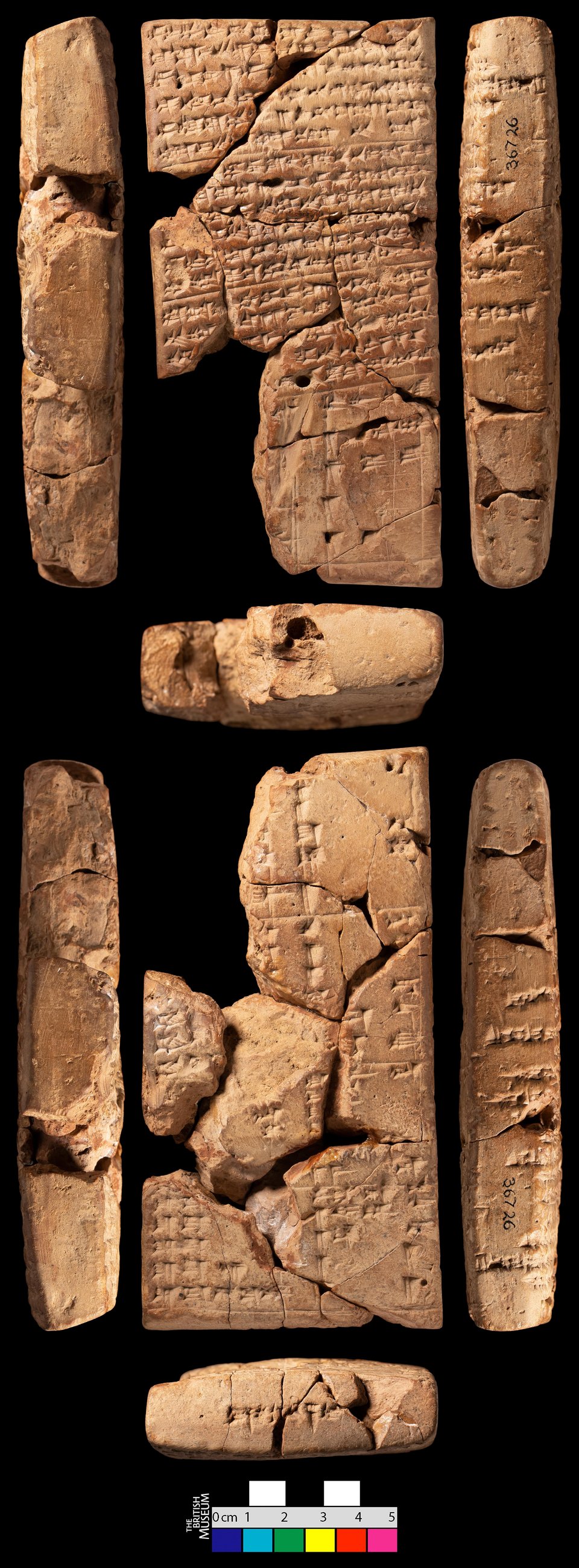
British Museum BM.36726: obverse, the tablet's own lines 7' to 12'. eBL's corpus edition (https://www.ebl.lmu.de/corpus/L/1/2/SB/I) attributes SB I 28-33 to this manuscript at these column and line numbers. Photograph checked: obverse, reverse and edges of a joined tablet, ink 36726 on the right edge. The obverse carries 15 or more lines and the reverse ruled sections of text, easily enough for eBL's six obverse lines. eBL classes BM.36726 as a school tablet (a scribal exercise that copies an excerpt of the text), not a library copy of the whole work. It carries these lines as text (eBL's transliteration has no commentary or quotation markup), and it is used because no photographed library copy preserves these lines as well. On this tablet lines 28-29, 31-32 are partly broken (square brackets and x in the Akkadian). The English of these lines translates eBL's composite text, so it includes words that are not preserved on this tablet but are restored from other manuscripts or by the editors. Square brackets in the English mark eBL's restorations in its composite text; words that survive on other tablets carry no brackets even where this tablet is broken. Lines 30, 33 are complete on this tablet.
28[l]a ṭa#-[b]at al-kat₂-su-nu šu-nu-ti# i-ta!?-x!?-zu!?
29[i-nu-š]u ABZU za-[a]r!? DINGIR.DINGIR ra-bi₂-u₃-ti₃
30is#-si#-ma# {d#}mu-um-mu suk-kal-la-šu i-zak-kar-šu
31{d}mu-[u]m-mu suk-kal-lu mu-ṭib#-ba# ka-bat-ti-ia
32al#-kam-ma ṣe-ri-iš ta-a₃-wa-ti i n[i-id-din x (x) x]
33il#-li-ku#-ma qu-ud-mi-iš ta-a₃#-wa#-ti# u₂!?-ši!?-bu#
28As offensive their behavior, she was indulgent.
29Thereupon Apsu, begetter of the great gods,
30Summoned Mummu his vizier, saying to him,
31“Mummu, vizier who contents me,
32“Come, let us hold counsel in the presence of Tiamat.”
33They went, took their places facing Tiamat,
Where on the image
British Museum BM.45528: obverse, the tablet's own lines 34 to 45. eBL's corpus edition (https://www.ebl.lmu.de/corpus/L/1/2/SB/I) attributes SB I 34-45 to this manuscript at these column and line numbers. Photograph checked: obverse, reverse and edges of a tall tablet (about 17 cm) built from many joined pieces, some with plaster, ink 45528 on the left edge and 47197 (81-8-30,719) and 47150 on joined pieces on the right edge. Both faces densely inscribed in small script, consistent with eBL's 58 obverse and 39 reverse lines. On this tablet of line 37 only one to three signs survive and lines 34-36, 38-45 are partly broken (square brackets and x in the Akkadian). The English of these lines translates eBL's composite text, so it includes words that are not preserved on this tablet but are restored from other manuscripts or by the editors. Square brackets in the English mark eBL's restorations in its composite text; words that survive on other tablets carry no brackets even where this tablet is broken.
34[a-ma-a]-ti im-t[a]l-li#-ku aš-šum DINGIR.DINGIR [x x x x x]
35[x x pa]-a#-šu i-p[u-šam-ma]
36[x x x x el]-li#-tam-ma i-za[k-kar-ši]
37[x x x x x] al-kat₂-[su-nu x x x]
38[x x x l]a šu-up-šu-ha-ak mu-ši-[iš x x x x x]
39[lu-uš-hal-li]q-ma al-kat₂-su-nu lu-s[a-ap-pi-i]h
40[qu-l]u liš-ša₂-kin-ma i ni#-[iṣ-lal ni-i-n]i?
41[x x a]n-ni-ta i-na [še-mi]-i#-šu#
42[i-zu-uz-m]a il-ta-si e-l[i ha-mi]-i?#-ri-šu#
43[x x x mar-ṣ]i-iš ug#-gu#-gat e-diš#-ši#-ša₂#
44[x x x i]t-ta-di a-na [kar]-ši-[ša₂]
45[x x x ni]-i#-nu ša₂ ni-i[b-nu-u₂ nu]-uš-hal-laq-ma
34They took counsel concerning the gods their offspring.
35Apsu made ready to speak,
36Saying to her, Tiamat, in a loud voice,
37“Their behavior is noisome to me!
38“By day I have no rest, at night I do not sleep!
39“I wish to put an end to their behavior, to do away with it!
40“Let silence reign that we may sleep.”
41When Tiamat heard this,
42She grew angry and cried out to her spouse,
43She cried out bitterly, outraged that she stood alone,
44This wicked speech had fallen heavy upon her:
45“What? Shall we put an end to what we created?
Where on the image
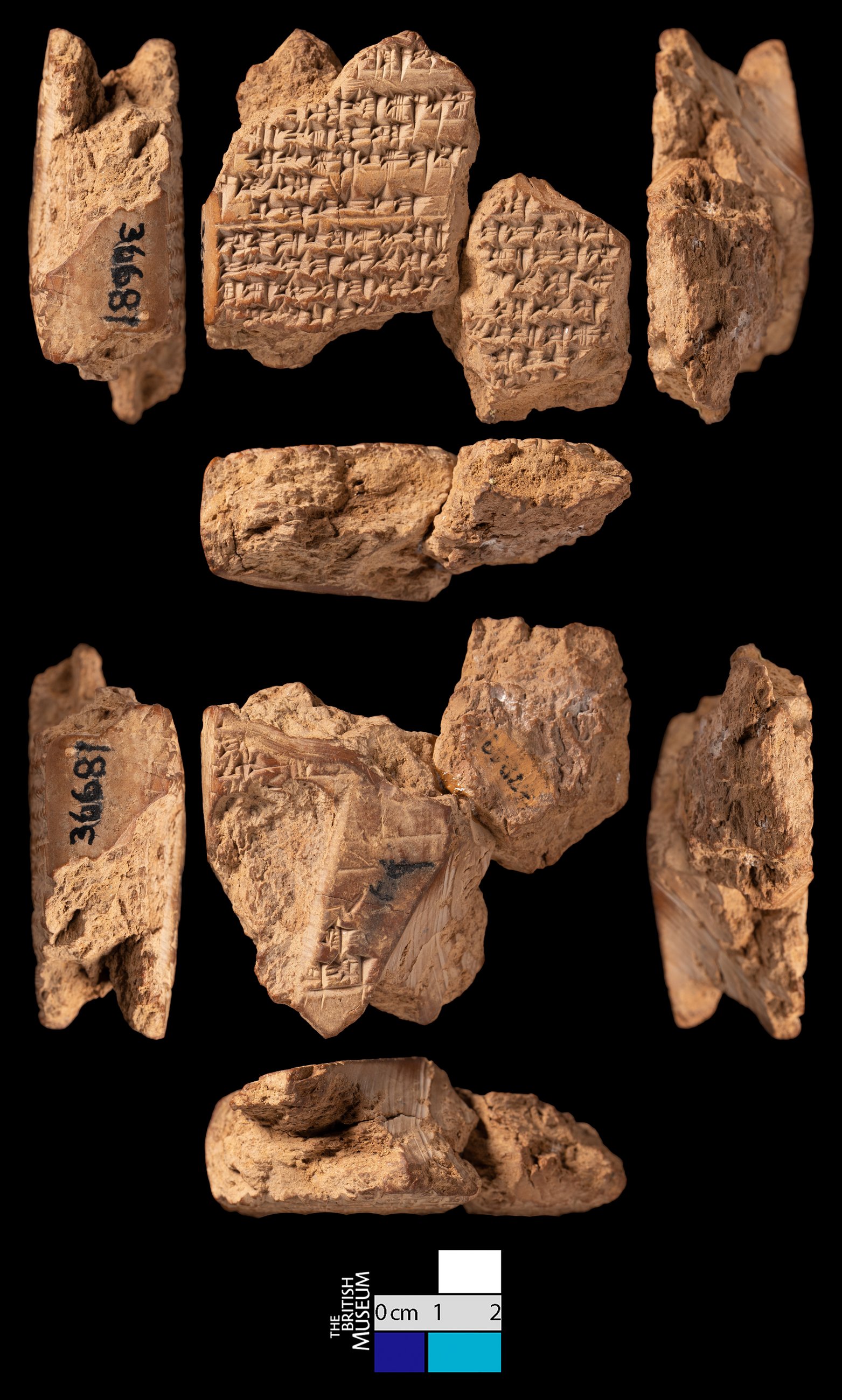
British Museum BM.36681: obverse, the tablet's own lines 9' to 12'. eBL's corpus edition (https://www.ebl.lmu.de/corpus/L/1/2/SB/I) attributes SB I 46-49 to this manuscript at these column and line numbers. Photograph checked: obverse, reverse and edges of two joined pieces, ink 36681 on the left edge and a faint, illegible number on the joined piece. About eight lines on the obverse, consistent with eBL's seven; the reverse is mostly worn with a few signs. eBL classes BM.36681 as a school tablet (a scribal exercise that copies an excerpt of the text), not a library copy of the whole work. It carries these lines as text (eBL's transliteration has no commentary or quotation markup), and it is used because no photographed library copy preserves these lines as well. On this tablet lines 46-49 are partly broken (square brackets and x in the Akkadian). The English of these lines translates eBL's composite text, so it includes words that are not preserved on this tablet but are restored from other manuscripts or by the editors. Square brackets in the English mark eBL's restorations in its composite text; words that survive on other tablets carry no brackets even where this tablet is broken.
46al-kat₂-su-nu lu-u₂ šum-ru-ṣa-[a]t-ma i ni-iš-du#-[ud x x]
47i-pu-ul-ma {d}mu-um-mu [a]p-sa-a i-ma-al-[lik]
48suk-kal-lu₄ la ma-gi-ri m[i-li]k mu-um-mi-[šu]
49hul#-li#-qa-am#-ma# [x (x) a]l-ka-ti e-š[i-tu₂]
46“Their behavior may be most noisome, but we should bear it in good part.”
47It was Mummu who answered, counselling Apsu,
48Like a dissenting vizier's was the counsel of his Mummu,
49“Put an end here and now, father, to the troublesome behavior!
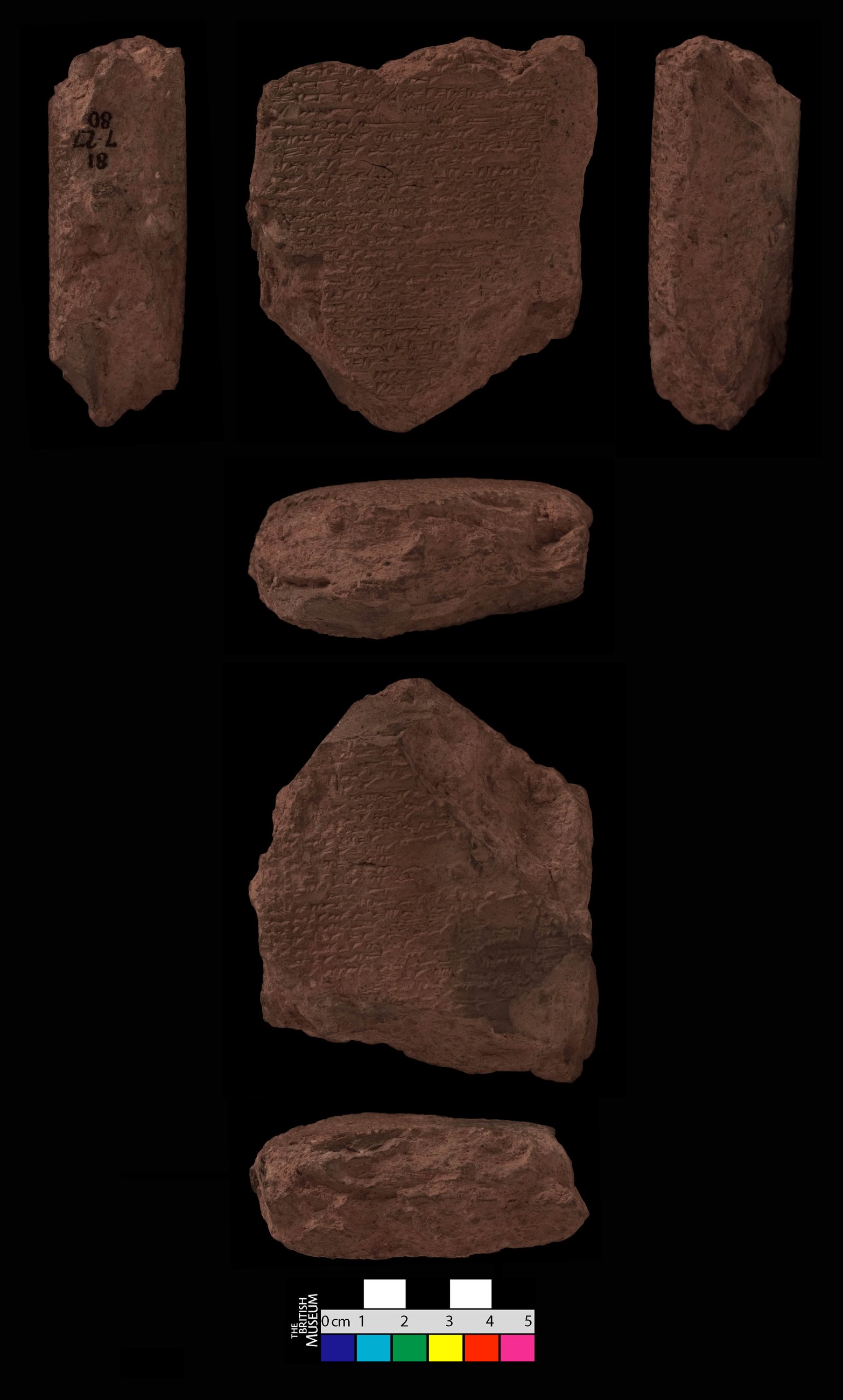
Where on the image
British Museum 1881,0727.80: obverse, the tablet's own lines 20' to 23'. eBL's corpus edition (https://www.ebl.lmu.de/corpus/L/1/2/SB/I) attributes SB I 50-53 to this manuscript at these column and line numbers. Photograph checked: obverse, reverse and edges, ink 81-7-27,80 on the left edge. Both faces of this tablet (about 8 cm wide) are covered in small, worn script with about 25 to 30 lines each, consistent with eBL's 28 obverse and 26 reverse lines. On this tablet lines 50-53 are partly broken (square brackets and x in the Akkadian). The English of these lines translates eBL's composite text, so it includes words that are not preserved on this tablet but are restored from other manuscripts or by the editors. Square brackets in the English mark eBL's restorations in its composite text; words that survive on other tablets carry no brackets even where this tablet is broken.
50[ur-ri-i]š lu šup#-šu-ha-at mu-šiš lu# ṣal#-[la-at]
51[ih-du]-šum-ma ABZU im-me-ru pa-nu-[šu]
52[x x] lem#-ne₂-e-ti ik-pu-du a-na DINGIR.DINGIR DU[MU.DUMU-šu]
53[{d}mu-um-m]u i-te-dir ki-[šad-su]
50By day you should have rest, at night you should sleep.
51Apsu was delighted with him, he beamed,
52On account the wicked deed he plotted against the gods his children,
53He embraced Mummu, around his neck,
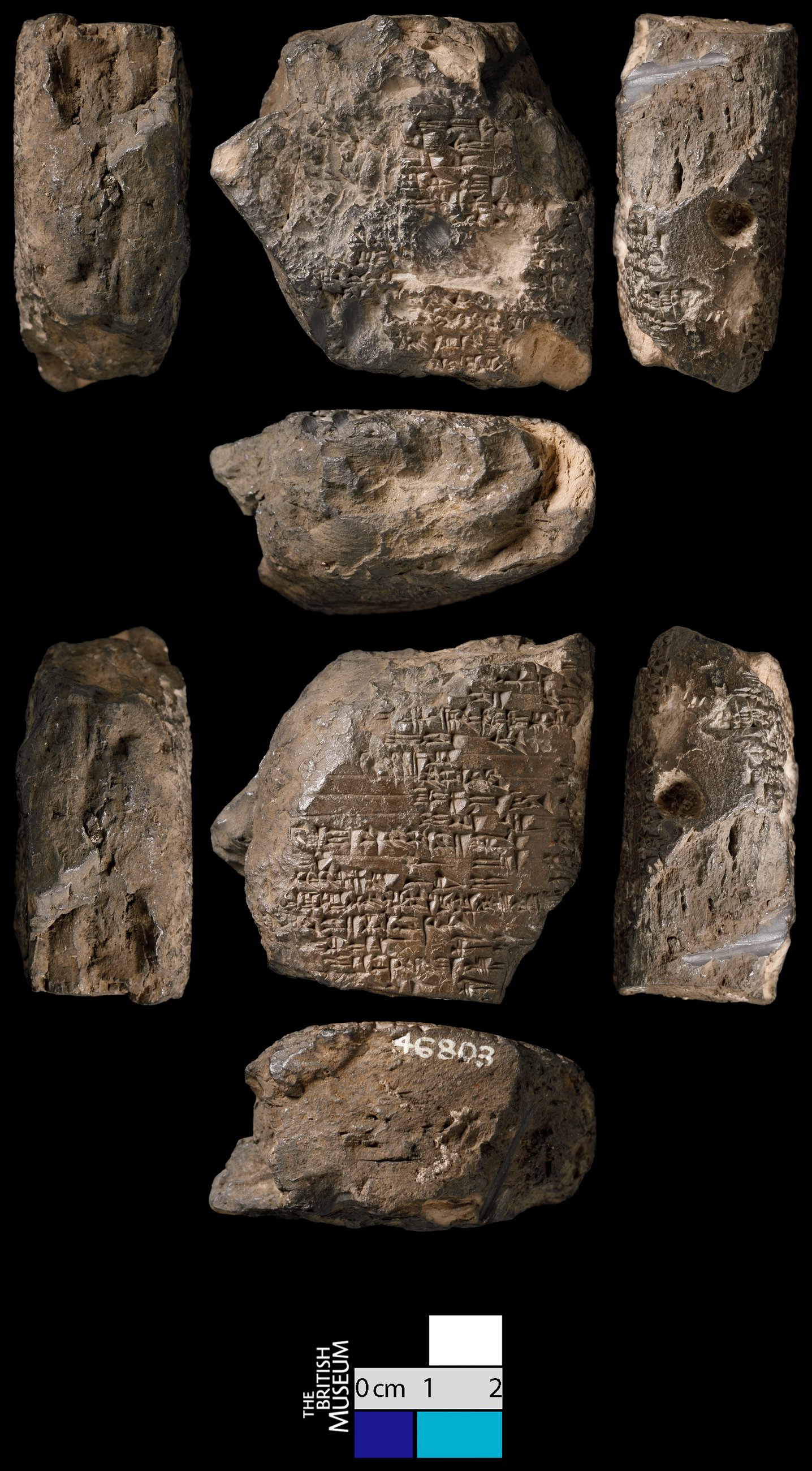
Where on the image
British Museum BM.46803: obverse, the tablet's own lines 8'b to 14'b. eBL's corpus edition (https://www.ebl.lmu.de/corpus/L/1/2/SB/I) attributes SB I 54-66 to this manuscript at these column and line numbers. Photograph checked: obverse, reverse and edges, ink 46803 on the bottom edge. A fragment about 5 cm square in small script: the obverse is worn but shows text in its upper and lower parts and the reverse has about 15 to 18 lines; the area can hold eBL's 23 obverse and 21 reverse lines, though fewer are clearly legible. On this tablet lines 61, 63, 65 are entirely broken, of lines 57, 59 only one to three signs survive and lines 54-56, 58, 62, 64, 66 are partly broken (square brackets and x in the Akkadian). The English of these lines translates eBL's composite text, so it includes words that are not preserved on this tablet but are restored from other manuscripts or by the editors. Square brackets in the English mark eBL's restorations in its composite text; words that survive on other tablets carry no brackets even where this tablet is broken. Line 60 is complete on this tablet.
54uš#-ba#-am#-[ma bir-k]a-a#-[šu n]a-ša₂-qu ša-a-šu
55[x x x x x x ina pu-u]h₂-ri-šu-un [ : ]
56[x x x bu-uk-ri]-šu₂#-nu uš-tan-nu-ni
57[x x x x x x i-du-u]l-lu :
58qu-l[u i]ṣ-ba#-[tu₄ ša-qu]-mi-iš uš-bu
59[x x x x x x x x te-l]e-e :
60{d#}e₂#-a ha-sis mi-im-ma#-ma# i-še-ʾ-a šib-qi₂-šu-un
61[x x x x x x x x x x x x x x : ]
62[u₂]-nak#-ki#-il-šu šu#-tu-ru ta-a-šu el-lu₄
63[x x x x x x x x x x x x : ]
64[x x ir]-te-hi-ša₂ <ṣa>-lil₂ ṭu₂-ba₄-tu₄!?#
65[x x x x x x x x x x x x : ]
66[{d}mu-um-m]u tam-la#-ku dal-la-piš# ku-u₂-ru
54He sank down on his knees so he could kiss him.
55Whatsoever they plotted between them,
56Was repeated to the gods their offspring.
57The gods heard it as they stirred about,
58They were stunned, they collapsed, stupefied.
59Surpassing in wisdom, ingenious, resourceful,
60Ea was aware of it all, was privy to their plans.
61He worked it out, he set it up, a master plan,
62He contrived it to be surpassing, his incorruptible magic spell.
63He recited it and brought calm into the waters,
64He put him in deep slumber, he lay fast asleep,
65He made Apsu sleep, he was put into deep slumber.
66Mummu the advisor was in a daze, as if robbed of sleep.
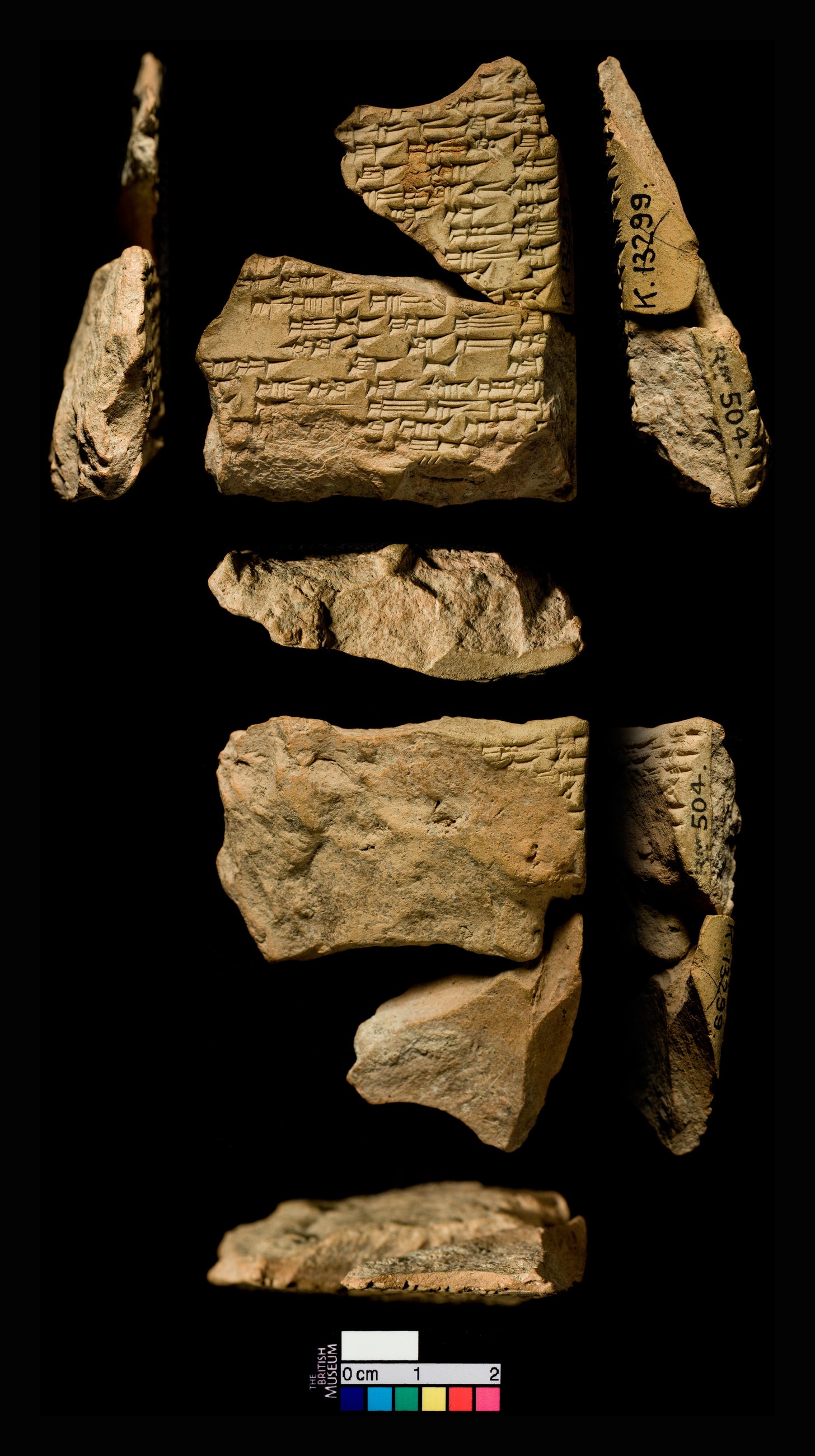
Where on the image
British Museum K.13299: obverse, the tablet's own lines 10' to 18'. eBL's corpus edition (https://www.ebl.lmu.de/corpus/L/1/2/SB/I) attributes SB I 67-75 to this manuscript at these column and line numbers. Photograph checked: obverse, reverse and edges of two joined pieces, ink K.13299 on one and Rm 504 on the other (right edge). About 15 to 16 lines on the obverse and four or five lines at the top corner of the reverse plus edge, broadly consistent with eBL's 19 obverse and 7 reverse lines. On this tablet lines 67-75 are partly broken (square brackets and x in the Akkadian). The English of these lines translates eBL's composite text, so it includes words that are not preserved on this tablet but are restored from other manuscripts or by the editors. Square brackets in the English mark eBL's restorations in its composite text; words that survive on other tablets carry no brackets even where this tablet is broken.
67[x x x x x i]š-ta-ha[ṭ a-g]a-šu₂
68[x x x x x x x] {d}e₂-a u₂-t[e]-di#-iq
69[x x x x (x)] x i-na-ra-aš₂-šu
70[x x x x x x (x)] x UGU-šu₂ ip-tar-ka
71[x x x x A]BZU šu-bat-su
72[x x x x it-ta-ma]h u₂-ka-la ṣer-ret-su
73[x x x x x ik-m]u-u₂# i-sa-a-du
74[x x x x x (x)] x (x) [x (x)] UGU# ga-ri-šu₂#
75[x x ku-um-mi-š]u₂? [šup-šu-hi]š i#-nu-uh#-[ma]
67He untied his sash, he stripped off his tiara,
68He took away his glory, he himself put it on.
69He tied him up, he killed him, Apsu,
70He took control of Mummu, put him under restraint.
71He founded his dwelling upon Apsu,
72He secured Mummu, held firm by a lead rope.
73After Ea had captured and vanquished his foes,
74Had won the victory over his opponents,
75In his chamber, in profound quiet, he rested.
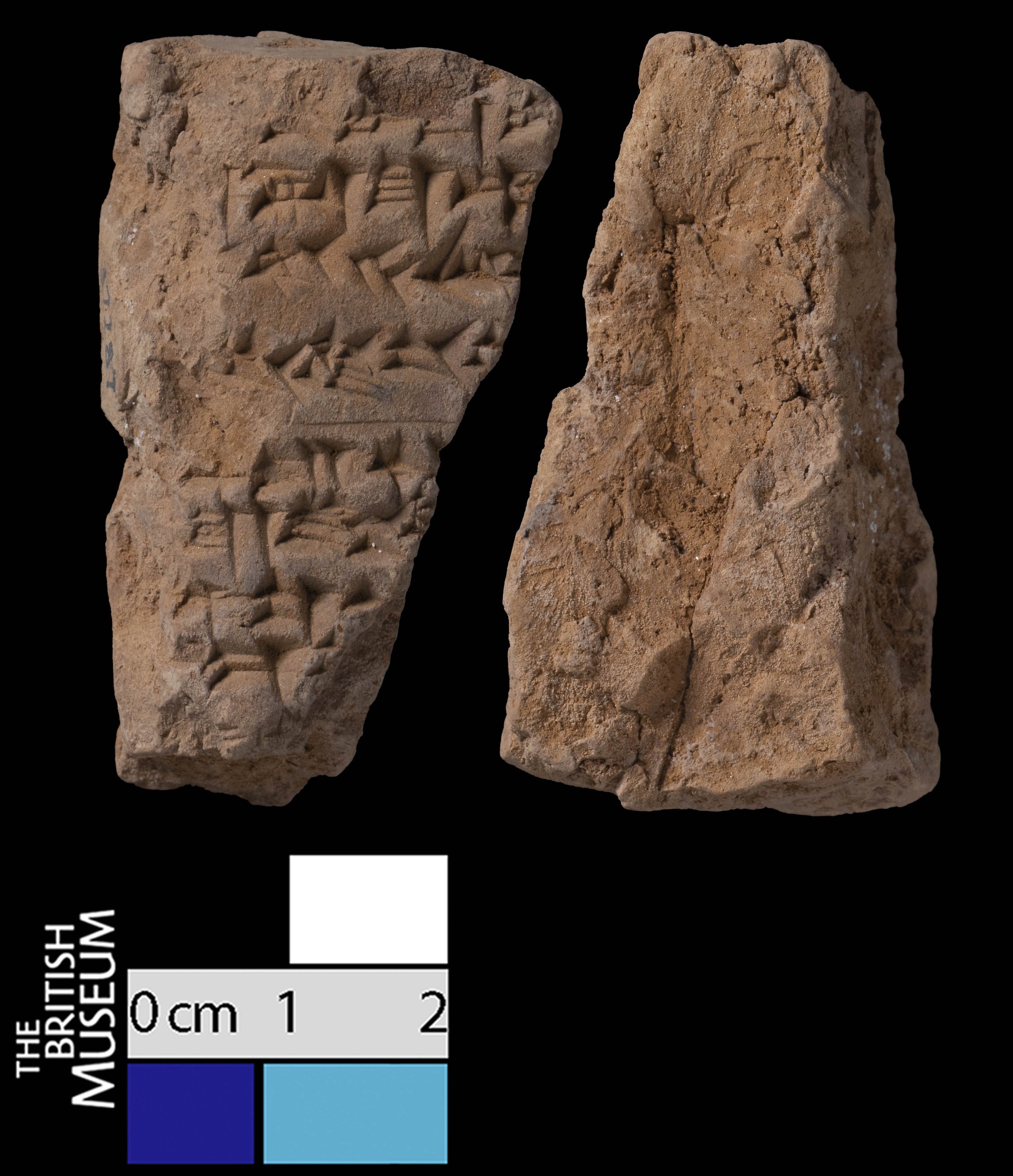
Where on the image
British Museum BM.37287: obverse, the tablet's own lines 1' to 4'. eBL's corpus edition (https://www.ebl.lmu.de/corpus/L/1/2/SB/I) attributes SB I 76-79 to this manuscript at these column and line numbers. Photograph checked: obverse and reverse only, with a faint ink number on the obverse margin. About five lines of large signs on the obverse, consistent with eBL's four; the reverse is uninscribed. eBL classes BM.37287 as a school tablet (a scribal exercise that copies an excerpt of the text), not a library copy of the whole work. It carries these lines as text (eBL's transliteration has no commentary or quotation markup), and it is used because no photographed library copy preserves these lines as well. On this tablet lines 76-79 are partly broken (square brackets and x in the Akkadian). The English of these lines translates eBL's composite text, so it includes words that are not preserved on this tablet but are restored from other manuscripts or by the editors. Square brackets in the English mark eBL's restorations in its composite text; words that survive on other tablets carry no brackets even where this tablet is broken.
76[im]-bi#-šum#-ma# a[p-su-u₂ x x x x x x x x]
77[aš₂-r]u-uš-šu g[i-pa-ra-šu₂ x x x x]
78{d}e₂-a u {d}d[am-ki-na x x x (x) x (x) x x x x x x]
79[i]-na ki-iṣ-ṣ[i x x (x x) x x (x) x x x (x x)]
76He called it “Apsu,” (which means) “They Recognize Sanctuaries.”
77He established therein his living quarters,
78Ea and Damkina his wife dwelt there in splendor.
79In the cella of destinies, the abode of designs,
Where on the image
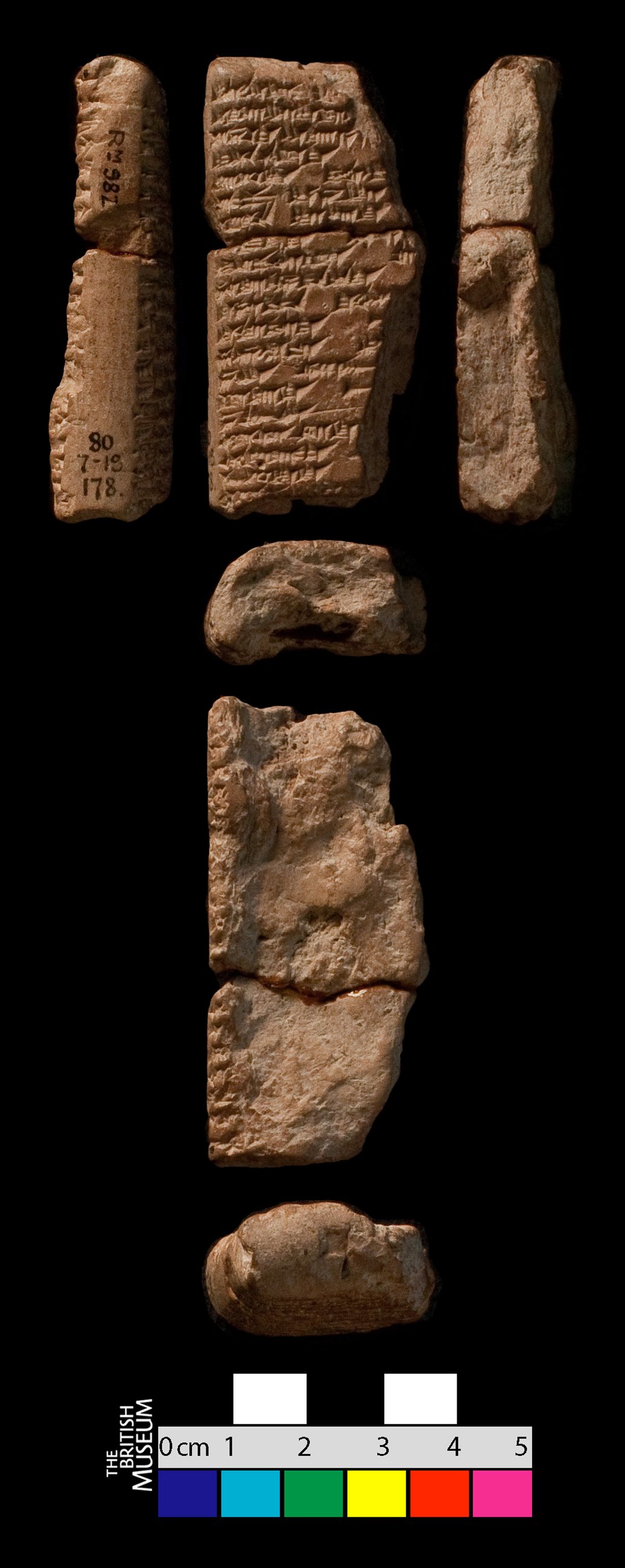
British Museum Rm.982: reverse, the tablet's own lines 1 to 20. eBL's corpus edition (https://www.ebl.lmu.de/corpus/L/1/2/SB/I) attributes SB I 80-101 to this manuscript at these column and line numbers. Photograph checked: obverse, reverse and edges of two joined pieces, ink Rm 982 and 80-7-19,178 on the left edge. About 20 lines on the obverse; the reverse surface is mostly lost but a narrow strip of signs runs down its left side for most of its height, so eBL's 20 obverse and 22 reverse lines are physically plausible, the reverse ones as fragments only. On this tablet lines 82, 84 are entirely broken, of line 97 only one to three signs survive and lines 80-81, 83, 85-96, 98-101 are partly broken (square brackets and x in the Akkadian). The English of these lines translates eBL's composite text, so it includes words that are not preserved on this tablet but are restored from other manuscripts or by the editors. Square brackets in the English mark eBL's restorations in its composite text; words that survive on other tablets carry no brackets even where this tablet is broken.
80le-ʾ-u₂ le#-[ʾ-u₂-ti x x x x x x x x x]
81ina qe₂-reb ABZU ib-b[a-ni {d}AMAR.UTU ( : )]
82[x x x x x x x x x x x x]
83ib-ni-šu₂-ma {d}e₂-a a#-[ba-šu ( : )]
84[x x x x x x x x x x]
85i-ti-niq-ma [x x x x x x]
86ta-ri-tu it-tar-[ru-šu x x x x x x x x]
87šam-hat nab-ni-su [x x x x x x x x (x)]
88uṭ-ṭu-lat ṣi-ta-šu g[a?-šir₃ x x x x]
89i!#-mur#-šu#-ma# {d}a-n[um x x x x x]
90i-riš im-mir lib₃-[ba-šu x x x x x]
91uš-ta-aṣ-bi-šum-ma [x x x x x x x]
92šu-uš-qu ma-ʾ-diš# [(x) x x x x x x x x]
93la lam-da-ma n[u-uk-ku-la x x x x]
94ha-sa-si-iš la [x x x x x x x x x]
95er-ba IGI-MIN-MEŠ-[šu₂ x x x x x]
96šap-ta-šu ina [x x x x x x x x x]
97ir-bu-ʾu [...]
98u₃# IGI-MIN GIM šu-[a-tu x x x x x x x x]
99ul-lu#-u₂-ma ina# [x x x x x x x x]
100meš-re-tu-šu [x x x x x x x x x]
101ma#-ri#-u₂?#-[tu] ma#-ri?#-[u₂-tu]
80The most capable, the sage of the gods, the Lord was conceived,
81In the midst of Apsu was Marduk born,
82In the midst of holy Apsu was Marduk born!
83Ea his father begot him,
84Damkina his mother was confined with him.
85He suckled at the breasts of goddesses,
86The nursemaid who raised him endowed him well with glories.
87His body was magnificent, fiery his glance,
88He was a hero at birth, he was a mighty one from the beginning!
89When Anu his grandfather saw him
90He was happy, he beamed, his heart was filled with joy.
91He perfected him, so that his divinity was unique,
92He was much greater, he surpassed them in every way.
93His members were fashioned with cunning beyond comprehension,
94Impossible to conceive, too difficult to visualize:
95Fourfold his vision, fourfold his hearing,
96When he moved his lips a fire broke out.
97Formidable his fourfold perception,
98And his eyes, in like manner, saw in every direction.
99He was tallest of the gods, surpassing in form,
100His limbs gigantic, by birthright was he surpassing.
101“Mar-Utu, Mar-Utu,
Where on the image
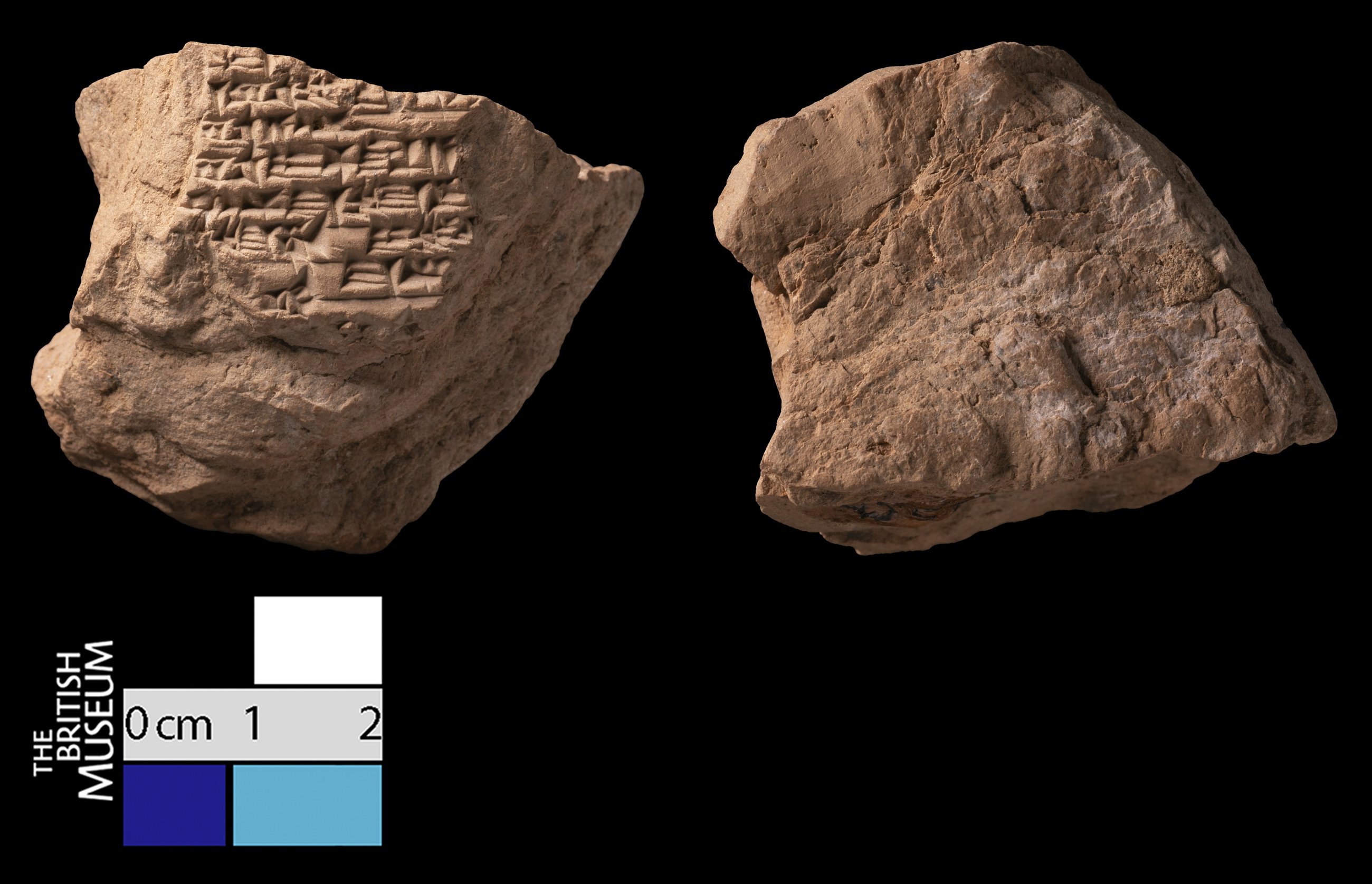
British Museum BM.45571: reverse, the tablet's own lines 8' to 9'. eBL's corpus edition (https://www.ebl.lmu.de/corpus/L/1/2/SB/I) attributes SB I 102-103 to this manuscript at these column and line numbers. Photograph checked: two faces only (no edges), with a faint, partly hidden ink number on the lower edge of the uninscribed face. One face has about eight or nine lines in its upper part, consistent with eBL's nine reverse lines; the other face is uninscribed. On this tablet of lines 102-103 only one to three signs survive. The English of these lines translates eBL's composite text, so it includes words that are not preserved on this tablet but are restored from other manuscripts or by the editors. Square brackets in the English mark eBL's restorations in its composite text; words that survive on other tablets carry no brackets even where this tablet is broken.
102[x x x x x x x {d}š]a₃-maš₂ [x x x]
103[x x x x x x x x x DINGIR].DINGIR# ša#-[qiš x x]
102“The son, the sun, the sunlight of the gods!”
103Clad in the glories of ten gods, he was of power prodigious,
Where on the image
British Museum BM.46803: reverse, the tablet's own lines 2' to 16'. eBL's corpus edition (https://www.ebl.lmu.de/corpus/L/1/2/SB/I) attributes SB I 104-120 to this manuscript at these column and line numbers. Photograph checked: obverse, reverse and edges, ink 46803 on the bottom edge. A fragment about 5 cm square in small script: the obverse is worn but shows text in its upper and lower parts and the reverse has about 15 to 18 lines; the area can hold eBL's 23 obverse and 21 reverse lines, though fewer are clearly legible. On this tablet line 107 is entirely broken, of lines 104-106, 111, 117 only one to three signs survive and lines 108-110, 112-116, 118-120 are partly broken (square brackets and x in the Akkadian). The English of these lines translates eBL's composite text, so it includes words that are not preserved on this tablet but are restored from other manuscripts or by the editors. Square brackets in the English mark eBL's restorations in its composite text; words that survive on other tablets carry no brackets even where this tablet is broken.
104[x x x x x x x x x e-li]-šu# [ka]-am?#-ra
105[x x x x x x x x x x x] {d}a-num
106[x x x x x x x x x x x li-i]m?-mel-li
107[x x x x x x x x x x x x x : ]
108[u₂-š]ab-ši# a-ga-am-ma i-dal-lah₃ {d}ti#-amta
109[x x x x x x x mu-š]a? i-du-ul-l[u₄]
110[x x x x x x i-za-ab-bi-l]u ša#-a-ri-šam
111[x x x x x x x x x] le-mut-t[u₄]
112[x x x x x x x] šu-un! iz-zak-kar#
113[x x x x x x x x] i-na-ru-m[a]
114[x x x la tal-l]i-ki-ma qa-li-iš <tu>-uš-bu
115[x x x x x x er-bet-t]u₄ ša₂ pu-luh-tu₄
116[x x x x x x kar-ša₂-ki-m]a ul ni-ṣa-al-lal!(AŠ) ni-i-ni
117[x x x x x x x x x] har#-ma-ku
118u₃ {d}mu-um-mu ša₂ ik-ka-mu-u₂ e!?-diš aš₂-b[a-ti]
119[x x x x x x dul-l]u-hi-iš ta-du-ul-l[i]
120[...] i# ni-iṣ-lal ni-i-[ni]
104Fifty glories were heaped upon him.
105Anu formed and made rise the four cardinal winds,
106He put them in his hand, “Let my son play!”
107He fashioned dust, he made a storm bear it up,
108He caused a wave and it roiled Tiamat,
109Tiamat was roiled, churning day and night,
110The gods, finding no rest, bore the brunt of each wind.
111They plotted evil in their hearts,
112They said to Tiamat their mother,
113“When he killed Apsu your husband,
114“You did nothing to save him but sat by, silent.
115“Now he has made four terrible winds,
116“They are roiling your vitals so we cannot sleep.
117“You had no care for Apsu your husband,
118“As for Mummu, who was captured, you remained aloof,
119“Since then you churn back and forth, in a turmoil.
120“As for us, who cannot lie down to rest, you do not love us!
Where on the image
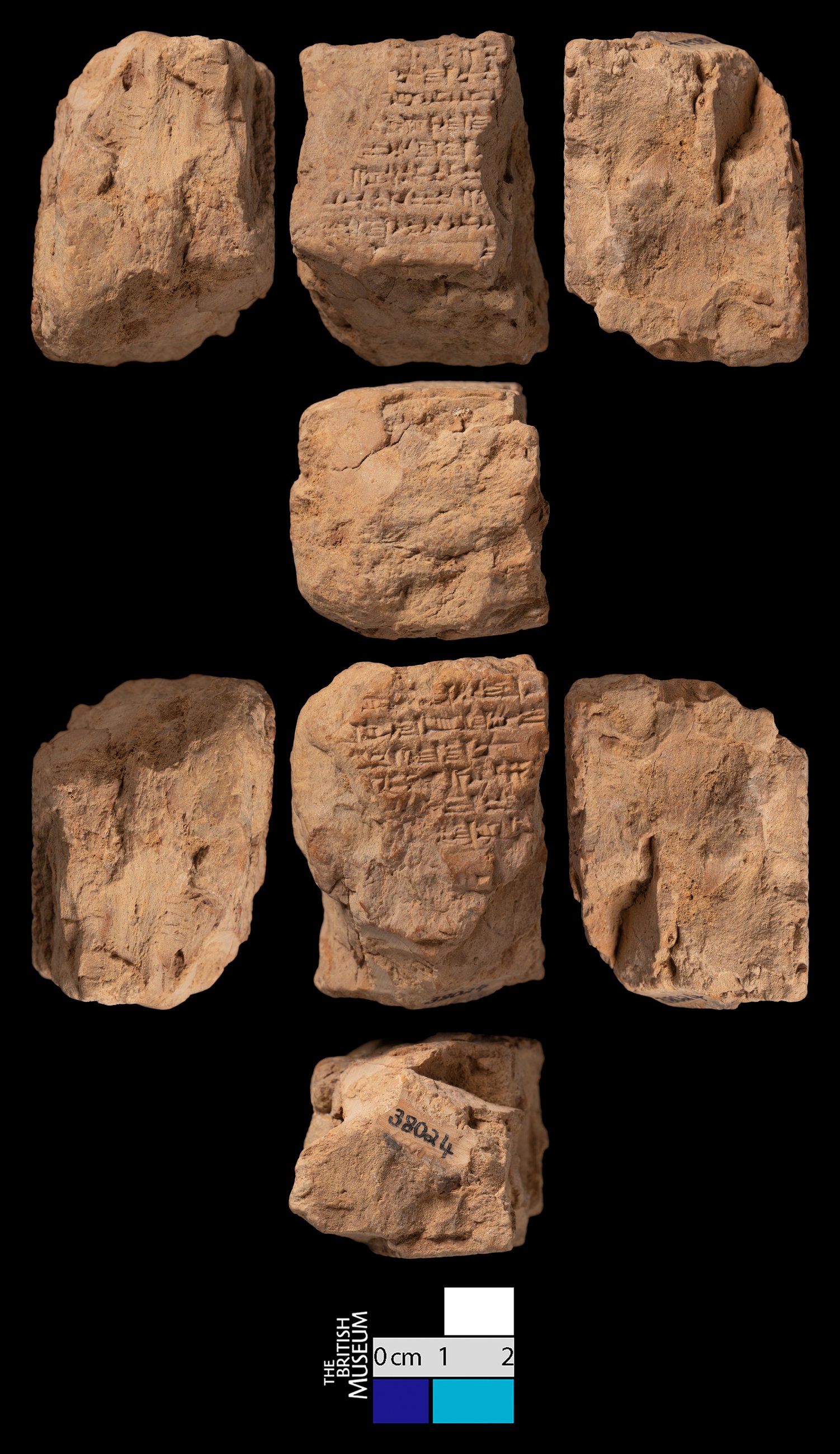
British Museum BM.38024: reverse, the tablet's own lines 1' to 4'. eBL's corpus edition (https://www.ebl.lmu.de/corpus/L/1/2/SB/I) attributes SB I 121-124 to this manuscript at these column and line numbers. Photograph checked: obverse, reverse and edges, ink 38024 on the bottom edge. About nine lines on the obverse and about seven or eight on the reverse, matching eBL's 9 and 8. On this tablet lines 121-124 are partly broken (square brackets and x in the Akkadian). The English of these lines translates eBL's composite text, so it includes words that are not preserved on this tablet but are restored from other manuscripts or by the editors. Square brackets in the English mark eBL's restorations in its composite text; words that survive on other tablets carry no brackets even where this tablet is broken.
121[x x sar-ma-ʾa-(a)]-ni# hu#-um#-mu#-ra e#-[na-tu-u₂-ni]
122[x x x ab-š]a-ni la sa-ki-pu# i# [ni-iṣ-lal x x x]
123[x x x x x g]i-mil-la#-šu-nu [x x (x)]
124[x x x x x i]b-ši-ma# a-na# za-q[i₂-qu x (x) x]
121“Think of our burden, our eyes are pinched,
122“Break off this unremitting yoke, let us sleep!
123“Declare war, give them what they deserve,
124“Everything they brought about, turn them into nothingness.”
Where on the image
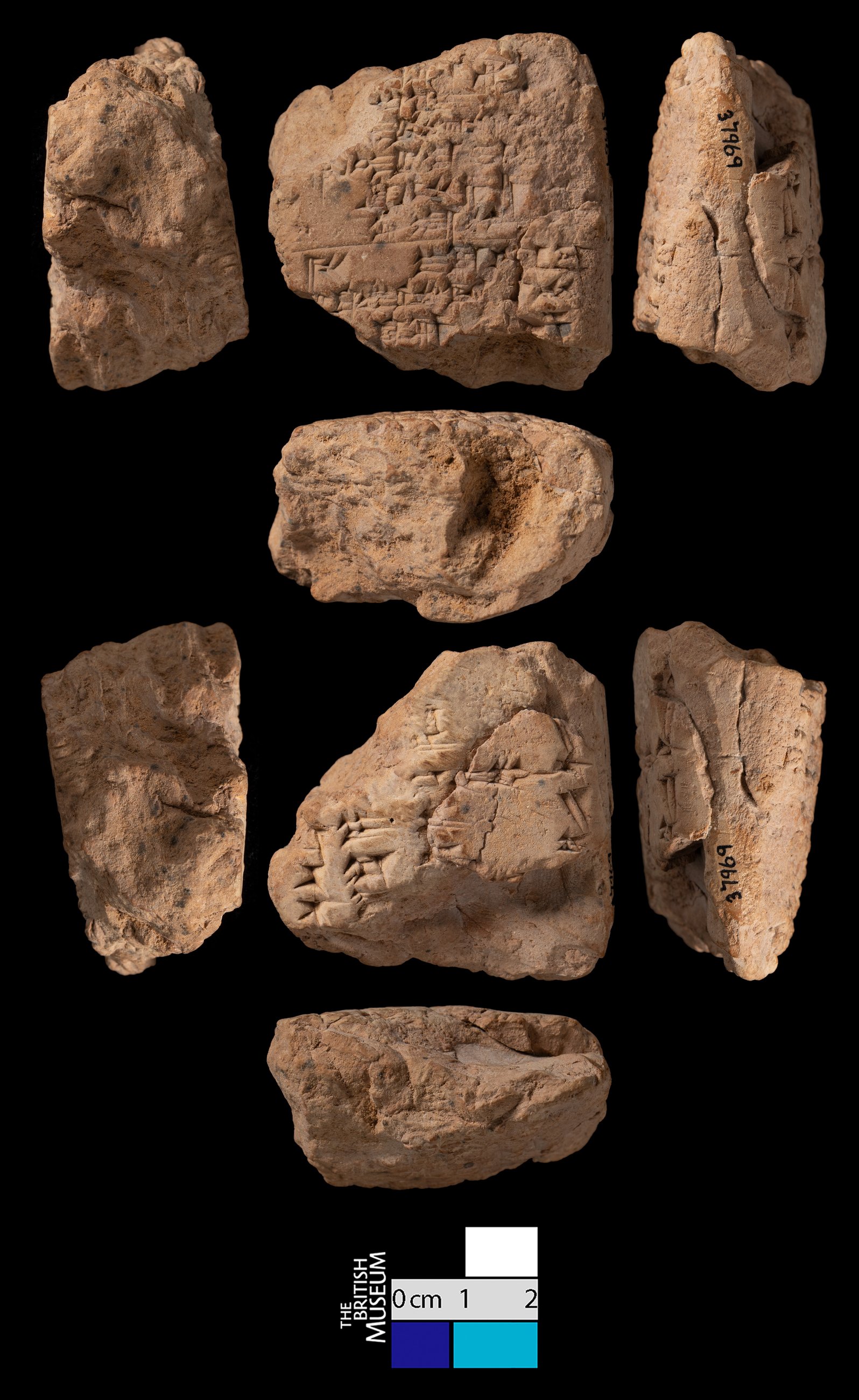
British Museum BM.37969: obverse, the tablet's own lines 8' to 9'. eBL's corpus edition (https://www.ebl.lmu.de/corpus/L/1/2/SB/I) attributes SB I 125-126 to this manuscript at these column and line numbers. Photograph checked: obverse, reverse and edges, ink 37969 on the right edge. About six lines on the obverse (with a ruling) and a few lines on the reverse, enough for eBL's four obverse lines. eBL classes BM.37969 as a school tablet (a scribal exercise that copies an excerpt of the text), not a library copy of the whole work. It carries these lines as text (eBL's transliteration has no commentary or quotation markup), and it is used because no photographed library copy preserves these lines as well. On this tablet lines 125-126 are partly broken (square brackets and x in the Akkadian). The English of these lines translates eBL's composite text, so it includes words that are not preserved on this tablet but are restored from other manuscripts or by the editors. Square brackets in the English mark eBL's restorations in its composite text; words that survive on other tablets carry no brackets even where this tablet is broken.
125[x x x ti-amt]u a-mat i-ṭib el#-šu#
126[x x x x x x tuš-ta-a]d!?-di-nu i ni-pu-uš u₄#-mu
125When Tiamat heard these words, they pleased her,
126“Whatever you think best, let us do it forthwith.”
Where on the image
British Museum BM.45528: reverse, the tablet's own lines 4' to 16'. eBL's corpus edition (https://www.ebl.lmu.de/corpus/L/1/2/SB/I) attributes SB I 127-139 to this manuscript at these column and line numbers. Photograph checked: obverse, reverse and edges of a tall tablet (about 17 cm) built from many joined pieces, some with plaster, ink 45528 on the left edge and 47197 (81-8-30,719) and 47150 on joined pieces on the right edge. Both faces densely inscribed in small script, consistent with eBL's 58 obverse and 39 reverse lines. On this tablet lines 127-139 are partly broken (square brackets and x in the Akkadian). The English of these lines translates eBL's composite text, so it includes words that are not preserved on this tablet but are restored from other manuscripts or by the editors. Square brackets in the English mark eBL's restorations in its composite text; words that survive on other tablets carry no brackets even where this tablet is broken.
127[x x x x x x q]e₂-reb#-š[u-u]n
128[x x x uš-tah-ha-z]u a-na DINGIR-MEŠ ba#-ni#-šu-un
129[x x x x x x i-d]u-uš ti-amti te-bu-u₂-ni
130[x x x x x sa-ki-p]u mu-ša u im-mu
131[x x x tam-ha]-ra# na-zar-bu-bu la-ab-bi#
132[x x šit-ku-nu-m]a i-ban-nu-u₂ ṣu#-la-a-t[i]
133[x x x x] pa-ti#-qat# [k]a-la-mu#
134[x x x ka]k-ku la mah-ru it-t[a-lad M]UŠ.MAH#
135[x x x ši]n-ni la pa-d[u-u a]t-ta#-ʾ-am
136[x x ki-m]a da-mu zu-mur-š[u-nu u]š-ma-al-li#
137[x x] na-ad-ru-tu₄ pu-ul-ha-[tu₄] u₂#-šal-biš#-ma#
138[x x x] uš-taš-ša-a i-li-i[š um-ta]š-ši-il#
139[a-mi-ir-š]u-nu šar-ba-bi-iš li-ih-h[ar-m]i-im#
127The gods within her rallied around her,
128They took up wicked plans against the gods their ancestors.
129They rallied around and drew up at Tiamat's side,
130Angry, scheming, never lying down to rest night nor day,
131Eager for battle, rumbling, raging,
132Forming a host, that they might start hostilities.
133Mother Hubur, who can form everything,
134Added countless invincible weapons, gave birth to monster serpents,
135Pointed of fang, with merciless incisors(?),
136She filled their bodies with venom for blood.
137Fierce dragons she clad with glories,
138Gave them glories, made them like gods, (saying)
139“Whoever sees them shall go numb with terror!
Where on the image
British Museum 1881,0727.80: reverse, the tablet's own lines 4' to 18'. eBL's corpus edition (https://www.ebl.lmu.de/corpus/L/1/2/SB/I) attributes SB I 140-154 to this manuscript at these column and line numbers. Photograph checked: obverse, reverse and edges, ink 81-7-27,80 on the left edge. Both faces of this tablet (about 8 cm wide) are covered in small, worn script with about 25 to 30 lines each, consistent with eBL's 28 obverse and 26 reverse lines. On this tablet lines 140-154 are partly broken (square brackets and x in the Akkadian). The English of these lines translates eBL's composite text, so it includes words that are not preserved on this tablet but are restored from other manuscripts or by the editors. Square brackets in the English mark eBL's restorations in its composite text; words that survive on other tablets carry no brackets even where this tablet is broken.
140[zu]-mur-šu₂-nu liš-tah-hi-ṭam-ma la i-ne₂-ʾ-u₂ i#-[rat-su-un]
141[uš-zi]z ba-aš-mu MUŠ.HUŠ u₃ {d}[la-ha-mu]
142[U₄.GA]L-MEŠ UR.IDIM-MEŠ GIR₂.TAB.LU₂.U₁₈#.[LU]
143[u₄-m]e da-ab-ru-te KU₆.LU₂.U₁₈.LU u₃ ku-[sa-ri-ik-ku]
144[na-š]i kak-ku la pa-du-u₂ la a-di-ru [x x x]
145[x x] te-re-tu-ša₂ la mah-ra š[i-na-ma]
146[ap-p]u-na-ma iš-ten₂-eš-ret GIM šu-a-ti u[š-tab-ši]
147[x x] DINGIR.DINGIR bu-uk-ri-ša₂ šu-ut iš-ku-nu-[ši x x x]
148[u₂]-ša₂-aš₂-qi₂ {d}qin-gu ina bi-ri-šu₂-nu ša₂-a-šu₂# [x x x x]
149[a-li]-kut mah-ri pa-an um-ma-ni mu-ʾ-ir-ru-[tu₂ x x x]
150[na-a]š₂ {giš}TUKUL ti-iṣ-bu-tu de-ku-u₂ a-na#-[an-ta]
151[x x ta]m-ha-ru ra-ab sik-ka#-[at-tu-tu]
152[x x x qa]-tuš-šu u₂-še-ši-ba-aš₂-šu₂ ina [x x]
153[x x ta-a]-ka# ina UKKIN DINGIR-MEŠ u₂-šar-b[i-ka]
154[x x x DINGIR]-MEŠ gim-ra-at#-su-nu qa-tuk₂?#-k[a x x x]
140“Let their bodies keep leaping forward and never retreat!”
141She deployed serpents, dragons, and hairy hero-men,
142Lion monsters, lion men, scorpion men,
143Mighty demons, fish men, bull men,
144Bearing unsparing arms, fearless in battle.
145Her commands were absolute, no one opposed them,
146Eleven indeed on this wise she created.
147From among the gods her offspring, who made up her host,
148She raised up Qingu, it was he she made greatest among them.
149Leadership of the forces, command of the host,
150Arming, contact, ordering the attack,
151Chief strategist in warfare,
152(All) she entrusted to him, stationed him at the command post.
153“I have cast a magic spell for you. I make you the greatest in the host of the gods,
154“Kingship of all the gods I put in your power.
Where on the image
British Museum BM.45528: reverse, the tablet's own lines 32' to 39'. eBL's corpus edition (https://www.ebl.lmu.de/corpus/L/1/2/SB/I) attributes SB I 155-162 to this manuscript at these column and line numbers. Photograph checked: obverse, reverse and edges of a tall tablet (about 17 cm) built from many joined pieces, some with plaster, ink 45528 on the left edge and 47197 (81-8-30,719) and 47150 on joined pieces on the right edge. Both faces densely inscribed in small script, consistent with eBL's 58 obverse and 39 reverse lines. On this tablet lines 155-162 are partly broken (square brackets and x in the Akkadian). The English of these lines translates eBL's composite text, so it includes words that are not preserved on this tablet but are restored from other manuscripts or by the editors. Square brackets in the English mark eBL's restorations in its composite text; words that survive on other tablets carry no brackets even where this tablet is broken.
155lu-u₂ šur-ba-ta-ma ha-ʾ-i-r[i x x x x x]
156li-ir#-tab#-bu-u₂ zik-ru-k[a x x x (x) x x x x x]
157id-din-[š]um-ma DUB NAM-MEŠ i#-[ra-tuš x x x x]
158KA.TA.[DU]G₄.GA-ka la in-nen-na-a l[i-kun ṣi-it pi-i]-ka#
159in-na-an-[n]a {d}qin-gu š[u-uš-qu-u₂ le-q]u-u₂# e-nu-ti
160(gloss: 10) a-na DINGIR-MEŠ# DUMU-MEŠ-šu ši-[ma]t? iš#-ti-ma
161ep-ša pi-i-ku-nu {d}GIRA₂ l[i-n]i-ih-ha
162im-tuk kit-mu-ru ma-ag-ša-r[u li]š-rab-bi-ib
155“You are the greatest, my husband, you are illustrious,
156“Your command shall always be greatest, over all the Anunna-gods.”
157She gave him the tablet of destinies, had him hold it to his chest, (saying)
158“As for you, your command shall not be changed, your utterance shall endure.”
159When Qingu was the highest, had taken supremacy,
160He ordained destinies for the gods her children,
161“Whatever you (gods) command shall cause a blaze to die out,
162“Your concentrated venom shall make a mighty one yield.”
Notes
- Akkadian: eBL transliteration of the signs on the photographed tablet (manuscript-level ATF), not a composite text.
- English: B. R. Foster's translation in the eBL edition; it renders eBL's composite text, including restorations from other tablets.
- Line numbers: eBL edition. Each section also gives the tablet's own column and line numbers.
- Signs in the Akkadian: [ ] broken away; x illegible sign; # damaged sign; ? uncertain reading; ! sign corrected by the editor; ... broken signs of unknown number; ( ) signs perhaps broken away; { } determinative; < > sign omitted by the scribe, supplied by the editor; : divider sign written on the tablet; (gloss: ...) a note written by the scribe in small signs or in the margin.
Cite
Sources
- Source: British Museum tablet photographs + eBL manuscript transliterations (eBL corpus edition L I.2, Poem of Creation (Enuma elish) (ed. A. C. Heinrich, rev. Z. J. Földi and E. Jiménez), SB I) + English of the eBL edition (B. R. Foster (eBL edition)) (holding institution)
- Critical edition: electronic Babylonian Library, Poem of Creation (ed. A. C. Heinrich), manuscript transliterations
← previous · → next · v cycle view · l back to library