Enuma Elish, Tablet II: the gods seek a champion
Introduction
Ea learns of Tiamat's preparations and reports to Anshar. Ea and then Anu go out against her and turn back. Marduk agrees to fight Tiamat on condition that the gods make his word supreme.
Enuma Elish ('When on high'), the Babylonian Poem of Creation, tells how Marduk, god of Babylon, defeated Tiamat, created the ordered world and became king of the gods. It was written on seven tablets and recited in Babylon during the New Year festival. The date of composition is debated (proposals range from the 18th to the 12th century BCE); the surviving copies date from the 9th to the 2nd century BCE and come from Ashur, Nineveh, Kish, Babylon, Sippar, Uruk and other sites. This page follows the line numbering of the electronic Babylonian Library edition.
How this page is built. Each section is a run of consecutive lines as written on one photographed clay tablet. For every line the eBL edition (https://www.ebl.lmu.de/corpus/L/1/2/SB/II) lists the manuscripts that carry it, with each tablet's own column and line numbers; the tablet chosen for each run is the photographed copy of the work with the most signs preserved there. Commentaries and texts that only quote a line are never chosen. School and excerpt tablets are used only for lines that no photographed library copy preserves as well, and only where they carry the line as text; their sections say so (BM.38167, BM.38864). The original text is eBL's transliteration of that tablet's signs (not a modern composite text): square brackets mark broken signs, x an illegible sign, # a damaged sign, ? an uncertain reading, and words in {braces} are determinatives; the notes give a key to every sign used on this page, and eBL's layout codes are written out in words (for example '(line break)' or '(blank space)'). Superscript numbers are the line numbers of the eBL edition, used in both the Akkadian and the English. The English is B. R. Foster's translation in the eBL edition (CC BY-NC-SA 4.0), one line of English per line of the poem; italics mark uncertain renderings, as in the source. Where the tablet is broken, the English still translates the whole line of eBL's composite text; each section's note names the lines that are broken on its tablet.
Finding a line on the photograph. Each section names the tablet, the face and column, and the tablet's own line numbers (a prime, as in 5', counts from the first preserved line of a broken column). On a tablet with six columns the obverse carries columns i-iii from left to right; the reverse, turned over from bottom to top, carries columns iv-vi from right to left. The photographs often show the obverse above the reverse with the edges around them; a fragment preserves only part of this layout.
This page shows 140 of the 162 lines of the eBL edition (86%), from 9 tablets in the British Museum: BM.40559, K.4832 (Nineveh), K.9511 (Nineveh), BM.38167, BM.44205, 1879,0708.178 (Nineveh), K.19822 (Nineveh), BM.38864, BM.38396.
Lines not shown. 22 of the 162 lines of the eBL edition are not shown, because no photographed copy of the work used here carries them: 71-74 (no photograph in eBL: VAT.14037 (Vorderasiatisches Museum, Berlin), IM.unn.7 (Iraq Museum)); 75-76 (no photograph in eBL: IM.unn.7 (Iraq Museum)); 77-78 (no photograph in eBL: VAT.14037 (Vorderasiatisches Museum, Berlin), IM.unn.7 (Iraq Museum)); 79 (no photograph in eBL: IM.unn.7 (Iraq Museum)); 88-91 (no photograph in eBL: VAT.14037 (Vorderasiatisches Museum, Berlin), IM.unn.7 (Iraq Museum)); 110-115 (no photograph in eBL: VAT.14037 (Vorderasiatisches Museum, Berlin), IM.unn.7 (Iraq Museum); photograph does not show these lines (visual check): BM.48270); 123-125 (no photograph in eBL: VAT.9971 (Vorderasiatisches Museum, Berlin), VAT.14037 (Vorderasiatisches Museum, Berlin), IM.unn.7 (Iraq Museum); not in the eBL Fragmentarium (no photograph there): NMS.1909,405.36; photograph does not show these lines (visual check): BM.48270). A line is shown only on a photographed tablet that carries it as text. Commentaries and other texts that quote a line (letters, rituals, god lists) are not used as witnesses, because they carry it with explanations or inside another text; tablets without a photograph in eBL are not used, because the line could not be shown on its tablet.
How was this verified? (Provenance)
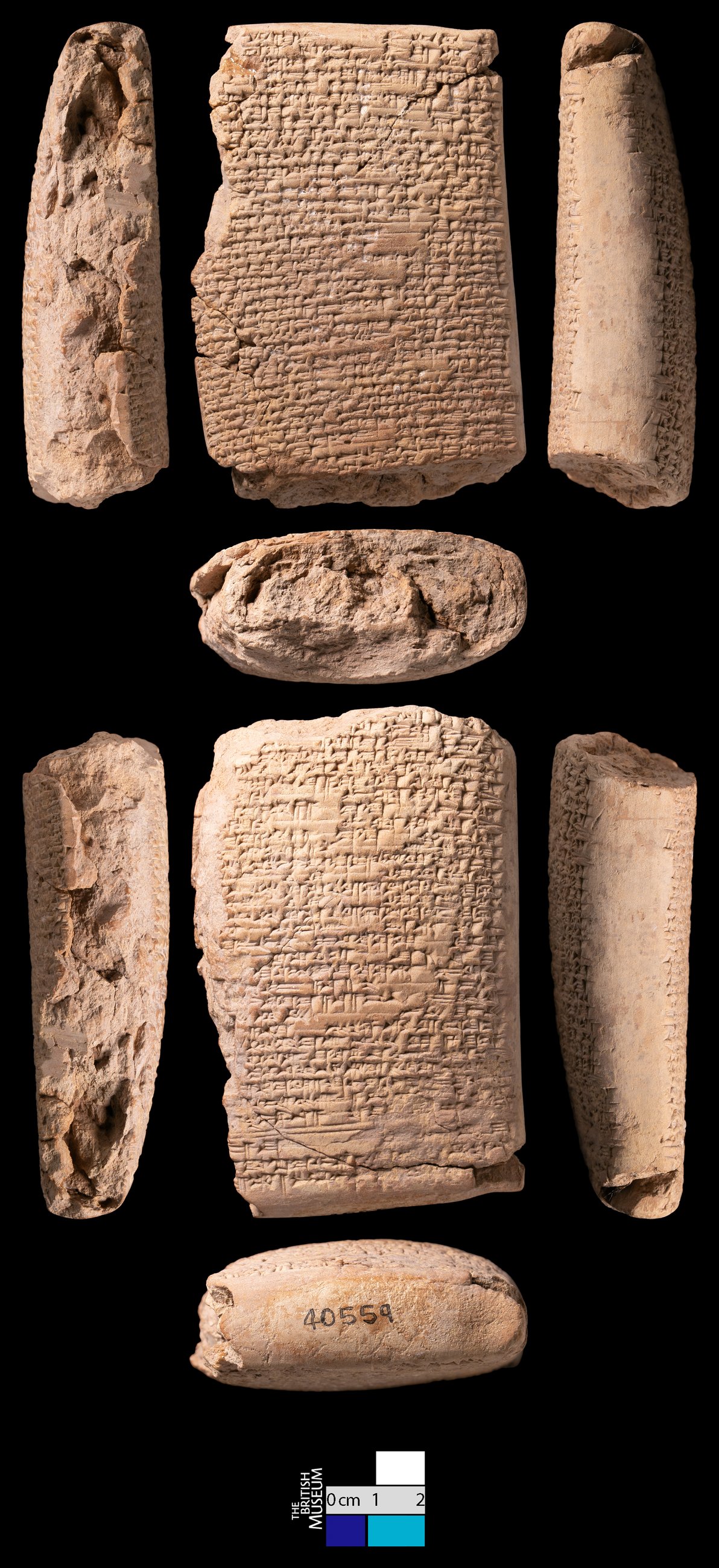
Where on the image
British Museum BM.40559: obverse, the tablet's own lines 1 to 20. eBL's corpus edition (https://www.ebl.lmu.de/corpus/L/1/2/SB/II) attributes SB II 1-20 to this manuscript at these column and line numbers. Photograph checked: obverse, reverse and edges of a nearly complete small tablet, ink 40559 on the bottom edge. Both faces are covered in very small script with about 30 to 40 lines each, consistent with eBL's 40 obverse and 30 reverse lines of Tablet II and one line of Tablet III. On this tablet lines 1-19 are partly broken (square brackets and x in the Akkadian). The English of these lines translates eBL's composite text, so it includes words that are not preserved on this tablet but are restored from other manuscripts or by the editors. Square brackets in the English mark eBL's restorations in its composite text; words that survive on other tablets carry no brackets even where this tablet is broken. Line 20 is complete on this tablet.
1[u₂-kap-pit-m]a ti-a-ma-tu₄ pi-ti-iq-šu
2[x x x ik]-ta-ṣar a-na DINGIR.DINGIR ni-ip-ri-šu
3[x x x x e]-li ABZU u₂-lam-mi-in ti-amtu#
4[a-na-an]-ta# ki#-i iṣ-mi-da a-na {d}e₂-a ip-ta-šar#
5[iš-me-e-m]a {d}e₂-a a-ma-tu₄ šu-a-ti₃#
6[ku-um-mi]-iš# uš#-ha-ri-ir-ma ša-qu-um-mi-iš uš-bu
7[x x i]m!-tal#-ku-ma uz-za-šu i-nu-hu
8[mu-ut-ti-i]š an-šar₂ a-bi-šu šu-u₂ uš-tar-di
9[i-ru-u]m-ma mah-ru a-bi a-li-di-šu an-šar₂
10[mi-im-mu]-u₂# ti-amtu ik-pu-du u₂-ša-an-na-a a-na ša₂-a-šu₂
11[x x t]i-amtu a-lit-ti-a-ni i-ze-er-ra-an-na-a-ti
12[pu-uh]-ru šit-ku-na-at-ma ag-gi-iš la-ab-bat
13[is-hu-ru-š]im-ma DINGIR.DINGIR gi-mi-ir-šu₂-un
14[x x x at-t]u-nu tab-na-a i-da-a-ša al-ka
15[im-ma-as]-ru-nim-ma i-du-uš ti-amti te-bu-u₂-ni
16[x x ka]p-du la sa-ki-pu mu-ša u im-ma
17[na-šu]-u₂# tam-ha-ra na-zar-bu-bu la-ab-bu
18[ukkin]-na šit-ku-nu-ma i-ban-nu-u₂ ṣu-la-a-tu₄
19[um]-ma hu-bu-ur pa-ti-iq-qa-at ka-la-mu
20uš#-rad-di kak-ku la mah-ru it-ta-lad muš-ma-hu
1Tiamat assembled her creatures,
2Drew up for battle against the gods her brood.
3Thereafter Tiamat, more than Apsu, was become an evildoer.
4She informed Ea that she was ready for battle.
5When Ea heard this,
6He fell silent in his chamber and sat stock still.
7After he had taken thought and his anger had calmed,
8He made straight his way to Anshar his grandfather.
9He came in before his grandfather, Anshar,
10All that Tiamat plotted he recounted to him,
11“My father, Tiamat our mother has come to hate us,
12“She has assembled a host, savage with rage.
13“All the gods rallied around her,
14“Even those you created are going over to her side,
15“They massed around her, drew up at Tiamat’s side.
16“Angry, scheming, never lying down to rest night nor day,
17“Eager for battle, rumbling, raging,
18“Forming a host, that they might start hostilities.
19“Mother Hubur, who can form everything,
20“Added countless invincible weapons, gave birth to monster serpents,
Where on the image
British Museum BM.40559: obverse, the tablet's own lines 21 to 40. eBL's corpus edition (https://www.ebl.lmu.de/corpus/L/1/2/SB/II) attributes SB II 21-40 to this manuscript at these column and line numbers. Photograph checked: obverse, reverse and edges of a nearly complete small tablet, ink 40559 on the bottom edge. Both faces are covered in very small script with about 30 to 40 lines each, consistent with eBL's 40 obverse and 30 reverse lines of Tablet II and one line of Tablet III. On this tablet of line 40 only one to three signs survive and lines 21, 37-39 are partly broken (square brackets and x in the Akkadian). The English of these lines translates eBL's composite text, so it includes words that are not preserved on this tablet but are restored from other manuscripts or by the editors. Square brackets in the English mark eBL's restorations in its composite text; words that survive on other tablets carry no brackets even where this tablet is broken. Lines 22-36 are complete on this tablet.
21[z]aq-tu-ma šin-nu la pa-du-u₂ at-ta-ʾ-um
22im-tu ki-ma da-am zu-mur-šu₂-nu uš-ma-al-lu
23UŠUMGAL#-MEŠ na-ad-ru-ti pu-ul-ha-a-ti u₂-šal-biš-ma
24me-lam-mu uš-taš-ša-a i-li-iš um-taš-ši-ir
25a-mi-ir-šu₂-nu šar-ba-bi-iš li-ih-har-mi-im
26zu#-mur-šu₂-nu liš-tah-hi-ṭa-am-ma la i-ne₂-ʾ-e i-rat-su-un
27uš-zi-iz-ma ba#-aš-mu {d}MUŠ.HUŠ u₃ {d}la-ha-mu
28U₄.GAL.LA UR.IDIM-ME# u₃ GIR₂.TAB.LU₂.U₁₈.LU
29U₄-ME da-ab-ru-ti KU₆.LU₂.U₁₈.LU u₃ ku-sa-rik-kum
30(gloss: 10) na-ši kak-ku la pa-du-u₂ la a-di-ru ta-ha-zi
31gap-ša te-re-tu-ša la ma-ah-ra ši-na-ma
32ap-pu-na-ma iš-ten-eš-ret ki-ma šu-a-ti uš-tab-ši
33i-na DINGIR-MEŠ bu-uk-ri-ša šu-ut iš-ku-nu-ši pu-uh₂-ru
34u₂-ša-aš-qa {d}qin-gu ina bi-ri-šu₂-nu ša-a-šu uš-rab-bi-iš
35a-li-ku-ut mah-ru pa-ni um-ma-nu mu-er-ru-tu₄ pu-uh₂-ru
36na-še-e kak-ku ti-iṣ-bu-tu₄ te-bu-u₂ a-na-an-tu₄
37[šu-u]t ta-am-ha-ra ra-ab sik-kat₂-u₂-tu₄
38[ip-qid]-ma# qa-tu-uš-šu₂ u₂-še-ši-ba-aš-ši i-na kar-ri
39[x x ta]-a#-ka i-na pu-hur DINGIR-MEŠ u₂-šar-bi#-ka#
40[x x x] DINGIR-M[EŠ x x x x x x x x x x x x]
21“Pointed of fang, with merciless incisors(?),
22“She filled their bodies with venom for blood.
23“Fierce dragons she clad with glories,
24“Gave them glories, made them like gods, (saying)
25‘Whoever sees them, shall collapse in terror!
26‘Let their bodies keep leaping forward and never retreat!’
27“She deployed serpents, dragons, and hairy hero-men,
28“Lion monsters, lion men, scorpion men,
29“Mighty demons, fish men, bull men,
30“Bearing unsparing arms, fearless in battle.
31“Her commands were absolute, no one opposed them,
32“Eleven indeed on this wise she created.
33“From among the gods her offspring, who made up her army,
34“She raised up Qingu, it was he she made greatest among them.
35“Leadership of the forces, command of the host,
36“Arming, contact, ordering the attack,
37“Supreme strategist in warfare,
38“(All) she entrusted to him, stationed him at the command post.
39‘I have cast a magic spell for you. I make you the greatest in the assembly of the gods,
40‘Kingship of all the gods I put in your power.
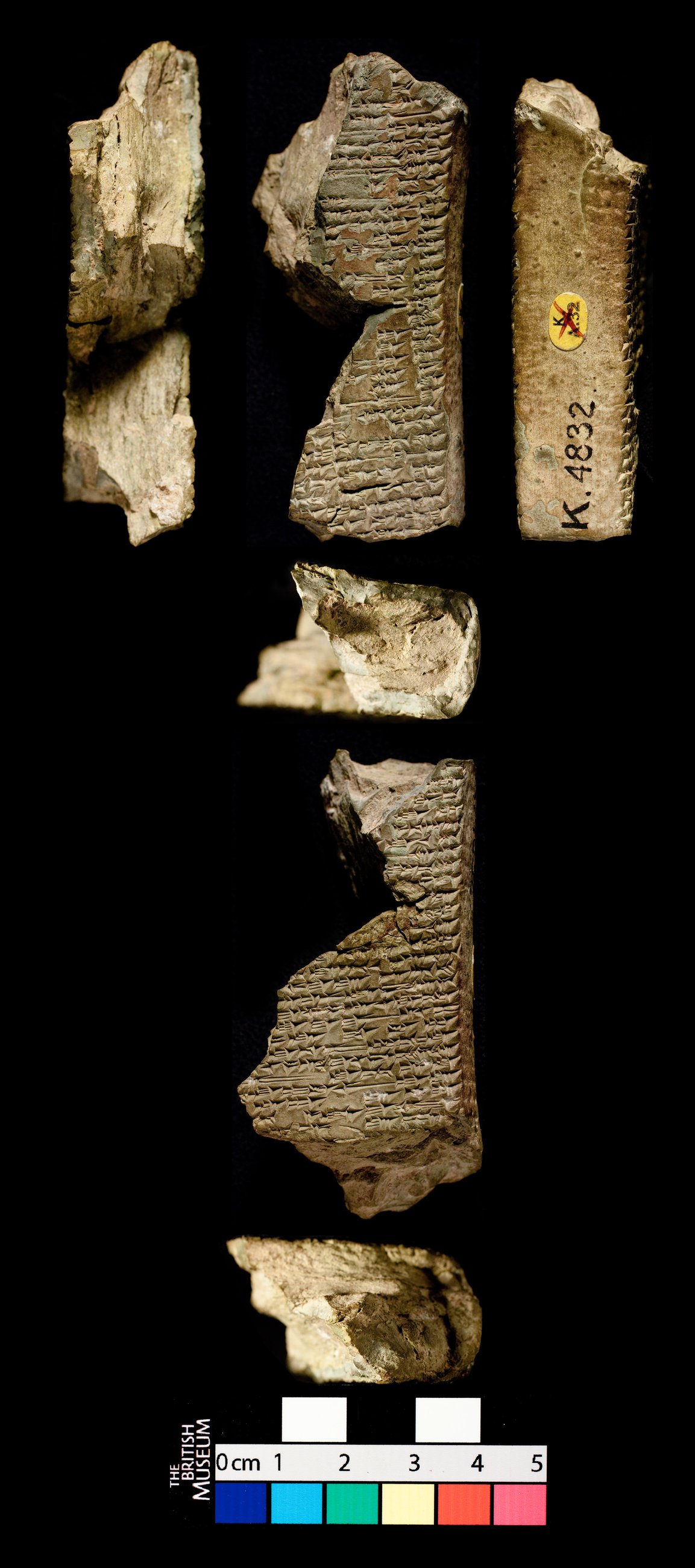
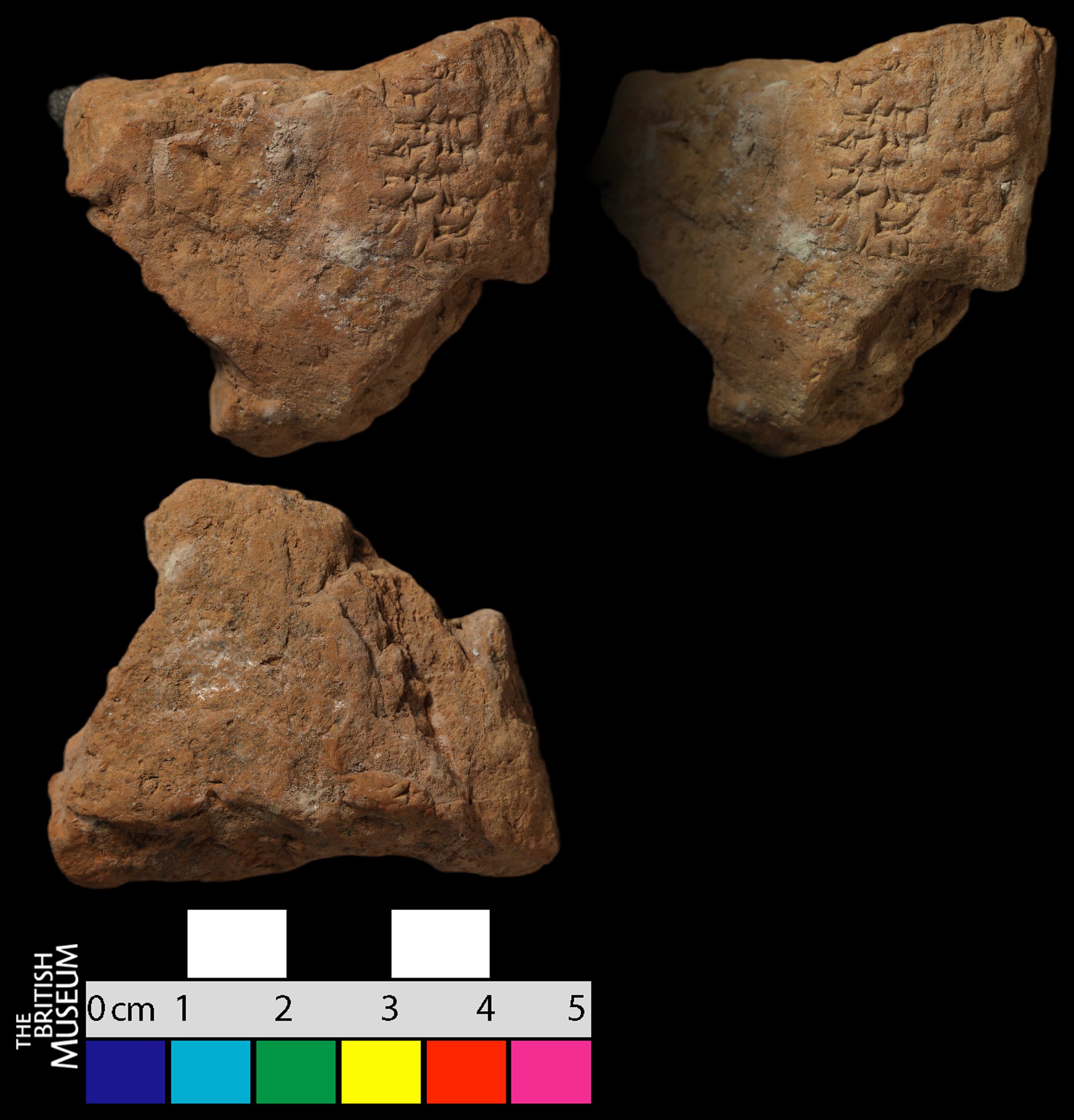
Where on the image
British Museum K.4832: obverse, the tablet's own lines 10' to 12'. eBL's corpus edition (https://www.ebl.lmu.de/corpus/L/1/2/SB/II) attributes SB II 41-43 to this manuscript at these column and line numbers. Photograph checked: obverse, reverse and edges, ink K.4832 and a yellow label on the right edge. A narrow fragment about 7.5 cm tall in small script with about 25 to 30 lines on each face, consistent with eBL's 27 obverse and 35 reverse lines. eBL treats K.4832 + K.23609 as one manuscript and holds a separate photograph of each of these pieces; it does not say which piece carries which line, so the photographs of K.4832 + K.23609 are linked, and the lines are on one or more of them. On this tablet of lines 41-43 only one to three signs survive. The English of these lines translates eBL's composite text, so it includes words that are not preserved on this tablet but are restored from other manuscripts or by the editors. Square brackets in the English mark eBL's restorations in its composite text; words that survive on other tablets carry no brackets even where this tablet is broken.
41[x x x x x x x x x x x x a]t-ta
42[x x x x x x x x x (x) x x x {d}e-nu]-uk-ki
43[x x x x x x x x x x x] u₂#-[šat-m]e-eh
41‘You are the greatest, my husband, you are illustrious.
42‘Your command shall always be greatest, over all the Anunna-gods.’
43‘She gave him the tablet of destinies, had him hold it to his chest, (saying)
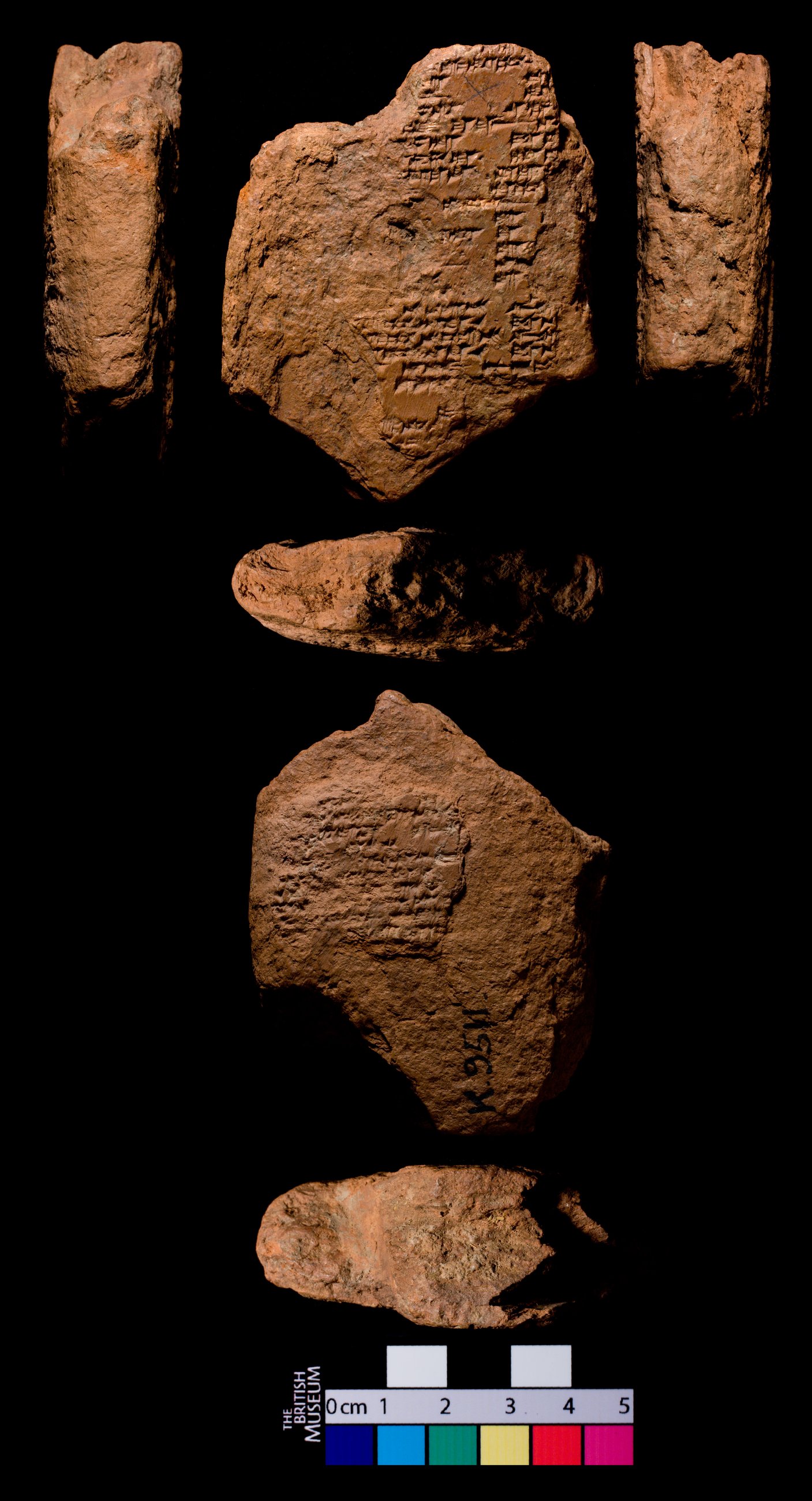
Where on the image
British Museum K.9511: obverse, the tablet's own lines 1' to 27'. eBL's corpus edition (https://www.ebl.lmu.de/corpus/L/1/2/SB/II) attributes SB II 44-70 to this manuscript at these column and line numbers. Photograph checked: obverse, reverse and edges, ink K.9511 on the reverse. The obverse has about 25 lines of small, partly worn script down its right half and the reverse a patch of about 10 to 12 lines, consistent with eBL's 27 obverse and 12 reverse lines. On this tablet line 67 is entirely broken, of lines 44, 46-47, 53, 55, 57-60, 68-70 only one to three signs survive and lines 45, 48-52, 54, 56, 61-66 are partly broken (square brackets and x in the Akkadian). The English of these lines translates eBL's composite text, so it includes words that are not preserved on this tablet but are restored from other manuscripts or by the editors. Square brackets in the English mark eBL's restorations in its composite text; words that survive on other tablets carry no brackets even where this tablet is broken.
44[x x x x x x x x x x] li#-kun# ṣi#-[it x x x]
45[x x x x x x šu-uš-q]u-u₂ le-qu-u [x x x x]
46[x (x) x x x x x ši-ma]-ta i[š-ti-ma]
47[x x x x x x {d}GIR]A₂ l[i-ni-ih-ha]
48[x x x x x ma-ag]-ša₂-ri liš-rab-[bi-ib]
49[x x (x) x x x a-ma]-tu₄ ma-gal da[l-hat]
50[x x x x x š]a-pat-su it-ta[š-ka]
51[x x x x x x x] la# ne₂-ha-at ka-ra[s-su]
52[x x x x x x x x x š]a-gim-ma-šu UR-ta-h[a-ah]
53[x x x te-eg-ru]-u₂# tu-qu-[un-tu₄]
54[x (x) x x x x x x te-pu-š]u i-taš-ši [x x]
55[x x x x x x] ta-n[a-ra]
56[x x x x x x x x] a#-li ma-h[ir-ša₂]
57[x x x x x x x x x] ta-š[im-ti]
58[x x x x x x x DIN]GIR {d}nu#-[dim₂-mud]
59[x x x x x x x si₃-qa]r ta-[ne₂-hi]
60[x x x x x ṭa-bi]š i[p-pal]
61[x x x x ru-u₂-q]u mu-šim-mu ši-i[m-ti]
62[x x x x x hu]l-lu-qu ba-šu-u it-t[i-šu]
63[x x x x ru]-u₂#-qu mu-šim-mu ši-im-[ti]
64[x x x x hul-l]u-qu ba-šu-u it-t[i-šu]
65[x x x (x) a-ta-mu-k]a sur#-riš# nu-ha#-am-[ma]
66[x x x x x x e-pu-š]u šu#-du#-ud# [x x x x]
67[x x x x x x x x x x]
68[x x x x x x x] i-[na-an-na x x x x]
69[x x x x x x x] u₂#-bal-l[u-u₂ x x x]
70[x x x x x uš-hal-li-q]u mi#-[nu-u₂ x x x]
44‘As for you, your command shall not be changed, your utterance shall endure.’
45‘When Qingu was the highest, had taken supremacy,
46‘He ordained destinies for the gods her children,
47‘Whatever you (gods) command shall cause a blaze to die out,
48‘Your concentrated venom shall make the mighty one yield.’”
49When Anshar heard, the speech was very alarming,
50He cried out “Woe!”; he bit his lip,
51His feelings were outraged, his mind was uneasy,
52His cries to Ea his offspring grew choked,
53“My son, you yourself were instigator of battle!
54“Do you bear the consequences of your own handiwork!
55“You went forth and killed Apsu,
56“So Tiamat, whom you have enraged, where is one who can face her?”
57The sage counsellor, wise prince,
58Producer of wisdom, divine Nudimmud,
59Answered [his] father Anshar gently,
60With soothing words, calming speech,
61“My father, inscrutable, ordainer of destinies,
62“Who has power to create and destroy,
63“O Anshar, inscrutable, ordainer of destinies,
64“Who has power to create and destroy,
65“I will declare my thoughts to you, calm yourself for a moment,
66“Recall in your heart that I made a good plan.
67“Before I undertook to kill Apsu,
68“Who had foreseen what is happening now?
69“Ere I was the one who moved quickly to snuff out his life,
70“I indeed, for it was I who destroyed him, [wh]at was occurring?”
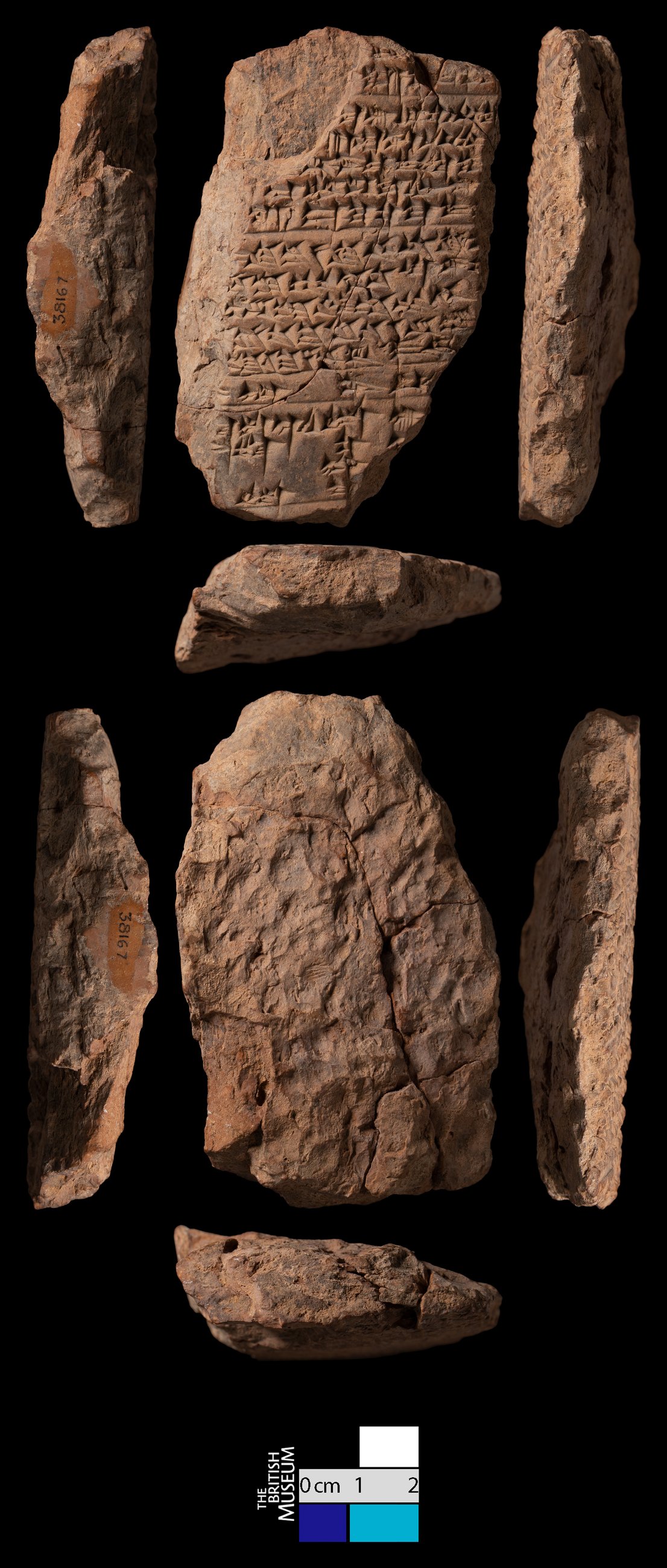
Where on the image
British Museum BM.38167: obverse, the tablet's own lines 3' to 7'. eBL's corpus edition (https://www.ebl.lmu.de/corpus/L/1/2/SB/II) attributes SB II 80-84 to this manuscript at these column and line numbers. Photograph checked: obverse, reverse and edges, ink 38167 on the left edge (on a paper label). About 15 lines on the obverse, easily enough for eBL's five; the reverse is worn with no clear lines. eBL classes BM.38167 as a school tablet (a scribal exercise that copies an excerpt of the text), not a library copy of the whole work. It carries these lines as text (eBL's transliteration has no commentary or quotation markup), and it is used because no photographed library copy preserves these lines as well. On this tablet lines 80-84 are partly broken (square brackets and x in the Akkadian). The English of these lines translates eBL's composite text, so it includes words that are not preserved on this tablet but are restored from other manuscripts or by the editors. Square brackets in the English mark eBL's restorations in its composite text; words that survive on other tablets carry no brackets even where this tablet is broken.
80[x x har-ra-an-šu]-ma u₂-ru-uh₂-š[u! x x x]
81[x x {d}]e₂#-a šib-ku-uš ti-am[ti! x x x x x]
82[x x uš-ha]r-ri#-ir-ma i-tu-r[a x x x]
83[i-ru-u]m-ma mah-ri ba-ʾ-u₂-[lu x x]
84[A.RA].ZU? iṣ-ba-tam-ma i-[zak-kar₃-šu]
80He set off, making straight his way,
81Ea went to seek out Tiamat's intentions.
82He stopped, speechless, then turned back.
83He came before Anshar the sovereign,
84He entreated him, saying,
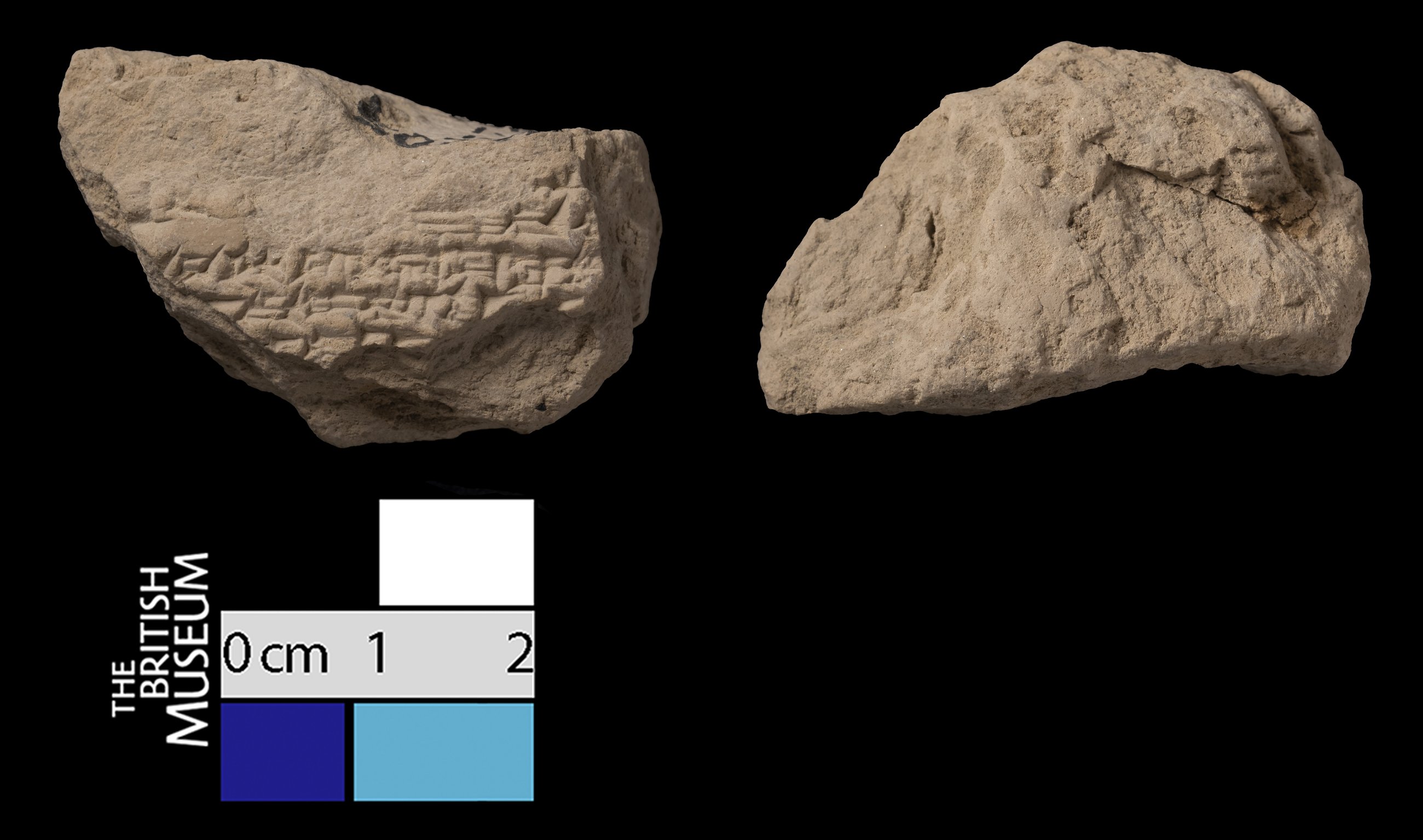
Where on the image
British Museum BM.44205: reverse, the tablet's own lines 3' to 5'. eBL's corpus edition (https://www.ebl.lmu.de/corpus/L/1/2/SB/II) attributes SB II 85-87 to this manuscript at these column and line numbers. Photograph checked: two faces only (no edges), with a partly visible, illegible ink number at the top of the inscribed face. About five lines on one face, matching eBL's five (uncertain) reverse lines; the other face is uninscribed. On this tablet of line 87 only one to three signs survive and lines 85-86 are partly broken (square brackets and x in the Akkadian). The English of these lines translates eBL's composite text, so it includes words that are not preserved on this tablet but are restored from other manuscripts or by the editors. Square brackets in the English mark eBL's restorations in its composite text; words that survive on other tablets carry no brackets even where this tablet is broken.
85[x x x x x x x t]i-amti ep-še#-ta-šu e-l[i-ia]
86[x x x e-še-ʾ-e-m]a ul i-mah-har# šip#-[ti]
87[x x x x x x m]a-la#-a[t x x x]
85“[My father], Tiamat has carried her actions beyond me,
86“I verified her intent, but my magic spell cannot counter it.
87“Her strength is enormous, she is utterly terrifying,
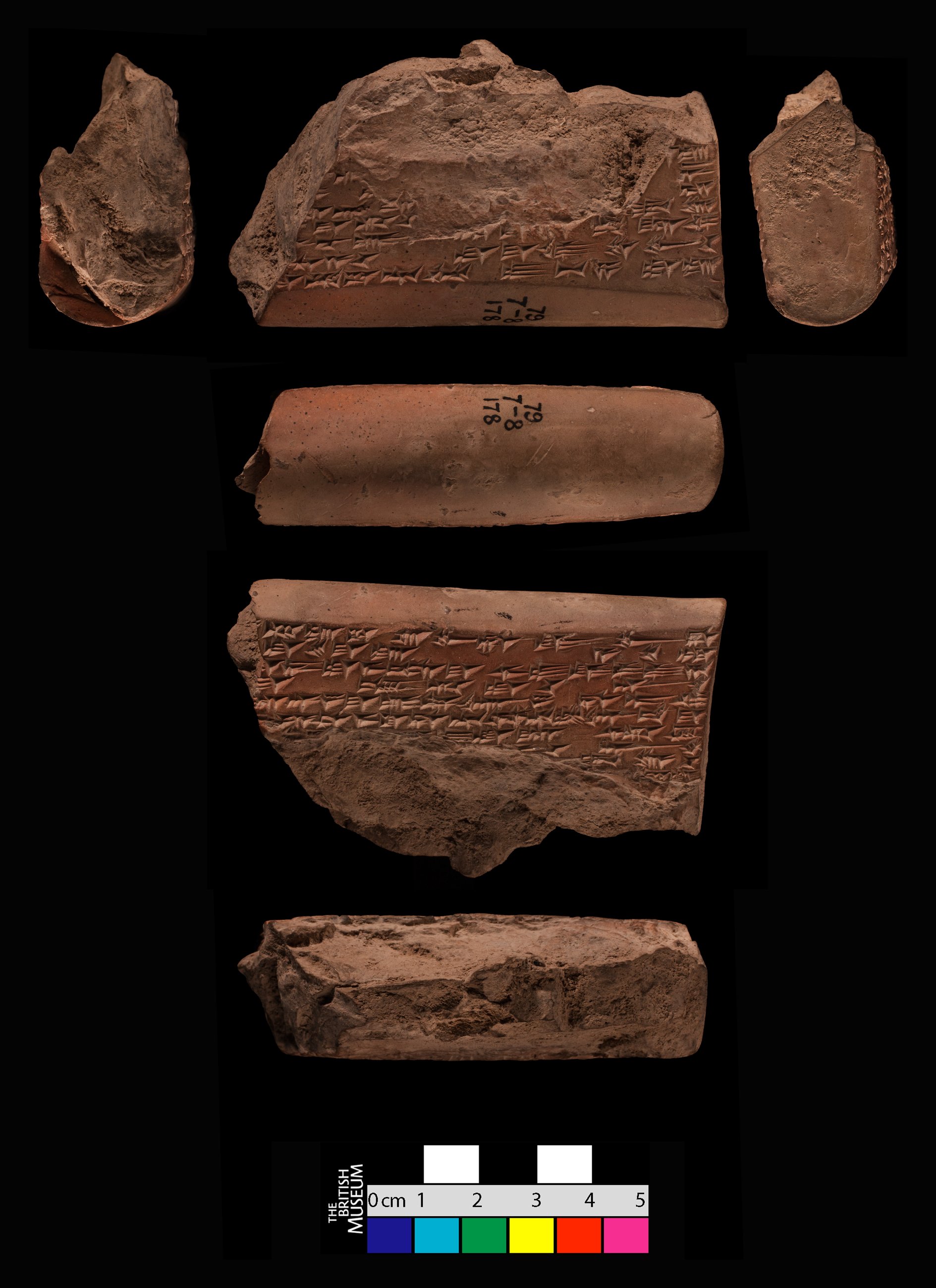
Where on the image
British Museum 1879,0708.178: obverse, the tablet's own lines 1' to 8'. eBL's corpus edition (https://www.ebl.lmu.de/corpus/L/1/2/SB/II) attributes SB II 92-99 to this manuscript at these column and line numbers. Photograph checked: obverse, reverse and edges, ink 79-7-8,178 on the obverse margin and the bottom edge. About six to eight lines at the lower part of the obverse and about eight to ten at the top of the reverse, consistent with eBL's 8 and 10. On this tablet of lines 92, 94 only one to three signs survive and lines 93, 95-99 are partly broken (square brackets and x in the Akkadian). The English of these lines translates eBL's composite text, so it includes words that are not preserved on this tablet but are restored from other manuscripts or by the editors. Square brackets in the English mark eBL's restorations in its composite text; words that survive on other tablets carry no brackets even where this tablet is broken.
92[x x x x x x x x x x x x x x x zik]-r[i]
93[x x x ki-i]ṣ-r[i-ša x x x x x x x a]t-ta
94[x x qa-ti-š]a₂ u[m-mi-du x x mu-uh-hi]-ni
95[x x uz-z]u-zi-iš# [i-ša-as]-si
96[x x {d}a-ni]m ma-ri-šu₂ [x x i]-zak-kar
97[x ka-a]n-nu-u₂ ka#-šu#-uš# qar#-ra-di
98[x x x e-mu]-qa-a-šu₂ la ma-har te-bu-šu₂
99[a-ru-uh₂-m]a mut-tiš₂ ti-amti i-ziz-za at-ta
92“A woman's force may be very great, but it cannot match a man’s.
93“Do you be the one to scatter her ranks, to thwart her intentions,
94“Before she lays her hands on us.”
95Anshar was shouting, in a passion,
96To Anu his son he said these words,
97“Cherished son, valiant warrior,
98“Whose strength is enormous, whose onslaught is irresistible,
99“Make haste, take a stand before Tiamat,
Where on the image
British Museum 1879,0708.178: reverse, the tablet's own lines 1 to 10. eBL's corpus edition (https://www.ebl.lmu.de/corpus/L/1/2/SB/II) attributes SB II 100-109 to this manuscript at these column and line numbers. Photograph checked: obverse, reverse and edges, ink 79-7-8,178 on the obverse margin and the bottom edge. About six to eight lines at the lower part of the obverse and about eight to ten at the top of the reverse, consistent with eBL's 8 and 10. On this tablet of line 109 only one to three signs survive and lines 100-108 are partly broken (square brackets and x in the Akkadian). The English of these lines translates eBL's composite text, so it includes words that are not preserved on this tablet but are restored from other manuscripts or by the editors. Square brackets in the English mark eBL's restorations in its composite text; words that survive on other tablets carry no brackets even where this tablet is broken.
100[šup-ši]h kab-ta-taš lib₃-bu-uš lip-pu-uš
101[šum-ma-m]a la še-ma-ta a-mat-ka
102[x x un-ne]n-ni at-me-šim-ma ši-i lip-pa-aš₂-ha
103[iš-me]-ma# zik-ri AD-šu₂ an-šar₂
104[x x har-r]a-an-ša₂-ma u₂-ru-uh-ša₂ uš-tar-di
105[x x] {d}a-num šib-qu₂-uš ti-a₃-wa-ti i-še-ʾ-am-ma
106[x x] uš#-ha#-[ri]-ir#-[m]a i#-tu-ra ar-kiš
107[x x x x x x x a]-li#-[d]i-šu₂ an-šar₂
108[x x x x x x x] i#-zak-kar-šu₂
109[x x x x x x x x x x x x x] UGU#-ia#
100“Soothe her feelings, let her heart be eased.
101“If she will not listen to what you say,
102“Say something by way of entreaty to her, so that she be pacified.”
103When he heard what his father Anshar said,
104“He set off, [made str]aight his way,
105Anu went to seek out Tiamat's intentions.
106He stopped, speechless, then turned back.
107He came before Anshar, his father who begot him,
108He entreated him, s[aying],
109“My father, Tiamat has carried her actions beyond me,
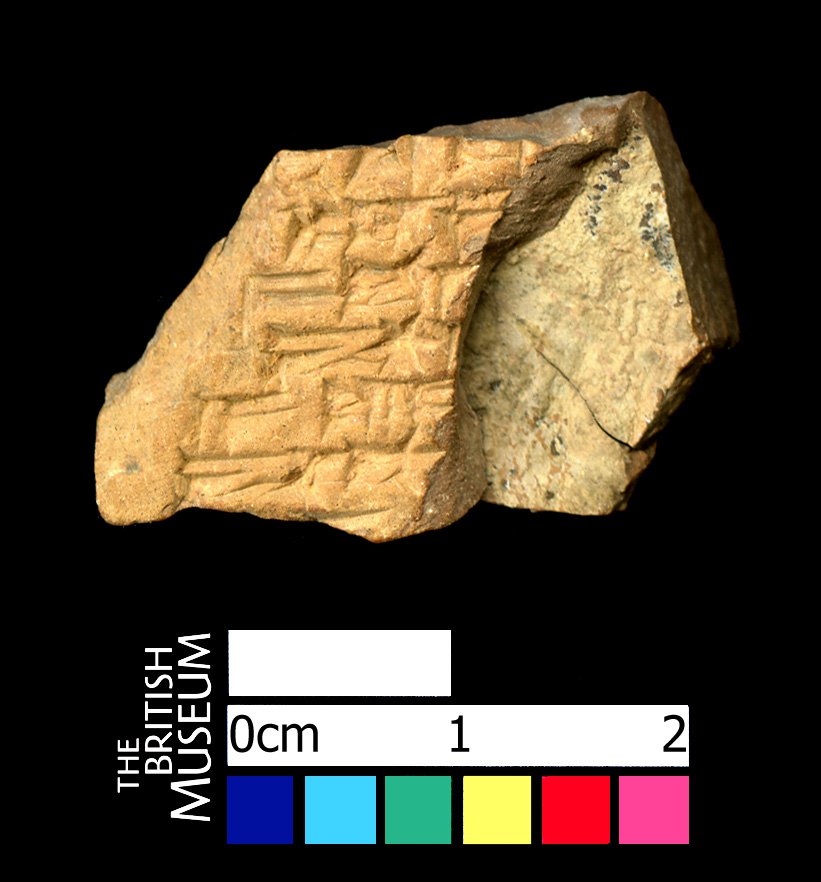
Where on the image
British Museum K.19822: reverse, the tablet's own lines 1' to 7'. eBL's corpus edition (https://www.ebl.lmu.de/corpus/L/1/2/SB/II) attributes SB II 116-122 to this manuscript at these column and line numbers. Photograph checked: one face of a small fragment about 2.5 cm across, no ink number visible; about seven short lines of signs at the left, the right part broken away. Consistent with eBL's seven reverse lines. On this tablet of lines 116-122 only one to three signs survive. The English of these lines translates eBL's composite text, so it includes words that are not preserved on this tablet but are restored from other manuscripts or by the editors. Square brackets in the English mark eBL's restorations in its composite text; words that survive on other tablets carry no brackets even where this tablet is broken.
116[x x (x) x x x (x) x la? du-un]-nu#-na# ma#-[la x x x]
117[x x x x x x mi]l-ka-ša₂ [x x x x x]
118[x x x x x um]-mi₃-da [x x x x]
119[x x x x x x x] qaq-q[a-ra x x x x]
120[x x x x (x) {d}]e₂#-a u₂-[na-ši x x x]
121[x x x x x x x x] DU₃#-šu₂-nu [x x x x x]
122[x x x x x (x) x x x (x)] qa?#-[li-iš x x]
116“A woman's strength may be very great, but it cannot match a man’s.
117“Do you be the one to scatter her ranks, to thwart her intentions,
118“Before she lays her hands on us.”
119Anshar fell silent, gazing at the ground,
120Nodding toward Ea, he shook his head.
121The Igigi-gods and Anunna-gods were all assembled,
122With lips closed tight, they sat in silence.
Where on the image
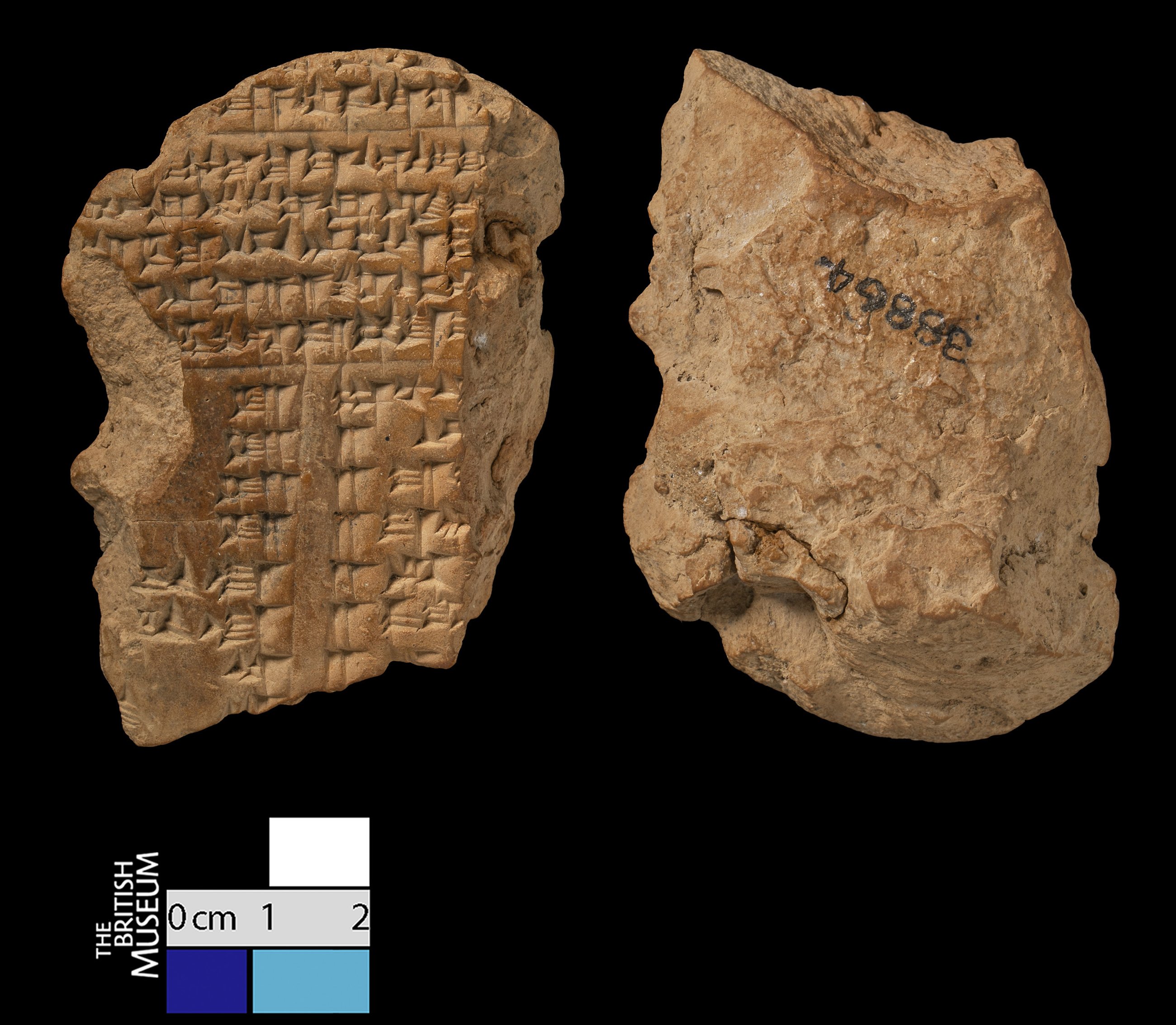
British Museum BM.38864: obverse, the tablet's own lines 3' to 7'. eBL's corpus edition (https://www.ebl.lmu.de/corpus/L/1/2/SB/II) attributes SB II 126-130 to this manuscript at these column and line numbers. Photograph checked: obverse and reverse only, ink 38864 on the reverse. About 15 lines on the obverse (two columns in its lower part), easily enough for eBL's five; the reverse is uninscribed. eBL classes BM.38864 as a school tablet (a scribal exercise that copies an excerpt of the text), not a library copy of the whole work. It carries these lines as text (eBL's transliteration has no commentary or quotation markup), and it is used because no photographed library copy preserves these lines as well. On this tablet lines 126-130 are partly broken (square brackets and x in the Akkadian). The English of these lines translates eBL's composite text, so it includes words that are not preserved on this tablet but are restored from other manuscripts or by the editors. Square brackets in the English mark eBL's restorations in its composite text; words that survive on other tablets carry no brackets even where this tablet is broken.
126[ka-mi-i]l? lib#-ba-šu-ma ul i-š[a-as-si x x x (x)]
127[x x g]a-aš-ru mu-tir-ru gi-mi[l-li x x x]
128[ha-ʾ]-iš# tuq-ma-ti {d}AMAR.UTU q[ar-du]
129[il-si-m]a {d}e₂-a a-šar pi-r[iš-ti-šu₂]
130[ka-inim-ma-a]k li-ib-bi-šu i#-[ta-mi-šu]
126His heart full of anger, did not summon anyone!
127The mighty firstborn, champion of his father,
128Hastener to battle, the warrior Marduk
129Did Ea summon to his secret place,
130That he made the speech to him he had prepared in his mind,
Where on the image
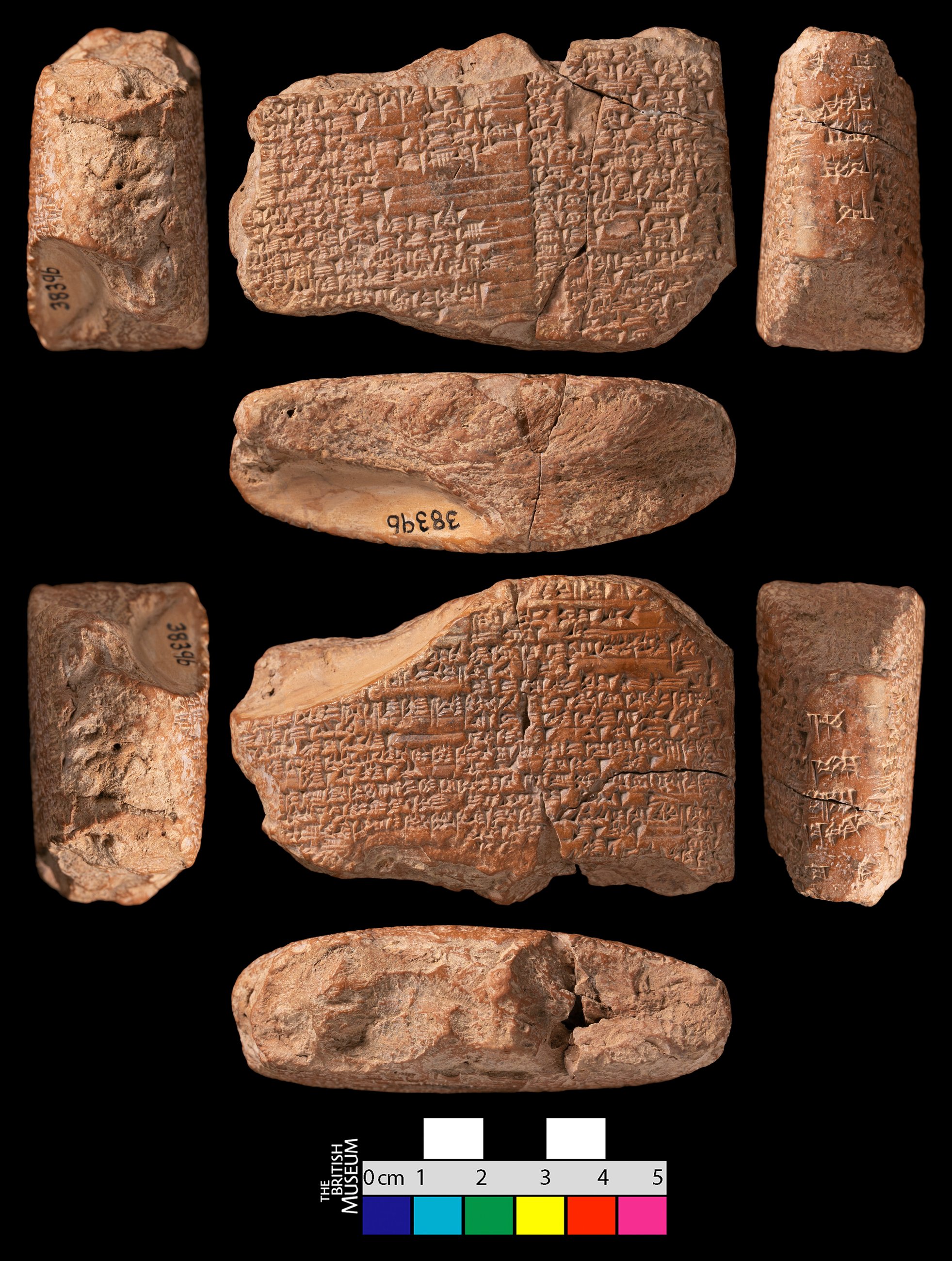
British Museum BM.38396: reverse, the tablet's own lines 5'a to 15'b. eBL's corpus edition (https://www.ebl.lmu.de/corpus/L/1/2/SB/II) attributes SB II 131-146 to this manuscript at these column and line numbers. Photograph checked: obverse, reverse and edges, ink 38396 on the left and top edges. Both faces of this fragment (about 7.5 cm wide) are covered in small script with about 20 to 25 lines each, consistent with eBL's 19 obverse and 28 reverse lines. On this tablet of line 131 only one to three signs survive and lines 132-134, 138-139, 141-142, 144-145 are partly broken (square brackets and x in the Akkadian). The English of these lines translates eBL's composite text, so it includes words that are not preserved on this tablet but are restored from other manuscripts or by the editors. Square brackets in the English mark eBL's restorations in its composite text; words that survive on other tablets carry no brackets even where this tablet is broken. Lines 135-137, 140, 143, 146 are complete on this tablet.
131[x x x x x x x x AD]-ka :
132at-ta-ma ma-ri mu-nap-pi-šu lib-b[i-šu₂]
133[x x x x x qi]t-ru-bi-iš ṭe-he-e-ma
134[x x x x x i-z]u-zu# e-ma-ru-uk-ka ni-i-hu#
135ih#-du#-ma# be-lu₄ a-na a-ma-tu₄ a-bi-šu :
136iṭ-he#-e#-ma it-ta-zi-iz ma-ha-ri-iš an-šar₂
137i-mur-šu-ma an-šar₂ lib₃-ba-šu# ṭu₂-ub-ba-a-ti im-la
138[i]š-ši-iq šap-ti-šu a-di-ra#-šu# ut-te-es-si
139[a-b]i la šuk-tu-mat pi-ti ša-ap-tu-uk :
140lu-ul-lik-ma lu-ša-am-ṣa-a ma-la lib₃-bi-ka
141[x x] la šuk-tu-mat pi-ti ša-ap-tu-uk
142[lu-ul-l]ik-ma lu-ša-am-ṣa-a ma-la lib₃-bi-ka :
143a-a-u₂ zik#-ri# ta-ha-za-šu u₂-še-ṣi-ka
144[u t]i-amtu ša₂ si-in-ni-ša-tu₄ ia-ar-ka i#-na kak-ku
145[x x b]a-nu-u₂ hi-di u₃ šu-li-il :
146ki-ša-ad# ti#-amti ur-ru-hi-iš ta-kab-ba-as at-ta
131“O Marduk, think carefully, heed your father,
132“You are my son who can relieve his heart!
133“Draw nigh, approach Anshar,
134“Be ready to speak, wait, seeing you he will be calm.”
135The Lord was delighted at his father's words,
136He drew near and waited before Anshar.
137When Anshar saw him, his heart was filled with joyful feelings,
138He kissed his lips, he banished his gloom.
139“My father, let not your lips be silent but speak,
140“Let me go, let me accomplish your heart's desire.
141“[O Anshar], let not your lips be silent but speak,
142“Let me go, let me accomplish your heart's desire!
143“What man is it who has sent forth his forces for battle against you?
144“Why, Tiamat, a woman, comes out against you to arms!
145“[My father], creator, rejoice and be glad,
146“Soon you will trample the neck of Tiamat.
Where on the image
British Museum BM.40559: reverse, the tablet's own lines 15' to 30'. eBL's corpus edition (https://www.ebl.lmu.de/corpus/L/1/2/SB/II) attributes SB II 147-162 to this manuscript at these column and line numbers. Photograph checked: obverse, reverse and edges of a nearly complete small tablet, ink 40559 on the bottom edge. Both faces are covered in very small script with about 30 to 40 lines each, consistent with eBL's 40 obverse and 30 reverse lines of Tablet II and one line of Tablet III. On this tablet lines 147-162 are partly broken (square brackets and x in the Akkadian). The English of these lines translates eBL's composite text, so it includes words that are not preserved on this tablet but are restored from other manuscripts or by the editors. Square brackets in the English mark eBL's restorations in its composite text; words that survive on other tablets carry no brackets even where this tablet is broken.
147[x x b]a-nu-u₂ hi-di u₃ šu-li-il
148[x x x] ti-amti ur-ru-hi-iš ta-kab-ba-as at-ta
149[x x ma]-ri mu-du-u₂ gim-ri uz-nu
150[x x] šu-up-ši-ih i-na te-e-ka el-lu
151[x x U₄]-ME# ur-ru-hi-iš šu-tar-di-ma
152[pa-nu-uš-š]a? la ut-tak-ka#-šu te-e-ri ar₂-ka-niš
153[ih-du-m]a be-lu₄ a-na a-mat a-bi-šu
154[x x x l]ib-ba-šu-ma a-na a-bi-šu₂ i-zak-kar
155[x x DINGIR]-MEŠ# NAM-MEŠ DINGIR-MEŠ GAL-MEŠ
156[šum-ma-m]a a-na-ku mu-tir gi-mil-li-ku-un
157[x x x t]i-amta-am-ma u₂-bal-laṭ ka-a-šu-un
158[x x x pu]-uh₂-ru šu-te-er ba#-ʾa šim-tu₄
159[ina up-š]u-ukkin-na-kam@v mit-ha-ri-iš ha-di-iš ti#-iš#-ba#-ma#
160[x x pi]-ia# ki-ma ka-a-tu-nu-ma ši-ma#-tu₄# lu#-ši#-im#
161[x ut-tak]-kar# mi-im-mu-u₂ a-ban-nu#-u₂# a#-na#-ku#
162[x x x x a]-a# in-ne₂-na-a si₃-qar# ša#-ap#-ti#-ia
147“[Anshar], creator, rejoice and be glad,
148“Soon you will trample the neck of Tiamat!”
149“[Go], son, knower of all there is to know,
150“Bring Tiamat to rest with your sacral spell.
151“Make straight, quickly, ride the storm chariot,
152“At the sight of it, unstoppable, turn her back!”
153The Lord was delighted at his grandfather's words,
154His heart was overjoyed as he said to his grandfather,
155“Lord of the gods, of the destiny of the great gods,
156“If indeed I am to champion you,
157“Subdue Tiamat and save your lives,
158“Convene the assembly, nominate me for the ultimate destiny!
159“Take your places in the Assembly Place of the Gods, all of you, in joyful mood.
160“When I speak, let me ordain destinies instead of you.
161“Let nothing that I shall bring about be altered,
162“Nor what I command be revoked or changed.”
Notes
- Akkadian: eBL transliteration of the signs on the photographed tablet (manuscript-level ATF), not a composite text.
- English: B. R. Foster's translation in the eBL edition; it renders eBL's composite text, including restorations from other tablets.
- Line numbers: eBL edition. Each section also gives the tablet's own column and line numbers.
- Signs in the Akkadian: [ ] broken away; x illegible sign; # damaged sign; ? uncertain reading; ! sign corrected by the editor; ( ) signs perhaps broken away; { } determinative; : divider sign written on the tablet; @v and similar: variant or modified form of a sign; (gloss: ...) a note written by the scribe in small signs or in the margin.
Cite
Sources
- Source: British Museum tablet photographs + eBL manuscript transliterations (eBL corpus edition L I.2, Poem of Creation (Enuma elish) (ed. A. C. Heinrich, rev. Z. J. Földi and E. Jiménez), SB II) + English of the eBL edition (B. R. Foster (eBL edition)) (holding institution)
- Critical edition: electronic Babylonian Library, Poem of Creation (ed. A. C. Heinrich), manuscript transliterations
← previous · → next · v cycle view · l back to library