Enuma Elish, Tablet IV: Marduk defeats Tiamat
Introduction
The gods give Marduk kingship and weapons. He rides out on his storm chariot, catches Tiamat in his net, kills her with an arrow, binds her helpers and Qingu, takes the Tablet of Destinies, and splits Tiamat's body in two to form the sky.
Enuma Elish ('When on high'), the Babylonian Poem of Creation, tells how Marduk, god of Babylon, defeated Tiamat, created the ordered world and became king of the gods. It was written on seven tablets and recited in Babylon during the New Year festival. The date of composition is debated (proposals range from the 18th to the 12th century BCE); the surviving copies date from the 9th to the 2nd century BCE and come from Ashur, Nineveh, Kish, Babylon, Sippar, Uruk and other sites. This page follows the line numbering of the electronic Babylonian Library edition.
How this page is built. Each section is a run of consecutive lines as written on one photographed clay tablet. For every line the eBL edition (https://www.ebl.lmu.de/corpus/L/1/2/SB/IV) lists the manuscripts that carry it, with each tablet's own column and line numbers; the tablet chosen for each run is the photographed copy of the work with the most signs preserved there. Commentaries and texts that only quote a line are never chosen. School and excerpt tablets are used only for lines that no photographed library copy preserves as well, and only where they carry the line as text; their sections say so (BM.33891, BM.36387, BM.36667). The original text is eBL's transliteration of that tablet's signs (not a modern composite text): square brackets mark broken signs, x an illegible sign, # a damaged sign, ? an uncertain reading, and words in {braces} are determinatives; the notes give a key to every sign used on this page, and eBL's layout codes are written out in words (for example '(line break)' or '(blank space)'). Superscript numbers are the line numbers of the eBL edition, used in both the Akkadian and the English. The English is B. R. Foster's translation in the eBL edition (CC BY-NC-SA 4.0), one line of English per line of the poem; italics mark uncertain renderings, as in the source. Where the tablet is broken, the English still translates the whole line of eBL's composite text; each section's note names the lines that are broken on its tablet.
Finding a line on the photograph. Each section names the tablet, the face and column, and the tablet's own line numbers (a prime, as in 5', counts from the first preserved line of a broken column). On a tablet with six columns the obverse carries columns i-iii from left to right; the reverse, turned over from bottom to top, carries columns iv-vi from right to left. The photographs often show the obverse above the reverse with the edges around them; a fragment preserves only part of this layout.
This page shows 138 of the 146 lines of the eBL edition (95%), from 9 tablets in the British Museum: K.3473 (Nineveh), BM.33891, BM.36667, K.16706 (Nineveh), F.2, BM.36387, K.3437 (Nineveh), K.5420.C (Nineveh), K.11863 (Nineveh).
Lines not shown. 8 of the 146 lines of the eBL edition are not shown, because no photographed copy of the work used here carries them: 8 (no photograph in eBL: SU-1951.58 (Museum of Anatolian Civilizations, Ankara), SU-1951.23.A (Museum of Anatolian Civilizations, Ankara), BM.93016; quotation in another text: K.1353); 25 (no photograph in eBL: VAT.10552 (Vorderasiatisches Museum, Berlin), SU-1951.58 (Museum of Anatolian Civilizations, Ankara), SU-1951.47 (Museum of Anatolian Civilizations, Ankara), BM.93016); 130 (no photograph in eBL: SU-1951.58 (Museum of Anatolian Civilizations, Ankara), SU-1951.47 (Museum of Anatolian Civilizations, Ankara), SU-1952.243 (Museum of Anatolian Civilizations, Ankara), BM.93016); 131-132 (no photograph in eBL: SU-1951.58 (Museum of Anatolian Civilizations, Ankara), SU-1951.47 (Museum of Anatolian Civilizations, Ankara), SU-1952.243 (Museum of Anatolian Civilizations, Ankara), BM.93016; commentary: K.4657, BM.66606); 133-135 (no photograph in eBL: SU-1951.58 (Museum of Anatolian Civilizations, Ankara), SU-1951.47 (Museum of Anatolian Civilizations, Ankara), SU-1952.243 (Museum of Anatolian Civilizations, Ankara), BM.93016). A line is shown only on a photographed tablet that carries it as text. Commentaries and other texts that quote a line (letters, rituals, god lists) are not used as witnesses, because they carry it with explanations or inside another text; tablets without a photograph in eBL are not used, because the line could not be shown on its tablet.
How was this verified? (Provenance)
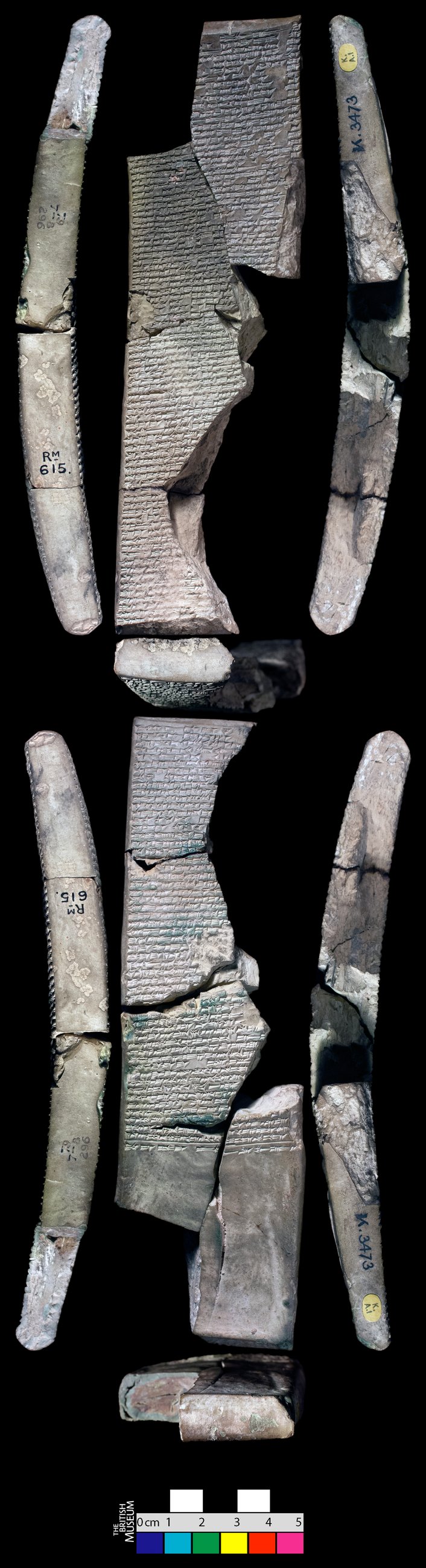
Where on the image
British Museum K.3473: reverse, the tablet's own line 54. eBL's corpus edition (https://www.ebl.lmu.de/corpus/L/1/2/SB/IV) attributes SB IV 1 to this manuscript at these column and line numbers. Photograph checked: obverse, reverse and edges of a tall tablet (about 17 cm) of several joined pieces, ink K.3473 on the right edge and Rm 615 and 79-7-8,296 on the left edge. Both faces are packed with very small script, about 80 or more lines on the obverse and 50 or more on the reverse, consistent with eBL's 85 and 53. K.3473, a copy of SB III, carries this line as its catch-line: the opening of the next tablet of the series, copied at the end of the previous one (eBL lists catch-lines among its quotations; unlike commentaries and quotations in other texts, a catch-line is the line itself on a copy of the work). Every line of this section is complete on this tablet; the English translates eBL's composite text, which may follow other manuscripts where they differ in wording.
1id-du-šum-ma pa-rak ru-bu-u₂-ti#
1They set out for him a princely dais,
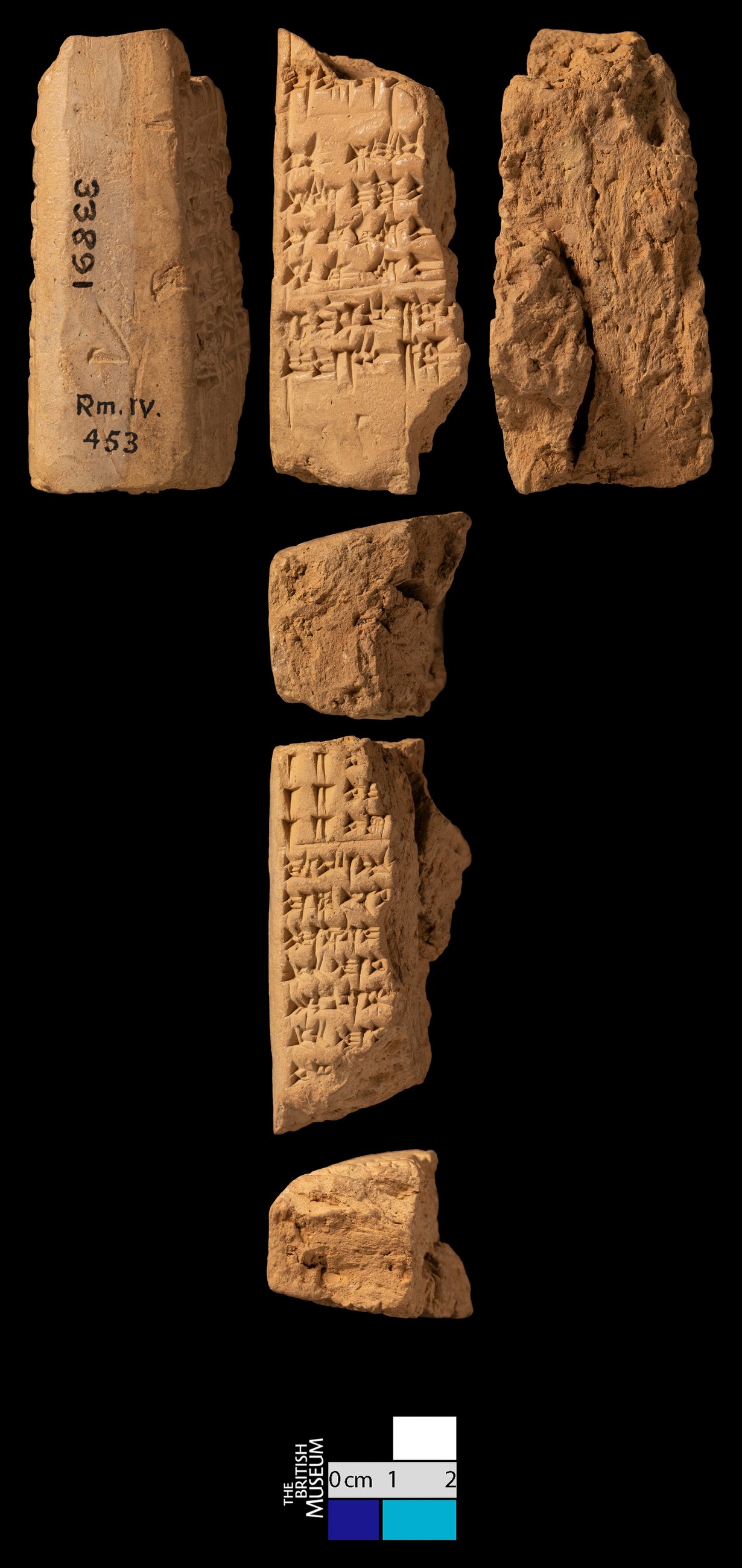
Where on the image
British Museum BM.33891: obverse, the tablet's own lines 5' to 10'. eBL's corpus edition (https://www.ebl.lmu.de/corpus/L/1/2/SB/IV) attributes SB IV 2-7 to this manuscript at these column and line numbers. Photograph checked: obverse, reverse and edges, ink 33891 and Rm IV 453 on the left edge. About eight or nine lines on the obverse, consistent with eBL's seven; the reverse also carries about ten lines. eBL classes BM.33891 as a school tablet (a scribal exercise that copies an excerpt of the text), not a library copy of the whole work. It carries these lines as text (eBL's transliteration has no commentary or quotation markup), and it is used because no photographed library copy preserves these lines as well. On this tablet of lines 3, 7 only one to three signs survive and lines 2, 4-6 are partly broken (square brackets and x in the Akkadian). The English of these lines translates eBL's composite text, so it includes words that are not preserved on this tablet but are restored from other manuscripts or by the editors. Square brackets in the English mark eBL's restorations in its composite text; words that survive on other tablets carry no brackets even where this tablet is broken.
2ma-ha-ri-i[š x x x x x x x x x x x x]
3at-ta-m[a x x x x x x x x x x]
4ši-mat{+at!(LA)}-k[a x x x x x x x x x]
5{d}AMAR.UTU ka[b-ta-ta x x x x x x x]
6ši-mat{+at}-k[a x x x x x x x x x x]
7iš#-t[u x x x x x x x x x x x x]
2He took his place before his fathers to be made sovereign.
3“You are the most important among the great gods,
4“Your destiny is unrivalled, your command is sublime.
5“O Marduk, you are the most important among the great gods,
6“Your destiny is unrivalled, your command is sublime!
7“Henceforth your command cannot be changed,
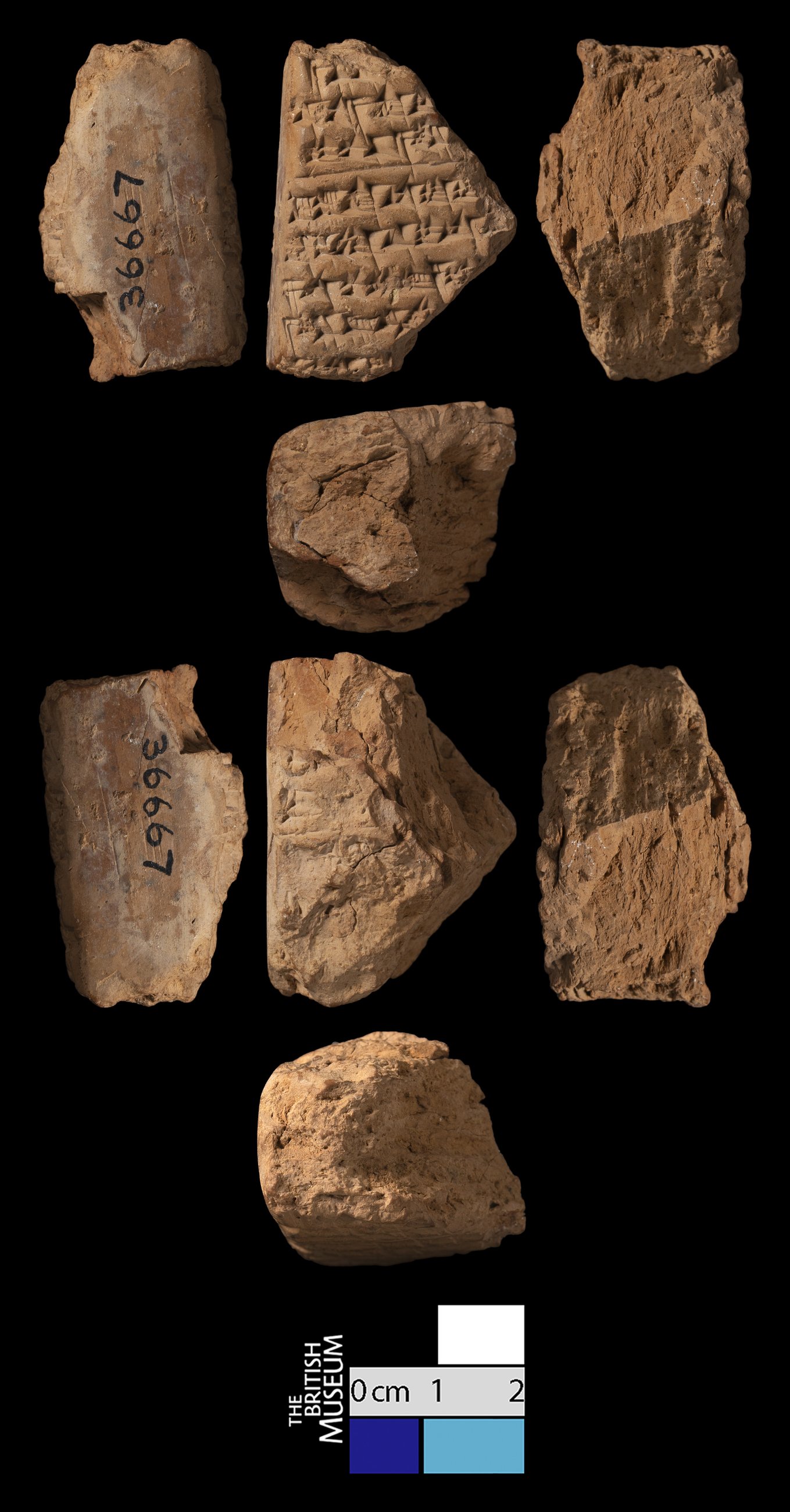
Where on the image
British Museum BM.36667: obverse, the tablet's own lines 4' to 8'. eBL's corpus edition (https://www.ebl.lmu.de/corpus/L/1/2/SB/IV) attributes SB IV 9-13 to this manuscript at these column and line numbers. Photograph checked: obverse, reverse and edges, ink 36667 on the left edge. About six lines on the obverse, consistent with eBL's five; the reverse is worn and uninscribed. eBL classes BM.36667 as a school tablet (a scribal exercise that copies an excerpt of the text), not a library copy of the whole work. It carries these lines as text (eBL's transliteration has no commentary or quotation markup), and it is used because no photographed library copy preserves these lines as well. On this tablet lines 9-13 are partly broken (square brackets and x in the Akkadian). The English of these lines translates eBL's composite text, so it includes words that are not preserved on this tablet but are restored from other manuscripts or by the editors. Square brackets in the English mark eBL's restorations in its composite text; words that survive on other tablets carry no brackets even where this tablet is broken.
9lu-u₂ ki-na-at ṣ[i-it x x x x x x x x x x]
10ma-am-ma-an i-na DING[IR.DINGIR x x x x x x x]
11za-na-nu-tu₄# kiš#-ša₂-tu₄ p[a-rak x x x]
12a-šar sa-gi-š[u-nu x x x x x x x x]
13{d#}AMAR#.UTU# a[t-ta-ma x x x x x x x]
9“Your command shall be steadfast, your word shall not be gainsaid.
10“Not one of the gods shall go beyond the limits you set.
11“Support is wanted for the gods’ sanctuaries,
12“Wherever their shrines are, your own shall be established.
13“You are Marduk, our champion,
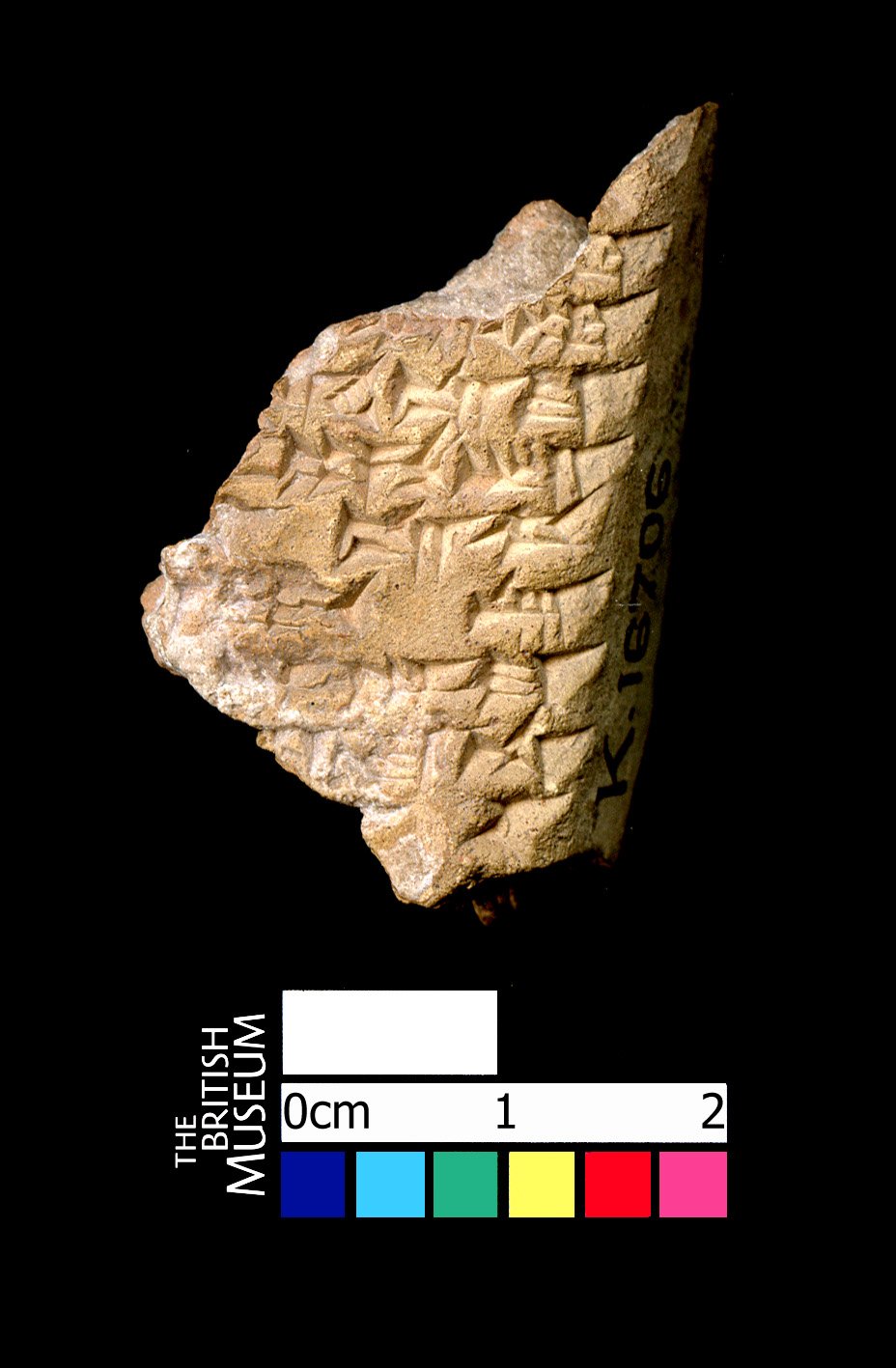
Where on the image
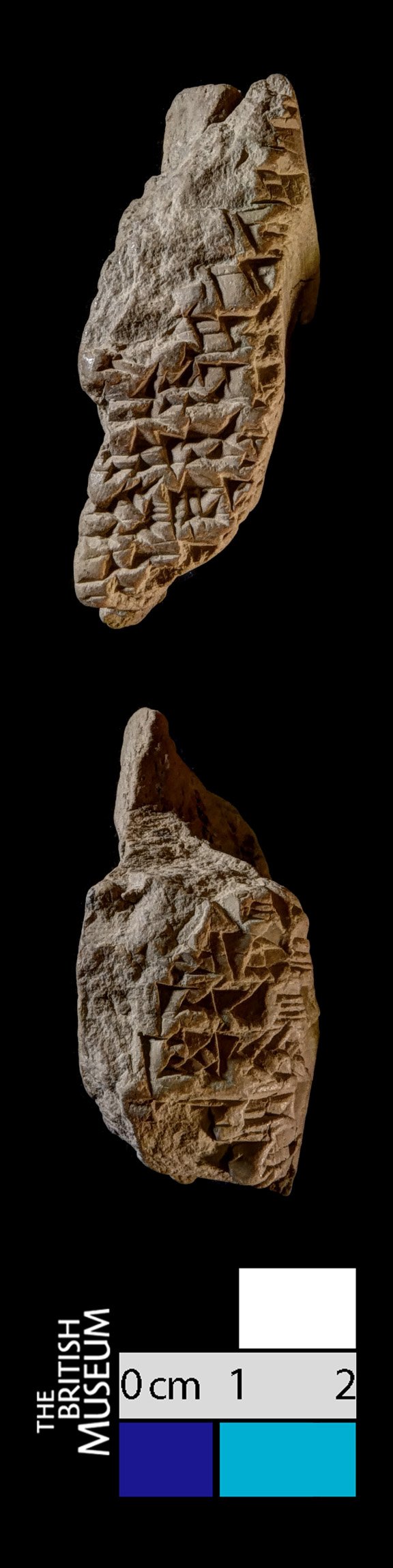
British Museum K.16706: obverse, the tablet's own lines 1' to 11'. eBL's corpus edition (https://www.ebl.lmu.de/corpus/L/1/2/SB/IV) attributes SB IV 14-24 to this manuscript at these column and line numbers. Photograph checked: one face of a small fragment about 2.5 cm tall, ink K.16706 along the right edge. About ten lines of signs, consistent with eBL's eleven obverse lines. On this tablet of lines 14-17, 19-24 only one to three signs survive and line 18 is partly broken (square brackets and x in the Akkadian). The English of these lines translates eBL's composite text, so it includes words that are not preserved on this tablet but are restored from other manuscripts or by the editors. Square brackets in the English mark eBL's restorations in its composite text; words that survive on other tablets carry no brackets even where this tablet is broken.
14[x x x x x x x x x x x gim-re-e-t]i
15[x x x x x x x x x x x a-mat-k]a
16[x x x x x x x x x x x x x x na]-ki#-ri#-ka
17[x x x x x x x x x x] gi-mil-ma
18[x x x x x x x x x x tu-bu-u]k nap-šat-su
19[x x x x x x x x x x lu-ma-š]a iš-ten₂
20[x x x x x x x x x x x i]z-zak-ru
21[x x x x x x x x] DINGIR.DINGIR-ma
22[x x x x x x x x x l]ik-tu-na
23[x x x x x x x x x lu-m]a-šu₂
24[x x x x x x x x x liš]-lim?#
14“We bestow upon you kingship of all and everything.
15“Take your place in the assembly, your word shall be supreme.
16“May your weapon never strike wide but dispatch your foes.
17“O Lord, spare his life who trusts in you,
18“But the god who has taken up evil, snuff out his life!”
19They set up among them a certain constellation,
20To Marduk their firstborn said they (these words),
21“Your destiny, O Lord, shall be foremost of the gods’,
22“Command destruction or creation, they shall take place.
23“At your word the constellation shall be destroyed,
24“Command again, the constellation shall be intact.”
Where on the image
British Museum F.2: obverse, the tablet's own lines 1' to 7'. eBL's corpus edition (https://www.ebl.lmu.de/corpus/L/1/2/SB/IV) attributes SB IV 26-32 to this manuscript at these column and line numbers. Photograph checked: two faces of a narrow fragment about 4.5 cm long (no edges, no ink number visible). About eight to ten lines on one face and about five to seven on the other, broadly consistent with eBL's 10 obverse and 7 reverse lines. On this tablet of lines 26-32 only one to three signs survive. The English of these lines translates eBL's composite text, so it includes words that are not preserved on this tablet but are restored from other manuscripts or by the editors. Square brackets in the English mark eBL's restorations in its composite text; words that survive on other tablets carry no brackets even where this tablet is broken.
26[x x x x x x x x x x it-tab-n]i
27[x x x x x x x x x x x x ab-be₂-e-š]u
28[x x x x x x x x x x šar-r]u
29[x x x x x x x x x x x x pala₄]-a-a[m]
30[x x x x x x x x x x x x x x] za#-a-a-[ri]
31[x x x x x x x x x x] pu#-ru-ʾ#-[ma]
32[x x x x x x x x x x x x li]-bi-il-l[u-ni]
26He commanded again and the constellation was created anew.
27When the gods his fathers saw what he had commanded,
28Joyfully they hailed, “Marduk is king!”
29They bestowed upon him scepter, throne, and staff,
30They gave him unopposable weaponry that vanquishes enemies, (saying),
31“Go, cut off the life of Tiamat,
32“Let the winds bear her blood away as glad tidings!”
Where on the image
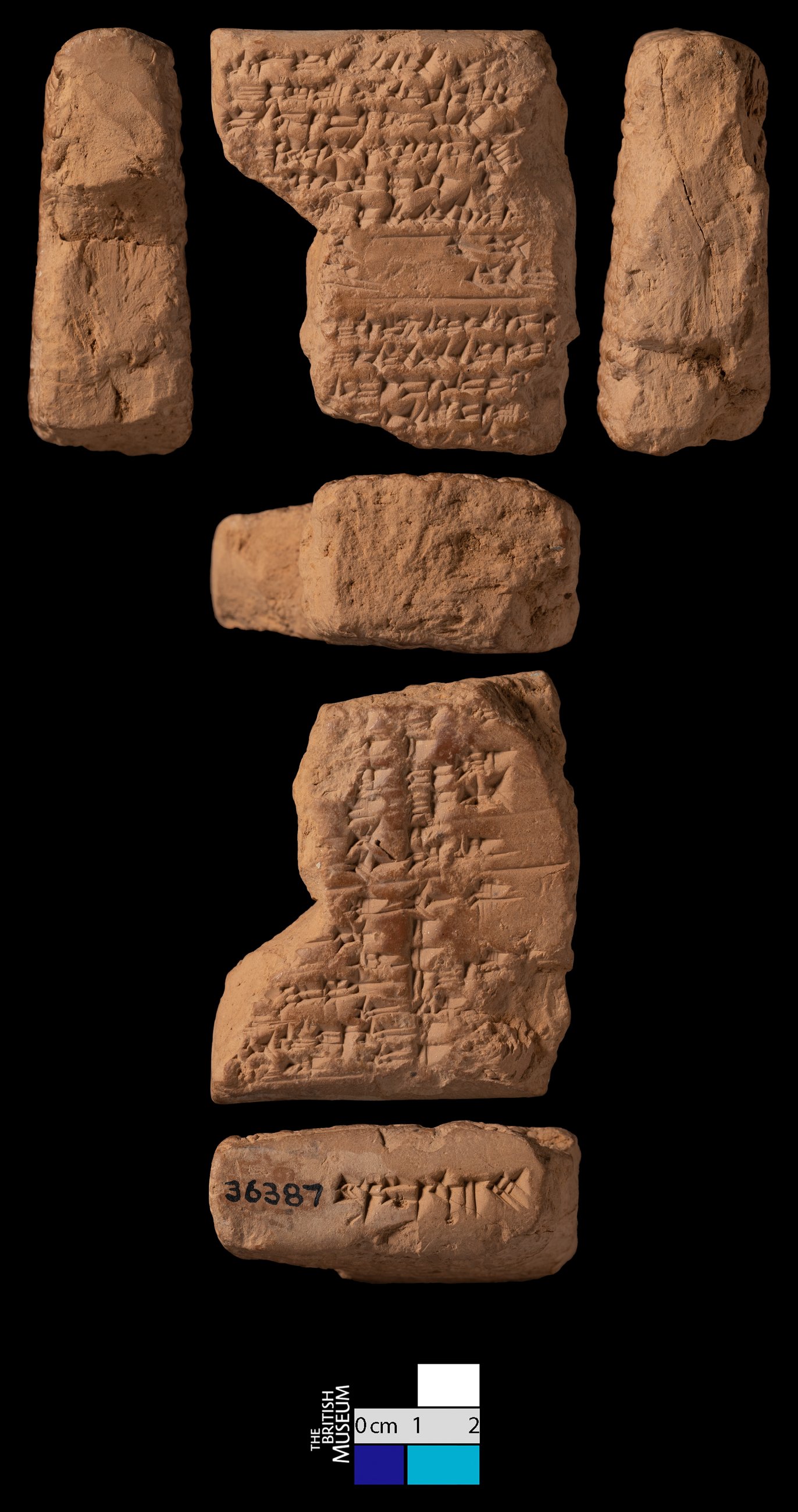
British Museum BM.36387: obverse, the tablet's own lines 9 to 12. eBL's corpus edition (https://www.ebl.lmu.de/corpus/L/1/2/SB/IV) attributes SB IV 33-36 to this manuscript at these column and line numbers. Photograph checked: obverse, reverse and edges, ink 36387 on the bottom edge (which also carries a line of signs). About nine lines on the obverse with rulings, enough for eBL's five; the reverse also carries about eight lines. eBL classes BM.36387 as a school tablet (a scribal exercise that copies an excerpt of the text), not a library copy of the whole work. It carries these lines as text (eBL's transliteration has no commentary or quotation markup), and it is used because no photographed library copy preserves these lines as well. On this tablet lines 33-36 are partly broken (square brackets and x in the Akkadian). The English of these lines translates eBL's composite text, so it includes words that are not preserved on this tablet but are restored from other manuscripts or by the editors. Square brackets in the English mark eBL's restorations in its composite text; words that survive on other tablets carry no brackets even where this tablet is broken.
33[i-ši-mu-m]a ša {d}+EN ši-ma-tu#-uš [x x x x x x]
34[x x x] šu#-ul-mu u teš₂-me-e u[š-ta-aṣ-bi-tu-uš x x x]
35[ib]-ši-ma {giš}BAN kak-k[a-šu x x x]
36[mul-mul-l]u uš#-tar-ki#-ba u₂-k[in?-šu₂ x x]
33The gods, his fathers, ordained the Lord’s destiny,
34On the path to success and authority did they set him marching.
35He made a bow, appointed it his weapon,
36He mounted an arrow, set it on the string.
Where on the image
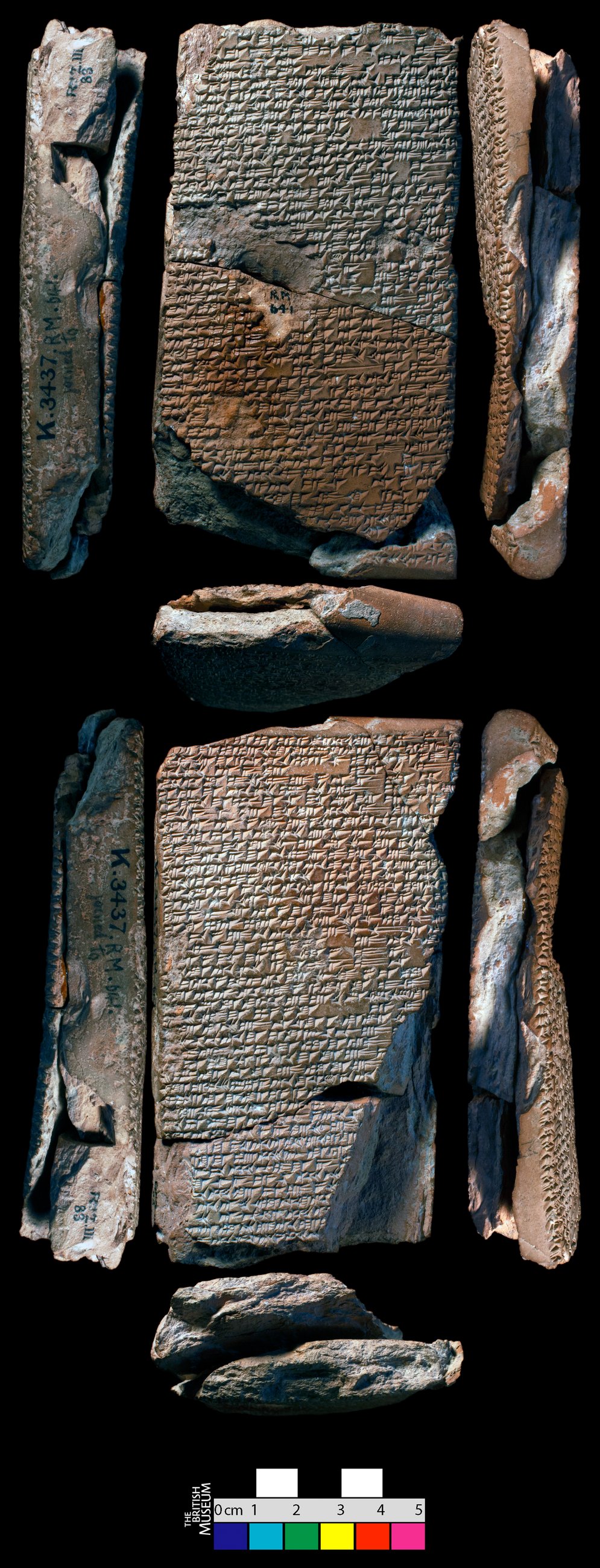
British Museum K.3437: obverse, the tablet's own lines 2' to 22'. eBL's corpus edition (https://www.ebl.lmu.de/corpus/L/1/2/SB/IV) attributes SB IV 37-57 to this manuscript at these column and line numbers. Photograph checked: obverse, reverse and edges of a large tablet of joined pieces (about 14 cm tall), ink "K.3437, Rm 641, joined" on the left edge, Rm 641 on the obverse and another Rm number on the left edge. Both faces are covered in small script with about 45 to 50 lines each, consistent with eBL's 48 obverse and 46 reverse lines. On this tablet lines 37-43, 52-57 are partly broken (square brackets and x in the Akkadian). The English of these lines translates eBL's composite text, so it includes words that are not preserved on this tablet but are restored from other manuscripts or by the editors. Square brackets in the English mark eBL's restorations in its composite text; words that survive on other tablets carry no brackets even where this tablet is broken. Lines 44-51 are complete on this tablet.
37[iš-ši-m]a miṭ-ṭa im-na-šu₂ u₂-ša₂-hi-iz
38[x x] u iš-pa-tu₄ i-du-uš-šu₂ i-lul
39[iš-k]un NIM.GIR₂ i-na pa-ni-šu₂
40[nab-l]a muš-tah-me-ṭu zu-mur-šu₂ um-tal-li
41[i-p]u-uš-ma sa-pa-ra šul-mu-u qer-biš ti-amta
42[er-b]et-ti ša₂-a-ri uš-te-eṣ-bi-ta ana la a-ṣe-e mim-mi-ša₂
43[{i]m}U₁₈.LU {im}SI.SA₂ {im}KUR.RA {im}MAR.TU
44i#-du-uš sa-pa-ra uš-taq-ri-ba qi₂-iš-ti AD-šu₂ {d}a-nim
45ib-ni im-hul-la IM lem-na me-ha-a a-šam-šu-tu₄
46{im}LIMMU₂.BA {im}IMIN {im}SUH₃ {im}NU.SA₂.A
47u₂-še-ṣa-am-ma IM-MEŠ ša₂ ib-nu-u₂ se-bet-ti-šu₂-un
48qer-biš ti-amti šu-ud-lu-hu ti-bu-u₂ EGIR-šu₂
49iš-ši-ma be-lu₄ a-bu-ba {giš}TUKUL-šu₂ GAL-a
50{giš}GIGIR u₄-mu la mah-ri ga-lit-ta ir-kab
51iṣ-mid-sim-ma er-bet na-aṣ-ma-di i-du-uš-ša₂ i-lul
52ša#-[ag-gi-ša₂? l]a pa#-du-u₂ ra-hi-ṣu mu-up-par-ša₂
53[x x x ša]p-ti šin-na-šu₂-nu na-ša₂-a im-ta
54[x x x x] i#-du#-u₂ sa-pa-na# lam-du
55[x x im]-nu?#-[uš-šu₂ ta-ha]-za ra-aš₂-ba u# [t]u-qu-un#-tu₄#
56šu-me-la u!?# [x x x] x da#-a#-a-i-pat k[a-la mut-t]e-[e]n-d[i]
57na-ah-l[ap-ta ap-luh]-ti# pul-ha-ti# h[a]-lip#-m[a]
37He took up a mace, held it in his right hand,
38Bow and quiver he slung at his side.
39Thunderbolts he set before his face,
40With raging fire he covered his body.
41Then he made a net to enclose Tiamat within it,
42He deployed the four winds that none of her might escape:
43South Wind, North Wind, East Wind, West Wind,
44He fastened the net at his side, gift of his grandfather Anu;
45He made ill wind, whirlwind, cyclone,
46Four-ways wind, seven-ways wind, destructive wind, back-and-forth wind:
47He released the winds that he had made, the seven of them,
48Mounting in readiness behind him to roil inside Tiamat.
49Then the Lord raised the Deluge, his great weapon.
50He mounted the terrible chariot, the unopposable Storm Demon,
51He hitched to it the four-steed team, he tied (the reins) at his side:
52“Slaughterer,” “Merciless,” “Overwhelmer,” “Soaring.”
53Their lips are curled back, their teeth bear venom,
54They know not fatigue, they are trained to trample down.
55He stationed at his right gruesome battle and strife,
56At his left fray that overthrows all formations.
57He was garbed in a ghastly armored garment,
Where on the image
British Museum K.3437: obverse, the tablet's own lines 23' to 43'. eBL's corpus edition (https://www.ebl.lmu.de/corpus/L/1/2/SB/IV) attributes SB IV 58-78 to this manuscript at these column and line numbers. Photograph checked: obverse, reverse and edges of a large tablet of joined pieces (about 14 cm tall), ink "K.3437, Rm 641, joined" on the left edge, Rm 641 on the obverse and another Rm number on the left edge. Both faces are covered in small script with about 45 to 50 lines each, consistent with eBL's 48 obverse and 46 reverse lines. On this tablet lines 58-63, 70-78 are partly broken (square brackets and x in the Akkadian). The English of these lines translates eBL's composite text, so it includes words that are not preserved on this tablet but are restored from other manuscripts or by the editors. Square brackets in the English mark eBL's restorations in its composite text; words that survive on other tablets carry no brackets even where this tablet is broken. Lines 64-69 are complete on this tablet.
58me-lam-mi u!? x [x x (x) a]-pi#-ir ra#-šu#-uš-šu₂
59uš-te-šir-ma [x x u]r-ha-šu₂ u₂-šar-di-ma
60aš₂-riš ti-amti# [x ug-gu]-gat# pa-nu-uš-šu₂ iš-kun
61i-na šap-ti-[šu₂ x x] u₂-kal-lu
62šam-mi im-ta b[ul-li]-i ta-me-eh rit-tuš-šu₂
63i-na u₄-mi-šu i-d[ul-l]u-šu DINGIR.DINGIR i-dul-lu-šu₂
64DINGIR.DINGIR AD.AD-šu₂ i-dul#-lu-šu DINGIR.DINGIR i-dul-lu-šu₂
65iṭ-he-ma be-lu₄ qab-lu-uš ti-a₃-wa-ti i-bar-ri
66ša₂ {d}qin-gu ha-ʾi-ri-ša₂ i-še-ʾ-a šib-qi₂-šu₂
67i-na-aṭ-ṭal-ma e-ši ma-lak-šu₂
68sa-pi-ih ṭe₃-ma-šu-ma se-ha-ti ep-šet-su
69u₃ DINGIR-MEŠ# re-ṣu-šu a-li-ku i-di-šu₂
70i-mu-ru-[ma] qar#-da a-ša₂-re-du ni-ṭil-šu₂-un i-ši
71[i]d-di T[U₆-ša₂] ti#-amtu ul u₂-ta-ri ki-šad-sa
72i#-na šap-t[i]-ša₂ lul-la-a u₂-kal sar-ra-a-ti
73[x] x ta x x ša₂ be-lu₄ DINGIR.DINGIR ti-bu-ka
74[x-r]u-uš-šu₂-un ip-hu-ru šu-nu aš₂-ruk-ka
75[iš-ši]-ma# be-lu₄ a-bu-ba {giš}TUKUL-šu₂ GAL-a
76[x x t]i-amti# ša₂ ik-mi-lu ki-a-am iš-pur-š[i]
77[x x x tub]-ba#-a-ti e-liš na-ša₂-ti-[ma]
78[x x x lib₃]-ba#-ki-ma de-ke a-na-an-[ta]
58On his head he was covered with terrifying glories.
59The Lord made straight and pursued his way,
60Toward raging Tiamat he set his face.
61He was holding a magic spell ready upon his lips,
62A plant, antidote to venom, he was grasping in his hand.
63At that moment the gods were stirring, stirring about him,
64The gods his fathers were stirring about him, the gods stirring about him.
65The Lord drew near, to see the battle of Tiamat,
66He was looking for the stratagem of Qingu her spouse.
67As he looked, his advance turned to confusion,
68His thinking was disconcerted and his actions panicky,
69And as for the gods his allies, who went at his side,
70When they saw the valiant vanguard, their sight failed them.
71Tiamat cast her magic spell pointblank,
72Falsehood, lies she held ready on her lips.
73“… lord, the gods rise against you,
74“They assembled [where] they are, (but) are they on your side?”
75The Lord [raised] the Deluge, his great weapon,
76To Tiamat, who acted conciliatory, sent he (this word),
77“Why outwardly do you assume a friendly attitude,
78“While your heart is plotting to open attack?
Where on the image
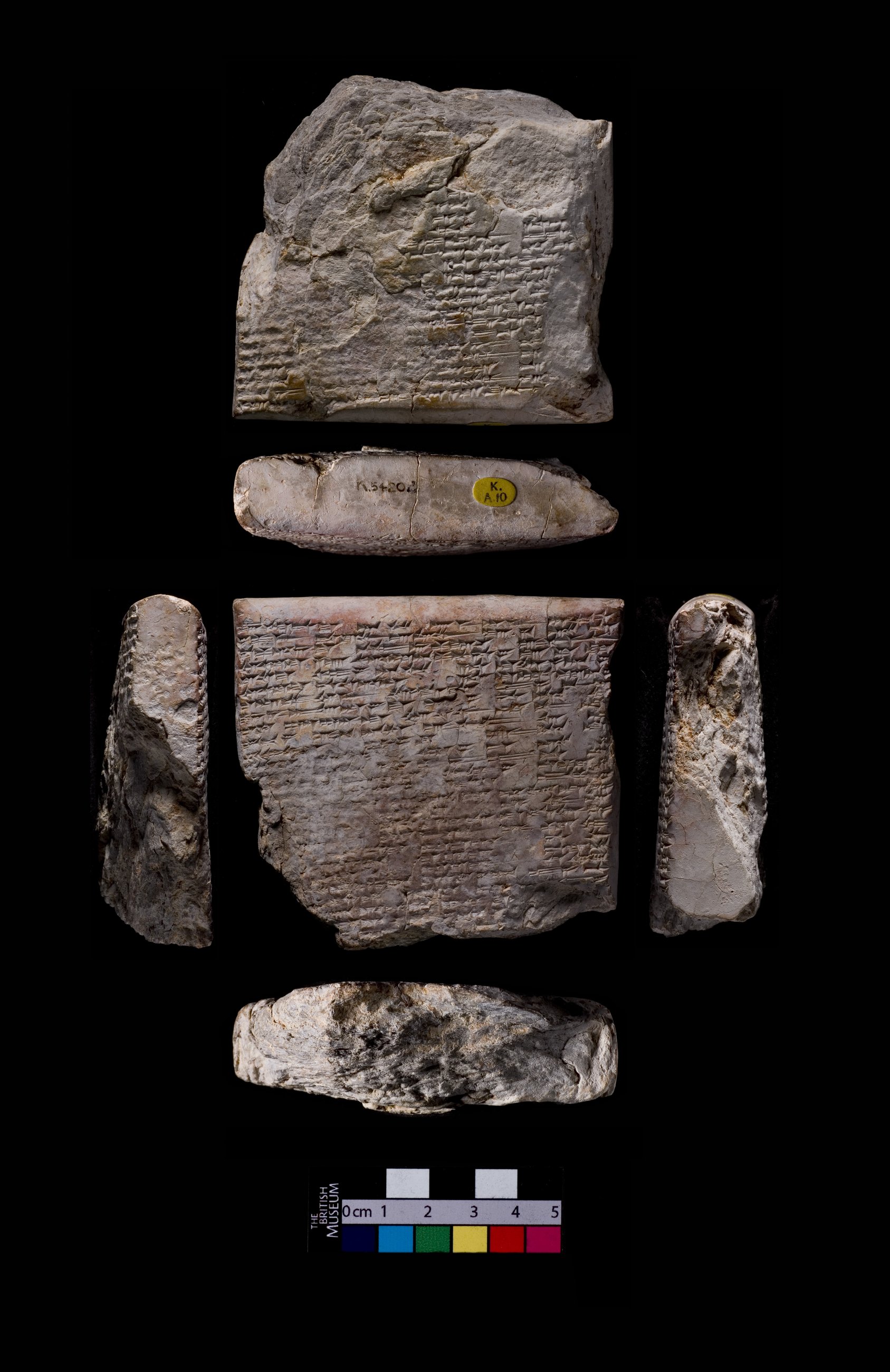
British Museum K.5420.C: obverse, the tablet's own lines 6' to 10'. eBL's corpus edition (https://www.ebl.lmu.de/corpus/L/1/2/SB/IV) attributes SB IV 79-83 to this manuscript at these column and line numbers. Photograph checked: obverse, reverse and edges, ink K.5420c and a yellow label on the top edge. The obverse is worn at the top but has about 15 to 19 lines in its lower part, and the reverse about 25 lines, consistent with eBL's 19 and 27. On this tablet lines 79-83 are partly broken (square brackets and x in the Akkadian). The English of these lines translates eBL's composite text, so it includes words that are not preserved on this tablet but are restored from other manuscripts or by the editors. Square brackets in the English mark eBL's restorations in its composite text; words that survive on other tablets carry no brackets even where this tablet is broken.
79[x x x x x (x) A]D-AD-šu-nu i-da-a[ṣ?-ṣu]
80[x x x a-lit-ta]-šu₂#-nu ta#-zer-ri re-e-[ma]
81[x x x {d}qin-g]u a-na ha-ʾi-i-ru-ti#-k[i]
82[x x x x x x x taš-ku]-ni#-šu₂# a-na pa#-ra-aṣ {d}a-n[u-ti]
83[x x x x x x x lem-n]e-e#-ti te-eš-š[i-ma]
79“The children cried out, they were oppressive to their parents,
80“But you, their own mother, spurned all natural feeling.
81“You named Qingu to be spouse for you,
82“Though he had no right to be, you set him up for chief god.
83“You attempted wicked deeds against Anshar, sovereign of the gods,
Where on the image
British Museum K.3437: reverse, the tablet's own lines 1 to 23. eBL's corpus edition (https://www.ebl.lmu.de/corpus/L/1/2/SB/IV) attributes SB IV 84-106 to this manuscript at these column and line numbers. Photograph checked: obverse, reverse and edges of a large tablet of joined pieces (about 14 cm tall), ink "K.3437, Rm 641, joined" on the left edge, Rm 641 on the obverse and another Rm number on the left edge. Both faces are covered in small script with about 45 to 50 lines each, consistent with eBL's 48 obverse and 46 reverse lines. On this tablet lines 84-86, 90-95, 105-106 are partly broken (square brackets and x in the Akkadian). The English of these lines translates eBL's composite text, so it includes words that are not preserved on this tablet but are restored from other manuscripts or by the editors. Square brackets in the English mark eBL's restorations in its composite text; words that survive on other tablets carry no brackets even where this tablet is broken. Lines 87-89, 96-104 are complete on this tablet.
84[x x x DINGIR].DINGIR# AD.AD-e-a le-mut-ta-ki tuk-tin-n[i]
85[x] ṣa#-an-da-at um-mat-ki lu rit-ku-su šu-nu {giš}TUKUL-MEŠ-ki
86[e]n-di-im-ma a-na-ku u ka-a-ši i ni-pu-uš ša₂-aš₂-ma
87ti-amtu an-ni-ta i-na še-mi-ša₂
88mah-hu-tiš₂ i-te-mi u₂-ša₂-an-ni ṭe₃-en-ša₂
89is-si-ma ti-amtu šit-mu-riš e-li-ta
90šur-šiš ma-al-ma-liš it-ru-ra iš-da-a-[ša₂?]
91i-man-ni šip-ta it-ta-nam-di ta-a-[ša₂?]
92u₃ DINGIR.DINGIR ša₂ ME₃ u₂-ša₂-ʾa-lu šu-nu {giš}TUKUL-MEŠ-šu₂-u[n]
93in-nen-du-ma ti-amtu ABGAL DINGIR-MEŠ {d}AMAR.[UTU]
94ša₂-aš₂-miš₂ it-lu-pu qit-ru-bu ta-ha-z[i-iš]
95uš-pa-ri-ir-ma be-lu₄ sa-pa-ra-šu₂ u₂-šal-m[i-ši]
96im-u₃!?-lu ṣa-bit ar-ka-ti pa-nu-uš-šu₂ um-taš-šir₃
97ip-te-ma pi-i-ša₂ ti-amtu a-na la-ʾ-a-ti-šu₂
98im-hul-la uš-te-ri-ba a-na la ka-tam šap-ti-šu₂
99ez-zu-ti IM-MEŠ kar-ša-ša i-ṣa-nu-ma
100in-ne₂-sil lib₃-ba-ša₂-ma pa-a-ša uš-pal-ki
101is-suk mul-mul-la ih-te-pi ka-ras-sa
102qer#-bi-ša₂ u₂-bat-ti-qa u₂-šal-liṭ lib₃-ba
103ik#-mi-ši-ma nap-ša₂-tiš₂ u₂-bal-li
104ša₂#-lam-<ta>-ša₂ id-da-a UGU-ša₂ i-za-za#
105ul#-tu ti-amta a-lik pa-ni i-na-r[u]
106ki#-iṣ-ri-ša₂ up-tar-ri-ra pu-hur-ša₂ is-sap-[ha]
84“And you have perpetrated your evil against the gods my fathers.
85“Though your main force is drawn up, though these your weapons are in array,
86“Come within range, let us meet in single combat, you and I!”
87When Tiamat heard this,
88She was beside herself, she turned into a maniac.
89Tiamat shrieked loud, in a passion,
90Her frame shook all over, down to the ground.
91She was reciting an incantation, casting her spell,
92While the gods of battle were whetting their blades.
93Tiamat and Marduk, sage of the gods, drew close,
94They locked in single combat, joining for the fray.
95The Lord spread out his net, encircled her,
96The ill wind he was holding behind him he released in her face.
97Tiamat opened her mouth to swallow (him),
98He thrust in the ill wind so she could not close her lips.
99The raging winds bloated her belly,
100Her insides were stopped up, she gaped her mouth wide.
101He shot off an arrow, it ruptured her belly,
102It cut to her innards, it pierced the heart.
103He subdued her and snuffed out her life,
104He flung down her carcass, he took a stand upon it.
105After he had slain Tiamat, the vanguard.
106Her forces scattered, her host dispersed.
Where on the image
British Museum K.3437: reverse, the tablet's own lines 24 to 46. eBL's corpus edition (https://www.ebl.lmu.de/corpus/L/1/2/SB/IV) attributes SB IV 107-129 to this manuscript at these column and line numbers. Photograph checked: obverse, reverse and edges of a large tablet of joined pieces (about 14 cm tall), ink "K.3437, Rm 641, joined" on the left edge, Rm 641 on the obverse and another Rm number on the left edge. Both faces are covered in small script with about 45 to 50 lines each, consistent with eBL's 48 obverse and 46 reverse lines. On this tablet of line 129 only one to three signs survive and lines 107-128 are partly broken (square brackets and x in the Akkadian). The English of these lines translates eBL's composite text, so it includes words that are not preserved on this tablet but are restored from other manuscripts or by the editors. Square brackets in the English mark eBL's restorations in its composite text; words that survive on other tablets carry no brackets even where this tablet is broken.
107u₃ DINGIR.DINGIR re-ṣu-ša₂ a-li-ku i-di-[ša₂]
108it#-tar-ru ip-la-hu u₂-sah-hi-ru ar-kat₃-su-[un]
109u₂#-še-ṣu-ma nap-ša₂-tuš e-ṭe-[ra]
110ni#-ta la-mu-u₂ na-par-šu-diš la le-ʾ#-[e]
111i#-sir₂-šu₂-nu-ti-ma {giš}TUKUL-MEŠ-šu₂-nu u₂-ša[b-bir]
112sa#-pa-riš na-du-ma ka-ma-riš u[š-bu]
113e[n]-du tub₂-qa-a-ti ma-lu-u₂ d[u-ma-mi]
114še#-ret-su na-šu-u₂ ka-lu-u₂ [x x x]
115u₃ iš-ten₂-eš-ret nab-ni-ti šu-ut pul-ha-ti ṣ[a-ʾ-nu]
116mi-il-la gal-le-e a-li#-[ku x x x x x]
117it#-ta-di ṣer-re-e-ti# i#-di#-šu₂#-[nu# x x x]
118qa₂-du tuq-ma-ti-šu₂-nu ša₂-pal-šu₂ [x x x]
119u₃ {d}qin#-gu ša₂ ir-ta-bu-u₂ b[i-ri-šu₂-un]
120[ik-m]i-šu-ma it-ti {d}UG₅.GA-e šu-a-[tu x x x]
121[i-ki]m-šu-ma DUB NAM-MEŠ la si-m[at!?-ti-šu]
122[x x k]i-[š]ib-bi ik-nu-kam₂-ma ir-t[uš x x]
123[ul-t]u lem-ne₂-e-šu₂ ik-mu-[u₂ x x x]
124[a-a]-bi mut-ta-du u₂-ša₂-p[u-u x x x]
125[er-ni]t-ti an-šar₂ UGU na-ki-ri k[a-liš x x x x]
126[ni-i]z-mat {d}nu-dim₂-mud i[k-šu-du x x x x x]
127[x x] DINGIR.DINGIR ka-mu-u₂-ti ṣi-b[it-ta-šu x x x x]
128[ṣe-r]iš ti-a₃-wa-ti ša₂ ik-mu-[u₂ x x x x x]
129[ik-bu-us]-ma?# [x x x t]i-amti# [x x x]
107As for the gods her allies, who had marched beside her,
108In fear and trembling they turned tail,
109They tried to find a way out to save their lives,
110There was no escaping the mesh that encircled them.
111He drew them in and smashed their weapons.
112They were cast in the net and sat in a heap,
113They were heaped up in the corners, full of woe,
114They were bearing his punishment, held in confinement.
115As for the eleven creatures, the ones adorned with glories,
116The demonic horde(?), who went as flunkies at her side,
117He put on leadropes, he trussed their arms.
118He trampled them under, together with their belligerence.
119As for Qingu, who was trying to be great among them,
120He bound him and reckoned him among the doomed gods.
121He took away from him the tablet of destinies, which he had no right to,
122He sealed it with a seal and affixed it to his chest.
123Having captured his enemies and triumphed,
124Having shown the vaunted foe subservient(?),
125Having brought about Anshar's victory over all his enemies,
126Having attained what Nudimmud desired, young Marduk
127Made firm his hold over the captured gods,
128Then turned back to Tiamat whom he had rendered helpless.
129The Lord trampled upon the frame of Tiamat,
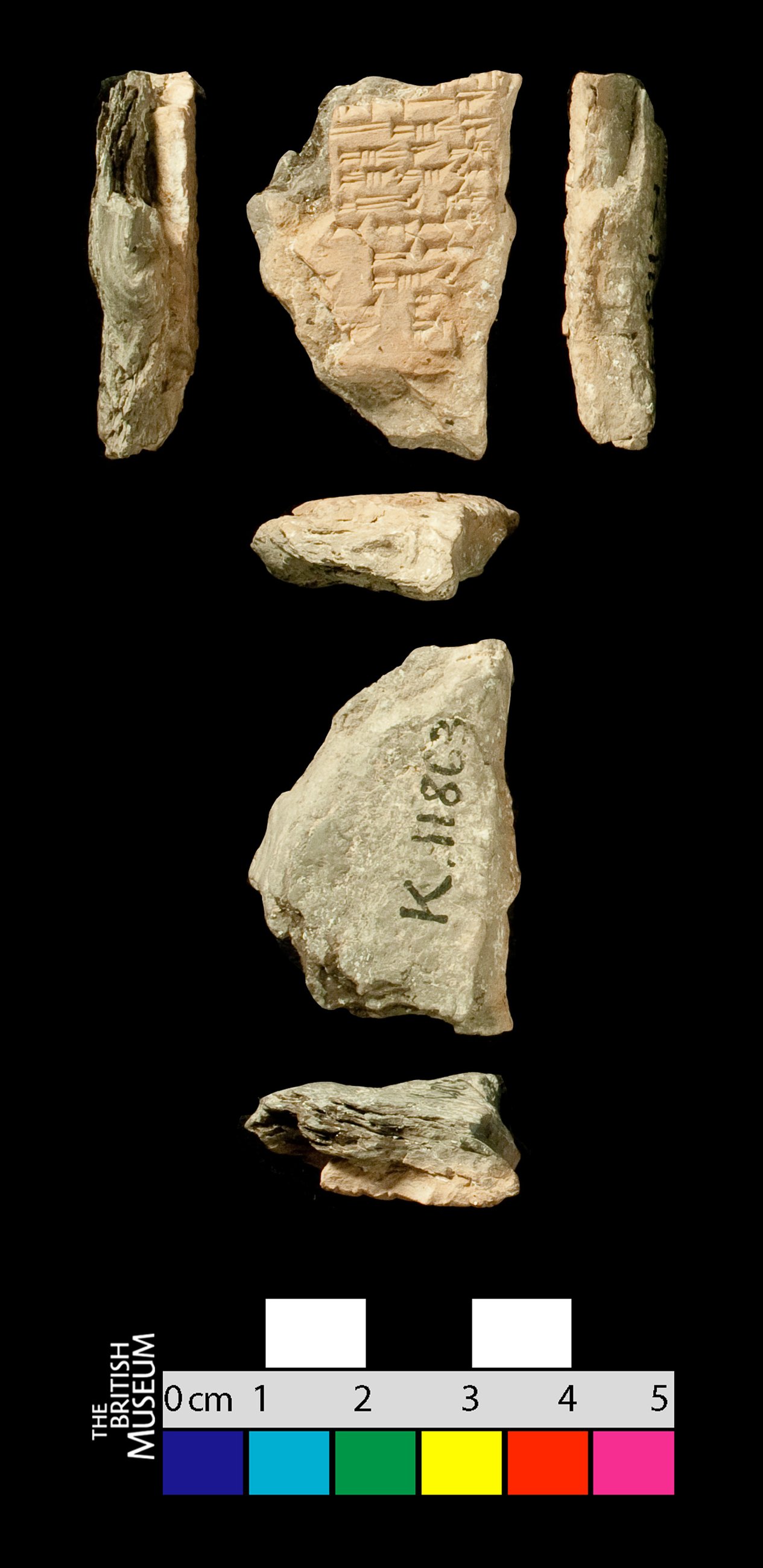
Where on the image
British Museum K.11863: reverse, the tablet's own lines 1' to 11'. eBL's corpus edition (https://www.ebl.lmu.de/corpus/L/1/2/SB/IV) attributes SB IV 136-146 to this manuscript at these column and line numbers. Photograph checked: both faces and edges, ink K.11863 on the uninscribed face. The inscribed face has about ten lines (photographed in the obverse position, which eBL calls the reverse), broadly consistent with eBL's eleven lines of Tablet IV plus one line of Tablet V. On this tablet of lines 136, 139-141, 143-146 only one to three signs survive and lines 137-138, 142 are partly broken (square brackets and x in the Akkadian). The English of these lines translates eBL's composite text, so it includes words that are not preserved on this tablet but are restored from other manuscripts or by the editors. Square brackets in the English mark eBL's restorations in its composite text; words that survive on other tablets carry no brackets even where this tablet is broken.
136[x x x x x x x x x x x ni]k-la#-a#-[ti]
137[x x x x x x x x x x x] a#-na# ši#-ni-[šu]
138[x x x x x x x x x ša₂-ma-m]i u₂-ṣal-l[il]
139[x x x x x x x x x] u₂-ša₂-aṣ-[bit]
140[x x x x x x x x x x] um-ta-ʾ-[ir]
141[x x x x x x x x] i-hi-ṭa[m-ma]
142[x x x x x x x x x šu]-bat {d}nu-d[im₂-mud]
143[x x x x x x x x x] bi-nu-[tuš-šu₂]
144[x x x x x x x u₂-ki]n e₂-šar₂#-[ra]
145[x x x x x x x ib-n]u-u ša₂-[ma-mi]
146[x x x x x x x x x ma-ha-zi-šu-u]n uš-[ram-ma]
136That he might divide the brine and fashion artful things.
137He split her in two, like a fish for drying,
138Half of her he set up and made as a cover, heaven.
139He stretched out the hide, assigned watchmen,
140Them he ordered not to let her waters escape.
141He crossed heaven, he inspected the firmament,
142He made it a counterpart to Apsu, the dwelling of Nudimmud.
143The Lord measured the construction of Apsu,
144He founded the Great Sanctuary, the likeness of Esharra
145(In) the Great Sanctuary, the Esharra he had built, (and in) heaven,
146He made Ea, Enlil, and Anu dwell in their holy places.
Notes
- Akkadian: eBL transliteration of the signs on the photographed tablet (manuscript-level ATF), not a composite text.
- English: B. R. Foster's translation in the eBL edition; it renders eBL's composite text, including restorations from other tablets.
- Line numbers: eBL edition. Each section also gives the tablet's own column and line numbers.
- Signs in the Akkadian: [ ] broken away; x illegible sign; # damaged sign; ? uncertain reading; ! sign corrected by the editor; ( ) signs perhaps broken away; { } determinative; {+ } phonetic gloss; < > sign omitted by the scribe, supplied by the editor.
Cite
Sources
- Source: British Museum tablet photographs + eBL manuscript transliterations (eBL corpus edition L I.2, Poem of Creation (Enuma elish) (ed. A. C. Heinrich, rev. Z. J. Földi and E. Jiménez), SB IV) + English of the eBL edition (B. R. Foster (eBL edition)) (holding institution)
- Critical edition: electronic Babylonian Library, Poem of Creation (ed. A. C. Heinrich), manuscript transliterations
← previous · → next · v cycle view · l back to library