Enuma Elish, Tablet V: the ordering of the universe
Introduction
Marduk sets the stars, the year and the moon in their courses, forms features of the world from Tiamat's body, returns to the gods, is acclaimed king, and announces the building of Babylon.
Enuma Elish ('When on high'), the Babylonian Poem of Creation, tells how Marduk, god of Babylon, defeated Tiamat, created the ordered world and became king of the gods. It was written on seven tablets and recited in Babylon during the New Year festival. The date of composition is debated (proposals range from the 18th to the 12th century BCE); the surviving copies date from the 9th to the 2nd century BCE and come from Ashur, Nineveh, Kish, Babylon, Sippar, Uruk and other sites. This page follows the line numbering of the electronic Babylonian Library edition.
How this page is built. Each section is a run of consecutive lines as written on one photographed clay tablet. For every line the eBL edition (https://www.ebl.lmu.de/corpus/L/1/2/SB/V) lists the manuscripts that carry it, with each tablet's own column and line numbers; the tablet chosen for each run is the photographed copy of the work with the most signs preserved there. Commentaries and texts that only quote a line are never chosen. School and excerpt tablets are used only for lines that no photographed library copy preserves as well, and only where they carry the line as text; their sections say so (BM.38049, BM.43969). The original text is eBL's transliteration of that tablet's signs (not a modern composite text): square brackets mark broken signs, x an illegible sign, # a damaged sign, ? an uncertain reading, and words in {braces} are determinatives; the notes give a key to every sign used on this page, and eBL's layout codes are written out in words (for example '(line break)' or '(blank space)'). Superscript numbers are the line numbers of the eBL edition, used in both the Akkadian and the English. The English is B. R. Foster's translation in the eBL edition (CC BY-NC-SA 4.0), one line of English per line of the poem; italics mark uncertain renderings, as in the source. Where the tablet is broken, the English still translates the whole line of eBL's composite text; each section's note names the lines that are broken on its tablet.
Finding a line on the photograph. Each section names the tablet, the face and column, and the tablet's own line numbers (a prime, as in 5', counts from the first preserved line of a broken column). On a tablet with six columns the obverse carries columns i-iii from left to right; the reverse, turned over from bottom to top, carries columns iv-vi from right to left. The photographs often show the obverse above the reverse with the edges around them; a fragment preserves only part of this layout.
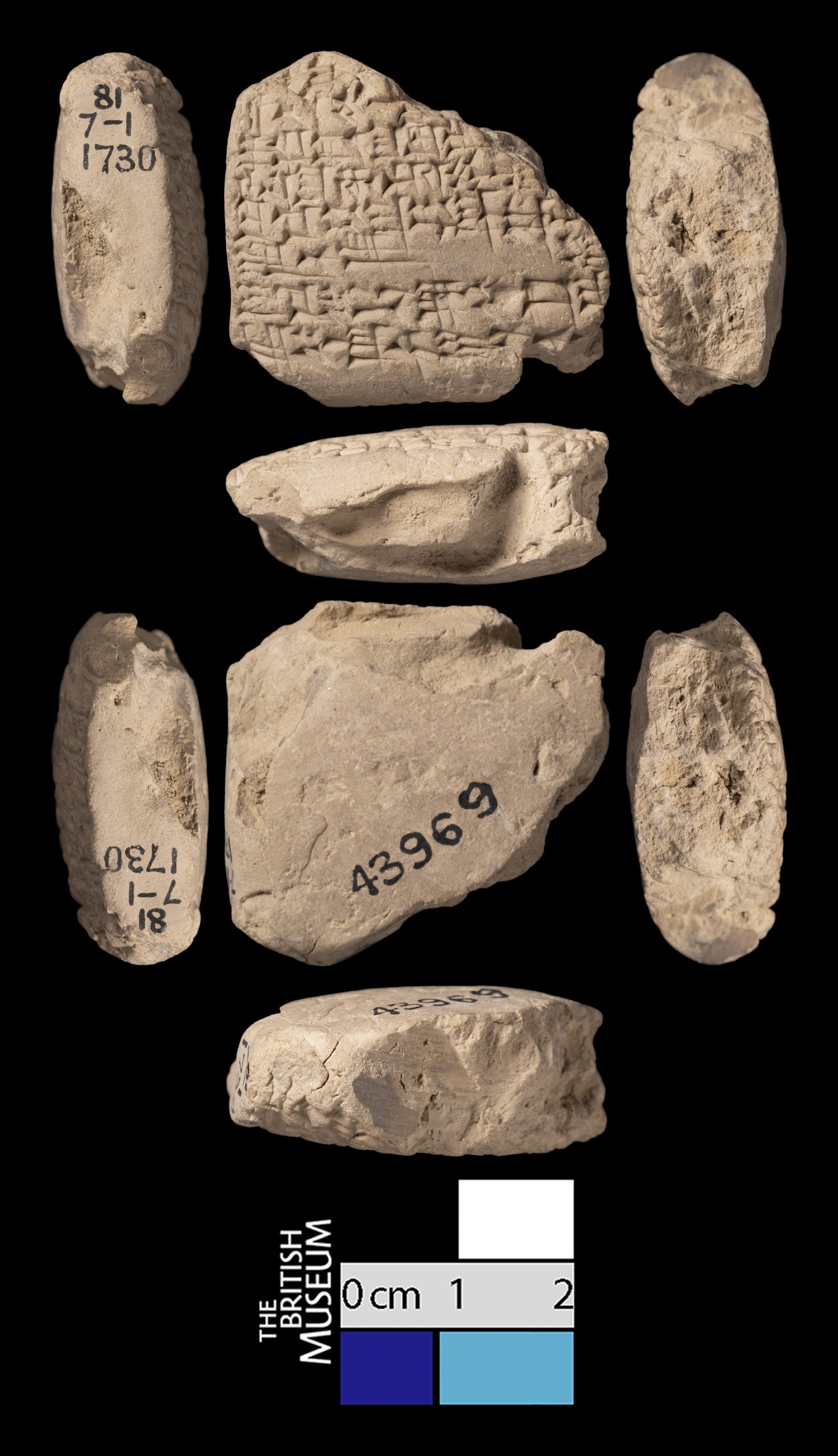
This page shows 135 of the 158 lines of the eBL edition (85%), from 5 tablets in the British Museum: K.3567 (Nineveh), K.3445 (Nineveh), BM.38049, 1879,0708.47 (Nineveh), BM.43969.
Lines not shown. 23 of the 158 lines of the eBL edition are not shown, because no photographed copy of the work used here carries them: 64 (no photograph in eBL: SU-1951.98 (Museum of Anatolian Civilizations, Ankara); commentary: BM.66606); 65-69 (no photograph in eBL: SU-1951.98 (Museum of Anatolian Civilizations, Ankara)); 70 (no photograph in eBL: SU-1951.98 (Museum of Anatolian Civilizations, Ankara); commentary: Rm.395, BM.66606); 71-76 (no photograph in eBL: SU-1951.98 (Museum of Anatolian Civilizations, Ankara)); 81-82 (no photograph in eBL: SU-1951.98 (Museum of Anatolian Civilizations, Ankara); quotation in another text: 79.B.1/30, BM.38706); 83 (no photograph in eBL: SU-1951.98 (Museum of Anatolian Civilizations, Ankara); commentary: BM.66606; quotation in another text: BM.32206); 84 (no photograph in eBL: SU-1951.98 (Museum of Anatolian Civilizations, Ankara); commentary: BM.66606); 85-89 (no photograph in eBL: SU-1951.98 (Museum of Anatolian Civilizations, Ankara)); 90 (no photograph in eBL: SU-1951.98 (Museum of Anatolian Civilizations, Ankara), VAT.12915 (Vorderasiatisches Museum, Berlin); commentary: Rm.395). A line is shown only on a photographed tablet that carries it as text. Commentaries and other texts that quote a line (letters, rituals, god lists) are not used as witnesses, because they carry it with explanations or inside another text; tablets without a photograph in eBL are not used, because the line could not be shown on its tablet.
How was this verified? (Provenance)
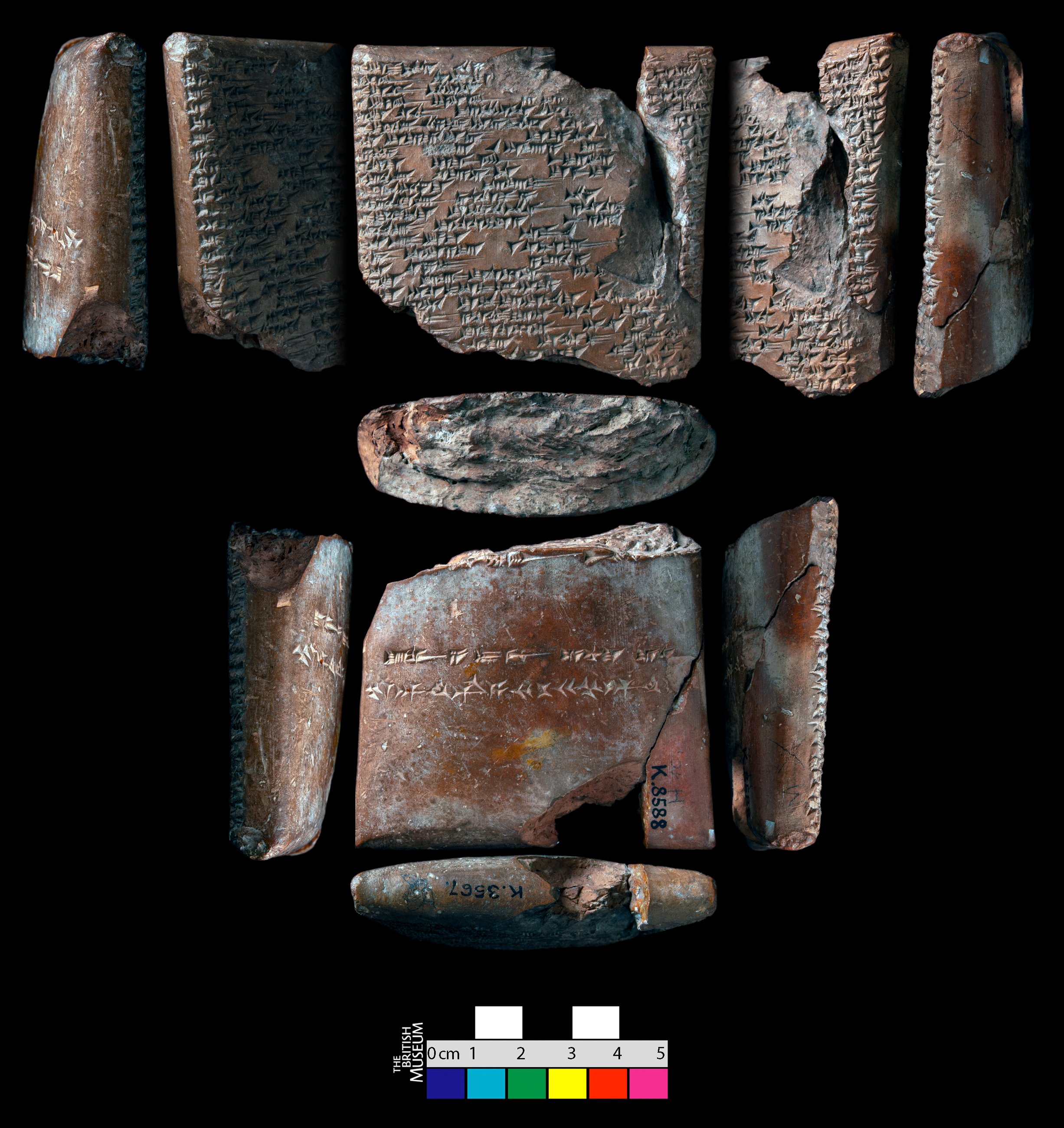
Where on the image
British Museum K.3567: obverse, the tablet's own lines 1 to 26. eBL's corpus edition (https://www.ebl.lmu.de/corpus/L/1/2/SB/V) attributes SB V 1-26 to this manuscript at these column and line numbers. Photograph checked: obverse, reverse and edges, ink K.3567 on the bottom edge and K.8588 on a joined piece. About 25 to 27 lines on the obverse, consistent with eBL's 27 obverse lines of Tablet V. The reverse is broken at the top: a damaged row of signs along the broken upper part is eBL's reverse 1'-2' (V 158 lost at r 1', then the catch-line VI 1 at r 2'); after a blank space, the two clear lines in the middle of the reverse are Ashurbanipal's colophon (eBL r 3'-4', 'tup-pi 5.KAM2.ME e-nu-ma e-lis'), as eBL's record of K.3567 for Tablet V (colophon field) gives them. On this tablet of line 25 only one to three signs survive and lines 1-24, 26 are partly broken (square brackets and x in the Akkadian). The English of these lines translates eBL's composite text, so it includes words that are not preserved on this tablet but are restored from other manuscripts or by the editors. Square brackets in the English mark eBL's restorations in its composite text; words that survive on other tablets carry no brackets even where this tablet is broken.
1u₂-ba-aš₂-šim man-za-[za x x x GA]L.GAL
2MUL-MEŠ tam-šil-šu-n[u lu-ma-š]i uš-zi-iz
3u₂-ad-di MU.AN.NA m[i-iṣ-ra-ti] u₂#-ma-aṣ-ṣir
412 ITI-MEŠ MUL-MEŠ 3#.TA#.[AM₃] uš-zi-iz
5iš-tu u₄-mi ša MU.AN.NA uṣ-ṣ[i-ru] u₂#-ṣu#-ra-ti
6u₂-šar-šid man-za-az {d}ne₂-be₂-ri ana ud-du#-[u rik-s]i-šu₂-un
7a-na la e-peš an-ni la e-gu-u# [ma-n]a-ma
8man-za-az {d}+en-lil₂ u {d}e₂-a u₂-k[in it-t]i-šu
9ip-te-ma ABUL-MEŠ ina ṣe-li [ki-lal]-la-an
10ši-ga-ru ud-dan-ni-na šu-me-la [x i]m-na
11ina ka-bat-ti-ša₂-ma iš-ta-kan e#-[la]-a#-ti
12{d}nanna-ru uš-te-pa-a mu-ša₂ i[q-t]i-pa
13u₂-ad-di-šum-ma šu-uk-nat mu-ši a-na ud-d[u-u₂] u₄#-mi₃
14ar-hi-šam la na-par-ka-a ina a-ge-[e u₂]-ṣir
15i-na SAG ITI-ma na-pa-hi e#-[la-a-t]i
16qar-ni na-ba-a-ta ana ud-du-u₂ za-k[a?-ri u₄]-mi
17i-na U₄.7.KAM₂ a-ga-a [maš]-la
18[š]a₂-pat-tu lu-u₂ šu-tam-hu-rat miš₂-l[i ar-hi]-šam
19[e-n]u-ma {d}UTU i-na i-šid AN-e ina-[aṭ-ṭa-l]u?-ka
20[x s]i?-im!?#-ti šu-tak-ṣi-ba-am-ma bi-ni# ar#-ka#-[nu]-uš
21[bu-ub-bu-l]u₄ a-na har-ra-an {d}UTU šu-taq-rib#-[m]a
22[x x U₄.3]0.KAM₂# lu šu-tam-hu-rat {d}UTU lu ša₂-na-[at]
23[x x x x (x)] x GISKIM ba-ʾ-i u₂-ru-uh-ša₂#
24[x x x x x x š]u-taq#-ri#-ba#-ma di-na di-n[a]
25[x x x x x (x) x x x x] ha-ba-la#
26[x x x x x (x) x x x x n]i ia-a-t[i]
1He made positions for the great gods,
2He set up constellations, the star images.
3He marked the year, drew (its) boundaries,
4He set up twelve months of three stars each.
5After he had laid out the plan for the days of the year,
6He fixed the position of Neberu to mark the (stars’) relationships.
7Lest any make an error or go astray,
8He established the position(s) of Enlil and Ea in relation to it.
9He opened up gates on both (sides of her) ribs,
10He made strong bolts to left and right.
11He established the heights in her vitals,
12He made the moon appear, entrusted (to him) the night.
13He assigned to him the crown jewel of nighttime to mark the days (of the month),
14Every month, without ceasing, he exalted him with a crown.
15“At the beginning of the month, waxing over the land,
16“You shine with two horns to mark the naming of six days,
17“At the seventh day, the crown is [ha]lf.
18“At the fifteenth day, you shall be in opposition, at the midpoint of each [month].
19“When the sun can see you on the horizon,
20“Wane at the same pace and form in reverse.
21“At the day of di[sappeara]nce, approach the sun's course,
22“On the thirtieth day, you shall be in conjunction with the sun as a double.
23“I d[efined?] the celestial signs, proceed on their path,
24“[…] approach each other and render (oracular) judgment.
25“You, the sun, … shall abjure murder, wrong-doing,
26“[…] me.”
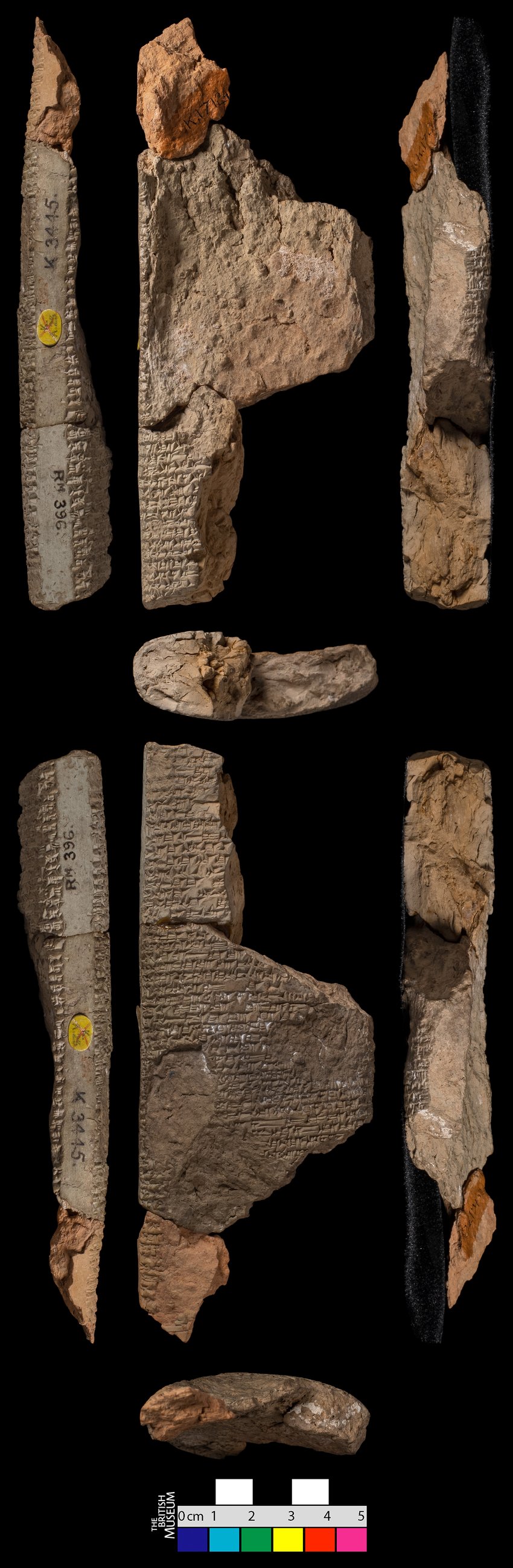
Where on the image
British Museum K.3445: obverse, the tablet's own lines 9' to 24'. eBL's corpus edition (https://www.ebl.lmu.de/corpus/L/1/2/SB/V) attributes SB V 27-42 to this manuscript at these column and line numbers. Photograph checked: obverse, reverse and edges of a tall tablet (about 15 cm) of joined pieces, ink K.3445, Rm 396 and a yellow label on the left edge and K.171.. (partly legible) on a small reddish piece at the top. The reverse is covered in very small script, about 60 or more lines, consistent with eBL's 68; the obverse surface is lost in its upper half but keeps line beginnings down its left side and about 20 to 25 full lines below, enough for eBL's 40. On this tablet of lines 27-42 only one to three signs survive. The English of these lines translates eBL's composite text, so it includes words that are not preserved on this tablet but are restored from other manuscripts or by the editors. Square brackets in the English mark eBL's restorations in its composite text; words that survive on other tablets carry no brackets even where this tablet is broken.
27e [...]
28qar-[x ...]
29{d}U[TU ...]
30ina x [...]
31lu-[u₂ x x x x x ...]
32at#-t[a? x x ...]
33a-a# [x x x x x ...]
34šu-[nu x x x x x ...]
35ina t[aq?-ti-it ...]
36UD.N[A₂.AM₃ x x x ...]
37ul-[tu x x x x (x) ...]
38u₂-[ṣu-ra-a-ti x x x x ...]
39ib-[ni-ma ...]
40MU.AN#.[NA x x x x x x x x ...]
41ina zag#-[muk-ki ...]
42MU#.AN#.[NA# ...]
27W[hen he …]
28The val[iant …]
29The sun […]
30In […]
31“[Let …] be given to him […]
32“You and he […]
33“Let there arise no […]
34“Let them be complete […]
35“At the end [of each month …]
36“Let there be the day of disappearance (of the moon) […].”
37After [he had …] given the orders,
38[He made] the plans for day [and night(?)],
39He made the day […]
40“Let the year be equal [in days and nights],
41“At New Year […]
42“(Another) year […]
Where on the image
British Museum K.3445: obverse, the tablet's own lines 25' to 40'. eBL's corpus edition (https://www.ebl.lmu.de/corpus/L/1/2/SB/V) attributes SB V 43-58 to this manuscript at these column and line numbers. Photograph checked: obverse, reverse and edges of a tall tablet (about 15 cm) of joined pieces, ink K.3445, Rm 396 and a yellow label on the left edge and K.171.. (partly legible) on a small reddish piece at the top. The reverse is covered in very small script, about 60 or more lines, consistent with eBL's 68; the obverse surface is lost in its upper half but keeps line beginnings down its left side and about 20 to 25 full lines below, enough for eBL's 40. On this tablet of line 58 only one to three signs survive and lines 43-57 are partly broken (square brackets and x in the Akkadian). The English of these lines translates eBL's composite text, so it includes words that are not preserved on this tablet but are restored from other manuscripts or by the editors. Square brackets in the English mark eBL's restorations in its composite text; words that survive on other tablets carry no brackets even where this tablet is broken.
43lu-u₂ ka#-a#-[a-nam-ma ...]
44si-gar a-ṣi-t[i ...]
45ul-tu u₄-me u₂#-[...]
46ma-aṣ-rat mu-ši u i[m-mi ...]
47ru-pu-uš-tu₂ ša₂ ti-a[mti ...]
48AN.ŠAR₂ ib-ta-š[im ...]
49ik-ṣur-ma ana u[r-pe-e-ti x x x x x]
50te-bi ša₂-a-ri š[u-uz-nu-nu x x x]
51šu-uq#-tur IM.D[UGUD x x x x x]
52u₂-ad#-di-ma r[a-ma-nu-uš x x x x x x]
53iš-kun SAG.D[U-sa x (x x) x x x x]
54nag-bu up-te-et#-[ta-a x x x x x]
55ip-te-e-ma ina I[GI!?+MIN-ša₂ x x x x x x x x]
56na-hi-ri-ša₂ up-t[e-eh-ha-a (x) x x x x x x]
57iš-pu-uk ina ṣ[er-ti-ša₂ x x x x x x]
58nam#-ba#-ʾi# [x x x x x x x x x x]
43“Let there be regularly […],
44“The door bolt of … [ ].”
45After he had as[signed] the days […],
46[And fixed] the divisions of night and day,
47[…] the foam of Tiamat,
48Marduk created […]
49He compacted (the foam) and made it billow as clouds.
50To raise the wind, to cause rainfall,
51To make mists steam, to pile up her spittle (as snow?),
52He assigned to himself, put under his control.
53He set down her head, he heaped di[rt] upon it,
54He opened underground springs, they filled up with water.
55From her eyes he let the Euphr[ates] and Tigris flow out,
56He stopped up her nostrils, he left …
57He heaped up distant mo[unt]ains from(?) her dugs.
58Waterholes he drilled through her to flow out into pools.
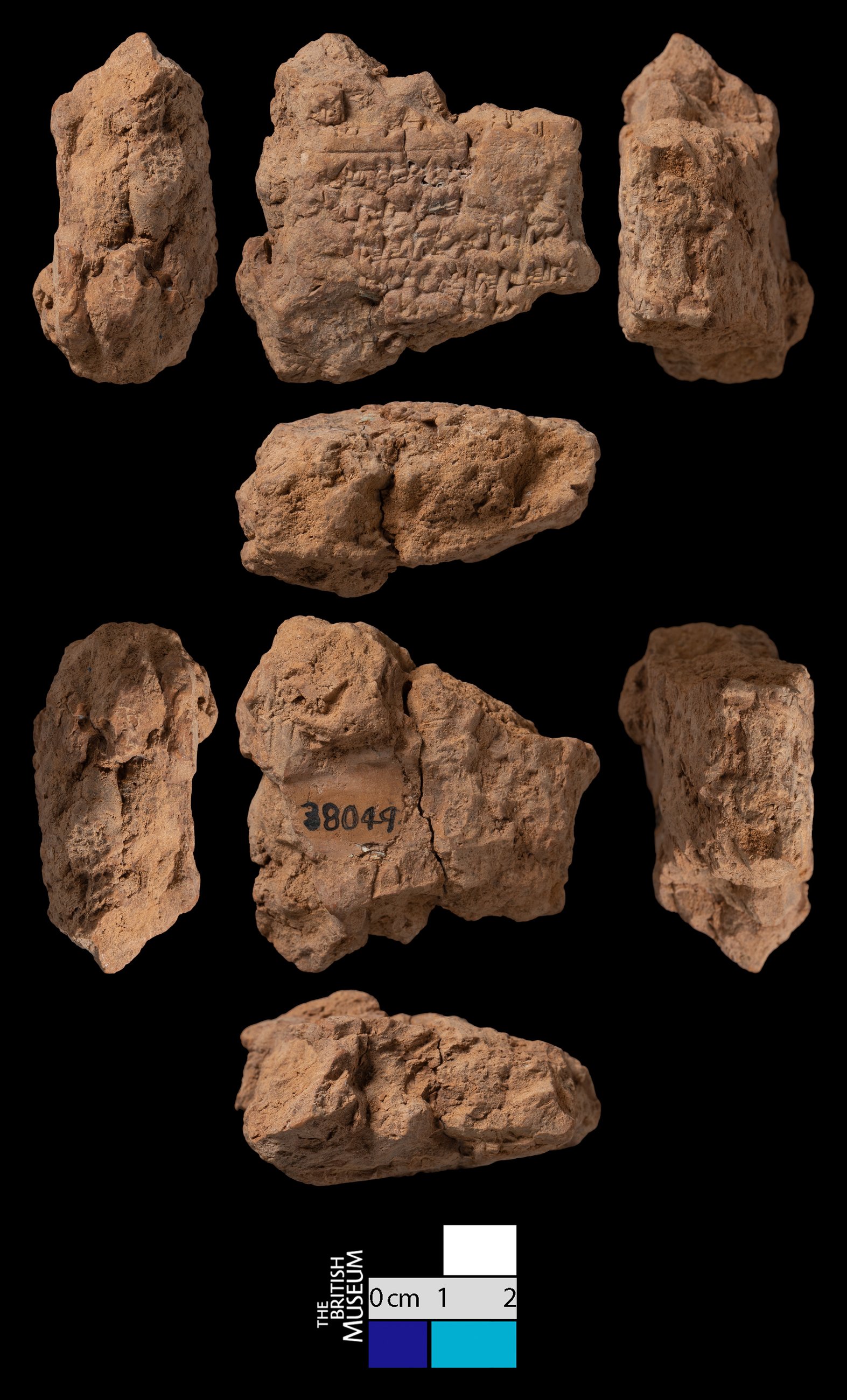
Where on the image
British Museum BM.38049: obverse, the tablet's own lines 3' to 7'. eBL's corpus edition (https://www.ebl.lmu.de/corpus/L/1/2/SB/V) attributes SB V 59-63 to this manuscript at these column and line numbers. Photograph checked: obverse, reverse and edges, ink 38049 on the reverse. About six to eight worn lines on the obverse below a ruling, enough for eBL's five; the reverse is uninscribed. eBL classes BM.38049 as a school tablet (a scribal exercise that copies an excerpt of the text), not a library copy of the whole work. It carries these lines as text (eBL's transliteration has no commentary or quotation markup), and it is used because no photographed library copy preserves these lines as well. On this tablet of line 63 only illegible traces (x) survive and lines 59-62 are partly broken (square brackets and x in the Akkadian). The English of these lines translates eBL's composite text, so it includes words that are not preserved on this tablet but are restored from other manuscripts or by the editors. Square brackets in the English mark eBL's restorations in its composite text; words that survive on other tablets carry no brackets even where this tablet is broken.
59[x x zib]-bat#-sa# dur₂#-ma-hi#-iš# [x x x x]
60[x (x x)] x ap-si#-i# [x x š]e-p[u-uš-šu]
61[x x (x) ha-a]l-la# ša ZAG?# re!#-ta!#-ti# š[a-ma-mi]
62[mi-ši-il-š]a₂ uṣ#-ṣal#-li#-la er-ṣe-ti₃# [x x x]
63[x x x x (x)] x x x x (x x) [x x x (x)]
59He coiled up her tail and tied it as “The Great Bond” (of heaven and earth),
60[…] Apsu beneath his feet.
61He set her crotch as the brace of heaven,
62Having spread [half of] her as a cover, he established the earth.
63[After] he had completed his task inside Tiamat,
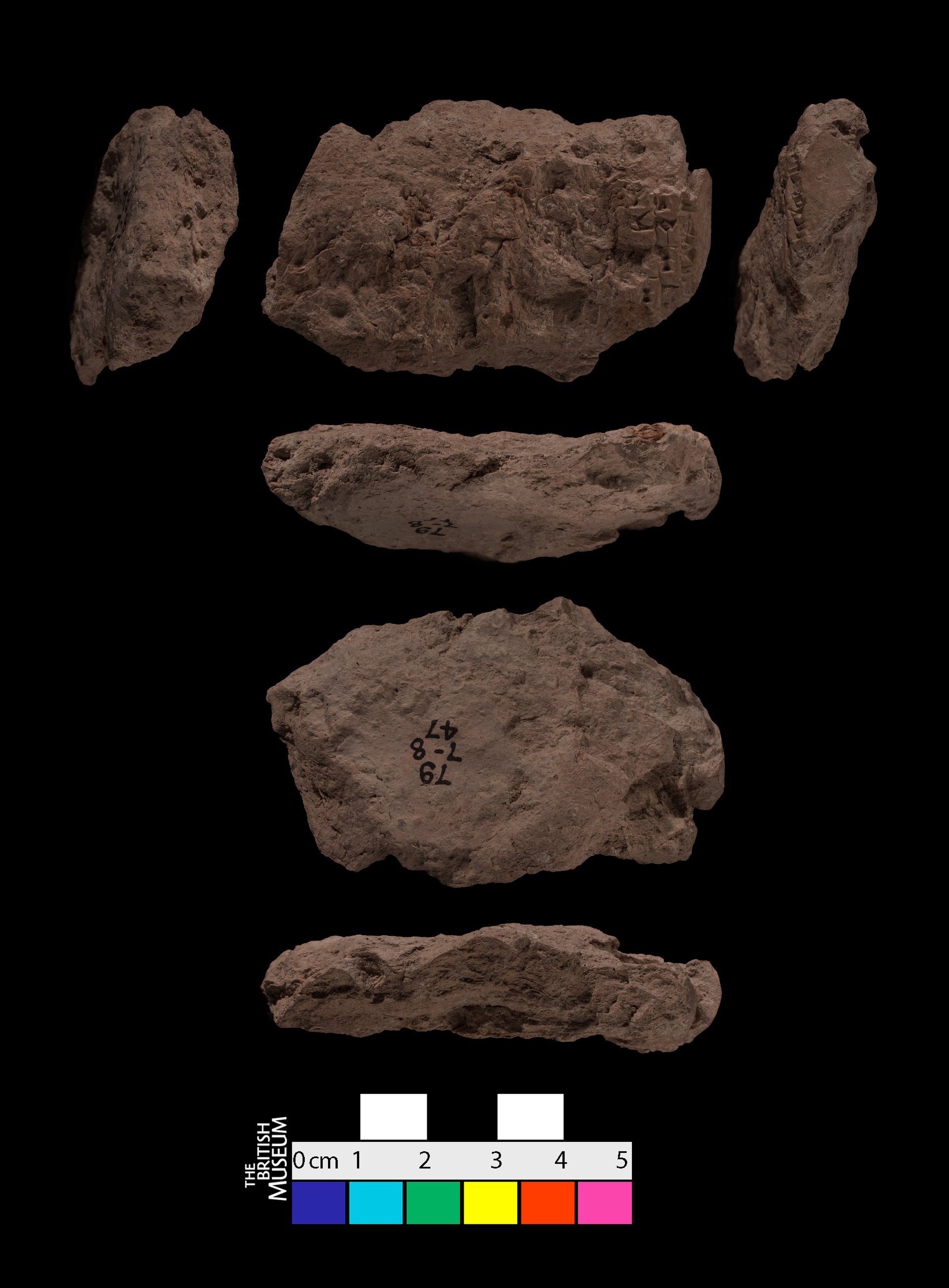
Where on the image
British Museum 1879,0708.47: obverse, the tablet's own lines 1' to 4'. eBL's corpus edition (https://www.ebl.lmu.de/corpus/L/1/2/SB/V) attributes SB V 77-80 to this manuscript at these column and line numbers. Photograph checked: obverse, reverse and four edges, ink number 79-7-8,47 on the reverse and lower edge. The obverse is badly worn with signs from about four or five lines surviving only along its right side, consistent with eBL's four obverse lines; the reverse is uninscribed. On this tablet of line 77 only one to three signs survive and lines 78-80 are partly broken (square brackets and x in the Akkadian). The English of these lines translates eBL's composite text, so it includes words that are not preserved on this tablet but are restored from other manuscripts or by the editors. Square brackets in the English mark eBL's restorations in its composite text; words that survive on other tablets carry no brackets even where this tablet is broken.
77[x x x x] DINGIR#-[MEŠ x x x x x x x x x]
78[x x x] u₃# {d#}la#-ha-mu# [...]
79[i-dir-šum]-ma an-šar₂ LU[GAL x x x x x x]
80[x x x {d}+e]n-lil₂ u₃ {d#}[e₂-a x x x x x x x x x]
77When [the gods] saw, they rejoiced and were glad,
78Lahmu, Lahamu, and all his fathers.
79Anshar [embra]ced him, proclaimed he be hailed as “the king.”
80[A]nu, Enlil, and Ea gave him gifts,
Where on the image
British Museum K.3445: reverse, the tablet's own lines 1' to 15'. eBL's corpus edition (https://www.ebl.lmu.de/corpus/L/1/2/SB/V) attributes SB V 91-109 to this manuscript at these column and line numbers. Photograph checked: obverse, reverse and edges of a tall tablet (about 15 cm) of joined pieces, ink K.3445, Rm 396 and a yellow label on the left edge and K.171.. (partly legible) on a small reddish piece at the top. The reverse is covered in very small script, about 60 or more lines, consistent with eBL's 68; the obverse surface is lost in its upper half but keeps line beginnings down its left side and about 20 to 25 full lines below, enough for eBL's 40. On this tablet lines 96, 98, 100, 103 are entirely broken, of line 91 only illegible traces (x) survive, of lines 92, 97 only one to three signs survive and lines 93-95, 99, 101-102, 104-109 are partly broken (square brackets and x in the Akkadian). The English of these lines translates eBL's composite text, so it includes words that are not preserved on this tablet but are restored from other manuscripts or by the editors. Square brackets in the English mark eBL's restorations in its composite text; words that survive on other tablets carry no brackets even where this tablet is broken.
91x [... x x x x x x]
92ha-šur-ru x [... x x x x x x]
93u₂#-[t]e-di#-iq-ma [x x x x x x x]
94[me-la]m-mi₃ šar-r[u-ti x x x x x x x]
95iš!?#-ši!?#-ma!?# {giš}MITUM im-n[a-šu₂ x x x x : ]
96[...]
97iš#-kun UGU x [... : ]
98[... x x x x x x x x x x x]
99uš-par₂ šul-mi₃ [x x x x x x x x x x : ]
100[...]
101ul-tu me-lam#-mi₃# x [...]
102a-za-mil-šu₂ ABZU ra-šub-b[a-tu ... : ]
103[x x x x x ...]
104ina e-ma-ši aš₂-t[i-šu₂ ...]
105ina si-ma-ak-ki-šu₂ [...]
106DINGIR-MEŠ ma-la ba-šu-[u₂ ...]
107{d}lah₃-mu u {d}[la-ha-mu ...]
108i-pu-šu-ma pa-[a-šu-nu x x x x x x x x x x x x]
109pa-na-a-ma AN.ŠAR₂# [x x x x x]
91[…] …
92With cedar [oil] and […] he anoi[nted] his body,
93He clothed himself in [his] lordly [rai]ment,
94The kingly glory, the awe-inspiring tiara,
95He picked up the mace, he held it in his right hand,
96[…] he held in his left hand.
97He set […] upon […],
98He rested his feet on a dragon.
99The staff of success and authority [he hung] at his side.
100He […] the […] of kingship,
101After he [had put on] glory,
102His netted sack, the Apsu […] awesomeness.
103He was seated like […]
104In [his] throne room […]
105In his cella […]
106The gods, all there are, […]
107Lahmu and Lahamu […]
108Made ready to speak and [said to] the Igigi-gods,
109“Formerly [Mar]duk was 'our beloved son’,
Where on the image
British Museum K.3445: reverse, the tablet's own lines 16' to 31'. eBL's corpus edition (https://www.ebl.lmu.de/corpus/L/1/2/SB/V) attributes SB V 110-127 to this manuscript at these column and line numbers. Photograph checked: obverse, reverse and edges of a tall tablet (about 15 cm) of joined pieces, ink K.3445, Rm 396 and a yellow label on the left edge and K.171.. (partly legible) on a small reddish piece at the top. The reverse is covered in very small script, about 60 or more lines, consistent with eBL's 68; the obverse surface is lost in its upper half but keeps line beginnings down its left side and about 20 to 25 full lines below, enough for eBL's 40. On this tablet of line 124 only one to three signs survive and lines 110-116, 118-122, 125-127 are partly broken (square brackets and x in the Akkadian). The English of these lines translates eBL's composite text, so it includes words that are not preserved on this tablet but are restored from other manuscripts or by the editors. Square brackets in the English mark eBL's restorations in its composite text; words that survive on other tablets carry no brackets even where this tablet is broken. Lines 117, 123 are complete on this tablet.
110i#-{d}nanna ša[r-ra-ku-un x x x x (x) x]
111ša₂-nu-u iz-zak-ru-m[a x x x x x x x]
112{d}lugal#-dim₃#-me#-er#-[an-ki-a x x x x x x x x x x]
113e-nu-ma a-na A[N.ŠAR₂ x x x x x x]
114ka-inim-ma-ak dum-qi₂ [x x x x x x x x x x]
115ul-tu u₄-mi₃ at-ta l[u? (x) x x x x x x x]
116mim-mu-u₂ at-ta ta-qab-bu-[u₂ x x x x x x x]
117AN.SAR₂ pa-a-šu₂ DU₃-uš-ma i-qab-bi :
118a-na DINGIR.DI[NGIR x x x x x x x x x]
119e-le-nu ap-si-i šu-bat [x x x]
120me₂-eh-ret e₂-šar₂-ra ša₂ ab-nu-u a-na-ku e[l-ku-un]
121šap-liš aš₂-ra-ta u₂-dan-ni-n[a x x x]
122lu-pu-uš-ma E₂ lu šu-bat [x x x x]
123qer-bu-uš-šu ma-ha-za-šu₂ lu-šar-šid-ma :
124ku#-[um-mi x x x x x x x x x]
125e-nu-ma ul-tu ABZU-i tel-l[a!?-a x x x x x (x)]
126aš₂-ru-u[š-šu l]u-u nu-bat-ta-k[un x x x (x) pu-uh-r]i!?-k[u-nu]
127e-n[u-ma ul-t]i!? ša₂-ma!?-mi tu[r-rad-da] a#-n[a x x x x]
110“Now he is your king, pay heed to his command.”
111Next all of them spoke and said,
112“‘Lugaldimmerankia’ is his name, trust in him!”
113When they had given kingship over to Marduk,
114They said to him expressions of goodwill and obedience,
115“Henceforth you shall be provider for our sanctuaries,
116“Whatever you command, we will do.”
117Marduk made ready to speak and said
118These words to the gods his fathers,
119“Above Apsu, the azure dwelling,
120“As a counterpart to Esharra, which I built for you,
121“Below the firmament, whose grounding I made firm,
122“A house I shall build, let it be the abode of my pleasure.
123“Within it I shall establish its holy place,
124“I shall appoint my (holy) chambers, I shall establish my kingship.
125“When you come up from Apsu to make decisions,
126“Let your stopping places be here, to receive all of you.
127“When you come down from heaven to make decisions,
Where on the image
British Museum BM.43969: obverse, the tablet's own lines 3'-4' to 7'-8'. eBL's corpus edition (https://www.ebl.lmu.de/corpus/L/1/2/SB/V) attributes SB V 128-130 to this manuscript at these column and line numbers. Photograph checked: obverse, reverse and edges, ink 43969 on the reverse and 81-7-1,1730 on the left edge. About eight lines on the obverse, enough for eBL's four; the reverse is uninscribed. eBL classes BM.43969 as a school tablet (a scribal exercise that copies an excerpt of the text), not a library copy of the whole work. It carries these lines as text (eBL's transliteration has no commentary or quotation markup), and it is used because no photographed library copy preserves these lines as well. On this tablet lines 128-130 are partly broken (square brackets and x in the Akkadian). The English of these lines translates eBL's composite text, so it includes words that are not preserved on this tablet but are restored from other manuscripts or by the editors. Square brackets in the English mark eBL's restorations in its composite text; words that survive on other tablets carry no brackets even where this tablet is broken.
128aš₂-ru-uš-šu lu-u₂# [x x x x (x)] (line break) a-na ma-ha-ri pu-hu[r-ku-un]
129lu-um-bi-ma šum-šu!(GAL) KA₂.DIN[GIR.RA{ki} x x x x] (line break) ra-be-u₂-t[u]
130i-si-in-nu qer-bu-uš d[a x (x) x] (line break) ip-pu-šu ši-i nu-bat-t[i]
128“Let your stopping places be there to receive all of you.
129“I shall call [its] name [Babylon], ‘Home of the Great Gods’,
130“We shall hold a ceremony ever after with[in] it, that is, the evening rite.”
Where on the image
British Museum K.3445: reverse, the tablet's own lines 34' to 56'. eBL's corpus edition (https://www.ebl.lmu.de/corpus/L/1/2/SB/V) attributes SB V 131-158 to this manuscript at these column and line numbers. Photograph checked: obverse, reverse and edges of a tall tablet (about 15 cm) of joined pieces, ink K.3445, Rm 396 and a yellow label on the left edge and K.171.. (partly legible) on a small reddish piece at the top. The reverse is covered in very small script, about 60 or more lines, consistent with eBL's 68; the obverse surface is lost in its upper half but keeps line beginnings down its left side and about 20 to 25 full lines below, enough for eBL's 40. On this tablet line 149 is entirely broken, of line 158 only illegible traces (x) survive, of lines 140, 144-148, 150-151, 153-157 only one to three signs survive and lines 131-139, 141-143, 152 are partly broken (square brackets and x in the Akkadian). The English of these lines translates eBL's composite text, so it includes words that are not preserved on this tablet but are restored from other manuscripts or by the editors. Square brackets in the English mark eBL's restorations in its composite text; words that survive on other tablets carry no brackets even where this tablet is broken.
131i[š!?-mu-u₂-ma x x A]D.AD-šu₂ an-na-a [qa-ba]-a-šu₂ [(x)]
132an!?# [x x x x] lu ka ma :
133UGU mim-ma ša₂ ib#-na-a qa#-ta-a-ka [(x)]
134man-[nu x x x (x)]-ka i-ši :
135UGU qaq-qa-ru ša₂ ib-na-a qa-ta-a-[ka]
136man-[nu x x x (x)]-ka# i-ši :
137{uru}BAL.TIL{ki} ša₂ taz-ku-ra MU#.N[E!?]
138aš₂-[ru-uš-šu₂ nu-bat]-ta#-ni i-di da-ri-šam [(x)]
139x [x x x x (x) sa]t-tuk-ka-ni li-bil-lu-ni [(x)]
140ṣi?#-[... x-n]i :
141ma-na-ma šip-ri-ni ša₂ ni-x [x x (x)]
142aš₂-ru#-uš#-šu₂# [x x x] ma#-na-ah-taš x [x x x (x x)]
143ih-du-u₂!?# [x x x x] x hi [x x x (x x x)]
144DINGIR-MEŠ šu [x x x x] x x [x x x (x x x)]
145ša₂ i-du-[u₂ ... x x x x x]
146ip-te#-e#-[ma x x x x x x x x x x x x]
147x ki?# [... x x x x x x]
148[u]š-pal-[ki ... : ]
149[...]
150u₃ x [...]
151uš-kin-[nu-šu-ma x x x x x x]
152(gloss: 10) a-na {d#}[lugal-dim₃-me-er-an-ki-a x x x x x x x x x]
153pa-na-[ma x x x x x x x x]
154i (written over an erasure)-n[a-an-na x x x x x ...]
155ša₂ m[i-x ... x x x x x x x]
156a!? x x [... x x x x x x x x x x]
157li#-[pu-uš x x x ... x x x x x x]
158[x] x x [...]
131When the gods his fathers heard what he commanded,
132They … […]
133“Over all things that your hands have created,
134“Who has [authority, save for you]?
135“Over the earth that you have created,
136“Who has [authority, save for] you?
137“Babylon, to which you have given name,
138“Make our [stopping place] there forever.
139“Let them bring us our daily portions,
140“[…] our […].
141“Whosoever shall […] our tasks that we […],
142“In this place […] his toil [he shall rest from].”
143They rejoiced […]
144The gods […] … them.
145He who knew […] granted him a weapon,
146He made ready to speak, enlightened them,
147… […] his command now,
148He … […] … the rituals
149[…] them […]
150And […] …
151The gods prostrated before him, saying,
152To Lugaldimmeran[ki]a, their lord, they [said],
153“Formerly, O Lord, you were our beloved son,
154“Now you are our King […]
155“He whose glory saved [our lives],
156“[… gl]ory, ma[ce] and sce[pter],
157“Let him make plans, everything demanding skill,
158“We shall [gladly execute them].”
Notes
- Akkadian: eBL transliteration of the signs on the photographed tablet (manuscript-level ATF), not a composite text.
- English: B. R. Foster's translation in the eBL edition; it renders eBL's composite text, including restorations from other tablets.
- Line numbers: eBL edition. Each section also gives the tablet's own column and line numbers.
- Signs in the Akkadian: [ ] broken away; x illegible sign; # damaged sign; ? uncertain reading; ! sign corrected by the editor; ... broken signs of unknown number; ( ) signs perhaps broken away; { } determinative; : divider sign written on the tablet; (line break) the line runs on to the next line of the tablet; (gloss: ...) a note written by the scribe in small signs or in the margin.
Cite
Sources
- Source: British Museum tablet photographs + eBL manuscript transliterations (eBL corpus edition L I.2, Poem of Creation (Enuma elish) (ed. A. C. Heinrich, rev. Z. J. Földi and E. Jiménez), SB V) + English of the eBL edition (B. R. Foster (eBL edition)) (holding institution)
- Critical edition: electronic Babylonian Library, Poem of Creation (ed. A. C. Heinrich), manuscript transliterations
← previous · → next · v cycle view · l back to library