Etana, Standard Babylonian Tablet I: the founding of kingship at Kish
Introduction
The gods plan the city of Kish and seek a king; Ishtar and Enlil choose Etana.
The Legend of Etana tells of an early king of Kish, chosen by the gods, who has no son. An eagle that betrayed its friend the serpent is thrown into a pit; Etana rescues it, and the eagle carries him up towards heaven to find the plant of birth. The story is known from Old Babylonian, Middle Assyrian and Standard Babylonian versions; the end is lost. This page follows the line numbering of the electronic Babylonian Library edition.
How this page is built. Each section is a run of consecutive lines as written on one photographed clay tablet. For every line the eBL edition (https://www.ebl.lmu.de/corpus/L/1/9/SB/I) lists the manuscripts that carry it, with each tablet's own column and line numbers; the tablet chosen for each run is the photographed copy of the work with the most signs preserved there. Commentaries and texts that only quote a line are never chosen. School and excerpt tablets are used only for lines that no photographed library copy preserves as well, and only where they carry the line as text; their sections say so. The original text is eBL's transliteration of that tablet's signs (not a modern composite text): square brackets mark broken signs, x an illegible sign, # a damaged sign, ? an uncertain reading, and words in {braces} are determinatives; the notes give a key to every sign used on this page, and eBL's layout codes are written out in words (for example '(line break)' or '(blank space)'). Superscript numbers are the line numbers of the eBL edition, used in both the Akkadian and the English. The English is B. R. Foster's translation in the eBL edition (CC BY-NC-SA 4.0), one line of English per line of the text; italics mark uncertain renderings, as in the source. Where the tablet is broken, the English still translates the whole line of eBL's composite text; each section's note names the lines that are broken on its tablet.
Finding a line on the photograph. Each section names the tablet, the face and column, and the tablet's own line numbers (a prime, as in 5', counts from the first preserved line of a broken column). On a tablet with six columns the obverse carries columns i-iii from left to right; the reverse, turned over from bottom to top, carries columns iv-vi from right to left. The photographs often show the obverse above the reverse with the edges around them; a fragment preserves only part of this layout.
This page shows 40 of the 40 lines of the eBL edition (100%), from 2 tablets in the British Museum: K.2606 (Nineveh), K.8563 (Nineveh).
How was this verified? (Provenance)
Where on the image
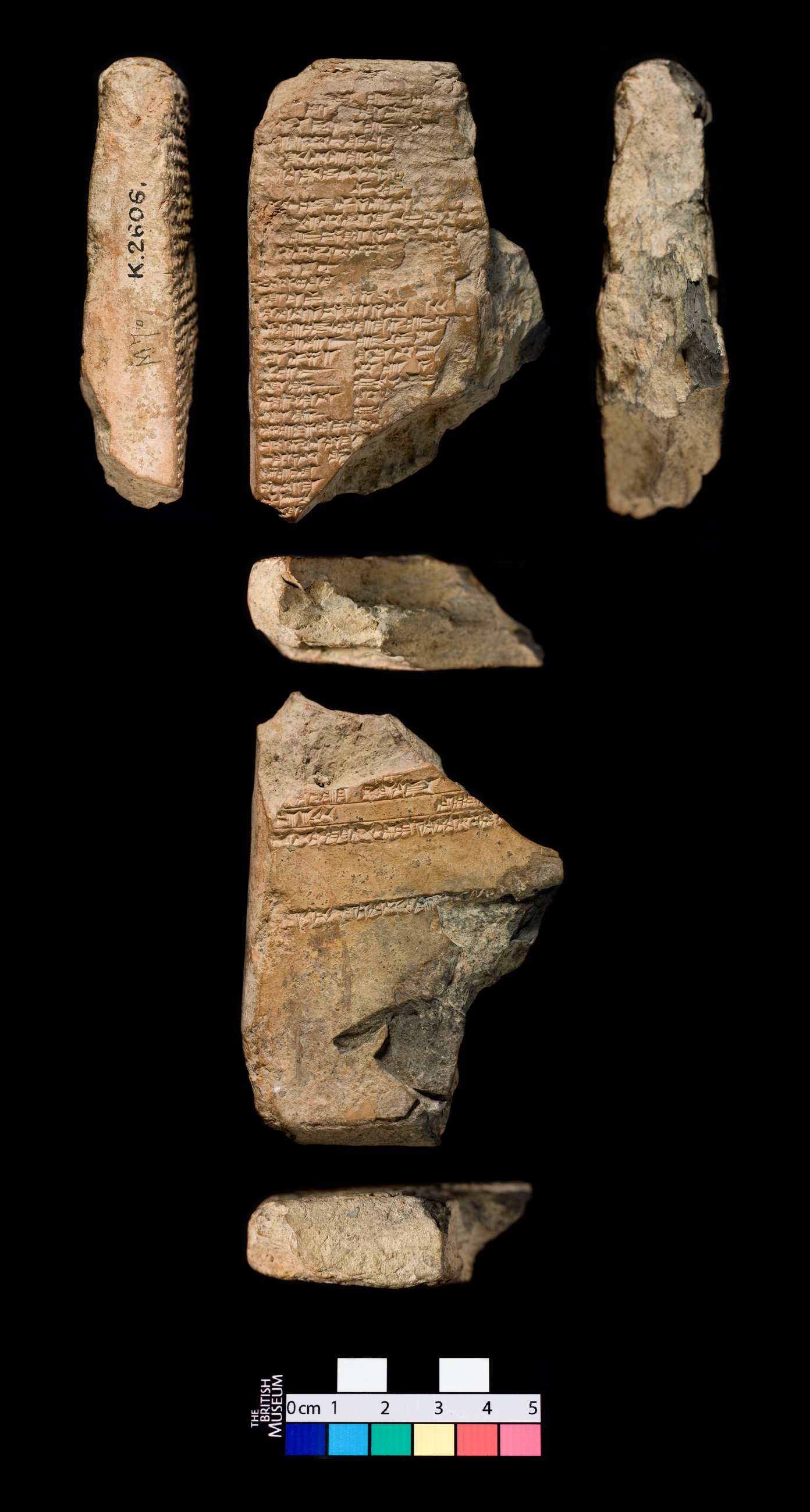
British Museum K.2606: column i, the tablet's own lines 1 to 30. eBL's corpus edition (https://www.ebl.lmu.de/corpus/L/1/9/SB/I) attributes SB I 1-29 to this manuscript at these column and line numbers. Photograph checked: obverse, reverse and edges, ink number K.2606 on the edge; a column of about 29 lines on the obverse and a few lines on the reverse, consistent with eBL's attribution. On this tablet of lines 1, 26-29 only one to three signs survive and lines 2-25 are partly broken (square brackets and x in the Akkadian). The English of these lines translates eBL's composite text, so it includes words that are not preserved on this tablet but are restored from other manuscripts or by the editors. Square brackets in the English mark eBL's restorations in its composite text; words that survive on other tablets carry no brackets even where this tablet is broken.
1[x i-ṣi-r]u x [...]
2[x (x) x] i?#-du-u₂ DINGIR-M[EŠ? ...]
3[kiš?{k]i} URU!(ZE₂) i#-ṣi-ru x x [...]
4[uš]-ši#-šu₂ id-du#-u₂ DINGIR#-[MEŠ? ...]
5{d#}i₂#-gi₃-gi₃ u₂-kin-nu lib-na-a[s-su ...]
6[L]U₂ lu-u re-e₂*-um-ši-n[a ...]
7e?#-[t]a-na lu-u i-tin#-ši-na e-x [...] (line break) (blank space) (erased: x x) ši-bir [...]
8[r]a-bu#-tu₄ {d}a-nun-na-ki# m[u?-šim? x x (x)]
9[uš-b]u im-tal-li-ku mi-lik-šu₂-nu# [x x x (x)]
10[ba]-nu#-u₂ kib-ra-a-ti# ša₂# im-n[a] u# [x x x]
11z[i?]-ik*#-ri DU₃-šu₂-nu {d}i₂#-gi₃-gi₃ [x (x)] UN?#-[MEŠ? x x (x) x x x]
12l[a] iš#-ku-nu [LU]GAL [...]
13i-na u₄-mi-šu-ma [(x x x x)] kur?*# [...]
14u₃# {giš}GIDRU {na₄#}ZA.GIN₃ ul?# [x (x) x]
15la ba-na-a <<kib-ra-a-ti>> 1-niš [x x (x)]
16{d}se-bet-tu₄ UGU um-ma-ni u₂-di-lu# [x x (x)]
17UGU# da-ad₂-me u₂-di-lu [x x (x) ...]
18URU {d}i₂-gi₃-gi₃ šu-tas-hu-ru [...]
19{d#}iš-tar re-e₂-a [...]
20u₃ LUGAL i-še-ʾ#-i [...]
21{d}in-nin-na re-e₂#-[a ...]
22u₃ LUGAL i-š[e-ʾ-i ...]
23{d}+en-lil₂ i-ha-aṭ pa-rak-ki# AN#-e# [...]
24iš-te-ne₂-ʾ-e-ma x [...]
25ina ma-a-ti LUGAL [...]
26LUGAL-u₂-tu [...]
27ub-lam-ma [...]
28DINGIR-MEŠ KUR-[MEŠ? ...]
29[(x)] x-šu x [...]
1They planned the city [...],
2[The gods] laid [its foundations],
3They planned the city [Kish],
4[The Anunna-gods] laid its foundations.
5The Igigi-gods founded its brickwork [...]
6“Let [a ma]n be their (the people’s) shepherd,
7“Let Etana be their master builder ...
8The great Anunna-gods, or[dainers of destinies],
9[Sa]t holding their counsel [concerning the land],
10Those who formed the four world regions, the right and [left] (banks of the rivers),
11By command of all of them, the Igigi-gods [ordained the holy day for] the peop[le].
12No [king] had they established [over the teeming peoples].
13At that time, [no headdress had been put together, nor crown],
14Nor yet scepter [had been set] with lapis,
15No [throne daises] whatsoever had been constructed.
16The seven gods barred the [gates] against the multitude,
17Against the inhabited world they barred [the gates ...],
18The Igigi-gods surrounded the city [with ramparts].
19Ishtar [came down from heaven to seek] a shepherd,
20And sought for a king [everywhere].
21Innina [came down from heaven to seek] a shepherd,
22And sought for a king e[verywhere].
23Enlil examined the lofty dais [in the city ...],
24“She has constantly sought ... [...],
25“[Let] king[ship be established] in the land, let the heart of Kish [be joyful].”
26Kingship, [the radiant crown, throne, ...]
27He brought and [...]
28The gods of the land[s ...]
29[...] ... [...]
Where on the image
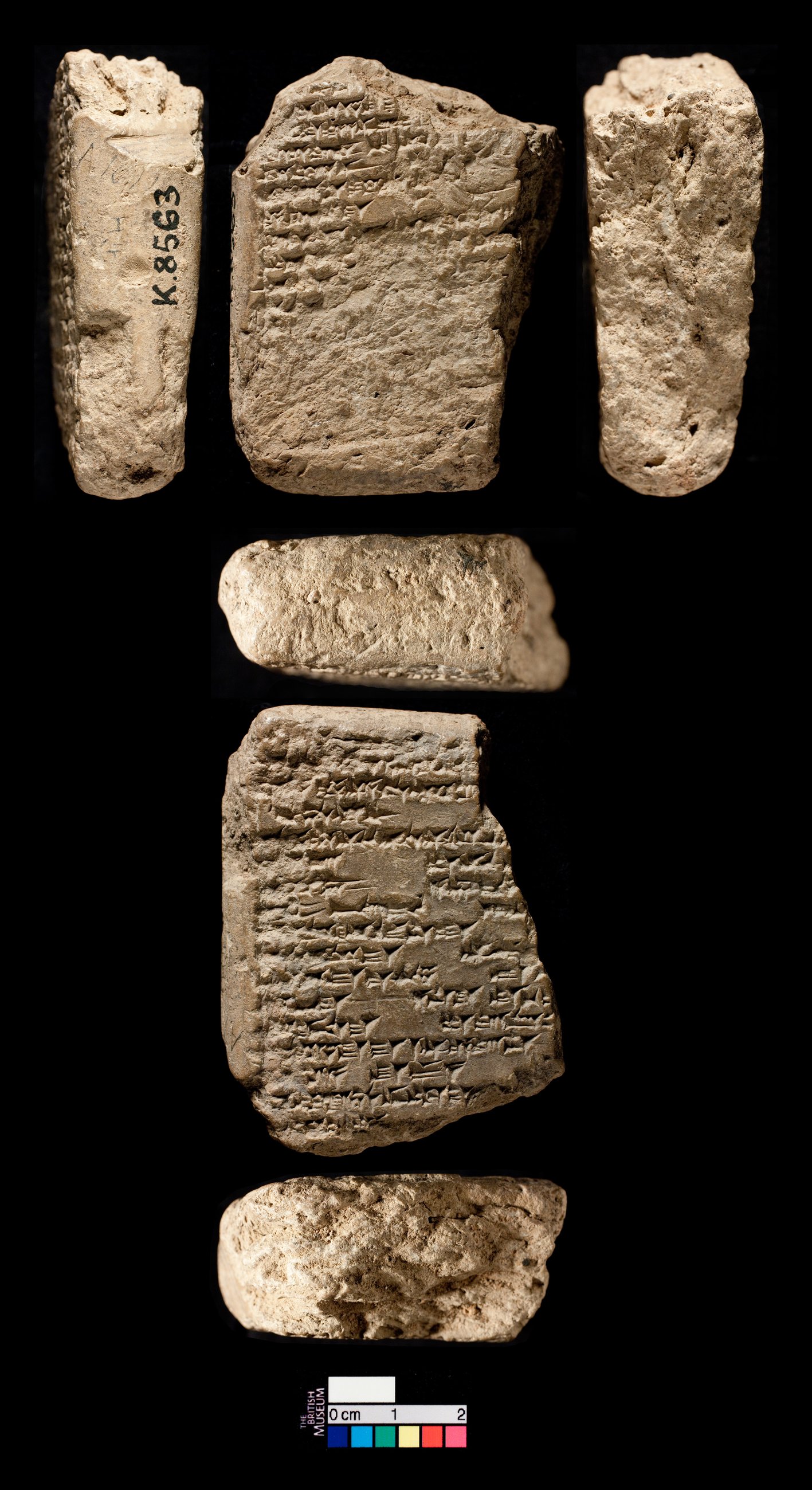
British Museum K.8563: column i, the tablet's own lines 1' to 11'. eBL's corpus edition (https://www.ebl.lmu.de/corpus/L/1/9/SB/I) attributes SB I a+1-a+11 to this manuscript at these column and line numbers. Photograph checked: obverse, reverse and edges, ink number K.8563 on the edge; text on both faces, consistent with eBL's columns i (11 lines) and iv (18 lines). On this tablet of lines a+10-a+11 only illegible traces (x) survive, of lines a+1, a+8-a+9 only one to three signs survive and lines a+2-a+7 are partly broken (square brackets and x in the Akkadian). The English of these lines translates eBL's composite text, so it includes words that are not preserved on this tablet but are restored from other manuscripts or by the editors. Square brackets in the English mark eBL's restorations in its composite text; words that survive on other tablets carry no brackets even where this tablet is broken.
a+1[x] x nu-x [...]
a+2[mar]-hi#-is-su ana ša₂-šu-m[a x x x x x x x x]
a+3[šu]-ut#-tu ia-a-ši u₂-šab#-[ra-an-ni ...]
a+4GIM# e-ta-ni mu-ti-šu?#-nu?# [...]
a+5GIM ka-a-ši x x x (x) [...]
a+6{d#}e#-ta#-na šar-ru# x (x) [...]
a+7e-ṭem₂-mu-šu ana?# [b]u?-[...]
a+8u₃ šu#/lul#-x x x x x x x x (x) [...]
a+9ba/zu#-x x (x) [...] x-ma?# x [...]
a+10x x x [...] (x) x x [...]
a+11x x [...]
a+1[...] ... [...]
a+2His wife [said] to him, [to Etana],
a+3“[...] made me have a dream:
a+4“Instead of Etana their hero [...]
a+5“Instead of you ... [...]
a+6“Etana the king [...]
a+7“His ghost to ... [...]
a+8and ... [...],
a+9... [...] ... [...]
a+10... [...] ... [...]
a+11... [...]
Notes
- Akkadian: eBL transliteration of the signs on the photographed tablet (manuscript-level ATF), not a composite text.
- English: B. R. Foster's translation in the eBL edition; it renders eBL's composite text, including restorations from other tablets.
- Line numbers: eBL edition. Each section also gives the tablet's own column and line numbers.
- Signs in the Akkadian: [ ] broken away; x illegible sign; # damaged sign; ? uncertain reading; ! sign corrected by the editor; * collated sign; ... broken signs of unknown number; ( ) signs perhaps broken away; { } determinative; << >> sign written in error by the scribe; / alternative readings; (line break) the line runs on to the next line of the tablet; (blank space) a space left by the scribe.
Cite
Sources
- Source: British Museum tablet photographs + eBL manuscript transliterations (eBL corpus edition L I.9, Etana, SB I) + English of the eBL edition (B. R. Foster (eBL edition)) (holding institution)
- Critical edition: electronic Babylonian Library, Etana, manuscript transliterations
← previous · → next · v cycle view · l back to library