Etana, Standard Babylonian Tablet II: the eagle and the serpent
Introduction
The eagle and the serpent swear friendship before Shamash. The eagle eats the serpent's young; on Shamash's advice the serpent traps the eagle in a pit. Etana prays for a son, and Shamash sends him to the eagle.
The Legend of Etana tells of an early king of Kish, chosen by the gods, who has no son. An eagle that betrayed its friend the serpent is thrown into a pit; Etana rescues it, and the eagle carries him up towards heaven to find the plant of birth. The story is known from Old Babylonian, Middle Assyrian and Standard Babylonian versions; the end is lost. This page follows the line numbering of the electronic Babylonian Library edition.
How this page is built. Each section is a run of consecutive lines as written on one photographed clay tablet. For every line the eBL edition (https://www.ebl.lmu.de/corpus/L/1/9/SB/II) lists the manuscripts that carry it, with each tablet's own column and line numbers; the tablet chosen for each run is the photographed copy of the work with the most signs preserved there. Commentaries and texts that only quote a line are never chosen. School and excerpt tablets are used only for lines that no photographed library copy preserves as well, and only where they carry the line as text; their sections say so. The original text is eBL's transliteration of that tablet's signs (not a modern composite text): square brackets mark broken signs, x an illegible sign, # a damaged sign, ? an uncertain reading, and words in {braces} are determinatives; the notes give a key to every sign used on this page, and eBL's layout codes are written out in words (for example '(line break)' or '(blank space)'). Superscript numbers are the line numbers of the eBL edition, used in both the Akkadian and the English. The English is B. R. Foster's translation in the eBL edition (CC BY-NC-SA 4.0), one line of English per line of the text; italics mark uncertain renderings, as in the source. Where the tablet is broken, the English still translates the whole line of eBL's composite text; each section's note names the lines that are broken on its tablet.
Finding a line on the photograph. Each section names the tablet, the face and column, and the tablet's own line numbers (a prime, as in 5', counts from the first preserved line of a broken column). On a tablet with six columns the obverse carries columns i-iii from left to right; the reverse, turned over from bottom to top, carries columns iv-vi from right to left. The photographs often show the obverse above the reverse with the edges around them; a fragment preserves only part of this layout.
This page shows 98 of the 152 lines of the eBL edition (64%), from 3 tablets in the British Museum: K.2527 (Nineveh), K.1547 (Nineveh), K.2606 (Nineveh).
Lines not shown. 54 of the 152 lines of the eBL edition are not shown, because no photographed copy of the work used here carries them: 1-43 (photograph does not show these lines (visual check): K.8572); 120-127 (photograph does not show these lines (visual check): K.8572); 148-150 (photograph does not show these lines (visual check): K.8572). A line is shown only on a photographed tablet that carries it as text. Commentaries and other texts that quote a line (letters, rituals, god lists) are not used as witnesses, because they carry it with explanations or inside another text; tablets without a photograph in eBL are not used, because the line could not be shown on its tablet.
How was this verified? (Provenance)
Where on the image
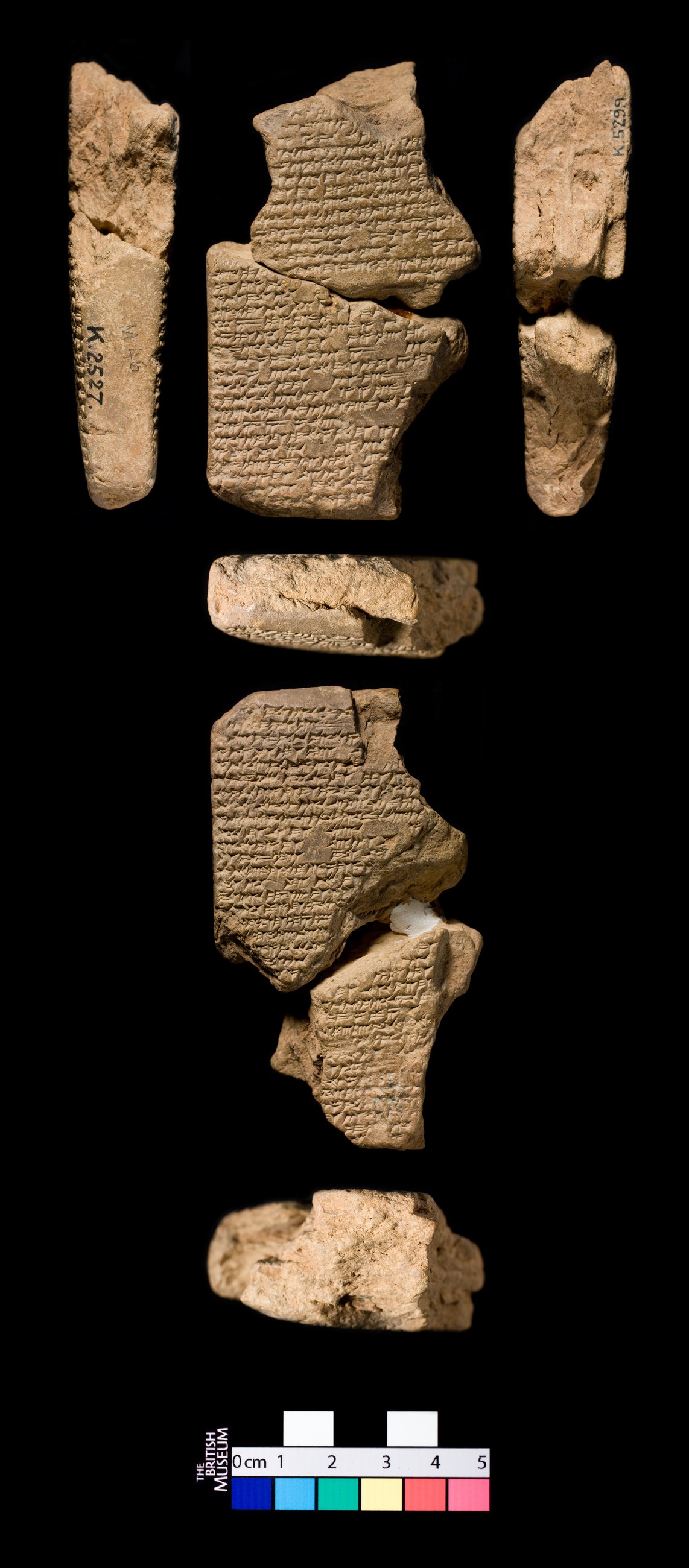
British Museum K.2527: obverse, the tablet's own lines 1' to 13'b. eBL's corpus edition (https://www.ebl.lmu.de/corpus/L/1/9/SB/II) attributes SB II 44-61 to this manuscript at these column and line numbers. Photograph checked: obverse, reverse and edges of the join K.2527 + K.5299 (two pieces on each face); text on both faces, consistent with eBL's obverse (36 lines) and reverse (40 lines). On this tablet line 46 is entirely broken, of lines 44, 50 only one to three signs survive and lines 45, 47-49, 51-59, 61 are partly broken (square brackets and x in the Akkadian). The English of these lines translates eBL's composite text, so it includes words that are not preserved on this tablet but are restored from other manuscripts or by the editors. Square brackets in the English mark eBL's restorations in its composite text; words that survive on other tablets carry no brackets even where this tablet is broken. Line 60 is complete on this tablet.
44[x x i]-na# ap#-[pi x x x x x x x]
45[x x ṣe-e]h-ru a-tar ha*#-[si-sa (x)]
46[x (x) x x x x x x x]
47[x ta-k]al a-bi še-e#-[tu x x x x x x x]
48[x x x m]a-mit {d}UTU ib-bal-ki-tu#-k[a-ma x x x x x]
49[x x x x] ša₂ {d}UTU it-ti-qu :
50{d}UTU [x x x (x) x x x x x x x x]
51[x iš-me]-šu#-nu-ti-ma : ul iš-ma-[a x x x x x]
52[u₂-ri-d]am-ma e-ta-kal DUMU-[MEŠ x x]
53[x (x) li-la]-a#-ti ina qer-bit u₄-me :
54MUŠ il#-[li-kam-ma] (line break) [x n]a-ši bi-lat-su :
55i-na KA₂ qin-ni-šu₂?# [x x x x]
56[ip-pal?]-sa#-ma qin-na-šu₂ la-aš₂-šu₂ :
57u₂-ši-ir-ma ul# (x) [...]
58[ṣu-up]-ra#-nu-uš-šu₂ qaq-qa-ra [... x x ...]
59e#-le#-nu# tur-bu-ʾ-ta-šu₂ ša₂-ma-m[i ...]
60MUŠ i-na#-ṣi?#-il-ma i-bak-ki :
61a-na pa-an {d}UTU i[l-la-ka x x (x) x]
44“I will come down to the crown of the tree and eat fruit.”
45The littlest fledgling, exceedingly wise,
46said these words to the eagle, his father,
47“Do not eat, my father! The net of Shamash will hunt [you] down,
48“The mesh and oath of Shamash will overthrow you and hunt you down.
49“Whoever transgresses the limits of Shamash,
50“Shamash [will deliver] him as an offender into the hands of a [sla]yer!”
51He did not heed them nor listen to [his sons’ words],
52He went down and ate the [serpent’s] children.
53In the evening of the same day,
54The serpent ca[me], bearing his burden,
55At the entrance to his nest [he cast down the meat].
56[He loo]ked around, his nest was gone!
57He looked down, [his children were] not [...]!
58[The eagle had gouged] the ground with his talon,
59The cloud of dust from the nest [darkened] the sky.
60The serpent collapsed, weeping,
61Before Shamash [his tears] r[an down],
Where on the image
British Museum K.2527: obverse, the tablet's own lines 14' to 31'. eBL's corpus edition (https://www.ebl.lmu.de/corpus/L/1/9/SB/II) attributes SB II 62-79 to this manuscript at these column and line numbers. Photograph checked: obverse, reverse and edges of the join K.2527 + K.5299 (two pieces on each face); text on both faces, consistent with eBL's obverse (36 lines) and reverse (40 lines). On this tablet lines 62-79 are partly broken (square brackets and x in the Akkadian). The English of these lines translates eBL's composite text, so it includes words that are not preserved on this tablet but are restored from other manuscripts or by the editors. Square brackets in the English mark eBL's restorations in its composite text; words that survive on other tablets carry no brackets even where this tablet is broken.
62at-kal-kum₂#-ma# {d}UTU [x x x]
63a-na TI₈{mušen} x [x] x [x x (x)] x x [...]
64e-nen-na qin-n[i ...]
65qin-ni ia-u₂-tu# i?#-na?#-[...]
66sa-ap-hu at-mu-u₂-a nu*#-x-[...]
67u₂#-ri-dam-ma e-ta-kal [x x x]
68lum#-nu ša₂ i-pu-ša₂-an-ni {d}UT[U x (x) x (x) x]
69a-bar-ša₂ {d}UTU še-et-ka er-ṣ[e-tu₄ x x (x)]
70giš-par-ru-ka AN-u₂ [x x (x)]
71i-na še-ti-ka a-a u₂-ṣ[i x x]
72e-piš HUL-ti₃ an-zu-u₂ mu-ki[l x x x (x) x x x]
73un-ni-ni ša₂ MUŠ [x (x) x x x]
74{d}UTU KA-šu i-pu-ša₂-am#-ma a-n[a x x (x x) x]
75a-lik ur-ha e-ti-i[q x x (x)]
76uk#-ta-as-si-ka ri-[(i)-mu ...]
77pi*#-te#-e#-ma lib₃-ba-šu [x x (x) x x x x]
78šu#-ub#-ta id-di [x (x) x x x]
79[mim-mu]-u!?# iṣ#-ṣu#-rat# ša₂-ma-me [x x x x x x x x (x x)]
62“I trusted in you, [O warrior] Shamash,
63“[I was the one who gave provisions] to the eagle,
64“Now my nest [...]!
65“My nest ... [...],
66“My young are destroyed, [while his young are] sa[fe]!
67“He came down and ate [my children]!
68“[You know], O Shamash, the evil he has done me,
69“Truly, O Shamash, your net is the [wide] earth,
70“Your trap is the [distant] heaven.
71“[The eagle] must not es[cape] from your net,
72“Th(at) malignant Anzu, who harbored [evil against his friend]!”
73[When he had heard] the serpent’s lament,
74Shamash made ready to speak, [and said],
75“Go (your) way and cros[s the mountains],
76“I have captured for you a wi[ld ox ...].
77“Open its insides, [rend its belly],
78“Set an ambush [in its belly].
79“[Every kind of] bird of heaven [will come down to eat the meat],
Where on the image
British Museum K.2527: reverse, the tablet's own lines 1 to 2. eBL's corpus edition (https://www.ebl.lmu.de/corpus/L/1/9/SB/II) attributes SB II 80-81 to this manuscript at these column and line numbers. Photograph checked: obverse, reverse and edges of the join K.2527 + K.5299 (two pieces on each face); text on both faces, consistent with eBL's obverse (36 lines) and reverse (40 lines). On this tablet lines 80-81 are partly broken (square brackets and x in the Akkadian). The English of these lines translates eBL's composite text, so it includes words that are not preserved on this tablet but are restored from other manuscripts or by the editors. Square brackets in the English mark eBL's restorations in its composite text; words that survive on other tablets carry no brackets even where this tablet is broken.
80[TI]{mušen#} it-ti-ši#-n[a ...]
81[ina?] la# i-du-u₂ [x x (x) ... x x]
80“[The eagle will come down] with them [to eat the meat].
81“[As] he will not know [...],
Where on the image
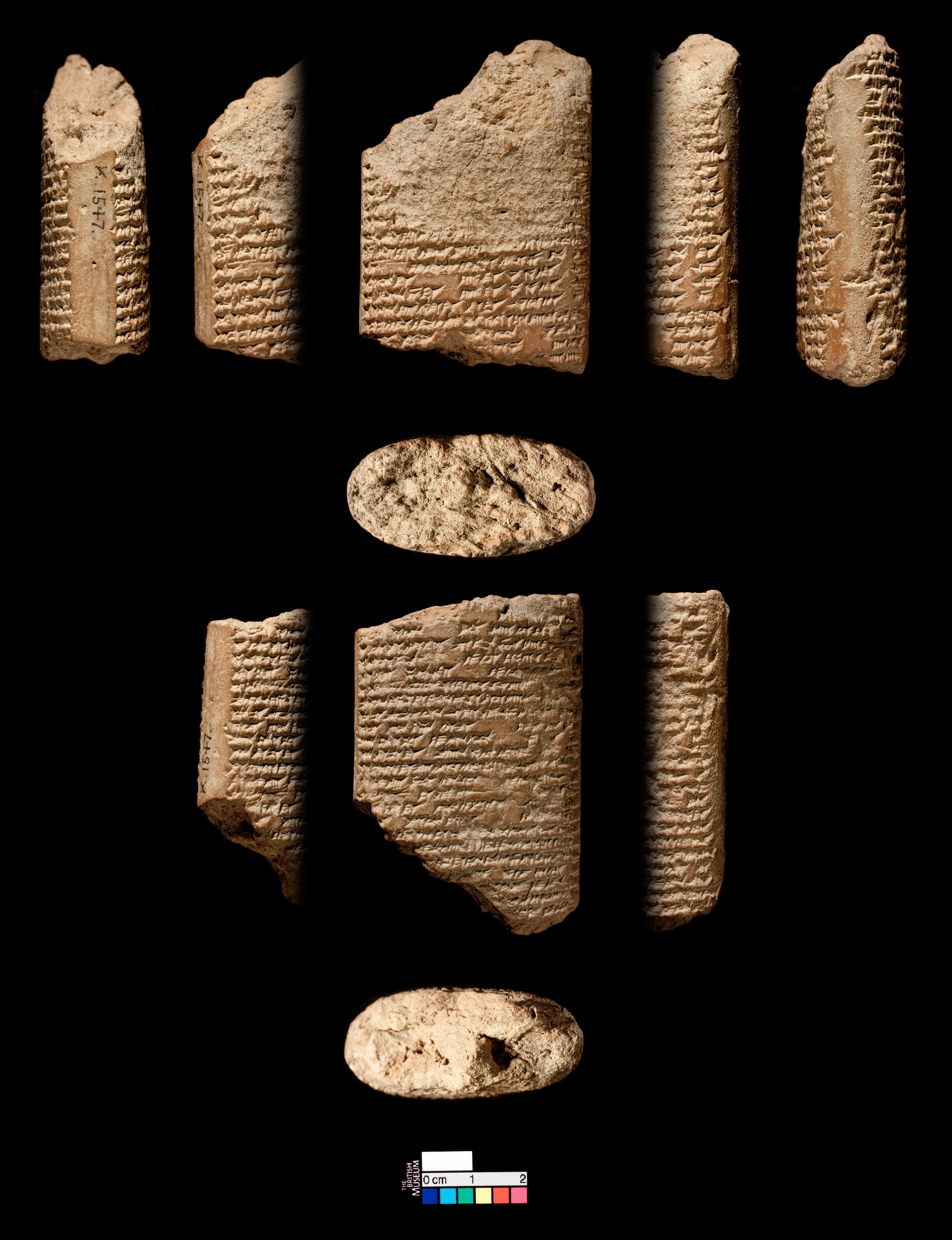
British Museum K.1547: obverse, the tablet's own lines 2'-3' to 24'. eBL's corpus edition (https://www.ebl.lmu.de/corpus/L/1/9/SB/II) attributes SB II 82-101 to this manuscript at these column and line numbers. Photograph checked: obverse, reverse and edges; text on both faces and the side edges, consistent with eBL's obverse (22 lines) and reverse (20 lines). On this tablet lines 82, 84, 86, 93-101 are partly broken (square brackets and x in the Akkadian). The English of these lines translates eBL's composite text, so it includes words that are not preserved on this tablet but are restored from other manuscripts or by the editors. Square brackets in the English mark eBL's restorations in its composite text; words that survive on other tablets carry no brackets even where this tablet is broken. Lines 83, 85, 87-92 are complete on this tablet.
82[nu-ru]-ub# UZU# iš#-te#-ne₂#-ʾ#-i# (line break) sa#-da#-a-ti it-ta-na-al#-lak#
83a-na ku-tu-um lib₃-bi uš-ta-ma-aṣ?#-ṣa#
84a-na lib₃-bi i-na e-re-bi#-š[u] (line break) at-ta ṣa-bat-su i-na# kap#-[p]i-šu₂
85nu-uk-kis kap-pi-šu₂ ab-ri-šu₂ u₃ nu#-bal*#-li#-šu₂
86bu-qu-un-šu₂-ma id-di-šu₂ ana šu-ut-ta-ti uk?#-kiš?# x-ši
87mu-ut bu-bu-ti u₃ ṣu-mi li#-mu#-ta#
88(gloss: 10) a-na zi-kir {d}UTU qu#-ra#-du?#
89MUŠ il-lik i-ti-iq ša₂-da#-a
90ik-šu-ud-ma MUŠ a-na ṣe-er# ri*#-mi
91ip-te-e-ma lib₃-ba-šu₂ ka-ra-as#-su# iš*#-ṭu-uṭ
92šu#-ub#-ta it-ta-di i#-na kar-ši-šu₂
93mim#-mu-u₂# iṣ-ṣu-rat ša₂#-ma-mi (line break) [u₂-r]i-da#-ma ik-ka-la ši#-i#-ra
94[TI₈{muš]en} lu-mu-un#-šu₂# i#-de?#-e?#-ma
95[it-t]i DUMU-MEŠ iṣ-ṣu#-ri# ul ik-kal ši-i-ra
96[x x x (x) x] i-pu-šam-ma# i-zak-ka-ra ana DUMU#-MEŠ-šu₂
97[(gloss: 10) x x x x i n]i-rid-ma UZU AM an-ne₂-e i ni-ku-la ni-nu
98[x x ṣe]-eh#-ru# a-tar ha-si-sa
99[x (x) x x x x] a#-ma#-tu₄ i-zak-kar
100[x x x x x x x x (x) x x] AM# an-ne₂-e MUŠ ra-bi-iṣ
101[x x x x x x x a-m]a-tu₄ i-qab-bi
82“He will search for the juiciest meat, he will walk about outside,
83“He will work his way into the covering of the intestines.
84“When he comes inside, seize him by his wing,
85“Cut off his wings, his pinions, and tail feathers,
86“Pluck him and cast him into a bottomless pit,
87“Let him die there of hunger and thirst.”
88As Shamash the warrior commanded,
89The serpent went and crossed the mountain.
90Then did the serpent reach the wild ox,
91He opened its insides, he rent its belly.
92He set an ambush in its belly.
93Every kind of bird of heaven came down to eat the meat.
94Did the eagle know the evil in store for him?
95He would not eat the meat with the other birds!
96The eagle made ready to speak, saying to his children,
97“[Co]me, let us go down and we too eat the meat of this wild ox.”
98The little [fled]gling, exceedingly wise,
99said these words to the eagle [his] father,
100“[Do not] go down, father, no doubt the serpent is lurking inside the wild ox.”
101The eagle said to himself,
Where on the image
British Museum K.2527: reverse, the tablet's own lines 21 to 36. eBL's corpus edition (https://www.ebl.lmu.de/corpus/L/1/9/SB/II) attributes SB II 102-119 to this manuscript at these column and line numbers. Photograph checked: obverse, reverse and edges of the join K.2527 + K.5299 (two pieces on each face); text on both faces, consistent with eBL's obverse (36 lines) and reverse (40 lines). On this tablet of line 119 only illegible traces (x) survive, of lines 102-103, 106, 109, 112, 117-118 only one to three signs survive and lines 104-105, 107-108, 110-111, 113-116 are partly broken (square brackets and x in the Akkadian). The English of these lines translates eBL's composite text, so it includes words that are not preserved on this tablet but are restored from other manuscripts or by the editors. Square brackets in the English mark eBL's restorations in its composite text; words that survive on other tablets carry no brackets even where this tablet is broken.
102[x x] x-a-x [x x x (x x)] x-ti [x x (x)]
103[...] x [x x (x)] ik#-ka-la [x (x x)]
104[x iš-me-šu-nu-t]i-ma ul iš-ma-[(a) x x x x x]
105[x x x x it-t]a-ziz ina UGU ri-mi :
106TI₈#[{mušen} x x x x (x x)]
107[iš-te-ne₂-ʾ]-i ša₂ pa-ni-šu₂ [x x (x) x]
108[x x x] it#-ta-sah UZU :
109iš#-te-n[e₂*-ʾ-i x x x x x x (x) x]
110[x x (x) x it-ta-na]-al#-lak# : a-n[a x x (x) x x x x x x x]
111[x (x) x x x (x) e-r]e-bi#-šu# : MUŠ# [x x x x x (x) x x x]
112[x x qu₂-n]e-en-ni# [x x x x x x]
113[x x x (x) x] i#-pu-ša₂-am#-ma# [x (x) x x (x x) x]
114[x x x x] GIM e-ri#-ši# n[u-dun-na-a x x x]
115[x x (x) x i-p]u-ša₂-am-ma# a#-na TI₈#[{mušen} x (x x) x]
116[u₂-maš-šar-ka-m]a {d}UTU# e#-l[e-nu x x x x]
117[x x (x) x] i-sah#-hu-[ra x (x) x x x]
118[x a-šak-ka-nu]-ka# a-n[a-ku x x x]
119[...] x x [...]
102“[Are the bird]s [afraid]?
103“How is it they eat the m[eat in peace]?”
104He did not listen to them, he did not listen to his sons’ words,
105He went down and perched on the wild ox.
106The eagle tore out the meat,
107searching in front and behind it.
108A second time he tore out the meat,
109searching in front and behind it,
110He walked around outside, he worked his way into the covering of the intestines.
111When he came inside, the serpent seized him by his wings,
112“You intruded into my precious nest, you intruded into my precious nest!
113The eagle made ready to speak, saying to the serpent,
114“Have mercy on me! I will make you such a gift as a king’s ransom!”
115The serpent made ready to speak, saying to the eagle,
116“If I release you, how shall I answer to Shamash on high?
117“Your punishment would turn upon me,
118“Me, the one to lay punishment upon you!”
119He cut off his wings, pinions, and tail feathers,
Where on the image
British Museum K.1547: reverse, the tablet's own lines 1' to 20'. eBL's corpus edition (https://www.ebl.lmu.de/corpus/L/1/9/SB/II) attributes SB II 128-147 to this manuscript at these column and line numbers. Photograph checked: obverse, reverse and edges; text on both faces and the side edges, consistent with eBL's obverse (22 lines) and reverse (20 lines). On this tablet of lines 128-131, 147 only one to three signs survive and lines 132-137, 145-146 are partly broken (square brackets and x in the Akkadian). The English of these lines translates eBL's composite text, so it includes words that are not preserved on this tablet but are restored from other manuscripts or by the editors. Square brackets in the English mark eBL's restorations in its composite text; words that survive on other tablets carry no brackets even where this tablet is broken. Lines 138-144 are complete on this tablet.
128[x x x (x) x x x (x) x x (x) x x i-zak-kar]-šu₂
129[x x x x x x x tu-šam-ri]-iṣ#
130[x x x x x x x x x ta-k]u-ul
131t[a-ma-ta-(a)-ma x a-sa-an-ni-qa-ak]-ka#
132a-l[i?-ik? x (x x) x x x x x x x x l]i*-iṣ-bat
133{d}e#-ta#-[na x x x x x x x x x {d}UTU]-ši
134ta-kul {d#}[UTU x x šu-ʾ]-e#-a
135er-ṣe-t[u₄ x x x x (x) as]-li#-ia
136(gloss: 10) DINGIR-MEŠ u₂#-[kab-bit x x x ap]-lah₃!(MAH*)
137ig-dam#-ra maš#-šak#-ki#-i[a* {munus}ENS]I-MEŠ
138as-li-ia i-na ṭu-ub-bu#-hi# DINGIR#-MEŠ# ig-dam-ru
139be-li₂ i-na pi-i-ka# li-ṣa-am-ma
140id-nam-ma# šam-ma ša₂ a-la-di
141kul-li-man-ni-ma šam-ma ša₂ a-la-di
142pil-ti u₂-suh-ma šu-ma šuk-na-an-ni
143{d}UTU pi-i-šu₂ i-pu-šam#-ma# a-na {m}e-ta-na# i-zak-kar-šu₂
144a*#-lik# ur-ha# e#-ti-iq ša₂-da-a
145[x x (x) x x x x] qe₂#-reb#-ša₂ bit-ri
146[x (x) x x x na]-di?# e#-ru-u₂
147[x x x x x x x a-la]-di?#
128Shamash made ready to speak and said to the eagle,
129“You are wicked and have done a deed abhorrent to me,
130“You committed an abomination of the gods, a forbidden act.
131“Were you (not) under oath? I will not come near you.
132“There, there! A man I will send you will help you.”
133Etana kept on beseeching Shamash day after day,
134“O Shamash, you have dined from my fattest sheep!
135“O Netherworld, you have drunk of the blood of my (sacrificed) lambs!
136“I have honored the gods, revered the spirits,
137“Dream interpreters have used up my incense,
138“Gods have used up my lambs in slaughter.
139“O lord, give the command!
140“Grant me the plant of birth!
141“Reveal to me the plant of birth!
142“Relieve me of my disgrace, grant me an heir!”
143Shamash made ready to speak and said to Etana,
144“Go (your) way, cross the mountain,
145“Find a pit, look inside,
146“An eagle is cast within it.
147“He will reveal to you the plant [of birth].”
Where on the image
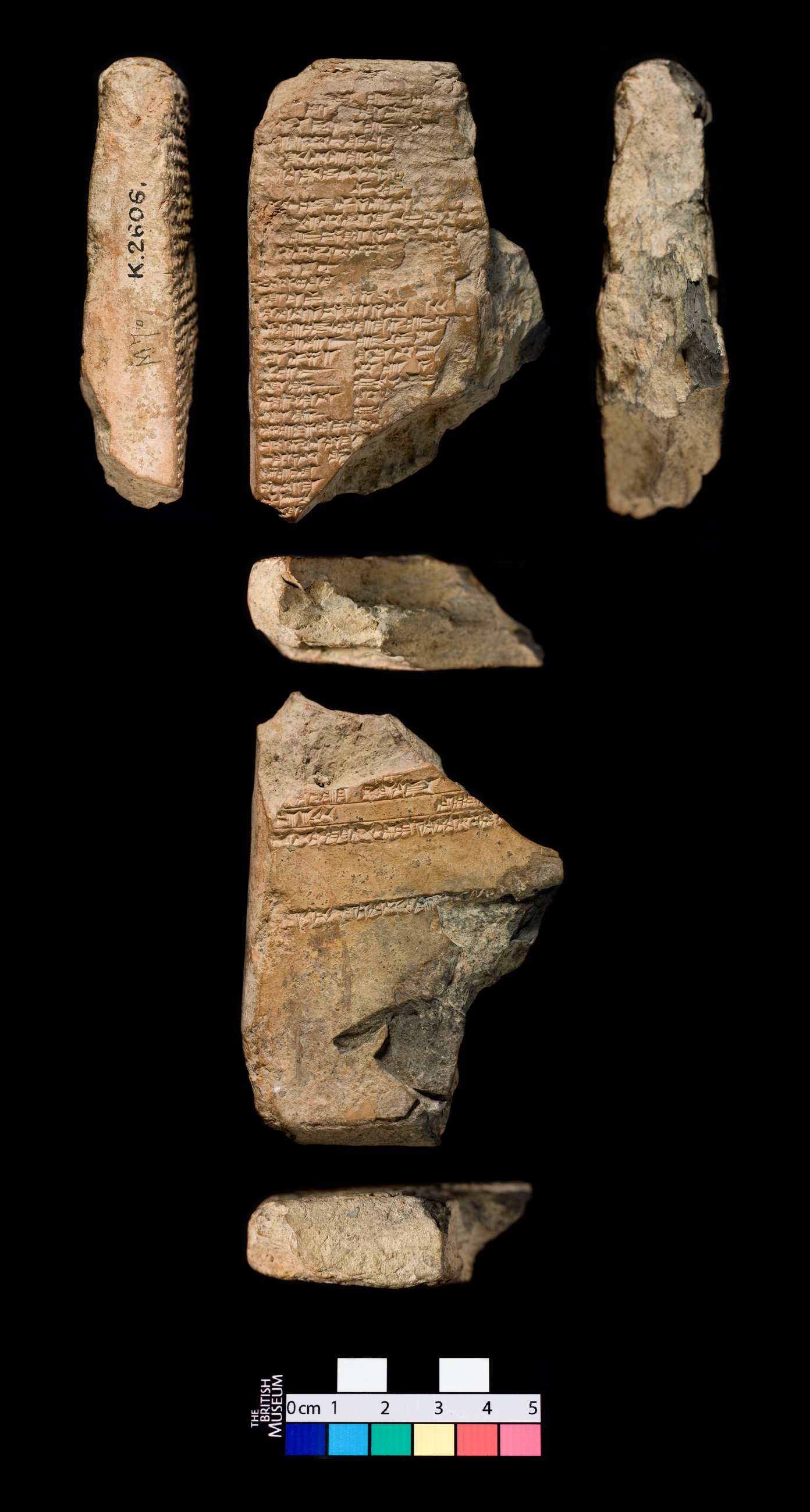
British Museum K.2606: column iv, the tablet's own lines 1' to 2'. eBL's corpus edition (https://www.ebl.lmu.de/corpus/L/1/9/SB/II) attributes SB II 151-152 to this manuscript at these column and line numbers. Photograph checked: obverse, reverse and edges, ink number K.2606 on the edge; a column of about 29 lines on the obverse and a few lines on the reverse, consistent with eBL's attribution. On this tablet of line 151 only one to three signs survive and line 152 is partly broken (square brackets and x in the Akkadian). The English of these lines translates eBL's composite text, so it includes words that are not preserved on this tablet but are restored from other manuscripts or by the editors. Square brackets in the English mark eBL's restorations in its composite text; words that survive on other tablets carry no brackets even where this tablet is broken.
151[x (x) x x x] na*#-di*# [x x]
152[u]l-la#-nu-um-ma uš-ta-qa-aš₂-šu₂ [...]
151[The eagle] was cast with[in it].
152There he was for him to bring up [...]!
Notes
- Akkadian: eBL transliteration of the signs on the photographed tablet (manuscript-level ATF), not a composite text.
- English: B. R. Foster's translation in the eBL edition; it renders eBL's composite text, including restorations from other tablets.
- Line numbers: eBL edition. Each section also gives the tablet's own column and line numbers.
- Signs in the Akkadian: [ ] broken away; x illegible sign; # damaged sign; ? uncertain reading; ! sign corrected by the editor; * collated sign; ... broken signs of unknown number; ( ) signs perhaps broken away; { } determinative; : divider sign written on the tablet; (line break) the line runs on to the next line of the tablet; (gloss: ...) a note written by the scribe in small signs or in the margin.
Cite
Sources
- Source: British Museum tablet photographs + eBL manuscript transliterations (eBL corpus edition L I.9, Etana, SB II) + English of the eBL edition (B. R. Foster (eBL edition)) (holding institution)
- Critical edition: electronic Babylonian Library, Etana, manuscript transliterations
← previous · → next · v cycle view · l back to library