Epic of Gilgamesh, Old Babylonian version: the Yale tablet (Gilgamesh and Enkidu plan the journey to the Forest of Cedar)
Introduction
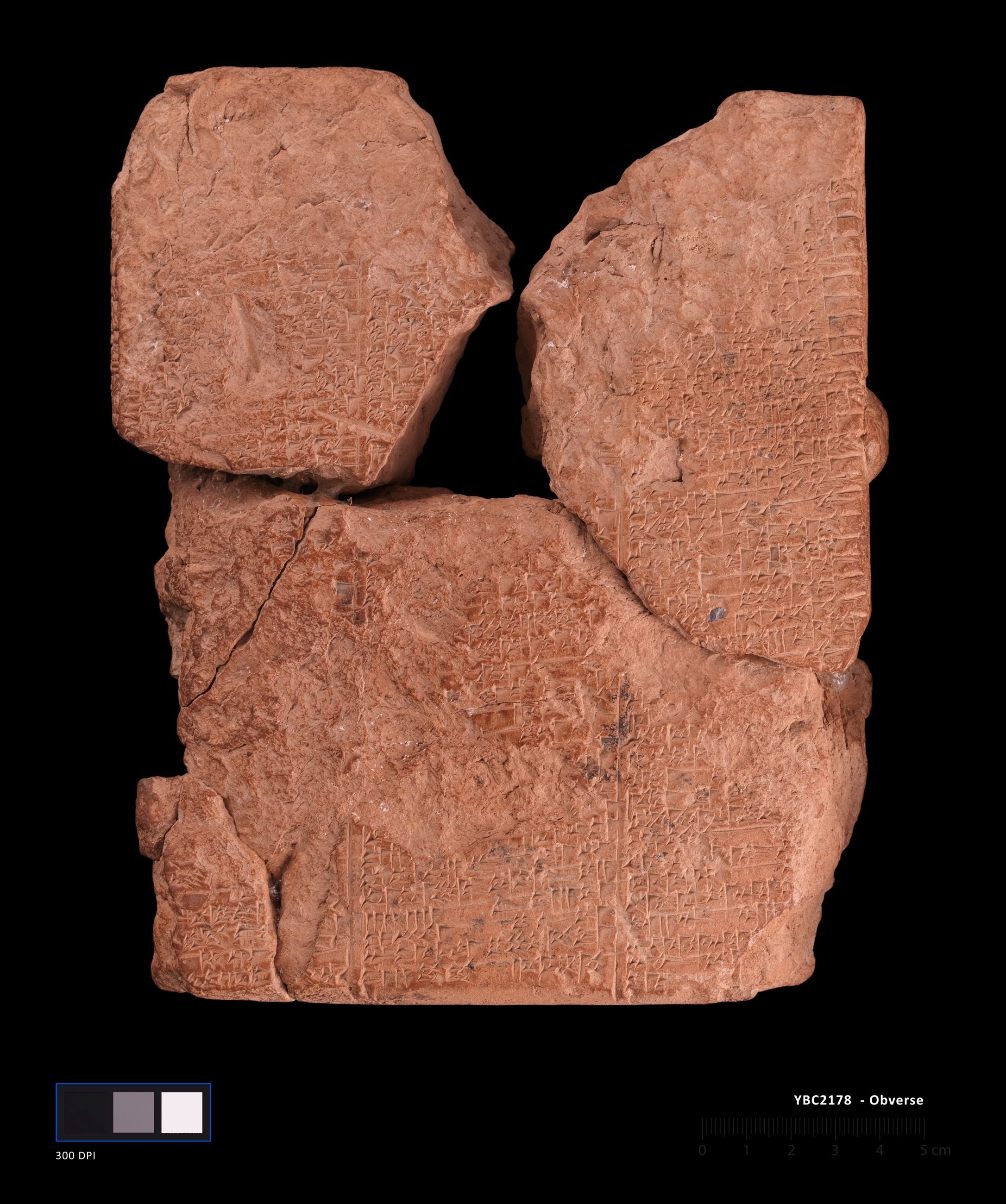
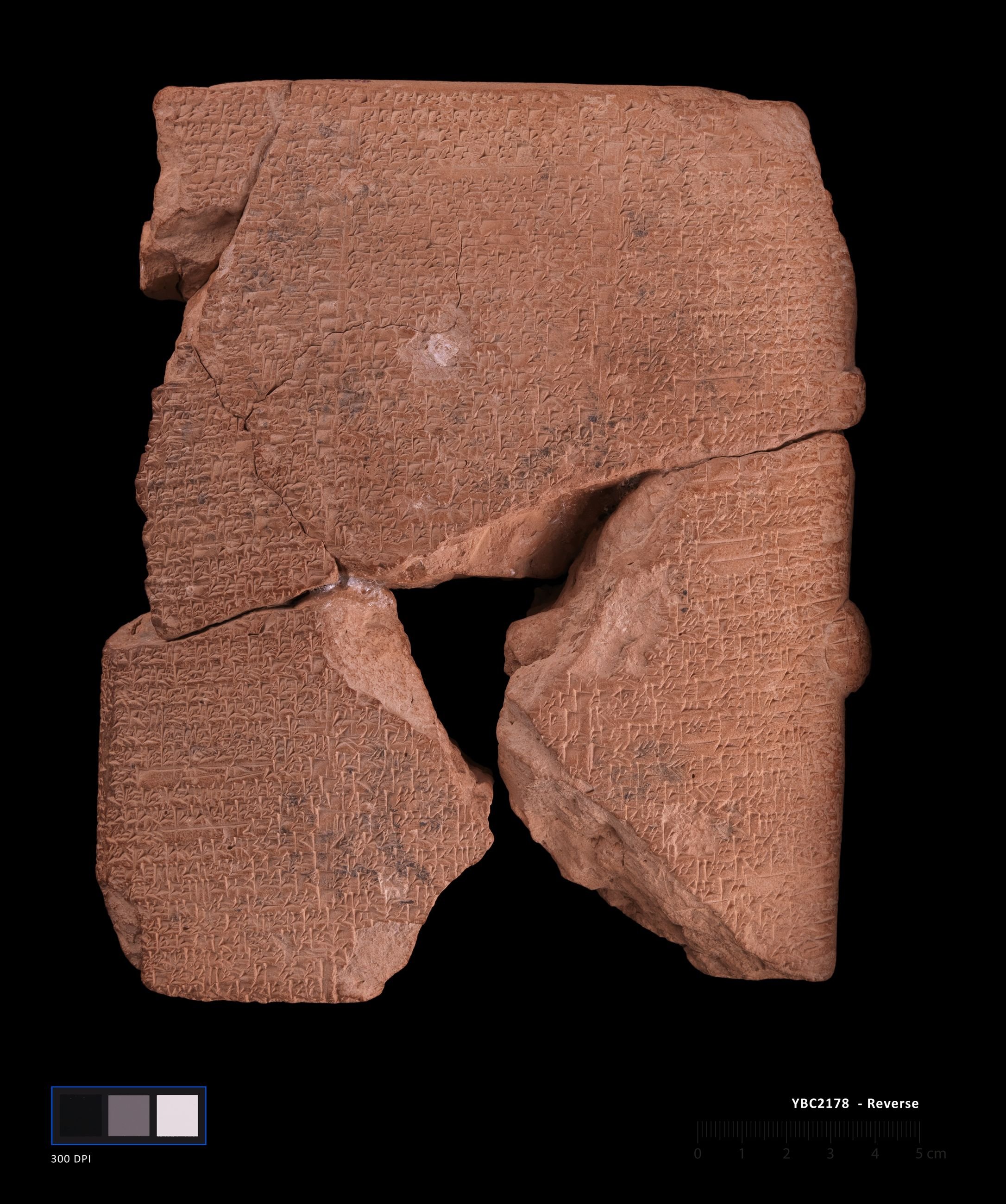
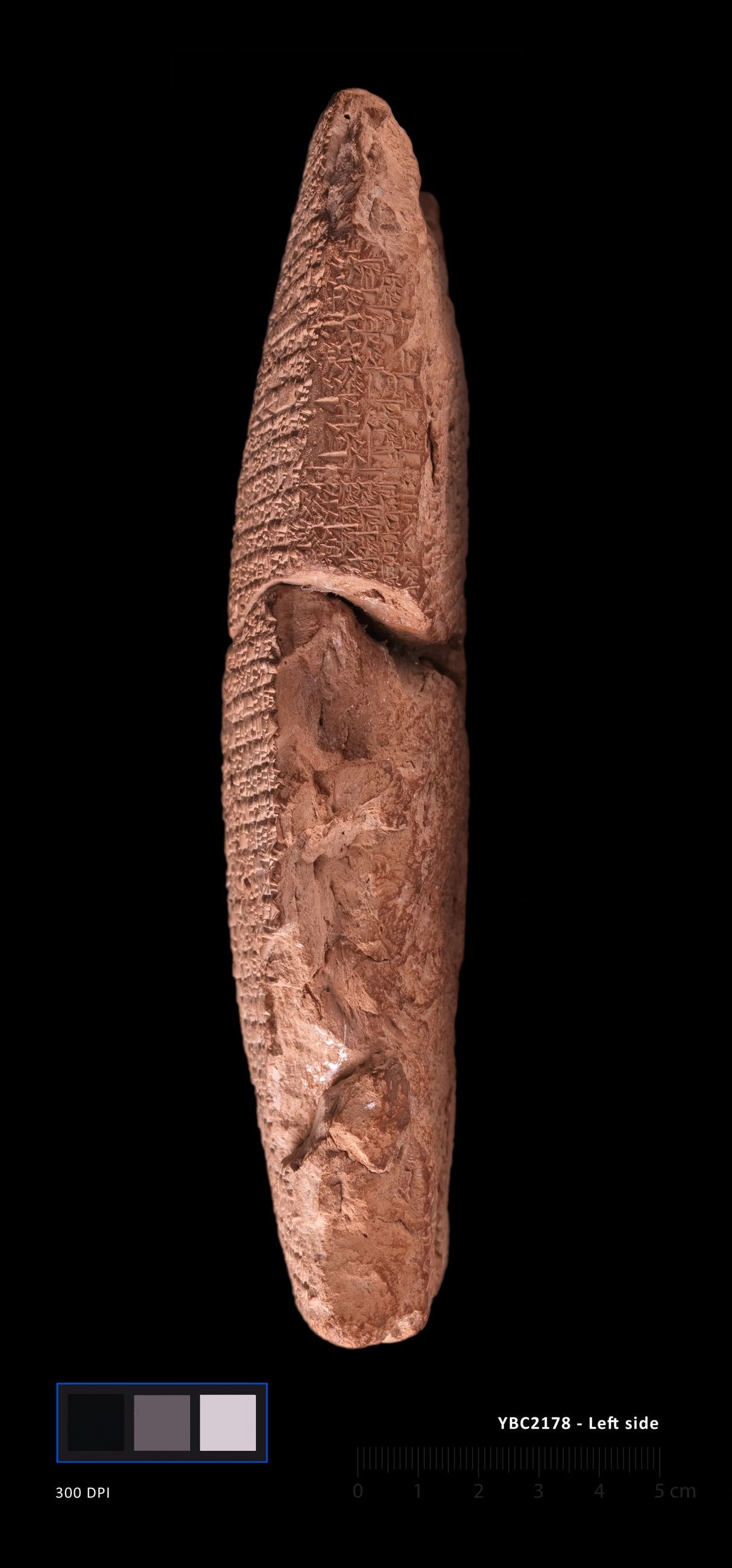
The 'Yale tablet' (Yale Babylonian Collection YBC 2178, now YPM BC 016806) is one of the two large Old Babylonian tablets of the epic, written about a thousand years before the Nineveh copies. It is the third tablet of the Old Babylonian series that began 'Surpassing all other kings'. It tells how Gilgamesh and Enkidu, now friends, decide to go to the Forest of Cedar to kill Humbaba, how Enkidu and the elders of Uruk try to dissuade Gilgamesh, how weapons are cast for the journey, and how the heroes set out. It was first published by M. Jastrow and A. T. Clay in 1920. Its six columns (three on each face) and two short columns on the left edge are badly worn in places.
This page follows the line numbering of the eBL edition of the Old Babylonian Gilgamesh (ed. A. R. George). The photographs are the Yale Peabody Museum's, released as CC0.
How this page is built. Each section is a run of consecutive lines as written on one photographed clay tablet. For every line the eBL edition (https://www.ebl.lmu.de/corpus/L/1/4/OB/III) lists the manuscripts that carry it, with each tablet's own column and line numbers; the tablet chosen for each run is the photographed copy of the work with the most signs preserved there. Commentaries and texts that only quote a line are never chosen. School and excerpt tablets are used only for lines that no photographed library copy preserves as well, and only where they carry the line as text; their sections say so. The original text is eBL's transliteration of that tablet's signs (not a modern composite text): square brackets mark broken signs, x an illegible sign, # a damaged sign, ? an uncertain reading, and words in {braces} are determinatives; the notes give a key to every sign used on this page, and eBL's layout codes are written out in words (for example '(line break)' or '(blank space)'). Superscript numbers are the line numbers of the eBL edition, used in both the Akkadian and the English. The English is A. R. George's translation in the eBL edition (CC BY-NC-SA 4.0), one line of English per line of the poem; italics mark uncertain renderings, as in the source. Where the tablet is broken, the English still translates the whole line of eBL's composite text; each section's note names the lines that are broken on its tablet.
Finding a line on the photograph. Each section names the tablet, the face and column, and the tablet's own line numbers (a prime, as in 5', counts from the first preserved line of a broken column). On a tablet with six columns the obverse carries columns i-iii from left to right; the reverse, turned over from bottom to top, carries columns iv-vi from right to left. The photographs often show the obverse above the reverse with the edges around them; a fragment preserves only part of this layout.
This page shows 218 of the 219 lines of the eBL edition (100%), from 1 tablet in the Yale Peabody Museum: YBC.2178.
Lines not shown. 1 of the 219 lines of the eBL edition are not shown, because no photographed copy of the work used here carries them: 295 (no manuscript preserves it). A line is shown only on a photographed tablet that carries it as text. Commentaries and other texts that quote a line (letters, rituals, god lists) are not used as witnesses, because they carry it with explanations or inside another text; tablets without a photograph in eBL are not used, because the line could not be shown on its tablet.
How was this verified? (Provenance)
Where on the image
Yale Peabody Museum YBC.2178: obverse, column i, the tablet's own lines 10-11 to 25 and 39 to 44. eBL's corpus edition (https://www.ebl.lmu.de/corpus/L/1/4/OB/III) attributes OB III 10-11 to 44 to this manuscript at these column and line numbers. Photograph checked: the Yale images carry the captions 'YBC2178 - Obverse', 'YBC2178 - Reverse' and 'YBC2178 - Left side'; the obverse and reverse each show three columns, and the left side carries two short columns of text, matching eBL's columns i-iii, iv-vi and left edge i-ii. eBL numbers these lines on the tablet 10-11 to 25 and 39 to 44: its line numbers jump although the poem lines are consecutive. On this tablet of lines 22-23 only illegible traces (x) survive, of lines 21, 39-40 only one to three signs survive and lines 10-11 to 17, 20, 24-25, 41-44 are partly broken (square brackets and x in the Akkadian). The English of these lines translates eBL's composite text, so it includes words that are not preserved on this tablet but are restored from other manuscripts or by the editors. Square brackets in the English mark eBL's restorations in its composite text; words that survive on other tablets carry no brackets even where this tablet is broken. Line 18-19 is complete on this tablet.
10-11[x (x) x]-x-im?# ša#-bi-iṣ ib?#-ri# (line break) i#-[n]a?-ak#-ku-ud pa-ag-rum
12-13a[m-mi-ni]m ta-ah-ši-ih (line break) a[n-n]i-a-am e#-p[e]-ša-am
14-15[x (x)] x mi-im-ma [(x x)-a]m? ma-di-iš (line break) [t]a-ah-ši-ih
16lu#-uš-x-u₂ [x (x)] x-tim
17ši-ip-ra-am# ša l[a i-b]a-aš-šu-u₂ i-na KALAM
18-19it-ta-aš-qu₂-u₂-ma (line break) i#-pu-šu ru-ʾu₅-tam
20[x x] x [x] x uš-ta-di#-nu
21[...] x uš#-bu#
22[...] x
23[...] x [...]
24[ar-ši? ib-ra-am? ma]-li#-kam! a#-[n]a-k[u]
25[ša a-ta-ma-ru-šu? i-n]a šu-na#-tim#
39[x (x)]-nam [...] x
40[x] x i[b?-ra?-a]m?
41[x (x)] u₂-na-i-du x [x-t]i
42-43[si₂-i]q-ra-am u₂-t[e-er]-ru (line break) [a-na] ha-ri-i[m-ti]m
44[x (x) x-b]u-ma a-na E₂# [ši?]-bu-ti
10-11‘[…] is gripped, my friend, the body palpitates.
12-13Why do you desire to do this thing?
14-15[…] anything […] do you desire so much?
16Let me … […] …
17a feat that does not (yet) exist in the land.’
18-19They kissed each other and formed a friendship,
20[…] they discussed.
21[…] they sat down,
22[…] ….
23[…] … […]
24I [have acquired a friend, a] counsellor,
25[the one that I kept seeing in] dreams.
39[…] … […] …
40[…] friend
41[…] they extolled […]
42-43They gave answer [to] the harlot:
44‘[…] go into the house [of the] elders.’
Where on the image
Yale Peabody Museum YBC.2178: obverse, column ii, the tablet's own lines 11-12 to 40. eBL's corpus edition (https://www.ebl.lmu.de/corpus/L/1/4/OB/III) attributes OB III 56-90 to this manuscript at these column and line numbers. Photograph checked: the Yale images carry the captions 'YBC2178 - Obverse', 'YBC2178 - Reverse' and 'YBC2178 - Left side'; the obverse and reverse each show three columns, and the left side carries two short columns of text, matching eBL's columns i-iii, iv-vi and left edge i-ii. On this tablet of lines 67, 69 only illegible traces (x) survive, of lines 60-66, 68, 70 only one to three signs survive and lines 56-59, 71-83 are partly broken (square brackets and x in the Akkadian). The English of these lines translates eBL's composite text, so it includes words that are not preserved on this tablet but are restored from other manuscripts or by the editors. Square brackets in the English mark eBL's restorations in its composite text; words that survive on other tablets carry no brackets even where this tablet is broken. Lines 84-90 are complete on this tablet.
56[...] (line break) i#-na# ma#-ah#-r[i-(i)-ki?]
57ma-hi-ra-am [x x x]
58šu-uk-ni-šum-ma# [x x x]
59la-al-la-r[u x x x x]
60um-mi {d#}[GIŠ x x x x x]
61i-na ba-[bi-šu? x x x (x)]
62ša₂ u₂-x [x x x x x]
63i-na r[e?-bi-it? x x x x x]
64ta#-[...]
65ṣa-a[r-pi-iš x x x (x)]-ru?#
66u₂#-[ul?-i]m?
67[x x x x x x x] x
68[x x uh-ta-an?-n]i-ib#
69[x x x x x x] x
70x [x x x x x x {d}+en-ki-d]u₁₀
71i-n[a-šu im-la]-a# di#-i[m-ta]m
72-73i[l-mi-in l]i-ib-ba-šu#-[ma] (line break) mar?#-[ṣi₂-iš?] uš-ta-ni-i[h]
74[i-na-(a) {d}+e]n-ki-du₁₀ im-la-a di-im-tam
75-76[x x x] li-ib-ba-šu-m[a] (line break) [mar-ṣi₂-i]š? uš-ta-ni-i[h]
77[x x i]t-ba!(AB)-lam pa-ni-šu
78[x x x x] a-na {d#}+en#-ki#-du₁₀#
79-80[am-mi-nim ib-r]i i-na-ka# (line break) [im-la-a] di#-im#-tam
81-82[il-mi-in li-ib-b]a-ka (line break) [mar-ṣi₂-iš? tu-uš-ta-n]i-ih
83{d}+e[n-ki-du₁₀ pi-šu i-pu-ša]-am#-ma#
84is-sa₃-qar#-am# a-na {d}GIŠ
85-86ta-ab-bi-a-tum ib-ri (line break) uš-ta-li-pa da-da-ni-ia
87-88a-ha-a-a ir-ma-a-ma (line break) e-mu-qi₂ i-ni-iš
89{d}GIŠ pi-šu i-pu-ša-am-ma
90is-sa₃-qar-am a-na {d}+en-ki-du₁₀
56‘[…] in [your] presence.
57a rival […]
58Establish for him […]
59mourners […]’
60The mother of [Gilgameš …]
61‘In [his] gate […]
62which… […]
63In the main [street…]
64you […]
65Bit[terly …] …
66[Enkidu possesses] no […]
67[…]
68[… grew] thickly.
69[…]
70[…] Enkidu.
71[His] eyes [brimmed with] tears,
72-73his heart grew vexed and he sighed heavily.
74Enkidu’s [eyes] brimmed with tears,
75-76his heart [grew vexed] and he sighed [heavily.]
77[Gilgameš] showed pity,
78[saying] to Enkidu:
79-80‘[Why,] my [friend, did] your eyes [brim with] tears,
81-82your [mood turn sad, (why) did you] sigh [heavily?]’
83Enkidu opened [his mouth,]
84saying to Gilgameš:
85-86‘Sobs, my friend, have knotted the sinews of my neck,
87-88my arms have gone limp and my strength ebbed away.’
89Gilgameš opened his mouth,
90saying to Enkidu:
Where on the image
Yale Peabody Museum YBC.2178: obverse, column iii, the tablet's own lines 6' to 21'. eBL's corpus edition (https://www.ebl.lmu.de/corpus/L/1/4/OB/III) attributes OB III 96-117 to this manuscript at these column and line numbers. Photograph checked: the Yale images carry the captions 'YBC2178 - Obverse', 'YBC2178 - Reverse' and 'YBC2178 - Left side'; the obverse and reverse each show three columns, and the left side carries two short columns of text, matching eBL's columns i-iii, iv-vi and left edge i-ii. On this tablet of line 96 only one to three signs survive and lines 97-104, 110, 115-116 to 117 are partly broken (square brackets and x in the Akkadian). The English of these lines translates eBL's composite text, so it includes words that are not preserved on this tablet but are restored from other manuscripts or by the editors. Square brackets in the English mark eBL's restorations in its composite text; words that survive on other tablets carry no brackets even where this tablet is broken. Lines 105-109, 111-112 to 113-114 are complete on this tablet.
96[...-a]m?
97[... {d}]hu#-wa#-wa da-pi-nu
98-99[... i ni-n]a-ra-[aš-š]u (line break) [ṭe-em-šu? li-ih]-li#-iq#
100-101[i-na qi₂-iš-ti] {giš}EREN (line break) [a-šar] {d#}[hu-wa-w]a! wa-aš-bu
102-103[i nu-ga?-a]l-li#-is-su₂ (line break) [i]n šu#-up-ti-šu
104[{d}+en-ki]-du₁₀ pi-šu i-pu-ša-am-ma
105is-sa₃-qar-am a-na {d}GIŠ
106i-de-ma ib-ri i-na KUR-i
107i-nu-ma at-ta-la-ku it-ti bu-lim
108a-na 1 šu+ši DANNA.TA.AM₃ nu-ma-at qi₂-iš-tum
109ma#-an#-nu# ša# ur-ra-du a-na ŠA₃-ša
110{d}[hu-w]a-wa ri-ig-ma-šu a-bu-bu
111-112pi#-šu# {d}gira₃-ma (line break) na-pi#-is₂-su mu-tum
113-114am-mi-nim ta-ah-ši-ih (line break) an-ni-a-am e-pe-ša-am
115-116qa₂#-ba#-al la ma-ha-ar (line break) [š]u-pa-at {d}hu-wa-wa
117[{d}G]IŠ pi-šu i-pu-ša-am-ma
96[...]...
97‘[…] ferocious Ḫuwawa,
98-99[… let us] slay him, [so his power] is no more!
100-101[In the Forest] of Cedar, [where Ḫuwawa] dwells,
102-103[let us] startle him in his lair!’
104Enkidu opened his mouth,
105saying to Gilgameš:
106‘I knew (him), my friend, in the uplands,
107when I roamed here and there with the herd.
108For sixty leagues the forest is a wilderness,
109who is there can venture inside it?
110Ḫuwawa, his voice is the Deluge,
111-112his speech is fire and his breath is death.
113-114Why do you desire to do this thing?
115-116An unwinnable battle is the ambush of Ḫuwawa.’
117Gilgameš opened his mouth,
Where on the image
Yale Peabody Museum YBC.2178: obverse, column iii, the tablet's own lines 22' to 36'. eBL's corpus edition (https://www.ebl.lmu.de/corpus/L/1/4/OB/III) attributes OB III 118 to 134-135 to this manuscript at these column and line numbers. Photograph checked: the Yale images carry the captions 'YBC2178 - Obverse', 'YBC2178 - Reverse' and 'YBC2178 - Left side'; the obverse and reverse each show three columns, and the left side carries two short columns of text, matching eBL's columns i-iii, iv-vi and left edge i-ii. On this tablet of lines 120-122, 125 only one to three signs survive and lines 118-119, 123-124, 126 to 134-135 are partly broken (square brackets and x in the Akkadian). The English of these lines translates eBL's composite text, so it includes words that are not preserved on this tablet but are restored from other manuscripts or by the editors. Square brackets in the English mark eBL's restorations in its composite text; words that survive on other tablets carry no brackets even where this tablet is broken.
118[is-sa₃-qa]r-am a-na {d}+en-ki-du₁₀
119[ša TIR? i]b-ri# lu-li-a ša-di-ša
120[x x x x x x]-tim
121šu#-[x x x (x)] x x
122a-na x x š[a x x x x x]
123mu-ša-ab DINGIR-M[EŠ] e?#-[nu-na-ki?]
124ha-aṣ-ṣi-nu-[um ...]
125at-ta l[u-u₂ ...]
126a-na-ku lu-[u₂ ...]
127{d}+en-ki-du₁₀ pi-šu i-p[u-ša-am-ma]
128is-sa₃-qar-am a-n[a {d}GIŠ]
129-130ki-i ni-[i]l-la#-ak i[b-ri] (line break) a-na qi₂-iš-ti {gi[š}EREN]
131-132na-ṣi-ir-ša {d}we-er-[ma] (line break) da-a-an la sa₃-k[i-ip]
133{d#}hu-wa-wa {d}we-e[r ...]
134-135{d}IŠKUR iš-[te-en] (line break) šu-u₂ [ša-nu-um]
118saying to Enkidu:
119‘I would climb, my friend, [the forest’s] slopes,
120[…] …’
121… […]
122… […]
123The home of the [Anunnaki] gods,
124an axe […]
125May you [be…]
126let me [be…]’
127Enkidu opened his mouth,
128saying to [Gilgameš:]
129-130‘How can we go, my friend, to the Forest of [Cedar?]
131-132The one who guards it [is] Wer; he is mighty, never resting,
133Ḫuwawa [was appointed by] Wer,
134-135Adad is the first, he [the second!]
Where on the image
Yale Peabody Museum YBC.2178: reverse, column iv, the tablet's own lines 1' to 22'-23'. eBL's corpus edition (https://www.ebl.lmu.de/corpus/L/1/4/OB/III) attributes OB III 136 to 158-159 to this manuscript at these column and line numbers. Photograph checked: the Yale images carry the captions 'YBC2178 - Obverse', 'YBC2178 - Reverse' and 'YBC2178 - Left side'; the obverse and reverse each show three columns, and the left side carries two short columns of text, matching eBL's columns i-iii, iv-vi and left edge i-ii. On this tablet lines 136-141, 154-155 to 158-159 are partly broken (square brackets and x in the Akkadian). The English of these lines translates eBL's composite text, so it includes words that are not preserved on this tablet but are restored from other manuscripts or by the editors. Square brackets in the English mark eBL's restorations in its composite text; words that survive on other tablets carry no brackets even where this tablet is broken. Lines 142-153 are complete on this tablet.
136aš-šum šu#-ul-lu-m[u {giš}EREN]
137pu-ul-hi-a-tim 7 i#-š[i-im-šum {d}+en-lil₂?]
138{d}GIŠ pi-šu i-pu-š[a-am-ma]
139is-sa₃-qar-am a-na {d}+e[n-ki-du₁₀]
140ma-an-nu ib-ri e-lu-u₂ ša-m[a-i]
141i-lu-ma it-ti {d}UTU da-ri-iš u[š-bu]
142a-wi-lu-tum-ma ma-nu-u₂ u₄-mu-ša
143mi-im-ma ša i-te-ne₂-pu-šu ša-ru-ma
144at-ta an-na#-nu-um-ma ta-dar mu-tam
145mi-is₂-su da-na-nu qar-ra-du-ti-ka
146lu-ul-li-ik-ma i-na pa-ni-ka
147pi-ka li-is₂-si-a-am ṭi-he e ta-du-ur
148šum-ma am-ta-qu₂-ut šu-mi lu# uš#-zi-iz
149-150{d}GIŠ-mi it-ti {d}hu-wa-wa da-pi-nim (line break) ta#-qum-tam iš-tu
151ta!(I)-wa-al-dam-ma tar-bi-a i-na EDIN
152iš-hi-iṭ-ka-ma la-bu ka-la-ma ti-de
153eṭ-lu-tum# ih#-bu#-tu# ma-har#-ka#
154-155x [x]-ku#-ka-ma (line break) [ka-ka-a]b? ši-wi-ti
156[u₃ at-t]a? ki-ma pa-as₂-na-qi₄ ta-qa₂-bi
157[pi-ka ir]-ma-a-am tu-lem-mi-in li-ib#-bi
158-159[qa₂-ti l]u-uš-ku-un-ma (line break) [lu-u]k-su₂#-ma-am {giš}EREN
136In order to safeguard [the cedar,]
137[Enlil] assigned [him] the Seven Terrors.’
138Gilgameš opened his mouth,
139saying to Enkidu:
140‘Who is there, my friend, that can climb to the sky?
141Only the gods have [dwelled] forever in sunlight.
142As for man, his days are numbered,
143whatever he may do, it is but wind.
144Here are you, afraid of death!
145For what purpose is the strength of your valour?
146I will walk in front of you,
147you can call to me, “Go to, do not fear!”
148If I fall, I should have made my name:
149-150(men will say) “Gilgameš joined battle with ferocious Ḫuwawa!”
151You were born and grew up in the wild,
152a lion attacked you and you experienced all.
153Grown men fled from your presence,
154-155[the] evening [star] even… you.
156[But (now)] you speak like a weakling,
157[with your] feeble [talk] you have vexed my heart.
158-159Let me start work and chop down the cedar!
Where on the image
Yale Peabody Museum YBC.2178: reverse, column iv, the tablet's own lines 24' to 44'. eBL's corpus edition (https://www.ebl.lmu.de/corpus/L/1/4/OB/III) attributes OB III 160-180 to this manuscript at these column and line numbers. Photograph checked: the Yale images carry the captions 'YBC2178 - Obverse', 'YBC2178 - Reverse' and 'YBC2178 - Left side'; the obverse and reverse each show three columns, and the left side carries two short columns of text, matching eBL's columns i-iii, iv-vi and left edge i-ii. On this tablet of lines 176, 178-180 only one to three signs survive and lines 160-163, 170, 172-175, 177 are partly broken (square brackets and x in the Akkadian). The English of these lines translates eBL's composite text, so it includes words that are not preserved on this tablet but are restored from other manuscripts or by the editors. Square brackets in the English mark eBL's restorations in its composite text; words that survive on other tablets carry no brackets even where this tablet is broken. Lines 164-169, 171 are complete on this tablet.
160[šu-ma ša] da-ru-u₂ a-na-ku lu-uš-ta-ak-na
161[al-kam i]b-ri a-na ki-iš-ka-ti-im lu-mu-ha
162[pa-ši li]-iš-pu-ku i-na mah-ri-ni
163[iṣ-ṣa-a]b-tu-ma a-na ki-iš-ka-ti-i i-mu-hu
164wa#-aš-bu uš-ta-da-nu um-mi-a-nu
165pa-ši iš-pu-ku ra-bu-tim
166ha-aṣ-ṣi-ni 3 GU₂.TA.AM₃ iš-tap-ku
167pa-at-ri iš-pu-ku ra-bu-tim
168me-še-le-tum 2 GU₂.TA.AM₃
169ṣi-ip-ru 30 ma-na.TA.AM₃ ša a-hi-ši-na
170[i]h-zu pa-at-ri 30 ma-na.TA.AM₃ KU₃.SIG₁₇
171{d#}GIŠ u₃ {d#}+en#-ki#-du₁₀ 10 GU₂.TA.AM₃ ša-ak-nu
172[a-bu-u]l-la-t[im ša] UNUG#{ki} 7 i-di-il-ma!(SU)
173[pu-uh-ra] is₂-si#-ma# um-ma-nu ip-tah-ra
174[x x me?]-e# UL.A i-na SILA ša uruk{ki} ri-bi-tim
175[... {giš}G]U.ZA-šu {d}GIŠ
176[x x x x x x x] ri-bi-tim
177[x x x x u]š-ša-ab i-na mah-ri-šu
178[{d}GIŠ ki-a-am? i-q]a₂-ab?-bi
179[x x x x x x x x r]i-bi-tim
180[x x x x x x x x x UNUG{k]i} ri#-[bi-t]im
160[A name that] is eternal I will establish for ever!
161[Come,] my friend, I will betake myself to the forge,
162[let] them cast [hatchets] in our presence!’
163They took [each other (by the hand)] and betook themselves to the forge,
164(where) the craftsmen were sitting down in discussion.
165Great hatchets they cast,
166they cast axes of three talents each.
167Great daggers they cast:
168the blades were two talents each,
169half a talent each were the crests of their handles,
170the daggers’ gold mountings were half a talent each.
171Gilgameš and Enkidu had a load of ten talents each.
172He bolted the seven city gates of Uruk,
173he convened [the assembly] and the crowd gathered around.
174[…] … in the street of Uruk-the-City,
175Gilgameš [sat down on] his throne.
176[In the street of Uruk]-the-City,
177[the crowd was] sitting before him.
178[Thus Gilgameš] spoke
179[to the elders of Uruk]-the-City:
180‘[Hear me, O elders of Uruk-the]-City!
Where on the image
Yale Peabody Museum YBC.2178: reverse, column v, the tablet's own lines 2' to 22'. eBL's corpus edition (https://www.ebl.lmu.de/corpus/L/1/4/OB/III) attributes OB III 182-203 to this manuscript at these column and line numbers. Photograph checked: the Yale images carry the captions 'YBC2178 - Obverse', 'YBC2178 - Reverse' and 'YBC2178 - Left side'; the obverse and reverse each show three columns, and the left side carries two short columns of text, matching eBL's columns i-iii, iv-vi and left edge i-ii. On this tablet lines 194-196, 202-203 are partly broken (square brackets and x in the Akkadian). The English of these lines translates eBL's composite text, so it includes words that are not preserved on this tablet but are restored from other manuscripts or by the editors. Square brackets in the English mark eBL's restorations in its composite text; words that survive on other tablets carry no brackets even where this tablet is broken. Lines 182-193, 197-201 are complete on this tablet.
182DINGIR <<GIŠ>> ša i-qa₂-ab-bu-u₂ lu-mu-ur
183ša šu-um-šu it-ta-nam-ba-la ma-ta-tum
184lu-uk-šu-su₂#-ma i-na qi₂-iš-ti {giš}EREN
185-186ki-ma da-an-nu pe-er-hu-um ša uruk{ki} (line break) lu-ši-eš-mi ma-tam
187qa₂-ti lu-uš-ku-un-ma lu-uk-su₂-ma {giš}EREN
188šu-ma ša da-ru-u₂ a-na-ku lu-uš-tak₂-nam
189ši-bu-tum ša uruk{ki} ri-bi-tim
190si₂-iq-ra u₂-te-er-ru a-na {d}GIŠ
191ṣe-eh-re-ti-ma {d}GIŠ ŠA₃-ka na-ši-ka
192mi-im-ma ša te-te-ne₂-pu-šu la ti-de
193ni-ši-em-me-ma {d}hu-wa-wa ša-nu-u₂ bu-nu-šu
194ma-an-nu-um š[a i-m]a-ha-ru ka-ak-ki-šu
195a-na 1 šu+ši [DANNA.TA.A]M₃ nu-ma-at TIR
196ma-an-nu ša# u[r-ra]-du a-na ŠA₃-ša
197{d}hu-wa-wa ri#-ig#-ma-šu a-bu-bu
198pi-šu {d}gira₃-ma na-pi-su mu-tum
199am-mi-nim tah-ši-ih an-ni-a-am e-pe-ša
200qa₂-ba-al la ma-ha-ar šu-pa-at {d}hu-wa-wa
201iš-me-e-ma {d}GIŠ si₂-qi₂-ir ma-li-ki#-šu#
202ip-pa-al-sa₃-am-ma i-ṣi-ih a-na ib-r[i-š]u
203i-na-an-na ib#-ri ki-a-am-m[a x x x x]
182I will see the god of whom they speak,
183whose name the lands do constantly repeat.
184I will conquer him in the Forest of Cedar,
185-186that Uruk’s offshoot is mighty I will have the land learn.
187Let me start work and chop down the cedar,
188a name that is eternal I will establish for ever!’
189The elders of Uruk-the-City
190gave answer to Gilgameš:
191‘You are young, Gilgameš, and carried away by enthusiasm,
192whatever you do, you cannot understand.
193We hear of Ḫuwawa, (that) he is strange of visage:
194who is there can withstand his weapons?
195For sixty [leagues] the forest is a wilderness;
196who is there can venture inside it?
197Ḫuwawa, his voice is the Deluge,
198his speech is fire and his breath is death.
199Why do you desire to do this thing?
200An unwinnable battle is the ambush of Huwāwa.’
201Gilgameš heard the speech of his advisers,
202he looked at his friend and laughed:
203‘Now, my friend, how [I am frightened!]
Where on the image
Yale Peabody Museum YBC.2178: reverse, column v, the tablet's own lines 23' to 24' and 29' to 46'. eBL's corpus edition (https://www.ebl.lmu.de/corpus/L/1/4/OB/III) attributes OB III 204-228 to this manuscript at these column and line numbers. Photograph checked: the Yale images carry the captions 'YBC2178 - Obverse', 'YBC2178 - Reverse' and 'YBC2178 - Left side'; the obverse and reverse each show three columns, and the left side carries two short columns of text, matching eBL's columns i-iii, iv-vi and left edge i-ii. eBL numbers these lines on the tablet 23' to 24' and 29' to 46': its line numbers jump although the poem lines are consecutive. On this tablet of lines 226-227 only illegible traces (x) survive, of lines 205-206 to 212, 224-225, 228 only one to three signs survive and lines 204, 213-223 are partly broken (square brackets and x in the Akkadian). The English of these lines translates eBL's composite text, so it includes words that are not preserved on this tablet but are restored from other manuscripts or by the editors. Square brackets in the English mark eBL's restorations in its composite text; words that survive on other tablets carry no brackets even where this tablet is broken.
204a-pa-la-ah-šu-ma-a u₂#-u[l? x x x x x]
205-206u₂#-ul [x x x x x x] (line break) [x] x x [x x x x x x x]
211š[u-u₂? x x x x x x x x]
212li#-x [x x x x x x-k]a
213DINGIR-ka l[i-ši-ši-ra-am ši-p]i-ka
214KASKAL li-ša-a[l-x x x-a]k?-ka
215a-na KAR ša UNUG[{ki} ṭi-he-a i-na š]u-ul-mi
216ka-mi-is-ma {d}GIŠ# i#-[na ma-har? {d}U]TU
217a-wa-at i-qa₂-ab-b[u-u₂ x x x] x-am
218a-al-la-ak {d}UTU-šu a-š[ar {d}hu-wa-wa?]
219ul-la-nu lu-uš-li-ma na-pi#-i[š-ti bu-ul-li-iṭ?]
220te-er-ra-an-ni a-na KAR š[a!? uruk{ki} ri-bi-tim?]
221ṣi-il-[l]am šu-ku-u[n e-li?-ia]
222is₂-si-ma {d}GIŠ u[r-x x x x x]
223te-er-ta-š[u x x x x x]
224E₂#.GAL#? x [x x x x x]
225UD x [x x x x x]
226x [x x x x x]
227x [x x x x x]
228i-na [x x x x x]
204Shall I fear him (so much) that I cannot […?]
205-206[Shall I] not […?]’
211‘He […]
212May he […] you!
213May your god [straighten (the path for)] your feet,
214May he let your […] …the journey,
215[come back] in safety to the quay of Uruk!’
216Gilgameš was kneeling [in the presence of] Šamaš,
217the words he was saying […] …:
218‘I am going, O Šamaš, to the place [of Huwawa,]
219let me come through safely, [keep me] alive!
220Bring me back to the quay of [Uruk-the-City!]
221Place (your) protection [over me!]’
222Gilgameš summoned the … […]
223h[is] instruction […:]
224‘The palace […]’
225… […]
226… […]
227… […]
228In […]
Where on the image
Yale Peabody Museum YBC.2178: reverse, column vi, the tablet's own lines 1' to 24'. eBL's corpus edition (https://www.ebl.lmu.de/corpus/L/1/4/OB/III) attributes OB III 229-253 to this manuscript at these column and line numbers. Photograph checked: the Yale images carry the captions 'YBC2178 - Obverse', 'YBC2178 - Reverse' and 'YBC2178 - Left side'; the obverse and reverse each show three columns, and the left side carries two short columns of text, matching eBL's columns i-iii, iv-vi and left edge i-ii. On this tablet of line 236 only one to three signs survive and lines 229-235, 237-253 are partly broken (square brackets and x in the Akkadian). The English of these lines translates eBL's composite text, so it includes words that are not preserved on this tablet but are restored from other manuscripts or by the editors. Square brackets in the English mark eBL's restorations in its composite text; words that survive on other tablets carry no brackets even where this tablet is broken.
229[e-li du]-ri# ša# ap#-pi#-šu# i#-[l]a-ka di-ma-tum
230[lu-li-ik?] i₃#-li₂ KASKAL ša la al-l[i]-ku ma#-ti-ma
231[x (x)] x-a-ka-su₂ i₃-li₂ la# i-de
232[lu-tu-u]r? lu-uš-li-m[a] a-na-ku
233[lu-mu-ur? pa-n]i-ka i-na [h]u-ud li-ib-bi
234[lu-ub-ni?-k]um bi-tam [š]a la-le-ka
235[lu-uš-ku-u]n-ka# i#-[n]a GU.ZA-MEŠ
236[x x x x x] u₂-nu-su₂
237[x x x pa-at-r]u ra-bu-tum
238[x x x x qa₂-a]š₂-tum u₃ iš-pa-tum
239[x x x x] qa₂-ti-is₂-su-nu
240[{d}GIŠ i]l-te-qe₂ pa-ši
241-242[x (x) x]-ri iš-pa-as-su₂ (line break) [u₃ P]A[N] an-ša-ni-tam
243[x x x p]a-tar-[š]u i-na ši-ip-pi-šu
244[iš-ša-a]k-nu i-ip#-pu-šu a-la-kam
245[GURUŠ?-M]EŠ u₂-ka₃-ra-bu {d}GIŠ
246[x] x-ti tu-ut-te-er a-na ŠA₃ URU{ki}
247-248[ši-b]u-tum i-ka-ra#-bu-šu (line break) [a-n]a KASKAL i-ma-li-ku {d}GIŠ
249[e t]a-at-kal {d}GIŠ a-na e-mu-qi₂-ka
250[i-n]a-ka lu šu-wu-ra-ma u₂-ṣur ra-ma-an-ka
251[li-i]l-lik {d}+en-ki-du₁₀ i-na pa-ni-ka
252[ur-h]a-am a-me-er a-lik KASKAL-na
253[i-d]e? ša TIR ne₂-re-be₂-tim
229tears were streaming [down the] sides of his face:
230‘[I will go,] my god, on a journey I have never made,
231its […], my god, I never knew.
232[Let me return] home in safety,
233[let me look on] your face with happy heart!
234[I will build] you the house of your desire,
235on thrones [I will set] you!’
236[…] his equipment,
237[…] great [daggers.]
238[…] bow and quiver,
239[were placed] into their hands.
240[Gilgameš] took up the hatchets,
241-242[…] … his quiver [and] the bow of Anšan.
243[He placed] his dagger in his belt,
244[(so)] equipped they started the journey.
245[The young men] hailed Gilgameš:
246‘[…] you (shall?) have sent back inside the city.’
247-248[The] elders blessed Gilgameš, giving him advice for the journey:
249‘[Do not] rely, O Gilgameš, on your strength (alone)!
250Keep your eyes peeled, and watch out for yourself!
251[Let] Enkidu go before you,
252he is experienced in [the] path, well travelled in the road.
253[He knows] the ways into the forest,
Where on the image
Yale Peabody Museum YBC.2178: reverse, column vi, the tablet's own lines 25' to 48'. eBL's corpus edition (https://www.ebl.lmu.de/corpus/L/1/4/OB/III) attributes OB III 254-277 to this manuscript at these column and line numbers. Photograph checked: the Yale images carry the captions 'YBC2178 - Obverse', 'YBC2178 - Reverse' and 'YBC2178 - Left side'; the obverse and reverse each show three columns, and the left side carries two short columns of text, matching eBL's columns i-iii, iv-vi and left edge i-ii. On this tablet lines 254-258, 270-277 are partly broken (square brackets and x in the Akkadian). The English of these lines translates eBL's composite text, so it includes words that are not preserved on this tablet but are restored from other manuscripts or by the editors. Square brackets in the English mark eBL's restorations in its composite text; words that survive on other tablets carry no brackets even where this tablet is broken. Lines 259-269 are complete on this tablet.
254[ša {d}]hu-wa-wa ka-li-šu-nu ši-ib-qi₄-šu
255[a-li]k mah-ra tap-pa-a u₂-ša-lim
256[ša i]-na-šu šu-wu-ra pa#-gar₃#-šu# i#-ṣ[u₂-ur?]
257[li-ša-a]k-ši!#(TI)-id#-ka# er-ni-ta#-ka {d}UTU-š[u]
258na#-aq-bi-a-at pi-ka li-kal-li-ma i-na-k[a]
259li-ip-te-kum pa-da-nam pe-hi-tam
260KASKAL li-iš-ta-si₂-iq a-na ki-ib-si₂-ka
261ša-di-a li-iš-ta-si₂-iq a-na GIR₃-ka
262-263amu-ši-it-ka a-wa-at ta-ha-du-u₂ (line break) li-ib-la-ku
263b-264{d}lugal-ban₃-da li-iz-zi-iz-ka (line break) i-na er-ni-ti-ka
265ki-ma ṣe-eh-ri er-ni-ta-ka ku-uš-da
266i-na na-ri ša {d}hu-wa-wa ša tu-ṣa-ma-ru
267mi-si₂ ši-pi-ka
268i-na nu-ba-ti-ka hi-ri bu-ur-tam
269lu ka-a-a-nu A SIKIL i-na na-di-ka
270[k]a-ṣu₂-tim me-e a-na {d}UTU ta-na-qi₂
271[il-k]a ta-ha-sa₃-as {d}lugal-ban₃-da
272[{d}+en-ki-d]u₁₀ pi-šu i#-pu-ša-am is-sa₃-qar a-na {d}GIŠ
273[(x x) a-š]ar ta-aš-tak₂-nu e-pu-uš# a-la-kam
274[a-a ip]-la-ah ŠA₃-ka ia-ti du-ug-la-ni
275[i-na T]IR i-de-a-am šu-pa-as-su₂
276[u₃ KASKAL? š]a? {d}hu-wa-wa it-ta-la-ku
277[x x x x] x qi₂-bi-ma te-er-šu-nu-ti
254all the tricks of Huwawa.
255“The one who went in front kept his comrade safe;
256the one whose eyes were peeled [protected] himself!”
257May Šamaš allow you to achieve your ambition,
258may your eyes show (you) what you have talked of!
259May he open for you the paths that are shut,
260may he ready the road for your footsteps!
261May he ready the mountain for your feet,
262-263amay each night bring you a thing you will be glad of!
263b-264May Lugalbanda assist you in your victory;
265attain your desire like a little child!
266In Huwawa’s river, for which you are aiming,
267wash your feet!
268When you camp for the night, dig a well;
269in your bottle should be fresh water always.
270You must pour cool water (in libation) to Šamaš,
271you must remember your [god,] Lugalbanda.’
272Enkidu opened his mouth, saying to Gilgameš:
273‘Where you are minded begin the journey,
274[let] your heart [have no] fear, keep your eyes on me!
275[In the] forest I knew his lair,
276[and the ways] that Ḫuwawa wandered.
277Speak [to the crowd] and send them home!’
Where on the image
Yale Peabody Museum YBC.2178: left edge, column i, the tablet's own lines 1 to 5. eBL's corpus edition (https://www.ebl.lmu.de/corpus/L/1/4/OB/III) attributes OB III 278-282 to this manuscript at these column and line numbers. Photograph checked: the Yale images carry the captions 'YBC2178 - Obverse', 'YBC2178 - Reverse' and 'YBC2178 - Left side'; the obverse and reverse each show three columns, and the left side carries two short columns of text, matching eBL's columns i-iii, iv-vi and left edge i-ii. On this tablet of line 278 only one to three signs survive and lines 279-282 are partly broken (square brackets and x in the Akkadian). The English of these lines translates eBL's composite text, so it includes words that are not preserved on this tablet but are restored from other manuscripts or by the editors. Square brackets in the English mark eBL's restorations in its composite text; words that survive on other tablets carry no brackets even where this tablet is broken.
278[(x x x) x x] x x x ba la
279[(x x x) a-a? i]l-li-ku it-ti-ia
280[(x x x) x x-l]i?-ma-ku-nu-ši-im
281[(x x x) um-m]a-nu i-na hu-ud li-ib-bi
282[(x x x) iš-mu]-u₂# an-ni-a qa₂-ba-šu
278‘[…] ….
279[… they should not] go with me,
280[…] … to you.’
281[(…) The] crowd with happy heart,
282[(…)] they [heard] what he had said.
Where on the image
Yale Peabody Museum YBC.2178: left edge, column ii, the tablet's own lines 1 to 7. eBL's corpus edition (https://www.ebl.lmu.de/corpus/L/1/4/OB/III) attributes OB III 283-289 to this manuscript at these column and line numbers. Photograph checked: the Yale images carry the captions 'YBC2178 - Obverse', 'YBC2178 - Reverse' and 'YBC2178 - Left side'; the obverse and reverse each show three columns, and the left side carries two short columns of text, matching eBL's columns i-iii, iv-vi and left edge i-ii. On this tablet of lines 288-289 only one to three signs survive and lines 283-287 are partly broken (square brackets and x in the Akkadian). The English of these lines translates eBL's composite text, so it includes words that are not preserved on this tablet but are restored from other manuscripts or by the editors. Square brackets in the English mark eBL's restorations in its composite text; words that survive on other tablets carry no brackets even where this tablet is broken.
283GURUŠ-MEŠ uš-te-[x x x (x x x x x)]
284a-lik {d}GIŠ lu x [x x x (x x x x x)]
285li-lik il-k[a i-na pa-ni-ka? (x x x)]
286li-ša-ak-ši-i[d-ka er-ni-ta-ka {d}UTU-šu]
287{d}GIŠ u₃ {d}+e[n-ki-du₁₀ x x x x x x]
288mu-de-eš-x [x x x x x x x x]
289bi-ri-i[t? x x x x x x x x]
283The young men… […:]
284‘Go, Gilgameš, let […]
285May your god go [before you!]
286May [Šamaš] permit you achieve [your ambition!]’
287Gilgameš and Enkidu […]
288[…]
289Between […]
Notes
- Akkadian: eBL transliteration of the signs on the photographed tablet (manuscript-level ATF), not a composite text.
- English: A. R. George's translation in the eBL edition; it renders eBL's composite text, including restorations from other tablets.
- Line numbers: eBL edition (based on A. R. George, The Babylonian Gilgamesh Epic, Oxford 2003). Each section also gives the tablet's own column and line numbers.
- Signs in the Akkadian: [ ] broken away; x illegible sign; # damaged sign; ? uncertain reading; ! sign corrected by the editor; ... broken signs of unknown number; ( ) signs perhaps broken away; { } determinative; << >> sign written in error by the scribe; (line break) the line runs on to the next line of the tablet.
Cite
Sources
- Source: Yale Peabody Museum tablet photographs + eBL manuscript transliterations (eBL corpus edition L I.4, Poem of Gilgamesh (ed. A. R. George, rev. G. Rozzi and E. Jiménez), OB III) + English of the eBL edition (A. R. George (eBL edition)) (holding institution)
- Critical edition: electronic Babylonian Library, Poem of Gilgamesh (ed. A. R. George), manuscript transliterations
← previous · → next · v cycle view · l back to library