Epic of Gilgamesh, Tablet VI (Ishtar and the Bull of Heaven): tablet Sm.2112
Introduction
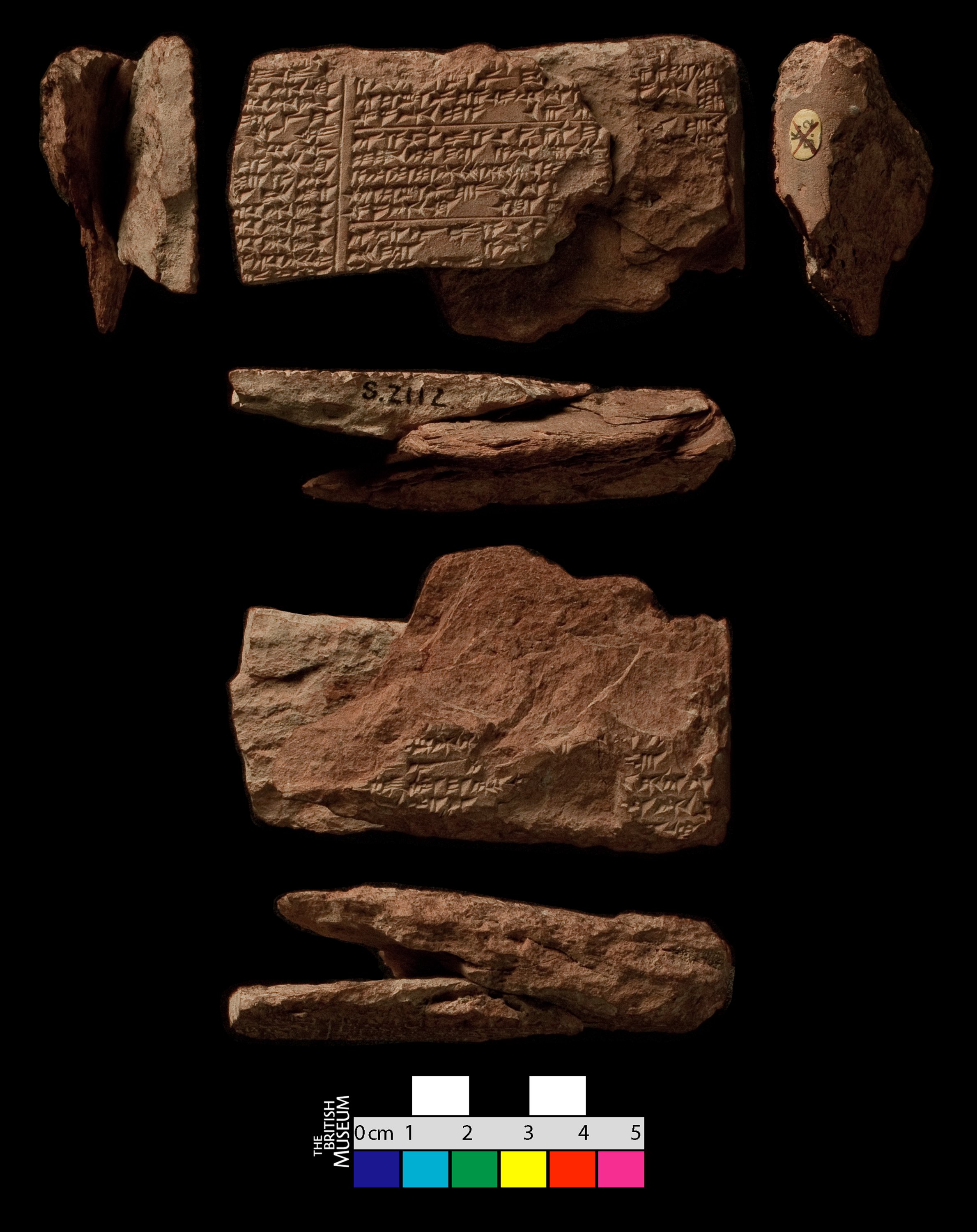
Tablet VI of the Epic of Gilgamesh (Standard Babylonian version, attributed to Sin-leqi-unninni) as it survives on one physical object: British Museum tablet Sm.2112 (Sm.2112 + DT.unn.1 (joined)), excavated at Nineveh from the library of Ashurbanipal (7th c. BCE). It is manuscript O₂ in A. R. George's 2003 edition. The photograph is the British Museum's, showing the inscribed face(s) and edges; column(s) ii, iii, iv are preserved (36 lines).
Three criteria are met for every section:
- Manuscript scan: the British Museum photograph of Sm.2112 itself (served by the Electronic Babylonian Library, LMU Munich). Each section names the column and face (obverse = columns i-iii, reverse = columns iv-vi) and the tablet's own line numbers, so the reader can find the lines on the photograph.
- Original text: the eBL manuscript-level ATF transliteration of the signs on this tablet (not the composite text). Brackets [ ] mark broken signs, x an illegible sign, # a damaged sign. Superscript numbers are the modern line numbers of George 2003 / eBL.
- Public-domain English: R. Campbell Thompson, The Epic of Gilgamish (London, 1928), verbatim, with his marginal line numbers as T n.
On line numbers. Thompson's 1928 numbering is not George's. For this tablet the correspondence was established one anchor per Thompson marginal number by reading his verse against the Akkadian; sections are cut only at those anchors, so each section's English is the block of Thompson's lines that renders exactly these Akkadian lines. Where the tablet's text begins or ends inside a Thompson block, the whole block is given and the section says so. Thompson's readings reflect the state of knowledge in 1928: modern editions (George 2003; the eBL edition, updated continuously) supersede him and are not public domain, so they are not reproduced here beyond the transliteration of this tablet's signs.
How was this verified? (Provenance)
44[x x x x x x x x x x ha]-mi#-ri#-[ki]
45[x x x x x x x x x x] i-di-šu₂
46[x x x x x x x x x ṣu-uh-r]e-ti-ki
47[x x x x x x x x x x x t]al-ti-meš-šu₂
48[x x x x x x ta]-ra-me-ma
49[x x x x x x x x tal]-te-bir
T 40Thou’rt but chalcedony [failing to guard (?)] in an enemy's country,
Thou’rt but a sandal which causeth its owner [to trip (by the wayside)].
Who was ever [thy] husband [thou faithfully lovedst] for all time?
Who hath been ever thy lord who hath gain’d [over thee the advantage?
Come, and I will unfold thee [the endless tale] of thy husbands.
T 45(Sooth), thou shalt vouch (?) for the truth (?) of (this) list—Thy maidenhood's consort,
Tammuz, each year dost make him the cause of Wailing , (then cometh
Next) the bird Roller gay-feather’d thou lovedst, and (yet) thou didst smite him
Thompson's numbered block(s) extend before the lines preserved on this tablet; the whole block is given so that no English line is cut mid-block.
50[x x x x x x x x i-šas-s]i kap-pi
51[x x x x x x x x x x] e-mu-qi₂
52[x x x x x x x šu-ut]-ta-a-ti
53[x x x x x x x na-ʾ-i]d qab-li
54[x x x x x x x x x x] tal-ti-meš-šu₂
55[x x x x x] tal-ti-meš-šu₂
56[x x x x x x x t]al-ti-meš-šu₂
57[x x x x x x x x x bi-tak-ka]-a tal-ti-mi
58[x x x x x x x x x x] u₂#-tul₅#-la#
T 50Breaking his wing: in the grove doth he stand, crying kappi 'my wing!'
Lovedst thou also a Lion, in (all) the full strength of (his) vigour,
(Yet) thou didst dig for him seven and seven (deep) pits (to entrap him).
Lovedst thou also a Stallion, magnificent he in the battle,
Thou wert the cause of a bridle, a spur, and a whip to him: (also)
T 55Thou wert the cause of his fifty miles galloping; thou wert the cause, too,
(Eke), of exhaustion and sweating (?); (thereafter), ’twas thou who didst (also)
Unto his mother Silili give cause for (her deep) lamentation.
Lovedst thou also a Shepherd, a neatherd, for thee without ceasing
Thompson's numbered block(s) extend after the lines preserved on this tablet; the whole block is given so that no English line is cut mid-block.
83[x x x x AM]A-ša₂# i[l-la-ka di]-ma#-[a-ša₂]
84a-bi {d#}GIŠ#-gim₂-maš it#-ta#-[na-a]z-za-ra-an-n[i]
85{d}GIŠ-gim₂-maš un-de-en-na-a [p]i-ša₂-ti-ia
86pi-ša₂-ti-ia u er-r[e]-ti#-ia
87{d}a-num pa-a-šu₂ DU₃-uš-ma DUG₄.GA
88i-zak-ka-ra a-na ru-bu-t[i] {d}iš₈-tar₂
89a-ba la at-ti te-eg-ri-i LUGAL# [{d}GIŠ-gim₂]-maš#
T 80[Heard] this (then) Ishtar: she burst into rage and [went up] to Heaven,
Hied her (thus) Ishtar to Anu, [her father], to Antu, her mother,
T 85Came she [to tell (them)]: "O father, doth Gilgamish load me with insult,
Gilgamish tale of my sins, my sins and iniquities telleth."
Anu made answer, (thus) speaking, and said unto Ishtar the Lady:
"Nay, thou didst ask him [to grant thee largesse of the fruit of his body],
Thompson's numbered block(s) extend before the lines preserved on this tablet; the whole block is given so that no English line is cut mid-block.
90u {d}GIŠ-gim₂-maš u₂-man-na-a# pi#-[ša₂-ti-ki]
91pi-ša₂-ti-ki u₃ e[r-re-ti-ki]
92{d}iš-tar pa-a-šu₂ D[U₃-ma x x x]
93MU-ra a-na {d#}[x x x x]
94a#-bi# a-la-a bi#-n[am-ma]
95[x x x x x x x x x x x]
T 90(Hence) he the tale of thy sins, thy sins and iniquities telleth."
(The Creation of the Divine Bull which is to destroy the heroes).
Ishtar made answer (thus) speaking, and said unto [Anu, her father]:
"Father, O make (me) a Heavenly Bull, which shall Gilgamish [vanquish],
T 95Filling [its body] with flame . . . .
But if thou’lt [not] make [this Bull], then . . . .
I'll smite . . . ., I'll put . . . ., I'll . . . .
Thompson's numbered block(s) extend after the lines preserved on this tablet; the whole block is given so that no English line is cut mid-block.
136lu-uṣ-bat-[su-ma ina ku-bur zib-ba-ti-šu₂]
137lu-uš-k[un še-pi ina ar?-kat₃? siq-qi₂-šu₂]
138i#-na x [x x x x x x x x-hi-is-su]
139[x x x k]i-i#? [x x x x x x x x x x]
140[i-na bi]-rit ti-i[k-ki qa]r-ni u nap#-l[a-ki] | [p]a-tar-k[a] um-[mi]d
T 130Enkidu girded (?) his middle; (and straightway) Enkidu, leaping,
Seized on the Heavenly Bull by [his] horns, and (headlong) before him
Cast down the Heavenly Bull his full length, . . . .
(Aye), by the thick of his tail.
(Gap of thirteen mutilated lines.)
Thompson's numbered block(s) extend before the lines preserved on this tablet; the whole block is given so that no English line is cut mid-block.
141i#-ṣu-dam-ma {d}+en-k[i-du₃ ana ku-ta]l GU₄.AN.NA
142[i]ṣ-bat-su-ma in[a ku-bur zib]-ba-ti-šu₂
143[iš-kun š]e-e[p-šu₂ x x x] siq#-qi₂-š[u₂]
T 147Chased him did Enkidu, . . . the Heavenly Bull . . .
Seized him and by [the thick] of his tail . . . .
(Gap of about fourteen mutilated lines in which the Bull is slain.)
Thompson's numbered block(s) extend after the lines preserved on this tablet; the whole block is given so that no English line is cut mid-block.
Cite
Source & Cross-References
- Source text: British Museum Sm.2112 photograph via eBL + eBL manuscript ATF (L.1.4 SB VI) + R. Campbell Thompson 1928 — view original
- Critical edition: Electronic Babylonian Library manuscript transliteration (CC BY-NC-SA 4.0)
← previous · → next · v cycle view · l back to library