Epic of Gilgamesh, Tablet I: Gilgamesh and the creation of Enkidu
Introduction
The prologue praises Gilgamesh, king of Uruk, and the walls of his city. Because he oppresses his people, the gods create Enkidu, a wild man who lives with the animals. A trapper sends the prostitute Shamhat to him; she civilizes him and tells him of Gilgamesh, who meanwhile dreams of his coming.
The Standard Babylonian version of the epic, traditionally ascribed to the scholar Sin-leqi-unninni, was written on twelve tablets. Most surviving copies come from the libraries of Ashurbanipal at Nineveh (7th century BCE) and from Babylon and other Babylonian cities (7th-2nd century BCE). This page gives Tablet I in the line numbering of the electronic Babylonian Library edition by A. R. George (2022 and later revisions).
How this page is built. Each section is a run of consecutive lines as written on one photographed clay tablet. For every line the eBL edition (https://www.ebl.lmu.de/corpus/L/1/4/SB/I) lists the manuscripts that carry it, with each tablet's own column and line numbers; the tablet chosen for each run is the photographed copy of the work with the most signs preserved there. Commentaries and texts that only quote a line are never chosen. School and excerpt tablets are used only for lines that no photographed library copy preserves as well, and only where they carry the line as text; their sections say so. The original text is eBL's transliteration of that tablet's signs (not a modern composite text): square brackets mark broken signs, x an illegible sign, # a damaged sign, ? an uncertain reading, and words in {braces} are determinatives; the notes give a key to every sign used on this page, and eBL's layout codes are written out in words (for example '(line break)' or '(blank space)'). Superscript numbers are the line numbers of the eBL edition, used in both the Akkadian and the English. The English is A. R. George's translation in the eBL edition (CC BY-NC-SA 4.0), one line of English per line of the poem; italics mark uncertain renderings, as in the source. Where the tablet is broken, the English still translates the whole line of eBL's composite text; each section's note names the lines that are broken on its tablet.
Finding a line on the photograph. Each section names the tablet, the face and column, and the tablet's own line numbers (a prime, as in 5', counts from the first preserved line of a broken column). On a tablet with six columns the obverse carries columns i-iii from left to right; the reverse, turned over from bottom to top, carries columns iv-vi from right to left. The photographs often show the obverse above the reverse with the edges around them; a fragment preserves only part of this layout.
This page shows 231 of the 300 lines of the eBL edition (77%), from 6 tablets in the British Museum: Rm.785, K.2756.C (Nineveh), K.4465 (Nineveh), K.8584 (Nineveh), K.2756.D (Nineveh), BM.38538.
Lines not shown. 69 of the 300 lines of the eBL edition are not shown, because no photographed copy of the work used here carries them: 19-47 (no photograph in eBL: IM.67577 (Iraq Museum); photograph does not show these lines (visual check): BM.34916); 48-51 (no photograph in eBL: IM.67577 (Iraq Museum); photograph does not show these lines (visual check): K.913, BM.34916); 52 (no photograph in eBL: IM.67577 (Iraq Museum); photograph does not show these lines (visual check): BM.34916); 82 (no photograph in eBL: VAT.17234 (Vorderasiatisches Museum, Berlin); photograph does not show these lines (visual check): BM.34916); 86 (no photograph in eBL: VAT.17234 (Vorderasiatisches Museum, Berlin); photograph does not show these lines (visual check): BM.34916); 145-154 (no photograph in eBL: K.2756.A); 208a-208b (not in the eBL Fragmentarium (no photograph there): IM.76973); 247-248 (photograph does not show these lines (visual check): K.913); 265-271 (photograph does not show these lines (visual check): K.913, BM.34916); 272 (photograph does not show these lines (visual check): BM.34916); 273-279 (photograph does not show these lines (visual check): K.913, BM.34916); 280 (photograph does not show these lines (visual check): BM.34916); 281-283 (photograph does not show these lines (visual check): K.913, BM.34916). A line is shown only on a photographed tablet that carries it as text. Commentaries and other texts that quote a line (letters, rituals, god lists) are not used as witnesses, because they carry it with explanations or inside another text; tablets without a photograph in eBL are not used, because the line could not be shown on its tablet.
How was this verified? (Provenance)
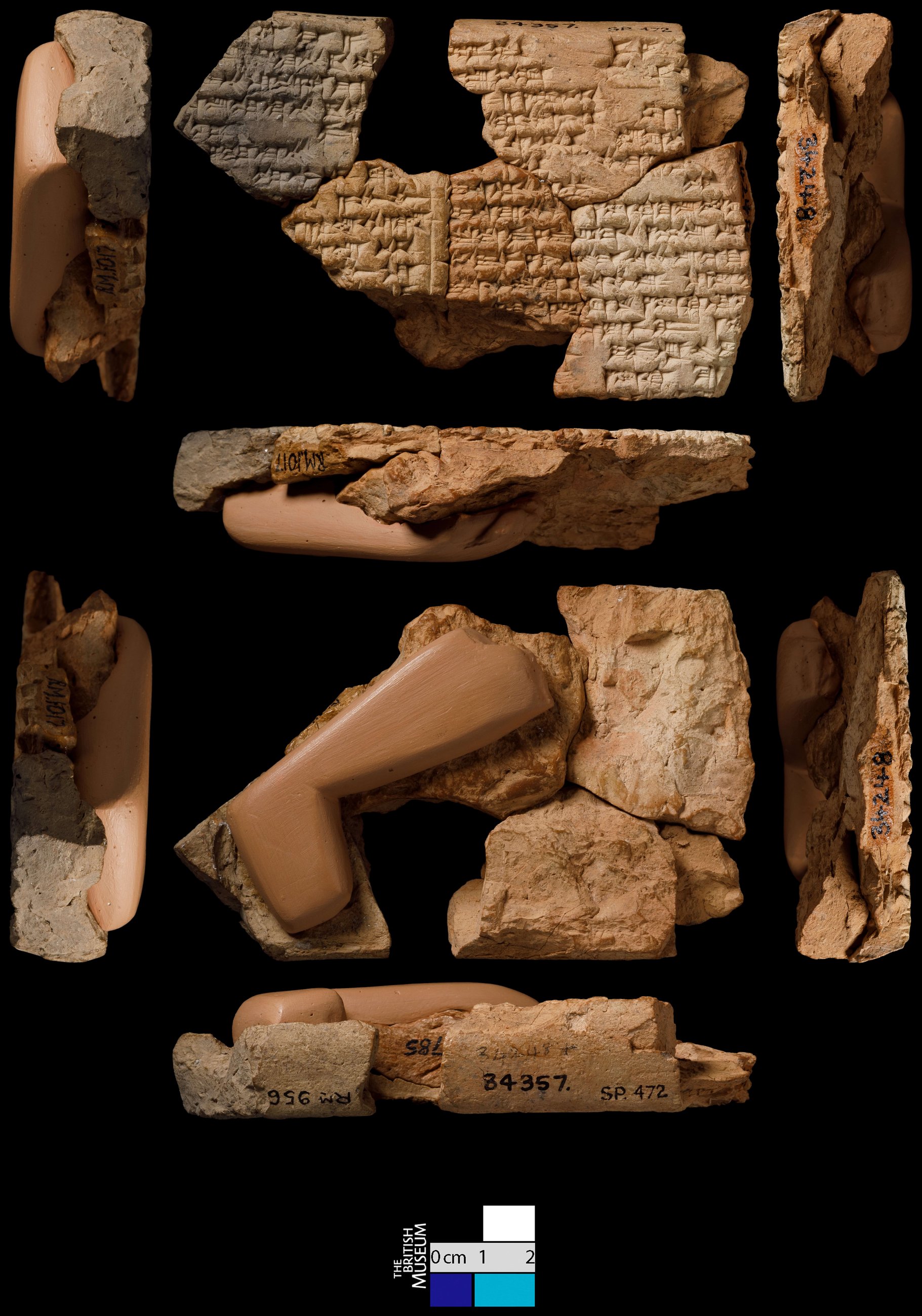
Where on the image
British Museum Rm.785: column i, the tablet's own lines 1 to 4. eBL's corpus edition (https://www.ebl.lmu.de/corpus/L/1/4/SB/I) attributes SB I 1-4 to this manuscript at these column and line numbers. Photograph checked: obverse, reverse and edges of the joined fragments (ink numbers of Rm.956 and BM.34357 visible on the edges, modern plaster fill); text on the obverse in two columns, consistent with eBL's columns i and ii. On this tablet lines 1-4 are partly broken (square brackets and x in the Akkadian). The English of these lines translates eBL's composite text, so it includes words that are not preserved on this tablet but are restored from other manuscripts or by the editors. Square brackets in the English mark eBL's restorations in its composite text; words that survive on other tablets carry no brackets even where this tablet is broken.
1[x x x x x x i]š-di# ma-a-[ti]
2[al-ka-ka-ti i-du]-u₂# ka#-la-mu ha-as-[su]
3[x x x x x x x] i-mu-ru iš-di ma-a#-[ti]
4[x x x x i-d]u-u₂ ka-la-mu ha-a[s-su]
1[He who saw the Deep, the] foundation of the country,
2[who knew all ways], was wise in everything!
3[Gilgameš, who] saw the Deep, the foundation of the country,
4[who] knew [all ways], was wise in everything!
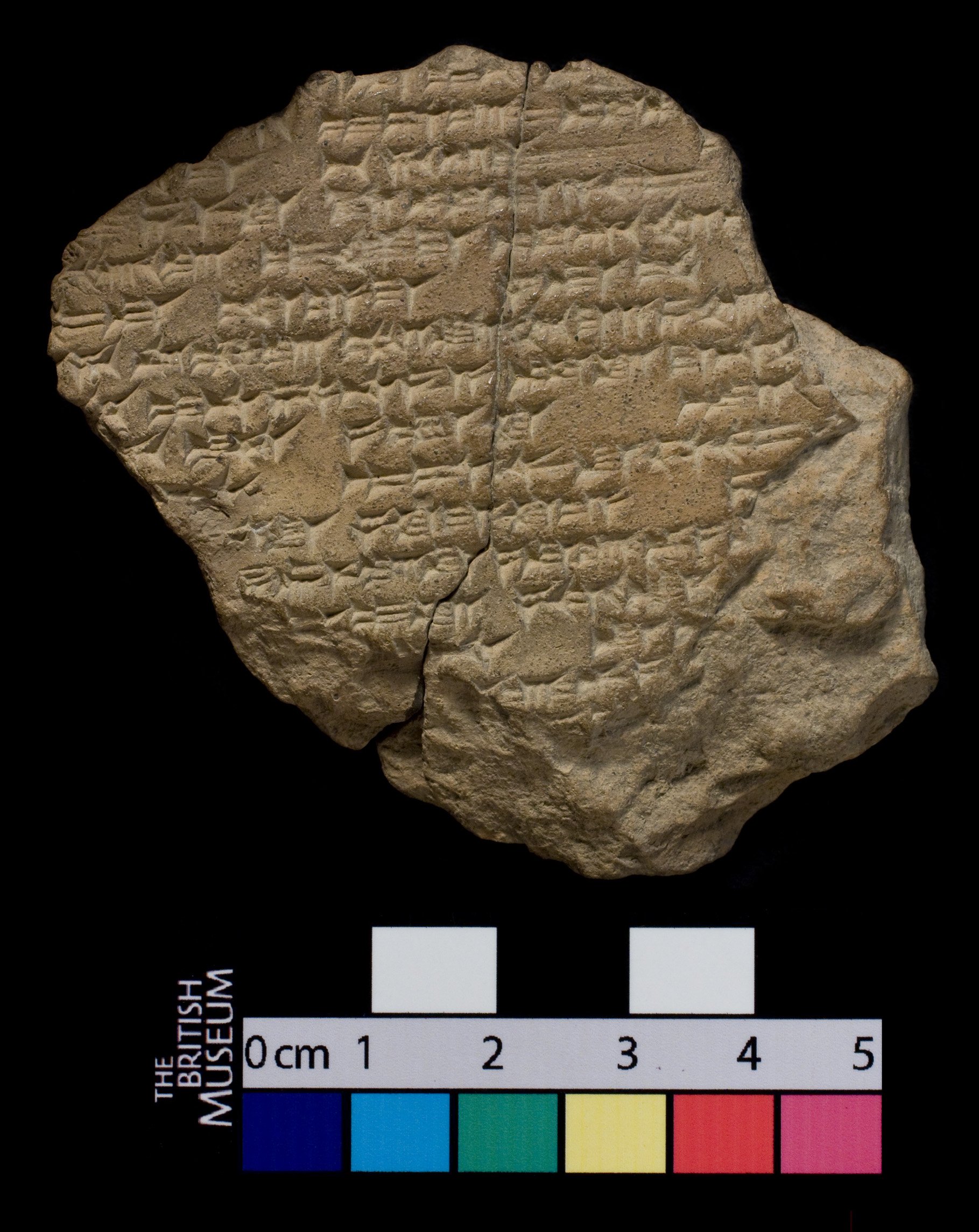
Where on the image
British Museum K.2756.C: column i, the tablet's own lines 3' to 16'. eBL's corpus edition (https://www.ebl.lmu.de/corpus/L/1/4/SB/I) attributes SB I 5-18 to this manuscript at these column and line numbers. Photograph checked: one face shown, about 16 lines in a single column, consistent with eBL's 16 lines in column i. On this tablet of line 18 only one to three signs survive and lines 5-17 are partly broken (square brackets and x in the Akkadian). The English of these lines translates eBL's composite text, so it includes words that are not preserved on this tablet but are restored from other manuscripts or by the editors. Square brackets in the English mark eBL's restorations in its composite text; words that survive on other tablets carry no brackets even where this tablet is broken.
5[i-hi-i]ṭ-ma mit-ha-riš p[a-rak-ki]
6[nap-h]ar ne₂-me-qi₂ ša ka-la-a-mi [x x]
7[ni]-ṣir-ta i-mur-ma ka-ti-im-t[i x x]
8[u]b-la ṭe₃-e-ma ša₂ la-am [x x x]
9[u]r-ha ru-uq-ta il-li-kam-ma a-ni-ih u# [x x x]
10[ša₂-k]in i-na {na₄}NA.RU₂.A ka-lu ma-na-a[h-ti]
11[up-pi]š BAD₃ ša₂ UNUG{ki} su-p[u-ri]
12[ša₂ E₂].AN#.NA qud-du-ši šu-tum₄-mi e[l-li₃]
13[a-mur B]AD₃-šu ša₂ ki-ma qe₂-e n[i-ip-šu?]
14[i-tap-la-a]s sa-me-ta-šu ša₂ la u₂-maš-ša₂-l[u x x]
15[x x x {gi]š}KUN₄ ša₂ ul-tu u[l!?-la-nu x x x]
16[x x x x E₂.A]N.NA šu-b[at x x]
17[x x x x x l]a u₂-maš-š[a₂-lu x x x]
18[x x x x x x] ša₂# U[NUG{ki} x x x]
5[He explored] everywhere the seats [of power,]
6he [knew] the totality of wisdom about everything.
7He saw the secret and uncovered the hidden,
8he brought back a message from the antediluvian age.
9He came a distant road and was weary but granted rest,
10all (his) labours [were] set down on a tablet of stone.
11He built the wall of Uruk-the-Sheepfold,
12of holy Eanna, the pure storehouse.
13See its wall which is like a strand of wool,
14view its parapet which nobody can replicate!
15Take the stairway that has been there since ancient times,
16and draw near to Eanna, the seat of Ištar,
17that no later king can ever replicate.
18Go up on to the wall of Uruk and walk around,
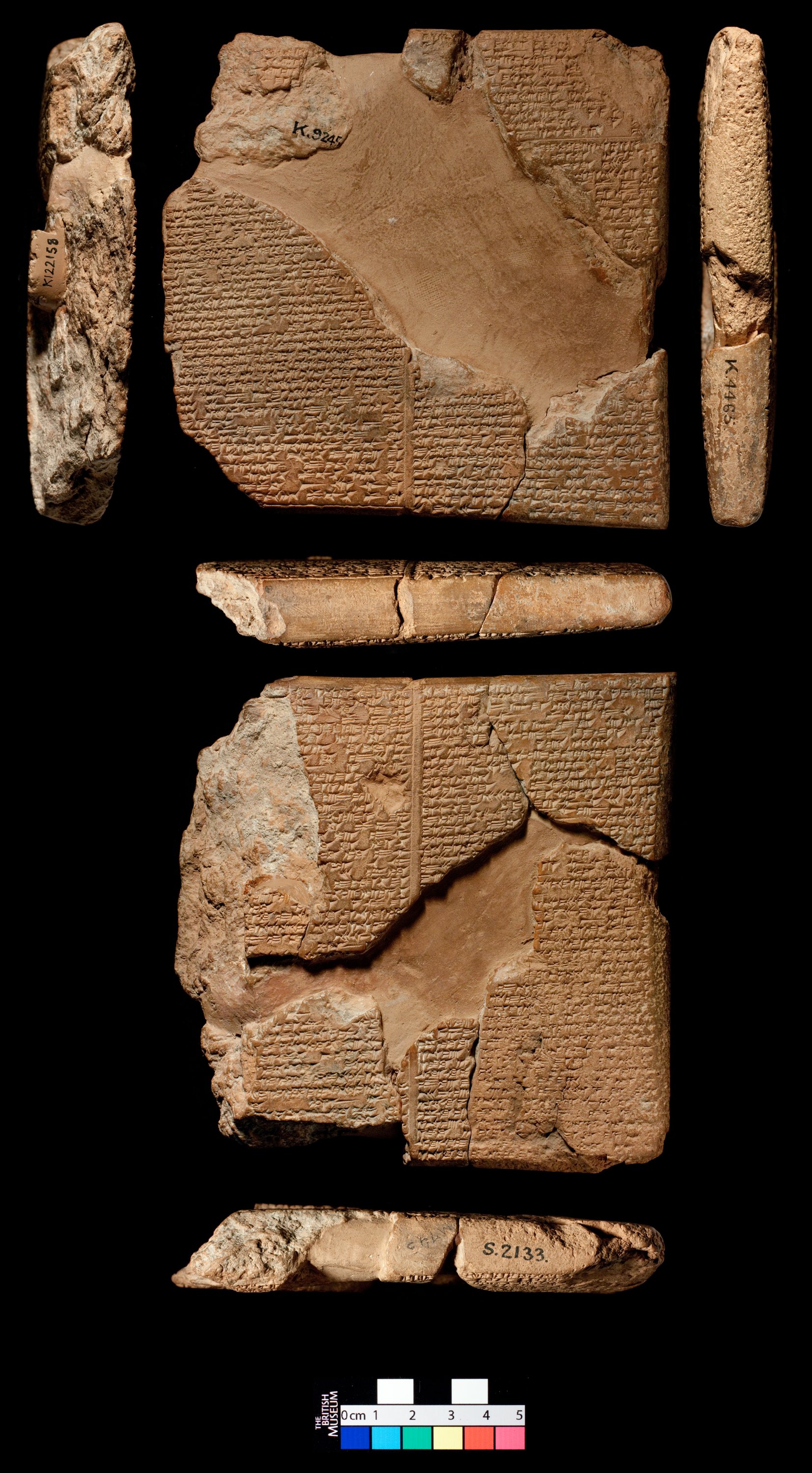
Where on the image
British Museum K.4465: obverse, column ii, the tablet's own line 2. eBL's corpus edition (https://www.ebl.lmu.de/corpus/L/1/4/SB/I) attributes SB I 53 to this manuscript at these column and line numbers. Photograph checked: obverse, reverse and edges of the joined tablet (K.4465 + K.9245 + K.22153 + Sm.2133; Sm.2133 ink number on the lower edge); two columns preserved on each face, consistent with eBL's columns ii-iii and iv-v. On this tablet of line 53 only illegible traces (x) survive. The English of this line translates eBL's composite text, so it includes words that are not preserved on this tablet but are restored from other manuscripts or by the editors. Square brackets in the English mark eBL's restorations in its composite text; words that survive on other tablets carry no brackets even where this tablet is broken.
53[x x x x x x x x] x [x x x x x x x]
53[Four] cubits was the width of his chest,
Where on the image
British Museum Rm.785: column ii, the tablet's own lines 1 to 14. eBL's corpus edition (https://www.ebl.lmu.de/corpus/L/1/4/SB/I) attributes SB I 54-67 to this manuscript at these column and line numbers. Photograph checked: obverse, reverse and edges of the joined fragments (ink numbers of Rm.956 and BM.34357 visible on the edges, modern plaster fill); text on the obverse in two columns, consistent with eBL's columns i and ii. On this tablet lines 54-67 are partly broken (square brackets and x in the Akkadian). The English of these lines translates eBL's composite text, so it includes words that are not preserved on this tablet but are restored from other manuscripts or by the editors. Square brackets in the English mark eBL's restorations in its composite text; words that survive on other tablets carry no brackets even where this tablet is broken.
54NIG₂.KA₉ GIR₃-šu₂ MAŠ nindan p[u-ri-is-su]
556# KUŠ₃ bi-rit (erasure) p[u-ri-di-šu₂]
56[3 K]UŠ₃ a-ša₂-rit-ti š[a₂ le-ti-šu₂]
57[ṭa]r₃-ra le-ta-šu₂ GIM ša₂ [x x x (x)]
58[it-q]i₂ per-ti-šu₂ uh-tan-n[a-ba GIM {d}nisaba]
59[ina] ši#-a#-hi-šu₂ git₂-ma-lu# la#-l[e-e-šu₂]
60i-na si-mat KI-ti₃ du[m-muq]
61i-na su-pu-r[u] ša₂ UNUG{ki} šu-u₂ it-t[a-lak]
62ug-da-aš₂-ša₂-ar₂ ri-ma-niš ša₂-qu-u₂ re-e?#-[šu₂]
63ul i-ši ša₂-ni-nam-ma te-bu-u₂ {giš}TUKUL-[MEŠ-šu₂]
64i-na pu-uk-ki-šu₂ te-bu-u₂ ru-uʾ₃-u₂#-[šu₂]
65[u₂]-ta#-ad#-da#-ri GURUŠ-MEŠ ša₂ UNUG{ki} ina ku-k[it-ti]
66[x x x x] {d#}GIŠ-gim₂-maš DUMU ana A[D-šu₂]
67[x x x mu-š]i i-kad₂-dir še-r[iš]
54A triple cubit was his foot, half a rod his leg.
55Six cubits was [his] stride,
56[three] cubits the curls at his [cheeks.]
57His cheeks were bearded, (dark as [gleaming]) lapis lazuli,
58the locks of his hair growing [thickly as Nissaba’s.]
59[As] he grew up he was perfect in [his] beauty,
60by human standards [he was] very handsome.
61He goes [about] in the sheepfold of Uruk,
62lording it like a wild bull, [head] held high.
63He has not any equal, [his] weapons being ready,
64[his] companions are kept on their feet by the ball.
65The young men of Uruk are wrongfully vexed,
66Gilgameš lets no son go free to [his] father.
67Day and night he behaves with fierce arrogance,
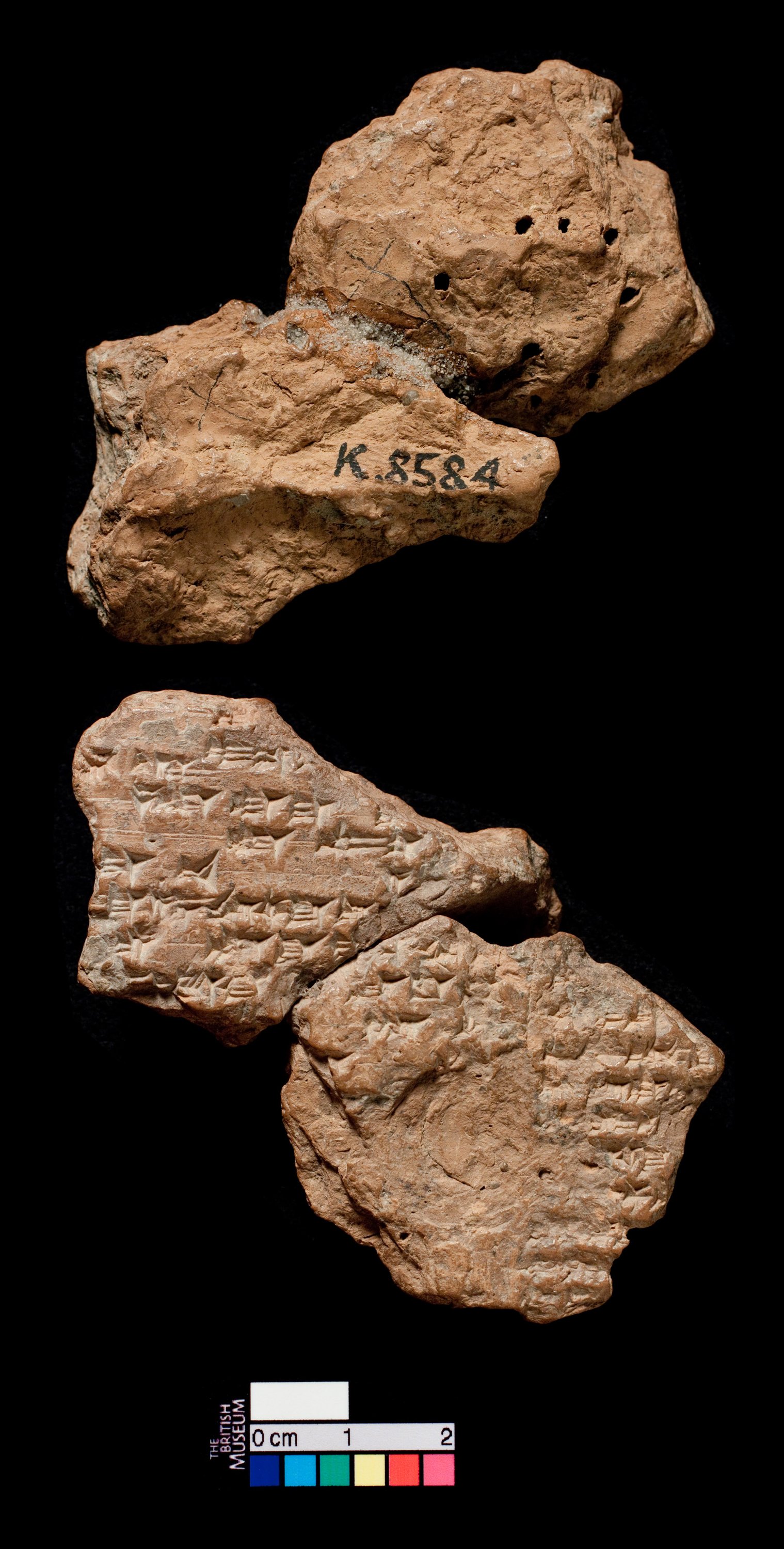
Where on the image
British Museum K.8584: column ii, the tablet's own lines 15 to 18. eBL's corpus edition (https://www.ebl.lmu.de/corpus/L/1/4/SB/I) attributes SB I 68-72 to this manuscript at these column and line numbers. Photograph checked: two views; the inscribed face (lower view) shows two columns, consistent with eBL's columns i and ii (12 lines each); the other view is the uninscribed back with the ink number K.8584. On this tablet line 71 is entirely broken and of lines 68-70, 72 only one to three signs survive. The English of these lines translates eBL's composite text, so it includes words that are not preserved on this tablet but are restored from other manuscripts or by the editors. Square brackets in the English mark eBL's restorations in its composite text; words that survive on other tablets carry no brackets even where this tablet is broken.
68[{d}GIŠ-gi]m₂-maš L[UGAL? ...]
69šu#-u₂# SIP[A-ma x x x x x x]
70ul# u₂#-ma[š-šar {d}GIŠ-gim₂-maš x x x x x]
71[x x x x x x x x x x x]
72ta#-z[i-im-ta-ši-na ...]
68[King] Gilgameš, [who guides the numerous people,]
69he who is shepherd of Uruk-the-Sheepfold!
70[Gilgameš] lets no [daughter go free to her] mother,
71[He is their herdsman,] they are [the] cows;
72[their] complaint […]
Where on the image
British Museum K.4465: obverse, column ii, the tablet's own lines 17 to 35a. eBL's corpus edition (https://www.ebl.lmu.de/corpus/L/1/4/SB/I) attributes SB I 73-97 to this manuscript at these column and line numbers. Photograph checked: obverse, reverse and edges of the joined tablet (K.4465 + K.9245 + K.22153 + Sm.2133; Sm.2133 ink number on the lower edge); two columns preserved on each face, consistent with eBL's columns ii-iii and iv-v. On this tablet line 78 is entirely broken, of lines 73-74 only one to three signs survive and lines 75-77, 79-81, 83-85, 87-91, 93, 95-96 are partly broken (square brackets and x in the Akkadian). The English of these lines translates eBL's composite text, so it includes words that are not preserved on this tablet but are restored from other manuscripts or by the editors. Square brackets in the English mark eBL's restorations in its composite text; words that survive on other tablets carry no brackets even where this tablet is broken. Lines 92, 94, 97 are complete on this tablet. eBL line(s) 82, 86 fall within this run but are not on this tablet (they are listed among the lines not shown).
73[gaš-r]u [šu-pu-u₂ mu-du-u₂ x x]
74[ul] u₂-maš-šar# [{d}GIŠ-gim₂-maš x x x x x x x x]
75ma#-rat qu-r[a-di x x x x]
76[t]a-zi-im-ta-ši-na i[š-te-nem-ma-a x x]
77[D]INGIR-MEŠ ša₂-ma-mi EN zi[k-ri : ]
78[x x x x x x x]
79[t]ul?-tab-ši-ma-a ri-ma kad₃-ra [x x x x x x]
80[u]l i-šu ša₂-ni-nam-ma t[e-bu-u₂ x x x x]
81[i]na pu-uk-ki šu-ut-bu-u₂ [x x x x]
83[u]l u₂-maš-šar {d}GIŠ-gim₂-maš DUMU ana AD-šu₂ :
84ur-ra u G[I₆ i-kad₂-dir x x]
85[š]u-u₂ SIPA-ma ša₂ UNUG{ki} s[u-pu-ri]
87[š]u-u₂ re-ʾ-u₂-ši-na-ma u x [x x x x]
88[g]aš-ru šu-pu-u₂ mu-du-u₂ [x x]
89[u]l u₂-maš-šar {d}GIŠ-gim₂-maš {munus}GURUŠ.TUR a-na m[u-ti-ša₂?]
90[m]a-rat qu-ra-di hi-rat e[ṭ-li]
91[t]a-zi-im-ta-ši-na iš-te-nem-me {d}[a-num]
92{d#}a-ru-ru is-su-u₂ GAL-tu₂ :
93at-ti {d}a-ru-ru tab-ni-[i LU₂]
94e#-nin-na bi-ni-i zi-kir-šu₂ :
95ana u₄-um lib₃-bi-šu₂ lu-u ma-h[ir?]
96[l]iš-ta-an-na-nu-ma UNUG{ki} liš-tap-š[ih]
97{d#}a#-ru-ru an-ni-ta ina še-me-ša₂ :
73‘[Powerful, pre-eminent], expert, [and mighty,]
74[Gilgamesh] lets [no] girl go free to [her bride groom.]’
75The warrior’s daughter, the [young man’s bride,]
76the goddess Ishtar was listening to their complaint.
77The gods of heaven, lords of initiative,
78[called out to the god Anu] …:
79‘Have you bred, indeed, a savage wild bull in Uruk-the-Sheepfold?
80He has not any equal, his weapons being ready,
81his companions are kept on their feet by the ball.
83Gilgameš lets no son go free to his father.
84Day and [night he behaves] with fierce [arrogance,]
85he who is shepherd of Uruk-the-Sheepfold!
87he is their herdsman and they are … […],
88powerful, pre-eminent, expert, [and mighty,]
89Gilgameš lets no girl go free to [her] bride-[groom.]’
90The warrior’s daughter, the young [man’s] bride,
91[Anu] was listening to their complaint.
92They summoned Aruru, the great one:
93‘You, O Aruru, created [man:]
94now create what he suggests!
95Let him be equal to the storm of his heart,
96let them rival each other and so let Uruk be rested.’
97When Aruru heard this,
Where on the image
British Museum K.4465: obverse, column ii, the tablet's own lines 35b to 52. eBL's corpus edition (https://www.ebl.lmu.de/corpus/L/1/4/SB/I) attributes SB I 98-119 to this manuscript at these column and line numbers. Photograph checked: obverse, reverse and edges of the joined tablet (K.4465 + K.9245 + K.22153 + Sm.2133; Sm.2133 ink number on the lower edge); two columns preserved on each face, consistent with eBL's columns ii-iii and iv-v. On this tablet lines 98-101, 103, 105-106, 108-119 are partly broken (square brackets and x in the Akkadian). The English of these lines translates eBL's composite text, so it includes words that are not preserved on this tablet but are restored from other manuscripts or by the editors. Square brackets in the English mark eBL's restorations in its composite text; words that survive on other tablets carry no brackets even where this tablet is broken. Lines 102, 104, 107 are complete on this tablet.
98zik-ru ša₂ {d}a-nim ib-ta-ni ina lib₃#-[bi-ša₂]
99[{d}a-r]u-ru im-ta-si ŠU+MIN-ša₂ :
100ṭi-ṭa ik-ta-ri-iṣ it-ta-di ina EDI[N]
101[ina EDI]N {d}+en-ki-du₃ ib-ta-ni qu-ra-du :
102i-lit-ti qul-ti ki-ṣir {d}nin-urta
103[šu]-ʾ#-ur šar-ta ka-lu zu-um-ri-šu₂ :
104up-pu-uš pe-re-tu GIM sin-niš-ti
105[i]-ti-iq pe-er-ti-šu uh-tan-na-ba ki-ma {d}nisaba
106[la] i-de UN-MEŠ u ma-tam-ma :
107lu-bu-uš-ti la-biš GIM {d}šakkan₂
108[i]t-ti MAŠ.DA₃-MEŠ-ma ik-ka-la šam-mi
109[i]t-ti bu-li₃ maš-qa-a i-tep-pir
110[i]t-ti nam-maš-ši-e A-MEŠ i-ṭib lib₃-ba-šu₂
111[ṣa]-a#-a-du ha-bi-lu LU₂
112[ina p]u-ut maš-qi₂-i ša₂-a-šu₂ uš-tam-hi-ir-šu₂
113[x x] u₄#-me 2-a u šal-ša₂ ina pu-ut maš-qi₂-i KIMIN
114[i-mur-š]u-ma ṣa-a-a-du uš-ta-ah-ri-ru pa-nu-šu₂
115[x x] u bu-li-šu₂ bi-tuš-šu₂ i-ru-um-ma
116[x x x] uš-ha-ri-ir i-qu-ul-ma
117[x x x] lib₃-ba-šu₂ pa-nu-šu₂ ar-pu
118[x x x x S]AG.PA.LAGAB ina kar-ši-šu
119[x x x x x x r]u-qu-ti pa-nu-šu₂ maš-lu
98she fashioned Anu’s idea in her heart.
99Aruru washed her hands,
100she took a pinch of clay, she threw it down in the wild.
101In the wild she created Enkidu, the hero,
102an offspring of silence, knit strong by Ninurta.
103All his body is matted with hair,
104he is adorned with tresses like a woman:
105the locks of his hair grow as thickly as Nissaba’s,
106he knows not at all a people nor even a country.
107He was clad in a garment like Šakkan’s,
108feeding on grass with the very gazelles.
109Jostling at the water-hole with the herd,
110he enjoyed the water with the animals.
111A hunter, a trapper-man,
112came face to face with him by the water-hole.
113One day, a second and a third, he came face to face with him by the water-hole.
114The hunter saw him and his expression froze,
115[he] and his herds – he went back to his lair.
116[He was] troubled, he grew still, he grew silent,
117his mood [was unhappy], his face clouded over.
118There [was] sorrow in his heart,
119his face was like [one who has travelled] distant [roads.]
Where on the image
British Museum K.4465: obverse, column iii, the tablet's own lines 1 to 21. eBL's corpus edition (https://www.ebl.lmu.de/corpus/L/1/4/SB/I) attributes SB I 120-140 to this manuscript at these column and line numbers. Photograph checked: obverse, reverse and edges of the joined tablet (K.4465 + K.9245 + K.22153 + Sm.2133; Sm.2133 ink number on the lower edge); two columns preserved on each face, consistent with eBL's columns ii-iii and iv-v. On this tablet of lines 137-140 only one to three signs survive and lines 120-136 are partly broken (square brackets and x in the Akkadian). The English of these lines translates eBL's composite text, so it includes words that are not preserved on this tablet but are restored from other manuscripts or by the editors. Square brackets in the English mark eBL's restorations in its composite text; words that survive on other tablets carry no brackets even where this tablet is broken.
120ṣa-a-a-d[u pa-a-šu₂] i-pu-uš-ma i-qab-bi MU-r[a a-na a-bi-šu₂]
121a-b[i iš-te]n₂ eṭ-lu ša₂ il-l[i-ka-an-na-ši]
122i#-[na KUR d]a-an e-mu-q[i₂ i-šu]
123[ki-ma ki-iṣ-ri] ša₂ {d}a-nim dun-nu-n[a e-mu-qa-šu]
124[it-ta-na-al-la]k ina UGU KUR-i k[a-a-a-nam-ma]
125[ka-a-a-nam-m]a it-ti bu-li₃ [am-mar-šu₂]
126[ka-a-a-nam-ma G]IR₃-MEŠ-šu₂ ina pu-ut maš-qi₂-i# [šak-na]
127[pal-ha-ku-ma u]l a-ṭe-eh-ha-a a-na š[a₂-a-šu]
128[um-tal-li bu]-u₂#-ri ša₂ u₂-har-ru-u₂ [ana-ku]
129[ut-ta-as-si-ih n]u-bal-li-ia ša₂ uš-n[i-lu]
130[uš-te-li ina ŠU-ia] bu-lam nam-maš-ša₂-a ša₂ ED[IN]
131[ul i-nam-din-a]n-ni a-na e-peš ED[IN]
132[a-bu-šu₂ pa-a-šu₂ i-pu-uš-ma i-qab-b]i i-zak-ka-ra a-na ṣa-a-a-du#
133[a-lik ma-ri ana NUNUZ ša₂ lib₃-b]i UNUG{ki} {d}GIŠ-gim₂-maš
134[x x x x x x (x)] x e-lu EDIN-šu
135[ki-ma ki-iṣ-ri ša₂ {d}a-nim dun-n]u-na e-mu-qa-a-šu
136[ṣa-bat ur-ha ina ŠA₃ UNUG{ki} šu-ku]n pa-ni-ka
137[x x x x x x x (x x x)] x e-muq LU₂
138[a-lik ma-ri it-ti-ka ha-rim-tu₂ {munus}šam-hat] u₂-ru-ma
139[x x x x x x x (x x x)] GIM dan-nu
140[x x x x x x x x x a-na] maš-qi₂-i
120The hunter opened [his mouth] to speak, saying [to his father:]
121‘My father, [there is a] certain fellow who has come [to us,]
122Mightiest in the [land, he possesses] strength,
123[his strength] is as mighty [as a lump of rock] from the sky.
124[He wanders always] over the hills,
125[always] with the herd [do I see him.]
126[Always] his feet [are found] by the water-hole,
127[I am afraid and so] I do not go up to him.
128[He has filled in the] pits that I dug,
129[he has uprooted] my snares that I laid.
130[He has set free from my grasp] the herd, the animals of the wild,
131[he will not let] me do the work of the wild.’
132[His father opened his mouth to speak], saying to the hunter:
133[Go, my son, to] Gilgamesh, [the offshoot sprung from] Uruk’s [midst!]
134[Make your way] into his presence,
135his strength [is as mig]hty [as a lump of rock from the sky.]
136[Take the road, set] your face [toward Uruk,]
137[…] the strength of a man!
138[Go, my son], bring [with you Šamhat the harlot,]
139[her allure is a match] for even the mighty!
140[When the herd comes] down [to] the water-hole,
Where on the image
British Museum K.4465: obverse, column iii, the tablet's own lines 22 to 25 and 36 to 51. eBL's corpus edition (https://www.ebl.lmu.de/corpus/L/1/4/SB/I) attributes SB I 141-170 to this manuscript at these column and line numbers. Photograph checked: obverse, reverse and edges of the joined tablet (K.4465 + K.9245 + K.22153 + Sm.2133; Sm.2133 ink number on the lower edge); two columns preserved on each face, consistent with eBL's columns ii-iii and iv-v. eBL numbers these lines on the tablet 22 to 25 and 36 to 51: its line numbers jump although the poem lines are consecutive. On this tablet of line 144 only illegible traces (x) survive, of lines 141-143, 155-157 only one to three signs survive and lines 158-164 are partly broken (square brackets and x in the Akkadian). The English of these lines translates eBL's composite text, so it includes words that are not preserved on this tablet but are restored from other manuscripts or by the editors. Square brackets in the English mark eBL's restorations in its composite text; words that survive on other tablets carry no brackets even where this tablet is broken. Lines 165-170 are complete on this tablet. eBL line(s) 145, 146, 147, 148, 149, 150, 151, 152, 153, 154 fall within this run but are not on this tablet (they are listed among the lines not shown).
141[x x x x x x x x x x x x x ku-z]u-ub-ša₂
142[x x x x x x x x x x x š]a₂-a-ši
143[x x x x x x x x x x x UGU E]DIN-šu
144[x x x x x x x x x x x] x x [(x)]
155u[m-tal-li x x x x x x x x x x x]
156u[t-ta-as-si-ih x x x x x x x x]
157uš-[te-li x x x x x x x x x x ša₂ EDI]N
158ul [i-na]m-din#-na#-an#-[ni x x x x x] EDIN
159{d}GIŠ-gim₂#-maš# a-na ša₂-šu₂-ma M[U-ra a-na ṣa-a]-a-di
160a-lik ṣa-a-a-di it-ti-ka {munus}h[a-rim-tu₂ {munus}šam-hat] u₂-ru-ma
161e-nu-ma bu-lam i-sa#-[an-ni-qu] ana maš-qi₂-i
162ši-i liš-hu-uṭ lu-bu-ši-š[a₂-ma lip]-ta#-a# ku-zu-ub-ša₂
163im-mar-ši-ma i-ṭ[e-e]h-ha-a a-na ša₂-a-ši
164i-nak-kir-šu₂ bu-ul-šu₂ š[a₂ i]r-bu-u₂ UGU EDIN-šu
165il-lik ṣa-a-<a>-di it-ti-šu₂ {munus#}ha#-rim-ti {munus}šam-hat u₂-ru-ma
166iṣ-ṣab#-tu ur-ha uš-te-še-ru KASKAL
167ina šal-ši u₄-me ina A.ŠA₃ a-dan-ni ik-tal-du-ni
168ṣa-a-a-du u {munus}ha-rim-tu ana uš-bi-šu₂-nu it-taš-bu-ni
1691-en u₄-ma 2-a u₄-ma ina pu-ut maš-qi₂-i it-taš-bu
170KUR-da bu-lu maš-qa-a i-šat-ti
141[she should strip off] her [clothing to reveal] her charms.
142[He will see] her and will go up [to] her,
143his herd will be estranged from him, [though he grew up] in its presence.
144[Paying heed] to the advice of his father,
155He has filled in the pits that I dug,
156he has uprooted my snares [that I laid.]
157He has released from my grasp the herds, the animals [of the] wild,
158he will not let me do the work [of the] wild.’
159Gilgameš said to him, to the hunter:
160‘Go, O hunter, take with you Šamḫat the harlot.
161When the herd comes down to the water-hole,
162she should strip off her clothing to reveal her charms.
163He will see her and will go up to her,
164his herd will be estranged from him, though he grew up in its presence.’
165Off went the hunter, he took with him Šamḫat the harlot,
166they set out on the road, they started the journey.
167On the third day they arrived at the destination;
168the hunter and the harlot sat down to wait.
169One day, a second day, they sat by the water-hole,
170(then) the herd arrived to drink at the water-hole.
Where on the image
British Museum K.4465: reverse, column iv, the tablet's own lines 1 to 23. eBL's corpus edition (https://www.ebl.lmu.de/corpus/L/1/4/SB/I) attributes SB I 171-194 to this manuscript at these column and line numbers. Photograph checked: obverse, reverse and edges of the joined tablet (K.4465 + K.9245 + K.22153 + Sm.2133; Sm.2133 ink number on the lower edge); two columns preserved on each face, consistent with eBL's columns ii-iii and iv-v. On this tablet lines 173, 176, 183-194 are partly broken (square brackets and x in the Akkadian). The English of these lines translates eBL's composite text, so it includes words that are not preserved on this tablet but are restored from other manuscripts or by the editors. Square brackets in the English mark eBL's restorations in its composite text; words that survive on other tablets carry no brackets even where this tablet is broken. Lines 171-172, 174-175, 177-182 are complete on this tablet.
171KUR-da nam-maš-<še>-e A-MEŠ i-ṭib lib₃-ba-šu
172u₃ šu-u₂ {d#}en-ki-du₃ i-lit-ta-šu₂ ša₂-du-um-ma
173it-ti MA[Š.D]A₃-MEŠ-ma ik-ka-la U₂
174it-ti bu-li₃ maš-qa-a i-šat-ti
175it-ti nam-maš-še#-e A-MEŠ i-ṭib lib₃-ba-šu₂
176i-mur-šu-m[a] {munus}šam-hat lul-la-a LU₂
177GURUŠ šag-ga-ša₂#-a ša₂ qa₂-bal-ti EDIN
178an-nu-u₂ šu-u₂ {munus}šam-hat ru-um-mi-i ki-rim-mi-ki
179ur-ki pi-te-ma ku-zu-ub-ki lil-qe₂
180e taš-hu-ti li-qe₂-e na-pis-su
181im-mar-ki-ma i-ṭe-eh-ha-a ana ka-a-ši
182lu-bu-ši-ki mu-uṣ-ṣi#-ma UGU-ki li-iṣ-lal
183ep-ši-šu₂-ma lul-[l]a-a ši-pir sin-niš-ti
184i-nak-kir-šu₂ bu-ul-šu₂ š[a₂ i]r-bu-u₂ ina EDIN-šu₂
185da-du-šu₂ i-hab-b[u-b]u UGU EDIN-ki
186ur-tam-mi šam-hat di-da-š[a₂]
187[x x x x x x ku-z]u-ub-ša₂ il-qe₂
188ul iš-hu-u[t x x x na-pi]s-su
189lu-bu-ši-š[a₂ u₂-ma-ṣi-m]a UGU-š[u₂ i]ṣ-lal
190i-pu-u[s-su-ma lul-l]a-a ši-pir si[n-niš-t]i
191da-d[u-šu ih-bu-b]u UGU EDIN-[ša₂]
1926# u[r-ri u? 7 GI₆-MEŠ {d}en-ki-d]u₃ te-bi-ma šam-hat-ta i-re-[hi]
193[x x iš-bu]-u₂# la-la-ša₂#
194[x x x x x x] a-na EDIN bu-li-š[u]
171The animals arrived, they enjoyed the water,
172and also Enkidu himself, whose birth-place was the hills.
173Feeding on grass with the very gazelles,
174jostling at the water-hole with the herd,
175he enjoyed the water with the animals.
176(Then) Šamḫat saw him, the man-savage,
177a murderous fellow from the midst of the wild.
178‘This is he, Šamḫat! Uncradle your bosom;
179bare your sex so he may take in your charms!
180Do not show fear, take in his scent!
181He will see you and he will come up to you.
182Spread your clothing so he may lie on you,
183treat the man to the work of a woman!
184his herd will be estranged from him, though he grew up in its presence.
185His ‘love’ will caress and embrace you,
186Šamḫat let loose her skirts,
187she bared her sex and he took in her charms.
188She showed no fear, she took in his scent:
189she spread her clothing and he lay upon her.
190She treated the man to the work of a woman,
191his ‘love’ caressed and embraced her.
192For six days and seven nights Enkidu, erect, did couple with Šamḫat.
193After he was sated with her delights,
194he turned his face toward his herd.
Where on the image
British Museum K.4465: reverse, column iv, the tablet's own lines 24 to 47. eBL's corpus edition (https://www.ebl.lmu.de/corpus/L/1/4/SB/I) attributes SB I 195-218 to this manuscript at these column and line numbers. Photograph checked: obverse, reverse and edges of the joined tablet (K.4465 + K.9245 + K.22153 + Sm.2133; Sm.2133 ink number on the lower edge); two columns preserved on each face, consistent with eBL's columns ii-iii and iv-v. On this tablet lines 195-207, 209, 211-214, 216-218 are partly broken (square brackets and x in the Akkadian). The English of these lines translates eBL's composite text, so it includes words that are not preserved on this tablet but are restored from other manuscripts or by the editors. Square brackets in the English mark eBL's restorations in its composite text; words that survive on other tablets carry no brackets even where this tablet is broken. Lines 208, 210, 215 are complete on this tablet. eBL line(s) 208a, 208b fall within this run but are not on this tablet (they are listed among the lines not shown).
195[x x x x x x x x x] i#-rap-pu-da MAŠ.DA₃-ME[Š]
196[x x x it-te-s]i ina SU-šu₂
197[x x x {d}en-ki-d]u₃ ul-lu-la pa-gar-šu₂
198[x x x x bir-ka-a-š]u₂ ša₂ il-la-ka bu-ul-šu₂
199[x x x x x x x x u]l ki-i ša₂ pa-ni la-sa-an-šu₂
200[x x x x x x x r]a-pa-aš₂ ha-si-sa
201[x x x x x i]-ta#-šab ina ša₂-pal {munus}ha-rim-ti
202[x x x x] i-na-aṭ-ṭa-la# pa-ni-ša₂
203[x x {munus}ha-rim]-ti i-qab-bu-u₂ i#-šem-ma-a GEŠTU+MIN-šu₂
204[x x x x a-n]a ša₂-šu₂-ma MU-ra a-na {d}en-ki-du₃
205[dam]-qa#-ta# {d#}+en#-ki-du₃ k[i-m]a DINGIR x x ba!# ši
206[a]m-me-ni it-ti nam-maš-š[e]-e ta-rap-pu-ud EDIN
207al-ka lu-[t]ar-ru-k[a ana l]ib₃-bi UNUG{ki} su-pu₂-ri
208a-na E₂ el#-li₃ mu-šab# {d}a-nim u {d}iš-tar
209a-šar {d#}[GI]Š-gim₂-maš git₂-ma-lu e-mu-qi₂
210u₃ ki-i# AM ug-da#-aš₂-ša₂-ru UGU GURUŠ-MEŠ
211i-ta-m[a]-aš₂-šum-ma ma-gir qa-ba-ša₂
212mu-du-u₂# lib₃-b[a-š]u₂ i-še-ʾ-a ib-ra
213{d}+en-ki-du₃ a-na ša₂-š[i-m]a MU-ra <ana> {munus}ha-rim-[t]i
214al-ki š[a]m-hat-ta qi₂#-re-en-[n]i ia-a-ši
215a-na E₂ el#-li₃ qud-du#-ši mu-šab# {d}a-nim {d}iš#-tar#
216a-šar {d#}GIŠ-gim₂-maš [git₂-m]a-lu e-mu-qi₂
217u₃ ki-i A[M ug]-da#-aš₂#-[ša₂-ru] UGU GURUŠ-M[EŠ]
218a-na-ku lu-ug-ri-šum-ma d[a-an x] x x x x
195The gazelles saw Enkidu and they started running,
196the animals of the wild moved away from his person.
197Enkidu had defiled his body so pure,
198his legs stood still, though his herd was on the move.
199Enkidu was diminished, his running was not as before,
200but he had reason, he [was] wide of understanding.
201He came back and sat down at the feet of the harlot,
202watching the harlot, (observing) her features.
203Then his ears heard what the [harlot] was speaking,
204[as the harlot] said to him, to Enkidu:
205‘You are handsome, Enkidu, you are just like a god,
206why with the animals do you range through the wild?
207Come, I will lead you to Uruk-the-Sheepfold,
208to the sacred temple, the dwelling of Anu and Ištar!
209where Gilgameš is perfect in strength,
210and lords it over the menfolk like a wild bull!
211She talked to him and what she said found favour,
212his heart (now) wise was seeking a friend.
213Enkidu said to her, to the harlot:
214‘Come, Šamḫat, take me along
215to the sacred temple, the holy dwelling of Anu and Ištar,
216where Gilgameš is perfect in strength,
217and lords it over the menfolk like a wild bull!
218I will challenge him, for [my strength] is mighty,
Where on the image
British Museum K.4465: reverse, column v, the tablet's own lines 1 to 21. eBL's corpus edition (https://www.ebl.lmu.de/corpus/L/1/4/SB/I) attributes SB I 219-239 to this manuscript at these column and line numbers. Photograph checked: obverse, reverse and edges of the joined tablet (K.4465 + K.9245 + K.22153 + Sm.2133; Sm.2133 ink number on the lower edge); two columns preserved on each face, consistent with eBL's columns ii-iii and iv-v. On this tablet of line 238 only one to three signs survive and lines 219-237, 239 are partly broken (square brackets and x in the Akkadian). The English of these lines translates eBL's composite text, so it includes words that are not preserved on this tablet but are restored from other manuscripts or by the editors. Square brackets in the English mark eBL's restorations in its composite text; words that survive on other tablets carry no brackets even where this tablet is broken.
219[x x x x x x UNU]G{ki} a-na-ku-mi dan-nu
220[x x x x ši-ma!?]-tu₂ u₂-nak-kar
221[x x x x x x da-a]n i-mu-qi₂ i-šu
222[x x li-mu-r]a pa-ni-ka
223[x x x x (x x)] i-ba-aš₂-šu-u₂ ana-ku lu i-de
224[x x x x x x UNU]G{ki} su-pu₂-ri
225[x x x x uz-z]u-hu {tug₂}IB₂.LA₂-MEŠ
226[x x x x x x (x) š]a₂-kin i-sin-nu
227[a-šar ur-ta-aṣ-ṣa-n]u a-lu-u₂
228[x x x x x š]u-su-ma bi-n[u-t]u₂
229[x x x x x ma-l]a-a ri-š[a₂-a-t]i
230[x x x x x x x x u₂-še-ṣ]u-u₂ ra-[bu-t]u₄
231[x x x x x x i-du]-u₂ ba-l[a₂-ṭ]a
232[x x x x x x x x x ha-d]i-ʾ-u₂-a LU₂
233[x x x x x u₂]-ṭul pa-ni-šu₂
234[x x x x x ba]l-ta i-ši
235[x x x x x x k]a-lu SU-šu₂
236[x x x x x U]GU-ka i-ši
237[x x x x x u]r-ra u GI₆
238[x x x x x x x] še-ret-ka
239[x x x x x x] i-ram-šu₂-ma
219[I will vaunt] myself in Uruk, (saying) “I am the mightiest!”
220[there] I shall change the way things are ordered,
221[the one] born in the wild is mighty, he has strength.’
222‘Let [the people] see your face,
223[…that] exists I know indeed.
224Go, Enkidu, to Uruk-the-Sheepfold,
225where the young men are girt with waistbands.
226Every day [in Uruk] a festival is held,
227where the drums are repeatedly beaten,
228and the harlots are comely of figure,
229graced with charm, full of joy.
230Even the aged they rouse from their beds!
231O Enkidu, [who do not (yet)] know life –
232I will show you Gilgameš, the man so merry,
233look at him, regard his face!
234He is fair in manhood, he has dignified bearing,
235his whole person is graced with charm.
236He has a strength more mighty than you,
237he is unsleeping by day and by night.
238O Enkidu, get rid of your sinful intention,
239as for Gilgameš Šamaš loves him.
Where on the image
British Museum K.4465: reverse, column v, the tablet's own lines 22 to 28 and 31 to 43. eBL's corpus edition (https://www.ebl.lmu.de/corpus/L/1/4/SB/I) attributes SB I 240-261 to this manuscript at these column and line numbers. Photograph checked: obverse, reverse and edges of the joined tablet (K.4465 + K.9245 + K.22153 + Sm.2133; Sm.2133 ink number on the lower edge); two columns preserved on each face, consistent with eBL's columns ii-iii and iv-v. eBL numbers these lines on the tablet 22 to 28 and 31 to 43: its line numbers jump although the poem lines are consecutive. On this tablet of lines 245, 249-250, 261 only one to three signs survive and lines 240-244, 246, 251-260 are partly broken (square brackets and x in the Akkadian). The English of these lines translates eBL's composite text, so it includes words that are not preserved on this tablet but are restored from other manuscripts or by the editors. Square brackets in the English mark eBL's restorations in its composite text; words that survive on other tablets carry no brackets even where this tablet is broken. eBL line(s) 247, 248 fall within this run but are not on this tablet (they are listed among the lines not shown).
240[x x x x x x x x] {d#}e₂#-a u₂#-[rap-p]i-šu₂ u₂-zu-un-šu₂
241[x x tal-l]i-ka u[l-t]u ša₂-di-ma
242[x x x x x x UN]UG{ki} i-na-ṭa#-lu šu-na-tu-ka
243[x x x x x x x] šu-na-tu₂ BUR₂-ar₂# MU-ar₂ a-na AM[A-šu₂]
244[x x MAŠ₂].GI₆ aṭ-ṭu-lu# mu-ši-t[i-ia]
245[ib-šu-nim-m]a MUL A[N-e]
246[x x x x x {d}a-nim]-ma?# im?#-taq?#-qu#-t[a UG]U [x x]
249[x x x x x i]z-za#-[az x x]
250[x x x x x x x] in[a muh-hi-šu₂]
251[i-tep-pi-ir um-m]a-nu U[GU E]DIN-[šu₂]
252[GURUŠ-MEŠ uk]-tam-ma-ru UGU-[šu₂]
253[ki-i šer₃-ri la]-ʾ#-i u₂-na-ša₂-qu GIR₃-[MEŠ-šu₂]
254[a-ram-šu₂-ma GI]M aš₂-ša₂-te UGU-šu₂ ah-bu-[ub]
255[aš₂-ša₂-aš₂-šu-ma a]t-ta-di-šu₂ ina šap-li-[ki]
256[u at-ti tul₅-t]a-mah-ri-šu it-ti-[i]a
257[um-mi {d}GIŠ-gim₂-maš em-qet mu-d]a-at ka-la-ma i-de MU-ar₂ ana EN-[š]a₂
258[x x x x x x x x m]u-da-at ka-la-ma i-de MU-ar₂ ana {d}GIŠ-gi[m₂-m]aš
259[ib-šu-nik-k]a MUL AN-e#
260[x x x x x x {d}a-n]im <<ša₂>> ŠUB-MEŠ UGU EDIN-ka
261[x x x x da]-an# UGU-ka
240Anu, Enlil and Ea broadened his wisdom:
241even before you came from the uplands,
242Gilgameš in Uruk was having dreams about you: –
243Gilgameš arose to reveal a dream, saying to his mother:
244“O mother, the dream that I saw in the course of this night –
245the stars of the heavens appeared before me,
246like a lump of rock from the sky one fell towards me.
249The land of Uruk was standing around [it],
250[the land was gathered] about it.
251A crowd [was jostling] before [it],
252[the menfolk were] thronging around it.
253They were kissing its feet [like a little] baby’s;
254[I loved it] like a wife and I caressed and embraced it.
255[I picked it up and] set it down at [your] feet,
256[and you, you] made it my equal.”
257[The mother of Gilgameš] was clever, she was wise, she knew everything, she said to her son;
258[Wild-Cow] Ninsun was clever, she was wise, she knew everything, she said to Gilgameš:
259“The stars of heaven [appeared] before you,
260[like a] lump of rock from the sky one fell toward you.
261You picked it up but it was too much for you,
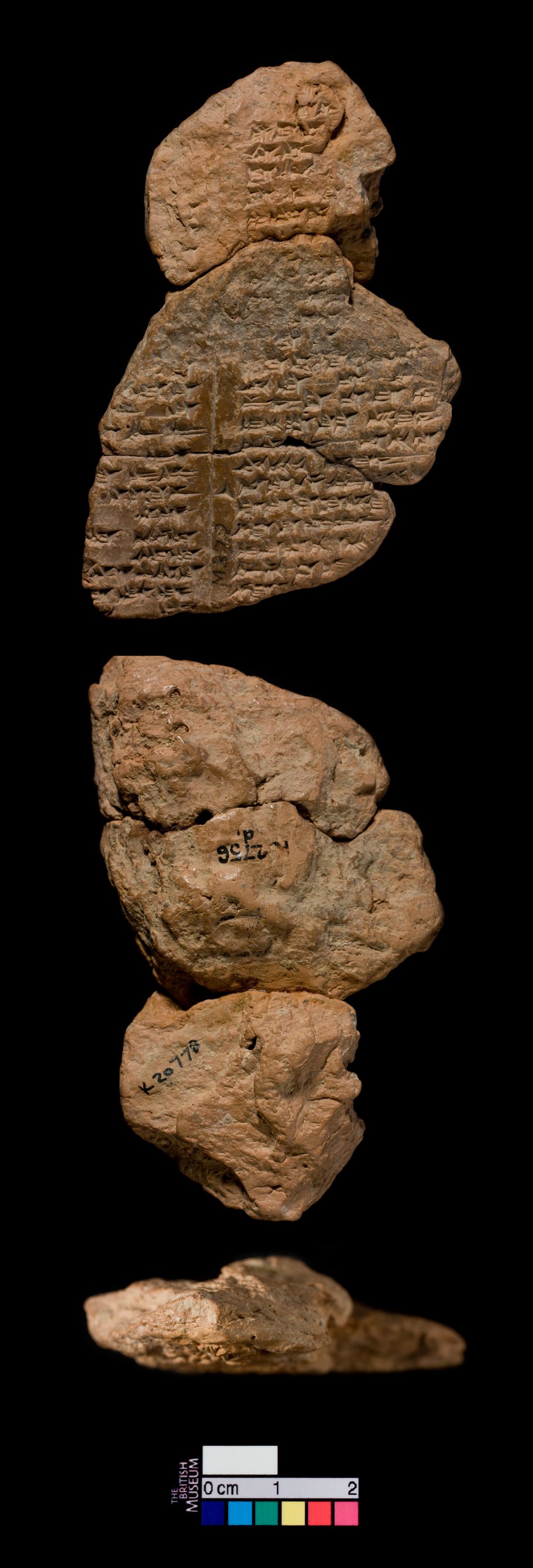
Where on the image
British Museum K.2756.D: reverse, column v, the tablet's own lines 37 to 39. eBL's corpus edition (https://www.ebl.lmu.de/corpus/L/1/4/SB/I) attributes SB I 262-264 to this manuscript at these column and line numbers. Photograph checked: the inscribed face shows two joined pieces (ink number K.20778 on the lower piece) with a column divider, consistent with eBL's columns iv and v on the reverse; the other view is the eroded obverse. On this tablet of lines 263-264 only one to three signs survive and line 262 is partly broken (square brackets and x in the Akkadian). The English of these lines translates eBL's composite text, so it includes words that are not preserved on this tablet but are restored from other manuscripts or by the editors. Square brackets in the English mark eBL's restorations in its composite text; words that survive on other tablets carry no brackets even where this tablet is broken.
262[x x x x x x ul te-le]-ʾ-a nu-us-su
263[x x x x x x x x x x ša]p-li-ia
264[x x x x x x x x x it-t]i-ka#
262you kept trying to roll it but you could not dislodge it.
263You picked it up and set it down at my feet,
264and I, I made it your equal,
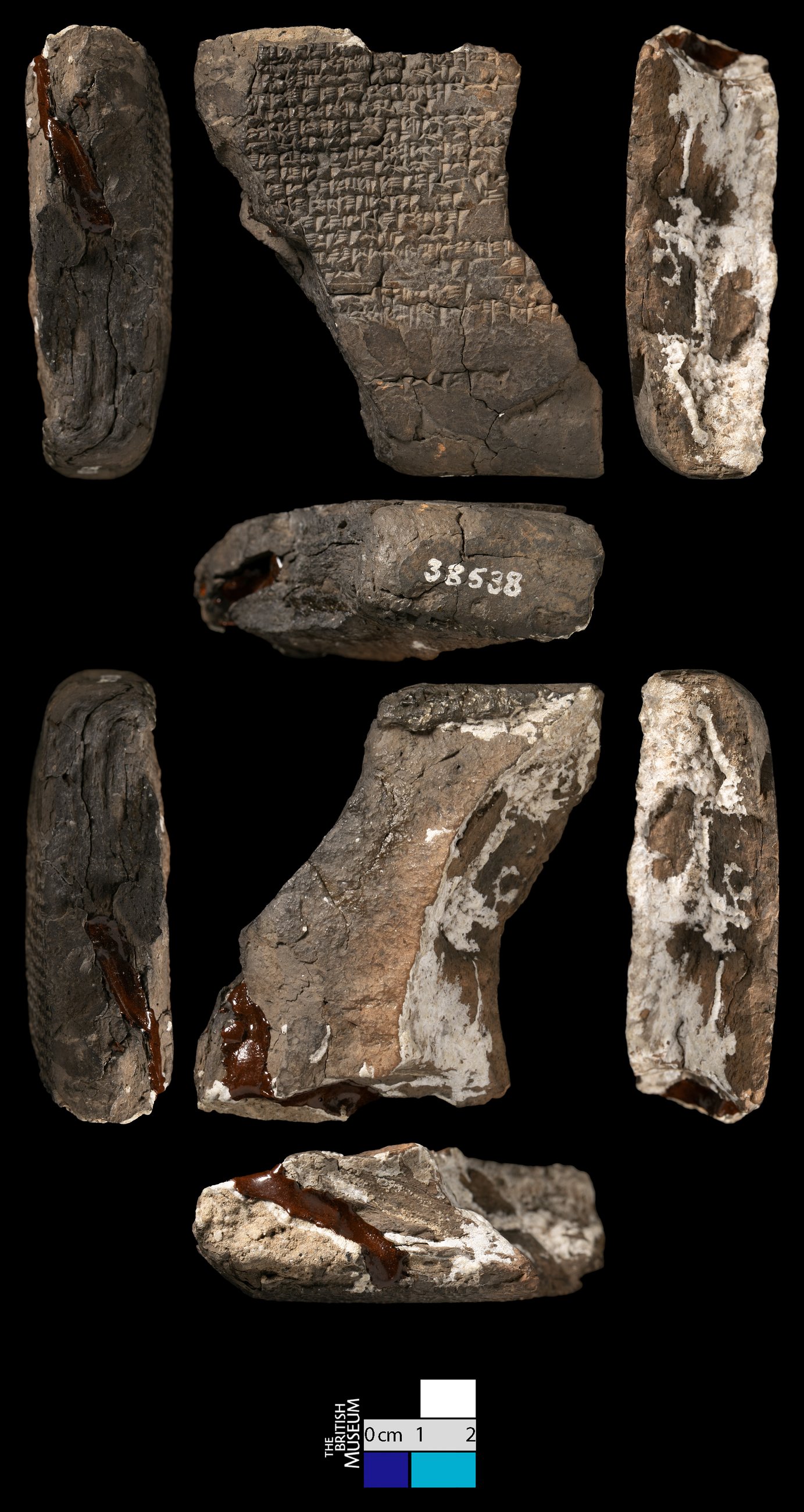
Where on the image
British Museum BM.38538: reverse, column vi, the tablet's own lines 1' to 15'. eBL's corpus edition (https://www.ebl.lmu.de/corpus/L/1/4/SB/I) attributes SB I 284-298 to this manuscript at these column and line numbers. Photograph checked: obverse, reverse and edges, ink number 38538 on the edge; one face carries about 15 lines running to the left edge, consistent with eBL's column vi (15 lines); the other face is worn. On this tablet lines 284-298 are partly broken (square brackets and x in the Akkadian). The English of these lines translates eBL's composite text, so it includes words that are not preserved on this tablet but are restored from other manuscripts or by the editors. Square brackets in the English mark eBL's restorations in its composite text; words that survive on other tablets carry no brackets even where this tablet is broken.
284AMA# {d#}GIŠ#-gim₂#-maš# e[n-qet x x x x x x x x x x x x x]
285{munus#}ri-mat-{d}nin-sun₂ en-qet mu-d[a-at k]a-la#-ma# i#-de# M[U-ar₂ x x x x x]
286[DUM]U! ha-ṣi-in-nu ša₂ ta-mu-ru i[b-ru]
287ta-ram-šu-ma GIM DAM ta-hab-bu-bu [x x]
288u a-na-ku ul-ta-mah-har-šu₂ K[I-ka]
289il-la-ka-ak-kum₂-ma dan-nu tap-pu-u₂ mu-[še-zib ib-ri]
290ina KUR da-an e-mu-qa i#-[šu]
291[k]i-ma ki-ṣir ša₂ {d}a-nim dun-nu-na e-mu-q[a-a-šu₂]
292{d#}GIŠ-gim₂-maš <ana> ša₂-ši-ma MU-ar₂ a-na A[MA-šu₂]
293[u]m-ma ina KA {d}+en-lil₂ ma-lik lim-qut-a[m-ma]
294[ib-r]i ma-li-ku a-na-ku lu-ur-[ši]
295[lu-u]r-ši-ma ib-ri ma-li-ku a#-[na-ku]
296[i-tam-r]a šu-na-a-ti-[šu]
297[x x {munus}š]am-hat šu-na-ti {d}GIŠ-gim₂-maš i-ta-ma-a# [x x x x x]
298[ur?-ta?-ʾ?]-a-mu ki-lal-la-[an]
284The mother of Gilgameš was clever, she was wise, she knew everything, she said to her son;
285Wild-Cow Ninsun was clever, she was wise, she knew everything, she said to Gilgameš:
286“My son, the axe you saw is a man,
287you will love him like a wife, and will caress and embrace him,
288and I, I shall make him your equal.
289A mighty companion will come to you, the saviour of (his) friend:
290he is the mightiest in the land, he has strength,
291his strength is as mighty as a lump of rock from the sky.”
292Gilgameš said to her, to his mother,
293“O mother, by Counsellor Enlil’s command may it befall me!
294I will acquire a friend, a counsellor,
295a friend, a counsellor, [I will] acquire!”
296[(Thus) he has] seen his dreams.’
297[After] Šamḫat told Enkidu the dreams of Gilgameš,
298the two of [them were making] love together.
Notes
- Akkadian: eBL transliteration of the signs on the photographed tablet (manuscript-level ATF), not a composite text.
- English: A. R. George's translation in the eBL edition; it renders eBL's composite text, including restorations from other tablets.
- Line numbers: eBL edition (based on A. R. George, The Babylonian Gilgamesh Epic, Oxford 2003). Each section also gives the tablet's own column and line numbers.
- Signs in the Akkadian: [ ] broken away; x illegible sign; # damaged sign; ? uncertain reading; ! sign corrected by the editor; ... broken signs of unknown number; ( ) signs perhaps broken away; { } determinative; < > sign omitted by the scribe, supplied by the editor; << >> sign written in error by the scribe; : divider sign written on the tablet.
Cite
Sources
- Source: British Museum tablet photographs + eBL manuscript transliterations (eBL corpus edition L I.4, Poem of Gilgamesh (ed. A. R. George, rev. G. Rozzi and E. Jiménez), SB I) + English of the eBL edition (A. R. George (eBL edition)) (holding institution)
- Critical edition: electronic Babylonian Library, Poem of Gilgamesh (ed. A. R. George), manuscript transliterations
← previous · → next · v cycle view · l back to library