Epic of Gilgamesh, Tablet II: Enkidu comes to Uruk
Introduction
Shamhat leads Enkidu to the shepherds, where he learns to eat bread and drink ale. He goes to Uruk, blocks Gilgamesh's way, and the two wrestle and become friends. Gilgamesh proposes an expedition to the Forest of Cedar to kill its guardian Humbaba; Enkidu and the elders of Uruk warn him against it.
The Standard Babylonian version of the epic, traditionally ascribed to the scholar Sin-leqi-unninni, was written on twelve tablets. Most surviving copies come from the libraries of Ashurbanipal at Nineveh (7th century BCE) and from Babylon and other Babylonian cities (7th-2nd century BCE). This page gives Tablet II in the line numbering of the electronic Babylonian Library edition by A. R. George (2022 and later revisions).
How this page is built. Each section is a run of consecutive lines as written on one photographed clay tablet. For every line the eBL edition (https://www.ebl.lmu.de/corpus/L/1/4/SB/II) lists the manuscripts that carry it, with each tablet's own column and line numbers; the tablet chosen for each run is the photographed copy of the work with the most signs preserved there. Commentaries and texts that only quote a line are never chosen. School and excerpt tablets are used only for lines that no photographed library copy preserves as well, and only where they carry the line as text; their sections say so. The original text is eBL's transliteration of that tablet's signs (not a modern composite text): square brackets mark broken signs, x an illegible sign, # a damaged sign, ? an uncertain reading, and words in {braces} are determinatives; the notes give a key to every sign used on this page, and eBL's layout codes are written out in words (for example '(line break)' or '(blank space)'). Superscript numbers are the line numbers of the eBL edition, used in both the Akkadian and the English. The English is A. R. George's translation in the eBL edition (CC BY-NC-SA 4.0), one line of English per line of the poem; italics mark uncertain renderings, as in the source. Where the tablet is broken, the English still translates the whole line of eBL's composite text; each section's note names the lines that are broken on its tablet.
Finding a line on the photograph. Each section names the tablet, the face and column, and the tablet's own line numbers (a prime, as in 5', counts from the first preserved line of a broken column). On a tablet with six columns the obverse carries columns i-iii from left to right; the reverse, turned over from bottom to top, carries columns iv-vi from right to left. The photographs often show the obverse above the reverse with the edges around them; a fragment preserves only part of this layout.
This page shows 118 of the 187 lines of the eBL edition (63%), from 6 tablets in the British Museum: BM.38538, Rm.289 (Nineveh), K.8574 (Nineveh), BM.38833, BM.34449, BM.40849.
Lines not shown. 69 of the 187 lines of the eBL edition are not shown, because no photographed copy of the work used here carries them: 26-36 (no photograph in eBL: IM.76941 (Iraq Museum)); 37-41 (no photograph in eBL: ISACM-A.3444 (Institute for the Study of Ancient Cultures, Chicago), IM.76941 (Iraq Museum)); 56-58 (photograph does not show these lines (visual check): BM.34964); a+1'-a+4' (no photograph in eBL: ISACM-A.3444 (Institute for the Study of Ancient Cultures, Chicago)); 212-217 (no photograph in eBL: IM.76854 (Iraq Museum)); 218b-220 (no photograph in eBL: IM.76854 (Iraq Museum)); 225-226 (no photograph in eBL: IM.76854 (Iraq Museum); photograph does not show these lines (visual check): BM.34964); 231 (no photograph in eBL: ISACM-A.3444 (Institute for the Study of Ancient Cultures, Chicago)); 243 (no photograph in eBL: IM.76854 (Iraq Museum)); 247-268 (no photograph in eBL: IM.76941 (Iraq Museum)); 269-272 (no photograph in eBL: IM.76941 (Iraq Museum), IM.76854 (Iraq Museum)); 281-285 (no photograph in eBL: IM.76854 (Iraq Museum)); 286 (no photograph in eBL: ISACM-A.3444 (Institute for the Study of Ancient Cultures, Chicago), IM.76854 (Iraq Museum)); 294 (no photograph in eBL: IM.76854 (Iraq Museum)); 297 (no photograph in eBL: ISACM-A.3444 (Institute for the Study of Ancient Cultures, Chicago), IM.76854 (Iraq Museum)); 300 (no photograph in eBL: BM.72719, ISACM-A.3444 (Institute for the Study of Ancient Cultures, Chicago), IM.76854 (Iraq Museum)); 301-302 (no photograph in eBL: ISACM-A.3444 (Institute for the Study of Ancient Cultures, Chicago), IM.76854 (Iraq Museum)); 322 (no manuscript preserves it). A line is shown only on a photographed tablet that carries it as text. Commentaries and other texts that quote a line (letters, rituals, god lists) are not used as witnesses, because they carry it with explanations or inside another text; tablets without a photograph in eBL are not used, because the line could not be shown on its tablet.
How was this verified? (Provenance)
Where on the image
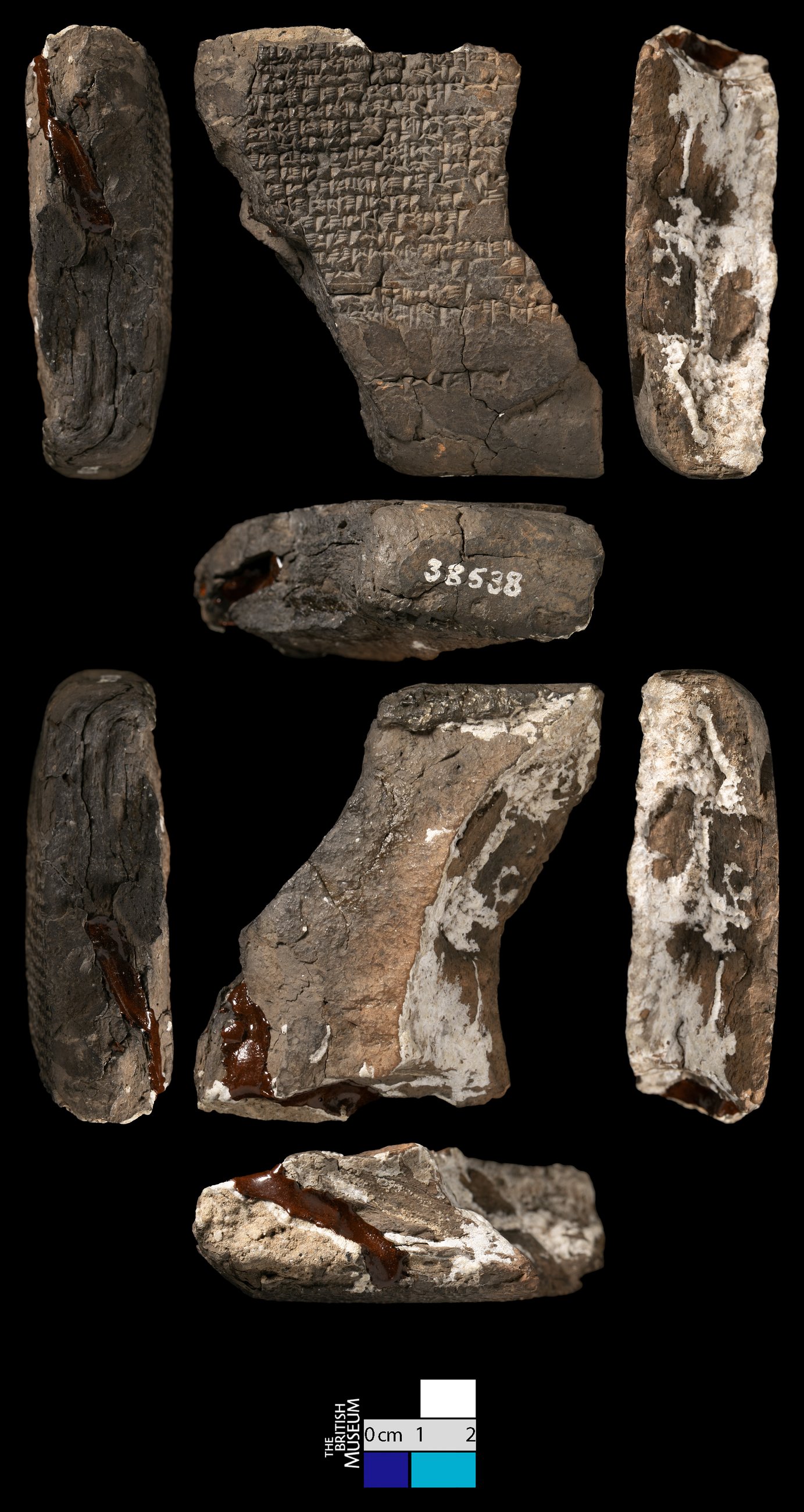
British Museum BM.38538: reverse, column vi, the tablet's own line 16'b-17'a. eBL's corpus edition (https://www.ebl.lmu.de/corpus/L/1/4/SB/II) attributes SB II 1 to this manuscript at these column and line numbers. Photograph checked: obverse, reverse and edges, ink number 38538 on the edge; one face carries about 15 lines running to the left edge, consistent with eBL's column vi (15 lines); the other face is worn. BM.38538, a copy of SB I, carries this line as its catch-line: the opening of the next tablet of the series, copied at the end of the previous one (eBL lists catch-lines among its quotations; unlike commentaries and quotations in other texts, a catch-line is the line itself on a copy of the work). On this tablet line 1 is partly broken (square brackets and x in the Akkadian). The English of this line translates eBL's composite text, so it includes words that are not preserved on this tablet but are restored from other manuscripts or by the editors. Square brackets in the English mark eBL's restorations in its composite text; words that survive on other tablets carry no brackets even where this tablet is broken.
1<{d}en-ki-du₃ a-šib> ma-har-[ša₂ (line break) it-taš]-qu?#
1[Enkidu] was sitting before her, […] …
Where on the image
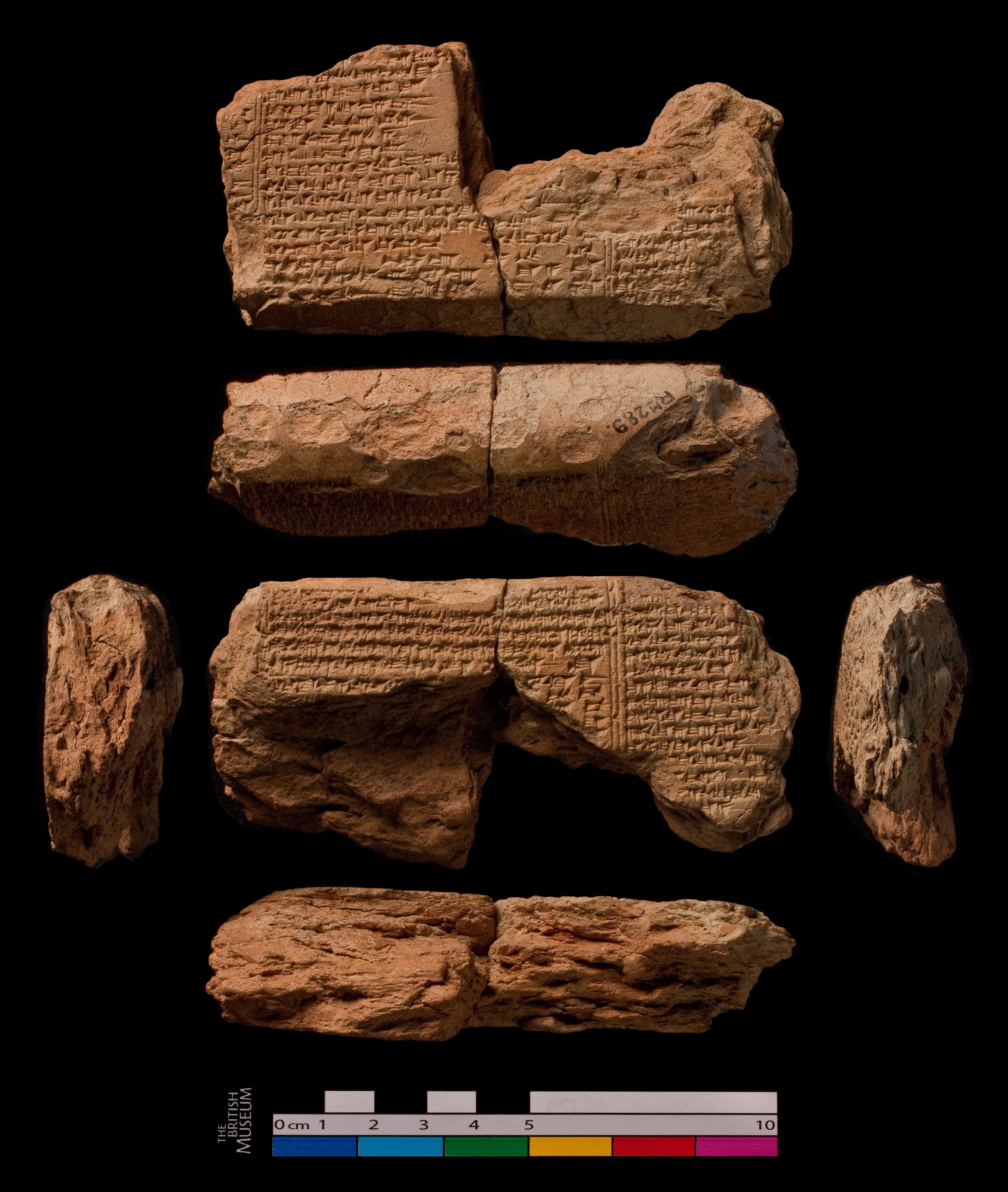
British Museum Rm.289: obverse, column i, the tablet's own lines 1' to 10'. eBL's corpus edition (https://www.ebl.lmu.de/corpus/L/1/4/SB/II) attributes SB II 42 to 52-53 to this manuscript at these column and line numbers. Photograph checked: obverse, reverse and edges of two joined pieces; text on both faces, consistent with eBL's columns i-iii and iv-v. On this tablet line 44 is entirely broken and of lines 42-43, 45 to 52-53 only one to three signs survive. The English of these lines translates eBL's composite text, so it includes words that are not preserved on this tablet but are restored from other manuscripts or by the editors. Square brackets in the English mark eBL's restorations in its composite text; words that survive on other tablets carry no brackets even where this tablet is broken.
42[x x x x x x x x x x x ša₂-di]-i#
43[x x x x x x x x x x e-mu-qa]-a-šu₂
44[x x x x x x x x : ]
45[x x x x x x ma-ha]r-šu
46[x x x x x x x x x x x x x i-dag]-gal
47[akala ana akāli la lum-mud?]-ma
48[šikara ana šatê {d}en-ki-du₃? ul] i#-de
49[harimtu ana šâšūma izzakkara ana {d}en-k]i-du₃
50[x x x x x x x x x (x x) ni?]-ši
51(gloss: 10) [x x x x x x x x (x) ma-a?]-te
52-53[x x x x x x x (x x) : x x (x x)] x x-ri
42For sure he was born in the hills,
43his strength is as mighty as a lump of rock from the sky.’
44They put bread before [him]
45they put ale before him.
46Enkidu did not eat the bread, he looked intently as he viewed (it):
47[how to eat bread he had never] even [been taught,]
48[how to drink ale Enkidu did not] know.
49[The harlot said to him, to] Enkidu,
50‘[Eat the bread, Enkidu, the staff of the] people,
51[drink the ale, the destiny of the] land!’
52-53[…] …
Where on the image
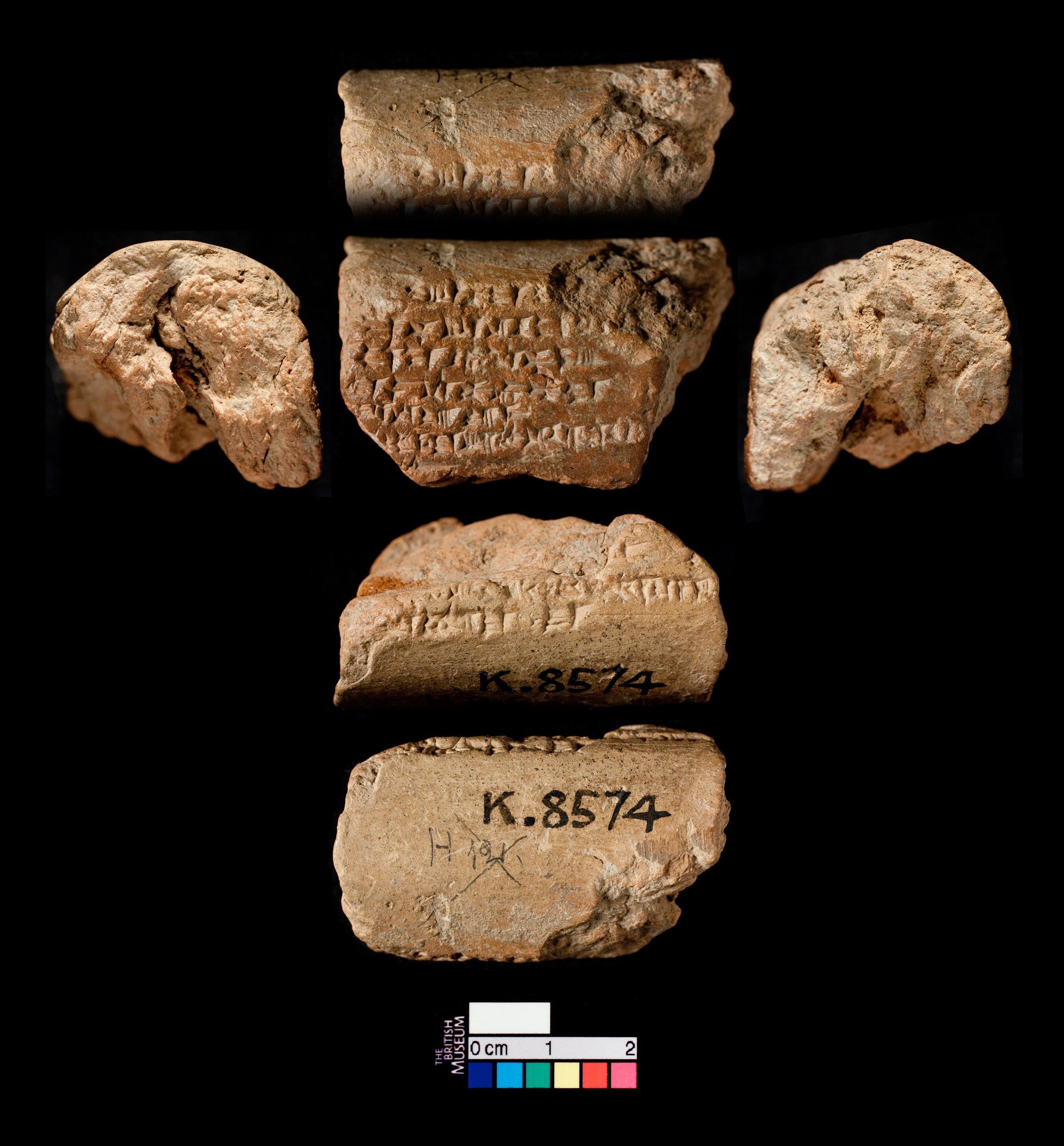
British Museum K.8574: obverse, column ii, the tablet's own lines 1 to 8. eBL's corpus edition (https://www.ebl.lmu.de/corpus/L/1/4/SB/II) attributes SB II 59-66 to this manuscript at these column and line numbers. Photograph checked: both faces and edges, ink number K.8574; a few lines on each face, consistent with eBL's columns ii and v. On this tablet of line 66 only illegible traces (x) survive, of line 65 only one to three signs survive and lines 59-64 are partly broken (square brackets and x in the Akkadian). The English of these lines translates eBL's composite text, so it includes words that are not preserved on this tablet but are restored from other manuscripts or by the editors. Square brackets in the English mark eBL's restorations in its composite text; words that survive on other tablets carry no brackets even where this tablet is broken.
59[mu-du-u₂?] lib#-ba-šu₂-ma x [...]
60[ut-tap-p]i-iṣ bar-ba-ri-ma l[ab?-bi? x x x x]
61[ni-l]u-nim-ma {lu₂}NA.GADA-MEŠ [x x]
62[{d}+en]-ki-du₃ NA.GADA-sa-nu-ma e?#-[ru a-me-lu?]
63[1-en GU]RUŠ a-na E₂ e!?(TA)-me x [...]
64[ina lib₃-b]i UNUG{ki} su-pu-ri a-na UD? x [...]
65[x x-b]u [...]
66[...] x [x x] x [...]
59His heart [now wise…]
60[he would] massacre wolves and [chase] away [lions.]
61[As] the senior herdsmen lay sleeping,
62Enkidu was their herdsman, a [wakeful man.]
63[A certain] fellow [was invited] to a wedding,
64[into] Uruk the sheepfold for … […]
65[…] … […]
66[…] … […]
Where on the image
British Museum Rm.289: obverse, column ii, the tablet's own lines 1' to 17'. eBL's corpus edition (https://www.ebl.lmu.de/corpus/L/1/4/SB/II) attributes SB II 99-115 to this manuscript at these column and line numbers. Photograph checked: obverse, reverse and edges of two joined pieces; text on both faces, consistent with eBL's columns i-iii and iv-v. On this tablet of line 99 only illegible traces (x) survive and lines 100-112, 115 are partly broken (square brackets and x in the Akkadian). The English of these lines translates eBL's composite text, so it includes words that are not preserved on this tablet but are restored from other manuscripts or by the editors. Square brackets in the English mark eBL's restorations in its composite text; words that survive on other tablets carry no brackets even where this tablet is broken. Lines 113-114 are complete on this tablet.
99[...] x x [...]
100[it-ta-ziz-m]a ina SILA ša# UNUG{k[i} su-pu-ri]
101[x] x-a?# i-be₂-eš dan-nu-ti-ma [x x x (x)]
102ip-ta-ra-as a-lak-ta [ša {d}GIŠ-gim₂-maš]
103UNUG{ki} ma-a-tu iz-za-az [UGU-šu]
104ma-a-tu pu-uh-hu-rat [ina muh-hi-šu]
105i-tep-pi-ir um-man-ni U[GU EDIN-šu]
106GURUŠ-MEŠ uk-tam-ma-ru [UGU-šu]
107ki-i šer₃-ri la-ʾ-i u₂-n[a-aš₂-ša₂-qu GIR+MIN₃-šu]
108ul-la-nu-um-ma eṭ-lu ba-ni-[x x x] x [(x)]
109a-na {d}iš-ha-ra ma-a-a-al [x x (x)]-ti [(x)]
110(gloss: 10) a-na {d}GIŠ-gim₂-maš ki-ma DINGIR ša₂-ki-i[š-š]u₂ pu-h[u?]
111{d}+en-ki-du₃ ina KA₂ E₂ e-mu-ti ip-te#-rik GIR+M[IN₃-šu₂]
112{d}GIŠ-gim₂-maš a-na šu-ru-bi ul# i-nam-di[n]
113iṣ-ṣab-tu-ma ina KA₂ E₂ e#-mu-ti
114ina SILA it-te-eg-ru-u₂# re-bit ma-a-tu#
115[si]p-pu# ir?#-u₂?#-bu i-ga-ra# i#-nu!(UD)-uš
99[…] … […]
100[He stood] in the street of Uruk [the sheepfold.]
101[…] parted, strength […,]
102he blocked the path [of Gilgameš.]
103The land of Uruk was standing [around him,]
104the land was gathered [about him.]
105A crowd was jostling before [him,]
106the menfolk were thronging [around him.]
107They were [kissing his feet] like a little baby’s;
108already the man … […] …
109For Išḫara a bed of […] …
110for Gilgameš, like a god, a substitute was in place.
111Enkidu with [his] feet blocked the doorway of the wedding house,
112not allowing Gilgameš to enter.
113They took hold of each other in the doorway of the wedding house,
114they joined combat in the street, the Main-Street-of-the-Land.
115The door jambs quaked, the wall shook.
Where on the image
British Museum Rm.289: obverse, column iii, the tablet's own lines 1 to 8. eBL's corpus edition (https://www.ebl.lmu.de/corpus/L/1/4/SB/II) attributes SB II 162-169 to this manuscript at these column and line numbers. Photograph checked: obverse, reverse and edges of two joined pieces; text on both faces, consistent with eBL's columns i-iii and iv-v. On this tablet of lines 162, 166, 168-169 only one to three signs survive and lines 163-165, 167 are partly broken (square brackets and x in the Akkadian). The English of these lines translates eBL's composite text, so it includes words that are not preserved on this tablet but are restored from other manuscripts or by the editors. Square brackets in the English mark eBL's restorations in its composite text; words that survive on other tablets carry no brackets even where this tablet is broken.
162[ina KUR d]a-an e#-[mu-qi₂ i-šu]
163[ki-ma ki]-ṣir ša₂ {d}a#-[nim dun-nu-na e-mu-qa-šu₂]
164[la?-a?-n]a? ši-i-hu n[a?-bur-riš šar-hu?]
165um#-mu {d}GIŠ-gim₂-maš K[A-ša₂ DU₃-ma DUG₄.GA]
166MU-ra a#-[na DUMU-ša₂]
167(gloss: AŠ) {munus}ri-mat-{d}nin-[sun₂ KA-ša₂ DU₃-ma DUG₄.GA MU-ra ana {d}GIŠ-gim₂-maš]
168ma-ri# [x] x x [x x x x x (x x x)]
169ṣar#-piš# tu-x [x x x x x (x x x)]
162‘He is the mightiest [in the land, strength he possesses,]
163[his strength is as mighty as a] lump of rock from the sky,
164tall in [stature, majestic as a battlement.]’
165The mother of Gilgameš [opened her] mouth [to speak,]
166saying to [her son,]
167Wild-Cow Ninsun [opened her mouth to speak, saying to Gilgameš:]
168‘My son, … […]
169bitterly you […]
Where on the image
British Museum Rm.289: reverse, column iv, the tablet's own lines 1a to 15a. eBL's corpus edition (https://www.ebl.lmu.de/corpus/L/1/4/SB/II) attributes SB II 170-185 to this manuscript at these column and line numbers. Photograph checked: obverse, reverse and edges of two joined pieces; text on both faces, consistent with eBL's columns i-iii and iv-v. On this tablet line 171 is entirely broken, of lines 170, 172 only one to three signs survive and lines 173-185 are partly broken (square brackets and x in the Akkadian). The English of these lines translates eBL's composite text, so it includes words that are not preserved on this tablet but are restored from other manuscripts or by the editors. Square brackets in the English mark eBL's restorations in its composite text; words that survive on other tablets carry no brackets even where this tablet is broken.
170(gloss: 10) x [x x x x x (x x) : ]
171[x x x x x (x x)]
172ṣab#-ta#-ta# x [x x x x x x x (x x x)]
173x-te-AD/la! ina KA₂-šu?# [x x x x x (x x)]
174ṣar-piš u₂-nam!(ZI)-ba!(ZU?) [x x x x x (x x)]
175ul i-ši {d}+en-ki-du₃ [x x x x x (x x)]
176uš-šur-tu₄ pe-re-tu ṣa-[x x x x x (x x x)]
177ina EDIN a-lid-ma mam-ma [x x x (x x x)]
178iz-za-az {d}+en-ki-du₃ iš-m[e qa-ba-(a)-ša₂]
179uš-ta-dan-ma it-ta-[šab x x x]
180(gloss: 10) e-na-šu i-mi-la-a [di-ma-a-ti]
181a-ha-šu ir-ma-a e-mu-qi₂ [x x x (x)]
182iṣ#-ṣab#-tu-ma mit-ha-riš [x x x (x)]
183[x x-r]u-ma ŠU-MEŠ-šu₂-nu GIM [x x x (x)]
184[{d}GIŠ-gim₂-ma]š iṭ-ṭu-ru₃ la [x x x (x)]
185[ana? {d}en-ki-d]u₃ a-mat i-zak-ka[r : ]
170… […]
171[…]
172You hold […]
173… in his gate […]
174Bitterly he wails […]
175Enkidu does not have [kith and kin]
176Loose-hanging hair…[…]
177he was born in the wild and [has] no [brother]
178Enkidu being present, he heard [what she said,]
179thinking it over, he sat [down weeping.]
180His eyes filled with [tears,]
181his arms fell limp, strength […]
182They took hold of each other and together […]
183they [linked] their hands and like […]
184Gilgameš … […]
185[to] Enkidu he said a word, [saying:]
Where on the image
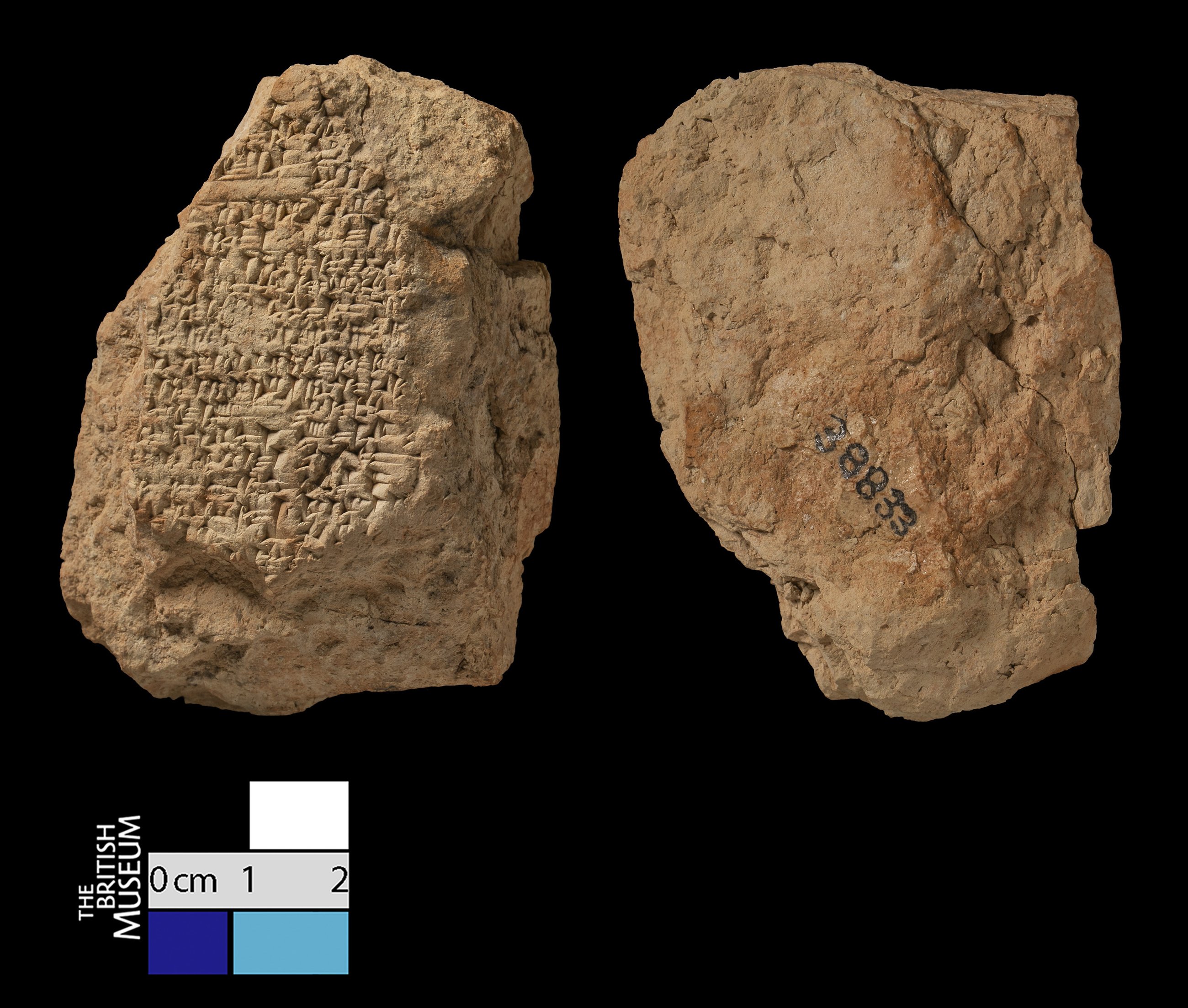
British Museum BM.38833: column iv, the tablet's own lines 7' to 22'. eBL's corpus edition (https://www.ebl.lmu.de/corpus/L/1/4/SB/II) attributes SB II 186-202 to this manuscript at these column and line numbers. Photograph checked: two views, the inscribed face with about 20 lines of small script and the back with the ink number 38833, consistent with eBL's 23 lines of column iv. On this tablet of line 202 only illegible traces (x) survive, of line 192 only one to three signs survive and lines 186-191, 193-201 are partly broken (square brackets and x in the Akkadian). The English of these lines translates eBL's composite text, so it includes words that are not preserved on this tablet but are restored from other manuscripts or by the editors. Square brackets in the English mark eBL's restorations in its composite text; words that survive on other tablets carry no brackets even where this tablet is broken. eBL gives no English for line(s) 192.
186[am-m]e-ni ib-ri im-l[a-a i-na-ka di-ma-a-ti]
187[a-h]a-a-ka ir-ma-a [e-mu-qi₂? ...]
188[{d}e]n-ki-du₃ ana ša₂-šu-ma i-zak-k[a-ra ana {d}GIŠ-gim₂-maš]
189[i]b-ri lib₃-bi uṣ-ṣar-ri-pu m[u?-...]
190[i]-na di-im?#-ma?#-tim-ma i-ru-[ub?-bu? ...]
191[<i>-r]u-ub a-di-ru a-na lib₃-bi-ia₂ :
192a-[...]
193{d#}GIŠ-gim₂-maš pa-a-ša₂ DU₃-ma DUG₄.GA M[U-ra ana {d}en-ki-du₃]
194[t]u-ša₂-ma-a ib-ri a-na da?-x [...]
195x-šu-u₂ it-ku-pu [...]
196u₃ na-ši-ma u₂-ma-ši x [...]
197it#?-ta#?-al#-šu u₄#-mi x [...]
198x-du# i-du-uk-ku# aš₂-ša₂-x [...]
199i#-na-an-na-ma ib-ri a-[...]
200[x x] x-ni ina KUR ni-x [...]
201[x (x) x] x {d}hum-ba-b[a ...]
202[...] x x [...]
186‘Why, my friend, [did your eyes] fill [with tears,]
187your arms fall limp, [strength…?]’
188Enkidu said to him, [to Gilgameš:]
189My friend, my heart was made to ache…[…]
190Through sobbing [my legs do] tremble,
191terror has entered my heart.
192(no English for this line in the eBL edition)
193Gilgameš opened his mouth to speak, saying to Enkidu:
194‘As if, my friend, to…[…]
195… is imminent […]
196But as for us, wrestling... […]
197… him, the days […]
198… beside you … […]
199So now, my friend, […]
200[…] in the land we […]
201[…] … Ḫubaba […]
202[…] … […]
Where on the image
British Museum Rm.289: reverse, column v, the tablet's own lines 1 to 9. eBL's corpus edition (https://www.ebl.lmu.de/corpus/L/1/4/SB/II) attributes SB II 218a-233 to this manuscript at these column and line numbers. Photograph checked: obverse, reverse and edges of two joined pieces; text on both faces, consistent with eBL's columns i-iii and iv-v. On this tablet of line 233 only one to three signs survive and lines 230, 232 are partly broken (square brackets and x in the Akkadian). The English of these lines translates eBL's composite text, so it includes words that are not preserved on this tablet but are restored from other manuscripts or by the editors. Square brackets in the English mark eBL's restorations in its composite text; words that survive on other tablets carry no brackets even where this tablet is broken. Lines 218a-219a, 221-224, 227-229 are complete on this tablet. eBL line(s) 218b, 219b, 220, 225, 226, 231 fall within this run but are not on this tablet (they are listed among the lines not shown).
218aaš₂-šu šul-lu-mu {giš#}EREN
219aana pul-ha-a-ti ša UN-MEŠ i#-šim-šu {d}en-lil₂
221(gloss: 10) {d}hum-ba-ba rig-ma-šu a-bu-bu :
222pi-i-šu₂ {d}GIRA₃#-um-ma na-pis-su mu-tu₂
223i-šem-mi-ma?# ana?# 1?# šu?#-ši?# DANNA rim#-mat {giš}TIR :
224man-nu ša ur-ra-du ana {giš}TIR-šu₂
227aš₂-šu₂ šul-lu-mu EREN :
228ana pul-ha-a-ti ša UN-MEŠ i-šim-šu₂ {d}+en-lil₂
229u a-rid {giš}TIR-šu₂ i-ṣab-bat-su lu#-uʾ-tu
230{d}GIŠ-gim₂-maš a-na ša-šu#-ma# [x x x x {d}e]n-ki-du₃
232(gloss: 10) [a-n]a mi#-i#-ni# i[b-ri x x x x ta]-qab-bi
233[x x x x x x x x x x x l]ib₃-bi
218aIn order to keep the cedars safe,
219aEnlil made it his destiny to be the terror of the people:
221Ḫumbaba, his voice is the Deluge,
222his speech is fire, his breath is death.
223He hears his forest’s murmur for sixty leagues;
224who is there that would venture into his forest?
227In order to keep the cedars safe,
228Enlil made it his destiny to be the terror of the people.
229And he who ventures into his forest, feebleness will seize him!’
230Gilgameš opened his mouth to speak, saying to Enkidu:
232Why, my friend, do you speak like a weakling?
233With your feeble talk you have vexed my heart!
Where on the image
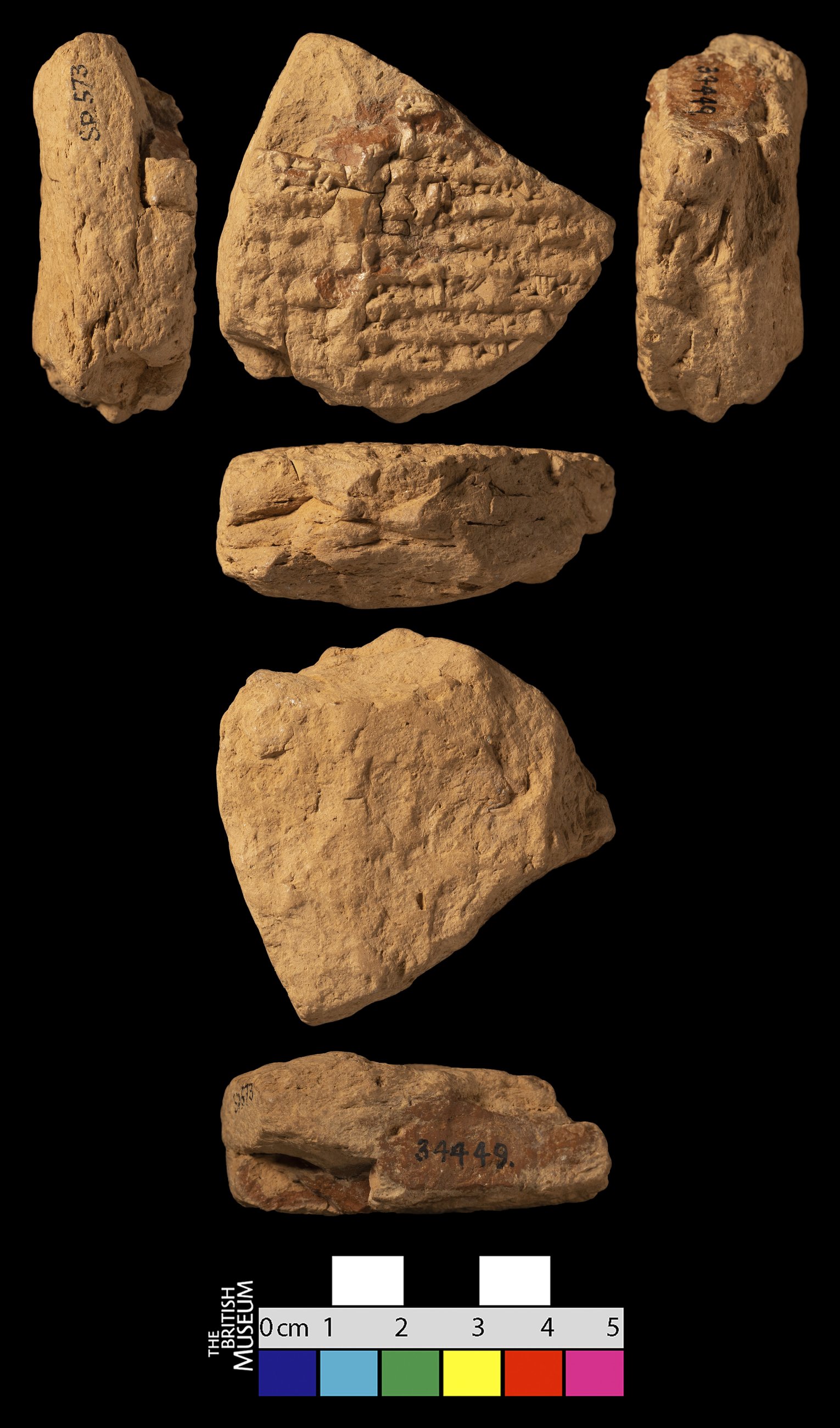
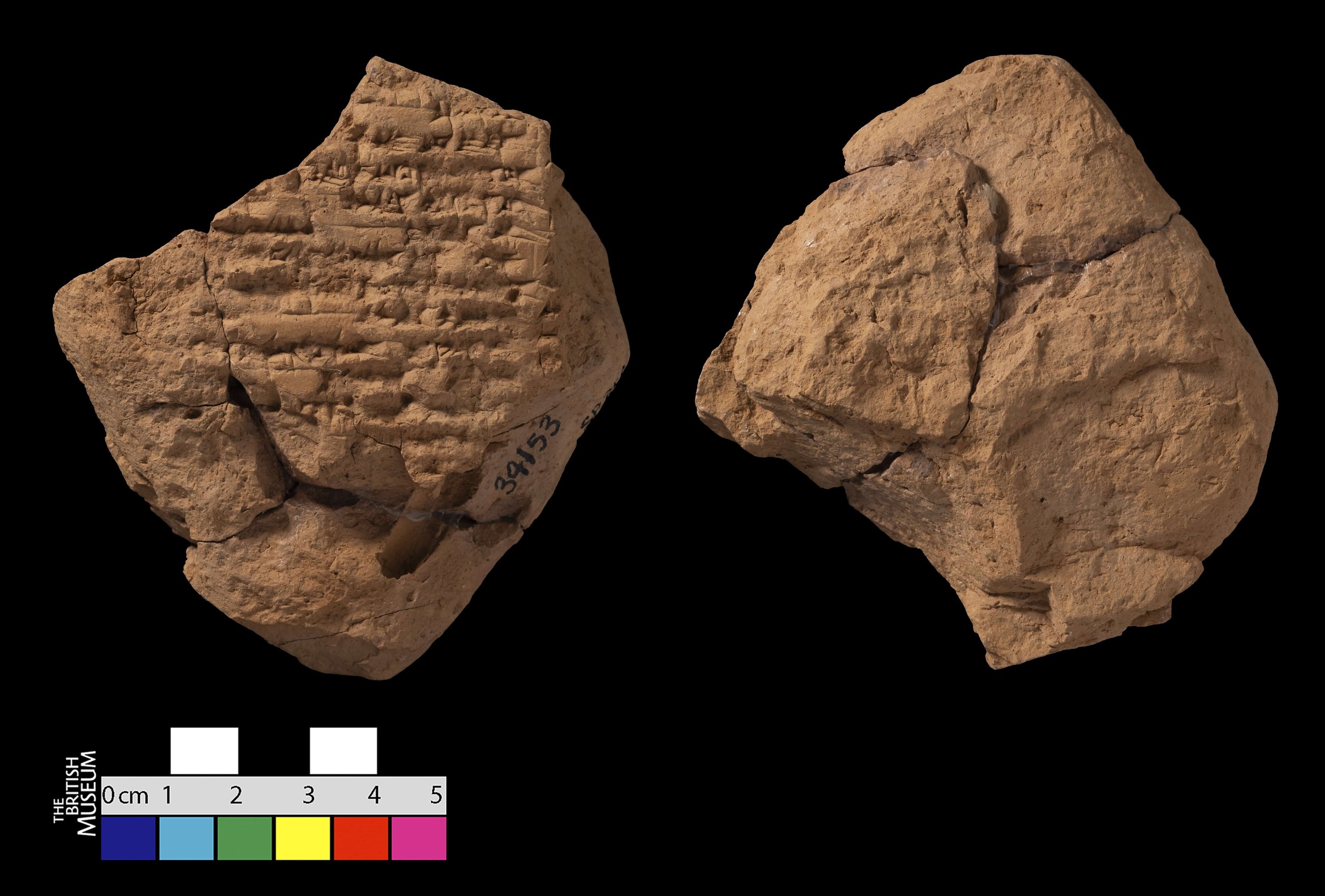
British Museum BM.34449: reverse, column v, the tablet's own lines 2' to 10'. eBL's corpus edition (https://www.ebl.lmu.de/corpus/L/1/4/SB/II) attributes SB II 234-242 to this manuscript at these column and line numbers. Photograph checked: obverse, reverse and edges of BM.34449 alone (ink numbers 34449 and Sp.573); about 10 lines in two columns on one face. eBL treats BM.34449 + BM.34153 as one manuscript and holds a separate photograph of each of these pieces; it does not say which piece carries which line, so the photographs of BM.34449 + BM.34153 are linked, and the lines are on one or more of them. On this tablet of line 242 only illegible traces (x) survive, of line 234 only one to three signs survive and lines 235-241 are partly broken (square brackets and x in the Akkadian). The English of these lines translates eBL's composite text, so it includes words that are not preserved on this tablet but are restored from other manuscripts or by the editors. Square brackets in the English mark eBL's restorations in its composite text; words that survive on other tablets carry no brackets even where this tablet is broken.
234a#-me-lu[t?-ti x x x x x x]
235mim#-mu#-u₂# e#-[te-ep-pu-šu x x x]
236x-a-tu₂# ul i?#-[ba-aš₂-ša₂-a ...]
237ta#-ʾ#-al#-dam#-ma?# [x x x x x x x]
238iš#-hu#-tu₂#?-ka#-ma# la#-[ab-bi x x x x x x]
239u₃ GURUŠ-MEŠ ih-mu-uṭ-[ṭu x x x]
240mu-du-u₂ lib₃-ba-ka [x x x x x x]
241al#-ka ib-r[i x x x x x x x x]
242x x x x [...]
234As for man, [his] days are numbered,
235all that ever he did is but [wind.]
236… do not exist […]
237You were born and grew up [in the wild.]
238Lions attacked you, [you experienced all,]
239grown men, too, fled [from your presence.]
240Your heart, well tried, [is tested in] combat;
241come, my friend, [I will go] to the forge!’
242[To the] forge [they went, …]
Where on the image
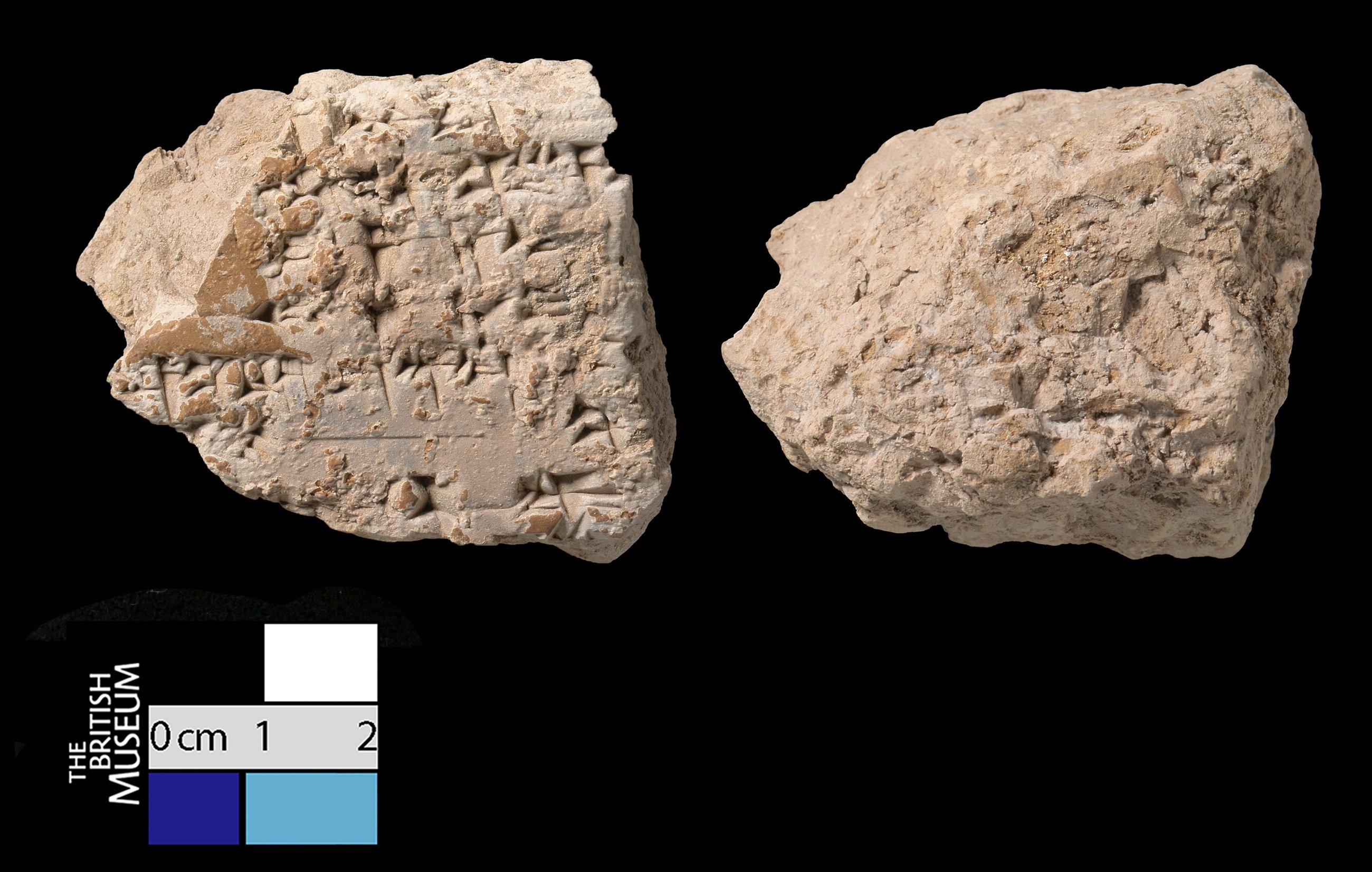
British Museum BM.40849: reverse, column vi, the tablet's own lines 1' to 9'. eBL's corpus edition (https://www.ebl.lmu.de/corpus/L/1/4/SB/II) attributes SB II 273-280 to this manuscript at these column and line numbers. Photograph checked: two views, the inscribed face with about 8 lines, consistent with eBL's column vi. On this tablet of lines 278-280 only one to three signs survive and lines 273-277 are partly broken (square brackets and x in the Akkadian). The English of these lines translates eBL's composite text, so it includes words that are not preserved on this tablet but are restored from other manuscripts or by the editors. Square brackets in the English mark eBL's restorations in its composite text; words that survive on other tablets carry no brackets even where this tablet is broken.
273[x x x x x UNUG{k]i} mu-du#-u₂# [x x (x)]
274[x x x x x x] il#-[la]k ana# {giš}TIR {g[iš}EREN]
275[x x x x x] ul# ša₂ a-l[a-ki]
276[x x x x x] ul ša₂# a#-m[a-ri]
277[x x x {giš}T]IR {giš}EREN da#-an la# [s]a-[kip]
278[x x šul-l]u-mu# {giš}[EREN]
279[x x x x x x x i-ši]m-šu₂ {d} (written over an erasure)[en-lil₂]
280[x x x x x x x {gi]š?}TIR?#-[šu₂]
273and the young men of Uruk, who understand [combat]
274‘Tell him that he must not go to the Forest of Cedar,
275that journey is not one for making.
276That man [is not one for] the seeing,
277he who guards the Forest of Cedar is mighty, never resting.
278Ḫumbaba, [his voice is the Deluge,]
279[his speech is fire,] his breath is death.
280[He hears] his forest’s murmur [for sixty leagues;]
Where on the image
British Museum K.8574: reverse, column v, the tablet's own lines 1'a to 2'. eBL's corpus edition (https://www.ebl.lmu.de/corpus/L/1/4/SB/II) attributes SB II 287-289 to this manuscript at these column and line numbers. Photograph checked: both faces and edges, ink number K.8574; a few lines on each face, consistent with eBL's columns ii and v. On this tablet line 287 is entirely broken and of lines 288-289 only one to three signs survive. The English of these lines translates eBL's composite text, so it includes words that are not preserved on this tablet but are restored from other manuscripts or by the editors. Square brackets in the English mark eBL's restorations in its composite text; words that survive on other tablets carry no brackets even where this tablet is broken.
287[x x x x x x x x x x x : ]
288[ṭe₃-e]-ma?# [x x x x x x x x x]
289[x x x x {d}GIŠ-gim₂]-maš l[ib-ba-ka x x x x x]
287The senior advisers arose,
288they expressed in return (their) opinion to Gilgameš:
289‘You are young, Gilgameš, carried away by enthusiasm,
Where on the image
British Museum BM.34449: reverse, column vi, the tablet's own lines 1' to 6'. eBL's corpus edition (https://www.ebl.lmu.de/corpus/L/1/4/SB/II) attributes SB II 290-296 to this manuscript at these column and line numbers. Photograph checked: obverse, reverse and edges of BM.34449 alone (ink numbers 34449 and Sp.573); about 10 lines in two columns on one face. eBL treats BM.34449 + BM.34153 as one manuscript and holds a separate photograph of each of these pieces; it does not say which piece carries which line, so the photographs of BM.34449 + BM.34153 are linked, and the lines are on one or more of them. On this tablet of line 295 only illegible traces (x) survive, of lines 290-293 only one to three signs survive and line 296 is partly broken (square brackets and x in the Akkadian). The English of these lines translates eBL's composite text, so it includes words that are not preserved on this tablet but are restored from other manuscripts or by the editors. Square brackets in the English mark eBL's restorations in its composite text; words that survive on other tablets carry no brackets even where this tablet is broken. eBL line(s) 294 fall within this run but are not on this tablet (they are listed among the lines not shown).
290[x x x x x x x x t]i-i#-de#
291[x x x x x x a-b]u-bu
292[x x x x x x x x x x x x mu]-ti
293[x x x x x x x x x x x x] {giš}TIR#
295[x x x x x x x x x] x x x
296man#-nu# ša₂# i#-ge#-[er?-ru?-šu₂] x x x
290and the thing that you talk of you do not understand.
291Ḫumbaba, his voice is the Deluge,
292his speech is fire, his breath is death.
293He hears his forest’s murmur for sixty leagues;
295Who is there that would venture into his forest?
296Who is there among the Igigi that would oppose him?
Where on the image
British Museum K.8574: reverse, column v, the tablet's own lines 3'a to 3'b. eBL's corpus edition (https://www.ebl.lmu.de/corpus/L/1/4/SB/II) attributes SB II 298-299 to this manuscript at these column and line numbers. Photograph checked: both faces and edges, ink number K.8574; a few lines on each face, consistent with eBL's columns ii and v. On this tablet of line 298 only one to three signs survive and line 299 is partly broken (square brackets and x in the Akkadian). The English of these lines translates eBL's composite text, so it includes words that are not preserved on this tablet but are restored from other manuscripts or by the editors. Square brackets in the English mark eBL's restorations in its composite text; words that survive on other tablets carry no brackets even where this tablet is broken.
298[aš₂-šu₂ šul-lu-mu {giš}ER]EN :
299ana# pul#-ha#-a#-ti ša₂ UN-MEŠ [x x x x x x]
298In order to keep the cedars safe,
299Enlil made it his destiny to be the terror of the people.
Notes
- Akkadian: eBL transliteration of the signs on the photographed tablet (manuscript-level ATF), not a composite text.
- English: A. R. George's translation in the eBL edition; it renders eBL's composite text, including restorations from other tablets.
- Line numbers: eBL edition (based on A. R. George, The Babylonian Gilgamesh Epic, Oxford 2003). Each section also gives the tablet's own column and line numbers.
- Signs in the Akkadian: [ ] broken away; x illegible sign; # damaged sign; ? uncertain reading; ! sign corrected by the editor; ... broken signs of unknown number; ( ) signs perhaps broken away; { } determinative; < > sign omitted by the scribe, supplied by the editor; / alternative readings; : divider sign written on the tablet; (line break) the line runs on to the next line of the tablet; (gloss: ...) a note written by the scribe in small signs or in the margin.
Cite
Sources
- Source: British Museum tablet photographs + eBL manuscript transliterations (eBL corpus edition L I.4, Poem of Gilgamesh (ed. A. R. George, rev. G. Rozzi and E. Jiménez), SB II) + English of the eBL edition (A. R. George (eBL edition)) (holding institution)
- Critical edition: electronic Babylonian Library, Poem of Gilgamesh (ed. A. R. George), manuscript transliterations
← previous · → next · v cycle view · l back to library