Herodotus, Histories 2.142-146: The priests' chronology: 341 generations and 11,340 years
Introduction
In the second book of his Histories (written c. 430 BCE) Herodotus reports what the priests of Hephaestus at Memphis told him of the kings of Egypt, from Min (Menes), who first ruled and founded Memphis, through 330 kings named from a papyrus roll, to Sesostris, Proteus, Rhampsinitus, the pyramid builders Cheops, Chephren and Mycerinus, and Sethos, priest-king in the time of Sennacherib. He ends with their chronology: 341 generations, 11,340 years, during which no god had reigned in human form and the sun had four times risen out of its usual place.
The manuscript is Florence, Biblioteca Medicea Laurenziana, Plut. 70.3, written in the 10th century, the oldest surviving manuscript of Herodotus (codex A of the editors). Chapters 2.99-146 run from fol. 78v to fol. 92v. Each section is one chapter (Godley's subdivisions of the Rhampsinitus story, 121a-f, are kept apart) and points at the page(s) that carry it; the page breaks were read on the images and are recorded in each note.
This entry covers 2.142 to 2.146, on fol. 91v to 92v.
How was this verified? (Provenance)
Where on the image
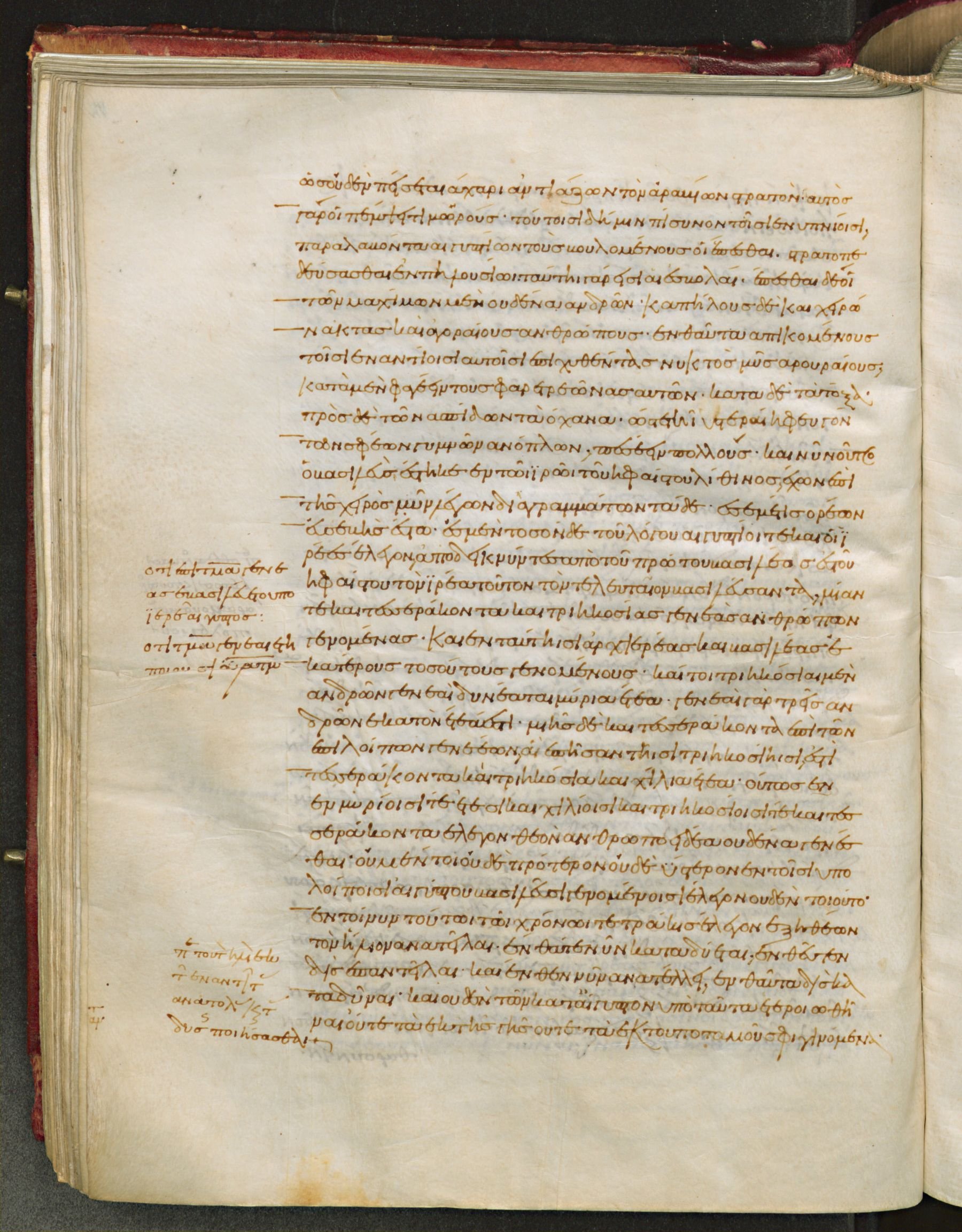
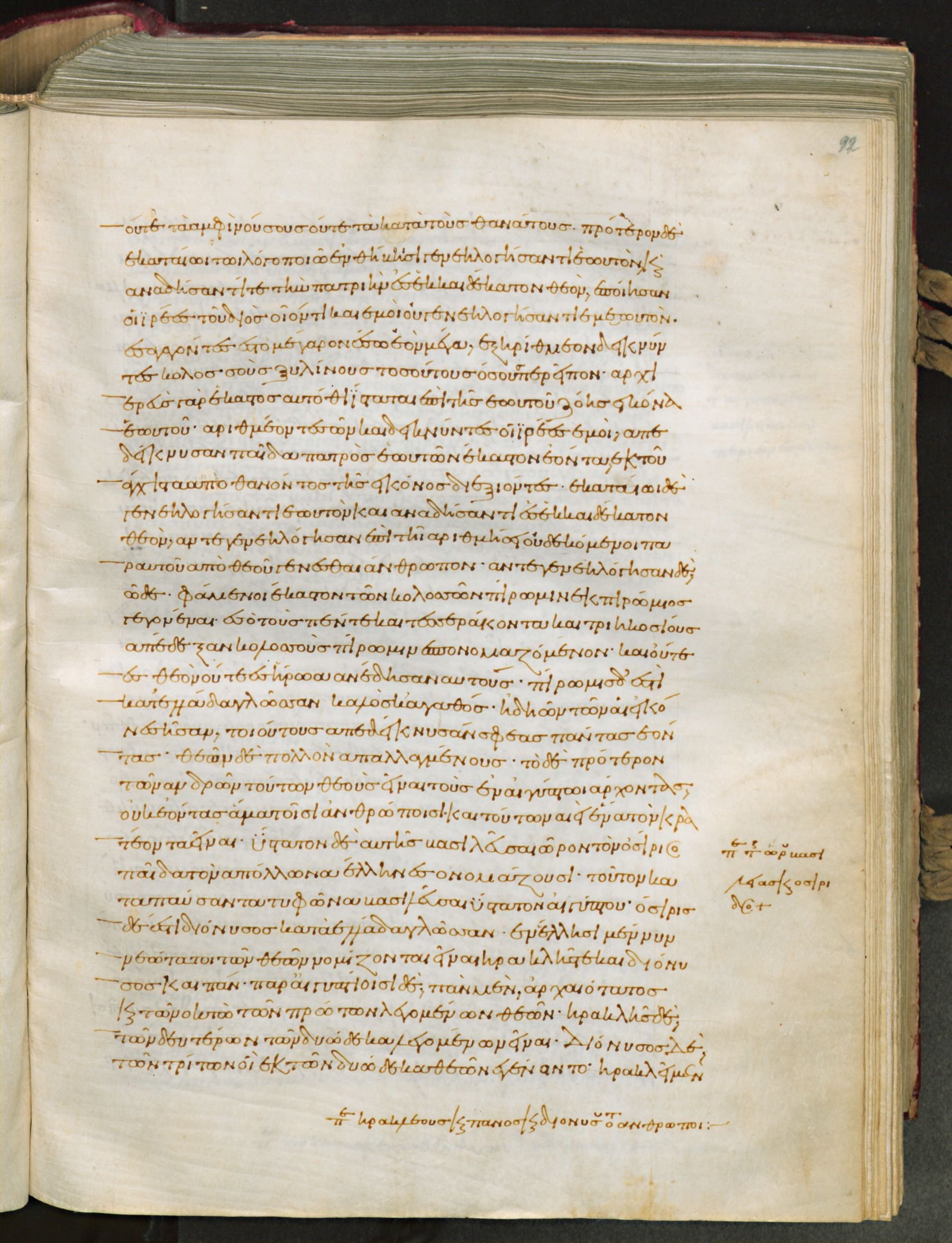
2.142 runs from fol. 91v to fol. 92r. Page breaks read on the images: fol. 91v begins 'ὡς οὐδὲν πείσεται ἄχαρι' (2.141.3) and ends '...οὔτε τὰ ἐκ τοῦ ποταμοῦ σφι γινόμενα' (2.142.4); the margin notes the sun rising twice where it now sets; fol. 92r begins 'οὔτε τὰ ἀμφὶ νούσους οὔτε τὰ κατὰ τοὺς θανάτους' (2.142.4) and ends 'Ἡρακλέι μέν' (2.145.2; a note on Heracles, Pan and Dionysus stands in the lower margin). Checked on the image. Viewer: https://tecabml.contentdm.oclc.org/digital/collection/plutei/id/1358114
2.142ἐς μὲν τοσόνδε τοῦ λόγου Αἰγύπτιοί τε καὶ οἱ ἱρέες ἔλεγον, ἀποδεικνύντες ἀπὸ τοῦ πρώτου βασιλέος ἐς τοῦ Ἡφαίστου τὸν ἱρέα τοῦτον τὸν τελευταῖον βασιλεύσαντα μίαν τε καὶ τεσσεράκοντα καὶ τριηκοσίας γενεὰς ἀνθρώπων γενομένας, καὶ ἐν ταύτῃσι ἀρχιερέας καὶ βασιλέας ἑκατέρους τοσούτους γενομένους.
καίτοι τριηκόσιαι μὲν ἀνδρῶν γενεαὶ δυνέαται μύρια ἔτεα· γενεαὶ γὰρ τρεῖς ἀνδρῶν ἑκατὸν ἔτεα ἐστί· μιῆς δὲ καὶ τεσσεράκοντα ἔτι τῶν ἐπιλοίπων γενεέων, αἳ ἐπῆσαν τῇσι τριηκοσίῃσι, ἐστὶ τεσσεράκοντα καὶ τριηκόσια καὶ χίλια ἔτεα.
οὕτω ἐν μυρίοισί τε ἔτεσι καὶ χιλίοισι καὶ τριηκοσίοισί τε καὶ τεσσεράκοντα ἔλεγον θεὸν ἀνθρωποειδέα οὐδένα γενέσθαι· οὐ μέντοι οὐδὲ πρότερον οὐδὲ ὕστερον ἐν τοῖσι ὑπολοίποισι Αἰγύπτου βασιλεῦσι γενομένοισι ἔλεγον οὐδὲν τοιοῦτο.
ἐν τοίνυν τούτῳ τῷ χρόνῳ τετράκις ἔλεγον ἐξ ἠθέων τὸν ἥλιον ἀνατεῖλαι· ἔνθα τε νῦν καταδύεται, ἐνθεῦτεν δὶς ἐπαντεῖλαι, καὶ ἔνθεν νῦν ἀνατέλλει, ἐνθαῦτα δὶς καταδῦναι. καὶ οὐδὲν τῶν κατʼ Αἴγυπτον ὑπὸ ταῦτα ἑτεροιωθῆναι, οὔτε τὰ ἐκ τῆς γῆς οὔτε τὰ ἐκ τοῦ ποταμοῦ σφι γινόμενα, οὔτε τὰ ἀμφὶ νούσους οὔτε τὰ κατὰ τοὺς θανάτους.
2.142Thus far went the record given me by the Egyptians and their priests; and they showed me that the time from the first king to that priest of Hephaestus, who was the last, covered three hundred and forty-one generations of men, and that in this time such also had been the number of their kings, and of their high priests. Now three hundred generations make up ten thousand years, three generations being equal to a century. And over and above the three hundred the remaining forty-one cover thirteen hundred and forty years. Thus the whole sum is eleven thousand three hundred and forty years; in all which time (they said) they had had no king who was a god in human form, nor had there been any such thing either before or after those years among the rest of the kings of Egypt. Four times in this period (so they told me) the sun rose contrary to his wont; twice he rose where he now sets, and twice he set where now he rises; yet Egypt at these times underwent no change, neither in the produce of the river and the land, nor in the matter of sickness and death.
Where on the image
2.143 is on fol. 92r. Page breaks read on the images: fol. 92r begins 'οὔτε τὰ ἀμφὶ νούσους οὔτε τὰ κατὰ τοὺς θανάτους' (2.142.4) and ends 'Ἡρακλέι μέν' (2.145.2; a note on Heracles, Pan and Dionysus stands in the lower margin). Checked on the image. Viewer: https://tecabml.contentdm.oclc.org/digital/collection/plutei/id/1358114
2.143πρότερον δὲ Ἑκαταίῳ τῷ λογοποιῷ ἐν Θήβῃσι γενεηλογήσαντί τε ἑωυτὸν καὶ ἀναδήσαντι τὴν πατριὴν ἐς ἑκκαιδέκατον θεὸν ἐποίησαν οἱ ἱρέες τοῦ Διὸς οἷόν τι καὶ ἐμοὶ οὐ γενεηλογήσαντι ἐμεωυτόν·
ἐσαγαγόντες ἐς τὸ μέγαρον ἔσω ἐὸν μέγα ἐξηρίθμεον δεικνύντες κολοσσοὺς ξυλίνους τοσούτους ὅσους περ εἶπον· ἀρχιερεὺς γὰρ ἕκαστος αὐτόθι ἱστᾷ ἐπὶ τῆς ἑωυτοῦ ζόης εἰκόνα ἑωυτοῦ·
ἀριθμέοντες ὦν καὶ δεικνύντες οἱ ἱρέες ἐμοὶ ἀπεδείκνυσαν παῖδα πατρὸς ἑωυτῶν ἕκαστον ἐόντα, ἐκ τοῦ ἄγχιστα ἀποθανόντος τῆς εἰκόνος διεξιόντες διὰ πασέων, ἕως οὗ ἀπέδεξαν ἁπάσας αὐτάς.
Ἑκαταίῳ δὲ γενεηλογήσαντι ἑωυτὸν καὶ ἀναδήσαντι ἐς ἑκκαιδέκατον θεὸν ἀντεγενεηλόγησαν ἐπὶ τῇ ἀριθμήσι, οὐ δεκόμενοι παρʼ αὐτοῦ ἀπὸ θεοῦ γενέσθαι ἄνθρωπον· ἀντεγενεηλόγησαν δὲ ὧδε, φάμενοι ἕκαστον τῶν κολοσσῶν πίρωμιν ἐκ πιρώμιος γεγονέναι, ἐς ὃ τοὺς πέντε καὶ τεσσεράκοντα καὶ τριηκοσίους ἀπέδεξαν κολοσσούς [πίρωμιν ἐπονομαζόμενον], καὶ οὔτε ἐς θεὸν οὔτε ἐς ἥρωα ἀνέδησαν αὐτούς. πίρωμις δὲ ἐστὶ κατὰ Ἑλλάδα γλῶσσαν καλὸς κἀγαθός.
2.143Hecataeus the historian was once at Thebes, where he made for himself a genealogy which connected him by lineage with a god in the sixteenth generation. But the priests did for him what they did for me (who had not traced my own lineage). They brought me into the great inner court of the temple and showed me there wooden figures which they counted up to the number they had already given, for every high priest sets there in his lifetime a statue of himself; counting and pointing to these, the priests showed me that each inherited from his father; they went through the whole tale of figures, back to the earliest from that of him who had lateliest died. Thus when Hecataeus had traced his descent and claimed that his sixteenth forefather was a god, the priests too traced a line of descent according to the method of their counting; for they would not be persuaded by him that a man could be descended from a god; they traced descent through the whole line of three hundred and forty-five figures, not connecting it with any ancestral god or hero, but declaring each figure to be a “Piromis” the son of a “Piromis,” that is, in the Greek language, one who is in all respects a good man.
Where on the image
2.144 is on fol. 92r. Page breaks read on the images: fol. 92r begins 'οὔτε τὰ ἀμφὶ νούσους οὔτε τὰ κατὰ τοὺς θανάτους' (2.142.4) and ends 'Ἡρακλέι μέν' (2.145.2; a note on Heracles, Pan and Dionysus stands in the lower margin). Checked on the image. Viewer: https://tecabml.contentdm.oclc.org/digital/collection/plutei/id/1358114
2.144ἤδη ὦν τῶν αἱ εἰκόνες ἦσαν, τοιούτους ἀπεδείκνυσαν σφέας πάντας ἐόντας, θεῶν δὲ πολλὸν ἀπαλλαγμένους.
τὸ δὲ πρότερον τῶν ἀνδρῶν τούτων θεοὺς εἶναι τοὺς ἐν Αἰγύπτῳ ἄρχοντας, οὐκ ἐόντας ἅμα τοῖσι ἀνθρώποισι, καὶ τούτων αἰεὶ ἕνα τὸν κρατέοντα εἶναι· ὕστατον δὲ αὐτῆς βασιλεῦσαι Ὦρον τὸν Ὀσίριος παῖδα, τὸν Ἀπόλλωνα Ἕλληνες ὀνομάζουσι· τοῦτον καταπαύσαντα Τυφῶνα βασιλεῦσαι ὕστατον Αἰγύπτου. Ὄσιρις δὲ ἐστὶ Διόνυσος κατὰ Ἑλλάδα γλῶσσαν.
2.144Thus they showed that all whose statues stood there had been good men, but wholly unlike gods. Before these men, they said, the rulers of Egypt were gods, but none had been contemporary with the human priests. Of these gods one or other had in succession been supreme; the last of them to rule the country was Osiris’ son Horus, called by the Greeks Apollo; he deposed Typhon, and was the last divine king of Egypt. Osiris is, in the Greek language, Dionysus.
Where on the image
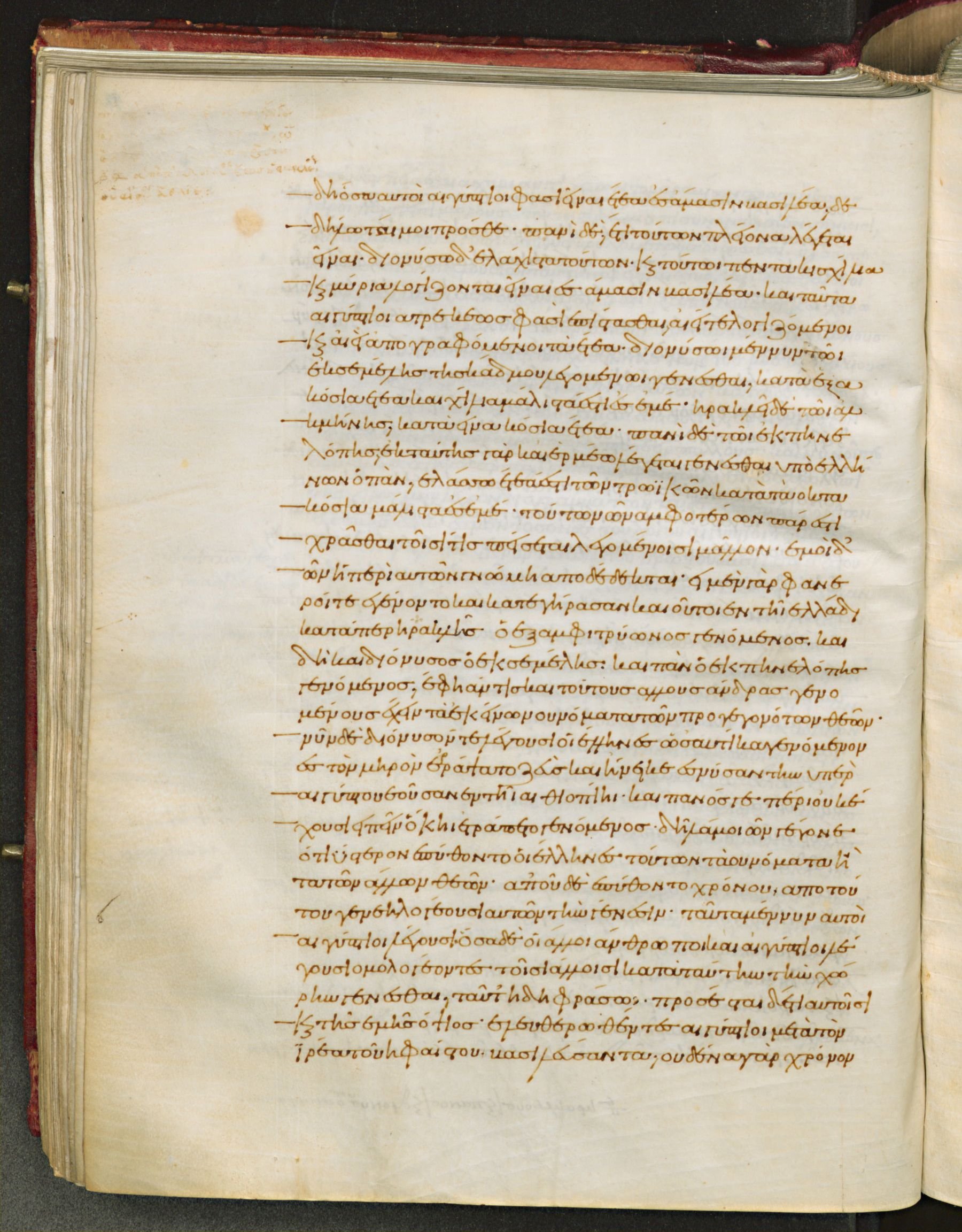
2.145 runs from fol. 92r to fol. 92v. Page breaks read on the images: fol. 92r begins 'οὔτε τὰ ἀμφὶ νούσους οὔτε τὰ κατὰ τοὺς θανάτους' (2.142.4) and ends 'Ἡρακλέι μέν' (2.145.2; a note on Heracles, Pan and Dionysus stands in the lower margin); fol. 92v begins 'δὴ ὅσα αὐτοὶ Αἰγύπτιοί φασι εἶναι ἔτεα' (2.145.2); 2.146 begins in line 11 'τούτων ὦν ἀμφοτέρων' and ends in line 27 '...γενεηλογέουσι αὐτῶν τὴν γένεσιν', where 2.147 'ταῦτα μέν νυν αὐτοὶ Αἰγύπτιοι λέγουσι' begins. Checked on the image. Viewer: https://tecabml.contentdm.oclc.org/digital/collection/plutei/id/1358114
2.145ἐν Ἕλλησι μέν νυν νεώτατοι τῶν θεῶν νομίζονται εἶναι Ἡρακλέης τε καὶ Διόνυσος καὶ Πάν, παρʼ Αἰγυπτίοισι δὲ Πὰν μὲν ἀρχαιότατος καὶ τῶν ὀκτὼ τῶν πρώτων λεγομένων θεῶν, Ἡρακλέης δὲ τῶν δευτέρων τῶν δυώδεκα λεγομένων εἶναι, Διόνυσος δὲ τῶν τρίτων, οἳ ἐκ τῶν δυώδεκα θεῶν ἐγένοντο.
Ἡρακλέι μὲν δὴ ὅσα αὐτοὶ Αἰγύπτιοι φασὶ εἶναι ἔτεα ἐς Ἄμασιν βασιλέα, δεδήλωταί μοι πρόσθε· Πανὶ δὲ ἔτι τούτων πλέονα λέγεται εἶναι, Διονύσῳ δʼ ἐλάχιστα τούτων, καὶ τούτῳ πεντακισχίλια καὶ μύρια λογίζονται εἶναι ἐς Ἄμασιν βασιλέα.
καὶ ταῦτα Αἰγύπτιοι ἀτρεκέως φασὶ ἐπίστασθαι, αἰεί τε λογιζόμενοι καὶ αἰεὶ ἀπογραφόμενοι τὰ ἔτεα.
Διονύσῳ μέν νυν τῷ ἐκ Σεμέλης τῆς Κάδμου λεγομένῳ γενέσθαι κατὰ ἑξακόσια ἔτεα καὶ χίλια μάλιστα ἐστὶ ἐς ἐμέ, Ἡρακλέι δὲ τῷ Ἀλκμήνης κατὰ εἰνακόσια ἔτεα· Πανὶ δὲ τῷ ἐκ Πηνελόπης (ἐκ ταύτης γὰρ καὶ Ἑρμέω λέγεται γενέσθαι ὑπὸ Ἑλλήνων ὁ Πάν) ἐλάσσω ἔτεα ἐστὶ τῶν Τρωικῶν, κατὰ ὀκτακόσια μάλιστα ἐς ἐμέ.
2.145Among the Greeks, Heracles, Dionysus, and Pan are held to be the youngest of the gods. But in Egypt Pan is the most ancient of these and is one of the eight gods who are said to be the first of all, Heracles belongs to the second dynasty (that of the so-called twelve gods), and Dionysus to the third, which came after the twelve. How many years there were between Heracles and the reign of Amasis, I have already shown; Pan is said to be earlier still; the years between Dionysus and Amasis are the fewest, and they are reckoned by the Egyptians at fifteen thousand. Of all this the Egyptians claim to have certain knowledge, seeing that they had always reckoned the years and chronicled them in writing. Now the Dionysus who was called the son of Semele, daughter of Cadmus, was about sixteen hundred years before my time, and Heracles son of Alcmene about nine hundred years; and Pan the son of Penelope (for according to the Greeks Penelope and Hermes were the parents of Pan) was about eight hundred years before me, and thus of a later date than the Trojan war.
Where on the image
2.146 is on fol. 92v. Page breaks read on the images: fol. 92v begins 'δὴ ὅσα αὐτοὶ Αἰγύπτιοί φασι εἶναι ἔτεα' (2.145.2); 2.146 begins in line 11 'τούτων ὦν ἀμφοτέρων' and ends in line 27 '...γενεηλογέουσι αὐτῶν τὴν γένεσιν', where 2.147 'ταῦτα μέν νυν αὐτοὶ Αἰγύπτιοι λέγουσι' begins. Checked on the image. Viewer: https://tecabml.contentdm.oclc.org/digital/collection/plutei/id/1358114
2.146τούτων ὦν ἀμφοτέρων πάρεστι χρᾶσθαι τοῖσί τις πείσεται λεγομένοισι μᾶλλον· ἐμοὶ δʼ ὦν ἡ περὶ αὐτῶν γνώμη ἀποδέδεκται. εἰ μὲν γὰρ φανεροί τε ἐγένοντο καὶ κατεγήρασαν καὶ οὗτοι ἐν τῇ Ἑλλάδι, κατά περ Ἡρακλέης ὁ ἐξ Ἀμφιτρύωνος γενόμενος, καὶ δὴ καὶ Διόνυσος ὁ ἐκ Σεμέλης καὶ Πὰν ὁ ἐκ Πηνελόπης γενόμενος, ἔφη ἄν τις καὶ τούτους ἄλλους ἄνδρας γενομένους ἔχειν τὰ ἐκείνων οὐνόματα τῶν προγεγονότων θεῶν.
νῦν δὲ Διόνυσόν τε λέγουσι οἱ Ἕλληνες ὡς αὐτίκα γενόμενον ἐς τὸν μηρὸν ἐνερράψατο Ζεὺς καὶ ἤνεικε ἐς Νύσαν τὴν ὑπὲρ Αἰγύπτου ἐοῦσαν ἐν τῇ Αἰθιοπίῃ, καὶ Πανός γε πέρι οὐκ ἔχουσι εἰπεῖν ὅκῃ ἐτράπετο γενόμενος. δῆλά μοι γέγονε ὅτι ὕστερον ἐπύθοντο οἱ Ἕλληνες τούτων τὰ οὐνόματα ἢ τὰ τῶν ἄλλων θεῶν· ἀπʼ οὗ δὲ ἐπύθοντο χρόνου, ἀπὸ τούτου γενεηλογέουσι αὐτῶν τὴν γένεσιν.
2.146With regard to these two, Pan and Dionysus, a man may follow whatsoever story he deems most credible; but I here declare my own opinion concerning them:—Had Dionysus son of Semele and Pan son of Penelope been made manifest in Hellas and lived there to old age, like Heracles the son of Amphitryon, it might have been said that they too (like Heracles) were but men, named after the older Pan and Dionysus, the gods of antiquity; but as it is, the Greek story has it that no sooner was Dionysus born than Zeus sewed him up in his thigh and carried him away to Nysa in Ethiopia beyond Egypt; and as for Pan, the Greeks know not what became of him after his birth. It is therefore plain to me that the Greeks learnt the names of these two gods later than the names of all the others, and trace the birth of both to the time when they gained the knowledge.
Notes
- Greek: the text printed in A. D. Godley's Loeb edition (1920), from Perseus. Square brackets mark words the editor considers later additions. The manuscript's wording differs from the edition in places; the Greek is the edition, not a transcription of the page.
- English: A. D. Godley's translation as printed in 1920 (Loeb Classical Library, Herodotus vol. 1), not the modernized version on Perseus. Godley's footnotes are omitted.
- Chapter 121 is divided into 121 and 121a-121f as in Godley's edition; the English is divided at the corresponding sentences.
Cite
Sources
- Source: Florence, Laur. Plut. 70.3 (10th c.) via BML Teca Digitale + Greek of Godley's Loeb (Perseus) + English of A. D. Godley (1920, Wikisource, checked against the printing) (holding institution)
- Critical edition: Greek of A. D. Godley's Loeb edition (1920), via Perseus
← previous · → next · v cycle view · l back to library