Herodotus, Histories 2.141: Sethos and the army of Sennacherib
Introduction
In the second book of his Histories (written c. 430 BCE) Herodotus reports what the priests of Hephaestus at Memphis told him of the kings of Egypt, from Min (Menes), who first ruled and founded Memphis, through 330 kings named from a papyrus roll, to Sesostris, Proteus, Rhampsinitus, the pyramid builders Cheops, Chephren and Mycerinus, and Sethos, priest-king in the time of Sennacherib. He ends with their chronology: 341 generations, 11,340 years, during which no god had reigned in human form and the sun had four times risen out of its usual place.
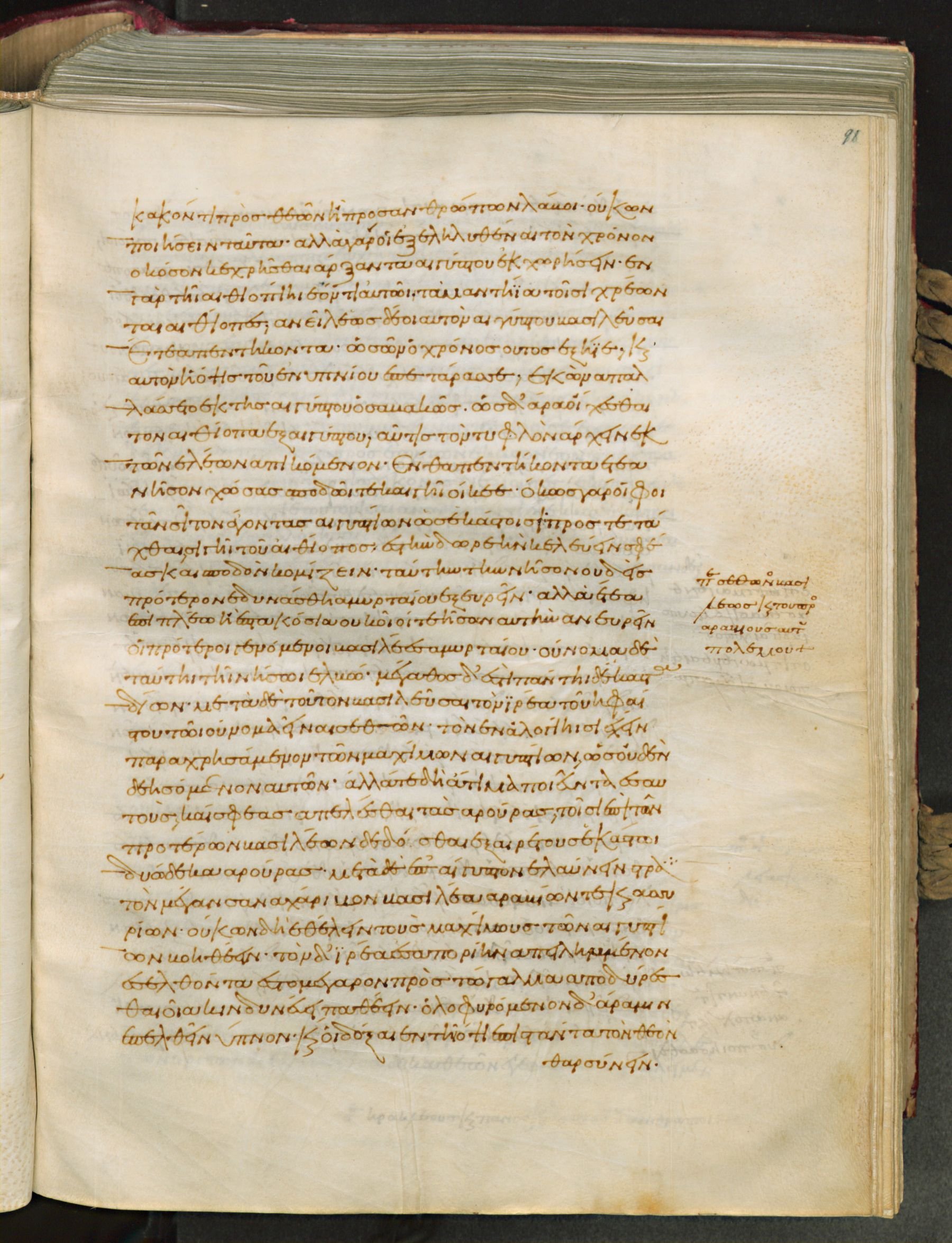
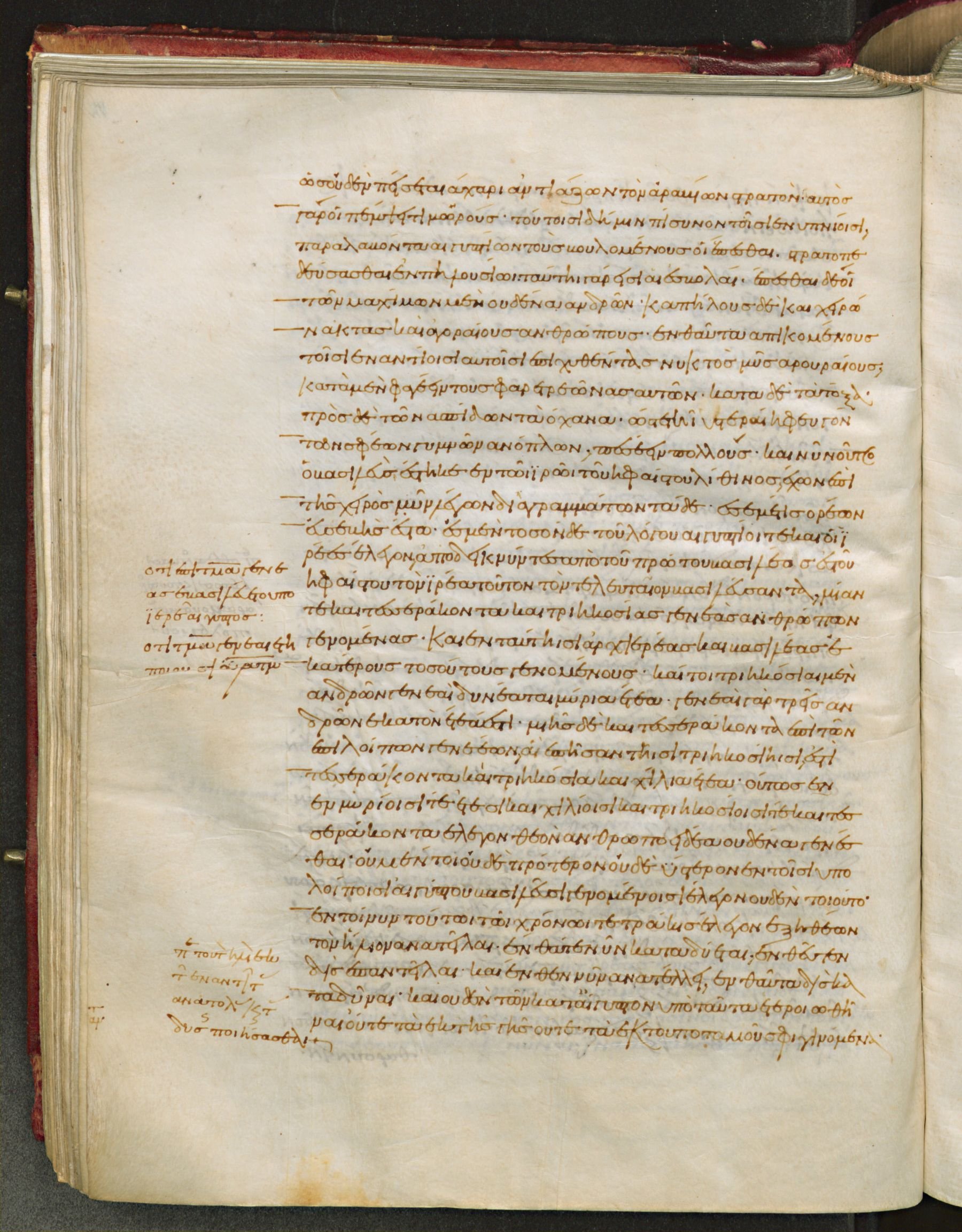
The manuscript is Florence, Biblioteca Medicea Laurenziana, Plut. 70.3, written in the 10th century, the oldest surviving manuscript of Herodotus (codex A of the editors). Chapters 2.99-146 run from fol. 78v to fol. 92v. Each section is one chapter (Godley's subdivisions of the Rhampsinitus story, 121a-f, are kept apart) and points at the page(s) that carry it; the page breaks were read on the images and are recorded in each note.
This entry covers 2.141, on fol. 91r to 91v.
How was this verified? (Provenance)
Where on the image
2.141 runs from fol. 91r to fol. 91v. Page breaks read on the images: fol. 91r begins 'κακόν τι πρὸς θεῶν ἢ πρὸς ἀνθρώπων λάβοι' (2.139.2) and ends '...ἐπιστάντα τὸν θεὸν θαρσύνειν' (2.141.3); fol. 91v begins 'ὡς οὐδὲν πείσεται ἄχαρι' (2.141.3) and ends '...οὔτε τὰ ἐκ τοῦ ποταμοῦ σφι γινόμενα' (2.142.4); the margin notes the sun rising twice where it now sets. Checked on the image. Viewer: https://tecabml.contentdm.oclc.org/digital/collection/plutei/id/1358114
2.141μετὰ δὲ τοῦτον βασιλεῦσαι τὸν ἱρέα τοῦ Ἡφαίστου, τῷ οὔνομα εἶναι Σεθῶν· τὸν ἐν ἀλογίῃσι ἔχειν παραχρησάμενον τῶν μαχίμων Αἰγυπτίων ὡς οὐδὲν δεησόμενον αὐτῶν, ἄλλα τε δὴ ἄτιμα ποιεῦντα ἐς αὐτούς, καί σφεας ἀπελέσθαι τὰς ἀρούρας· τοῖσι ἐπὶ τῶν προτέρων βασιλέων δεδόσθαι ἐξαιρέτους ἑκάστῳ δυώδεκα ἀρούρας.
μετὰ δὲ ἐπʼ Αἴγυπτον ἐλαύνειν στρατὸν μέγαν Σαναχάριβον βασιλέα Ἀραβίων τε καὶ Ἀσσυρίων· οὔκων δὴ ἐθέλειν τοὺς μαχίμους τῶν Αἰγυπτίων βοηθέειν.
τὸν δʼ ἱρέα ἐς ἀπορίην ἀπειλημένον ἐσελθόντα ἐς τὸ μέγαρον πρὸς τὤγαλμα ἀποδύρεσθαι οἷα κινδυνεύει παθεῖν. ὀλοφυρόμενον δʼ ἄρα μιν ἐπελθεῖν ὕπνον, καί οἱ δόξαι ἐν τῇ ὄψι ἐπιστάντα τὸν θεὸν θαρσύνειν ὡς οὐδὲν πείσεται ἄχαρι ἀντιάζων τὸν Ἀραβίων στρατόν· αὐτὸς γάρ οἱ πέμψειν τιμωρούς.
τούτοισι δή μιν πίσυνον τοῖσι ἐνυπνίοισι, παραλαβόντα Αἰγυπτίων τοὺς βουλομένους οἱ ἕπεσθαι, στρατοπεδεύσασθαι ἐν Πηλουσίῳ· ταύτῃ γὰρ εἰσὶ αἱ ἐσβολαί· ἕπεσθαι δέ οἱ τῶν μαχίμων μὲν οὐδένα ἀνδρῶν, καπήλους δὲ καὶ χειρώνακτας καὶ ἀγοραίους ἀνθρώπους.
ἐνθαῦτα ἀπικομένοισι τοῖσι ἐναντίοισι αὐτοῖσι ἐπιχυθέντας νυκτὸς μῦς ἀρουραίους κατὰ μὲν φαγεῖν τοὺς φαρετρεῶνας αὐτῶν κατὰ δὲ τὰ τόξα, πρὸς δὲ τῶν ἀσπίδων τὰ ὄχανα, ὥστε τῇ ὑστεραίῃ φευγόντων σφέων γυμνῶν πεσεῖν πολλούς.
καὶ νῦν οὗτος ὁ βασιλεὺς ἕστηκε ἐν τῷ ἱρῷ τοῦ Ἡφαίστου λίθινος, ἔχων ἐπὶ τῆς χειρὸς μῦν, λέγων διὰ γραμμάτων τάδε· ἐς ἐμέ τις ὁρέων εὐσεβὴς ἔστω.
2.141The next king was the priest of Hephaestus, whose name was Sethos. He despised and took no account of the warrior Egyptians, thinking he would never need them; besides otherwise dishonouring them, he took away the chosen lands which had been given to them, twelve fields to each man, in the reign of former kings. So presently came king Sanacharib against Egypt, with a great host of Arabians and Assyrians; and the warrior Egyptians would not march against him. The priest, in this quandary, went into the temple shrine and there bewailed to the god’s image the peril which threatened him. In his lamentation he fell asleep, and dreamt that he saw the god standing over him and bidding him take courage, for he should suffer no ill by encountering the host of Arabia: “Myself,” said the god, “will send you champions.” So he trusted the vision, and encamped at Pelusium with such Egyptians as would follow him, for here is the road into Egypt; and none of the warriors would go with him, but only hucksters and artificers and traders. Their enemies too came thither, and one night a multitude of fieldmice swarmed over the Assyrian camp and devoured their quivers and their bows and the handles of their shields likewise, insomuch that they fled the next day unarmed and many fell. And at this day a stone statue of the Egyptian king stands in Hephaestus’ temple, with a mouse in his hand, and an inscription to this effect: “Look on me, and fear the gods.”
Notes
- Greek: the text printed in A. D. Godley's Loeb edition (1920), from Perseus. Square brackets mark words the editor considers later additions. The manuscript's wording differs from the edition in places; the Greek is the edition, not a transcription of the page.
- English: A. D. Godley's translation as printed in 1920 (Loeb Classical Library, Herodotus vol. 1), not the modernized version on Perseus. Godley's footnotes are omitted.
- Chapter 121 is divided into 121 and 121a-121f as in Godley's edition; the English is divided at the corresponding sentences.
Cite
Sources
- Source: Florence, Laur. Plut. 70.3 (10th c.) via BML Teca Digitale + Greek of Godley's Loeb (Perseus) + English of A. D. Godley (1920, Wikisource, checked against the printing) (holding institution)
- Critical edition: Greek of A. D. Godley's Loeb edition (1920), via Perseus
← previous · → next · v cycle view · l back to library