Hesiod, Shield of Heracles 1-77: Alcmene and the birth of Heracles; Cycnus at Pagasae
Introduction
The Shield of Heracles is a short epic handed down under Hesiod's name, probably composed in the 6th century BCE. It tells of Heracles' fight with Cycnus, son of Ares, and describes the hero's shield at length. This part: Alcmene and the birth of Heracles; Cycnus at Pagasae (lines 1-77, 77 lines). Alcmene, wife of Amphitryon, bears Heracles to Zeus and Iphicles to her husband; Heracles finds Cycnus, son of Ares, at the grove of Apollo.
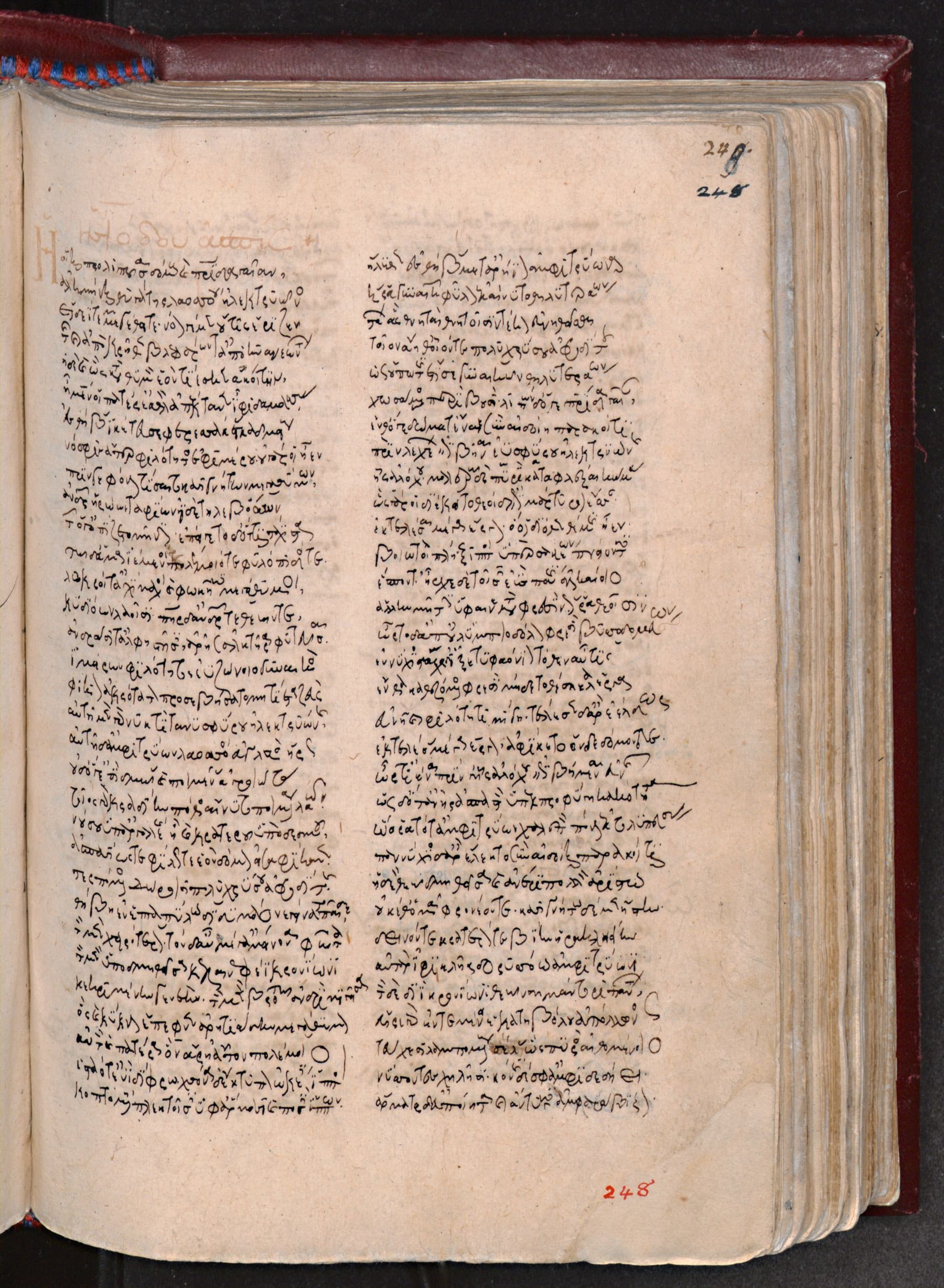
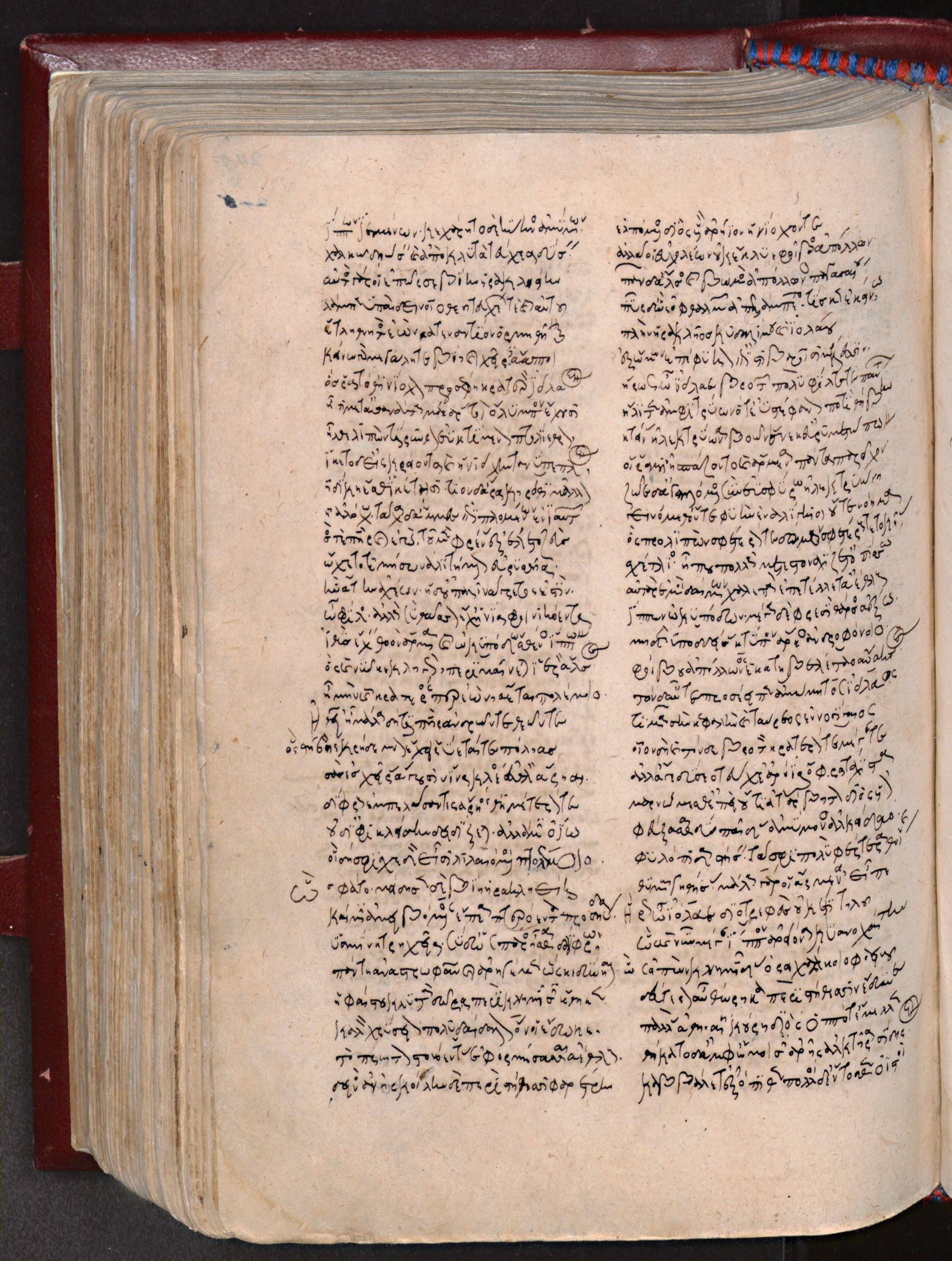
The page photographs are from Florence, Biblioteca Medicea Laurenziana, Plut. 32.16 (paper, late 13th century; a large collection of Greek poetry that also holds letters of Maximus Planudes), Shield of Heracles on fols. 248r-251v, in the Biblioteca Medicea Laurenziana's Teca Digitale. It follows the Works and Days and the Theogony in the same manuscript. This part is on fol. 248r, 248v. The scribe writes two verses to a row, one in each column, so a page is read across the columns, row by row; a few short notes stand in the margins. Each section below is one page; its note gives the page's first and last verse as read on the photograph.
The Greek is Evelyn-White's Loeb text (1914) via Perseus, not a transcription of this manuscript, whose wording differs here and there. Verses the editor brackets as later additions are shown in square brackets. The English is Evelyn-White's prose translation (1914); it is cut at the end of his sentences, so where a sentence runs across a page break it is given whole to one page; each section's note gives the exact lines its English covers.
How was this verified? (Provenance)
Where on the image
Laur. Plut. 32.16, fol. 248r: lines 1-64, begins ‹ἢ οἵη προλιποῦσα δόμους›, ends ‹εὐποίητα καὶ ἄντυγες ἀμφαράβιζον›. Checked on the image: first and last verse rows read and matched to the Greek (re-read on the image 2026-11-12: first row ‹1 | 2: Ἢ οἵη προλιποῦσα δόμους ... | ἤλυθεν ἐς Θήβας ...›, last row ‹63 | 64: ... ὑφ' ἅρμασι καὶ ποσὶν ἵππων | ... ἄντυγες ἀμφαράβιζον›); this is the first page of the poem and the page after begins at line 65. The poem begins at the head of the page under the red title Ἡσιόδου ἀσπίς, with a large initial, directly after the Theogony on the previous page. English here: lines 1-65, cut at the end of Evelyn-White's sentences. His sentence that runs across the break with the next page is given whole here, so the English ends with line 65 (‹... as the horses plunged.›).
1ἢ οἵη προλιποῦσα δόμους καὶ πατρίδα γαῖαν
2ἤλυθεν ἐς Θήβας μετʼ ἀρήιον Ἀμφιτρύωνα
3Ἀλκμήνη, θυγάτηρ λαοσσόου Ἠλεκτρύωνος·
4ἥ ῥα γυναικῶν φῦλον ἐκαίνυτο θηλυτεράων
5εἴδεΐ τε μεγέθει τε· νόον γε μὲν οὔ τις ἔριζε
6τάων, ἃς θνηταὶ θνητοῖς τέκον εὐνηθεῖσαι.
7τῆς καὶ ἀπὸ κρῆθεν βλεφάρων τʼ ἄπο κυανεάων
8τοῖον ἄηθʼ οἷόν τε πολυχρύσου Ἀφροδίτης.
9ἣ δὲ καὶ ὣς κατὰ θυμὸν ἑὸν τίεσκεν ἀκοίτην,
10ὡς οὔ πώ τις ἔτισε γυναικῶν θηλυτεράων·
11ἦ μέν οἱ πατέρʼ ἐσθλὸν ἀπέκτανε ἶφι δαμάσσας,
12χωσάμενος περὶ βουσί· λιπὼν δʼ ὅ γε πατρίδα γαῖαν
13ἐς Θήβας ἱκέτευσε φερεσσακέας Καδμείους.
14ἔνθʼ ὅ γε δώματʼ ἔναιε σὺν αἰδοίῃ παρακοίτι
15νόσφιν ἄτερ φιλότητος ἐφιμέρου, οὐδέ οἱ ἦεν
16πρὶν λεχέων ἐπιβῆναι ἐυσφύρου Ἠλεκτρυώνης,
17πρίν γε φόνον τίσαιτο κασιγνήτων μεγαθύμων
18ἧς ἀλόχου, μαλερῷ δὲ καταφλέξαι πυρὶ κώμας
19ἀνδρῶν ἡρώων Ταφίων ἰδὲ Τηλεβοάων.
20τὼς γάρ οἱ διέκειτο, θεοὶ δʼ ἐπὶ μάρτυροι ἦσαν·
21τῶν ὅ γʼ ὀπίζετο μῆνιν, ἐπείγετο δʼ ὅττι τάχιστα
22ἐκτελέσαι μέγα ἔργον, ὅ οἱ Διόθεν θέμις ἦεν.
23τῷ δʼ ἅμα ἱέμενοι πολέμοιό τε φυλόπιδός τε
24Βοιωτοὶ πλήξιπποι, ὑπὲρ σακέων πνείοντες,
25Λοκροί τʼ ἀγχέμαχοι καὶ Φωκῆες μεγάθυμοι
26ἕσποντʼ· ἦρχε δὲ τοῖσιν ἐὺς πάις Ἀλκαίοιο
27κυδιόων λαοῖσι. πατὴρ δʼ ἀνδρῶν τε θεῶν τε
28ἄλλην μῆτιν ὕφαινε μετὰ φρεσίν, ὥς ῥα θεοῖσιν
29ἀνδράσι τʼ ἀλφηστῇσιν ἀρῆς ἀλκτῆρα φυτεύσαι.
30ὦρτο δʼ ἀπʼ Οὐλύμποιο δόλον φρεσὶ βυσσοδομεύων,
31ἱμείρων φιλότητος ἐυζώνοιο γυναικός,
32ἐννύχιος· τάχα δʼ ἷξε Τυφαόνιον· τόθεν αὖτις
33Φίκιον ἀκρότατον προσεβήσατο μητίετα Ζεύς.
34ἔνθα καθεζόμενος φρεσὶ μήδετο θέσκελα ἔργα·
35αὐτῇ μὲν γὰρ νυκτὶ τανυσφύρου Ἠλεκτρυώνης
36εὐνῇ καὶ φιλότητι μίγη, τέλεσεν δʼ ἄρʼ ἐέλδωρ·
37αὐτῇ δʼ Ἀμφιτρύων λαοσσόος, ἀγλαὸς ἥρως,
38ἐκτελέσας μέγα ἔργον ἀφίκετο ὅνδε δόμονδε.
39οὐδʼ ὅ γʼ ἐπὶ δμῶας καὶ ποιμένας ἀγροιώτας
40ὦρτʼ ἰέναι, πρίν γʼ ἧς ἀλόχου ἐπιβήμεναι εὐνῆς·
41τοῖος γὰρ κραδίην πόθος αἴνυτο ποιμένα λαῶν.
42ὡς δʼ ὅτʼ ἀνὴρ ἀσπαστὸν ὑπεκπροφύγῃ κακότητα
43νούσου ὕπʼ ἀργαλέης ἢ καὶ κρατεροῦ ὑπὸ δεσμοῦ,
44ὥς ῥα τότʼ Ἀμφιτρύων χαλεπὸν πόνον ἐκτολυπεύσας
45ἀσπασίως τε φίλως τε ἑὸν δόμον εἰσαφίκανεν.
46παννύχιος δʼ ἄρʼ ἔλεκτο σὺν αἰδοίῃ παρακοίτι
47τερπόμενος δώροισι πολυχρύσου Ἀφροδίτης.
48ἣ δὲ θεῷ δμηθεῖσα καὶ ἀνέρι πολλὸν ἀρίστῳ
49Θήβῃ ἐν ἑπταπύλῳ διδυμάονε γείνατο παῖδε,
50οὐ καθʼ ὁμὰ φρονέοντε· κασιγνήτω γε μὲν ἤστην·
51τὸν μὲν χειρότερον, τὸν δʼ αὖ μέγʼ ἀμείνονα φῶτα,
52δεινόν τε κρατερόν τε, βίην Ἡρακληείην·
53τὸν μὲν ὑποδμηθεῖσα κελαινεφέι Κρονίωνι,
54τὸν δʼ ἄρα Ἰφικλῆα δορυσσόῳ Ἀμφιτρύωνι,
55κεκριμένην γενεήν· τὸν μὲν βροτῷ ἀνδρὶ μιγεῖσα,
56τὸν δὲ Διὶ Κρονίωνι, θεῶν σημάντορι πάντων.
57ὃς καὶ Κύκνον ἔπεφνεν, Ἀρητιάδην μεγάθυμον.
58εὗρε γὰρ ἐν τεμένει ἑκατηβόλου Ἀπόλλωνος
59αὐτὸν καὶ πατέρα ὃν Ἄρην, ἄατον πολέμοιο,
60τεύχεσι λαμπομένους σέλας ὣς πυρὸς αἰθομένοιο,
61ἑσταότʼ ἐν δίφρῳ· χθόνα δʼ ἔκτυπον ὠκέες ἵπποι
62νύσσοντες χηλῇσι, κόνις δέ σφʼ ἀμφιδεδήει
63κοπτομένη πλεκτοῖσιν ὑφʼ ἅρμασι καὶ ποσὶν ἵππων.
64ἅρματα δʼ εὐποίητα καὶ ἄντυγες ἀμφαράβιζον
1Or like her who left home and country and came to Thebes, following warlike Amphitryon,—even Alcmena, the daughter of Electryon, gatherer of the people. She surpassed the tribe of womankind 5in beauty and in height; and in wisdom none vied with her of those whom mortal women bore of union with mortal men. Her face and her dark eyes wafted such charm as comes from golden Aphrodite. And she so honored her husband in her heart 10as none of womankind did before her. In truth he had slain her noble father violently when he was angry about oxen; so he left his own country and came to Thebes and was suppliant to the shield-carrying men of Cadmus. There he dwelt with his modest wife 15without the joys of love, nor might he go in unto the neat-ankled daughter of Electryon until he had avenged the death of his wife's great-hearted brothers and utterly burned with blazing fire the villages of the heroes, the Taphians and Teleboans; 20for this thing was laid upon him, and the gods were witnesses to it. And he feared their anger, and hastened to perform the great task to which Zeus had bound him. With him went the horse-driving Boeotians, breathing above their shields, 25and the Locrians who fight hand to hand, and the gallant Phocians eager for war and battle. And the noble son of Alcaeus led them, rejoicing in his host. But the father of men and gods was forming another scheme in his heart, to beget one to defend against destruction gods and men who eat bread. 30So he arose from Olympus by night pondering guile in the deep of his heart, and yearned for the love of the well-girded woman. Quickly he came to Typhaonium, and from there again wise Zeus went on and trod the highest peak of Phicium: there he sat and planned marvellous things in his heart. 35So in one night Zeus shared the bed and love of the neat-ankled daughter of Electryon and fulfilled his desire; and in the same night Amphitryon, gatherer of the people, the glorious hero, came to his house when he had ended his great task. 39He hastened not to go to his bondmen and shepherds afield, 40but first went in to his wife: such desire took hold on the shepherd of the people. And as a man who has escaped joyfully from misery, whether of sore disease or cruel bondage, so then did Amphitryon, when he had wound up all his heavy task, 45come glad and welcome to his home. And all night long he lay with his modest wife, delighting in the gifts of golden Aphrodite. And she, being subject in love to a god and to a man exceeding goodly, brought forth twin sons in seven-gated Thebes. 50Though they were brothers, these were not of one spirit; for one was weaker but the other a far better man, one terrible and strong, the mighty Heracles. She bore him through the embrace of the son of Cronos lord of dark clouds and the other, Iphicles, of Amphitryon the spear-wielder— 55offspring distinct, this one of union with a mortal man, but that other of union with Zeus, leader of all the gods. And he slew Cycnus, the gallant son of Ares. For he found him in the precinct of far-shooting Apollo, him and his father Ares, never sated with war. 60Their armour shone like a flame of blazing fire as they two stood in their chariot: their swift horses struck the earth and pawed it with their hoofs, and the dust rose like smoke about them, pounded by the chariot wheels and the horses' hoofs, while the well-made chariot and its rails rattled around them 65as the horses plunged.
Where on the image
Laur. Plut. 32.16, fol. 248v: lines 65-130, begins ‹ἵππων ἱεμένων· κεχάρητο δὲ›, ends ‹πολλοὶ δʼ ἔντοσθεν ὀιστοὶ›. Checked on the image: first and last verse rows read and matched to the Greek (re-read on the image 2026-11-12: first row ‹65 | 66: ἵππων ἱεμένων κεχάρητο δὲ Κύκνος ἀμύμων | ἐλπόμενος Διὸς υἱὸν ...›, last row ‹129 | 130: δεινὸς ἀνήρ κοίλην δὲ ... φαρέτρην | κάββαλε τ' ἐξόπιθεν ... ὀϊστοί›); the page before ends at line 64 and the page after begins at line 131. This section shows lines 65-77 of that page; the rest of the page belongs to the next part of the poem. The row above the last holds 127 | 128. (Corrected 2026-11-12: the page map had ended this page at 128.) English here: lines 65-77, cut at the end of Evelyn-White's sentences. The sentence that runs across the page break (to line 65) is given whole with the page before; the English here begins with ‹And blameless Cycnus was glad ...› (line 65).
65ἵππων ἱεμένων· κεχάρητο δὲ Κύκνος ἀμύμων,
66ἐλπόμενος Διὸς υἱὸν ἀρήιον ἡνίοχόν τε
67χαλκῷ δηιώσειν καὶ ἀπὸ κλυτὰ τεύχεα δύσειν.
68ἀλλά οἱ εὐχωλέων οὐκ ἔκλυε Φοῖβος Ἀπόλλων·
69αὐτὸς γάρ οἱ ἐπῶρσε βίην Ἡρακληείην.
70πᾶν δʼ ἄλσος καὶ βωμὸς Ἀπόλλωνος Παγασαίου
71λάμπεν ὑπὸ δεινοῖο θεοῦ τευχέων τε καὶ αὐτοῦ·
72πῦρ δʼ ὣς ὀφθαλμῶν ἀπελάμπετο. τίς κεν ἐκείνου
73ἔτλη θνητὸς ἐὼν κατεναντίον ὁρμηθῆναι
74πλήν γʼ Ἡρακλῆος καὶ κυδαλίμου Ἰολάου;
75κείνων γὰρ μεγάλη τε βίη καὶ χεῖρες ἄαπτοι
76ἐξ ὤμων ἐπέφυκον ἐπὶ στιβαροῖσι μέλεσσιν.
77ὅς ῥα τόθʼ ἡνίοχον προσέφη κρατερὸν Ἰόλαον·
65And blameless Cycnus was glad, for he hoped to slay the warlike son of Zeus and his charioteer with the sword, and to strip off their splendid armour. But Phoebus Apollo would not listen to his vaunts, for he himself had stirred up mighty Heracles against him. 70And all the grove and altar of Pagasaean Apollo flamed because of the dread god and because of his arms; for his eyes flashed as with fire. What mortal man would have dared to meet him face to face save Heracles and glorious Iolaus? 75For great was their strength and unconquerable were the arms which grew from their shoulders on their strong limbs. Then Heracles spake to his charioteer strong Iolaus:
Notes
- Greek: H. G. Evelyn-White, Hesiod, the Homeric Hymns and Homerica (Loeb Classical Library, 1914), via Perseus. Square brackets mark verses the editor regards as interpolated.
- English: H. G. Evelyn-White's translation in the same volume; his footnotes are omitted.
- The Loeb text has no line 298; the numbering is the editor's.
Cite
Sources
- Source: Laur. Plut. 32.16 (BML Teca Digitale IIIF) + Evelyn-White Greek (Loeb 1914, Perseus) + Evelyn-White English (1914, Perseus) (holding institution)
- Critical edition: Evelyn-White, Loeb 1914, via Perseus
← previous · → next · v cycle view · l back to library