Hesiod, Shield of Heracles 78-153: Heracles and Iolaus; the arming of Heracles
Introduction
The Shield of Heracles is a short epic handed down under Hesiod's name, probably composed in the 6th century BCE. It tells of Heracles' fight with Cycnus, son of Ares, and describes the hero's shield at length. This part: Heracles and Iolaus; the arming of Heracles (lines 78-153, 76 lines). Heracles speaks with his charioteer Iolaus and puts on the armour given by the gods, and takes up his shield.
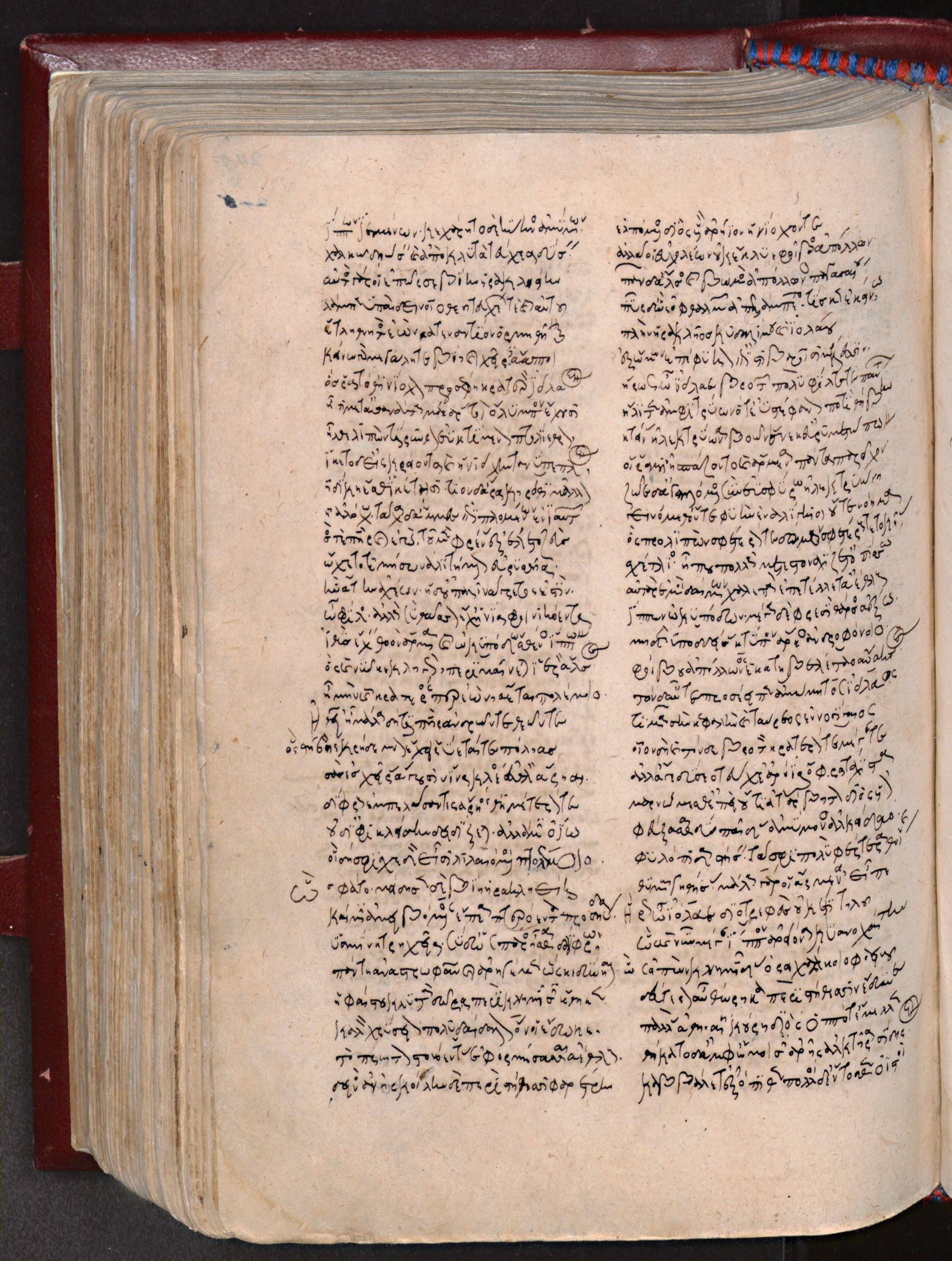
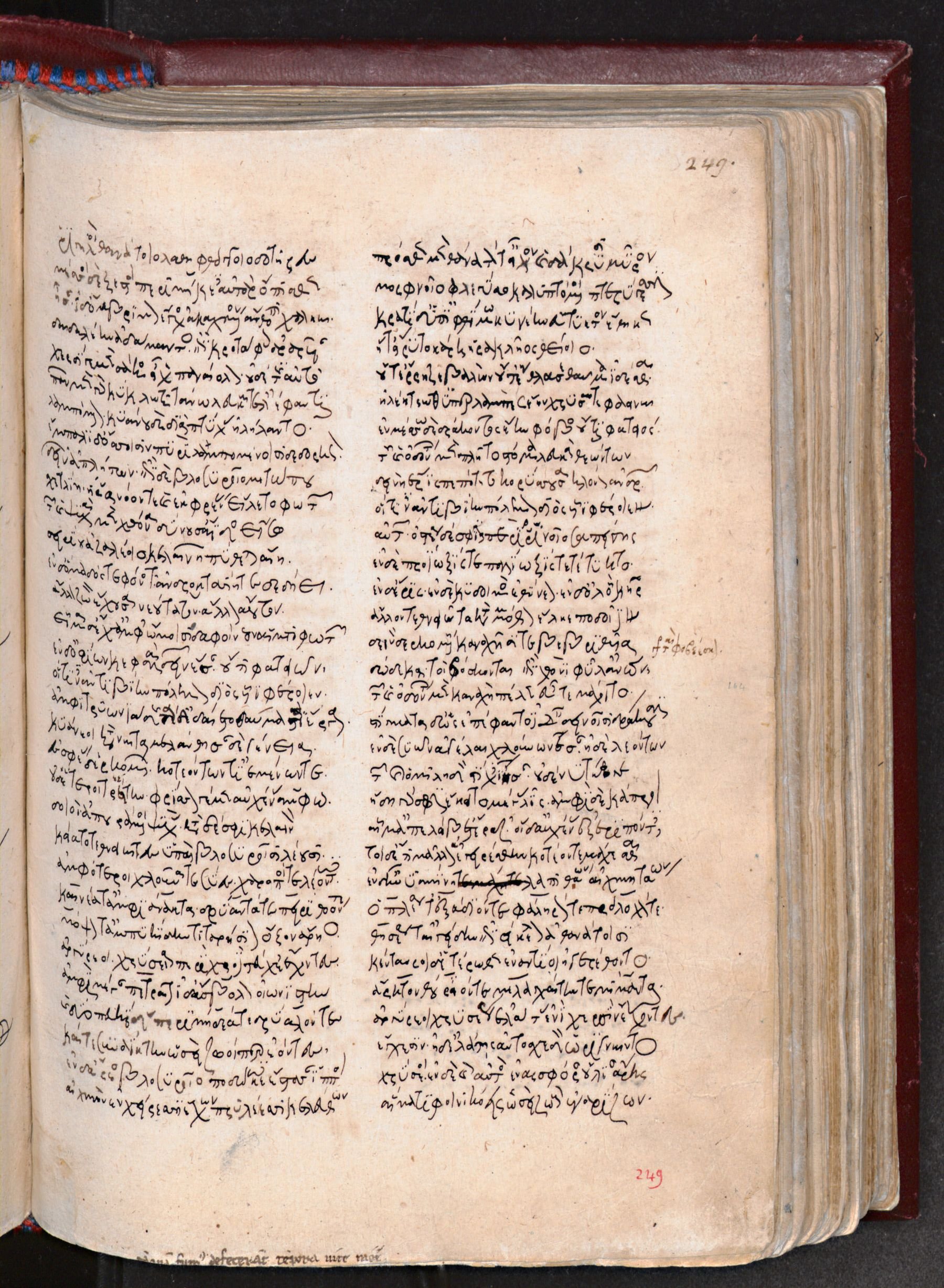
The page photographs are from Florence, Biblioteca Medicea Laurenziana, Plut. 32.16 (paper, late 13th century; a large collection of Greek poetry that also holds letters of Maximus Planudes), Shield of Heracles on fols. 248r-251v, in the Biblioteca Medicea Laurenziana's Teca Digitale. It follows the Works and Days and the Theogony in the same manuscript. This part is on fol. 248v, 249r. The scribe writes two verses to a row, one in each column, so a page is read across the columns, row by row; a few short notes stand in the margins. Each section below is one page; its note gives the page's first and last verse as read on the photograph.
The Greek is Evelyn-White's Loeb text (1914) via Perseus, not a transcription of this manuscript, whose wording differs here and there. Verses the editor brackets as later additions are shown in square brackets. The English is Evelyn-White's prose translation (1914); it is cut at the end of his sentences, so where a sentence runs across a page break it is given whole to one page; each section's note gives the exact lines its English covers.
How was this verified? (Provenance)
Where on the image
Laur. Plut. 32.16, fol. 248v: lines 65-130, begins ‹ἵππων ἱεμένων· κεχάρητο δὲ›, ends ‹πολλοὶ δʼ ἔντοσθεν ὀιστοὶ›. Checked on the image: first and last verse rows read and matched to the Greek (re-read on the image 2026-11-12: first row ‹65 | 66: ἵππων ἱεμένων κεχάρητο δὲ Κύκνος ἀμύμων | ἐλπόμενος Διὸς υἱὸν ...›, last row ‹129 | 130: δεινὸς ἀνήρ κοίλην δὲ ... φαρέτρην | κάββαλε τ' ἐξόπιθεν ... ὀϊστοί›); the page before ends at line 64 and the page after begins at line 131. This section shows lines 78-130 of that page; the rest of the page belongs to the previous part of the poem. The row above the last holds 127 | 128. (Corrected 2026-11-12: the page map had ended this page at 128.) English here: lines 78-130, cut at the end of Evelyn-White's sentences. His sentence ‹Within it were many chilling arrows ...› begins in line 130, before the page break, and is given whole with the next page, so the English here ends with line 130 (the sentence break falls inside that line).
78ἥρως ὦ Ἰόλαε, βροτῶν πολὺ φίλτατε πάντων,
79ἦ τε μέγʼ ἀθανάτους μάκαρας, τοὶ Ὄλυμπον ἔχουσιν,
80ἤλιτεν Ἀμφιτρύων, ὅτʼ ἐυστέφανον ποτὶ Θήβην
81ἦλθε λιπὼν Τίρυνθα, ἐυκτίμενον πτολίεθρον,
82κτείνας Ἠλεκτρύωνα βοῶν ἕνεκʼ εὐρυμετώπων·
83ἵκετο δʼ ἐς Κρείοντα καὶ Ἠνιόχην τανύπεπλον,
84οἵ ῥά μιν ἠσπάζοντο καὶ ἄρμενα πάντα παρεῖχον,
85ἣ δίκη ἔσθʼ ἱκέτῃσι, τίον δέ ἑ κηρόθι μᾶλλον.
86ζῶε δʼ ἀγαλλόμενος σὺν ἐυσφύρῳ Ἠλεκτρυώνῃ,
87ᾗ ἀλόχῳ· τάχα δʼ ἄμμες ἐπιπλομένων ἐνιαυτῶν
88γεινόμεθʼ οὔτε φυὴν ἐναλίγκιοι οὔτε νόημα,
89σός τε πατὴρ καὶ ἐγώ· τοῦ μὲν φρένας ἐξέλετο Ζεύς,
90ὃς προλιπὼν σφέτερόν τε δόμον σφετέρους τε τοκῆας
91ᾤχετο, τιμήσων ἀλιτήμενον Εὐρυσθῆα,
92σχέτλιος· ἦ που πολλὰ μετεστεναχίζετʼ ὀπίσσω
93ἣν ἄτην ὀχέων· ἣ δʼ οὐ παλινάγρετός ἐστιν.
94αὐτὰρ ἐμοὶ δαίμων χαλεποὺς ἐπετέλλετʼ ἀέθλους.
95ὦ φίλος, ἀλλὰ σὺ θᾶσσον ἔχʼ ἡνία φοινικόεντα
96ἵππων ὠκυπόδων· μέγα δὲ φρεσὶ θάρσος ἀέξων
97ἰθὺς ἔχειν θοὸν ἅρμα καὶ ὠκυπόδων σθένος ἵππων,
98μηδὲν ὑποδδείσας κτύπον Ἄρεος ἀνδροφόνοιο,
99ὃς νῦν κεκληγὼς περιμαίνεται ἱερὸν ἄλσος
100Φοίβου Ἀπόλλωνος, ἑκατηβελέταο ἄνακτος·
101ἦ μὴν καὶ κρατερός περ ἐὼν ἄαται πολέμοιο.
102τὸν δʼ αὖτε προσέειπεν ἀμώμητος Ἰόλαος·
103ἠθεῖʼ, ἦ μάλα δή τι πατὴρ ἀνδρῶν τε θεῶν τε
104τιμᾷ σὴν κεφαλὴν καὶ ταύρεος Ἐννοσίγαιος,
105ὃς Θήβης κρήδεμνον ἔχει ῥύεταί τε πόληα·
106οἷον δὴ καὶ τόνδε βροτὸν κρατερόν τε μέγαν τε
107σὰς ἐς χεῖρας ἄγουσιν, ἵνα κλέος ἐσθλὸν ἄρηαι.
108ἀλλʼ ἄγε δύσεο τεύχεʼ ἀρήια, ὄφρα τάχιστα
109δίφρους ἐμπελάσαντες Ἄρηός θʼ ἡμέτερόν τε
110μαρνώμεσθʼ, ἐπεὶ οὔ τοι ἀτάρβητον Διὸς υἱὸν
111οὐδʼ Ἰφικλεΐδην δειδίξεται, ἀλλά μιν οἴω
112φεύξεσθαι δύο παῖδας ἀμύμονος Ἀλκεΐδαο,
113οἳ δή σφι σχεδόν εἰσι, λιλαιόμενοι πολέμοιο
114φυλόπιδα στῆσαι, τά σφιν πολὺ φίλτερα θοίνης.
115ὣς φάτο· μείδησεν δὲ βίη Ἡρακληείη
116θυμῷ γηθήσας· μάλα γάρ νύ οἱ ἄρμενα εἶπεν·
117καί μιν ἀμειβόμενος ἔπεα πτερόεντα προσηύδα·
118ἥρως ὦ Ἰόλαε, διοτρεφές, οὐκέτι τηλοῦ
119ὑσμίνη τρηχεῖα· σὺ δʼ ὡς πάρος ἦσθα δαΐφρων,
120ὣς καὶ νῦν μέγαν ἵππον Ἀρίονα κυανοχαίτην
121πάντη ἀναστρωφᾶν καὶ ἀρηγέμεν, ὥς κε δύνηαι.
122ὣς εἰπὼν κνημῖδας ὀρειχάλκοιο φαεινοῦ,
123Ἡφαίστου κλυτὰ δῶρα, περὶ κνήμῃσιν ἔθηκεν·
124δεύτερον αὖ θώρηκα περὶ στήθεσσιν ἔδυνε
125καλὸν χρύσειον πολυδαίδαλον, ὅν οἱ ἔδωκε
126Παλλὰς Ἀθηναίη, κούρη Διός, ὁππότʼ ἔμελλε
127τὸ πρῶτον στονόεντας ἐφορμήσεσθαι ἀέθλους.
128θήκατο δʼ ἀμφʼ ὤμοισιν ἀρῆς ἀλκτῆρα σίδηρον
129δεινὸς ἀνήρ· κοΐλην δὲ περὶ στήθεσσι φαρέτρην
130καββάλετʼ ἐξόπιθεν· πολλοὶ δʼ ἔντοσθεν ὀιστοὶ
78“O hero Iolaus, best beloved of all men, truly Amphitryon sinned deeply against the blessed gods who dwell on Olympus 80when he came to sweet-crowned Thebes and left Tiryns, the well-built citadel, because he slew Electryon for the sake of his wide-browed oxen. Then he came to Creon and long-robed Eniocha, who received him kindly and gave him all fitting things, 85as is due to suppliants, and honored him in their hearts even more. And he lived joyfully with his wife the neat-ankled daughter of Electryon: and presently, while the years rolled on, we were born, unlike in body as in mind, even your father and I. From him Zeus took away sense, so that he left his home and his parents 90and went to do honor to the wicked Eurystheus—unhappy man! Deeply indeed did he grieve afterwards in bearing the burden of his own mad folly; but that cannot be taken back. But on me fate laid heavy tasks. 95“Yet, come, friend, quickly take the red-dyed reins of the swift horses and raise high courage in your heart and guide the swift chariot and strong fleet-footed horses straight on. Have no secret fear at the noise of man-slaying Ares who now rages shouting about the holy grove 100of Phoebus Apollo, the lord who shoots from afar. Surely, strong though he be, he will have enough of war.” And blameless Iolaus answered him again: “Good friend, truly the father of men and gods greatly honors your head and the bull-like Earth-Shaker also, 105who keeps Thebe's veil of walls and guards the city,—so great and strong is this fellow they bring into your hands that you may win great glory. But come, put on your arms of war that with all speed we may bring the car of Ares and our own together and 110fight; for he shall not frighten the dauntless son of Zeus, nor yet the son of Iphiclus: rather I think he will flee before the two sons of blameless Alcides who are near him and eager to raise the war cry for battle; for this they love better than a feast.” 115So he said. And mighty Heracles was glad in heart and smiled, for the other's words pleased him well, and he answered him with winged words: “O hero Iolaus, heaven-sprung, now is rough battle hard at hand. 120But, as you have shown your skill at other times, so now also wheel the great black-maned horse Arion about every way, and help me as you may be able.” So he said, and put upon his legs greaves of shining bronze, the splendid gift of Hephaestus. Next he fastened about his breast 125a fine golden breast-plate, curiously wrought, which Pallas Athena the daughter of Zeus had given him when first he was about to set out upon his grievous labors. Over his shoulders the fierce warrior put the steel that saves men from doom, and across his breast 130he slung behind him a hollow quiver.
Where on the image
Laur. Plut. 32.16, fol. 249r: lines 131-194, begins ‹ῥιγηλοί, θανάτοιο λαθιφθόγγοιο δοτῆρες.›, ends ‹ὡς εἰ ζωοὺς ἐναρίζων›. Checked on the image: first and last verse rows read and matched to the Greek (re-read on the image 2026-11-12: first row ‹131 | 132: ῥιγηλοὶ θανάτοιο λαθιφθόγγοιο δοτῆρες | πρόσθεν μὲν θάνατόν τ' εἶχον ...›, last row ‹193 | 194: αἰχμὴν ἐν χείρεσσιν ἔχων ... | αἵματι φοινικόεις ... ἐναρίζων›); the page before ends at line 130 and the page after begins at line 195. This section shows lines 131-153 of that page; the rest of the page belongs to the next part of the poem. A Latin pen note in the lower margin, in a later hand, is not part of the poem. English here: lines 130-153, cut at the end of Evelyn-White's sentences. His sentence ‹Within it were many chilling arrows ...› begins in line 130, before the page break, and is given whole with this page (line 130 holds the end of one sentence and the start of the next).
131ῥιγηλοί, θανάτοιο λαθιφθόγγοιο δοτῆρες.
132πρόσθεν μὲν θάνατόν τʼ εἶχον καὶ δάκρυσι μῦρον,
133μέσσοι δὲ ξεστοί, περιμήκεες, αὐτὰρ ὄπισθε
134μόρφνοιο φλεγύαο καλυπτόμενοι πτερύγεσσιν.
135εἵλετο δʼ ὄβριμον ἔγχος, ἀκαχμένον αἴθοπι χαλκῷ,
136κρατὶ δʼ ἔπʼ ἰφθίμῳ κυνέην ἐύτυκτον ἔθηκε,
137δαιδαλέην ἀδάμαντος, ἐπὶ κροτάφοις ἀραρυῖαν,
138ἥτʼ εἴρυτο κάρη Ἡρακλῆος θείοιο.
139χερσί γε μὴν σάκος εἷλε παναίολον, οὐδέ τις αὐτὸ
140οὔτʼ ἔρρηξε βαλὼν οὔτʼ ἔθλασε, θαῦμα ἰδέσθαι.
141πᾶν μὲν γὰρ κύκλῳ τιτάνῳ λευκῷ τʼ ἐλέφαντι
142ἠλέκτρῳ θʼ ὑπολαμπὲς ἔην χρυσῷ τε φαεινῷ
143λαμπόμενον, κυάνου δὲ διὰ πτύχες ἠλήλαντο.
144ἐν μέσσῳ δʼ ἀδάμαντος ἔην Φόβος οὔ τι φατειός,
145ἔμπαλιν ὄσσοισιν πυρὶ λαμπομένοισι δεδορκώς·
146τοῦ καὶ ὀδόντων μὲν πλῆτο στόμα λευκὰ θεόντων,
147δεινῶν ἀπλήτων, ἐπὶ δὲ βλοσυροῖο μετώπου
148δεινὴ Ἔρις πεπότητο κορύσσουσα κλόνον ἀνδρῶν,
149σχετλίη, ἥ ῥα νόον τε καὶ ἐκ φρένας εἵλετο φωτῶν.
150οἵτινες ἀντιβίην πόλεμον Διὸς υἷι φέροιεν.
151τῶν καὶ ψυχαὶ μὲν χθόνα δύμεναι Ἄιδος εἴσω
152κάκκιον, ὀστέα δέ σφι περὶ ῥινοῖο σαπείσης
153Σειρίου ἀζαλέοιο μελαίνῃ πύθεται αἴῃ.
130Within it were many chilling arrows, dealers of death which makes speech forgotten: in front they had death, and trickled with tears; their shafts were smooth and very long; and their butts were covered with feathers of a brown eagle. 135And he took his strong spear, pointed with shining bronze, and on his valiant head set a well-made helm of adamant, cunningly wrought, which fitted closely on the temples; and that guarded the head of god-like Heracles. In his hands he took his shield, all glittering: no one ever 140broke it with a blow or crushed it. And a wonder it was to see; for its whole orb shimmered with enamel and white ivory and electrum, and it glowed with shining gold; and there were zones of cyanus drawn upon it. In the center was Fear worked in adamant, unspeakable, 145staring backwards with eyes that glowed with fire. His mouth was full of teeth in a white row, fearful and daunting, and upon his grim brow hovered frightful Strife who arrays the throng of men: pitiless she, for she took away the mind and senses of poor wretches 150who made war against the son of Zeus. Their souls passed beneath the earth and went down into the house of Hades; but their bones, when the skin is rotted about them, crumble away on the dark earth under parching Sirius.
Notes
- Greek: H. G. Evelyn-White, Hesiod, the Homeric Hymns and Homerica (Loeb Classical Library, 1914), via Perseus. Square brackets mark verses the editor regards as interpolated.
- English: H. G. Evelyn-White's translation in the same volume; his footnotes are omitted.
- The Loeb text has no line 298; the numbering is the editor's.
Cite
Sources
- Source: Laur. Plut. 32.16 (BML Teca Digitale IIIF) + Evelyn-White Greek (Loeb 1914, Perseus) + Evelyn-White English (1914, Perseus) (holding institution)
- Critical edition: Evelyn-White, Loeb 1914, via Perseus
← previous · → next · v cycle view · l back to library