Hesiod, Shield of Heracles 327-480: The fight with Cycnus and Ares
Introduction
The Shield of Heracles is a short epic handed down under Hesiod's name, probably composed in the 6th century BCE. It tells of Heracles' fight with Cycnus, son of Ares, and describes the hero's shield at length. This part: The fight with Cycnus and Ares (lines 327-480, 154 lines). Athena advises Heracles, who kills Cycnus, wounds Ares and returns home; the burial of Cycnus.
The page photographs are from Florence, Biblioteca Medicea Laurenziana, Plut. 32.16 (paper, late 13th century; a large collection of Greek poetry that also holds letters of Maximus Planudes), Shield of Heracles on fols. 248r-251v, in the Biblioteca Medicea Laurenziana's Teca Digitale. It follows the Works and Days and the Theogony in the same manuscript. This part is on fol. 250r, 250v, 251r, 251v. The scribe writes two verses to a row, one in each column, so a page is read across the columns, row by row; a few short notes stand in the margins. Each section below is one page; its note gives the page's first and last verse as read on the photograph.
The Greek is Evelyn-White's Loeb text (1914) via Perseus, not a transcription of this manuscript, whose wording differs here and there. Verses the editor brackets as later additions are shown in square brackets. The English is Evelyn-White's prose translation (1914); it is cut at the end of his sentences, so where a sentence runs across a page break it is given whole to one page; each section's note gives the exact lines its English covers.
How was this verified? (Provenance)
Where on the image
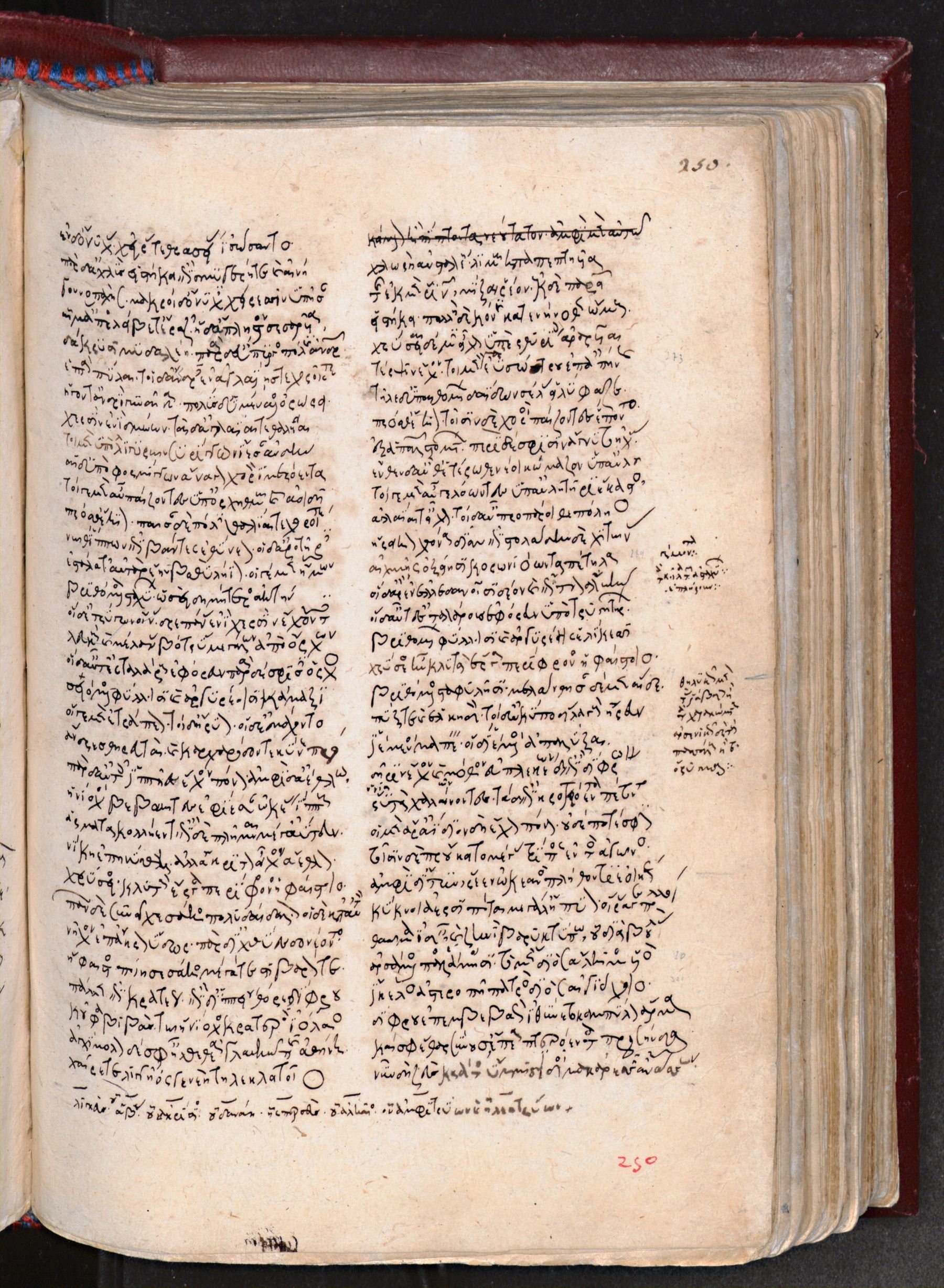
Laur. Plut. 32.16, fol. 250r: lines 263-328, begins ‹ἐν δʼ ὄνυχας χεῖράς›, ends ‹ὔμμι διδοῖ μακάρεσσιν ἀνάσσων›. Checked on the image: first and last verse rows read and matched to the Greek (re-read on the image 2026-11-12: first row ‹263 | a struck-through line: ἐν δ' ὄνυχας χεῖράς τε ... | (a cancelled repeat of 253, ... ἢ πίπτοντα νεούτατον ἀμφὶ μὲν αὐτῷ); row 2 is 264 | 265›, last row ‹327 | 328: χαίρετε Λυγκῆος γενεὴ τηλεκλειτοῖο | νῦν δὴ Ζεὺς κράτος ὔμμι ...›); the page before ends at line 262 and the page after begins at line 329. This section shows lines 327-328 of that page; the rest of the page belongs to the previous part of the poem. In the first row the right-hand verse is a repeat of 253, struck through by the scribe. The writing in the lower margin is not a verse: as far as it can be read it is a list of names (Lynceus, Abas, Acrisius, Danae, Perseus, Alcaeus, Amphitryon), a genealogy explaining Λυγκῆος γενεή in 327, which carries a mark. English here: lines 327-329, cut at the end of Evelyn-White's sentences. His sentence that runs across the break with the next page is given whole here, so the English ends with line 329 (‹... strip off his splendid armor.›).
327χαίρετε, Λυγκῆος γενεὴ τηλεκλειτοῖο·
328νῦν δὴ Ζεὺς κράτος ὔμμι διδοῖ μακάρεσσιν ἀνάσσων
327“Hail, offspring of far-famed Lynceus! Even now Zeus who reigns over the blessed gods gives you power to slay Cycnus and to strip off his splendid armor.
Where on the image
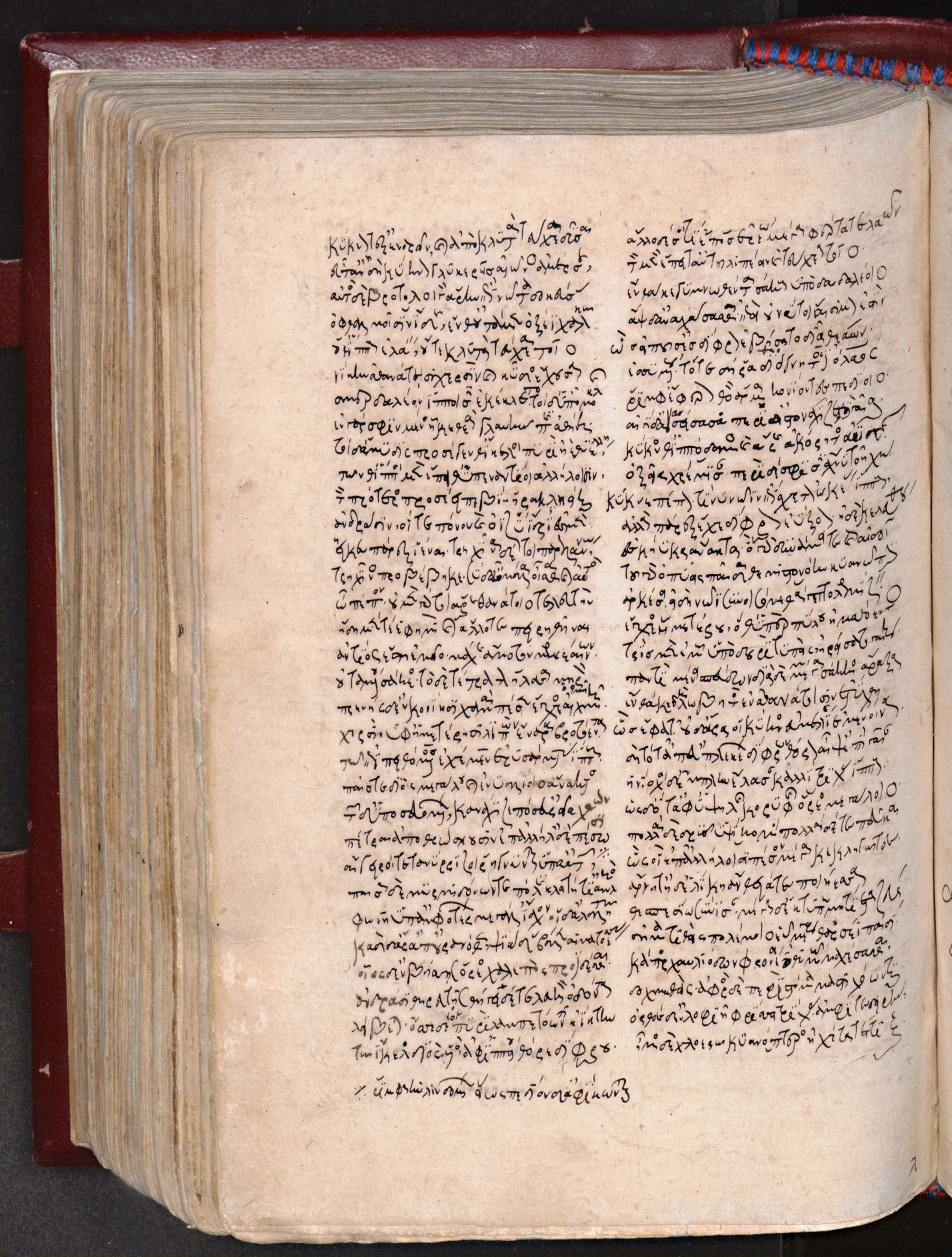
Laur. Plut. 32.16, fol. 250v: lines 329-393, begins ‹Κύκνον τʼ ἐξεναρεῖν καὶ›, ends ‹χλοερῷ κυανόπτερος ἠχέτα τέττιξ›. Checked on the image: first and last verse rows read and matched to the Greek (re-read on the image 2026-11-12: first row ‹329 | 330: Κύκνον τ' ἐξεναρεῖν ... | ἄλλο δέ τοί τι ἔπος ἐρέω ...›, last row ‹392 | 393: τῷ ἴκελος Διὸς υἱὸς ... δίφρου | ἦμος δὲ χλοερῷ κυανόπτερος ἠχέτα τέττιξ›); the page before ends at line 328 and the page after begins at line 394. Verse 378 (ῥίμφα κυλινδομένων εἵως πεδίονδ' ἀφίκωνται) is left out of the column, where the row reads 377 | 379, and written below the last row, keyed by the sign that follows 377; the Greek shows it in its place. (Corrected 2026-11-12: this line had been described as a note.) English here: lines 330-392, cut at the end of Evelyn-White's sentences. The sentence that runs across the page break (to line 329) is given whole with the page before; the English here begins with ‹Yet I will tell you something besides ...› (line 330). His sentence ‹And when the dark-winged whirring grasshopper ...› begins in line 393, before the page break, and is given whole with the next page, so the English here ends with line 392.
329Κύκνον τʼ ἐξεναρεῖν καὶ ἀπὸ κλυτὰ τεύχεα δῦσαι.
330ἄλλο δέ τοί τι ἔπος ἐρέω, μέγα φέρτατε λαῶν·
331εὖτʼ ἂν δὴ Κύκνον γλυκερῆς αἰῶνος ἀμέρσῃς,
332τὸν μὲν ἔπειτʼ αὐτοῦ λιπέειν καὶ τεύχεα τοῖο,
333αὐτὸς δὲ βροτολοιγὸν Ἄρην ἐπιόντα δοκεύσας,
334ἔνθα κε γυμνωθέντα σάκευς ὕπο δαιδαλέοιο
335ὀφθαλμοῖσιν ἴδῃς, ἔνθʼ οὐτάμεν ὀξέι χαλκῷ·
336ἂψ δʼ ἀναχάσσασθαι· ἐπεὶ οὔ νύ τοι αἴσιμόν ἐστιν
337οὔθʼ ἵππους ἑλέειν οὔτε κλυτὰ τεύχεα τοῖο.
338ὣς εἰποῦσʼ ἐς δίφρον ἐβήσατο δῖα θεάων,
339νίκην ἀθανάτῃς χερσὶν καὶ κῦδος ἔχουσα,
340ἐσσυμένως. τότε δή ῥα διόγνητος Ἰόλαος
341σμερδαλέον ἵπποισιν ἐκέκλετο· τοὶ δʼ ὑπʼ ὀμοκλῆς
342ῥίμφʼ ἔφερον θοὸν ἅρμα κονίοντες πεδίοιο.
343ἐν γάρ σφιν μένος ἧκε θεὰ γλαυκῶπις Ἀθήνη
344αἰγίδʼ ἀνασσείσασα· περιστονάχησε δὲ γαῖα.
345τοὶ δʼ ἄμυδις προγένοντʼ ἴκελοι πυρὶ ἠὲ θυέλλῃ,
346Κύκνος θʼ ἱππόδαμος καὶ Ἄρης ἀκόρητος ἀυτῆς.
347τῶν ἵπποι μὲν ἔπειθʼ ὑπεναντίοι ἀλλήλοισιν
348ὀξεῖα χρέμισαν, περὶ δέ σφισιν ἄγνυτο ἠχώ.
349τὸν πρότερος προσέειπε βίη Ἡρακληείη·
350Κύκνε πέπον, τί νυ νῶιν ἐπίσχετον ὠκέας ἵππους
351ἀνδράσιν, οἵ τε πόνου καὶ ὀιζύος ἴδριές εἰμεν;
352ἀλλὰ παρὲξ ἔχε δίφρον ἐύξοον ἠδὲ κελεύθου
353εἶκε παρὲξ ἰέναι. Τρηχῖνα δέ τοι παρελαύνω
354ἐς Κήυκα ἄνακτα· ὃ γὰρ δυνάμι τε καὶ αἰδοῖ
355Τρηχῖνος προβέβηκε, σὺ δʼ εὖ μάλα οἶσθα καὶ αὐτός·
356τοῦ γὰρ ὀπυίεις παῖδα Θεμιστονόην κυανῶπιν.
357ὦ πέπον, οὐ μὲν γὰρ τοι Ἄρης θανάτοιο τελευτὴν
358ἀρκέσει, εἰ δὴ νῶι συνοισόμεθα πτολεμίζειν.
359ἤδη μέν τέ ἕ φημι καὶ ἄλλοτε πειρηθῆναι
360ἔγχεος ἡμετέρου, ὅθʼ ὑπὲρ Πύλου ἠμαθόεντος
361ἀντίος ἔστη ἐμεῖο, μάχης ἄμοτον μενεαίνων.
362τρὶς μὲν ἐμῷ ὑπὸ δουρὶ τυπεὶς ἠρείσατο γαίῃ
363οὐταμένου σάκεος, τὸ δὲ τέτρατον ἤλασα μηρὸν
364παντὶ μένει σπεύδων, διὰ δὲ μέγα σαρκὸς ἄραξα.
365πρηνὴς δʼ ἐν κονίῃσι χαμαὶ πέσεν ἔγχεος ὁρμῇ.
366ἔνθα κε δὴ λωβητὸς ἐν ἀθανάτοισιν ἐτύχθη
367χερσὶν ὕφʼ ἡμετέρῃσι λιπὼν ἔναρα βροτόεντα.
368ὣς ἔφατʼ· οὐδʼ ἄρα Κύκνος ἐυμμελίης ἐμενοίνα
369τῷ ἐπιπειθόμενος ἐχέμεν ἐρυσάρματας ἵππους.
370δὴ τότʼ ἀπʼ εὐπλεκέων δίφρων θόρον αἶψʼ ἐπὶ γαῖαν
371παῖς τε Διὸς μεγάλου καὶ Ἐνυαλίοιο ἄνακτος.
372ἡνίοχοι δʼ ἔμπλην ἔλασαν καλλίτριχας ἵππους·
373τῶν δʼ ὕπο σευομένων κανάχιζε πόσʼ εὐρεῖα χθών.
374ὡς δʼ ὅτʼ ἀφʼ ὑψηλῆς κορυφῆς ὄρεος μεγάλοιο
375πέτραι ἀποθρῴσκωσιν, ἐπʼ ἀλλήλῃς δὲ πέσωσι,
376πολλαὶ δὲ δρῦς ὑψίκομοι, πολλαὶ δέ τε πεῦκαι
377αἴγειροί τε τανύρριζοι ῥήγνυνται ὑπʼ αὐτέων
378ῥίμφα κυλινδομένων, εἵως πεδίονδʼ ἀφίκωνται,
379ὣς οἳ ἐπʼ ἀλλήλοισι πέσον μέγα κεκλήγοντες.
380πᾶσα δὲ Μυρμιδόνων τε πόλις κλειτή τʼ Ἰαωλκὸς
381Ἄρνη τʼ ἠδʼ Ἑλίκη Ἄνθειά τε ποιήεσσα
382φωνῇ ὕπʼ ἀμφοτέρων μεγάλʼ ἴαχον· οἳ δʼ ἀλαλητῷ
383θεσπεσίῳ σύνισαν· μέγα δʼ ἔκτυπε μητίετα Ζεύς.
384κὰδ δʼ ἄρʼ ἀπʼ οὐρανόθεν ψιάδας βάλεν αἱματοέσσας,
385σῆμα τιθεὶς πολέμοιο ἑῷ μεγαθαρσέι παιδί.
386οἷος δʼ ἐν βήσσῃς ὄρεος χαλεπὸς προϊδέσθαι
387κάπρος χαυλιόδων φρονέει θυμῷ μαχέσασθαι
388ἀνδράσι θηρευτῇς, θήγει δέ τε λευκὸν ὀδόντα
389δοχμωθείς, ἀφρὸς δὲ περὶ στόμα μαστιχόωντι
390λείβεται, ὄσσε δέ οἱ πυρὶ λαμπετόωντι ἔικτον,
391ὀρθὰς δʼ ἐν λοφιῇ φρίσσει τρίχας ἀμφί τε δειρήν·
392τῷ ἴκελος Διὸς υἱὸς ἀφʼ ἱππείου θόρε δίφρου.
393ἦμος δὲ χλοερῷ κυανόπτερος ἠχέτα τέττιξ
330Yet I will tell you something besides, mightiest of the people. When you have robbed Cycnus of sweet life, then leave him there and his armor also, and you yourself watch man-slaying Ares narrowly as he attacks, and wherever you shall see him uncovered below his cunningly-wrought shield, 335there wound him with your sharp spear. Then draw back; for it is not ordained that you should take his horses or his splendid armor.” So said the bright-eyed goddess and swiftly got up into the car with victory and renown in her hands. 340Then heaven-nurtured Iolaus called terribly to the horses, and at his cry they swiftly whirled the fleet chariot along, raising dust from the plain; for the goddess bright-eyed Athena put mettle into them by shaking her aegis. And the earth groaned all round them. 345And they, horse-taming Cycnus and Ares, insatiable in war, came on together like fire or whirlwind. Then their horses neighed shrilly, face to face; and the echo was shivered all round them. And mighty Heracles spoke first and said to that other: 350“Cycnus, my friend! Why do you set your swift horses at us, men who are tried in labor and pain? No, guide your fleet car aside and yield and go out of the path. It is to Trachis I am driving on, to Ceyx the king, who is the first in Trachis for power and for honor, 355and that you yourself know well, for you have his daughter dark-eyed Themistinoe to wife. Fool! For Ares shall not deliver you from the end of death, if we two meet together in battle. Another time ere this I declare he has made trial 360of my spear, when he defended sandy Pylos and stood against me, fiercely longing for fight. Thrice was he stricken by my spear and dashed to earth, and his shield was pierced; but the fourth time I struck his thigh, laying on with all my strength, and tore deep into his flesh. 365And he fell headlong in the dust upon the ground through the force of my spear-thrust; then truly he would have been disgraced among the deathless gods, if by my hands he had left behind his bloody spoils.” So said he. But Cycnus the stout spearman cared not to obey him and to pull up the horses that drew his chariot. 370Then it was that from their well-woven chariots they both leaped straight to the ground, the son of Zeus and the son of the Lord of War. The charioteers drove near by their horses with beautiful manes, and the wide earth rang with the beat of their hoofs as they rushed along. As when rocks leap forth from the high peak of a great mountain, 375and fall on one another, and many towering oaks and pines and long-rooted poplars are broken by them as they whirl swiftly down until they reach the plain; so did they fall on one another with a great shout: 380and all the town of the Myrmidons, and famous Iolcus, and Arne, and Helice, and grassy Anthea echoed loudly at the voice of the two. With an awful cry they closed: and wise Zeus thundered loudly and rained down drops of blood, 385giving the signal for battle to his dauntless son. As a tusked boar, fearful for a man to see before him in the glens of a mountain, resolves to fight with the huntsmen and whets his white tusks, turning sideways, while foam flows all round his mouth 390as he gnashes, and his eyes are like glowing fire, and he bristles the hair on his mane and around his neck—, like him the son of Zeus leaped from his horse chariot.
Where on the image
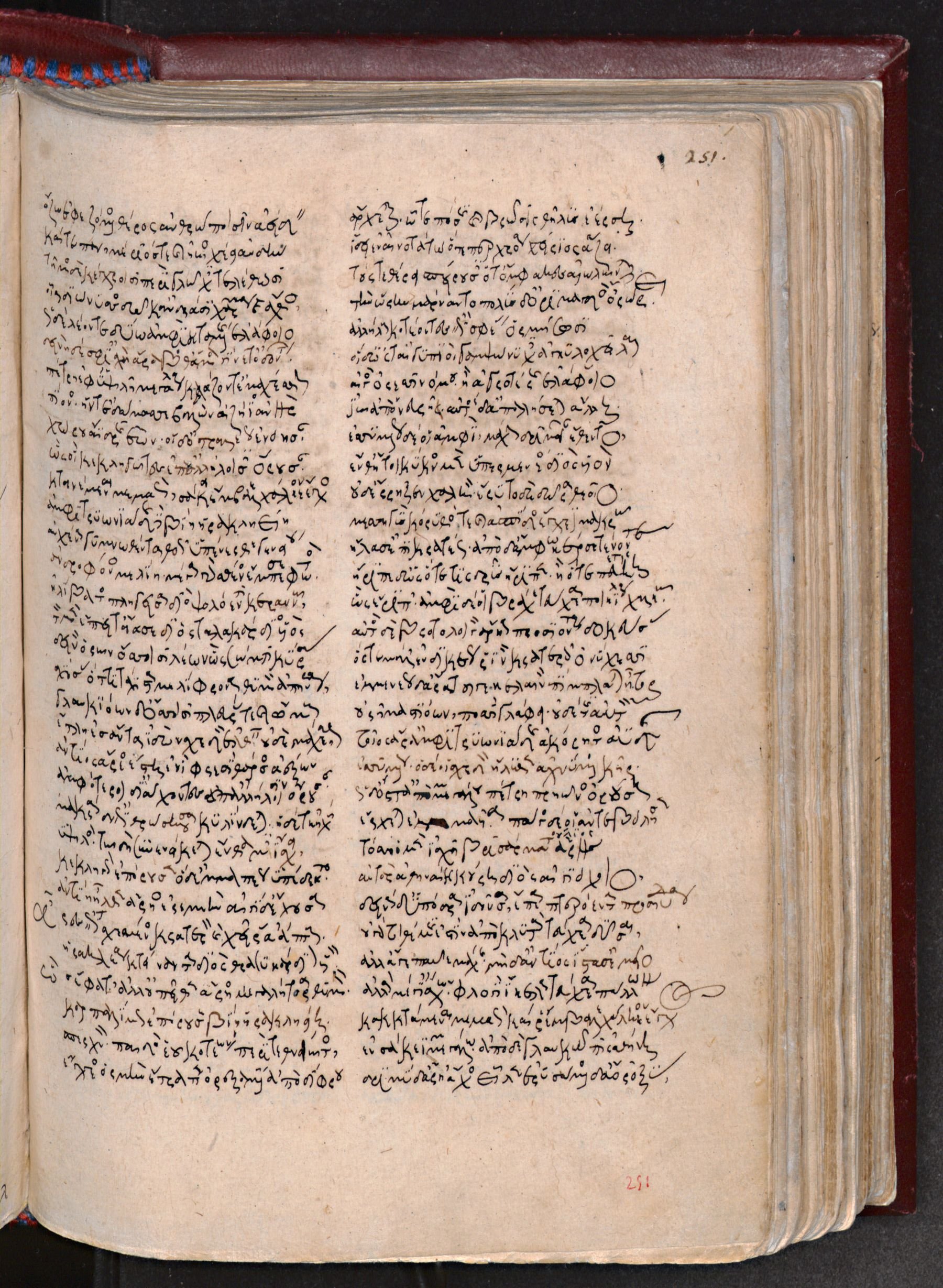
Laur. Plut. 32.16, fol. 251r: lines 394-457, begins ‹ὄζῳ ἐφεζόμενος θέρος ἀνθρώποισιν›, ends ‹ἐρυσσάμενος δʼ ἄορ ὀξὺ›. Checked on the image: first and last verse rows read and matched to the Greek (re-read on the image 2026-11-12: first row ‹394 | 395: ὄζῳ ἐφεζόμενος θέρος ... | ἄρχεται ᾧ τε πόσις ...›, last row ‹456 | 457: ἔγχεος ὁρμὴν ἔτραπ' ὀρεξαμένη ... | δριμὺ δ' Ἄρην ἄχος εἷλε ... ἄορ ὀξύ›); the page before ends at line 393 and the page after begins at line 458. English here: lines 393-458, cut at the end of Evelyn-White's sentences. His sentence ‹And when the dark-winged whirring grasshopper ...› begins in line 393, before the page break, and is given whole with this page. His sentence that runs across the break with the next page is given whole here, so the English ends with line 458 (‹... and leaped upon bold-hearted Heracles.›).
394ὄζῳ ἐφεζόμενος θέρος ἀνθρώποισιν ἀείδειν
395ἄρχεται, ᾧ τε πόσις καὶ βρῶσις θῆλυς ἐέρση,
396καί τε πανημέριός τε καὶ ἠώιος χέει αὐδὴν
397ἴδει ἐν αἰνοτάτῳ, ὅτε τε χρόα Σείριος ἄζει,
398τῆμος δὴ κέγχροισι πέρι γλῶχες τελέθουσι
399τούς τε θέρει σπείρουσιν, ὅτʼ ὄμφακες αἰόλλονται,
400οἷα Διώνυσος δῶκʼ ἀνδράσι χάρμα καὶ ἄχθος·
401τὴν ὥρην μάρναντο, πολὺς δʼ ὀρυμαγδὸς ὀρώρει.
402ὡς δὲ λέοντε δύω ἀμφὶ κταμένης ἐλάφοιο
403ἀλλήλοις κοτέοντες ἐπὶ σφέας ὁρμήσωσι,
404δεινὴ δέ σφʼ ἰαχὴ ἄραβός θʼ ἅμα γίγνετʼ ὀδόντων·
405οἳ δʼ ὥς τʼ αἰγυπιοὶ γαμψώνυχες, ἀγκυλοχεῖλαι,
406πέτρῃ ἔφʼ ὑψηλῇ μεγάλα κλάζοντε μάχονται
407αἰγὸς ὀρεσσινόμου ἢ ἀγροτέρης ἐλάφοιο
408πίονος, ἥν τʼ ἐδάμασσε βαλὼν αἰζήιος ἀνὴρ
409ἰῷ ἀπὸ νευρῆς, αὐτὸς δʼ ἀπαλήσεται ἄλλῃ
410χώρου ἄιδρις ἐών· οἳ δʼ ὀτραλέως ἐνόησαν,
411ἐσσυμένως δέ οἱ ἀμφὶ μάχην δριμεῖαν ἔθεντο·
412ὣς οἳ κεκλήγοντες ἐπʼ ἀλλήλοισιν ὄρουσαν.
413ἔνθʼ ἦ τοι Κύκνος μὲν ὑπερμενέος Διὸς υἱὸν
414κτεινέμεναι μεμαὼς σάκει ἔμβαλε χάλκεον ἔγχος,
415οὐδʼ ἔρρηξεν χαλκόν· ἔρυτο δὲ δῶρα θεοῖο.
416Ἀμφιτρυωνιάδης δέ, βίη Ἡρακληείη,
417μεσσηγὺς κόρυθός τε καὶ ἀσπίδος ἔγχεϊ μακρῷ
418αὐχένα γυμνωθέντα θοῶς ὑπένερθε γενείου
419ἤλασʼ ἐπικρατέως· ἀπὸ δʼ ἄμφω κέρσε τένοντε
420ἀνδροφόνος μελίη· μέγα γὰρ σθένος ἔμπεσε φωτός.
421ἤριπε δʼ, ὡς ὅτε τις δρῦς ἤριπεν ἢ ὅτε πεύκη
422ἠλίβατος, πληγεῖσα Διὸς ψολόεντι κεραυνῷ·
423ὣς ἔριπʼ· ἀμφὶ δέ οἱ βράχε τεύχεα ποικίλα χαλκῷ.
424τὸν μὲν ἔπειτʼ εἴασε Διὸς ταλακάρδιος υἱός,
425αὐτὸς δὲ βροτολοιγὸν Ἄρην προσιόντα δοκεύσας,
426δεινὸν ὁρῶν ὄσσοισι, λέων ὣς σώματι κύρσας,
427ὅς τε μάλʼ ἐνδυκέως ῥινὸν κρατεροῖς ὀνύχεσσι
428σχίσσας ὅττι τάχιστα μελίφρονα θυμὸν ἀπηύρα·
429ἐμ μένεος δʼ ἄρα τοῦ γε κελαινὸν πίμπλαται ἦτορ·
430γλαυκιόων δʼ ὄσσοις δεινὸν πλευράς τε καὶ ὤμους
431οὐρῇ μαστιόων ποσσὶν γλάφει, οὐδέ τις αὐτὸν
432ἔτλη ἐς ἄντα ἰδὼν σχεδὸν ἐλθέμεν οὐδὲ μάχεσθαι·
433τοῖος ἄρʼ Ἀμφιτρυωνιάδης, ἀκόρητος ἀυτῆς,
434ἀντίος ἔστη Ἄρηος, ἐνὶ φρεσὶ θάρσος ἀέξων,
435ἐσσυμένως· ὃ δέ οἱ σχεδὸν ἤλυθεν ἀχνύμενος κῆρ·
436ἀμφότεροι δʼ ἰάχοντες ἐπʼ ἀλλήλοισιν ὄρουσαν.
437ὡς δʼ ὅτʼ ἀπὸ μεγάλου πέτρη πρηῶνος ὀρούσῃ,
438μακρὰ δʼ ἐπιθρῴσκουσα κυλίνδεται, ἣ δέ τε ἠχῇ
439ἔρχεται ἐμμεμαυῖα, πάγος δέ οἱ ἀντεβόλησεν
440ὑψηλός· τῷ δὴ συνενείκεται, ἔνθα μιν ἴσχει·
441τόσσῃ ὃ μὲν ἰαχῇ βρισάρματος οὔλιος Ἄρης
442κεκληγὼς ἐπόρουσεν· ὃ δʼ ἐμμαπέως ὑπέδεκτο.
443αὐτὰρ Ἀθηναίη, κούρη Διὸς αἰγιόχοιο,
444ἀντίη ἦλθεν Ἄρηος ἐρεμνὴν αἰγίδʼ ἔχουσα·
445δεινὰ δʼ ὑπόδρα ἰδοῦσα ἔπεα πτερόεντα προσηύδα·
446Ἆρες, ἔπισχε μένος κρατερὸν καὶ χεῖρας ἀάπτους·
447οὐ γάρ τοι θέμις ἐστὶν ἀπὸ κλυτὰ τεύχεα δῦσαι
448Ἡρακλέα κτείναντα, Διὸς θρασυκάρδιον υἱόν·
449ἀλλʼ ἄγε παῦε μάχην, μηδʼ ἀντίος ἵστασʼ ἐμεῖο.
450ὣς ἔφατʼ· ἀλλʼ οὐ πεῖθʼ Ἄρεος μεγαλήτορα θυμόν,
451ἀλλὰ μέγα ἰάχων φλογὶ εἴκελά τʼ ἔγχεα πάλλων
452καρπαλίμως ἐπόρουσε βίῃ Ἡρακληείῃ
453κακτάμεναι μεμαώς· καί ῥʼ ἔμβαλε χάλκεον ἔγχος,
454σπερχνὸν παιδὸς ἑοῦ κοτέων πέρι τεθνηῶτος,
455ἐν σάκεϊ μεγάλῳ. ἀπὸ δὲ γλαυκῶπις Ἀθήνη
456ἔγχεος ὁρμὴν ἔτραπʼ ὀρεξαμένη ἀπὸ δίφρου.
457δριμὺ δʼ Ἄρην ἄχος εἷλε· ἐρυσσάμενος δʼ ἄορ ὀξὺ
393And when the dark-winged whirring grasshopper, perched on a green shoot, begins to sing of summer to men— 395his food and drink is the dainty dew—and all day long from dawn pours forth his voice in the deadliest heat, when Sirius scorches the flesh (then the beard grows upon the millet which men sow in summer), when the crude grapes 400which Dionysus gave to men— a joy and a sorrow both—begin to color, in that season they fought and loud rose the clamor. 402As two lions on either side of a slain deer spring at one another in fury, and there is a fearful snarling and a clashing also of teeth—, 405like vultures with crooked talons and hooked beak that fight and scream aloud on a high rock over a mountain goat or fat wild-deer which some active man has shot with an arrow from the string, and himself has wandered away elsewhere, 410not knowing the place; but they quickly mark it and vehemently do keen battle about it—, like these they two rushed upon one another with a shout. Then Cycnus, eager to kill the son of almighty Zeus, struck upon his shield with a brazen spear, 415but did not break the bronze; and the gift of the god saved his foe. But the son of Amphitryon, mighty Heracles, with his long spear struck Cycnus violently in the neck beneath the chin, where it was unguarded between helm and shield. And the deadly spear cut through the two sinews; 420for the hero's full strength lighted on his foe. And Cycnus fell as an oak falls or a lofty pine that is stricken by the lurid thunderbolt of Zeus; even so he fell, and his armour adorned with bronze clashed about him. Then the stout-hearted son of Zeus let him be, 425and himself watched for the onset of manslaying Ares: fiercely he stared, like a lion who has come upon a body and full eagerly rips the hide with his strong claws and takes away the sweet life with all speed: his dark heart is filled with rage 430and his eyes glare fiercely, while he tears up the earth with his paws and lashes his flanks and shoulders with his tail so that no one dares to face him and go near to give battle. Even so, the son of Amphitryon, unsated of battle, stood eagerly face to face with Ares, 435nursing courage in his heart. And Ares drew near him with grief in his heart; and they both sprang at one another with a cry. As it is when a rock shoots out from a great cliff and whirls down with long bounds, careering eagerly with a roar, and a high crag clashes with it and keeps it there where they strike together; 440with no less clamor did deadly Ares, the chariot-borne, rush shouting at Heracles. And he quickly received the attack. 443But Athena the daughter of aegis-bearing Zeus came to meet Ares, wearing the dark aegis, 445and she looked at him with an angry frown and spoke winged words to him. “Ares, check your fierce anger and matchless hands; for it is not ordained that you should kill Heracles, the bold-hearted son of Zeus, and strip off his rich armor. Come, then, cease fighting and do not withstand me.” 450So said she, but did not move the courageous spirit of Ares. But he uttered a great shout and waving his spears like fire, he rushed headlong at strong Heracles, longing to kill him, and hurled a brazen spear upon the great shield, for he was furiously angry because of his dead son; 455but bright-eyed Athena reached out from the chariot and turned aside the force of the spear. Then bitter grief seized Ares, and he drew his keen sword and leaped upon bold-hearted Heracles.
Where on the image
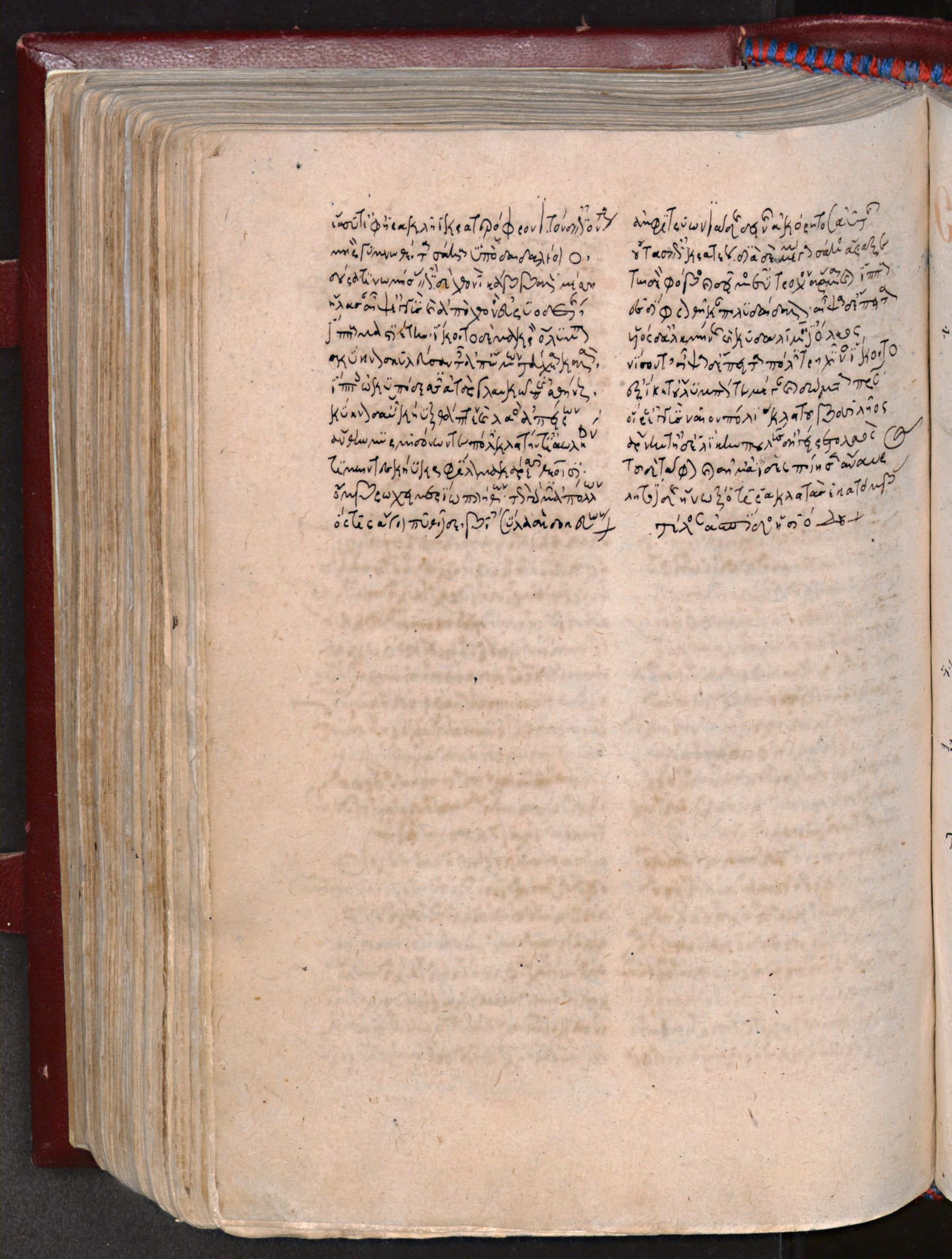
Laur. Plut. 32.16, fol. 251v: lines 458-480, begins ‹ἔσσυτʼ ἐφʼ Ἡρακλέα κρατερόφρονα·›, ends ‹Πυθοῖδε βίῃ σύλασκε δοκεύων.›. Checked on the image: first and last verse rows read and matched to the Greek (re-read on the image 2026-11-12: first row ‹458 | 459: ἔσσυτ' ἐφ' Ἡρακλῆα κρατερόφρονα ... | Ἀμφιτρυωνιάδης δεινῆς ἀκόρητος ἀυτῆς›, last row ‹480 | subscription: ὅστις ἄγοι Πυθοῖδε βίῃ σύλασκε δοκεύων | τέλος ἀσπίδος Ἡσιόδου›); the page before ends at line 457 and this is its last page. The poem ends with 480 in the twelfth row, in the upper part of the page, beside the subscription. English here: lines 458-480, cut at the end of Evelyn-White's sentences. The sentence that runs across the page break (to line 458) is given whole with the page before; the English here begins with ‹But as he came on, the son of Amphitryon ...› (line 458).
458ἔσσυτʼ ἐφʼ Ἡρακλέα κρατερόφρονα· τὸν δʼ ἐπιόντα
459Ἀμφιτρυωνιάδης, δεινῆς ἀκόρητος ἀυτῆς,
460μηρὸν γυμνωθέντα σάκευς ὕπο δαιδαλέοιο
461οὔτασʼ ἐπικρατέως· διὰ δὲ μέγα σαρκὸς ἄραξε
462δούρατι νωμήσας, ἐπὶ δὲ χθονὶ κάββαλε μέσσῃ.
463τῷ δὲ Φόβος καὶ Δεῖμος ἐύτροχον ἅρμα καὶ ἵππους
464ἤλασαν αἶψʼ ἐγγύς, καὶ ἀπὸ χθονὸς εὐρυοδείης
465ἐς δίφρον θῆκαν πολυδαίδαλον· αἶψα δʼ ἔπειτα
466ἵππους μαστιέτην· ἵκοντο δὲ μακρὸν Ὄλυμπον.
467υἱὸς δʼ Ἀλκμήνης καὶ κυδάλιμος Ἰόλαος
468Κύκνον σκυλεύσαντες ἀπʼ ὤμων τεύχεα καλὰ
469νίσσοντʼ· αἶψα δʼ ἔπειτα πόλιν Τρηχῖνος ἵκοντο
470ἵπποις ὠκυπόδεσσιν. ἀτὰρ γλαυκῶπις Ἀθήνη
471ἐξίκετʼ Οὔλυμπόν τε μέγαν καὶ δώματα πατρός.
472Κύκνον δʼ αὖ Κῆυξ θάπτεν καὶ λαὸς ἀπείρων,
473οἵ ῥʼ ἐγγὺς ναῖον πόλιας κλειτοῦ βασιλῆος
474Ἄνθην Μυρμιδόνων τε πόλιν κλειτήν τʼ Ἰαωλκὸν
475Ἄρνην τʼ ἠδʼ Ἑλίκην· πολλὸς δʼ ἠγείρετο λαός,
476τιμῶντες Κήυκα, φίλον μακάρεσσι θεοῖσιν.
477τοῦ δὲ τάφον καὶ σῆμʼ ἀιδὲς ποίησεν Ἄναυρος
478ὄμβρῳ χειμερίῳ πλήθων· τὼς γάρ μιν Ἀπόλλων
479Λητοΐδης ἤνωξʼ, ὅτι ῥα κλειτὰς ἑκατόμβας
480ὅστις ἄγοι Πυθοῖδε βίῃ σύλασκε δοκεύων.
458But as he came on, the son of Amphitryon, unsated of fierce battle, 460shrewdly wounded his thigh where it was exposed under his richly-wrought shield, and tore deep into his flesh with the spear thrust and cast him flat upon the ground. And Panic and Dread quickly drove his smooth-wheeled chariot and horses near him and lifted him from the wide-pathed earth 465into his richly-wrought car, and then straight lashed the horses and came to high Olympus. But the son of Alcmena and glorious Iolaus stripped the fine armour off Cycnus' shoulders and went, 470and their swift horses carried them straight to the city of Trachis. And bright-eyed Athena went from there to great Olympus and her father's house. As for Cycnus, Ceyx buried him and the countless people who lived near the city of the glorious king, in Anthe and the city of the Myrmidons, and famous Iolcus, 475and Arne, and Helice: and many people were gathered doing honor to Ceyx, the friend of the blessed gods. But Anaurus, swelled by a rain-storm, blotted out the grave and memorial of Cycnus; for so Apollo, Leto's son, commanded him, because he used to watch for and violently despoil the rich hecatombs 480that any might bring to Phyto.
Notes
- Greek: H. G. Evelyn-White, Hesiod, the Homeric Hymns and Homerica (Loeb Classical Library, 1914), via Perseus. Square brackets mark verses the editor regards as interpolated.
- English: H. G. Evelyn-White's translation in the same volume; his footnotes are omitted.
- The Loeb text has no line 298; the numbering is the editor's.
Cite
Sources
- Source: Laur. Plut. 32.16 (BML Teca Digitale IIIF) + Evelyn-White Greek (Loeb 1914, Perseus) + Evelyn-White English (1914, Perseus) (holding institution)
- Critical edition: Evelyn-White, Loeb 1914, via Perseus
← previous · → next · v cycle view · l back to library