Hesiod, Shield of Heracles 154-326: The Shield: its scenes
Introduction
The Shield of Heracles is a short epic handed down under Hesiod's name, probably composed in the 6th century BCE. It tells of Heracles' fight with Cycnus, son of Ares, and describes the hero's shield at length. This part: The Shield: its scenes (lines 154-326, 173 lines). The scenes on the shield: Fear and Strife, boars and lions, the Lapiths and Centaurs, Perseus and the Gorgons, a city at war and a city at peace.
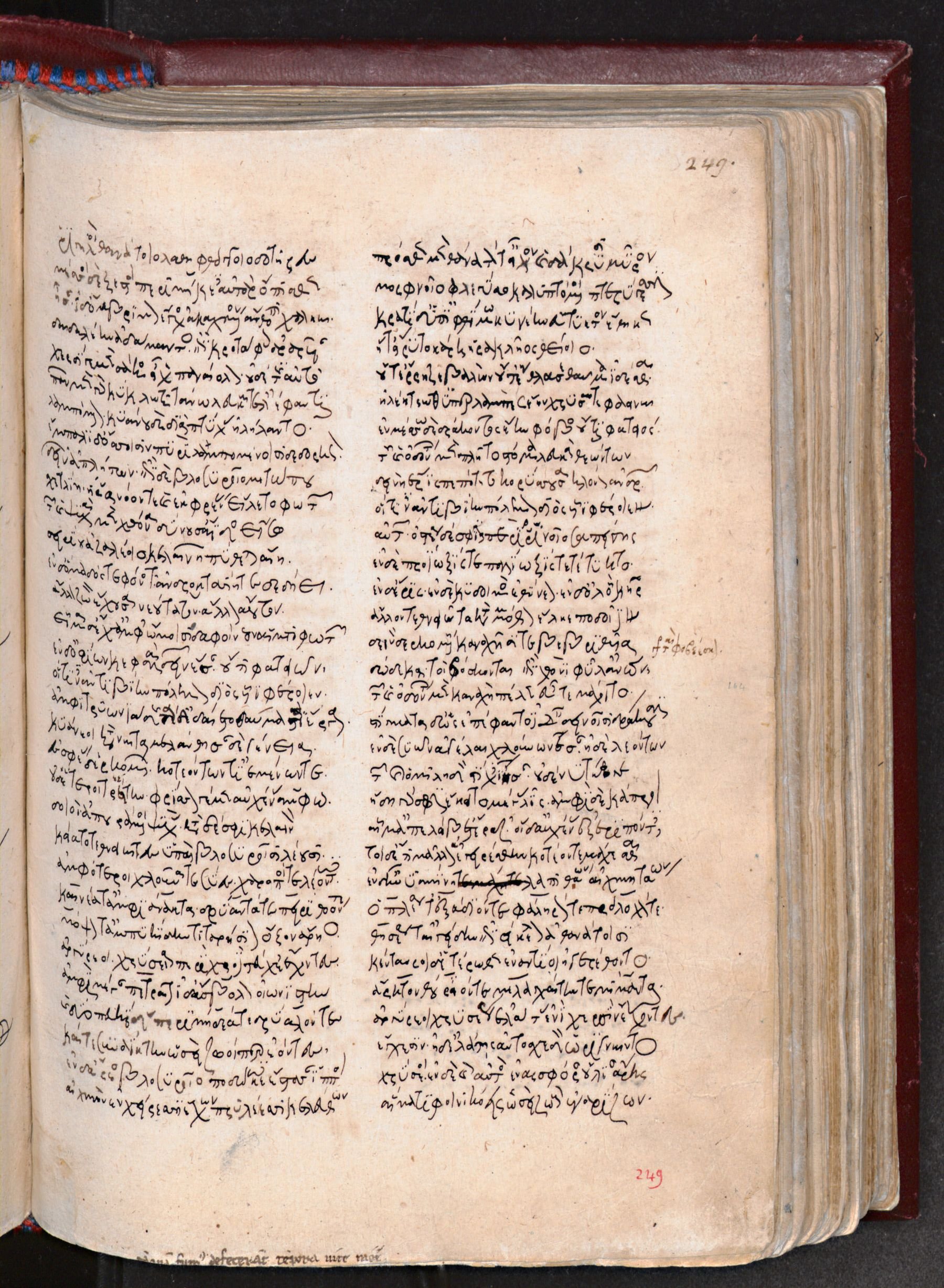
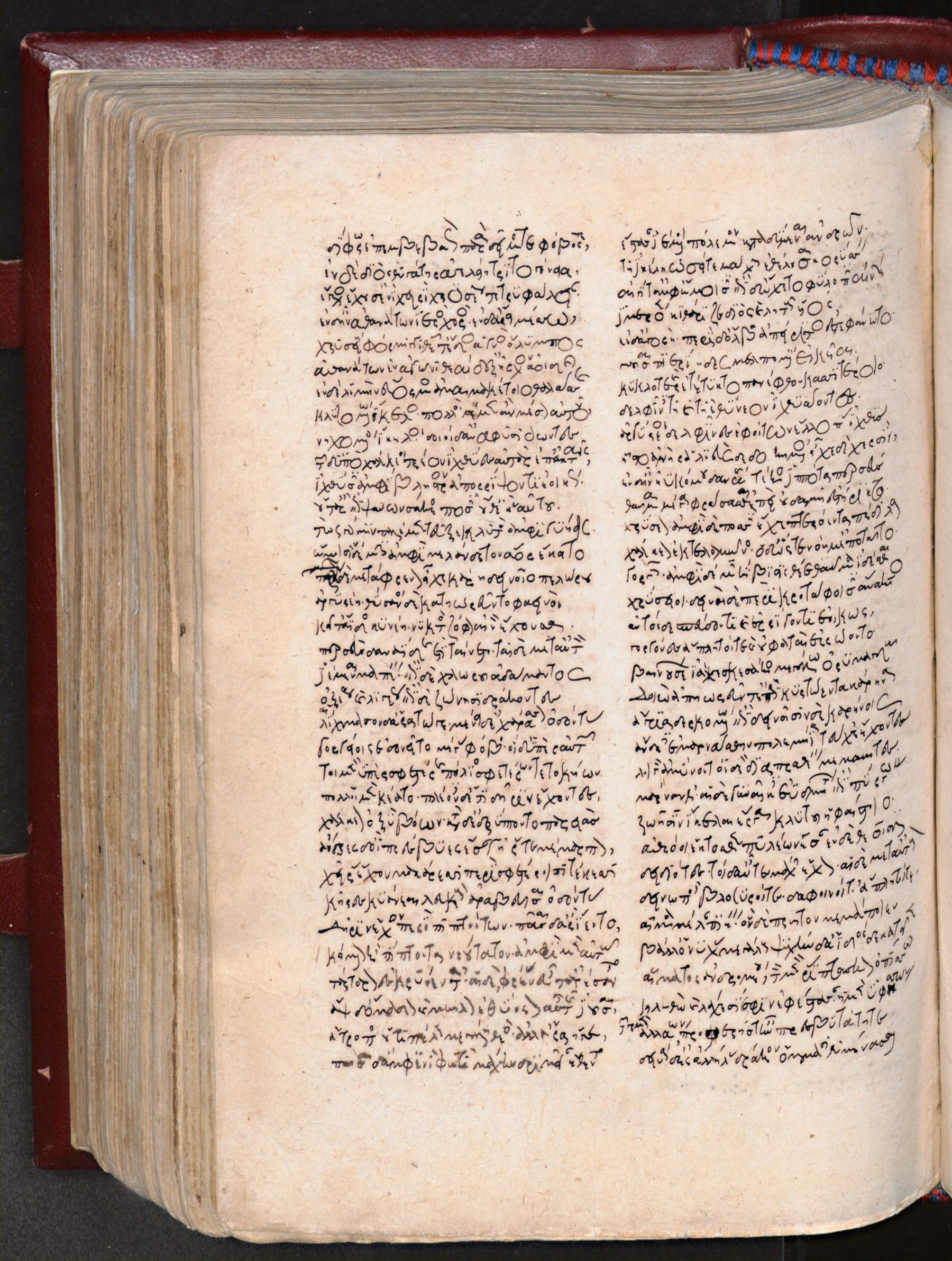
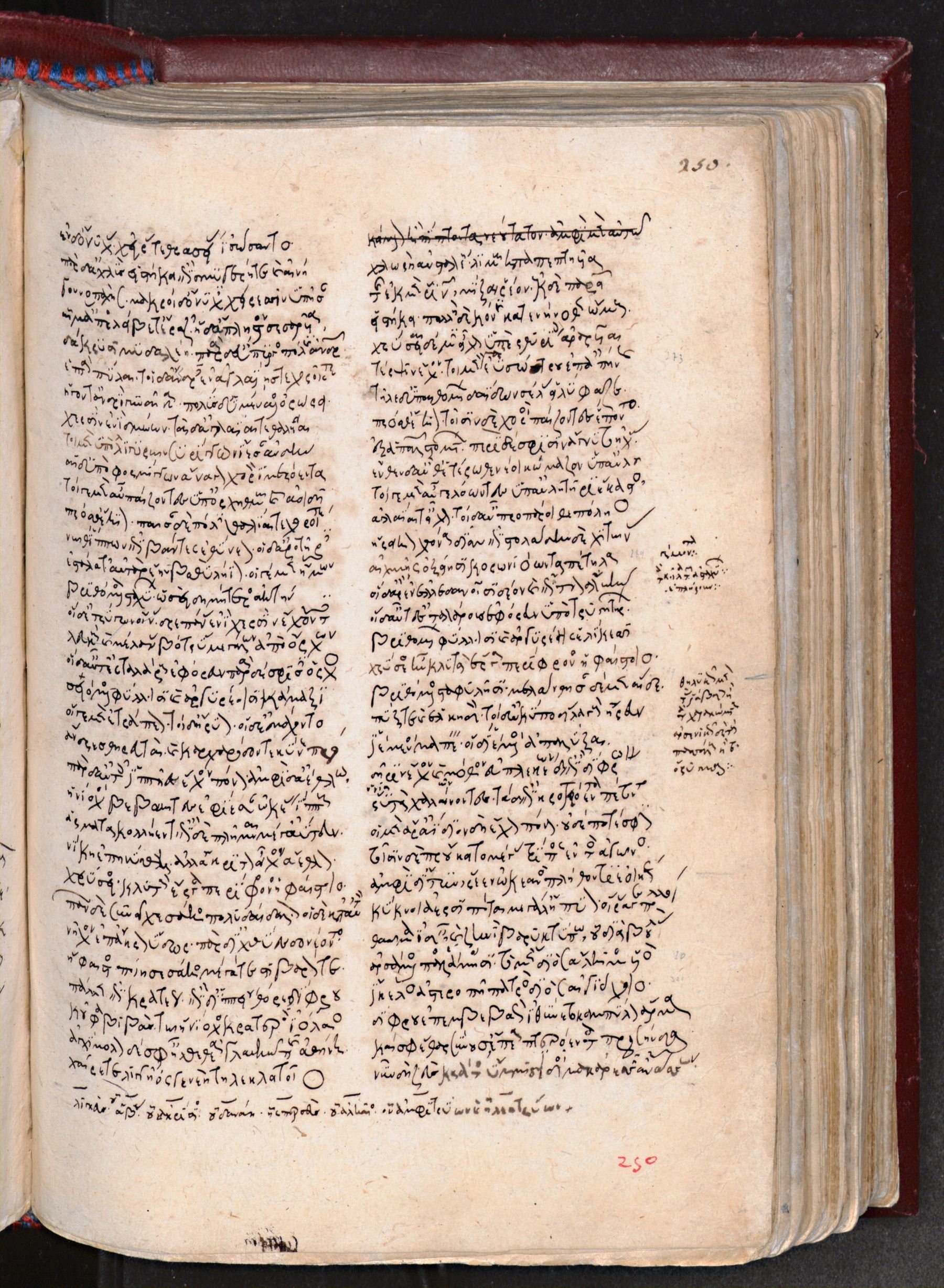
The page photographs are from Florence, Biblioteca Medicea Laurenziana, Plut. 32.16 (paper, late 13th century; a large collection of Greek poetry that also holds letters of Maximus Planudes), Shield of Heracles on fols. 248r-251v, in the Biblioteca Medicea Laurenziana's Teca Digitale. It follows the Works and Days and the Theogony in the same manuscript. This part is on fol. 249r, 249v, 250r. The scribe writes two verses to a row, one in each column, so a page is read across the columns, row by row; a few short notes stand in the margins. Each section below is one page; its note gives the page's first and last verse as read on the photograph.
The Greek is Evelyn-White's Loeb text (1914) via Perseus, not a transcription of this manuscript, whose wording differs here and there. Verses the editor brackets as later additions are shown in square brackets. The English is Evelyn-White's prose translation (1914); it is cut at the end of his sentences, so where a sentence runs across a page break it is given whole to one page; each section's note gives the exact lines its English covers.
How was this verified? (Provenance)
Where on the image
Laur. Plut. 32.16, fol. 249r: lines 131-194, begins ‹ῥιγηλοί, θανάτοιο λαθιφθόγγοιο δοτῆρες.›, ends ‹ὡς εἰ ζωοὺς ἐναρίζων›. Checked on the image: first and last verse rows read and matched to the Greek (re-read on the image 2026-11-12: first row ‹131 | 132: ῥιγηλοὶ θανάτοιο λαθιφθόγγοιο δοτῆρες | πρόσθεν μὲν θάνατόν τ' εἶχον ...›, last row ‹193 | 194: αἰχμὴν ἐν χείρεσσιν ἔχων ... | αἵματι φοινικόεις ... ἐναρίζων›); the page before ends at line 130 and the page after begins at line 195. This section shows lines 154-194 of that page; the rest of the page belongs to the previous part of the poem. A Latin pen note in the lower margin, in a later hand, is not part of the poem. English here: lines 154-195, cut at the end of Evelyn-White's sentences. His sentence that runs across the break with the next page is given whole here, so the English ends with line 195 (‹... he stood in his chariot.›).
154ἐν δὲ Προΐωξίς τε Παλίωξίς τε τέτυκτο,
155ἐν δʼ Ὅμαδός τε Φόβος τʼ Ἀνδροκτασίη τε δεδήει,
156ἐν δʼ Ἔρις, ἐν δὲ Κυδοιμὸς ἐθύνεον, ἐν δʼ ὀλοὴ Κὴρ
157ἄλλον ζωὸν ἔχουσα νεούτατον, ἄλλον ἄουτον,
158ἄλλον τεθνηῶτα κατὰ μόθον ἕλκε ποδοῖιν.
159εἷμα δʼ ἔχʼ ἄμφʼ ὤμοισι δαφοινεὸν αἵματι φωτῶν,
160δεινὸν δερκομένη καναχῇσί τε βεβρυχυῖα.
161ἐν δʼ ὀφίων κεφαλαὶ δεινῶν ἔσαν, οὔ τι φατειῶν,
162δώδεκα, ταὶ φοβέεσκον ἐπὶ χθονὶ φῦλʼ ἀνθρώπων,
163οἵ τινες ἀντιβίην πόλεμον Διὸς υἷι φέροιεν·
164τῶν καὶ ὀδόντων μὲν καναχὴ πέλεν, εὖτε μάχοιτο
165Ἀμφιτρυωνιάδης, τὰ δʼ ἐδαίετο θαυματὰ ἔργα.
166στίγματα δʼ ὣς ἐπέφαντο ἰδεῖν δεινοῖσι δράκουσιν·
167κυάνεοι κατὰ νῶτα, μελάνθησαν δὲ γένεια.
168ἐν δὲ συῶν ἀγέλαι χλούνων· ἔσαν ἠδὲ λεόντων
169ἐς σφέας δερκομένων, κοτεόντων θʼ ἱεμένων τε.
170τῶν καὶ ὁμιληδὸν στίχες ἤισαν· οὐδέ νυ τώ γε
171οὐδέτεροι τρεέτην· φρῖσσόν γε μὲν αὐχένας ἄμφω.
172ἤδη γάρ σφιν ἔκειτο μέγας λῖς, ἀμφὶ δὲ κάπροι
173δοιοί, ἀπουράμενοι ψυχάς, κατὰ δέ σφι κελαινὸν
174αἷμʼ ἀπελείβετʼ ἔραζʼ· οἳ δʼ αὐχένας ἐξεριπόντες
175κείατο τεθνηῶτες ὑπὸ βλοσυροῖσι λέουσιν.
176τοὶ δʼ ἔτι μᾶλλον ἐγειρέσθην κοτέοντε μάχεσθαι,
177ἀμφότεροι, χλοῦναί τε σύες χαροποί τε λέοντες.
178ἐν δʼ ἦν ὑσμίνη Λαπιθάων αἰχμητάων
179Καινέα τʼ ἀμφὶ ἄνακτα Δρύαντά τε Πειρίθοόν τε
180Ὁπλέα τʼ Ἐξάδιόν τε Φάληρόν τε Πρόλοχόν τε
181Μόψον τʼ Ἀμπυκίδην, Τιταρήσιον, ὄζον Ἄρηος,
182Θησέα τʼ Αἰγεΐδην, ἐπιείκελον ἀθανάτοισιν·
183ἀργύρεοι, χρύσεια περὶ χροῒ τεύχεʼ ἔχοντες.
184Κένταυροι δʼ ἑτέρωθεν ἐναντίοι ἠγερέθοντο
185ἀμφὶ μέγαν Πετραῖον ἰδʼ Ἄσβολον οἰωνιστὴν
186Ἄρκτον τʼ Οὔρειόν τε μελαγχαίτην τε Μίμαντα
187καὶ δύο Πευκεΐδας, Περιμήδεά τε Δρύαλόν τε,
188ἀργύρεοι, χρυσέας ἐλάτας ἐν χερσὶν ἔχοντες.
189καί τε συναΐγδην ὡς εἰ ζωοί περ ἐόντες
190ἔγχεσιν ἠδʼ ἐλάτῃς αὐτοσχεδὸν ὠριγνῶντο.
191ἐν δʼ Ἄρεος βλοσυροῖο ποδώκεες ἕστασαν ἵπποι
192χρύσεοι, ἐν δὲ καὶ αὐτὸς ἐναρσφόρος οὔλιος Ἄρης
193αἰχμὴν ἐν χείρεσσιν ἔχων, πρυλέεσσι κελεύων,
194αἵματι φοινικόεις, ὡς εἰ ζωοὺς ἐναρίζων
154Upon the shield Pursuit and Flight were wrought, 155and Tumult, and Panic, and Slaughter. Strife also, and Uproar were hurrying about, and deadly Fate was there holding one man newly wounded, and another unwounded; and one, who was dead, she was dragging by the feet through the tumult. She had on her shoulders a garment red with the blood of men, 160and terribly she glared and gnashed her teeth. And there were heads of snakes unspeakably frightful, twelve of them; and they used to frighten the tribes of men on earth made war against the son of Zeus; for they would clash their teeth when Amphitryon's son was fighting: 165and brightly shone these wonderful works. And it was as though there were spots upon the frightful snakes: and their backs were dark blue and their jaws were black. Also there were upon the shield droves of boars and lions who glared at each other, being furious and eager: 170the rows of them moved on together, and neither side trembled but both bristled up their manes. For already a great lion lay between them and two boars, one on either side, bereft of life, and their dark blood was dripping down upon the ground; 175they lay dead with necks outstretched beneath the grim lions. And both sides were roused still more to fight because they were angry, the fierce boars and the bright-eyed lions. 178And there was the strife of the Lapith spearmen gathered round the prince Caeneus and Dryas and Peirithous, 180with Hopleus, Exadius, Phalereus, and Prolochus, Mopsus the son of Ampyce of Titaresia, a scion of Ares, and Theseus, the son of Aegeus, like the deathless gods. These were of silver, and had armor of gold upon their bodies. And the Centaurs were gathered against them on the other side 185with Petraeus and Asbolus the diviner, Arctus, and Ureus, and black-haired Mimas, and the two sons of Peuceus, Perimedes and Dryalus: these were of silver, and they had pinetrees of gold in their hands, and they were rushing together as though they were alive 190and striking at one another hand to hand with spears and with pines. And on the shield stood the fleet-footed horses of grim Ares made of gold, and deadly Ares the spoil-winner himself. He held a spear in his hands and was urging on the footmen: he was red with blood as if he were slaying living men, 195and he stood in his chariot.
Where on the image
Laur. Plut. 32.16, fol. 249v: lines 195-262, begins ‹δίφρου ἐπεμβεβαώς· παρὰ δὲ›, ends ‹ἀλλήλας δράκον ὄμμασι θυμήνασαι,›. Checked on the image: first and last verse rows read and matched to the Greek (re-read on the image 2026-11-12: first row ‹195 | 196: δίφρου ἐπεμβεβαὼς παρὰ δὲ Δεῖμος ... | ἕστασαν ἱέμενοι ...›, last row ‹261 | 262: πᾶσαι δ' ἀμφ' ἑνὶ φωτὶ μάχην ... | δεινὰ δ' ἐς ἀλλήλας δράκον ...›); the page before ends at line 194 and the page after begins at line 263. English here: lines 195-263, cut at the end of Evelyn-White's sentences. The sentence that runs across the page break (to line 195) is given whole with the page before; the English here begins with ‹Beside him stood Fear and Flight ...› (line 195). His sentence that runs across the break with the next page is given whole here, so the English ends with line 263 (‹... equally with claws and hands.›).
195δίφρου ἐπεμβεβαώς· παρὰ δὲ Δεῖμός τε Φόβος τε
196ἕστασαν ἱέμενοι πόλεμον καταδύμεναι ἀνδρῶν.
197ἐν δὲ Διὸς θυγάτηρ ἀγελείη Τριτογένεια,
198τῇ ἰκέλη ὡς εἴ τε μάχην ἐθέλουσα κορύσσειν,
199ἔγχος ἔχουσʼ ἐν χερσὶν ἰδὲ χρυσέην τρυφάλειαν
200αἰγίδα τʼ ἀμφʼ ὤμοις· ἐπὶ δʼ ᾤχετο φύλοπιν αἰνήν.
201ἐν δʼ ἦν ἀθανάτων ἱερὸς χορός· ἐν δʼ ἄρα μέσσῳ
202ἱμερόεν κιθάριζε Διὸς καὶ Λητοῦς υἱὸς
203χρυσείῃ φόρμιγγι· [θεῶν δʼ ἕδος ἁγνὸς Ὄλυμπος·]
204[ἐν δʼ ἀγορή, περὶ δʼ ὄλβος ἀπείριτος ἐστεφάνωτο]
205[ἀθανάτων ἐν ἀγῶνι·] θεαὶ δʼ ἐξῆρχον ἀοιδῆς
206Μοῦσαι Πιερίδες, λιγὺ μελπομένῃς ἐικυῖαι.
207ἐν δὲ λιμὴν ἐύορμος ἀμαιμακέτοιο θαλάσσης
208κυκλοτερὴς ἐτέτυκτο πανέφθου κασσιτέροιο
209κλυζομένῳ ἴκελος· [πολλοί γε μὲν ἂμ μέσον αὐτοῦ]
210[δελφῖνες τῇ καὶ τῇ ἐθύνεον ἰχθυάοντες]
211[νηχομένοις ἴκελοι·] δοιὼ δʼ ἀναφυσιόωντες
212ἀργύρεοι δελφῖνες ἐθοινῶντʼ ἔλλοπας ἰχθῦς.
213τῶν δʼ ὕπο χάλκειοι τρέον ἰχθύες· αὐτὰρ ἐπʼ ἀκταῖς
214ἧστο ἀνὴρ ἁλιεὺς δεδοκημένος· εἶχε δὲ χερσὶν
215ἰχθύσιν ἀμφίβληστρον ἀπορρίψοντι ἐοικώς.
216ἐν δʼ ἦν ἠυκόμου Δανάης τέκος, ἱππότα Περσεύς,
217οὔτʼ ἄρʼ ἐπιψαύων σάκεος ποσὶν οὔθʼ ἑκὰς αὐτοῦ,
218θαῦμα μέγα φράσσασθʼ, ἐπεὶ οὐδαμῇ ἐστήρικτο.
219τὼς γάρ μιν παλάμαις τεῦξεν κλυτὸς Ἀμφιγυήεις
220χρύσεον· ἀμφὶ δὲ ποσσὶν ἔχεν πτερόεντα πέδιλα.
221ὤμοισιν δέ μιν ἀμφὶ μελάνδετον ἆορ ἔκειτο
222χαλκέου ἐκ τελαμῶνος· ὃ δʼ ὥς τε νόημʼ ἐποτᾶτο·
223πᾶν δὲ μετάφρενον εἶχε κάρη δεινοῖο πελώρου,
224Γοργοῦς· ἀμφὶ δέ μιν κίβισις θέε, θαῦμα ἰδέσθαι,
225ἀργυρέη· θύσανοι δὲ κατῃωρεῦντο φαεινοὶ
226χρύσειοι· δεινὴ δὲ περὶ κροτάφοισιν ἄνακτος
227κεῖτʼ Ἄιδος κυνέη νυκτὸς ζόφον αἰνὸν ἔχουσα.
228αὐτὸς δὲ σπεύδοντι καὶ ἐρρίγοντι ἐοικὼς
229Περσεὺς Δαναΐδης ἐτιταίνετο. ταὶ δὲ μετʼ αὐτὸν
230Γοργόνες ἄπλητοί τε καὶ οὐ φαταὶ ἐρρώοντο
231ἱέμεναι μαπέειν. ἐπὶ δὲ χλωροῦ ἀδάμαντος
232βαινουσέων ἰάχεσκε σάκος μεγάλῳ ὀρυμαγδῷ
233ὀξέα καὶ λιγέως· ἐπὶ δὲ ζώνῃσι δράκοντε
234δοιὼ ἀπῃωρεῦντʼ ἐπικυρτώοντε κάρηνα.
235λίχμαζον δʼ ἄρα τώ γε· μένει δʼ ἐχάρασσον ὀδόντας
236ἄγρια δερκομένω. ἐπὶ δὲ δεινοῖσι καρήνοις
237Γοργείοις ἐδονεῖτο μέγας Φόβος. οἳ δʼ ὑπὲρ αὐτέων
238ἄνδρες ἐμαρνάσθην πολεμήια τεύχεʼ ἔχοντες,
239τοὶ μὲν ὑπὲρ σφετέρης πόλιος σφετέρων τε τοκήων
240λοιγὸν ἀμύνοντες, τοὶ δὲ πραθέειν μεμαῶτες.
241πολλοὶ μὲν κέατο, πλέονες δʼ ἔτι δῆριν ἔχοντες
242μάρνανθʼ· αἱ δὲ γυναῖκες ἐυδμήτων ἐπὶ πύργων
243χαλκέων ὀξὺ βόων, κατὰ δʼ ἐδρύπτοντο παρειάς,
244ζωῇσιν ἴκελαι, ἔργα κλυτοῦ Ἡφαίστοιο.
245ἄνδρες δʼ, οἳ πρεσβῆες ἔσαν γῆράς τε μέμαρπεν,
246ἀθρόοι ἔκτοσθεν πυλέων ἔσαν, ἂν δὲ θεοῖσι
247χεῖρας ἔχον μακάρεσσι, περὶ σφετέροισι τέκεσσι
248δειδιότες· τοὶ δʼ αὖτε μάχην ἔχον. αἳ δὲ μετʼ αὐτοὺς
249Κῆρες κυάνεαι, λευκοὺς ἀραβεῦσαι ὀδόντας,
250δεινωπαὶ βλοσυραί τε δαφοιναί τʼ ἄπληταί τε
251δῆριν ἔχον περὶ πιπτόντων· πᾶσαι δʼ ἄρʼ ἵεντο
252αἷμα μέλαν πιέειν· ὃν δὲ πρῶτον μεμάποιεν
253κείμενον ἢ πίπτοντα νεούτατον, ἀμφὶ μὲν αὐτῷ
254βάλλʼ ὄνυχας μεγάλους, ψυχὴ δʼ Ἄιδόσδε κατῇεν
255Τάρταρον ἐς κρυόενθʼ. αἳ δὲ φρένας εὖτʼ ἀρέσαντο
256αἵματος ἀνδρομέου, τὸν μὲν ῥίπτασκον ὀπίσσω,
257ἂψ δʼ ὅμαδον καὶ μῶλον ἐθύνεον αὖτις ἰοῦσαι.
258Κλωθὼ καὶ Λάχεσίς σφιν ἐφέστασαν· ἣ μὲν ὑφήσσων
259Ἄτροπος οὔ τι πέλεν μεγάλη θεός, ἀλλʼ ἄρα ἥ γε
260τῶν γε μὲν ἀλλάων προφερής τʼ ἦν πρεσβυτάτη τε.
261πᾶσαι δʼ ἀμφʼ ἑνὶ φωτὶ μάχην δριμεῖαν ἔθεντο.
262δεινὰ δʼ ἐς ἀλλήλας δράκον ὄμμασι θυμήνασαι,
195Beside him stood Fear and Flight, eager to plunge amidst the fighting men. There, too, was the daughter of Zeus, Tritogeneia who drives the spoil. She was like as if she would array a battle, with a spear in her hand, and a golden helmet, 200and the aegis about her shoulders. And she was going towards the awful strife. And there was the holy company of the deathless gods: and in the midst the son of Zeus and Leto played sweetly on a golden lyre. There also was the abode of the gods, pure Olympus, and their assembly, and infinite riches were spread around 205in the gathering of the deathless gods. Also the goddesses, the Muses of Pieria were beginning a song like clear-voiced singers. And on the shield was a harbor with a safe haven from the irresistible sea, made of refined tin wrought in a circle, and it seemed to heave with waves. In the middle of it were 210many dolphins rushing this way and that, fishing: and they seemed to be swimming. Two dolphins of silver were spouting and devouring the mute fishes. And beneath them fishes of bronze were trembling. And on the shore sat a fisherman watching: in his hands he held 215a casting net for fish, and seemed as if about to cast it forth. 216There, too, was the son of rich-haired Danae, the horseman Perseus: his feet did not touch the shield and yet were not far from it—very marvellous to remark, since he was not supported anywhere; for so did the famous Lame One fashion him of gold with his hands. 220On his feet he had winged sandals, and his black-sheathed sword was slung across his shoulders by a cross-belt of bronze. He was flying swift as thought. The head of a dreadful monster, the Gorgon, covered the broad of his back, and a bag of silver—a marvel to see— 225contained it: and from the bag bright tassels of gold hung down. Upon the head of the hero lay the dread cap of Hades which had the awful gloom of night. Perseus himself, the son of Danae, was at full stretch, like one who hurries and shudders with horror. And after him rushed 230the Gorgons, unapproachable and unspeakable, longing to seize him: as they trod upon the pale adamant, the shield rang sharp and clear with a loud clanging. Two serpents hung down at their girdles with heads curved forward: 235their tongues were flickering, and their teeth gnashing with fury, and their eyes glaring fiercely. And upon the awful heads of the Gorgons great Fear was quaking. And beyond these there were men fighting in warlike harness, some defending their own town and parents 240from destruction, and others eager to sack it; many lay dead, but the greater number still strove and fought. The women on well-built towers of bronze were crying shrilly and tearing their cheeks like living beings—the work of famous Hephaestus. 245And the men who were elders and on whom age had laid hold were all together outside the gates, and were holding up their hands to the blessed gods, fearing for their own sons. But these again were engaged in battle: and behind them the dusky Fates, gnashing their white fangs, 250lowering, grim, bloody, and unapproachable, struggled for those who were falling, for they all were longing to drink dark blood. So soon as they caught a man overthrown or falling newly wounded, one of them would clasp her great claws about him, and his soul would go down to Hades 255to chilly Tartarus. And when they had satisfied their souls with human blood, they would cast that one behind them, and rush back again into the tumult and the fray. Clotho and Lachesis were over them and Atropos less tall than they, a goddess of no great frame, yet 260superior to the others and the eldest of them. And they all made a fierce fight over one poor wretch, glaring evilly at one another with furious eyes and fighting equally with claws and hands.
Where on the image
Laur. Plut. 32.16, fol. 250r: lines 263-328, begins ‹ἐν δʼ ὄνυχας χεῖράς›, ends ‹ὔμμι διδοῖ μακάρεσσιν ἀνάσσων›. Checked on the image: first and last verse rows read and matched to the Greek (re-read on the image 2026-11-12: first row ‹263 | a struck-through line: ἐν δ' ὄνυχας χεῖράς τε ... | (a cancelled repeat of 253, ... ἢ πίπτοντα νεούτατον ἀμφὶ μὲν αὐτῷ); row 2 is 264 | 265›, last row ‹327 | 328: χαίρετε Λυγκῆος γενεὴ τηλεκλειτοῖο | νῦν δὴ Ζεὺς κράτος ὔμμι ...›); the page before ends at line 262 and the page after begins at line 329. This section shows lines 263-326 of that page; the rest of the page belongs to the next part of the poem. In the first row the right-hand verse is a repeat of 253, struck through by the scribe. The writing in the lower margin is not a verse: as far as it can be read it is a list of names (Lynceus, Abas, Acrisius, Danae, Perseus, Alcaeus, Amphitryon), a genealogy explaining Λυγκῆος γενεή in 327, which carries a mark. English here: lines 264-326, cut at the end of Evelyn-White's sentences. The sentence that runs across the page break (to line 263) is given whole with the page before; the English here begins with ‹By them stood Darkness of Death ...› (line 264).
263ἐν δʼ ὄνυχας χεῖράς τε θρασείας ἰσώσαντο.
264πὰρ δʼ Ἀχλὺς εἱστήκει ἐπισμυγερή τε καὶ αἰνή,
265χλωρὴ ἀυσταλέη λιμῷ καταπεπτηυῖα,
266γουνοπαχής, μακροὶ δʼ ὄνυχες χείρεσσιν ὑπῆσαν.
267τῆς ἐκ μὲν ῥινῶν μύξαι ῥέον, ἐκ δὲ παρειῶν
268αἷμʼ ἀπελείβετʼ ἔραζʼ· ἣ δʼ ἄπλητον σεσαρυῖα
269εἱστήκει, πολλὴ δὲ κόνις κατενήνοθεν ὤμους,
270δάκρυσι μυδαλέη. παρὰ δʼ εὔπυργος πόλις ἀνδρῶν·
271χρύσειαι δέ μιν εἶχον ὑπερθυρίοις ἀραρυῖαι
272ἑπτὰ πύλαι· τοὶ δʼ ἄνδρες ἐν ἀγλαΐῃς τε χοροῖς τε
273τέρψιν ἔχον· τοὶ μὲν γὰρ ἐυσσώτρου ἐπʼ ἀπήνης
274ἤγοντʼ ἀνδρὶ γυναῖκα, πολὺς δʼ ὑμέναιος ὀρώρει·
275τῆλε δʼ ἀπʼ αἰθομένων δαΐδων σέλας εἰλύφαζε
276χερσὶν ἔνι δμῳῶν· ταὶ δʼ ἀγλαΐῃ τεθαλυῖαι
277πρόσθʼ ἔκιον· τῇσιν δὲ χοροὶ παίζοντες ἕποντο.
278τοὶ μὲν ὑπὸ λιγυρῶν συρίγγων ἵεσαν αὐδὴν
279ἐξ ἁπαλῶν στομάτων, περὶ δέ σφισιν ἄγνυτο ἠχώ.
280αἳ δʼ ὑπὸ φορμίγγων ἄναγον χορὸν ἱμερόεντα.
281ἔνθεν δʼ αὖθʼ ἑτέρωθε νέοι κώμαζον ὑπʼ αὐλοῦ,
282τοί γε μὲν αὖ παίζοντες ὑπʼ ὀρχηθμῷ καὶ ἀοιδῇ
283τοί γε μὲν αὖ γελόωντες ὑπʼ αὐλητῆρι ἕκαστος
284πρόσθʼ ἔκιον· πᾶσαν δὲ πόλιν θαλίαι τε χοροί τε
285ἀγλαΐαι τʼ εἶχον. τοὶ δʼ αὖ προπάροιθε πόληος
286νῶθʼ ἵππων ἐπιβάντες ἐθύνεον. οἱ δʼ ἀροτῆρες
287ἤρεικον χθόνα δῖαν, ἐπιστολάδην δὲ χιτῶνας
288ἐστάλατʼ. αὐτὰρ ἔην βαθὺ λήιον· οἵ γε μὲν ἤμων
289αἰχμῇς ὀξείῃσι κορωνιόωντα πέτηλα,
290βριθόμενα σταχύων, ὡς εἰ Δημήτερος ἀκτήν·
291οἳ δʼ ἄρʼ ἐν ἐλλεδανοῖσι δέον καὶ ἔπιτνον ἀλωήν,
292οἳ δʼ ἐτρύγων οἴνας δρεπάνας ἐν χερσὶν ἔχοντες,
293οἳ δʼ αὖτʼ ἐς ταλάρους ἐφόρευν ὑπὸ τρυγητήρων
294λευκοὺς καὶ μέλανας βότρυας μεγάλων ἀπὸ ὄρχων,
295βριθομένων φύλλοισι καὶ ἀργυρέῃς ἑλίκεσσιν.
296οἳ δʼ αὖτʼ ἐς ταλάρους ἐφόρευν. παρὰ δέ σφισιν ὄρχος
297χρύσεος ἦν, κλυτὰ ἔργα περίφρονος Ἡφαίστοιο,
299σειόμενος φύλλοισι καὶ ἀργυρέῃσι κάμαξι,
300βριθόμενος σταφυλῇσι· μελάνθησάν γε μὲν αἵδε.
301οἵ γε μὲν ἐτράπεον, τοὶ δʼ ἤρυον· οἳ δʼ ἐμάχοντο
302πύξ τε καὶ ἑλκηδόν· τοὶ δʼ ὠκύποδας λαγὸς ᾕρευν
303ἄνδρες θηρευταί, καὶ καρχαρόδοντε κύνε πρό,
304ἱέμενοι μαπέειν, οἳ δʼ ἱέμενοι ὑπαλύξαι.
305πὰρ δʼ αὐτοῖς ἱππῆες ἔχον πόνον, ἀμφὶ δʼ ἀέθλῳ
306δῆριν ἔχον καὶ μόχθον. ἐυπλεκέων δʼ ἐπὶ δίφρων
307ἡνίοχοι βεβαῶτες ἐφίεσαν ὠκέας ἵππους
308ῥυτὰ χαλαίνοντες, τὰ δʼ ἐπικροτέοντα πέτοντο
309ἅρματα κολλήεντʼ, ἐπὶ δὲ πλῆμναι μέγʼ ἀύτευν.
310οἳ μὲν ἄρʼ ἀίδιον εἶχον πόνον οὐδέ ποτέ σφιν
311νίκη ἐπηνύσθη, ἀλλʼ ἄκριτον εἶχον ἄεθλον.
312τοῖσιν δὲ προέκειτο μέγας τρίπος ἐντὸς ἀγῶνος,
313χρύσειος, κλυτὰ ἔργα περίφρονος Ἡφαίστοιο.
314ἀμφὶ δʼ ἴτυν ῥέεν Ὠκεανὸς πλήθοντι ἐοικώς,
315πᾶν δὲ συνεῖχε σάκος πολυδαίδαλον, οἳ δὲ κατʼ αὐτὸν
316κύκνοι ἀερσιπόται μεγάλʼ ἤπυον, οἵ ῥά τε πολλοὶ
317νῆχον ἐπʼ ἄκρον ὕδωρ· παρὰ δʼ ἰχθύες ἐκλονέοντο.
318θαῦμα ἰδεῖν καὶ Ζηνὶ βαρυκτύπῳ, οὗ διὰ βουλὰς
319Ἥφαιστος ποίησε σάκος μέγα τε στιβαρόν τε,
320ἀρσάμενος παλάμῃσι. τὸ μὲν Διὸς ἄλκιμος υἱὸς
321πάλλεν ἐπικρατέως· ἐπὶ δʼ ἱππείου θόρε δίφρου,
322εἴκελος ἀστεροπῇ πατρὸς Διὸς αἰγιόχοιο,
323κοῦφα βιβάς· τῷ δʼ ἡνίοχος κρατερὸς Ἰόλαος
324δίφρου ἐπεμβεβαὼς ἰθύνετο καμπύλον ἅρμα.
325ἀγχίμολον δέ σφʼ ἦλθε θεὰ γλαυκῶπις Ἀθήνη,
326καί σφεας θαρσύνουσα ἔπεα πτερόεντα προσηύδα·
264By them stood Darkness of Death, mournful and fearful, 265pale, shrivelled, shrunk with hunger, swollen-kneed. Long nails tipped her hands, and she dribbled at the nose, and from her cheeks blood dripped down to the ground. She stood leering hideously, and much dust sodden with tears lay upon her shoulders. 270Next, there was a city of men with goodly towers; and seven gates of gold, fitted to the lintels, guarded it. The men were making merry with festivities and dances; some were bringing home a bride to her husband on a well-wheeled car, while the bridalsong swelled high, 275and the glow of blazing torches held by handmaidens rolled in waves afar. And these maidens went before, delighting in the festival; and after them came frolicsome choirs, the youths singing soft-mouthed to the sound of shrill pipes, while the echo was shivered around them, 280and the girls led on the lovely dance to the sound of lyres. Then again on the other side was a rout of young men revelling, with flutes playing; some frolicking with dance and song, and others were going forward in time with a flute player and laughing. The whole town was filled with mirth and dance and festivity. 285Others again were mounted on horseback and galloping before the town. And there were ploughmen breaking up the good soil, clothed in tunics girt up. Also there was a wide cornland, and some men were reaping with sharp hooks the stalks 290which bended with the weight of the ears—as if they were reaping Demeter's grain: others were binding the sheaves with bands and were spreading the threshing floor. And some held reaping hooks and were gathering the vintage, while others were taking from the reapers into baskets white and black clusters from the long rows of vines 295which were heavy with leaves and tendrils of silver. Others again were gathering them into baskets. Beside them was a row of vines 297in gold, the splendid work of cunning Hephaestus: 299it had shivering leaves and stakes of silver 300and was laden with grapes which turned black. And there were men treading out the grapes and others drawing off the liquor. Also there were men boxing and wrestling, and huntsmen chasing swift hares with a leash of sharp-toothed dogs before them, they eager to catch the hares, and the hares eager to escape. 305Next to them were horsemen hard set, and they contended and labored for a prize. The charioteers standing on their well-woven cars, urged on their swift horses with loose rein; the jointed cars flew along clattering and the naves of the wheels shrieked loudly. 310So they were engaged in an unending toil, and the end with victory came never to them, and the contest was ever unwon. And there was set out for them within the course a great tripod of gold, the splendid work of cunning Hephaestus. And round the rim Ocean was flowing, with a full stream as it seemed, 315and enclosed all the cunning work of the shield. Over it swans were soaring and calling loudly, and many others were swimming upon the surface of the water; and near them were shoals of fish. A wonderful thing the great strong shield was to see—even for Zeus the loud-thunderer, by whose will Hephaestus made it 320and fitted it with his hands. This shield the valiant son of Zeus wielded masterly, and leaped upon his horse-chariot like the lightning of his father Zeus who holds the aegis, moving lithely. And his charioteer, strong Iolaus, standing upon the car, guided the curved chariot. 325Then the goddess grey-eyed Athena came near them and spoke winged words, encouraging them:
Notes
- Greek: H. G. Evelyn-White, Hesiod, the Homeric Hymns and Homerica (Loeb Classical Library, 1914), via Perseus. Square brackets mark verses the editor regards as interpolated.
- English: H. G. Evelyn-White's translation in the same volume; his footnotes are omitted.
- The Loeb text has no line 298; the numbering is the editor's.
Cite
Sources
- Source: Laur. Plut. 32.16 (BML Teca Digitale IIIF) + Evelyn-White Greek (Loeb 1914, Perseus) + Evelyn-White English (1914, Perseus) (holding institution)
- Critical edition: Evelyn-White, Loeb 1914, via Perseus
← previous · → next · v cycle view · l back to library