Hesiod, Theogony 1-103: Proem: the Muses of Helicon
Introduction
Hesiod's Theogony (c. 700 BCE) is the oldest Greek account of the origin of the world and the gods, from Chaos and Earth through the reign of Cronos to the victory of Zeus. This part: Proem: the Muses of Helicon (lines 1-103, 103 lines). Hesiod meets the Muses on Mount Helicon, receives the poet's staff and sings of their birth from Zeus and Mnemosyne.
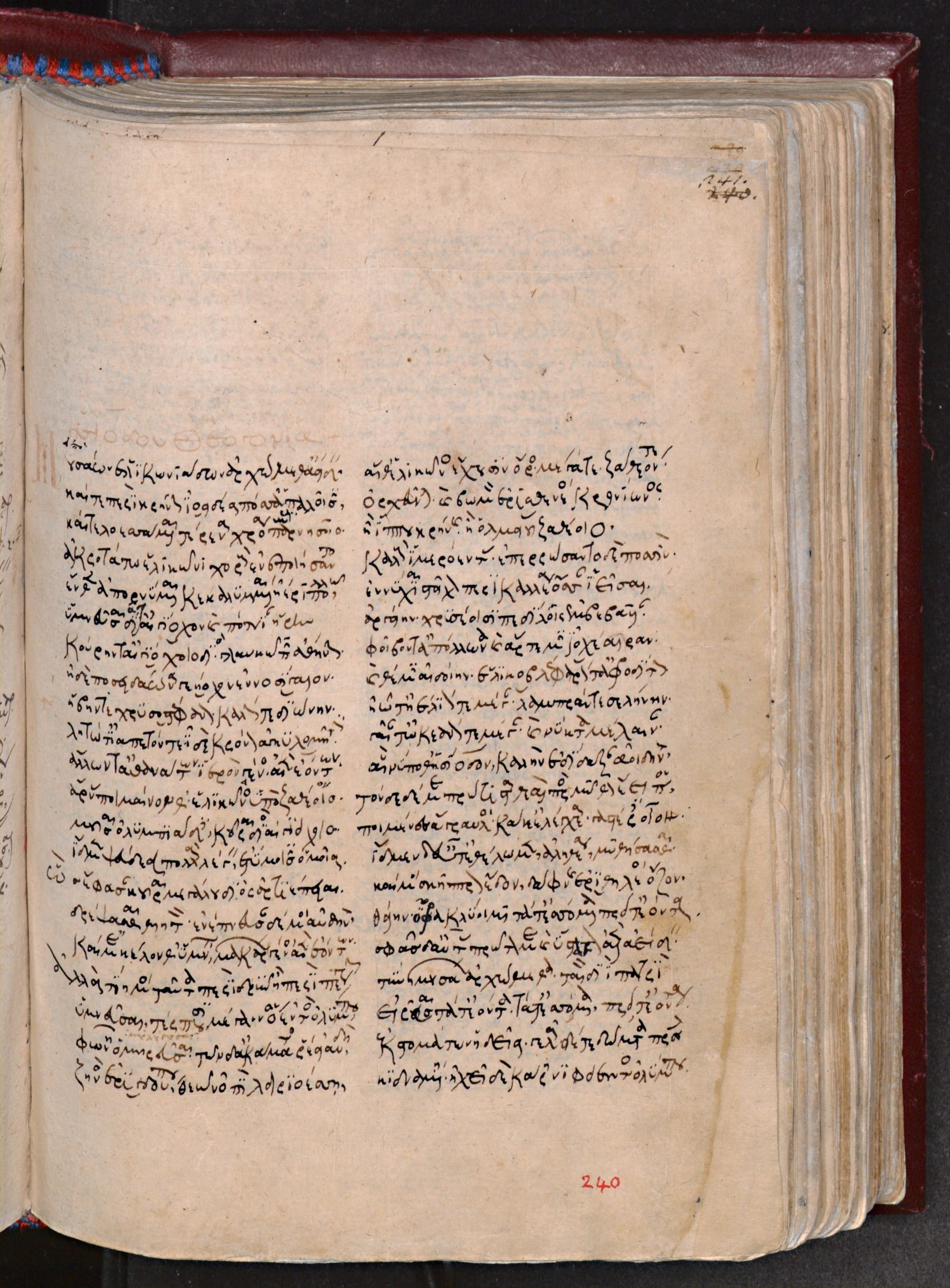
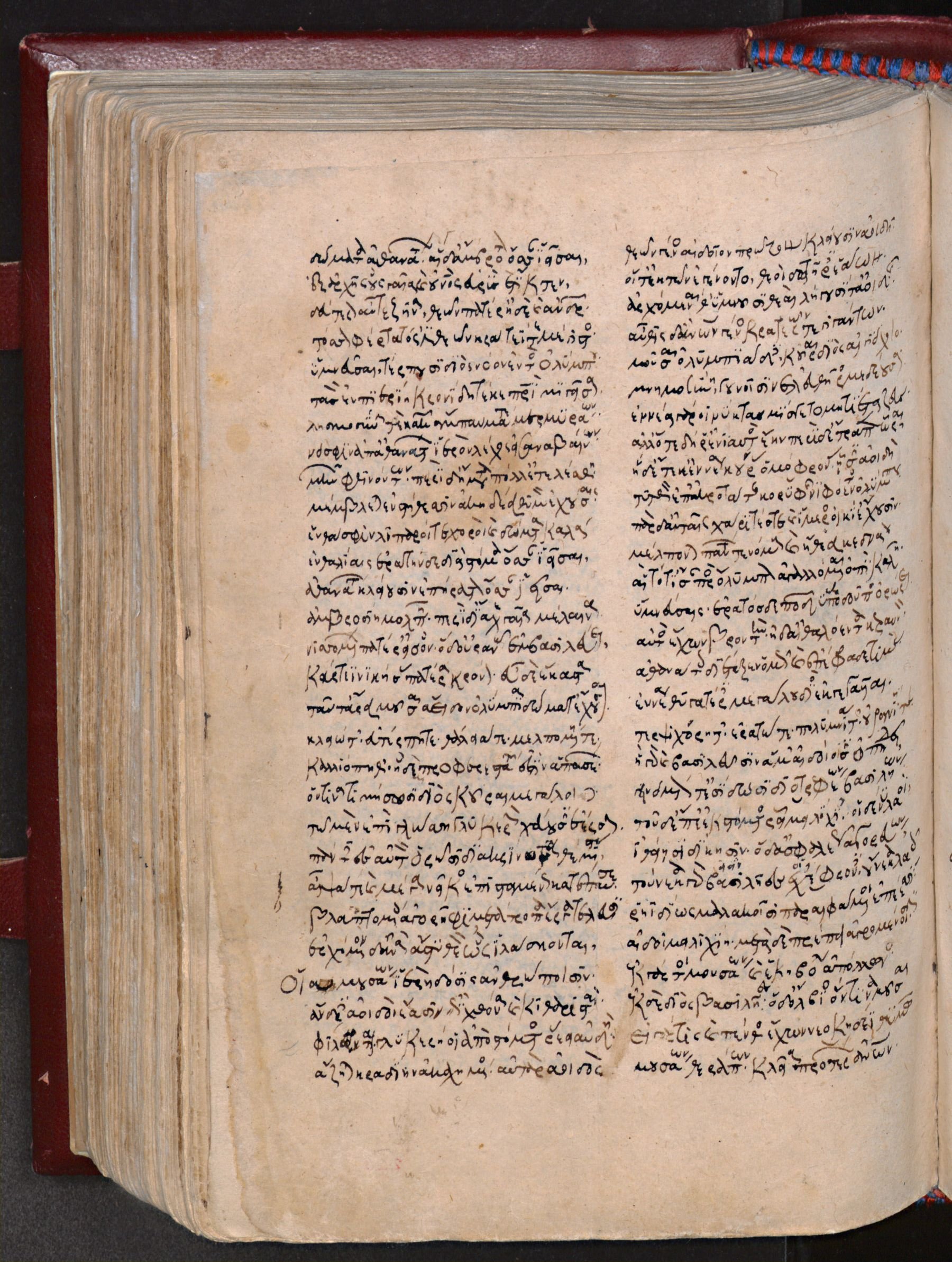
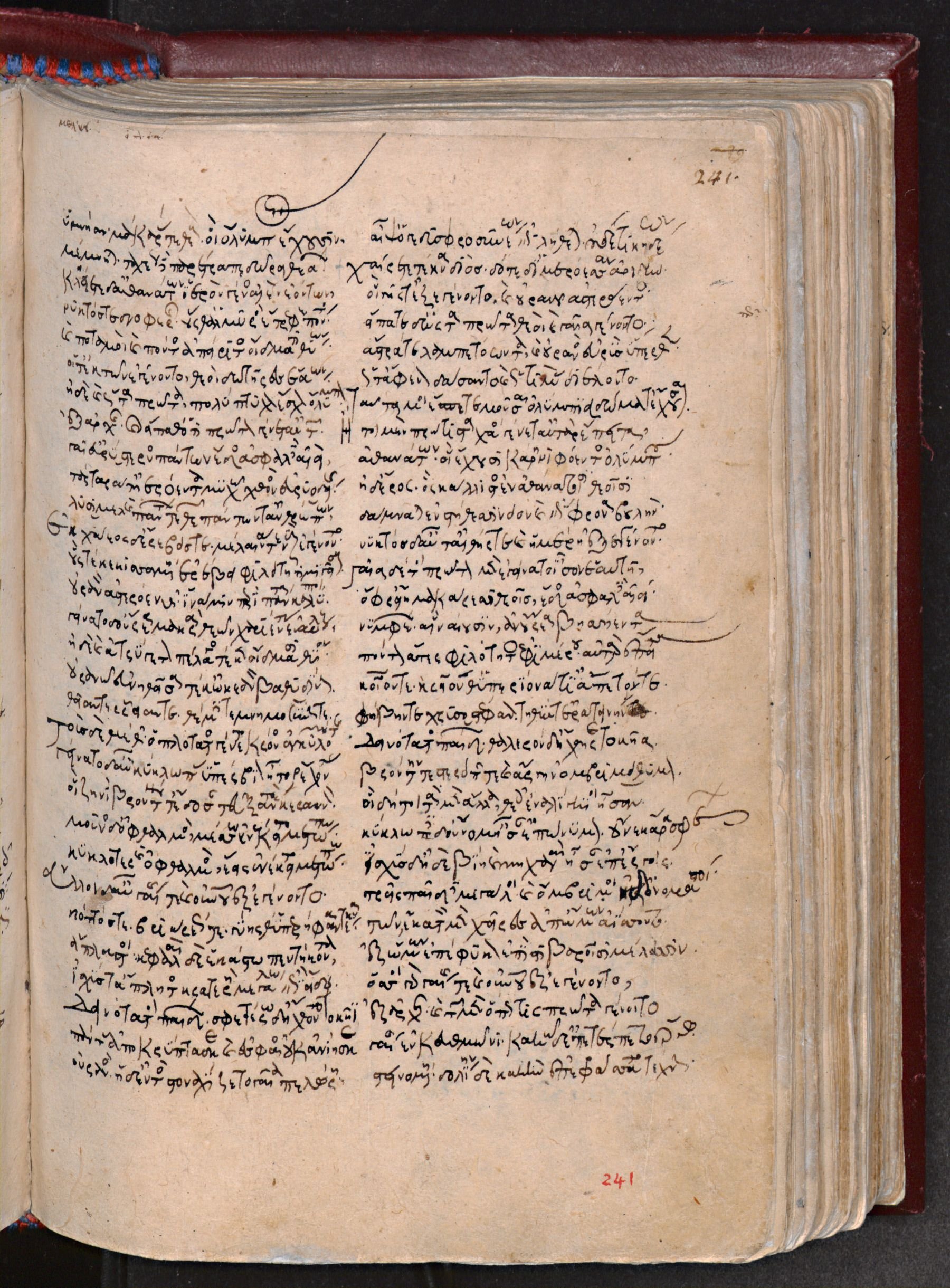
The page photographs are from Florence, Biblioteca Medicea Laurenziana, Plut. 32.16 (paper, late 13th century; a large collection of Greek poetry that also holds letters of Maximus Planudes), Theogony on fols. 240r-247v, the oldest complete manuscript of the poem with published images, in the Biblioteca Medicea Laurenziana's Teca Digitale. This part is on fol. 240r, 240v, 241r. The scribe writes two verses to a row, one in each column, so a page is read across the columns, row by row. Each section below is one page; its note gives the page's first and last verse as read on the photograph.
The Greek is Evelyn-White's Loeb text (1914) via Perseus, not a transcription of this manuscript, whose wording differs here and there. Verses the editor brackets as later additions are shown in square brackets. The English is Evelyn-White's prose translation (1914); it is cut at the end of his sentences, so where a sentence runs across a page break it is given whole to one page; each section's note gives the exact lines its English covers.
How was this verified? (Provenance)
Where on the image
Laur. Plut. 32.16, fol. 240r: lines 1-42, begins ‹Μουσάων Ἑλικωνιάδων ἀρχώμεθʼ ἀείδειν,›, ends ‹δὲ κάρη νιφόεντος Ὀλύμπου›. Checked on the image: first and last rows read and matched to the Greek (re-read on the image 2026-11-12: first row ‹1 | 2: Μουσάων ἑλικωνιάδων ἀρχώμεθ' ... | αἵθ' ἑλικῶνος ἔχουσιν ...›, last row ‹41 | 42: ... θεᾶν ὀπὶ λειριοέσσῃ | ... κάρη νιφόεντος ὀλύμπου›); this is the first page of the poem and the page after begins at line 43. The Theogony begins in the lower half of the page under the faded red title ἡσιόδου θεογονία, with a faded red initial; 21 rows of two verses. English here: lines 1-43, cut at the end of Evelyn-White's sentences. His sentence that runs across the break with the next page is given whole here, so the English ends with line 43 (‹... the homes of the immortals.›).
1Μουσάων Ἑλικωνιάδων ἀρχώμεθʼ ἀείδειν,
2αἵθʼ Ἑλικῶνος ἔχουσιν ὄρος μέγα τε ζάθεόν τε
3καί τε περὶ κρήνην ἰοειδέα πόσσʼ ἁπαλοῖσιν
4ὀρχεῦνται καὶ βωμὸν ἐρισθενέος Κρονίωνος.
5καί τε λοεσσάμεναι τέρενα χρόα Περμησσοῖο
6ἢ Ἵππου κρήνης ἢ Ὀλμειοῦ ζαθέοιο
7ἀκροτάτῳ Ἑλικῶνι χοροὺς ἐνεποιήσαντο
8καλούς, ἱμερόεντας· ἐπερρώσαντο δὲ ποσσίν.
9ἔνθεν ἀπορνύμεναι, κεκαλυμμέναι ἠέρι πολλῇ,
10ἐννύχιαι στεῖχον περικαλλέα ὄσσαν ἱεῖσαι,
11ὑμνεῦσαι Δία τʼ αἰγίοχον καὶ πότνιαν Ἥρην
12Ἀργεΐην, χρυσέοισι πεδίλοις ἐμβεβαυῖαν,
13κούρην τʼ αἰγιόχοιο Διὸς γλαυκῶπιν Ἀθήνην
14Φοῖβόν τʼ Ἀπόλλωνα καὶ Ἄρτεμιν ἰοχέαιραν
15ἠδὲ Ποσειδάωνα γεήοχον, ἐννοσίγαιον,
16καὶ Θέμιν αἰδοίην ἑλικοβλέφαρόν τʼ Ἀφροδίτην
17Ἥβην τε χρυσοστέφανον καλήν τε Διώνην
18Λητώ τʼ Ἰαπετόν τε ἰδὲ Κρόνον ἀγκυλομήτην
19Ἠῶ τʼ Ἠέλιόν τε μέγαν λαμπράν τε Σελήνην
20Γαῖάν τʼ Ὠκεανόν τε μέγαν καὶ Νύκτα μέλαιναν
21ἄλλων τʼ ἀθανάτων ἱερὸν γένος αἰὲν ἐόντων.
22αἵ νύ ποθʼ Ἡσίοδον καλὴν ἐδίδαξαν ἀοιδήν,
23ἄρνας ποιμαίνονθʼ Ἑλικῶνος ὕπο ζαθέοιο.
24τόνδε δέ με πρώτιστα θεαὶ πρὸς μῦθον ἔειπον,
25Μοῦσαι Ὀλυμπιάδες, κοῦραι Διὸς αἰγιόχοιο·
26ποιμένες ἄγραυλοι, κάκʼ ἐλέγχεα, γαστέρες οἶον,
27ἴδμεν ψεύδεα πολλὰ λέγειν ἐτύμοισιν ὁμοῖα,
28ἴδμεν δʼ, εὖτʼ ἐθέλωμεν, ἀληθέα γηρύσασθαι.
29ὣς ἔφασαν κοῦραι μεγάλου Διὸς ἀρτιέπειαι·
30καί μοι σκῆπτρον ἔδον δάφνης ἐριθηλέος ὄζον
31δρέψασαι, θηητόν· ἐνέπνευσαν δέ μοι αὐδὴν
32θέσπιν, ἵνα κλείοιμι τά τʼ ἐσσόμενα πρό τʼ ἐόντα.
33καί μʼ ἐκέλονθʼ ὑμνεῖν μακάρων γένος αἰὲν ἐόντων,
34σφᾶς δʼ αὐτὰς πρῶτόν τε καὶ ὕστατον αἰὲν ἀείδειν.
35ἀλλὰ τί ἦ μοι ταῦτα περὶ δρῦν ἢ περὶ πέτρην;
36τύνη, Μουσάων ἀρχώμεθα, ταὶ Διὶ πατρὶ
37ὑμνεῦσαι τέρπουσι μέγαν νόον ἐντὸς Ὀλύμπου,
38εἰρεῦσαι τά τʼ ἐόντα τά τʼ ἐσσόμενα πρό τʼ ἐόντα,
39φωνῇ ὁμηρεῦσαι· τῶν δʼ ἀκάματος ῥέει αὐδὴ
40ἐκ στομάτων ἡδεῖα· γελᾷ δέ τε δώματα πατρὸς
41Ζηνὸς ἐριγδούποιο θεᾶν ὀπὶ λειριοέσσῃ
42σκιδναμένῃ· ἠχεῖ δὲ κάρη νιφόεντος Ὀλύμπου
1From the Heliconian Muses let us begin to sing, who hold the great and holy mount of Helicon, and dance on soft feet about the deep-blue spring and the altar of the almighty son of Cronos, 5and, when they have washed their tender bodies in Permessus or in the Horse's Spring or Olmeius, make their fair, lovely dances upon highest Helicon and move with vigorous feet. Thence they arise and go abroad by night, 10veiled in thick mist, and utter their song with lovely voice, praising Zeus the aegis-holder, and queenly Hera of Argos who walks on golden sandals, and the daughter of Zeus the aegis-holder bright-eyed Athena, and Phoebus Apollo, and Artemis who delights in arrows, 15and Poseidon the earth holder who shakes the earth, and revered Themis, and quick-glancing Aphrodite, and Hebe with the crown of gold, and fair Dione, Leto, Iapetus, and Cronos the crafty counsellor, Eos, and great Helius, and bright Selene, 20Earth, too, and great Oceanus, and dark Night, and the holy race of all the other deathless ones that are for ever. And one day they taught Hesiod glorious song while he was shepherding his lambs under holy Helicon, and this word first the goddesses said to me— 25the Muses of Olympus, daughters of Zeus who holds the aegis: “Shepherds of the wilderness, wretched things of shame, mere bellies, we know how to speak many false things as though they were true; but we know, when we will, to utter true things.” 29So said the ready-voiced daughters of great Zeus, and they plucked and gave 30me a rod, a shoot of sturdy laurel, a marvellous thing, and breathed into me a divine voice to celebrate things that shall be and things that were aforetime; and they bade me sing of the race of the blessed gods that are eternally, but ever to sing of themselves both first and last. 35But why all this about oak or stone? Come you, let us begin with the Muses who gladden the great spirit of their father Zeus in Olympus with their songs, telling of things that are and that shall be and that were aforetime with consenting voice. Unwearying flows the sweet sound 40from their lips, and the house of their father Zeus the loud-thunderer is glad at the lily-like voice of the goddesses as it spreads abroad, and the peaks of snowy Olympus resound, and the homes of the immortals.
Where on the image
Laur. Plut. 32.16, fol. 240v: lines 43-100, begins ‹δώματά τʼ ἀθανάτων. αἳ›, ends ‹θεράπων κλέεα προτέρων ἀνθρώπων›. Checked on the image: first and last rows read and matched to the Greek (re-read on the image 2026-11-12: first row ‹43 | 44: δώματ' ἀθανάτων αἳ δ' ... | θεῶν γένος αἰδοῖον ...›, last row ‹99 | 100: ... ἀκαχήμενος αὐτὰρ ἀοιδὸς | μουσάων θεράπων κλέα προτέρων ...›); the page before ends at line 42 and the page after begins at line 101. English here: lines 43-97, cut at the end of Evelyn-White's sentences. The sentence that runs across the page break (to line 43) is given whole with the page before; the English here begins with ‹And they, uttering their immortal voice ...› (line 43). His sentence ‹For although a man has sorrow ...› begins in line 98, before the page break, and is given whole with the next page, so the English here ends with line 97.
43δώματά τʼ ἀθανάτων. αἳ δʼ ἄμβροτον ὄσσαν ἱεῖσαι
44θεῶν γένος αἰδοῖον πρῶτον κλείουσιν ἀοιδῇ
45ἐξ ἀρχῆς, οὓς Γαῖα καὶ Οὐρανὸς εὐρὺς ἔτικτεν,
46οἵ τʼ ἐκ τῶν ἐγένοντο θεοί, δωτῆρες ἐάων.
47δεύτερον αὖτε Ζῆνα, θεῶν πατέρʼ ἠδὲ καὶ ἀνδρῶν,
48ἀρχόμεναί θʼ ὑμνεῦσι καὶ ἐκλήγουσαι ἀοιδῆς,
49ὅσσον φέρτατός ἐστι θεῶν κράτεί τε μέγιστος.
50αὖτις δʼ ἀνθρώπων τε γένος κρατερῶν τε Γιγάντων
51ὑμνεῦσαι τέρπουσι Διὸς νόον ἐντὸς Ὀλύμπου
52Μοῦσαι Ὀλυμπιάδες, κοῦραι Διὸς αἰγιόχοιο.
53τὰς ἐν Πιερίῃ Κρονίδῃ τέκε πατρὶ μιγεῖσα
54Μνημοσύνη, γουνοῖσιν Ἐλευθῆρος μεδέουσα,
55λησμοσύνην τε κακῶν ἄμπαυμά τε μερμηράων.
56ἐννέα γάρ οἱ νυκτὸς ἐμίσγετο μητίετα Ζεὺς
57νόσφιν ἀπʼ ἀθανάτων ἱερὸν λέχος εἰσαναβαίνων·
58ἀλλʼ ὅτε δή ῥʼ ἐνιαυτὸς ἔην, περὶ δʼ ἔτραπον ὧραι
59μηνῶν φθινόντων, περὶ δʼ ἤματα πόλλʼ ἐτελέσθη,
60ἣ δʼ ἔτεκʼ ἐννέα κούρας ὁμόφρονας, ᾗσιν ἀοιδὴ
61μέμβλεται ἐν στήθεσσιν, ἀκηδέα θυμὸν ἐχούσαις,
62τυτθὸν ἀπʼ ἀκροτάτης κορυφῆς νιφόεντος Ὀλύμπου.
63ἔνθα σφιν λιπαροί τε χοροὶ καὶ δώματα καλά.
64πὰρ δʼ αὐτῇς Χάριτές τε καὶ Ἵμερος οἰκίʼ ἔχουσιν
65ἐν θαλίῃς· ἐρατὴν δὲ διὰ στόμα ὄσσαν ἱεῖσαι
66μέλπονται πάντων τε νόμους καὶ ἤθεα κεδνὰ
67ἀθανάτων κλείουσιν, ἐπήρατον ὄσσαν ἱεῖσαι.
68αἳ τότʼ ἴσαν πρὸς Ὄλυμπον ἀγαλλόμεναι ὀπὶ καλῇ,
69ἀμβροσίῃ μολπῇ· περὶ δʼ ἴαχε γαῖα μέλαινα
70ὑμνεύσαις, ἐρατὸς δὲ ποδῶν ὕπο δοῦπος ὀρώρει
71νισσομένων πατέρʼ εἰς ὅν· ὃ δʼ οὐρανῷ ἐμβασιλεύει,
72αὐτὸς ἔχων βροντὴν ἠδʼ αἰθαλόεντα κεραυνόν,
73κάρτει νικήσας πατέρα Κρόνον· εὖ δὲ ἕκαστα
74ἀθανάτοις διέταξεν ὁμῶς καὶ ἐπέφραδε τιμάς.
75ταῦτʼ ἄρα Μοῦσαι ἄειδον, Ὀλύμπια δώματʼ ἔχουσαι,
76ἐννέα θυγατέρες μεγάλου Διὸς ἐκγεγαυῖαι,
77Κλειώ τʼ Εὐτέρπη τε Θάλειά τε Μελπομένη τε
78Τερψιχόρη τʼ Ἐρατώ τε Πολύμνιά τʼ Οὐρανίη τε
79Καλλιόπη θʼ· ἣ δὲ προφερεστάτη ἐστὶν ἁπασέων.
80ἣ γὰρ καὶ βασιλεῦσιν ἅμʼ αἰδοίοισιν ὀπηδεῖ.
81ὅν τινα τιμήσωσι Διὸς κοῦραι μεγάλοιο
82γεινόμενόν τε ἴδωσι διοτρεφέων βασιλήων,
83τῷ μὲν ἐπὶ γλώσσῃ γλυκερὴν χείουσιν ἐέρσην,
84τοῦ δʼ ἔπεʼ ἐκ στόματος ῥεῖ μείλιχα· οἱ δέ τε λαοὶ
85πάντες ἐς αὐτὸν ὁρῶσι διακρίνοντα θέμιστας
86ἰθείῃσι δίκῃσιν· ὃ δʼ ἀσφαλέως ἀγορεύων
87αἶψά κε καὶ μέγα νεῖκος ἐπισταμένως κατέπαυσεν·
88τοὔνεκα γὰρ βασιλῆες ἐχέφρονες, οὕνεκα λαοῖς
89βλαπτομένοις ἀγορῆφι μετάτροπα ἔργα τελεῦσι
90ῥηιδίως, μαλακοῖσι παραιφάμενοι ἐπέεσσιν.
91ἐρχόμενον δʼ ἀνʼ ἀγῶνα θεὸν ὣς ἱλάσκονται
92αἰδοῖ μειλιχίῃ, μετὰ δὲ πρέπει ἀγρομένοισιν·
93τοίη Μουσάων ἱερὴ δόσις ἀνθρώποισιν.
94ἐκ γάρ τοι Μουσέων καὶ ἑκηβόλου Ἀπόλλωνος
95ἄνδρες ἀοιδοὶ ἔασιν ἐπὶ χθόνα καὶ κιθαρισταί,
96ἐκ δὲ Διὸς βασιλῆες· ὃ δʼ ὄλβιος, ὅν τινα Μοῦσαι
97φίλωνται· γλυκερή οἱ ἀπὸ στόματος ῥέει αὐδή.
98εἰ γάρ τις καὶ πένθος ἔχων νεοκηδέι θυμῷ
99ἄζηται κραδίην ἀκαχήμενος, αὐτὰρ ἀοιδὸς
100Μουσάων θεράπων κλέεα προτέρων ἀνθρώπων
43And they, uttering their immortal voice, celebrate in song first of all the revered race of the gods 45from the beginning, those whom Earth and wide Heaven begot, and the gods sprung of these, givers of good things. Then next, the goddesses sing of Zeus, the father of gods and men, as they begin and end their strain, how much he is the most excellent among the gods and supreme in power. 50And again, they chant the race of men and strong giants, and gladden the heart of Zeus within Olympus,—the Olympian Muses, daughters of Zeus the aegis-holder. 53Them in Pieria did Mnemosyne (Memory), who reigns over the hills of Eleuther, bear of union with the father, the son of Cronos, 55a forgetting of ills and a rest from sorrow. For nine nights did wise Zeus lie with her, entering her holy bed remote from the immortals. And when a year was passed and the seasons came round as the months waned, and many days were accomplished, 60she bore nine daughters, all of one mind, whose hearts are set upon song, and whose spirit is free from care, a little way from the top-most peak of snowy Olympus. 63There are their bright dancing places and beautiful homes, and beside them the Graces and Himerus (Desire) live 65in delight. And they, uttering through their lips a lovely voice, sing the laws of all and the goodly ways of the immortals, uttering their lovely voice. Then went they to Olympus, delighting in their sweet voice, with heavenly song, and the dark earth resounded 70about them as they chanted and a lovely sound rose up beneath their feet as they went to their father. And he was reigning in heaven, himself holding the lightning and glowing thunderbolt, when he had overcome by might his father Cronos; and he distributed fairly to the immortals their portions and declared their privileges. 75These things, then, the Muses sang who dwell on Olympus, nine daughters begotten by great Zeus, Cleio and Euterpe, Thaleia, Melpomene and Terpsichore, and Erato and Polyhymnia and Urania and Calliope, who is the chiefest of them all, 80for she attends on worshipful princes: whomever of heaven-nourished princes the daughters of great Zeus honor and behold at his birth, they pour sweet dew upon his tongue, and from his lips flow gracious words. All the people 85look towards him while he settles causes with true judgements: and he, speaking surely, would soon make wise end even of a great quarrel; for therefore are there princes wise in heart, because when the people are being misguided in their assembly, they set right the matter again 90with ease, persuading them with gentle words. And when he passes through a gathering, they greet him as a god with gentle reverence, and he is conspicuous amongst the assembled: such is the holy gift of the Muses to men. For it is through the Muses and far-shooting Apollo that 95there are singers and harpers upon the earth; but princes are of Zeus, and happy is he whom the Muses love: sweet flows speech from his mouth.
Where on the image
Laur. Plut. 32.16, fol. 241r: lines 101-160, begins ‹ὑμνήσῃ μάκαράς τε θεούς,›, ends ‹κακήν τʼ ἐφράσσατο τέχνην.›. Checked on the image: first and last rows read and matched to the Greek (re-read on the image 2026-11-12: first row ‹101 | 102: ὑμνήσῃ μάκαράς τε θεοὺς ... | αἶψ' ὅ γε δυσφροσυνέων ...›, last row ‹159 | 160: ... στοναχίζετο γαῖα πελώρη | ... κακήν τ' ἐφράσσατο τέχνην›); the page before ends at line 100 and the page after begins at line 161. This section shows lines 101-103 of that page; the rest of the page belongs to the next part of the poem. English here: lines 98-103, cut at the end of Evelyn-White's sentences. His sentence ‹For although a man has sorrow ...› begins in line 98, before the page break, and is given whole with this page.
101ὑμνήσῃ μάκαράς τε θεούς, οἳ Ὄλυμπον ἔχουσιν,
102αἶψʼ ὅ γε δυσφροσυνέων ἐπιλήθεται οὐδέ τι κηδέων
103μέμνηται· ταχέως δὲ παρέτραπε δῶρα θεάων.
98For although a man has sorrow and grief in his newly-troubled soul and lives in dread because his heart is distressed, yet, when a singer, 100the servant of the Muses, chants the glorious deeds of men of old and the blessed gods who inhabit Olympus, at once he forgets his heaviness and remembers not his sorrows at all; but the gifts of the goddesses soon turn him away from these.
Notes
- Greek: H. G. Evelyn-White, Hesiod, the Homeric Hymns and Homerica (Loeb Classical Library, 1914), via Perseus. Square brackets mark verses the editor regards as interpolated.
- English: H. G. Evelyn-White's translation in the same volume; his footnotes are omitted.
- Lines 929a-929t of the Loeb text (a passage on the birth of Athena quoted by Galen from Chrysippus) are not in the medieval manuscripts and are not included.
Cite
Sources
- Source: Laur. Plut. 32.16 (BML Teca Digitale IIIF) + Evelyn-White Greek (Loeb 1914, Perseus) + Evelyn-White English (1914, Perseus) (holding institution)
- Critical edition: Evelyn-White, Loeb 1914, via Perseus
← previous · → next · v cycle view · l back to library