Hesiod, Theogony 104-206: Chaos, Earth and Heaven; the Titans; Cronos and the castration of Heaven
Introduction
Hesiod's Theogony (c. 700 BCE) is the oldest Greek account of the origin of the world and the gods, from Chaos and Earth through the reign of Cronos to the victory of Zeus. This part: Chaos, Earth and Heaven; the Titans; Cronos and the castration of Heaven (lines 104-206, 103 lines). The invocation, the first beings (Chaos, Earth, Tartarus, Eros), the children of Earth and Heaven, Cronos' sickle and the birth of Aphrodite.
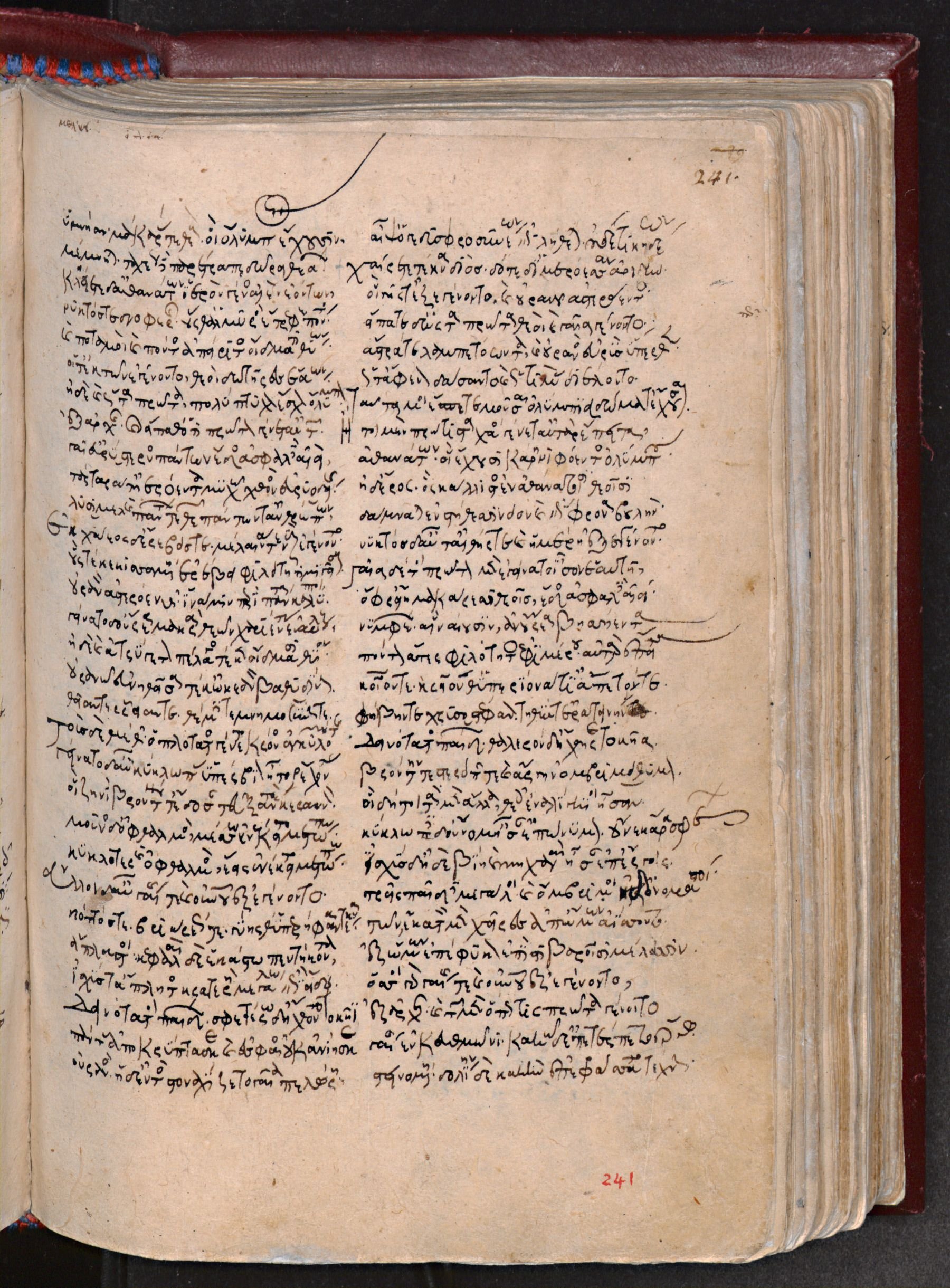
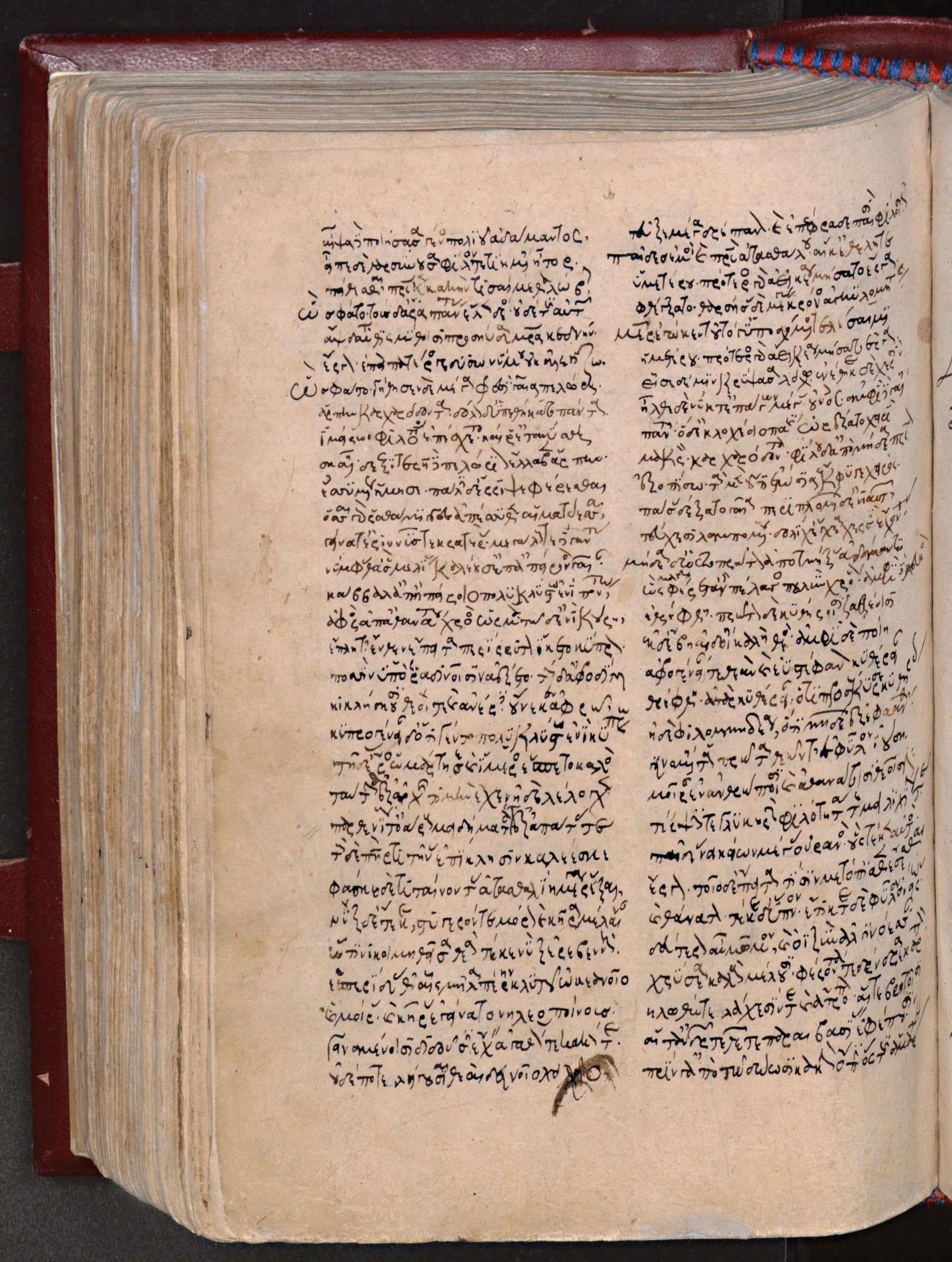
The page photographs are from Florence, Biblioteca Medicea Laurenziana, Plut. 32.16 (paper, late 13th century; a large collection of Greek poetry that also holds letters of Maximus Planudes), Theogony on fols. 240r-247v, the oldest complete manuscript of the poem with published images, in the Biblioteca Medicea Laurenziana's Teca Digitale. This part is on fol. 241r, 241v. The scribe writes two verses to a row, one in each column, so a page is read across the columns, row by row. Each section below is one page; its note gives the page's first and last verse as read on the photograph.
The Greek is Evelyn-White's Loeb text (1914) via Perseus, not a transcription of this manuscript, whose wording differs here and there. Verses the editor brackets as later additions are shown in square brackets. The English is Evelyn-White's prose translation (1914); it is cut at the end of his sentences, so where a sentence runs across a page break it is given whole to one page; each section's note gives the exact lines its English covers.
How was this verified? (Provenance)
Where on the image
Laur. Plut. 32.16, fol. 241r: lines 101-160, begins ‹ὑμνήσῃ μάκαράς τε θεούς,›, ends ‹κακήν τʼ ἐφράσσατο τέχνην.›. Checked on the image: first and last rows read and matched to the Greek (re-read on the image 2026-11-12: first row ‹101 | 102: ὑμνήσῃ μάκαράς τε θεοὺς ... | αἶψ' ὅ γε δυσφροσυνέων ...›, last row ‹159 | 160: ... στοναχίζετο γαῖα πελώρη | ... κακήν τ' ἐφράσσατο τέχνην›); the page before ends at line 100 and the page after begins at line 161. This section shows lines 104-160 of that page; the rest of the page belongs to the previous part of the poem. English here: lines 104-160, cut at the end of Evelyn-White's sentences. At the break with the next page the English ends with line 160, the same line as the Greek.
104χαίρετε, τέκνα Διός, δότε δʼ ἱμερόεσσαν ἀοιδήν.
105κλείετε δʼ ἀθανάτων ἱερὸν γένος αἰὲν ἐόντων,
106οἳ Γῆς τʼ ἐξεγένοντο καὶ Οὐρανοῦ ἀστερόεντος,
107Νυκτός τε δνοφερῆς, οὕς θʼ ἁλμυρὸς ἔτρεφε Πόντος.
108εἴπατε δʼ, ὡς τὰ πρῶτα θεοὶ καὶ γαῖα γένοντο
109καὶ ποταμοὶ καὶ πόντος ἀπείριτος, οἴδματι θυίων,
110ἄστρα τε λαμπετόωντα καὶ οὐρανὸς εὐρὺς ὕπερθεν
111[οἵ τʼ ἐκ τῶν ἐγένοντο θεοί, δωτῆρες ἐάων]
112ὥς τʼ ἄφενος δάσσαντο καὶ ὡς τιμὰς διέλοντο
113ἠδὲ καὶ ὡς τὰ πρῶτα πολύπτυχον ἔσχον Ὄλυμπον.
114ταῦτά μοι ἔσπετε Μοῦσαι, Ὀλύμπια δώματʼ ἔχουσαι
115ἐξ ἀρχῆς, καὶ εἴπαθʼ, ὅ τι πρῶτον γένετʼ αὐτῶν.
116ἦ τοι μὲν πρώτιστα Χάος γένετʼ, αὐτὰρ ἔπειτα
117Γαῖʼ εὐρύστερνος, πάντων ἕδος ἀσφαλὲς αἰεὶ
118[ἀθανάτων, οἳ ἔχουσι κάρη νιφόεντος Ὀλύμπου,]
119Τάρταρά τʼ ἠερόεντα μυχῷ χθονὸς εὐρυοδείης,
120ἠδʼ Ἔρος, ὃς κάλλιστος ἐν ἀθανάτοισι θεοῖσι,
121λυσιμελής, πάντων δὲ θεῶν πάντων τʼ ἀνθρώπων
122δάμναται ἐν στήθεσσι νόον καὶ ἐπίφρονα βουλήν.
123ἐκ Χάεος δʼ Ἔρεβός τε μέλαινά τε Νὺξ ἐγένοντο·
124Νυκτὸς δʼ αὖτʼ Αἰθήρ τε καὶ Ἡμέρη ἐξεγένοντο,
125οὓς τέκε κυσαμένη Ἐρέβει φιλότητι μιγεῖσα.
126Γαῖα δέ τοι πρῶτον μὲν ἐγείνατο ἶσον ἑαυτῇ
127Οὐρανὸν ἀστερόενθʼ, ἵνα μιν περὶ πάντα καλύπτοι,
128ὄφρʼ εἴη μακάρεσσι θεοῖς ἕδος ἀσφαλὲς αἰεί.
129γείνατο δʼ Οὔρεα μακρά, θεῶν χαρίεντας ἐναύλους,
130Νυμφέων, αἳ ναίουσιν ἀνʼ οὔρεα βησσήεντα.
131ἣ δὲ καὶ ἀτρύγετον πέλαγος τέκεν, οἴδματι θυῖον,
132Πόντον, ἄτερ φιλότητος ἐφιμέρου· αὐτὰρ ἔπειτα
133Οὐρανῷ εὐνηθεῖσα τέκʼ Ὠκεανὸν βαθυδίνην,
134Κοῖόν τε Κρῖόν θʼ Ὑπερίονά τʼ Ἰαπετόν τε
135Θείαν τε Ῥείαν τε Θέμιν τε Μνημοσύνην τε
136Φοίβην τε χρυσοστέφανον Τηθύν τʼ ἐρατεινήν.
137τοὺς δὲ μέθʼ ὁπλότατος γένετο Κρόνος ἀγκυλομήτης,
138δεινότατος παίδων· θαλερὸν δʼ ἤχθηρε τοκῆα.
139γείνατο δʼ αὖ Κύκλωπας ὑπέρβιον ἦτορ ἔχοντας,
140Βρόντην τε Στερόπην τε καὶ Ἄργην ὀβριμόθυμον,
141οἳ Ζηνὶ βροντήν τε δόσαν τεῦξάν τε κεραυνόν.
142οἳ δή τοι τὰ μὲν ἄλλα θεοῖς ἐναλίγκιοι ἦσαν,
143μοῦνος δʼ ὀφθαλμὸς μέσσῳ ἐνέκειτο μετώπῳ.
144Κύκλωπες δʼ ὄνομʼ ἦσαν ἐπώνυμον, οὕνεκʼ ἄρα σφέων
145κυκλοτερὴς ὀφθαλμὸς ἕεις ἐνέκειτο μετώπῳ·
146ἰσχὺς δʼ ἠδὲ βίη καὶ μηχαναὶ ἦσαν ἐπʼ ἔργοις.
147ἄλλοι δʼ αὖ Γαίης τε καὶ Οὐρανοῦ ἐξεγένοντο
148τρεῖς παῖδες μεγάλοι τε καὶ ὄβριμοι, οὐκ ὀνομαστοί,
149Κόττος τε Βριάρεώς τε Γύης θʼ, ὑπερήφανα τέκνα.
150τῶν ἑκατὸν μὲν χεῖρες ἀπʼ ὤμων ἀίσσοντο,
151ἄπλαστοι, κεφαλαὶ δὲ ἑκάστῳ πεντήκοντα
152ἐξ ὤμων ἐπέφυκον ἐπὶ στιβαροῖσι μέλεσσιν·
153ἰσχὺς δʼ ἄπλητος κρατερὴ μεγάλῳ ἐπὶ εἴδει.
154ὅσσοι γὰρ Γαίης τε καὶ Οὐρανοῦ ἐξεγένοντο,
155δεινότατοι παίδων, σφετέρῳ δʼ ἤχθοντο τοκῆι
156ἐξ ἀρχῆς· καὶ τῶν μὲν ὅπως τις πρῶτα γένοιτο,
157πάντας ἀποκρύπτασκε, καὶ ἐς φάος οὐκ ἀνίεσκε,
158Γαίης ἐν κευθμῶνι, κακῷ δʼ ἐπετέρπετο ἔργῳ
159Οὐρανός. ἣ δʼ ἐντὸς στοναχίζετο Γαῖα πελώρη
160στεινομένη· δολίην δὲ κακήν τʼ ἐφράσσατο τέχνην.
104Hail, children of Zeus! Grant lovely song 105and celebrate the holy race of the deathless gods who are for ever, those that were born of Earth and starry Heaven and gloomy Night and them that briny Sea did rear. Tell how at the first gods and earth came to be, and rivers, and the boundless sea with its raging swell, 110and the gleaming stars, and the wide heaven above, and the gods who were born of them, givers of good things, and how they divided their wealth, and how they shared their honors amongst them, and also how at the first they took many-folded Olympus. These things declare to me from the beginning, you Muses who dwell in the house of Olympus, 115and tell me which of them first came to be. In truth at first Chaos came to be, but next wide-bosomed Earth, the ever-sure foundation of all the deathless ones who hold the peaks of snowy Olympus, and dim Tartarus in the depth of the wide-pathed Earth, 120and Eros (Love), fairest among the deathless gods, who unnerves the limbs and overcomes the mind and wise counsels of all gods and all men within them. From Chaos came forth Erebus and black Night; but of Night were born Aether and Day, 125whom she conceived and bore from union in love with Erebus. And Earth first bore starry Heaven, equal to herself, to cover her on every side, and to be an ever-sure abiding-place for the blessed gods. And she brought forth long hills, graceful haunts 130of the goddess Nymphs who dwell amongst the glens of the hills. She bore also the fruitless deep with his raging swell, Pontus, without sweet union of love. But afterwards she lay with Heaven and bore deep-swirling Oceanus, Coeus and Crius and Hyperion and Iapetus, 135Theia and Rhea, Themis and Mnemosyne and gold-crowned Phoebe and lovely Tethys. After them was born Cronos the wily, youngest and most terrible of her children, and he hated his lusty sire. 139And again, she bore the Cyclopes, overbearing in spirit, 140Brontes, and Steropes and stubborn-hearted Arges, who gave Zeus the thunder and made the thunderbolt: in all else they were like the gods, 145but one eye only was set in the midst of their foreheads. And they were surnamed Cyclopes (Orb-eyed) because one orbed eye was set in their foreheads. Strength and might and craft were in their works. And again, three other sons were born of Earth and Heaven, great and doughty beyond telling, Cottus and Briareos and Gyes, presumptuous children. 150From their shoulders sprang a hundred arms, not to be approached, and fifty heads grew from the shoulders upon the strong limbs of each, and irresistible was the stubborn strength that was in their great forms. For of all the children that were born of Earth and Heaven, 155these were the most terrible, and they were hated by their own father from the first. And he used to hide them all away in a secret place of Earth so soon as each was born, and would not suffer them to come up into the light: and Heaven rejoiced in his evil doing. But vast Earth 160groaned within, being straitened, and she thought a crafty and an evil wile.
Where on the image
Laur. Plut. 32.16, fol. 241v: lines 161-222, begins ‹αἶψα δὲ ποιήσασα γένος›, ends ‹ὄπιν, ὅς τις ἁμάρτῃ.›. Checked on the image: first and last rows read and matched to the Greek (re-read on the image 2026-11-12: first row ‹161 | 162: αἶψα δὲ ποιήσασα γένος ... | τεῦξε μέγα δρέπανον ...›, last row ‹221 | 222: ... θεαὶ δεινοῖο χόλοιο | ... κακὴν ὄπιν ὅς τις ἁμάρτῃ›); the page before ends at line 160 and the page after begins at line 223. This section shows lines 161-206 of that page; the rest of the page belongs to the next part of the poem. English here: lines 161-206, cut at the end of Evelyn-White's sentences. At the break with the page before, his sentence for line 161 (‹Forthwith she made the element of grey flint ...›) begins with the Greek of this page.
161αἶψα δὲ ποιήσασα γένος πολιοῦ ἀδάμαντος
162τεῦξε μέγα δρέπανον καὶ ἐπέφραδε παισὶ φίλοισιν·
163εἶπε δὲ θαρσύνουσα, φίλον τετιημένη ἦτορ·
164παῖδες ἐμοὶ καὶ πατρὸς ἀτασθάλου, αἴ κʼ ἐθέλητε
165πείθεσθαι, πατρός κε κακὴν τισαίμεθα λώβην
166ὑμετέρου· πρότερος γὰρ ἀεικέα μήσατο ἔργα.
167ὣς φάτο· τοὺς δʼ ἄρα πάντας ἕλεν δέος, οὐδέ τις αὐτῶν
168φθέγξατο. θαρσήσας δὲ μέγας Κρόνος ἀγκυλομήτης
169ἂψ αὖτις μύθοισι προσηύδα μητέρα κεδνήν·
170μῆτερ, ἐγώ κεν τοῦτό γʼ ὑποσχόμενος τελέσαιμι
171ἔργον, ἐπεὶ πατρός γε δυσωνύμου οὐκ ἀλεγίζω
172ἡμετέρου· πρότερος γὰρ ἀεικέα μήσατο ἔργα.
173ὣς φάτο· γήθησεν δὲ μέγα φρεσὶ Γαῖα πελώρη·
174εἷσε δέ μιν κρύψασα λόχῳ· ἐνέθηκε δὲ χερσὶν
175ἅρπην καρχαρόδοντα· δόλον δʼ ὑπεθήκατο πάντα.
176ἦλθε δὲ νύκτʼ ἐπάγων μέγας Οὐρανός, ἀμφὶ δὲ Γαίῃ
177ἱμείρων φιλότητος ἐπέσχετο καί ῥʼ ἐτανύσθη
178πάντη· ὃ δʼ ἐκ λοχέοιο πάις ὠρέξατο χειρὶ
179σκαιῇ, δεξιτερῇ δὲ πελώριον ἔλλαβεν ἅρπην
180μακρὴν καρχαρόδοντα, φίλου δʼ ἀπὸ μήδεα πατρὸς
181ἐσσυμένως ἤμησε, πάλιν δʼ ἔρριψε φέρεσθαι
182ἐξοπίσω· τὰ μὲν οὔ τι ἐτώσια ἔκφυγε χειρός·
183ὅσσαι γὰρ ῥαθάμιγγες ἀπέσσυθεν αἱματόεσσαι,
184πάσας δέξατο Γαῖα· περιπλομένων δʼ ἐνιαυτῶν
185γείνατʼ Ἐρινῦς τε κρατερὰς μεγάλους τε Γίγαντας,
186τεύχεσι λαμπομένους, δολίχʼ ἔγχεα χερσὶν ἔχοντας,
187Νύμφας θʼ ἃς Μελίας καλέουσʼ ἐπʼ ἀπείρονα γαῖαν.
188μήδεα δʼ ὡς τὸ πρῶτον ἀποτμήξας ἀδάμαντι
189κάββαλʼ ἀπʼ ἠπείροιο πολυκλύστῳ ἐνὶ πόντῳ,
190ὣς φέρετʼ ἂμ πέλαγος πουλὺν χρόνον, ἀμφὶ δὲ λευκὸς
191ἀφρὸς ἀπʼ ἀθανάτου χροὸς ὤρνυτο· τῷ δʼ ἔνι κούρη
192ἐθρέφθη· πρῶτον δὲ Κυθήροισιν ζαθέοισιν
193ἔπλητʼ, ἔνθεν ἔπειτα περίρρυτον ἵκετο Κύπρον.
194ἐκ δʼ ἔβη αἰδοίη καλὴ θεός, ἀμφὶ δὲ ποίη
195ποσσὶν ὕπο ῥαδινοῖσιν ἀέξετο· τὴν δʼ Ἀφροδίτην
196[ἀφρογενέα τε θεὰν καὶ ἐυστέφανον Κυθέρειαν]
197κικλῄσκουσι θεοί τε καὶ ἀνέρες, οὕνεκʼ ἐν ἀφρῷ
198θρέφθη· ἀτὰρ Κυθέρειαν, ὅτι προσέκυρσε Κυθήροις·
199Κυπρογενέα δʼ, ὅτι γέντο πολυκλύστῳ ἐνὶ Κύπρῳ·
200ἠδὲ φιλομμηδέα, ὅτι μηδέων ἐξεφαάνθη.
201τῇ δʼ Ἔρος ὡμάρτησε καὶ Ἵμερος ἕσπετο καλὸς
202γεινομένῃ τὰ πρῶτα θεῶν τʼ ἐς φῦλον ἰούσῃ.
203ταύτην δʼ ἐξ ἀρχῆς τιμὴν ἔχει ἠδὲ λέλογχε
204μοῖραν ἐν ἀνθρώποισι καὶ ἀθανάτοισι θεοῖσι,
205παρθενίους τʼ ὀάρους μειδήματά τʼ ἐξαπάτας τε
206τέρψιν τε γλυκερὴν φιλότητά τε μειλιχίην τε.
161Forthwith she made the element of grey flint and shaped a great sickle, and told her plan to her dear sons. And she spoke, cheering them, while she was vexed in her dear heart: 165“My children, gotten of a sinful father, if you will obey me, we should punish the vile outrage of your father; for he first thought of doing shameful things.” So she said; but fear seized them all, and none of them uttered a word. But great Cronos the wily took courage and answered his dear mother: 170“Mother, I will undertake to do this deed, for I reverence not our father of evil name, for he first thought of doing shameful things.” 173So he said: and vast Earth rejoiced greatly in spirit, and set and hid him in an ambush, and put in his hands 175a jagged sickle, and revealed to him the whole plot. And Heaven came, bringing on night and longing for love, and he lay about Earth spreading himself full upon her. Then the son from his ambush stretched forth his left hand and in his right took the great long sickle 180with jagged teeth, and swiftly lopped off his own father's members and cast them away to fall behind him. And not vainly did they fall from his hand; for all the bloody drops that gushed forth Earth received, and as the seasons moved round 185she bore the strong Erinyes and the great Giants with gleaming armour, holding long spears in their hands and the Nymphs whom they call Meliae all over the boundless earth. And so soon as he had cut off the members with flint and cast them from the land into the surging sea, 190they were swept away over the main a long time: and a white foam spread around them from the immortal flesh, and in it there grew a maiden. First she drew near holy Cythera, and from there, afterwards, she came to sea-girt Cyprus, and came forth an awful and lovely goddess, and grass 195grew up about her beneath her shapely feet. Her gods and men call Aphrodite, and the foam-born goddess and rich-crowned Cytherea, because she grew amid the foam, and Cytherea because she reached Cythera, and Cyprogenes because she was born in billowy Cyprus, 200and Philommedes because she sprang from the members. And with her went Eros, and comely Desire followed her at her birth at the first and as she went into the assembly of the gods. This honor she has from the beginning, and this is the portion allotted to her amongst men and undying gods,— 205the whisperings of maidens and smiles and deceits with sweet delight and love and graciousness.
Notes
- Greek: H. G. Evelyn-White, Hesiod, the Homeric Hymns and Homerica (Loeb Classical Library, 1914), via Perseus. Square brackets mark verses the editor regards as interpolated.
- English: H. G. Evelyn-White's translation in the same volume; his footnotes are omitted.
- Lines 929a-929t of the Loeb text (a passage on the birth of Athena quoted by Galen from Chrysippus) are not in the medieval manuscripts and are not included.
Cite
Sources
- Source: Laur. Plut. 32.16 (BML Teca Digitale IIIF) + Evelyn-White Greek (Loeb 1914, Perseus) + Evelyn-White English (1914, Perseus) (holding institution)
- Critical edition: Evelyn-White, Loeb 1914, via Perseus
← previous · → next · v cycle view · l back to library