Hesiod, Works and Days 1-41: Proem: Zeus, and the two kinds of Strife
Introduction
Hesiod's Works and Days (c. 700 BCE) is a poem of advice to his brother Perses on justice, work and the farmer's year. It contains the myth of Prometheus and Pandora and the Five Ages of mankind, from the golden race to the race of iron. This part: Proem: Zeus, and the two kinds of Strife (lines 1-41, 41 lines). Hesiod calls on the Muses to sing of Zeus, then tells his brother Perses that there are two Strifes: one breeds war, the other good competition.
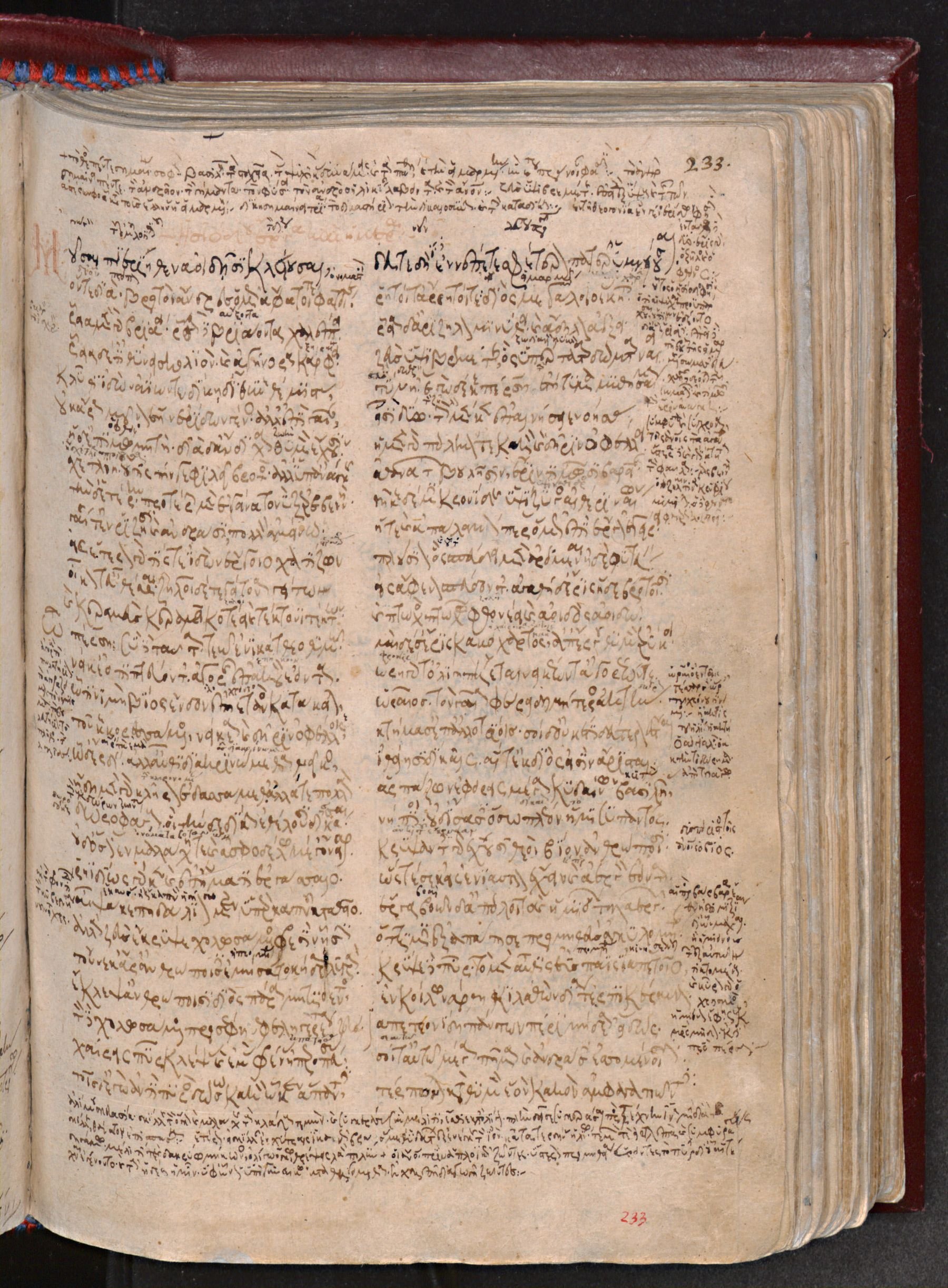
The page photographs are from Florence, Biblioteca Medicea Laurenziana, Plut. 32.16 (paper, late 13th century; a large collection of Greek poetry that also holds letters of Maximus Planudes), Works and Days on fols. 233r-239v, in the Biblioteca Medicea Laurenziana's Teca Digitale. Older manuscripts of the poem exist (Paris gr. 2771, 10th/11th century; Florence, Laur. Plut. 31.39, 12th century), but this copy is legible on every page and holds Hesiod's three poems together. This part is on fol. 233r. The scribe writes two verses to a row, one in each column, so a page is read across the columns, row by row; the margins are filled with scholia (ancient and Byzantine notes). Each section below is one page; its note gives the page's first and last verse as read on the photograph.
The Greek is Evelyn-White's Loeb text (1914) via Perseus, not a transcription of this manuscript, whose wording differs here and there. Verses the editor brackets as later additions are shown in square brackets. The English is Evelyn-White's prose translation (1914); it is cut at the end of his sentences, so where a sentence runs across a page break it is given whole to one page; each section's note gives the exact lines its English covers.
How was this verified? (Provenance)
Where on the image
Laur. Plut. 32.16, fol. 233r: lines 1-58, begins ‹μοῦσαι Πιερίηθεν ἀοιδῇσιν κλείουσαι›, ends ‹θυμὸν ἑὸν κακὸν ἀμφαγαπῶντες.›. Checked on the image: first and last verse rows read and matched to the Greek (re-read on the image 2026-11-12: first row ‹1 | 2: μοῦσαι πιερίηθεν ἀοιδῆσι ... | δεῦτε δί' ἐννέπετε ...›, last row ‹57 | 58: ... δώσω κακὸν ᾧ κεν ἅπαντες | ... κακὸν ἀμφαγαπῶντ(ες)›); this is the first page of the poem and the page after begins at line 59. This section shows lines 1-41 of that page; the rest of the page belongs to the next part of the poem. The poem begins under a faded red title with a large red initial M; scholia in the upper and lower margins and down the right side. English here: lines 1-41, cut at the end of Evelyn-White's sentences.
1μοῦσαι Πιερίηθεν ἀοιδῇσιν κλείουσαι
2δεῦτε, Δίʼ ἐννέπετε, σφέτερον πατέρʼ ὑμνείουσαι·
3ὅντε διὰ βροτοὶ ἄνδρες ὁμῶς ἄφατοί τε φατοί τε,
4ῥητοί τʼ ἄρρητοί τε Διὸς μεγάλοιο ἕκητι.
5ῥέα μὲν γὰρ βριάει, ῥέα δὲ βριάοντα χαλέπτει,
6ῥεῖα δʼ ἀρίζηλον μινύθει καὶ ἄδηλον ἀέξει,
7ῥεῖα δέ τʼ ἰθύνει σκολιὸν καὶ ἀγήνορα κάρφει
8Ζεὺς ὑψιβρεμέτης, ὃς ὑπέρτατα δώματα ναίει.
9κλῦθι ἰδὼν ἀίων τε, δίκῃ δʼ ἴθυνε θέμιστας
10τύνη· ἐγὼ δέ κε, Πέρση, ἐτήτυμα μυθησαίμην.
11οὐκ ἄρα μοῦνον ἔην Ἐρίδων γένος, ἀλλʼ ἐπὶ γαῖαν
12εἰσὶ δύω· τὴν μέν κεν ἐπαινέσσειε νοήσας,
13ἣ δʼ ἐπιμωμητή· διὰ δʼ ἄνδιχα θυμὸν ἔχουσιν.
14ἣ μὲν γὰρ πόλεμόν τε κακὸν καὶ δῆριν ὀφέλλει,
15σχετλίη· οὔτις τήν γε φιλεῖ βροτός, ἀλλʼ ὑπʼ ἀνάγκης
16ἀθανάτων βουλῇσιν Ἔριν τιμῶσι βαρεῖαν.
17τὴν δʼ ἑτέρην προτέρην μὲν ἐγείνατο Νὺξ ἐρεβεννή,
18θῆκε δέ μιν Κρονίδης ὑψίζυγος, αἰθέρι ναίων,
19γαίης ἐν ῥίζῃσι, καὶ ἀνδράσι πολλὸν ἀμείνω·
20ἥτε καὶ ἀπάλαμόν περ ὁμῶς ἐπὶ ἔργον ἔγειρεν.
21εἰς ἕτερον γάρ τίς τε ἰδὼν ἔργοιο χατίζει
22πλούσιον, ὃς σπεύδει μὲν ἀρώμεναι ἠδὲ φυτεύειν
23οἶκόν τʼ εὖ θέσθαι· ζηλοῖ δέ τε γείτονα γείτων
24εἰς ἄφενος σπεύδοντʼ· ἀγαθὴ δʼ Ἔρις ἥδε βροτοῖσιν.
25καὶ κεραμεὺς κεραμεῖ κοτέει καὶ τέκτονι τέκτων,
26καὶ πτωχὸς πτωχῷ φθονέει καὶ ἀοιδὸς ἀοιδῷ.
27ὦ Πέρση, σὺ δὲ ταῦτα τεῷ ἐνικάτθεο θυμῷ,
28μηδέ σʼ Ἔρις κακόχαρτος ἀπʼ ἔργου θυμὸν ἐρύκοι
29νείκεʼ ὀπιπεύοντʼ ἀγορῆς ἐπακουὸν ἐόντα.
30ὤρη γάρ τʼ ὀλίγη πέλεται νεικέων τʼ ἀγορέων τε,
31ᾧτινι μὴ βίος ἔνδον ἐπηετανὸς κατάκειται
32ὡραῖος, τὸν γαῖα φέρει, Δημήτερος ἀκτήν.
33τοῦ κε κορεσσάμενος νείκεα καὶ δῆριν ὀφέλλοις
34κτήμασʼ ἐπʼ ἀλλοτρίοις· σοὶ δʼ οὐκέτι δεύτερον ἔσται
35ὧδʼ ἔρδειν· ἀλλʼ αὖθι διακρινώμεθα νεῖκος
36ἰθείῃσι δίκῃς, αἵ τʼ ἐκ Διός εἰσιν ἄρισται.
37ἤδη μὲν γὰρ κλῆρον ἐδασσάμεθʼ, ἀλλὰ τὰ πολλὰ
38ἁρπάζων ἐφόρεις μέγα κυδαίνων βασιλῆας
39δωροφάγους, οἳ τήνδε δίκην ἐθέλουσι δίκασσαι.
40νήπιοι, οὐδὲ ἴσασιν ὅσῳ πλέον ἥμισυ παντὸς
41οὐδʼ ὅσον ἐν μαλάχῃ τε καὶ ἀσφοδέλῳ μέγʼ ὄνειαρ.
1Muses of Pieria who give glory through song, come hither, tell of Zeus your father and chant his praise. Through him mortal men are famed or unfamed, sung or unsung alike, as great Zeus wills. 5For easily he makes strong, and easily he brings the strong man low; easily he humbles the proud and raises the obscure, and easily he straightens the crooked and blasts the proud,—Zeus who thunders aloft and has his dwelling most high. Attend thou with eye and ear, and make judgements straight with righteousness. 10And, Perses, I would tell of true things. 11So, after all, there was not one kind of Strife alone, but all over the earth there are two. As for the one, a man would praise her when he came to understand her; but the other is blameworthy: and they are wholly different in nature. For one fosters evil war and battle, being cruel: 15her no man loves; but perforce, through the will of the deathless gods, men pay harsh Strife her honor due. But the other is the elder daughter of dark Night, and the son of Cronos who sits above and dwells in the aether, set her in the roots of the earth: and she is far kinder to men. 20She stirs up even the shiftless to toil; for a man grows eager to work when he considers his neighbor, a rich man who hastens to plough and plant and put his house in good order; and neighbor vies with his neighbor as he hurries after wealth. This Strife is wholesome for men. 25And potter is angry with potter, and craftsman with craftsman, and beggar is jealous of beggar, and minstrel of minstrel. Perses, lay up these things in your heart, and do not let that Strife who delights in mischief hold your heart back from work, while you peep and peer and listen to the wrangles of the court-house. 30Little concern has he with quarrels and courts who has not a year's victuals laid up betimes, even that which the earth bears, Demeter's grain. When you have got plenty of that, you can raise disputes and strive to get another's goods. But you shall have no second chance 35to deal so again: nay, let us settle our dispute here with true judgement which is of Zeus and is perfect. For we had already divided our inheritance, but you seized the greater share and carried it off, greatly swelling the glory of our bribe-swallowing lords who love to judge such a cause as this. 40Fools! They know not how much more the half is than the whole, nor what great advantage there is in mallow and asphodel.
Notes
- Greek: H. G. Evelyn-White, Hesiod, the Homeric Hymns and Homerica (Loeb Classical Library, 1914), via Perseus. Square brackets mark verses the editor regards as interpolated.
- English: H. G. Evelyn-White's translation in the same volume; his footnotes are omitted.
- Lines 169a-169d of the Loeb text (fragments from a papyrus on Cronos and the fifth race) are not in the medieval manuscripts and are not included.
Cite
Sources
- Source: Laur. Plut. 32.16 (BML Teca Digitale IIIF) + Evelyn-White Greek (Loeb 1914, Perseus) + Evelyn-White English (1914, Perseus) (holding institution)
- Critical edition: Evelyn-White, Loeb 1914, via Perseus
← previous · → next · v cycle view · l back to library