Hesiod, Works and Days 42-108: Prometheus and Pandora
Introduction
Hesiod's Works and Days (c. 700 BCE) is a poem of advice to his brother Perses on justice, work and the farmer's year. It contains the myth of Prometheus and Pandora and the Five Ages of mankind, from the golden race to the race of iron. This part: Prometheus and Pandora (lines 42-108, 67 lines). Why men must work: Prometheus steals fire, and Zeus sends Pandora, who opens the jar of evils and leaves only Hope inside.
The page photographs are from Florence, Biblioteca Medicea Laurenziana, Plut. 32.16 (paper, late 13th century; a large collection of Greek poetry that also holds letters of Maximus Planudes), Works and Days on fols. 233r-239v, in the Biblioteca Medicea Laurenziana's Teca Digitale. Older manuscripts of the poem exist (Paris gr. 2771, 10th/11th century; Florence, Laur. Plut. 31.39, 12th century), but this copy is legible on every page and holds Hesiod's three poems together. This part is on fol. 233r, 233v. The scribe writes two verses to a row, one in each column, so a page is read across the columns, row by row; the margins are filled with scholia (ancient and Byzantine notes). Each section below is one page; its note gives the page's first and last verse as read on the photograph.
The Greek is Evelyn-White's Loeb text (1914) via Perseus, not a transcription of this manuscript, whose wording differs here and there. Verses the editor brackets as later additions are shown in square brackets. The English is Evelyn-White's prose translation (1914); it is cut at the end of his sentences, so where a sentence runs across a page break it is given whole to one page; each section's note gives the exact lines its English covers.
How was this verified? (Provenance)
Where on the image
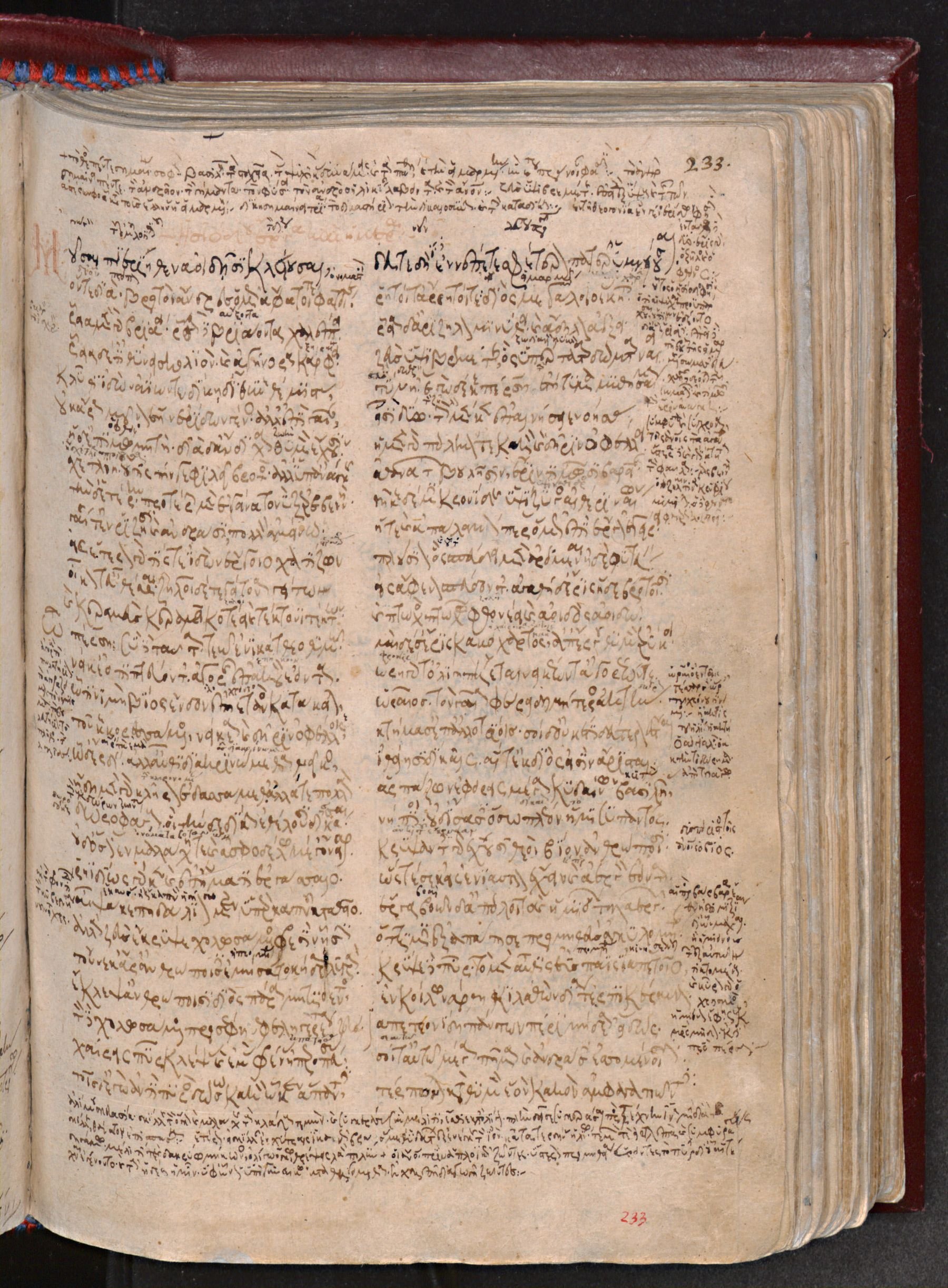
Laur. Plut. 32.16, fol. 233r: lines 1-58, begins ‹μοῦσαι Πιερίηθεν ἀοιδῇσιν κλείουσαι›, ends ‹θυμὸν ἑὸν κακὸν ἀμφαγαπῶντες.›. Checked on the image: first and last verse rows read and matched to the Greek (re-read on the image 2026-11-12: first row ‹1 | 2: μοῦσαι πιερίηθεν ἀοιδῆσι ... | δεῦτε δί' ἐννέπετε ...›, last row ‹57 | 58: ... δώσω κακὸν ᾧ κεν ἅπαντες | ... κακὸν ἀμφαγαπῶντ(ες)›); this is the first page of the poem and the page after begins at line 59. This section shows lines 42-58 of that page; the rest of the page belongs to the previous part of the poem. The poem begins under a faded red title with a large red initial M; scholia in the upper and lower margins and down the right side. English here: lines 42-58, cut at the end of Evelyn-White's sentences. At the break with the next page the English ends with line 58, the same line as the Greek.
42κρύψαντες γὰρ ἔχουσι θεοὶ βίον ἀνθρώποισιν·
43ῥηιδίως γάρ κεν καὶ ἐπʼ ἤματι ἐργάσσαιο,
44ὥστε σε κεἰς ἐνιαυτὸν ἔχειν καὶ ἀεργὸν ἐόντα·
45αἶψά κε πηδάλιον μὲν ὑπὲρ καπνοῦ καταθεῖο,
46ἔργα βοῶν δʼ ἀπόλοιτο καὶ ἡμιόνων ταλαεργῶν.
47ἀλλὰ Ζεὺς ἔκρυψε χολωσάμενος φρεσὶν ᾗσιν,
48ὅττι μιν ἐξαπάτησε Προμηθεὺς ἀγκυλομήτης·
49τοὔνεκʼ ἄρʼ ἀνθρώποισιν ἐμήσατο κήδεα λυγρά.
50κρύψε δὲ πῦρ· τὸ μὲν αὖτις ἐὺς πάις Ἰαπετοῖο
51ἔκλεψʼ ἀνθρώποισι Διὸς πάρα μητιόεντος
52ἐν κοΐλῳ νάρθηκι λαθὼν Δία τερπικέραυνον.
53τὸν δὲ χολωσάμενος προσέφη νεφεληγερέτα Ζεύς·
54Ἰαπετιονίδη, πάντων πέρι μήδεα εἰδώς,
55χαίρεις πῦρ κλέψας καὶ ἐμὰς φρένας ἠπεροπεύσας,
56σοί τʼ αὐτῷ μέγα πῆμα καὶ ἀνδράσιν ἐσσομένοισιν.
57τοῖς δʼ ἐγὼ ἀντὶ πυρὸς δώσω κακόν, ᾧ κεν ἅπαντες
58τέρπωνται κατὰ θυμὸν ἑὸν κακὸν ἀμφαγαπῶντες.
42For the gods keep hidden from men the means of life. Else you would easily do work enough in a day to supply you for a full year even without working; 45soon would you put away your rudder over the smoke, and the fields worked by ox and sturdy mule would run to waste. But Zeus in the anger of his heart hid it, because Prometheus the crafty deceived him; therefore he planned sorrow and mischief against men. 50He hid fire; but that the noble son of Iapetus stole again for men from Zeus the counsellor in a hollow fennel-stalk, so that Zeus who delights in thunder did not see it. But afterwards Zeus who gathers the clouds said to him in anger: “Son of Iapetus, surpassing all in cunning, 55you are glad that you have outwitted me and stolen fire—a great plague to you yourself and to men that shall be. But I will give men as the price for fire an evil thing in which they may all be glad of heart while they embrace their own destruction.”
Where on the image
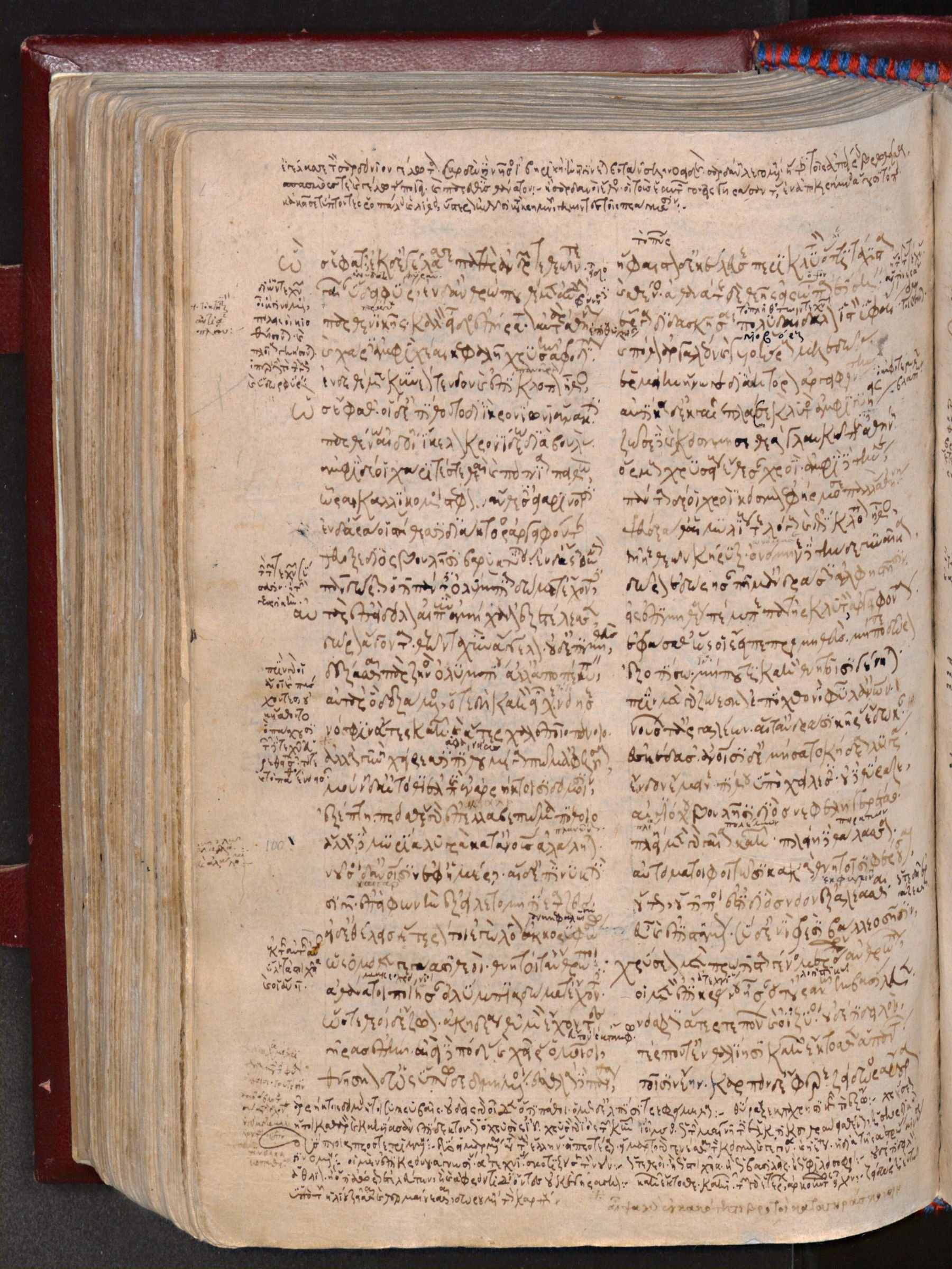
Laur. Plut. 32.16, fol. 233v: lines 59-117, begins ‹ὣς ἔφατʼ· ἐκ δʼ›, ends ‹δʼ ἔφερε ζείδωρος ἄρουρα›. Checked on the image: first and last verse rows read and matched to the Greek (re-read on the image 2026-11-12: first row ‹59 | 60: ὣς ἔφατ' ἐκ δ' ἐγέλασσε ... | ἥφαιστον δ' ἐκέλευσε ...›, last row ‹116 | 117: θνῇσκον δ' ὥσθ' ὕπνῳ ... | ... ζείδωρος ἄρουρα›); the page before ends at line 58 and the page after begins at line 118. This section shows lines 59-108 of that page; the rest of the page belongs to the next part of the poem. Verse 93 (αἶψα γὰρ ἐν κακότητι βροτοὶ καταγηράσκουσιν) is not in the column (the row after 91 | 92 is 94 | 95); it is written in pale ink at the foot of the page, keyed by a + sign in the left margin. The Greek shows it in its place. English here: lines 59-108, cut at the end of Evelyn-White's sentences. At the break with the page before, his sentence for line 59 (‹So said the father of men and gods, and laughed aloud ...›) begins with the Greek of this page.
59ὣς ἔφατʼ· ἐκ δʼ ἐγέλασσε πατὴρ ἀνδρῶν τε θεῶν τε.
60Ἥφαιστον δʼ ἐκέλευσε περικλυτὸν ὅττι τάχιστα
61γαῖαν ὕδει φύρειν, ἐν δʼ ἀνθρώπου θέμεν αὐδὴν
62καὶ σθένος, ἀθανάτῃς δὲ θεῇς εἰς ὦπα ἐίσκειν
63παρθενικῆς καλὸν εἶδος ἐπήρατον· αὐτὰρ Ἀθήνην
64ἔργα διδασκῆσαι, πολυδαίδαλον ἱστὸν ὑφαίνειν·
65καὶ χάριν ἀμφιχέαι κεφαλῇ χρυσέην Ἀφροδίτην
66καὶ πόθον ἀργαλέον καὶ γυιοκόρους μελεδώνας·
67ἐν δὲ θέμεν κύνεόν τε νόον καὶ ἐπίκλοπον ἦθος
68Ἑρμείην ἤνωγε, διάκτορον Ἀργεϊφόντην.
69ὣς ἔφαθʼ· οἳ δʼ ἐπίθοντο Διὶ Κρονίωνι ἄνακτι.
70αὐτίκα δʼ ἐκ γαίης πλάσσεν κλυτὸς Ἀμφιγυήεις
71παρθένῳ αἰδοίῃ ἴκελον Κρονίδεω διὰ βουλάς·
72ζῶσε δὲ καὶ κόσμησε θεὰ γλαυκῶπις Ἀθήνη·
73ἀμφὶ δέ οἱ Χάριτές τε θεαὶ καὶ πότνια Πειθὼ
74ὅρμους χρυσείους ἔθεσαν χροΐ· ἀμφὶ δὲ τήν γε
75Ὧραι καλλίκομοι στέφον ἄνθεσιν εἰαρινοῖσιν·
76[πάντα δέ οἱ χροῒ κόσμον ἐφήρμοσε Παλλὰς Ἀθήνη.]
77ἐν δʼ ἄρα οἱ στήθεσσι διάκτορος Ἀργεϊφόντης
78ψεύδεά θʼ αἱμυλίους τε λόγους καὶ ἐπίκλοπον ἦθος
79[τεῦξε Διὸς βουλῇσι βαρυκτύπου· ἐν δʼ ἄρα φωνὴν]
80θῆκε θεῶν κῆρυξ, ὀνόμηνε δὲ τήνδε γυναῖκα
81Πανδώρην, ὅτι πάντες Ὀλύμπια δώματʼ ἔχοντες
82δῶρον ἐδώρησαν, πῆμʼ ἀνδράσιν ἀλφηστῇσιν.
83αὐτὰρ ἐπεὶ δόλον αἰπὺν ἀμήχανον ἐξετέλεσσεν,
84εἰς Ἐπιμηθέα πέμπε πατὴρ κλυτὸν Ἀργεϊφόντην
85δῶρον ἄγοντα, θεῶν ταχὺν ἄγγελον· οὐδʼ Ἐπιμηθεὺς
86ἐφράσαθʼ, ὥς οἱ ἔειπε Προμηθεὺς μή ποτε δῶρον
87δέξασθαι πὰρ Ζηνὸς Ὀλυμπίου, ἀλλʼ ἀποπέμπειν
88ἐξοπίσω, μή πού τι κακὸν θνητοῖσι γένηται.
89αὐτὰρ ὃ δεξάμενος, ὅτε δὴ κακὸν εἶχʼ, ἐνόησεν.
90Πρὶν μὲν γὰρ ζώεσκον ἐπὶ χθονὶ φῦλʼ ἀνθρώπων
91νόσφιν ἄτερ τε κακῶν καὶ ἄτερ χαλεποῖο πόνοιο
92νούσων τʼ ἀργαλέων, αἵ τʼ ἀνδράσι Κῆρας ἔδωκαν.
93[αἶψα γὰρ ἐν κακότητι βροτοὶ καταγηράσκουσιν.]
94ἀλλὰ γυνὴ χείρεσσι πίθου μέγα πῶμʼ ἀφελοῦσα
95ἐσκέδασʼ· ἀνθρώποισι δʼ ἐμήσατο κήδεα λυγρά.
96μούνη δʼ αὐτόθι Ἐλπὶς ἐν ἀρρήκτοισι δόμοισιν
97ἔνδον ἔμιμνε πίθου ὑπὸ χείλεσιν, οὐδὲ θύραζε
98ἐξέπτη· πρόσθεν γὰρ ἐπέλλαβε πῶμα πίθοιο
99[αἰγιόχου βουλῇσι Διὸς νεφεληγερέταο.]
100ἄλλα δὲ μυρία λυγρὰ κατʼ ἀνθρώπους ἀλάληται·
101πλείη μὲν γὰρ γαῖα κακῶν, πλείη δὲ θάλασσα·
102νοῦσοι δʼ ἀνθρώποισιν ἐφʼ ἡμέρῃ, αἳ δʼ ἐπὶ νυκτὶ
103αὐτόματοι φοιτῶσι κακὰ θνητοῖσι φέρουσαι
104σιγῇ, ἐπεὶ φωνὴν ἐξείλετο μητίετα Ζεύς.
105οὕτως οὔτι πη ἔστι Διὸς νόον ἐξαλέασθαι.
106εἰ δʼ ἐθέλεις, ἕτερόν τοι ἐγὼ λόγον ἐκκορυφώσω
107εὖ καὶ ἐπισταμένως· σὺ δʼ ἐνὶ φρεσὶ βάλλεο σῇσιν.
108ὡς ὁμόθεν γεγάασι θεοὶ θνητοί τʼ ἄνθρωποι.
59So said the father of men and gods, and laughed aloud. 60And he bade famous Hephaestus make haste and mix earth with water and to put in it the voice and strength of human kind, and fashion a sweet, lovely maiden-shape, like to the immortal goddesses in face; and Athena to teach her needlework and the weaving of the varied web; 65and golden Aphrodite to shed grace upon her head and cruel longing and cares that weary the limbs. And he charged Hermes the guide, the Slayer of Argus, to put in her a shameless mind and a deceitful nature. So he ordered. And they obeyed the lord Zeus the son of Cronos. 70Forthwith the famous Lame God moulded clay in the likeness of a modest maid, as the son of Cronos purposed. And the goddess brighteyed Athena girded and clothed her, and the divine Graces and queenly Persuasion put necklaces of gold upon her, 75and the rich-haired Hours crowned her head with spring flowers. And Pallas Athena bedecked her form with all manner of finery. Also the Guide, the Slayer of Argus, contrived within her lies and crafty words and a deceitful nature at the will of loud thundering Zeus, 80and the Herald of the gods put speech in her. And he called this woman Pandora, because all they who dwelt on Olympus gave each a gift, a plague to men who eat bread. 83But when he had finished the sheer, hopeless snare, the Father sent glorious Argus-Slayer, 85the swift messenger of the gods, to take it to Epimetheus as a gift. And Epimetheus did not think on what Prometheus had said to him, bidding him never take a gift of Olympian Zeus, but to send it back for fear it might prove to be something harmful to men. But he took the gift, and afterwards, when the evil thing was already his, he understood. 90For ere this the tribes of men lived on earth remote and free from ills and hard toil and heavy sicknesses which bring the Fates upon men; for in misery men grow old quickly. But the woman took off the great lid of the jar with her hands 95and scattered, all these and her thought caused sorrow and mischief to men. Only Hope remained there in an unbreakable home within under the rim of the great jar, and did not fly out at the door; for ere that, the lid of the jar stopped her, by the will of Aegis-holding Zeus who gathers the clouds. 100But the rest, countless plagues, wander amongst men; for earth is full of evils, and the sea is full. Of themselves diseases come upon men continually by day and by night, bringing mischief to mortals silently; for wise Zeus took away speech from them. 105So is there no way to escape the will of Zeus. Or if you will, I will sum you up another tale well and skilfully—and do you lay it up in your heart,—how the gods and mortal men sprang from one source.
Notes
- Greek: H. G. Evelyn-White, Hesiod, the Homeric Hymns and Homerica (Loeb Classical Library, 1914), via Perseus. Square brackets mark verses the editor regards as interpolated.
- English: H. G. Evelyn-White's translation in the same volume; his footnotes are omitted.
- Lines 169a-169d of the Loeb text (fragments from a papyrus on Cronos and the fifth race) are not in the medieval manuscripts and are not included.
Cite
Sources
- Source: Laur. Plut. 32.16 (BML Teca Digitale IIIF) + Evelyn-White Greek (Loeb 1914, Perseus) + Evelyn-White English (1914, Perseus) (holding institution)
- Critical edition: Evelyn-White, Loeb 1914, via Perseus
← previous · → next · v cycle view · l back to library