Hesiod, Works and Days 765-828: The Days
Introduction
Hesiod's Works and Days (c. 700 BCE) is a poem of advice to his brother Perses on justice, work and the farmer's year. It contains the myth of Prometheus and Pandora and the Five Ages of mankind, from the golden race to the race of iron. This part: The Days (lines 765-828, 64 lines). Which days of the month are lucky or unlucky for work, birth and marriage.
The page photographs are from Florence, Biblioteca Medicea Laurenziana, Plut. 32.16 (paper, late 13th century; a large collection of Greek poetry that also holds letters of Maximus Planudes), Works and Days on fols. 233r-239v, in the Biblioteca Medicea Laurenziana's Teca Digitale. Older manuscripts of the poem exist (Paris gr. 2771, 10th/11th century; Florence, Laur. Plut. 31.39, 12th century), but this copy is legible on every page and holds Hesiod's three poems together. This part is on fol. 239r, 239v. The scribe writes two verses to a row, one in each column, so a page is read across the columns, row by row; the margins are filled with scholia (ancient and Byzantine notes). Each section below is one page; its note gives the page's first and last verse as read on the photograph.
The Greek is Evelyn-White's Loeb text (1914) via Perseus, not a transcription of this manuscript, whose wording differs here and there. Verses the editor brackets as later additions are shown in square brackets. The English is Evelyn-White's prose translation (1914); it is cut at the end of his sentences, so where a sentence runs across a page break it is given whole to one page; each section's note gives the exact lines its English covers.
How was this verified? (Provenance)
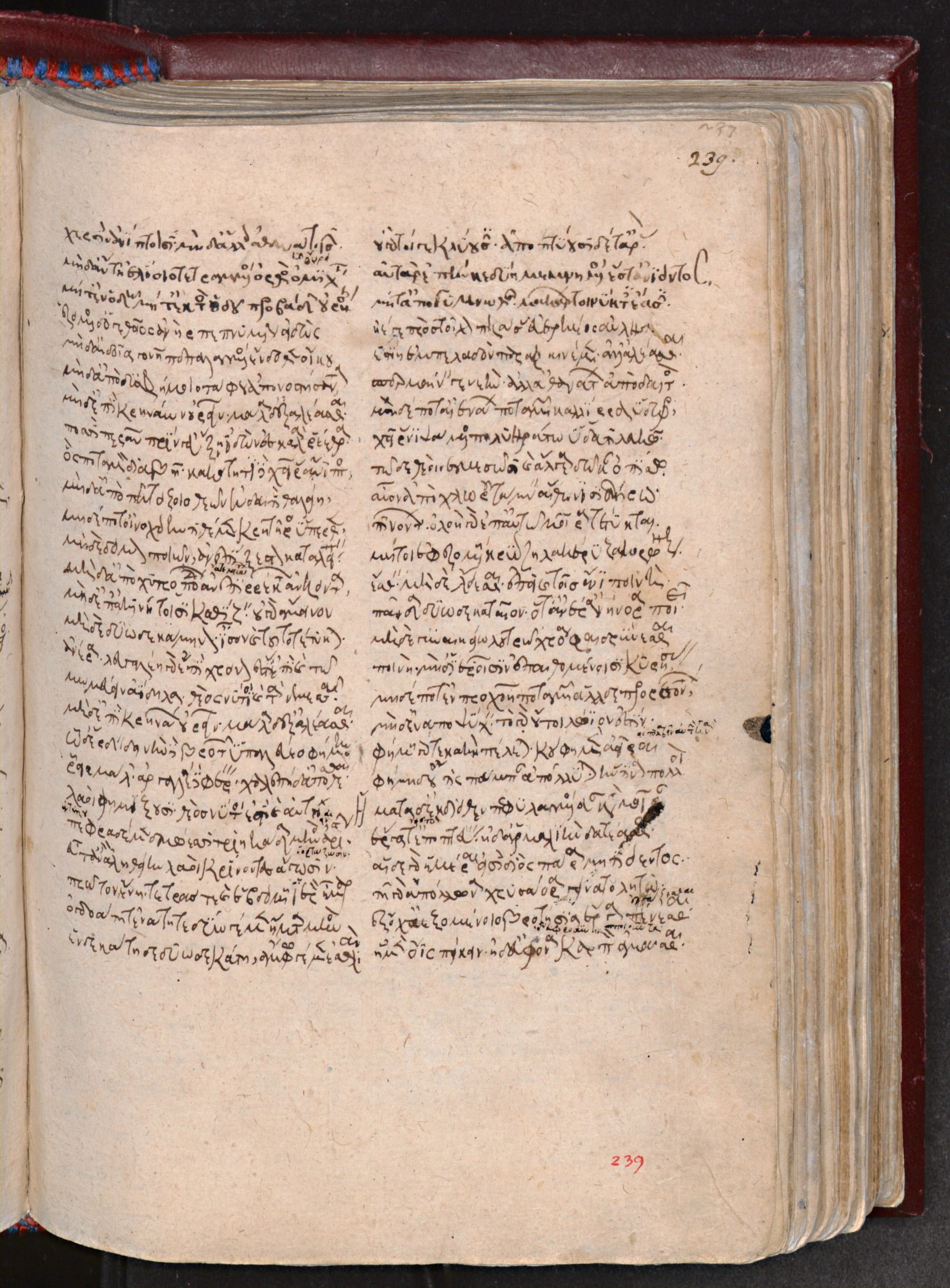
Where on the image
Laur. Plut. 32.16, fol. 239r: lines 725-775, begins ‹χερσὶν ἀνίπτοισιν μηδʼ ἄλλοις›, ends ‹ἠδʼ εὔφρονα καρπὸν ἀμᾶσθαι·›. Checked on the image: first and last verse rows read and matched to the Greek (re-read on the image 2026-11-12: first row ‹725 | 726: χερσὶν δ' ἀνίπτοισι ... | οὐ γὰρ τοί γε κλύουσιν ...›, last row ‹774 | 775: ἑνδεκάτη δὲ δυωδεκάτη ... | ἠμὲν ὄις πείκειν ... ἀμᾶσθαι›); the page before ends at line 724 and the page after begins at line 776. This section shows lines 765-775 of that page; the rest of the page belongs to the previous part of the poem. Verse 758 (μηδ' ἐπὶ κρηνάων οὐρεῖν, μάλα δ' ἐξαλέασθαι) is written twice: once out of place, as the left verse of row 5 (after 736, beside 737), and again in its place (757 | 758). The page has 768 and 769 in the traditional order; Evelyn-White prints 769 before 768. English here: lines 765-773, cut at the end of Evelyn-White's sentences. His sentence ‹Also the eleventh and twelfth are both excellent ...› begins in line 774, before the page break, and is given whole with the next page, so the English here ends with line 773.
765Ἤματα δʼ ἐκ Διόθεν πεφυλαγμένος εὖ κατὰ μοῖραν
766πεφραδέμεν δμώεσσι· τριηκάδα μηνὸς ἀρίστην
767ἔργα τʼ ἐποπτεύειν ἠδʼ ἁρμαλιὴν δατέασθαι.
768εὖτʼ ἂν ἀληθείην λαοὶ κρίνοντες ἄγωσιν.
769αἵδε γὰρ ἡμέραι εἰσὶ Διὸς πάρα μητιόεντος,
770Πρῶτον ἔνη τετράς τε καὶ ἑβδόμη ἱερὸν ἦμαρ·
771τῇ γὰρ Ἀπόλλωνα χρυσάορα γείνατο Λητώ·
772ὀγδοάτη δʼ ἐνάτη τε, δύω γε μὲν ἤματα μηνὸς
773ἔξοχʼ ἀεξομένοιο βροτήσια ἔργα πένεσθαι·
774ἑνδεκάτη δὲ δυωδεκάτη τʼ, ἄμφω γε μὲν ἐσθλαί,
775ἠμὲν ὄις πείκειν ἠδʼ εὔφρονα καρπὸν ἀμᾶσθαι·
765Mark the days which come from Zeus, duly telling your slaves of them, and that the thirtieth day of the month is best for one to look over the work and to deal out supplies. 769For these are days which come from Zeus the all-wise, 768when men discern aright. 770To begin with, the first, the fourth, and the seventh— on which Leto bore Apollo with the blade of gold—each is a holy day. The eighth and the ninth, two days at least of the waxing month, are especially good for the works of man.
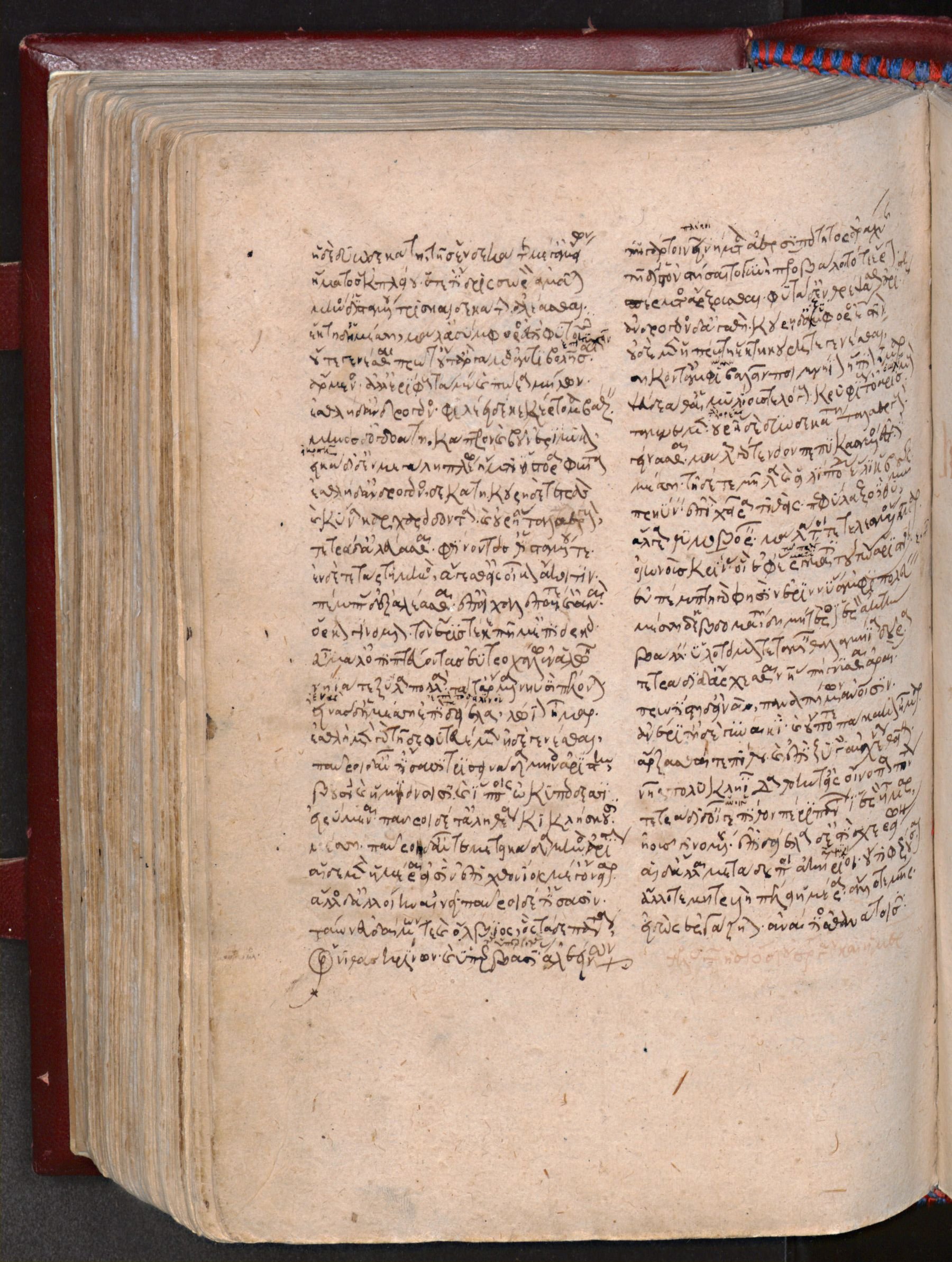
Where on the image
Laur. Plut. 32.16, fol. 239v: lines 776-828, begins ‹ἡ δὲ δυωδεκάτη τῆς›, ends ‹κρίνων καὶ ὑπερβασίας ἀλεείνων.›. Checked on the image: first and last verse rows read and matched to the Greek (re-read on the image 2026-11-12: first row ‹776 | 777: ἡ δὲ δυωδεκάτη ... | τῇ γάρ τοι νῇ νήματ' ...›, last row ‹826 | 827: τάων εὐδαίμων ... | εἰδὼς ἐργάζηται ...; then 828 ὄρνιθας κρίνων καὶ ὑπερβασίας ἀλεείνων alone in the left column›); the page before ends at line 775 and this is its last page. The poem ends with 828 about three quarters of the way down the page (a circled mark before it, a cross after), followed in the right-hand slot of that row by a faded red subscription. English here: lines 774-828, cut at the end of Evelyn-White's sentences. His sentence ‹Also the eleventh and twelfth are both excellent ...› begins in line 774, before the page break, and is given whole with this page.
776ἡ δὲ δυωδεκάτη τῆς ἑνδεκάτης μέγʼ ἀμείνων·
777τῇ γάρ τοι νῇ νήματʼ ἀερσιπότητος ἀράχνης
778ἤματος ἐκ πλείου, ὅτε ἴδρις σωρὸν ἀμᾶται·
779τῇ δʼ ἱστὸν στήσαιτο γυνὴ προβάλοιτό τε ἔργον.
780Μηνὸς δʼ ἱσταμένου τρισκαιδεκάτην ἀλέασθαι
781σπέρματος ἄρξασθαι· φυτὰ δʼ ἐνθρέψασθαι ἀρίστη.
782ἕκτη δʼ ἡ μέσση μάλʼ ἀσύμφορός ἐστι φυτοῖσιν,
783ἀνδρογόνος δʼ ἀγαθή· κούρῃ δʼ οὐ σύμφορός ἐστιν,
784οὔτε γενέσθαι πρῶτʼ οὔτʼ ἂρ γάμου ἀντιβολῆσαι.
785οὐδὲ μὲν ἡ πρώτη ἕκτη κούρῃ γε γενέσθαι
786ἄρμενος, ἀλλʼ ἐρίφους τάμνειν καὶ πώεα μήλων
787σηκόν τʼ ἀμφιβαλεῖν ποιμνήιον ἤπιον ἦμαρ·
788ἐσθλὴ δʼ ἀνδρογόνος· φιλέοι δʼ ὅ γε κέρτομα βάζειν
789ψεύδεά θʼ αἱμυλίους τε λόγους κρυφίους τʼ ὀαρισμούς.
790μηνὸς δʼ ὀγδοάτῃ κάπρον καὶ βοῦν ἐρίμυκον
791ταμνέμεν, οὐρῆας δὲ δυωδεκάτῃ ταλαεργούς.
792εἰκάδι δʼ ἐν μεγάλῃ, πλέῳ ἤματι, ἵστορα φῶτα
793γείνασθαι· μάλα γάρ τε νόον πεπυκασμένος ἐστίν.
794ἐσθλὴ δʼ ἀνδρογόνος δεκάτη, κούρῃ δέ τε τετρὰς
795μέσση· τῇ δέ τε μῆλα καὶ εἰλίποδας ἕλικας βοῦς
796καὶ κύνα καρχαρόδοντα καὶ οὐρῆας ταλαεργοὺς
797πρηΰνειν ἐπὶ χεῖρα τιθείς. πεφύλαξο δὲ θυμῷ
798τετράδʼ ἀλεύασθαι φθίνοντός θʼ ἱσταμένου τε
799ἄλγεʼ ἃ θυμοβορῆ μάλα γὰρ τετελεσμένον ἦμαρ.
800Ἐν δὲ τετάρτῃ μηνὸς ἄγεσθαι οἶκον ἄκοιτιν
801οἰωνοὺς κρίνας, οἳ ἐπʼ ἔργματι τούτῳ ἄριστοι.
802πέμπτας δʼ ἐξαλέασθαι, ἐπεὶ χαλεπαί τε καὶ αἰναί·
803ἐν πέμπτῃ γάρ φασιν Ἐρινύας ἀμφιπολεύειν
804Ὅρκον γεινόμενον, τὸν Ἔρις τέκε πῆμʼ ἐπιόρκοις.
805Μέσσῃ δʼ ἑβδομάτῃ Δημήτερος ἱερὸν ἀκτὴν
806εὖ μάλʼ ὀπιπεύοντα ἐυτροχάλῳ ἐν ἀλωῇ
807βαλλέμεν, ὑλοτόμον τε ταμεῖν θαλαμήια δοῦρα
808νήιά τε ξύλα πολλά, τά τʼ ἄρμενα νηυσὶ πέλονται.
809τετράδι δʼ ἄρχεσθαι νῆας πήγνυσθαι ἀραιάς.
810εἰνὰς δʼ ἡ μέσση ἐπὶ δείελα λώιον ἦμαρ,
811πρωτίστη δʼ εἰνὰς παναπήμων ἀνθρώποισιν·
812ἐσθλὴ μὲν γάρ θʼ ἥ γε φυτευέμεν ἠδὲ γενέσθαι
813ἀνέρι τʼ ἠδὲ γυναικί· καὶ οὔποτε πάγκακον ἦμαρ.
814παῦροι δʼ αὖτε ἴσασι τρισεινάδα μηνὸς ἀρίστην
815ἄρξασθαί τε πίθου καὶ ἐπὶ ζυγὸν αὐχένι θεῖναι
816βουσὶ καὶ ἡμιόνοισι καὶ ἵπποις ὠκυπόδεσσι,
817νῆα πολυκλήιδα θοὴν εἰς οἴνοπα πόντον
818εἰρύμεναι· παῦροι δέ τʼ ἀληθέα κικλῄσκουσιν.
819τετράδι δʼ οἶγε πίθον· περὶ πάντων ἱερὸν ἦμαρ
820μέσση· παῦροι δʼ αὖτε μετʼ εἰκάδα μηνὸς ἀρίστην
821ἠοῦς γιγνομένης· ἐπὶ δείελα δʼ ἐστὶ χερείων.
822αἵδε μὲν ἡμέραι εἰσὶν ἐπιχθονίοις μέγʼ ὄνειαρ,
823αἱ δʼ ἄλλαι μετάδουποι, ἀκήριοι, οὔ τι φέρουσαι.
824ἄλλος δʼ ἀλλοίην αἰνεῖ, παῦροι δὲ ἴσασιν.
825ἄλλοτε μητρυιὴ πέλει ἡμέρη, ἄλλοτε μήτηρ.
826τάων εὐδαίμων τε καὶ ὄλβιος, ὃς τάδε πάντα
827εἰδὼς ἐργάζηται ἀναίτιος ἀθανάτοισιν,
828ὄρνιθας κρίνων καὶ ὑπερβασίας ἀλεείνων.
774Also the eleventh and twelfth are both excellent, 775alike for shearing sheep and for reaping the kindly fruits; but the twelfth is much better than the eleventh, for on it the airy-swinging spider spins its web in full day, and then the Wise One, gathers her pile. On that day a woman should set up her loom and get forward with her work. 780Avoid the thirteenth of the waxing month for beginning to sow: yet it is the best day for setting plants. The sixth of the mid-month is very unfavorable for plants, but is good for the birth of males, though unfavorable for a girl either to be born at all or to be married. 785Nor is the first sixth a fit day for a girl to be born, but a kindly for gelding kids and sheep and for fencing in a sheep cote. It is favorable for the birth of a boy, but such will be fond of sharp speech, lies, cunning words, and stealthy conversation. 790On the eighth of the month geld the boar and loud-bellowing bull, but hard-working mules on the twelfth. On the great twentieth, in full day, a wise man should be born. Such a one is very sound-witted. The tenth is favorable for a male to be born; but, for a girl, the fourth day 795of the mid-month. On that day tame sheep and shambling, horned oxen, and the sharp-fanged dog and hardy mules to the touch of the hand. But take care to avoid troubles which eat out the heart on the fourth of the beginning and ending of the month; it is a day very fraught with fate. 800On the fourth of the month bring home your bride, but choose the omens which are best for this business. Avoid fifth days: they are unkindly and terrible. On a fifth, they say, the Erinyes assisted at the birth of Horcus (Oath) whom Eris (Strife) bore to trouble the forsworn. 805Look about you very carefully and throw out Demeter's holy grain upon the well-rolled threshing floor on the seventh of the mid-month. Let the woodman cut beams for house building and plenty of ships' timbers, such as are suitable for ships. On the fourth day begin to build narrow ships. 810The ninth of the mid-month improves towards evening; but the first ninth of all is quite harmless for men. It is a good day on which to beget or to be born both for a male and a female: it is never a wholly evil day. Again, few know that the twenty-seventh of the month is best 815for opening a wine jar, and putting yokes on the necks of oxen and mules and swift-footed horses, and for hauling a swift ship of many thwarts down to the sparkling sea; few call it by its right name. On the fourth day open a jar. The fourth of the mid-month is a day holy above all. And again, few men know that the fourth day after the twentieth is best while it is morning: 820towards evening it is less good. These days are a great blessing to men on earth; but the rest are changeable, luckless, and bring nothing. Everyone praises a different day but few know their nature. Sometimes a day is a stepmother, sometimes a mother. 825That man is happy and lucky in them who knows all these things and does his work without offending the deathless gods, who discerns the omens of birds and avoids transgression.
Notes
- Greek: H. G. Evelyn-White, Hesiod, the Homeric Hymns and Homerica (Loeb Classical Library, 1914), via Perseus. Square brackets mark verses the editor regards as interpolated.
- English: H. G. Evelyn-White's translation in the same volume; his footnotes are omitted.
- Lines 169a-169d of the Loeb text (fragments from a papyrus on Cronos and the fifth race) are not in the medieval manuscripts and are not included.
Cite
Sources
- Source: Laur. Plut. 32.16 (BML Teca Digitale IIIF) + Evelyn-White Greek (Loeb 1914, Perseus) + Evelyn-White English (1914, Perseus) (holding institution)
- Critical edition: Evelyn-White, Loeb 1914, via Perseus
← previous · → next · v cycle view · l back to library