Hesiod, Works and Days 706-764: Friends and rules of conduct
Introduction
Hesiod's Works and Days (c. 700 BCE) is a poem of advice to his brother Perses on justice, work and the farmer's year. It contains the myth of Prometheus and Pandora and the Five Ages of mankind, from the golden race to the race of iron. This part: Friends and rules of conduct (lines 706-764, 59 lines). Advice on friends and guests, and a list of religious and everyday rules.
The page photographs are from Florence, Biblioteca Medicea Laurenziana, Plut. 32.16 (paper, late 13th century; a large collection of Greek poetry that also holds letters of Maximus Planudes), Works and Days on fols. 233r-239v, in the Biblioteca Medicea Laurenziana's Teca Digitale. Older manuscripts of the poem exist (Paris gr. 2771, 10th/11th century; Florence, Laur. Plut. 31.39, 12th century), but this copy is legible on every page and holds Hesiod's three poems together. This part is on fol. 238v, 239r. The scribe writes two verses to a row, one in each column, so a page is read across the columns, row by row; the margins are filled with scholia (ancient and Byzantine notes). Each section below is one page; its note gives the page's first and last verse as read on the photograph.
The Greek is Evelyn-White's Loeb text (1914) via Perseus, not a transcription of this manuscript, whose wording differs here and there. Verses the editor brackets as later additions are shown in square brackets. The English is Evelyn-White's prose translation (1914); it is cut at the end of his sentences, so where a sentence runs across a page break it is given whole to one page; each section's note gives the exact lines its English covers.
How was this verified? (Provenance)
Where on the image
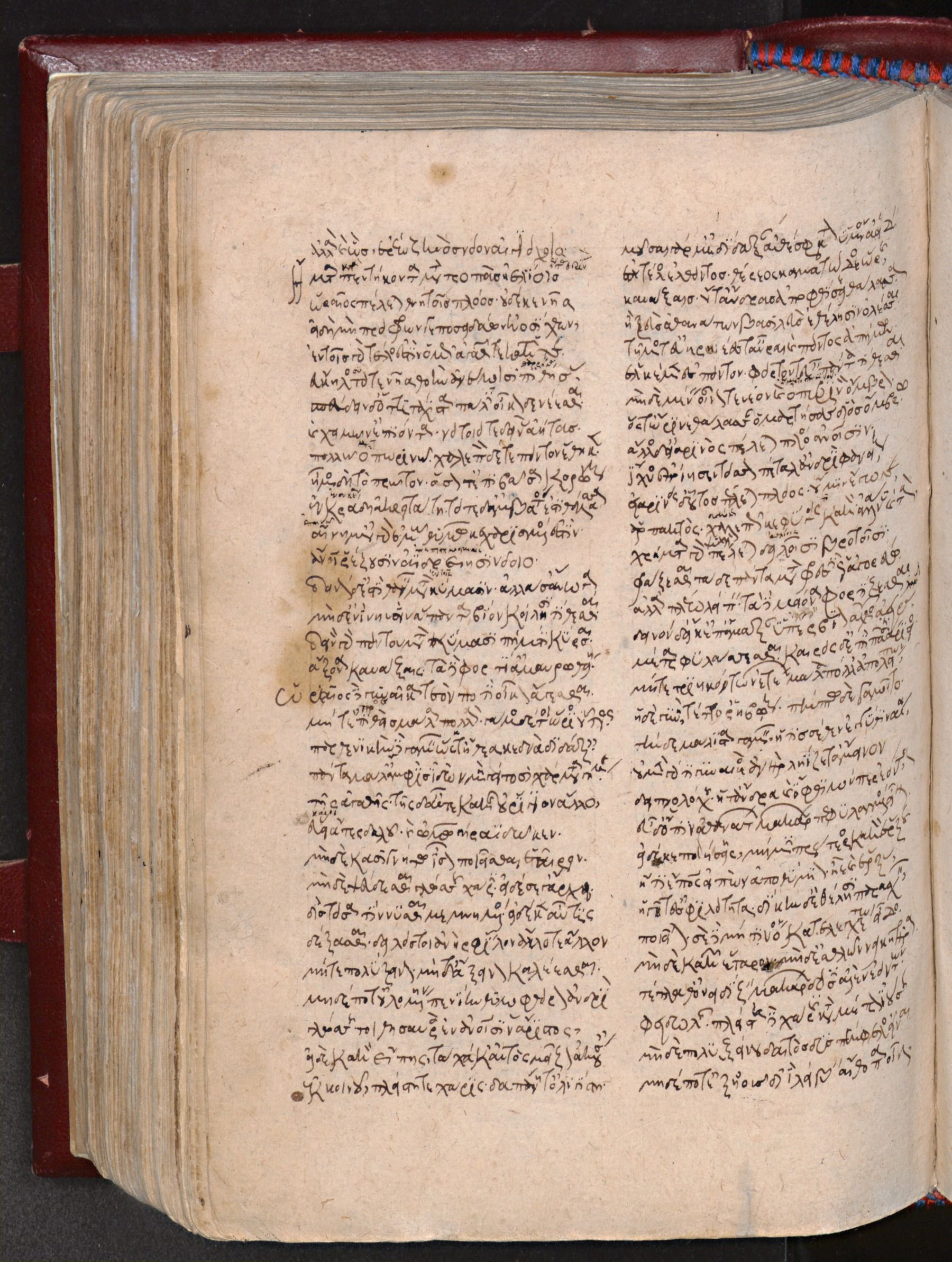
Laur. Plut. 32.16, fol. 238v: lines 661-724, begins ‹ἀλλὰ καὶ ὣς ἐρέω›, ends ‹Διὶ λειβέμεν αἴθοπα οἶνον›. Checked on the image: first and last verse rows read and matched to the Greek (re-read on the image 2026-11-12: first row ‹661 | 662: ἀλλὰ καὶ ὣς ἐρέω ... | μοῦσαι γάρ μ' ἐδίδαξαν ...›, last row ‹723 | 724: ἐκ κοινοῦ πλείστη δὲ χάρις ... | μηδέ ποτ' ἐξ ἠοῦς διὶ ... οἶνον›); the page before ends at line 660 and the page after begins at line 725. This section shows lines 706-724 of that page; the rest of the page belongs to the previous part of the poem. English here: lines 706-723, cut at the end of Evelyn-White's sentences. His sentence ‹Never pour a libation of sparkling wine ...› begins in line 724, before the page break, and is given whole with the next page, so the English here ends with line 723.
706εὖ δʼ ὄπιν ἀθανάτων μακάρων πεφυλαγμένος εἶναι.
707μηδὲ κασιγνήτῳ ἶσον ποιεῖσθαι ἑταῖρον·
708εἰ δέ κε ποιήσῃς, μή μιν πρότερος κακὸν ἔρξῃς.
709μηδὲ ψεύδεσθαι γλώσσης χάριν· εἰ δὲ σέ γʼ ἄρχῃ
710ἤ τι ἔπος εἰπὼν ἀποθύμιον ἠὲ καὶ ἔρξας,
711δὶς τόσα τίνυσθαι μεμνημένος· εἰ δὲ σέ γʼ αὖτις
712ἡγῆτʼ ἐς φιλότητα, δίκην δʼ ἐθέλῃσι παρασχεῖν,
713δέξασθαι· δειλός τοι ἀνὴρ φίλον ἄλλοτε ἄλλον
714ποιεῖται, σὲ δὲ μή τι νόον κατελεγχέτω εἶδος.
715μηδὲ πολύξεινον μηδʼ ἄξεινον καλέεσθαι,
716μηδὲ κακῶν ἕταρον μηδʼ ἐσθλῶν νεικεστῆρα.
717μηδέ ποτʼ οὐλομένην πενίην θυμοφθόρον ἀνδρὶ
718τέτλαθʼ ὀνειδίζειν, μακάρων δόσιν αἰὲν ἐόντων.
719γλώσσης τοι θησαυρὸς ἐν ἀνθρώποισιν ἄριστος
720φειδωλῆς, πλείστη δὲ χάρις κατὰ μέτρον ἰούσης.
721εἰ δὲ κακὸν εἴποις, τάχα κʼ αὐτὸς μεῖζον ἀκούσαις.
722μηδὲ πολυξείνου δαιτὸς δυσπέμφελος εἶναι
723ἐκ κοινοῦ· πλείστη δὲ χάρις, δαπάνη τʼ ὀλιγίστη.
724μηδέ ποτʼ ἐξ ἠοῦς Διὶ λειβέμεν αἴθοπα οἶνον
706Be careful to avoid the anger of the deathless gods. Do not make a friend equal to a brother; but if you do, do not wrong him first, and do not lie to please the tongue. But if he wrongs you first, 710offending either in word or in deed, remember to repay him double; but if he asks you to be his friend again and be ready to give you satisfaction, welcome him. He is a worthless man who makes now one and now another his friend; but as for you, do not let your face put your heart to shame. 715Do not get a name either as lavish or as churlish, as a friend of rogues, or as a slanderer of good men. Never dare to taunt a man with deadly poverty which eats out the heart; it is sent by the deathless gods. 720The best treasure a man can have is a sparing tongue, and the greatest pleasure, one that moves orderly; for if you speak evil, you yourself will soon be worse spoken of. Do not be boorish at a common feast where there are many guests; the pleasure is greatest and the expense is least.
Where on the image
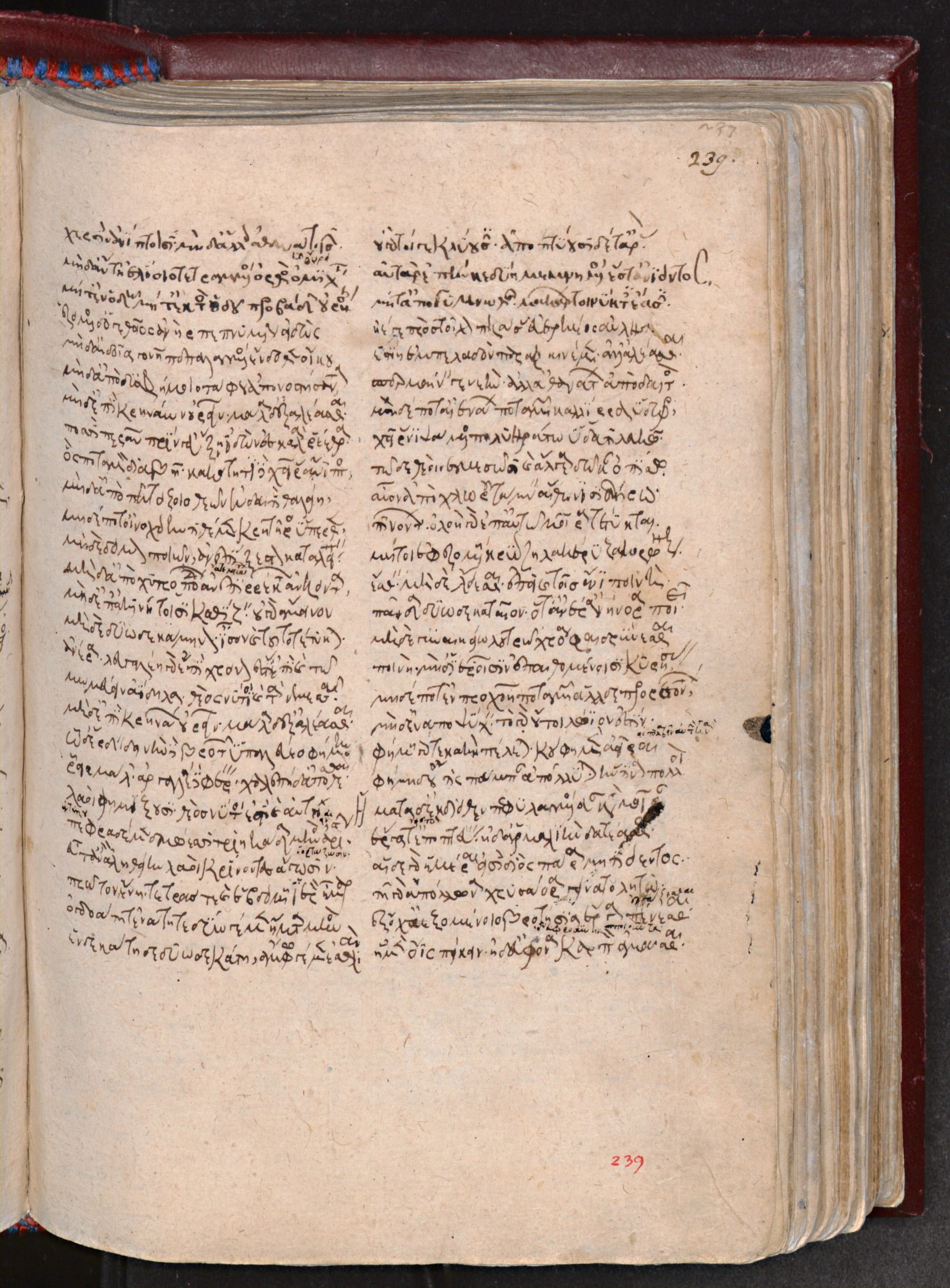
Laur. Plut. 32.16, fol. 239r: lines 725-775, begins ‹χερσὶν ἀνίπτοισιν μηδʼ ἄλλοις›, ends ‹ἠδʼ εὔφρονα καρπὸν ἀμᾶσθαι·›. Checked on the image: first and last verse rows read and matched to the Greek (re-read on the image 2026-11-12: first row ‹725 | 726: χερσὶν δ' ἀνίπτοισι ... | οὐ γὰρ τοί γε κλύουσιν ...›, last row ‹774 | 775: ἑνδεκάτη δὲ δυωδεκάτη ... | ἠμὲν ὄις πείκειν ... ἀμᾶσθαι›); the page before ends at line 724 and the page after begins at line 776. This section shows lines 725-764 of that page; the rest of the page belongs to the next part of the poem. Verse 758 (μηδ' ἐπὶ κρηνάων οὐρεῖν, μάλα δ' ἐξαλέασθαι) is written twice: once out of place, as the left verse of row 5 (after 736, beside 737), and again in its place (757 | 758). The page has 768 and 769 in the traditional order; Evelyn-White prints 769 before 768. English here: lines 724-764, cut at the end of Evelyn-White's sentences. His sentence ‹Never pour a libation of sparkling wine ...› begins in line 724, before the page break, and is given whole with this page.
725χερσὶν ἀνίπτοισιν μηδʼ ἄλλοις ἀθανάτοισιν·
726οὐ γὰρ τοί γε κλύουσιν, ἀποπτύουσι δέ τʼ ἀράς.
727μηδʼ ἄντʼ ἠελίου τετραμμένος ὀρθὸς ὀμιχεῖν·
728αὐτὰρ ἐπεί κε δύῃ, μεμνημένος, ἔς τʼ ἀνιόντα·
729μήτʼ ἐν ὁδῷ μήτʼ ἐκτὸς ὁδοῦ προβάδην οὐρήσῃς
730μηδʼ ἀπογυμνωθείς· μακάρων τοι νύκτες ἔασιν·
731ἑζόμενος δʼ ὅ γε θεῖος ἀνήρ, πεπνυμένα εἰδώς,
732ἢ ὅ γε πρὸς τοῖχον πελάσας ἐυερκέος αὐλῆς.
733μηδʼ αἰδοῖα γονῇ πεπαλαγμένος ἔνδοθι οἴκου
734ἱστίῃ ἐμπελαδὸν παραφαινέμεν, ἀλλʼ ἀλέασθαι.
735μηδʼ ἀπὸ δυσφήμοιο τάφου ἀπονοστήσαντα
736σπερμαίνειν γενεήν, ἀλλʼ ἀθανάτων ἀπὸ δαιτός.
737μηδέ ποτʼ αἰενάων ποταμῶν καλλίρροον ὕδωρ
738ποσσὶ περᾶν, πρίν γʼ εὔξῃ ἰδὼν ἐς καλὰ ῥέεθρα,
739χεῖρας νιψάμενος πολυηράτῳ ὕδατι λευκῷ.
740ὃς ποταμὸν διαβῇ κακότητʼ ἰδὲ χεῖρας ἄνιπτος,
741τῷ δὲ θεοὶ νεμεσῶσι καὶ ἄλγεα δῶκαν ὀπίσσω.
742μηδʼ ἀπὸ πεντόζοιο θεῶν ἐν δαιτὶ θαλείῃ
743αὖον ἀπὸ χλωροῦ τάμνειν αἴθωνι σιδήρῳ.
744μηδέ ποτʼ οἰνοχόην τιθέμεν κρητῆρος ὕπερθε
745πινόντων· ὀλοὴ γὰρ ἐπʼ αὐτῷ μοῖρα τέτυκται.
746μηδὲ δόμον ποιῶν ἀνεπίξεστον καταλείπειν,
747μή τοι ἐφεζομένη κρώξῃ λακέρυζα κορώνη.
748μηδʼ ἀπὸ χυτροπόδων ἀνεπιρρέκτων ἀνελόντα
749ἔσθειν μηδὲ λόεσθαι· ἐπεὶ καὶ τοῖς ἔνι ποινή.
750μηδʼ ἐπʼ ἀκινήτοισι καθιζέμεν, οὐ γὰρ ἄμεινον,
751παῖδα δυωδεκαταῖον, ὅτʼ ἀνέρʼ ἀνήνορα ποιεῖ,
752μηδὲ δυωδεκάμηνον· ἴσον καὶ τοῦτο τέτυκται.
753μηδὲ γυναικείῳ λουτρῷ χρόα φαιδρύνεσθαι
754ἀνέρα· λευγαλέη γὰρ ἐπὶ χρόνον ἔστʼ ἐπὶ καὶ τῷ
755ποινή. μηδʼ ἱεροῖσιν ἐπʼ αἰθομένοισι κυρήσας
756μωμεύειν ἀίδηλα· θεός νύ τι καὶ τὰ νεμεσσᾷ.
757μηδέ ποτʼ ἐν προχοῇς ποταμῶν ἅλαδε προρεόντων
758μηδʼ ἐπὶ κρηνάων οὐρεῖν, μάλα δʼ ἐξαλέασθαι·
759μηδʼ ἐναποψύχειν· τὸ γὰρ οὔ τοι λώιόν ἐστιν.
760ὧδʼ ἔρδειν· δεινὴν δὲ βροτῶν ὑπαλεύεο φήμην.
761φήμη γάρ τε κακὴ πέλεται, κούφη μὲν ἀεῖραι
762ῥεῖα μάλʼ, ἀργαλέη δὲ φέρειν, χαλεπὴ δʼ ἀποθέσθαι.
763φήμη δʼ οὔτις πάμπαν ἀπόλλυται, ἥν τινα πολλοὶ
764λαοὶ φημίξωσι· θεός νύ τίς ἐστι καὶ αὐτή.
724Never pour a libation of sparkling wine to Zeus after dawn 725with unwashed hands, nor to others of the deathless gods; otherwise they do not hear your prayers but spit them back. Do not stand upright facing the sun when you make water, but remember to do this when he has set and towards his rising. And do not make water as you go, whether on the road or off the road, 730and do not uncover yourself: the nights belong to the blessed gods. A scrupulous man who has a wise heart sits down or goes to the wall of an enclosed court. Do not expose yourself befouled by the fireside in your house, but avoid this. 735Do not beget children when you are come back from ill-omened burial, but after a festival of the gods. 737Never cross the sweet-flowing water of ever-rolling rivers afoot until you have prayed, gazing into the soft flood, and washed your hands in the clear, lovely water. 740Whoever crosses a river with hands unwashed of wickedness, the gods are angry with him and bring trouble upon him afterwards. At a cheerful festival of the gods do not cut the withered from the quick upon that which has five branches with bright steel. Never put the ladle upon the mixing-bowl 745at a wine party, for malignant ill-luck is attached to that. When you are building a house, do not leave it rough hewn, or a cawing crow may settle on it and croak. Take nothing to eat or to wash with from uncharmed pots, for in them there is mischief. 750Do not let a boy of twelve years sit on things which may not be moved, for that is bad, and makes a man unmanly; nor yet a child of twelve months, for that has the same effect. A man should not clean his body with water in which a woman has washed, for there is bitter mischief in that also for a time. 755When you come upon a burning sacrifice, do not make a mock of mysteries, for Heaven is angry at this also. Never make water in the mouths of rivers which flow to the sea, nor yet in springs; but be careful to avoid this. And do not ease yourself in them: it is not well to do this. 760So do: and avoid the talk of men. For Talk is mischievous, light, and easily raised, but hard to bear and difficult to be rid of. Talk never wholly dies away when many people voice her: even Talk is in some ways divine.
Notes
- Greek: H. G. Evelyn-White, Hesiod, the Homeric Hymns and Homerica (Loeb Classical Library, 1914), via Perseus. Square brackets mark verses the editor regards as interpolated.
- English: H. G. Evelyn-White's translation in the same volume; his footnotes are omitted.
- Lines 169a-169d of the Loeb text (fragments from a papyrus on Cronos and the fifth race) are not in the medieval manuscripts and are not included.
Cite
Sources
- Source: Laur. Plut. 32.16 (BML Teca Digitale IIIF) + Evelyn-White Greek (Loeb 1914, Perseus) + Evelyn-White English (1914, Perseus) (holding institution)
- Critical edition: Evelyn-White, Loeb 1914, via Perseus
← previous · → next · v cycle view · l back to library