Homeric Hymn 1, To Dionysus (the end)
Introduction
The Homeric Hymns are 33 hexameter poems to the Greek gods, composed by anonymous poets between about the 7th and the 5th century BCE and handed down under Homer's name. This entry: Homeric Hymn 1, To Dionysus (the end). The opening hymn of the collection, to Dionysus, survives only in fragments. M preserves its last twelve verses (10-21): Zeus promises the god's honours and the singer takes his leave. Verses 1-9 of the Loeb text come from quotations in Diodorus and are not in this manuscript.
This collection has Hymns 1-18 only. The manuscript shown, M, breaks off at Hymn 18, line 4 (fol. 50r; fol. 50v is blank), so the rest of Hymn 18 (lines 5-12) and Hymns 19-33 (to Pan, Hephaestus, Apollo, Poseidon, Zeus, Hestia, the Muses and Apollo, Dionysus, Artemis, Athena, Hestia, Earth, Helios, Selene and the Dioscuri) are not in it and are not given here.
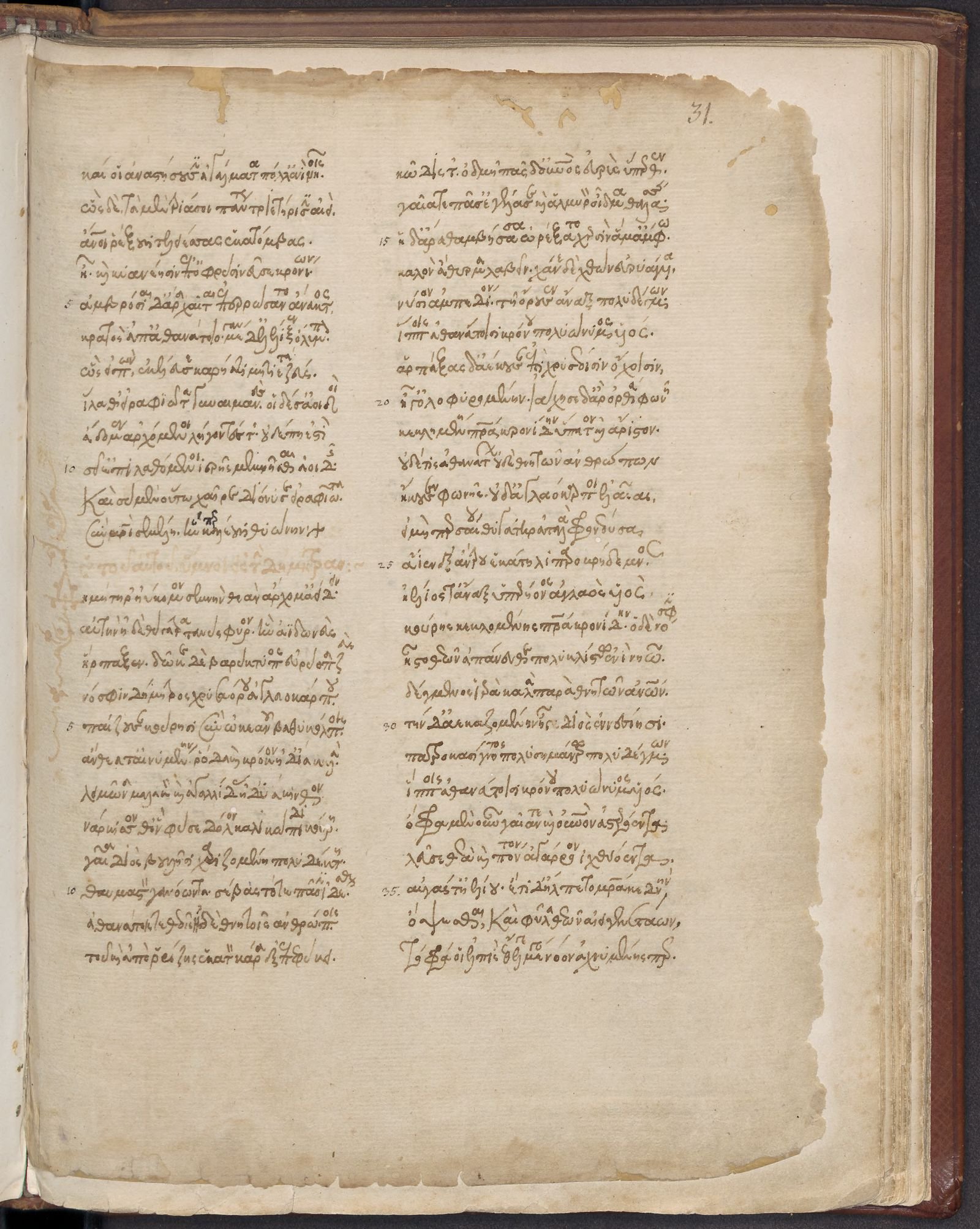
The page photographs are from Leiden, Universiteitsbibliotheek, BPG 33 H (the 'Moscow' manuscript, M; paper, Greece?, first half of the 15th century; found in Moscow in 1777 by C. F. Matthaei), Homeric Hymns on fols. 31r-50r. M is the only manuscript of the Hymn to Demeter. Each section below is one column of a page (a = left, b = right); its note gives the first and last verse as read on the photograph. This entry is on fol. 31r.
Verses of the Loeb text that are not in this manuscript, and so are not shown: Hymn 1: 1-9.
The Greek is Evelyn-White's Loeb text (1914) via Perseus, not a transcription of the manuscript; where M is damaged the edition's restorations are shown in square brackets. The English is Evelyn-White's prose translation (1914), in blocks of about five lines, so a block can begin a line or two before or after a column break.
How was this verified? (Provenance)
Where on the image
Leiden BPG 33 H, fol. 31r, column a (left): Hymn 1 10-21; Hymn 2 1-12; begins ‹…καί οἱ ἀναστήσουσιν ἀγάλματα›, ends ‹ῥίζης ἑκατὸν κάρα ἐξεπεφύκει·›. Checked on the image: the first and last verses of the column were read and matched to the Greek. The next column begins with Hymn 2 13. Hymn 1 ends with verse 21; the red title of the Hymn to Demeter (faded) follows, then Demeter 1-12. English blocks here: 10-14, 15-19, 20-21.
10…καί οἱ ἀναστήσουσιν ἀγάλματα πόλλʼ ἐνὶ νηοῖς.
11ὣς δὲ τὰ μὲν τρία, σοὶ πάντως τριετηρίσιν αἰεὶ
12ἄνθρωποι ῥέξουσι τεληέσσας ἑκατόμβας.
13ἦ καὶ κυανέῃσιν ἐπʼ ὀφρύσι νεῦσε Κρονίων·
14ἀμβρόσιαι δʼ ἄρα χαῖται ἐπερρώσαντο ἄνακτος
15κρατὸς ἀπʼ ἀθανάτοιο· μέγαν δʼ ἐλέλιξεν Ὄλυμπον.
16ὣς εἰπὼν ἐπένευσε καρήατι μητίετα Ζεύς.
17ἵληθʼ, εἰραφιῶτα, γυναιμανές· οἱ δέ σʼ ἀοιδοὶ
18ᾄδομεν ἀρχόμενοι λήγοντές τʼ· οὐδέ πῃ ἔστι
19σεῖʼ ἐπιληθομένῳ ἱερῆς μεμνῆσθαι ἀοιδῆς.
20καὶ σὺ μὲν οὕτω χαῖρε, Διώνυσʼ εἰραφιῶτα,
21σὺν μητρὶ Σεμέλῃ, ἥν περ καλέουσι Θυώνην.
10“and men will lay up for her many offerings in her shrines. And as these things are three, so shall mortals ever sacrifice perfect hecatombs to you at your feasts each three years.”The Son of Cronos spoke and nodded with his dark brows. And the divine locks of the king flowed forward 15from his immortal head, and he made great Olympus reel. So spake wise Zeus and ordained it with a nod. Be favorable, O Insewn, Inspirer of frenzied women! we singers sing of you as we begin and as we end a strain, and none forgetting you may call holy song to mind. 20And so, farewell, Dionysus, Insewn, with your mother Semele whom men call Thyone.
Notes
- Greek: H. G. Evelyn-White, Hesiod, the Homeric Hymns and Homerica (Loeb Classical Library, 1914), via Perseus. Square brackets mark the editor's restorations of text lost or doubtful in the manuscript.
- Lines the Loeb numbers with letters (137a, 236a, 317a, 526a and others) are editorial supplements or variants and are left out.
- English: Evelyn-White's translation in the same volume; his footnotes are omitted. English blocks that fall wholly in verses missing from M are left out (Hymn 1: 1-4, 5-9).
Cite
Sources
- Source: Leiden BPG 33 H (Leiden University Libraries IIIF) + Evelyn-White Greek (Loeb 1914, Perseus) + Evelyn-White English (1914, Perseus) (holding institution)
- Critical edition: Evelyn-White, Loeb 1914, via Perseus
← previous · → next · v cycle view · l back to library