Homeric Hymn 2, To Demeter
Introduction
The Homeric Hymns are 33 hexameter poems to the Greek gods, composed by anonymous poets between about the 7th and the 5th century BCE and handed down under Homer's name. This entry: Homeric Hymn 2, To Demeter. Hades carries off Persephone; Demeter searches for her, nurses the child Demophon at Eleusis, withholds the harvest, and wins her daughter back for two thirds of each year. The hymn ends with the founding of the Eleusinian Mysteries. This manuscript is its only witness.
This collection has Hymns 1-18 only. The manuscript shown, M, breaks off at Hymn 18, line 4 (fol. 50r; fol. 50v is blank), so the rest of Hymn 18 (lines 5-12) and Hymns 19-33 (to Pan, Hephaestus, Apollo, Poseidon, Zeus, Hestia, the Muses and Apollo, Dionysus, Artemis, Athena, Hestia, Earth, Helios, Selene and the Dioscuri) are not in it and are not given here.
The page photographs are from Leiden, Universiteitsbibliotheek, BPG 33 H (the 'Moscow' manuscript, M; paper, Greece?, first half of the 15th century; found in Moscow in 1777 by C. F. Matthaei), Homeric Hymns on fols. 31r-50r. M is the only manuscript of the Hymn to Demeter. Each section below is one column of a page (a = left, b = right); its note gives the first and last verse as read on the photograph. This entry is on fol. 31r, 31v, 32r, 32v, 33r, 33v, 34r, 34v, 35r, 35v, 36r.
The Greek is Evelyn-White's Loeb text (1914) via Perseus, not a transcription of the manuscript; where M is damaged the edition's restorations are shown in square brackets. The English is Evelyn-White's prose translation (1914), in blocks of about five lines, so a block can begin a line or two before or after a column break.
How was this verified? (Provenance)
Where on the image
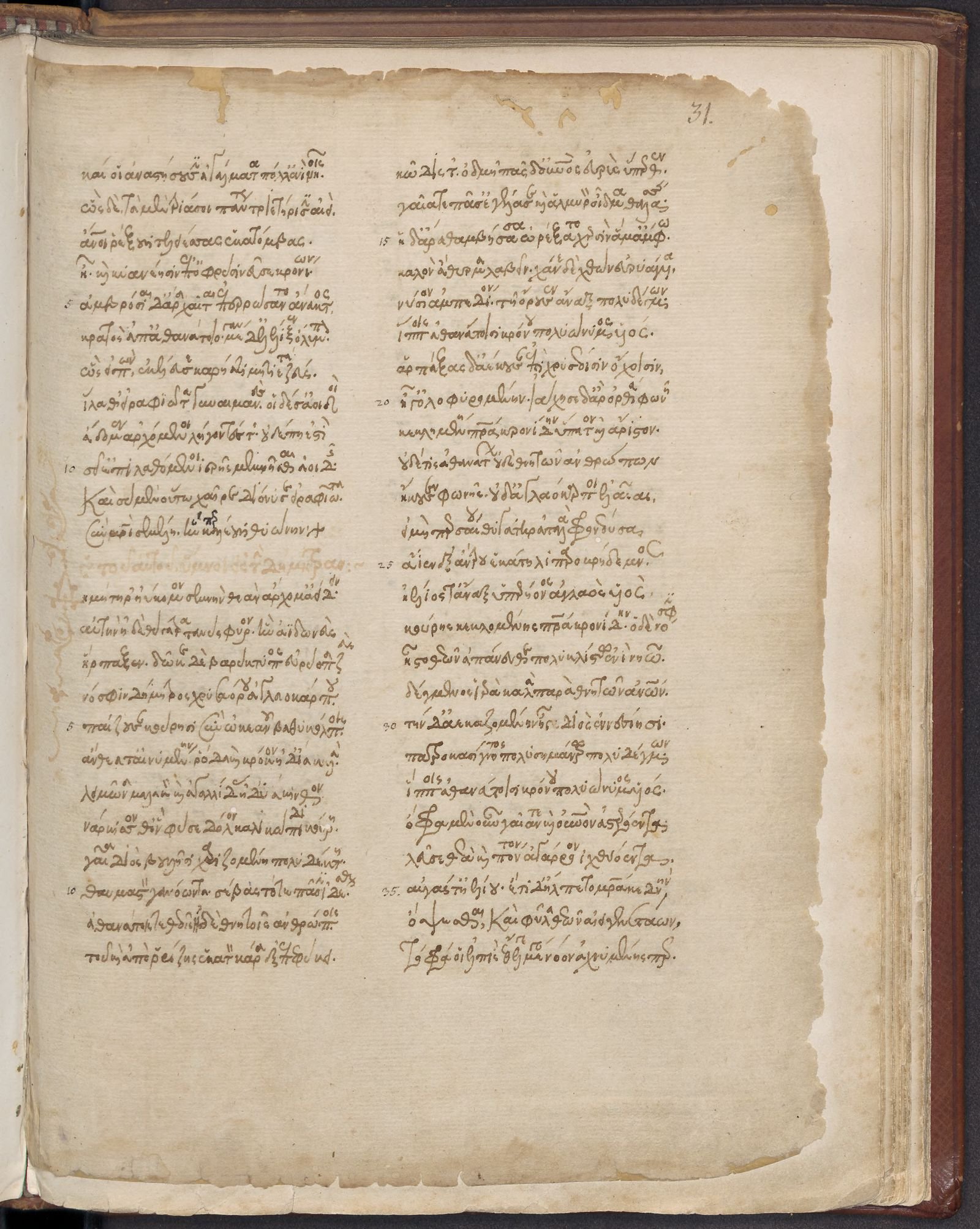
Leiden BPG 33 H, fol. 31r, column a (left): Hymn 1 10-21; Hymn 2 1-12; begins ‹…καί οἱ ἀναστήσουσιν ἀγάλματα›, ends ‹ῥίζης ἑκατὸν κάρα ἐξεπεφύκει·›. Checked on the image: the first and last verses of the column were read and matched to the Greek. The next column begins with Hymn 2 13. Hymn 1 ends with verse 21; the red title of the Hymn to Demeter (faded) follows, then Demeter 1-12. English blocks here: 1-4, 5-9, 10-14.
1Δήμητρʼ ἠύκομον, σεμνὴν θεόν, ἄρχομʼ ἀείδειν,
2αὐτὴν ἠδὲ θύγατρα τανύσφυρον, ἣν Ἀιδωνεὺς
3ἥρπαξεν, δῶκεν δὲ βαρύκτυπος εὐρύοπα Ζεύς,
4νόσφιν Δήμητρος χρυσαόρου, ἀγλαοκάρπου,
5παίζουσαν κούρῃσι σὺν Ὠκεανοῦ βαθυκόλποις
6ἄνθεά τʼ αἰνυμένην, ῥόδα καὶ κρόκον ἠδʼ ἴα καλὰ
7λειμῶνʼ ἂμ μαλακὸν καὶ ἀγαλλίδας ἠδʼ ὑάκινθον
8νάρκισσόν θʼ, ὃν φῦσε δόλον καλυκώπιδι κούρῃ
9Γαῖα Διὸς βουλῇσι χαριζομένη Πολυδέκτῃ,
10θαυμαστὸν γανόωντα· σέβας τό γε πᾶσιν ἰδέσθαι
11ἀθανάτοις τε θεοῖς ἠδὲ θνητοῖς ἀνθρώποις·
12τοῦ καὶ ἀπὸ ῥίζης ἑκατὸν κάρα ἐξεπεφύκει·
1I begin to sing of rich-haired Demeter, awful goddess —of her and her trim-ankled daughter whom Aidoneus rapt away, given to him by all-seeing Zeus the loud-thunderer. Apart from Demeter, lady of the golden sword and glorious fruits, 5she was playing with the deep-bosomed daughters of Oceanus and gathering flowers over a soft meadow, roses and crocuses and beautiful violets, irises also and hyacinths and the narcissus, which Earth made to grow at the will of Zeus and to please the Host of Many, to be a snare for the bloom-like girl — 10a marvellous, radiant flower. It was a thing of awe whether for deathless gods or mortal men to see: from its root grew a hundred blooms and it smelled most sweetly, so that all wide heaven above and the whole earth and the sea's salt swell laughed for joy.
Where on the image
Leiden BPG 33 H, fol. 31r, column b (right): Hymn 2 13-37; begins ‹κὦζʼ ἥδιστʼ ὀδμή, πᾶς›, ends ‹μέγαν νόον ἀχνυμένης περ·›. Checked on the image: the first and last verses of the column were read and matched to the Greek. The column before ends with Hymn 2 12. The next column begins with Hymn 2 38. English blocks here: 15-19, 20-24, 25-29, 30-34, 35-39.
13κὦζʼ ἥδιστʼ ὀδμή, πᾶς τʼ οὐρανὸς εὐρὺς ὕπερθεν
14γαῖά τε πᾶσʼ ἐγέλασσε καὶ ἁλμυρὸν οἶδμα θαλάσσης.
15ἣ δʼ ἄρα θαμβήσασʼ ὠρέξατο χερσὶν ἅμʼ ἄμφω
16καλὸν ἄθυρμα λαβεῖν· χάνε δὲ χθὼν εὐρυάγυια
17Νύσιον ἂμ πεδίον, τῇ ὄρουσεν ἄναξ Πολυδέγμων
18ἵπποις ἀθανάτοισι, Κρόνου πολυώνυμος υἱός.
19ἁρπάξας δʼ ἀέκουσαν ἐπὶ χρυσέοισιν ὄχοισιν
20ἦγʼ ὀλοφυρομένην· ἰάχησε δʼ ἄρʼ ὄρθια φωνῇ,
21κεκλομένη πατέρα Κρονίδην ὕπατον καὶ ἄριστον.
22οὐδέ τις ἀθανάτων οὐδὲ θνητῶν ἀνθρώπων
23ἤκουσεν φωνῆς, οὐδʼ ἀγλαόκαρποι ἐλαῖαι†
24εἰ μὴ Περσαίου θυγάτηρ ἀταλὰ φρονέουσα
25ἄιεν ἐξ ἄντρου, Ἑκάτη λιπαροκρήδεμνος,
26Ἠέλιός τε ἄναξ, Ὑπερίονος ἀγλαὸς υἱός,
27κούρης κεκλομένης πατέρα Κρονίδην· ὃ δὲ νόσφιν
28ἧστο θεῶν ἀπάνευθε πολυλλίστῳ ἐνὶ νηῷ,
29δέγμενος ἱερὰ καλὰ παρὰ θνητῶν ἀνθρώπων.
30τὴν δʼ ἀεκαζομένην ἦγεν Διὸς ἐννεσίῃσι
31πατροκασίγνητος, Πολυσημάντωρ Πολυδέγμων,
32ἵπποις ἀθανάτοισι, Κρόνου πολυώνυμος υἱός.
33ὄφρα μὲν οὖν γαῖάν τε καὶ οὐρανὸν ἀστερόεντα
34λεῦσσε θεὰ καὶ πόντον ἀγάρροον ἰχθυόεντα
35αὐγάς τʼ ἠελίου, ἔτι δʼ ἤλπετο μητέρα κεδνὴν
36ὄψεσθαι καὶ φῦλα θεῶν αἰειγενετάων,
37τόφρα οἱ ἐλπὶς ἔθελγε μέγαν νόον ἀχνυμένης περ·
15And the girl was amazed and reached out with both hands to take the lovely toy; but the wide-pathed earth yawned there in the plain of Nysa, and the lord, Host of Many, with his immortal horses sprang out upon her —the Son of Cronos, He who has many names. He caught her up reluctant on his golden car and bare her away 20lamenting. Then she cried out shrilly with her voice, calling upon her father, the Son of Cronos, who is most high and excellent. But no one, either of the deathless gods or of mortal men, heard her voice, nor yet the olive-trees bearing rich fruit: 25only tender-hearted Hecate, bright-coiffed, the daughter of Persaeus, heard the girl from her cave, and the lord Helios, Hyperion's bright son, as she cried to her father, the Son of Cronos. But he was sitting aloof, apart from the gods, in his temple where many pray, and receiving sweet offerings from mortal men. So he, that son of Cronos, of many names, who is Ruler of Many and Host of Many, 30was bearing her away by leave of Zeus on his immortal chariot —his own brother's child and all unwilling. And so long as she, the goddess, yet beheld earth and starry heaven and the strong-flowing sea where fishes shoal, 35and the rays of the sun, and still hoped to see her dear mother and the tribes of the eternal gods, so long hope calmed her great heart for all her troubleand the heights of the mountains and the depths of the sea rang with her immortal voice: and her queenly mother heard her.
Where on the image
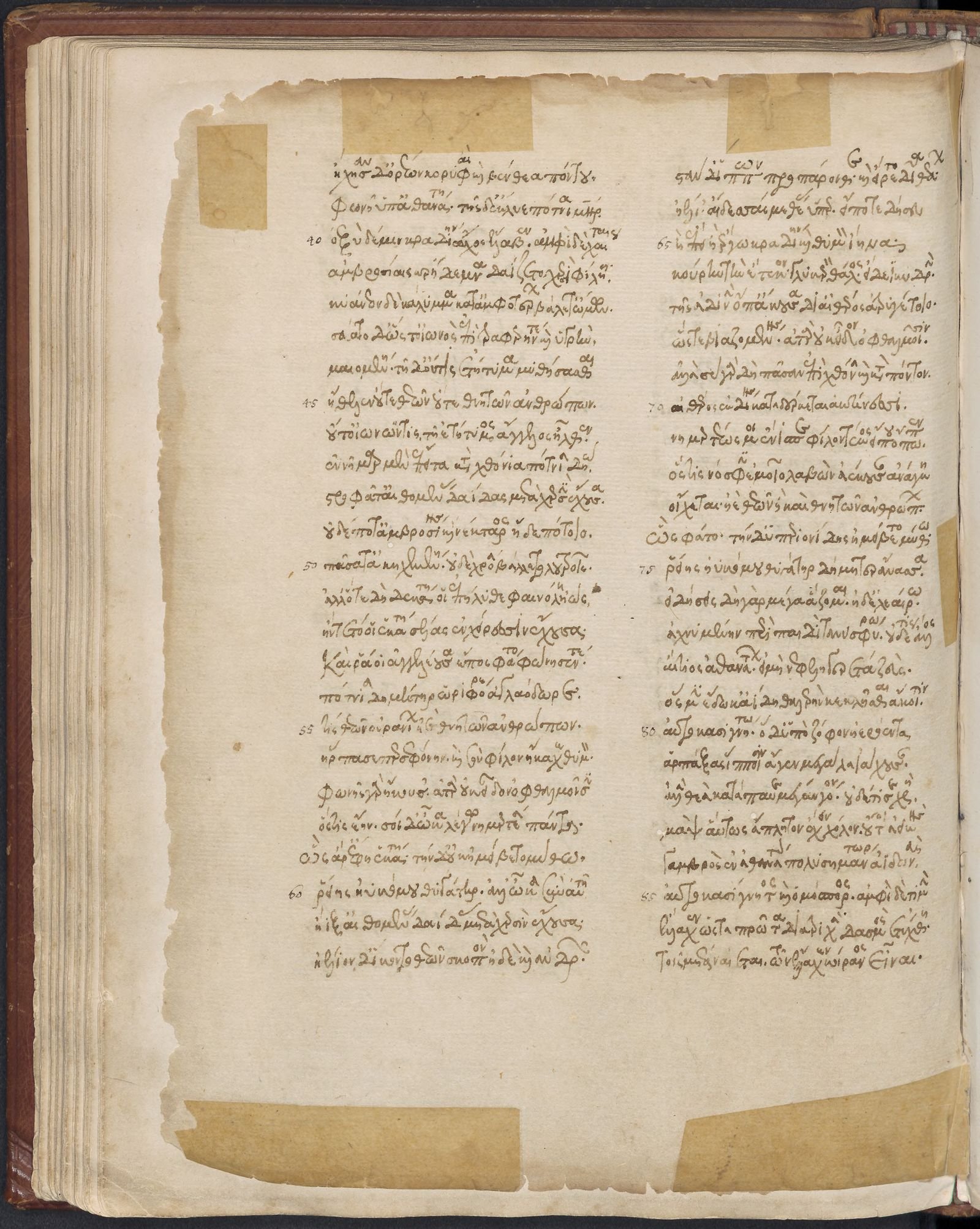
Leiden BPG 33 H, fol. 31v, column a (left): Hymn 2 38-62; begins ‹…ἤχησαν δʼ ὀρέων κορυφαὶ›, ends ‹σκοπὸν ἠδὲ καὶ ἀνδρῶν,›. Checked on the image: the first and last verses of the column were read and matched to the Greek. The column before ends with Hymn 2 37. The next column begins with Hymn 2 63. English blocks here: 40-44, 45-49, 50-54, 55-59, 60-64.
38…ἤχησαν δʼ ὀρέων κορυφαὶ καὶ βένθεα πόντου
39φωνῇ ὑπʼ ἀθανάτῃ· τῆς δʼ ἔκλυε πότνια μήτηρ.
40ὀξὺ δέ μιν κραδίην ἄχος ἔλλαβεν, ἀμφὶ δὲ χαίταις
41ἀμβροσίαις κρήδεμνα δαΐζετο χερσὶ φίλῃσι,
42κυάνεον δὲ κάλυμμα κατʼ ἀμφοτέρων βάλετʼ ὤμων,
43σεύατο δʼ ὥστʼ οἰωνός, ἐπὶ τραφερήν τε καὶ ὑγρὴν
44μαιομένη· τῇ δʼ οὔτις ἐτήτυμα μυθήσασθαι
45ἤθελεν οὔτε θεῶν οὔτε θνητῶν ἀνθρώπων,
46οὔτʼ οἰωνῶν τις τῇ ἐτήτυμος ἄγγελος ἦλθεν.
47ἐννῆμαρ μὲν ἔπειτα κατὰ χθόνα πότνια Δηὼ
48στρωφᾶτʼ αἰθομένας δαΐδας μετὰ χερσὶν ἔχουσα,
49οὐδέ ποτʼ ἀμβροσίης καὶ νέκταρος ἡδυπότοιο
50πάσσατʼ ἀκηχεμένη, οὐδὲ χρόα βάλλετο λουτροῖς.
51ἀλλʼ ὅτε δὴ δεκάτη οἱ ἐπήλυθε φαινολὶς ἠώς,
52ἤντετό οἱ Ἑκάτη, σέλας ἐν χείρεσσιν ἔχουσα
53καί ῥά οἱ ἀγγελέουσα ἔπος φάτο φώνησέν τε·
54πότνια Δημήτηρ, ὡρηφόρε, ἀγλαόδωρε,
55τίς θεῶν οὐρανίων ἠὲ θνητῶν ἀνθρώπων
56ἥρπασε Περσεφόνην καὶ σὸν φίλον ἤκαχε θυμόν;
57φωνῆς γὰρ ἤκουσʼ, ἀτὰρ οὐκ ἴδον ὀφθαλμοῖσιν,
58ὅστις ἔην· σοὶ δʼ ὦκα λέγω νημερτέα πάντα.
59ὣς ἄρʼ ἔφη Ἑκάτη· τὴν δʼ οὐκ ἠμείβετο μύθῳ
60Ῥείης ἠυκόμου θυγάτηρ, ἀλλʼ ὦκα σὺν αὐτῇ
61ἤιξʼ αἰθομένας δαΐδας μετὰ χερσὶν ἔχουσα.
62Ἠέλιον δʼ ἵκοντο, θεῶν σκοπὸν ἠδὲ καὶ ἀνδρῶν,
40Bitter pain seized her heart, and she rent the covering upon her divine hair with her dear hands: her dark cloak she cast down from both her shoulders and sped, like a wild-bird, over the firm land and yielding sea, seeking her child. 45But no one would tell her the truth, neither god nor mortal man; and of the birds of omen none came with true news for her. Then for nine days queenly Deo wandered over the earth with flaming torches in her hands, so grieved that she never tasted ambrosia and the sweet draught of nectar, 50nor sprinkled her body with water. But when the tenth enlightening dawn had come, Hecate, with a torch in her hands, met her, and spoke to her and told her news: “Queenly Demeter, bringer of seasons and giver of good gifts, 55what god of heaven or what mortal man has rapt away Persephone and pierced with sorrow your dear heart? For I heard her voice, yet saw not with my eyes who it was. But I tell you truly and shortly all I know.” So, then, said Hecate. 60And the daughter of rich-haired Rhea answered her not, but sped swiftly with her, holding flaming torches in her hands. So they came to Helios, who is watchman of both gods and men, and stood in front of his horses: and the bright goddess enquired of him: “Helios, do you at least regard me, goddess as I am,
Where on the image
Leiden BPG 33 H, fol. 31v, column b (right): Hymn 2 63-87; begins ‹στὰν δʼ ἵππων προπάροιθε›, ends ‹τῶν ἔλλαχε κοίρανος εἶναι.›. Checked on the image: the first and last verses of the column were read and matched to the Greek. The column before ends with Hymn 2 62. The next column begins with Hymn 2 88. English blocks here: 65-69, 70-74, 75-79, 80-84, 85-86.
63στὰν δʼ ἵππων προπάροιθε καὶ εἴρετο δῖα θεάων·
64ἠέλιʼ, αἴδεσσαί με θεὰν σύ περ, εἴ ποτε δή σευ
65ἢ ἔπει ἢ ἔργῳ κραδίην καὶ θυμὸν ἴηνα·
66κούρην τὴν ἔτεκον, γλυκερὸν θάλος, εἴδεϊ κυδρήν,
67τῆς ἀδινὴν ὄπʼ ἄκουσα διʼ αἰθέρος ἀτρυγέτοιο
68ὥστε βιαζομένης, ἀτὰρ οὐκ ἴδον ὀφθαλμοῖσιν.
69ἀλλά, σὺ γὰρ δὴ πᾶσαν ἐπὶ χθόνα καὶ κατὰ πόντον
70αἰθέρος ἐκ δίης καταδέρκεαι ἀκτίνεσσι,
71νημερτέως μοι ἔνισπε φίλον τέκος, εἴ που ὄπωπας,
72ὅστις νόσφιν ἐμεῖο λαβὼν ἀέκουσαν ἀνάγκῃ
73οἴχεται ἠὲ θεῶν ἢ καὶ θνητῶν ἀνθρώπων.
74ὣς φάτο· τὴν δʼ Ὑπεριονίδης ἠμείβετο μύθῳ·
75Ῥείης ἠυκόμου θύγατερ, Δήμητερ ἄνασσα,
76εἰδήσεις· δὴ γὰρ μέγα σʼ ἅζομαι ἠδʼ ἐλεαίρω
77ἀχνυμένην περὶ παιδὶ τανυσφύρῳ· οὐδέ τις ἄλλος
78αἴτιος ἀθανάτων, εἰ μὴ νεφεληγερέτα Ζεύς,
79ὅς μιν ἔδωκʼ Ἀίδῃ θαλερὴν κεκλῆσθαι ἄκοιτιν
80αὐτοκασιγνήτῳ· ὃ δʼ ὑπὸ ζόφον ἠερόεντα
81ἁρπάξας ἵπποισιν ἄγεν μεγάλα ἰάχουσαν.
82ἀλλά, θεά, κατάπαυε μέγαν γόον· οὐδέ τί σε χρὴ
83μὰψ αὔτως ἄπλητον ἔχειν χόλον· οὔ τοι ἀεικὴς
84γαμβρὸς ἐν ἀθανάτοις Πολυσημάντωρ Ἀιδωνεύς,
85αὐτοκασίγνητος καὶ ὁμόσπορος· ἀμφὶ δὲ τιμὴν
86ἔλλαχεν ὡς τὰ πρῶτα διάτριχα δασμὸς ἐτύχθη,
87τοῖς μεταναιετάειν, τῶν ἔλλαχε κοίρανος εἶναι.
65if ever by word or deed of mine I have cheered your heart and spirit. Through the fruitless air I heard the thrilling cry of my daughter whom I bare, sweet scion of my body and lovely in form, as of one seized violently; though with my eyes I saw nothing. But you —for with your beams you look down 70from the bright upper air over all the earth and sea —tell me truly of my dear child, if you have seen her anywhere, what god or mortal man has violently seized her against her will and mine, and so made off.” So said she. And the Son of Hyperion answered her: 75“Queen Demeter, daughter of rich-haired Rhea, I will tell you the truth; for I greatly reverence and pity you in your grief for your trim-ankled daughter. None other of the deathless gods is to blame, but only cloud-gathering Zeus who gave her to Hades, her father's brother, to be called his buxom wife. 80And Hades seized her and took her loudly crying in his chariot down to his realm of mist and gloom. Yet, goddess, cease your loud lament and keep not vain anger unrelentingly: Aidoneus, the Ruler of Many, is no unfitting husband among the deathless gods for your child, 85being your own brother and born of the same stock: also, for honor, he has that third share which he received when division was made at the first, and is appointed lord of those among whom he dwells.”
Where on the image
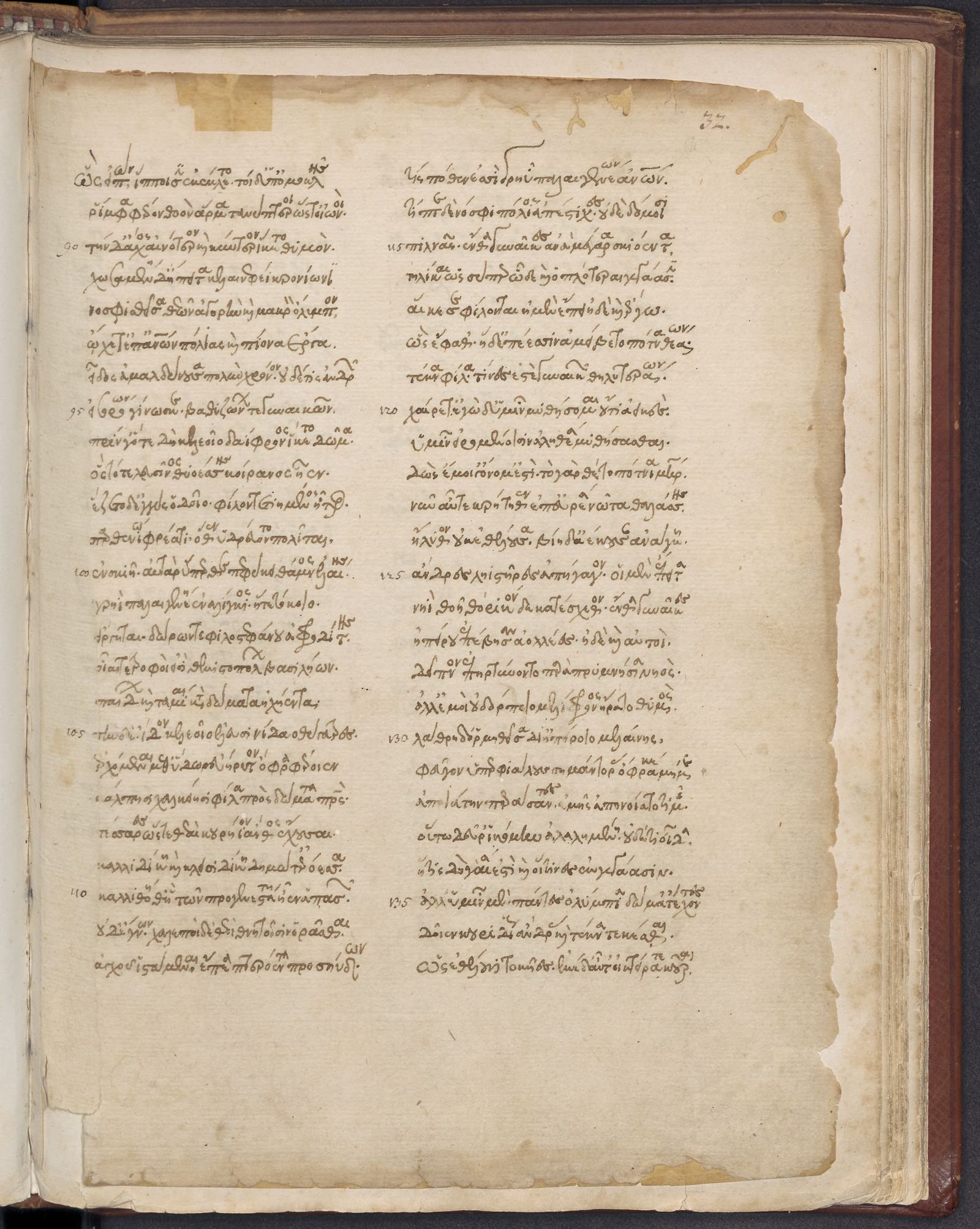
Leiden BPG 33 H, fol. 32r, column a (left): Hymn 2 88-112; begins ‹ὣς εἰπὼν ἵπποισιν ἐκέκλετο·›, ends ‹ἱστάμεναι ἔπεα πτερόεντα προσηύδων·›. Checked on the image: the first and last verses of the column were read and matched to the Greek. The column before ends with Hymn 2 87. The next column begins with Hymn 2 113. English blocks here: 87-89, 90-94, 95-99, 100-104, 105-109, 110-114.
88ὣς εἰπὼν ἵπποισιν ἐκέκλετο· τοὶ δʼ ὑπʼ ὀμοκλῆς
89ῥίμφα φέρον θοὸν ἅρμα τανύπτεροι ὥστʼ οἰωνοί.
90Τὴν δʼ ἄχος αἰνότερον καὶ κύντερον ἵκετο θυμόν·
91χωσαμένη δὴ ἔπειτα κελαινεφέι Κρονίωνι
92νοσφισθεῖσα θεῶν ἀγορὴν καὶ μακρὸν Ὄλυμπον
93ᾤχετʼ ἐπʼ ἀνθρώπων πόλιας καὶ πίονα ἔργα
94εἶδος ἀμαλδύνουσα πολὺν χρόνον· οὐδέ τις ἀνδρῶν
95εἰσορόων γίγνωσκε βαθυζώνων τε γυναικῶν,
96πρίν γʼ ὅτε δὴ Κελεοῖο δαΐφρονος ἵκετο δῶμα,
97ὃς τότʼ Ἐλευσῖνος θυοέσσης κοίρανος ἦεν.
98ἕζετο δʼ ἐγγὺς ὁδοῖο φίλον τετιημένη ἦτορ,
99Παρθενίῳ φρέατι, ὅθεν ὑδρεύοντο πολῖται,
100ἐν σκιῇ, αὐτὰρ ὕπερθε πεφύκει θάμνος ἐλαίης,
101γρηὶ παλαιγενέι ἐναλίγκιος, ἥτε τόκοιο
102εἴργηται δώρων τε φιλοστεφάνου Ἀφροδίτης,
103οἷαί τε τροφοί εἰσι θεμιστοπόλων βασιλήων
104παίδων καὶ ταμίαι κατὰ δώματα ἠχήεντα.
105τὴν δὲ ἴδον Κελεοῖο Ἐλευσινίδαο θύγατρες
106ἐρχόμεναι μεθʼ ὕδωρ εὐήρυτον, ὄφρα φέροιεν
107κάλπισι χαλκείῃσι φίλα πρὸς δώματα πατρός,
108τέσσαρες, ὥστε θεαί, κουρήιον ἄνθος ἔχουσαι,
109Καλλιδίκη καὶ Κλεισιδίκη Δημώ τʼ ἐρόεσσα
110Καλλιθόη θʼ, ἣ τῶν προγενεστάτη ἦεν ἁπασῶν·
111οὐδʼ ἔγνον· χαλεποὶ δὲ θεοὶ θνητοῖσιν ὁρᾶσθαι.
112ἀγχοῦ δʼ ἱστάμεναι ἔπεα πτερόεντα προσηύδων·
87So he spake, and called to his horses: and at his chiding they quickly whirled the swift chariot along, like long-winged birds. 90But grief yet more terrible and savage came into the heart of Demeter, and thereafter she was so angered with the dark-clouded Son of Cronos that she avoided the gathering of the gods and high Olympus, and went to the towns and rich fields of men, disfiguring her form a long while. And no one of men 95or deep-bosomed women knew her when they saw her, until she came to the house of wise Celeus who then was lord of fragrant Eleusis. Vexed in her dear heart, she sat near the wayside by the Maiden Well, from which the women of the place were used to draw water, 100in a shady place over which grew an olive shrub. And she was like an ancient woman who is cut off from childbearing and the gifts of garland-loving Aphrodite, like the nurses of kings' children who deal justice, or like the house-keepers in their echoing halls. 105There the daughters of Celeus, son of Eleusis, saw her, as they were coming for easy-drawn water, to carry it in pitchers of bronze to their dear father's house: four were they and like goddesses in the flower of their girlhood, Callidice and Cleisidice and lovely Demo 110and Callithoë who was the eldest of them all. They knew her not,—for the gods are not easily discerned by mortals—, but standing near by her spoke winged words: “Old mother, whence and who are you of folk born long ago? Why are you gone away from the city and do not draw near the houses?
Where on the image
Leiden BPG 33 H, fol. 32r, column b (right): Hymn 2 113-137; begins ‹τίς πόθεν ἐσσί, γρῆυ,›, ends ‹δʼ αὖτʼ οἰκτείρατε, κοῦραι.›. Checked on the image: the first and last verses of the column were read and matched to the Greek. The column before ends with Hymn 2 112. The next column begins with Hymn 2 138. English blocks here: 115-117, 118-119, 120-124, 125-129, 130-134, 135-139.
113τίς πόθεν ἐσσί, γρῆυ, παλαιγενέων ἀνθρώπων;
114τίπτε δὲ νόσφι πόληος ἀπέστιχες, οὐδὲ δόμοισι
115πίλνασαι; ἔνθα γυναῖκες ἀνὰ μέγαρα σκιόεντα
116τηλίκαι, ὡς σύ περ ὧδε καὶ ὁπλότεραι γεγάασιν,
117αἵ κέ σε φίλωνται ἠμὲν ἔπει ἠδὲ καὶ ἔργῳ.
118ὣς ἔφαν· ἣ δʼ ἐπέεσσιν ἀμείβετο πότνα θεάων·
119τέκνα φίλʼ, αἵ τινές ἐστε γυναικῶν θηλυτεράων,
120χαίρετʼ· ἐγὼ δʼ ὑμῖν μυθήσομαι· οὔ τοι ἀεικὲς
121ὑμῖν εἰρομένῃσιν ἀληθέα μυθήσασθαι.
122Δωσὼ ἐμοί γʼ ὄνομʼ ἐστί· τὸ γὰρ θέτο πότνια μήτηρ.
123νῦν αὖτε Κρήτηθεν ἐπʼ εὐρέα νῶτα θαλάσσης
124ἤλυθον οὐκ ἐθέλουσα, βίῃ δʼ ἀέκουσαν ἀνάγκῃ
125ἄνδρες ληιστῆρες ἀπήγαγον. οἳ μὲν ἔπειτα
126νηὶ θοῇ Θόρικόνδε κατέσχεθον, ἔνθα γυναῖκες
127ἠπείρου ἐπέβησαν ἀολλέες ἠδὲ καὶ αὐτοί,
128δεῖπνόν τʼ ἐπηρτύνοντο παρὰ πρυμνήσια νηός·
129ἀλλʼ ἐμοὶ οὐ δόρποιο μελίφρονος ἤρατο θυμός·
130λάθρη δʼ ὁρμηθεῖσα διʼ ἠπείροιο μελαίνης
131φεῦγον ὑπερφιάλους σημάντορας, ὄφρα κε μή με
132ἀπριάτην περάσαντες ἐμῆς ἀποναίατο τιμῆς.
133οὕτω δεῦρʼ ἱκόμην ἀλαλημένη, οὐδέ τι οἶδα,
134ἥ τις δὴ γαῖʼ ἐστι καὶ οἵ τινες ἐγγεγάασιν.
135ἀλλʼ ὑμῖν μὲν πάντες Ὀλύμπια δώματʼ ἔχοντες
136δοῖεν κουριδίους ἄνδρας, καὶ τέκνα τεκέσθαι,
137ὡς ἐθέλουσι τοκῆες· ἐμὲ δʼ αὖτʼ οἰκτείρατε, κοῦραι.
115For there in the shady halls are women of just such age as you, and others younger; and they would welcome you both by word and by deed.” 118Thus they said. And she, that queen among goddesses answered them saying: “Hail, dear children, whosoever you are of woman-kind. 120I will tell you my story; for it is not unseemly that I should tell you truly what you ask. Doso is my name, for my stately mother gave it me. And now I am come from Crete over the sea's wide back,—not willingly; but against my liking, by force of strength, 125pirates brought me thence. Afterwards they put in with their swift craft to Thoricus, and there the women landed on the shore in full throng and the men likewise, and they began to make ready a meal by the stern-cables of the ship. But my heart craved not pleasant food, 130and I fled secretly across the dark country and escaped my masters, that they should not take me unpurchased across the sea, there to win a price for me. And so I wandered and am come here: and I know not at all what land this is or what people are in it. 135But may all those who dwell on Olympus give you husbands and birth of children as parents desire, so you take pity on me, maidens,
Where on the image
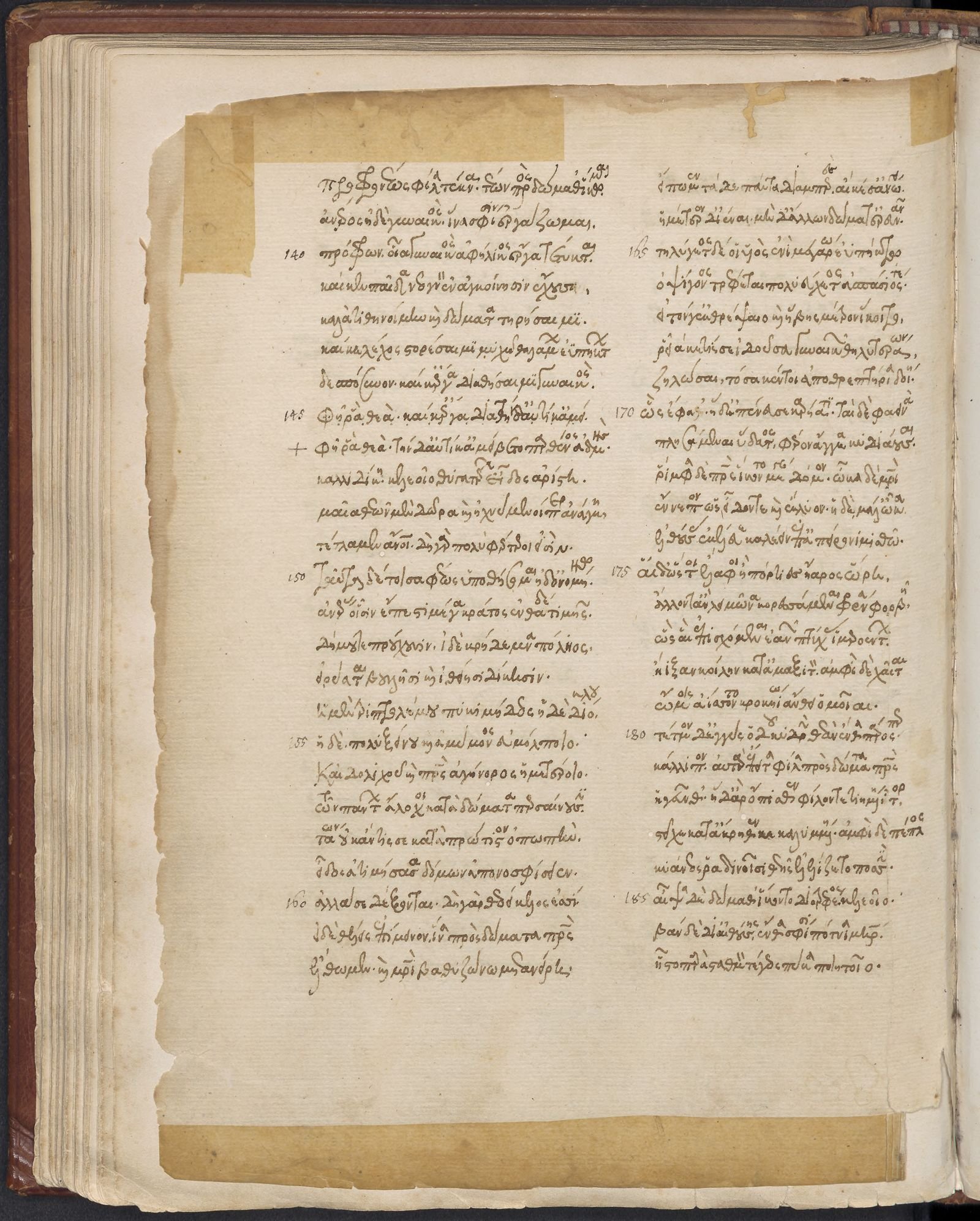
Leiden BPG 33 H, fol. 32v, column a (left): Hymn 2 138-161; begins ‹προφρονέως, φίλα τέκνα, τέων›, ends ‹καὶ μητρὶ βαθυζώνῳ Μετανείρῃ›. Checked on the image: the first and last verses of the column were read and matched to the Greek. The column before ends with Hymn 2 137. The next column begins with Hymn 2 162. Line 137a of the Loeb text is not in the manuscript: 32r b ends with 137 and this column begins with 138. English blocks here: 140-144, 145-146, 147-149, 150-154, 155-159.
138προφρονέως, φίλα τέκνα, τέων πρὸς δώμαθʼ ἵκωμαι
139ἀνέρος ἠδὲ γυναικός, ἵνα σφίσιν ἐργάζωμαι
140πρόφρων, οἷα γυναικὸς ἀφήλικος ἔργα τέτυκται·
141καί κεν παῖδα νεογνὸν ἐν ἀγκοίνῃσιν ἔχουσα
142καλὰ τιθηνοίμην καὶ δώματα τηρήσαιμι
143καί κε λέχος στορέσαιμι μυχῷ θαλάμων εὐπήκτων
144δεσπόσυνον καί κʼ ἔργα διδασκήσαιμι γυναῖκας.
145φῆ ῥα θεά· τὴν δʼ αὐτίκʼ ἀμείβετο παρθένος ἀδμής,
146Καλλιδίκη, Κελεοῖο θυγατρῶν εἶδος ἀρίστη·
147μαῖα, θεῶν μὲν δῶρα καὶ ἀχνύμενοί περ ἀνάγκῃ
148τέτλαμεν ἄνθρωποι· δὴ γὰρ πολὺ φέρτεροί εἰσι.
149ταῦτα δέ τοι σαφέως ὑποθήσομαι ἠδʼ ὀνομήνω
150ἀνέρας οἷσιν ἔπεστι μέγα κράτος ἐνθάδε τιμῆς
151δήμου τε προὔχουσιν ἰδὲ κρήδεμνα πόληος
152εἰρύαται βουλῇσι καὶ ἰθείῃσι δίκῃσιν·
153ἠμὲν Τριπτολέμου πυκιμήδεος ἠδὲ Διόκλου
154ἠδὲ Πολυξείνου καὶ ἀμύμονος Εὐμόλποιο
155καὶ Δολίχου καὶ πατρὸς ἀγήνορος ἡμετέροιο,
156τῶν πάντων ἄλοχοι κατὰ δώματα πορσαίνουσι·
157τάων οὐκ ἄν τίς σε κατὰ πρώτιστον ὀπωπὴν
158εἶδος ἀτιμήσασα δόμων ἀπονοσφίσσειεν,
159ἀλλά σε δέξονται· δὴ γὰρ θεοείκελός ἐσσι.
160εἰ δʼ ἐθέλεις, ἐπίμεινον, ἵνα πρὸς δώματα πατρὸς
161ἔλθωμεν καὶ μητρὶ βαθυζώνῳ Μετανείρῃ
140to work for them cheerfully at such tasks as belong to a woman of my age. Well could I nurse a new born child, holding him in my arms, or keep house, or spread my masters' bed in a recess of the well-built chamber, or teach the women their work.” 145So said the goddess. And straightway the unwed maiden Callidice, goodliest in form of the daughters of Celeus, answered her and said: 147“Mother, what the gods send us, we mortals bear perforce, although we suffer; for they are much stronger than we. But now I will teach you clearly, 150telling you the names of men who have great power and honor here and are chief among the people, guarding our city's coif of towers by their wisdom and true judgements: there is wise Triptolemus and Dioclus and Polyxeinus and blameless Eumolpus 155and Dolichus and our own brave father. All these have wives who manage in the house, and no one of them, so soon as she had seen you, would dishonor you and turn you from the house, but they will welcome you; for indeed you are godlike.
Where on the image
Leiden BPG 33 H, fol. 32v, column b (right): Hymn 2 162-186; begins ‹εἴπωμεν τάδε πάντα διαμπερές,›, ends ‹σταθμὸν τέγεος πύκα ποιητοῖο›. Checked on the image: the first and last verses of the column were read and matched to the Greek. The column before ends with Hymn 2 161. The next column begins with Hymn 2 187. English blocks here: 160-164, 165-169, 170-174, 175-179, 180-183, 184-184.
162εἴπωμεν τάδε πάντα διαμπερές, αἴ κέ σʼ ἀνώγῃ
163ἡμέτερόνδʼ ἰέναι μηδʼ ἄλλων δώματʼ ἐρευνᾶν.
164τηλύγετος δέ οἱ υἱὸς ἐνὶ μεγάρῳ εὐπήκτῳ
165ὀψίγονος τρέφεται, πολυεύχετος ἀσπάσιός τε.
166εἰ τόν γʼ ἐκθρέψαιο καὶ ἥβης μέτρον ἵκοιτο,
167ῥεῖά κέ τίς σε ἰδοῦσα γυναικῶν θηλυτεράων
168ζηλώσαι· τόσα κέν τοι ἀπὸ θρεπτήρια δοίη.
169ὣς ἔφαθʼ· ἣ δʼ ἐπένευσε καρήατι· ταὶ δὲ φαεινὰ
170πλησάμεναι ὕδατος φέρον ἄγγεα κυδιάουσαι.
171ῥίμφα δὲ πατρὸς ἵκοντο μέγαν δόμον, ὦκα δὲ μητρὶ
172ἔννεπον, ὡς εἶδόν τε καὶ ἔκλυον. ἣ δὲ μάλʼ ὦκα
173ἐλθούσας ἐκέλευε καλεῖν ἐπʼ ἀπείρονι μισθῷ.
174αἳ δʼ ὥστʼ ἢ ἔλαφοι ἢ πόρτιες εἴαρος ὥρῃ
175ἅλλοντʼ ἂν λειμῶνα κορεσσάμεναι φρένα φορβῇ,
176ὣς αἳ ἐπισχόμεναι ἑανῶν πτύχας ἱμεροέντων
177ἤιξαν κοίλην κατʼ ἀμαξιτόν· ἀμφὶ δὲ χαῖται
178ὤμοις ἀίσσοντο κροκηίῳ ἄνθει ὁμοῖαι.
179τέτμον δʼ ἐγγὺς ὁδοῦ κυδρὴν θεόν, ἔνθα πάρος περ
180κάλλιπον· αὐτὰρ ἔπειτα φίλου πρὸς δώματα πατρὸς
181ἡγεῦνθʼ· ἣ δʼ ἄρʼ ὄπισθε φίλον τετιημένη ἦτορ
182στεῖχε κατὰ κρῆθεν κεκαλυμμένη· ἀμφὶ δὲ πέπλος
183κυάνεος ῥαδινοῖσι θεᾶς ἐλελίζετο ποσσίν.
184αἶψα δὲ δώμαθʼ ἵκοντο διοτρεφέος Κελεοῖο,
185βὰν δὲ διʼ αἰθούσης, ἔνθα σφίσι πότνια μήτηρ
186ἧστο παρὰ σταθμὸν τέγεος πύκα ποιητοῖο
160But if you will, stay here; and we will go to our father's house and tell Metaneira, our deep-bosomed mother, all this matter fully, that she may bid you rather come to our home than search after the houses of others. She has an only son, 165late-born, who is being nursed in our well-built house, a child of many prayers and welcome: if you could bring him up until he reached the full measure of youth, any one of womankind who should see you would straightway envy you, such gifts would our mother give for his upbringing.” So she spake: and the goddess bowed her head in assent. And they filled their shining vessels 170with water and carried them off rejoicing. Quickly they came to their father's great house and straightway told their mother according as they had heard and seen. Then she bade them go with all speed and invite the stranger to come for a measureless hire. As hinds or heifers in spring time, 175when sated with pasture, bound about a meadow, so they, holding up the folds of their lovely garments, darted down the hollow path, and their hair like a crocus flower streamed about their shoulders. And they found the good goddess near the wayside where they had left her before, 180and led her to the house of their dear father. And she walked behind, distressed in her dear heart, with her head veiled and wearing a dark cloak which waved about the slender feet of the goddess. 184Soon they came to the house of heaven-nurtured Celeus
Where on the image
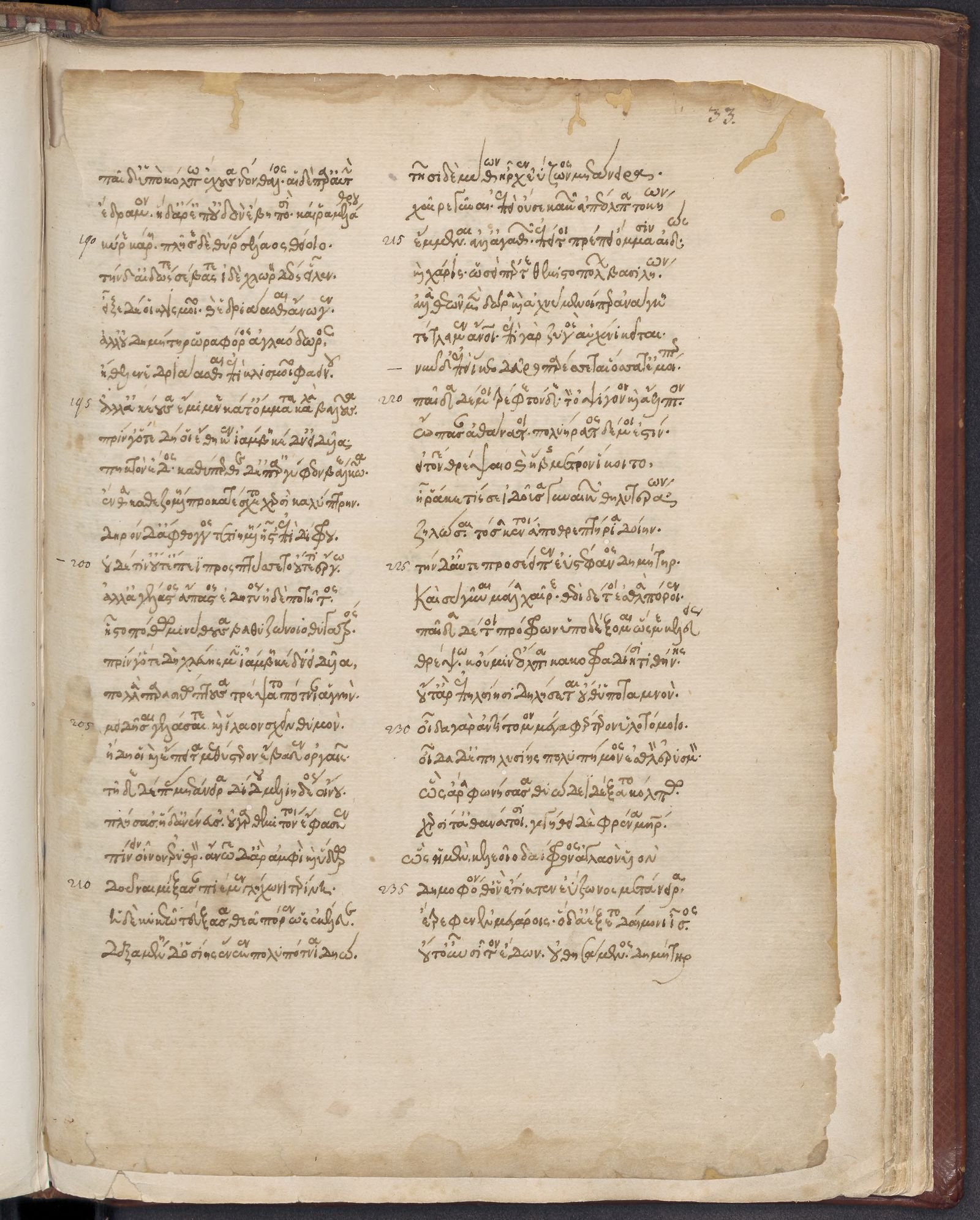
Leiden BPG 33 H, fol. 33r, column a (left): Hymn 2 187-211; begins ‹παῖδʼ ὑπὸ κόλπῳ ἔχουσα,›, ends ‹ὁσίης ἕνεκεν πολυπότνια Δηώ›. Checked on the image: the first and last verses of the column were read and matched to the Greek. The column before ends with Hymn 2 186. The next column begins with Hymn 2 212. English blocks here: 185-189, 190-194, 195-199, 200-204, 205-209, 210-212.
187παῖδʼ ὑπὸ κόλπῳ ἔχουσα, νέον θάλος· αἳ δὲ παρ αὐτὴν
188ἔδραμον· ἣ δʼ ἄρʼ ἐπʼ οὐδὸν ἔβη ποσὶ καί ῥα μελάθρου
189κῦρε κάρη, πλῆσεν δὲ θύρας σέλαος θείοιο.
190τὴν δʼ αἰδώς τε σέβας τε ἰδὲ χλωρὸν δέος εἷλεν·
191εἶξε δέ οἱ κλισμοῖο καὶ ἑδριάασθαι ἄνωγεν.
192ἀλλʼ οὐ Δημήτηρ ὡρηφόρος, ἀγλαόδωρος,
193ἤθελεν ἑδριάασθαι ἐπὶ κλισμοῖο φαεινοῦ,
194ἀλλʼ ἀκέουσʼ ἀνέμιμνε κατʼ ὄμματα καλὰ βαλοῦσα,
195πρίν γʼ ὅτε δή οἱ ἔθηκεν Ἰάμβη κέδνʼ εἰδυῖα
196πηκτὸν ἕδος, καθύπερθε δʼ ἐπʼ ἀργύφεον βάλε κῶας.
197ἔνθα καθεζομένη προκατέσχετο χερσὶ καλύπτρην·
198δηρὸν δʼ ἄφθογγος τετιημένη ἧστʼ ἐπὶ δίφρου,
199οὐδέ τινʼ οὔτʼ ἔπεϊ προσπτύσσετο οὔτε τι ἔργῳ,
200ἀλλʼ ἀγέλαστος, ἄπαστος ἐδητύος ἠδὲ ποτῆτος
201ἧστο πόθῳ μινύθουσα βαθυζώνοιο θυγατρός,
202πρίν γʼ ὅτε δὴ χλεύῃς μιν Ἰάμβη κέδνʼ εἰδυῖα
203πολλὰ παρασκώπτουσʼ ἐτρέψατο πότνιαν ἁγνήν,
204μειδῆσαι γελάσαι τε καὶ ἵλαον σχεῖν θυμόν·
205ἣ δή οἱ καὶ ἔπειτα μεθύστερον εὔαδεν ὀργαῖς.
206τῇ δὲ δέπας Μετάνειρα δίδου μελιηδέος οἴνου
207πλήσασʼ· ἣ δʼ ἀνένευσʼ· οὐ γὰρ θεμιτόν οἱ ἔφασκε
208πίνειν οἶνον ἐρυθρόν· ἄνωγε δʼ ἄρʼ ἄλφι καὶ ὕδωρ
209δοῦναι μίξασαν πιέμεν γλήχωνι τερείνῃ.
210ἣ δὲ κυκεῶ τεύξασα θεᾷ πόρεν, ὡς ἐκέλευε·
211δεξαμένη δʼ ὁσίης ἕνεκεν πολυπότνια Δηώ
185and went through the portico to where their queenly mother sat by a pillar of the close-fitted roof, holding her son, a tender scion, in her bosom. And the girls ran to her. But the goddess walked to the threshold: and her head reached the roof and she filled the doorway with a heavenly radiance. 190Then awe and reverence and pale fear took hold of Metaneira, and she rose up from her couch before Demeter, and bade her be seated. But Demeter, bringer of seasons and giver of perfect gifts, would not sit upon the bright couch, but stayed silent with lovely eyes cast down 195until careful Iambe placed a jointed seat for her and threw over it a silvery fleece. Then she sat down and held her veil in her hands before her face. A long time she sat upon the stool without speaking because of her sorrow, and greeted no one by word or by sign, but rested, 200never smiling, and tasting neither food nor drink, because she pined with longing for her deep-bosomed daughter, until careful Iambe —who pleased her moods in aftertime also —moved the holy lady with many a quip and jest to smile and laugh and cheer her heart. 205Then Metaneira filled a cup with sweet wine and offered it to her; but she refused it, for she said it was not lawful for her to drink red wine, but bade them mix meal and water with soft mint and give her to drink. 210And Metaneira mixed the draught and gave it to the goddess as she bade. So the great queen Deo received it to observe the sacrament And of them all, well-girded Metaneira first began to speak:
Where on the image
Leiden BPG 33 H, fol. 33r, column b (right): Hymn 2 212-236; begins ‹…τῇσι δὲ μύθων ἦρχεν›, ends ‹οὐ θησάμενος [γάλα μητρὸς]›. Checked on the image: the first and last verses of the column were read and matched to the Greek. The column before ends with Hymn 2 211. The next column begins with Hymn 2 237. The last verse (236) runs on to the word Δημήτηρ; editors take this as a sign that text is lost here, and the Loeb's 236a is a supplement that is not in the manuscript. English blocks here: 213-214, 215-219, 220-224, 225-229, 230-234.
212…τῇσι δὲ μύθων ἦρχεν ἐύζωνος Μετάνειρα·
213χαῖρε, γύναι, ἐπεὶ οὔ σε κακῶν ἄπʼ ἔολπα τοκήων
214ἔμμεναι, ἀλλʼ ἀγαθῶν· ἐπί τοι πρέπει ὄμμασιν αἰδὼς
215καὶ χάρις, ὡς εἴ πέρ τε θεμιστοπόλων βασιλήων.
216ἀλλὰ θεῶν μὲν δῶρα καὶ ἀχνύμενοί περ ἀνάγκῃ
217τέτλαμεν ἄνθρωποι· ἐπὶ γὰρ ζυγὸς αὐχένι κεῖται.
218νῦν δʼ, ἐπεὶ ἵκεο δεῦρο, παρέσσεται ὅσσα τʼ ἐμοί περ.
219παῖδα δέ μοι τρέφε τόνδε, τὸν ὀψίγονον καὶ ἄελπτον
220ὤπασαν ἀθάνατοι, πολυάρητος δέ μοί ἐστιν.
221εἰ τόν γε θρέψαιο καὶ ἥβης μέτρον ἵκοιτο,
222ῥεῖά κέ τίς σε ἰδοῦσα γυναικῶν θηλυτεράων
223ζηλώσαι· τόσα κέν τοι ἀπὸ θρεπτήρια δοίην.
224τὴν δʼ αὖτε προσέειπεν ἐυστέφανος Δημήτηρ·
225καὶ σύ, γύναι, μάλα χαῖρε, θεοὶ δέ τοι ἐσθλὰ πόροιεν·
226παῖδα δέ τοι πρόφρων ὑποδέξομαι, ὥς με κελεύεις,
227θρέψω κοὔ μιν, ἔολπα, κακοφραδίῃσι τιθήνης
228οὔτʼ ἄρʼ ἐπηλυσίη δηλήσεται οὔθʼ ὑποτάμνον·
229οἶδα γὰρ ἀντίτομον μέγα φέρτερον ὑλοτόμοιο,
230οἶδα δʼ ἐπηλυσίης πολυπήμονος ἐσθλὸν ἐρυσμόν.
231ὣς ἄρα φωνήσασα θυώδεϊ δέξατο κόλπῳ
232χείρεσσʼ ἀθανάτῃσι· γεγήθει δὲ φρένα μήτηρ.
233ὣς ἣ μὲν Κελεοῖο δαΐφρονος ἀγλαὸν υἱὸν
234Δημοφόωνθʼ, ὃν ἔτικτεν ἐύζωνος Μετάνειρα,
235ἔτρεφεν ἐν μεγάροις· ὃ δʼ ἀέξετο δαίμονι ἶσος,
236οὔτʼ οὖν σῖτον ἔδων, οὐ θησάμενος [γάλα μητρὸς]
213“Hail, lady! For I think you are not meanly but nobly born; truly dignity and 215grace are conspicuous upon your eyes as in the eyes of kings that deal justice. Yet we mortals bear perforce what the gods send us, though we be grieved; for a yoke is set upon our necks. But now, since you are come here, you shall have what I can bestow: and nurse me this child whom the gods gave me in my old age and beyond my hope, 220a son much prayed for. If you should bring him up until he reach the full measure of youth, any one of woman-kind that sees you will straightway envy you, so great reward would I give for his upbringing.” Then rich-haired Demeter answered her: 225“And to you, also, lady, all hail, and may the gods give you good! Gladly will I take the boy to my breast, as you bid me, and will nurse him. Never, I ween, through any heedlessness of his nurse shall witchcraft hurt him nor yet the Undercutter: for I know a charm far stronger than the Woodcutter, 230and I know an excellent safeguard against woeful witchcraft.” When she had so spoken, she took the child in her fragrant bosom with her divine hands: and his mother was glad in her heart. So the goddess nursed in the palace Demophoon, wise Celeus' goodly son whom well-girded Metaneira bare.
Where on the image
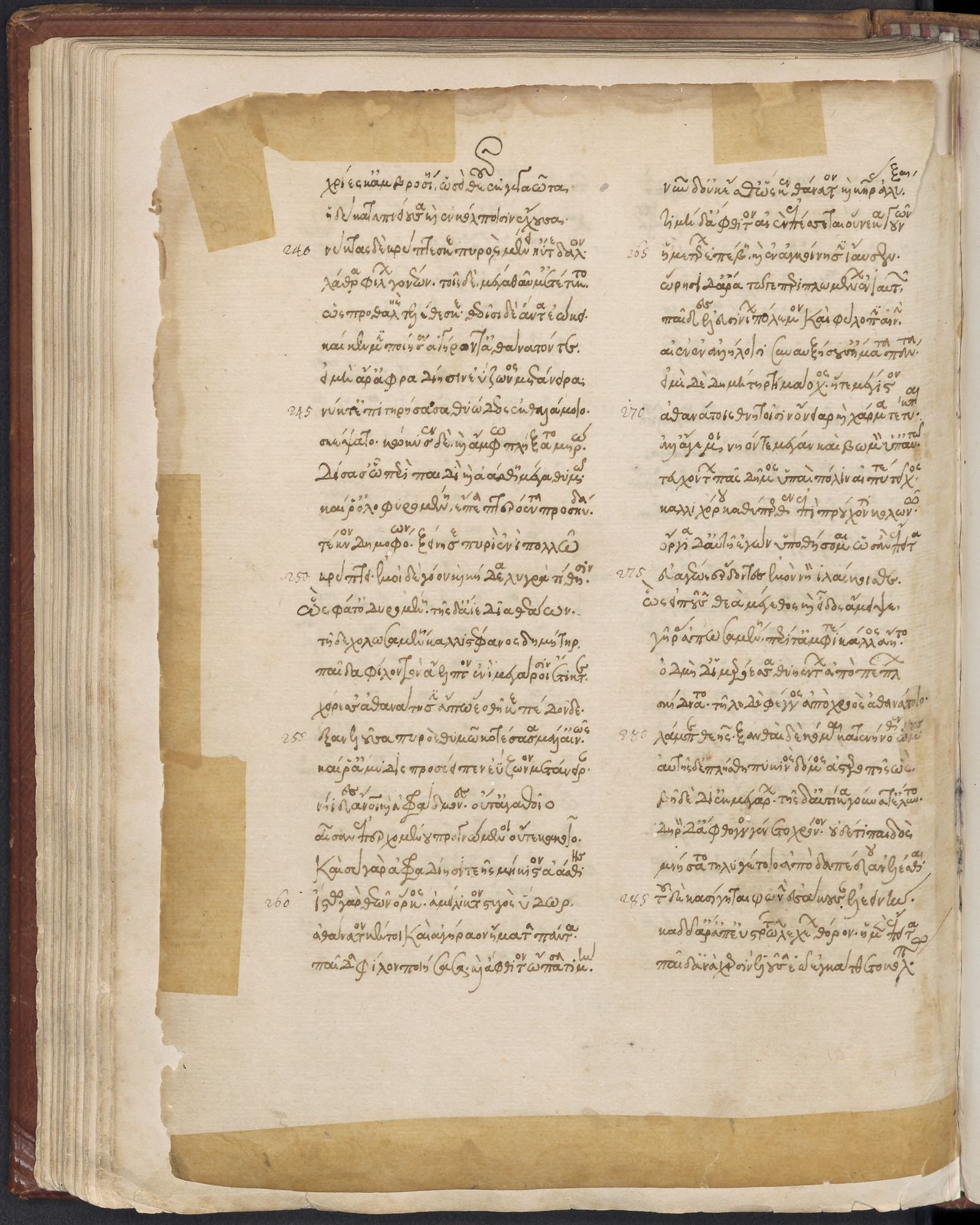
Leiden BPG 33 H, fol. 33v, column a (left): Hymn 2 237-261; begins ‹χρίεσκʼ ἀμβροσίῃ ὡσεὶ θεοῦ›, ends ‹καὶ ἄφθιτον ὤπασα τιμήν·›. Checked on the image: the first and last verses of the column were read and matched to the Greek. The column before ends with Hymn 2 236. The next column begins with Hymn 2 262. English blocks here: 235-239, 240-244, 245-247, 248-249, 250-254, 255-259.
237χρίεσκʼ ἀμβροσίῃ ὡσεὶ θεοῦ ἐκγεγαῶτα
238ἡδὺ καταπνείουσα καὶ ἐν κόλποισιν ἔχουσα·
239νύκτας δὲ κρύπτεσκε πυρὸς μένει ἠύτε δαλὸν
240λάθρα φίλων γονέων· τοῖς δὲ μέγα θαῦμʼ ἐτέτυκτο,
241ὡς προθαλὴς τελέθεσκε· θεοῖσι γὰρ ἄντα ἐῴκει.
242καί κέν μιν ποίησεν ἀγήρων τʼ ἀθάνατόν τε,
243εἰ μὴ ἄρʼ ἀφραδίῃσιν ἐύζωνος Μετάνειρα
244νύκτʼ ἐπιτηρήσασα θυώδεος ἐκ θαλάμοιο
245σκέψατο· κώκυσεν δὲ καὶ ἄμφω πλήξατο μηρὼ
246δείσασʼ ᾧ περὶ παιδὶ καὶ ἀάσθη μέγα θυμῷ
247καί ῥʼ ὀλοφυρομένη ἔπεα πτερόεντα προσηύδα·
248τέκνον Δημοφόων, ξείνη σε πυρὶ ἔνι πολλῷ
249κρύπτει, ἐμοὶ δὲ γόον καὶ κήδεα λυγρὰ τίθησιν.
250ὣς φάτʼ ὀδυρομένη· τῆς δʼ ἄιε δῖα θεάων.
251τῇ δὲ χολωσαμένη καλλιστέφανος Δημήτηρ
252παῖδα φίλον, τὸν ἄελπτον ἐνὶ μεγάροισιν ἔτικτε,
253χείρεσσʼ ἀθανάτῃσιν ἀπὸ ἕθεν ἧκε πέδονδε,
254ἐξανελοῦσα πυρός, θυμῷ κοτέσασα μάλʼ αἰνῶς,
255καί ῥʼ ἄμυδις προσέειπεν ἐύζωνον Μετάνειραν·
256νήιδες ἄνθρωποι καὶ ἀφράδμονες οὔτʼ ἀγαθοῖο
257αἶσαν ἐπερχομένου προγνώμεναι οὔτε κακοῖο·
258καὶ σὺ γὰρ ἀφραδίῃσι τεῇς νήκεστον ἀάσθης.
259ἴστω γὰρ θεῶν ὅρκος, ἀμείλικτον Στυγὸς ὕδωρ,
260ἀθάνατόν κέν τοι καὶ ἀγήραον ἤματα πάντα
261παῖδα φίλον ποίησα καὶ ἄφθιτον ὤπασα τιμήν·
235And the child grew like some immortal being, not fed with food nor nourished at the breast: for by day 240unknown to his dear parents. And it wrought great wonder in these that he grew beyond his age; for he was like the gods face to face. And she would have made him deathless and unageing, had not well-girded Metaneira in her heedlessness kept watch by night from her sweet-smelling chamber and 245spied. But she wailed and smote her two hips, because she feared for her son and was greatly distraught in her heart; so she lamented and uttered winged words: 248“Demophoön, my son, the strange woman buries you deep in fire and works grief and bitter sorrow for me.” 250Thus she spoke, mourning. And the bright goddess, lovely-crowned Demeter, heard her, and was wroth with her. So with her divine hands she snatched from the fire the dear son whom Metaneira had born unhoped-for in the palace, and cast him from her to the ground; for she was terribly angry in her heart. 255Forthwith she said to well-girded Metaneira: “Witless are you mortals and dull to foresee your lot, whether of good or evil, that comes upon you. For now in your heedlessness you have wrought folly past healing; for —be witness the oath of the gods, the relentless water of Styx —
Where on the image
Leiden BPG 33 H, fol. 33v, column b (right): Hymn 2 262-286; begins ‹νῦν δʼ οὐκ ἔσθʼ›, ends ‹ἑλοῦσα ἑῷ ἐγκάτθετο κόλπῳ·›. Checked on the image: the first and last verses of the column were read and matched to the Greek. The column before ends with Hymn 2 261. The next column begins with Hymn 2 287. English blocks here: 260-264, 265-269, 270-274, 275-279, 280-284.
262νῦν δʼ οὐκ ἔσθʼ ὥς κεν θάνατον καὶ κῆρας ἀλύξαι·
263τιμὴ δʼ ἄφθιτος αἰὲν ἐπέσσεται, οὕνεκα γούνων
264ἡμετέρων ἐπέβη καὶ ἐν ἀγκοίνῃσιν ἴαυσεν.
265ὥρῃσιν δʼ ἄρα τῷ γε περιπλομένων ἐνιαυτῶν
266παῖδες Ἐλευσινίων πόλεμον καὶ φύλοπιν αἰνὴν
267αἰὲν ἐν ἀλλήλοισιν συνάξουσʼ ἤματα πάντα.
268εἰμὶ δὲ Δημήτηρ τιμάοχος, ἥτε μέγιστον
269ἀθανάτοις θνητοῖς τʼ ὄνεαρ καὶ χάρμα τέτυκται.
270ἀλλʼ ἄγε μοι νηόν τε μέγαν καὶ βωμὸν ὑπʼ αὐτῷ
271τευχόντων πᾶς δῆμος ὑπαὶ πόλιν αἰπύ τε τεῖχος
272Καλλιχόρου καθύπερθεν ἐπὶ προὔχοντι κολωνῷ.
273ὄργια δʼ αὐτὴ ἐγὼν ὑποθήσομαι, ὡς ἂν ἔπειτα
274εὐαγέως ἔρδοντες ἐμὸν νόον ἱλάσκοισθε.
275ὣς εἰποῦσα θεὰ μέγεθος καὶ εἶδος ἄμειψε
276γῆρας ἀπωσαμένη· περί τʼ ἀμφί τε κάλλος ἄητο·
277ὀδμὴ δʼ ἱμερόεσσα θυηέντων ἀπὸ πέπλων
278σκίδνατο, τῆλε δὲ φέγγος ἀπὸ χροὸς ἀθανάτοιο
279λάμπε θεᾶς, ξανθαὶ δὲ κόμαι κατενήνοθεν ὤμους,
280αὐγῆς δʼ ἐπλήσθη πυκινὸς δόμος ἀστεροπῆς ὥς·
281βῆ δὲ διὲκ μεγάρων· τῆς δʼ αὐτίκα γούνατʼ ἔλυντο,
282δηρὸν δʼ ἄφθογγος γένετο χρόνον, οὐδέ τι παιδὸς
283μνήσατο τηλυγέτοιο ἀπὸ δαπέδου ἀνελέσθαι.
284τοῦ δὲ κασίγνηται φωνὴν ἐσάκουσαν ἐλεινήν,
285κὰδ δʼ ἄρʼ ἀπʼ εὐστρώτων λεχέων θόρον· ἣ μὲν ἔπειτα
286παῖδʼ ἀνὰ χερσὶν ἑλοῦσα ἑῷ ἐγκάτθετο κόλπῳ·
260I would have made your dear son deathless and unaging all his days and would have bestowed on him everlasting honor, but now he can in no way escape death and the fates. Yet shall unfailing honor always rest upon him, because he lay upon my knees and slept in my arms. 265But, as the years move round and when he is in his prime, the sons of the Eleusinians shall ever wage war and dread strife with one another continually. Lo! I am that Demeter who has share of honor and is the greatest help and cause of joy to the undying gods and mortal men. 270But now, let all the people build me a great temple and an altar below it and beneath the city and its sheer wall upon a rising hillock above Callichorus. And I myself will teach my rites, that hereafter you may reverently perform them and so win the favour of my heart.” 275When she had so said, the goddess changed her stature and her looks, thrusting old age away from her: beauty spread round about her and a lovely fragrance was wafted from her sweet-smelling robes, and from the divine body of the goddess a light shone afar, while golden tresses spread down over her shoulders, 280so that the strong house was filled with brightness as with lightning. And so she went out from the palace. And straightway Metaneira's knees were loosed and she remained speechless for a long while and did not remember to take up her late-born son from the ground. But his sisters heard his pitiful wailing and sprang down from their well-spread beds:
Where on the image
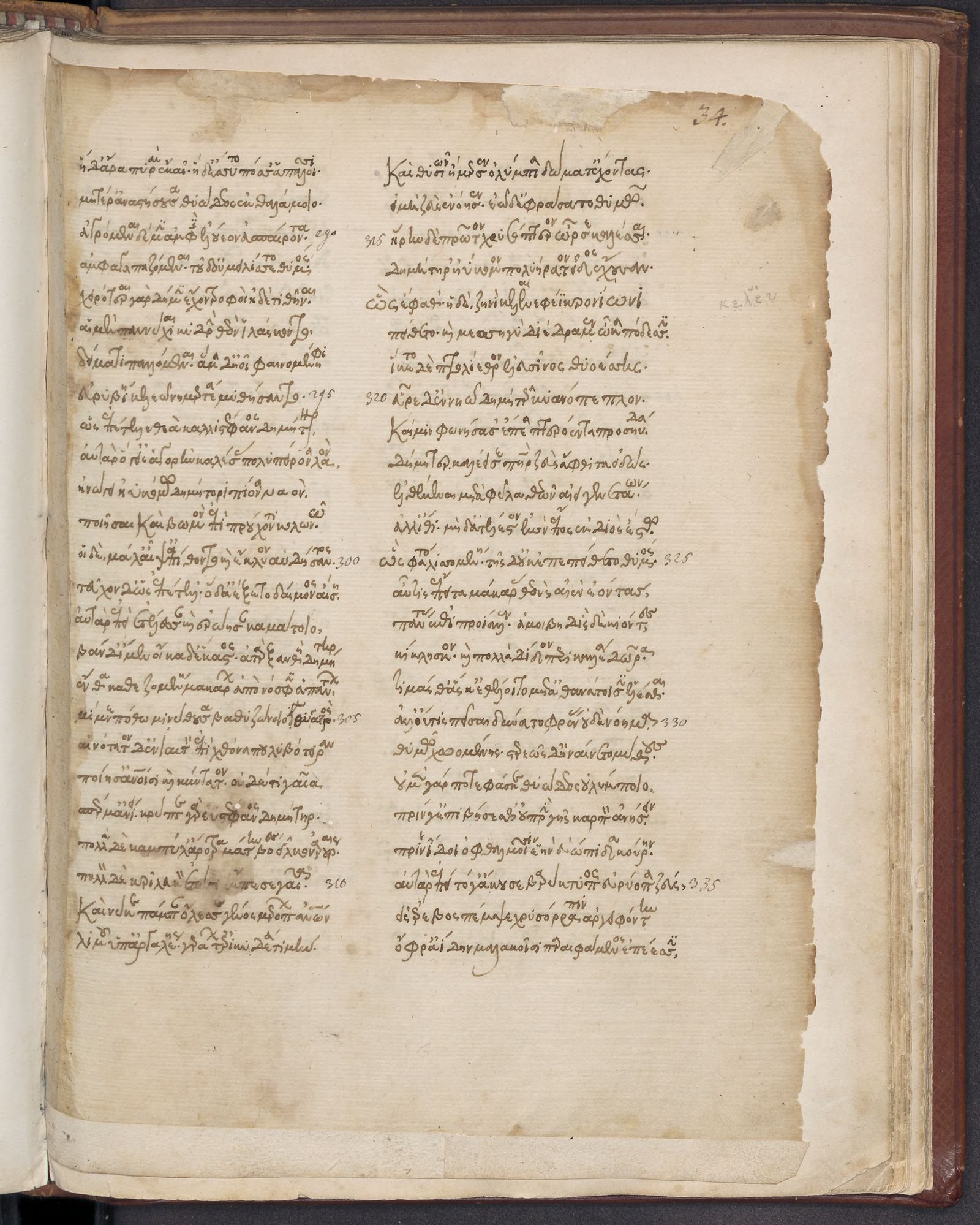
Leiden BPG 33 H, fol. 34r, column a (left): Hymn 2 287-311; begins ‹ἣ δʼ ἄρα πῦρ›, ends ‹γεράων τʼ ἐρικυδέα τιμὴν›. Checked on the image: the first and last verses of the column were read and matched to the Greek. The column before ends with Hymn 2 286. The next column begins with Hymn 2 312. English blocks here: 285-289, 290-291, 292-294, 295-299, 300-304, 305-309.
287ἣ δʼ ἄρα πῦρ ἀνέκαιʼ· ἣ δʼ ἔσσυτο πόσσʼ ἁπαλοῖσι
288μητέρʼ ἀναστήσουσα θυώδεος ἐκ θαλάμοιο.
289ἀγρόμεναι δέ μιν ἀμφὶς ἐλούεον ἀσπαίροντα
290ἀμφαγαπαζόμεναι· τοῦ δʼ οὐ μειλίσσετο θυμός·
291χειρότεραι γὰρ δή μιν ἔχον τροφοὶ ἠδὲ τιθῆναι.
292αἳ μὲν παννύχιαι κυδρὴν θεὸν ἱλάσκοντο
293δείματι παλλόμεναι, ἅμα δʼ ἠοῖ φαινομένηφιν
294εὐρυβίῃ Κελεῷ νημερτέα μυθήσαντο,
295ὡς ἐπέτελλε θεά, καλλιστέφανος Δημήτηρ.
296αὐτὰρ ὅ γʼ εἰς ἀγορὴν καλέσας πολυπείρονα λαὸν
297ἤνωγʼ ἠυκόμῳ Δημήτερι πίονα νηὸν
298ποιῆσαι καὶ βωμὸν ἐπὶ προὔχοντι κολωνῷ.
299οἳ δὲ μάλʼ αἶψʼ ἐπίθοντο καὶ ἔκλυον αὐδήσαντος,
300τεῦχον δʼ, ὡς ἐπέτελλʼ. ὃ δʼ ἀέξετο δαίμονι ἶσος.
301αὐτὰρ ἐπεὶ τέλεσαν καὶ ἐρώησαν καμάτοιο,
302βάν ῥʼ ἴμεν οἴκαδʼ ἕκαστος· ἀτὰρ ξανθὴ Δημήτηρ
303ἔνθα καθεζομένη μακάρων ἀπὸ νόσφιν ἁπάντων
304μίμνε πόθῳ μινύθουσα βαθυζώνοιο θυγατρός.
305αἰνότατον δʼ ἐνιαυτὸν ἐπὶ χθόνα πουλυβότειραν
306ποίησʼ ἀνθρώποις καὶ κύντατον· οὐδέ τι γαῖα
307σπέρμʼ ἀνίει, κρύπτεν γὰρ ἐυστέφανος Δημήτηρ·
308πολλὰ δὲ καμπύλʼ ἄροτρα μάτην βόες εἷλκον ἀρούραις·
309πολλὸν δὲ κρῖ λευκὸν ἐτώσιον ἔμπεσε γαίῃ·
310καί νύ κε πάμπαν ὄλεσσε γένος μερόπων ἀνθρώπων
311λιμοῦ ὑπʼ ἀργαλέης, γεράων τʼ ἐρικυδέα τιμὴν
285one of them took up the child in her arms and laid him in her bosom, while another revived the fire, and a third rushed with soft feet to bring their mother from her fragrant chamber. And they gathered about the struggling child and washed him, 290embracing him lovingly; but he was not comforted, because nurses and handmaids much less skilful were holding him now. 292All night long they sought to appease the glorious goddess, quaking with fear. But, as soon as dawn began to show, they told powerful Celeus all things without fail, 295as the lovely-crowned goddess Demeter charged them. So Celeus called the countless people to an assembly and bade them make a goodly temple for rich-haired Demeter and an altar upon the rising hillock. And they obeyed him right speedily and harkened to his voice, 300doing as he commanded. As for the child, he grew like an immortal being. Now when they had finished building and had drawn back from their toil, they went every man to his house. But golden-haired Demeter sat there apart from all the blessed gods and stayed, wasting with yearning for her deep-bosomed daughter. 305Then she caused a most dreadful and cruel year for mankind over the all-nourishing earth: the ground would not make the seed sprout, for rich-crowned Demeter kept it hid. In the fields the oxen drew many a curved plough in vain, and much white barley was cast upon the land without avail.
Where on the image
Leiden BPG 33 H, fol. 34r, column b (right): Hymn 2 312-336; begins ‹καὶ θυσιῶν ἤμερσεν Ὀλύμπια›, ends ‹Ἀίδην μαλακοῖσι παραιφάμενος ἐπέεσσιν›. Checked on the image: the first and last verses of the column were read and matched to the Greek. The column before ends with Hymn 2 311. The next column begins with Hymn 2 337. English blocks here: 310-314, 315-319, 320-324, 325-329, 330-334.
312καὶ θυσιῶν ἤμερσεν Ὀλύμπια δώματʼ ἔχοντας,
313εἰ μὴ Ζεὺς ἐνόησεν ἑῷ τʼ ἐφράσσατο θυμῷ.
314Ἶριν δὲ πρῶτον χρυσόπτερον ὦρσε καλέσσαι
315Δήμητρʼ ἠύκομον, πολυήρατον εἶδος ἔχουσαν.
316ὣς ἔφαθʼ· ἣ δὲ Ζηνὶ κελαινεφέι Κρονίωνι
317πείθετο καὶ τὸ μεσηγὺ διέδραμεν ὦκα πόδεσσιν.
318ἵκετο δὲ πτολίεθρον Ἐλευσῖνος θυοέσσης,
319εὗρεν δʼ ἐν νηῷ Δημήτερα κυανόπεπλον
320καί μιν φωνήσασʼ ἔπεα πτερόεντα προσηύδα·
321Δήμητερ, καλέει σε πατὴρ Ζεὺς ἄφθιτα εἰδὼς
322ἐλθέμεναι μετὰ φῦλα θεῶν αἰειγενετάων.
323ἄλλʼ ἴθι, μηδʼ ἀτέλεστον ἐμὸν ἔπος ἐκ Διὸς ἔστω.
324ὣς φάτο λισσομένη· τῇ δʼ οὐκ ἐπεπείθετο θυμός.
325αὖτις ἔπειτα πατὴρ μάκαρας θεοὺς αἰὲν ἐόντας
326πάντας ἐπιπροΐαλλεν· ἀμοιβηδὶς δὲ κιόντες
327κίκλησκον καὶ πολλὰ δίδον περικαλλέα δῶρα
328τιμάς θʼ, †ἅς κʼ ἐθέλοιτο† μετʼ ἀθανάτοισιν ἑλέσθαι.
329ἀλλʼ οὔτις πεῖσαι δύνατο φρένας οὐδὲ νόημα
330θυμῷ χωομένης· στερεῶς δʼ ἠναίνετο μύθους.
331οὐ μὲν γάρ ποτʼ ἔφασκε θυώδεος Οὐλύμποιο
332πρίν γʼ ἐπιβήσεσθαι, οὐ πρὶν γῆς καρπὸν ἀνήσειν,
333πρὶν ἴδοι ὀφθαλμοῖσιν ἑὴν εὐώπιδα κούρην.
334αὐτὰρ ἐπεὶ τό γʼ ἄκουσε βαρύκτυπος εὐρύοπα Ζεύς,
335εἰς Ἔρεβος πέμψε χρυσόρραπιν Ἀργειφόντην,
336ὄφρʼ Ἀίδην μαλακοῖσι παραιφάμενος ἐπέεσσιν
310So she would have destroyed the whole race of man with cruel famine and have robbed them who dwell on Olympus of their glorious right of gifts and sacrifices, had not Zeus perceived and marked this in his heart. First he sent golden-winged Iris to call 315rich-haired Demeter, lovely in form. So he commanded. And she obeyed the dark-clouded Son of Cronos, and sped with swift feet across the space between. She came to the stronghold of fragrant Eleusis, and there finding dark-cloaked Demeter in her temple, 320spake to her and uttered winged words: “Demeter, father Zeus, whose wisdom is everlasting, calls you to come join the tribes of the eternal gods: come therefore, and let not the message I bring from Zeus pass unobeyed.” Thus said Iris imploring her. But Demeter's heart was not moved. 325Then again the father sent forth all the blessed and eternal gods besides: and they came, one after the other, and kept calling her and offering many very beautiful gifts and whatever rights she might be pleased to choose among the deathless gods. Yet no one was able to persuade her mind and will, 330so wroth was she in her heart; but she stubbornly rejected all their words: for she vowed that she would never set foot on fragrant Olympus nor let fruit spring out of the ground, until she beheld with her eyes her own fair-faced daughter. Now when all-seeing Zeus the loud-thunderer heard this,
Where on the image
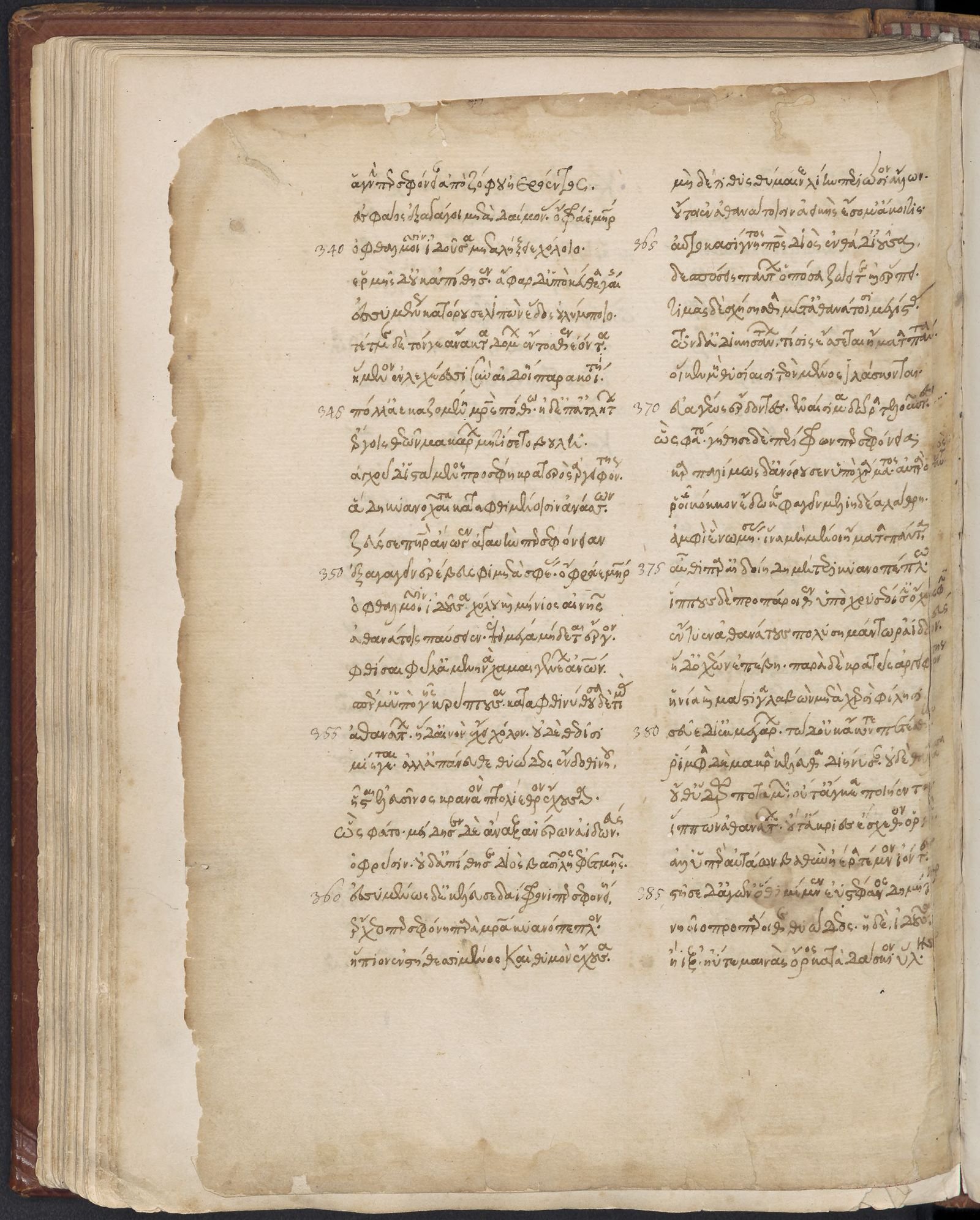
Leiden BPG 33 H, fol. 34v, column a (left): Hymn 2 337-361; begins ‹ἁγνὴν Περσεφόνειαν ὑπὸ ζόφου›, ends ‹μένος καὶ θυμὸν ἔχουσα,›. Checked on the image: the first and last verses of the column were read and matched to the Greek. The column before ends with Hymn 2 336. The next column begins with Hymn 2 362. English blocks here: 335-339, 340-344, 345-346, 347-349, 350-354, 355-359.
337ἁγνὴν Περσεφόνειαν ὑπὸ ζόφου ἠερόεντος
338ἐς φάος ἐξαγάγοι μετὰ δαίμονας, ὄφρα ἑ μήτηρ
339ὀφθαλμοῖσιν ἰδοῦσα μεταλήξειε χόλοιο.
340Ἑρμῆς δʼ οὐκ ἀπίθησεν, ἄφαρ δʼ ὑπὸ κεύθεα γαίης
341ἐσσυμένως κατόρουσε λιπὼν ἕδος Οὐλύμποιο.
342τέτμε δὲ τόν γε ἄνακτα δόμων ἔντοσθεν ἐόντα,
343ἥμενον ἐν λεχέεσσι σὺν αἰδοίῃ παρακοίτι,
344πόλλʼ ἀεκαζομένῃ μητρὸς πόθῳ· ἣ δʼ ἀποτηλοῦ
345ἔργοις θεῶν μακάρων [δεινὴν] μητίσετο βουλήν.
346ἀγχοῦ δʼ ἱστάμενος προσέφη κρατὺς Ἀργειφόντης·
347Ἅιδη κυανοχαῖτα, καταφθιμένοισιν ἀνάσσων,
348Ζεύς με πατὴρ ἤνωγεν ἀγαυὴν Περσεφόνειαν
349ἐξαγαγεῖν Ἐρέβευσφι μετὰ σφέας, ὄφρα ἑ μήτηρ
350ὀφθαλμοῖσιν ἰδοῦσα χόλου καὶ μήνιος αἰνῆς
351ἀθανάτοις λήξειεν· ἐπεὶ μέγα μήδεται ἔργον,
352φθῖσαι φῦλʼ ἀμενηνὰ χαμαιγενέων ἀνθρώπων,
353σπέρμʼ ὑπὸ γῆς κρύπτουσα, καταφθινύθουσα δὲ τιμὰς
354ἀθανάτων· ἣ δʼ αἰνὸν ἔχει χόλον, οὐδὲ θεοῖσι
355μίσγεται, ἀλλʼ ἀπάνευθε θυώδεος ἔνδοθι νηοῦ
356ἧσται Ἐλευσῖνος κραναὸν πτολίεθρον ἔχουσα.
357ὣς φάτο· μείδησεν δὲ ἄναξ ἐνέρων Ἀιδωνεὺς
358ὀφρύσιν, οὐδʼ ἀπίθησε Διὸς βασιλῆος ἐφετμῇς·
359ἐσσυμένως δʼ ἐκέλευσε δαΐφρονι Περσεφονείῃ·
360ἔρχεο, Περσεφόνη, παρὰ μητέρα κυανόπεπλον
361ἤπιον ἐν στήθεσσι μένος καὶ θυμὸν ἔχουσα,
335he sent the Slayer of Argus whose wand is of gold to Erebus, so that having won over Hades with soft words, he might lead forth chaste Persephone to the light from the misty gloom to join the gods, and that her mother might see her with her eyes and cease from her anger. 340And Hermes obeyed, and leaving the house of Olympus, straightway sprang down with speed to the hidden places of the earth. And he found the lord Hades in his house seated upon a couch, and his shy mate with him, much reluctant, because she yearned for her mother. But she was afar off, 345brooding on her fell design because of the deeds of the blessed gods. And the strong Slayer of Argus drew near and said: 347“Dark-haired Hades, ruler over the departed, father Zeus bids me bring noble Persephone forth from Erebus unto the gods, 350that her mother may see her with her eyes and cease from her dread anger with the immortals; for now she plans an awful deed, to destroy the weakly tribes of earth-born men by keeping seed hidden beneath the earth, and so she makes an end of the honors of the undying gods. For she keeps fearful anger and does not consort with the gods, 355but sits aloof in her fragrant temple, dwelling in the rocky hold of Eleusis.” So he said. And Aidoneus, ruler over the dead, smiled grimly and obeyed the behest of Zeus the king. For he straightway urged wise Persephone, saying:
Where on the image
Leiden BPG 33 H, fol. 34v, column b (right): Hymn 2 362-386; begins ‹μηδέ τι δυσθύμαινε λίην›, ends ‹ὄρος κάτα δάσκιον ὕλῃ.›. Checked on the image: the first and last verses of the column were read and matched to the Greek. The column before ends with Hymn 2 361. The next column begins with Hymn 2 387. English blocks here: 360-364, 365-369, 370-374, 375-379, 380-384.
362μηδέ τι δυσθύμαινε λίην περιώσιον ἄλλων·
363οὔ τοι ἐν ἀθανάτοισιν ἀεικὴς ἔσσομʼ ἀκοίτης,
364αὐτοκασίγνητος πατρὸς Διός· ἔνθα δʼ ἐοῦσα
365δεσπόσσεις πάντων ὁπόσα ζώει τε καὶ ἕρπει,
366τιμὰς δὲ σχήσησθα μετʼ ἀθανάτοισι μεγίστας.
367τῶν δʼ ἀδικησάντων τίσις ἔσσεται ἤματα πάντα,
368οἵ κεν μὴ θυσίῃσι τεὸν μένος ἱλάσκωνται
369εὐαγέως ἔρδοντες, ἐναίσιμα δῶρα τελοῦντες.
370ὣς φάτο· γήθησεν δὲ περίφρων Περσεφόνεια,
371καρπαλίμως δʼ ἀνόρουσʼ ὑπὸ χάρματος· αὐτὰρ ὅ γʼ αὐτὸς
372ῥοιῆς κόκκον ἔδωκε φαγεῖν μελιηδέα λάθρῃ,
373ἀμφὶ ἓ νωμήσας, ἵνα μὴ μένοι ἤματα πάντα
374αὖθι παρʼ αἰδοίῃ Δημήτερι κυανοπέπλῳ.
375ἵππους δὲ προπάροιθεν ὑπὸ χρυσέοισιν ὄχεσφιν
376ἔντυεν ἀθανάτους Πολυσημάντωρ Ἀιδωνευς.
377ἣ δʼ ὀχέων ἐπέβη, πάρα δὲ κρατὺς Ἀργειφόντης
378ἡνία καὶ μάστιγα λαβὼν μετὰ χερσὶ φίλῃσι
379σεῦε διὲκ μεγάρων· τὼ δʼ οὐκ ἀέκοντε πετέσθην.
380ῥίμφα δὲ μακρὰ κέλευθα διήνυσαν· οὐδὲ θάλασσα
381οὔθʼ ὕδωρ ποταμῶν οὔτʼ ἄγκεα ποιήεντα
382ἵππων ἀθανάτων οὔτʼ ἄκριες ἔσχεθον ὁρμήν,
383ἀλλʼ ὑπὲρ αὐτάων βαθὺν ἠέρα τέμνον ἰόντες.
384στῆσε δʼ ἄγων, ὅθι μίμνεν ἐυστέφανος Δημήτηρ,
385νηοῖο προπάροιθε θυώδεος· ἣ δὲ ἰδοῦσα
386ἤιξʼ, ἠύτε μαινὰς ὄρος κάτα δάσκιον ὕλῃ.
360“Go now, Persephone, to your dark-robed mother, go, and feel kindly in your heart towards me: be not so exceedingly cast down; for I shall be no unfitting husband for you among the deathless gods, that am own brother to father Zeus. And while you are here, 365you shall rule all that lives and moves and shall have the greatest rights among the deathless gods: those who defraud you and do not appease your power with offerings, reverently performing rites and paying fit gifts, shall be punished for evermore.” 370When he said this, wise Persephone was filled with joy and hastily sprang up for gladness. But he on his part secretly gave her sweet pomegranate seed to eat, taking care for himself that she might not remain continually with grave, dark-robed Demeter. Then Aidoneus the Ruler of Many openly got ready his deathless 375horses beneath the golden chariot. And she mounted on the chariot, and the strong Slayer of Argus took reins and whip in his dear hands and drove forth from the hall, the horses speeding readily. 380Swiftly they traversed their long course, and neither the sea nor river-waters nor grassy glens nor mountain-peaks checked the career of the immortal horses, but they clave the deep air above them as they went. And Hermes brought them to the place where rich-crowned Demeter was staying and checked them
Where on the image
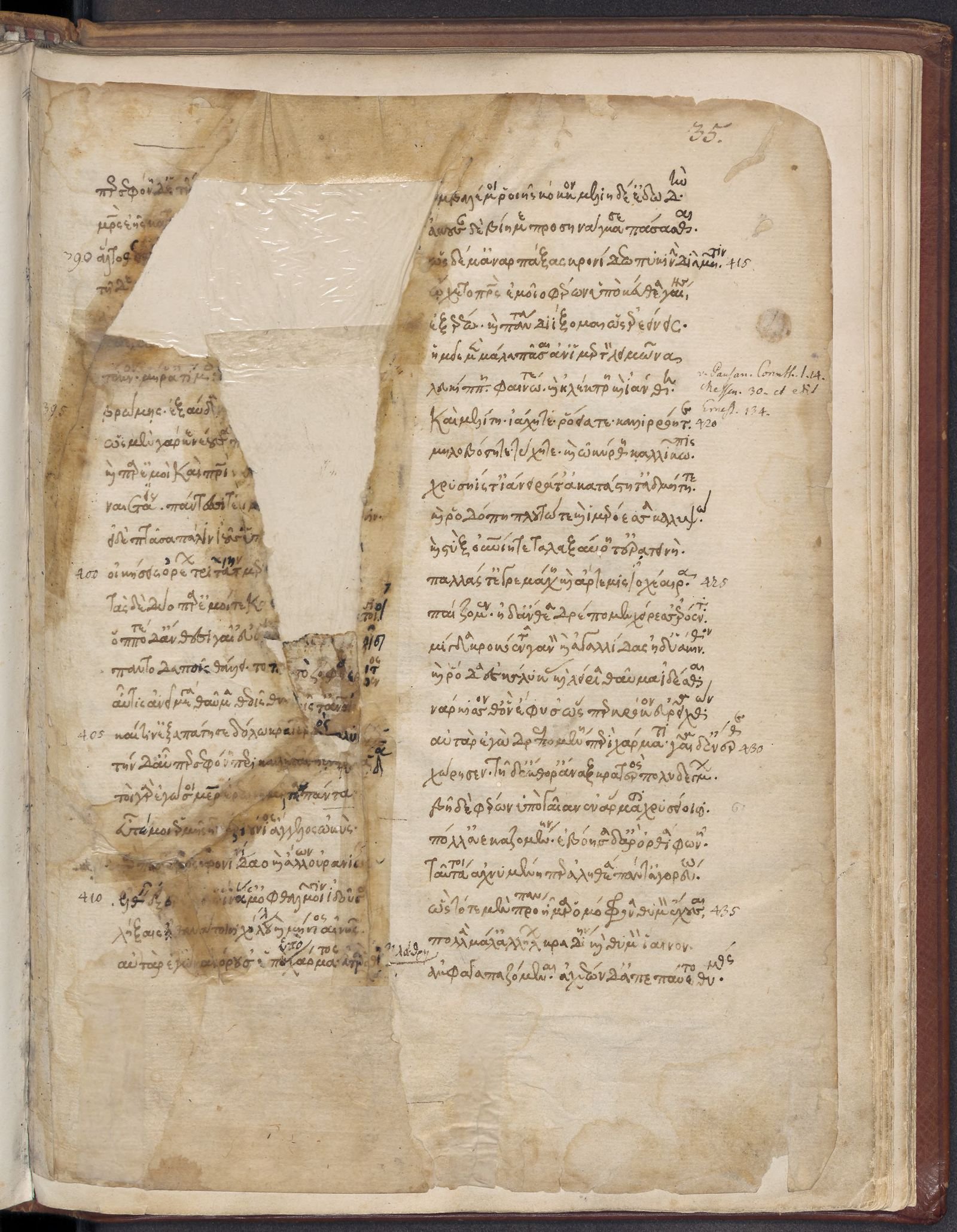
Leiden BPG 33 H, fol. 35r, column a (left): Hymn 2 387-411; begins ‹Περσεφόνη δʼ ἑτέρ[ωθεν ἐπεὶ›, ends ‹χάρματος· αὐτὰρ ὃ λάθρῃ›. Checked on the image: the first and last verses of the column were read and matched to the Greek. The column before ends with Hymn 2 386. The next column begins with Hymn 2 412. Folio 35 is badly damaged and repaired; most of this column is lost and survives only in fragments along the left margin. The words in square brackets are the editor's restorations, not on the page. English blocks here: 385-389, 390-394, 395-397, 398-399, 400-404, 405-409.
387Περσεφόνη δʼ ἑτέρ[ωθεν ἐπεὶ ἴδεν ὄμματα καλὰ]
388μητρὸς ἑῆς κατʼ [ἄρʼ ἥ γʼ ὄχεα προλιποῦσα καὶ ἵππους]
389ἆλτο θέει[ν, δειρῇ δέ οἱ ἔμπεσε ἀμφιχυθεῖσα·]
390τῇ δὲ [φίλην ἔτι παῖδα ἑῇς μετὰ χερσὶν ἐχούσῃ]
391α[ἶψα δόλον θυμός τινʼ ὀίσατο, τρέσσε δʼ ἄρʼ αἰνῶς]
392παυομ[ένη φιλότητος, ἄφαρ δʼ ἐρεείνετο μύθῳ·]
393τέκνον, μή ῥά τι μοι σ[ύ γε πάσσαο νέρθεν ἐοῦσα]
394βρώμης; ἐξαύδα, μ[ὴ κεῦθʼ, ἵνα εἴδομεν ἄμφω·]
395ὣς μὲν γάρ κεν ἐοῦσα π[αρὰ στυγεροῦ Ἀίδαο]
396καὶ παρʼ ἐμοὶ καὶ πατρὶ κελ[αινεφέϊ Κρονίωνι]
397ναιετάοις πάντεσσι τετιμ[ένη ἀθανάτοι]σιν.
398εἰ δʼ ἐπάσω, πάλιν αὖτις ἰοῦσʼ ὑπ[ὸ κεύθεσι γαίης]
399οἰκήσεις ὡρέων τρίτατον μέρ[ος εἰς ἐνιαυτόν,]
400τὰς δὲ δύω παρʼ ἐμοί τε καὶ [ἄλλοις ἀθανά]τοισιν.
401ὁππότε δʼ ἄνθεσι γαῖʼ εὐώδε[σιν] εἰαρινο[ῖσι]
402παντοδαποῖς θάλλῃ, τόθʼ ὑπὸ ζόφου ἠερόεντος
403αὖτις ἄνει μέγα θαῦμα θεοῖς θνητοῖς τʼ ἀνθρώποις.
404καὶ τίνι σʼ ἐξαπάτησε δόλῳ κρατερὸς Πολυδέγμων;
405τὴν δʼ αὖ Περσεφόνη περικαλλὴς ἀντίον ηὔδα·
406τοιγὰρ ἐγώ τοι, μῆτερ, ἐρέω νημερτέα πάντα·
407εὖτέ μοι Ἑρμῆς ἦλθʼ ἐριούνιος ἄγγελος ὠκὺς
408πὰρ πατέρος Κρονίδαο καὶ ἄλλων Οὐρανιώνων,
409ἐλθεῖν ἐξ Ἐρέβευς, ἵνα μ’ ὀφθαλμοῖσιν ἰδοῦσα
410λήξαις ἀθανάτοισι χόλου καὶ μήνιος αἰνῆς,
411αὐτίκʼ ἐγὼν ἀνόρουσʼ ὑπὸ χάρματος· αὐτὰρ ὃ λάθρῃ
385before her fragrant temple. And when Demeter saw them, she rushed forth as does a Maenad down some thick-wooded mountain, while Persephone on the other side, when she saw her mother's sweet eyes, left the chariot and horses, and leaped down to run to her, and falling upon her neck, embraced her. 390But while Demeter was still holding her dear child in her arms, her heart suddenly misgave her for some snare, so that she feared greatly and ceased fondling her daughter and asked of her at once: “My child, tell me, surely you have not tasted any food while you were below? Speak out and hide nothing, but let us both know. 395For if you have not, you shall come back from loathly Hades and live with me and your father, the dark-clouded Son of Cronos and be honored by all the deathless gods; 398but if you have tasted food, you must go back again beneath the secret places of the earth, there to dwell a third part of the seasons every year: 400yet for the two parts you shall be with me and the other deathless gods. But when the earth shall bloom with the fragrant flowers of spring in every kind, then from the realm of darkness and gloom thou shalt come up once more to be a wonder for gods and mortal men. 405Then beautiful Persephone answered her thus: “Mother, I will tell you all without error. When luck-bringing Hermes came, swift messenger from my father the Son of Cronos and the other Sons of Heaven, bidding me come back from Erebus that you might see me with your eyes
Where on the image
Leiden BPG 33 H, fol. 35r, column b (right): Hymn 2 412-436; begins ‹ἔμβαλέ μοι ῥοιῆς κόκκον,›, ends ‹ἀχέων δʼ ἀπεπαύετο θυμός.›. Checked on the image: the first and last verses of the column were read and matched to the Greek. The column before ends with Hymn 2 411. The next column begins with Hymn 2 437. English blocks here: 410-414, 415-419, 420-424, 425-429, 430-434.
412ἔμβαλέ μοι ῥοιῆς κόκκον, μελιηδέʼ ἐδωδήν,
413ἄκουσαν δὲ βίῃ με προσηνάγκασσε πάσασθαι.
414ὡς δέ μʼ ἀναρπάξας Κρονίδεω πυκινὴν διὰ μῆτιν
415ᾤχετο πατρὸς ἐμοῖο, φέρων ὑπὸ κεύθεα γαίης,
416ἐξερέω, καὶ πάντα διίξομαι, ὡς ἐρεείνεις.
417ἡμεῖς μὲν μάλα πᾶσαι ἀνʼ ἱμερτὸν λειμῶνα,
418Λευκίππη Φαινώ τε καὶ Ἠλέκτρη καὶ Ἰάνθη
419καὶ Μελίτη Ἰάχη τε Ῥόδειά τε Καλλιρόη τε
420Μηλόβοσίς τε Τύχη τε καὶ Ὠκυρόη καλυκῶπις
421Χρυσηίς τʼ Ἰάνειρά τʼ Ἀκάστη τʼ Ἀδμήτη τε
422καὶ Ῥοδόπη Πλουτώ τε καὶ ἱμερόεσσα Καλυψὼ
423καὶ Στὺξ Οὐρανίη τε Γαλαξαύρη τʼ ἐρατεινὴ
424Παλλάς τʼ ἐγρεμάχη καὶ Ἄρτεμις ἰοχέαιρα,
425παίζομεν ἠδʼ ἄνθεα δρέπομεν χείρεσσʼ ἐρόεντα,
426μίγδα κρόκον τʼ ἀγανὸν καὶ ἀγαλλίδας ἠδʼ ὑάκινθον
427καὶ ῥοδέας κάλυκας καὶ λείρια, θαῦμα ἰδέσθαι,
428νάρκισσόν θʼ, ὃν ἔφυσʼ ὥς περ κρόκον εὐρεῖα χθών.
429αὐτὰρ ἐγὼ δρεπόμην περὶ χάρματι· γαῖα δʼ ἔνερθε
430χώρησεν· τῇ δʼ ἔκθορʼ ἄναξ κρατερὸς Πολυδέγμων·
431βῆ δὲ φέρων ὑπὸ γαῖαν ἐν ἅρμασι χρυσείοισι
432πόλλʼ ἀεκαζομένην· ἐβόησα δʼ ἄρʼ ὄρθια φωνῇ.
433ταῦτά τοι ἀχνυμένη περ ἀληθέα πάντʼ ἀγορεύω.
434ὣς τότε μὲν πρόπαν ἦμαρ ὁμόφρονα θυμὸν ἔχουσαι
435πολλὰ μάλʼ ἀλλήλων κραδίην καὶ θυμὸν ἴαινον
436ἀμφαγαπαζόμεναι· ἀχέων δʼ ἀπεπαύετο θυμός.
410and so cease from your anger and fearful wrath against the gods, I sprang up at once for joy; but he secretly put in my mouth sweet food, a pomegranate seed, and forced me to taste against my will. Also I will tell how he rapt me away by the deep plan 415of my father the Son of Cronos and carried me off beneath the depths of the earth, and will relate the whole matter as you ask. All we were playing in a lovely meadow, Leucippe and Phaeno and Electra and Ianthe, Melita also and Iache with Rhodea and Callirhoe 420and Melobosis and Tyche and Ocyrhoe, fair as a flower, Chryseis, Ianeira, Acaste and Admete and Rhodope and Pluto and charming Calypso; Styx too was there and Urania and lovely Galaxaura with Pallas who rouses battles and Artemis delighting in arrows: 425we were playing and gathering sweet flowers in our hands, soft crocuses mingled with irises and hyacinths, and rose-blooms and lilies, marvellous to see, and the narcissus which the wide earth caused to grow yellow as a crocus. That I plucked in my joy; but the earth 430parted beneath, and there the strong lord, the Host of Many, sprang forth and in his golden chariot he bore me away, all unwilling, beneath the earth: then I cried with a shrill cry. All this is true, sore though it grieves me to tell the tale.” So did they then, with hearts at one,
Where on the image
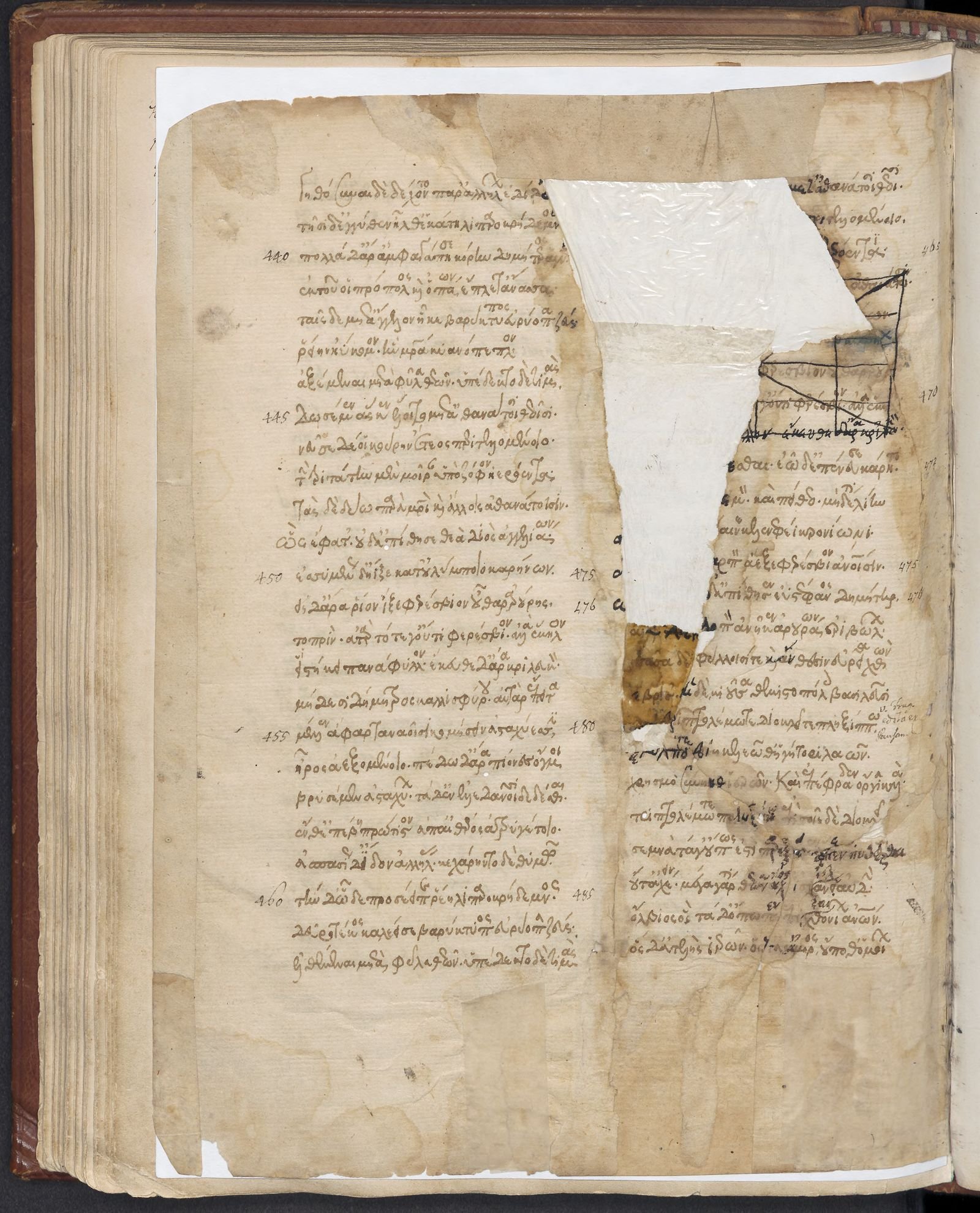
Leiden BPG 33 H, fol. 35v, column a (left): Hymn 2 437-461; begins ‹γηθοσύνας δʼ ἐδέχοντο παρʼ›, ends ‹θεῶν, ὑπέδεκτο δὲ τιμὰς›. Checked on the image: the first and last verses of the column were read and matched to the Greek. The column before ends with Hymn 2 436. The next column begins with Hymn 2 462. English blocks here: 435-439, 440-444, 445-448, 449-449, 450-454, 455-459.
437γηθοσύνας δʼ ἐδέχοντο παρʼ ἀλλήλων ἔδιδόν τε.
438τῇσιν δʼ ἐγγύθεν ἦλθʼ Ἑκάτη λιπαροκρήδεμνος·
439πολλὰ δʼ ἄρʼ ἀμφαγάπησε κόρην Δημήτερος ἁγνήν·
440ἐκ τοῦ οἱ πρόπολος καὶ ὀπάων ἔπλετʼ ἄνασσα.
441ταῖς δὲ μέτʼ ἄγγελον ἧκε βαρύκτυπος εὐρύοπα Ζεὺς
442Ῥείην ἠύκομον, Δημήτερα κυανόπεπλον
443ἀξέμεναι μετὰ φῦλα θεῶν, ὑπέδεκτο δὲ τιμὰς
444δωσέμεν, ἅς κεν ἕλοιτο μετʼ ἀθανάτοισι θεοῖσι·
445νεῦσε δέ οἱ κούρην ἔτεος περιτελλομένοιο
446τὴν τριτάτην μὲν μοῖραν ὑπὸ ζόφον ἠερόεντα,
447τὰς δὲ δύω παρὰ μητρὶ καὶ ἄλλοις ἀθανάτοισιν.
448ὣς ἔφατʼ· οὐδʼ ἀπίθησε θεὰ Διὸς ἀγγελιάων.
449ἐσσυμένως δʼ ἤιξε κατʼ Οὐλύμποιο καρήνων,
450ἐς δʼ ἄρα Ῥάριον ἷξε, φερέσβιον οὖθαρ ἀρούρης
451τὸ πρίν, ἀτὰρ τότε γʼ οὔτι φερέσβιον, ἀλλὰ ἕκηλον
452ἑστήκει πανάφυλλον· ἔκευθε δʼ ἄρα κρῖ λευκὸν
453μήδεσι Δήμητρος καλλισφύρου· αὐτὰρ ἔπειτα
454μέλλεν ἄφαρ ταναοῖσι κομήσειν ἀσταχύεσσιν
455ἦρος ἀεξομένοιο, πέδῳ δʼ ἄρα πίονες ὄγμοι
456βρισέμεν ἀσταχύων, τὰ δʼ ἐν ἐλλεδανοῖσι δεδέσθαι.
457ἔνθʼ ἐπέβη πρώτιστον ἀπʼ αἰθέρος ἀτρυγέτοιο·
458ἀσπασίως δʼ ἴδον ἀλλήλας, κεχάρηντο δὲ θυμῷ.
459τὴν δʼ ὧδε προσέειπε Ῥέη λιπαροκρήδεμνος·
460δεῦρο τέκος, καλέει σε βαρύκτυπος εὐρύοπα Ζεὺς
461ἐλθέμεναι μετὰ φῦλα θεῶν, ὑπέδεκτο δὲ τιμὰς
435greatly cheer each the other's soul and spirit with many an embrace: their hearts had relief from their griefs while each took and gave back joyousness. Then bright-coiffed Hecate came near to them, and often did she embrace the daughter of holy Demeter: 440and from that time the lady Hecate was minister and companion to Persephone. And all-seeing Zeus sent a messenger to them, rich-haired Rhea, to bring dark-cloaked Demeter to join the families of the gods: and he promised to give her what rights she should choose among the deathless gods 445and agreed that her daughter should go down for the third part of the circling year to darkness and gloom, but for the two parts should live with her mother and the other deathless gods. Thus he commanded. And the goddess did not disobey the message of Zeus; 449swiftly she rushed down from the peaks of Olympus 450and came to the plain of Rharus, rich, fertile corn-land once, but then in nowise fruitful, for it lay idle and utterly leafless, because the white grain was hidden by design of trim-ankled Demeter. But afterwards, 455as spring-time waxed, it was soon to be waving with long ears of corn, and its rich furrows to be loaded with grain upon the ground, while others would already be bound in sheaves. There first she landed from the fruitless upper air: and glad were the goddesses to see each other and cheered in heart. Then bright-coiffed Rhea said to Demeter:
Where on the image
Leiden BPG 33 H, fol. 35v, column b (right): Hymn 2 462-481; begins ‹[δωσέμεν, ἅς κʼ ἐθέλῃσθα]›, ends ‹τʼ ἄμμορος, οὔποθʼ ὁμοίων›. Checked on the image: the first and last verses of the column were read and matched to the Greek. The column before ends with Hymn 2 461. The next column begins with Hymn 2 482. The upper part of this column is torn away and repaired; the ends of the first verses survive at the right. Text in square brackets is restored by the editor. Fragments of folio 35 are also mounted on a separate sheet (photographed by the library as 'pag. t.o. f035r'). English blocks here: 460-464, 465-469, 470-474, 475-479.
462[δωσέμεν, ἅς κʼ ἐθέλῃσθα] μετʼ ἀθανάτοισι θεοῖσι.
463[νεῦσε δέ σοι κούρην ἔτεος π]εριτελλομένοιο
464[τὴν τριτάτην μὲν μοῖραν ὑπὸ ζόφον ἠ]ερόεντα,
465[τὰς δὲ δύω παρὰ σοί τε καὶ ἄλλοις] ἀθανάτοισιν.
466[ὣς ἄρʼ ἔφη τελέ]εσθαι· ἑῷ δʼ ἐπένευσε κάρητι.
467[ἀλλʼ ἴθι, τέκνον] ἐμόν, καὶ πείθεο, μηδέ τι λίην
468ἀ[ζηχὲς μεν]έαινε κελαινεφέι Κρονίωνι.
469α[ἶψα δὲ κα]ρπὸν ἄεξε φερέσβιον ἀνθρώποισιν.
470ὣς ἔφατʼ. οὐδʼ ἀπίθησεν ἐυστέφανος Δημήτηρ·
471αἶψα δὲ καρπὸν ἀνῆκεν ἀρουράων ἐριβώλων·
472πᾶσα δὲ φύλλοισίν τε καὶ ἄνθεσιν εὐρεῖα χθὼν
473ἔβρισʼ· ἣ δὲ κιοῦσα θεμιστοπόλοις βασιλεῦσι
474δεῖξεν Τριπτολέμῳ τε Διοκλεῖ τε πληξίππῳ
475Εὐμόλπου τε βίῃ Κελεῷ θʼ ἡγήτορι λαῶν
476δρησμοσύνην θʼ ἱερῶν καὶ ἐπέφραδεν ὄργια πᾶσι,
477Τριπτολέμῳ τε Πολυξείνῳ, ἐπὶ τοῖς δὲ Διοκλεῖ
478σεμνά, τά τʼ οὔπως ἔστι παρεξίμεν οὔτε πυθέσθαι
479οὔτʼ ἀχέειν· μέγα γάρ τι θεῶν σέβας ἰσχάνει αὐδήν.
480ὄλβιος, ὃς τάδʼ ὄπωπεν ἐπιχθονίων ἀνθρώπων·
481ὃς δʼ ἀτελὴς ἱερῶν ὅς τʼ ἄμμορος, οὔποθʼ ὁμοίων
460“Come, my daughter; for far-seeing Zeus the loud-thunderer calls you to join the families of the gods, and has promised to give you what rights you please among the deathless gods, and has agreed that for a third part of the circling year your daughter shall go down to darkness and gloom, 465but for the two parts shall be with you and the other deathless gods: so has he declared it shall be and has bowed his head in token. But come, my child, obey, and be not too angry unrelentingly with the dark-clouded Son of Cronos; but rather increase forthwith for men the fruit that gives them life.” 470So spake Rhea. And rich-crowned Demeter did not refuse but straightway made fruit to spring up from the rich lands, so that the whole wide earth was laden with leaves and flowers. Then she went, and to the kings who deal justice, Triptolemus and Diocles, the horse-driver, 475and to doughty Eumolpus and Celeus, leader of the people, she showed the conduct of her rites and taught them all her mysteries, to Triptolemus and Polyxeinus and Diocles also, —awful mysteries which no one may in any way transgress or pry into or utter, for deep awe of the gods checks the voice.
Where on the image
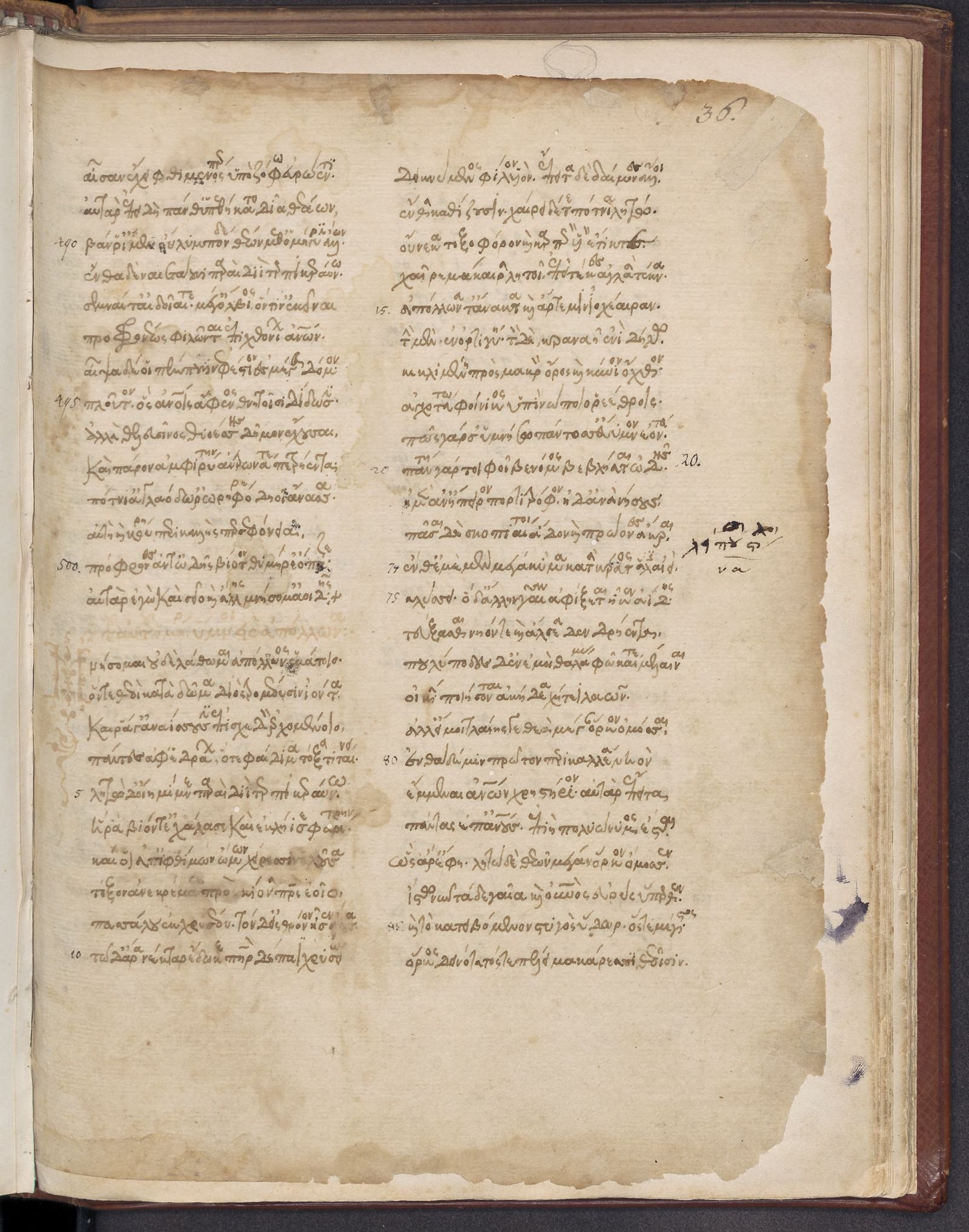
Leiden BPG 33 H, fol. 36r, column a (left): Hymn 2 482-495; Hymn 3 1-10; begins ‹αἶσαν ἔχει φθίμενός περ›, ends ‹ἔδωκε πατὴρ δέπαϊ χρυσείῳ›. Checked on the image: the first and last verses of the column were read and matched to the Greek. The column before ends with Hymn 2 481. The next column begins with Hymn 3 11. The Hymn to Demeter ends with verse 495; a red title (faded) introduces the Hymn to Apollo. English blocks here: 480-484, 485-489, 490-494, 495-495.
482αἶσαν ἔχει φθίμενός περ ὑπὸ ζόφῳ ἠερόεντι.
483αὐτὰρ ἐπειδὴ πάνθʼ ὑπεθήκατο δῖα θεάων,
484βάν ῥʼ ἴμεν Οὔλυμπόνδε θεῶν μεθʼ ὁμήγυριν ἄλλων.
485ἔνθα δὲ ναιετάουσι παραὶ Διὶ τερπικεραύνῳ
486σεμναί τʼ αἰδοῖαί τε· μέγʼ ὄλβιος, ὅν τινʼ ἐκεῖναι
487προφρονέως φίλωνται ἐπιχθονίων ἀνθρώπων·
488αἶψα δέ οἱ πέμπουσιν ἐφέστιον ἐς μέγα δῶμα
489Πλοῦτον, ὃς ἀνθρώποις ἄφενος θνητοῖσι δίδωσιν.
490ἀλλʼ ἄγʼ Ἐλευσῖνος θυοέσσης δῆμον ἔχουσα
491καὶ Πάρον ἀμφιρύτην Ἀντρῶνά τε πετρήεντα,
492πότνια, ἀγλαόδωρʼ, ὡρηφόρε, Δηοῖ ἄνασσα,
493αὐτὴ καὶ κούρη περικαλλὴς Περσεφόνεια·
494πρόφρονες ἀντʼ ᾠδῆς βίοτον θυμήρεʼ ὄπαζε.
495αὐτὰρ ἐγὼ καὶ σεῖο καὶ ἄλλης μνήσομʼ ἀοιδῆς.
480Happy is he among men upon earth who has seen these mysteries; but he who is uninitiate and who has no part in them, never has lot of like good things once he is dead, down in the darkness and gloom. But when the bright goddess had taught them all, they went to Olympus to the gathering of the other gods. 485And there they dwell beside Zeus who delights in thunder, awful and reverend goddesses. Right blessed is he among men on earth whom they freely love: soon they do send Plutus as guest to his great house, Plutus who gives wealth to mortal men. 490And now, queen of the land of sweet Eleusis and sea-girt Paros and rocky Antron, lady, giver of good gifts, bringer of seasons, queen Deo, be gracious, you and your daughter all beauteous Persephone, and for my song grant me heart-cheering substance. 495And now I will remember you and another song also.
Notes
- Greek: H. G. Evelyn-White, Hesiod, the Homeric Hymns and Homerica (Loeb Classical Library, 1914), via Perseus. Square brackets mark the editor's restorations of text lost or doubtful in the manuscript.
- Lines the Loeb numbers with letters (137a, 236a, 317a, 526a and others) are editorial supplements or variants and are left out.
- English: Evelyn-White's translation in the same volume; his footnotes are omitted.
Cite
Sources
- Source: Leiden BPG 33 H (Leiden University Libraries IIIF) + Evelyn-White Greek (Loeb 1914, Perseus) + Evelyn-White English (1914, Perseus) (holding institution)
- Critical edition: Evelyn-White, Loeb 1914, via Perseus
← previous · → next · v cycle view · l back to library