Homeric Hymns 6-18 (the shorter hymns)
Introduction
The Homeric Hymns are 33 hexameter poems to the Greek gods, composed by anonymous poets between about the 7th and the 5th century BCE and handed down under Homer's name. This entry: Homeric Hymns 6-18 (the shorter hymns). Thirteen short hymns, to Aphrodite, Dionysus (the pirates turned into dolphins), Ares, Artemis, Athena, Hera, Demeter, the Mother of the Gods, Heracles, Asclepius, the Dioscuri and Hermes, in the order in which M copies them.
This collection has Hymns 1-18 only. The manuscript shown, M, breaks off at Hymn 18, line 4 (fol. 50r; fol. 50v is blank), so the rest of Hymn 18 (lines 5-12) and Hymns 19-33 (to Pan, Hephaestus, Apollo, Poseidon, Zeus, Hestia, the Muses and Apollo, Dionysus, Artemis, Athena, Hestia, Earth, Helios, Selene and the Dioscuri) are not in it and are not given here.
The page photographs are from Leiden, Universiteitsbibliotheek, BPG 33 H (the 'Moscow' manuscript, M; paper, Greece?, first half of the 15th century; found in Moscow in 1777 by C. F. Matthaei), Homeric Hymns on fols. 31r-50r. M is the only manuscript of the Hymn to Demeter. Each section below is one column of a page (a = left, b = right); its note gives the first and last verse as read on the photograph. This entry is on fol. 48v, 49r, 49v, 50r.
Verses of the Loeb text that are not in this manuscript, and so are not shown: Hymn 18: 5-12.
The Greek is Evelyn-White's Loeb text (1914) via Perseus, not a transcription of the manuscript; where M is damaged the edition's restorations are shown in square brackets. The English is Evelyn-White's prose translation (1914), in blocks of about five lines, so a block can begin a line or two before or after a column break.
How was this verified? (Provenance)
Where on the image
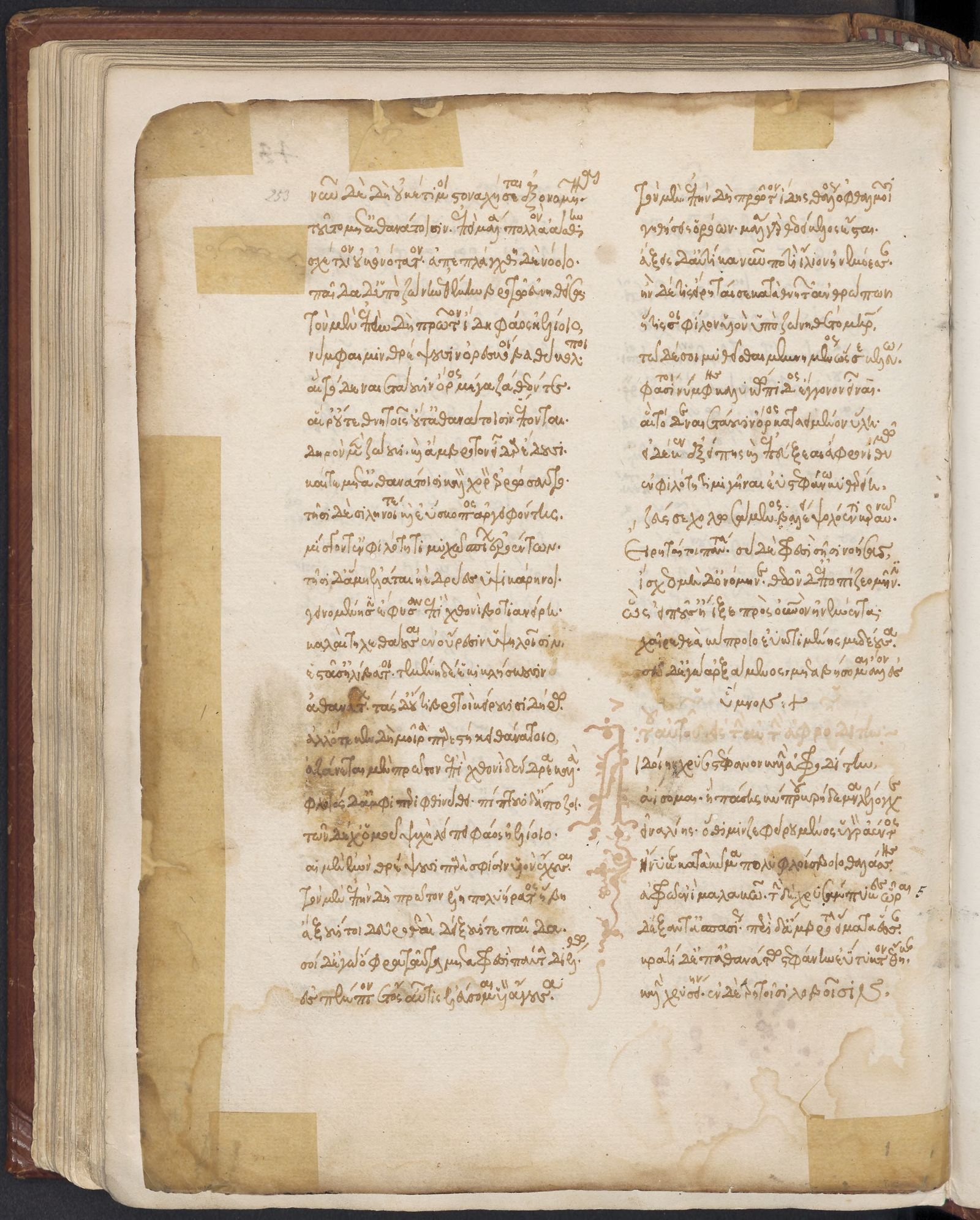
Leiden BPG 33 H, fol. 48v, column b (right): Hymn 5 278-293; Hymn 6 1-8; begins ‹τὸν μὲν ἐπὴν δὴ›, ends ‹ἐν δὲ τρητοῖσι λοβοῖσιν›. Checked on the image: the first and last verses of the column were read and matched to the Greek. The column before ends with Hymn 5 277. The next column begins with Hymn 6 9. The Hymn to Aphrodite ends with verse 293; a red title (faded) introduces the short Hymn 6. English blocks here: 1-4, 5-9.
Hymn 6
1αἰδοίην, χρυσοστέφανον, καλὴν Ἀφροδίτην
2ᾄσομαι, ἣ πάσης Κύπρου κρήδεμνα λέλογχεν
3εἰναλίης, ὅθι μιν Ζεφύρου μένος ὑγρὸν ἀέντος
4ἤνεικεν κατὰ κῦμα πολυφλοίσβοιο θαλάσσης
5ἀφρῷ ἔνι μαλακῷ· τὴν δὲ χρυσάμπυκες Ὧραι
6δέξαντ’ ἀσπασίως, περὶ δ’ ἄμβροτα εἵματα ἕσσαν·
7κρατὶ δ’ ἐπ’ ἀθανάτῳ στεφάνην εὔτυκτον ἔθηκαν
8καλήν, χρυσείην· ἐν δὲ τρητοῖσι λοβοῖσιν
Hymn 6, To Aphrodite
1I will sing of stately Aphrodite, gold-crowned and beautiful, whose dominion is the walled cities of all sea-set Cyprus. There the moist breath of the western wind wafted her over the waves of the loud-moaning sea 5in soft foam, and there the gold-filleted Hours welcomed her joyously. They clothed her with heavenly garments: on her head they put a fine, well-wrought crown of gold, and in her pierced ears they hung ornaments of orichalc and precious gold,
Where on the image
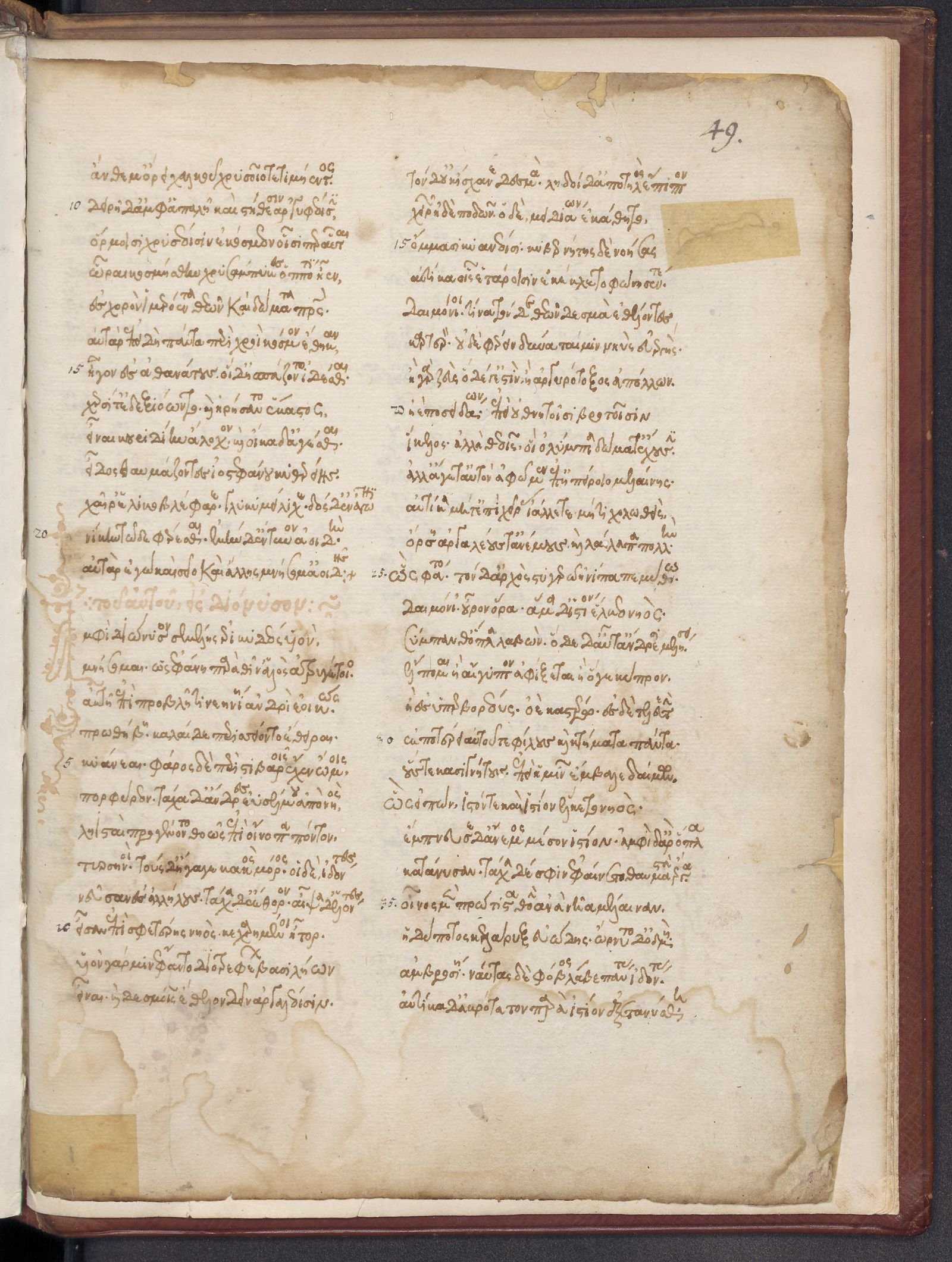
Leiden BPG 33 H, fol. 49r, column a (left): Hymn 6 9-21; Hymn 7 1-12; begins ‹ἄνθεμ’ ὀρειχάλκου χρυσοῖό τε›, ends ‹δεσμοῖς ἔθελον δεῖν ἀργαλέοισι.›. Checked on the image: the first and last verses of the column were read and matched to the Greek. The column before ends with Hymn 6 8. The next column begins with Hymn 7 13. Hymn 6 ends with verse 21; a red title (faded) introduces Hymn 7, To Dionysus. English blocks here: 10-14, 15-19, 20-21, 1-4, 5-9, 10-14.
Hymn 6
9ἄνθεμ’ ὀρειχάλκου χρυσοῖό τε τιμήεντος·
10δειρῇ δ’ ἀμφ’ ἁπαλῇ καὶ στήθεσιν ἀργυφέοισιν
11ὅρμοισι χρυσέοισιν ἐκόσμεον, οἷσί περ αὐταὶ
12Ὧραι κοσμείσθην χρυσάμπυκες, ὁππότ’ ἴοιεν
13ἐς χορὸν ἱμερόεντα θεῶν καὶ δώματα πατρός.
14αὐτὰρ ἐπειδὴ πάντα περὶ χροῒ κόσμον ἔθηκαν,
15ἦγον ἐς ἀθανάτους· οἳ δ’ ἠσπάζοντο ἰδόντες
16χερσί τ’ ἐδεξιόωντο καὶ ἠρήσαντο ἕκαστος
17εἶναι κουριδίην ἄλοχον καὶ οἴκαδ’ ἄγεσθαι,
18εἶδος θαυμάζοντες ἰοστεφάνου Κυθερείης.
19χαῖρ’ ἑλικοβλέφαρε, γλυκυμείλιχε· δὸς δ’ ἐν ἀγῶνι
20νίκην τῷδε φέρεσθαι, ἐμὴν δ’ ἔντυνον ἀοιδήν.
21αὐτὰρ ἐγὼ καὶ σεῖο καὶ ἄλλης μνήσομ’ ἀοιδῆς.
Hymn 7
1ἀμφὶ Διώνυσον, Σεμέλης ἐρικυδέος υἱόν,
2μνήσομαι, ὡς ἐφάνη παρὰ θῖν’ ἁλὸς ἀτρυγέτοιο
3ἀκτῇ ἔπι προβλῆτι νεηνίῃ ἀνδρὶ ἐοικώς,
4πρωθήβῃ· καλαὶ δὲ περισσείοντο ἔθειραι,
5κυάνεαι, φᾶρος δὲ περὶ στιβαροῖς ἔχεν ὤμοις
6πορφύρεον· τάχα δ’ ἄνδρες ἐυσσέλμου ἀπὸ νηὸς
7ληισταὶ προγένοντο θοῶς ἐπὶ οἴνοπα πόντον,
8Τυρσηνοί· τοὺς δ’ ἦγε κακὸς μόρος· οἳ δὲ ἰδόντες
9νεῦσαν ἐς ἀλλήλους, τάχα δ’ ἔκθορον. αἶψα δ’ ἑλόντες
10εἷσαν ἐπὶ σφετέρης νηὸς κεχαρημένοι ἦτορ.
11υἱὸν γάρ μιν ἔφαντο διοτρεφέων βασιλήων
12εἶναι καὶ δεσμοῖς ἔθελον δεῖν ἀργαλέοισι.
Hymn 6, To Aphrodite
10and adorned her with golden necklaces over her soft neck and snow-white breasts, jewels which the gold-filleted Hours wear themselves whenever they go to their father's house to join the lovely dances of the gods. And when they had fully decked her, 15they brought her to the gods, who welcomed her when they saw her, giving her their hands. Each one of them prayed that he might lead her home to be his wedded wife, so greatly were they amazed at the beauty of violet-crowned Cytherea. Hail, sweetly-winning, coy-eyed goddess! Grant that I may gain the victory in this contest, 20and order you my song. And now I will remember you and another song also.
Hymn 7, To Dionysus
1I will tell of Dionysus, the son of glorious Semele, how he appeared on a jutting headland by the shore of the fruitless sea, seeming like a stripling in the first flush of manhood: his rich, dark hair was waving about him, 5and on his strong shoulders he wore a purple robe. Presently there came swiftly over the sparkling sea Tyrsenian pirates on a well-decked ship —a miserable doom led them on. When they saw him they made signs to one another and sprang out quickly, and seizing him straightway 10put him on board their ship exultingly; for they thought him the son of heaven-nurtured kings. They sought to bind him with rude bonds, but the bonds would not hold him, and the withes fell far away from his hands and feet: and he sat with a smile
Where on the image
Leiden BPG 33 H, fol. 49r, column b (right): Hymn 7 13-38; begins ‹τὸν δ’ οὐκ ἴσχανε›, ends ‹ἀκρότατον παρὰ ἱστίον ἐξετανύσθη›. Checked on the image: the first and last verses of the column were read and matched to the Greek. The column before ends with Hymn 7 12. The next column begins with Hymn 7 39. English blocks here: 15-19, 20-24, 25-29, 30-31, 32-34, 35-39.
Hymn 7
13τὸν δ’ οὐκ ἴσχανε δεσμά, λύγοι δ’ ἀπὸ τηλόσε πῖπτον
14χειρῶν ἠδὲ ποδῶν· ὃ δὲ μειδιάων ἐκάθητο
15ὄμμασι κυανέοισι· κυβερνήτης δὲ νοήσας
16αὐτίκα οἷς ἑτάροισιν ἐκέκλετο φώνησέν τε·
17δαιμόνιοι, τίνα τόνδε θεὸν δεσμεύεθ’ ἑλόντες,
18καρτερόν; οὐδὲ φέρειν δύναταί μιν νηῦς εὐεργής.
19ἢ γὰρ Ζεὺς ὅδε γ’ ἐστὶν ἢ ἀργυρότοξος Ἀπόλλων
20ἠὲ Ποσειδάων· ἐπεὶ οὐ θνητοῖσι βροτοῖσιν
21εἴκελος, ἀλλὰ θεοῖς, οἳ Ὀλύμπια δώματ’ ἔχουσιν.
22ἀλλ’ ἄγετ’, αὐτὸν ἀφῶμεν ἐπ’ ἠπείροιο μελαίνης
23αὐτίκα· μηδ’ ἐπὶ χεῖρας ἰάλλετε, μή τι χολωθεὶς
24ὄρσῃ ἔπ’ ἀργαλέους τ’ ἀνέμους καὶ λαίλαπα πολλήν.
25Ὣς φάτο· τὸν δ’ ἀρχὸς στυγερῷ ἠνίπαπε μύθῳ·
26δαιμόνι’, οὖρον ὅρα, ἅμα δ’ ἱστίον ἕλκεο νηὸς
27σύμπανθ’ ὅπλα λαβών· ὅδε δ’ αὖτ’ ἄνδρεσσι μελήσει.
28ἔλπομαι, ἢ Αἴγυπτον ἀφίξεται ἢ ὅ γε Κύπρον
29ἢ ἐς Ὑπερβορέους ἢ ἑκαστέρω· ἐς δὲ τελευτὴν
30ἔκ ποτ’ ἐρεῖ αὐτοῦ τε φίλους καὶ κτήματα πάντα
31οὕς τε κασιγνήτους, ἐπεὶ ἡμῖν ἔμβαλε δαίμων.
32ὣς εἰπὼν ἱστόν τε καὶ ἱστίον ἕλκετο νηός.
33ἔμπνευσεν δ’ ἄνεμος μέσον ἱστίον· ἀμφὶ δ’ ἄρ’ ὅπλα
34καττάνυσαν· τάχα δέ σφιν ἐφαίνετο θαυματὰ ἔργα.
35οἶνος μὲν πρώτιστα θοὴν ἀνὰ νῆα μέλαιναν
36ἡδύποτος κελάρυζ’ εὐώδης, ὤρνυτο δ’ ὀδμὴ
37ἀμβροσίη· ναύτας δὲ τάφος λάβε πάντας ἰδόντας.
38αὐτίκα δ’ ἀκρότατον παρὰ ἱστίον ἐξετανύσθη
Hymn 7, To Dionysus
15in his dark eyes. Then the helmsman understood all and cried out at once to his fellows and said: “Madmen! what god is this whom you have taken and bind, strong that he is? Not even the well-built ship can carry him. Surely this is either Zeus or Apollo who has the silver bow, 20or Poseidon, for he looks not like mortal men but like the gods who dwell on Olympus. Come, then, let us set him free upon the dark shore at once: do not lay hands on him, lest he grow angry and stir up dangerous winds and heavy squalls.” 25So said he: but the master chid him with taunting words: “Madman, mark the wind and help hoist sail on the ship: catch all the sheets. As for this fellow we men will see to him: I reckon he is bound for Egypt or for Cyprus or to the Hyperboreans or further still. But in the end 30he will speak out and tell us his friends and all his wealth and his brothers, now that providence has thrown him in our way.” 32When he had said this, he had mast and sail hoisted on the ship, and the wind filled the sail and the crew hauled taut the sheets on either side. But soon strange things were seen among them. 35First of all sweet, fragrant wine ran streaming throughout all the black ship and a heavenly smell arose, so that all the seamen were seized with amazement when they saw it. And all at once a vine spread out both ways along the top of the sail with many clusters hanging down from it,
Where on the image
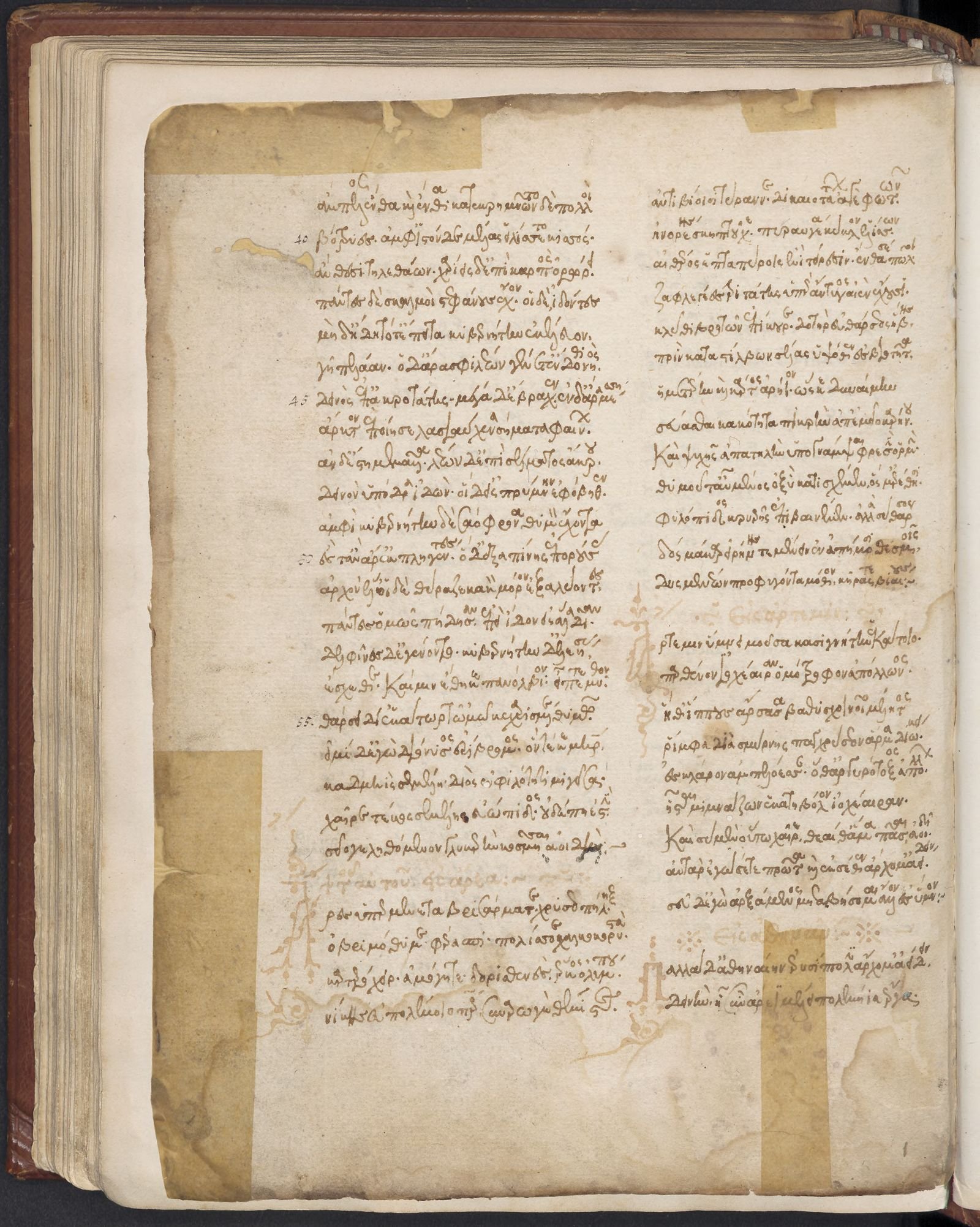
Leiden BPG 33 H, fol. 49v, column a (left): Hymn 7 39-59; Hymn 8 1-4; begins ‹ἄμπελος ἔνθα καὶ ἔνθα,›, ends ‹εὐπολέμοιο πάτερ, συναρωγὲ Θέμιστος,›. Checked on the image: the first and last verses of the column were read and matched to the Greek. The column before ends with Hymn 7 38. The next column begins with Hymn 8 5. Hymn 7 ends with verse 59; red title, then Hymn 8, To Ares. English blocks here: 40-44, 45-49, 50-54, 55-59, 1-4.
Hymn 7
39ἄμπελος ἔνθα καὶ ἔνθα, κατεκρημνῶντο δὲ πολλοὶ
40βότρυες· ἀμφ’ ἱστὸν δὲ μέλας εἱλίσσετο κισσός,
41ἄνθεσι τηλεθάων, χαρίεις δ’ ἐπὶ καρπὸς ὀρώρει·
42πάντες δὲ σκαλμοὶ στεφάνους ἔχον· οἳ δὲ ἰδόντες,
43νῆ’ ἤδη τότ’ ἔπειτα κυβερνήτην ἐκέλευον
44γῇ πελάαν· ὃ δ’ ἄρα σφι λέων γένετ’ ἔνδοθι νηὸς
45δεινὸς ἐπ’ ἀκροτάτης, μέγα δ’ ἔβραχεν, ἐν δ’ ἄρα μέσσῃ
46ἄρκτον ἐποίησεν λασιαύχενα, σήματα φαίνων·
47ἂν δ’ ἔστη μεμαυῖα· λέων δ’ ἐπὶ σέλματος ἄκρου
48δεινὸν ὑπόδρα ἰδών· οἳ δ’ ἐς πρύμνην ἐφόβηθεν,
49ἀμφὶ κυβερνήτην δὲ σαόφρονα θυμὸν ἔχοντα
50ἔσταν ἄρ’ ἐκπληγέντες· ὃ δ’ ἐξαπίνης ἐπορούσας
51ἀρχὸν ἕλ’, οἳ δὲ θύραζε κακὸν μόρον ἐξαλύοντες
52πάντες ὁμῶς πήδησαν, ἐπεὶ ἴδον, εἰς ἅλα δῖαν,
53δελφῖνες δ’ ἐγένοντο· κυβερνήτην δ’ ἐλεήσας
54ἔσχεθε καί μιν ἔθηκε πανόλβιον εἶπέ τε μῦθον·
55θάρσει, †δῖε κάτωρ†, τῷ ἐμῷ κεχαρισμένε θυμῷ·
56εἰμὶ δ’ ἐγὼ Διόνυσος ἐρίβρομος, ὃν τέκε μήτηρ
57Καδμηὶς Σεμέλη Διὸς ἐν φιλότητι μιγεῖσα.
58χαῖρε, τέκος Σεμέλης εὐώπιδος· οὐδέ πη ἔστι
59σεῖό γε ληθόμενον γλυκερὴν κοσμῆσαι ἀοιδήν.
Hymn 8
1Ἆρες ὑπερμενέτα, βρισάρματε, χρυσεοπήληξ,
2ὀβριμόθυμε, φέρασπι, πολισσόε, χαλκοκορυστά,
3καρτερόχειρ, ἀμόγητε, δορισθενές, ἕρκος Ὀλύμπου,
4Νίκης εὐπολέμοιο πάτερ, συναρωγὲ Θέμιστος,
Hymn 7, To Dionysus
40and a dark ivy-plant twined about the mast, blossoming with flowers, and with rich berries growing on it; and all the thole-pins were covered with garlands. When the pirates saw all this, then at last they bade the helmsman to put the ship to land. But the god changed into a dreadful lion there on the ship, 45in the bows, and roared loudly: amidships also he showed his wonders and created a shaggy bear which stood up ravening, while on the forepeak was the lion glaring fiercely with scowling brows. And so the sailors fled into the stern and crowded bemused about the right-minded helmsman, until suddenly the lion sprang upon the master 50and seized him; and when the sailors saw it they leapt out overboard one and all into the bright sea, escaping from a miserable fate, and were changed into dolphins. But on the helmsman Dionysus had mercy and held him back and made him altogether happy, saying to him: 55“Take courage, good ; you have found favour with my heart. I am loud-crying Dionysus whom Cadmus' daughter Semele bare of union with Zeus.” Hail, child of fair-faced Semele! He who forgets you can in no wise order sweet song.
Hymn 8, To Ares
1Ares, exceeding in strength, chariot-rider, golden-helmed, doughty in heart, shield-bearer, Saviour of cities, harnessed in bronze, strong of arm, unwearying, mighty with the spear, O defence of Olympus, father of warlike Victory, ally of Themis,
Where on the image
Leiden BPG 33 H, fol. 49v, column b (right): Hymn 8 5-17; Hymn 9 1-9; Hymn 11 1-2; begins ‹ἀντιβίοισι τύραννε, δικαιοτάτων ἀγὲ›, ends ‹Ἄρηι μέλει πολεμήια ἔργα›. Checked on the image: the first and last verses of the column were read and matched to the Greek. The column before ends with Hymn 8 4. The next column begins with Hymn 11 3. Hymn 8 ends; red titles introduce Hymn 9, To Artemis, and then the hymn to Athena (Hymn 11 in the modern numbering; in M it stands before Hymn 10). English blocks here: 5-9, 10-14, 15-17, 1-4, 5-9, 1-4.
Hymn 8
5ἀντιβίοισι τύραννε, δικαιοτάτων ἀγὲ φωτῶν,
6ἠνορέης σκηπτοῦχε, πυραυγέα κύκλον ἑλίσσων
7αἰθέρος ἑπταπόροις ἐνὶ τείρεσιν, ἔνθα σε πῶλοι
8ζαφλεγέες τριτάτης ὑπὲρ ἄντυγος αἰὲν ἔχουσι·
9κλῦθι, βροτῶν ἐπίκουρε, δοτὴρ εὐθαρσέος ἥβης,
10πρηὺ καταστίλβων σέλας ὑψόθεν ἐς βιότητα
11ἡμετέρην καὶ κάρτος ἀρήιον, ὥς κε δυναίμην
12σεύασθαι κακότητα πικρὴν ἀπʼ ἐμοῖο καρήνου,
13καὶ ψυχῆς ἀπατηλὸν ὑπογνάμψαι φρεσὶν ὁρμήν,
14θυμοῦ τ᾽ αὖ μένος ὀξὺ κατισχέμεν, ὅς μʼ ἐρέθῃσι
15φυλόπιδος κρυερῆς ἐπιβαινέμεν· ἀλλὰ σὺ θάρσος
16δός, μάκαρ, εἰρήνης τε μένειν ἐν ἀπήμοσι θεσμοῖς
17δυσμενέων προφυγόντα μόθον Κῆράς τε βιαίους.
Hymn 9
1Ἄρτεμιν ὕμνει, Μοῦσα, κασιγνήτην Ἑκάτοιο.
2παρθένον ἰοχέαιραν, ὁμότροφον Ἀπόλλωνος,
3ἥθʼ ἵππους ἄρσασα βαθυσχοίνοιο Μέλητος
4ῥίμφα διὰ Σμύρνης παγχρύσεον ἅρμα διώκει
5ἐς Κλάρον ἀμπελόεσσαν, ὅθʼ ἀργυρότοξος Ἀπόλλων
6ἧσται μιμνάζων ἑκατηβόλον ἰοχέαιραν.
7καὶ σὺ μὲν οὕτω χαῖρε θεαί θʼ ἅμα πᾶσαι ἀοιδῇ·
8αὐτὰρ ἐγώ σε πρῶτα καὶ ἐκ σέθεν ἄρχομʼ ἀείδειν,
9σεῦ δʼ ἐγὼ ἀρξάμενος μεταβήσομαι ἄλλον ἐς ὕμνον.
Hymn 11
1Παλλάδʼ Ἀθηναίην ἐρυσίπτολιν ἄρχομʼ ἀείδειν,
2δεινήν, ᾗ σὺν Ἄρηι μέλει πολεμήια ἔργα
Hymn 8, To Ares
5stern governor of the rebellious, leader of righteous men, sceptred King of manliness, who whirl your fiery sphere among the planets in their sevenfold courses through the aether wherein your blazing steeds ever bear you above the third firmament of heaven; hear me, helper of men, giver of dauntless youth! 10Shed down a kindly ray from above upon my life, and strength of war, that I may be able to drive away bitter cowardice from my head and crush down the deceitful impulses of my soul. Restrain also the keen fury of my heart which provokes me to tread 15the ways of blood-curdling strife. Rather, O blessed one, give you me boldness to abide within the harmless laws of peace, avoiding strife and hatred and the violent fiends of death.
Hymn 9, To Artemis
1Muse, sing of Artemis, sister of the Far-shooter, the virgin who delights in arrows, who was fostered with Apollo. She waters her horses from Meles deep in reeds, and swiftly drives her all-golden chariot through Smyrna 5to vine-clad Claros where Apollo, god of the silver bow, sits waiting for the far-shooting goddess who delights in arrows. And so hail to you, Artemis, in my song and to all goddesses as well. Of you first I sing and with you I begin; now that I have begun with you, I will turn to another song.
Hymn 11, To Athena
1Of Pallas Athena, guardian of the city, I begin to sing. Dread is she, and with Ares she loves deeds of war, the sack of cities and the shouting and the battle. It is she who saves the people as they go out to war and come back.
Where on the image
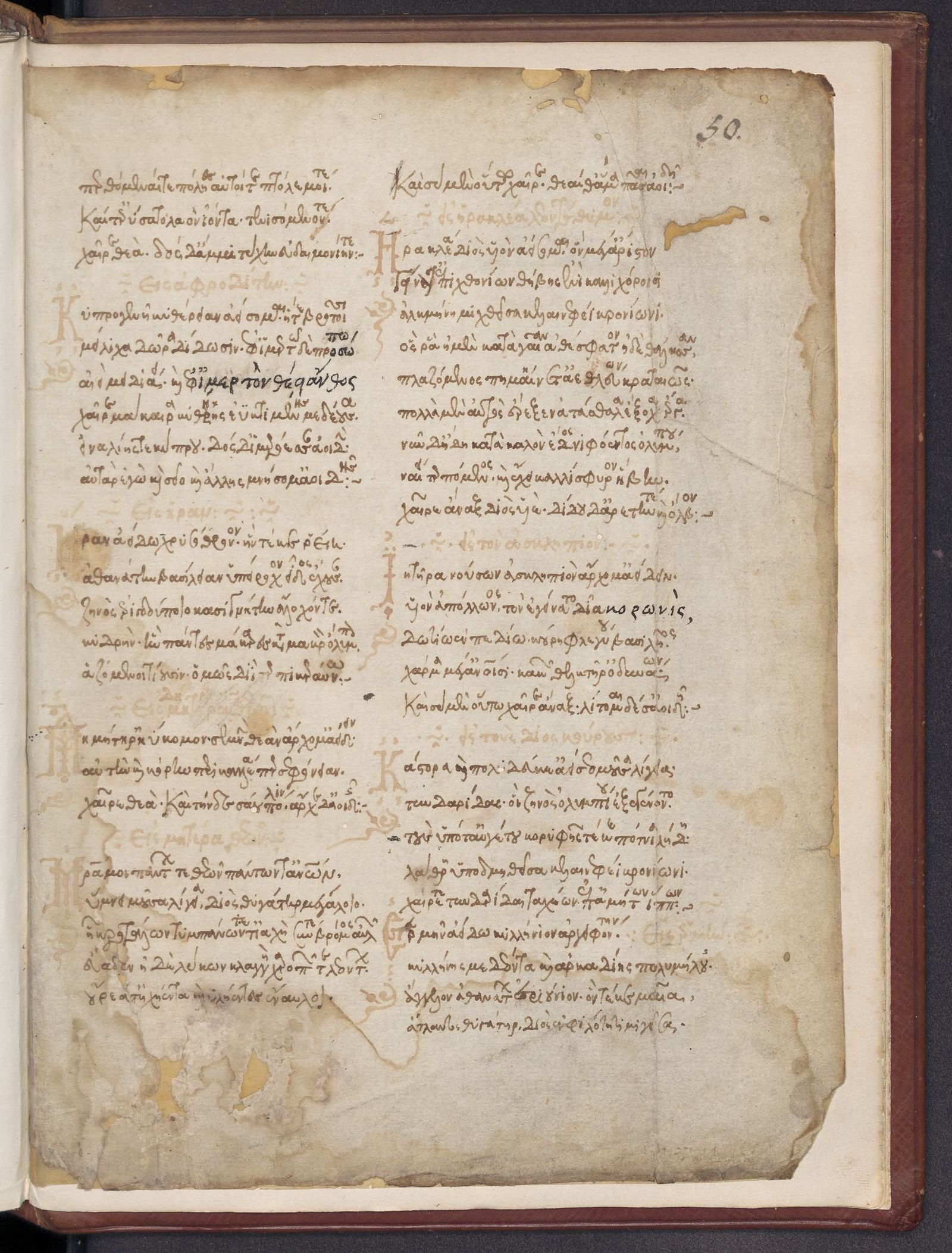
Leiden BPG 33 H, fol. 50r, column a (left): Hymn 11 3-5; Hymn 10 1-6; Hymn 12 1-5; Hymn 13 1-3; Hymn 14 1-5; begins ‹περθόμεναί τε πόληες ἀϋτή›, ends ‹ἠχήεντα καὶ ὑλήεντες ἔναυλοι.›. Checked on the image: the first and last verses of the column were read and matched to the Greek. The column before ends with Hymn 11 2. The next column begins with Hymn 14 6. Four short hymns, each under its own red title: the end of Hymn 11, then 10, 12, 13 and the beginning of 14. English blocks here: 1-4, 5-6, 5-5, 1-4, 5-5, 1-3, 1-4, 5-6.
Hymn 11
3περθόμεναί τε πόληες ἀϋτή τε πτόλεμοί τε,
4καί τʼ ἐρρύσατο λαὸν ἰόντα τε νισσόμενόν τε.
5χαῖρε, θεά, δὸς δʼ ἄμμι τύχην εὐδαιμονίην τε.
Hymn 10
1κυπρογενῆ Κυθέρειαν ἀείσομαι, ἥτε βροτοῖσι
2μείλιχα δῶρα δίδωσιν, ἐφ’ ἱμερτῷ δὲ προσώπῳ
3αἰεὶ μειδιάει καὶ ἐφ’ ἱμερτὸν θέει ἄνθος.
4χαῖρε, θεά, Σαλαμῖνος ἐυκτιμένης μεδέουσα
5εἰναλίης τε Κύπρου· δὸς δ’ ἱμερόεσσαν ἀοιδήν.
6αὐτὰρ ἐγὼ καὶ σεῖο καὶ ἄλλης μνήσομ’ ἀοιδῆς.
Hymn 12
1Ἥρην ἀείδω χρυσόθρονον, ἣν τέκε Ῥείη,
2ἀθανάτων βασίλειαν, ὑπείροχον εἶδος ἔχουσαν,
3Ζηνὸς ἐριγδούποιο κασιγνήτην ἄλοχόν τε,
4κυδρήν, ἣν πάντες μάκαρες κατὰ μακρὸν Ὄλυμπον
5ἁζόμενοι τίουσιν ὁμῶς Διὶ τερπικεραύνῳ.
Hymn 13
1Δημήτρ’ ἠύκομον, σεμνὴν θεάν, ἄρχομ’ ἀείδειν,
2αὐτὴν καὶ κούρην, περικαλλέα Περσεφόνειαν.
3χαῖρε, θεά, καὶ τήνδε σάου πόλιν· ἄρχε δ’ ἀοιδῆς.
Hymn 14
1μητέρα μοι πάντων τε θεῶν πάντων τʼ ἀνθρώπων
2ὕμνει, Μοῦσα λίγεια, Διὸς θυγάτηρ μεγάλοιο,
3ᾗ κροτάλων τυπάνων τʼ ἰαχὴ σύν τε βρόμος αὐλῶν
4εὔαδεν ἠδὲ λύκων κλαγγὴ χαροπῶν τε λεόντων
5οὔρεά τʼ ἠχήεντα καὶ ὑλήεντες ἔναυλοι.
Hymn 11, To Athena
5Hail, goddess, and give us good fortune with happiness!
Hymn 10, To Aphrodite
1Of Cytherea, born in Cyprus, I will sing. She gives kindly gifts to men: smiles are ever on her lovely face, and lovely is the brightness that plays over it. Hail, goddess, queen of well-built Salamis 5and sea-girt Cyprus; grant me a cheerful song. And now I will remember you and another song also.
Hymn 12, To Hera
1I sing of golden-throned Hera whom Rhea bare. Queen of the immortals is she, surpassing all in beauty: she is the sister and the wife of loud-thundering Zeus, —the glorious one whom all the blessed throughout high Olympus 5reverence and honor even as Zeus who delights in thunder.
Hymn 13, To Demeter
1I begin to sing of rich-haired Demeter, awful goddess, of her and of her daughter lovely Persephone. Hail, goddess! Keep this city safe, and govern my song.
Hymn 14, To the Mother of the Gods
1I Prithee, clear-voiced Muse, daughter of mighty Zeus, sing of the mother of all gods and men. She is well-pleased with the sound of rattles and of timbrels, with the voice of flutes and the outcry of wolves and bright-eyed lions, 5with echoing hills and wooded coombes. And so hail to you in my song and to all goddesses as well!
Where on the image
Leiden BPG 33 H, fol. 50r, column b (right): Hymn 14 6-6; Hymn 15 1-9; Hymn 16 1-5; Hymn 17 1-5; Hymn 18 1-4; begins ‹καὶ σὺ μὲν οὕτω›, ends ‹Διὸς ἐν φιλότητι μιγεῖσα,›. Checked on the image: the first and last verses of the column were read and matched to the Greek. The column before ends with Hymn 14 5. The last page: the end of Hymn 14, then Hymns 15, 16 and 17, and the first four verses of Hymn 18, To Hermes, where the manuscript breaks off (fol. 50v is blank). English blocks here: 1-4, 5-9, 1-4, 5-5, 1-4, 5-5, 1-4.
Hymn 14
6καὶ σὺ μὲν οὕτω χαῖρε θεαί θʼ ἅμα πᾶσαι ἀοιδῇ.
Hymn 15
1Ἡρακλέα, Διὸς υἱόν, ἀείσομαι, ὃν μέγʼ ἄριστον
2γείνατʼ ἐπιχθονίων Θήβῃς ἔνι καλλιχόροισιν
3Ἀλκμήνη μιχθεῖσα κελαινεφέι Κρονίωνι·
4ὃς πρὶν μὲν κατὰ γαῖαν ἀθέσφατον ἠδὲ θάλασσαν
5πλαζόμενος πομπῇσιν ὕπʼ Εὐρυσθῆος ἄνακτος
6πολλὰ μὲν αὐτὸς ἔρεξεν ἀτάσθαλα, πολλὰ δʼ ἀνέτλη·
7νῦν δʼ ἤδη κατὰ καλὸν ἕδος νιφόεντος Ὀλύμπου
8ναίει τερπόμενος καὶ ἔχει καλλίσφυρον Ἥβην.
9χαῖρε, ἄναξ, Διὸς υἱέ· δίδου δʼ ἀρετήν τε καὶ ὄλβον.
Hymn 16
1ἰητῆρα νόσων Ἀσκληπιὸν ἄρχομʼ ἀείδειν,
2υἱὸν Ἀπόλλωνος, τὸν ἐγείνατο δῖα Κορωνὶς
3Δωτίῳ ἐν πεδίῳ, κούρη Φλεγύου βασιλῆος,
4χάρμα μέγʼ ἀνθρώποισι, κακῶν θελκτῆρʼ ὀδυνάων.
5καὶ σὺ μὲν οὕτω χαῖρε, ἄναξ· λίτομαι δέ σʼ ἀοιδῇ.
Hymn 17
1Κάστορα καὶ Πολυδεύκε’ ἀείσεο, Μοῦσα λίγεια,
2Τυνδαρίδας, οἳ Ζηνὸς Ὀλυμπίου ἐξεγένοντο·
3τοὺς ὑπὸ Τηϋγέτου κορυφῇς τέκε πότνια Λήδη
4λάθρη ὑποδμηθεῖσα κελαινεφέι Κρονίωνι.
5χαίρετε, Τυνδαρίδαι, ταχέων ἐπιβήτορες ἵππων.
Hymn 18
1Ἑρμῆν ἀείδω Κυλλήνιον, Ἀργειφόντην,
2Κυλλήνης μεδέοντα καὶ Ἀρκαδίης πολυμήλου,
3ἄγγελον ἀθανάτων ἐριούνιον, ὃν τέκε Μαῖα,
4Ἄτλαντος θυγάτηρ, Διὸς ἐν φιλότητι μιγεῖσα,
Hymn 14, To the Mother of the Gods
(The English for these verses is given with the neighbouring column.)
Hymn 15, To Heracles the Lion-hearted
1I will sing of Heracles, the son of Zeus and much the mightiest of men on earth. Alcmena bare him in Thebes, the city of lovely dances, when the dark-clouded Son of Cronos had lain with her. Once he used to wander over unmeasured tracts of land and sea 5at the bidding of King Eurystheus, and himself did many deeds of violence and endured many; but now he lives happily in the glorious home of snowy Olympus, and has neat-ankled Hebe for his wife. Hail, lord, son of Zeus' Give me success and prosperity.
Hymn 16, To Asclepius
1I begin to sing of Asclepius, son of Apollo and healer of sicknesses. In the Dotian plain fair Coronis, daughter of King Phlegyas, bare him, a great joy to men, a soother of cruel pangs. 5And so hail to you, lord: in my song I make my prayer to thee!
Hymn 17, To the Dioscuri
1Sing, clear-voiced Muse, of Castor and Polydeuces, the Tyndaridae, who sprang from Olympian Zeus. Beneath the heights of Taygetus stately Leda bare them, when the dark-clouded Son of Cronos had privily bent her to his will. 5Hail, children of Tyndareus, riders upon swift horses!
Hymn 18, To Hermes
1I sing of Cyllenian Hermes, the Slayer of Argus, lord of Cyllene and Arcadia rich in flocks, luck-bringing messenger of the deathless gods. He was born of Maia, the daughter of Atlas, when she had mated with Zeus,—
Notes
- Greek: H. G. Evelyn-White, Hesiod, the Homeric Hymns and Homerica (Loeb Classical Library, 1914), via Perseus. Square brackets mark the editor's restorations of text lost or doubtful in the manuscript.
- Lines the Loeb numbers with letters (137a, 236a, 317a, 526a and others) are editorial supplements or variants and are left out.
- English: Evelyn-White's translation in the same volume; his footnotes are omitted. English blocks that fall wholly in verses missing from M are left out (Hymn 18: 5-9, 10-12).
Cite
Sources
- Source: Leiden BPG 33 H (Leiden University Libraries IIIF) + Evelyn-White Greek (Loeb 1914, Perseus) + Evelyn-White English (1914, Perseus) (holding institution)
- Critical edition: Evelyn-White, Loeb 1914, via Perseus
← previous · → next · v cycle view · l back to library