Ludlul bel nemeqi, Tablet V: thanksgiving at Esagil
Introduction
The restored man passes through the gates of Esagil in Babylon, gives thanks and offerings, and the people of Babylon praise Marduk.
Ludlul bel nemeqi ('I will praise the lord of wisdom'), the Poem of the Righteous Sufferer, is a monologue in five tablets by Shubshi-meshre-Shakkan, a nobleman who lost the favour of his king and his gods, was struck by illness, and was restored by Marduk. It was composed in the late second millennium BCE and copied widely in the first millennium. This page follows the line numbering of the electronic Babylonian Library edition.
How this page is built. Each section is a run of consecutive lines as written on one photographed clay tablet. For every line the eBL edition (https://www.ebl.lmu.de/corpus/L/2/2/SB/V) lists the manuscripts that carry it, with each tablet's own column and line numbers; the tablet chosen for each run is the photographed copy of the work with the most signs preserved there. Commentaries and texts that only quote a line are never chosen. School and excerpt tablets are used only for lines that no photographed library copy preserves as well, and only where they carry the line as text; their sections say so. The original text is eBL's transliteration of that tablet's signs (not a modern composite text): square brackets mark broken signs, x an illegible sign, # a damaged sign, ? an uncertain reading, and words in {braces} are determinatives; the notes give a key to every sign used on this page, and eBL's layout codes are written out in words (for example '(line break)' or '(blank space)'). Superscript numbers are the line numbers of the eBL edition, used in both the Akkadian and the English. The English is B. R. Foster's translation in the eBL edition (CC BY-NC-SA 4.0), one line of English per line of the text; italics mark uncertain renderings, as in the source. Where the tablet is broken, the English still translates the whole line of eBL's composite text; each section's note names the lines that are broken on its tablet.
Finding a line on the photograph. Each section names the tablet, the face and column, and the tablet's own line numbers (a prime, as in 5', counts from the first preserved line of a broken column). On a tablet with six columns the obverse carries columns i-iii from left to right; the reverse, turned over from bottom to top, carries columns iv-vi from right to left. The photographs often show the obverse above the reverse with the edges around them; a fragment preserves only part of this layout.
This page shows 71 of the 120 lines of the eBL edition (59%), from 2 tablets in the British Museum: BM.34650, BM.32208.
Lines not shown. 49 of the 120 lines of the eBL edition are not shown, because no photographed copy of the work used here carries them: 23 (no photograph in eBL: BM.77253; commentary: K.3291); 24 (no photograph in eBL: BM.77253); 54 (no photograph in eBL: VAT.9303 (Vorderasiatisches Museum, Berlin), VAT.9442 (Vorderasiatisches Museum, Berlin), BM.74201, Ashm-1924.1795 (Ashmolean Museum)); 55 (no photograph in eBL: VAT.9303 (Vorderasiatisches Museum, Berlin), VAT.9442 (Vorderasiatisches Museum, Berlin), BM.74201); 56 (no photograph in eBL: VAT.9303 (Vorderasiatisches Museum, Berlin), VAT.9442 (Vorderasiatisches Museum, Berlin)); 57-60 (no photograph in eBL: VAT.9303 (Vorderasiatisches Museum, Berlin), VAT.9442 (Vorderasiatisches Museum, Berlin), BM.74201); 61-63 (no photograph in eBL: VAT.9442 (Vorderasiatisches Museum, Berlin)); 64 (no photograph in eBL: VAT.9303 (Vorderasiatisches Museum, Berlin), VAT.9442 (Vorderasiatisches Museum, Berlin)); 65-67 (no photograph in eBL: VAT.9303 (Vorderasiatisches Museum, Berlin)); 68-69 (no photograph in eBL: VAT.9303 (Vorderasiatisches Museum, Berlin), VAT.10538 (Vorderasiatisches Museum, Berlin)); 70 (no photograph in eBL: VAT.9303 (Vorderasiatisches Museum, Berlin)); 71-80 (no photograph in eBL: VAT.9303 (Vorderasiatisches Museum, Berlin), VAT.10538 (Vorderasiatisches Museum, Berlin), SU-1952.212 (Museum of Anatolian Civilizations, Ankara)); 81-82 (no photograph in eBL: VAT.9303 (Vorderasiatisches Museum, Berlin), VAT.10538 (Vorderasiatisches Museum, Berlin), BM.77253, SU-1952.212 (Museum of Anatolian Civilizations, Ankara)); 83-86 (no photograph in eBL: VAT.9303 (Vorderasiatisches Museum, Berlin), VAT.10538 (Vorderasiatisches Museum, Berlin), BM.77253); 87-90 (no photograph in eBL: VAT.10538 (Vorderasiatisches Museum, Berlin), BM.77253); 91-100 (no photograph in eBL: VAT.unn.1 (Vorderasiatisches Museum, Berlin), BM.77253). A line is shown only on a photographed tablet that carries it as text. Commentaries and other texts that quote a line (letters, rituals, god lists) are not used as witnesses, because they carry it with explanations or inside another text; tablets without a photograph in eBL are not used, because the line could not be shown on its tablet.
How was this verified? (Provenance)
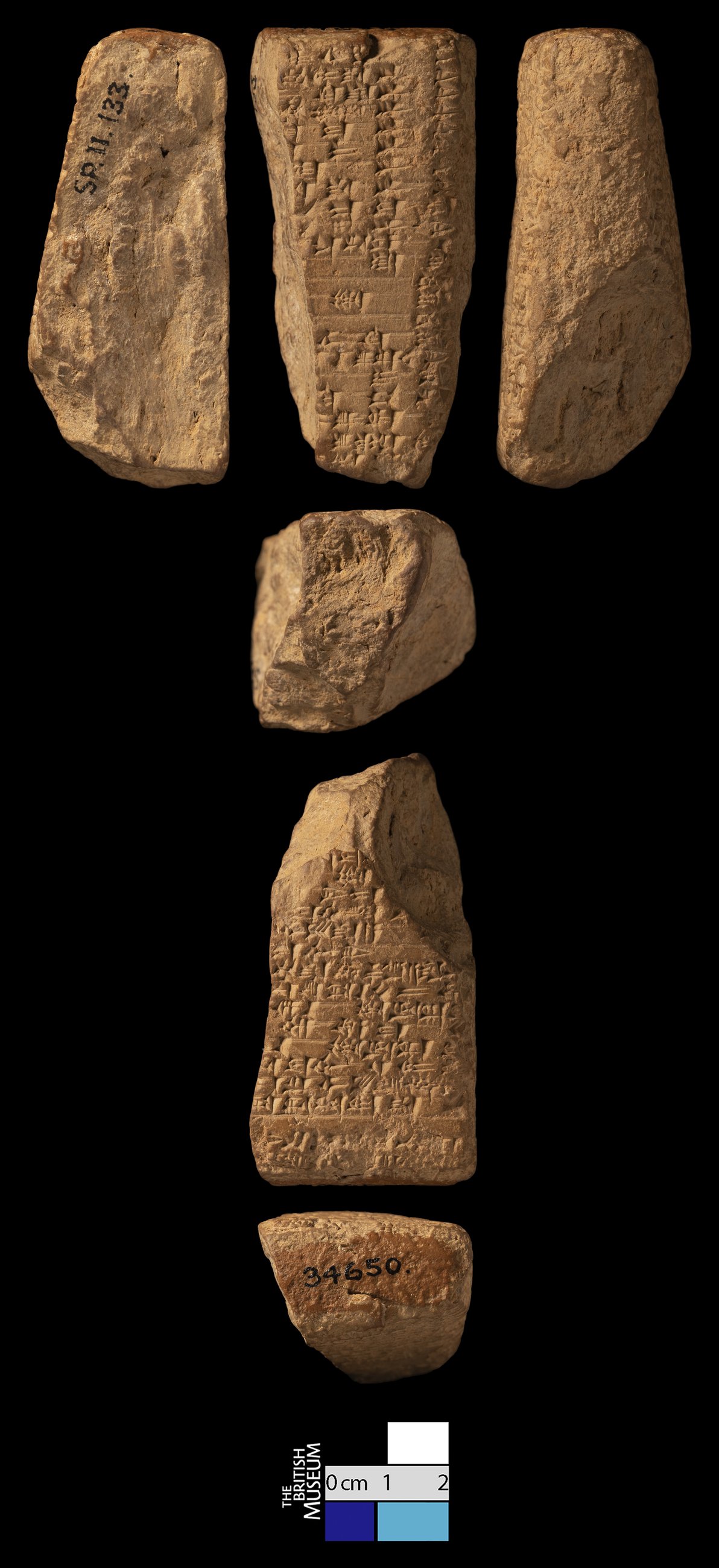
Where on the image
British Museum BM.34650: obverse, the tablet's own lines 1 to 22. eBL's corpus edition (https://www.ebl.lmu.de/corpus/L/2/2/SB/V) attributes SB V 1-22 to this manuscript at these column and line numbers. Photograph checked: obverse, reverse and edges of a narrow fragment, inks Sp II,133 and 34650. About 20 lines on the obverse and about 14 on the reverse, consistent with eBL's obverse 22 and reverse 14. On this tablet of lines 7, 12-16, 18-19, 22 only one to three signs survive and lines 1-6, 8-11, 17, 20-21 are partly broken (square brackets and x in the Akkadian). The English of these lines translates eBL's composite text, so it includes words that are not preserved on this tablet but are restored from other manuscripts or by the editors. Square brackets in the English mark eBL's restorations in its composite text; words that survive on other tablets carry no brackets even where this tablet is broken. eBL gives no English for line(s) 15, 17.
1[x x u₂-pa]-aš₂-ši-ha#-[a]n-ni
2[x x u₂-ṣa]-am-mi-da-an-ni
3[x x u₂-p]a-ṭi-ra-an-ni
4[x x u₂-b]al-li-ṭa-an-ni
5[x x x i-k]i-ma-an-ni
6[... i-s]i?-pa-an-ni#
7[x x x x x id-k]a-an-ni#
8[x x x x iš-d]u-da-an-ni
9[x x x x (x) qa-t]i iṣ-ba-at
10[x x im-h]a-ṣa-an-ni
11[x x x u₂-š]a-qa re-e-šu₂
12[x x x x x ma-hi]-ṣi-ia
13[x x x x x x {d}]AMAR.UTU#
14[x x x x x a-ki]-li-ia
15[x x x x x {d}]AMAR.UTU
16[x x x x mu-ka-aš₂]-ši-di-ia
17[x x x x x as-suk-k]a-šu₂ u₂-sah-hi-ir
18[x x x x x x x x x] i-kim
19[x x x x x x u₂-šad-d]i ṣur-ri
20[x x x x x x qu-be₂]-e# u₂-šak-lu*
21[x x x x x x x x] u₂-ma-al-li#
22[...] x li# x [x (x)]
1My lord granted me relief,
2My lord bandaged me,
3My lord released me,
4My lord revived me,
5He rescued me [from the pi]t,
6He gathered me up,
7He summoned me [from destruc]tion,
8He pulled me back from the river of death.
9In adversity he took my hand,
10He slapped me (to arouse me) with the right hand,
11With the left he raised my head.
12He smote the hand of him who would smite me,
13It was Marduk who made him drop his weapon.
14It was Marduk who muzzled the maw of the lion about to devour me,
15(no English for this line in the eBL edition)
16Marduk wrested the sling from my stalker, he deflected his slingstone,
17(no English for this line in the eBL edition)
18He wrested the shovel from the digger of my grave.
19He made the man mourning me drop his flint knife (for cutting himself),
20He put a stop to the keening of the woman who was mourning me.
21He filled with “Alas!” the mouth of the man who was gloating over my misfortune,
22He […] the mouth of the woman who was gloating over my misfortune.
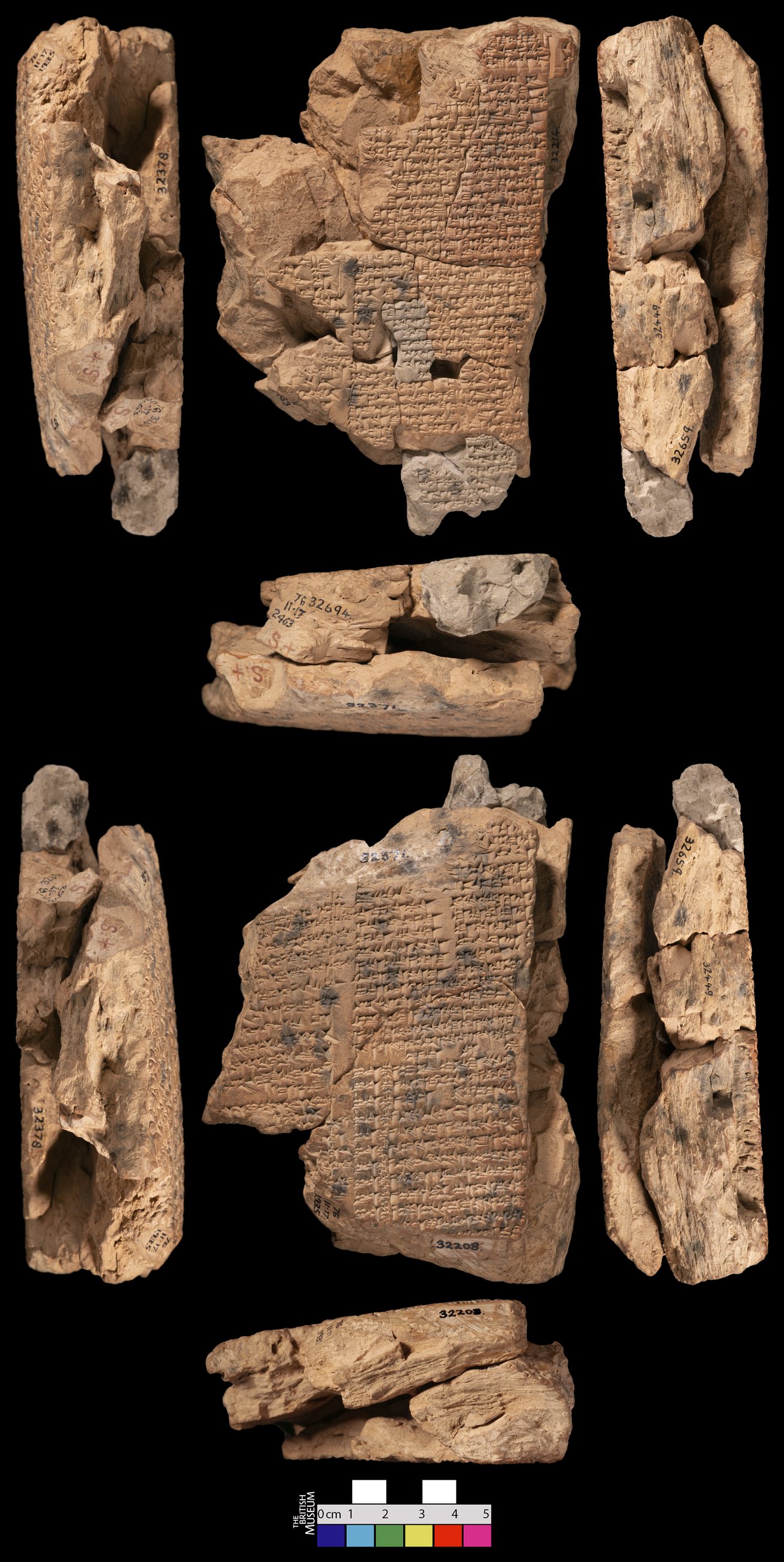
Where on the image
British Museum BM.32208: reverse, the tablet's own lines 1' to 30'. eBL's corpus edition (https://www.ebl.lmu.de/corpus/L/2/2/SB/V) attributes SB V 25-53 to this manuscript at these column and line numbers. Photograph checked: obverse, reverse and edges of a large tablet rebuilt from many joined pieces with plaster fill. Inks 32208, 32214, 32371, 32378, 32449, 32659 and 32694 are visible on the pieces, plus 76-11-17 registration numbers, matching eBL's join list, which also names four unnumbered fragments. The obverse has columns of up to about 45 lines and the reverse two columns of about 25 and 35; consistent with eBL's 112 lines in obverse columns i to iii and reverse columns i' and ii'. On this tablet of line 25 only illegible traces (x) survive and lines 26-53 are partly broken (square brackets and x in the Akkadian). The English of these lines translates eBL's composite text, so it includes words that are not preserved on this tablet but are restored from other manuscripts or by the editors. Square brackets in the English mark eBL's restorations in its composite text; words that survive on other tablets carry no brackets even where this tablet is broken.
25[...] x x [x x (x)]
26[x x x (x x x x x) u₂?-š]e*-te*#-qa-an#-[ni]
27[x x x x x (x) (...) u]-še#-ri-ba-an-n[i?]
28[x x x x x x u₂?-ka]š?-šu₂?# {d}AMAR.UTU
29ha#-di?#-x (x) u₂-kaš-šu₂ {d}zar-pa-n[i-tu₄]
30lu-man la₃ be-lu₄# | u₂#-maš-ši-ra-an-n[i]
31na-piš-tu₂ ar₂-hiš | ib-te-li-ma an-n[i]
32a-na er-kal-la | aṭ!(LA)-ṭar₂?-ra-ad an-[ni]
33e-ṭem₂-mu-tu | at-ta-lak an-n[i]
34lu-man la₃ {d}AMAR.UTU | i-zib-ba-an-n[i]
35a-na UZU a-sak-ku | am-{+ma-an}-man-n[u?]
36šal-lam-ta nim-ma | at-ta-lak-ma# [x (x)]
37i-na me-es-se-e ma-le-e u₂#-tal?#-l[i-il?]
38ri-im-ki te-diš#-tu₄# u₃# i-tab-b[u-ṭu]
39u₃ um#-ma ša₂ ina tes₂-li-tu₄ iš-mu-u₂# [x x]
40a-na la-ban ap-pi u ut-nen-ni a-na e₂-sag-i[l₂ x x]
41a-na-<ku> ša₂ iš-tu qab-ri a-tu-ru a-na ka₂-{d#}utu#-[e₃-a] (line break) (blank space) e-te-ru-ub
42i-na ka₂-he₂-gal₂ he₂-gal₂-la in-ne₂#-ša₂*#-[ra? (x)]
43i-na ka₂-{d}lamma-ra-bi {d}lamma iṭ-ṭe-h[a-an-ni]
44i-na ka₂-silim-ma šul-lu-ma-niš a[p-x x (x)]
45i-na ka₂-nam-til-la ba-la-ṭu am#-[ma-hi-ir]
46i-na ka₂-{d}utu-e₃-a it-ti TIN am-m[a-ni]
47i-na ka₂-u₆-babbar e-da-tu-u₂-a im-m[e-ra]
48i-na ka₂-nam-tag-ga-du₈-a eʾ-il-tu₂ ip-p[aṭ-ṭir]
49i-na ka₂-sikil-la A-MEŠ te-lil-tu₄ as-s[a-li-ih]
50i-na ka₂-ka-tar-ra iš-ta-lu pi-i[a]
51i-na ka₂-šer₃-du₈-u₃-da ip-paṭ-ṭar t[a-ne₂-hi]
52[i-n]a ka₂#-silim#-ma# it-ti {d}AMAR.UTU an-na-m[ir]
53[x x ka₂-hi-li]-su₃# GIR₃#+MIN# {d#}zar#-pa-ni-t[u₄ x x x]
25The street […]
26He had me […] pass through the main square of the city,
27He had me […] come in through the main gate (of the temple),
28[…] Marduk increased,
29[…] Zarpanitu increased.
30Had it not been that the lord released me,
31My life would soon have been snuffed out, Oh yes!
32I would have been sent down to the netherworld, Oh yes!
33I would have departed as a ghost, Oh yes!
34Had it not been that the lord let me abide,
35I would have been reckoned as meat for a demon,
36I would have departed as a corpse for a lion.
37I made myself pure by washing my matted hair,
38An ablution of renewal and perpetual radian[ce].
39And the mother who heard […] in prayer,
40[With] prostration and supplication […] to Esagila.
41I who came back here from the grave came in through the “Gate of [Sunrise],”
42[In the] “Gate of Prosperity” prosperity came my way,
43[In the] “Gate of the Guardian Spirit” a guardian spirit drew close [to me].
44[In the] “Gate of Well-being” I was vouchsafed well-being,
45In the “Gate of Life” I was granted life,
46In the “Gate of Sunrise” I was reckoned among the living,
47In the “Gate of Splendid Wonderment” my signs were plain to see.
48In the “Gate of Release from Guilt” I was released from my bond,
49In the “Gate of Pure Water” I was sprinkled with purifying water,
50In the “Gate of Deliberation” my mouth made inquiry,
51In the “Gate of Relief from Sighing” my sighing was relieved.
52In the “Gate of Conciliation” I appeared with Marduk,
53In the “Gate of Joy” I kissed the foot of Zarpanitu.
Where on the image
British Museum BM.32208: reverse, the tablet's own lines 1' to 16'. eBL's corpus edition (https://www.ebl.lmu.de/corpus/L/2/2/SB/V) attributes SB V 101-114 to this manuscript at these column and line numbers. Photograph checked: obverse, reverse and edges of a large tablet rebuilt from many joined pieces with plaster fill. Inks 32208, 32214, 32371, 32378, 32449, 32659 and 32694 are visible on the pieces, plus 76-11-17 registration numbers, matching eBL's join list, which also names four unnumbered fragments. The obverse has columns of up to about 45 lines and the reverse two columns of about 25 and 35; consistent with eBL's 112 lines in obverse columns i to iii and reverse columns i' and ii'. On this tablet line 102 is entirely broken, of line 101 only one to three signs survive and lines 103-114 are partly broken (square brackets and x in the Akkadian). The English of these lines translates eBL's composite text, so it includes words that are not preserved on this tablet but are restored from other manuscripts or by the editors. Square brackets in the English mark eBL's restorations in its composite text; words that survive on other tablets carry no brackets even where this tablet is broken.
101[...] x x x šu₂
102[[(x x) x x x x x x-t]u₄ i-tu-ru# URU-šu₂
103[(x x) x x x x x x U]N-MEŠ ṣal-mat SAG#+DU li?-be-el-ma
104[(x x) x x ša₂? {d?}zar?-pa?-n]i-tu₄ re-e-mu ša₂ {d}AMAR.UTU
105[(x x) x x x x e₂-sag-i]l₂? u E{ki} erim ti₃ šar-hu
106[(x x) x x x x] x-uš li-in-na-bi ana SIG₅-ti₃
107[(x x) x x x x x x l]a-le-e TIN liš-bu
108[(x x) x x x x x x] x x AN-e li-ir#-šu₂
109[(x x) x x x x x x x] x x ni-iz-mat-su
110[(x x) x x x x x x x] UGU ba-ʾ-u₂-la#-ti-šu₂
111[(x x) x x x {m}]šub-ši-meš-ra-šakkan₂{an}
112[(x x) x šu]-me#-ri u URI{ki} mu-ma-ʾ-er (line break) ma-a-tu₄
113[x ma?-ru?-u]š-tu₂ i-mu-ru li-pa-ṭir (line break) a-ra-an-šu₂
114[x x x x x x x (x x) m]a-na#-a[h-t]a-šu₂# liš#-[ta]p-ših
101[…]
102[…] the lord, his city returned
103[…] the people, may he rule the Mesopotamians.
104[… of Zarpan]itu, Marduk’s mercy
105[… Esagi]l and Babylon, […] proud
106[…], may his name be invoked for good fortune,
107[…], may he partake to the fullest of the joys of life,
108[…] may he gain the […] of heaven,
109[… may he achieve] what he desires,
110[…] over his subjects.
111[…] Shubshi-meshre-Shakkan,
112[…] of Sumer and Akkad, the ruler of the land.
113[He who has seen suffering, let] his punishment [be remitted],
114[…], may his distress be relieved,
Where on the image
British Museum BM.34650: reverse, the tablet's own lines 9' to 14'. eBL's corpus edition (https://www.ebl.lmu.de/corpus/L/2/2/SB/V) attributes SB V 115-120 to this manuscript at these column and line numbers. Photograph checked: obverse, reverse and edges of a narrow fragment, inks Sp II,133 and 34650. About 20 lines on the obverse and about 14 on the reverse, consistent with eBL's obverse 22 and reverse 14. On this tablet lines 115-120 are partly broken (square brackets and x in the Akkadian). The English of these lines translates eBL's composite text, so it includes words that are not preserved on this tablet but are restored from other manuscripts or by the editors. Square brackets in the English mark eBL's restorations in its composite text; words that survive on other tablets carry no brackets even where this tablet is broken.
115[x x x x x x x (x x) {d}]15-šu₂ li-kab-bit-su
116[x x x x x x x x x x x (x x)]-im šul-ma-niš
117[x x x x x x x x (x x) LUGA]L-šu₂ li-kab-bit-su
118[x x x x x x x x x x (x x) l]i-ba-ʾi u₄-mi-šam
119[(x x) ... x x x x (x) š]a₂* {m}šub-ši-meš-ra-a-{d}šakkan₂# id?#-[lu?-la?] (line break) [x x x x]
120[... t]a-nit-ta-ka ṭa-bat
115[May his god …him], may his goddess honor him,
116[…] the people […] in well-being,
117[…], may his king honor him,
118[Good health] and joy of heart may he look out for every day.
119[The people …] through the song of Shubshi-meshre-Shakkan, they praised [him],
120[O Marduk, pr]aising you is sweet.
Notes
- Akkadian: eBL transliteration of the signs on the photographed tablet (manuscript-level ATF), not a composite text.
- English: B. R. Foster's translation in the eBL edition; it renders eBL's composite text, including restorations from other tablets.
- Line numbers: eBL edition. Each section also gives the tablet's own column and line numbers.
- Signs in the Akkadian: [ ] broken away; x illegible sign; # damaged sign; ? uncertain reading; ! sign corrected by the editor; * collated sign; ... broken signs of unknown number; ( ) signs perhaps broken away; { } determinative; {+ } phonetic gloss; < > sign omitted by the scribe, supplied by the editor; | division between the parts of a line written in separate columns on the tablet; (line break) the line runs on to the next line of the tablet; (blank space) a space left by the scribe.
Cite
Sources
- Source: British Museum tablet photographs + eBL manuscript transliterations (eBL corpus edition L II.2, Righteous Sufferer (Ludlul bel nemeqi) (ed. A. Hätinen), SB V) + English of the eBL edition (B. R. Foster (eBL edition)) (holding institution)
- Critical edition: electronic Babylonian Library, Righteous Sufferer (Ludlul bel nemeqi) (ed. A. Hätinen), manuscript transliterations
← previous · → next · v cycle view · l back to library